When i was 12, my parents told me to “man up” and find my own ride home, then left me at a gas station 80 miles away, i slept behind a dumpster that night and never spoke to them again until last week, when i got a wedding invite from my brother with a note from them inside.
My name is Isaac, and I’m thirty years old now. But some memories don’t fade. They ferment, growing sharper with time. I don’t talk about my childhood much, not because I’ve forgotten, but because saying it out loud makes everything feel real again. Suddenly, I’m twelve years old, standing in the middle of a gas station parking lot, clutching a candy bar I don’t have the money to pay for and watching my parents’ taillights disappear into the night.
It happened in August, right before school started. We’d gone on one of those awkward family bonding trips my mother always insisted we needed. Except bonding in our house meant everyone pretending my father’s rants were wisdom and my older brother Caleb’s every mediocre thought was a gift to mankind. I was the quiet one, the sensitive one, too soft-spoken and always somehow in the way. On that particular day, I’d spilled a Sprite in the back seat. Caleb, who was sixteen and already a master at deflecting blame, smirked and told our parents I’d done it on purpose.
Dad pulled over at the next gas station off the highway, his eyes blazing. “You’re not a baby anymore,” he barked. “You want to act grown? You can figure your own way home.”
At first, I laughed. I thought it was another one of his twisted jokes. But then the back door of the SUV slammed shut, and they simply drove away. I ran after them for a few seconds, calling their names, but my voice cracked and disappeared beneath the roar of engines and tires. A clerk poked his head out of the gas station door, a cigarette dangling from his lips, and gave me a look that made me feel like just another stray someone had dumped along the highway.
That night, I slept behind the station’s dumpster, curled into myself, my heart pounding every time a car passed. I remember counting the hours and thinking about the distance between that parking lot and home. Eighty miles. I had no money, no phone, and not a single person I could call. When I asked the clerk for help, he refused. “Ain’t a daycare, kid,” he muttered.
I didn’t cry. I think a part of me froze that night, the part that had believed family meant something unshakable, something that couldn’t simply disappear because you’d made a mistake.
Eventually, the next morning, I found a pay phone and called a teacher I trusted, Mrs. Valencia. She came to pick me up and drove me back to town. I told her my parents must have forgotten me. She didn’t believe it. I could tell by the way her grip tightened around the steering wheel, but she didn’t press me for the truth. She just made sure I had food, dropped me off at home, and told me I could always call her.
When I walked through our front door, no one looked surprised. No one asked where I’d been or whether I was hurt. No one apologized.
Mom glanced up from her laptop and said, “Took you long enough.”
Caleb was sprawled on the couch playing video games. Without even looking away from the screen, he muttered, “Should’ve walked faster.”
Dad never acknowledged what had happened. The following morning, he simply nodded at me over breakfast, as though everything was perfectly normal.
That was the day I stopped trying to belong.
I finished high school like a ghost moving through the hallways. I ate lunch alone, studied in silence, and learned to make myself as invisible as possible. As soon as I turned eighteen, I got out. I worked three jobs, put myself through community college, and eventually transferred to a university across the country without telling anyone. I changed my phone number, never left a forwarding address, and, for the first time in my life, began breathing on my own.
I’ve spent the last decade building a life my family knows absolutely nothing about. I became a software engineer and moved to a city where no one ever said the words “man up” as if they were some magical cure for trauma. I made friends who consider me grounded and loyal. I even adopted a rescue dog named Max, a skittish little mutt who flinches whenever someone raises their voice. Max and I understand each other in ways most people probably never will.
I never thought I’d hear from my family again.
But last week, a letter showed up at my apartment.
There was no return address, but I recognized the handwriting immediately. Those dramatic, looping letters could only belong to my mother. I opened the envelope slowly, half expecting a legal threat or another passive-aggressive lecture about how I’d abandoned the family. Instead, I found something I never could have predicted.
It was a thick envelope containing a wedding invitation.
Caleb was getting married.
The invitation was engraved in gold lettering, elaborate and traditional, the kind of expensive stationery that practically screamed rented elegance and carefully manufactured smiles. Tucked inside was a folded sheet of notebook paper covered in handwriting I hadn’t seen in years.
“Isaac, we know things have been distant between us, but Caleb is getting married, and it would mean a lot to the family if you could attend. He asked that we reach out to you personally. We hope you’ll come. We’d love to reconnect. Mom and Dad.”
I read those words again and again.
They were reaching out as though nothing had happened. As though they hadn’t abandoned their twelve-year-old son eighty miles from home and left him to sleep behind a gas station dumpster. As though they hadn’t spent the years afterward refusing to acknowledge what they’d done. As though Caleb hadn’t always been the golden boy whose shadow I was never allowed to escape.
I sat there staring at the note for a long time, my fingers tightening around the paper until its edges crinkled. For a moment, I nearly threw the whole thing into the trash.
Almost.
But something made me stop.
I turned the invitation over and studied the details. A fancy venue. An outdoor ceremony. Formal attire. There was even a QR code to RSVP, as though I were just another distant relative receiving a routine invitation. As though these people hadn’t taught me exactly what it meant to be disposable.
My eyes drifted back to the handwritten note.
It would mean a lot to the family.
Interesting.
Because I wasn’t the same little boy they’d dumped beside the highway anymore. And if they wanted me back in their picture, I had a few ideas about how that picture ought to be framed.
Let’s just say I didn’t RSVP right away.
Instead, I began planning quietly and carefully, the way I’d learned to do everything important in my life. Some debts don’t get paid in words. They get paid in presence. And sometimes showing up is the loudest thing a person can do.
The moment I noticed Caleb’s fiancée’s name, Emily R. Kensington, printed in embossed cursive on the invitation, I knew exactly what sort of wedding this was going to be. Upper-middle-class perfection. Lawn games, a live quartet, personalized cocktail napkins bearing the couple’s initials. Every little detail carefully selected to advertise elegance and good breeding.
The Kensingtons were practically local royalty back in my hometown. Old money, old gossip, and old grudges. I vaguely remembered Emily from school. Even at fifteen, she dressed as though she were heading to church or a job interview. She was the kind of girl who’d never needed to fight for attention because it had always been handed to her like an inheritance.
And Caleb had landed her.
Of course he had.
Caleb, the charming oldest son with the quarterback smile and parents who orbited around him as though he were the center of the universe. My parents probably wore their approval of the match like expensive jewelry.
I looked Emily up online that same night. She was everything I’d expected: a dental school graduate with a meticulously curated Instagram account filled with inspirational quotes, cappuccino art, and engagement photographs beneath a tree that looked as though it had been selected from a wedding magazine.
Buried among the tags on one of her posts was a link to their wedding website.
I clicked it.
“Welcome to Caleb and Emily’s Big Day.”
A countdown showed three weeks remaining.
The wedding would take place at Stone Brook Vineyard and Lodge. Their registry included Bloomingdale’s, Crate & Barrel, and Amazon. The dress code was black-tie optional. Guests were instructed to arrive thirty minutes before the ceremony, with shuttle transportation available from the guest hotel.
And at the bottom of the page was a cheerful message: “We are so excited to celebrate with friends and family.”
Family.
Right.
There was even a section titled “Our Love Story.” Caleb had apparently written it himself, or at least someone had written it from his perspective. Every sentence was so polished it could have come straight from a public relations firm.
“I was always the kind of guy who believed in fate. But nothing prepared me for Emily. Her grace, her kindness, the way she looked at me and saw more than just the guy I used to be.”
More than the guy I used to be.
I read that line three times.
Then I remembered exactly what kind of boy Caleb used to be.
He was a bully in khakis, a liar with a halo. He was the same brother who’d pushed me into a pond during my own twelfth birthday party, then told our parents I’d slipped. I’d been forced to walk home soaked while everyone else stayed behind eating cake. My family laughed about that incident for years.
Until I saw that sentence on the wedding website, I hadn’t really intended to attend.
But there he was, rewriting his own history, pretending that his journey into adulthood had left no collateral damage behind. And now the very people who had literally abandoned me were casually calling me family again.
I decided I wasn’t going to RSVP through the website. That would have been too easy.
Instead, I contacted an old college friend named Jenny, who now worked in logistics, and arranged for a high-end formal suit to be sent to me. It was custom-fitted, midnight blue, with a vest that looked like something out of a James Bond movie.
I also booked a room at the same luxury guest hotel listed on the wedding website. I paid in advance and used a slightly different name because I didn’t want my family to know I was coming.
Not yet.
If they intended to pretend the past didn’t exist, I figured I could give them a little taste of their own game.
Two weeks before the wedding, I sent a single email to the RSVP address on the invitation. It belonged to Emily.
“Looking forward to the celebration. Please don’t mention I’m attending. I’d like to surprise the happy couple. Isaac.”
No reply came, but the message was marked as read.
During the week leading up to the wedding, I cleared my schedule, arranged for someone to look after Max, and packed light. I brought the suit, a pair of polished shoes, and one old photograph, folded and worn from years of being handled.
It showed me at twelve years old, standing outside that gas station with a backpack and a blank stare.
Mrs. Valencia had taken the photograph the morning she picked me up. Years later, she’d printed a copy and mailed it to me with a small handwritten note.
“You survived.”
I wasn’t entirely sure what I planned to do with the photograph, but something told me I needed to bring it.
When I arrived at the vineyard the day before the wedding, the place looked like a movie set. Rolling green hills stretched into the distance. Polished wooden beams framed the buildings, and strings of fairy lights hung from elegant archways. The weather was perfect, the grounds immaculate, and the guests looked as though they’d stepped out of a luxury lifestyle magazine.
Every detail seemed designed to broadcast warmth and sophistication, but it was the kind of carefully curated warmth that had always made people like me feel excluded.
The rehearsal dinner was already in full swing when I arrived.
I stood in a quiet corner of the outdoor terrace, sunglasses on, my suit jacket folded over one arm. At first, nobody noticed me.
Then I saw her.
My mother.
She looked thinner than I remembered, like a balloon that had slowly lost air but was somehow still trying to hold its original shape. Her hair had been dyed a deeper brown, almost reddish, and a strand of pearls rested awkwardly against her sunburned neckline. She was laughing, that high, brittle laugh I’d always associated with her attempts to convince everyone that everything was fine.
My father stood beside her, wearing a blazer that probably still held the same money clip in its inside pocket. He used to flick it open dramatically whenever he wanted to remind us who paid the bills. His face had grown puffier with age, as though life had finally started pushing back against him.
They were talking to Emily’s parents, smiling, shaking hands, and praising Caleb in the same sugary tone that had made my skin crawl when I was a child.
I didn’t approach them.
Not yet.
Then Caleb turned.
For the first time in almost two decades, my older brother and I locked eyes.
His expression dropped.
It wasn’t dramatic enough for anyone else to notice, but I saw it clearly. That fleeting moment of disbelief, the silent question written across his perfectly groomed face.
What is he doing here?
He raised his glass toward me, hesitated, and then quickly turned away as though he hadn’t seen me at all.
But I knew he had.
More importantly, I knew he hadn’t told our parents I was coming.
I slipped away before the toast and walked back to the hotel, my heart buzzing with adrenaline. My hands trembled slightly, not from fear, but from anticipation.
They had asked me to come. They had claimed they wanted me to be part of the family again.
And I was about to show them exactly what that meant.
I hadn’t even opened my mouth yet.
The morning of the wedding arrived wrapped in mist and tension. I stood before the floor-to-ceiling window of my hotel room, watching fog drift over the vineyard hills like something from an old movie. I’d barely slept, not because I was nervous, but because my memories wouldn’t leave me alone. They played through my mind like a silent film: the cold pavement behind the gas station, the look on Mrs. Valencia’s face when she arrived, and the suffocating silence that had greeted me when I returned home.
I ironed my shirt slowly, deliberately pressing out every crease as though it were a scar I could somehow flatten. Then I reached for the photograph. It was folded and faded, the image of a twelve-year-old boy staring into the distance with eyes caught somewhere between fear and disbelief. I slipped it into my breast pocket, behind a silk pocket square, close to my heart.
The shuttle to the vineyard was filled with people who didn’t recognize me. Distant cousins, old neighbors, and Emily’s college friends chatted about the venue, the weather, and the beautiful surroundings. Nobody paid much attention to the quiet man sitting among them.
I preferred it that way.
By the time I stepped off the shuttle, the vineyard had been transformed. Rows of white chairs spread across the lawn like carefully arranged dominoes. An enormous floral arch stood at the front of the ceremony space, overflowing with ivory roses and pale greenery. Classical music drifted through the air, and servers carried trays of prosecco that sparkled in the morning light.
It was stunning.
I stayed toward the back, where I could observe without being noticed. My parents were seated in the front row, beaming at the guests and shaking hands with the officiant. Dad laughed too loudly at something someone said. Mom clutched a bouquet of white lilies that didn’t suit her at all.
Caleb stood off to the side in a tailored tuxedo, talking to a man I assumed was his best man. Emily hadn’t appeared yet.
That was when an older woman approached me.
She was elegant, with silver hair and a navy-blue dress. She studied my face for a moment before offering a polite smile.
“You must be Isaac.”
I blinked. “I am.”
“I’m Evelyn Kensington. Emily’s mother.”
Of course.
I straightened slightly and offered my hand. She shook it gracefully, but there was something beyond politeness in her expression.
Curiosity.
“Caleb told us you might be here,” she said. “I just wanted to thank you for coming.”
My guard went up immediately.
“He told you I might come?”
She nodded, her smile tightening just a little.
“He said there had been some distance between you, but he hoped this wedding might be a step toward healing.”
I could have laughed.
Instead, I said, “He’s an optimist.”
Her smile became slightly awkward.
“Well, regardless, welcome. And if you need anything, please don’t hesitate to ask.”
I watched her walk away, her heels sinking faintly into the grass.
So Caleb had told Emily’s family about me, at least enough to explain why I might appear. But he hadn’t told our own parents I was coming.
Interesting.
The ceremony began like any other beautiful, carefully planned wedding. Gentle music filled the air as guests settled into their seats. The officiant cleared his throat, and then Emily appeared.
She looked radiant, exactly the image everyone had been waiting to see. A collective breath seemed to sweep through the crowd as she made her way down the aisle to soft applause. Caleb stood beneath the arch like a prince waiting to accept his crown.
I watched from the back row without saying a word.
The ceremony was short and predictable. There were heartfelt vows, nervous laughter, and the familiar exchange of “I do” that seemed almost ceremonial in its perfection. Then came the announcement, the kiss, and the applause.
Just like that, my brother was married.
It was during the reception that everything began to unravel.
The celebration took place in an enormous glass-walled hall overlooking the vineyard. Chandeliers hung from the ceiling like frozen waterfalls. Every table was decorated with orchids and floating candles, and guests were directed to their assigned seats by beautifully printed calligraphy cards.
Mine didn’t exist.
I wandered casually toward the table where my parents were sitting. There was an empty chair beside them, with a name card indicating it was reserved for family.
I stopped nearby.
Mom’s eyes landed on me.
“Oh, you made it,” she said, taking a sip of wine without bothering to stand.
“Apparently,” I replied.
Dad didn’t say anything. He looked at me with an unreadable expression, then leaned back in his chair as though I were a question he had no intention of answering.
“I didn’t see a seating card for me,” I said calmly.
Mom shrugged.
“Must’ve been a mistake. Maybe you’re at one of the other tables. We didn’t handle the seating arrangements.”
Sure they didn’t.
I glanced around the room. Nearly every table was full, and laughter rose from every direction. It was a room filled with families, friends, and people who belonged somewhere.
Then I spotted Caleb across the hall.
He was deep in conversation with Emily and two older gentlemen wearing tuxedos. He noticed me almost immediately.
He didn’t smile.
Instead, he excused himself and walked directly toward me.
“Hey,” he said, lowering his voice. “Glad you could make it.”
“No thanks to you,” I replied.
He exhaled sharply.
“Listen, I didn’t think you’d actually come.”
“But you invited me.”
“I asked Mom and Dad to invite you. That’s different.”
My jaw tightened.
“I figured you’d see the invitation, toss it, and move on like you always do,” he continued.
I looked at him, really looked at him.
He was tanned, stylish, and confident, a man who had never truly paid for anything in blood or silence. Everything about him suggested a life built on the assumption that someone else would always absorb the consequences.
“I came because I wanted to see if you remembered,” I said quietly.
His eyebrows drew together.
“Remember what?”
I didn’t answer immediately.
Instead, I reached into my jacket and pulled out the photograph.
I held it up between us and let the image speak.
His expression changed. It was subtle, but unmistakable. His eyes darted from the photograph to my face and back again.
He swallowed.
“That was years ago.”
“Yes,” I said. “And you never said a word. You never told them to turn around. You never checked whether I made it home alive.”
He glanced around nervously, clearly worried someone might overhear us.
“Isaac, it was one bad night. You were dramatic even then. I thought you were over it.”
Over it.
Something inside me went completely still.
“I’m not here to ruin your wedding,” I said. “You can relax.”
He gave a short, hollow laugh.
“Good.”
“But I am staying until the speeches.”
He studied my face again, trying to decide whether I was bluffing.
I wasn’t.
Because the best revenge isn’t always loud. Sometimes it’s surgical, precise enough to reach the place someone has spent years trying to protect.
And I had a toast prepared that my family would never forget.
As the reception moved into the evening, the lights in the ballroom dimmed and servers cleared the final dinner plates. Guests relaxed into the pleasant haze of champagne and expensive food. Some leaned back in their chairs, while others danced in small, polite circles to the music of a four-piece jazz band in the corner.
Caleb and Emily sat together at the long head table. Their names shimmered in gold script behind them. Everything sparkled—the wineglasses, the silverware, the chandeliers, even the people.
A man in a powder-blue suit stood and clinked his glass.
The room gradually quieted.
“It’s time for a few words from the people who know the bride and groom best.”
Polite applause followed as Emily’s father rose to speak.
His voice was smooth and practiced, a careful blend of wealth and warmth. He talked about Emily’s childhood, her dreams, and the first time she’d mentioned Caleb. At one point, he joked that Caleb had been so charming they hadn’t even realized he was trying to marry up.
Everyone laughed.
Next came the best man, Caleb’s former college roommate. His speech was light and funny, full of stories about fraternity parties, Caleb’s inability to cook, and how fortunate he was to have found Emily. It was exactly the sort of speech people expected at a wedding: a little heart, a little humor, and nothing sharp enough to make anyone uncomfortable.
Then the master of ceremonies returned to the microphone.
He glanced at his list.
“And finally, we have a special toast from Isaac.”
The room became quiet.
Eyes shifted toward me.
My parents froze in the middle of taking drinks. Caleb’s jaw tightened. Emily blinked in confusion.
I stood.
I walked slowly toward the microphone, ignoring the uncomfortable movements and whispers around me. Some guests looked puzzled. Others stared openly, clearly wondering who I was and why I had been invited to speak.
I tapped the microphone once.
The sound echoed through the ballroom.
“Good evening,” I began, keeping my voice steady. “I’m Isaac, Caleb’s younger brother.”
Several heads turned sharply.
I heard the first murmurs moving through the room.
He has a brother?
“I wasn’t sure I was going to come tonight,” I continued. “In fact, I spent the last few weeks thinking about whether I should. You see, I haven’t spoken to my family in eighteen years.”
Silence settled over the crowd.
Not the comfortable kind.
It was the kind that seemed to draw the air out of the room.
“I received a wedding invitation out of nowhere. No phone call, no real conversation. Just a card and a note saying it would mean a lot to the family if I came.”
I let those words hang in the air.
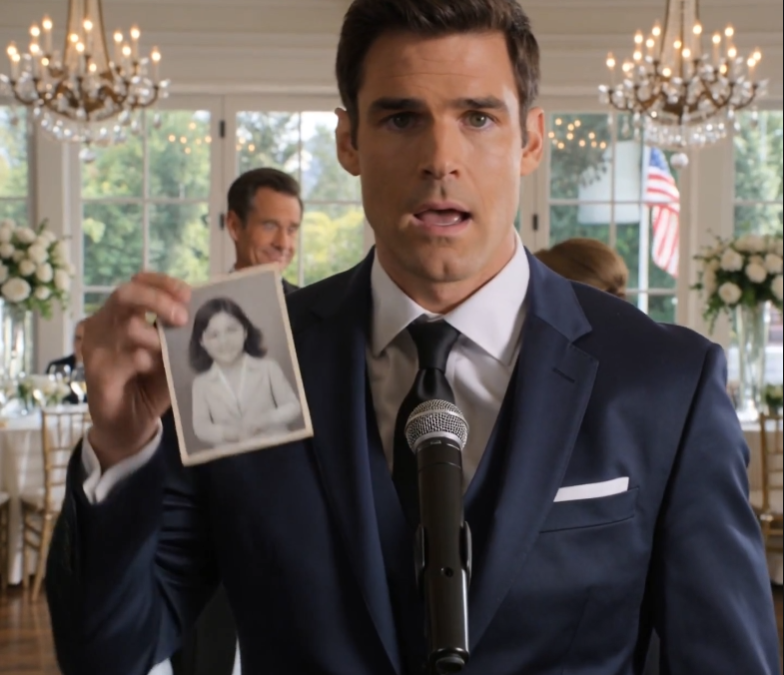
Then I reached into my pocket.
“This is me at twelve years old.”
I held up the photograph between two fingers.
Guests leaned forward and craned their necks to see it.
“This picture was taken the morning after my parents left me at a gas station eighty miles from home.”
The room seemed to stiffen.
“I’d spilled a soda in the car. Instead of scolding me, they left me there. They told me to man up and figure out how to get home.”
Uneasy glances passed between tables. Somewhere nearby, someone carefully set down a wineglass.
“They didn’t come back. They didn’t call. I slept behind a dumpster. The only reason I made it home was because a teacher came to pick me up the following morning.”
I paused, letting the silence do what raised voices never could.
“I never received an apology. Not from my parents. Not from Caleb. And until this wedding invitation arrived, I thought they were all perfectly happy pretending I didn’t exist.”
I looked directly toward my parents.
Dad’s face had gone pale.
Mom’s mouth hung slightly open, as if she were desperately searching for something to say but couldn’t find the words quickly enough.
“Now, I’m not here to ruin anyone’s evening,” I continued. “Emily, you seem lovely. Your family has been kind and welcoming.”
I turned toward the head table.
“And Caleb, well, you’ve always known how to put on a good face.”
That line landed hard.
For just a moment, his carefully maintained expression cracked.
“But I think weddings are supposed to be about honesty. About truth. And it wouldn’t be honest for me to stand here tonight pretending we were ever close, or pretending I grew up in a house where family meant protection instead of survival.”
The ballroom was utterly silent now.
People barely seemed to breathe.
“I was invited to this wedding to play a part in a picture-perfect day. A prop, really. A brother-shaped placeholder.”
I looked directly at Caleb.
“So consider this my gift to you.”
I walked toward the head table and placed the old photograph directly in front of him.
“A reminder of what family looks like when you turn your back on it.”
Then I turned and walked away from the microphone.
There was no applause.
Only stunned silence and a few audible gasps.
As I passed my parents’ table, I heard my mother hiss my name, barely louder than a whisper. My father began to rise from his chair.
I didn’t stop.
I didn’t turn around.
I walked through the side exit and stepped into the cool night air, leaving the lights, the flowers, and the stunned wedding guests behind me.
The music was faint in the distance.
I wasn’t angry.
I wasn’t shaking.
For the first time, I felt free.
But freedom is a strange thing. It doesn’t always arrive with immediate peace. Sometimes it leaves a vast silence behind, the kind that makes you wonder what will happen next.
I’d made my move.
The fallout was still coming.
The ride back to the hotel was quiet. There was no jazz music, no clinking glassware, no performative laughter bouncing off polished walls. Just the steady hum of tires against the road and the low roar of my own thoughts finally catching up with me.
I didn’t return to my room right away.
Instead, I took a walk along one of the vineyard trails behind the hotel, winding between rows of dark grapevines beneath a moonlit sky. With every step away from that wedding hall, the tension in my chest seemed to unravel, one thread at a time.
I could still hear my mother’s sharp gasp. I could see the instant Caleb’s carefully constructed expression fractured. I could feel the bewildered stares of strangers trying to piece together the existence of a person who had been deliberately erased from a family photograph.
For most of my life, I’d believed I was the ghost in my own family.
But that night, I’d reminded them I was flesh and blood. I was memory. I was a person who had survived what they preferred to forget.
And memory can be a dangerous thing, especially for people whose lives depend on everyone else forgetting.
When I returned to the hotel, there was a voicemail waiting from a number I didn’t recognize.
I pressed play.
“Isaac, it’s Emily.”
Her voice was low and controlled, but I could hear how fragile that control was.
“I don’t know what I expected, but I didn’t expect that. I wish someone had told me. I just… I just wanted you to know I’m not mad you said what you did. You deserved to say it. And I’m sorry.”
Then the message ended.
She hadn’t left a number to call back.
I sat there staring at my phone.
It was the first apology I’d received in eighteen years.
And it hadn’t even come from my own family.
I left early the following morning. No breakfast, no prolonged goodbyes, no attempt to find out what was happening back at the vineyard. I sent a short email to the front desk asking them to cancel the remainder of my reservation and forward the final bill.
I didn’t want to stay and watch the aftermath.
I knew my parents. I knew Caleb. They would either pretend nothing had happened or scramble to reframe the whole thing as a misunderstanding.
Probably both.
But I also knew the photograph had been sitting on the head table when I walked away.
That was enough.
I kept the suit, threw away the tie, and went home.
And once I was truly home, back in my small apartment where Max greeted me with excited barking and a wildly wagging tail, something unexpected began to happen.
People started reaching out.
The first was my cousin Hannah.
She sent me a message through LinkedIn, explaining that someone who’d attended the wedding had told her about my speech. She wanted to apologize for never asking where I’d gone after I disappeared from the family.
She said she’d always thought it was strange how nobody mentioned me anymore, but she’d assumed it wasn’t her place to ask questions.
We exchanged messages for a while.
Eventually, she asked whether she could come visit.
I didn’t say yes.
But I didn’t say no, either.
Then a message arrived from Mrs. Valencia.
She still remembered.
She still had the photograph she’d taken of me outside the gas station all those years ago.
“I always wondered what happened to you,” she wrote. “I’m so proud of you, Isaac.”
I hadn’t cried in years.
But I cried that night.
It wasn’t loud or dramatic. It was a quiet, aching release, the kind that comes after you’ve been holding your breath for so long that you’ve forgotten what breathing freely feels like.
For the first time in years, I began sleeping better.
I woke up earlier. My days developed a new rhythm. Work seemed easier, and the code I wrote felt cleaner, as though the noise in my head had finally begun to settle. I took Max on longer walks, and I started writing again.
Short stories, essays, anything that allowed me to pour the storm inside my mind into words that made sense.
A week later, I received an email from a woman who worked for a nonprofit organization supporting estranged adults, people who had been cut off, disowned, or abandoned by their families.
She’d heard about my wedding speech through a friend of a friend who’d worked the event. She described it as one of the most quietly powerful things she’d ever heard.
Then she asked whether I’d be willing to speak at one of the organization’s private retreats.
Not as a motivational speaker.
Just as someone who’d lived through something that many others understood but struggled to describe.
I said yes.
That first event led to another, and then another. Before long, I’d spoken at two retreats, then four. Eventually, an invitation came to participate in a panel at a university symposium focusing on family estrangement and trauma recovery.
I didn’t wear my expensive wedding suit to those events. Usually, I wore a simple shirt and jeans, sometimes adding a blazer when I wanted to look a little more polished.
But I always carried the photograph.
Whenever I spoke, I’d hold it up and tell the story exactly as it happened. No embellishment, no dramatic inventions. Just the truth.
And almost every time, someone would approach me afterward and say, “That happened to me, too.”
I began to understand something I’d never fully believed before.
I wasn’t alone.
I’d never truly been alone.
My voice, the same voice my family had mocked for being too soft, too sensitive, and too quiet, had finally found its volume.
It wasn’t revenge.
Not yet.
But it was power.
And with every person I helped, every story I heard, and every hand I shook, I felt that power growing.
Not the anger.
The clarity.
The certainty that what had happened to me was real, that it mattered, and that I no longer had to carry it as though it were something shameful.
While Caleb returned to his new wife and his carefully polished reputation, he had no idea how far the ripple from that wedding reception had already traveled.
He also had no idea that I wasn’t finished.
Because someone else from his side of the family was about to come looking for answers.
And this time, the questions wouldn’t be so easy to dismiss.
It began with another email from Emily.
But this one was different.
It wasn’t short or polite or carefully composed. There was something raw about the way she’d written it, as though she’d been staring at the screen for hours before finally deciding to press send.
“Isaac, I need to ask you something, and I need you to be honest with me. Did your parents really leave you like that when you were twelve? I asked Caleb. He didn’t deny it. He just said, ‘It’s complicated.’ But you didn’t sound complicated when you told that story. You sounded clear, like someone who’s been carrying something heavy for a long time. If it’s true, I need to know more. Please.”
I stared at her message for a long time.
Emily had every reason to close that door and move on. She could have ignored me, dismissed my speech as another ugly piece of family drama, or convinced herself that I was bitter, unstable, or trying to ruin my brother’s happiness.
But she hadn’t.
She’d asked for the truth.
And I wasn’t going to waste that opportunity.
So I wrote back.
I told her everything, without dramatics or exaggeration. Just the sequence of events as they had happened. I explained what happened at the gas station, how my parents abandoned me, and how nobody acknowledged it when I returned home. I told her about putting myself through school without their help, about disappearing from their lives, and about the strange way my name had eventually stopped being mentioned at all.
It was as though they’d taken a family photograph and carefully cropped out the one person who didn’t fit the image they wanted the world to see.
I didn’t blame Emily.
I didn’t ask her to choose between Caleb and me.
I simply gave her the truth and allowed her to decide what to do with it.
She replied the following day.
“I believe you, and I need time to process this. They never told me. Caleb said he was an only child until we got engaged. They erased you. And now I’m wondering what else they’ve rewritten. Would you ever be willing to meet for coffee? Just the two of us?”
Reading those words felt like watching a crack appear in a window that had always looked perfectly spotless.
I knew better than to push her.
I told her I’d be willing to meet, but I let her choose the time and place.
A week later, we sat across from each other in a quiet café two towns away from the home she shared with Caleb.
She looked nothing like the polished bride I’d seen walking down the aisle. She wore no makeup, no pearls, none of the carefully arranged elegance from the wedding. Just a hoodie and jeans. Her hair was pulled back, and her eyes were swollen, as though she hadn’t slept properly in days.
When she sat down, she didn’t even bother with a greeting.
“What else did they do?”
I looked at her for a moment.
Then I told her.
Not everything. Not the countless little humiliations that had filled my childhood, the thousand small cuts that never bled enough for anyone else to notice. But I told her about the larger things, the memories that had stayed with me no matter how far away I moved.
I told her about the two consecutive years my mother forgot my birthday, then blamed me for failing to remind her.
I told her about the time my father refused to co-sign a small student loan because, as he put it, “You’ll just waste it.”
And I told her how that same father had handed Caleb five thousand dollars for a trip to Cancun without hesitation.
Emily listened without interrupting.
Her hands remained wrapped around her coffee mug throughout the conversation. She asked questions and seemed to be mentally recording every answer. She never tried to defend my parents or explain Caleb’s behavior away.
Finally, she looked up.
“They called you a ghost at the wedding,” she said quietly.
I frowned.
“What?”
“That’s how Caleb explained it. He said you vanished when you were a teenager. That you always had a flair for the dramatic.”
I blinked.
“They used the word ghost?”
She nodded.
I couldn’t help laughing.
Not because it was funny, but because it was so absurdly perfect. For years, I’d thought of myself as a ghost in my own family, and apparently they’d been using that same word to explain away my absence.
“They didn’t lose a son,” I said. “They buried one.”
Emily went quiet.
Then she leaned closer, lowering her voice until it was barely above a whisper.
“You know what scares me most?”
I waited.
“What if they do that to our kids someday?”
And there it was.
The shift.
The doubt had finally taken root.
Caleb had spent his entire life controlling the version of himself other people were allowed to see. Now his new wife was beginning to wonder whether the man she’d married was someone she actually knew.
And Caleb didn’t know what was happening.
Emily stood before we could discuss anything further. She said she needed time to think, that she was grateful I’d been honest, and that she wasn’t ready to confront Caleb just yet.
She promised she’d be in touch.
Three days later, another letter arrived in my mailbox.
There was no return address, just like the wedding invitation. But this time, I recognized a different handwriting.
My father’s.
I opened the envelope and unfolded a sheet of paper covered in rigid, uneven letters.
“Isaac, I don’t know what you think you’re doing. This isn’t helping anyone. You’re bringing shame on the family. Let it go. If you keep stirring things up, there will be consequences. We gave you a second chance to be included. Don’t make us regret it. Dad.”
I read it slowly.
There it was again.
No apology.
No regret.
Not even the faintest acknowledgment that abandoning a twelve-year-old child beside a highway might have been wrong.
Just another threat disguised as family dignity.
Apparently, in my father’s mind, being invited to Caleb’s wedding had been some extraordinary act of generosity. A second chance he’d graciously offered to the son he’d once left behind.
I sat with the letter for a moment.
Then I placed it beside the photograph of my twelve-year-old self.
Two artifacts from the same family legacy.
One showed what they’d done to me.
The other showed exactly who they still were.
And looking at them together, I smiled.
Because now I had something I hadn’t possessed before.
Proof.
Not just my memories or my words, but a letter written in my father’s own handwriting, revealing the same cruelty and entitlement I’d lived with as a child.
I scanned it, saved a digital copy in a secure folder, and backed it up to two separate cloud drives.
Then I picked up my phone.
There was a journalist I’d met at one of the trauma panels. Her name was Clare Russo, and we’d talked about the power of personal stories after the event.
At the time, she’d told me, “If you ever decide to share your story, I’ll help you do it right.”
Now I was ready to take her up on that offer.
I called.
She answered on the first ring.
“I’m ready,” I said.
There was a brief silence.
“But I don’t want to just talk. I want to show them.”
Clare paused.
Then she asked, “How far are you willing to go?”
I looked down at the photograph, the threatening letter, and the wedding invitation that had tried to welcome me back into a family that had spent years pretending I didn’t exist.
“All the way,” I said.
The article was published under the title Left Behind: One Man’s Quiet Escape from a Family That Tried to Erase Him.
It went live on a Tuesday morning.
By noon, it had already been shared thousands of times.
Clare had done her research thoroughly. She hadn’t simply taken my account and published it. She verified every detail she could, interviewed Mrs. Valencia, confirmed the gas station incident, and even tracked down my former landlord, who could attest that I’d put myself through school without financial support from my family.
The article included the photograph of twelve-year-old me standing outside the gas station near the dumpster, wearing a torn backpack and cracked sneakers.
It included excerpts from the speech I’d delivered at Caleb’s wedding.
It also included my father’s letter, with portions blurred to protect private information, and mentioned Emily’s decision to contact me afterward, with her permission.
Clare was careful and precise.
It wasn’t a tabloid scandal or some sensationalized attempt to destroy people for entertainment. It was the truth, presented clearly and without embellishment.
And that was why the story spread.
Because it wasn’t loud.
It was honest.
Comments poured in from people who recognized pieces of their own lives in what had happened to me. Some described growing up in families where their pain had been dismissed. Others spoke about being replaced, silenced, disowned, or treated as though they were disposable.
Many praised the restraint I’d shown at the wedding.
A few commenters tried to guess which vineyard had hosted the ceremony, but I never confirmed the location.
The public attention was overwhelming, but it wasn’t what affected me most.
What mattered were the private messages.
Dozens arrived from people who had been abandoned or forgotten, people who had grown up being called problem children simply because their families refused to take responsibility for the harm they’d caused.
They told me things they’d never told anyone else.
Some thanked me for speaking.
Others said they’d spent years believing they were the only ones.
But one message stood out.
It came from a Kensington.
Emily’s older brother, Mark.
He didn’t waste time on polite introductions.
“I always thought Caleb was fake. Too polished, too rehearsed. Now I know why. I’m sorry they did that to you. My parents are furious. Not at you, but at Caleb. They feel like they were lied to. Used. They’re meeting with Emily today. Thought you’d want to know.”
I read the message and set my phone down.
I didn’t reply.
I didn’t need to.
Two days later, another email arrived from Emily.
“Isaac, I read the article. I saw the comments. I showed Caleb. He exploded. Said you ambushed him. Said you made it all sound worse than it was. But you didn’t. You didn’t even share everything. And that’s what made me realize you’re telling the truth.”
I kept reading.
“He asked me to choose. I chose. I’m staying at my parents’ place for now. The marriage is being annulled. I’m sorry it had to happen like this, but thank you for not letting me step into that lie with blinders on. Emily.”
I read her message three times.
Then I closed my laptop.
For a long while, I simply sat there in silence.
I wasn’t celebrating.
I wasn’t gloating over my brother’s failed marriage.
I was remembering.
I was remembering the boy I’d once been, standing in that gas station parking lot with a candy bar in his hand, desperately watching the highway and thinking the same thing over and over.
They have to come back.
They have to.
I’d been so certain that even my parents couldn’t really mean to leave me behind. I’d believed that eventually they’d return, angry perhaps, but ready to take me home.
Instead, they’d made me find my own way back.
And nearly two decades later, the family that abandoned me had finally discovered what it felt like to lose control of their own story.
But it wasn’t over.
Three days after the article was published, my parents called.
I still don’t know how they got my number. Maybe someone passed it along. Maybe they found an old contact, or perhaps they’d finally started paying attention to the places where I’d been speaking publicly.
When an unfamiliar number appeared on my screen, I let the call go to voicemail.
Then I listened.
My mother’s voice came first.
It trembled, but not with grief or remorse.
With fury.
“Isaac, how dare you? We invited you. We tried to be civil, and you humiliated us. You’ve ruined Caleb’s life. Emily’s parents are threatening legal action over the gifts, the deposits, the reputation. You think this is justice? It’s cruelty. Vindictive, petty cruelty. I hope you’re happy. I hope you’re proud of yourself.”
I listened without moving.
Then my father’s voice replaced hers.
He wasn’t shouting.
His tone was quiet, almost defeated, but the contempt was still there.
“You always were too soft. I should’ve known you’d grow into the kind of man who’d twist a moment into a weapon. Congratulations. You’ve destroyed your family. Don’t ever call us again.”
Then he hung up.
I stared at the wall for a long time.
I wondered whether their words would hurt the way they used to. Whether I’d hear their voices in my head for weeks afterward, questioning myself and wondering if perhaps I’d gone too far.
But the pain never came.
Not the old kind.
Because I hadn’t destroyed my family.
They had destroyed the version of me that still needed them.
And there was a difference.
I stood, walked over to my desk, and opened the drawer where I kept my old photographs and letters.
I took out the picture of the twelve-year-old boy one last time.
There he was, staring back at me, frightened and alone, with no idea what sort of man he’d eventually become.
I looked at him for a while.
Then I smiled.
And I put the photograph away.
Not because I was trying to bury the past, but because I’d finally finished writing the ending that little boy had been denied.
The consequences didn’t arrive all at once.
They came in fragments.
First, there were whispers.
Mutual acquaintances from my hometown began reaching out, people I hadn’t spoken to in more than a decade. Some sent private messages expressing shock. Others apologized for believing the version of events my parents had apparently been telling everyone.
“I had no idea.”
“I thought you moved away for college.”
“Your parents always said you were difficult.”
I read the messages without feeling much need to correct them. The truth was available now. People could read it for themselves.
Then came the changes on social media.
My parents had spent years carefully curating their public image. Their online profiles had always been filled with flattering family photographs, celebrations, and cheerful reminders of what wonderful parents they were.
Suddenly, those accounts went quiet.
Photographs began disappearing.
The banner celebrating them as the proud parents of Caleb and Emily vanished.
And perhaps the most revealing change was that Caleb’s entire wedding album disappeared overnight.
No announcement.
No explanation.
Just gone.
Later, I discovered through a quiet LinkedIn update that Caleb had taken a leave of absence from his company.
“Personal matters,” the update said.
I knew there was considerably more behind those two words.
Emily had followed through with the annulment.
She stayed temporarily with her brother and eventually returned to her studies, trying to rebuild the life that had been interrupted by everything she’d learned.
Several weeks later, she sent me another short message.
“I’m rebuilding. It’s messy, but it’s mine. Thank you again. I hope you’re doing okay.”
I read it and found myself smiling.
Because I was doing better than okay.
The nonprofit organization I’d begun speaking for invited me to become a regular contributor. I started working with them part-time, helping organize outreach programs for other estranged young adults.
I met people who reminded me of myself at eighteen, frightened but determined, carrying the weight of families who’d taught them that love always came with conditions.
Some were still struggling to leave.
Others had already escaped but didn’t know how to stop feeling guilty about it.
I understood both.
I helped organize events, shared resources, and listened to stories that sounded painfully familiar. What had started as one speech at a wedding had become something I never could have imagined when I first walked into that reception hall.
I began writing more seriously, too.
Not just short articles and essays anymore.
A book.
The working title was Ghost Son: What Happens When They Pretend You Never Existed?
I didn’t write it to punish my parents or humiliate Caleb.
I wrote it for the boy I used to be.
And for all the children still out there, quietly packing bags they’re terrified to carry out the door. Children who have learned to move through their own homes without making noise because even the sound of their footsteps might be enough to make someone angry.
I knew what that felt like.
I knew what it meant to grow up believing the safest thing you could do was disappear.
And I wanted those kids to know that surviving wasn’t the end of their story.
One afternoon, another letter arrived.
It wasn’t from my parents.
It wasn’t from Caleb.
It was from Mrs. Valencia.
I recognized her generous, looping cursive immediately. Unlike the handwriting on my mother’s wedding invitation, hers brought back a memory that didn’t hurt.
I opened the envelope and unfolded the letter.
“Dear Isaac,
“I clipped out your article and read it twice. Then I put it on the wall of my classroom, right above the desk where I keep extra snacks for students who never bring lunch.
“I tell them about you sometimes. Not by name, but your story.
“I tell them that sometimes being kind isn’t just about helping someone up. It’s about remembering them when everyone else forgets.
“I’m so proud of you.
“Love, Mrs. V.”
I sat there holding the letter for a long time.
Then I cried.
Not the silent tears I’d grown accustomed to swallowing.
Real tears.
The kind that come from somewhere deep inside, cracking open something that’s been sealed shut for years.
Because Mrs. Valencia had never needed me to be successful before deciding I mattered.
She hadn’t waited until I became a software engineer, until I stood before a room full of wedding guests, or until my story appeared in a widely shared article.
She’d seen a frightened twelve-year-old boy standing outside a gas station, and she’d come to get him.
She’d made sure he had food.
She’d taken him home.
And she’d remembered him long after everyone else had decided to forget.
For most of my life, I’d confused being seen with having something to prove. I thought I had to become successful enough, strong enough, and independent enough that my family would finally recognize what they’d thrown away.
But reading that letter, I understood something different.
For the first time, I didn’t feel like I was proving anything at all.
I wasn’t a shadow.
I wasn’t the forgotten child.
I wasn’t a ghost trapped in someone else’s version of the past.
I was here.
I had survived.
And now I was living.
My life wasn’t perfect. I still had memories that hurt. There were days when certain words or sounds could pull me back toward places I’d rather forget. But I had friends who cared about me, a dog who trusted me, work that challenged me, and people who found hope in hearing my story.
I had built a life that belonged entirely to me.
And no one could take that away.
Sometimes people ask me what it felt like to stand in front of my family at Caleb’s wedding and finally tell everyone the truth.
They expect me to describe the satisfaction of watching my brother’s smile disappear, or the pleasure of seeing my parents confronted with something they could no longer deny.
Maybe they expect me to say that ruining their carefully polished reputation was the greatest moment of my life.
But that isn’t how I remember it.
When I think about that night, I remember the feeling of walking out of the reception hall into the cool evening air.
I remember realizing I no longer had to beg for a place in a family that had never truly made room for me.
And I remember the strange, almost unfamiliar sensation of knowing that I could finally leave without waiting for anyone to come after me.
So when people ask how it felt, I usually just smile.
Because I’ve learned that the best revenge isn’t watching the people who hurt you crumble.
It’s watching yourself rise in full daylight while they’re still trying to rewrite what happened in the dark.
And I’ve never looked back.








