On Christmas Eve, he abandoned his children, who were burning with fever, to be with his mistress. It seemed like only betrayal, but no! He was even greedier than that. But when he came back, it was already too late…
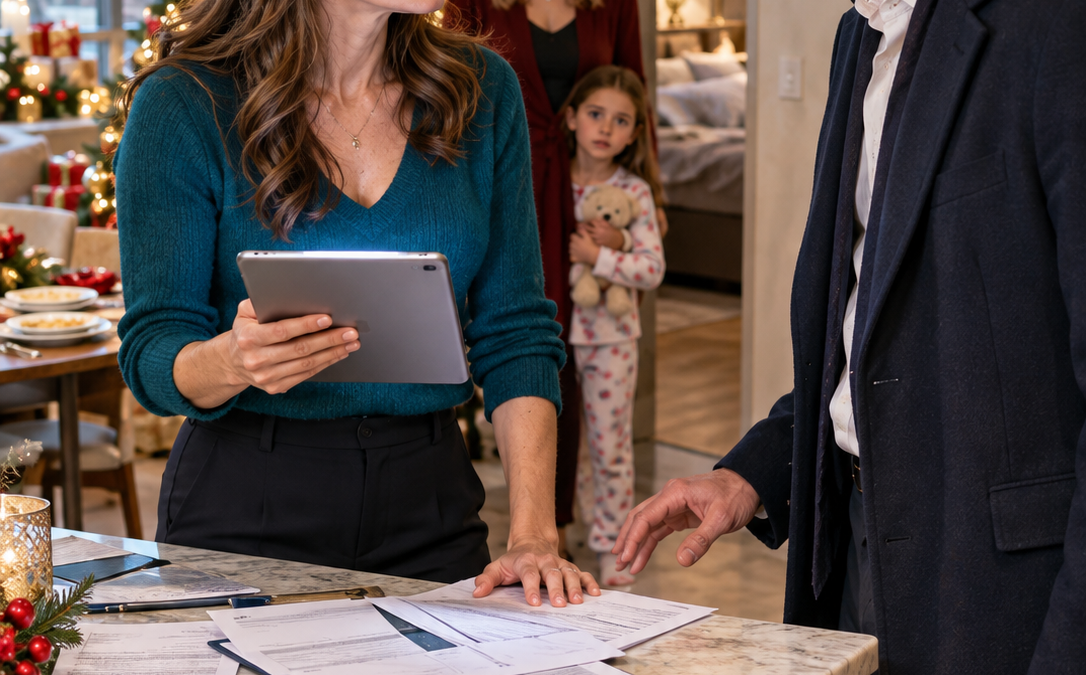
I glanced at the clock. Less than three hours earlier, I’d left Michael at home with both children. Sophia and Jacob had been fighting an infection since morning. At first, neither of their temperatures had climbed above 100 degrees, but by early evening, both had developed higher fevers. I’d been watching them carefully, keeping track of their medication and making sure they drank enough water.
Then my sister Eve called. She lived only a few blocks away, but her car had broken down, and our seventy-three-year-old mother had suddenly developed severe abdominal pain. Eve needed help getting her to the emergency room. I had hesitated because of the children, but Michael was the one who insisted I go.
“Go with Eve,” he’d told me. “I’ll stay with the kids. I’m not going anywhere tonight anyway.”
I remembered looking at him with genuine gratitude. I remembered thinking how fortunate I was to have a husband who understood that my mother needed me, too.
God, I had been an idiot.
Before leaving, I’d kissed both children, written down the times for their fever medication, and reminded Michael to call if either temperature rose. I should have been home much sooner, but my mother’s tests took longer than anyone anticipated. Fortunately, she didn’t need to be admitted. Eve drove her home and then dropped me off at my building.
Throughout the drive, I had been texting Michael. He hadn’t answered a single message. I called him four times, and each time the phone rang until the call went unanswered. I’d assumed he was busy with the children, or perhaps his phone had been left in another room.
Now, looking at Jacob’s flushed face, I understood that something was terribly wrong.
I retrieved the thermometer from the bathroom cabinet and checked both children. Jacob’s temperature was 102.5 degrees Fahrenheit. Sophia’s was 102.2. I forced myself to breathe slowly before asking, “Sweetheart, what time did Daddy leave?”
Sophia shrugged helplessly. “It was dark outside for a long time.”
“And what did he say?”
“That he was just going downstairs for a second. Then he came back and got his coat and that black bag.”
My hand stopped moving on Jacob’s comforter. “What bag?”
“The little black bag he takes when he goes to Denver.”
I knew exactly which bag she meant. It was Michael’s small black duffel, the one he packed for occasional overnight business trips. He traveled to Denver about once a year, sometimes more, and that was the bag he always carried.
A chill moved through me, even as heat radiated from my son’s body. Michael hadn’t simply stepped downstairs or gone out to the car. He had taken an overnight bag.
“Did you try calling him?” I asked Sophia.
“My phone died.” Her lower lip trembled. “Jacob tried to get up, but he got dizzy. I was scared, Mommy.”
I pulled her into my arms and held her tightly. “I’m here now. I’m going to take care of everything.”
I wanted to scream. I wanted to call Michael and demand to know what kind of father walked out on two feverish children on Christmas Eve. But Jacob was shaking under the covers, and Sophia was clinging to me as though I might disappear, too. Whatever Michael had done, there would be time to deal with him later. Right then, my children needed me.
I called the nurse advice line and explained their symptoms, temperatures, and medication schedule. The nurse walked me through the warning signs and told me when emergency care would be necessary. Jacob was unusually weak and struggling to drink water. When his condition became more concerning, I didn’t wait any longer. I called 911.
The paramedics arrived quickly and examined both children. After their assessment, they decided Jacob needed to be taken to the hospital for further testing. Sophia would come with us because I wasn’t about to leave her alone in the apartment.
As we prepared to leave, one of the paramedics paused in the doorway. “Ma’am, are you here alone with the children?”
I looked past him toward the empty entryway, where Michael’s coat should have been hanging.
“I am.”
It was only two words, but saying them out loud hurt more than I expected.
At the hospital, I sat between the children’s beds, staring at the Christmas decals stuck to the observation room window. Jacob received medication and an IV while a nurse monitored his condition. Sophia eventually fell asleep against my shoulder, exhausted from crying. Every few minutes, I glanced at my phone, waiting for Michael to call.
He never did.
I sent him another message: “The kids’ fevers are over 102. We’re at the hospital. Where are you?”
Two minutes later, the message was marked as read. There was no reply. I called him immediately, and this time he rejected the call.
That was the moment I stopped worrying that something might have happened to him. Until then, some frightened part of me had imagined a car accident, an emergency, or a situation that prevented him from answering. But he had seen my message. He knew our children were in the hospital, and he was choosing not to respond.
At 11:47 p.m., a message finally appeared on my screen.
“Don’t be so dramatic. You said you’d be back earlier. The kids were in bed. I’m handling something important. I’ll be there in the morning.”
I read it three times.
In the morning.
On Christmas Eve, while our children were sick. When he knew their fevers had been rising. When he knew I wasn’t home.
I took a screenshot. At that moment, I wasn’t planning a divorce or thinking about lawyers and courtrooms. I didn’t even fully understand why I felt compelled to save it. I simply knew that Michael would eventually try to convince me that he’d said something different, that I’d misunderstood, or that I’d exaggerated the situation.
I wanted proof of what he had actually written.
My reply contained only four words. “Where are you now?”
He didn’t answer.
Around one in the morning, the doctor explained that both children most likely had a strong viral infection. Jacob’s condition was stabilizing, and although Sophia still had a fever, neither child required a longer hospital admission. We were given detailed instructions for medication, hydration, warning signs, and a follow-up examination.
Eve came to pick us up. By then, I was so exhausted that the overhead lights in the hospital corridor seemed painfully bright. Sophia slept against my chest while we waited, and Jacob leaned heavily on my arm as I helped him into the car.
As soon as we were driving, I told Eve that Michael had left the children alone.
She turned toward me with an expression I had never seen on her face before. “He knew they had fevers?”
“Yes.”
“And he just left?”
“Yes.”
“Where did he go?”
“I don’t know.”
Her hands tightened around the steering wheel. For several seconds, she said nothing. Then she glanced at me again. “Anna, check his location.”
“What location?”
“You two have that shared family account on your phones. Remember when you went to Hawaii this summer? You told me you’d activated location sharing.”
I went still. She was right. We had enabled the feature during our vacation because it made it easier to find one another when we separated at beaches, shopping centers, or tourist attractions. We rarely used it at home, and I couldn’t remember whether Michael had switched it off.
I opened the app. The screen took a few seconds to load before a small blue dot appeared.
Michael wasn’t at his office. He wasn’t at his parents’ house or at the home of any friend I knew. His phone was in downtown Chicago, inside a five-star hotel on Michigan Avenue.
I recognized the hotel immediately. My interior design studio, Form Interiors, had designed its lobby and restaurants two years earlier. I knew the building, its reputation, and the kind of money people spent there.
Eve glanced at the screen. “Maybe he has a business meeting there. In the middle of the night. On Christmas Eve.”
Her voice was dry, but she didn’t push any further. She didn’t have to.
I stared at the blue dot and tried desperately to imagine some explanation that didn’t destroy the life I believed we had. I wanted to believe in our fifteen years of marriage, our shared mortgage, our family vacations, the photographs lining our hallway, and all the ordinary days we’d spent building something together.
Then I remembered the black duffel bag.
By two-thirty in the morning, we were back at the apartment. I settled the children into their beds, gave them the medication prescribed by the doctor, and made sure they had water within reach. Eve stayed with me. After checking on them one more time, I sat down at the kitchen table with my phone in front of me.
“Do you want me to go to the hotel?” Eve asked.
“No.”
“What about calling the front desk?”
“No.”
She pulled out the chair opposite mine. “Then what are you going to do?”
I looked at my phone. “First, I’m going to find out the truth.”
Michael had always described me as the emotional one in our marriage. Whenever we argued, he accused me of reacting too quickly, getting angry before I understood the facts, and allowing my feelings to dictate my decisions. For years, I had accepted at least part of that criticism.
That night, I did the opposite of what he expected.
I opened our shared online banking account. Michael and I maintained separate personal accounts, but we used one joint credit card for household and family expenses. I scrolled through the latest transactions until I found two charges I couldn’t explain.
At 9:18 p.m., fifty dollars had been charged at the hotel restaurant. At 10:53 p.m., another $130 had been spent at the hotel bar.
Both transactions were made while I was in the emergency room with our children.
I could have stopped there. The location and charges already told me enough to know that Michael had lied about where he was. But something pushed me to look further.
We kept a tablet in the kitchen that both of us used. Michael had signed into his personal email on it some time earlier and apparently forgotten that the account was still accessible. When I opened the email application, I found an automatic reservation confirmation.
A room for two.
One night.
Christmas package, including dinner and breakfast.
The reservation had been made more than three weeks earlier.
I sat very still, reading the details again. This wasn’t an impulsive decision after a disagreement. Michael hadn’t left the apartment because he’d suddenly needed time alone. He hadn’t unexpectedly run into someone downtown.
He had arranged this night weeks in advance, knowing it was Christmas Eve, knowing we had children, and knowing we were supposed to spend the holiday together.
“Anna?” Eve moved closer when she saw my face.
I turned the tablet toward her. She read the confirmation, then pressed a hand over her mouth.
“Oh, my God.”
At the bottom of the reservation was the name of the second guest.
Caroline Reed.
Of course I knew Caroline. She was a sales manager at a real estate firm that had collaborated with Form Interiors on several projects. She had been a guest at our backyard barbecue in June, sitting at our table and eating the cake Sophia had helped make. I remembered her laughing with Michael, complimenting our home, and telling me how fortunate I was to have a husband who could balance family life with such a demanding career.
Now she was spending Christmas with him in a luxury hotel while his children lay sick and unattended at home.
I thought I would cry when I finally discovered the truth. Instead, I felt a fury so intense that my hands became remarkably steady.
I photographed the reservation confirmation, downloaded a copy, and saved the credit card transactions. Then I sent everything to a separate folder.
Eve watched me without interrupting.
“Don’t call him,” she finally said.
“I don’t intend to.”
“What are you going to do when he comes home?”
I stared at the screen. “I don’t know yet.”
At that exact moment, the intercom buzzed.
It was 3:12 a.m. Eve and I looked at each other, and my heart began to pound. For a second, I thought Michael had returned earlier than he’d promised. But when I checked the intercom screen, I saw our neighbor, Mrs. Davis, standing downstairs.
She lived directly across the hallway from us. I let her into the building, and a few minutes later, she appeared at our door wearing a bathrobe beneath a heavy winter coat.
“I’m sorry to bother you at this hour,” she said. “I saw your lights on. Are the children all right?”
“We were at the hospital,” I explained. “They both have very high fevers.”
Her expression changed immediately.
“That’s why I came.”
I stared at her. “What do you mean?”
She hesitated, then stepped inside. “Earlier tonight, around nine o’clock, I heard Sophia in the hallway. She was knocking on my door. She told me she couldn’t find her father and that Jacob wasn’t feeling well.”
My stomach seemed to drop.
Mrs. Davis explained that she’d brought Sophia into her apartment, given her some water, and gone across the hall to check on Jacob. Our apartment door had been slightly ajar. Michael was already gone.
I gripped the back of a dining chair to steady myself. My children hadn’t been alone for a few minutes. They had been alone long enough for Sophia to become frightened, leave the apartment, and seek help from a neighbor.
“Why didn’t you call me?” I asked.
“I didn’t have your number. Sophia said her father would be right back, and I thought perhaps he’d gone to the pharmacy. I stayed with them for almost forty minutes. Jacob’s fever seemed to come down a little after I gave him some fever medicine. Then Sophia said her father had sent her a message saying he would be back later.”
Mrs. Davis looked genuinely distressed. She explained that her own husband was recovering from surgery, and she eventually had to return to him. She hadn’t understood that Michael intended to remain away for the night.
“But there’s something else,” she said.
“What?”
She reached into her coat pocket and took out her phone. “We installed a camera facing our front door because someone has been stealing packages on our floor. Your husband left around eight-thirty tonight, and he wasn’t alone.”
I stared at her. “Who was with him?”
Instead of answering, she opened the video.
The recording showed our hallway and the entrance to our apartment. Michael appeared wearing his overcoat, carrying the same black duffel bag Sophia had described. Beside him stood Caroline Reed, adjusting the scarf around her neck.
Caroline hadn’t been waiting for him at the hotel. She had been inside my home on Christmas Eve while my children were burning with fever.
Michael locked the apartment door. Then he said something too softly for me to understand.
Mrs. Davis raised the volume.
There was a brief rustle of background noise before Caroline’s voice became clear.
“What if Anna comes back early?”
Michael answered without hesitation. “She won’t. And even if she does, after Christmas, everything’s going to change.”
The recording ended.
For a long moment, I couldn’t speak. I stared at the dark screen, unable to move past those words.
After Christmas, everything’s going to change.
I had discovered an affair, but the conversation suggested something more. Michael hadn’t merely planned a night away from his family. He and Caroline were anticipating a change in our lives, one I knew absolutely nothing about.
I didn’t sleep another minute.
By seven the next morning, Sophia and Jacob were still in bed, and their fevers had begun to come down slowly. Eve made coffee while I sat at the kitchen table surrounded by the evidence I’d collected: the hospital discharge papers, a printed copy of the hotel reservation, screenshots of the charges, and a copy of Mrs. Davis’s surveillance footage, which she’d allowed me to save.
Michael returned at 8:17 a.m.
He opened the apartment door quietly, probably assuming I would still be asleep. He was wearing the same shirt as the night before, and as he passed the kitchen doorway, I caught the unmistakable scent of an expensive perfume I hadn’t bought him.
When he saw me sitting at the table, he stopped.
“You’re here.”
Those were the first words out of his mouth. Not a question about the children. Not an apology. Not even a mention of the hospital.
You’re here.
I looked at him. “Where were you?”
He took off his overcoat and reached for the coat rack. “I already told you. I had something important to take care of.”
“At the hotel?”
His hand paused.
“What hotel?” he asked.
“The one on Michigan Avenue.”
Michael turned around slowly. “Are you following me?”
I could hardly believe he was asking that question. “You left two sick children home alone. Jacob’s fever reached 102.5 degrees. We ended up in the hospital.”
He sighed.
It was the kind of weary, impatient sigh he might have made if I were telling him that a furniture delivery had been delayed.
“They weren’t alone that long.”
“How long?”
“Twenty minutes. Maybe half an hour.”
“You’re lying.”
“Anna, I really don’t have the patience for hysterics right now.”
“Caroline was here.”
For one brief instant, genuine panic flashed across his face. He concealed it almost immediately, but I had seen it.
“What are you talking about?”
I placed my phone on the table and played the hallway recording.
Michael stood completely still as he watched himself leave our apartment alongside Caroline. The image was clear. His face, her scarf, the black bag, the door locking behind them. There was no possibility of pretending that it was someone else.
When the video ended, he remained silent.
“Would you like to explain anything?” I asked.
“This isn’t what you think.”
I almost laughed. Of all the things he could have said, he had chosen the most predictable line in the world.
“Did you spend the night with her in that hotel? Yes or no?”
“Anna, our marriage hasn’t been working for a long time.”
I stared at him. Until yesterday morning, as far as I knew, our marriage had been working perfectly well.
“That’s interesting,” I said. “Because you never mentioned that to me.”
“You always make everything about you.”
“About me?”
I pointed toward the children’s bedroom. “They had fevers over 102 degrees. You left them alone.”
“You left them, too.”
The accusation was so absurd that I needed a moment to make sure I’d heard him correctly.
“I went to the emergency room with my mother. You told me you would stay home with the kids.”
“But you’re their mother.”
“And what are you, Michael?”
He didn’t answer.
Instead, his attention shifted to the documents spread across the table. I watched his eyes move from the hotel confirmation to the bank statements, then to the hospital discharge papers.
“What are you planning to do with those?” he asked.
That was when I saw real fear enter his expression. He hadn’t shown it when I mentioned Jacob’s condition or Sophia’s terror. He hadn’t shown it when I told him our children had spent the night in an emergency room.
The documents frightened him.
“I don’t know yet,” I said.
“Don’t do anything stupid. Don’t involve the police, lawyers, or my company in this.”
I gave him a humorless smile. “Your company?”
“You know what I’m talking about.”
“No, Michael. I don’t. But I’m beginning to wonder.”
He picked up his phone, apparently preparing to leave the kitchen. Before he could move away, the tablet beside my coffee cup lit up with a notification.
Michael looked at it and lunged across the table.
I reached it first.
A message from Caroline had appeared on the screen.
“Don’t tell her about the kids’ documents yet. She has to sign that thing after Christmas first.”
All the anger inside me suddenly gave way to something much colder.
I looked at Michael. His face had gone pale.
“What kids’ documents?” I asked.
“Give me the tablet.”
“What documents, Michael?”
He stepped toward me. Eve immediately came out of the living room and moved between us.
“Don’t touch her,” my sister warned.
Michael stopped. I took a screenshot of Caroline’s message, then another, and a third to make certain I had a record of it.
In that moment, I understood that his night with his mistress might not be the worst thing I was going to discover.
Caroline knew about documents involving my children. Documents I was apparently expected to sign immediately after Christmas, without understanding what they were.
For several seconds, nobody said anything.
The tablet lay on the table between us, Caroline’s words still visible on the screen. Eve stood with her arms folded across her chest, facing Michael.
“Give me the tablet,” he said again.
“Answer the question first,” I replied.
“Anna, not now.”
“What kids’ documents?”
“It’s not what you think.”
I shook my head. “You’ve said that so many times in the last twelve hours that it’s starting to lose its meaning.”
Michael moved toward me again. Eve took a step forward at the same time.
“If you get any closer to her like that,” she said, “I’m calling the police.”
He gave a contemptuous laugh. “Fantastic. Now your sister’s going to make a scene in my house.”
“In your house?” I repeated.
I heard the words as though someone else had spoken them. His children. His company. His house. Everything we had spent fifteen years building together suddenly belonged entirely to him whenever he was angry.
I turned to Eve. “Would you check on the kids?”
“I’m not leaving you alone with him.”
“I can handle it.”
She studied my face, then looked at Michael. “If he so much as raises his voice, yell.”
She went down the hallway, and Michael sat in the chair opposite mine.
“Look,” he began, rubbing his forehead, “these documents are just a formality.”
I laughed without any amusement. “That word usually means trouble.”
“They’re about making sure the children are secure.”
“Secure against what?”
“In case something happens.”
“To whom?”
He didn’t answer.
“Yesterday, you left two sick children alone so you could go to a hotel with your mistress. If you want me to believe you’re suddenly concerned about their security, you’re going to have to do better than that.”
His expression hardened. “It has to do with our financial situation.”
“What financial situation?”
“The company is having problems.”
I stared at him.
Michael ran a consulting firm that supported real estate investments. For the past two years, he’d talked constantly about expansion. There were new clients, a larger office, major contracts, and promising opportunities. We had bought a bigger apartment than we needed, spent three weeks vacationing in Hawaii that summer, and just the previous month, he’d been discussing the possibility of buying a house in the Chicago suburbs.
“What problems?” I asked.
“Temporary ones.”
“What kind?”
“I don’t know exactly.”
“You’re the managing partner, Michael.”
“I’m not the one who handles the accounting.”
I knew he was lying. After fifteen years, I recognized the pattern. Whenever he wanted to avoid responsibility, he suddenly became a man who knew nothing, controlled nothing, and couldn’t possibly be expected to answer ordinary questions.
“What am I supposed to sign?”
“A change in how we protect our assets.”
“Which assets?”
He looked away.
“Michael.”
“The apartment.”
I felt cold spread through my chest.
“It’s just a technical guarantee for a loan,” he added quickly.
“We don’t have another loan on the apartment.”
He didn’t respond. And then I began to understand.
“Did you take out a loan using our home as collateral?”
“No.”
“Then what did you do?”
“The company needed collateral.”
“For what?”
“A bank line of credit.”
“And you were planning to use our home?”
“I haven’t done anything yet.”
Yet.
That single word told me more than all his explanations.
“What exactly am I supposed to sign after Christmas?”
He hesitated before answering. “A spousal consent form to encumber the property. It’s a guarantee for the financing.”
“You’re asking me to put our home at risk for your company’s debts.”
“That’s not what it means.”
“That’s exactly what it means to me.”
I stood up. Michael rose immediately.
“Anna, don’t make a scene.”
“You’re the one who made a scene yesterday when you left our children alone.”
“I already said I overreacted.”
“No, you didn’t.”
He fell silent.
“You never said that, Michael. You haven’t apologized even once.”
I walked into our bedroom and closed the door.
The first thing I did was look for the phone number of Joanna Fischer, an attorney who had previously helped with matters involving my mother’s estate. I remembered Joanna as a direct, careful woman who didn’t waste time on dramatic reactions. I had liked that about her when we first met. Now, I needed it more than ever.
I sent her a message explaining that I urgently needed legal advice concerning family law and marital assets. My husband was pressuring me to sign documents involving our shared apartment and our children, and I suspected he was withholding significant information.
Twenty minutes later, she replied.
“Tomorrow at 9:30 a.m. Please do not sign absolutely anything.”
Nothing more.
It was enough.
Next, I called the bank. I knew I wouldn’t have access to every financial obligation associated with Michael’s company, but our home was jointly owned. If he was attempting to use it as collateral, I needed to know whether any formal process had already begun.
The bank representative couldn’t disclose every detail over the phone, but he did confirm one thing.
“I can see an open file regarding the establishment of a mortgage on a property.”
My heart accelerated.
“Who submitted it?”
“I’m not authorized to disclose that information over the phone.”
“Would my signature be required?”
“If you’re a co-owner under a joint tenancy arrangement, your consent may be necessary, depending on the specifics of the transaction.”
“Have any documents already been submitted?”
There was a pause.
“Ma’am, I would strongly recommend visiting a branch with your identification.”
I ended the call and remained sitting on the edge of the bed.
When I returned to the living room, Michael was gone. Eve was sitting beside Sophia, who was watching cartoons under a blanket.
“He left?” I asked.
Eve nodded. “Said he had to go to the office.”
“On Christmas Day.”
“Apparently.”
The children were still weak, but their temperatures were gradually improving. Jacob slept most of the morning, while Sophia kept asking whether her father was coming home. Each time, I told her that Daddy was taking care of something and that I was staying with her.
I hated how little I could explain.
Before noon, another message arrived on my phone.
This one was from Caroline Reed.
I had no idea how she’d obtained my number.
“Anna, we need to talk. Michael didn’t tell you everything.”
I stared at the message for a moment, then typed, “Write it here.”
Her response came almost immediately.
“Not by message. Can we meet?”
There was no chance I would agree to meet her alone.
“If you have something to say, write it,” I answered.
Several minutes passed before another message appeared.
“It’s not just about your house.”
Then a second message followed.
“Michael intends to change the children’s residence.”
I sat down slowly.
“To where?”
The three dots indicating that she was typing appeared, disappeared, then appeared again.
Finally, her answer came.
“Denver.”
I couldn’t understand what I was reading. Michael had no family in Denver. Caroline, however, worked for a company headquartered there.
“Why?” I typed.
Her answer arrived a minute later.
“Because Michael is taking a new position in the new year. He wanted to take the kids.”
My breath caught.
“Without me?”
She didn’t answer.
I tried calling her, but she rejected the call. A moment later, another message appeared.
“Just ask him about the school on Vista Avenue.”
A school?
I opened my browser and searched for the address. It led me to a private school in Denver. I found the school’s website, looked up the headmaster, and located the admissions office telephone number. But it was Christmas Day, and no one answered.
I returned to the shared email account.
Michael had always insisted on keeping his professional correspondence separate, but some family-related messages still arrived at the email address we’d created together before the children were born.
I searched the inbox first, then the archived folders. Finally, I opened the trash folder.
There, buried among old advertisements and deleted notifications, I found an email from two weeks earlier.
Subject: Confirmation of Receipt of Application Documents.
Sophia and Jacob Silva.
For a moment, I couldn’t bring myself to open it. Then I tapped the screen.
“Dear Mr. Silva, we confirm receipt of the application forms for Sophia and Jacob. To complete the process, the signature of the second legal guardian is required, along with documentation from their previous school.”
I read the message twice.
Michael had already submitted applications to enroll our children in a school in another city without telling me.
I downloaded the email, saved screenshots, and continued searching. In the same deleted folder, I found a digital file titled “Family Relocation Plan.”
It wasn’t a formal legal document. It looked like a private checklist Michael had prepared for himself.
January: Financing.
February: Finalize apartment issues.
March: Kids.
April: Move.
Beside the final item, he’d written: “Anna signature. Amicable agreement. In case of problems, mediation.”
Below that was another line.
“Caroline temporary address after summer.”
I covered my mouth.
This wasn’t an affair that had gotten out of hand. Michael and Caroline were planning a future together, and my children were part of their plans. The hotel reservation, the proposed mortgage, the school application, and Caroline’s message all belonged to the same scheme.
I finally understood why she’d written, “Don’t tell her yet.”
Michael intended to get me to sign documents one at a time. First, something related to the apartment and the loan. Then, apparently, agreements involving our children’s living arrangements. Perhaps he planned to present everything as an ordinary career change, only announcing his intention to leave me after he’d secured the signatures he needed.
But one thing still didn’t make sense.
Why would I ever agree to let my children move to Denver without me?
I wouldn’t. Not knowingly.
Unless the documents were presented as something entirely different.
A memory surfaced so suddenly that I sat upright.
Three days before Christmas, Michael had left a stack of papers on our kitchen table.
“Sign here and here,” he’d said. “It’s the kids’ insurance and some permission slips for field trips.”
I’d been wrapping Christmas presents, surrounded by ribbons, tape, and half-finished packages. I signed one sheet, intending to look at the others later. Then my mother called, and I never returned to the paperwork.
By that evening, the papers were gone.
I felt sick.
Had I already signed something that I didn’t understand?
I went into Michael’s home office and approached the cabinet where he kept important documents. It was locked.
He had never locked that cabinet before.
I took a photograph of the lock but didn’t attempt to force it open. Instead, I called Joanna Fischer. Although it was a holiday, she answered.
I explained what I’d found: the school application, Caroline’s messages, the relocation checklist, and the papers Michael had asked me to sign before Christmas.
“Do you have a copy of the document you signed?” Joanna asked.
“No.”
“Was your signature notarized?”
“No.”
“Do you remember what the document said?”
“The top looked like an insurance form. It had the children’s names and personal information.”
“All right. We aren’t going to assume the worst without seeing the document, but I want you to sign absolutely nothing else. Send me copies of everything you’ve found.”
I swallowed. “Can Michael take the kids to Denver without my permission?”
“Based on what you’re describing, he cannot simply decide on a permanent change of residence by himself. If you both share parental responsibilities, decisions of that significance require agreement. If the parents cannot agree, the court may have to decide.”
For the first time that morning, I felt as though I could breathe.
“And if he tries to take them anyway?”
“Then we act immediately. But Anna, I need facts, not provocations. Don’t confront him to get a reaction.”
“I have a video showing him leaving the children alone.”
“Keep the original recording. Preserve the emergency room documents, too.”
“Could those be important?”
“Potentially. Especially if he later tries to claim that you’ve neglected the children.”
My hand tightened around the phone.
“Why would he claim that?”
“Because people preparing for custody disputes sometimes begin constructing their version of events long before the other parent realizes there’s a dispute.”
I thought about Michael’s message from the hotel: “You said you’d be back earlier.”
And his accusation that morning: “You left them, too.”
Those remarks hadn’t necessarily been random expressions of anger. They could already be part of a story he intended to tell about me.
That evening, Caroline contacted me again.
“Michael knows I messaged you. He’s furious.”
“That’s his problem,” I replied.
“Anna, I didn’t know the kids were sick.”
I stared at my phone before typing, “You were inside my house.”
“They were sleeping. Michael said it was just a cold and that you were almost home.”
I didn’t know whether to believe her. I’d seen her leave with him while our children were upstairs, but I couldn’t know what Michael had told her.
“Why are you helping me now?”
Almost five minutes passed.
“Because he lied to me, too.”
I waited.
Another message arrived.
“He told me you were already getting divorced.”
I closed my eyes.
Michael and I had never discussed divorce. Not once. Even during our worst arguments, neither of us had seriously raised the possibility of ending the marriage.
“What else did he tell you?” I asked.
“That you’d agreed to let the kids live with him starting in the new year because you’d received a job offer in Germany.”
I nearly dropped the phone.
There was no job offer in Germany. I hadn’t applied for one, considered one, or discussed moving abroad with anyone.
“Where did he get that idea?” I wrote.
“I know now. Yesterday at the hotel, I saw a document.”
“What document?”
“A draft of an amicable divorce agreement.”
My heart began to race.
“Do you have it?”
“Photos of some pages.”
“Send them.”
Caroline didn’t respond immediately. One minute passed, then another, then a third. I watched the screen until three images finally appeared.
The first photograph was blurry, but the second was clear enough.
At the top was a heading identifying the document as a parenting plan agreement. Beneath it were my full name, Michael’s name, and our children’s details.
I read it rapidly, barely able to process the sentences.
According to the draft, I would supposedly consent to Sophia and Jacob establishing their primary residence with Michael in Denver after our separation. I would have parenting time on alternate weekends.
Further down, a clause stated that the relocation was necessary because of my professional plans abroad.
Every word of that explanation was a lie.
The third photograph showed a proposed property division agreement. Our apartment would be sold, with a substantial portion of its value used to settle Michael’s business obligations. Whatever remained would be divided afterward.
Considering what I suspected about his company’s financial problems, I might have been left with almost nothing.
“He told me you’d already agreed to this,” Caroline wrote.
“I haven’t agreed to any of it.”
Several minutes later, she sent another message.
“There’s one more thing. I don’t have a photo.”
“What?”
“An addendum related to your business. Your professional activity.”
For six years, I’d been running my own interior design studio. Form Interiors wasn’t as large as Michael’s consulting firm, but it was profitable, stable, and entirely legitimate. Its earnings paid for most of the children’s extracurricular activities, our vacations, and a significant portion of our home renovations.
“What does my company have to do with his plans?”
“Michael said that if you refused the terms, he’d prove you were hiding income and your company would be audited by the IRS.”
I clenched my jaw.
My accounting was handled by an outside firm. Every legitimate expense and source of revenue was documented and reported. The accusation was absurd, but that didn’t mean it was harmless.
Michael didn’t need the allegation to be true. He only needed to make me afraid of what it could do to my business.
“Why were you willing to get involved in any of this?” I asked Caroline.
She took a long time to answer.
“Because I believed your marriage was already over. And I believed the children wanted to live with him.”
I felt a cold anger settle over me.
“My children don’t even know who you are.”
This time, Caroline didn’t reply.
The next morning, I sat across from Joanna Fischer in her office while Eve looked after Sophia and Jacob at home.
The conference table was covered with printed messages, hospital records, the hotel reservation, bank transactions, Mrs. Davis’s surveillance footage, the Denver school application, the relocation checklist, and photographs of the proposed divorce and parenting agreements.
Joanna read everything carefully. She moved through the documents page by page, occasionally making notes, asking a question, or comparing one date with another. When she finished, she removed her glasses and looked at me.
“I can’t tell you that these unsigned drafts have any legal effect,” she said. “But your husband appears to have prepared a very specific plan for the separation.”
I waited.
“He intended to relocate the children. He also prepared documents that would put him in a highly advantageous position if you signed them. As for the apartment, we need to find out exactly what debts his company has incurred and how he intends to involve your property.”
“Can I find that out?”
“Not everything. But as his spouse and a co-owner, you have the right to protect your interests. We’re going to the bank today.”
That afternoon, with Joanna’s assistance, I obtained the first important document.
It was an application to establish a mortgage on our apartment to secure a business loan.
The requested amount was $750,000.
I nearly dropped the paper.
“His company needs seven hundred and fifty thousand dollars?”
“That’s the amount shown in this application.”
I looked down at the next section. “Why does it say ‘short-term liability restructuring’?”
Joanna studied the wording.
“That suggests the company may be trying to restructure existing obligations.”
“Meaning it’s in serious trouble.”
“Possibly. And if that’s the case, he appears to be trying to support it using your family home.”
I stared at the numbers. Seven hundred and fifty thousand dollars. Michael had been talking about buying another house while quietly preparing to risk the one we already owned.
Then Joanna pointed toward the bottom of the application.
“Anna, there’s a bigger problem.”
I followed her finger.
Beside Michael’s signature was my full name, written in a style that resembled my handwriting.
But it wasn’t my signature.
“I didn’t sign this.”
Joanna immediately stopped touching the document.
“Are you certain?”
“Absolutely.”
Her expression became serious.
“Then we need to handle this formally. We’ll file an objection with the bank, obtain a certified copy of the application, and consider a criminal complaint concerning suspected signature forgery.”
My mouth went dry.
Michael hadn’t merely planned to deceive me into signing something. Someone had already used my name without my permission.
“Is that why he wanted me to sign more documents after Christmas?” I asked.
“It’s possible. He may have wanted an authentic signature to use for comparison or to reduce the risk of a challenge. But that’s only a possibility. We don’t know yet.”
Joanna’s phone rang before I could respond. She answered, listened for less than a minute, and then ended the call.
When she looked at me again, her expression had changed.
“That was the director of your children’s private school.”
“What?”
“At your request, I contacted the school this morning using its emergency number. They’ve been reviewing the documents connected to the Denver transfer. There’s an addendum to the application.”
“What kind of addendum?”
“A declaration from the second parent consenting to the school transfer.”
My heart seemed to leap into my throat.
“I didn’t sign anything like that.”
“I understand.”
“Then what’s in the addendum?”
“A document bearing your signature.”
I couldn’t move.
Another signature. Another document I had never seen.
“Another forgery,” I whispered.
“Possibly. But there’s something else. This signature was witnessed.”
“By whom?”
Joanna turned her computer screen toward me. The school had just emailed her a copy of the document. At the bottom was a name that belonged neither to Caroline nor to anyone from Michael’s company.
It was a name I had known for more than fifteen years.
Paul Miller.
Jacob’s godfather.
Michael’s best friend.
The man who had stood beside Michael at our wedding and celebrated countless holidays with our family. Only a few days earlier, he’d sat at our holiday table, raised a glass with us, and wished me and my children a merry Christmas while looking me directly in the eyes.
I stared at the signature beneath his name.
Joanna spoke softly. “Anna, I don’t think your husband has been preparing all of this alone.”
At that moment, my phone vibrated.
A message from Paul.
“We need to meet without Michael knowing. If you don’t act now, after New Year’s you could lose a lot more than just the house.”
I read the message several times.
A few days earlier, I would have named Paul Miller as one of the closest people to our family. He had been the best man at our wedding and had held Jacob at his baptism. Every year on Jacob’s birthday, he arrived with ridiculously expensive Lego sets, joking that a godfather’s duty was to spoil his godchild more than the parents ever would.
Now his signature appeared on a document supposedly confirming that I had agreed to transfer my children to a school in Denver.
I didn’t answer him immediately.
Instead, I showed the message to Joanna.
“You’ll meet with him only in my presence,” she said firmly. “If he genuinely wants to help, he’ll agree to that.”
I sent Paul the address of her office and a proposed time.
His answer contained only two words.
“I’ll be there.”
Paul arrived twenty minutes early.
When I entered the conference room, I almost didn’t recognize him. He was usually impeccably dressed, confident, and loud enough to fill any room without trying. That morning, he sat hunched over the table in a wrinkled overcoat, with dark circles beneath his eyes and a thick brown envelope in front of him. His phone lay beside it, face down.
“Anna,” he began.
I opened my mouth, but Joanna gently motioned for me to wait. I sat across from Paul, and she took the chair beside me.
“Mr. Miller,” Joanna said calmly, “before we begin, I need to make it clear that I represent Mrs. Anna Silva. If you provide information that suggests criminal conduct, my client may use that information in future legal proceedings.”
“I know.”
“Would you prefer to have your own attorney present?”
Paul shook his head. “I don’t have time anymore.”
I studied his face. “Time for what?”
He pushed the brown envelope toward me.
“Michael wants to disappear with the money.”
For a moment, I thought I had misunderstood.
“Disappear where?”
“I don’t know. Maybe just from the company. Maybe from the country. But I know he planned to put the final phase into motion at the beginning of the new year.”
Joanna left the envelope untouched.
“Start at the beginning, Mr. Miller. Tell us exactly what you know.”
Paul drew a long breath. “Michael’s company is in much worse shape than he’s told you, Anna.”
“How much worse?”
“More than two million dollars in debt.”
I felt a chill move through me.
Two million dollars.
I’d spent years listening to Michael discuss impressive projects, promising investors, and expanding opportunities. He’d talked about his business as though it were one successful quarter away from becoming something enormous. Now his closest friend was sitting across from me, telling me the company was drowning.
“Some of the debt is owed to banks,” Paul continued. “Some to suppliers. And some involves client money that should have been allocated to specific projects.”
Joanna leaned forward. “What do you mean by money that should have been allocated?”
Paul looked down at his hands.
“Michael was moving funds between projects. He used money from one contract to cover shortfalls in an earlier one. Then he used funds from another client to fill the next gap. As long as new business kept coming in, he managed to keep everything going. But sales started dropping, and eventually there wasn’t enough new money to cover the old obligations.”
I stared at him.
“You knew about this?”
Paul didn’t answer quickly enough.
“You knew for months that my husband was doing this, and you never told me?”
“Michael said he’d found an investor. He told me everything would be resolved.”
“Caroline?” I asked.
“No. Caroline was going to be part of the new company.”
My fingers tightened against the edge of the table.
“What new company?”
Paul opened the envelope and removed a certificate of incorporation. He slid it across the table so both Joanna and I could read it.
Rocky Mountain Development Solutions LLC.
Registered headquarters: Denver, Colorado.
Date of incorporation: Four months earlier.
Caroline Reed was listed as the managing partner. A company called MMS Investments held a ninety-percent ownership interest.
I looked up. “What’s MMS Investments?”
Paul hesitated.
“Michael Martin Silva.”
For a moment, the initials meant nothing to me. Then I understood.
My husband’s full name.
“MMS belongs to Michael?”
“Not directly on paper. The shares are held through an intermediary, but I have the preliminary agreements and documents showing the arrangement.”
He removed another set of papers from the envelope. Joanna began reviewing them immediately.
“How did you get these?” she asked.
“Michael emailed me a draft to review, including the proposed company documents. He assumed I’d deleted the attachment.”
I watched him take another breath.
“And why are you bringing this to us now?”
Paul rubbed both hands over his face. “Because I finally realized he was using me, too.”
“Only now?” I asked.
“You have every right to hate me.”
“Don’t decide how I’m supposed to feel, Paul.”
He lowered his eyes.
“Did you witness a document concerning my children’s school transfer?”
“Yes.”
“Did you know I hadn’t signed it?”
“No.”
I gave a bitter laugh. “Of course you didn’t.”
“Michael showed me a scanned document with your signature. He said you’d signed the authorization at home, but the school required someone to witness it. He also told me the two of you were handling the divorce privately and that you were the one moving to Germany.”
“And you believed him?”
“Yes.”
I stared at him in disbelief.
“Paul, you’ve known me for fifteen years.”
He looked down at the table.
“You’ve watched my children grow up. You’ve sat with them on Christmas mornings. You knew Michael was planning to take them to Denver, and you didn’t think to ask me whether I was aware of it?”
“I thought you knew. I really did.”
I wanted to believe him, but believing that he’d been deceived didn’t erase what he’d done.
“Then what changed? Why don’t you believe Michael anymore?”
Paul reached into the envelope and withdrew another document.
It was a list of financial transfers, organized by company names, dates, and amounts. Money had moved out of Michael’s consulting firm to several other entities before being transferred into Rocky Mountain Development Solutions.
The total exceeded five hundred thousand dollars.
I stared at the figures.
“This money came out of Michael’s company?”
“Yes.”
“While the company was accumulating debt?”
“Yes.”
“And it ended up in the company he started with Caroline?”
Paul nodded.
Joanna was already making notes. “What services were supposedly being purchased with these payments?”
“Consulting. Licensing. Intermediation. Market research.”
“What services were actually provided?”
Paul gave a short, bitter laugh. “Most of them never existed.”
I felt nauseated.
Michael was planning to use our family home as collateral to support his failing business while quietly transferring substantial amounts of money into another company. The more I studied the documents, the clearer his intentions became.
“Why Denver?” I asked. “Why build a second company there?”
“Because the new company was supposed to take over the best clients, some employees, and the profitable new contracts. The old company would be left with the debts and creditors.”
I leaned back in my chair.
“So he was going to leave an empty company behind for everyone he owed.”
“That was the plan.”
“And our apartment?”
Paul looked ashamed.
“The mortgage was supposed to buy him time. The additional financing would keep the old business operating long enough to move the valuable assets into the new one.”
I stared at him, barely believing what I was hearing.
“He wanted to put our home at risk so he could keep his company alive just long enough to strip it of everything valuable?”
Paul nodded.
“After that, the old company would enter a restructuring process or declare bankruptcy.”
I turned toward Joanna. Her expression was unreadable, but her pen had stopped moving.
“And the children?” I asked.
Paul said nothing.
“Michael doesn’t need Sophia and Jacob to open a company. Why was he planning to take them to Denver?”
Paul stared at the documents.
“Because Caroline gave him a condition.”
I felt a hard knot form in my stomach.
“What condition?”
“She didn’t want to start a new life with him if he had to keep coming back to Chicago for custody weekends.”
For several seconds, I couldn’t speak.
Caroline didn’t want to be inconvenienced by my children having a relationship with their mother. Michael had apparently considered that a reasonable problem to solve by taking them away.
“But why would Michael agree to that?” I asked. “Why would he need the kids living with him?”
“Because he was worried about how the divorce would look. He said that if the children stayed with you, people would think he’d abandoned his family for another woman. He was concerned about his reputation with clients, friends, and his parents.”
I looked down at the table.
It wasn’t enough for him to walk away from our marriage. He needed to look like the responsible parent who had held the family together. He needed the children beside him to support the story he wanted everyone to believe.
“Then the kids were just part of his image,” I whispered.
Paul didn’t deny it.
I got up and paced slowly across the conference room, trying to fit everything together.
Michael hadn’t simply intended to separate from me. He wanted to rewrite the entire history of our marriage.
He wasn’t going to be the husband who cheated, abandoned his family, and left two feverish children alone on Christmas Eve. According to his plan, I would become the woman who had chosen an exciting job overseas over her marriage and children. I would be the parent who moved away. I would be the one who had voluntarily agreed to the children’s relocation and accepted the sale or mortgage of our home.
Meanwhile, Michael would move to Denver with Caroline, take the profitable contracts, leave the debts behind, and begin a new life while appearing to be the devoted father who’d stepped up after his wife abandoned the family.
“What was the final step?” I asked.
Paul looked at Joanna.
“Show her,” she said.
He removed one last sheet from the envelope.
It was a printed email exchange between Michael and a financial consultant. The subject line read, “Post-Signature Plan.”
I sat down and began reading.
After obtaining my consent to encumber the apartment, the bank was expected to release an additional line of credit. Some of those funds would be used to settle urgent business obligations.
Then came the part that explained everything.
“Following availability of financing: transfer operational assets to RMDS.”
Rocky Mountain Development Solutions.
Joanna pointed to the next line.
“Request legal separation. Temporary custody of children. January.”
Beneath that was another item.
“Material against Anna: prepared.”
I raised my head.
“What material?”
Paul swallowed. “Michael’s been collecting things he thinks he can use to make you look like a neglectful wife and mother.”
I laughed without any humor.
“Me?”
“Photographs from your business trips. Emails where you told him you’d be home late. Hotel receipts from interior design fairs. Messages asking Eve to pick up the children from school.”
“I work, Paul. I run a business. Michael travels twice as much as I do.”
“I know.”
“And Christmas Eve?”
Paul lowered his eyes.
“That was his biggest mistake.”
“No,” I said. “That was him abandoning his sick children.”
Joanna leaned forward.
“Mr. Miller, did Michael intend to use the events of Christmas Eve against Anna?”
Paul shook his head. “Not originally. He thought she’d be home before nine.”
I looked at him.
“How do you know that?”
“He called me from the hotel that night. He was furious that you weren’t back.”
I suddenly understood something that had been troubling me since Christmas Eve.
Michael hadn’t ignored my calls because he didn’t know the children were alone. He knew exactly where they were and who was supposed to be caring for them. He’d simply expected me to come home before anyone noticed that he was gone.
He had been willing to gamble with their safety because his evening with Caroline mattered more to him.
“I recorded that call,” Paul said.
I stared at him.
“You recorded Michael?”
“I’ve been recording some of our conversations for about a month. I started to suspect that if everything collapsed, he’d try to blame me for the transactions and documents I signed. I wanted a record of what he was telling me.”
He unlocked his phone and handed it to Joanna.
The recording began with Michael’s voice, unmistakably irritated.
“Anna should’ve been home by now. The kids are asleep. Nothing’s going to happen to them.”
Paul’s recorded voice answered, “Go back to them, Michael.”
“I’m not going back. I didn’t book this room three weeks ago for nothing.”
In the background, Caroline laughed.
I closed my eyes. Hearing her laughter while knowing how frightened Sophia had been that night made my stomach turn.
“I don’t want to hear any more,” I whispered.
Joanna looked at me. “Anna, we need to listen.”
The recording continued. After a brief pause, Paul asked Michael what he intended to do if I became angry about being left alone with the children.
Michael’s answer was immediate.
“Then I’ll say she’s the one who left the sick kids alone to take her mother for a joyride around the city. I’ve even got the messages proving she promised to be back sooner.”
For a moment, I couldn’t breathe.
He had been preparing his defense while I was at the hospital. He hadn’t improvised those accusations when he came home. He’d already decided to turn my mother’s medical emergency into evidence of my supposed irresponsibility.
Joanna stopped the recording.
“I need a copy.”
“You can have everything,” Paul said.
“And you’ll need to provide a formal statement about what you know.”
“I understand.”
I looked directly at him.
“Why are you really doing this, Paul?”
He was quiet for a long time.
“Because yesterday, Michael asked me to sign another declaration.”
He opened the envelope again and removed a copy of a typed statement. According to the document, Paul would attest that he’d seen me drinking alcohol on Christmas Eve before leaving the apartment and that I’d behaved irresponsibly toward my children.
I stared at the paper.
“I hadn’t been drinking.”
“I know.”
“And you weren’t even at our apartment that night.”
“I know that, too.”
“But Michael still wanted you to sign it.”
“Yes.”
I studied Paul’s face.
“And that’s when you suddenly remembered you had a conscience?”
He accepted the accusation without defending himself.
“Yes.”
I didn’t forgive him that morning. But I believed he was frightened, and I believed that at least part of him finally understood how much damage he’d helped Michael do.
Those weren’t the same things as forgiveness.
Later that day, Joanna began taking formal action on several fronts.
She initiated a complaint concerning suspected forgery of my signature and filed a written objection with the bank. She sought preservation of the documents connected to the Denver school application and notified Sophia and Jacob’s current school that I disputed the authenticity of the transfer authorization. She made it clear that no transfer should proceed based on paperwork whose validity was being formally challenged.
The most important measures, however, concerned the children’s safety.
“Given the events of Christmas Eve, the disputed signatures, and the attempted relocation,” Joanna told me, “we need to be prepared for Michael to act without your consent.”
I sat across from her, gripping a cup of coffee I hadn’t touched.
“He’s their father,” she continued, “and he shares parental responsibilities. But he cannot simply establish a permanent residence for the children in another city over your objection. If you disagree, there are legal procedures that must be followed.”
“And if he just takes them?”
“Then we respond immediately through the appropriate legal channels.”
Her words stayed with me throughout the next two days.
Michael barely spoke to me. He returned to the apartment only to collect some clothes, announcing that he would temporarily stay at Paul’s house. He had no idea that Paul had already spent hours in Joanna’s office, handing over documents and recordings.
As Michael stuffed shirts into a travel bag, he looked at me and said, “Don’t try to manipulate the kids.”
“That’s an interesting warning coming from you.”
“Caroline told me she sent you messages.”
“I’m not interested in discussing Caroline.”
“She’s confused. She doesn’t really understand what’s happening.”
I looked him in the eyes. “You left our sick children alone on Christmas Eve to spend the night with her.”
He turned away.
“I want to take Sophia and Jacob to my parents’ house for a few days,” he said.
“No.”
“I’m their father.”
“They’re recovering from an illness, and they have a follow-up appointment.”
“My mother is perfectly capable of looking after her grandchildren.”
“Then why do you need your mother to look after them if you’re claiming you want to spend time caring for them yourself?”
He clenched his jaw.
“Are you going to make it impossible for me to see my own children?”
“You can see them here.”
“I’m not going to come into my own home to visit them like some stranger.”
“After what happened on Christmas Eve, they’re not leaving with you without a clear, written agreement that protects them.”
Michael stepped toward the bedroom door.
“You’re going to regret this.”
For the first time in our marriage, I didn’t simply absorb the threat and hope he would calm down.
I took my phone from my pocket and held it where he could see.
“Repeat that.”
He looked at the phone, then at me. Without another word, he grabbed his bag, slammed the apartment door, and left.
By New Year’s Eve, both children’s temperatures were finally back to normal. Jacob had regained his appetite, and Sophia was laughing again, playing with her toys and trying to persuade her brother to join her games. I watched them moving around the living room and felt a fragile sense of relief.
For one brief moment, I thought the worst might be over.
I was wrong.
On January 2, at approximately eleven in the morning, my phone rang. The caller was the secretary from the children’s school.
“Mrs. Silva, are we supposed to release the children early today?”
I frowned. “What do you mean?”
“Their father is here to pick them up.”
I stood so abruptly that my chair fell backward.
“Do not let the children leave.”
“Mr. Silva says he’s taking them to Denver. He has a consent form with your signature.”
My heart began pounding so hard that I could feel it in my throat.
“He does not have my consent.”
“He’s shown us a signed declaration.”
“It’s not genuine. Please keep Sophia and Jacob in their classrooms and contact the principal immediately. I’m coming.”
I ended the call and dialed Joanna.
“Michael’s at the school. He’s trying to take the children.”
“Don’t go alone,” she said. “I’ll contact the school and notify the police.”
“I don’t think I can get there in time.”
“Anna, listen to me—”
But I was already moving toward the door.
Eve came with me. I barely remember the drive. I remember watching the traffic lights, gripping my phone, and imagining the children being led out of their classrooms with no idea that their father intended to take them to another state.
When we reached the school, Michael was standing in the lobby with a suitcase.
A suitcase.
Beside him stood Caroline.
The moment she saw me, the color drained from her face.
“Where are my children?” I demanded.
“Anna, calm down,” Michael replied.
“Where are they?”
“They’re in their classrooms,” he said impatiently. “They’re coming with me.”
“No, they’re not.”
He reached into his coat and pulled out a document.
“I have your signed consent.”
“You have a forged signature.”
Caroline turned toward him, her expression suddenly uncertain.
“Michael told me this was legal,” she said.
I looked at her. “Just like he told you we were getting divorced?”
Michael snapped his head toward her.
“Shut up.”
“Don’t talk to her like that,” I said.
The words came out before I had time to think. I wasn’t trying to defend Caroline or excuse anything she’d done. I simply wasn’t willing to stand by while Michael tried to intimidate yet another person into silence.
A moment later, the school principal appeared with two teachers.
“The children will remain on school grounds until this situation is properly clarified,” she announced.
Michael raised his voice. “I am their father. I have rights.”
“Mrs. Silva also has parental responsibilities,” the principal replied. “We’ve already been informed that the documents concerning the proposed transfer to Denver are disputed.”
Michael looked at me as though I had betrayed him.
“You orchestrated all this.”
“I protected my children from their own father,” I said. “From the man who left them alone with high fevers and then forged my signature.”
Caroline took a step backward.
“Forged?”
Michael turned toward her.
“No. That’s not what happened.”
“You told me Anna signed the papers.”
“Caroline, shut up for once.”
She stared at him. Then she said something that changed the entire direction of the confrontation.
“You also told me the bank had already approved everything.”
A sudden silence settled over the lobby.
Joanna had just entered with two police officers. She’d heard Caroline’s last remark.
“What approval?” Joanna asked. “From which bank?”
Caroline looked first at Michael, then at me.
For a moment, I thought she might retreat into the same frightened silence she’d shown before. Instead, something seemed to break inside her.
“He has a second account,” she said.
Michael took a sharp step toward her. One of the officers immediately moved between them, holding out an arm.
“Sir, stay where you are.”
I stared at Caroline.
“What account?”
She opened her purse and took out her phone.
“A business account in Luxembourg. Michael told me it was used to receive payments from European clients, but before Christmas, I noticed transfers I couldn’t explain.”
“What transfers?” Joanna asked.
“Money from the Denver company. Large payments. They were being forwarded to another company connected to him.”
Joanna moved closer.
“Do you have documentation?”
“I took pictures.”
Michael suddenly lunged toward Caroline.
“You had no right!”
The officer stopped him again and ordered him to remain where he was.
Caroline stared at Michael for several seconds. Whatever she’d believed about him was clearly collapsing in front of us.
“You were going to pull off this whole scam and leave me holding the bag, weren’t you?”
Michael said nothing.
“You were going to take the money and disappear.”
“You don’t know what you’re talking about,” he snapped.
Caroline gave a short, nervous laugh.
“I know more than you think.”
She sent the photographs directly to Joanna.
On the screen, we could see a transaction history: repeated transfers involving hundreds of thousands of dollars, totaling more than one million. The beneficiary account was connected to a company registered in Luxembourg.
Joanna scrolled through the images.
“Who owns this company?”
Caroline shook her head.
“I don’t know.”
At that exact moment, Paul entered through the school’s main doors, accompanied by his attorney. He stopped when he heard the name of the Luxembourg company.
“I know,” he said.
Everyone turned toward him.
Michael’s face went white.
“Paul, don’t be stupid.”
Paul reached for his phone.
“I researched the company in the database yesterday.”
“Shut your mouth,” Michael warned.
“It’s over, Michael.”
Paul turned toward me.
“Anna, that company was established nine years ago.”
“By whom?”
He hesitated.
“The registered owner isn’t Michael.”
“Then who is it?”
He handed the phone to Joanna. I leaned closer, caught a glimpse of the name, and for a second tried to convince myself that there had to be someone else with the same name.
But I knew exactly who she was.
She had stood in the church on my wedding day. She had attended both children’s baptisms. For years, she had told me she considered me the daughter she’d never had.
The beneficial owner of the offshore account Michael had been using to move hidden funds was his mother.
Helena Silva.
My mother-in-law.
“That’s not possible,” I whispered.
Paul met my eyes.
“It’s worse than it looks.”
I didn’t think there could be anything worse.
“What do you mean?”
“Helena signed another document connected to your apartment.”
Joanna turned sharply toward him.
“What document?”
“A preliminary purchase and sale agreement.”
For a second, I couldn’t understand the words.
“A sale of what?”
“Your home.”
I stared at him.
“She doesn’t own our apartment. She can’t sell it.”
“No, she can’t. But Michael prepared a power of attorney.”
My hands went cold.
“I never gave him a power of attorney.”
Paul’s expression told me the answer before he spoke.
“Another signature, Anna. Another one that appears to have been forged.”
I felt the familiar sickness rising through me. Every time I thought I’d found the worst part of Michael’s plan, another document appeared, another lie, another attempt to take something from me without my knowledge.
Joanna immediately began asking questions.
“When is the closing scheduled?”
Paul checked his phone.
“Tomorrow morning. Ten o’clock.”
I stood motionless in the school lobby.
Until that moment, I’d been trying to stop something Michael intended to do in the future. I’d believed there was still time to prevent the mortgage, the relocation, and the transfer of our property.
But the proposed sale was no longer a distant possibility.
If Michael and his mother managed to proceed with the disputed paperwork, they intended to complete the transaction in less than twenty-four hours. The apartment where my children slept, where we’d celebrated birthdays and Christmases, and where I’d spent years building a family was about to become another asset in Michael’s financial scheme.
And the proceeds could disappear into the same network of companies that had already absorbed hundreds of thousands of dollars.
Joanna turned toward me.
“Anna, now we know where the final part of his plan is supposed to happen.”
“At the notary’s office.”
“Exactly.”
I looked at Michael.
For the first time since Christmas Eve, he no longer seemed furious or untouchable. He looked like a man finally beginning to understand that the next morning, at one table, he could find himself facing his wife, his mistress, his mother, his best friend, their lawyers, the financial records, and every document he’d worked so hard to keep hidden.
And this time, I intended to be there.
The next morning, I woke at five-thirty, although calling it waking wasn’t entirely accurate. I had barely slept. I’d spent most of the night lying beside Sophia, listening to her steady breathing and thinking about what was supposed to happen at ten o’clock.
In a matter of hours, Michael and his mother intended to complete the sale of our home for far less than its market value.
I thought about the apartment we’d bought together, the place we’d called home for years. I remembered Jacob taking his first uncertain steps across the living room, Sophia’s birthday parties, Christmas mornings, and the endless arguments over toys scattered across the floor. I thought about ordinary breakfasts, laundry piled on the couch, and the hundreds of small moments I’d never bothered to photograph because I assumed there would always be more.
Those moments suddenly felt more valuable than anything we owned.
A week earlier, I would have fought desperately to save my marriage. I would have asked Michael what had gone wrong, whether we could repair it, whether fifteen years of shared history meant enough to make him reconsider.
That morning, I no longer wanted to save anything that bound me to him.
I wanted to protect my children, my property, and whatever remained of my peace of mind. I wanted to keep the man I’d trusted for fifteen years from destroying everything we’d built while pretending he was the one being wronged.
At 6:15 a.m., Joanna called.
“The closing is still scheduled for ten,” she said. “The notary’s office has been formally notified that you’re contesting the validity of the power of attorney.”
“Will they cancel it?”
“Possibly. But we shouldn’t assume the other side will simply give up. If they believe their documents are valid, they may still attempt to persuade the notary to proceed.”
I looked toward the window. Chicago was slowly waking beneath a cloudy winter sky.
“What do we have to stop them?”
“We have samples of your genuine signature, the documentation supporting our legal challenge, the criminal complaint, and certified records from the bank. The police have also been informed of the developments. If the power of attorney was forged, it cannot provide legitimate authorization for the sale.”
I gripped the phone more tightly.
“Joanna, I want to be there.”
“I expected you would.”
“I’m not going to sit at home watching cartoons while my mother-in-law tries to sell my property.”
“Then meet me outside the notary’s office at nine-thirty. But Anna, I need you to understand something. No shouting, no threats, no emotional arguments. We need facts, authentic signatures, documents, and a clear record of what everyone says.”
I promised her I understood.
For years, Michael had believed my emotions were my weakness. He thought that if he pushed hard enough, I would become angry, lose control, and make myself look unreasonable. He had relied on that assumption throughout our marriage.
But I’d learned something during the days since Christmas Eve.
I didn’t need to shout to be heard.
This time, the evidence would speak for me.
Eve arrived early to stay with the children. She had barely taken off her coat when Jacob came into the kitchen and reached for my hand.
“Mom?”
I crouched beside him.
“What is it, sweetheart?”
He looked down at his socks, then back at me.
“Is Dad angry with us?”
The question hurt more than I could have imagined. I had prepared myself for lawyers, accusations, financial documents, and confrontations. I hadn’t prepared myself for my little boy believing he’d done something wrong.
“Of course not, honey.”
“Then why doesn’t he come sleep here anymore?”
I brushed the hair away from his forehead.
“Mom and Dad have some grown-up problems we need to work out. But none of this is because of anything you or Sophia did. You haven’t done anything wrong.”
Jacob watched me carefully, searching my face for reassurance.
I held him close for a moment before standing.
I refused to turn Michael into a monster in our children’s eyes, no matter how deeply he’d betrayed us. They were too young to understand the financial fraud, the forged signatures, or the cruelty of what he’d planned. But I also couldn’t keep offering explanations that made promises I didn’t know how to fulfill.
He was still their father. One day, we would have to talk honestly about what had happened to our family.
That day wasn’t the day.
I kissed Jacob, told both children I loved them, and left with the quiet determination that they would still have a safe home when I returned.
The notary’s office was in downtown Chicago, inside a modern building of glass and limestone. The lobby was quiet, polished, and filled with the ordinary sounds of a professional office beginning its business day. People walked past carrying coffee, briefcases, and folders, unaware that upstairs, the future of my family was about to be decided.
Joanna met me outside, carrying a large folder of documents. We entered together.
Paul was already waiting near the conference room with his attorney. He stood against the wall, his hands tucked into his coat pockets. When he saw me, he straightened slightly but made no attempt to approach.
I appreciated that. Whatever his reasons for helping me now, I wasn’t ready to pretend the past fifteen years had made his betrayal insignificant.
A few minutes later, Caroline arrived.
She was alone. Her face looked pale, and her hair had been pulled back carelessly. She wore a dark coat and carried a handbag pressed tightly against her side. Nothing about her resembled the confident woman who had walked through my apartment on Christmas Eve or checked into a luxury hotel with my husband.
“Has Michael arrived?” she asked.
“Not yet,” Joanna answered.
Caroline turned toward me.
“Anna, I know you probably won’t believe me, but I swear I didn’t understand what he was really doing with the house and the move to Denver.”
I studied her face.
“And my children?”
“I believed what he told me. I thought you’d agreed to everything. I didn’t ask enough questions.”
She pressed her lips together.
“I’m not going to ask you to forgive me.”
“Good,” I replied. “Because I can’t.”
Then I turned away.
I didn’t need another apology from Michael’s mistress. I didn’t need to hear how she’d been deceived or how much she regretted believing him. She had been willing to build a future with a married man whose children barely knew her.
I wanted the truth, and I wanted the scheme stopped.
At 9:50 a.m., the elevator doors opened, and Helena Silva stepped out.
For fifteen years, Helena had been my mother-in-law. She’d always called me the daughter she’d never had. Whenever someone in our household was sick, she appeared with chicken soup, advice, and a practical sort of affection that had once made me feel genuinely fortunate.
After Sophia and Jacob were born, she’d stayed with us for nearly a month, helping with laundry, cooking meals, and listening patiently while I complained about sleepless nights. During difficult periods at my studio, she’d reminded me that I was capable of more than I realized. She spoke proudly about the family Michael and I had built.
I’d loved her.
That was what made seeing her step out of the elevator with an expensive beige trench coat and a black portfolio beneath her arm so painful.
She looked elegant and composed until she saw me.
Then her steps faltered.
“What is this?” she demanded. “Why are you here interfering?”
Her reaction told me everything I needed to know.
She wasn’t surprised to see lawyers or business associates. She wasn’t confused about the purpose of the meeting.
She was horrified that I had found out about it.
“I came to see how you planned to sell something that belongs to me,” I replied.
Helena’s face tightened.
“I don’t know who’s been feeding you these ridiculous lies.”
Paul looked toward the floor.
Before I could respond, a familiar voice came from behind us.
“Mom.”
Michael had arrived.
He wore a dark suit, perfectly pressed, with his hair carefully styled. He looked like a businessman arriving for an important meeting, prepared to discuss contracts and investment terms.
Then his eyes moved across the hallway.
He saw me, Joanna, Paul and his attorney, Caroline, and finally his mother. The color drained from his face as he realized that the people who possessed different pieces of his secret life were now standing together.
For several seconds, nobody moved.
Then Michael turned toward Paul.
“You bastard.”
Paul didn’t flinch.
“This was you,” Michael said, taking a step toward him. “You’ve filled her head with lies and conspiracy theories.”
“I gave her documents,” Paul replied. “Facts. Things I should’ve told her from the beginning.”
Michael moved forward again, but Paul’s lawyer immediately stepped between them.
“Mr. Silva, I strongly advise you to remain calm.”
Michael ignored him.
“You’ve ruined my future.”
Paul gave a bitter laugh.
“No, Michael. You ruined it yourself.”
Before the argument could escalate, the conference room doors opened.
The notary was a professionally dressed woman who appeared to be in her early fifties. She looked from one face to another before inviting us inside and reminding everyone that the meeting would be conducted formally.
We took our seats around a long table.
A substantial stack of papers lay in the center, including the complete draft of the purchase and sale agreement concerning our property.
I began reading immediately.
The proposed sale price was shockingly low, far below what the apartment would have been worth on the open market. It wasn’t simply a bad business decision. It looked like a transaction designed to move the property quickly to someone who would benefit from the difference in value.
I leaned toward Joanna.
“Who’s the buyer?”
She pointed to the name on the document. I didn’t recognize it.
Paul, who had been reading over his attorney’s shoulder, leaned forward.
“That’s a related company,” he said. “It’s connected to the same corporate structure. The person managing it is part of their arrangement.”
I looked back at the agreement.
Michael wasn’t selling our home to an ordinary buyer. He was trying to transfer it through another company connected to his financial network, at a price that would leave us with far less than the property was worth.
The notary cleared her throat.
“I’m going to ask everyone to keep their comments relevant to the transaction. Any unrelated disputes can be handled through the proper channels.”
Joanna opened her folder.
“These matters are directly relevant,” she said calmly. “I represent Mrs. Anna Silva, who is a co-owner of the property listed in this proposed agreement. My client formally disputes the authenticity and validity of the power of attorney being used to authorize this sale.”
Michael leaned forward.
“There’s nothing wrong with the power of attorney.”
Joanna didn’t look at him.
“My client maintains that she never executed this document and never granted Mr. Silva authority to sell the property on her behalf.”
Michael gave an impatient laugh.
“That’s ridiculous. She signed it.”
I turned toward him.
“Where?”
“In our living room.”
“When?”
He hesitated.
“You know when, Anna.”
“No, Michael. I don’t. Tell everyone when I signed a document giving you permission to sell our home.”
He opened his mouth, then closed it.
“Who witnessed my signature?” I asked.
Michael looked toward his mother, then back at the papers.
Joanna placed a copy of the disputed document on the table, followed by examples of my verified signature and the records we’d obtained from the bank.
She directed the notary’s attention to the dates, the authorization language, and the formal markings on the paperwork. Parts of the document referred to an outdated time frame, while another marking appeared connected to an earlier administrative filing rather than the transaction being proposed.
There were serious questions about whether authentic material from a previous document had been reused to create the appearance of a valid authorization.
The notary examined the papers carefully. Her expression grew more serious as she compared the documents.
Michael shifted in his chair.
“This is just Anna refusing to accept our divorce,” he said. “She’s emotional. She’s trying to interfere because she’s angry.”
I looked directly at him.
“Emotional?”
He didn’t answer.
“You forged my signature to sell our home. You left our sick children alone on Christmas Eve so you could spend the night at a hotel with your mistress. And now you’re telling everyone I’m upset because I can’t accept a divorce?”
Michael stared at me.
“This isn’t about whether our marriage survives,” I continued. “It’s about what you tried to take from me and our children. Your scheme ends here, Michael. The police already know about it.”
His face lost what little color remained.
Joanna placed another set of documents on the table.
“The disputed power of attorney is not an isolated concern,” she explained. “We also have documentation relating to an attempted mortgage application bearing a signature my client denies making, as well as disputed authorizations concerning the transfer of the parties’ children to a school in Denver.”
She continued, outlining the proposed parenting agreement and the claim that I was planning to move to Germany for work. She explained that I had no such plans and had never agreed to relocate my children or surrender their primary residence.
Each document made the pattern clearer.
Michael had not made a single questionable financial decision. He had constructed a series of agreements designed to create an entirely different version of our family circumstances, complete with signatures I insisted were not mine.
As Joanna spoke, I watched Michael.
He no longer interrupted every sentence. His eyes moved from the papers to his lawyer, then to the notary, as though he were calculating which explanation might still work.
I had spent years wondering whether I was too emotional, too quick to react, too unwilling to see his perspective.
Now, surrounded by his own documents, I understood how useful that accusation had been to him.
Whenever I questioned him, he accused me of being unreasonable. Whenever I demanded information, he called it an attack. Whenever I became upset by something he’d done, he made my reaction the subject of the argument instead of his behavior.
But no amount of composure could make a forged signature genuine.
And no amount of indignation could make our home his alone.
The notary closed the folder in front of her.
“Under these circumstances, I cannot proceed with formalizing this transaction,” she said. “There is a substantial dispute concerning the authority being relied upon, and the police have been informed. I am not satisfied that the necessary consent has been validly established.”
Michael leaned back in his chair.
Helena sat upright.
“But everyone has already agreed,” she protested. “We’ve already paid a substantial deposit toward this transaction.”
The room fell silent.
I turned toward her.
Joanna’s expression sharpened immediately.
“Mrs. Silva,” she asked, “who paid this deposit?”
Helena hesitated.
“And on what basis was it paid when my client had not authorized the sale?”
“I didn’t mean—”
“Are you saying money has already changed hands in connection with a transaction Mrs. Anna Silva never approved?”
Helena pressed her lips together.
She had said too much.
The deposit suggested that the transaction was already being treated as a committed arrangement despite the unresolved ownership and authorization issues. It also raised another question: where had that money come from, and where was it supposed to go?
Paul leaned forward.
“The Luxembourg account,” he said.
Helena turned sharply toward him.
For the first time that morning, I saw fear in her face.
“What about it?” Joanna asked.
Paul began explaining the connection between the offshore account, Michael’s financial transfers, and the corporate entities involved in the proposed sale. The documents already suggested that money had been moving through companies linked to Michael, and the Luxembourg account appeared to be another part of that network.
Helena tried to interrupt him.
Then she turned on Michael.
Her voice rose as she demanded to know why he’d allowed matters to reach this point, why the paperwork was being challenged, and why he’d involved people who could expose the transactions.
The woman who had arrived so confidently, apparently expecting to complete a profitable deal, was suddenly confronting the son she’d helped.
Michael looked at her with disbelief.
“Mom, stop talking.”
But Helena was no longer listening.
She had just watched the proposed sale collapse, and whatever confidence she’d had in Michael’s ability to control the situation was disappearing with it.
Caroline opened her handbag and removed her phone.
“I have messages,” she said.
Everyone turned toward her.
She placed several text exchanges and audio recordings before Joanna, including conversations in which she had questioned Michael about his plans for the separation and his intention to portray me as an irresponsible mother.
One recording concerned Christmas Eve.
Caroline had challenged Michael about using that night as evidence against me, and his responses reflected the same willingness to twist events that Paul had already exposed in his earlier recording.
I sat there listening to people who had known different parts of my husband’s life reveal those parts one by one.
His mother knew about the financial transactions. Paul knew about the debts, the company transfers, and the documents. Caroline knew about the affair, the proposed divorce, and the relocation.
No single one of them had known everything.
But Michael had relied on their silence, their trust, or their willingness not to ask questions.
Once they began talking to one another, the story he’d constructed could no longer hold together.
The meeting ended without the sale being completed.
The notary refused to proceed with the transaction in light of the disputed authorization and the legal proceedings already underway. The documentation was preserved for further examination, and the information uncovered during the meeting became part of the expanding investigation.
I remember hearing the notary repeat that the property belonged to both spouses and that the authority to sell it had not been satisfactorily established.
I remember Helena sitting rigidly in her chair, staring at her portfolio.
And I remember Michael looking at the papers spread across the table with the expression of someone watching the walls of a carefully built structure collapse around him.
For the first time since Christmas Eve, I didn’t feel compelled to argue with him.
There was nothing left I needed to say.
The days that followed were filled with legal proceedings, interviews, records requests, and calls from Joanna.
Investigators obtained evidence relating to the disputed transactions and signatures. The bank stopped the proposed mortgage process, preventing our home from being used to secure the debts Michael had tried to place against it.
The attempted sale remained blocked. The Denver school transfer was canceled, and measures were taken to prevent the children from being relocated based on the contested documents.
Joanna also obtained interim legal protections concerning the children’s residence while the family proceedings continued. The hospital records, text messages, security footage, disputed school forms, and recordings all became important parts of the documented history.
My children remained with me in Chicago.
That was what mattered most.
I didn’t want to prevent Sophia and Jacob from having an appropriate relationship with their father. Despite everything Michael had done, they still loved him. They still remembered the man who had built Lego sets with them, taken them on vacations, and read bedtime stories.
I wanted their contact with him to be safe, properly arranged, and protected from the kind of impulsive decisions he’d already demonstrated he was willing to make.
The legal protections were designed to do that, not to erase him from their lives.
Michael continued telling people that I had become a bitter, vengeful wife. He claimed I was punishing him for an affair and trying to destroy his relationship with the children because I couldn’t accept the end of our marriage.
Some acquaintances believed him at first.
I stopped trying to convince everyone.
The evidence was no longer confined to screenshots on my phone or papers spread across my kitchen table. There were formal complaints, financial documents, witness statements, and records that could be independently examined.
I had learned that I didn’t owe every curious person a detailed explanation of the worst days of my life.
The financial investigation gradually revealed the extent of the trouble Michael had concealed. His company’s debts were substantial, and the movement of funds between business entities raised serious questions about how client money had been handled.
The records concerning Rocky Mountain Development Solutions supported the allegations that valuable business assets and funds had been diverted while his original company struggled to meet its obligations.
The offshore account also became part of the investigation. Helena’s involvement did not make the transfers disappear or protect Michael from scrutiny. Instead, it brought her own role in the transactions under examination.
The scheme that was supposed to provide Michael with a fresh start in Denver had exposed him to serious legal consequences.
He could no longer control the story by accusing me of overreacting.
Paul cooperated with the investigation. He handed over the documents and recordings he possessed, answered questions, and acknowledged his involvement in witnessing the disputed school document.
He didn’t pretend that being deceived excused everything.
He had allowed Michael to use his name and credibility without taking the time to ask me whether I had truly agreed to the arrangements. He had accepted explanations that should have troubled him, partly because Michael was his best friend and partly because questioning him would have been uncomfortable.
There was a difference between being intentionally dishonest and being dangerously willing to believe someone. But the consequences for my family had been real either way.
For a long time, I couldn’t bring myself to speak to Paul beyond what was necessary.
He had stood beside us during some of the happiest moments of our lives. He had watched my children grow up. He should have been one of the people who protected them from a deception like this, not someone whose signature helped make it possible.
Eventually, as time passed, I found room to forgive him.
That didn’t mean I forgot what he’d done or pretended his cooperation had erased it. It meant I could recognize his remorse without carrying my anger toward him forever.
Caroline ended her relationship with Michael.
I wasn’t surprised. By the time the financial records and secret accounts came to light, she had discovered that the man who promised her a new life had also been preparing ways to conceal money and abandon obligations.
She had believed she was the person with whom Michael intended to start over.
Instead, she’d learned that she could easily have become another person left behind when he decided she was no longer useful.
I felt no satisfaction in her disappointment. She had helped damage my marriage, and I would never forget that. But by then, I understood that her relationship with Michael was only one part of a much larger pattern.
He had lied to everyone in different ways, offering each person the version of himself they were most willing to believe.
The most difficult betrayal to accept was Helena’s.
One afternoon, she appeared outside my apartment. I saw her standing near the door, looking older and far less confident than she had at the notary’s office.
She asked whether she could see Sophia and Jacob.
“I just want to hold my grandchildren,” she said.
For years, I would have opened the door without hesitation. I would have invited her inside, made coffee, and watched as the children ran to her.
But I couldn’t look at her without remembering that she’d participated in a plan that could have cost those same children their home.
“You helped him,” I told her.
“Anna, he’s my son.”
“And they’re your grandchildren.”
Her eyes filled with tears.
“You don’t understand what position I was in.”
“I understand that you knew what he was doing. You helped him with the financial arrangements. You were there to complete the sale of a home that didn’t belong to you.”
She tried to interrupt, but I continued.
“You watched him put his children at risk, and you helped him do it.”
Helena began to cry.
“Are you really going to keep me away from my own family?”
I looked at the woman who had once called me her daughter and felt a sadness deeper than anger.
“I didn’t destroy this family, Helena. I wasn’t the one who signed those papers or tried to take the roof from over the children’s heads.”
She shook her head, refusing to accept my answer.
But I didn’t open the door.
She left in tears, still protesting that I was turning my back on family.
I stood there long after she’d gone, remembering all the times she’d brought soup when the children were ill and all the holidays we’d spent together.
I had loved her. That was why her participation hurt so much.
But love couldn’t make what she’d done harmless, and the fact that she was their grandmother didn’t erase the danger she’d helped create.
A year later, our divorce was finalized.
The process had been exhausting. There were days when I felt as though my life consisted entirely of appointments, legal documents, financial records, and conversations I never wanted to have.
But when the final papers were completed, I felt something I hadn’t experienced in a long time.
Relief.
The marriage was over, and I was no longer obligated to spend my days trying to understand why Michael had done what he’d done or persuade him to become the man I had believed he was.
Sophia and Jacob continued living with me in Chicago, in the home that had been protected from Michael’s debts and schemes.
Every time I walked through the front door, I felt grateful that the rooms were still ours.
Their bedrooms were still filled with toys, books, and artwork. The marks measuring their height remained on the doorframe. We still gathered around the same kitchen table for meals, homework, and conversations about school.
The apartment wasn’t simply an asset anymore.
It was the place where my children had survived one of the most frightening experiences of their young lives and where we were learning to feel safe again.
My business began to grow in ways I hadn’t expected.
Form Interiors secured several excellent contracts with boutique hotels along the Pacific Coast. The projects were challenging, creative, and financially rewarding. My team expanded, and I found myself working with clients who respected my judgment and trusted my experience.
For years, I’d allowed Michael’s career to occupy the center of our family’s ambitions. His deals, his travel, his clients, and his professional concerns often determined how we organized our lives.
Now I was able to give my own work the attention it deserved.
I wasn’t building a successful business to prove anything to him. I was doing work I loved, providing stability for my children, and rediscovering a part of myself that had become smaller during my marriage.
The hardest part of rebuilding our lives wasn’t financial.
It was finding the right words to explain what had happened to Sophia and Jacob.
Children notice more than adults sometimes realize. They hear changes in our voices, recognize the absence of familiar routines, and ask questions at the exact moments when we feel least prepared to answer.
One evening, Sophia sat beside me in the living room while Jacob played on the rug.
“Mom,” she asked quietly, “why did Dad leave us?”
I looked at her and felt the old ache return.
There were so many answers I could have given. I could have told her about Caroline, about the money, about the documents, and about the way Michael had tried to make me look like the parent who wanted to leave.
But Sophia was still a child.
She didn’t need to carry the full weight of what her father had done.
“Sometimes grown-ups make very bad decisions,” I told her. “Sometimes they choose things that hurt people they love. Your dad made choices that caused a lot of problems, and those problems changed our family.”
She thought about that for a moment.
“Was it because of us?”
I took her hand.
“No, sweetheart. Never because of you. Neither you nor Jacob did anything wrong.”
She leaned against me.
“Are we going to be okay?”
I wrapped my arm around her shoulders.
“Yes. We are.”
I couldn’t promise my children that life would never hurt them again. I couldn’t promise that their father would become the person they wanted him to be or that every difficult question would have an easy answer.
But I could promise that I would do everything possible to keep them safe, love them, and tell them the truth in ways they were ready to understand.
Those conversations weren’t easy.
Some ended in tears. Others ended with quiet hugs or questions I had to think about before answering. As the children grew older, I gave them more information, always trying to keep my own anger from becoming something they felt obligated to carry.
I wanted them to understand what had happened without believing they were responsible for repairing it.
And little by little, our home began to feel like a home again.
Years later, on Christmas Eve, we gathered in the same living room where everything had started.
The Christmas tree stood near the window, its lights reflecting across the glass. The dining table was crowded with platters, serving dishes, and the small decorations Sophia insisted on arranging herself.
A turkey rested in the center of the table, still steaming. Eve had brought her French toast casserole, and the green bean casserole smelled wonderful as it came out of the oven.
My mother immediately complained that it didn’t have enough crispy fried onions.
Eve rolled her eyes, and we all laughed.
Jacob was trying to steal pecans from the pie before dessert had even been served. Sophia caught him and threatened to tell everyone, then became distracted by a pile of shiny ribbons she’d been using to decorate the gifts.
The room was noisy, warm, and full of ordinary life.
There was no untouched dinner sitting on the table. No frightened child waiting for a father who had disappeared. No unanswered calls or frantic searches for medicine.
There was simply our family, enjoying Christmas together.
At one point, the phone rang.
It was Michael.
He wanted to wish the children a merry Christmas.
The conversation was brief. Sophia and Jacob spoke to him, and when the call ended, they returned to the evening’s activities.
I didn’t interfere.
Whatever had happened between Michael and me, I wanted the children to know that they were allowed to love their father without feeling guilty about it.
Later that night, when the dishes had been cleared and everyone was beginning to settle down, Jacob came over and wrapped his arms around me.
He kissed my cheek.
“Mom,” he said softly, “last year I was scared you wouldn’t come back. But you came to stay forever.”
I held him close.
For a moment, I couldn’t answer.
I thought about that terrible Christmas Eve when I’d walked into our apartment and heard Sophia crying. I remembered Jacob trembling beneath his blanket, the hospital lights, Michael’s unanswered calls, and the message telling me not to be dramatic.
I remembered the black bag, the hotel reservation, Caroline’s name, and the surveillance video.
Then came the forged documents, the financial schemes, the planned relocation, and the realization that my husband had been willing to risk our children’s home to protect his own interests.
For a long time, I’d believed the worst part of our marriage’s collapse was discovering that Michael had been unfaithful.
But the affair hadn’t been the deepest betrayal.
It was the dishonesty that went far beyond our relationship. It was his willingness to gamble with the security of our children, use our home to support his failing business, forge my signature, and construct a story in which I became the person who had abandoned the family.
He had tried to take everything while making me believe I was the unreasonable one for questioning him.
The truth was that I’d almost trusted him long enough to lose far more than my marriage.
I had been fortunate to discover the documents before the sale went through, before the children were taken to Denver, and before the financial arrangements could strip away the security I’d worked so hard to build.
Michael’s scheme collapsed, and with it went the carefully constructed future he had planned for himself.
I no longer had to live beneath the weight of his lies.
Outside, heavy rain beat against the windows, blurring the reflections of the Christmas lights. I looked around the living room at my children, my sister, and my mother.
Jacob was still leaning against me. Sophia was laughing at something Eve had said, and the familiar smell of our Christmas dinner lingered in the air.
For the first time in years, I wasn’t waiting for an argument, an accusation, or the discovery of another secret.
I was simply home.
I had once thought that keeping our family together meant holding on to my marriage at any cost. I had believed that if I worked hard enough, forgave enough, and trusted enough, everything would eventually become what it was supposed to be.
But the life I had rebuilt taught me something different.
A home wasn’t made safe by pretending that betrayal hadn’t happened. It wasn’t preserved by surrendering my judgment or allowing someone else to decide what my children and I deserved.
It was built through honesty, protection, love, and the small daily choices that allowed us to trust one another.
I looked at Sophia and Jacob and realized that, despite everything Michael had tried to destroy, we had kept what mattered most.
We were together. We were safe. We had a future that belonged to us.
I took a deep breath and smiled.
Michael had lost the life he tried to build through deception. I had found the strength to rebuild ours through the love I had for my children.
And now, sitting at our own table, sharing casseroles, laughter, Christmas memories, and the simple comfort of being home, we were finally living a life shaped by our own love.
It was the life I intended to protect for the rest of my days.