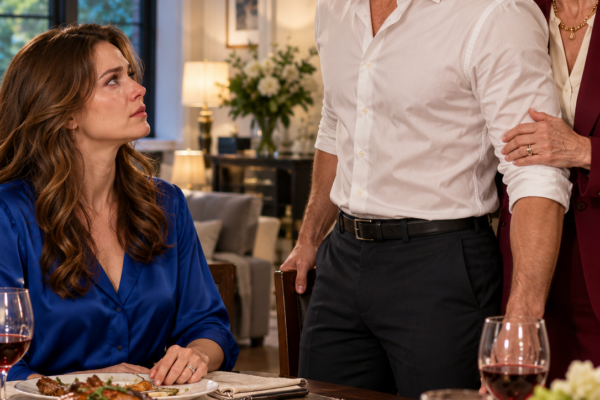
My husband demanded that i donate a kidney to his mistress, my mother-in-law shouted, “sign it and stop making a scene!” as i watched, i overheard their conversation and discovered a shocking truth that changed everything…
It was Monday, October 6. The clock on the stove read 6:41 a.m., and from Charles Street below came the metallic screech of the first Green Line train.
Ethan was already awake. He stood beside the window in the shirt I had ironed for him the night before, typing something on his phone. When I entered the kitchen, he immediately turned the screen facedown.
“Starting early,” I remarked.
“Someone in this house has to work beyond the kitchen table.”
He said things like that often, always with the same crooked smile, as though wrapping an insult in a joke somehow made it harmless.
I had worked in the medical industry for eleven years. I wasn’t a doctor, and I didn’t wear a white coat. My job involved legal compliance, data protection, and internal audits for a company that manufactured hospital equipment. In practical terms, that meant I could identify a forged signature buried in a three-hundred-page document, recognize an unauthorized financial transfer, and ask the question everyone else preferred to avoid.
For the previous fourteen months, I had worked mostly from home. After my father’s stroke, I drove to Worcester three times a week to buy his groceries, supervise his physical therapy, and organize his medications. Ethan called it my private mission to save the provinces. His mother, Eleanor, said a normal woman would hire a caregiver and concentrate on her husband.
Neither of them understood one simple thing: my father had never made me feel like a burden.
Ethan hadn’t always been like this. When we first met at a conference in Boston, he admired the fact that I could talk as comfortably with a hospital CEO as I could with the technician repairing an infusion pump. He used to tell me I possessed a rare kind of intelligence. After we married, he gradually began calling that same quality arrogance.
That morning, he set a pot of coffee in front of me and announced that he was taking me to dinner that evening.
“No laptops, no calls from your dad. Just us,” he said.
For the first time in months, it sounded like an invitation rather than an order.
I spent the entire day allowing myself to believe he wanted to talk about our marriage. About why he had begun turning toward the wall when we went to bed. Why he showered the moment he came home from work. Why, every other Thursday, he attended regional meetings that somehow continued until after midnight.
At 7:12 p.m., we entered an elegant restaurant near Copley Square. The polished wooden tables glowed beneath warm lighting, waiters moved quietly between them, and beyond the windows, the rain softened the city lights into blurred reflections on the wet pavement.
At a corner table, Eleanor was already waiting.
She wore a cream-colored jacket and a strand of pearls. In front of her sat an open bottle of mineral water and a gray folder.
Whatever hope I had brought into the restaurant disappeared.
“You’re seven minutes late,” she said in greeting.
“Traffic on Massachusetts Avenue,” I explained.
“People from the provinces always blame the journey. People with class simply arrive earlier.”
Ethan sat down beside his mother, not beside me.
The waiter brought our menus, but Eleanor pushed hers aside.
“First, the important matter,” she announced. “The food can wait.”
Ethan rested his hand on the gray folder.
“It’s about Patricia Cruz. Do you know the name?”
I shook my head.
“She works with our network,” he explained. “Marketing, information campaigns, patient outreach. She’s been suffering from kidney failure for several years. She’s on hemodialysis, and lately her condition has gotten worse.”
Eleanor sighed as though she herself had just returned from a dialysis session.
“Such a young, valuable woman. It’s an injustice.”
Ethan opened the folder. Inside were printouts of laboratory results, excerpts from medical consultations, and a sheet of paper bearing a handwritten blood type.
My blood type.
“Where did you get this?” I asked.
“I took it from the file cabinet at home. It’s hardly a secret, Sarah. You’re O positive.”
“My medical records are my business. Why are you discussing them with your mother and a stranger?”
A muscle twitched in his jaw.
“Don’t be dramatic. This is about someone’s life.”
He slid a brochure about living kidney donation across the table.
“You could be a match. You should start the tests.”
For several seconds, all I could hear was silverware clinking against plates at the next table.
“I should?” I repeated.
“A healthy person can function normally with one kidney.”
“But who is Patricia to me?”
“A friend of the family.”
“I’ve never even heard of her.”
Eleanor leaned back in her chair.
“Because for the last several years, you’ve only been interested in your spreadsheets, your father, and your own comfort. Patricia doesn’t need your friendship. She needs a kidney.”
My stomach tightened into a hard knot.
“I’m not making a decision like this over dinner.”
“What decision?” Eleanor scoffed. “You have two. You give one. It’s not a matter of philosophy.”
Ethan leaned toward me.
“Nobody’s asking for your life, Sarah.”
“You’re asking for surgery, risks, pain, and a long recovery. And you’re doing it without even asking whether I want to meet this woman.”
Eleanor traced one finger around the rim of her glass.
“My son took you out of Worcester, gave you a condo in Boston, a respected name, and access to a social circle you would never have entered on your own. Gratitude should take some form.”
“We bought the condo together,” I replied. “The mortgage may have been approved partly because of Ethan’s position, but the payments have also been coming out of my account for seven years.”
Her eyes narrowed.
“That’s exactly why you’ll never be one of us. We’re talking about saving a life, and you’re counting mortgage payments like some back-office accountant.”
Ethan didn’t defend me. He looked at me coldly, the way a supervisor might regard an employee who had become difficult to manage.
“Will you go for the consultation?” he asked. “You can decide afterward.”
“A consultation isn’t consent.”
“Of course,” he answered far too quickly.
I agreed only to an informational appointment. I wanted to understand the procedure, and I wanted to meet Patricia before I could even consider making such an enormous sacrifice for someone I didn’t know.
In the parking garage, Ethan walked several feet away and pulled out his phone. I stood beside the passenger door, searching through my purse for my keys.
“She agreed,” I heard him say. “Yes, Mom. I told you we just had to pressure her the right way.”
When he turned around a moment later, I managed a weak smile. I didn’t want him to know I had overheard.
The first appointment was scheduled for October 13 at 8:17 a.m.
Ethan insisted that we arrive early, although he spent nearly the entire drive texting. When we stopped at a red light near Massachusetts General Hospital, his phone lit up with a message.
“We’re on our way. Don’t be nervous. I’ll handle everything.”
I couldn’t see the recipient.
Ethan cleared his throat and turned the phone facedown on the seat.
“Work?” I asked.
He offered no real explanation.
Ethan wasn’t a doctor. He managed the administration of a regional network of dialysis clinics, yet he spoke about patients as though each of them personally owed him their life.
The clinic hallway smelled of disinfectant and machine-brewed coffee. Pamphlets lined the walls, explaining informed consent, surgical risks, and a donor’s right to withdraw from the process at any stage.
I read every sentence carefully.
Beside me, Ethan tapped his foot impatiently.
“You don’t need to analyze the brochure like it’s a mortgage contract,” he muttered.
“This is about my body.”
“I know. You’ve been repeating that for a week.”
That was when Patricia appeared.
She was thin, pale, and visibly exhausted. Her dark hair was pulled back at the nape of her neck, and she wore a navy-blue coat with a gray scarf. She didn’t look like someone trying to invite pity. She looked like a woman whose entire existence had long been organized around laboratory tests, dialysis sessions, and medical appointments.
She went straight to Ethan.
“Ethan, you’re here,” she said.
She laid a hand on his forearm. The touch lasted perhaps a second, but then she reached up and straightened his collar.
“It’s always crooked.”
It was the kind of familiar, absentminded gesture people make when they’ve done the same thing countless times before.
Ethan took half a step backward only after noticing that I was watching.
“Sarah, this is Patricia. Patricia, my wife.”
“I know,” she answered.
Her eyes moved across my face with an expression I couldn’t identify at the time. It wasn’t gratitude. It was caution.
“Ethan said you offered to get tested yourself,” she continued. “I don’t know how to thank you.”
I didn’t answer immediately. Instead, I looked at my husband.
“Is that really what you told her?”
Ethan shoved his hands into his pockets.
“Sarah doesn’t like to make a big deal about herself.”
“I didn’t offer to donate,” I said clearly. “I agreed to come for a consultation.”
Patricia grew even paler. For a moment, her eyes darted toward Ethan.
“I thought we’d clear everything up,” he interrupted. “No point getting worked up before the tests.”
A nurse called my name before I could answer.
Dr. David Weiss had a calm voice and a habit of putting down his pen before asking an important question. He began by explaining that blood-type compatibility alone determined nothing. He described the necessary tests, the medical evaluation, the psychological consultation, and the importance of establishing that a potential donor’s decision was entirely voluntary.
Ethan immediately began answering for me.
“Sarah is healthy. She’s a nonsmoker, drinks only occasionally, and has no family history of kidney disease.”
Dr. Weiss looked directly at him.
“I’m going to ask Mrs. Miller.”
After a few minutes, the doctor asked Ethan to wait in the hallway.
My husband stiffened.
“We don’t have any secrets from each other.”
“In this procedure, a private conversation is standard,” Dr. Weiss replied. “Please close the door on your way out.”
When we were alone, silence settled over the office. The air conditioner hummed steadily, and rain dotted the windowpane.
Dr. Weiss opened a form.
“How long have you known the recipient?”
“Since today.”
He looked up.
“Your husband indicated that you’ve known her for several years.”
“That’s not true.”
“Did the idea to donate a kidney come from you?”
“No.”
“Is anyone tying your decision to your marriage, your home, your finances, or your moral standing?”
I wanted to say no.
The word caught in my throat.
I remembered Eleanor sitting beneath the restaurant’s warm lights, reminding me that her son had supposedly given me a condo, a respected name, and a place in Boston society.
“My husband thinks I have an obligation to help,” I finally said. “His mother does, too.”
“And you, Mrs. Miller?”
That question hurt more than all of Eleanor’s accusations because I didn’t know the answer.
I felt genuine compassion for Patricia. The thought of her having to connect herself to a machine several times a week filled me with sadness. But compassion didn’t erase my fear of surgery, and it didn’t create a personal bond where none existed.
“I don’t know,” I admitted.
The doctor nodded.
“‘I don’t know’ is an honest answer. Remember one thing: you can stop this process at any stage, without your husband’s consent or your family’s consent. You don’t have to prove to anyone that you have a reason.”
“And what will you tell the recipient?”
“Only what we’re permitted to say under confidentiality rules. Your safety is just as important as the recipient’s health.”
When I left the office, Ethan sprang up from his chair.
“What did you tell him?”
“The truth. That I met Patricia today.”
His expression hardened.
“Couldn’t you have just said you knew each other from company events?”
“I don’t know her from any events.”
Patricia sat a few feet away, pretending to read a text message. Her fingers weren’t moving on the screen.
Ethan remained silent all the way home. Only when we reached the parking garage did he slam his palm against the steering wheel.
“Because of your nitpicking, everything is going to be delayed.”
“Because of my honesty, you mean?”
“Because of your lack of flexibility. These procedures are created for people who can’t assess their own situations. We know what we’re doing.”
“We don’t,” I replied.
That evening, the printer in my home office suddenly began running.
I was in the kitchen holding a cup of tea when I heard the mechanical whir of paper feeding through the machine. Six pages lay in the output tray, headed Declaration of Relationship with Potential Recipient.
I read the first page.
According to the document, I had known Patricia for nine years. I had supported her throughout her treatment, regarded her as a sister, and personally proposed donating my kidney. The declaration stated that I was acting voluntarily, without pressure from anyone.
On the last page was a space for my signature.
Ethan walked into the room before I could put the papers down.
“Good. You found it.”
“What is this?”
“The lawyer prepared a version that won’t raise any questions.”
“You mean a false version.”
“An effective version.”
“I haven’t known her for nine years.”
“No one’s going to check whether you had coffee together in 2017.”
“You want me to lie to the doctor, the psychologist, the committee, and the court?”
He sighed as though I had asked something childish.
“You just need to stop blocking the chance to save someone’s life over formalities.”
In the upper-right corner of my laptop screen, I noticed the file properties.
Author: E. Miller.
Created at 2:26 p.m. on his work laptop.
I made a mental note of it.
Two days later, Eleanor hosted lunch at her house in Brookline. Seated around the table were her brother and his wife, one of Ethan’s cousins, and two family friends.
Before the soup had even been served, everyone knew that I was supposedly hesitating to save Patricia’s life.
“I don’t see what there is to think about,” the cousin said. “If someone in my family needed help—”
“Patricia isn’t my family,” I replied.
Eleanor put down her spoon.
“Are you all hearing this? A young woman is fighting for her life, and this small-town auditor is inventing her own category of people who are sufficiently close to deserve help.”
“I didn’t say I wouldn’t help her. I said I won’t agree to lies and pressure.”
“Pressure?” My mother-in-law gave a harsh laugh. “You make a risk-assessment chart just to choose curtains. Patricia doesn’t have time to wait for your spreadsheets to make you feel important.”
Ethan continued eating without saying a word.
“Say something,” I pleaded.
He finally looked up.
“You’re the one making a scene out of this.”
We drove home in silence.
By October 28, I had begun paying attention to things I had once dismissed without a second thought. That day, I opened the car’s app to check the inspection date. In its route history, I noticed an address on Boylston Street.
The same location appeared nine times over two months, always at night and always on dates when Ethan claimed he was attending training sessions or regional meetings.
I checked the building number.
It was where Patricia Cruz lived.
Then I found a hotel receipt for $180. It listed two dinners, wine, and a room paid for with Ethan’s card on a night when he had supposedly been in Hartford.
I took thirty-seven screenshots and emailed them to my private account.
For the first time in eleven years, I changed my email password.
The following evening, I placed the printed hotel receipt on the table.
Ethan came home from work at 7:30 p.m. He smelled of expensive perfume I didn’t wear and mint gum. He removed his coat, saw the paper, and paused for just a second without asking what it was.
That second was long enough.
“How long have you been sleeping with Patricia?” I asked.
I didn’t shout. I was surprised by how calm my voice sounded.
Ethan sat across from me, looked at the receipt, and then looked at me.
“You went through my things.”
“This is a charge on our joint account,” I pointed out. “You didn’t answer my question.”
“Neither did you.”
For several moments, he twisted his wedding ring around his finger. Then he removed it and placed it beside the receipt.
“Two years.”
The air left my lungs without a sound.
Two years.
My father’s birthday. Our wedding anniversaries. Christmases spent with Eleanor. Every business trip, every late night, every occasion when I asked whether something was wrong and he told me I was being too sensitive.
“Two years,” I repeated.
“Don’t pretend to be surprised. There hasn’t been anything between us for a long time.”
“Two weeks ago, you told me I was the most important person in your life.”
“I wanted to keep the peace.”
“And now you want me to give a kidney to your mistress.”
“Don’t reduce this to some affair. Patricia is sick.”
“That’s exactly why you should have told me the truth from the very beginning.”
He leaned across the table.
“If I’d told you, you would have refused out of jealousy.”
“You don’t know what I would have done.”
“I know you. You analyze everything until a person becomes nothing more than a procedural problem.”
I stared at him and couldn’t recognize the face I had looked at every day for eleven years.
The same eyebrows. The same small scar beside his chin.
A completely different man.
“When were you planning to tell me you were leaving after the surgery?”
His gaze flickered.
“Who said I’m leaving?”
“You did, by not denying it.”
He stood abruptly.
“I’m not going to be interrogated in my own home.”
“This is my home, too.”
“Are you going to start counting the mortgage payments again?”
Twenty minutes later, the front door opened.
Eleanor had her own key. She had never asked my permission to keep it.
She walked into the kitchen as though arriving at a board meeting.
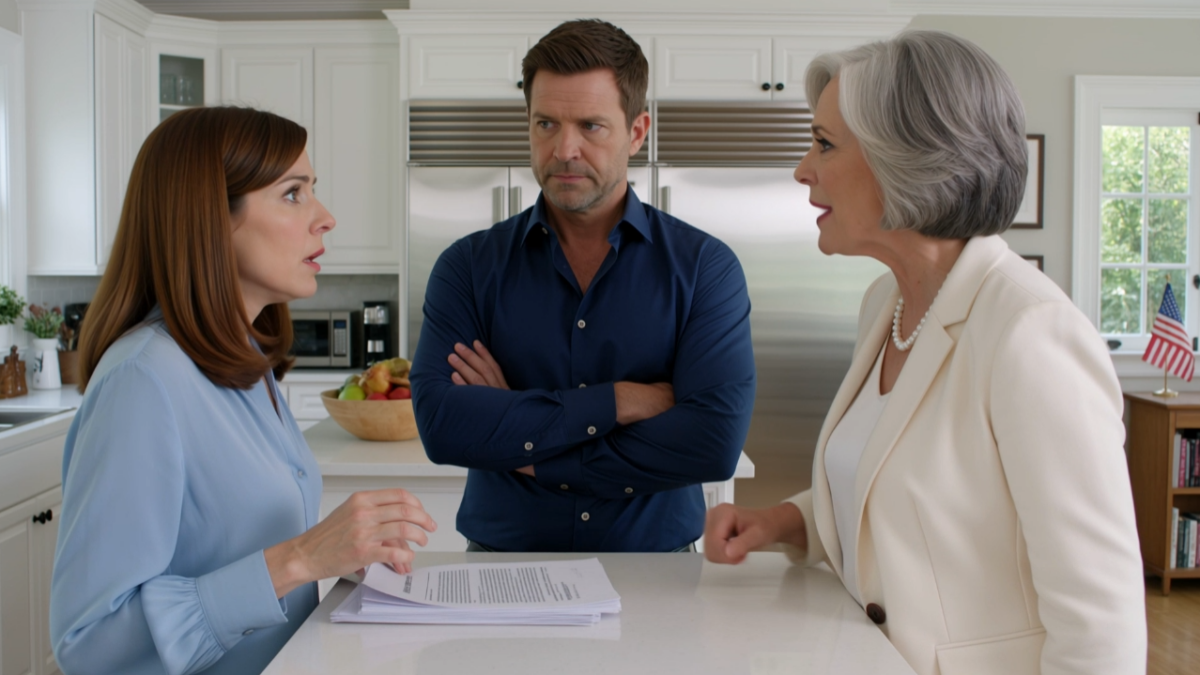
“Ethan said you made a scene.”
“Ethan admitted he’s been having an affair with Patricia for two years.”
“An affair is a word used by women who can’t keep their husbands interested,” she snapped.
“And what do you call demanding that I give my kidney to his mistress?”
Eleanor removed her gloves, pulling them off one finger at a time.
“I call it an opportunity for you to behave with class for the first time.”
A short, bitter laugh escaped me.
“Class?”
“You couldn’t hold on to your marriage. You treated your father as though he were the only man in the world. You spent your days in sweatpants in front of a laptop. And now you’re surprised my son became interested in a woman who is polished, ambitious, and present. The least you can do is help her live.”
“Patricia knows I never agreed to the surgery.”
“Stop playing with words. You went to the consultation.”
Ethan slammed his hand against the counter.
“Enough. You’re going to sign the declaration and end this circus.”
“I’m not signing a lie.”
His face flushed.
“In that case, you’ll make your situation much worse.”
Silence fell over the kitchen.
It was the first sentence that sounded unmistakably like a threat.
“What situation?” I asked.
Eleanor answered for him.
“After the surgery, you’ll need to rest. You can recover at our house. Ethan will take care of the rest. No one’s going to throw you out on the street overnight.”
“Overnight?”
That word settled over me like ice.
“And after that?”
Eleanor looked away.
Ethan picked up his wedding ring from the table and slid it back onto his finger.
“We’re not talking about that now.”
Two days later, at 10:23 a.m., I received an email from the law firm that had handled Ethan’s company’s legal affairs for years.
The subject line read: Draft Agreement — Post-Review Comments.
The message was intended for Ethan and his attorney. My email address had been included in the CC field, probably because I had communicated with the firm years earlier about our mortgage agreement.
I was never supposed to receive that correspondence.
But I did.
Attached were seventeen pages.
There was a draft of a no-fault divorce agreement, a proposal that Ethan retain the condo, and a clause waiving my claim to a portion of our investments. An itemized list of belongings assigned me the desk, chair, two bookshelves, and coffee machine from the study.
The next page contained an appraisal of our condo.
The final page listed the planned date for Ethan’s move into the Boylston Street apartment.
Six weeks after my scheduled surgery.
I checked the file properties. The first version had been created on September 20, before Ethan had even approached me about donating a kidney. The accompanying timeline made it clear that the divorce had already been planned before our dinner conversation.
Before he asked me for a part of my body, he had already decided how to divide our marriage.
I opened our bank statements again.
This time, I wasn’t looking at them as a wife.
There was a $4,000 transfer to a remodeling company. The work address was on Boylston Street.
Another $2,200 had gone toward a refrigerator and washing machine.
There was a $500 payment for a private nephrology consultation and a $900 deposit on a condo in Fort Myers for the following May.
Money had been disappearing for months, scattered among transactions small enough that no single charge seemed especially alarming.
Together, the payments told a different story.
They were building a new life.
His life, not ours.
That evening, I told Ethan I needed two more days and that, after changing a few sentences, I would probably sign the declaration.
Relief crossed his face so quickly that I almost missed the contempt concealed beneath it.
He brought home flowers. He cooked dinner and opened a bottle of wine, even though he knew I never drank during the week. Then he stood behind me in the kitchen and wrapped his arms around my waist.
My entire body went rigid.
“I knew you’d come to your senses,” he whispered.
I didn’t pull away.
Not because I had forgiven him.
For the first time, I wanted him to believe that he could still manipulate me.
The next day, Ethan told me the corrected documents were at his mother’s house. He claimed to have a business dinner that evening and asked me to pick up the folder around eight.
I arrived an hour early.
Eleanor lived on a quiet street in Brookline. Damp autumn leaves clung to the sidewalk, and the air carried the cold, earthy smell of rain-soaked pavement.
Ethan’s car was parked in the driveway.
He was supposed to be at a meeting.
The front door stood slightly ajar. Eleanor usually locked it twice, even when she was only stepping outside to take out the trash.
I pushed it open and stepped inside.
Voices drifted from the study.
The first belonged to a man I didn’t recognize.
“The settlement has to be signed while Mrs. Miller is of sound mind. If she’s taking strong postoperative medication or she’s in poor condition, we can’t rush anything.”
“Of course,” Ethan replied. “This is just preparation.”
“And one more thing,” the man continued. “The declaration about her relationship with the recipient must be truthful. The committee can ask detailed questions. If the donor candidate feels pressured, the procedure will be halted.”
“Sarah wants to help of her own free will.”
Papers rustled.
“In that case, there shouldn’t be a problem. I’ll send the revised version tomorrow morning.”
I heard a chair move, followed by footsteps.
I quickly backed into the dim alcove beside the staircase.
The man emerged from the study and passed without noticing me. Eleanor accompanied him to the front door, exchanged a few final words, and returned to the study.
“I don’t like how he keeps repeating the words ‘sound mind,’” she said.
“Lawyers always protect themselves,” Ethan replied. “Sarah will sign.”
“And if she backs out anyway?”
“She won’t back out. I told her she can recover here after the surgery.”
“Here?”
“You’ll watch her. Make sure she doesn’t call her father or talk to people from work.”
My heart hammered against my ribs.
I took out my phone and started recording.
“How long will she stay?” Eleanor asked.
“A week, maybe ten days. When she’s exhausted and medicated, we’ll show her the settlement. We’ll tell her she has to sign if she wants peace and care.”
“And if she starts reading every clause like the little bean counter she is?”
“She won’t have the strength. Besides, we have a second argument.”
A chair scraped across the floor.
“The declaration,” Ethan continued. “If she lies to the committee and the court, she’ll be in trouble herself. I’ll tell her that if she doesn’t sign the divorce papers, I’ll report that she deliberately deceived the process.”
Eleanor laughed softly.
“Brilliant. First, she puts the noose around her own neck.”
“Exactly.”
I gripped the phone so tightly that my fingers began to ache.
“And the money?” my mother-in-law asked.
“The day before the surgery, I’ll transfer most of the funds into the company account as a liability guarantee. Before she can start asking questions, the money will be out of her reach.”
“And the condo?”
“The settlement takes care of that. She waives her claims, I take over the mortgage, and six weeks after the surgery, I move in with Patricia.”
“Does Patricia know all this?”
There was a brief silence.
“She knows I’m getting a divorce. She doesn’t need to know how I’m protecting the money.”
“Good. The less women know, the easier they are to manage.”
Ethan gave a dismissive chuckle.
“After the surgery, Sarah will be too weak to fight for the condo.”
“First, she gives Patricia the kidney, and then she signs the divorce settlement,” Eleanor said. “If she starts making demands, we’ll remind her that she lied to the ethics committee.”
“Six weeks after the operation, I’m moving into Patricia’s place. Sarah won’t be needed for anything anymore.”
I stood in the hallway clutching the folder containing my test results, its plastic cover crackling beneath my fingers.
This was the moment you heard at the beginning of my story.
Only now, I wasn’t certain I could leave the house without screaming.
Eleanor spoke again.
“A woman with one kidney, no husband, and no money isn’t going to make demands. At best, she’ll go back to that paralyzed father of hers, and the two of them can count pills together in Worcester.”
The folder slipped from my trembling hands.
I managed to catch it against my knee an inch above the floor.
Inside the study, a chair scraped backward abruptly.
“Did you hear something?” Ethan asked.
I backed into the powder room and carefully closed the door, keeping the latch from clicking. In the darkness, I stood perfectly still and listened to footsteps moving along the hallway.
Eleanor peered into the foyer.
“Must have been the neighbor’s cat on the deck,” she said after a moment.
I waited another thirty seconds.
Then I flushed the toilet, opened the door, and stepped into the hallway as though I had only just arrived.
“The front door was open,” I announced.
Eleanor froze.
“You were supposed to come at eight.”
“I finished early.”
For a moment, both of them stared at me.
Beneath my coat, sweat trickled down my back.
“The folder is here,” Eleanor said.
She handed me the documents and smiled.
“You’re finally making an adult decision.”
I looked directly into her eyes.
“Yes,” I said. “I just made one.”
When I reached my car, I locked the doors and tried to put the key in the ignition. My hands shook so badly that I dropped it onto the floor.
Then my stomach lurched.
I bent forward and vomited into a paper bag I found in the glove compartment.
Afterward, I sat motionless for nine minutes.
The recording on my phone showed eleven minutes and thirty-seven seconds.
I called my father.
“Sarah?” he answered, his voice thick with sleep. “Is everything okay?”
I wanted to tell him everything.
Instead, I dug my fingernails into my palm.
“I’m coming over tomorrow, Dad. I need to tell you something.”
“Your voice is shaking.”
“I’m just tired.”
“Don’t lie to me the way you lie to yourself.”
I closed my eyes.
“Tomorrow,” I repeated.
When I got home, I copied the recording onto an encrypted drive, uploaded another copy to my private cloud account, and saved a third to a USB flash drive.
I named each file using the date, time, and location. Then I wrote a brief note identifying who had been present, what I had heard, and why I had gone to Eleanor’s house.
At 2:14 a.m., my laptop screen finally went dark.
In its black reflection, I saw a woman with swollen eyes and a tightly clenched jaw.
The same woman who, only that morning, had still been wondering how to save her marriage.
That night, I stopped wondering.
Tears weren’t evidence.
And evidence was what I needed.
At nine the following morning, I called Diana Castro.
We knew each other professionally. Three years earlier, she had led a training session at my company on whistleblower protection and board-member liability. I remembered her because she was the only attorney I knew who could say something important in ten words instead of a hundred.
She agreed to see me that same day at her office near Post Office Square.
Diana didn’t begin by asking whether I wanted a divorce. She didn’t ask whether I still loved my husband.
She listened to the entire recording, made three notes, and removed her headphones.
“Health first,” she said. “Then documents, then money, and finally emotions. Because only those can wait.”
“Is the recording enough?”
“We’re not building a story about monsters, Sarah. We’re building a collection of facts. The recording is one of them.”
She took a sheet of paper and divided it into four sections.
Medical procedure.
False declaration.
Assets.
Data and work equipment.
Then she explained what I needed to do.
“We don’t touch your husband’s phone. We don’t guess passwords or install cameras. We protect what you can legally access. We describe every file, and we place every financial transfer in context. No emotional text messages, no threats, and absolutely no warning them about what you have.”
“And if they try to rush the medical tests?”
“That’s why you’re going to contact the medical coordinator today.”
Dr. Weiss found time to see me at 3:40 that afternoon.
This time, I went alone.
I sat in the same office, listening to the same steady hum of the air conditioner. The same form lay on his desk, but I was no longer the woman who had sat across from him during our first appointment.
“I do not give my consent,” I said.
Then I told him the truth.
“My husband and his mother are pressuring me. Patricia is my husband’s mistress. They prepared a false declaration and planned to take advantage of my postoperative condition to force me into a divorce.”
Dr. Weiss didn’t appear shocked. Instead, he asked several precise questions.
“Do you feel safe at home?”
“For now.”
“Has anyone threatened you physically?”
“Not directly.”
“Do you have somewhere you can stay if necessary? Would you like to speak with a psychologist or a domestic violence support organization?”
I explained that I had already spoken with an attorney and was taking precautions.
“But I don’t want my husband to know exactly what I told you.”
“We will not disclose the contents of our conversation,” he assured me. “The procedure will be canceled for reasons related to the potential donor’s safety. That’s sufficient.”
He paused before continuing.
“Patricia will continue receiving treatment. One person’s refusal doesn’t mean the end of every possibility. Please don’t allow anyone to make you feel responsible for the course of her illness.”
That sentence stayed with me for a long time.
The next day, I began organizing everything I had collected.
Not chaotically, and not as a betrayed wife searching for reasons to hate her husband.
I approached it as an auditor.
I created a spreadsheet with columns for source, description, access, backup location, risk of tampering, and associated documents.
I entered the recording from Eleanor’s house, the draft declaration with metadata pointing to Ethan’s work computer, the email containing the proposed divorce settlement, and the condo appraisal.
I added the thirty-seven screenshots of the car’s location history, the hotel receipts, and the transfers connected to renovations at Patricia’s apartment. I preserved Ethan’s messages warning that my refusal to sign would have consequences, along with photographs of the documents he had left on our printer.
Every item was dated, categorized, and linked to its supporting evidence.
At 6:05 p.m., I called the bank.
I activated immediate alerts for transactions exceeding $250 and downloaded our account history. I arranged for my salary to be deposited into an individual account while continuing to pay my portion of the mortgage and our shared expenses.
I didn’t take money that belonged to both of us.
I wanted protection, not revenge.
I photographed the contents of our condo and secured the deeds, mortgage agreement, insurance policies, and tax records.
Then I took my passport, diplomas, and my father’s documents to Worcester.
My father, Frank, was sitting at the kitchen table when I told him everything.
Since his stroke, his right hand had moved more slowly, but his eyes were as sharp as ever.
He listened without interrupting.
Only once did he close his eyes, when I repeated what Eleanor had said about him in the study.
“It’s because of me,” he whispered. “If I hadn’t gotten sick, you wouldn’t have had to come here so often. Maybe Ethan—”
“Don’t finish that,” I interrupted.
He looked at me.
“My marriage didn’t end because I helped my father. It ended because my husband saw kindness as a weakness he could exploit.”
My father studied my face for a long time.
“What should I do?”
“Don’t answer Ethan’s calls without telling me. Don’t let him into the house. And keep this envelope somewhere safe.”
“That’s it?”
“That’s it.”
He reached into his pocket and handed me his spare keys.
“You’ll always have your room here, Sarah. You don’t have to pay anyone anything. You don’t have to give anything back. You just have to come.”
I nodded, unable to speak.
Later, sitting in my car, I cried for the first time since the night I made the recording.
Not from helplessness.
From relief.
Two days later, the clinic suspended the medical qualification process.
Ethan called at 11:09 a.m.
“What did you do?”
“I went for a consultation,” I answered. “They said the procedure couldn’t continue.”
“What did you go and tell them?”
“The truth.”
“Get home right now.”
“I’m working,” I replied, glancing down at the slippers on my feet.
“You’re not working at that table. Get back here. Now.”
I ended the call.
At 5:02 p.m., Ethan and Eleanor entered the condo together.
My mother-in-law carried a burgundy folder. Ethan locked the front door with his key, even though I was sitting inside.
He walked directly to my desk, took a document from the folder, and laid a pen beside it.
“You’re going to sign the new version,” he said. “Tomorrow we’re going to clear up this misunderstanding.”
“I’m not signing.”
Eleanor removed her coat and tossed it onto my desk.
“Only someone with the mentality of a servant would cling so desperately to her own health when a better woman needs help.”
“My health is not your property.”
“Everything you have, you owe to Ethan.”
“That’s not true.”
“You’re sitting in my son’s condo. You’re breathing air bought with his position. And now you’re playing the grand lady. Without him, you’d be some girl from Worcester checking invoices in a cubicle.”
Ethan pushed the pen closer.
“Sign. Don’t make your situation worse.”
I looked at the document, then at him.
“My body is not marital property,” I said. “It cannot be transferred, mortgaged, or seized.”
Eleanor raised her hand.
Halfway through the motion, she noticed the phone lying beside my laptop.
Her arm stopped.
“You can finish,” I told her. “The full audio recording will be much clearer.”
Her expression changed.
She didn’t turn pale.
Her face darkened.
“You’re recording us? This conversation is being recorded?”
Ethan lunged for the phone, but its screen was locked with facial recognition.
I pressed the emergency button on my smartwatch.
The device began transmitting my location to Diana and my father.
Ethan dropped the phone.
“Have you lost your mind?”
“No,” I answered. “I’ve just stopped ignoring the facts.”
They left eight minutes later.
They took the document with them, but they left a trail.
The camera at the building’s entrance recorded their arrival and departure. The audio of our confrontation had already been saved automatically to my cloud account.
That same night, Ethan made a mistake he could never erase.
Using his company laptop, he emailed Patricia the corrected draft of my declaration.
In the body of the message, he wrote:
“Sarah will give in. As a last resort, we’ll use the condo argument. Do not reply to this address.”
He also attached excerpts from my medical donor-evaluation file, information he should never have accessed or used for personal purposes.
I didn’t see that email at the time.
I didn’t hack his account or search through his computer.
I learned about it later, after Diana filed a formal complaint on my behalf with the company’s data protection officer and senior management.
We submitted only documents concerning me that I had obtained through lawful means. The company secured Ethan’s devices and discovered the remaining correspondence through its own investigation.
The timing could hardly have been worse for him.
In ten days, Ethan was scheduled to open a national conference in Boston devoted to the ethics of renal replacement therapy.
His photograph appeared on the promotional materials beside the slogan:
“The Gift Begins with Trust.”
Diana read the slogan twice.
“We’re not going to take over their screens or stage a spectacle,” she said. “We’ll present the facts. The company itself will decide whether a man suspected of coercing a donor should speak publicly about trust.”
She laid the promotional brochure on her desk.
“And if they protect him, we’ll know the problem is bigger than one man.”
When I returned home, Ethan was asleep on the sofa. His work laptop lay closed on the coffee table.
I sat in the armchair and watched him for several minutes.
Once, I had considered this man my safe harbor.
At one in the morning, I sent Diana the final batch of files and turned off the light.
In the days that followed, a sharp silence settled over the condo.
Ethan no longer pretended to be concerned about me. He left before seven, returned late, and took his phone calls in the building’s stairwell.
Eleanor sent messages accusing me of moral homicide and predicting that I would eventually be punished for my selfishness.
I never replied.
On Wednesday morning, Ethan’s company opened an internal audit.
I didn’t know what the investigators had discovered. Diana had warned me that the company would not share correspondence involving third parties or disclose the findings before the inquiry was complete.
All I knew was that Ethan had been summoned to a meeting and had emerged looking as though the skin had been pulled too tightly over his bones.
That night, he confronted me.
“You complained to my company.”
“I reported suspected misuse of my medical data and company equipment for personal coercion.”
“You have nothing to do with the computer I use.”
“When you draft a false declaration in my name on your work computer, it becomes my business.”
“You’re going to destroy my career.”
“No. I’m not the one who wrote those documents.”
He moved closer.
“Withdraw the complaint. Don’t think you’re going to win just because you have a few printouts.”
“I don’t want to win, Ethan. I want you to stop having the power to decide for me.”
For the first time, I saw genuine fear in his eyes.
Not fear of losing his wife.
Fear of losing his position.
The day before the conference, Patricia called me.
I recognized her number from the case documents, but we had never spoken without Ethan present.
“We need to meet,” she said.
“We don’t.”
“Please, Sarah. Twenty minutes.”
I hesitated before answering.
“A public place.”
We met at a café near the Public Garden.
Patricia looked worse than she had at the clinic. Deep shadows lay beneath her eyes, and her hands were wrapped around a coffee cup that had long since stopped steaming.
“The company called me in to give a statement,” she began. “They showed me Ethan’s email. The one about the condo.”
I remained silent.
“I knew he was planning a divorce,” she continued. “I also knew the two of you were only together on paper. At least, that’s what he told me. He said you’d offered to get tested because you didn’t want my illness to become another source of conflict between you.”
“You heard at the clinic that wasn’t true.”
She lowered her eyes.
“I should have walked away then.”
“Yes,” I replied.
I had no intention of comforting her.
“I didn’t know about the settlement after the surgery,” she continued. “I didn’t know he planned to divert the money or that his mother intended to isolate you. But I knew he was married. For that, I have no excuse.”
She reached into her purse and took out a printed sheet.
It was an email from Ethan to Eleanor.
“Don’t talk to Patricia about protecting the funds until Sarah signs. Patricia has to believe everything will be divided fairly.”
I read it once, then placed it on the table.
“He was deceiving both of us,” I said. “That doesn’t put us in the same position.”
For the first time, I looked at Patricia without anger.
“No,” she agreed. “It doesn’t.”
She folded her hands around the cup again.
“I’m giving a full statement, and I don’t want Ethan contacting me about a donor anymore.”
“Your treatment still has to continue.”
“I know. I’ll stay in the program. I’ll continue dialysis and wait according to the medical protocol.”
She looked directly at me.
“I don’t want a kidney someone donates out of fear.”
That was the only sentence I needed to hear from her.
We didn’t become friends. We didn’t embrace when she stood to leave, and neither of us made promises about keeping in touch.
We simply went our separate ways.
The conference was held in an elegant hotel near downtown Boston. The ballroom had soaring windows, graphite-colored curtains, and a projection screen nearly forty feet wide.
On that screen was Ethan’s photograph, beside the slogan about trust.
Rows of chairs near the stage had been reserved for representatives of medical clinics, patient associations, and technology companies.
I arrived with Diana at 9:31 a.m.
Ethan stood near the stage in a navy-blue suit, talking to several board members. His gestures were quick and restless. Every few seconds, he straightened his cuffs.
Eleanor sat in the front row wearing a red dress.
When she noticed me, she smiled with open contempt.
“Come to see what a real career looks like?” she asked as I passed.
“I came to hear about trust.”
“You wouldn’t understand the word.”
I didn’t answer.
Diana and I took seats in a section off to the side.
At exactly ten o’clock, the lights dimmed.
The host introduced Ethan as an experienced director and an ambassador for responsible cooperation with patients.
Applause filled the ballroom.
My husband walked confidently onto the stage.
“Trust between the patient, the family, and the medical team is the cornerstone of every decision involving donation,” he began. “Without trust, even the best procedures are nothing more than dead letters on a page.”
He spoke two more sentences.
Then Constance Sores, the company’s CEO, rose from the front row.
“Please turn off Mr. Miller’s microphone.”
The room fell silent.
Ethan turned toward her.
“Constance?”
She walked onto the stage carrying a thin black folder.
“Due to serious allegations revealed today concerning violations of internal compliance rules, breaches of data confidentiality, and coercion of a potential living donor, the board of directors has decided to suspend Mr. Miller from all his duties, effective immediately.”
Someone in the third row dropped a pen.
The small, sharp sound echoed across the floor.
“This is slander,” Ethan said.
Constance continued without raising her voice.
“The company is also withdrawing its support for this conference. Mr. Miller, please hand over your work laptop, company phone, and identification badge to our legal representative.”
Phone screens began lighting up throughout the audience.
Ethan seized the laptop resting on the lectern.
“You have no right to take my equipment.”
“It is company property,” Constance replied. “The seizure is being conducted in strict accordance with our internal regulations.”
The company’s attorney approached the stage. A security guard positioned himself two steps away without touching anyone.
His presence alone was enough.
Eleanor sprang to her feet and pointed at me.
“That manipulative girl from the provinces fabricated this entire thing because she’s jealous of my son’s position!”
Dozens of faces turned in my direction.
I rose slowly.
“Your son drafted the documents himself, sent the emails, and used company equipment. I simply stopped protecting him from the consequences.”
“You’re lying!”
“In that case, the audit should clear his name.”
Eleanor opened her mouth but said nothing.
Ethan came down from the stage.
He approached until he was close enough that I could smell his cologne.
“You destroyed my life over one mistake,” he hissed.
I looked directly at him.
“The affair was a betrayal. The false declaration was a choice. Planning to take the money was a choice. Trying to exploit my condition after surgery was a choice.”
I kept my voice steady.
“Don’t call a series of decisions a mistake.”
His expression twisted.
“Because of you, Patricia might not live long enough to receive a transplant.”
“Don’t use my treatment to blackmail anyone else.”
The voice came from behind him.
Patricia stood at the entrance to the ballroom.
Ethan spun around.
“What are you doing here?”
“I’ve given my statement, and I’m ending whatever was between us.”
“I did this for you.”
“No, you didn’t.”
Her voice was quiet, but the room had become so silent that every word carried.
“You did it because you wanted a wife, money, and a condo without taking responsibility for the consequences of your own decisions.”
Eleanor hurried toward her.
“After everything my son did for you—”
Patricia faced her without a trace of gratitude.
“Your son took advantage of my illness, and you helped him try to dispose of another woman’s body. Don’t confuse that with helping.”
Watching Eleanor, I realized something inside her had finally broken.
Not her conscience.
Her sense of control.
For years, her tone of voice, her son’s last name, and the assumption that everyone feared a scandal had been enough to bend people to her will.
Now, no one wanted to play the role she had written for them.
Constance asked security to escort Ethan out of the conference area.
He wasn’t handcuffed. There were no police officers or sirens, and no court delivered a sentence that morning.
But he lost the stage, his position, and the ability to control the story everyone else heard.
For that day, it was enough.
As he was leaving, Ethan turned and looked at me.
“And now what are you going to do?”
“Exactly what you feared most,” I replied. “I’m going to make decisions without you.”
The investigations continued for months.
The company examined correspondence, financial records, expenses, and data-access logs. Its data protection officer investigated how information from my medical evaluation had ended up on Ethan’s work computer. Attorneys examined the false declaration, and the bank documented the history of financial transfers.
The case wasn’t resolved in a dramatic five-minute confrontation.
Real consequences rarely happen that way.
They arrive through certified letters, filing deadlines, suspended access privileges, and questions that can no longer be answered with a charming smile.
Ethan lost his executive position.
In an industry built on ethical responsibility and professional trust, it was difficult for him to explain why he had been suspended during his own lecture about the importance of trust.
He wasn’t immediately arrested, nor did he end up begging on the street. His life simply became smaller and more difficult.
He had to sell his car, reduce his expenses, and eventually rent a modest apartment after our shared home was divided according to our actual financial contributions.
Our divorce was finalized eight months later.
I didn’t get everything, and Ethan didn’t get what he had planned to take.
An independent expert examined the improvements made to the condo, the mortgage payments, and the funds that had been diverted from our accounts.
Most of the expenses connected to Patricia’s apartment were successfully challenged in court.
The divorce agreement I was supposed to sign immediately after donating my kidney became one of the most important pieces of evidence.
It demonstrated that Ethan had intended to exploit the physical vulnerability I would have experienced after surgery.
Even in court, he tried to tell our story in a way that favored him.
He claimed the documents were merely preliminary drafts, that the money had been used to support a sick acquaintance, and that I had exploited his extramarital relationship to destroy his professional reputation.
He spoke smoothly.
Ethan had always known how to sound reasonable, until someone placed the dates beside one another.
Diana presented a printout of the divorce agreement, its editing history, and the timeline of my transplant appointments to Ethan’s attorney.
“The first draft existed before Mrs. Miller was approached about organ donation,” she pointed out. “The husband’s planned move was scheduled to coincide with her recovery period.”
She placed the next document beside it.
“At the same time, a false declaration was prepared to establish a close personal relationship with the patient who was supposed to receive the kidney.”
The dates, file properties, and financial records were laid out in chronological order.
“These aren’t random thoughts,” Diana said. “This is a documented sequence of events.”
Ethan’s attorney had little to add.
Ethan looked at me.
In the past, that look would have been enough to make me doubt myself, soften my words, or invent excuses for him.
This time, I sat upright and remained silent.
I didn’t need to embellish the facts.
They were already part of the court record.
After the hearing, Ethan stopped me in the hallway.
People passed us carrying briefcases. Someone nearby was speaking quietly on a phone, and a coffee machine dispensed a plastic cup with a dull thud.
Ethan looked much older than he had on the morning of the conference.
“Did you really have to give them everything?” he asked.
“Did you really have to do everything you did?”
“I wanted to help Patricia.”
“If helping her had been your only intention, you would have told me the truth. You would have respected my refusal. You wouldn’t have planned a divorce behind my back for the days when I might have struggled to get out of bed on my own.”
“My mother crossed a line.”
“And you were standing right beside her, adding the details.”
He looked away.
“We could have handled this privately.”
“Privately, you tried to steal my right to choose. What became public were the consequences of your professional conduct.”
He fell silent.
For the first time, he didn’t try to stop me when I walked away.
Throughout that process, I learned another lesson.
Many people imagine defending themselves against abuse as some enormous act of courage: a nighttime escape, a frantic call to the police, a dramatic revelation that exposes everything at once.
Sometimes survival really does look like that.
But more often, it consists of small, nearly invisible decisions.
Changing a password. Making a copy of a document. Visiting a doctor without family members accompanying you. Opening a separate bank account. Recognizing a threat for what it is before that threat becomes reality.
Diana repeatedly warned me never to sign something merely to avoid an argument.
“Buying peace by surrendering your rights,” she said, “only creates the silence that comes before the next abuse.”
I carried those words into my professional life.
Later, when other women crossed my path through work, I sometimes shared the principle without revealing the details of my marriage.
I encouraged them to request private conversations with healthcare professionals before making irreversible medical decisions, to take forms home and read them carefully, and to seek impartial advice whenever they felt pressured.
A person suffocating beneath someone else’s demands needs time, not heroics.
Meanwhile, my father was slowly regaining his independence.
By spring, he managed to walk from his house to the public park without assistance for the first time since his stroke.
I walked half a step behind him, close enough to support him if he stumbled.
Not once did he reach for my arm.
When we sat together on a bench, he smiled.
“You see, Sarah? Helping someone doesn’t mean walking for them. It means staying beside them until they’re strong enough to walk on their own.”
I committed those words to memory.
They were the exact opposite of what Ethan and Eleanor had called love.
Eleanor sent me one final text message.
“I never wanted things to get to this point.”
I read it three times.
There was no I’m sorry.
Not even an acknowledgment that she had hurt me.
Only regret that her plan had backfired.
I didn’t answer.
Patricia remained on dialysis while continuing through the established medical eligibility process.
We never saw each other again.
Months later, however, she sent me a short email.
“I’ve entered a paired-exchange program for donors and recipients. I don’t know what the outcome will be. I just wanted to say again that refusing was your right.”
I replied with one sentence.
“I wish you a safe healing process.”
I didn’t have to forgive her to wish that she would survive.
In June, I returned to our old condo one final time to collect my books and a ceramic bowl that had belonged to my mother.
The rooms were almost empty.
A pale rectangle remained on the living room wall where our wedding portrait had once hung.
In the kitchen, the coffee machine that had been listed among my belongings in the first divorce agreement was gone.
I didn’t demand it back.
Not every right you possess is worth the emotional exhaustion of enforcing it.
Ethan stood near the front door holding a set of keys.
“Patricia won’t answer my calls,” he said suddenly.
“That has nothing to do with me.”
“My mother insists you poisoned the entire world against us.”
“Your mother heard herself on the recording. She didn’t need anyone to interpret what she said.”
I handed him my keys and the final property settlement document.
He studied my handwriting as though searching for some mistake that would force us to remain in the same room a little longer.
But everything was correct.
“We were happy once,” he said.
That was the truth.
And somehow, hearing him say it hurt more than all the accusations.
We had been happy once.
There had been ordinary mornings when we laughed together, evenings when he reached for my hand without being asked, and years when I genuinely believed we were building a life that would last.
But a history filled with good memories doesn’t grant someone unlimited permission to manipulate another person.
The moments when we treated each other well should never become collateral for the cruelty that follows.
“Yes,” I told him. “We were.”
I held his gaze.
“But a person doesn’t get a lifetime pass to torment someone just because they were decent for a few years.”
I turned away before he could answer.
The door closed behind me with a soft click.
I didn’t feel victorious.
I felt as though there was finally enough room around me to breathe.
I rented a two-bedroom apartment near Haymarket in Boston.
It was smaller than the condo, but none of its locks depended on someone else’s permission.
No one entered without ringing the bell.
No one questioned the hours I spent at my computer or mocked me for traveling to Worcester to help my father.
I resumed my professional routine and gradually rebuilt the part of my life that had nothing to do with Ethan.
Not long afterward, I was offered the position of national director of ethical conduct oversight.
Whenever I lead seminars for corporate executives, I repeat a principle I learned through experience.
Signing a document does not automatically mean someone has given genuine consent.
Consent requires a mind free from fear, threats, punishment, and blackmail.
My audiences don’t know where that conviction came from.
They don’t need to.
A year after that gray afternoon when my life began to unravel, I sat on the patio of a café near the market.
It was early morning.
Pale sunlight touched the damp Boston pavement, and the city was slowly waking around me. I held a warm cup of coffee between my hands while my phone rested inside my purse.
I didn’t check it.
For a long time, I had been haunted by the suspicion that refusing to donate my kidney made me morally inferior.
Patricia had truly been sick.
She had truly needed help.
Those facts didn’t disappear simply because the man I had married had betrayed me.
Her suffering was real. So was my compassion for her.
But I had finally learned that two truths could exist at the same time.
A human being can feel genuine sympathy for another person’s suffering while also protecting their own life.
We can recognize the extraordinary value of organ donation without becoming donors ourselves.
We can love our families, honor our commitments, and care deeply about the people around us without surrendering our right to say no when someone demands our organs, our savings, or our future.
True solidarity can exist only when it is freely chosen.
Affection that demands suffering, surgery, or extreme personal risk as proof of loyalty is no longer reciprocal love.
It becomes a form of captivity disguised as devotion.
No relationship gives one person the authority to count another person’s healthy organs, claim the wealth they have earned, or dictate how much of their life they are permitted to keep.
Real commitment to another person’s well-being respects the boundary between I and you.
It recognizes that another person’s need, however urgent or heartbreaking, does not erase your humanity.
Manipulative people call those boundaries selfish because condemning them is often the first step toward breaking them.
I don’t tell my story to discourage the courageous people who willingly donate their organs to save others.
Quite the opposite.
I believe their decision represents one of the purest forms of human generosity.
But when you remove free, informed, and uncoerced choice from that act, you take away the very quality that makes it a gift.
What remains is coercion wearing the mask of love.
I lifted my espresso and took a sip.
It was exactly right—sharp, strong, and authentic.
For the first time in a very long while, nobody was demanding that I prove my worth.
I was simply sitting in the morning sunlight, enjoying a cup of coffee that I had chosen for myself.
And that was enough.
If this story struck a chord with you, leave a like, share the video with someone you care about, and subscribe to our channel for more stories. Tell us what you think in the members section.
Do those who carry the title of family have the right to demand sacrifices that violate another person’s sovereignty over their own body and life?