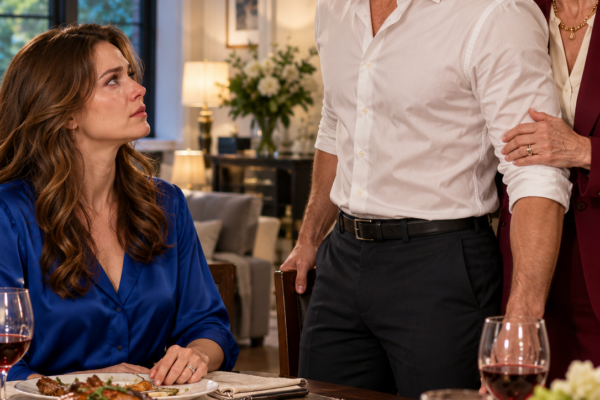
We’ve been married for six years, and he has never spent christmas with me, why? I found on his phone a photo of him with another woman and their kids: “our family is complete,” he had absolutely no idea, but my revenge? It’s only just getting started.

By then, everything had gone cold.
The chair across from mine remained empty. I glanced at the clock for what felt like the hundredth time. It was 10:47 p.m., and my phone showed no new messages.
My husband, Michael Thompson, was thirty-eight years old and the CEO of a prominent logistics company based in Los Angeles. We had been married for six years. To anyone looking at my life from the outside, I was a woman who had everything. I had a successful husband, an extraordinary house, a luxury car, and no financial worries. My in-laws occupied a respected position in the city’s social circles, and I had earned a reputation as the understanding wife who never complained about her husband’s demanding career.
For six years, I had believed that was what a happy marriage looked like.
Then my phone vibrated.
I reached for it almost instinctively, my heart lifting at the sight of Michael’s name. The message was short.
We had a serious breakdown with one of the trucks in the fleet. I’m going to be very late. Have dinner without me.
I stared at those words for a long time. I couldn’t explain why, but an exhaustion so profound washed over me that I barely recognized the woman sitting there.
Six years of marriage. Six Christmas Eves. Not once had Michael sat through an entire Christmas dinner with me.
The first year, he said several company trucks had been caught in a major pileup on the freeway. The second year, German business partners had arrived unexpectedly and required his immediate attention. The third year, there had supposedly been a fire at the company’s warehouse in Long Beach. The fourth year brought an emergency meeting with the board of directors. During the fifth, he claimed he had to make an urgent business trip to the port. And now, for the sixth Christmas Eve, there was another sudden emergency involving the company’s transportation fleet.
I used to take tremendous pride in the fact that I never made my husband’s life more difficult. Whenever friends commented on how rarely they saw us together, I defended him. I would explain that a man responsible for such a large company couldn’t possibly spend every evening sitting comfortably at home.
My mother-in-law repeated the same philosophy whenever the subject arose. A man needed to focus on building his career, she would tell me, and his wife had a responsibility to be patient.
“Don’t become one of those jealous women who keep their husbands on a tight leash,” she often warned.
For six years, I listened.
There were New Year’s Eves when I sat alone in front of the television until midnight. There were anniversaries of my parents’ deaths when Michael promised to accompany me to Pasadena to place flowers on their graves, only to call at the last minute and explain that something urgent had come up. Once, when my fever climbed to nearly 104 degrees, I drove myself to the emergency room at Hoag Hospital. I sat there receiving intravenous fluids while my husband sent a message telling me that his assistant would take care of the hospital bill.
Even then, I hadn’t demanded anything more from him. I genuinely believed that every sacrifice he made was for our future together.
At 11:18 p.m., I heard a key turning in the front door.
Michael stepped inside wearing a gray shirt with the sleeves rolled to his elbows. His dark hair was slightly disheveled, and his face carried the carefully familiar expression of a man worn down by a long, difficult day. As he walked past me, I caught the faint scent of perfume.
It was soft and expensive.
And it wasn’t mine.
I rose from my chair. “You’re back.”
Michael glanced toward the dining table, and for a moment, his expression tightened.
“Why haven’t you eaten yet?”
“I was waiting for you,” I answered with a faint smile.
He removed his wristwatch, laid it on the entryway table, and walked farther into the room. “I told you not to wait. The end of the year is always chaos. Several trucks had problems with their customs paperwork today, and I had to sort everything out myself.”
I nodded and reached toward the dishes. “I’ll heat up dinner.”
“No need,” he interrupted. “I already grabbed something to eat on the way.”
My hand stopped above the platter of ham.
“You already ate?”
Michael didn’t seem to notice the way I was looking at him. He settled onto the sofa and unlocked his phone.
“Yeah. The clients kept me for a quick meal. Go ahead and eat. Don’t make yourself hungry waiting for me.”
I said nothing.
Perhaps if the night had ended there, I would have behaved as I always had. I would have carried the cold food into the kitchen, packed it carefully into containers, and reassured myself that Michael’s responsibilities were simply greater than those of an ordinary husband. I would have swallowed my disappointment and gone to bed beside him, grateful that he had at least come home.
But as I lifted the serving platter from the table, the screen of his phone, which he had left on the coffee table, suddenly lit up.
A social media notification appeared.
I had never made a habit of looking through my husband’s phone. For six years, we had respected what I believed was each other’s privacy. I had never demanded his passwords, inspected his messages, or searched through his belongings.
That night, however, one involuntary glance shattered everything I thought I knew about my marriage.
A photograph glowed on the screen.
In it, a woman wearing an elegant cream-colored dress stood beside a beautifully decorated Christmas tree, holding a glass ornament. Next to her was a boy who looked about five years old, smiling so broadly that his whole face seemed to shine. Behind them stood a dining table crowded with Christmas dishes. Steam was still rising from some of the food. Candles flickered among the decorations, and a platter of holiday sweets sat near the center.
It looked like a perfectly ordinary family Christmas.
Then I noticed the corner of the photograph.
Only part of a man’s arm was visible, but I recognized the black luxury sports watch fastened around his wrist. It was a TAG Heuer, the unmistakable watch Michael had been wearing when he left our house that afternoon.
My heart began pounding so violently that a ringing filled my ears.
I moved closer.
The account belonged to a woman named Anna Miller.
Beneath the photograph, she had written a brief caption.
This Christmas, our family is complete.
The post had been published at 10:32 p.m.
For a moment, I couldn’t move. I stared at the glowing screen, then turned toward the hallway, where Michael was emerging from the bathroom barely ten feet away.
He had told me he was dealing with broken-down trucks and customs paperwork. He had claimed that clients had kept him for a hurried meal.
But at 10:32 that evening, he had been in another house, celebrating Christmas with another woman and a little boy.
Michael saw how close I was standing to his phone.
His expression changed instantly.
The reaction lasted less than a second, but I saw it. There was a flash of cold panic in his eyes before he hurried across the room and snatched the device from the table.
“Are you looking for something?”
I looked directly at him.
A hundred questions collided inside my head. Who was Anna Miller? Who was that child? Why had Michael been celebrating Christmas with them? Why had Anna called the three of them a family? How could he sit down to dinner with another woman and a child, then return to our house and calmly tell me that a truck had broken down?
Most of all, how many times had he looked me straight in the eye and lied like this before?
But I didn’t ask any of those questions.
“I’m looking for the TV remote,” I said.
Michael studied my face for several seconds. Then his shoulders relaxed, and he released a quiet sigh.
“It’s on the end table.”
I bent down and picked up the remote. My fingers were so cold that I could barely hold it.
He had no idea that in those few seconds, the woman who had trusted him blindly for six years had ceased to exist.
Michael returned to the sofa and mentioned that he had to leave early the next morning because of an eight o’clock meeting. I answered without enthusiasm, keeping my voice steady.
He looked at me from the corner of his eye.
“Are you upset?”
I shook my head.
Michael smiled, took my hand, and gently pulled me down beside him. “I know I’m rarely home for the holidays. You’ve missed out on a lot because of my schedule. But once things settle down at the company, next year I’ll spend the entire Christmas Eve with you.”
Next year.
How many times had I heard those words?
Next year, we would spend a romantic weekend in Napa Valley. Next year, we would visit my hometown. Next year, we would seriously start trying for a baby. Next year, he would finally slow down and make more time for us.
But one year had followed another, and somehow I was always the person left waiting.
I studied the face of the man sitting beside me. After six years together, I knew every line and expression. I knew the way his eyebrows moved when he was irritated, the slight tightening around his mouth when he was thinking, and the particular silence he adopted when he was worried about work.
I had believed I understood even the things he chose not to say.
Only now did I realize that I might never have known the man who slept beside me.
“Michael,” I asked quietly, “don’t you ever get tired of keeping track of so many things at once?”
He frowned. “What do you mean?”
“Your work. All those clients, the overlapping schedules, the constant emergencies. Just thinking about everything you have to remember makes me exhausted.”
He laughed, sounding almost relieved.
“I’m used to it.”
I looked at him for a long moment.
Yes, he was used to it.
He was used to lying without hesitation, coming home late, and delivering carefully rehearsed explanations while looking directly into my eyes. And he was undoubtedly used to the fact that I had believed every single word.
That night, Michael fell asleep almost immediately.
I lay awake beside him, facing the window, watching pale moonlight stretch across the hardwood bedroom floor. I expected myself to cry. I waited for the pain to break through, for the tears to come, but they never did.
Instead, one image kept returning to me.
The boy in the photograph.
He had Michael’s eyes. The resemblance was so striking that it frightened me. Even the shape of his eyebrows looked familiar.
A terrible possibility began taking shape in my mind.
If that child was Michael’s son, how long had this deception been going on? Five years? Six? Had it begun before I put on my wedding dress and became a member of the Thompson family?
At approximately three in the morning, I slipped quietly out of bed and went downstairs. I opened my laptop in the living room and typed Anna Miller’s name into the search bar.
Finding her wasn’t difficult.
Most of her social media profile was private, but a few older public posts remained visible. In one photograph, dated four years earlier, she stood in front of a beautiful house inside a gated community in Calabasas. Beneath the picture, one of her friends had written a comment.
May the three of you always be this happy.
I stared at those words until they seemed to blur.
The three of you.
I saved screenshots of every photograph, caption, and comment I could access. My hands moved steadily across the keyboard, even though my thoughts were in turmoil.
For the first time in six years as Michael’s wife, I felt no desire to wake him, confront him, and demand that he tell me the truth.
Something had become painfully clear to me: when a person is capable of deceiving you every day for six years, the answers that come out of his mouth have lost their value.
I would have to discover the truth myself.
I needed to know how many secrets lay buried beneath the polished surface of my marriage. I needed to find out how many people had helped Michael maintain his deception. And most importantly, I needed to understand exactly what would remain mine if I decided to walk away.
When I finally closed the laptop, the rain outside had stopped. The house had settled into complete silence. Christmas had passed, and Michael was sleeping peacefully upstairs.
I looked toward the bedroom door and made a decision that felt almost frightening in its clarity.
If my marriage had been a performance in which everyone knew the script except me, then I would continue playing my role. I would stop asking questions. I would stop revealing my doubts. I would become the understanding, obedient wife they all expected me to be.
I wanted to see just how long they were prepared to keep their secrets buried.
And when I finally stepped away from that carefully constructed life, Michael would be the last person to realize that the wife he expected to wait forever had disappeared.
The next morning, I woke an hour before Michael.
I made fresh coffee, set the breakfast table, and laid out his favorite dark blue tie over the back of his chair, just as I often did at the beginning of a busy week. Everything was arranged with the same quiet attention that had defined our household for years.
At precisely seven, Michael came downstairs, fastening his cufflinks.
He gave me a searching look.
“You went to bed very late last night.”
I placed a steaming cup of coffee in front of him and smiled. “I had some tea before bed. I think the caffeine kept me awake.”
He nodded and began eating.
That was all it took. My ordinary explanation extinguished the small spark of concern in his eyes.
Watching him, I understood something else.
Michael wasn’t especially worried that I might be unhappy. He was terrified that I might discover the truth.
He had eaten only a few bites when his phone began vibrating on the table. He glanced at the screen, then immediately turned the device facedown. I pretended not to notice.
Before leaving, he mentioned that he had a business dinner with investors that evening and would probably return late.
“Don’t worry about me,” I told him gently. “Take care of your business.”
He seemed pleased. He picked up his briefcase, kissed me goodbye, and walked out.
The moment the heavy front door closed behind him, my smile vanished.
I went upstairs to our walk-in closet and pulled a wooden box from the bottom shelf. Inside were six years’ worth of receipts, invoices, bank statements, airline tickets, and hotel bills. I had always kept financial records carefully because, early in our marriage, I had helped Michael organize our household expenses.
For years, those papers had seemed like nothing more than ordinary administrative clutter.
Now, spread across the floor in front of me, they were beginning to form the pieces of a terrifying puzzle.
During the second year of our marriage, Michael had claimed he was traveling to the port to meet an important client. Yet among the old documents was an invoice showing that he had spent the night at a resort in Los Angeles.
Three Christmas Eves earlier, he had assured me he was dealing with an emergency at the company’s large warehouse in San Pedro. But a crumpled restaurant receipt I had once taken from his coat pocket showed that he had eaten dinner in Calabasas.
And the previous year, on the painful anniversary of my father’s death, Michael had insisted that an unavoidable business trip to San Diego prevented him from accompanying me to the cemetery. His credit card statement, however, showed a transaction exceeding $2,500 at an expensive children’s boutique on Rodeo Drive.
I sat motionless, staring at the documents.
Each amount, date, and location felt like another cold slap across my face.
It wasn’t the amount of money he had spent on someone else that hurt most. It was the knowledge of what I had been doing on those exact days.
I remembered standing alone beside my father’s grave, trying to justify Michael’s absence even in the privacy of my own thoughts. I remembered defending him to relatives who wondered why he was never there when I needed him, insisting that they didn’t understand the pressures of managing an enormous company.
All those years, I had been so certain that everyone else misunderstood my husband.
Now I realized that the person who understood absolutely nothing was me.
Around ten that morning, my mother-in-law called.
She invited me to lunch, explaining that acquaintances from her hometown in Vermont had sent her some wonderful artisanal cured meats, and she wanted me to try them.
Under ordinary circumstances, I might have made an excuse. That morning, however, I accepted immediately.
There was something I needed to find out.
Michael’s parents lived in an imposing mansion in Bel Air, within a relatively short drive of our home. When I arrived, my mother-in-law was in the living room unpacking several cardboard boxes.
She looked up as I entered.
“Has Michael already gone to work?”
“Yes,” I replied, sitting beside her.
I waited a few moments, then spoke in the most natural voice I could manage.
“Mom, do you happen to know exactly where Michael went last night to deal with that truck problem?”
Her hands continued moving over the boxes.
“He mentioned something about customs paperwork,” I added. “But while I was cleaning this morning, I found an old document from the San Pedro warehouse. I started worrying that he might have driven all the way out there in the middle of the night.”
Her hand stopped.
It was only for a fraction of a second, but I saw it clearly.
She lowered her eyes toward the floor.
“How would I know the details of his company’s business?” she replied curtly. “The operation has grown so large. It’s perfectly normal for him to be in one place today and somewhere else tomorrow.”
I nodded. “Of course. I just worry about him exhausting himself.”
She released a quiet, unmistakable sigh of relief.
“Don’t overthink things, Emily. Michael doesn’t like women trying to control him. A man who works that hard already deals with tremendous stress outside the home. When he comes back, what he needs is an understanding wife.”
I studied her face.
For six years, she had repeated that advice to me. I had listened respectfully, believing she was teaching me how to support a successful husband.
But now I understood what she really meant by understanding.
It meant not asking questions. It meant pretending not to see things that didn’t make sense. It meant allowing her son to go wherever he pleased, with whomever he pleased, while I waited obediently at home.
I rested my hands in my lap.
“Mom, can I ask you something?”
She looked at me.
“What if I discovered one day that Michael had been hiding something very serious from me for a long time? What do you think I should do?”
Her face hardened instantly.
“Has someone been telling you stories?”
The question came out so quickly that she seemed to realize her mistake the moment she spoke.
I held her gaze and smiled.
“No, nothing like that. I was watching a movie with a similar plot, and the question just occurred to me.”
For several seconds, she remained silent. Then she forced a stiff smile.
“Those movies are ridiculous. People invent all kinds of nonsense. The foundation of a good marriage is trust.”
Trust.
I had to clench my jaw to keep from laughing.
Here was a woman whose reaction strongly suggested that she knew far more than she wanted to admit, sitting in front of me and delivering a lecture on marital trust.
My father-in-law joined us for lunch a little later. While we ate, I casually mentioned that Michael seemed to travel frequently around Christmas.
He continued chewing his food before finally responding in the deep, authoritative voice he used whenever he wanted to end a conversation.
“He runs a complicated business. Naturally, he has commitments. Don’t spoil the peaceful atmosphere of this family over petty things.”
I didn’t pursue the matter.
Between my mother-in-law’s sudden alarm and my father-in-law’s dismissal, I had learned enough to deepen my suspicions.
It wasn’t merely Michael performing in this deception. His parents appeared to know their parts as well.
On my way home, I pulled over along the Pacific Coast Highway and sat in the car for a long time, watching the gray afternoon settle over the coast.
I still didn’t cry.
It felt as though something inside my chest had hardened into ice.
If one man had betrayed me, perhaps I might eventually have found the strength to ask him why. But the thought that his entire family could have joined in a pact of silence to protect his deception made that question seem almost meaningless.
That afternoon, I picked up my phone and called Meredith.
She was a brilliant attorney who had handled the complicated inheritance arrangements after my parents’ deaths. I had trusted her professionalism for years, and I knew she was someone who valued facts more than comforting words.
As soon as she heard my voice, she asked what was wrong.
I stood near the window, looking out over the property where I had spent six years believing I was building a future with my husband.
“I want a complete assessment of my personal assets,” I told her. “Everything I owned before the marriage, and everything acquired afterward.”
There was a long silence on the other end of the line.
“Emily,” she asked carefully, “are you planning to divorce Michael?”
I tightened my grip on the phone.
“I haven’t filed anything with the court yet. But I intend to prepare myself before other people make preparations for me.”
It was the first time I had said the word divorce aloud.
I had always imagined that speaking it would bring unbearable pain. Instead, I felt an unexpected clarity. For the first time in what seemed like years, my thoughts were moving in a definite direction.
That evening, Michael returned around midnight.
He entered the kitchen carrying an elegant shopping bag from one of my favorite designer brands and placed it on the counter.
“I passed the store and thought of you,” he said.
Inside was a beautiful pure silk scarf that must have cost nearly a thousand dollars.
A month earlier, I would have been delighted by such a gesture. I would have admired the fabric, thanked him warmly, and convinced myself that even if he rarely had time for me, his gifts proved how much he cared.
Now I found myself wondering how many expensive gifts he had purchased over the years to keep his two lives comfortably separated.
I smiled and thanked him.
Michael watched me for a moment, an almost thoughtful expression crossing his face.
“You’re being unusually sweet and well-behaved today.”
I lifted my eyes.
“I’ve always been this way.”
He laughed, entirely unaware of the meaning behind my answer.
And he was right. I had always been cooperative. I had always made life easy for him. I had always accepted his explanations, protected his reputation, and arranged my own desires around his convenience.
I intended to remain just as agreeable for a while longer.
At least until I had gathered enough evidence, secured my finances, and made the necessary arrangements to walk out of our house with my head held high.
When Michael finally understood what was happening, I wanted it to be too late for him to stop me.
The following morning, Meredith sent me a message asking me to bring all my banking and property documents to her office in Century City.
I didn’t leave immediately. I waited until Michael had driven away, then went into his home office and opened the concealed safe where we kept our important papers.
Throughout most of our marriage, Michael had maintained almost exclusive control over our household finances. I had never questioned that arrangement. I had believed that in a truly loving marriage, there was no need to draw hard lines between what belonged to one spouse and what belonged to the other.
Now I was beginning to understand that blind trust was meaningful only when the person receiving it possessed enough integrity to honor it.
Inside the safe, I found the deed to the house in Pasadena that my parents had left me. I also retrieved two certificates of deposit established in my name before our wedding, along with documents concerning a substantial investment I had made in a company owned by an old family friend.
I examined each document carefully before arranging them inside a black leather briefcase.
At Meredith’s office, she reviewed the papers with sharp professional attention.
After several minutes, she looked up.
“These particular assets have a clear individual origin,” she explained. “But the joint bank accounts, investments made during the last six years, and property registered in Michael’s name are another matter. We’ll need a thorough forensic accounting review.”
I asked what would happen if Michael had secretly transferred marital funds to someone else.
Meredith put down her fountain pen.
“Do you have any evidence that he’s done that?”
I unlocked my phone and showed her the photographs of receipts, transactions, and financial statements I had collected.
There was a payment of more than $70,000 to an exclusive architecture and interior design firm two years earlier. Another transfer, approaching $140,000, had gone to a real estate agency specializing in the Calabasas market. Beyond those larger transactions was a long series of smaller expenses: private school tuition, life insurance premiums, and purchases from expensive children’s clothing stores.
Meredith studied the records in silence.
When she finally looked at me, her expression was grave.
“Don’t confront him with any of this yet. We need to establish who these payments are legally connected to and trace the source of the money. That has to be done carefully.”
I nodded.
She leaned back in her chair, and for the first time that morning, her expression softened.
“Emily, I’m going to ask you something difficult. I need you to be honest with yourself. Is there any part of you that still wants to save this marriage?”
I couldn’t answer immediately.
Instead, I remembered our wedding day, six years earlier. We had stood together at an elegant estate, surrounded by flowers and people who smiled as if they were witnessing something beautiful and permanent. Michael held my hands at the altar and promised that he would never let anything hurt me.
I had believed him with my entire heart.
And now that same man could spend Christmas Eve laughing, eating cookies, and celebrating with another woman and a child, then come home and tell me tenderly about problems with the company’s trucks.
At last, I spoke.
“I don’t even know whether there’s anything left worth saving.”
When I left Meredith’s office, I didn’t drive home to Newport Beach.
I joined the traffic on the 405 and headed toward Calabasas.
The address I had pieced together from the old invoices and the background of Anna’s photographs pointed to one of the area’s most exclusive gated communities. I had no intention of confronting anyone, forcing my way through a gate, or creating a public scene.
I simply needed to see the truth with my own eyes.
It was approximately four in the afternoon when I parked discreetly near a café across the street.
I sat in my car, watching the entrance to a large white mansion.
About twenty minutes later, the automatic gates opened.
A woman stepped onto the sidewalk.
I recognized Anna Miller immediately.
In person, she looked even younger than she had in the Christmas photograph. She appeared to be around thirty-three, with long brown hair and an understated outfit that was obviously expensive despite its simplicity.
Beside her walked the little boy from the picture.
He carried a small blue backpack and clutched a toy car in his right hand.
I watched him closely. His eyes resembled Michael’s so strongly that the sight made my stomach tighten.
Anna bent down, adjusted the collar of his coat with a mother’s familiar tenderness, then reached into her purse for her phone. I assumed she was about to call a car.
But before she could leave, a black sports car turned the corner.
I stopped breathing.
I knew the vehicle. I knew its license plate by heart.
It was Michael’s car.
That very morning, he had assured me that he would be occupied with back-to-back meetings in downtown Los Angeles until evening.
Now he was pulling up outside Anna Miller’s house.
The car stopped near the gate, and Michael stepped out.
The moment the little boy saw him, he released his mother’s hand and ran toward him.
“Daddy!”
One word.
That was all it took.
Every sound around me seemed to disappear.
Michael bent down with his arms wide open and caught the boy as he reached him. He lifted him into the air, laughing with an ease and genuine happiness I hadn’t seen in our home for years.
There was no hesitation, no uncertainty, no awkwardness. This wasn’t a man greeting a child he barely knew. It was the natural affection of a father welcoming his son.
Anna came closer, smiling. She reached up and straightened the collar of Michael’s overcoat with her fingertips.
He didn’t move away.
Instead, he rested one hand on her waist with the unconscious familiarity of a gesture repeated countless times.
The three of them stood together outside that white mansion in the late afternoon sunlight. To anyone passing by, they would have looked like an ordinary, happy family, comfortable in a life they had shared for years.
I sat inside my car with my hands freezing around the steering wheel.
There was nothing left to debate.
I didn’t need another excuse, another explanation, or a session of marriage counseling. The child had called Michael Daddy, and Michael had responded without the slightest hesitation.
Whatever hope had survived inside me until that moment was gone.
I raised my phone and began photographing them.
It wasn’t because I wanted to hurt anyone. I needed those images as a reminder to myself. If I ever weakened, if loneliness or old affection ever tempted me to accept another of Michael’s explanations, I wanted to remember exactly what I had witnessed on that street in Calabasas.
Around five, Michael drove away.
I returned to our house in Newport Beach almost an hour before he arrived. I changed clothes, went downstairs, and began preparing dinner as though the day had been no different from any other.
At 7:10 p.m., the front door opened.
Michael entered, dropped his leather briefcase onto an armchair, and released a long, weary sigh.
“What a day. Nothing but meetings. I’m exhausted.”
I was standing near the stove.
“Where were all those meetings?”
“Downtown L.A.,” he answered without missing a beat. “We had new investors in from Arizona.”
The lie came out so smoothly that I almost admired the skill required to deliver it.
Less than three hours earlier, I had watched him lift a laughing little boy into the air. I had seen another woman touch him with the intimate confidence of someone who had every right to be near him.
And now he stood in my kitchen, speaking about imaginary investors with the casual ease of a man discussing the weather.
I carried a bowl of soup to the dining table.
“Go wash your hands and sit down.”
Michael studied me curiously.
“You’ve been very quiet lately. Is something wrong?”
I gave him a small smile. “Everything’s fine.”
He crossed the kitchen and slipped his arms around my shoulders, drawing me into a loose embrace.
“Don’t start imagining things,” he murmured. “Work will slow down soon, and everything will go back to normal.”
I didn’t pull away, but I didn’t return the embrace either.
I looked down at the hand resting on my shoulder.
Only a few hours earlier, that same hand had rested comfortably on Anna Miller’s waist.
There are moments when seeing something with your own eyes breaks the invisible bond connecting you to your former life. Once that bond is severed, no amount of reassurance can make things what they were before.
That night, I sent every photograph to Meredith through an encrypted message.
She called less than two minutes later.
“Emily, did you take these pictures this afternoon?”
“Yes.”
I swallowed, then added, “The little boy called him Daddy.”
Meredith remained silent for several seconds.
When she finally spoke, she chose her words carefully.
“Then you need to prepare yourself, emotionally and financially. This could become a very difficult legal fight.”
I looked through the glass doors toward the balcony.
Michael was standing outside beneath the stars, talking on his phone. A tender smile lingered at the corners of his mouth.
I knew with absolute certainty that the person on the other end wasn’t an investor from Arizona.
For the first time since Christmas Eve, the pain seemed to have receded. In its place was a steady, almost frightening determination.
“Help me put together a complete plan,” I told Meredith. “This time, I’m not letting anyone else write the chapters of my life.”
After that conversation with Meredith, my life seemed to divide into two separate identities occupying the same body.
During the day, I continued to be Michael’s devoted wife. I prepared his meals, maintained the house, remembered his appointments, and listened patiently when he complained about work. At night, after his breathing deepened and I was certain he was asleep, I became the quiet architect of my own departure.
I went through bank statements, property deeds, investment records, company shares, and stacks of financial documents I had never thought necessary to examine. The more carefully I studied them, the more disgusted I became.
Over the previous three fiscal years, Michael had withdrawn substantial amounts from our joint investment accounts. Every time, he had claimed that his transportation company required an urgent infusion of cash to secure contracts or maintain operations. Together, those withdrawals approached $230,000.
I remembered the conversations surrounding those transactions with painful clarity.
Sometimes Michael would sit beside me on the sofa during a quiet weekend, take my hand, and explain the unpredictable nature of the logistics market. He would describe rising transportation costs, fluctuations in demand, and enormous cross-country contracts that required immediate financial backing. He spoke with such conviction that I felt proud to have the opportunity to support him.
He always promised that the money would be returned within a quarter.
And I always signed the withdrawal authorizations without hesitation.
Now, comparing the dates with the records I had collected, I began to see an alarming pattern. The withdrawals coincided with the period when the luxurious Calabasas property underwent extensive remodeling, received expensive furnishings, and accumulated substantial bills for the little boy’s private international school.
The man who had asked me to sacrifice our financial security for his business appeared to have been using that sacrifice to build another family’s life.
The next day, I sent Meredith digital copies of everything I had found.
When we met again behind the closed door of her office, her expression was unusually serious.
“Emily, I need to be clear about something. These dates are disturbing, but a court won’t simply assume that the money went to Anna Miller because the timing matches. We need evidence that traces the funds to their final destination.”
She explained that uncovering the complete financial trail might require formal legal procedures and forensic accounting. There were limits to what we could investigate ourselves, and she was adamant that I not cross them.
“Do not attempt to hack his accounts or access financial information you’re not legally authorized to see,” she warned. “I don’t want anything you do to compromise your position.”
I understood.
Meredith slid a printed document across the polished conference table. It contained a list of records she wanted me to locate, along with the steps necessary to protect the inheritance and other assets that had belonged to me before the marriage.
“We need to establish clear legal boundaries between your separate property and anything that might be considered community property,” she explained. “The sooner we organize everything, the better.”
I looked down at the neat lines of black print.
For reasons I couldn’t fully explain, those pages brought me a sense of peace. Numbers and documents didn’t smile at me while secretly planning something else. A date on a bank statement couldn’t invent a transportation emergency. A signed property deed couldn’t pretend to be somewhere it wasn’t.
Meredith watched me for a moment before asking another question.
“Are you eventually going to confront Michael and demand an explanation?”
“Not yet.”
“Why not?”
I considered my answer carefully.
“Because I need to know how far he’s willing to go while he still believes I’m the same obedient, trusting wife he left at home in Newport Beach.”
Meredith let out a long sigh.
“Emily, be careful. I don’t want you to become so consumed with exposing him that you sacrifice the rest of your life to this betrayal.”
Her warning struck me harder than I expected.
I looked through her office window at the traffic moving steadily below. She was right. I didn’t want to spend the rest of my life pursuing proof of what an unfaithful husband had done. I didn’t want his dishonesty to become the defining purpose of my existence.
I needed the truth to protect myself and make a clean departure. I didn’t want to carry it forever like poison.
That evening, Michael returned home unusually early.
In his hands was a large bouquet of fresh white Dutch tulips, flowers I had loved since I was young.
He handed them to me with the bright, polished smile he used in business photographs.
“I have a surprise for you. This weekend, we’re going to disappear for a couple of days. Just the two of us. We’ll go to Palm Springs.”
For a moment, I simply stared.
The days when Michael spontaneously suggested romantic trips seemed to belong to a distant lifetime. I couldn’t remember the last time he had arranged a getaway without my begging him to take time off.
“What brought this on?” I asked.
He removed his tailored Italian coat and draped it over a chair.
“I’ve noticed you’ve been down lately. You seem tired. Besides, routine isn’t good for romance. We haven’t done anything together in months.”
Had he made that suggestion a month earlier, I would have been overjoyed. I would have started planning outfits, researching restaurants, and imagining two uninterrupted days with the husband I missed so much.
Now I wondered what he was trying to accomplish.
Perhaps he had sensed the distance growing between us and wanted to reassure himself that I remained firmly within his control. Or perhaps the weekend was simply another attractive layer of paint over a marriage whose foundations were already rotting.
“Are you sure your work schedule will allow it?” I asked.
Michael smiled confidently.
“I’ll rearrange a few things. Don’t worry about anything.”
At that very moment, his phone vibrated inside his pocket.
He took it out and glanced at the screen.
His smile froze.
Almost immediately, he swiped away the incoming call.
I watched the movement without changing my expression.
“Who was that?”
“Just an annoying supplier,” he said dismissively.
I nodded, then agreed to the trip.
Michael seemed genuinely surprised.
“Really? You’re not going to argue about the timing or ask a hundred questions?”
“Why would I?”
He stepped forward and wrapped his arms around me.
“This is what I want, Emily. I just want to see you happy.”
I stood inside his embrace, feeling strangely detached from my own body.
For years, I had longed for exactly this kind of attention. There had been so many nights when I wished Michael would put aside his phone, hold me close, and remind me that I mattered more than another business appointment.
Now that his arms were around me, I could think only of how little I knew about the man holding me.
It was like being embraced by a dangerous stranger who happened to know every detail of my daily routine.
On Saturday morning, we drove to Palm Springs.
During the long journey, Michael talked far more than usual. He described developments at his company, discussed possible changes to our kitchen, suggested a skiing vacation at the end of the year, and spoke enthusiastically about plans we might make together.
Then, with astonishing casualness, he brought up the subject of children.
“Maybe next year we should seriously think about starting a family.”
I turned toward him.
“Are you sure you want a child at this point in your life?”
His hands tightened slightly around the steering wheel.
“What kind of question is that?”
“Just curiosity,” I answered. “Nothing more.”
For nearly a mile, neither of us spoke.
Then Michael said, “Of course I want children. A house filled with their laughter is a house filled with real happiness.”
I turned back toward the window and watched the highway disappear beneath us.
I thought of the little boy running toward Michael outside Anna’s house, shouting Daddy with absolute joy.
Michael already knew what it felt like to have a child greet him that way. He had been enjoying that happiness for years.
He simply hadn’t considered me worthy of sharing it.
Once we arrived at the luxury resort, Michael behaved like the ideal husband.
He pulled out my chair at restaurants, ordered the fresh fish dishes he knew I enjoyed, and took photographs of me against the resort’s scenic waterfront backdrop. He complimented my clothes, asked whether I was comfortable, and spoke with a warmth that might have convinced anyone watching that we were still deeply in love.
At night, we sat together on a softly illuminated terrace overlooking the dark water. The gentle sound of waves carried through the warm evening air, and the lights around us cast a flattering glow across Michael’s face.
For a moment, I remembered the man I had fallen in love with.
When we were dating, before his company reached its present level of success, Michael hadn’t possessed the wealth or status he enjoyed now. There had been evenings when he traveled across the city on public transportation simply to surprise me with a slice of my favorite cake.
I had believed his kindness belonged to his character rather than his circumstances. I had believed that no amount of money or professional success could change the essence of the man I loved.
Looking at him now, I wondered whether that man had ever truly existed.
“Michael,” I said, breaking the silence, “can I ask you a hypothetical question?”
He lifted his wineglass.
“Go ahead.”
“Suppose I disappeared one day. Just vanished from your life without warning. What would you do?”
The glass stopped halfway to his lips.
“Where is this morbid conversation coming from?”
“It’s just a hypothetical situation.”
He frowned. “Don’t tempt fate with questions like that.”
But I continued.
“Have you ever imagined waking up one morning and discovering that I was no longer there?”
Michael studied me for several seconds before releasing an uneasy laugh.
“Your mind really does come up with the strangest things. Where would you go, my dear Emily?”
There was something in the way he said it that made my stomach tighten.
He hadn’t answered my question because he couldn’t imagine the possibility.
Not because he loved me so deeply that losing me was unthinkable, but because he was convinced I lacked the courage to leave. In his mind, I was a dependent, compliant woman who would never voluntarily abandon the comfort of the life he had provided.
I lowered my eyes to conceal my disgust and took a sip of sparkling water.
“Maybe you’re right. I suppose I’m overthinking things.”
He reached across the white tablecloth and covered my hand with his.
“Don’t torture yourself with nonsense. You have a wonderful life, Emily. There are women who would give anything to live the way you do. You don’t lack a single thing.”
I looked at his fingers resting over mine.
My life was supposed to be perfect as long as I remained grateful, unquestioning, and ignorant.
That night, while Michael brushed his teeth in the bathroom, his phone lit up on the bed.
I didn’t touch it.
I didn’t need to.
The screen was bright enough that I could read the notification from where I was standing.
Don’t forget your promise. Next week we have the appointment together to enroll him in the private school. It’s important.
I read the message once, then turned away.
By then, the evidence had become so overwhelming that another secret appointment hardly surprised me.
When Michael returned, wrapped in a towel, I was standing near the balcony railing, looking into the darkness beyond the resort.
He approached from behind and circled my waist with his arms.
“Are you cold?” he whispered.
“No.”
He rested his chin against my shoulder.
“Emily, I swear I’d give anything for us to stay as happy as we are right now.”
I kept my eyes fixed on the horizon.
“Nothing lasts forever.”
He laughed.
“There you go again with your strange little philosophies.”
I didn’t answer.
I understood perfectly what kind of stability Michael wanted.
He wanted a respectable, accommodating wife living in Newport Beach, a passionate relationship hidden away in Calabasas, a little boy who worshiped him as a father, and the freedom to move between those worlds without sacrificing comfort, reputation, or wealth.
He wanted everything.
And he had apparently convinced