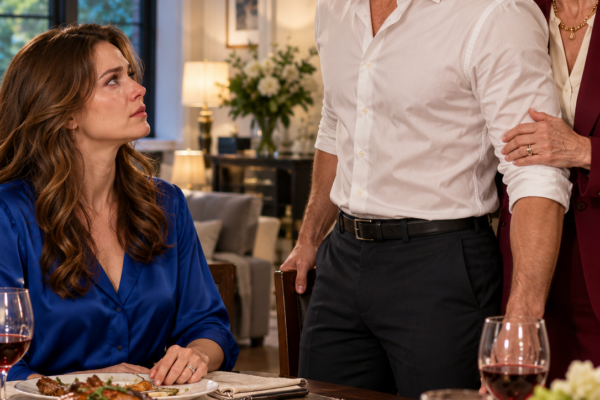
On the way to the party, my husband kicked me out of the car in the rain because of his secretary. I immediately flew to madeira. At the party, the president of our partner company asked: “why has my daughter still not arrived?”
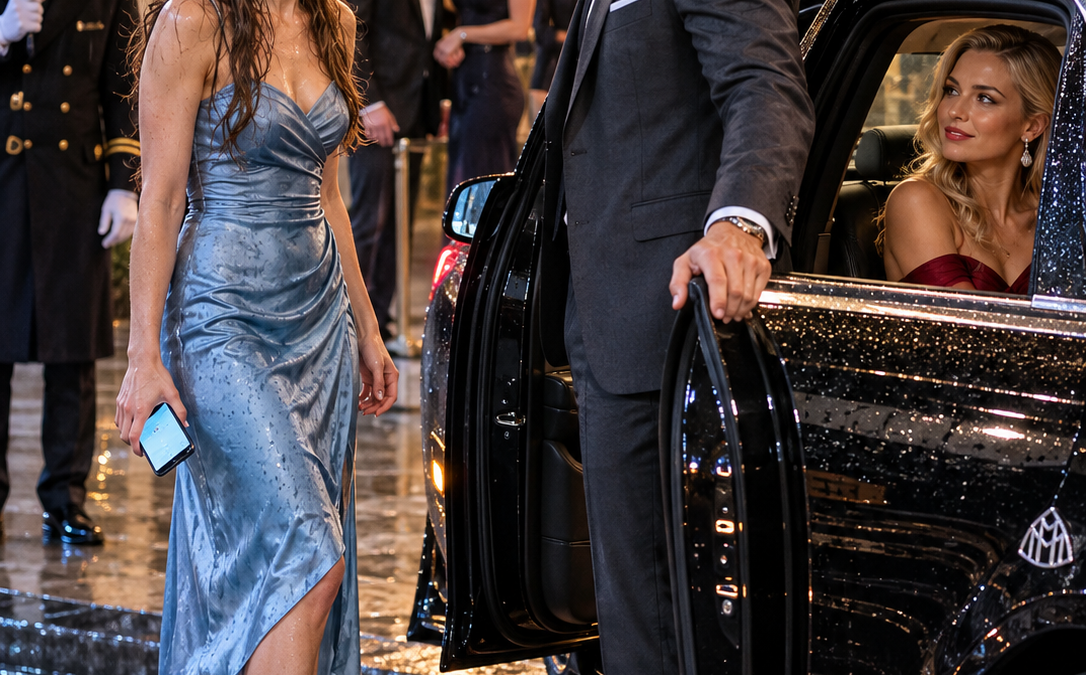
A doorman hurried out of the event hall and held an umbrella over my head. He looked at me cautiously, his expression caught somewhere between concern and embarrassment. “Ma’am, would you like me to call you a cab?” I shook my head and took out my phone with fingers so cold they barely responded. The screen lit up, revealing three new messages.
The first was from my personal assistant. My 11 p.m. flight to Key West had been confirmed. First class, window seat. A car and hotel in Florida had already been arranged. Everything was ready.
The second message was from Megan, the very woman who had just taken my place in the passenger seat, smiling as she asked me to make a little room. Her message was accompanied by a small apologetic emoji.
“Honey, are you home yet? It’s cold out. Don’t catch a cold. By the way, Mr. Thompson says he’s going to be very late tonight. He asked me to accompany him to an important dinner. Don’t wait up for him.”
The third message came from my husband, Liam Thompson. Four words, delivered with the efficiency of a military command.
“Text me when you’re home.”
I studied the three messages, and the corners of my mouth slowly curved upward. In three years of marriage, Liam’s messages to me had rarely exceeded ten words. They were usually some variation of “Not coming home tonight,” “Buy me a plane ticket,” or “Don’t wait up.” Even his punctuation seemed reluctant, as though every additional character demanded more effort than he was willing to spend.
Megan, on the other hand, never seemed to run out of words. Her messages were always decorated with cheerful little faces and that condescending sweetness she had perfected. She spoke like an innocent girl who couldn’t possibly imagine hurting anyone, yet somehow her messages always arrived at precisely the right moment to twist the knife a little deeper. She never needed to say anything openly cruel. She preferred to make every insult sound like concern.
I opened my contacts and found a number saved under a single letter. The call rang twice before someone answered. In the background, I heard the clatter of silverware, polite laughter, and overlapping conversations. Glasses chimed as people offered toasts, and the steady murmur of an expensive business dinner poured through the receiver.
“Madison?” The man’s voice dropped with surprise. “Where are you? I’ll send someone to the entrance to get you.”
It was my father, Henry Sterling.
“Dad, I’m not coming.”
There was a pause. The sounds of the dinner seemed to recede, and I imagined him rising from the table and finding somewhere quieter to speak.
“What happened?”
“Liam kicked me out of his car.” My voice was so calm that even I found it strange. “He took Megan to the gala instead. I’m standing outside Cipriani, and my coat is still in his car.”
For approximately three seconds, my father said nothing. I knew that silence. Henry Sterling did not fall quiet because he was uncertain of what to say. He fell quiet when he was trying to contain his anger.
“He kicked you out of the car?” His voice deepened, like thunder gathering in the distance.
I could almost see his face. His eyebrows would be drawn into a tight knot, the lines around his mouth sharpened into deep grooves. The hand that usually held a glass of fine whiskey so steadily would probably be trembling. My father had spent decades building an empire, and very little in the world could make him lose his composure. But I knew what happened when someone hurt the people he loved.
“He doesn’t know who you are,” he said.
“No. He never has.”
Three years earlier, I had insisted on hiding my identity before marrying into the Thompson family. Liam and his relatives believed I was an orphan with no family support, no money, and no influence. They assumed I had entered the marriage with nothing but the clothes on my back.
Even our wedding had been a hurried ceremony at City Hall, without so much as a decent glass of champagne to celebrate. Liam’s mother, Amelia Thompson, had looked at me from her armchair as though a cockroach had crawled onto her dinner table.
“Our Liam marrying you is a step up for you.”
Those had been her exact words.
Over the next three years, I heard variations of that sentence more times than I could count. Whenever Liam went to a business dinner and failed to come home, Amelia told me I wasn’t woman enough to keep a man interested. Whenever Megan received a raise or promotion, Amelia praised the secretary’s competence and reminded me that I was nothing but a freeloader living under her son’s roof.
Liam never defended me. Not once.
It wasn’t that he hadn’t heard the insults. He heard them perfectly well. He simply didn’t care enough to stop them.
“Fine,” my father said at last.
There was something terrifying about how calm his voice had become.
“All right, Dad. Tonight, at the signing dinner, don’t show him any mercy.”
I looked down at my elongated shadow beneath the streetlight. Rainwater continued to drip from the ends of my hair.
“Negotiate exactly as you should. You know better than anyone how Liam’s company got to where it is today.”
And I knew it, too.
Every round of financing Thompson Materials had secured during those three years, every major client, every invitation to an industry summit, every opportunity that seemed to appear at exactly the right moment had been arranged by me, anonymously and from behind the scenes.
Liam believed he was exceptionally talented. He believed fortune had finally recognized his brilliance. It never occurred to him that those miracles falling into his lap had been carefully arranged by the woman he considered useless.
“What are you planning to do?” my father asked.
“I have a ticket to Key West tonight.” I lowered my gaze to the flight confirmation on my phone. “I’m going to clear my head. I’ll visit Aunt Rose while I’m there.”
Aunt Rose had been my late mother’s closest friend. She had lived in Key West for nearly twenty years, but when I was little, she had cared for me as though I were her own daughter. There had always been a place for me in her home, even after years passed between our visits.
“Okay.” My father’s tone finally softened. “Call me when you get there. Don’t worry about anything happening here.”
I hesitated before answering. When I spoke again, my voice was quiet, almost gentle.
“Dad, don’t let him fall too fast. I want him to give back everything he owes me. Piece by piece, with interest.”
After ending the call, I stood beneath the entrance canopy and looked at the dazzling lights reflected across the wet pavement. Above the doors, enormous gold letters announced the Sterling Group Annual Partner Dinner.
Sterling Group was my father’s company.
Liam and Megan had almost certainly entered the ballroom already. I could picture her hanging on my husband’s arm, holding a flute of champagne and parading through one of the most exclusive business events in New York City. She would be smiling at powerful executives, convinced that she had finally secured the place she deserved.
In her mind, she had won. She had pushed the miserable, unwanted wife into the mud and taken her rightful position beside Liam Thompson.
I opened my wallet and checked my reservation confirmation. Four hours remained before takeoff. That was more than enough time.
The doorman helped me hail a taxi. I climbed into the back seat and asked the driver to take me to Terminal 1 at JFK. As we pulled away, I opened the gallery on my phone and found the image I had captured of the Maybach’s taillights disappearing into the rain. I sent it to my father with a single word.
“Remember.”
Then I switched my phone to airplane mode, leaned against the seat, and closed my eyes.
The streetlights along the Belt Parkway slipped past one after another, fading behind us into the darkness. Outside, the night stretched over the city like an endless sheet of black fabric. The taxi radio was tuned to a late-night relationship advice program. A host with a soothing voice was reading letters from listeners, offering gentle answers to questions about love and heartbreak.
I barely heard him.
In my head, I was doing the math.
Three years. One thousand and ninety-five days.
Every night of neglect. Every public humiliation. Every cruel remark from my mother-in-law. Every provocative message from Megan, carefully decorated with smiley faces. Every time Liam looked through me as though I were furniture.
I remembered all of it.
I hadn’t overlooked a single detail.
As the taxi entered the airport access roads, the terminal appeared in the distance, glowing with a cold white light. Against the darkness, it looked like an enormous island waiting to rise into the sky. I rested my forehead against the window and found myself remembering another bitterly cold night three years earlier.
I had just returned to New York after studying abroad. My father asked what I wanted to do with my life, and I told him I wanted to get married. I wanted to marry a man I genuinely liked, build a family, and experience an ordinary life.
Henry Sterling had been silent for a long time.
“Your mother passed away too soon,” he finally said. “I raised you alone, and I was always afraid I might spoil you. You told me you wanted independence, that you wanted to stand on your own two feet, and I gave you that freedom. But there’s something I need you to understand, Madison. Not everyone in this world deserves to have you bow your head to them.”
At the time, I hadn’t taken his warning seriously.
When I met Liam Thompson, he was the owner of a small construction materials company. He drove a secondhand Audi and lived in a rented apartment above the company warehouse. The place was so bare that the windows didn’t even have curtains.
He was handsome, with sharply defined features and a deep voice that reminded me of the low, rich sound of a cello. When he spoke about his business, his eyes lit up with ambition. He had plans, and he seemed willing to work as hard as necessary to achieve them.
The first time he invited me to dinner, he took me to a greasy little diner tucked away on a side street in Queens. He ordered the daily special, and the total bill came to fifteen dollars.
When the check arrived, he took a ten-dollar bill from his wallet, followed by a crumpled one, two-dollar coins, and a handful of change. He counted everything twice before handing the money to the waiter.
I watched him carefully smooth the wrinkled bills against the table, and something inside me softened.
I thought he was a hardworking man who understood the value of money. I admired his determination. I believed that someone who paid so much attention to small details would also pay attention to the person he loved.
Only later did I realize his meticulousness extended to money and almost nothing else.
After we married, the sentence I heard most often was, “Don’t wait up.”
He said it on our wedding night.
He told me he had a company commitment and that I should go to bed without him. I sat alone on our double bed, watching the cheap bedside lamp cast a pale glow across the room. Under that light, the bedroom looked more like a hospital ward than a place where newlyweds were supposed to begin their life together.
I waited until two in the morning.
When Liam finally came home, he smelled of alcohol, and the collar of his shirt carried the faint trace of an unfamiliar perfume. He told me it came from a gift a client had given him.
I believed him.
The following year, his company began receiving enormous contracts with almost inexplicable ease. A real estate developer who had ignored Thompson Materials for months suddenly called to propose a partnership. A substantial investment appeared through a financing arrangement that required none of the scrutiny Liam had expected. An invitation to a prestigious industry summit arrived even though his company wasn’t among the twenty leading businesses in its sector.
Liam believed his luck had changed.
He thought his exceptional abilities were finally being recognized.
At a company dinner celebrating another successful quarter, he stood before his employees and raised his glass, congratulating everyone on the results of their hard work. I sat quietly in the audience with a cup of tea that had already gone cold.
Megan, who was serving as his secretary, had brought me that tea. She placed it in front of me with a flawless smile, said nothing, and walked away.
Liam had no idea that I had used Sterling Group’s resources to facilitate the contracts he was celebrating. The investment that had saved his company’s cash flow came from the trust fund my mother left me. As for the coveted summit invitation, my father had personally called the organizers to secure it.
Liam knew none of this.
As far as he was concerned, I was a woman without family, influence, or a respectable dowry. I contributed nothing to the household. I lived on his money and enjoyed the comforts his success provided.
By the third year of our marriage, Megan had become an increasingly important presence in his life.
No. That wasn’t quite right.
She hadn’t simply entered his life.
She had invaded it.
At first, she was an ordinary administrative assistant with a pretty, harmless-looking face and an excessively sweet voice. Whenever she spoke to me, she stretched the ends of her words into a soft, childish whine. The sound seemed designed to suggest innocence, yet it always left behind a faint irritation that grew more painful with time.
I sometimes wondered exactly when Liam had begun to change.
Perhaps it started the day Amelia invited Megan to lunch at our house.
My mother-in-law had never worked a day in her life, yet she considered herself an authority on everything from business to marriage. The moment Megan entered the dining room, Amelia beamed at her.
“Oh, what a pretty girl. So much better than ours.”
Megan blushed and lowered her head.
“Miss Amelia, please don’t say that. Madison is a very good person.”
Even as she spoke, her gaze lingered on the family photograph hanging on the wall behind me. In that photograph, I stood at the edge of the group, wearing a smile that had obviously taken effort to maintain.
Soon afterward, Megan began riding to and from work with Liam because, as he explained, her apartment was conveniently on his route. Then she started accompanying him to business dinners. Before long, she was appearing beside him at virtually every professional event.
Eventually, she began staying in his office until the early hours of the morning, explaining that Mr. Thompson had asked her to organize important documents.
Whenever I tried to raise the subject, Amelia rolled her eyes.
“That girl is working for your husband. You sit at home all day doing nothing and eating for free. You have no right to complain about someone who’s actually useful.”
I said nothing.
Not because I was afraid to speak.
I was waiting for the right moment to collect what I was owed, with three years of interest.
And that moment had finally arrived.
The taxi stopped outside the terminal. Rain was still falling, lighter now but no less cold. When I opened the door, a gust of wind swept against my damp dress and made me shiver.
For some reason, I remembered our wedding day.
Three years earlier, hail had fallen over New York. I stood outside City Hall in my wedding dress, waiting forty minutes for Liam to arrive. Ice gathered in my hair, my heels slipped against the frozen pavement, and my toes gradually lost all feeling.
When he finally appeared, he didn’t apologize.
“Something came up at the company. Why didn’t you go inside first?”
I had carried that sentence with me for three years.
Only now did I understand how miserable it truly was. In Liam’s version of life, I had never been someone worth hurrying for. I was expected to understand his delays, accommodate his decisions, and wait quietly until he found it convenient to remember I existed.
I took my suitcase into the terminal, passed through security, and entered the VIP lounge. I ordered a hot latte and settled into a chair near the windows.
Just as the coffee arrived, my phone lit up again.
It wasn’t Liam.
It was Megan.
She had sent me a photograph of the banquet.
A large round table was covered with expensive dishes, sparkling glasses, and carefully arranged flowers. Liam sat near the head of the table, a drink in his hand, leaning toward someone in conversation. In one corner of the image, Megan’s hand rested on the arm of his chair. Her fingertips appeared to brush casually against the cuff of his suit.
The accompanying message read, “Honey, tonight’s dinner is spectacular. What a shame you’re not here.”
I stared at the photograph for a moment before taking a sip of my latte.
The coffee was bitter, but my heart was strangely peaceful.
I opened my conversation with my father.
“Dad, I’m on the plane. You can start.”
Three seconds later, he replied.
“Done.”
I placed the phone facedown on the table and leaned back in the lounge chair. The space around me was quiet, disturbed only by the soft hum of air conditioning and occasional announcements in English and Spanish.
Beyond the glass, the runway lights stretched into the darkness in two long, broken lines of gold. An aircraft moved slowly toward takeoff, its engines rumbling through the windows.
Watching it, I remembered the last words my mother had spoken to me.
I was twelve when she died.
By then, she had grown terribly thin. Her body seemed almost too fragile to support the weight of the hospital blankets. Yet when she reached for my hand, her grip was surprisingly strong.
“Madison,” she whispered, “the best thing that ever happened to me was marrying your father. But the thing I regret most in my life is also marrying him.”
I hadn’t understood what she meant.
She smiled faintly.
“If you marry the right man, you’ll never have to grow up. But if you make the wrong choice, you may have to learn everything in a single night. I hope you never have to learn those lessons, sweetheart. But if that day comes, don’t be afraid. You have Sterling blood in your veins. You have the strength to overcome it.”
It had taken twelve years for me to understand her words.
At eleven that night, my flight departed on schedule.
My first-class seat was spacious, and a flight attendant brought me a warm towel and a flute of champagne. I held the glass near the window and watched the lights of New York grow smaller beneath us. The streets became thin, luminous threads, then dissolved into a distant blur.
I didn’t know that at the very moment my plane lifted into the night sky, a storm was breaking inside the Sterling Group’s annual dinner.
When Liam and Megan had entered the grand ballroom earlier that evening, enormous crystal chandeliers had cast warm light over a glittering crowd of business executives and women in couture gowns. Twelve large round tables filled the room, each covered with dark-gold linens and decorated with fresh flowers flown in from Hawaii.
The head table stood at the far end of the ballroom, beside a wall of tall windows. Two rows of security personnel in dark suits were stationed nearby, discreetly separating the most important guests from the rest of the gathering.
Megan walked into the room on Liam’s arm.
Her lips parted slightly as she scanned the ballroom, taking in the chandeliers, the decorations, and the powerful people gathered beneath them. Her eyes shone with barely concealed excitement.
She had worked as Liam’s secretary for two years and accompanied him to many dinners, but she had never attended an event on the scale of a Sterling Group gathering.
That evening, the room included presidents of three publicly traded companies, two vice presidents of the Chamber of Commerce, and several prominent figures Megan had previously seen only on the covers of financial magazines.
“Liam,” she whispered, drawing out his name in her familiar, spoiled tone. “Where’s our table?”
He checked the electronic invitation on his phone.
“Table seven. Near the center.”
It wasn’t a bad assignment. Considering the size and reputation of Thompson Materials, a place at table seven was already an impressive achievement. Liam knew how difficult it had been to obtain an invitation, and he was determined to make the most of the opportunity.
A hostess led them through the ballroom.
Megan’s red-soled heels clicked against the polished marble in a light, triumphant rhythm. She had spent considerable time choosing her outfit: a fitted burgundy dress, new shoes, and accessories selected to convey sophistication without appearing too ostentatious.
She didn’t want to outshine the hosts. She simply wanted everyone important to remember her.
Several of Liam’s acquaintances from the construction materials industry were already seated at table seven. They exchanged polite greetings and business cards, smiling with the restrained courtesy of people who were always evaluating whether a new acquaintance might someday be useful.
After taking his seat, Liam’s eyes drifted toward the head table.
Seven or eight guests were already gathered there, but the central chair remained empty.
Henry Sterling had not yet arrived.
Megan leaned toward Liam and filled his water glass. Her movements were so practiced that she made them appear effortless, and her fingers brushed the back of his hand as she withdrew.
“Do you want me to go with you when you toast Mr. Sterling?” she whispered.
Liam nodded without looking at her.
He was already calculating the most effective way to approach the man.
Thompson Materials was competing for Sterling Group’s supply contract for the following year. Winning that agreement could secure the company’s position for the next three years. Losing it would mean surrendering one of the most important opportunities Liam had ever encountered.
Tonight was supposed to be his breakthrough.
Then, almost without warning, the ballroom fell silent.
Every head turned toward the main entrance.
Henry Sterling had arrived.
He wore an impeccably tailored dark-gray suit, with a dark-red pin bearing the family emblem fastened to his lapel. His hair had begun to gray, but his posture was straight and his presence commanding. He moved through the room with the confidence of someone who had spent decades making decisions that affected the lives of everyone around him.
Two assistants and a secretary followed closely behind him, their movements precise and coordinated.
As Henry passed, guests rose from their chairs to greet him.
“Good evening, Mr. Sterling.”
“It’s wonderful to see you again.”
“Long time no see, sir.”
He acknowledged each greeting with a courteous nod. His smile remained perfectly controlled, thin and cold as ice forming over a lake.
Megan watched him with open fascination.
She lightly pinched Liam’s arm.
“Liam, President Sterling is here. When are we going over?”
“Wait until he’s made his first round,” Liam murmured. “Then we’ll approach him.”
He was still working out how to introduce the subject of next year’s supply agreement.
What Liam didn’t know was that the first thing Henry Sterling did after sitting down at the head table was summon his secretary and whisper a brief instruction.
The secretary nodded and immediately left the ballroom.
The first course arrived soon afterward: beautifully presented seared grouper arranged on elegant porcelain plates. As the guests began eating, conversation returned to the room. People laughed, exchanged business cards, and rose from their tables to offer toasts to potential partners.
This was the real purpose of the evening. Beneath the champagne and ceremony, relationships were being negotiated, alliances strengthened, and fortunes quietly decided.
Megan grew impatient.
She tugged at Liam’s sleeve.
“Liam, it’s time. If we don’t go now, everyone else will get ahead of us.”
Several guests had already gathered around Henry Sterling.
Liam watched them for a moment, then sighed, picked up his wineglass, and stood. He adjusted his tie before turning toward Megan.
“Let’s go.”
She followed him across the ballroom, her heels clicking sharply on the marble. She could feel people glancing in her direction. Some seemed curious, others scrutinizing, and a few perhaps envious.
She lifted her chin and made her smile a little brighter.
When the group surrounding Henry Sterling finally dispersed, Liam stepped forward and bowed slightly, demonstrating his utmost respect.
“Good evening, Mr. Sterling. I’m Liam Thompson of Thompson Materials. Thank you for honoring us with your presence tonight. On behalf of my entire company, I’d like to offer a toast to you.”
He raised his glass and emptied it in one swallow.
Megan quickly raised hers as well.
“Good evening, Mr. Sterling. I’m Megan, Director Thompson’s secretary. I’ve heard so many wonderful things about you. It’s truly an honor to finally meet you.”
Henry Sterling remained seated.
He made no attempt to stand or lift his glass.
One hand rested on the table. With the other, he slowly touched the handle of a cup of black tea that had already gone cold.
His gaze moved from Liam to Megan and back again. He studied them carefully, once, then a second time.
It wasn’t quite a hostile look, but there was nothing welcoming about it. He examined them as though they were questionable merchandise someone had brought before him for inspection.
“Director Thompson,” he finally said.
His voice wasn’t loud. It carried the deep, measured authority of a man accustomed to being heard without raising it.
“Did you come alone tonight?”
Liam blinked, surprised by the question.
“I came with my secretary.”
He stepped aside to allow Megan to move forward.
Henry’s gaze shifted toward her.
For a moment, his eyes rested on the pearl earrings hanging from her ears. Something in his expression changed. The detached scrutiny vanished, replaced by a cold, sharp glimmer.
Megan didn’t notice.
She continued smiling with exaggerated sweetness.
“Mr. Sterling,” she began again, leaning forward just enough to display the graceful line of her collarbones.
Henry ignored her.
Instead, he turned back to Liam and spoke in the same ordinary tone someone might use to discuss the weather.
“You’re married, aren’t you?”
Liam was startled again. The conversation was moving in a direction he hadn’t anticipated.
“Yes, Mr. Sterling. I’ve been married for three years.”
“And your wife?”
Henry lifted his teacup and took a sip of the cold tea without looking away.
“Why didn’t your wife come tonight?”
Megan’s smile froze.
For a fraction of a second, she stood completely still. Then she lowered her head and pretended to adjust her dress. The wineglass in her hand trembled slightly, the liquid threatening to spill.
Liam’s expression stiffened as well.
He cleared his throat.
“She wasn’t feeling well. She decided to stay home and rest.”
“Oh, really?”
Henry placed his cup on the table and leaned back in his chair. He clasped his hands over his stomach and fixed his dark eyes on Liam.
“Then tell me, Director Thompson. Is this young lady your secretary, or is she your date?”
The atmosphere around the head table changed instantly.
The senior executives seated nearby stopped talking. Guests from table seven who had been waiting to offer their own toasts turned toward the exchange.
The air seemed to thicken.
Liam felt his Adam’s apple move as he swallowed. A cold film of sweat began forming beneath his shirt.
He had negotiated with demanding clients, managed difficult suppliers, and faced executives who enjoyed humiliating smaller businessmen. But the meaning behind Henry Sterling’s question was so obvious that pretending not to understand it would only make matters worse.
“Mr. Sterling, Megan is an employee of the company. She’s attending tonight in a professional capacity as a representative of—”
He never finished.
Henry raised one hand, cutting him off.
Then he stood.
His assistant immediately pulled back the chair, its legs making a dull sound against the marble floor. The other guests at the head table rose almost simultaneously.
Standing upright, Henry Sterling was nearly half a head taller than Liam.
He looked down at the younger man, and the restraint in his expression finally gave way to the fury he had been holding back since receiving his daughter’s call.
“Director Thompson, I’m going to tell you a story.”
He didn’t shout.
Nevertheless, silence spread across the enormous ballroom.
More than a hundred people seated at the twelve tables set down their forks and knives. Conversations stopped. Glasses remained suspended halfway to people’s lips as their attention shifted toward the head table.
“I have a daughter,” Henry began slowly. “My only biological daughter. She’s my entire world.”
The color began to drain from Liam’s face.
Beside him, Megan still seemed unable to understand what was happening. Her wineglass trembled so violently that she had to tighten her grip to keep from dropping it.
“Three years ago, my daughter got married without involving me in the arrangements,” Henry continued. “She told me she loved the man she had chosen. She wanted to build her marriage on her own, without my interference or influence, and I respected her decision.”
He paused, keeping his eyes on Liam.
“For three years, I allowed her to live that life. I didn’t interfere with her choices or demand explanations about her marriage. She wanted to experience an ordinary life, and I allowed her to have it.”
He took one step forward.
“But just because she didn’t tell me everything doesn’t mean I didn’t know what was happening.”
Liam’s lips moved, but no sound emerged.
His throat seemed to have closed completely.
“In those three years, every round of financing, every important client, every invitation to an industry event—”
Henry’s voice rose suddenly, filling the ballroom.
“Did you think you accomplished all of that by yourself?”
The question struck Liam harder than any accusation he had expected.
“It was my daughter who was opening those doors for you from the shadows. One after another.”
Megan’s wineglass slipped from her hand.
The crystal struck the floor and shattered with a sharp crash. Red wine splashed over her expensive red-soled shoes, spreading through the narrow grooves between the marble tiles.
No one bent down to clean it.
No one even moved.
Every eye in the ballroom seemed fixed on Liam.
Surprise, contempt, curiosity, and something almost cruel passed across the faces of the people who watched him.
He stood motionless, his complexion as white as the tablecloth. Sweat gathered on his forehead beneath the chandeliers. His palms had become so damp that when he brushed them against his trousers, they left dark marks on the fabric.
“And you didn’t know?” Henry let out a bitter, humorless laugh. “You didn’t know your wife is Henry Sterling’s daughter?”
He reached into his jacket pocket, took out his phone, and opened a photograph.
Then he turned the screen toward Liam.
In the image, a woman stood near the steps at the entrance of the venue. She wore no coat. The wind pressed her thin dress against her legs, and her three-inch heels rested on rain-soaked pavement. Off to one side, the red taillights of a black Maybach could be seen pulling away.
“When you kicked her out of your car so you could bring another woman to this banquet, did you know who she was?”
Henry’s voice hardened.
“Did you know?”
He lowered the phone for a moment, then struck it against the tabletop with a sharp sound.
“Of course you didn’t. You had no idea she was my daughter.”
Liam stared at the photograph.
It wasn’t especially sharp. The image looked like a frame enlarged from a security camera, yet he recognized every detail.
The wet entrance.
The red taillights.
The black Maybach.
And the woman he had forced out of his car less than two hours earlier.
Madison.
His wife.
Madison was Henry Sterling’s daughter.
Megan saw the image, too.
The blood disappeared from her face so quickly that she looked almost gray. She stumbled backward, and one of her heels landed on the broken crystal scattered across the marble.
The glass made a loud, brittle crunch beneath her shoe.
The ballroom was so quiet that the hum of the air conditioning could be heard overhead.
More than a hundred people watched as Liam’s expression changed from stunned disbelief to something much closer to terror. His face had turned an unhealthy, ashen color. He looked like a man who had suddenly discovered that the ground beneath him was no longer solid.
Someone nearby discreetly took out a phone and began recording.
Henry returned to his chair.
His assistant immediately handed him the cup of tea. He took a sip, frowned at how cold it had become, and set it aside.
“Sit down, Director Thompson.”
He gestured toward an empty chair at the far end of the head table.
It was positioned so awkwardly that anyone sitting there would have difficulty reaching the food. It wasn’t a place meant for an honored guest. It was the sort of chair reserved for an employee summoned to receive a reprimand.
Liam didn’t move.
He couldn’t decide which would be more humiliating: obeying the command or refusing it.
He remained frozen beneath the weight of the room’s attention, trembling as the gazes around him seemed to pierce his skin.
“I told you to sit down,” Henry repeated.
This time his voice was even calmer.
That calm frightened Liam more than the anger had.
Anger could pass. Anger might produce threats spoken in the heat of the moment. But Henry Sterling’s composure suggested he had already decided precisely how the debt would be collected.
Finally, Liam began walking.
His legs felt impossibly heavy. Every step toward the chair seemed to require an effort he barely possessed.
He sat down at the far end of the table, his shoulders hunched, his hands resting helplessly in his lap.
Megan remained standing behind him.
She didn’t dare follow him to the chair, but she was equally afraid to leave. She stood in the center of the ballroom like someone who had forgotten how to move.
Henry allowed her to remain there for several moments before turning his attention toward her.
“Miss Secretary.”
Every muscle in Megan’s body tightened.
She nodded quickly and managed a faint, trembling “Yes?”
“Those pearl earrings you’re wearing. I recognize them.”
His gaze settled on her ears.
Megan instinctively reached up to touch the pearls. The instant her fingertips made contact, she pulled her hands away as though the jewelry had burned her.
“They belonged to my late wife,” Henry said.
His voice was so soft that he might have been describing an ordinary family memory.
“Before she died, she asked me to preserve her jewelry for our daughter. She wanted Madison to have those pieces as part of her wedding trousseau. I didn’t give everything to her at once. I selected a few pieces for her to wear, and those earrings were among them.”
He looked directly at Megan.
The softness disappeared from his voice.
“I would very much like to know why my late wife’s belongings are hanging from your ears.”
Megan opened her mouth.
Nothing came out.
What could she possibly say?
Could she explain that Amelia Thompson had taken the earrings from Madison’s jewelry box and given them to her? Could she admit that she had worn the dead woman’s pearls to the Sterling Group banquet because she wanted to appear more elegant, more important, and more deserving of Liam’s attention than his legitimate wife?
She had believed she was arriving as the winner.
Now, beneath Henry Sterling’s gaze, those earrings felt less like jewelry and more like evidence.
Liam flinched when he heard the words “my late wife’s belongings.”
He bent even farther forward in his chair, as though trying to make himself smaller.
His mind was finally beginning to connect details he had never bothered to question.
The unexpected investment three years earlier.
The real estate contract that had seemed impossible to secure until the client suddenly called.
The invitation to a summit normally reserved for the industry’s largest companies.
All those extraordinary strokes of good fortune were falling into place.
The explanation had been beside him all along.
But now that he understood, it was too late.
Henry placed both hands on the table and rose once more.
He surveyed the room before speaking in a clear, powerful voice that reached every corner.
“Ladies and gentlemen, many of you have been partners of Sterling Group for years. Tonight, I want you to witness something.”
The silence was almost absolute.
“First, all cooperation between Sterling Group and Thompson Materials is terminated, effective immediately.”
Liam jerked his head upward.
His eyes widened, and he opened his mouth to protest.
Henry didn’t look at him.
“Second, if anyone here has existing business agreements with Thompson Materials, I will not interfere with your individual business decisions. But I want to make one thing perfectly clear.”
He paused, allowing his next words to settle over the room.
“Everything that company owes my daughter, I intend to recover. Piece by piece. I suggest each of you assess your own exposure and decide what risks you’re willing to accept.”
The statement wasn’t shouted, but its effect was devastating.
Several businessmen at table seven immediately lowered their eyes and began typing on their phones. It required little imagination to understand what they were doing. Legal teams would be contacted. Contracts would be reviewed. Pending agreements would be frozen before morning.
“Third.”
Henry glanced at his phone.
On the screen was the message his daughter had sent earlier, including her flight information, departure time, and destination.
When he looked back at Liam, his voice dropped to a level that made the surrounding silence feel even colder.
“Your wife, my biological daughter, is currently thirty thousand feet in the air, flying to Key West. Her coat was left in your car. She stood outside in the rain and freezing wind, wearing nothing but a thin dress, and waited fifteen minutes for a taxi.”
Henry leaned forward, bracing his hands against the table.
He looked directly into Liam’s eyes.
“Tell me, Director Thompson. When you kicked her out of the car, did it ever cross your mind that she might be cold?”
Liam’s mouth hung open.
His Adam’s apple moved as he struggled to swallow, but no words came.
Behind him, Megan’s legs finally gave way.
She collapsed onto the marble, landing among the fragments of her shattered wineglass. Broken crystal cut into her palms, and she let out a small gasp of pain.
Tears streamed down her face, but she bit her lip so hard that she barely made a sound.
No one helped her.
The colleagues who had greeted her warmly at table seven now watched with undisguised disgust.
Henry straightened, adjusted the collar of his suit, and nodded to his assistant.
“Escort them out.”
The command was brief and unmistakable.
The assistant approached Liam and gestured toward the exit.
Liam rose like a man moving in a trance.
He began walking toward the doors, his steps awkward and uncertain. As he passed table seven, his leg struck one of the chairs. The tablecloth shifted, a glass wobbled, and wine spilled across the surface.
No one reached to stop it.
No one offered him assistance.
The eyes following his retreat seemed as bright and merciless as spotlights.
Megan scrambled to her feet and hurried after him.
Blood dripped from her injured hands. The knees of her carefully chosen burgundy dress were stained with wine, and her elaborate hairstyle had begun to come apart.
Her red-soled shoes left uneven, bloodstained marks on the polished marble as she stumbled toward the exit.
Outside the ballroom, the corridor was almost empty.
The heavy doors shut behind them, muffling the laughter and conversations that were gradually returning to the banquet.
Cold white ceiling lights illuminated every detail of their disheveled appearance.
Megan began sobbing uncontrollably.
“Liam, I swear I didn’t know. I didn’t know she was—”
She reached for his sleeve.
He pulled his arm away.
It wasn’t an especially violent movement, but she was already unsteady. She lost her balance and struck the corridor wall.
For a moment, she simply stared at him.
Liam continued toward the elevator without looking back.
The doors opened, and he stepped inside.
Just before they closed, his phone rang.
It wasn’t Henry Sterling or one of the executives from the banquet.
It was his mother.
“Mom,” Liam answered weakly.
Before he could say anything else, Amelia’s shrill voice filled the elevator.
“Liam, how did the signing dinner go? Did you secure the contract with Sterling? Listen, this is your chance. Your father is waiting for news. What’s wrong? Why aren’t you saying anything? Liam, what happened?”
The elevator began its descent.
The signal weakened and returned in uneven bursts.
Liam leaned against the mirrored metal wall and stared at his reflection. His face was pale and hollow, his eyes bloodshot, and his mouth seemed unfamiliar even to him.
He barely recognized the man looking back.
“It’s Madison,” he finally managed.
His voice sounded dry and rough, like sandpaper.
“Her father is Henry Sterling.”
For five full seconds, there was silence at the other end.
Then Amelia screamed.
“What are you talking about?”
The sound was so sharp that Liam instinctively moved the phone away from his ear.
The elevator reached the ground floor with a soft chime.
Liam didn’t answer his mother’s question.
He ended the call, slipped the phone into his pocket, and stepped out.
The chandeliers in the hotel’s magnificent lobby continued to shine. A bellman opened the front doors with the same impeccable courtesy he had shown when Liam arrived. Outside, the cold wind swept across the entrance, carrying the scent of rain.
Nothing about New York had changed.
The city was still alive, still wealthy, still indifferent.
But Liam knew that his own world had collapsed.
And the woman he had thrown out of his car was now sitting thirty thousand feet above the earth in a first-class cabin, holding a flute of champagne and watching the clouds pass beyond her window, perhaps wearing a smile he had never bothered to understand.
On my first morning in Key West, I slept until I woke naturally.
There was no alarm.
No furious pounding on my bedroom door.
No mother-in-law striking the door with a spoon and shouting, “Look at the time! Get up already!”
There were no sugary “Good morning, honey” messages from Megan, accompanied by her usual collection of smiley faces.
There was only the brilliant Florida sunshine filtering through the white curtains and falling across the sheets. It filled the room with a gentle warmth that seemed to settle into every corner.
I rolled over, buried my face in the pillow, and took a long, unhurried breath.
The pillowcase carried a faint lavender scent from the relaxing spray the hotel provided.
For a few moments, I did nothing but enjoy the quiet.
My phone lay on the nightstand.
Eventually, I picked it up.
Thirty-seven missed calls.
Some were from Liam, some from Megan, and several from my in-laws’ landline. An unfamiliar number had called eleven times.
WhatsApp notifications filled the screen, one after another, like a swarm of flies trapped inside a glass jar.
I didn’t open a single one.
Instead, I went straight to my conversation with my father.
His most recent message, sent the night before, contained a photograph.
It showed the empty chair at the Sterling Group’s head table. Draped carefully across the back was my wool coat—the same coat that had remained in Liam’s car when he drove away and abandoned me in the rain.
My father had sent someone to retrieve it.
Beneath the photograph were three simple words.
“Dad’s waiting.”
I stared at the image for a long time.
Then I set the phone aside and went to shower.
As the warm water ran over my shoulders, I looked down at my knees.
The bruises from the pavement were enormous. Purple had begun fading toward yellow, with greenish edges, like fruit changing color as it ripened too quickly.
I touched one of the bruises gently.
There was pain, but not much.
Or perhaps, compared with the pain I had accumulated over three years, it was hardly worth noticing.
After my shower, I opened my suitcase and took out the clothes I had bought for the trip: a white linen shirt, loose cream-colored trousers, and flat sandals.
I didn’t bother with makeup. I applied sunscreen, dried my hair halfway, and allowed it to fall naturally over my shoulders.
When I looked in the mirror, I barely recognized the woman standing there.
During my marriage, I had developed the habit of wearing dark, plain clothes. I walked with my head slightly lowered and my shoulders drawn inward, trying to occupy as little space as possible.
I had become like an inconvenient piece of furniture in the Thompson house, something that everyone noticed only when it was in the way.
If I dressed simply, Amelia complained.
“Why do you always look so drab? You don’t look like the lady of this house at all.”
If I made an effort with my appearance, she found another reason to criticize me.
“Who are you getting all dressed up for? It’s not as if anyone is looking at you.”
Eventually, I had almost stopped leaving the house altogether.
But the woman in the hotel mirror looked different.
Her shoulders were relaxed.
Her eyes were calm.
The corners of her mouth curved naturally upward.
It felt as though a dull, dusty shell I had been carrying around for years had finally cracked open.
My phone vibrated.
A message from my father appeared.
“Have you arrived?”
I recorded a voice message, unable to keep the smile out of my voice.
“I’m here, Dad. The sunshine in Key West is wonderful. It’s so beautiful that I’ve almost forgotten it was raining yesterday.”
He replied almost immediately.
“Good.”
A second message followed.
“Your Aunt Rose was ecstatic when she heard you were coming. She says she’s making pot roast for lunch.”
A lump formed in my throat.
Aunt Rose.
When my mother died, I was only twelve. Aunt Rose had come to New York and stayed with us for three entire months. She cooked for me every day, slept beside me when I couldn’t bear to be alone, and combed my hair in the mornings when grief had made even ordinary tasks feel impossible.
On the day she had to leave, I wrapped my arms around her legs and refused to let go. I cried so hard that I struggled to breathe.
Eventually, she returned to Florida.
But every Christmas, a postcard arrived from Key West. Her handwriting was round, careful, and instantly recognizable.
The final sentence was always the same.
“Madison, be happy.”
I put down my phone, took another deep breath, and gathered my things.
With a canvas bag over my shoulder, I left the room.
The hotel wasn’t large. It was a charming boutique property tucked among the island’s quiet streets. The lobby had soft, muted lighting, and a warm table lamp glowed near the reception desk.
I ordered an espresso and settled onto a sofa in the corner to wait for Alex.
Alex was Aunt Rose’s son, two years older than me. He owned an architecture studio on the island. When we were children, we had spent countless hours playing together, but we gradually lost touch after I went away to college.
We still exchanged holiday greetings, occasionally wished each other happy birthday, and spoke on video calls from time to time.
When Aunt Rose learned I was coming, she had reportedly become so excited that she’d spent three days preparing her guest room.
Alex had offered to collect me from the airport, but I declined. My flight was landing in the early morning, and I didn’t want anyone waking up just to meet me.
Now he had insisted on picking me up from the hotel.
My coffee had barely arrived when the glass entrance doors swung open.
Brilliant midday sunshine poured into the lobby.
I squinted against the sudden brightness.
A tall man stood silhouetted in the doorway. At first, I couldn’t make out his face, but the light-gray linen suit and brown loafers looked perfectly suited to the relaxed atmosphere of Key West.
“Madison.”
His voice had grown much deeper since childhood, but the way he said my name was unmistakable. He still stretched the final syllable slightly, giving it a lazy, playful sound.
Alex walked toward me, twirling a keychain around one finger.
He had changed so much that I could hardly believe it.
His shoulders were broad, his jaw sharply defined, and his skin had taken on a warm tan from the Florida sun. His hair was cut short, making him look neat, energetic, and entirely at home on the island.
He stopped in front of me and frowned.
“How did you get so thin?”
He looked me over carefully.
“The last time we video chatted, you didn’t look like this.”
That had been the previous Christmas.
I stood, holding my coffee, and smiled.
“It’s been almost a year. People lose weight, you know.”
Alex studied me for another second.
He didn’t argue.
Instead, he reached down, picked up the canvas bag beside my chair, and slung it over his shoulder as naturally as though he had been doing it his entire life.
“Come on. Mom’s waiting at home. She’s already got everything going on the stove. She says she’s putting the meat in when we get there because she wants you to eat it fresh.”
I followed him outside.
A white Porsche was parked along the curb.
Alex opened the passenger door for me, waited until I had settled into the seat, then walked around to the driver’s side.
After starting the engine, he glanced at me.
“Has that guy tried to contact you again?”
I leaned back and placed my phone facedown on my lap.
“Thirty-seven missed calls. I didn’t answer.”
Alex didn’t press for details.
He tapped the steering wheel twice, then pulled out onto the main road.
We drove past the waterfront with the windows partly open. Seagulls called overhead, and the air carried the scent of the sea, freshly brewed coffee, and toasted bread from cafés along the street.
The boardwalk was crowded with people enjoying the beautiful weather.
For a while, neither of us spoke.
Then Alex asked, “What are you going to do?”
“First, I’m going to eat,” I replied. “Then we’ll talk.”
He glanced at me and smiled.
It wasn’t a loud laugh or an exaggerated reaction. Just a small, genuine smile.
The white Porsche continued along the coast.
The Atlantic shimmered silver beneath the sunlight. The sky was such an intense shade of blue that it seemed almost violet, and soft white clouds floated along the horizon like freshly washed cotton.
I lowered the window a little farther.
Warm air brushed my face, carrying the clean scent of salt water.
For the first time in three years, I felt as though I could breathe properly.
I was free.
Aunt Rose lived in a traditional house with whitewashed walls and a large bougainvillea growing beside the entrance. Its branches were heavy with purple blossoms, and the wind scattered petals across the ground until the pathway looked as though it had been covered with a soft violet carpet.
Alex parked outside.
I opened the car door.
Before my feet even touched the ground, an energetic voice came from inside the house.
“My girl is here!”
The front door burst open.
Aunt Rose appeared wearing a floral apron, bright-yellow rubber gloves, and her hair tied into a haphazard bun.
Her smile was so wide that it seemed to take over her entire face.
She had aged considerably since I last saw her. Deep lines surrounded her eyes, and gray strands ran through her hair. But her eyes themselves hadn’t changed.
They shone when she looked at me with the same unmistakable warmth I remembered from childhood.
“Aunt Rose!”
My voice caught as soon as I called her name.
“Oh, my treasure!”
She hurried toward me and wrapped both arms around me.
Her dishwashing gloves were still wet, and water soaked into the back of my shirt. She didn’t care. She pulled me close, pressing me against her chest and resting her chin on my head.
“Oh, sweetheart, how did you get so skinny? Has that scoundrel been starving you?”
Alex spoke from behind us.
“Mom, I’m pretty sure she wasn’t short of food.”
“You be quiet!”
Without letting go of me, she reached out and slapped his arm.
“What do you know? I can look at my girl and tell she’s been through hell. I told you that man was no good.”
“Mom, you’ve never even seen his face.”
“I don’t need to.”
Aunt Rose loosened her embrace just enough to cup my face between her hands.
She studied me closely, her eyes beginning to fill with tears.
“All I need is one look at my girl’s eyes. Madison used to have a sparkle in them. Three years ago, even through a camera, I could see it. Now look at you.”
Her voice trembled.
“That sparkle is gone.”
I froze.
My eyes burned, and for a moment I thought I might break down right there in the driveway.
But Aunt Rose didn’t give me the chance.
She took my hand and pulled me toward the house, talking continuously as she went.
“I’ve got pot roast cooking. I went to the market first thing this morning to get everything fresh. And I made meatballs using your mother’s recipe. I burned the first batch, but the second one turned out perfectly. You have to tell me what you think.”
The kitchen was filled with steam and the rich smell of home cooking.
Two large pots simmered on the stove. Chopped onions and garlic covered part of the cutting board, freshly washed vegetables filled a colander near the sink, and a bouquet of flowers stood on the windowsill.
The entire room smelled so warm and comforting that I almost couldn’t move.
I stood in the doorway and watched Aunt Rose bustle between the stove and the counter.
Suddenly, I remembered my mother.
She had loved floral aprons, too.
When she cooked, she would hum quietly to herself, often managing two pots at once while asking me to pass the salt or pepper. Sometimes she would let me stand beside her and watch as she stirred vegetables in a pan.
When my mother died, I was twelve years old and couldn’t even fry an egg.
After marrying Liam, I had made a determined effort to learn.
Amelia constantly complained that my cooking was bland, that I didn’t wash dishes properly, that I missed dust in the corners, or that the floors weren’t clean enough.
I spent months improving.
I learned to prepare elaborate meals and keep every room in the Thompson house immaculate.
Nothing ever satisfied her.
“It’s your obligation,” she would say. “Don’t expect applause for doing what you’re supposed to do.”
Liam wasn’t any kinder.
“A cleaning lady could do that,” he once remarked. “It’s the least you can do.”
The least you can do.
I had heard those words throughout three years of marriage.
No matter how much I gave, there was always something more I was expected to provide.
“Come on, sweetheart. Sit down.”
Aunt Rose placed a steaming bowl of chicken noodle soup in front of me.
“Have something warm to settle your stomach. The roast will be ready in a minute.”
I lifted the spoon and tasted the broth.
It was hot enough to make me pause, but the flavor was rich and deeply comforting.
Then came the main course.
The pot roast was so tender that the meat nearly fell apart under my fork. Its aroma filled the kitchen, bringing with it a wave of memories I hadn’t expected.
It tasted exactly like something my mother would have made.
Aunt Rose sat opposite me, resting her face in her hands.
“Is it good?”
She watched me with bright, hopeful eyes.
“It’s delicious,” I managed.
My voice came out thick with emotion.
Her expression softened.
For a moment, neither of us spoke.
Then she reached across the table and stroked my hair with extraordinary tenderness, as though she were touching something precious she had feared was lost forever.
“Then eat as much as you want. From now on, Auntie will make it for you every day.”
Alex sat in an armchair beside the table, watching us with a faint smile.
He pulled his plate closer, tore off a piece of bread, and used it to soak up the gravy without interrupting.
Sunshine filtered through the blinds, drawing golden stripes across the tiled floor. The pot continued to simmer on the stove, and the scent of meat and herbs mingled with the flowers near the window.
I finished every drop of soup and leaned back in my chair.
Warmth spread through my stomach.
And, slowly, through my heart.
For the first time in three years, the word home no longer felt like a cold concrete building where I was constantly reminded of how little I mattered.
It felt like this kitchen.
Like a hot bowl of soup.
Like Aunt Rose fussing over whether I had eaten enough.
Like Alex quietly dipping bread into the gravy while pretending not to notice my tears.
My phone vibrated again.
Another message from an unfamiliar number.
“It’s Megan. I know you don’t want to talk to me, but there’s something I have to tell you. That night, I honestly had no idea you were Henry Sterling’s daughter. If I’d known, I never would have done something like that. Could you please give me a chance to apologize in person?”
I read the message twice.
Then I smiled faintly.
She hadn’t known.
If she had known, she never would have done it.
The meaning was almost breathtaking in its simplicity.
Because Megan believed I was a woman without money, power, or family support, she had considered it perfectly acceptable to humiliate me.
Because she believed I had no one to defend me, she thought she could sit in my husband’s passenger seat and sweetly ask me to make room.
Because she thought I had nowhere else to go, she felt entitled to send messages boasting about the evenings she spent with Liam.
Because she believed she was more important than I was, she had worn my late mother’s pearl earrings to the banquet, parading them around as though they were a trophy.
And now she wanted forgiveness because she had discovered that I wasn’t powerless after all.
I took a screenshot of the message and sent it to my father.
“Dad, does this sound like a human response to you?”
His reply came almost instantly.
“She’s saying that because she didn’t know who you were, she thought mistreating a woman without money or protection was perfectly natural.”
Three seconds later, another message appeared.
“Got it. I understand exactly what kind of person she is.”
I blocked Megan’s number and placed the phone facedown on the table.
Aunt Rose poked her head through the kitchen doorway.
“Madison, the meatballs are ready. Come eat them before they get cold.”
I got up and followed her into the kitchen.
The platter was steaming, the meatballs golden and fragrant.
As I helped her carry it to the table, I looked at her and smiled.
“Aunt Rose, do you think I could come freeload off you guys more often?”
She stopped.
Then she burst into laughter, squeezing her eyes shut until they became two narrow crescents.
“Freeload? What nonsense is that? This is your home, Madison. You can come whenever you damn well please, and you can stay as long as you want.”
From the living room, Alex called out, “Mom, she hasn’t even said whether she’s moving here.”
“You shut up!” Aunt Rose and I said at exactly the same moment.
We looked at each other.
Then we both started laughing.
Alex raised his hands in exaggerated surrender, shrugged, and went back to dipping bread into the gravy.
Sunlight poured over the three of us, wrapping the kitchen in a lazy, peaceful warmth.
Thousands of miles away, however, the Thompson family home in New York had become a place of absolute chaos.
Liam sat in the back of the Maybach for so long after the driver parked that the man eventually turned around, visibly concerned.
“Mr. Thompson, we’ve arrived.”
Liam slowly raised his head.
The large house stood before him, its porch lights burning brightly against the gray morning. His mother’s red BMW and his father’s black Audi were parked outside, both engines off.
Everyone was home.
He opened the car door.
The moment he stepped onto the driveway, his legs trembled so badly that he nearly fell. He braced himself against the car, took a deep breath, and forced himself toward the front entrance.
He had barely inserted his key into the lock when the door was pulled open from inside.
Amelia stood there in the pajamas she had worn the night before, with a trench coat thrown carelessly over her shoulders.
Her hair was disheveled, and her face was twisted with panic.
“Get inside.”
She grabbed his arm and pulled him across the threshold.
Her voice was low and shrill, like the warning rumble before a volcanic eruption.
“Your father is waiting in the living room. Uncle Albert, Uncle Carlos, your brother-in-law—they’re all here.”
Liam entered the hallway.
From there, he could see the entire living room.
His father, James Thompson, sat on the central sofa, his face pale and drawn. The ashtray on the coffee table overflowed with cigarette butts, and the air was thick with smoke.
Uncle Albert sat nearby holding an unlit cigar. His forehead was creased with such deep lines that his brows seemed tied into a knot.
Uncle Carlos occupied an armchair, his hands folded across his stomach and his eyes closed. It was difficult to tell whether he was thinking deeply or simply trying to avoid the disaster unfolding around him.
Another relative stood in a corner, typing frantically on his phone. The blue-white light from the screen illuminated his anxious face.
A stack of papers lay on the coffee table.
The first page bore the official letterhead of Sterling Group’s legal department.
Beneath it, in bold lettering, was the title:
“Notification of Termination of Business Partnership.”
“Sit down,” James ordered.
He pointed to the sofa opposite him.
Liam obeyed, lowering himself onto the cushions as though his body had lost the strength to remain upright.
For several seconds, the room was silent.
Then Amelia exploded.
“Madison is Henry Sterling’s daughter!”
Her voice was loud enough to make the glassware tremble.
“She hid that from us for three whole years! She married into this family without telling us a single word. That’s marital deception. It’s fraud!”
“Shut your mouth!”
James’s roar cut her off instantly.
Amelia froze.
James rarely involved himself in the day-to-day affairs of his son’s company, but when he became truly angry, no one in the household dared argue with him.
He crushed his cigarette into the ashtray and turned toward Liam.
“At that dinner, what exactly did Henry Sterling say in front of everyone?”
Liam stared at the floor.
When he answered, his voice was barely audible.
“First, Sterling Group is canceling every contract with Thompson Materials, effective immediately.”
He swallowed.
“Second, anyone who continues doing business with us will be responsible for whatever risks they take.”
He paused again.
“Third…”
He lowered his eyes.
“He said Madison was flying to Key West.”
Another oppressive silence settled over the room.
Uncle Carlos finally opened one eye.
“Liam, do you have any idea how much operating cash this company has left?”
Liam looked at him without speaking.
Carlos held up three fingers.
“Three months. If Sterling Group withdraws its investment and the other partners start canceling contracts because they’re afraid of being caught in the fallout, Thompson Materials has three months before it goes bankrupt.”
Uncle Albert leaned forward.
His expression was grave.
“On my way here, I received three phone calls. One from the CEO of Luca Construction, one from the head of Southern Logistics, and another from Costa Cement. Every one of them wanted to know what the hell happened at that dinner.”
He cleared his throat.
“They’re all reevaluating their partnerships with us.”
The relative who had been using his phone finally looked up.
“That’s not all. Look at this.”
He turned his screen toward Liam.
“The construction industry’s WhatsApp groups are on fire. Somebody leaked an audio recording from the banquet. Everyone in the business knows.”
On the screen was a group conversation titled Material Sector Association.
Messages were arriving so quickly that the screen seemed to move on its own.
“They made Henry Sterling’s daughter wash dishes for three years. That’s unbelievable.”
“Wash dishes? They treat their cleaning ladies better.”
“I heard the poor girl couldn’t even count on getting a hot dinner in that house.”
“And the mother-in-law called her a starving freeloader right to her face.”
“Don’t forget the secretary. She showed up at the gala wearing jewelry that belonged to Sterling’s deceased wife.”
“And she was sending messages to mock the actual wife. Did you see the screenshots?”
“Of course. That Megan always acts like such a little angel, calling everyone honey. Turns out she’s a snake.”
“And Liam Thompson spent all those years without knowing who his own wife was.”
“He didn’t care about his wife. That’s the whole point.”
“He only ever cared about himself.”
Liam read the messages one by one.
Each sentence seemed to carve another piece out of the reputation he had spent years building.
The humiliation from the banquet had already traveled through the industry, and by morning, people who had never met Madison were discussing the way he had treated her.
Amelia couldn’t bear it any longer.
She sprang up from her chair.
“What do those people know? We treated her wonderfully! We gave her a roof over her head and food to eat. She lived here for three years without lifting a finger. What more did she want?”
“Mom.”
Liam spoke so quietly that his voice almost vanished into the smoky air.
Amelia turned toward him.
“What?”
“Where’s her coat?”
She blinked.
“What coat?”
Liam raised his head.
His eyes were bloodshot.
“Her wool coat. The one that was in the back seat.”
Amelia stared at him, confused.
“When I kicked her out of the car, she didn’t have it.” His voice began to shake. “That dress she was wearing was thin as paper. It was pouring rain last night. It was freezing. She stood outside for fifteen minutes in those heels, trying to find a taxi.”
The room went silent.
Everyone looked at Liam.
They had never seen him like this—defeated, trembling, and seemingly unable to hold himself together.
Amelia opened her mouth.
Then she closed it again.
For once, even she couldn’t immediately find an insult to throw at Madison.
James lit another cigarette, inhaled deeply, and exhaled through his nose. The smoke accentuated the heavy lines etched across his face.
“It’s too late to think about that now,” he said wearily.
Liam’s phone rang again.
He looked at the screen.
A message had arrived from an unfamiliar number.
“Director Thompson, I am Mr. Henry Sterling’s personal secretary. Mr. Sterling has asked me to convey the following information. Miss Madison’s address in Key West is as follows…”
Liam stared at the message for a long time.
Then he lowered the phone, sank back into the sofa, and closed his eyes.
No one spoke.
The wall clock continued ticking.
Tick.
Tock.
Tick.
Tock.
Each sound seemed to strike the remains of a family whose foundations had already begun to crack.
Eventually, Amelia spoke again.
Her voice was trembling.
“Son, why don’t you fly to Key West and bring her back? Apologize to her in person. Women have soft hearts. If you cry a little—”
“Shut your mouth for once!”
James’s roar made the glasses on the coffee table rattle.
“Do you think you’re untouchable? Do you think your son is the king of the world? You trampled that girl for three years, and now you think a few crocodile tears will make her forgive everything?”
Amelia recoiled.
Her face flushed with shame and anger.
She sank onto the sofa and began sobbing, covering her face with both hands.
But she wasn’t crying for Madison.
She was crying for herself.
“I did everything for this family,” she insisted between sobs. “For the company. How was I supposed to know her father was Henry Sterling? If she had told me, I would have treated her like a queen. She hid it from me on purpose. And now everyone acts like this is my fault.”
James paid her no attention.
A long silence passed before he finally spoke again.
“The biggest mistake I ever made was failing to put this house in order.”
His voice had lost its anger.
It sounded exhausted.
“Your mother said terrible things to that girl, and I looked the other way. You went around living like a scoundrel, and I pretended I didn’t see it. Madison came into this house three years ago, and not once did I even ask whether she’d eaten.”
He looked down.
“What this family owes that girl, we couldn’t repay in three lifetimes.”
Liam said nothing.
His attention had settled on another document lying among the papers on the coffee table.
It was a photocopy of the divorce agreement sent by Sterling Group’s legal team at dawn.
Thirteen pages.
He had already read every page, from beginning to end.
Each one had felt like a razor being drawn slowly across an open wound.
On the third page was a financial calculation.
He had looked at the figure three times because he couldn’t believe what he was seeing.
It represented twelve percent of the total value of Thompson Materials, multiplied by three.
The fourth page contained an inventory of seven pieces of jewelry. Each item was accompanied by a serial number, a photograph, and an official appraisal.
The pearl earrings Megan had worn to the banquet were valued at one hundred and fifty thousand dollars.
He remembered her wearing them.
He remembered how confidently she had moved through the ballroom, with his mother’s approval and encouragement.
He also remembered Amelia standing beside Madison’s jewelry box one afternoon, carelessly sorting through its contents.
“You never wear these,” she had said with disdain. “Let someone have them who’ll actually look good in them.”
At the time, Liam hadn’t questioned her.
Now he knew exactly what those earrings represented.
On the fifth page was a detailed record of his infidelity during the marriage.
Dates.
Locations.
Security camera images.
Hotel records.
Every entry documented down to the minute.
As he stared at the evidence, another memory returned to him.
His wedding night.
He had rushed out of the apartment after receiving what he described as an important business call.
When he returned, Madison was still sitting on the edge of the bed.
The bedside lamp was on.
“Why aren’t you asleep?” he’d asked.
“I was waiting for you.”
She had smiled faintly when she said it.
“Don’t wait up,” he had replied. “Don’t ever wait up for me again.”
She nodded.
“Okay.”
And from that day forward, she had never openly waited for him again.
Whenever he came home late, the living room was dark.
Only the small lamp on her bedside table remained lit.
Madison would be lying on her side, facing the window with her back to the bedroom door.
He had seen that scene hundreds of times.
He had never thought anything of it.
Now he understood.
The lamp hadn’t been left on by accident.
It was a quiet sign that some part of her was still waiting.
Every night its light remained on seemed to say, “I’m waiting for you.”
And every morning, when the light finally went out, it marked another night in which he had proved he wasn’t worth waiting for.
That same morning, Liam purchased a plane ticket to Key West.
He told no one.
He left the house at three in the morning with a suitcase and drove alone to JFK.
On his way through Queens, he passed the little diner where he had taken Madison for their first dinner.
It had been closed for years.
The windows were dark, and a faded poster showing three birds hung against the shutter, its loose edges fluttering in the wind.
Liam slowed the car.
He remembered Madison sitting opposite him at that small table, eating a dry hamburger and smiling.
“This is so good,” she’d told him.
At the time, he had thought she was simply easy to please.
Now he understood something he had never bothered to consider.
The hamburger hadn’t been good.
The diner hadn’t been special.
She had enjoyed that meal because she was sitting across from someone she loved.
To her, even ordinary bread had tasted wonderful when she was happy to be with him.
And he had taken that woman, who once found happiness in something so simple, and thrown her into a cold New York street without even leaving her a coat.
Liam’s plane landed in Key West at nine in the morning.
When he stepped outside the terminal, the brilliant blue sky seemed almost unreal.
It was the middle of winter on the mainland, but the weather in Key West felt like spring.
Palm trees swayed gently above the roads, and sunlight washed over the sidewalks.
Madison was somewhere beneath that same warm sky, wearing light clothes and enjoying the Florida sunshine.
Yet Liam felt a chill moving through his body that no amount of warmth seemed capable of easing.
He hailed a taxi and gave the driver the address he had received through Henry Sterling’s secretary.
His mother had forwarded the information to him on WhatsApp, along with three frantic messages filled with exclamation points.
“Find her!”
“Kneel down if you have to!”
“Don’t get up until she agrees to come home with us!”
Liam read the messages but didn’t reply.
He entered the address into his phone’s GPS, closed WhatsApp, and leaned back against the taxi seat.
The city outside was bright, colorful, and peaceful.
Palm-lined streets passed beneath the clear sky. Traditional houses stood behind flowering gardens, and balconies overflowed with tropical plants.
Everything about Key West seemed relaxed and full of life.
It was a brutal contrast to the destruction unfolding inside him.
The taxi stopped outside a small boutique hotel.
Liam paid the driver, stepped onto the sidewalk, and went inside.
The lobby was softly illuminated and welcoming.
For some reason, he immediately thought of Madison’s bedside lamp.
She had always disliked darkness.
That was why she kept the little light burning beside her bed.
For three years, she had left it on, and he had never once stopped long enough to ask why.
He approached the reception desk.
“Excuse me. I’m looking for a guest. Her name is Madison Sterling.”
The receptionist looked up and studied him for a moment.
Liam’s appearance was a far cry from that of the polished businessman who had walked into the Sterling Group banquet.
His shirt was wrinkled, his eyes bloodshot, and the exhaustion of a sleepless night hung heavily over him. He looked like a man who had spent hours moving between airports, airplanes, and increasingly desperate thoughts.
The young receptionist hesitated before answering politely.
“I’m sorry, sir. Under hotel policy, we can’t disclose information about our guests.”
Liam opened his mouth to argue.
Then he stopped himself.
He knew that making a scene would accomplish nothing.
He turned away, dragged himself toward one of the sofas in the corner of the lobby, and sat down.
With his elbows resting on his knees, he buried his face in his hands.
He looked like an abandoned stone statue.
Time passed.
Eight o’clock.
Nine.
Ten.
The hotel gradually filled with activity.
Guests crossed the lobby pulling wheeled suitcases. Tourists lingered over breakfast and coffee. Families gathered near the entrance before heading out toward the waterfront.
No one paid much attention to the miserable man sitting alone in the corner.
At ten thirty, an elevator chimed.
It wasn’t the main guest elevator. It was the private elevator serving the suites.
The doors opened, and a woman stepped out.
Liam lifted his head.
The moment he saw her, his entire body went still.
It was Madison.
And yet, somehow, it didn’t seem like the Madison he knew.
She wore flowing cream-colored linen trousers and a sky-blue silk blouse. Her hair was gathered into a loose ponytail, leaving a few soft strands around her face.
She wore little, if any, makeup.
Under the warm Florida light, her skin had a natural rosy glow.
A canvas bag hung from her shoulder, and from its opening protruded a freshly baked loaf of bread and a bouquet of bird-of-paradise flowers wrapped in brown paper.
She looked beautiful.
Not in the carefully arranged, expensive way that Megan had tried to achieve at the banquet, but in a way that seemed entirely effortless.
She was relaxed.
Radiant.
Alive.
For a moment, Liam struggled to reconcile the woman before him with the wife he remembered from New York.
In his memory, Madison was always a quiet figure dressed in dark clothes, sitting near the edge of the sofa and trying not to disturb anyone.
He couldn’t remember the last time she had laughed freely in front of him.
He couldn’t remember her saying, “I feel happy today.”
She had rarely complained.
She had never demanded much from him.
And now, standing in the bright hotel lobby with bread and flowers in her bag, she looked like someone who had stepped out of an entirely different life.
Liam felt his chest tighten.
What kind of hell had he put her through for those three years?
For the first time, he was beginning to understand.
Madison walked several steps toward the entrance.
Then she stopped.
Her gaze settled on him.
Liam pushed himself upright.
His joints felt stiff and rusted, as though his body had forgotten how to move.
He took two awkward steps toward her.
“Madison.”
His voice cracked.
She remained where she was, holding the canvas bag, her expression as calm as the surface of a still lake.
She didn’t retreat.
She didn’t rush toward him.
She simply looked at him.
“You’ve been here all morning?” she asked in the same tone she might have used to speak to a stranger. “Have you had breakfast?”
Liam stared at her.
He had spent the entire night imagining how this meeting would unfold.
He expected her to scream at him.
He expected accusations, tears, anger, or perhaps an order to leave and never return.
He had imagined a thousand terrible possibilities.
But he had never imagined that her first question would be whether he had eaten breakfast.
“No,” he managed. “No, I haven’t.”
“Then sit down.”
Madison gestured toward one of the tables in the hotel’s café and took a seat.
Liam followed mechanically.
He sat opposite her, barely able to lift his eyes.
A waiter brought the latte she had ordered and a plate of toast.
Madison took a sip of coffee before sliding the plate toward him.
“Eat.”
Liam looked down at the bread.
His throat seemed too tight to swallow.
He picked up a slice and took a bite, chewing slowly before forcing it down.
The toast was fresh.
But it tasted like nothing at all.
“Madison, I’m sorry.”
The words finally escaped him.
His voice was so weak that the quiet background music almost drowned it out.
She set her cup on the saucer and looked at him steadily.
“Sorry for what, exactly?”
Liam lowered the bread.
He placed both hands on the table and intertwined his fingers, gripping them so tightly that his knuckles turned white.
“For throwing you out of the car in the rain. For leaving you there without your coat. I was a complete bastard.”
His voice shook.
“For ignoring you these past three years. For everything Megan said and did to you. I knew things were happening, and I didn’t stop them. I should have protected you. It’s my fault.”
Madison interrupted him.
She set down her cup, picked up a napkin, and wiped the corners of her mouth.
Every movement was unhurried and precise.
To Liam, she suddenly seemed like a stranger—a composed, elegant woman who had no reason to be intimidated by him.
“Do you think I asked you to sit here because I wanted to listen to you apologize?”
Liam opened his mouth.
Nothing came out.
“I accept your apology,” Madison said.
She folded the napkin neatly in half.
“But the debt you’ve accumulated over the last three years isn’t settled by saying you’re sorry.”
She reached into her canvas bag and removed a thick brown envelope.
Then she pushed it across the table toward him.
“Open it.”
Liam stared at the envelope.
His hand trembled so badly that he struggled to lift the flap.
Inside was a stack of documents.
The first was a divorce agreement.
Madison Sterling’s signature was already written in the bottom-right corner, clean and unmistakable.
Beneath it were hundreds of pages of bank statements, financial reports, supporting documents, and an official appraisal.
“Read everything carefully,” Madison said.
She leaned back in her chair and rested one arm on the table, speaking with the same detached professionalism someone might use while reviewing a quarterly financial statement.
“My attorneys have prepared the asset division in detail. Everything has been documented and calculated. But I’ll summarize the three main points for you.”
Liam looked at her over the pages, which were beginning to slip from his sweaty hands.
“First, every piece of jewelry my late mother left me must be returned within three days. That includes the earrings Megan wore to the banquet last night. If a single piece is missing, you’ll be required to pay three times its market value.”
She paused to take another sip of her latte.
“Second, all the profits generated by the capital I provided to Thompson Materials have been recalculated. That money came from my private accounts before our marriage, and it was used to support your company’s cash flow.”
Her voice remained steady.
“The resulting financial interest has been converted into a shareholding percentage based on Thompson Materials’ current valuation. You will have to buy out that interest at three times its base value.”
She gestured toward the documents.
“The final calculation is on page three. My attorneys and accountants have worked it out to the cent.”
Liam turned the pages.
He saw the figure again.
His face turned as white as the tablecloth.
The amount was equivalent to twelve percent of the total value of Thompson Materials, multiplied by three.
“I can’t,” he whispered. “I can’t pay that.”
“That’s fine.”
Madison didn’t hesitate.
“If you can’t pay, there’s no problem. I’ll keep the shares.”
She looked directly at him.
“And with that percentage, I’ll demand a seat on the board of directors. So, Director Thompson, remember to leave a chair available for me at your next meeting.”
Liam sat with his mouth slightly open.
No sound came out.
The number itself was terrifying, but what frightened him most was the way Madison spoke about it.
She sat before him perfectly composed, her clothes immaculate, her expression polite.
There was no fury in her eyes.
No desperation.
No visible desire to hurt him.
But there was no love, either.
Not even the faintest trace of the tenderness he had once taken for granted.
There was only a cold, unwavering determination to recover every last cent of what he owed.
“And third.”
Madison rose from her chair.
She glanced at the bill on the table, opened her wallet, and placed a five-dollar bill beside the plate of toast.
“Your mother took a great deal from me. Not just the pearl earrings.”
She nodded toward the envelope.
“You’ll find the complete inventory in the appendix on page four. It includes the jewelry she took, the pieces she gave away, and the ones she lost.”
Liam looked down at the documents.
“Seven pieces altogether,” Madison continued. “All gifts from my mother. Their combined market value is a little over three hundred thousand dollars.”
Her voice remained matter-of-fact.
“I’m not asking for anything beyond their appraised value. You simply have to pay what they’re worth.”
She picked up her canvas bag.
Carefully, she adjusted the loaf of bread and the flowers so they rested securely inside.
Then she looked down at the man sitting hunched over the divorce papers.
“Over these three years, you told me exactly three hundred and twelve times not to wait up.”
Her voice softened to a whisper meant only for him.
“Now it’s my turn.”
She paused.
For a moment, she looked directly into his eyes.
“Liam, don’t wait for me.”
Then she turned and walked toward the exit.
Her flat leather shoes made soft, steady sounds against the marble floor.
There was no hesitation in her steps.
No unsteadiness.
Not even the slightest suggestion that she might turn around.
Liam suddenly pushed himself to his feet.
He wanted to chase after her.
He wanted to reach the door, call her name, and somehow convince her to listen for another minute.
But his legs felt as though they had been nailed to the floor.
He looked down at the divorce papers lying on the table.
Her signature stood out clearly against the white page.
The strokes were clean and firm, written with so much conviction that the pen had nearly pressed through the paper.
Suddenly, he remembered another signature.
Three years earlier, at City Hall, Madison’s hand had trembled as she signed their marriage certificate.
He had assumed she was nervous about getting married.
Now he remembered the weather.
New York had been bitterly cold that morning, and he had left her waiting outside in a freezing downpour while he dealt with something at work.
By the time he arrived, her hands were almost numb.
“What are you doing standing out here?” he’d asked. “Why didn’t you go inside and wait for me?”
She had smiled and said nothing.
He had forgotten the exchange almost immediately.
But she had remembered it for three years.
And now, looking at the firm signature on the divorce agreement, Liam finally understood how thoroughly he had failed the woman who had once loved him.
He forced himself to move.
By the time he managed to run toward the hotel entrance, the white Porsche was already merging into the traffic on a sunlit Key West avenue.
Madison sat in the passenger seat with her window lowered.
The breeze lifted loose strands of her hair and carried them away from her face.
She turned toward the driver and said something.
Then a wide smile spread across her lips.
Liam stopped at the doorway.
He had seen that smile once before.
On their wedding day, when he finally arrived after leaving her standing outside in the New York hail, Madison had greeted him with almost the same expression.
But now he understood that the two smiles were entirely different.
The smile on their wedding day had been one of resignation.
It had meant, “It’s okay. Never mind.”
It was the smile of a woman forcing herself to forgive something that had hurt her.
The smile she wore now was genuine.
It belonged to someone who had found happiness again without him.
Liam stood beneath the hotel entrance as warm Florida air filled his wrinkled shirt.
The divorce papers were clenched in his hand, crumpled and damp with cold sweat.
His phone had run out of battery.
But even if it had still worked, whom could he have called?
Madison wouldn’t answer.
His mother would only scream at him to crawl back on his knees and beg until his wife agreed to return.
There was no one left who could explain how to undo what he had done.
He stood beneath the incandescent Key West sunshine and trembled with cold.
Three blocks away, Liam rented a room in a cheap, dingy motel.
He sat on the edge of a narrow single bed with photocopies of the divorce agreement spread across the mattress.
A pen rested in his hand.
For a long time, its tip hovered above the paper.
He wanted to write something.
“I’m sorry.”
“Please give me another chance.”
“I swear I’ll change.”
He imagined writing each sentence.
He imagined Madison reading it.
He imagined, for one desperate moment, that there might still be words powerful enough to restore what he had destroyed.
But in the end, he wrote nothing.
Because he finally understood the most painful truth of those three years.
It wasn’t that Madison had never given him chances.
She had given him opportunities every day.
Every quiet dinner.
Every night she waited.
Every time she endured his mother’s insults without retaliating.
Every time she turned on that small bedside lamp.
Every time she smiled and told him it was all right when he knew perfectly well that it wasn’t.
Opportunity had come to his door again and again.
And every time, he had chosen to crush it beneath his own feet and look away.
Liam placed the pen aside.
He gathered the papers, folded them carefully, and put them in the nightstand drawer.
Then he turned off the light.
Outside the window, Key West remained dazzling beneath its seemingly endless sunshine.
The sky was bright.
The palm trees swayed.
People laughed on the sidewalks, and the island went on living as though nothing extraordinary had happened.
But Liam knew, somewhere deep inside himself, that no matter how brilliantly the world outside continued to shine, the light of his own life had gone out.
The woman who had once been the quiet beacon of his existence, the person who had illuminated his path without ever asking for recognition, was now on the other side of the island.
She was sitting in a house filled with warmth and laughter, enjoying a hot plate of pot roast with people who truly cared about her.
She didn’t need to leave the bedside lamp burning for him anymore.
She didn’t need to wait for footsteps in the hallway or wonder whether he would come home.
She no longer had to make herself smaller so that someone else could feel important.
Because she had finally discovered something he had never understood.
She herself was the sun.
And that sun would never warm him again.