When i walked into the courtroom, my daughter giggled and my son-in-law shook his head. The judge went pale, his hand shaking as he whispered, “My god… is that really him?” Everyone turned and stared. Nobody had a clue who i really was until that day.
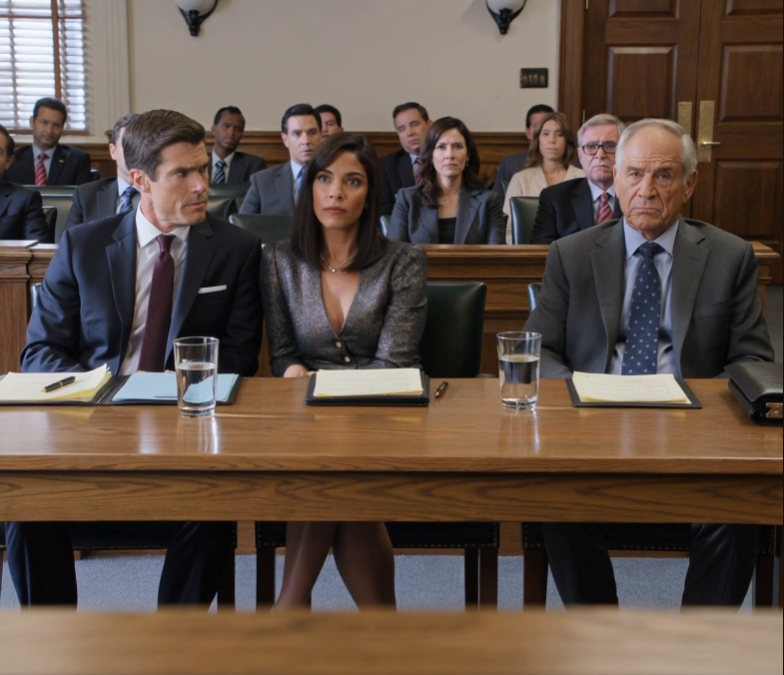
The moment I stepped into that courtroom, my daughter Melissa let out a nervous giggle. My son-in-law, Gregory, just shook his head as though I were some pathetic joke. But then the judge looked up. His face went white as a sheet. His gavel slipped from his trembling hand as he whispered a name nobody else in that room knew.
“The Scalpel.”
He was staring straight at me.
My family thought they were putting a senile old man in a cage. They had no idea they had just declared war on a ghost.
It began, as these things often do, with an insult I was expected to ignore.
It was a Sunday dinner. I was sitting at the far end of a polished mahogany table, a piece of furniture so long it could have served as a landing strip. My daughter, Melissa, and her husband, Gregory “Greg” Walsh, were holding court in their sprawling Los Angeles mansion.
“The infinity pool is non-negotiable, Greg,” Melissa said, her voice sharp. “It has to look seamless, like it’s pouring right into the canyon.”
Greg, a man whose custom-made suits always seemed one size too tight, didn’t even look up from his phone.
“Whatever you want, baby. As soon as this Ohio deal closes, you can have a pool filled with champagne.”
He was bragging, broadcasting his success to everyone within earshot.
“It’s a guaranteed nine-figure play.”
They talked right through me, discussing pool contractors, Greg’s nine-figure deal, and Melissa’s upcoming charity gala as though I were a piece of furniture. An old armchair they had inherited and didn’t quite know where to put.
My name is Nathaniel Price. I am seventy-one years old, and I was invisible.
Ever since Isabelle, my wife, passed away ten years earlier, I had done what I believed was the right thing. I sold our large family home in Connecticut, a place filled with too many memories, and bought the guest house tucked away on this massive property. I wanted to be close to my only daughter, Isabelle’s only child. I thought that was what my wife would have wanted.
My grandson, Tyler, who was sixteen, seemed to be the only person at the table who recognized that I existed.
He looked down the long table toward me.
“Grandpa, my playoff game is next week. You want to come? We’re playing Palisades.”
Before I could open my mouth, Greg cut him off. His voice was slick with casual dismissal, and he didn’t even bother to look in my direction.
“Tyler, don’t bother your grandfather. He needs his rest. He’s old.”
Melissa giggled.
It was a light, airy sound, but it cut deeper than a knife.
“He’s right, honey. Just let him be. He’s probably tired just from sitting there.”
They decided for me. They diagnosed my energy levels, my desires, and my entire existence without giving me so much as a glance.
I said nothing.
I simply looked down at the intricate pattern on my dinner plate, where a piece of asparagus had gone cold.
They had turned me into a ghost in my own life, and the worst part was that I had allowed it to happen. I had mistaken my silence for patience. I could see now that it had been nothing more than permission.
Three days later, a sharp knock struck the door of my guest house.
It was Greg.
This was a rare event. He avoided my modest little home as though it carried some contagious disease, probably because it lacked gold-plated fixtures.
He was holding a ridiculously expensive bottle of wine, which he pushed into my hands with a salesman’s smile.
“For you, Nate. Top of the line.”
He knew perfectly well that I didn’t drink. My cardiologist had made that very clear after my bypass surgery.
This gesture wasn’t kindness. It was stagecraft.
Greg had always been a salesman. He sold real estate dreams. He sold the image of a perfect family. I had seen his type my entire life. Men like him didn’t simply enter a room. They assessed its value.
He didn’t waste time.
After one superficial comment about the weather, he went straight to the point.
“Nate, I’m sitting on the opportunity of a lifetime. A resort in Ohio. It’s almost a done deal, but we’ve hit a small regulatory snag. I just need a little bridge loan to clear the permits, just to show liquidity.”
He leaned forward, his expensive cologne overpowering the small room.
“I know you own this guest house outright. It’s just sitting here. All you need to do is put a little leverage against it. Five hundred thousand dollars. That’s it.”
He sensed my silence and rushed to close the deal.
“Six months, tops. I’ll give you back seven hundred grand. That’s a forty percent return, Nate. You can’t beat that anywhere.”
I watched him carefully.
He wasn’t merely enthusiastic. He was desperate. A fine sheen of sweat had begun gathering across his forehead.
“Greg,” I said, keeping my voice perfectly level, “I’m seventy-one years old. I’m past my risk-taking days. My money is for my retirement and, frankly, for my medical bills. The answer is no.”
The change was immediate.
It was as though someone had ripped a mask from his face. His smile vanished, replaced by a cold, reptilian fury.
“Unbelievable,” he hissed. “Just unbelievable. After everything we do for you. You live here on our land rent-free.”
“I paid for this house, Greg,” I interrupted quietly.
“And you won’t lift a finger to help your own family? My God, you are one selfish old man.”
He said I lived on his land.
He didn’t know, or had conveniently forgotten, that when I bought this guest house ten years earlier, I hadn’t purchased only the house. I had also bought the two-acre parcel of land on which his sprawling mansion stood.
His ninety-nine-year lease, for a symbolic one dollar a year, was with me.
He was living on my land.
He had absolutely no idea.
Greg threw the bottle of wine onto my coffee table with enough force to make me wince.
“You’ll regret this, old man. You’ll regret being so selfish.”
He stormed out and slammed the door behind him. The vibration made the framed photograph of Isabelle on my desk tremble.
A week later, I woke at three in the morning with a dull ache spreading across my chest and radiating down my left arm.
It wasn’t the sharp, stabbing pain of a heart attack, but the familiar, suffocating grip of angina.
Stress.
My cardiologist had warned me about it.
Don’t be a hero, Nate. Call for help.
My first call was to the main house, to Melissa.
She answered on the fourth ring, her voice thick with sleep and annoyance.
“Dad, what is it? It’s the middle of the night.”
“Honey, I’m not feeling right,” I said, trying to keep my voice steady. “I’ve got chest pains. It’s not terrible, but can you drive me to the clinic? Just to be safe?”
A heavy sigh came through the phone.
It was the sound of profound inconvenience.
“Dad, seriously? I have the big charity gala meeting first thing in the morning. The whole committee is coming here. I can’t. Just call 911 if it’s that bad. Don’t overreact.”
Click.
She hung up.
She didn’t ask how severe the pain was. She didn’t ask whether I was frightened. She didn’t ask whether I was alone.
She simply told me not to overreact.
The ache in my chest tightened, but this time the pain seemed to come from somewhere much deeper than my heart.
I called an Uber.
I sat in the back of a Toyota Prius, clutching my chest, and allowed a complete stranger to drive me to the emergency room.
It was stress-induced angina. They gave me a nitroglycerin tablet and kept me under observation for four hours. By nine that morning, they discharged me.
I called another Uber to take me home.
As we approached the property’s massive gates, I thought about Melissa’s pearl-white Range Rover. Instead of being at the main house for the important meeting she had mentioned, it was parked outside a Beverly Hills spa.
So much for the charity meeting.
They didn’t merely disrespect me. They didn’t merely see me as a financial resource to be tapped whenever they needed something.
They saw me as a nuisance. A problem to be managed. An errand to be ignored.
And that was the moment I knew something had to change.
I just didn’t know how quickly that change was coming.
The following morning, I was sitting with a cup of black coffee, watching the fog burn away from the canyon, when a sharp, impatient knock echoed through my little house.
It wasn’t Greg.
Greg’s knock was arrogant.
This one was professional.
I opened the door to find a man in a crisp uniform holding a digital scanner and a stiff white envelope.
“Nathaniel Price?” he asked, his voice flat. “Legal express delivery. Sign here.”
I signed the screen. He handed me the envelope and disappeared before I could close the door.
The envelope felt heavy, not with paper, but with intent.
My hands were perfectly steady as I picked up the letter opener from my desk, the same one Isabelle had given me thirty years earlier.
I slid it beneath the flap and pulled out the contents.
The words seemed to leap from the page, cold and precise.
It was a legal petition. A lawsuit filed in Los Angeles Superior Court.
The petitioners were Gregory Walsh and Melissa Walsh.
The respondent was me.
I scanned the first page, my vision narrowing.
They were requesting an emergency hearing.
They were seeking a conservatorship.
The blood didn’t drain from my face. It didn’t rush to my ears.
Instead, a cold, perfect clarity settled over me.
They were accusing me, Nathaniel Price, of being mentally incapacitated. They claimed I was no longer capable of managing my own financial or medical affairs.
They were claiming I was senile.
It wasn’t merely an insult.
It wasn’t merely greed.
This was a legal execution.
They wanted to erase me, to turn me into a nonperson, a ward of the state with them holding the strings.
They wanted to make my invisibility official. Legally binding.
I turned the page.
Exhibit A: Evidence.
It was a three-page diagnostic report from a supposed psychological expert named Dr. Peter Lim.
I read his assessment carefully.
He claimed I exhibited severe signs of dementia, paranoid delusions, and an inability to grasp financial realities. He gravely concluded that I was a danger to myself and my own assets.
I stared at the name.
Dr. Peter Lim.
Peter Lim.
A cold, dry laugh, more like a cough, escaped my lips.
I had never met anyone named Peter Lim in my entire life.
I didn’t knock. I didn’t hesitate.
Holding the legal petition in my hand, the thick white paper stark against my age-spotted skin, I walked out of my small house and across the perfectly manicured lawn that separated my world from theirs.
I headed straight for the main house.
The glass doors leading onto the patio stood open.
I could hear ice clinking in glasses and light, vapid music playing from the outdoor speakers.
They were by the pool, exactly where I expected them to be.
Melissa was stretched out on a chaise lounge, sunglasses on, a magazine balanced on her stomach. Greg stood beside the outdoor bar, pouring himself another cocktail.
They looked relaxed and untroubled, like two predators who had set a trap and were now patiently waiting for their prey to bleed out.
I stepped onto the patio.
The music stopped.
My shadow fell across Melissa. She sat up, startled, and pulled down her sunglasses.
“Dad, what are you doing? You’re interrupting our—”
Her voice trailed off when she noticed the documents in my hand.
She didn’t look at my face.
She looked at the papers.
Greg turned around with a fake smile plastered across his face.
“Nate, we were just—”
Then he saw the petition.
His smile didn’t simply fade. It twisted into a sneer of annoyance before he quickly covered it with an expression of false concern.
I held up the envelope.
“What is this?”
Melissa flinched. She turned toward the pool, unable to meet my eyes.
But Greg was a performer.
He set down his drink, wiped his hands on a towel, and folded his arms across his chest. He was assuming a position of power.
“Dad,” he said, his voice dripping with condescending pity, “we were hoping you wouldn’t have to see it like this. We were going to talk to you right before the hearing.”
“What is this?”
“It’s for your own good,” Greg replied, stepping closer. “Look, after that little heart attack incident last week, Melissa and I realized you just can’t take care of yourself anymore. You’re forgetting things. You’re confused.”
“I had indigestion, Greg.”
He waved a hand, dismissing my version of reality.
“That’s what you think it was. But you were in pain. You were disoriented. What if it’s worse next time? You need someone to manage things for you. Someone to protect your finances, make sure your bills are paid, and handle your medical decisions before you, you know, hurt yourself.”
He was gaslighting me.
He was using the very medical emergency they had ignored as evidence of my supposed incompetence.
I turned to my daughter.
“Melissa, is this what you want? You’re signing a paper that says your own father is insane.”
She finally looked at me, but her eyes were cold, reflecting the bright blue water of the pool.
“It’s what’s best, Dad. We’re just trying to help. We love you.”
“Love,” I repeated.
The word tasted like ash in my mouth.
“You don’t even know the meaning of the word.”
That was when Greg’s patience snapped.
The mask of the concerned son-in-law fell away, revealing the vulture underneath.
He laughed, a short, sharp, ugly sound.
“See you in court, old man,” he sneered. “Frankly, this just proves our point. You’re paranoid. That’s exactly what Dr. Lim said.”
He picked up his drink and raised it in a mocking toast.
“You’d better go find yourself a public defender, because I really, really don’t think you can afford a real lawyer.”
That was it.
That was the last straw.
It was the moment the man they thought was a frail, forgetful old ghost finally died.
And something else, something they couldn’t possibly have prepared for, woke up.
I walked back to the guest house.
When I closed the door, the click of the lock sliding into place sounded louder than anything I had ever heard.
It was the sound of a line being drawn.
A final, definitive boundary.
They thought this was the home of a senile old man. A quiet beige box where I could doze, be managed, and eventually be forgotten.
They had never, not once, seen the other door.
It stood at the back of my walk-in closet, concealed behind a rack of old suits I never wore.
It wasn’t secured with an ordinary key.
It had a biometric thumbprint scanner.
I pressed my thumb against the cold glass. A green light flashed, and a heavy deadbolt slid open with a quiet, expensive click.
I stepped inside.
This was my real home.
There was no bed. No recliner.
Only floor-to-ceiling bookshelves, three massive computer monitors, a wall of file cabinets, and a dedicated encrypted satellite telephone system.
The air was cool and perfectly still.
Greg thought I was a retired pencil pusher, a simple accountant who had spent his career managing ledgers for some midlevel firm in Connecticut.
He thought my greatest achievement in life was saving enough money for a comfortable retirement.
He had no idea.
Thirty years earlier, in Washington, D.C., I wasn’t Nate.
The CEOs of Fortune 500 companies, corrupt senators, and high-level politicians had another name for me.
They called me the Scalpel.
I was the lead forensic investigator for the Department of Justice, the man they called when the numbers didn’t merely look wrong.
They looked impossible.
I didn’t just follow the money.
I dissected it.
I found the financial tumors, the hidden accounts, and the secret ledgers everyone else had missed.
I was the man who could, and did, send twelve high-profile executives to prison with a single spreadsheet.
Then I walked away from all of it.
I buried that man.
I buried him the day Isabelle received her first diagnosis.
I traded my secure office and the thrill of the hunt for hospital waiting rooms and chemotherapy schedules.
I did it without a second thought.
I became a full-time husband, then a widower, then a father trying to reconnect with a daughter I barely knew, and finally an invisible grandfather.
I let the Scalpel die because my family needed Nate.
But today, Gregory Walsh and my daughter had given the Scalpel a very good reason to come out of retirement.
I sat down at the console.
I bypassed my normal phone line and picked up the secure receiver.
My fingers didn’t tremble as I dialed the eleven-digit number.
It was a number I hadn’t used in ten years, but one I had never forgotten.
The phone rang twice.
A sharp, professional voice answered.
“Avery Hayes.”
“Avery,” I said. “It’s Nate Price.”
There was a pause.
Not confusion.
Shock. Recognition.
“Mr. Price?”
Her voice had suddenly gone breathless.
“My God. I thought—I thought you’d fallen off the face of the earth. My father asks about you all the time. He always wondered what happened to the Scalpel.”
“I’m in Los Angeles, Avery. I need you here tomorrow. Bring your best team. The ones who know how to dig.”
There was another pause, shorter this time.
The shock was gone, replaced by the steel I remembered.
“Just say the word, Nate. What did they do?”
“They filed for conservatorship,” I replied, my voice flat. “They’re claiming I’m senile. They want to take control of everything.”
A sound came through the receiver.
A laugh.
Not an amused laugh, but a short, sharp bark of disbelief.
“They’re claiming you’re senile? They have no idea, do they? They have no idea who they just tried to put in a cage.”
Her voice turned completely businesslike.
“Understood, Scalpel. I’m on my way. Just tell me, where do you want me to make the first cut?”
Avery Hayes arrived at exactly ten the following morning.
She didn’t look like a high-powered Los Angeles attorney. There was no flashy car, no thousand-dollar handbag. She wore a simple dark pantsuit, her hair pulled into a severe bun, her eyes the color of cold steel.
She carried a single slim briefcase.
She was the exact opposite of Gregory Walsh.
Substance, not style.
She was her father’s daughter.
Avery didn’t waste time on pleasantries. She stepped into my hidden office, swept her gaze across the servers, monitors, and locked file cabinets, then gave a single appreciative nod.
“They really have no idea, do they?” she said.
It wasn’t a question.
“They think I’m a confused old man,” I replied, sliding the petition across the desk. “They’ve provided their proof. Exhibit A. A Dr. Peter Lim.”
Avery picked up the document. She didn’t bother reading the entire report. Her eyes scanned the name and signature.
“Dr. Peter Lim. Psychological evaluation. Got it.”
She snapped open her briefcase, produced a tablet, and typed the name into a secure database.
“Give me three hours,” she said.
“Take two.”
She smiled, a thin, sharp expression that never reached her eyes.
“I’ll call you in one.”
Then she left as quietly as she had arrived.
For the next hour, I didn’t simply sit and wait. I began my own investigation. I started mapping the financial architecture of Walsh Holdings GP and the other limited liability companies I knew Greg had created over the years.
I was building the skeleton.
Avery would bring me the flesh.
My secure line buzzed exactly fifty-eight minutes later.
I picked it up.
“Nate.”
“Avery. That was fast.”
“It wasn’t hard,” she replied, her voice crisp and devoid of emotion. “When they’re this sloppy, the threads are just lying on the floor waiting to be pulled. Nate, you’re not going to believe this.”
“Try me.”
“Okay. First, Dr. Peter Lim is not a psychologist.”
I waited.
“He’s not a psychiatrist. He’s not a neurologist. He’s not even a general practitioner.”
I could feel the but coming.
“What is he, Avery?”
“He’s a dentist.”
I let the word hang in the air.
A dentist.
A man who scraped plaque and filled cavities.
A man who had signed a legal document declaring me mentally incompetent.
The sheer, naked arrogance of it was breathtaking.
“A dentist,” I repeated, my voice flat.
“Or he was a dentist,” Avery corrected. “The California Dental Board permanently revoked his license five years ago.”
Now we were getting somewhere.
“What for?”
“Take your pick,” she said.
I could hear her typing.
“Massive insurance fraud, billing for nonexistent surgeries, and his specialty, illegally prescribing opioids. Thousands of pills. He was running a pill mill out of a strip mall in Reseda.”
So Greg hadn’t found a legitimate expert who could be bribed.
He had found a criminal.
A disgraced professional, desperate for money and already compromised. A man with nothing left to lose.
This revelation, however, led to the question that mattered far more than the answer.
“Avery,” I said, leaning forward, “that’s specific. That’s not a name you find on Google. A high-flying real estate developer like Greg doesn’t just happen to know a disgraced dentist from a Reseda strip mall. How did he find him?”
“That,” Avery replied, her voice tightening, “is what I’ve spent the last forty minutes digging into. You’re right. It wasn’t a social connection. It wasn’t random. It was financial.”
“Go on.”
“I’m looking at Lim’s criminal file right now. When he was arrested five years ago, he was facing ten felony counts. Bail was set at a hundred thousand dollars. He didn’t have it.”
“A bail bondsman?” I murmured, my mind already connecting the dots.
“Exactly. A bondsman covered the note, but the bondsman required a guarantor. Someone to cosign and put up collateral in case Lim skipped town.”
I felt a coldness settle in my chest that had nothing to do with my heart condition.
“Who guaranteed the bond, Avery?”
She paused for a second, allowing the impact of what she was about to say to land.
“A shell corporation. An LLC registered in Delaware for single-purpose asset management.”
“What’s the name of the company?”
I already knew the answer.
“Walsh Holdings GP.”
My God.
I leaned back in my chair.
The pieces didn’t merely fall into place.
They slammed together.
Greg hadn’t found Dr. Lim last week. He hadn’t bribed him last month.
He had owned him for five years.
He had paid the man’s bail. He had likely paid for his defense attorney. He had kept this dirty, compromised asset on a leash, hidden in his back pocket for half a decade.
Waiting.
Waiting for the day he would need a doctor to sign a piece of paper.
This wasn’t an impulsive act of greed because I had refused his loan.
The loan request had merely been Greg testing the waters.
This was a contingency plan.
It was premeditated.
He had been planning to declare me incompetent and seize my assets for years.
“Avery,” I said, my voice low and hard, “you’ve disarmed their primary weapon. You’ve neutralized their medical expert. Now it’s my turn.”
“What do you need?”
“You keep digging on the legal side. Find everything you can on Lim’s case files. Find the name of the lawyer Greg hired. I’ll handle the numbers.”
She nodded, already turning toward the door.
“Be careful, Scalpel.”
“They should have been,” I replied.
I closed the door to my office, and the world shrank to the glow of my three monitors.
This was where I truly lived.
Not in the quiet guest house, but here, inside the data.
Greg thought I was a relic. He imagined that finance in my day had been conducted with paper ledgers and green eyeshades.
He had no concept of what I really was.
I was a digital ghost, and I was about to haunt every server he had ever touched.
I started with the company that had paid Lim’s bail.
Walsh Holdings GP.
It was a Delaware LLC, naturally. Anonymous. Shielded.
Greg was sloppy, but he wasn’t stupid. He understood the basics of asset protection, and he had layered his corporate structure accordingly.
Walsh Holdings was owned by Ohio Crest Properties LLC, which was, in turn, owned by the Walsh Family Trust.
A nice little nesting doll of legal entities designed to make it nearly impossible for an outsider to determine who actually owned what.
But Greg had made an amateur’s mistake.
A critical, fatal error.
He was arrogant.
He was in a hurry.
And he was cheap.
To register all those different LLCs, file the necessary paperwork with the secretaries of state in Delaware and California, and establish their banking relationships, he had used the same personal email address every single time.
It was an old address, a throwaway account he probably thought was clever.
GregWalsh\@hotmail.com.
An account he likely hadn’t logged into for years. An address he believed was long dead and buried.
He didn’t understand that old email servers never truly delete everything.
I didn’t need to hack his email. That would have been illegal, and I intended to do this by the book.
But I didn’t need to read his messages.
I only needed to see whom he had been communicating with.
I ran the email address through a series of databases I could still access, back doors into financial systems that the Department of Justice had established decades earlier and never bothered to close.
I was looking for patterns.
Correspondence with banks. Wire transfers. Loan applications.
Within twenty minutes, I found a hit.
A big one.
The email address was associated with a secure data room, a virtual vault where lenders and borrowers exchanged sensitive financial documents.
And Greg had been very, very busy.
The data room wasn’t connected to a conventional bank, not Wells Fargo or Chase.
It belonged to a private equity firm.
A name that made the hair on my arms stand up.
Citadel Apex Capital.
These weren’t ordinary bankers.
They were vulture capitalists.
They didn’t make their money lending to healthy, stable businesses. They hunted desperate men like Greg, men who had already been rejected by everyone else, and offered them a lifeline.
A lifeline attached to an anchor.
I couldn’t access the data room itself, but I could see the server logs. I could identify file names and email subject lines.
And that was all I needed.
It was a bloodbath.
Greg’s supposed nine-figure deal in Ohio wasn’t a sure thing.
It was a categorical disaster.
He hadn’t encountered some minor regulatory snag.
He had run out of money halfway through construction.
He had falsified his liquidity reports to secure the original loan. He had lied to his contractors, who were now filing liens against the project.
He hadn’t merely lost a few million dollars.
The logs showed a total capital burn of fifty million dollars.
Fifty million.
And Citadel Apex had discovered the truth.
The emails were no longer polite. They were frantic.
First came the automated default notices.
Then the personal messages.
Greg was begging for an extension.
Just another sixty days. The project is solid. It’s a temporary cash-flow problem.
And then I found the final email.
The one that explained everything.
It had been sent by Citadel Apex one week earlier, the day after I refused Greg’s five-hundred-thousand-dollar loan request.
It was a capital call.
The fund wasn’t merely angry.
It was activating an emergency clause in its contract.
Citadel Apex was demanding an immediate lump-sum interest payment.
Not five hundred thousand dollars.
Five million.
And Greg had been given ten business days to pay.
If he failed, the fund wouldn’t simply seize the Ohio property. It would activate the cross-collateralization clause in his contract, a provision I was certain Greg had signed without properly reading.
That meant the fund could seize everything.
Walsh Holdings. The mansion. Melissa’s Range Rover. Every penny in every account connected to his name.
They were going to wipe him out.
I stared at the screen as the pieces clicked into place with horrifying, perfect logic.
Greg hadn’t needed my five hundred thousand dollars as a bridge loan.
He had needed it as a desperate good-faith payment to hold off the wolves.
And when I refused, he activated the contingency plan he had been sitting on for five years.
He didn’t merely want my little guest house.
He wasn’t suing me to gain control of a modest retirement account.
He was suing me because he was bankrupt.
He wanted my entire estate, an estate he clearly believed was worth far more than the half million dollars he had originally requested.
He needed to liquidate everything I owned.
Not to build his resort.
To save his own skin.
He wasn’t simply trying to rob me.
He was trying to sacrifice me so he could survive.
Then a new question formed in my mind, a cold, hard question that settled deep in my stomach.
Wait a minute.
Greg was bankrupt. He was facing a five-million-dollar capital call. He was a cornered animal, bleeding money from every pore.
So where had he found the cash to attack me?
A lawsuit like this, even a fraudulent one, wasn’t cheap.
Lawyers, even the bottom-feeding kind Greg would hire, demanded retainers. They didn’t work on credit.
And Dr. Lim, a disgraced criminal who had already lost his professional license, wouldn’t have signed his name to a piece of perjury in exchange for a promise.
He would have demanded cash upfront.
Lots of it.
Where had Greg, a man who couldn’t pay his own bills, found fifty or a hundred thousand dollars in liquid cash to finance this lawsuit?
My mind returned to that Sunday dinner.
I remembered Greg bragging about his Ohio deal.
But I also remembered Melissa.
What had she been talking about?
The pool, certainly.
But there had been something else.
Her charity.
The upcoming gala.
The fundraiser.
My heart sank.
When Isabelle died, I had taken a portion of the proceeds from the sale of our Connecticut home, several million dollars, and placed it into a charitable trust.
I named it the Isabelle Price Foundation.
Its mission was to fund the kind of early-stage cancer research that might have saved my wife.
I had appointed Melissa as managing director.
I thought the responsibility would give her purpose. I thought it would give her a lasting connection to the mother she had lost.
I was the founder, of course, with full oversight rights.
But I had never exercised them.
I trusted her.
It was my wife’s name.
It was my daughter.
I picked up the telephone and called the private bank in Boston that managed the foundation’s assets.
A banker I hadn’t spoken with in five years answered. His voice was full of surprise when I identified myself.
“Mr. Price. What a pleasure. We, uh, usually only hear from Melissa.”
“I’m sure you do,” I replied coldly. “I’m invoking my founder’s rights. I need a full, detailed statement of all expenditures and transfers from the Isabelle Price Foundation for the past twelve months. I need it in the next five minutes. Secure email.”
“Sir, that might take some time to compile.”
“Five minutes.”
I hung up.
My secure inbox chimed three minutes later.
The PDF was attached.
I opened the file.
My hands were perfectly still.
I looked at the top line.
The total asset value.
It was supposed to be well over three million dollars.
The number staring back at me was $412,000.
I scrolled down, my blood turning to ice.
The foundation was hemorrhaging money.
I saw the usual small donations I expected. Five thousand dollars to a research laboratory here. Ten thousand dollars to a hospice there.
Then I saw the other charges.
Administrative fees.
Consulting fees.
Event-planning services.
They were massive.
One hundred and fifty thousand dollars had been paid out two months earlier.
The recipient was Walsh Holdings GP.
Greg’s company.
He had billed his wife’s charity for consulting work.
Then came another charge.
Eighty thousand dollars for gala-planning services.
The vendor was listed as LA Premier Events LLC.
It took me less than sixty seconds to run the name.
The company was a shell corporation registered three months earlier. Its business address was a post office box in Van Nuys.
And the sole proprietor listed on the filing was Gregory Walsh.
He had paid himself eighty thousand dollars to plan his own party.
But the final, devastating piece of evidence wasn’t in the line items.
It was in the proof of payment.
I clicked the links to the scanned checks. The bank provided copies for every transaction exceeding twenty thousand dollars.
The check for $150,000 to Walsh Holdings.
The check for $80,000 to LA Premier Events.
I examined the signature lines.
The elegant, flowing handwriting authorizing those transfers.
It wasn’t Greg’s signature.
It was Melissa Walsh’s.
I closed my eyes.
I had prepared myself for Greg’s corruption. He was a snake, and snakes bite. That was their nature.
Somewhere in my heart, I had even prepared myself to discover that Melissa was weak, foolish, or manipulated. That Greg had tricked her or bullied her into participating.
But this wasn’t weakness.
This was an active partnership.
Complicity.
Those were her signatures, clear as day.
She wasn’t merely being manipulated by her husband.
She was an active participant in the looting of her own mother’s legacy.
She was stealing money intended for cancer patients.
Stealing it from a foundation named after the woman who had given her life.
And she was using that money for what?
To fund her husband’s collapsing fantasy?
No.
It was worse.
I looked at the dates.
The first major transfer had occurred six weeks earlier.
The second, three weeks earlier.
This was their seed money.
This was the money they had used to hire the lawyers who were trying to have me declared insane.
They weren’t merely robbing me.
They were using Isabelle’s memory to finance the legal execution of her husband.
I had believed there was a line my daughter would never cross. A boundary of decency, family loyalty, and basic human compassion.
I was wrong.
She wasn’t merely lost.
She wasn’t simply weak.
She was a co-conspirator.
And in that moment, she stopped being a victim in this story.
She stopped being my daughter.
She became the enemy.
I stared at Melissa’s signature on the scanned check, at the elegant loop of the letter M, at the handwriting that had helped finance an attempt to declare me insane using her dead mother’s money.
The grief I felt, the shock, the profound sadness, didn’t gradually fade.
It evaporated.
Something else took its place.
Something cold, sharp, and perfectly clear.
The Scalpel was back in surgery.
I picked up the secure phone.
Avery answered on the first ring.
“Nate, I’m already digging into the law firm they hired. They’re bottom feeders, but they’re known for—”
“It doesn’t matter,” I interrupted.
My voice sounded different, even to me.
Flat. Hard.
Like polished steel.
“Change of plans, Avery.”
“What? What change of plans?”
“We are no longer on defense. We are not going to sit around disproving their case. We are going to end them. We’re going to rip this entire operation apart, root and stem. I’m done.”
Silence settled over the line.
“Nate,” she said carefully, “what did you find?”
“My daughter’s signature on checks from my wife’s foundation. They used Isabelle’s money to finance this attack.”
“My God, Nate.”
“Save your sympathy. I need data. You found the vulture fund he’s involved with, the one that’s about to wipe him out. I need their name. Now.”
I heard the rapid, precise clicks of her keyboard.
“He’s in default to a fund called Citadel Apex Capital. Nate, these guys are monsters. They don’t negotiate. They liquidate.”
“I know exactly who they are,” I said.
And for the first time in a decade, a cold, thin smile touched my lips.
Citadel Apex Capital.
I wasn’t merely familiar with the name.
I knew the man who had built the company from scratch.
James “Jim” Callahan.
Avery didn’t know that.
Nobody did.
Thirty years earlier, back in Washington, D.C., Jim Callahan had been a brash, arrogant young trader who had gotten himself tangled in the Enright Corporation scandal.
The Securities and Exchange Commission was preparing to indict him. Investigators wanted to charge him with conspiracy and send him to federal prison for twenty years.
They were convinced he had participated in the fraud.
They were wrong.
Jim was greedy, yes.
Arrogant, absolutely.
But he wasn’t a criminal.
Not then.
I was the lead investigator on that case.
I was the one who had spent three sleepless nights digging through server data, past the doctored ledgers, until I found the exculpatory evidence.
The original, timestamped trades proved that Jim had been a victim of the fraud, not a participant.
I saved him.
I saved his career.
I saved him from prison.
I did it because it was the truth, and my job was to make the books balance.
Jim Callahan went on to build Citadel Apex into a billion-dollar empire.
He never forgot what I had done.
He called me once, ten years earlier, shortly after Isabelle passed away.
His voice had been unusually quiet.
“Nate,” he’d said, “I know what you did for me. If you ever need anything, a new life, a new career, a blank check, you just call.”
I never called him.
Until today.
“Avery,” I said, returning to the matter at hand, “I’m going to handle Citadel Apex. I need you to do something else immediately.”
“What?”
“Draft a writ of seizure.”
“A writ? On what grounds? We don’t have a judgment, Nate.”
“You will.”
I switched lines, my fingers already dialing another number I knew by heart.
It was the private, direct line to Jim Callahan’s personal office.
His assistant attempted to block me.
“Mr. Callahan is in a board meeting.”
“Tell him the Scalpel is on the line,” I replied. “Tell him it’s about Enright.”
I was on hold for less than three seconds.
“Nate?”
His voice was booming and confident, but there was a trace of something else beneath it.
Fear.
The fear of encountering a ghost from the past.
“Nate Price? Is everything okay?”
“Hello, Jim. It’s been a long time. I’m not calling about the old days. I’m calling to cash in my chip.”
Silence.
Then one word.
“Name it.”
“You have a loan out to a man named Gregory Walsh. A project in Ohio. He’s in default. He’s bankrupt.”
“Walsh.”
I heard him typing.
“Yeah. A fifty-million-dollar disaster. My team is moving to seize his assets on Monday. The man’s a fool.”
“I don’t want you to seize his assets, Jim. I want you to sell me the debt. All of it. The note, the collateral, the default. Everything.”
“Sell it to you, Nate? It’s toxic paper. It’s—”
“I’m not buying it as an investment,” I interrupted. “I want to be his sole creditor. I’ll wire the full outstanding principal, the five million, right now from a blind trust. No paper trail leading back to me. Just a quiet transfer of ownership.”
Jim was a smart man.
He didn’t ask why.
“You want to be the monster, Nate? Fine. You saved my life. It’s the least I can do.”
He barked a series of orders to someone in his office.
“My lawyers will execute the transfer. It’ll be done in an hour. The debt is yours.”
“Thank you, Jim.”
“No, Nate,” he replied, his voice suddenly deadly serious. “Thank you. Good hunting.”
I hung up and called Avery back.
“It’s done,” I said. “Citadel Apex no longer holds the note. I do.”
Avery gasped.
I heard her sharp intake of breath through the receiver.
“Nate, you bought his debt. You’re his bank.”
“I’m his nightmare,” I corrected. “Now finish drafting that writ of seizure. He’s in default on a five-million-dollar loan to me. I want the lien on that mansion. I want his cars. I want Walsh Holdings LLC. I want it all.”
“I’ll have the process server at his door in an hour.”
“No,” I said firmly. “You hold that paper.”
There was a pause.
“He’s expecting a fight over my sanity. He has no idea his entire life is on the line. We’re not going to serve him. We’re not going to warn him.”
I looked down at the court date printed on the petition.
“We’re going to walk into that courtroom, and we’re going to hand it to him. Right in front of the judge.”
On the morning of the hearing, Avery and I stood in a long, fluorescent-lit hallway outside Department 5B.
She looked at me, her expression impassive, a single slim briefcase in her hand.
“Nate, are you ready?”
I adjusted the cuffs of my shirt.
I wasn’t wearing the soft-knit sweaters and corduroy trousers my family had grown accustomed to seeing me in. I wasn’t dressed like a man fading into beige invisibility.
Today, I was wearing armor.
It was a charcoal-gray, single-breasted suit from Savile Row.
I hadn’t worn it in more than a decade.
The last time I put it on, I had been entering a hearing room to testify before the Senate Banking Committee.
It still fit perfectly.
I had gotten a haircut.
I was clean-shaven.
I was not the man my daughter and son-in-law thought I was.
I was the man I had once been.
“I’m ready,” I said.
The doors opened.
We walked inside.
The courtroom was small and beige, smelling of stale coffee and cheap floor wax. It was exactly the kind of joyless room where lives were quietly dismantled.
Greg and Melissa were already seated at the petitioners’ table.
They were whispering to each other, almost giddy with anticipation.
Their attorney, a man in a shiny suit with far too much gel in his hair, was shuffling papers and looking supremely confident.
Then they saw me.
I watched my daughter’s expression.
She looked up, saw me in my suit, and let out a nervous, suppressed giggle.
She covered her mouth with one hand, but her shoulders continued shaking.
She leaned toward Greg and whispered something.
I could almost hear the words.
Look at him. Dad thinks this is a funeral or something.
Greg looked me over.
His eyes traveled across my suit and my posture, and then he smirked.
He slowly shook his head, profound, pitying contempt written across his face.
To him, this wasn’t dignity.
It was a pathetic last-ditch effort, a dying animal puffing up its fur.
His lawyer glanced at me, sized me up as a frail seventy-one-year-old man playing dress-up, and dismissed me without another thought.
He returned to his notes.
They had no idea.
I sat at the respondent’s table.
Avery placed her slim briefcase on the surface and sat beside me, a pillar of quiet, coiled strength.
We said nothing.
We simply waited.
“All rise,” the bailiff intoned, his voice bored.
We stood.
The judge entered through a side door, wearing his black robe and looking tired.
He had the appearance of a man who had seen far too much and been paid far too little.
He settled into his high-backed chair, the leather groaning beneath him.
“Please be seated.”
He put on a pair of gold-rimmed reading glasses and picked up the day’s docket.
The nameplate on his desk read Judge John Carmichael.
“Good morning,” he mumbled, his voice a monotone. “We are here for the first item on the docket. Case number 881B, in the matter of the conservatorship of Nathaniel Price.”
He read my name.
Then, as procedure dictated, he looked up from his papers.
He peered over the top of his glasses to identify the respondent.
He looked directly at me.
The air seemed to leave the room.
The judge didn’t merely pause.
He froze.
His face, which moments earlier had been a mask of tired bureaucracy, turned white.
Ashen.
His eyes widened behind the magnifying lenses of his glasses.
The cheap ballpoint pen he was holding slipped from his fingers.
It clattered onto the wooden desk, the sound echoing through the suddenly silent courtroom.
Greg and Melissa stared at him in confusion.
Their lawyer looked up, annoyed by the interruption.
The judge’s hand, the one that had dropped the pen, was visibly shaking.
He stared at me, his mouth slightly open.
Then he leaned toward the gooseneck microphone on his desk, apparently forgetting it was there.
In a voice meant to be a whisper, but caught and amplified for everyone to hear, he spoke in pure, unadulterated shock.
“My God. Is that—is that really him?”
Every head in the courtroom swiveled.
They were no longer looking at the judge.
They were staring at me.
Greg and Melissa’s faces were blank with confusion.
What was happening?
This wasn’t part of their plan.
I recognized him, too.
Oh, yes.
I recognized him.
John Carmichael.
But the man I remembered wasn’t a sixty-year-old judge with a weary face.
The man I knew had been a thirty-five-year-old assistant U.S. attorney, terrified, ambitious, and hopelessly in over his head.
He had been handed the biggest case of his young career.
The Enright Corporation fraud.
A billion-dollar house of cards.
And he was losing.
His case was falling apart. His star witnesses had been discredited. He was on the verge of defeat, a defeat that would have ended his career before it truly began.
Then his expert witness took the stand.
I was that expert witness.
I was the man they brought in when the numbers had become a tangled mess of lies.
In a single day, I took a billion-dollar fraud and laid it bare on one spreadsheet for the jury to understand.
I was the one who put twelve CEOs and their accountants behind bars.
John Carmichael hadn’t merely known me.
I had made him.
I had handed him his career on a silver platter.
Now Judge Carmichael sat frozen at his bench, his face pale, both hands gripping the edges of his desk.
He was no longer looking at a supposedly senile old man.
He was looking at a ghost from his past.
The man they had once called the Scalpel.
Finally, he tore his eyes away from me and slowly, deliberately turned toward the petitioners’ table.
His gaze fixed on Greg’s slick, smiling attorney.
“Counselor,” the judge said.
His voice was no longer tired.
It was sharp, cold, and dangerous.
“Are you aware of who your respondent is?”
The lawyer stood, looking baffled.
“He’s, uh, Nathaniel Price, Your Honor. A retiree.”
Judge Carmichael released a short, harsh breath.
It wasn’t a laugh.
It was a warning.
“No, Counselor,” he said, his voice ringing through the silent courtroom. “That is the Scalpel Price. Good luck. You’re going to need it.”
Greg’s attorney, a man named Fiero, looked as though he had swallowed a bug.
He was visibly sweating.
He glanced toward Greg, who made a sharp, furious gesture with his hand.
Get on with it.
Fiero, clearly rattled by the judge’s reaction, began shuffling his papers.
“Your Honor, the petitioners call our first and primary witness to the stand. Dr. Peter Lim.”
A side door opened.
A small, greasy-looking man in an ill-fitting suit scurried into the courtroom.
He looked less like a doctor than a man who had spent his life hiding in a basement.
He avoided looking at anyone, especially the judge.
He took the witness stand, his hand trembling as he was sworn in.
Fiero, desperate to regain his footing, began his examination.
“Dr. Lim, did you have occasion to evaluate the respondent, Nathaniel Price?”
“I did,” Lim replied, his voice oily and rehearsed. “I conducted a full psychological workup.”
He sounded as though he were reading from a script.
“And what were your findings?”
Dr. Lim put on a pair of smudged glasses.
“Mr. Price presented with severe signs of cognitive decline. His short-term memory is frankly nonexistent. He exhibits classic symptoms of paranoid delusion, particularly concerning his family’s finances and their intentions toward him.”
I sat perfectly still.
He was describing the man they wanted me to be.
“In your professional opinion, Dr. Lim,” Fiero continued, “is Mr. Price capable of managing his own affairs?”
“Absolutely not,” Lim said, shaking his head with false sadness. “He is a danger to himself and his own assets. He requires immediate full-time supervision.”
Fiero smiled.
A weak, triumphant little smile.
“Thank you, Doctor. Your witness.”
He sat down, looking relieved.
Avery Hayes stood.
She didn’t carry a stack of documents.
She didn’t bring a laptop.
She held a single sheet of paper as she walked slowly toward the witness box.
The courtroom fell silent.
“Good morning, Dr. Lim,” she said.
Her voice was polite and quiet, but it cut through the room like a scalpel.
“Or perhaps I should call you Mr. Lim. It is Mister, isn’t it?”
Lim blinked in confusion.
“It’s—it’s Doctor.”
“Is it?”
Avery turned toward the bench.
“Your Honor, I have no record of Mr. Lim being a licensed psychologist, psychiatrist, or neurologist.”
She looked back at the witness.
“Mr. Lim, what kind of doctor are you?”
“I—I have a medical background,” he stammered, glancing desperately toward Fiero.
Fiero jumped to his feet.
“Objection. Relevance. This is a character—”
“Overruled,” Judge Carmichael snapped.
His eyes remained fixed on Lim.
“Sit down, Counselor. The witness will answer the question.”
Avery waited.
“What is your medical background, Mr. Lim?”
Lim swallowed.
“I—I was a dentist.”
A murmur rippled through the courtroom.
Greg’s face went white.
“A dentist,” Avery repeated, allowing the word to hang in the air. “Or, to be more accurate, a former dentist. Isn’t that right, Mr. Lim?”
“I’m—I’m retired,” he lied.
“Retired?”
Avery’s voice sharpened.
“Or was your license to practice dentistry permanently revoked by the state of California in 2019?”
Lim began shaking.
“That’s—that’s not—”
“It’s public record, Mr. Lim,” Avery continued relentlessly. “Revoked for gross misconduct, specifically insurance fraud and operating an illegal prescription pill mill out of your Reseda office. Is that correct?”
Lim had no answer.
He looked like a cornered rat, his gaze darting wildly between Greg and the judge.
Greg’s lawyer was on his feet again.
“Objection! Objection! This is—this is badgering!”
“This is cross-examination, Counselor,” the judge barked. “And it’s fascinating. Please continue, Ms. Hayes.”
Avery took another step toward the witness box.
“Just one more question, Mr. Lim, regarding your expert opinion.”
She held up her single sheet of paper.
“Did you or did you not receive a payment of twenty-five thousand dollars from a corporation named Walsh Holdings GP three days before you signed this fraudulent diagnosis?”
“Objection!” Fiero screamed, his voice cracking. “Speculation! No foundation!”
Avery didn’t even look at him.
She turned calmly toward the judge.
“Your Honor, I have the bank transfer record right here.”
She crossed to the overhead projector and placed the paper on the glass.
The image flashed onto the wall, a stark black-and-white receipt displayed for the entire courtroom to see.
From: Walsh Holdings GP.
To: Peter Lim.
Amount: $25,000.
Memo: Consulting.
Judge Carmichael’s face turned a deep, furious red.
He glared at Lim, who looked as though he might be physically sick.
“Mr. Lim.”
The judge’s voice was a low growl of thunder.
“You are under oath. You have just committed blatant, egregious perjury in my courtroom. You have filed a fraudulent document with this court as part of a criminal conspiracy with the petitioners.”
He pointed a shaking finger toward the bailiff.
“Bailiff, take this man into custody. He is under arrest for perjury.”
The click of the handcuffs closing echoed through the stunned silence.
Melissa let out a small, terrified squeak.
Greg sat rigidly, staring at his star witness as the bailiff led him away.
Their entire case had just been put in handcuffs.
Greg’s lawyer, Fiero, was completely adrift.
He was sputtering, his notes scattered across the table. His star witness had been led away in handcuffs, his entire case had evaporated, and the judge was looking at him as though he were something unpleasant scraped from the bottom of a shoe.
Greg had gone beyond pale.
His face was now a furious, blotchy red.
He seemed to vibrate with rage.
He grabbed Fiero by the sleeve and hissed something into his ear.
Fiero looked terrified of his own client.
He stood shakily.
“Your Honor,” he stammered, “my—my client, Mr. Walsh, would like to take the stand to—to clarify this unfortunate misunderstanding.”
Judge Carmichael raised one eyebrow.
“Oh, he does, does he? He wants to testify? After his primary witness was just arrested for perjury in a conspiracy with him?”
The judge looked toward Avery.
“Ms. Hayes, any objection?”
Avery stood.
“Not at all, Your Honor. We would be delighted to hear what Mr. Walsh has to say.”
“Very well,” the judge replied, his voice laced with ice. “Mr. Walsh, take the stand. You are, of course, under oath.”
Greg shoved his way toward the witness box, practically pushing the bailiff aside.
He was trying to project confidence, but he looked like a drowning man who was only making more bubbles.
He sat down and gripped the railing so tightly that his knuckles turned white.
“Your Honor,” Greg began.
His voice slipped into the slick, practiced performance of a wounded victim.
He was speaking directly to the judge, ignoring Avery and me.
“This is—this is a travesty. My wife and I, we’re just—we’re worried about him. That’s all this has ever been about.”
He pointed a finger in my direction.
“He—he’s confused. He’s paranoid. He locks himself in that little house for days. He hides his finances. He accused me of trying to steal from him, for God’s sake. All we wanted was to help him. To protect him from himself.”
He paused, attempting to look heartbroken.
Instead, he looked monstrous.
“He’s not lucid, Your Honor. He doesn’t know what he’s doing.”
Fiero, seeing what he believed was an opening, leaned forward.
“So your only motivation was concern for his well-being?”
“One hundred percent,” Greg replied, oozing false sincerity.
“Thank you,” Fiero said.
He sat down, looking as though he had narrowly dodged a bullet.
Then Avery stood again.
She walked toward Greg, not with aggression, but with a kind of surgical curiosity.
“Mr. Walsh,” she began quietly, “you just testified under oath that my client, Mr. Price, is not lucid and is paranoid.”
“That’s right,” Greg replied, puffing out his chest. “He’s deeply confused.”
“And his confusion centers on his finances, you said?”
“Yes. Absolutely. He doesn’t understand money. He’s from a different time. He doesn’t grasp modern finance.”
“I see,” Avery said, nodding thoughtfully. “And that’s why you believe he’s not lucid? Because he doesn’t understand modern finance?”
“It’s a major part of it, yes,” Greg said confidently.
Avery paused.
“So when you approached him two weeks ago and asked him to give you five hundred thousand dollars, you were doing what? Testing his lucidity?”
Greg’s face tightened.
“I—I was offering him an investment. A chance to be part of the family’s success.”
“You asked a man you believed to be confused and paranoid for half a million dollars?”
Her voice remained mild.
Greg recognized the trap and tried to dance around it.
“It—it was his refusal that proved our point. I offered him the deal of a lifetime. A golden opportunity. A guaranteed forty percent return in six months on my Ohio resort project. It was a slam dunk.”
He turned back toward the judge, once again playing the reasonable businessman.
“Your Honor, he refused. He said it was too risky. He—he was too senile, too scared to recognize a golden opportunity when it was staring him in the face. That’s when I knew. That’s when Melissa and I knew he’d truly lost it.”
His confidence was growing with every word.
“He was no longer capable of making sound financial decisions. He was letting his paranoia get in the way of a fortune.”
He had done it.
Under oath, he had linked his entire claim of my senility to my refusal to give him money.
He had built his own gallows.
Now Avery was going to kick away the chair.
“A golden opportunity, Mr. Walsh?” she asked.
Her voice was no longer curious.
It was cold.
“A slam dunk?”
“Absolutely,” Greg replied, arrogant to the last. “That project is gold.”
“Is that why the project is currently fifty million dollars over budget and facing sixteen contractor liens for nonpayment?”
The color drained from Greg’s face.
He stammered.
“That’s—that’s a lie. That’s— that’s privileged information. How—”
“It’s not privileged when you’re in default, Mr. Walsh,” Avery replied.
Her voice rose, each word landing like a hammer blow.
“And this golden opportunity is, in fact, a sinking ship, isn’t it? Isn’t it true that your primary lender, Citadel Apex Capital, found you in breach of your loan covenants and issued a capital call for five million dollars, due ten days ago?”
Greg was speechless.
His mouth opened and closed, but no sound came out.
He glanced at Fiero, who was staring at his client in pure horror.
“A five-million-dollar demand, Mr. Walsh, and you didn’t have the money. You were, and still are, completely, hopelessly bankrupt, weren’t you?”
“No!” Greg finally roared, his composure shattering. “It’s a temporary cash-flow problem. The project is sound!”
“Is it?” Avery pressed relentlessly. “You were bankrupt. You had no money. Your credit was frozen. And yet you somehow found the money to hire Mr. Fiero. You found twenty-five thousand dollars in cash to bribe a disgraced dentist.”
She took a step closer.
“My question, Mr. Walsh, is where did you get that money?”
Greg was trapped.
He looked at Melissa.
He looked at the judge.
He had no answer.
So Avery provided one.
“You got it,” she said, her voice dropping with contempt, “from a charity. You got it from the Isabelle Price Foundation.”
At the sound of her mother’s name, Melissa, who had been frozen in her seat, released a tiny, choked sound.
“Isn’t that right, Mr. Walsh?” Avery thundered. “When you were broke, when your empire was collapsing, you turned to your wife and had her sign checks. You convinced her to steal from her dead mother’s cancer charity.”
“You—you can’t prove that!” Greg spat.
“I can.”
Avery held up another set of documents.
“One hundred and fifty thousand dollars paid to Walsh Holdings for consulting fees. Eighty thousand dollars paid to LA Premier Events, a shell company you own, for gala planning.”
She allowed the numbers to settle.
“A total of two hundred and thirty thousand dollars embezzled from a fund dedicated to cancer research.”
Then she turned and looked directly at Melissa for the first time.
“He didn’t just lie to the court, Melissa. He lied to you.”
That was when my daughter broke.
She shot to her feet, her face twisted with disbelief and rage, and screamed at her husband.
“You lied to me! You told me those were legal administrative fees! You told me it was—it was all approved!”
Her voice cracked.
“You were—you were stealing from my mother!”
Greg finally, completely lost control.
All the charm, the polished performance, the arrogance—everything boiled away, leaving only the raw, desperate man underneath.
He stood up in the witness box, his face turning purple, and pointed a shaking finger.
Not at Avery.
Not at Melissa.
At me.
“Shut up, Melissa!” he shrieked, his voice cracking. “Just shut up! This is all—it’s his fault! All of it! That selfish old man! He had the money! He could have fixed everything! He just had to write a check, and he said no!”
He was practically foaming at the mouth.
“He made me do it! It’s all his fault!”
The courtroom dissolved into chaos.
Melissa was sobbing hysterically, a raw, ugly sound.
Greg was screaming at her to shut up, his face a mask of purple rage.
Fiero was desperately trying to object, but Judge Carmichael waved him into silence.
The judge’s expression was a thundercloud.
He slammed his gavel down, the sound cracking through the room like a gunshot.
“Silence!” he roared. “Mr. Walsh, you will sit down and be silent, or I will have you held in contempt. Madam, control yourself.”
Greg collapsed back into his chair, breathing hard.
Melissa sank into her seat, her sobbing reduced to wet, choked gasps.
The room became deathly quiet.
The only sound was the faint click of the bailiff’s radio.
Judge Carmichael turned his cold, furious gaze away from the wreckage at the petitioners’ table and looked at me.
He studied me for a long moment.
Gradually, the anger in his expression softened, replaced by something else.
Respect.
And a deep, profound curiosity.
“Mr. Price,” he said, his voice now calm but carrying the full authority of the bench, “your opponents have made their case, such as it was.”
He gestured toward Greg.
“He has just confessed under oath to a litany of financial crimes. But the petition is still before me. Do you have anything you wish to say in your defense regarding your own competency?”
I rose slowly to my feet.
I didn’t lean against the table.
I didn’t waver.
I stood straight, my hands clasped loosely behind my back.
The courtroom was so quiet that I could hear the hum of the fluorescent lights.
I looked at Greg.
I looked at Melissa.
Then I looked at the judge.
“Thank you, Your Honor,” I said.
My voice was clear and strong, echoing through the small room.
“But I’m not here today to argue about my sanity. I’m not here to defend myself. My competency is not in question. My record speaks for itself.”
I paused, letting the words settle.
“No, Your Honor,” I continued. “I didn’t come here today to be a respondent. I came here to file a criminal complaint.”
Fiero leaped to his feet.
“Objection! This is—this is theater! This is not the proper venue!”
“Sit down, Counselor!” Carmichael roared. “You opened this door. You brought this man into my court, accusing him of delusion. The court will hear what he has to say.”
He turned back toward me.
“Proceed, Mr. Price.”
I shifted my gaze toward Greg.
He was staring at me, his eyes wide with a new and dawning horror.
“Mr. Walsh has just confessed to part of it,” I said, my voice flat, like an anatomist describing a corpse. “He confessed to embezzling two hundred and thirty thousand dollars from a charitable foundation. My wife’s foundation. The Isabelle Price Foundation.”
Then I slowly, deliberately turned toward my daughter.
She was watching me, her face streaked with tears and mascara, her eyes pleading.
“But he didn’t act alone,” I said, holding her gaze. “He couldn’t. He needed a signature. He needed the signature of the foundation’s director.”
I looked back at the judge.
“And you, Melissa, my daughter, signed those checks. You knowingly, and with full intent, looted your own mother’s legacy to fund your husband’s lifestyle and finance this pathetic attempt to seize my assets.”
Melissa released a wail of pure, animal despair.
“No! No, I didn’t know! He told me—”
“You signed them,” I stated, cutting her off.
It wasn’t an accusation.
It was a fact.
Greg, seeing his wife crumble, found one last surge of desperate, cornered-animal bravado.
He jumped to his feet, knocking over his chair.
Then he laughed.
It was a high-pitched, hysterical, ugly sound.
“You can’t do anything to me!” he shrieked, pointing at me. “You! You’re a nobody! You’ve got nothing! You think you can do what? File a complaint? It’s my word against hers!”
He was almost screaming now.
“And you? You’re just a sad, senile old man! You’re living in a guest house! A guest house! You’re broke! You have nothing!”
His voice cracked.
“You are nothing!”
He believed it.
Even now, with his lies exposed and his case in ruins, he believed I was powerless.
He believed the money was gone.
That I had nothing left but my suit.
I simply waited.
I let his voice echo through the courtroom and die.
I allowed the silence to return.
I let him stand there panting, a failed king on a stage of his own making.
Then I smiled.
A thin, cold smile.
“Ah,” I said quietly. “About that.”
I turned my head and gave Avery Hayes a single, slight nod.
She stood.
Without saying a word, she reached into her slim briefcase and removed a thick stack of documents bound beneath a blue legal cover.
She didn’t hand it to the judge.
She didn’t hand it to me.
She walked across the aisle, straight to the petitioners’ table, and placed the documents directly in front of Gregory Walsh.
“What? What is this?” Greg stammered, staring at the ominous blue cover.
“That, Mr. Walsh,” Avery said, her voice clear and ringing, “is an emergency notice of foreclosure and seizure.”
Greg’s lawyer snatched up the papers.
His eyes scanned the first page.
His face, which had already been pale, turned the color of ash.
“This is—this is impossible,” Fiero whispered, looking at Avery. “This is from Citadel Apex Capital. But that’s not the—”
Greg snatched the documents out of his attorney’s hands.
“What is it?”
“It seems you’re a little behind on the news, Greg,” I said conversationally. “You were quite right. You defaulted on your five-million-dollar loan to Citadel Apex. They were, as you know, preparing to seize all your assets. A terrible shame.”
Greg stared at the paper, his hands shaking so violently that he could barely read the words.
“This—this says the debt was sold.”
“Yes, it was,” I replied. “They were very motivated to sell. It was, as you said, toxic paper. And when you couldn’t pay them, I stepped in.”
I watched his expression.
“I bought that debt, Greg. All of it. The note, the loan, the collateral. Everything.”
I took a step forward.
“You defaulted on your loan, Greg, but you didn’t default on Citadel Apex.”
I paused.
“You defaulted on me.”
I let the words sink in.
I watched the final traces of color leave his face as the blood-freezing, soul-shattering reality of his situation settled over him.
“And I,” I continued, “am not as patient as Jim Callahan. I’m not offering an extension. I’m not renegotiating. I’m calling the note. Effective immediately.”
Greg looked up at me, his mouth open in a silent scream.
I pointed toward the mansion he lived in.
“The main house is mine.”
Then toward the cars he drove.
“The cars are mine.”
I gestured toward the corporate documents.
“Your entire Walsh Holdings empire is mine.”
Finally, I pointed at the suit he was wearing.
“Everything you thought was yours now belongs to me.”
I turned back toward Judge Carmichael, who was watching the exchange with an expression of pure, unadulterated awe.
“Your Honor,” I said, my voice ringing with finality, “this pathetic conservatorship hearing is over.”
I gestured toward Avery and the documents in her hand.
“The eviction hearing begins now.”
Greg was finished.
A man who screams his own confession in a courtroom doesn’t have many legal options left.
After that performance, what followed felt less like a trial than a sentencing.
The evidence Avery and I had compiled was a precise, airtight coffin.
There were the bank transfers from Isabelle’s foundation. The fraudulent invoices from Greg’s shell companies. The perjured testimony he had purchased from Peter Lim. And, of course, the open-and-shut case of bank fraud he’d been running on the Ohio project.
It was an avalanche of paper, and every single sheet had his name on it.
He tried to fight.
He hired a new attorney, an even more expensive one, probably with money he didn’t have.
They attempted to argue that Greg had been under extreme duress. They tried to paint me as a vindictive, manipulative mastermind who had somehow entrapped him.
It was a pathetic defense.
Like a rat caught in a steel trap trying to blame the cheese.
The district attorney, who had taken a very keen interest in the case following Judge Carmichael’s report, didn’t even break a sweat.
The prosecution offered Greg a plea deal to spare the state the expense of a trial.
He refused.
Arrogant to the very end.
He still believed he could talk, charm, or sell his way out of the consequences.
So they took him to trial.
And they buried him.
I didn’t have to testify.
Avery’s documentation and my financial forensics did all the talking.
The jury deliberated for less than an hour.
They found Gregory Walsh guilty on twelve counts involving wire fraud, securities fraud, and aggravated embezzlement.
The judge looked at Greg, this man who had walked into a courtroom and tried to destroy another man’s life to conceal his own crimes, and decided to make an example of him.
He wasn’t given a slap on the wrist.
He wasn’t sent to some comfortable white-collar country-club prison.
He was sentenced to ten years in a state penitentiary.
Ten years.
I watched as they led him away, no longer wearing one of his expensive custom suits, but an orange prison jumpsuit.
For the first time in his life, Gregory Walsh was truly out of cards to play.
The books were balanced.
But then there was Melissa.
Melissa was the hardest part.
She was my daughter.
She was Isabelle’s blood.
And she was also a co-conspirator.
The evidence was undeniable.
Her signature was on those checks.
She had sat in that mansion week after week, enjoying a life of extraordinary luxury, knowing it was being financed by money stolen from her own mother’s legacy.
Her lawyer approached me.
He begged.
He pleaded.
“Mr. Price, she was manipulated. She was a victim of psychological abuse. Greg controlled her.”
I looked at him.
“Did Greg hold the pen? Did he force her hand to write her own name? She’s a grown woman. She made a choice.”
He asked me to speak to the district attorney.
He wanted me to request leniency, to write a letter in her defense, to explain that she was a good person who had simply made a mistake.
I said no.
I would not interfere.
This wasn’t about revenge.
It was about consequences.
I had spent ten years allowing my daughter to live without any.
I had enabled her weakness, her greed, and her casual cruelty.
To step in now and save her from the fire she had helped set would have been the final, worst act of a failed father.
She had to stand on her own.
She had to face the ledger.
Melissa was indicted, just as Greg had been.
But unlike her husband, she was smart enough to recognize when she had reached the end of the line.
She accepted a plea agreement.
She pleaded guilty to felony misuse of charitable funds.
The judge was less harsh with her.
He saw her tears. He heard her testimony about Greg’s controlling behavior.
But he also saw the bank statements.
She was sentenced to three years of formal probation.
She was ordered to repay every single cent of the money she had helped steal.
All $230,000 had to be returned to the Isabelle Price Foundation.
And then the judge added one final condition.
Two thousand hours of mandatory community service.
Not picking up trash along a highway.
Not filing papers in an air-conditioned office.
He assigned her to Glenwood Gardens Nursing Home.
Specifically, to its locked dementia and Alzheimer’s ward.
For the next two years, my daughter, the woman who had tried to have her own father declared legally senile so she could take control of his money, would spend every weekend bathing, feeding, and cleaning up after men and women who truly were lost.
People who no longer knew their own names.
People who couldn’t remember the faces of their children.
People whose minds had been taken from them by diseases they had never chosen and could not control.
I wanted her to see it.
I wanted her to smell it.
I wanted her to understand, in her bones, the reality of the weapon she had tried to use against me.
It was a just sentence.
Perhaps the only real education she had ever received.
Six months passed.
The silence that settled over the property was absolute.
The grand, ridiculous mansion Greg and Melissa had built was gone.
I had it sold at auction.
The land beneath it, the guest house, my own little home—I sold those, too.
All of it.
The proceeds went to two places.
Half was used to replenish and substantially expand the Isabelle Price Foundation, which was now under new professional management.
The other half went into a trust for my grandson, Tyler.
The money would remain protected until his twenty-fifth birthday.
At least something good could come from all that destruction.
One afternoon, I stood inside the guest house for what would be one of the last times.
It was almost empty.
Cardboard boxes were stacked against the walls. The shelves had been cleared. The rooms that had once contained ten years of my life were bare.
I was in my hidden office, packing the last of my files.
The monitors were dark.
The servers were silent.
The Scalpel was going back into retirement.
I heard a hesitant footstep on the porch.
Not a knock.
Just the sound of someone standing outside, uncertain whether to come in.
I walked toward the door.
It was Melissa.
She had been transformed.
But not in the way a spa treatment or a new designer dress transforms someone.
She looked hollowed out.
The expensive clothes were gone, replaced by a cheap, faded blue volunteer’s smock with Glenwood Gardens embroidered on the pocket.
Her hair was pulled back.
Her face was pale and thin.
She looked ten years older.
The entitlement, the casual cruelty, that arrogant little giggle—all of it was gone.
Burned away.
Her hands, once perfectly manicured, were red and raw.
She stood silently in the doorway, watching me tape up the last cardboard box.
When she finally spoke, her voice was nothing like the one I remembered.
It was a rasp.
Quiet, rough, and exhausted.
“Why?”
I stopped what I was doing, but I didn’t turn around.
“Why what, Melissa?”
“Why did you do it?”
Her voice trembled, not with sadness, but with a deep, exhausted rage.
“Why did you let it go so far? You—you knew. Don’t—don’t pretend you didn’t.”
I remained silent.
“You’re—you’re him. You knew what Greg was. You knew what he was doing.”
She took a step into the empty room.
“You could have stopped us at any time. When Greg asked you for the five hundred thousand dollars, you could have just said, ‘No, I know you’re broke.’ You could have shown me the papers then. You could have warned me.”
Her voice cracked.
A single hot, angry tear ran down her cheek.
“But you didn’t. You let us. You—you let me sign those checks. You let us file that lawsuit. You sat there in your little house, and you watched us destroy ourselves.”
She gestured helplessly toward the empty rooms.
“You didn’t have to ruin us. You didn’t have to send him to prison. You didn’t have to do this to me.”
She pointed at her cheap volunteer uniform.
“You—you wanted this. You wanted to punish us.”
I slowly taped the cardboard box shut.
I pressed the strip of tape down with my palm, smoothing it carefully along the seam.
Then I turned to face her.
I looked at this stranger who was my daughter.
“Because if I had stopped you, Melissa,” I said quietly, “you would have learned nothing.”
She stared at me.
“You would have hated me for a week. You would have called me a paranoid, controlling old man. And then you would have gone right back to him.”
I paused.
“You would have believed his next lie.”
Her face tightened, but she didn’t interrupt.
“You would have found another way to get him the money. You would have continued to bleed your mother’s foundation dry, one gala at a time.”
I held her gaze.
“I didn’t let you do anything. I just let you be who you were.”
I walked over to my old desk.
“When you were ten years old, you stole fifty dollars from your mother’s purse. You wanted a toy, and she had told you no.”
Melissa flinched.
Her eyes widened.
She remembered.
“Isabelle found out,” I continued. “She knew it was you, and she cried. She cried for an hour in the bathroom, thinking she had failed as a mother.”
I could still remember that afternoon.
The sound of Isabelle crying behind the closed bathroom door.
The way she had tried to hide the pain from our daughter.
“And then she came out, and she hugged you, and she never said a word. She put fifty dollars of her own money back into that purse.”
Melissa lowered her eyes.
“She forgave you because her heart was soft. She wanted peace.”
I looked at her, my eyes as hard and clear as glass.
“But I believe in ledgers.”
She slowly raised her head.
“The books must always balance.”
My voice remained quiet.
“Melissa, you never paid for that first theft. So you just kept stealing bigger and bigger things.”
I thought of the ten years I had spent sitting silently at the edge of her life.
The dinners.
The insults.
The condescending laughter.
The night I had called her with chest pains and she had been too inconvenienced to help.
“You didn’t respect me. Greg didn’t respect me. And neither of you—neither of you respected the memory of your mother.”
My voice hardened.
“You didn’t just cross a line, Melissa. You erased it. You danced on her grave for a swimming pool.”
She had no answer.
She simply wept.
“You didn’t destroy yourselves,” I said. “You were already destroyed. You were bankrupt in every possible way a human being can be.”
I let the silence settle between us.
“I just presented the bill.”
I picked up a single envelope from the desk.
Then I held it out to her.
“This is the address of a studio apartment in Burbank. The first three months’ rent is paid. There’s a bus pass inside.”
Her eyes moved from the envelope to my face.
“After that, you’re on your own.”
I waited until she took it.
“The books are clear.”
Her hand trembled as she accepted the envelope.
She looked at me one last time, searching my face.
Searching for what?
For her father?
He was gone.
She turned and walked away.
I stood in the doorway and watched her leave.
I am seventy-one years old.
I have retired twice in my life.
The first time was from my job.
The second was from being an invisible, accommodating, silent old man.
That day in court, I simply decided to pick up the pen again.
My name is Nathaniel Price.
And my books are finally balanced.
This entire ordeal taught me a painful but necessary lesson.
I learned that silence should never be mistaken for weakness.
For ten years, I had allowed my love for my family to blind me to their contempt.
I thought patience was a virtue.
But I learned that patience without firm boundaries is simply permission to be disrespected.
True strength isn’t measured by how loudly you can shout.
It’s about knowing the precise moment to make your move and having the discipline to wait for it.
I didn’t want revenge.
I wanted accountability.
Sometimes, the most profound act of love, both for ourselves and even for others, is to finally and decisively balance the books.
What would you have done in my position?
Let me know your thoughts in the comments below. And please like and subscribe if you believe that true respect is something that must be earned.








