Two weeks ago, my wife went to visit our daughter and son-in-law; i decided to surprise them and went too; when i approached the door of their house, their neighbor ran up to me and shouted, “wait, i have something to tell you…”; five minutes later, police arrived
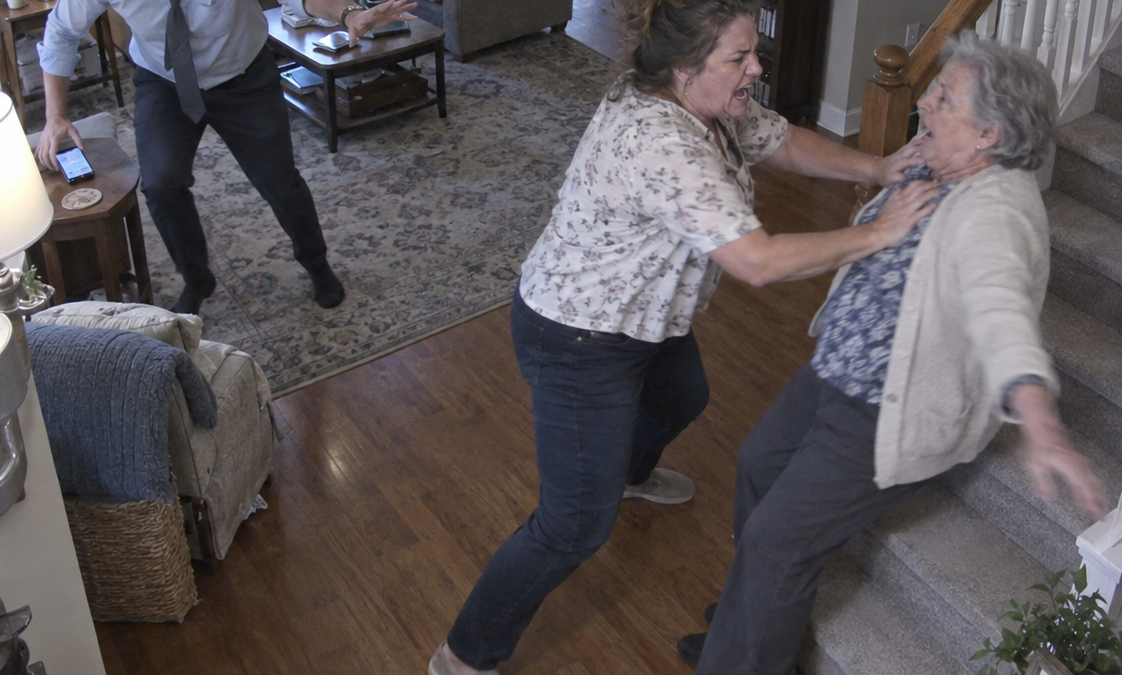
“The police are two seconds away. Let them handle it.”
His name, I would later learn, was Henderson. He lived right next door.
“What did you hear?” I demanded, my voice cracking. “What did you hear?”
He looked back at the house, his face grim. “It started about ten minutes ago. Yelling. Loud. A man’s voice, then a woman’s. Then a crash, like a heavy piece of furniture going over, and glass shattering. Then the woman screamed. Not just a yell, but a real scream, the kind you only hear once.”
He looked me dead in the eye. “She pleaded, ‘Please stop. You’re hurting her.’ Then it went quiet. Dead quiet. That’s when I called.”
My mind was spinning. Hurting her. Hurting who? Maya or Evelyn? My wife was sixty-nine years old, a gentle soul. The thought of anyone laying a hand on her made me see red. The sirens were deafening now, and I knew, just as sure as I was standing there, who was responsible.
Jason. My daughter’s husband.
I had never trusted that man, not from the day Maya brought him home. He was white, from a wealthy family, and he had this smirk, like he was always in on a joke the rest of us weren’t smart enough to get. He managed some kind of investment fund, drove a car that cost more than my first house, and always talked down to me and Evelyn. He would call me Lou instead of Mr. Harrison or Dad. He would pat me on the shoulder like I was a child.
I’m a retired city planner. I helped design the very streets we were standing on. I am not a child.
Evelyn, bless her heart, always saw the good in people. “He’s just nervous, Lou,” she would say. “He’s trying to fit in.”
But I knew better. I saw the way he looked at Maya, like she was another one of his possessions. And Maya—she just faded. My vibrant, strong-willed daughter became quiet, agreeable, always looking to him for approval.
Two weeks ago, Evelyn had driven here from our home in Atlanta to stay with them. The official reason was that Maya had suffered a miscarriage. She needed her mother. It felt thin to me. Maya sounded off on the phone. Strained. Evelyn, too.
In our last call, Evelyn’s voice had been tight. “Everything is fine, Louis. Just—just let me handle this. Maya needs me.”
Handle what? I had wanted to ask. But Evelyn was a private woman, and I trusted her. Now, standing on this sidewalk, my trust felt like stupidity. I should have come sooner. I should have trusted my gut. That miscarriage story was a lie. This was something else. This was Jason.
Two squad cars screeched to a halt, cutting off the street. Two officers, a man and a woman, jumped out, guns drawn but pointed down.
“What’s the situation?” the male officer barked at Henderson.
Henderson pointed. “Heard a violent altercation. Glass breaking. Woman screamed for help. No sound since.”
The officers moved up the walkway, stacking on either side of the front door.
“This is the Atlanta PD! Open the door!” the male officer shouted.
Silence. My heart felt like it was going to explode. I pushed past Henderson, ignoring his protest.
“My wife is in there! Evelyn Harrison! My daughter, Maya!”
The female officer put a hand up to stop me. “Sir, stay back. We need you to stay on the lawn.”
“That’s my family!” I roared.
The officer shouted again. “Police! Open the door now, or we’re coming in!”
Nothing. Just a terrible, heavy silence from inside the house.
“Okay, breach it,” the male officer said.
He stepped back and slammed his heavy boot just beside the doorknob. The wood splintered, but the deadbolt held. Again. He kicked again. The frame cracked. On the third kick, the door flew open, slamming against the inside wall with a bang that echoed my own heartbeat.
“Clear!” the officers yelled, disappearing inside, one going left, one going right.
I couldn’t wait. I didn’t care what they said. I ran past the officer on the porch, Henderson right behind me.
“Sir, I told you to wait!”
But I was already in the foyer. The smell hit me first. Something coppery, metallic. Blood. The house was a wreck. A tall floor lamp was shattered, its shade crumpled. A heavy oak chair was on its side. Glass from what looked like a picture frame was scattered across the hardwood floor.
“Evelyn!” I screamed. “Maya!”
“In here!” The female officer’s voice came from the living room, just past the staircase.
I ran toward the sound, and then I saw her. My world stopped. It just ceased to exist.
Evelyn. My Evelyn. She was lying at the bottom of the stairs, her body twisted at an angle bodies shouldn’t be. Her eyes were open, vacant, staring at the ceiling. A dark, spreading pool of blood haloed her gray hair on the light tile floor.
“Oh, God, no. No, no, no.”
I think I said it out loud. I don’t know. My legs gave out. I stumbled, catching myself on the wall. This wasn’t real. This was a nightmare. I was going to wake up in my own bed in Atlanta, and Evelyn would be there, warm and safe beside me. But the copper smell was too strong. The silence was too loud.
I stumbled past the officer, my mind refusing to process what my eyes were seeing. The living room was a scene of chaos. A tall, elegant floor lamp, one Evelyn had picked out, was smashed, its shade crumpled like a wad of paper. A heavy oak chair was on its side as if it had been thrown. Shards of glass from a shattered picture frame crunched under my shoes.
But it was the silence that was wrong. The air was thick and heavy, and it smelled of something metallic, something coppery. Then I saw her. My world didn’t just stop. It evaporated.
At the bottom of the staircase, on the cold beige tile Maya and Jason had been so proud of, lay my wife. My Evelyn. She was on her back, her body twisted at an angle that wasn’t natural. Her eyes were open, staring blankly at the chandelier above. A dark, glistening pool of blood was spreading slowly from beneath her head.
I don’t think I made a sound. I couldn’t. My lungs had turned to solid stone. This wasn’t real. This was a nightmare. I was back in Atlanta, asleep, and I would wake up, and Evelyn would be there beside me, smelling faintly of cocoa butter and books.
But the coppery smell was too strong. Her hand was outstretched, palm up, her fingers slightly curled. I saw the simple gold wedding band I had placed on her finger forty-five years ago. It was still gleaming.
“Evelyn,” I whispered.
The voice that came out wasn’t mine. It was a dry, cracking sound, like an old leaf scraping the pavement. This wasn’t just a fall. Evelyn was clumsy sometimes. Sure, she might trip, but she wouldn’t shatter a lamp. She wouldn’t overturn a chair. This was violence. This was rage.
The female officer was suddenly kneeling beside her, her fingers pressing into Evelyn’s neck.
“I’ve got a pulse!” she yelled. “It’s faint, but she’s breathing. Get a bus rolling now!”
Breathing. The word was a hammer blow. The stone in my chest cracked. I surged forward, my knees hitting the hard tile floor, the impact jarring my old bones.
“Evie! Evie, baby, I’m here.”
I reached for her hand, the one with the ring.
“Sir, don’t touch her,” the officer commanded. “Paramedics are on the way. We can’t move her.”
I knelt there, helpless, just two feet away from the love of my life. I stared at the blood matting her beautiful gray hair. I stared at the unnatural angle of her head. Who? Who could do this? Who could do this to her?
Evelyn was the kindest soul I had ever known. She baked for the neighbors. She volunteered at the library. She couldn’t hurt a fly.
My eyes, stinging with tears I refused to let fall, scanned the room again. The broken lamp. The overturned chair. Then my gaze traveled up the staircase.
I hadn’t seen her—my daughter, my Maya. She was crushed into the corner at the top of the stairs, on the second-floor landing. She was huddled against the wall, her knees pulled tight to her chest, her face buried in her hands. Her entire body was shaking, racked with violent sobs.
“Maya!” I cried out, my voice finally finding its power. “Maya, what happened? Are you hurt?”
She lifted her head. Her face was a grotesque mask of terror and tears. Mascara ran in black rivers down her cheeks. She didn’t look at me. She looked past me, staring at something in the room. Then her arm shot out, her finger trembling as she pointed—not at me, but at the man standing just a few feet away from her at the top of the landing.
“He! It was him!” she screamed, a sound so raw and painful it ripped through the house. “He did it! He pushed her! He pushed Mama!”
I followed her trembling finger. My head snapped up, and there he was. Jason. He was just standing there by the railing, staring down at the scene below. He was still holding his cell phone in his right hand. He looked dazed. His expensive dress shirt was torn at the collar, and his face—
“He attacked Mama!” Maya shrieked again.
I saw it clearly then, even from fifteen feet below. Bright, angry red scratches. Three of them, running from his left temple down his cheek, disappearing under his jaw.
Defensive wounds. My God. Evelyn, my sixty-nine-year-old wife, had fought him. She had fought for her life against this—this animal. The man I had never trusted. The man I had let into my family.
“Police! Show me your hands!” the male officer roared, his gun now unholstered and raised.
He was already taking the stairs two at a time. Jason didn’t even seem to register him. He just stood there, his mouth opening and closing as if he was trying to speak, but no sound came out. He looked completely and utterly stunned.
The officer didn’t hesitate. He slammed Jason against the wall, face-first.
“You have the right to remain silent.”
“No,” Jason finally whispered. It was the first sound he had made. “No, she’s—”
“Shut up,” the officer commanded, yanking Jason’s arms behind his back.
The sharp click of the handcuffs echoed in the stairwell. That sound snapped me out of my shock. The ice in my veins turned to fire. A pure, cleansing rage, the kind I hadn’t felt in decades, surged through me.
“You!” I roared, pushing myself up from the floor. “You worthless piece of trash! You did this!”
I lunged for the stairs, my only thought to get my hands on him, to make him pay. But Henderson, the neighbor, was suddenly there, grabbing me in a bear hug.
“Louis, no. Let the police handle this. Don’t you do something you’ll regret.”
I fought against his grip, tears of pure fury finally blinding me.
“He killed her! He killed my wife!”
“I didn’t! I didn’t!” Jason started yelling, finally finding his voice as they dragged him down the stairs.
He was twisting, his eyes wild, looking not at Maya but right at me.
“Mr. Harrison! Louis, please! It wasn’t me! Check her laptop! Check Maya’s laptop! She found—she—”
His words were frantic, desperate, but Maya’s screams drowned him out.
“Liar!” she howled from the top of the stairs. “You monster! You tried to kill her!”
The officers dragged Jason through the foyer and out the splintered front door.
“Please!” he yelled one last time. “The laptop!”
The front door slammed shut. I was left in the ruined living room, my chest heaving, my body shaking. Henderson still had a firm hand on my shoulder. Maya was sobbing uncontrollably, collapsing onto the upstairs carpet. And my Evelyn—my Evelyn was still lying on the floor, so terribly still, as paramedics finally rushed in with a stretcher.
Check her laptop. What kind of nonsense was that? The man was a cornered rat trying to bite anyone he could. My daughter was the victim. My wife was the victim. And he—he was the monster. I knew it. I knew it the moment I first laid eyes on him.
The fluorescent lights of the hospital waiting room hummed. It was the only sound, a low, agonizing buzz that drilled right into my skull. It had been six hours. Six hours since I had watched them wheel Evelyn through those double doors, her face pale, her beautiful hair still matted with blood.
The doctor, a young man who looked barely old enough to shave, had used words I couldn’t hold on to. Severe cranial trauma. Pressure on the brain. Medically induced coma. He spoke, but all I could hear was that hum.
I was sitting on a hard plastic chair that felt like it was molded from ice. Beside me, my daughter Maya was a crumpled heap. She hadn’t stopped crying. She was using a pile of rough hospital tissues, her body shaking with silent sobs. I put my arm around her, pulling her close.
“It’s going to be okay, baby girl,” I whispered.
But the words felt like ash in my mouth. My wife was in surgery, and the man who had put her there was my son-in-law.
“Dad,” she finally whispered, her voice raw from crying. “I have to tell you. I—I’m so ashamed.”
I held her tighter, my old heart aching for her. “It’s not your fault, Maya. None of this is your fault.”
“But it is,” she insisted, pulling back just enough to look at me, her eyes bloodshot and pleading. “I—I let this happen. I hid it from you. I hid it from Mom.”
“Hid what, baby?”
She took a ragged breath. “Jason. It’s a sickness, Dad. A gambling sickness.”
The word hung in the air between us. Gambling. It clicked. It made a terrible, perfect sense. That expensive watch I had seen on his wrist last month. The new sports car he had claimed was just a company lease. That arrogant, entitled smirk he always wore. It wasn’t the confidence of success. It was the bluff of a desperate, broken man.
“I didn’t know how bad it was until about a month ago,” she continued, the words spilling out of her in a torrent. “I found statements. Online accounts. He’d lost everything, Dad. He’d drained our savings account. The whole eighty thousand dollars.”
Eighty thousand dollars. I felt the blood drain from my face. That was the money Evelyn and I had given them for a down payment. Our money. Money we had saved over forty years of hard work. Gone.
“I confronted him,” she sobbed, her body shaking. “He promised he’d stop. He swore he’d get help. He—he begged me not to tell you. He said he was embarrassed to face you, that he couldn’t stand for you to think he was a failure.”
That, too, made perfect sense. I had never hidden my disapproval of him. Of course he would be afraid of me.
“And the miscarriage?” I asked, my voice barely a whisper. “The reason your mother came down here?”
Maya’s face crumpled, and she looked away, her shame palpable.
“There—there was no miscarriage, Dad.”
“What?”
“I lied,” she whispered. “I—I was so scared. I was desperate. I called Mom and told her that because I needed her. I needed someone. I was terrified of what Jason would do when he realized the money was completely, finally gone. I didn’t know who else to turn to.”
So Evelyn had walked into a trap. My wife, the fixer, the one who always protected her children, had walked straight into a lion’s den.
“She—she’s so smart, Dad,” Maya cried, hiding her face in her hands. “She’s smarter than me. She must have seen the bank statements I’d hidden in my desk. She found the notices from the credit card companies. This afternoon, while I was upstairs in the shower, she confronted him.”
And I could picture it perfectly. My Evelyn, sixty-nine years old but with a spine of steel, standing up to that arrogant boy.
“I heard them shouting,” Maya cried. “I ran downstairs. Mom was holding the bank statements. She was telling him he was a thief, that he had betrayed her trust, that she was going to call the police. And—”
“And what, Maya? Tell me.”
“He just—he snapped. He grabbed her arm. He yelled at her to mind her own business. Mom tried to get to the phone, and he—he just—he shoved her. He shoved her, Dad. Hard. With both hands. She—she flew backward. She hit the bottom stair, and—and she didn’t get up.”
She dissolved into hysterical sobs, clinging to my shirt, her story finished. I held her, but my body was rigid. My mind was painting the picture over and over: my wife, my strong, brave Evelyn, lying broken on the floor. All because of him. Because of that leech I had let into my family.
I must have sat there for another hour, just stewing in my own rage, rocking my daughter while she cried. The hum of the lights was the only sound. Then came a new voice.
“Mr. Harrison?”
I looked up. A man in a tired suit was standing there. He looked like he had seen too much of the world.
“I’m Detective Miller,” he said, flashing a badge. “I need to ask you and your daughter a few questions. Your wife, Mrs. Harrison—she’s out of surgery. She’s stable, but she’s in intensive care. She’s not awake.”
“I—okay,” I said, helping Maya sit up.
The detective looked at Maya, then at me. “Your daughter gave a preliminary statement at the scene. I just want to clarify a few things. You both stated that your son-in-law, Jason Powell, pushed Mrs. Harrison down the stairs during an argument.”
“That’s right,” I said firmly. “My daughter saw it all.”
Detective Miller nodded slowly, pulling out a small notebook. “The thing is, Mr. Harrison, we have a conflicting statement.”
My brow furrowed. “Conflicting? From who? From Jason?”
“No, sir. From your neighbor, a Mr. Henderson. The man who called 911.”
“What about him?”
“Well, he’s a veteran. Says he’s got sharp hearing. He’s very clear on what he heard. He says he heard the argument, yes. But he says he distinctly heard a man’s voice, presumably Mr. Powell, shouting, ‘Maya, stop,’ and ‘Maya, you’re hurting her.’ He also says he heard him yell, ‘Give me the phone. I have to call 911.’”
I stared at him. “That’s impossible. He’s confused. He must have heard it backward.”
“Maybe,” the detective said, his eyes unreadable. “But there’s something else. We ran Mr. Powell’s background. He’s clean. Not even a speeding ticket. No history of violence. Nothing.”
He paused, and his gaze shifted to Maya, who had suddenly gone very, very still.
“Your daughter, on the other hand—she has a sealed juvenile record. An assault charge from when she was fifteen. She broke another girl’s arm in a fight.”
I stood up. I stood, and the ice in my veins was back.
“Now you listen to me, Detective. Are you really standing there trying to blame my daughter? My daughter, who just watched her mother almost get murdered? That was twenty years ago. She was a child. Kids get into fights.”
“Sir, I’m just—”
“No,” I cut him off, my voice dangerously low. “You’re just what? Trying to muddy the water? That man, Jason, is a gambler who stole eighty thousand dollars from my family. He attacked my wife when she confronted him. My daughter saw it. I saw the scratches on his face. My wife fought back. What more do you need?”
“The scratches, yes,” the detective said, unfazed. “We’re looking into those.”
“The neighbor is an old man,” I said, dismissing him with a wave of my hand. “He’s probably half-deaf. He heard what he wanted to hear. My daughter is the victim here. So you go and do your job, and make sure that monster stays locked up.”
The detective held my gaze for a long moment. “Understood, Mr. Harrison. We’ll be in touch.”
He turned and walked away, his footsteps echoing down the sterile hallway. I sat back down, my heart pounding with anger. How dare he? How dare he try to twist this?
I looked at Maya. She was trembling again, looking smaller than ever.
“Dad,” she whispered. “He thinks I did it.”
“No, he doesn’t,” I said, pulling her back into my arms, my resolve hardening like concrete. “He’s just a lazy cop looking for an easy out. Don’t you worry, baby girl. I’m here. I won’t let anyone hurt you. I believe you.”
And I did. At that moment, I believed her with every fiber of my being.
Two days later, I was back at the house. The yellow crime scene tape was still stretched across the splintered doorframe. It felt wrong walking back in. It felt like trespassing in my own daughter’s life. But Evelyn was still unconscious in that silent, sterile room, and the nurse said she needed her own things. A robe, her toiletries, her worn leather slippers. Small comforts in a world that had suddenly become hard and cold.
I walked past the dark stain on the tile, my eyes fixed forward, refusing to look at it. As I stepped back outside, my hands full with a small overnight bag, I saw him. The neighbor, Henderson. He was sitting on his own porch, just watching me. He didn’t wave. He just stood up slowly, a man moving with the stiff precision of old injuries, and walked across the lawn that separated the two houses.
“Mr. Harrison,” he said, his voice respectful but firm.
He stopped about ten feet away.
“Mr. Henderson.” I nodded. “I want to thank you for what you did. Calling the police. You—you probably saved my wife’s life.”
He just looked at me, his eyes sharp. “Sir, I spoke with the detective. He came by this morning. Detective Miller.”
“Yes. He spoke to us at the hospital.”
I was tired. I wanted this conversation to be over. I wanted to get back to Evelyn.
“I don’t think he believed me, Mr. Harrison,” Henderson said. “And I have a feeling I need you to believe me.”
A knot of irritation tightened in my stomach. I was grieving. My family was shattered. I didn’t have time for this old man’s stories.
“Believe what?” I said, my voice sharper than I intended. “That you heard wrong? I was just at the hospital. My daughter Maya, she told me everything. That man, Jason, he’s a gambler. He stole eighty thousand dollars from my family. He attacked my wife when she confronted him.”
Henderson didn’t flinch. He just stood there, solid as an old oak tree.
“Sir, with all due respect, I’ve lived next door to your daughter and her husband for three years. I’m a widower. I’m home most of the time. My windows are open. I know what I hear.”
He took a step closer.
“And I need to tell you, sir, I spent twenty years in the United States Army Signal Corps. My ears, my hearing—it’s the only part of me that still works perfectly. I can tell you what kind of bird is in that tree just by its call. And I can tell you who does the yelling in that house.”
I gripped the overnight bag, the plastic handle digging into my palm. “What are you trying to say, Mr. Henderson?”
“I’m saying,” he said, his voice dropping low, “that in three years, I’ve maybe heard Mr. Powell raise his voice twice. Once during a football game. Once when he dropped something heavy in the garage. But your daughter, Maya—sir, she screams. She screams every week, usually Thursdays. I reckon that’s when the bills come due.”
My blood ran cold. This was the exact opposite of what Maya had said.
“It’s always about money,” Henderson continued, shaking his head. “‘Where is it, Jason? You promised me, Jason. I can’t live like this.’ And he—he’s always the one I hear trying to calm her down. ‘It’s okay, Maya. It’s okay. We’ll figure it out. Just calm down.’ That’s the dynamic, sir. It has always been the dynamic.”
I stared at him, my mind scrambling. This was wrong. This was a lie. The detective had said this, and I had dismissed it. But hearing it from this man, this soldier, it felt different.
“That night,” I said, my voice shaking. “You told the police—”
“I told them exactly what I heard,” Henderson interrupted, his eyes locking onto mine. “And it wasn’t Thursday screaming. This was panic. I was in my yard, right by that fence. I heard your wife’s voice. She was upset. She said something like, ‘Maya, no. That’s—that’s madness.’ Then I heard the crash, the glass breaking. The lamp, I guess.”
He took a deep breath, like he was bracing himself.
“And then, sir, I heard Jason. And he wasn’t calm. He was terrified. He shouted, and I mean shouted. He yelled, ‘Maya, look what you did! You’re hurting her!’ Then he yelled it again. ‘Maya, get away from her!’”
My mind just stopped. You’re hurting her.
“And then,” Henderson said, his voice barely a whisper, “I heard him yell, ‘Give me the phone. I have to call 911.’”
He let the words hang in the air between us. I couldn’t speak. I just stood there, frozen. This was impossible. Maya was the victim. Jason was the monster. I saw the scratches.
“Sir,” Henderson continued, “that was maybe thirty seconds before the big fall. I heard the scuffle. Then—then I heard the sound a body makes. A heavy, awful sound at the bottom of the stairs. And the only person I heard screaming, ‘He pushed her,’ was your daughter. After it was all over.”
I must have staggered, because Henderson put a hand out to steady me.
“That’s—that’s not what my daughter said,” I whispered, the world tilting beneath my feet.
“I know, sir,” Henderson said, his face etched with a sad, hard pity. “That’s why I’m talking to you. I’m just an old soldier, and I’ve seen friendly fire before. I’ve seen people get confused in the fog of war. But I also know when someone is lying to cover their flank.”
He looked me square in the eye.
“Mr. Harrison, I truly believe you are protecting the wrong person.”
I drove away from my daughter’s house, but I couldn’t go back to the hospital. I couldn’t go back to Evelyn. Not yet. I just parked on a quiet side street, the little overnight bag sitting on the passenger seat, mocking me with its simple domestic purpose. Henderson’s words were a poison. They had seeped into my bloodstream and were now working their way to my heart.
I think you are protecting the wrong person.
It was nonsense. It had to be. My daughter was a victim. I saw her. I held her while she sobbed. My wife was a victim. I saw her lying in a pool of her own blood. But my mind kept pulling me back. The detective. The juvenile record. Henderson’s certainty.
Maya, stop. You’re hurting her.
Why would he lie? And then, like a key turning in a rusty lock, I heard Jason’s voice again. Not the arrogant man I despised, but the desperate man being dragged out in handcuffs.
Check her laptop. Check Maya’s laptop.
At the time, I had dismissed it as the frantic raving of a guilty man. A pathetic attempt to shift blame, to muddy the water. But what if it wasn’t? What if it was the only true thing said that day?
I felt a profound, bone-deep sickness. I had been a city planner for forty-two years. My job was to see the foundation beneath the facade. I dealt with facts. I dealt with blueprints. My entire life was built on looking at the structure of things. And right now, the foundation of my family was cracking.
My heart was telling me one thing, but my gut—my gut was telling me I was a seventy-one-year-old fool who had been staring at the wrong blueprint all along. I couldn’t go back to that hospital until I knew. I needed facts.
The next morning, I drove downtown. I didn’t go to my old family lawyer. I couldn’t. I went to a new firm, a name a colleague from the city planning commission had given me years ago. Angela Russo. She had a reputation for being a shark in a silk blouse. She didn’t deal in family sentiment. She dealt in assets, fraud, and the cold, hard truth.
I needed that.
I walked into her sharp, modern office. I must have looked like what I was: a grieving, broken old man.
“Ms. Russo,” I said, my voice steadier than I felt, “my son-in-law was just arrested for the attempted murder of my wife. My daughter Maya is the primary witness. She’s a wreck.”
I paused, letting the lie settle in the air.
“With her husband in jail and her mother in a coma, she’s—she’s not capable of handling her affairs. She needs help. I need you to protect her. I need you to get a clear picture of her finances, to secure her assets. Her husband was a gambler. I need to know how bad the damage is.”
It was the perfect cover. A concerned father protecting his traumatized daughter’s estate.
Angela Russo just nodded, her eyes sharp, analytical. “I’ll need your daughter to sign a power of attorney giving us temporary access to her financial records and personal devices.”
“She’ll sign anything I put in front of her right now,” I said.
And she did. That afternoon at the hospital, Maya signed the papers without even reading them, her tears staining the ink.
“Thank you, Daddy,” she had whispered, clinging to my hand. “You’re the only one I can count on.”
The words felt like a splinter of glass being pushed into my heart.
It took Angela Russo less than twenty-four hours. My phone rang the next morning. It was her.
“Louis,” she said. She didn’t use “Mister.” “You need to come to my office. Now.”
The line went dead.
I sat in that same stark, modern chair. Angela didn’t offer me coffee. She didn’t offer condolences. She simply slid a thick stack of bank statements across her polished glass desk.
“You hired me to find out how much damage your daughter’s gambler husband did,” she said, her voice flat, devoid of emotion. “You were right about the damage, Louis. You were just wrong about who was holding the hammer.”
I stared at the papers. My hands were shaking. They were withdrawals from the joint savings account. Dozens of them. Ten thousand. Fifteen thousand. Five thousand. All transferred to offshore websites, sites with names like Slots Royale and Vegas Palace Online. A total of eighty thousand dollars gone in six months.
“This—this is what he did,” I whispered.
“No,” Angela said. “I cross-referenced the timestamps. Every single transfer was made from an IP address registered to your daughter’s personal laptop. Jason Powell was verifiably at his office, in documented meetings, during every single one of these transfers. This wasn’t Jason, Louis. This was Maya.”
“No.” It came out as a croak. “No, that’s—that’s not possible. She told me. She—she told me he was the gambler.”
Angela leaned forward, her eyes merciless. “She lied. And that, Louis, is not the only lie. You told me your wife was visiting because your daughter had suffered a miscarriage.”
I nodded, my mouth too dry to speak.
“I pulled the local hospital and OB-GYN records for the last six months. Your daughter was never pregnant. There was no miscarriage. She was never a patient.”
The room tilted. The air hummed. The miscarriage was a lie. A fabrication. A cold, calculated maneuver.
“Then—then why?” I stammered. “Why did she—why did Evelyn go to her?”
“You tell me, Louis,” Angela said. “Why does a compulsive gambler who just lost eighty thousand dollars—the exact amount you gave them for a down payment—suddenly need her mother to visit?”
She was luring her. She was luring Evelyn there to get more money. My wife, my Evelyn, hadn’t just stumbled into an argument. She had been summoned to her own execution.
Angela wasn’t finished. She spun her laptop monitor around to face me.
“Jason’s frantic last words,” she said. “‘Check the laptop.’ He was right. You should have checked.”
On the screen was an email chain between Maya and Jason, dated one week before the attack. My vision was swimming. Angela read the words out loud for me, her voice cutting through the silent room.
“It’s from Jason to Maya,” she said. “‘Maya, I can’t do this anymore. I just checked the joint account. It’s empty. You promised me you’d stopped. You promised me. We’re going to lose the house, Maya. We’re going to lose everything.’”
I put my head in my hands. I couldn’t breathe.
“Scroll down,” I managed to say.
Angela clicked.
“Maya’s reply: ‘It’s just a setback, Jason. I can win it back. I just need a little more. Your parents have money. Or just ask your dad. Just don’t tell mine. Please, Jason. Don’t tell them. I can fix this.’”
And then the final email, the one that sealed all of our fates, from Jason.
“‘No more lies, Maya. I am done. I am done covering for you. I am done watching you destroy yourself. I’m calling your parents. I’m telling them everything. You need help, and if you won’t get it, I’m going to get it for you. I love you, but I won’t be your accomplice anymore.’”
Angela looked up from the screen, her gaze pinning me to the chair.
“That email was sent at 1:17 p.m. on Tuesday, Louis. Your neighbor’s 911 call was at 4:30 p.m. That was the argument your wife walked into. He wasn’t attacking her. He was trying to get help. He was trying to tell the truth.”
I left Angela Russo’s office, but I couldn’t drive. I couldn’t go anywhere. I walked out onto the busy Atlanta street, and the noise of the traffic, the horns, the chatter of people on their lunch breaks—it all just hit me like a physical wave. I stumbled over to a concrete bench at a bus stop and put my head in my hands.
I was wrong. It wasn’t a small mistake. It wasn’t a misunderstanding. It was a catastrophic failure of judgment. I, Louis Harrison, a man who had prided himself on seeing the structure of things, a man who planned city grids, had failed to see the rot in the foundation of his own family.
I had let my prejudice, my simple, ugly bias against Jason, blind me completely. I felt sick. Physically ill. I thought about Jason sitting in a jail cell right now. I thought about the scratches on his face, the ones I had pointed to as proof of his guilt.
My God. Evelyn must have done that. Or Maya. He had been attacked, and I had been part of the mob that threw the stones.
He had been trying to protect my wife. He had been trying to get help. He was the only one telling the truth. And I, in my arrogant blindness, had helped my daughter—the real monster—lock him away. The shame was so thick, I felt like I was choking on it.
My phone buzzed in my pocket, making me jump. The vibration felt like an electric shock. I fumbled for it, my hands shaking. It was the hospital.
“Mr. Harrison?” A nurse’s voice. “Your wife—she’s waking up. She’s out of the coma. The doctor thinks you should come.”
I don’t remember the drive. I don’t remember parking. I just remember bursting through the automatic doors of the ICU, my heart pounding a frantic, terrified rhythm.
When I got to her room, Maya was already there. She was sitting in the chair by the bed, her back to the door. She was holding Evelyn’s hand, stroking her hair. Evelyn’s eyes were open, just barely. They were fluttering, filmed over with medication, confused, trying to focus on the ceiling.
“Mama,” Maya was saying, her voice thick and soft. “Mama, you’re back. You’re awake. Oh, thank God.”
Evelyn made a small sound, a faint, dry groan. Her eyes, clouded with pain, tried to find the source of the voice.
“Shh. Shh. It’s okay,” Maya cooed, squeezing her hand. “You’re safe now. I’m right here. Dad’s here, too. We’re all here.”
I stood in the doorway, my feet bolted to the floor. I was frozen, watching the performance. It was masterful. She was the loving, devoted daughter, her voice trembling with what anyone else would mistake for relief.
Evelyn’s eyes slowly moved, finally landing on Maya’s face.
“We got him, Mama,” Maya whispered, leaning in so close her hair brushed the pillow. “He can’t hurt us anymore. Jason. He’s in jail. The police took him away. He’s gone. You’re safe. We’re all safe now.”
I watched the words hit Evelyn. I watched my wife, weak and battered, try to process this new information. Maya was reinforcing the lie, cementing it, using Evelyn’s vulnerable, foggy state to build her false narrative before I could get to her.
But I was watching my wife’s face. I know Evelyn. I have known her for forty-five years. I know the way her eyes crinkle when she smiles. I know the way her jaw sets when she’s angry. And I know what she looks like when she’s afraid.
I was expecting to see relief. I was expecting peace, a softening, a release of tension. That is not what I saw.
As Maya spoke, Evelyn’s eyes didn’t soften. They widened, just a fraction. But I saw it. I saw the monitor beside her bed, the little green number tracking her heart rate. It had been steady, beeping quietly at seventy-two. When Maya said, “Jason’s in jail,” it jumped. Seventy-eight. Eighty-four. Ninety.
It wasn’t relief. It was panic.
Her gaze shifted, moving past Maya, searching the room frantically. She wasn’t looking at Maya. She was looking for something, or someone. She wasn’t reacting like a victim who had just been told her attacker was captured. She was reacting like a hostage who had just learned her only rescuer was gone.
Maya, lost in her own performance, didn’t notice. She was too busy playing her part.
“It’s okay, Mama. Just rest. I’ve got you.”
I had to get her out of that room. I stepped inside, forcing my voice to sound gentle. Normal.
“Maya, baby girl, you look exhausted. You’ve been here for hours.”
She looked up, startled, her eyes wide. She quickly composed her face back into a mask of tear-streaked grief.
“Dad, I just—I can’t leave her.”
“You need coffee,” I said.
It wasn’t a suggestion. It was a command.
“You haven’t eaten a thing since this morning. You’re no good to her if you collapse. Go. Go to the cafeteria. Get a sandwich. Get something hot. I’ll sit with her. I promise I won’t leave her side for a second.”
She hesitated. Her eyes darted from me to Evelyn. She didn’t want to leave. She didn’t want to leave her mother alone with me. Not now.
“Go,” I said, a little more force in my voice. “That’s an order, young lady. I’ll call you if anything changes. Go.”
She finally relented, giving Evelyn’s hand one last tight squeeze.
“I’ll be right back, Mama. I love you.”
She walked past me, sniffing, still the perfect picture of the devoted daughter. The moment the door clicked shut, I moved to the bedside. The room was heavy with the smell of antiseptic and the quiet, steady beep of the heart monitor. I took Evelyn’s hand. Her skin was so cold, so papery.
“Evelyn,” I whispered, leaning in close. “Evie, it’s me. It’s Louis. You’re safe. I am here.”
Her eyes found mine. They were filled with a desperate, terrifying urgency.
“Evie, what happened?” I whispered. “I need the truth. I—I know about Maya. I know about the gambling. I saw the laptop. I know Jason was trying to get help. Just tell me what happened.”
Her lips, cracked and dry, began to tremble. A small, dry sound came out, a little click. She tried to swallow.
“It’s okay,” I soothed, my heart breaking. “It’s okay. Just whisper. I’m right here. I’m listening.”
Her eyes filled with tears. Not the performance tears of her daughter, but real, hot tears of terror. They welled up and spilled over, running down her temples into her matted hair.
“It,” she whispered, her voice a dry rasp, barely air.
“What, Evie? What was it?”
“It was Maya,” she breathed.
The words were a tiny puff of air. My heart shattered.
“I know, baby. I know she lied. Was it just the money? Did she just panic?”
Evelyn shook her head, a tiny, agonizing movement that I could see cost her everything. The tears came faster.
“She found—”
“Found what, Evelyn? What did she find?”
Her gaze was locked on mine. She was using every last ounce of her strength, every bit of life she had left, to push the words out.
“She found my will.”
The word hit me like a physical blow.
“The will? Our will? What about it? It all goes to her anyway. We signed it years ago.”
“No,” Evelyn whispered.
Her eyes closed for a moment, as if in agony.
“No. Not my will.”
My mind seized on that one word. Will. It made no sense.
“What are you talking about, Evie?” I whispered, my voice rough. “Our will. We did that together. We did that twenty years ago. It’s simple. Everything—everything we have goes to Maya. She knows that. What—what does our will have to do with anything?”
I was confused. Was the head trauma making her delirious? Was she mixing things up? I squeezed her hand gently.
“Baby, it’s okay. The will is fine. It’s all taken care of. It all goes to Maya. It’s fine.”
Evelyn’s eyes, those beautiful brown eyes I had known my entire adult life, stared at me with a terrifying clarity. The fog was gone. This was not delirium. This was truth.
A single tear rolled down her temple.
“No,” she whispered, the sound scraping her dry throat. “No, Louis. Not—not our will. My will.”
My will. The words hung in the sterile, beeping air. I didn’t understand.
“Your will? We’re married. We have one will. One life. What are you talking about?”
Evelyn tried to take a breath. It hitched in her chest. I saw a flash of pain cross her face.
“Please, Evie. Don’t talk if it hurts.”
“I must,” she insisted. “You don’t know.”
She closed her eyes for a moment, gathering what little strength she had.
“When—when my aunt Josephine died twenty years ago. Remember?”
I nodded. “Of course. The funeral in Chicago. You were gone for a week. She left you that little porcelain music box. Maya used to love it.”
“She—she didn’t just leave me the music box, Louis,” Evelyn whispered. “She—she left me everything.”
I frowned. “Everything? Evie, your aunt was a seamstress. She lived in a tiny apartment. What are you—”
“She lived like that by choice,” Evelyn breathed. “Her husband, my uncle, he had invested years ago. Smartly. When he died, he left it all to her. And she left it all to me. She was the only one who knew my secret.”
“Secret? Evelyn, you’re scaring me. What are you talking about?”
Her eyes met mine, and in them I saw a secret she had carried for two decades, a burden she had carried alone.
“She left me one point two million dollars.”
The number was absurd. It was a cartoon number. It meant nothing. One point two million dollars. I almost laughed. It had to be the trauma.
“Baby, you’re confused. One point—”
“I invested it,” she interrupted, her voice gaining a desperate, paper-thin strength. “Like she taught me. I never touched it. I just let it grow. For twenty years. For us. For our retirement. For an emergency.”
I just stared at her. A million dollars. My wife, my quiet, frugal Evelyn, who clipped coupons, who bought her clothes at department store sales, who insisted we drive our old car until the wheels fell off—she was a millionaire.
“I don’t understand,” I stammered, my entire reality shifting under my feet. “Why? Why didn’t you tell me? For twenty years, Evie? Why would you hide that from me?”
The tears were flowing freely now, hot and silent.
“Because of my father,” she whispered, her voice cracking. “You never knew him, but I remember.”
I knew her father had died when she was young. She never spoke of him. It was a locked door in her past.
“He was a gambler, Louis,” she said, and the shame in her voice was still fresh after sixty years. “He was a wonderful man. He could charm anyone. He could light up a room. But he had a sickness. The same sickness I saw in Maya.”
My heart stopped. She knew. She had known all along.
“He lost everything,” Evelyn continued, her gaze distant, looking at a ghost in the corner of the room. “The house. My mother’s jewelry. My college money. He lost it all. And he—he couldn’t live with it. He took his own life. I found him.”
“Oh, Evie.”
I gripped her hand, my own guilt and shame now mixing with hers.
“When I got that money from Josephine, I was so scared. I was terrified. I saw what money could do. It was a curse. I just—I hid it. I hid it from everyone. Even you. I’m so sorry, Louis. I was so afraid it would poison us, too.”
“It’s okay,” I whispered, though my mind was still reeling. “It’s okay.”
“No,” she said, her voice hardening. “It’s not okay. Because I saw it. I saw the signs in Maya years ago. The little lies about money. The way she always needed more. I tried to believe it was just—just youth. But then—then I saw her bank statements, the ones she left on her desk two months ago when I came to visit. The withdrawals. The websites. Just like my father’s.”
“So what did you do?”
“I did what I had to do,” she said. “I went to my lawyer secretly. I changed my will. My will. The one just for my money. The million dollars. I took Maya out of it.”
“You disinherited her?”
“I left all of it,” she sobbed. “All one point two million dollars. To a charity. A foundation for gambling addiction.”
The pieces clicked into place with the horrifying sound of a cell door slamming shut. The will. The addiction. The lies.
“Evelyn,” I said, my voice barely audible. “That day, the day of the—the fall. Did you tell her?”
Evelyn shook her head, her face pale.
“No. She—she found it. I brought a copy in my suitcase. I don’t know why. Maybe I was going to show her, to scare her into getting help. I—I don’t know.”
“She found it in your suitcase?” I repeated, my voice flat.
“Yes,” she whispered. “When I was confronting Jason about the eighty thousand dollars, I didn’t know. He didn’t know. He was just as shocked as I was. He was trying to—to help me. He was the one who—who said we had to call you. He said Maya needed an intervention. And Maya—she came downstairs. She must have been in my suitcase while we were arguing. She came down the stairs holding the will in her hand. Her face, Louis. I’ve never seen such hate.”
She was screaming. Evelyn’s words were coming in short, painful gasps.
“She called me a monster. She said I was stealing her future. She—she demanded I call my lawyer, that I change it right now. I refused. I told her the money was going to help people like her. People who were sick.”
Evelyn’s breath hitched.
“She lunged at me. She tried to rip the will from my hands. She just lost her mind. And she pushed me. She pushed me, Louis. Down the stairs.”
I closed my eyes. I saw it. I saw my daughter consumed by rage, pushing her mother into darkness.
“And Jason?” I choked out the last question. “The scratches? Maya told me you fought him.”
“No.” Evelyn was crying openly now, a desperate, weak sound. “No. Jason—he saw her. He screamed. He ran to the phone to call 911. And—”
She couldn’t say it.
“What? Evelyn, what did Maya do?”
“The kitchen,” she gasped, her eyes wide with the memory. “The knife block. She grabbed a knife. She attacked him, Louis. She attacked Jason to stop him from calling for help. He was just trying to save me.”
I stood by Evelyn’s bed, my hand still holding hers, but my mind was a thousand miles away. It was replaying a movie. Jason. The scratches. I had screamed at the detective about them.
My wife fought back.
My God. I was right, but I was wrong about who she was fighting.
Evelyn’s words echoed in the humming silence of the ICU. She grabbed a knife. She attacked him, Louis, to stop him from calling for help. Those marks on Jason’s face—they weren’t just scratches. They were defensive wounds. They were the marks of a man dodging a blade. He hadn’t just been shoved. He had been attacked.
And I, in my arrogance, in my seventy-one years of stubborn pride and prejudice, had pointed to those wounds as his condemnation. I felt a wave of nausea so profound I had to grip the bed rail. I had accused an innocent man. No, worse. I had accused the other victim.
I had stood by, comforting the monster, while the man who tried to save my wife sat in a jail cell. I hadn’t just been blind. I had been an accomplice after the fact. The shame was a physical weight, heavier than any grief I had ever known. It settled in my gut like cold lead. I felt dirty. I felt weak. I was seventy-one years old, and I had never felt more foolish or more wrong in my entire life.
The lead in my gut turned to fire. I let go of Evelyn’s hand. I pulled out my phone, my fingers shaking so badly I almost dropped it on the sterile floor. I didn’t leave the room. I didn’t care who heard. I punched Angela Russo’s number.
She answered on the second ring, her voice crisp. “Russo.”
“It’s Louis Harrison,” I said, my voice low and shaking with a fury I had never known I possessed. “He’s innocent. Jason Powell. He’s innocent.”
There was a half second of silence.
“Louis, what are you—”
“She told me,” I cut her off, my voice a gravelly roar. “Evelyn is awake. She told me everything. Maya did it. Maya attacked both of them. She pushed Evelyn. She attacked Jason with a knife. You have to get him out. You have to get him out now.”
“Louis, slow down. I need a formal statement.”
“Now, Angela!” I shouted, causing a nurse at the station down the hall to look up. “Get him out of that jail. Use the money. Use all of it. I don’t care. Just fix this. Fix what I broke.”
I hung up without waiting for a reply. I needed air. I needed to see the monster I had been protecting. I walked out of the ICU, my blood roaring in my ears. I felt ancient, brittle, like I could shatter into a thousand pieces.
I saw her. She was just stepping off the elevator, a cup of coffee in one hand, her phone in the other. She looked calm. Composed. She looked like someone who had just gotten a minor inconvenience out of the way. When she saw me, she smiled. That same practiced, tear-streaked, fraudulent smile.
“Dad, you’re back. Is she okay? Did she say anything else?”
I didn’t move. I just stood in her path, blocking her way to Evelyn’s room. I let the silence stretch. I watched her smile falter. I watched the first flicker of confusion, then annoyance, creep into her eyes.
“Dad,” she said, her voice laced with that fake concern. “What’s wrong? You’re scaring me.”
“She’s awake,” I said. My voice was flat.
“Dad, I know. I saw her just—”
“No,” I cut her off. “You don’t know. You weren’t there just now. I spoke to her. I really spoke to her.”
I watched her grip tighten on the coffee cup. I could see the tiny tremor in her hand.
“What? What did she say?”
“She told me, Maya.”
I took a step closer, close enough to smell the faint scent of coffee and lies, close enough to see the panic flare deep in her pupils.
“She told me everything.”
I expected her to crumble. I expected the dam to break. I expected tears, confessions, hysterical apologies, a complete breakdown. That is not what happened.
Maya didn’t cry. She didn’t flinch. She didn’t even look guilty. Instead, something in her eyes went cold, as if a steel door had slammed shut behind them. The terrified, grieving daughter I had been comforting for two days vanished. She just disappeared. In her place was a stranger—a cold, assessing, reptilian stranger.
She let out a small, sharp laugh. It was the most terrifying sound I had ever heard.
“She told you everything?” Maya repeated.
Her voice was no longer soft. It was dripping with a sarcasm that chilled me to the bone.
“Did she? Or did she tell you a new set of lies?”
I was so stunned I couldn’t speak.
“Think about it, Dad,” she said, and the way she spat the word made it an insult. “The woman just had her head bounce off a tile floor. She’s full of painkillers. She’s confused. The doctor said she would be confused. She’s probably hallucinating. She doesn’t know what she’s saying.”
“She wasn’t hallucinating,” I managed to say. “She was telling the truth. About the will. About the knife.”
“The will?” Maya laughed again, a sound completely devoid of humor. “Oh, this is rich. This is what it’s about.”
She took a step toward me, and for the first time in my life, I actually felt a flicker of fear of my own daughter.
“Let me ask you something, Dad,” she said, her voice dropping to a conspiratorial whisper. “You’re standing here ready to believe a woman who just admitted she lied to you? She lied to you, her husband, for twenty years. About one point two million dollars.”
The words hit me like a slap. She was right. Evelyn had lied to me.
“She hid a fortune from you, Dad,” Maya pressed, her eyes glittering. “From her husband. For decades. She’s a liar. A proven, professional, lifelong liar. And I’m your daughter. Your blood.”
She was using Evelyn’s confession against her. She was turning my own sense of betrayal into a weapon.
“So who are you going to believe?” she hissed, her face inches from mine. “Are you going to believe the woman with the brain injury who just confessed to being a master liar? The woman who is going to give our money—your money—to a bunch of strangers rather than her own family?”
She smiled. It was a cold, terrible, triumphant smile.
“Or,” she said, “are you going to believe me? Your daughter? The one who has always loved you? The one who is telling you the truth? Jason did this. And Mom—Mom is just confused. She’s trying to protect him. Or maybe—maybe she’s just trying to punish me for finding out about her secret money.”
I stood there in that sterile hospital hallway, feeling like I was being torn in two. Maya’s words were venomous, but they were also smart. She had found the one crack in my armor, the one place I was truly vulnerable, and she was driving a wedge into it with all her strength.
Evelyn had lied to me. For twenty years, she had kept a secret that changed the entire shape of our marriage, our past, our future. A million dollars. She had watched me pinch pennies, seen me worry about our retirement, listened to me talk about whether we could afford a new roof, all while she was sitting on a fortune.
The betrayal felt fresh, sharp, and very real. It stung. And Maya, with her cold, reptilian eyes, saw it. She was using my own wounded pride, my own sense of being fooled, as her shield.
“Who do you believe, Dad? The proven liar, or your blood?”
My daughter. My little girl, the one I had taught to ride a bike, the one I had walked down the aisle. She was standing right in front of me, her face a mask of false righteousness, daring me to choose. I could see the calculation in her eyes. She believed she had me.
She believed that my pride, my male pride at being deceived by my wife, would be stronger than my bond with Evelyn. She thought I would side with her, my blood, against the woman who had made a fool of me.
For a second, a dark, awful second, she was almost right. The anger I felt toward Evelyn was so strong, so confusing. But then, as I stared into my daughter’s hard, challenging eyes, her face began to blur, and I saw other things.
I saw Mr. Henderson, my neighbor, a man with no stake in this, standing on his lawn, his face etched with the sad certainty of a soldier.
I think you are protecting the wrong person.
I saw the scratches on Jason’s face. Not the chaotic marks of a scuffle, but the parallel, desperate slashes of a blade.
She—she grabbed a knife. She attacked him.
I saw Jason’s face as they dragged him away. The pure, unadulterated shock and his desperate yell: “Check her laptop!”
He wasn’t trying to blame her. He was trying to show me.
And most of all, I saw my wife. I saw Evelyn. Not the woman with the secret, but the woman in the hospital bed. I saw her eyes fluttering open, clouded with pain and medication. And I saw the raw, undiluted terror that filled them the second she saw Maya. The heart monitor. The spike. Ninety beats per minute.
That wasn’t a lie. That wasn’t a hallucination. That was the truth written in a language the body cannot fake.
The fog in my head cleared. The anger at Evelyn evaporated, replaced by a cold, hard clarity. Yes, Evelyn had lied to me about money. But Maya—Maya was lying about everything. One lie was born from a place of fear, a fear rooted in her own family’s trauma. The other—the other was born from a place of pure, dark, bottomless greed.
I looked at my daughter, the stranger wearing my daughter’s face. I took a slow breath. I felt seventy-one years of life settle back into my bones, not as a weakness, but as a weight. As judgment.
“I believe my wife,” I said.
My voice was quiet, but it cut through the hallway tension like a razor. Maya’s smirk wavered, the first sign of a crack in her perfect composure.
“What?”
“I said, I believe my wife,” I repeated, tasting the words. “And I believe the man I hated. I believe Jason.”
The color drained from Maya’s face. This was not the move she had calculated. This was not in her plan.
“Dad, you can’t. She admitted—”
“She admitted she hid money,” I said, my voice rising, growing stronger. “She didn’t admit to pushing herself down a flight of stairs. She didn’t admit to faking her own terror. She didn’t admit to framing an innocent man. You did that. You did all of this.”
“No!” she shrieked, the mask completely shattering, revealing the desperate, cornered animal underneath. “No, you’re wrong. You’re a fool. She’s lying. She’s manipulating you, just like she’s manipulated everyone.”
“She’s not the one who lied about a miscarriage to lure her mother into a trap!” I roared back, my voice echoing in the sterile corridor. “She’s not the one who drained her family’s savings. She’s not the one who attacked a man with a knife to stop him from calling 911.”
“He’s lying! She’s lying!” Maya screamed, her hands balling into fists. “You’re a stupid old man. You’re weak, just like he is. You’d believe that white trash gambler over your own daughter!”
She raised her hand. I saw it coming. She was going to hit me, just as she had pushed her mother, just as she had cut her husband. Now she was going to strike her father.
“That’s enough, Ms. Powell.”
The voice was calm, male, and right behind her. Maya froze, her hand still in the air. She spun around. Detective Miller was standing there, his face hard, his hand resting on his service weapon. He wasn’t alone. Two uniformed officers were with him.
“You’re under arrest, Maya,” he said, “for the attempted murder of Evelyn Harrison and the aggravated assault of Jason Powell.”
Maya did not take it well. The moment the steel cuff snapped around her wrist, the grieving victim disappeared, and a cornered animal took its place. She lunged, twisting in the officer’s grip—not toward the detective, but toward me.
“You!” she shrieked, her voice a raw, ugly sound I had never heard before. “You did this, you senile old fool! You believe her? You believe them over me? Your own blood?”
The uniformed officers were strong, but she fought them with a wild, terrifying strength.
“You will regret this!” she screamed, her face purple with rage. “He’s a gambler! He’s a liar! He attacked my mother! Dad, do something! Tell them they’re wrong!”
I just stood there, my legs shaking, my heart a cold, dead stone in my chest. I couldn’t move. I couldn’t speak. I just watched as the daughter I had raised, the little girl whose scraped knees I had bandaged, was dragged backward down the hallway, fighting, kicking, and spitting.
“You’ll never see me again!” she howled just before they pushed her into the elevator. “I hate you! I hate all of you!”
The silver doors slid shut, cutting off her scream. The silence that flooded the hallway was heavier, more profound than any sound. It was the sound of a life ending, the sound of a family that had just ceased to exist.
Detective Miller let out a long, slow breath. He looked at me, his eyes filled with a professional pity I found almost as painful as Maya’s hatred.
“Mr. Harrison, I know this is a lot. We’re processing her. We’re also processing the immediate release of Mr. Powell. He’s on his way out now.”
My stomach dropped. Jason. I had to face him. I had to look at the man I had wrongly accused, the man I had despised, the man I had helped put in jail.
What do you say to a man like that? How do you apologize for a sin so profound?
I nodded numbly, and the detective walked away, his radio squawking. I made my way to the hospital lobby, sinking onto one of the hard plastic chairs. The bright, cheerful art on the walls felt like an insult. I just stared at the automatic doors, waiting.
Five minutes passed. Ten. Then the doors slid open, and he walked out, flanked by a single police officer.
He looked broken. He hadn’t slept. He hadn’t shaved. His expensive suit was wrinkled, his shirt still torn at the collar where Maya had attacked him. The angry red scratches on his cheek looked even more vivid in the lobby’s bright light. He was carrying a small plastic bag with his wallet and keys.
He saw me, and he just stopped. He stood there about twenty feet away. Not angry. Not yelling. Just looking at me. His eyes were empty. He looked like a man who had walked through hell and hadn’t quite come back.
My throat was tight. My palms were sweating. All my life, I had prided myself on being a man who said what he meant, a man of conviction. But standing there in front of the man I had wronged so deeply, I was a coward. I had no words.
I stood up slowly, my old joints cracking.
“Jason,” I said. My voice was a dry croak. “I—I—”
I faltered. What could I say? I’m sorry? It was a pathetic, tiny word for such a massive betrayal.
“I—” I tried again, my voice shaking. “I was wrong. I was so wrong.”
Jason just watched me. He didn’t speak. He didn’t move. He didn’t make it easy for me. He didn’t say it was okay, because it wasn’t.
“I saw the laptop,” I pushed the words out, desperate to fill the awful silence. “The lawyer, Ms. Russo, she showed me the emails. The gambling. I didn’t know.”
“No,” he said, his voice hoarse, raw. “You didn’t.”
“I thought it was you,” I stammered. “I thought you were the gambler. The—the—”
“Monster,” he finished the sentence for me, his voice flat. “The arrogant white boy who wasn’t good enough. The man who attacked your wife.”
I flinched, because he was right.
“Yes,” I whispered.
He finally moved, but only to slump onto one of the chairs, dropping his head into his hands. He looked like a puppet whose strings had just been cut.
“She’s good, isn’t she?” he whispered, his voice muffled. “She had me fooled for a solid year. She had you fooled her entire life.”
I sat a few chairs down from him, a gulf of shame and silence between us.
“The detective told me,” I said, “that she attacked you with a knife.”
He let out a dry, bitter laugh that sounded more like a sob. “Yeah, she did. When I tried to call 911.”
“I don’t understand,” I said, leaning forward. “Why did you never tell us? Why did you let us believe you were this person?”
He finally looked up at me. His eyes were red-rimmed and so tired. So profoundly tired.
“Louis,” he said, using my first name for the first time.
“When did it start? The gambling? Was it just the eighty thousand?”
He shook his head slowly. “The gambling? It’s been five years.”
The air left my lungs. Five years.
“It started small,” he said, his voice a monotone. “Online poker. ‘Just fun,’ she said. ‘Just relaxing.’ I didn’t find out until our savings account was empty three years ago. I confronted her. She broke down, cried for days, swore it was a mistake, that she was stressed, that she’d never do it again. And I—”
His voice cracked.
“I loved her, Louis. I really did. So I believed her. I fixed it.”
“Fixed it how?”
“I took twenty thousand dollars,” he said, looking away, “out of my own inheritance. Money my mother left me. I put it back into the joint account so the mortgage wouldn’t bounce. I told her we were starting fresh. I set up alerts. I thought I had it under control.”
The man I thought was a leech. The man I thought was after our money.
“But she’s a liar,” he continued, his voice hardening. “She’s just—she’s a brilliant liar. She opened new accounts, took out credit cards in her own name. Then in my name. Then, God, then in Evelyn’s name. I didn’t even know that part until the lawyer told me.”
“So all this time—”
“All this time,” he said, his voice rising with a frantic, bitter energy, “I’ve been playing defense. I’ve been a dam, trying to plug the holes she was blowing in our lives. I’m not a gambler, Louis. I hate it. I’ve spent the last five years of my life trying to get her into rehab, trying to pay off shadow debts, trying to keep our heads above water.”
The arrogance. The smirk I always saw. The way he seemed stressed, distant.
“I thought you were arrogant,” I whispered, the confession tasting like poison. “The way you always looked. That smirk. I thought you were laughing at us, at our simple life.”
He looked at me, and for the first time, I saw the real Jason. Not the stereotype I had built in my head, but a thirty-eight-year-old man who was completely and totally exhausted.
“Arrogance,” he said, his voice breaking. “That wasn’t arrogance, Louis. That was terror. That was the stress of knowing the next paycheck was already gone. That was the humiliation of having to lie to my parents to borrow money from them to cover her debts. That was the look of a man who hasn’t slept through the night in three years because he’s waiting for the next bank alert. The smirk? That was me trying not to burst into tears in front of you.”
I couldn’t speak. My prejudice, my seventy-one years of hard-set conclusions, had been so wrong. So profoundly, devastatingly wrong.
“Why?” I finally asked. “Why didn’t you just tell us? Why protect her?”
“Because I was ashamed!” he cried out, pounding his fist on his knee. “I was ashamed. I was supposed to be her husband. I was supposed to fix it, and I couldn’t. And I was trying to protect you.”
“Protect us?”
“Yes. I didn’t want you to see her like this. She’s your little girl. I didn’t want Evelyn to know what her daughter had become. I just—I thought I could handle it. I thought I could get her into help, fix the money, and you—you would never have to know how broken she was. I was protecting you from the truth.”
He finally broke. He dropped his head into his hands, his shoulders shaking with silent, racking sobs.
“When Evelyn showed up, that’s why I sent that last email. I was done. I couldn’t do it alone. I needed her help. I needed your help. I was going to tell her everything that night. And Maya—she saw the email on my phone.”
He looked up, his eyes swimming in despair.
“When Evelyn confronted her, Maya just snapped. She saw her whole world ending. She pushed her. She pushed her own mother. And when I ran for the phone, she grabbed that paring knife from the kitchen. She just came at me. ‘You won’t ruin me,’ she screamed. ‘You won’t tell them.’”
He touched the angry scratches on his cheek.
“This,” he whispered, his voice broken. “This was your daughter. This was the woman I was trying to protect.”
The trial began four months later. Four long months of watching Evelyn learn to live in a body that had betrayed her. She went through grueling physical therapy every single day. She had to learn to walk again. Her balance was gone. Her left hand trembled. But she never complained. She just worked, her jaw set with a silent, terrifying determination.
I sat with Jason in that sterile hospital waiting room for weeks. We barely spoke. What was there to say? We just sat in a shared, heavy silence. We were two men bound together by a tragedy we couldn’t comprehend, waiting to see if the woman we both loved would ever be the same.
When the trial started, I sat in the front row, right behind the prosecution. Evelyn insisted on sitting beside me. She refused the wheelchair the hospital had provided. She walked into that courtroom, her back straight, leaning heavily on a four-pronged cane. Every step was a visible, agonizing effort, a quiet act of defiance that screamed louder than any words.
Across the aisle, Jason sat alone. He wore a simple dark suit. He looked tired, but he was calm. He was here to testify against the woman he had once loved.
Maya’s lawyer, a slick man in a suit that cost more than my first car, began his opening statement. And it was exactly what Angela Russo, our lawyer, had warned us it would be. He didn’t just defend Maya. He attacked us.
He painted a picture of a dysfunctional family, a web of lies and secrets where Maya was the real victim. He described Jason as a failed investor, a man with a volatile temper who had isolated Maya from her loving parents. He told the jury Jason was a chronic gambler who had drained their accounts dry.
Then he turned on me. He described me as a controlling, prejudiced father-in-law, a man who had despised his son-in-law from the moment he laid eyes on him simply because he was white. I felt the blood rush to my face. I felt the stares of the jury. I wanted to stand up and shout, but I just gripped the wooden bench, my knuckles white.
But he saved his real venom for Evelyn. This was the lowest blow. He painted my wife as a cold, manipulative, deceitful woman. A woman who secretly, gleefully hoarded a million-dollar fortune while her own daughter struggled. A woman who, when discovered, chose to give that fortune to strangers—a vague gambling charity—rather than her own child.
He painted Maya’s discovery of the will not as a motive for murder, but as the ultimate act of maternal rejection. He was painting Maya as the victim.
“A daughter who finally snapped,” he said, “under the crushing weight of an abusive husband and a cold, unloving, money-hoarding mother.”
I could feel Evelyn trembling beside me, but she never looked away. She just stared at the lawyer, her face a mask of stone.
Evelyn was the prosecution’s first major witness. I held my breath as I watched her make that long, painful walk to the stand. She settled herself in the chair, her frail hand shaking as she adjusted the microphone. She did not look at Maya. Not once.
“Mrs. Harrison,” the prosecutor began, his voice gentle, “can you tell the court about your financial situation? Specifically, an inheritance you received?”
Evelyn’s voice was quiet, but it filled the silent room. It was clear, and it was strong.
“My aunt Josephine passed away twenty years ago,” she said. “She left me her estate. It was significant.”
“And why, Mrs. Harrison, did you keep this inheritance a secret from your husband and your daughter for two decades?”
This was it. I leaned forward. I needed to hear this again. To understand.
“My father,” Evelyn said, her eyes fixed on the back wall as if she was watching a movie only she could see. “My father was a gambler.”
She told the story, the one she had whispered to me in the ICU, the story of a man she loved, a man who could charm a room, but who had a sickness. She told the jury about growing up watching her mother hide money in sugar bowls. She told them about the day her college fund vanished. She told them about the day she came home from high school at seventeen years old to find that her father, unable to live with the shame of losing their house, had taken his own life.
“I found him,” she said, her voice thick with a sixty-year-old pain. “I learned that day that money wasn’t just money. It was a poison. It was a disease. It could rot a person from the inside out.”
The courtroom was absolutely still.
“When I received that inheritance,” she continued, “I was terrified. I was terrified it would poison us, that it would make us weak, that it would hurt my family the same way my father hurt his. So I hid it. I invested it. I told no one. Not even my husband. I was—I was so afraid.”
“And why did you change your will?” the prosecutor asked softly.
“Because I saw the sickness in my daughter,” she said, her voice finally cracking. “I saw his sickness in her. The little lies about money. The way she always needed more. I found her bank statements. I saw the withdrawals to the online casinos. Just like my father.”
“So you disinherited her?”
“No,” Evelyn said, her voice ringing with conviction. “I didn’t do it to punish her. I did it to save her. I thought—I thought if she hit rock bottom, if she knew she would get nothing, maybe she would finally agree to get help. I was going to use that money, all of it, to pay for the best treatment in the country. I was going to—I was going to save my baby girl.”
She finally broke, just for a moment, a single, sharp sob escaping her.
“I left the money to the gambling charity in the will as—as a threat. As a last, desperate wake-up call. I never thought—I never thought she would read it. And—and—”
The defense lawyer stood up. He had a thin, reptilian smile.
“So, Mrs. Harrison, you admit you lied to your husband for twenty years.”
Evelyn stiffened. “I kept a secret to protect my family.”
“You lied,” he repeated, his voice sharp. “You built your entire marriage, your entire life, on a foundation of deceit. A one-point-two—two-million-dollar lie. Is that correct?”
“Objection,” the prosecutor snapped. “Argumentative.”
“Sustained. Rephrase, Counselor.”
The lawyer didn’t miss a beat.
“You hid this massive fortune. And then, when your daughter, your only child, was clearly in desperate financial trouble, your final, desperate move was to threaten her. To cut her off. To give her inheritance to strangers.”
“I was trying to help her get better.”
“You were trying to control her, weren’t you?” he shot back. “Just like you controlled your husband for forty-five years by hiding the truth of your wealth.”
He then turned his gaze on me, sitting there in the front row.
“And Mr. Harrison,” he said, though he was speaking to the jury. “He had a—a problem with Mr. Powell, didn’t he? A problem that started the day he found out his daughter was marrying a white man.”
“Objection!” I roared, standing up before I even realized I was moving. “That’s a lie!”
“Sit down, Mr. Harrison,” the judge commanded.
The lawyer just smiled, satisfied. The seed was planted. He had painted us exactly as he wanted: a lying, controlling wife and a prejudiced, angry husband.
The prosecution’s next witness was Jason. He was quiet, factual, and heartbreaking. He recounted the attack, the knife, the terror in Evelyn’s eyes. The defense lawyer tore into him, painting him as a violent, cheating man who was now lying to save himself.
By the end of his testimony, the jury looked confused. It was our word against Maya’s. A he-said, she-said built on a foundation of our family’s lies.
I leaned over to Angela Russo.
“It’s not enough,” I whispered, my throat tight. “They’re making them doubt us.”
She just smiled faintly. “Don’t worry, Louis. We saved the best for last.”
The prosecutor stood up. “The people call their next witness, Mr. David Henderson.”
Mr. Henderson walked to the witness stand just like he had walked across my daughter’s lawn. Slowly. Deliberately. He wore a simple pressed suit and a tie. He looked directly at the jury, then at Maya, then at me. He looked like a man who was about to do a job he didn’t want to do, but would do right.
The prosecutor was brief, just establishing who he was, where he lived, and what he did on the night of the incident. Henderson’s voice was low, clear, and certain. He recounted everything he had told me: the yelling he had heard for weeks, the escalation, and finally the sounds he heard that night. The man’s voice shouting, “Maya, you’re hurting her!” The desperate cry to call 911.
Then it was the defense’s turn. Maya’s lawyer, the slick one, glided up to the witness stand like a snake moving through grass. He gave Henderson a thin, condescending smile.
“Mr. Henderson, is it? Thank you for your service,” he began, his voice dripping with false sincerity. “You were in the Army, you said? Signal Corps? It must have been some time ago.”
“1968 to 1988,” Henderson replied, his voice flat.
“Quite some time indeed,” the lawyer said, nodding to the jury. “Mr. Henderson, you’ve testified that you heard a great many things on the night of this tragedy. You heard voices through walls. You heard sounds across a yard, in the dark.”
“My windows were open, Counselor. It was a clear night.”
“A clear night?” the lawyer repeated, as if this were a ridiculous detail. “Sir, let’s be honest. You’re—what is it? Sixty-eight? Seventy?”
“Sixty-seven,” Henderson said.
“Sixty-seven. And you’re claiming that your hearing is so perfect that, in the middle of a chaotic, emotional family argument—a fog of war, as you military men might say—you could perfectly distinguish every single word and correctly attribute it to the right person? A person you’d only heard through a wall a few times before?”
“Yes, sir. I could.”
The lawyer laughed, a short, barking sound.
“You’re very confident. But let’s get to the facts, shall we? You’re not a family therapist. You’re not a relationship expert. You’re a man who eavesdrops on his neighbors. Isn’t that right?”
“I’m a man who sits on his porch.”
“And you heard things. You didn’t see anything, did you, Mr. Henderson? You didn’t see my client, Maya Powell, touch her mother. You didn’t see her touch her husband. You didn’t see her with a knife. All you have is a collection of sounds that you, an old man with a grudge, perhaps, have interpreted to fit a narrative. You heard, but you did not see. Isn’t that the truth?”
The lawyer leaned in, placing both hands on the witness box.
“Yes or no, Mr. Henderson? You heard sounds. You did not see what happened in that house.”
The courtroom was silent. I could feel Maya watching him, a smug, faint smile on her lips. She thought this was it. The final nail in his testimony.
Henderson leaned back in his chair. He looked at the lawyer. He looked at the jury. He looked at the judge. Then he leaned forward into the microphone, his voice suddenly filling the entire room, cold and hard as steel.
“Counselor, you keep asking me what I heard. You keep saying I didn’t see anything.”
“It’s a yes-or-no question, sir.”
“No, son,” Henderson said, and the authority in his voice made the lawyer flinch. “It is not. I’m an old soldier, as you keep pointing out. We’re taught to observe. We’re taught to use every tool at our disposal. We don’t just listen. We watch.”
The lawyer’s smile faltered. “What is that supposed to mean?”
Henderson looked directly at the jury.
“It means, to answer your question, it’s not just that I heard it. I saw it, too.”
The air was sucked out of the room. I grabbed Evelyn’s hand. Maya’s lawyer was frozen, his mouth slightly open. He had clearly not expected that.
The prosecutor, Angela Russo’s partner, stood up smoothly.
“Your Honor, redirection.”
The judge nodded, his own expression now intensely curious. “Proceed.”
“Mr. Henderson,” the prosecutor said, his voice calm, “please explain to the jury what you meant when you said you saw it.”
“Well,” Henderson said, adjusting his tie, “I have a security camera. It’s not a fancy system, just a simple motion-activated camera. I mounted it myself on the corner of my porch. It’s aimed at my driveway, you see, to watch my truck.”
The defense lawyer suddenly came to life.
“Objection, Your Honor! This is a complete ambush. This was not disclosed. This is a blatant violation—”
The prosecutor didn’t even turn around.
“Your Honor,” he said, holding up a piece of paper, “I’d like to direct the defense’s attention to the evidence log they received four months ago. Item 34B: digital media provided by D. Henderson, neighboring property. The defense had every opportunity to review this evidence. It is not the prosecution’s fault that they, like Mr. Harrison, assumed what was on it. They never even looked at it.”
The judge’s eyes were narrow.
“Objection overruled, Counselor. You may have just learned a valuable lesson about doing your homework. Please continue, Mr. Henderson.”
A faint, tight smile played on Henderson’s lips.
“Thank you, Your Honor. As I was saying, my camera is aimed at my driveway. But the thing about your daughter’s house, Mr. Harrison,” he said, turning to me for a second, “is that big, curved bay window. The one that sticks out from the living room.”
I nodded, my heart starting to pound.
“During the day, it just reflects the sky,” Henderson continued. “But at night, when it’s dark outside and the lights are on inside that house, well, that big, curved piece of glass—it becomes a mirror. A giant, distorted, fisheye mirror. And my camera is pointed right at it.”
“Your Honor,” the prosecutor said, his voice ringing with triumph, “the state would like to play for the court Exhibit 34B.”
The judge nodded. “So ordered.”
The defense lawyer was sputtering, but it was too late. The large monitors in the courtroom, the ones that had been dark, flickered to life. The image was grainy. It was black and white from the infrared. The timestamp in the corner was clear.
The angle was from the side. You could see Henderson’s driveway clearly, but there, in the center of the frame, was a dark, curved, reflected image: the inside of my daughter’s living room. It was silent. It was warped, like looking through a fishbowl, but it was clear.
My heart stopped. I could see them. I could see Evelyn standing, her hands up. I could see Jason, his back to the window. And I could see Maya.
“This is the truth,” I whispered.
Evelyn squeezed my hand so hard her knuckles turned white.
The monitors in the courtroom flickered on. A low murmur rippled through the gallery. I gripped Evelyn’s hand. I could feel the tremor in her fingers. Or maybe it was mine. I couldn’t tell. Beside me, Evelyn sat up, her back rigid, her eyes locked on the screen. She was about to watch the worst moment of her life play out again.
Maya’s lawyer was on his feet, sputtering.
“Your Honor, this is—it’s a reflection. It’s distorted. It’s prejudicial and proves nothing.”
The judge’s voice was cold. “Counselor, you had four months to review this evidence. You chose not to. Please sit down.”
The lawyer sat, his face pale.
The image on the screen was exactly as Henderson had described it. It was grainy, black and white. The timestamp glowed in the corner. The main focus was Henderson’s dark driveway, but in the center, captured in the convex curve of my daughter’s bay window, was a silent, ghostly play. The figures were warped, their proportions strange, like looking at a funhouse mirror.
But it was them. There was no mistaking it.
I saw my wife, Evelyn. She was standing with her back to the window, her reflection the clearest. She looked agitated. Her hands were up, gesturing. I saw Jason. He was pacing back and forth, his reflection fainter, his hands running through his hair. He looked exactly like I had felt in that hospital waiting room. He looked stressed. He looked terrified.
And then there was Maya. Even distorted by the glass, her rage was a physical thing. She was leaning forward, her face a mask of fury. She was screaming. I couldn’t hear the words, but I could see the venom. I saw her holding a piece of paper. The will. She was waving it in Evelyn’s face.
My wife was shaking her head, backing away, her reflection getting smaller as she moved toward the stairs. I saw Jason step between them. His reflection was a blur, but I saw his hands go up in a clear gesture of peace. He was trying to de-escalate. He was trying to stop it.
I watched Maya’s reflection turn on him. She screamed at him. He backed away, shaking his head. Then he turned his back on her, moving toward the wall. Toward the telephone.
My heart was pounding so hard I thought it would break through my chest. This was it. This was the moment. The moment he told her he was calling me. The moment he was going to get help.
And then it happened. It happened so fast. If I had blinked, I would have missed it. Maya saw Jason turn his back. She saw him reaching for the phone. Her body coiled like a snake, and she launched herself.
Not at Jason. At her mother.
It was not a stumble. It was not an accident. It was not a scuffle in the fog of war. It was a push. A violent, two-handed shove aimed straight at Evelyn’s chest.
My wife, my Evelyn, who weighed maybe one hundred and twenty pounds, never stood a chance. The video showed her staggering backward, her arms flailing, her reflection disappearing instantly as she went over the first step and vanished from the window’s view.
I felt Evelyn sob beside me, a sharp, broken sound. But the video didn’t stop. The silent movie continued.
Jason’s reflection spun around, his mouth a wide, black O of pure horror. He looked down toward where Evelyn had fallen. He took one step, then another, moving toward the stairs, disappearing from the reflection. He was gone for a second.
Then he was back, his face frantic. He ran back to the phone. He was trying to call 911. He was trying to save her, just like he said.
But Maya—Maya’s reflection moved with a terrifying speed. She darted out of the window’s view toward the kitchen. She was gone for one second. Two seconds. Then she was back, and there was something in her hand.
Even in the grainy, warped glass, I could see it. Something silver. Something that glinted in the light of the living room lamp.
Jason was at the phone. He had it in his hand, pressed to his ear. Maya came at him from his blind side. She raised her hand, the one holding the silver object. She lunged.
Jason saw her at the last possible second. He threw his body sideways, raising his arm to block her, dropping the phone. The two reflections became a blur, a chaotic, silent, violent tangle of limbs. I saw her hand rise and fall, rise and fall. I saw him fighting her off, pushing her away, his hands coming up to protect his face.
The scratches. It was all there. Every lie she had told. Every truth he had spoken. It was all right there, reflected in glass for the entire world to see.
The prosecutor’s voice was the only sound in the room.
“Stop the video.”
The screen went black. The silence in that courtroom was absolute. It was heavier than stone. I looked at the jury. A woman in the front row had both hands pressed hard against her mouth, her eyes wide with horror. A man in the back row just shook his head slowly, back and forth.
I turned my head. I looked at Maya. She was staring at the black screen, her face a waxy, chalk white. Her slick, expensive lawyer was standing beside her, his own face pale, his mouth slightly open. He knew it was over.
Maya’s body began to tremble. A low, keening sound started in her throat. It wasn’t a cry of sadness. It was the sound of an animal caught in a trap. She looked at me, her eyes wild, pleading, desperate. But there was no victim there. There was no daughter. There was only a person I did not know.
I didn’t say anything. I just looked back at her. I let her see the truth in my eyes.
And then she collapsed. She didn’t faint. She just imploded. Her body slid sideways off the chair, hitting the floor in a boneless heap, her hands covering her head as she let out a wail that had nothing to do with grief and everything to do with being caught.
The judge slammed his gavel. “Order! Order in the court!”
But it didn’t matter. The case was over.
It was two days later. The judge didn’t waste any time. With the video evidence, the jury had returned a guilty verdict in under an hour. Manslaughter. Aggravated assault with a deadly weapon. The lawyer’s entire defense, his house of cards built on our family’s lies, had been blown away by a single grainy reflection.
I sat in the front row again, Evelyn beside me. This time, she was in the wheelchair. The testimony had exhausted her. Jason sat on my other side. I had insisted.
Maya was brought in wearing cuffs. She looked hollow. The fire was gone. She was just a thirty-five-year-old woman in an orange jumpsuit, her life over.
The judge looked down at her. He spoke of the profound betrayal. He spoke of the violence captured on tape. He spoke of the cold, calculated manipulation. He sentenced her to twenty years in a state penitentiary. Fifteen for the manslaughter. Five for the assault.
I watched her face as the sentence landed. I was waiting for something. A scream. A sob. A final plea. There was nothing. She just closed her eyes. As they led her away, she didn’t look at me. She didn’t look at Evelyn. She didn’t look at anyone. She was already gone.
I pushed Evelyn’s chair out of the courtroom, Jason walking quietly beside us. We didn’t talk. We just moved through the crowd of reporters, a strange, broken trio.
That night, we were back in Evelyn’s hospital room. The doctor said she could come home in a week. Jason had been staying in a hotel. He came by to say good night. He stood by the door, awkward, a man with no anchor.
“Well,” he said, “I guess I’ll head out.”
“Jason, wait,” Evelyn said.
Her voice was stronger now. Clearer. He stopped.
“I need to say something,” she said, her hands twisting the thin hospital blanket. “I need to apologize to you.”
Jason frowned. “Apologize? Evelyn, for what? You’re the one—”
“No.” She cut him off, her eyes filling with tears. “I did this. Not the push, but the secret. The money.”
She looked at me, then back at him.
“My lie. My fear. It put you in that house. It put you in that position. If I had just been honest with my husband, with my daughter, from the beginning—if I hadn’t been so afraid of that old ghost, my father—none of this would have happened.”
She was crying now, quiet tears.
“You were just trying to help. You were trying to do the right thing, to protect Maya, to protect us. And I—my secret—it turned you into a target. And then it almost got you killed. And—and Louis, he—”
She couldn’t finish. She just looked at me, and I knew it was my turn.
I stood up from my chair and walked over to Jason. I stood in front of him. This man who was thirty-three years my junior. This man I had despised. This man who had shown more strength and character than I had in my entire seventy-one years.
“Jason,” I said, and my voice was thick. “She’s right, but she’s not the one who needs to apologize. I am.”
He just looked at me, his eyes guarded, waiting.
“When I first saw you,” I started, fumbling for the words, “I made up my mind about you. In about ten seconds. I saw the car. I saw the watch. I saw the color of your skin. And I saw the way you just—you seemed so, I don’t know, smug.”
“Louis, you don’t have to—”
“Yes,” I said, holding up a hand. “Yes, I do. Let me say this. I was a fool. I am a seventy-one-year-old prejudiced, arrogant old fool.”
The confession hung in the air.
“I grew up in a different time. I had to fight for everything. Every single thing. And my father—he was a weak man, a man who let people walk all over him. And when I looked at you, I thought you were just like him. I thought you were weak. I thought my daughter was marrying a weak, privileged man who would never understand.”
I took a deep breath, the shame burning in my throat.
“I was wrong. I was so wrong. What I thought was arrogance, what I called that smug look—it wasn’t. It was, as you said, it was terror. It was exhaustion. It was the look of a man trying to hold his whole world together with both hands while the woman he loved was blowing holes in the foundation.”
I looked him square in the eye.
“I didn’t see a man protecting my daughter. I just—I saw a white kid who I didn’t think was good enough. And that prejudice, my prejudice, it blinded me. It made me deaf. I heard what Henderson said, and I refused to believe him. I saw the scratches on your face, and I used them as proof of your guilt when they were proof of your innocence.”
I kept going.
“I helped her. I helped my daughter frame you. When she pointed her finger, I was the first one to pick up a stone. I am so, so sorry, Jason. For what I did. For what I thought. For the man I was.”
Jason stared at me for a long time. I watched a dozen emotions pass over his face. Anger. Sadness. Exhaustion. And then something like understanding. He just nodded once, slowly.
“I don’t know what to do now,” he whispered. “She’s gone. My wife, my life—it’s all just gone. I have nowhere to go.”
Evelyn was watching us, her hand over her mouth. I looked at Jason. This man who had been through an inferno. This man who had tried to save my wife. This man who had taken the fall for my daughter.
“Yes, you do,” I said.
He looked up at me, confused.
“You’re not alone,” I said, and I put my hand on his shoulder. “You’re not some stranger. You’re family. You’re our family, and you’re coming home with us.”
It has been one year. One year since I watched a judge sentence my only daughter to prison. One year since the foundations of my world cracked, and I had to start rebuilding, piece by painful piece.
The first thing we did after Evelyn was strong enough to leave the rehabilitation center was sell my daughter’s house. I couldn’t set foot in it again. I couldn’t look at that staircase. I couldn’t breathe the air in that living room.
Our neighbor, Mr. Henderson, a man I now owed an immeasurable debt, handled everything with our lawyer, Angela Russo. He told me the bank foreclosed on it quickly. The gambling debts were too deep. It was better that way. We let them take it all. The broken furniture. Maya’s clothes. The ghosts. We just walked away.
Our old house in Atlanta felt wrong, too. It was too quiet. Every room was a memory of a little girl who no longer existed. So we sold that, too. We cut all the old ties, packed up forty-five years of our lives, and decided to start over.
We bought a new house, a smaller place, single-story, with a small yard in a quiet neighborhood north of the city. There are no stairs. That was my one absolute requirement. No more stairs for Evelyn.
And it is not just the two of us. Jason lives with us. After the trial, he had nothing. His name had been cleared, but in the process, his life had been demolished. He had no wife. He had no savings. The company he worked for had politely let him go during the investigation. He was just as broken as we were.
I remember Evelyn leaning heavily on her new cane, sitting with him in that sterile hospital lobby after the verdict. She just looked at him and said, “Well, son, what do we do now?”
He lives in the guest room. He helps me in the garden. My back is not what it used to be, and he does the heavy lifting. He plants the tomatoes and the collard greens. He fixes the leaky faucet in the kitchen. He helps Evelyn with her therapy exercises every single morning. He holds her steady as she practices walking without her cane.
He sits with her on the back porch, and they read. They don’t talk much about Maya. They don’t have to.
It was awkward at first, the three of us shuffling around this new house, bound by this terrible, unspoken trauma. Three survivors of a shipwreck washed up on a strange shore. But the silence wasn’t the old silence. It wasn’t the silence of secrets and anger. It was a healing silence.
He’s—he’s our son. He is more of a son to me than Maya ever was. I watch him. I watch how he anticipates what Evelyn needs before she even asks for it. I watch how he respects her. I watch how he listens. He doesn’t just wait for his turn to talk. He listens.
I confessed something to him last week. We were in the garage, organizing tools. My hands shake now. It’s a tremor that started the day Evelyn fell, and it never really went away. I was trying to hang a hammer. He saw me struggling and gently took it from my hand.
“You know why I hated you, Jason?” I said. My voice was quiet.
He stopped, the hammer in his hand. He looked at me, his eyes guarded.
“Because I was a white kid from a rich family who you thought wasn’t good enough for Maya.”
“That was part of it,” I admitted, and the shame still burned. “But that wasn’t the real reason. I hated you because I thought you were weak.”
He frowned, confused. “Weak?”
I told him something I had never told anyone, not even Evelyn. I told him about my father.
“My dad was a good man. A kind man. But he was weak. He was a porter in a hotel his whole life. He let people walk all over him. My mother, his boss, anyone. He just took it. He smiled and bowed his head and said, ‘Yes, sir,’ while life stole his dignity.”
I kept talking.
“I spent my entire childhood watching him apologize for the space he took up in the world. I swore to God I would never be him. I swore I would be strong. I swore I would build a life he was too scared to build.”
When I looked at Jason, my voice was thick.
“When I saw you, I saw my father. I saw the way you let Maya talk. The way you just—you were so quiet. You never fought back. You just absorbed it. I mistook your silence for weakness. I thought my daughter was marrying a man who would let her and the world walk all over him. I thought you were him, and I despised you for it.”
Jason just stood there listening, the hammer hanging by his side.
“I was wrong,” I said. “I was a seventy-one-year-old fool. Your silence—it wasn’t weakness, son. It was strength. It was the strength to hold your family together. It was the strength to absorb her sickness so that we wouldn’t have to see it. You weren’t weak. You were the strongest man in that house. You were the man I wish my father had been.”
He didn’t say anything. He just nodded once, and we went back to organizing the tools. But something had passed between us. The last ghost had finally left the room.
We were healing. Evelyn’s limp was almost gone. She was baking again. Jason had found a new job at a small, local financial firm. We were building a new life. A quiet life. We were safe.
And that is when the letter came.
It arrived yesterday morning, a plain white business envelope. I almost threw it out with the junk mail. But the return address wasn’t from a business. It was from the Georgia State Correctional Facility for Women.
My hands started to shake again. That tremor. Evelyn saw it from the kitchen.
“Louis, what is it? What’s wrong?”
I couldn’t speak. I just held up the envelope. The color drained from her face. Jason walked in from the hallway, saw the letter in my hand, saw our faces. The new, fragile peace of our home instantly evaporated.
“It’s from her,” Jason said.
It wasn’t a question. I stood there in the entryway, the letter feeling like it was burning a hole in my hand. Part of me, a dark, angry part, wanted to throw it straight into the fireplace. Just burn it. Burn her. Get her out of our lives.
But Evelyn put her small, warm hand on mine.
“We have to, Louis,” she whispered, her voice trembling. “We have to read it. We have to do this together.”
I looked at Jason. He just nodded, his jaw set. I slid my finger under the flap. The sound of the paper tearing was too loud in the quiet room. I unfolded the single sheet of ruled notebook paper. It was my daughter’s handwriting. Frantic. Angry. I began to read it out loud.
My hands were shaking. That tremor, the one that started the day I saw Evelyn at the bottom of the stairs, was back. I stood there in the bright, cheerful entryway of our new home, the sunlight streaming in, feeling the warmth of Evelyn’s hand on mine. But the envelope in my hand felt like a block of ice.
It was a plain white business envelope. Flimsy. Cheap. But the return address, printed in stark black letters, stole the warmth from the entire room.
Georgia State Correctional Facility for Women.
Evelyn’s grip tightened on my hand.
“Louis,” she whispered, her voice suddenly frail.
Jason, who had been in the kitchen making coffee, went very still. He looked over, saw the envelope, and the mug in his hand trembled.
“It’s from her,” I said.
The words came out flat. Dead. A year. We had one year of healing, one year of building this new, fragile peace, one year of learning to sleep through the night without waking up in a cold sweat, hearing the sound of a body hitting tile. All of it felt like it was about to shatter.
“Throw it away,” Jason said, his voice hard, protective. “Just throw it in the trash. Burn it. We don’t have to read it.”
A part of me, the angry, wounded part, agreed. I wanted to—I wanted to rip it to shreds, unread, and pretend it never existed. Just make her disappear.
“No,” Evelyn said.
Her voice was quiet but firm. She let go of my hand and stood straighter, her cane steadying her on the hardwood floor.
“He’s right, Louis. We don’t have to read it. But we will. We read it together. No more secrets. No more hiding.”
She was right. She was always right. This was the final ghost. We had to face it.
I slid my finger under the flap. The sound of the paper tearing was unnaturally loud in the quiet house. I pulled out a single sheet of ruled notebook paper, folded twice. The handwriting was frantic, angry, pressing so hard into the paper it almost tore through.
I unfolded it. I held it in my shaking hands. Jason and Evelyn stood on either side of me, and I began to read it out loud.
“To the people who destroyed my life,” I read.
Evelyn closed her eyes.
“I hope you’re happy. I hope you’re enjoying my mother’s money, Jason. I hope you’re enjoying my house, Dad. You stole everything from me. You stole my life. You sat there, and you lied. You chose him. You chose a lying, manipulative stranger over your own blood. Your own daughter.”
My voice was steady, but the words felt like acid on my tongue.
“You think you’ve won. You think you’ve locked me in here, and you can just forget about me. You think you’re safe in your new little house. But you’re wrong. I am not my father. I am not weak. I am not a gambler who needs saving. I am a victim.
“You, Mom, with your secret money—you are the snake. You, Dad, with your weak-willed prejudice—you are the fool. And you, Jason—you are the thief who gets to enjoy the spoils.”
I paused, taking a breath. The venom in the ink was palpable.
“I am counting the days. Every single one. I’m learning things in here. I’m getting stronger, and you are getting older. You’re getting weaker. Twenty years is not forever. And when I get out, I am coming back. I am going to take back everything you stole from me. The house. The money. All of it. It’s mine. You will pay for what you did to me. All three of you.”
I finished reading. The last word, “you,” was underlined so hard the pen had ripped the paper. The three of us just stood there in the foyer. The grandfather clock in the hall, a clock Jason had found at an antique shop and meticulously repaired, ticked loudly.
Ticktock. Ticktock.
Evelyn let out a breath she seemed to have been holding for a year.
“Well,” she whispered, her hand finding mine again, “she hasn’t learned a single thing.”
Jason just stared at the floor, his jaw tight. I could see the old anger in him, the tension in his shoulders. He was remembering the knife. He was remembering the attack.
And me—the Louis Harrison of one year ago, the man who walked into that hospital—would have been raging. I would have been shouting. I would have crumpled that paper, screaming about the injustice, the audacity, the disrespect. I would have been terrified of the threat. I would have called Angela Russo. I would have started a new file. I would have prepared for a new war.
But I just stood there, looking at the angry blue scrawl. And the only thing I felt, the only overwhelming emotion, was a profound and bottomless sadness. It wasn’t anger. It wasn’t fear. It was just pity.
This wasn’t a threat from a monster. This was a tantrum. A desperate, pathetic tantrum from a child trapped in a woman’s body. A child who had been given every chance, every opportunity for love, every bit of help, and had chosen, again and again, to blame the entire world for her own choices.
She had learned nothing.
“She’s still blaming us,” Jason said, his voice heavy. “Even now. After everything. After the trial. After the video. She still thinks we did this to her.”
“Yes,” Evelyn said.
She walked over to the fireplace, leaning on her cane. We had lit a small fire that morning just to take the chill out of the autumn air.
“She’s just like my father. He blamed the cards. He blamed the horses. He blamed my mother. He never—not once—blamed himself. It’s a sickness, Louis. It’s just a sickness of the soul.”
I looked at the letter in my hand.
When I get out, I will take back what’s mine.
I thought about the Louis of a year ago, the man terrified of weakness. He would have seen this as a threat, a new fight to prepare for. He would have let it poison the next twenty years of his life. But the Louis of today, the man standing next to Evelyn and Jason, saw it for what it was.
Empty words.
She had nothing to come back to. The house was gone. The eighty thousand dollars was gone. The secret one point two million—that was now healing other families, funding the very addiction centers Maya refused to enter.
“She thinks we have her money,” I said, a slow realization dawning. “She still thinks it was all about her. She still doesn’t understand that the money was never the point.”
“She never will,” Jason said. “She’ll be counting those twenty years, planning her revenge. How do we—how do we live with that, knowing she’s coming back?”
I looked at Evelyn, who was watching the fire, her face calm in the warm light. I looked at Jason, this good, strong man who had become my son in every way that mattered. This man who had faced down a knife to save my wife.
This was my family. This new, strange, broken, and beautiful family, forged in tragedy.
I walked over to the fireplace.
“She’s wrong,” I said.
Jason looked up. “What?”
“She’s wrong,” I repeated. “She’s not coming back to take everything. Because she can’t.”
I held the letter over the flames.
“She can’t take this house, because we built it together. She can’t take our peace, because we earned it. And she can’t take us, because we chose each other. We faced the truth. She is still living in the lie.”
Evelyn put her hand on my arm. Jason stood up and came to stand on my other side. I let go of the paper.
We watched it together, the three of us. We watched the paper curl, the edges browning. We watched the angry blue ink turn black, then gray. We watched Maya’s threats, her rage, her blame, her entire toxic world turn into smoke. It floated up the chimney and disappeared into the bright morning sky.
It was gone.
“She can’t hurt us anymore,” I said.
And the words were true. The old Louis would have taken that letter to the lawyer. He would have started a file. He would have prepared for a fight twenty years from now. He would have lived in fear. But I wasn’t that man anymore. That man died in the hospital waiting room.
Evelyn leaned her head on my shoulder.
“It’s over, Louis. It’s finally over.”
Jason put his hand on her shoulder, a strong, protective gesture. He was looking at the fire.
“She has nothing to take,” he said quietly. “The money she wanted—it’s already helping people. It’s helping families just like ours. Families broken by this sickness. It’s doing good in the world. That’s the one thing she can never, ever understand.”
He was right. The one point two million dollars, the secret that had almost destroyed us, was now our legacy. Evelyn and I, with Jason as a co-signer on the new family trust, had endowed three different recovery centers in the state. The Harrison Powell Foundation, as Angela Russo had named it.
Maya’s inheritance was already at work saving the very people she refused to become.
I looked at the two people beside me. My wife, my Evelyn, scarred but stronger than I ever knew. And Jason, the man I had misjudged so completely. This was my family now. Not born of blood, but forged in fire. We were three survivors standing in a new home, watching the last ghost of our past turn to ash.
I put my arm around Evelyn. I put my other arm around Jason.
“She’s right about one thing,” I said.
They both looked at me.
“Twenty years is not forever,” I said. “And when she gets out, she won’t find us. We’ll be long gone. But we’ll have lived. We’ll have healed. And we’ll have done it together.”
The last glowing ember of the letter winked out, and in our new home, the three of us stood in the silence, finally, truly at peace.
Six months later, we were sitting on folding chairs in a brightly lit church basement. The coffee was weak, and the fluorescent lights hummed, just like they did in the hospital. But this place felt different. This was a place of healing.
We were at a meeting for the New Horizon’s Recovery Center. It was a support group for families of gambling addicts. Evelyn, Jason, and I were just sitting in the back, listening.
Evelyn walked with her cane now, her steps slow but deliberate. Her physical recovery had been remarkable. Her spirit, though, was still mending. Jason sat beside her, not as a son-in-law, but as a son. He wore a simple sweater and jeans. The tired, haunted look was gone from his eyes. He just looked present.
A woman at the front of the room, a counselor named Sarah, stood up.
“We have some people to thank tonight,” she said, her voice warm. “This program, our family counseling wing, was going to be shut down due to budget cuts two months ago.”
She looked toward the back row, right at us.
“But thanks to a miraculous donation from the new Harrison Powell Foundation, our doors are staying open. We can help over a hundred new families this year.”
A few people clapped politely. They didn’t know the story. They just knew they had a safe place to meet.
A young man, maybe thirty years old, stood up to speak.
“My wife left me,” he said, his voice shaking. “I lost my job. I—I stole from my own parents to feed the slots online. I hit rock bottom. This place—this is the only reason I’m still here.”
I watched Evelyn as she listened. She reached out and took Jason’s hand. He squeezed it gently.
I sat there and thought about the money. That one point two million dollars. It had felt like a curse. It was a secret born from Evelyn’s childhood trauma, her gambler father. It was a poison she had hidden, terrified it would destroy us.
And in the end, it did. It was the target. It was the motive. It was the reason my wife was pushed down a flight of stairs. It was the reason my daughter was in a prison cell. Evelyn had been right all along. Money, when hoarded and feared and lusted after, is a poison. It rots you from the inside. It rotted her father. It rotted our daughter.
But now, sitting in this church basement, listening to this young man talk about his second chance, I finally understood the other side of it.
That money wasn’t a curse anymore. It was the antidote.
The very inheritance Maya had tried to kill for, the money she thought was hers by right, was now being used to save hundreds of people just like her. The poison, when released with purpose, had become the medicine. This was the legacy Evelyn had tried to create with that final, desperate will. And now we were fulfilling it. Not as a threat, but as a promise.
I looked at Jason. He wasn’t just living with us. He was a co-administrator of the foundation. He was the one who vetted the programs. He was the one who sat in on these meetings. He had lived inside the destructive storm of addiction for five years. He knew better than anyone who was real and who was just running a new con.
He had taken the darkest chapter of his life and turned it into his purpose. He was helping Evelyn guide her secret, the secret that had almost destroyed him, and turning it into something good. He had found his own peace.
When the meeting was over, the young man who had spoken came up to us.
“You’re the Harrison Powells?” he asked.
“We are,” I said.
He just looked at us, his eyes wet.
“I just—thank you,” he whispered. “You don’t know what you did. You saved my kids. You gave them their father back.”
Jason just nodded, his throat too thick to speak.
We walked out into the cool night air, the three of us. We drove home in silence, but it was a comfortable silence, the kind you can only share with people who have seen you at your worst and chosen to stay.
I pulled into the driveway of our new single-story home. The porch light was on. Evelyn was dozing in the passenger seat. Jason was looking out the window, lost in thought. I thought about Maya’s letter. The anger. The threats.
When I get out, I’m coming back.
It felt like a story from another lifetime. A ghost story about a different family. She couldn’t touch us. She was trapped in the past, obsessed with something that no longer had any power.
I parked the car and turned off the engine. The silence was deep, broken only by the sound of crickets. I looked at Evelyn, her face peaceful in sleep. I looked at Jason, this good, strong man who had become my son.
This was my family. This was my home. I didn’t feel anger anymore. I didn’t feel fear. I didn’t even feel that profound, heavy sadness. I just felt quiet.
We were home, and we were, at last, at peace.
Here is a powerful lesson we can learn from this story. It teaches us about the devastating power of secrets and prejudice. Louis’s judgment of Jason based on appearances blinded him to the real threat, while Evelyn’s own secret, born from past trauma, created a target for greed. It shows how addiction and lies can poison a family from within, turning love into betrayal.
But most importantly, it reveals that true family is not always defined by blood. It is forged in loyalty, sacrifice, and the courage to face the truth, proving that even after the deepest wounds, it is possible to rebuild a life of peace and purpose.
What would you have done if you discovered a secret that changed everything you believed about your family? Let us know your thoughts in the comments, and tell us where you are listening from today








