‘Try not to embarrass us tonight,’ my aunt whispered as I parked the car. I nodded, got back in, and took the cake, the gifts, and their reserved venue key with me. An hour later, I got a text from my cousin: ‘Everyone’s just standing around… what happened?’
My name is Ryan. I’m 28 years old, and for the last few years, I’ve done my best to keep a low profile when it comes to family events. Not because I hate my family or anything like that, but because, well, let’s just say I was unofficially labeled the disappointment a long time ago.
I don’t have a flashy job. I’m not married with kids, and I didn’t go into law or medicine like my cousins. I work in IT, mostly freelance, and I enjoy the quiet life I’ve built for myself. But to my aunt Linda, the undisputed queen of family image, quiet equals failure. So when she leaned through my car window that afternoon and whispered, “Try not to embarrass us tonight,” I just smiled and nodded.
Then I turned off the engine, got out, walked around to the back seat, and calmly collected the cake I’d custom-ordered, the pile of neatly wrapped birthday gifts I’d bought with my own money, and perhaps most importantly, the key to the rented party venue I’d booked weeks earlier. I put everything together, got back into my car, shut the door, and drove away.
The party was for my cousin Emily’s eighteenth birthday. Emily was Aunt Linda’s youngest child and the golden girl of the family. Straight A’s, athletic, pretty, always perfectly dressed. The kind of daughter Linda could show off without even trying. But Emily was actually sweet, which made the whole situation considerably more complicated.
She’d asked me, not her mother, to help organize her birthday. She said she wanted something chill, something that wasn’t over-the-top. Something that actually felt like her instead of another gala where Aunt Linda could parade her around like a debutante.
So I’d quietly taken the reins. I booked a venue by the lake, ordered her favorite cake from a local bakery, bought gifts I knew she’d love, and even printed little Polaroid-style pictures from her childhood to hang around the room. I’d thought about every detail, from the music to the decorations, because I wanted her to walk in and feel like the evening belonged to her.
It was supposed to be a simple, beautiful night.
But the thing about Aunt Linda was that nothing was ever really about anyone except her. When I told her the week before that Emily wanted to keep things low-key, she gave me one of her fake little laughs.
“Oh, Ryan, you don’t have to cover for her shyness. She’ll love what I have planned.”
I should have pushed back harder. I knew that even then. But by that point, I was so accustomed to being steamrolled by Linda that I barely reacted. I didn’t even understand what she meant by “what I have planned” until the morning of the party, when I received a call from a thoroughly confused caterer asking about the setup.
It turned out Aunt Linda had taken it upon herself to hire a party planner, a photographer, and a DJ. Every one of them was scheduled to arrive at a completely different venue, some fancy banquet hall halfway across town. She’d created an entirely separate celebration without discussing any of it with me.
She had no idea I’d already paid the deposit on the lakeside venue. Or maybe she knew and simply didn’t care. With Linda, it was difficult to tell the difference.
When I texted her to ask what was going on, she responded with a thumbs-up emoji and a cheerful message: “Don’t worry, I’m handling it.” She even added a smiley face, which, coming from her, was basically code for Back off, peasant.
I told Emily what had happened. She sounded disappointed, but not particularly surprised.
“Just come to the one you planned,” she said. “If it’s just us and a few people, that’s fine. I just want to be with people who get me.”
So that became the plan. Or at least it was the plan until I pulled up outside Aunt Linda’s house to help with transportation, because apparently I was still enough of a fool to believe that maybe, just maybe, the evening could be salvaged.
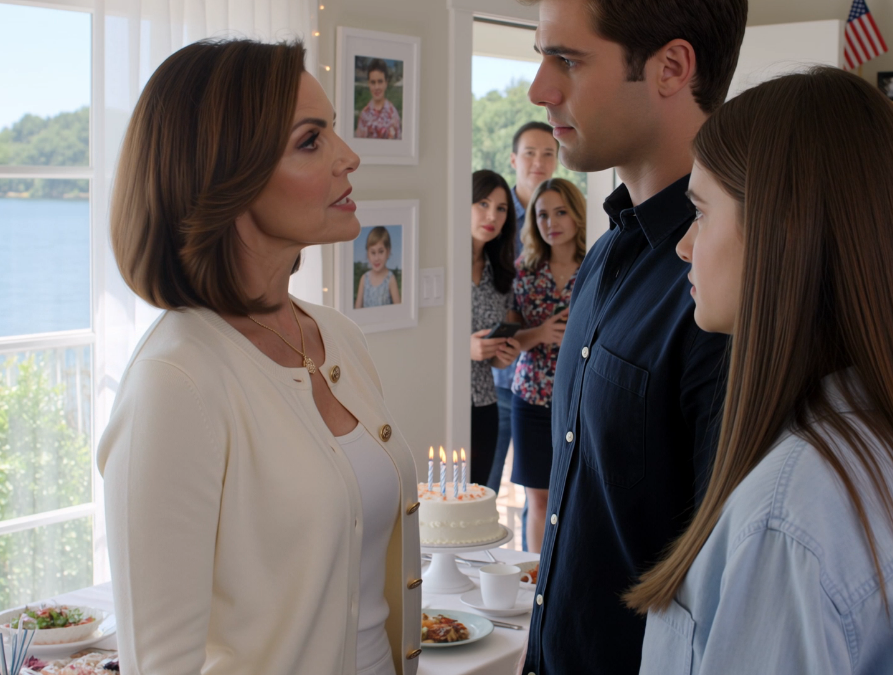
That’s when she leaned through my window in her gold-accented cardigan, gave me that tight, pinched smile, and whispered, “Try not to embarrass us tonight.”
She said it as though I were hired help. As though everything I’d done up to that point—the planning, the money, the time, the effort—meant absolutely nothing. As though I should be grateful she’d even allowed me to participate.
That was the last straw.
As I drove away with the cake, the gifts, and the key to the venue Emily had actually wanted, my phone began buzzing with texts from my mother asking where I was. I didn’t answer. I just kept driving until I reached the lakeside property.
I unlocked the doors and started setting everything up exactly the way Emily and I had discussed. Soft lighting filled the room. Her favorite music played quietly in the background. I arranged the childhood photographs along the walls and laid out the personalized little gift bags I’d stayed up all night making.
The cake looked amazing. Vanilla with strawberry layers, covered in soft pastel frosting, with the words “18 Years of Awesome” written across the top in looping cursive. Everything was exactly where I’d imagined it would be.
When I finally finished, I poured myself a soda, sat on the edge of one of the chairs, and waited.
Thirty minutes passed. Then an hour.
Finally, a text appeared from Emily.
“Everyone’s just standing around. What happened?”
My stomach dropped. I called her immediately, but she didn’t answer. Then I called my mother. She picked up on the second ring.
“Where are you?” she hissed, sounding as though I’d abandoned an entire army in the middle of a battlefield. “Everyone’s here. Emily’s crying, and your aunt is furious.”
I swallowed hard. “I’m at the venue. The one Emily asked for.”
“What venue?” she snapped, already sounding rattled. “Everyone’s at the Gold View Banquet Center.”
“She didn’t want the Gold View,” I said. “She wanted something small. I booked it weeks ago. She asked me to.”
There was a long pause on the other end of the line, the kind of silence that told me my mother was trying to figure out how to make the situation my fault.
“Well, you didn’t tell anyone that,” she finally said. “Your aunt had a whole thing planned.”
“No,” I replied, my voice growing quieter. “She had a thing planned for herself. Not for Emily.”
Then I hung up.
For several minutes, I sat staring at my phone while unread messages accumulated on the screen. A few cousins wanted to know if I was okay. Uncle James sent a message asking whether I was pulling another stunt. I didn’t know what to say to any of them, so I said nothing.
Then, finally, another message appeared from Emily.
“Can I come to your place?”
I immediately sent her the address to the lakeside venue.
Fifteen minutes later, the door opened and Emily walked in. Her makeup was smudged, and the dress she was wearing looked stiff and uncomfortable, like something pulled straight from a fashion magazine shoot. It wasn’t her style at all.
She kicked off her heels almost immediately, pulled a pair of Converse sneakers from her bag, and slipped them on. Then she looked around the room and stopped.
For a long moment, she just stood there, silently taking everything in.
The cake. The lights. The music. The photographs. Little pieces of her actual childhood, her real interests, and her own personality reflected in every corner of the room. It wasn’t a glamorous spectacle arranged to impress strangers. It was a birthday party made for Emily.
“This is perfect,” she said.
I nodded, but my throat had tightened so much that I couldn’t immediately find the words to answer. I’d never seen her cry before, but there were tears gathering in her eyes now.
Then she looked at me and said, “My mom’s going to be mad.”
I laughed softly. “Yeah,” I said. “I figured.”
I knew the night wasn’t over. Not by a long shot.
While Emily was with me, barefoot and eating cake beneath the dim glow of the string lights, the rest of the family was still back at the Gold View. And Aunt Linda was undoubtedly lighting matches in her mind. I knew it was only a matter of time before that fire reached us.
Sure enough, the first spark came about ten minutes later.
A car pulled into the parking lot much faster than necessary. Then another. I glanced through the window and saw Aunt Linda climbing out, her phone pressed to her ear, her eyes scanning the building like a hawk searching for prey.
Emily went completely still beside me.
“She followed my location,” she whispered.
I stood up. Things were about to get ugly, and I knew it. But I didn’t regret what I’d done. Not yet.
Aunt Linda came through the door with the kind of storm written across her face that could make a grown adult reconsider every decision they’d ever made. Behind her came my mother, Uncle James, and several other relatives, all dragging their feet and wearing the same disapproving expressions.
It was that familiar family look. The one that silently demanded, How dare you make a scene? Even though, up until that moment, I hadn’t made one at all.
Then Aunt Linda spoke, and the entire atmosphere in the room changed.
She didn’t start by screaming. That would have been too obvious, too easy. Linda was more of a slow-boil kind of tyrant, the sort who could smile with her teeth while her eyes remained completely cold.
She walked into the room with her perfectly manicured hands folded over the clutch bag she carried in front of her. Her voice was smooth, almost syrupy, when she finally spoke.
“There you are.”
I didn’t answer. I simply remained standing between her and Emily.
“This is where you’ve been?” Linda asked, turning her attention to her daughter. “Sneaking off in the middle of your own party? To this?”
Her eyes swept across the room, taking in the handwritten banners, the tablecloths I’d ironed, and the Polaroids of Emily riding a tricycle or dressed as a carrot for Halloween. For just a second, those photographs seemed to make her hesitate. Something about them interrupted her performance.
Then her expression hardened again.
“You had guests waiting, Emily. Important people. Sponsors from your gym. That photographer from Voyage Weekly was there.”
“I didn’t invite them,” Emily said softly. “You did.”
“And what were they supposed to think when the birthday girl disappeared?”
Emily lowered her eyes. I could practically feel her shrinking beside me, retreating into that familiar space where she was expected to apologize for disappointing her mother. I stepped forward before she could apologize for wanting to enjoy her own birthday.
“She didn’t disappear,” I said. “She just came to the party she actually wanted.”
That cracked Linda’s carefully arranged mask. Her jaw tightened.
“Excuse me?”
“This,” I said, gesturing around the room, “was the plan all along. Emily told me what she wanted. She didn’t want to be a product launch. She wanted a birthday.”
Behind Linda, Uncle James shifted uncomfortably.
“Ryan, not the time,” he muttered.
“No,” I said, looking directly at him. “It’s the exact time.”
That was when Linda finally dropped the smile.
“You self-righteous little—”
She stopped herself before finishing the insult, visibly forcing her voice back under control.
“Do you even realize what you’ve done? I had vendors, Ryan. Contracts. RSVPs. There was a sushi bar, a live string quartet. I’ve had to refund deposits.”
“She didn’t want a sushi bar,” I shot back. “She wanted a chocolate cake with pink frosting and pictures of her with her cat. That’s it. That’s what she asked for. But you weren’t listening.”
Behind her, my mother stood wide-eyed, clutching her purse as though it might suddenly fly out of her hands. Several cousins hovered awkwardly near the door, clearly uncertain whether to stay or make a discreet escape. One of them had already taken out a phone and started filming.
Of course someone was filming. In our family, even the most uncomfortable moments apparently needed an audience.
Emily took a breath and stepped forward.
“I told you I didn’t want a big thing, Mom.”
Linda turned on her immediately.
“You said that, but you didn’t mean it. You’re shy. You don’t always know what’s best for you, and that’s okay. That’s why I make the decisions.”
“You make the decisions for yourself,” Emily replied.
Her voice cracked, but she didn’t move backward.
“You wanted that party. You wanted the photographer. You wanted everyone to see the perfect version of me.”
The silence that followed landed like a slap.
Linda looked as though someone had punched her in the stomach, but she was fighting desperately to keep herself composed. She drew in an unsteady breath, straightened her shoulders, and turned toward me again.
“You’ve been jealous of this family since you were a teenager,” she said. “You just couldn’t stand to see us do something right.”
There it was. The accusation she’d been carrying around for years, finally spoken out loud.
I wanted to say a million things.
I wanted to tell her I wasn’t jealous. I was exhausted. Exhausted from being dismissed, mocked, and treated like a cautionary tale at every Thanksgiving table since I was old enough to stop believing that going to college would magically fix everything.
I wanted to tell her how hard I’d worked, how much I’d learned to keep to myself, and how many times I’d swallowed a response just to avoid another argument. I wanted her to understand that I’d spent my own money, my own time, and my own heart creating something meaningful for Emily.
Not because I wanted attention. Not because I needed to prove I was better than anyone. But because Emily deserved one night that belonged to her.
Instead of saying any of that, I looked at my cousin.
Emily looked back at me. Then she turned toward the relatives still gathered in the half-shadowed doorway.
“I’m staying here,” she said.
“You are not!” Linda snapped. “We have a schedule.”
“No, you do,” Emily replied. Her voice was stronger now. “I’m eighteen, remember? Adult and everything. You told everyone. You posted it online with three exclamation points.”
My mother actually gasped. Somewhere near the doorway, somebody stifled a laugh.
Linda took a step toward her daughter, but Emily moved closer to my side.
And that was the moment I felt something change. It was like hearing a lock click open, like watching someone finally draw a line in the sand. I felt it deep in my chest, that strange electric sensation you get when someone who’s spent their entire life being pushed around finally begins to push back.
“I tried to let you have your way,” Emily continued. “I wore the dress. I smiled. I played nice. But you still found a way to make my birthday about you. So yeah, I left. And honestly, it feels like the first time in years that I’ve been able to breathe.”
Aunt Linda froze.
She was shaking now, but not with sadness. This was fury, the kind that comes from suddenly realizing you can no longer control the story everyone else is hearing.
“You think this is freedom?” she hissed. “This is delusion. You’re throwing away everything I’ve built for you. Everything I’ve sacrificed. For what? For him?”
She pointed at me as though I were the villain responsible for destroying everything she’d worked so hard to construct.
“Ryan listened,” Emily said simply. “That’s more than I can say for anyone else.”
The room fell silent again. It was a thick, uncomfortable silence, so complete that I could almost hear the electrical hum of the string lights hanging above us.
Then Aunt Linda laughed. It was a short, sharp sound with no real humor in it.
“You’re going to regret this. Both of you.”
She turned and stormed out.
Several relatives hurried after her. Others remained standing where they were, seemingly uncertain which side they were supposed to be on. My mother lingered a moment longer, looking from Emily to me before releasing a heavy sigh.
Then she shook her head and left, muttering something under her breath about family drama.
And suddenly, it was just the two of us again, standing in a room filled with real, raw, imperfect memories.
Emily sat down beside me and picked up another forkful of cake.
“She’s going to come for you hard,” she said. “You know that, right?”
I nodded.
“You ready for that?”
I looked at her. For the first time in years, I actually felt as though maybe I was.
“I am now,” I told her.
But I had absolutely no idea how far Aunt Linda was willing to go to make me regret every second of what had happened that night.
Emily didn’t stay much longer after that. Maybe another half hour, just long enough for us to finish a couple of slices of cake, play her favorite indie song through the speakers, and light the tiny sparkler candles I’d tucked away earlier, just in case.
She filmed herself blowing them out, laughing with a little frosting on her nose, and posted the video to her story with a caption that simply read, “Real party.”
There were no filters, no staged poses, and no carefully arranged photographs designed to impress strangers. Just Emily sitting cross-legged on the floor in mismatched socks and a hoodie she’d borrowed from my trunk, looking happier than I’d seen her in a long time.
After she left, the venue felt almost painfully quiet.
I cleaned up slowly, taking down the Polaroids one by one and sliding them carefully back into their envelope. My phone had started blowing up again, but I ignored it. I knew there would be consequences for what had happened. I just hadn’t expected them to arrive quite so quickly, or to become so public.
By the time I got home, my inbox was overflowing. Emails, direct messages, posts I’d been tagged in, and a Facebook message from my cousin Jake.
“Dude, you’re all over Nextdoor.”
It turned out Aunt Linda had absolutely no intention of allowing the evening to fade quietly into memory. She’d gone completely scorched-earth, publishing a long, furious rant on her public social media account.
According to her version of events, I’d kidnapped her daughter on her eighteenth birthday, sabotaged a professional event, and emotionally manipulated a young girl during an especially vulnerable time in her life.
She described me as a bitter, unstable black sheep who had deliberately isolated Emily from her family and weaponized childhood nostalgia to turn her against her own mother.
I could hardly believe what I was reading.
She’d included pictures from the banquet hall. Empty chairs. Untouched food. A photograph of herself standing beside the DJ, looking appropriately distraught. The whole thing had been arranged to make it appear as though she’d been the victim of some cruel, calculated attack.
And people were buying it.
The post had already collected hundreds of reactions and shares. Several local parents who knew her were leaving sympathetic comments, offering support and expressing outrage over what they believed had happened.
One person wrote, “What a tragedy. I’d be devastated if someone did that to my daughter.”
Then I noticed something that made the blood drain from my face.
Linda had tagged my professional profile. She was publicly claiming I was unfit to manage community technology projects because of repeated emotional instability.
That one stung.
My freelance projects weren’t enormous, and I wasn’t pretending to run some multimillion-dollar company. But I’d spent years building a reputation as someone who could be trusted. I showed up when I said I would. I finished jobs properly. I treated clients fairly. In freelance work, especially IT, trust matters. Once someone puts a crack in that reputation, the damage can spread much faster than the truth.
I read Linda’s post twice. Then a third time. Every time I went through it, my chest seemed to tighten a little more.
It wasn’t simply that she was lying. It was how effortlessly the lies seemed to come to her. How easily she could take something that had actually happened, rearrange the details, strip away every inconvenient fact, and present herself as the wounded party.
For a moment, I considered doing nothing.
Maybe I could just let the whole thing pass. People moved on from online drama eventually, didn’t they? A new scandal would come along, everyone would find something else to talk about, and Linda’s post would disappear into the endless stream of things people shared and forgot.
Then my phone lit up with a message from Emily.
“She went through my room. Took my phone, my laptop, everything. Grounded me. Said I’m not emotionally stable enough to make my own decisions.”
Before I’d even finished processing that message, another arrived.
“And she’s trying to get me pulled from my gym program until I straighten out.”
I stared at the screen, feeling guilt hit me squarely in the stomach.
This wasn’t just about me anymore.
Linda was punishing Emily for thinking for herself. For choosing the birthday celebration she’d actually wanted. For standing in front of her own family and saying something her mother didn’t want to hear.
And if Linda could get away with doing that, I had no reason to believe she’d ever stop.
The next morning, I woke up to another wave of messages.
My mother, of all people, had shared Aunt Linda’s post with a passive-aggressive comment of her own.
“I always said Ryan needed help.”
My uncle had liked it. Several cousins had left vague comments about how sad it was when families turned against one another. Nobody seemed particularly interested in finding out what had actually happened. They were perfectly comfortable discussing my character without ever asking for my side of the story.
Nobody, that is, except Sarah.
Sarah had been one of Emily’s babysitters when we were younger. She’d spent enough time around the family to know most of us pretty well, although I hadn’t heard much from her in a while.
Her message was short.
“Saw the post. Doesn’t sound like you. What’s the real story?”
I sat down and started sending her everything I had.
First came the photographs from the actual birthday party. The decorations. The cake. The childhood pictures on the walls. Emily laughing, her expression soft and genuinely happy.
Then I sent screenshots of our messages. Emily asking if she could come to my venue. Emily thanking me afterward. Emily saying she hadn’t wanted to be at the banquet hall in the first place.
I didn’t have to manufacture anything. The proof was already sitting there in our conversations and photographs.
Sarah took a little while to respond.
When she finally did, her message contained only three words.
“Let me help.”
I wasn’t entirely sure what she meant. But two hours later, I understood.
Sarah published a very different account of what had happened. It was public, it was tagged, and unlike Linda’s post, it came with receipts.
She wrote about how Aunt Linda had always micromanaged Emily’s life. How she’d used guilt and control while disguising both as concern. How Emily had spent years being told what to wear, what to do, and how to behave so that her mother could maintain a particular image.
Sarah described the time Linda had pulled Emily out of a school play because she considered the costume undignified. She explained how even the smallest decisions in Emily’s life somehow became questions of appearances rather than happiness.
She also hinted at something I hadn’t known before. Apparently, Linda had once tried to get Sarah fired from her babysitting job because she’d allowed Emily to have pizza for dinner instead of the grilled salmon her mother had specified.
That was Linda in a nutshell. The world could be falling apart, but as long as the salmon was served and everyone smiled for the photographs, everything was apparently fine.
Sarah didn’t stop with anecdotes, either.
She included screenshots of messages Emily had sent her months earlier, venting about her mother. Sarah had saved some of those conversations when she first started worrying about what Emily was going through.
Those messages gave people something Linda’s carefully staged photographs couldn’t: a glimpse of what Emily had actually been feeling long before her birthday.
Sarah’s post blew up.
People started commenting and asking questions. Then others began sharing their own experiences. An old coach. A retired teacher. Even a neighbor.
One by one, people came forward with stories. None of them seemed especially enormous on its own. A controlling remark here, an unreasonable demand there, a moment when Linda had made someone feel small for failing to meet her expectations.
But when all those little stories were placed together, they painted a very different picture of the woman who’d spent so many years presenting herself as the perfect mother and respected community figure.
Aunt Linda tried to fight back, of course.
She insisted that the stories were fake. She dismissed the messages, challenged people’s memories, and attempted to portray the entire situation as some coordinated attack against her.
But for the first time I could remember, people weren’t automatically accepting her version of events.
The tide was turning.
I wish I could say that was the end of it. I wish Linda had simply deleted her post, apologized to Emily, and found some way to move forward.
But that was only the beginning.
Two days later, an email arrived in my inbox.
It wasn’t from a cousin, a family friend, or someone wanting to offer an opinion about what had happened.
It was from a lawyer.
Not mine. Hers.
Apparently, Aunt Linda wasn’t content with being angry anymore. She wanted to sue me.
When I saw the lawyer’s name in my inbox, my stomach dropped. I won’t pretend otherwise. There’s something deeply unsettling about seeing a formal legal communication addressed to you, especially when you know the person behind it would happily see your entire life fall apart.
But after everything Linda had already thrown at me, part of me felt as though this had been inevitable.
She wasn’t simply trying to embarrass me now.
She wanted to ruin me.
And if the past few days had taught me anything, it was that people like Linda didn’t stop just because you asked them to be reasonable. They stopped when they were finally forced to confront consequences they couldn’t control.
The cease-and-desist letter was full of pompous language and legal threats.
It accused me of publicly disparaging the character of a respected community figure and orchestrating an event designed to undermine parental authority. It threatened defamation charges and portrayed my involvement in Emily’s birthday as something deliberately malicious.
Her lawyer demanded that I issue a public apology, remove anything referencing the birthday party, and pay $5,000 in reputational damages.
Five thousand dollars.
For throwing my cousin the birthday party she’d asked me to organize.
For refusing to stand quietly while her mother rewrote what had happened.
For being the person Linda had always assumed would eventually back down.
Something inside me finally snapped.
I’d spent years brushing things off. Being easygoing. Avoiding arguments. Letting people make jokes at my expense because responding would only create more problems. I’d allowed other people to rewrite my story because it seemed easier than being accused of causing family drama.
But sitting there with that letter open on my computer, I suddenly realized just how much control I’d allowed Linda to have over my life.
Even when I wasn’t speaking to her, I was still making decisions based on how she might react. I’d been adjusting my own behavior to accommodate her expectations for years, and I hadn’t fully recognized it until that moment.
So I decided to fight back.
I didn’t hire a lawyer.
I became one.
Not literally, obviously. But close enough for what I needed to do.
For the next forty-eight hours, I read everything I could find about defamation law, paying particular attention to the laws in our state. I looked into the difference between opinions and false factual accusations. I studied what could happen when someone made damaging public claims about another person’s professional reputation.
I also reached out to a friend of a friend who worked as a paralegal. They helped walk me through the basics, explained what I should pay attention to, and gave me a clearer understanding of the kind of response I needed to prepare.
Then I sat down and wrote a letter of my own.
It wasn’t petty. It wasn’t emotional. I didn’t fill it with personal insults or spend three pages explaining how awful Linda had been to me over the years.
I made it truthful, careful, and meticulous.
I went through every claim in her cease-and-desist letter and addressed it individually. Where I had screenshots, I included them. Where there were messages confirming Emily’s wishes, I referenced them. I laid out the timeline and provided testimony from people who had witnessed what happened that night.
I included the communications between Emily and me, along with the photographs and other evidence showing that she’d chosen to attend the lakeside celebration of her own free will.
Then I addressed Linda’s public accusations.
She’d accused me of criminal conduct, including kidnapping. Those weren’t harmless comments or ordinary expressions of anger. They were serious allegations presented as facts to an audience that included people I worked with.
I explained why I believed those statements were false, defamatory, and actionable, particularly given the potential damage to my professional reputation.
I ended the letter with a clear statement of what I intended to do next.
If Linda did not retract her public accusations and delete her post within seventy-two hours, I would pursue legal action for defamation, harassment, and damages to my professional reputation.
I copied her lawyer on the response and sent it using a certified email-tracking service.
Then I waited.
The next morning, Linda’s post was gone.
Just like that.
The same woman who’d been perfectly willing to accuse me of kidnapping her daughter in front of hundreds of people had apparently decided those accusations weren’t worth defending once she understood that I wasn’t going to simply accept them.
But I wasn’t finished.
Because while Linda had been sitting on her increasingly unstable throne, trying to dictate the narrative, she hadn’t noticed just how many people were beginning to turn against her.
The local gym board was one of the first places where the consequences became impossible to ignore.
Linda had used her connections to interfere with Emily’s membership, attempting to have her frozen out of the athletic program until she supposedly straightened herself out.
But now the board was being flooded with complaints.
People sent screenshots of Emily’s messages. Others pointed to the growing public backlash. And Emily herself quietly submitted a statement that was shared in a private Facebook group for teen athletes.
She explained how her mother had attempted to shut her down simply because she wanted one night to be herself.
That statement carried more weight than any angry post Linda could have written.
The board voted unanimously to reinstate Emily.
Then they went a step further.
They cut ties with Aunt Linda as a sponsor.
I could hardly believe it when I heard. For years, Linda had treated her community connections as proof that she was untouchable. She knew the right people, supported the right organizations, and made sure everyone understood how important her contributions were.
Now one of those same organizations had decided it no longer wanted to be associated with her.
And the consequences kept coming.
Next was the photographer from Voyage Weekly, the one Linda had made such a big deal about inviting to the banquet hall.
It turned out he hadn’t appreciated being lied to, either.
He’d been told that Emily would be attending a staged coming-of-age photo shoot, something designed to celebrate an important milestone in her life. He hadn’t been told that Emily had already made it clear she didn’t want that kind of event.
As far as he was concerned, he’d been brought into a situation under false pretenses, effectively ambushing a young woman at a celebration she hadn’t wanted.
He published a statement of his own.
It wasn’t dramatic or aggressive. He didn’t launch into a personal attack against Linda or try to add more fuel to the controversy. He simply clarified what he’d been told and made his position clear.
“Respecting a young woman’s boundaries should always come before press coverage.”
That was all it took.
The carefully maintained influence Linda had built through social media began to crumble. Sponsors dropped their associations with her. Friends started distancing themselves. People who’d previously brushed off her controlling behavior began remembering all the little moments they’d overlooked.
The micromanaging. The guilt-tripping. The passive-aggressive comments. The way she could turn someone else’s important moment into an opportunity to promote herself.
For years, those incidents had seemed isolated. Now people were beginning to recognize the pattern.
And Linda, who’d always depended on controlling how other people perceived her, was discovering what happened when she no longer had the final word.
Still, the real victory didn’t come from the deleted post, the board’s decision, or the loss of her sponsors.
It came a few weeks later.
Emily moved out.
She’d been quietly saving money for some time, putting aside what she earned from a part-time job and the occasional babysitting gig. She hadn’t made a big announcement about it, and she certainly hadn’t asked her mother’s permission.
With a little help from Sarah and a scholarship adviser, she managed to secure a place in a shared apartment near her college campus.
It wasn’t some luxurious place with designer furniture and an impressive view. It was an ordinary apartment, the kind of place most college students would recognize immediately. Small rooms, mismatched belongings, and the usual uncertainty that comes with trying to build an independent life.
But it was hers.
On the day she moved in, she sent me a photograph.
She was standing in a tiny kitchen, grinning beside a cardboard box filled with mismatched mugs.
The caption read, “Thanks for helping me get here.”
I sat there looking at that picture for a long time.
I’d spent so much of my life feeling as though I was the one who never quite measured up. The cousin without the impressive career title, the perfect family, or the kind of accomplishments Aunt Linda liked to announce at holiday dinners.
Yet here was Emily, standing in a kitchen that probably barely had enough counter space for a coffee maker, smiling as though she’d just been handed the keys to an entire kingdom.
And she’d taken the time to thank me.
That meant more than I knew how to explain.
Naturally, Aunt Linda tried to spin the situation.
She claimed Emily had been brainwashed. She insisted her daughter was running away from her responsibilities and making a terrible mistake. She wanted everyone to believe that Emily’s decision to move out was another result of the influence I’d supposedly had over her.
But people weren’t buying it anymore.
The mask had cracked too widely, and there were too many people who’d seen what was underneath. Linda could keep insisting that she knew what was best for her daughter, but Emily was eighteen, attending college, and beginning to make her own choices.
For once, her mother’s approval wasn’t the deciding factor.
As for me, I didn’t disappear quietly back into the background the way I usually did after a family argument.
Something had changed.
I began getting new freelance projects, bigger ones than the small jobs I’d been accustomed to taking. Some of the opportunities came from people who’d followed the controversy and admired the way I’d stood up for myself.
A few clients had seen everything unfold and told me they respected how I’d handled the situation. They appreciated that I’d responded with evidence rather than insults, that I’d kept my professional communications measured even when someone was publicly attacking my character.
One client actually said my response demonstrated integrity.
Another described me as “shockingly professional for a guy in jeans.”
Go figure.
It was strange, realizing that the same public mess Linda had tried to use to destroy my reputation had actually helped some people see me differently.
For years, I’d been convinced that keeping my head down was the only way to protect the quiet life I wanted. I’d believed that staying out of arguments and letting other people have the last word was the easiest way to maintain peace.
But sometimes keeping quiet didn’t preserve peace. Sometimes it just allowed someone else to keep causing damage without being challenged.
And I was finally beginning to understand the difference.
The best part, though, came at the next family gathering.
It was my cousin Jake’s wedding.
Normally, an event like that would have been exactly the kind of occasion I’d approached with a certain amount of dread. I’d have spent the drive rehearsing polite answers to questions about my job, my relationship status, and whether I had any plans to do something more impressive with my life.
I’d have walked in quietly, found somewhere unobtrusive to stand, and done my best not to attract Aunt Linda’s attention.
This time, things were different.
I walked in with my head held high.
There were no whispers following me across the room. No awkward glances from relatives who thought they knew something embarrassing about my life. Nobody seemed particularly interested in treating me like the family disappointment.
And Aunt Linda didn’t say a single word.
When she saw me, she simply looked away, her cheeks tightening as though even acknowledging my presence would cost her more than she was willing to give.
I didn’t confront her. I didn’t make a speech or demand an apology. There was nothing I needed to prove to her anymore.
Instead, I went over to Emily and gave her a hug.
Then I handed her a small gift.
It was a framed copy of the photograph from her birthday, the one taken while she was laughing beside the little sparkler candles. The picture captured her exactly as she’d been that night, happy and unguarded, surrounded by the kind of memories that mattered to her.
Emily looked down at it and smiled.
We didn’t need to say much. She understood why I’d chosen that picture, and I knew she understood what it represented.
She tucked the frame beneath her arm and leaned closer.
“You know,” she whispered, “she still thinks you ruined her party.”
I glanced across the room, where Aunt Linda was doing her best to pretend neither of us existed.
Then I grinned.
“I didn’t ruin it,” I said. “I saved the real one.”
And for once, standing there among the same relatives who’d spent years treating me like a disappointment, I didn’t feel like the black sheep of the family.
I felt like the only one who had finally done something.








