The week before college, my parents sat me down and said, “we gave your tuition money to your brother — his business needs it more,” then they told me to be proud of “supporting the family,” i didn’t argue, i just packed my bags and left, a year later, his business went bankrupt… and i was quietly making millions without a degree, now they keep calling — but i don’t pick up.
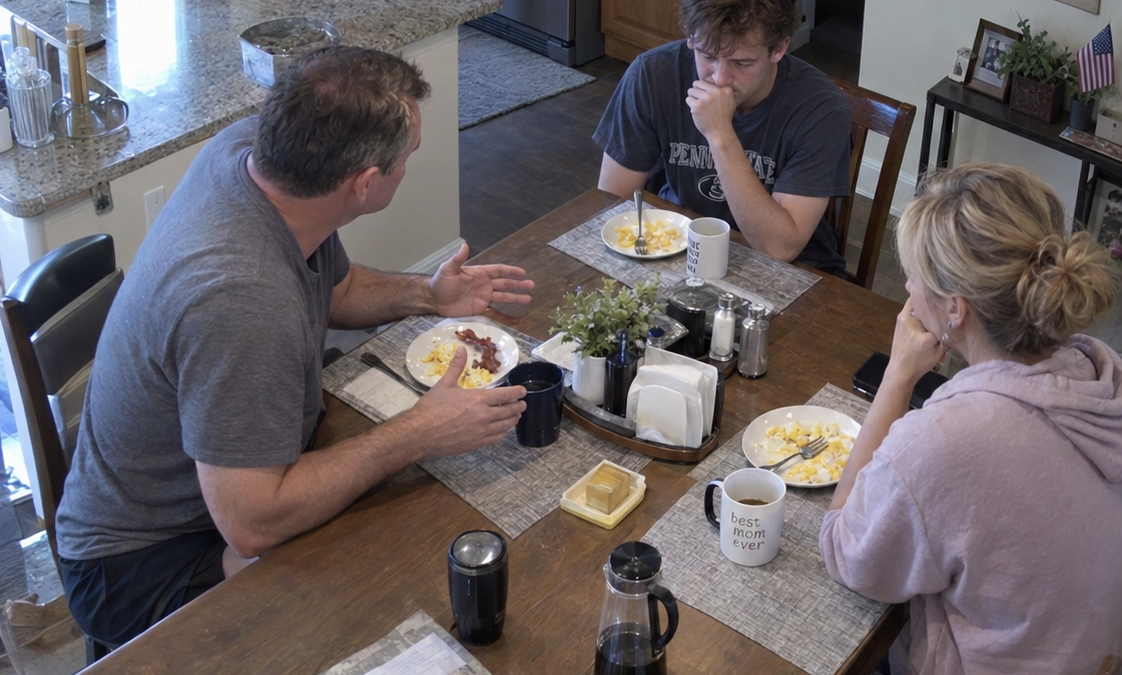
The day my life flipped upside down started with a plate of scrambled eggs and a fake smile. I still remember the way the morning light fell across the kitchen counter, how my mom’s voice sounded just a little too cheerful, and how my dad kept tapping his wedding ring against his coffee mug like a metronome, as though he were rehearsing a speech in his head.
My name is Trevor, and I was eighteen when my parents sat me down that morning, just one week before I was supposed to move into my college dorm. I’d spent the previous year obsessively planning every detail. I’d registered for orientation, shopped for secondhand textbooks, and worked nights at the grocery store to afford dorm decorations and a decent laptop. I had a spreadsheet for practically everything. I’d even bought one of those tiny dorm-sized refrigerators because I’d read somewhere that campus dining got old fast.
For most of high school, I’d been the quiet, responsible one in our family. The kind of kid who got straight A’s, didn’t go to parties, and stayed out of trouble. Not because I was afraid of the consequences, but because I thought being responsible would mean something. I believed that if I worked hard enough and didn’t make waves, someone would eventually notice. Maybe not with grand gestures or dramatic praise, but with little things. Things like keeping their promises. Things like paying the tuition they’d told me they had been saving for since I was twelve.
So when my mom said, “Trevor, sweetie, your dad and I need to talk to you about something important,” I simply smiled and took another bite of eggs. I had no reason to be suspicious, no reason to prepare myself for the absolute gut punch that was coming.
My dad leaned forward, wearing that familiar, composed expression he always used when he was about to lecture me about how unfair life could be. Then he said it.
“We gave your tuition money to your brother. His business needs it more right now.”
Just like that. One sentence. No buildup, no apology, just a cold, clinical statement, as casually delivered as a weather report. I didn’t even respond at first. I just blinked, staring at the salt shaker in the middle of the table because I couldn’t bring myself to look either of them in the eye.
For a moment, I honestly thought they might be joking. But when I finally looked up, my mother was wearing a strange expression. She didn’t look guilty or embarrassed. If anything, she looked proud.
“You should be happy,” she said. “You’re supporting the family in a big way. This is what being part of something bigger than yourself looks like.”
That was when it hit me. They weren’t telling me because they felt bad about what they’d done. They were telling me because they genuinely believed I should be proud. In their eyes, I wasn’t someone with dreams or goals of my own anymore. I was simply convenient.
To understand how we got there, you have to understand my older brother, Jason.
Jason is six years older than me, and growing up, he was always the golden child. Every mistake he made was treated as a valuable learning experience. Meanwhile, I could bring home straight A’s, and somehow he’d still get a pizza party for remembering to take out the trash.
When he dropped out of college after one semester to start a tech company in our garage, my parents acted like he’d discovered fire. They poured money into his startup as if it were a trust fund, buying him equipment, helping him rent office space, and even co-signing a loan when things got tight.
The company never really took off, but Jason always had another pivot planned, another brilliant idea that supposedly needed just a little more runway. I won’t call him lazy, because he wasn’t. I’ll give him that much. But he was reckless. He borrowed money as though nobody would ever expect repayment, made promises he couldn’t fulfill, and somehow always managed to convince our parents that he was standing on the edge of something extraordinary.
So when I got accepted into a great university—not an Ivy League school, but still a competitive one—and my parents assured me they had my first year covered, I believed them. Why wouldn’t I? I’d followed every rule. I’d played it safe and stayed in my lane. In return, I was finally supposed to get my shot.
Instead, I got a morning lecture about making sacrifices, served alongside eggs and toast.
I asked one question. Just one.
“So what am I supposed to do now?”
My father looked at me as though I were being unreasonable.
“Take a gap year. Get a job. Plenty of kids your age need time to figure things out.”
“I already figured it out,” I said, barely recognizing my own voice. “I’m supposed to move in next week.”
“We know,” my mother replied gently, as if her tone somehow made the situation better. “And we’re really sorry about the timing. But you’re smart, Trevor. You’ll find another way.”
The worst part wasn’t even the decision itself. It was the way they treated the whole thing like an opportunity for personal growth, as though having my future ripped away from me were some kind of character-building exercise.
I didn’t yell. I didn’t argue. I didn’t cry. I simply nodded, excused myself from the table, walked upstairs to my bedroom, and closed the door.
That was the moment everything changed, because something deep inside me finally snapped. Not in the dramatic, movie-style way where someone smashes a mirror or punches a hole in the wall. It was quieter than that, and somehow more final. Like a switch being flipped off.
I didn’t sleep that night. I lay in bed staring at the ceiling, replaying every conversation I’d ever had with my parents that suddenly felt fake. Every time they’d told me they were proud of me. Every time they’d promised, “We’ve got your back.”
It was like discovering that the safety net you’d trusted your entire life was made of paper.
The next morning, I started packing my bags. But I wasn’t packing for college anymore. I was preparing for something entirely different.
That was the beginning of a long year. The beginning of the silence between my parents and me. The beginning of my disappearance—not physically, but emotionally. I left that house with two suitcases, a thousand dollars I’d saved from my grocery store job, and one rule burned into my mind.
Never rely on anyone who treats you like a backup plan.
While my brother’s business was burning through money like a bonfire, I was about to start building something of my own. Something I didn’t tell anyone about. Something quiet, something smart. Because if my parents wanted me to support the family, I was eventually going to show them exactly what that looked like.
But not in the way they expected. Not even close.
The truth was, I didn’t have a plan. Not a real one, anyway. What I had was determination and anger. Not the kind of explosive rage that burns itself out in a few minutes, but the quiet, patient kind that simmers for months, slowly hardening into something sharp and useful.
I moved out the day everything fell apart. I didn’t give my parents a chance to ask where I was going. I packed my laptop, my clothes, and the little money I’d managed to save, then contacted Connor, a guy I’d worked with at the grocery store who happened to have a spare room in his apartment across town.
The place wasn’t glamorous. There was no air conditioning, and I slept on a futon that creaked whenever I breathed too hard. But it was mine. More importantly, it wasn’t theirs.
I didn’t completely cut my parents off, at least not officially. During that first week, they sent a few texts, checking on me as though nothing had happened.
“How’s the job hunt going?”
“Let us know if you need anything.”
I didn’t answer. I wasn’t ready to talk to them. I was too busy feeling stupid for ever trusting them, too consumed by a bitterness I didn’t know how to release.
During the day, I bounced between Craigslist gigs and YouTube videos about digital marketing, e-commerce, coding, and anything else that might eventually give me a more stable future than stocking shelves. At night, I worked shifts at a local sandwich shop.
I told Connor I was just trying to figure things out for a year before college. I never told him why. I couldn’t even say the truth aloud without feeling that ugly mixture of humiliation and fury, as though I’d been cheated at a card table and then expected to thank the dealer for the privilege.
Meanwhile, Jason was everywhere.
His face was all over my parents’ social media accounts. My mother posted pictures of his office as though it were NASA headquarters. My father shared links to his company’s website like he was announcing the launch of the next Google.
Every caption practically overflowed with pride.
“So proud of our oldest, chasing his dreams!”
“Support small business!”
“Check out Jason’s new venture!”
It made me sick. Not because Jason was succeeding, but because I knew he wasn’t. I knew his company was bleeding money, struggling to deliver on overpromised contracts, and scrambling to maintain the appearance of legitimacy while our parents kept throwing money at him as though it were Monopoly cash.
Jason wasn’t evil. He was spoiled. He was the kind of person who had never learned what the word no meant because nobody had ever bothered to say it to him.
About a month after I moved out, my mother texted me a photograph of Jason standing in front of a giant banner that read, “Genius Tech Solutions — Grand Opening.”
They’d rented a co-working space downtown. There were balloons, a ribbon-cutting ceremony, and my parents grinning in the background as though they’d just won the lottery.
I didn’t respond. I didn’t congratulate anyone. I simply stared at the picture until I realized just how completely alone I really was.
And that was when something shifted.
I could have spent the next year sulking. I could have waited, applied for scholarships and loans, and tried to restart my college plans. But I understood something now that I hadn’t understood before.
If I wanted a future, I was going to have to build it myself. Brick by brick. Out of spite, if nothing else.
So I began learning obsessively.
I’d always been reasonably good with technology. In high school, I’d run a small tutoring side hustle, helped other kids repair their phones, and even built a few custom PCs. But now I started going much deeper.
I taught myself how to run Facebook ads, how to identify promising dropshipping products, and how to write sales copy that actually converted visitors into customers. I watched ten hours of tutorials a day, took online courses I couldn’t afford and found other ways to access, and tested practically every free trial known to man.
I failed constantly. I lost money on terrible product ideas. I ate far too many cups of ramen. But I kept going.
Three months into the process, I launched my first real online store. It wasn’t anything flashy, just a niche gadget website selling portable humidifiers and phone holders. But slowly, I found a rhythm. I reinvested everything I earned and lived on pennies.
I even canceled my Spotify subscription to save money and started listening to motivational YouTube videos instead.
The grind became addictive, and gradually, things started clicking.
By the fifth month, I was earning more in one week than I’d previously made in an entire month at the sandwich shop.
I didn’t tell anyone. Not Connor, not my old friends, and definitely not my family. This wasn’t about showing off. It was about building something that nobody could take away from me.
Meanwhile, things back home were getting strange.
My mother started calling again. At first, it was casual. A voicemail here, a message there.
“Hey, honey. Just checking in. Hope you’re doing okay.”
Then her messages became more persistent.
“We haven’t heard from you in a while. Can we meet up? Your dad’s worried.”
And then, one day, she sent a message that made me stop in my tracks.
“Jason could really use your help. You’re so good with computers.”
I read it three times before I actually laughed out loud.
The audacity was unbelievable.
I didn’t respond. I didn’t need to, because by that point, I had something I’d never possessed before.
Leverage.
But I wasn’t ready to use it yet. Not until the breaking point.
That breaking point came six months later, when I received a message from my cousin Erica.
Erica had always been close to my parents. She used to babysit me when I was little, although we hadn’t spoken much in years. That day, she sent me a screenshot of something my mother had posted on Facebook.
“Sometimes family means making hard choices. We’re so proud of both our sons. Jason, who’s revolutionizing local tech, and Trevor, who’s bravely taking a gap year to find himself. Supporting each other is what it’s all about.”
I felt my jaw tighten as I read it.
Supporting each other.
They were presenting the whole thing as though I’d voluntarily decided to give up college. As though it had been some noble act of self-sacrifice, as though I’d happily handed over my future so Jason could continue playing CEO.
And people were actually liking the post.
“You raised such generous boys,” someone commented.
“Trevor sounds like a sweetheart,” another person wrote.
I wanted to scream. I wanted to tell every single person who’d commented exactly what had happened. But I stayed quiet. I kept my attention on my work, because I knew getting into a public argument with my parents wasn’t going to change what they’d done.
Then the phone call came.
It was a Tuesday, and I was in the middle of fulfilling orders when my phone rang. My dad’s name appeared on the screen. I let it go to voicemail. A minute later, he called again. Then again.
Finally, I answered.
“Trevor,” he said, breathing hard, almost as though he’d been running. “I need to talk to you. It’s about Jason.”
I didn’t say anything.
My father hesitated before letting out a long sigh.
“His business… it’s not doing well.”
“Oh, really?”
“He’s behind on rent for the office space. The loan we co-signed is… well, the payments are piling up.”
I stayed silent, waiting for him to get to the point.
“We were hoping,” he continued slowly, “that you might be able to help. You’ve always been good with numbers. Maybe you could take a look at the books, see if there’s anything we’re missing.”
That was the moment. The exact second I felt the fracture in our family widen into a canyon.
They’d taken everything from me. My trust, my future, my tuition. And now that their decision was falling apart, they were coming back to the person they’d sacrificed in the first place.
But it got worse.
My mother called later that night. Her voice was soft and careful, almost as though she were trying to cast a spell.
“Sweetheart, we know things didn’t go as planned, but Jason is your brother. He needs you. We all need you.”
For the first time, I said what I’d been holding back.
“You gave him my college fund.”
There was a pause, followed by an irritated sigh.
“We loaned it to him. It was a family decision.”
“No, it was your decision,” I said, my voice beginning to shake. “I didn’t agree to anything.”
“We didn’t think you’d be so rigid about it.”
Rigid.
As though expecting your parents to honor their word were some kind of personality flaw.
“We’ve supported both of you in different ways,” she added. “Jason just needs more right now.”
“And what do I need?” I asked.
There was silence.
And that silence was the real answer.
I wasn’t supposed to need anything. I was supposed to give. I was supposed to be the stable one, the fixer, the background character in Jason’s never-ending startup drama.
Everything finally came to a head about a week later, when I stopped by my parents’ house. I don’t even know why I went. Maybe some part of me still wanted them to acknowledge what they’d done, to take responsibility, to offer one sincere apology.
Instead, I walked straight into a full-blown intervention.
Jason was there, along with both my parents. The living room was unusually tidy, the way it always looked when they were expecting company. My mother smiled the second I walked through the door.
“We’re so glad you came. Sit down.”
I stayed standing.
Jason looked exhausted. There were dark bags beneath his eyes, and his laptop was open on the table in front of him.
“Trevor, man,” he began, “I messed up. I know I did. But I just need a little help. You’re good at this online stuff. You’ve always been smart.”
My father immediately jumped in.
“We’re not asking for much. Just a few ideas. Maybe you could help him restructure the business. There’s still time.”
I looked at the three of them, sitting there as though this were a perfectly reasonable conversation.
“Did any of you ever think about helping me?”
They blinked, almost as though I’d started speaking a foreign language.
“I needed help a year ago. I needed support. I needed you. But you didn’t show up.”
My mother’s smile faltered.
“Honey, we were trying to do what’s best for the family.”
“No,” I said, keeping my voice low and steady. “You were doing what was best for Jason. And now that it’s all collapsing, you think I’m your safety net. Again.”
Jason opened his mouth, but I cut him off before he could speak.
“I’m not here to fix your mess. I’m not your backup plan. I’m not your Plan B.”
My father stood up, clearly annoyed.
“Don’t be dramatic, Trevor.”
I laughed, a sharp, humorless sound that surprised even me.
“I’m not being dramatic. I’m being done.”
And with that, I walked out.
Nobody followed me. Nobody called after me or tried to stop me. But two hours later, my mother sent one final message.
“We just want our family back.”
I stared at those words, my heart pounding, my fingers hovering over the screen.
Because in a way, she was right. Something had broken. But not in the way she thought. It wasn’t something that could be repaired with a quick conversation or a hug. It was something much deeper.
And I knew then that the next move would be mine. Whatever I chose to do next was going to change everything.
The day I walked out of my parents’ house after that little family meeting, I felt ten feet tall. I was still angry, still raw from the betrayal, but for the first time, I also felt free.
It was as though I’d finally stopped waiting for something that was never going to come.
Their approval. Their support. Their respect.
All of it had always come with strings attached. It had always been conditional, always tilted in Jason’s favor.
But that surge of adrenaline didn’t last.
Two weeks later, I found myself sitting in the dark at two in the morning, inside the cramped apartment I shared with Connor, wondering what the hell I was even doing with my life.
The glow from my laptop illuminated the peeling paint on the wall. I had my Shopify dashboard open in one tab and a spreadsheet filled with ad spending and conversion rates in another.
It was the fifth day in a row that I hadn’t broken even.
There were no sales coming in. My advertising account had been flagged for unusual activity. My PayPal funds were frozen for fraud prevention. I had exactly $213 left in my bank account, and I didn’t have a backup plan.
That was rock bottom. Not only financially, but emotionally.
Until that moment, I’d been carrying a fantasy somewhere in the back of my mind. I imagined I’d win, that I’d make it big, that one day I’d prove my parents wrong so thoroughly they’d have no choice but to acknowledge me.
But when your stomach is growling, the rent is due, your store’s checkout system isn’t working, and nobody is responding to your emails, all the revenge fantasies in the world start feeling like impossible dreams.
I didn’t sleep that night.
The following morning, I stood in front of the bathroom mirror brushing my teeth and barely recognized the guy staring back at me. My skin looked pale, my eyes were heavy, and I looked like a ghost haunting my own life.
Later that day, Connor found me in the kitchen, hunched over my phone and doomscrolling through job listings.
He didn’t say much. He just grabbed a soda from the refrigerator, leaned against the counter, and looked at me.
“You good?” he asked.
“Yeah,” I lied.
He nodded.
“Cool. You still doing that online business thing?”
I shrugged.
“Trying.”
He paused for a second, then said something I’ll never forget.
“Well, just don’t forget to eat. Even gladiators need sandwiches.”
It was such a stupid line, but somehow, it made me smile for the first time in days.
That afternoon, I walked to the library. Not some trendy coffee shop or expensive co-working space, just an ordinary public library with weak Wi-Fi and flickering lights.
I stayed there for hours. No distractions, no unnecessary noise. Just me, a notebook, and the stubborn determination to figure out what I was doing wrong.
I made a new plan. A better one.
Instead of chasing trendy products and trying to get rich quickly, I decided to build something small, stable, and honest.
I studied search engine optimization like my life depended on it. I watched videos about affiliate marketing, niche content websites, building email lists, and optimizing landing pages.
No more get-rich-quick nonsense. No more dropshipping junk from questionable suppliers. I wanted to build something that provided real value.
That was how I started my first informational website.
It focused on portable camping gear, something I actually cared about. I wrote every article myself, spending weeks compiling product reviews while teaching myself about keyword clustering, backlink outreach, and the mysterious inner workings of Google’s algorithm.
Progress was painfully slow.
During the first month, the site barely attracted twenty visitors a day. But I stuck with it. I updated articles, split-tested headlines, searched for better affiliate programs, and concentrated on building trust with readers.
Meanwhile, I picked up freelance work to keep the lights on. Copywriting jobs, SEO audits, even helping local businesses repair their broken websites. Whatever I could do to earn enough money to survive, I did.
I wasn’t thriving yet. But at least I was surviving again.
Then a small miracle happened.
Three months after launching the site, one of my articles, titled “Top Five Ultralight Camping Stoves for 2022,” got picked up by a much larger outdoor gear blog. They included a link to my article in one of their roundup posts.
Overnight, my website traffic tripled.
That week, I earned $180 in affiliate commissions.
It wasn’t a fortune, but to me, it felt enormous. For the first time, I had tangible proof that something I’d built from scratch could actually work.
That little victory became a spark.
I kept building. I wrote more articles, reached out to more blogs, and eventually hired an inexpensive editor through Upwork when I couldn’t keep up with the workload. I invested in a better website theme and faster hosting, started a newsletter, and launched a second website in a completely different niche: minimalist productivity tools.
By the end of that year, I was running three websites.
One earned around $800 per month. Another brought in $400. The third was barely breaking even.
But together, they added up.
I wasn’t rich. Not even close. But I no longer needed to be rich to appreciate what I’d accomplished.
I was free.
I’d built everything myself. No college, no degree, no financial support from my parents. And I still hadn’t spoken a single word to them.
They didn’t know what I was doing. As far as they were concerned, I was probably still out there finding myself, stumbling through some extended gap-year crisis while Jason desperately tried to revive his technological Frankenstein.
But even his situation was getting worse.
Most of what I heard came through Erica, my cousin, who’d stayed in touch with me despite all the tension in our family.
According to her, Jason’s business was imploding.
His biggest client had pulled out. He was four months behind on rent. The loan my parents had co-signed was in default, and there were rumors that someone was preparing to sue him over software he’d promised but never delivered.
Apparently, he’d started showing up to family dinners looking like a shadow of his former self. His girlfriend had left him, and he’d moved back into my parents’ basement, the same basement where his startup had originally begun years earlier.
My parents were beginning to crack, too.
My mother’s Facebook posts became less frequent. There were no more glowing captions about Jason’s brilliant mind or his revolutionary business ideas. My father stopped responding to messages from extended family members who had begun asking uncomfortable questions about the money.
And me?
I moved into a better apartment.
I bought a new laptop, a standing desk, and a potted plant that I named Gordon. I even hired a virtual assistant to help manage my third website, which focused on home office equipment.
The irony wasn’t lost on me.
Jason had enjoyed a flashy office with glass walls and ribbon-cutting ceremonies. I had a quiet room, a decent chair, and consistent revenue.
I considered reaching out to my parents. I thought about rubbing my success in their faces, about sending them the numbers and watching them realize what I’d accomplished without their help.
But I didn’t.
I wasn’t ready.
Because no matter how well things were beginning to go, a part of me was still hurting. I couldn’t explain it to anyone, not even Connor.
It had never been only about the money or the lost opportunity to attend college.
It was the betrayal.
The people who’d raised me, the people who claimed to love me, had looked me directly in the eyes and told me that my dreams didn’t matter. That my future was disposable. That everything I’d worked for was negotiable if Jason needed something.
That kind of betrayal leaves a mark.
It changes the way you trust people. It changes the way you hope.
But even scars can eventually harden into armor. And little by little, I started feeling strong again.
About a year after I left home, my phone rang one afternoon. The caller ID displayed an unknown number, so I let it go to voicemail.
The message was from Jason.
His voice sounded shaky, quieter than I’d ever heard it.
“Hey, Trev. I know it’s been a while. I just… I don’t know, man. Things are really bad right now. I messed up. I know I did. But I could really use some help.”
I listened to that message six times.
Not because I was considering helping him. I wasn’t.
I listened because I wanted to understand what it sounded like when someone who’d been handed everything his entire life finally ran out of hands willing to catch him.
I never returned his call, but I saved the voicemail.
It reminded me why I’d done everything I’d done. Why I’d spent so many nights awake, studying skills nobody had bothered to teach me. Why I’d pushed through panic attacks, weeks when I earned nothing, and landlords who couldn’t have cared less whether I was still figuring out my future.
They’d underestimated me.
And that mistake was eventually going to cost them.
I wasn’t the background character anymore.
I was about to become the plot twist.
Jason’s voicemail sat in my inbox like a lit fuse that never quite went off. Every few days, I’d listen to it again. Not because I needed proof of how far I’d come, but because it kept me grounded.
It reminded me that while I’d spent the previous year working in silence, slowly growing in the shadows, the people who’d dismissed me were now sinking into the mess they’d created themselves.
But I wasn’t in any hurry to gloat.
I’d started to understand that revenge, real revenge, wasn’t simply about proving someone wrong. It was about letting them realize their mistake themselves, slowly and painfully, without a lifeline.
That kind of reckoning required patience, precision, timing, and an enormous amount of restraint.
And now, finally, I had what I needed.
My first major opportunity arrived from an unexpected place: a LinkedIn message.
One of the companies whose affiliate program I’d been promoting contacted me to ask whether I’d be interested in consulting for them.
Apparently, my website was bringing in more sales than some of their much larger partners, and they wanted to understand how I was doing it.
At first, I hesitated. I’d never done anything official like that before. I had experience building my own websites, but consulting for an actual company felt like an entirely different world.
Then I saw their proposal.
Three thousand dollars for a ten-hour audit.
I accepted immediately.
That single job paid two months of rent.
And it didn’t stop there. One consulting gig turned into two more. Suddenly, I had credibility. I had clients, referrals, and people who were actually willing to pay for my knowledge.
More importantly, I had an idea.
It started as a joke, really.
Connor and I were sitting in our apartment one evening. He’d recently quit his retail job to take a shot at app development, and I mentioned how funny it would be to turn my whole journey from betrayed college kid to self-made entrepreneur into a public case study.
When I told him what I was thinking, he laughed.
“You’d break the internet.”
I paused, letting the thought settle.
“No, seriously. What if I did tell my story? Not in a bitter way, but in an educational, strategic way? What if I turned everything they thought was my downfall into a blueprint for building something from nothing?”
Connor leaned forward, suddenly interested.
“You’d get clients, sponsors, maybe even a book deal.”
“Maybe,” I said with a smirk. “But more than that, I’d get eyes.”
Because if I was going to play this game, if I was going to dismantle the narrative my parents had created and rewrite my own, I wanted them to see it happening.
That night, I bought a new domain name. Something clean and professional.
I started drafting the first installment of a multipart blog series documenting how I’d built my affiliate websites, how I’d dealt with burnout, and how I’d navigated the complicated world of online business without money, connections, or family support.
I didn’t write it as an emotional attack or a bitter confession. I approached it almost surgically, focusing on the facts.
Every post ended with the same line.
“No degree. No help. No excuses.”
And the series took off.
First, it gained attention on Reddit. Then it spread to Hacker News. Eventually, a YouTuber in the finance niche made a reaction video titled “The Kid Who Got Cut Off and Built an Empire.”
Within two weeks, I’d gained more than 10,000 email subscribers.
My website traffic tripled.
One company even offered to buy one of my sites for a mid-five-figure sum.
I turned them down.
Not because the money wasn’t tempting, but because I had bigger plans. Plans that involved stepping out of the digital shadows and into the rooms where real decisions were being made.
So I started attending local meetups, SEO events, technology panels, and even a couple of startup expos.
At first, I stayed quiet. I observed, listened, and learned how people talked when they assumed someone wasn’t important enough to notice.
But eventually, I started contributing to conversations, sharing insights, and offering advice.
Not the flashy, empty advice you hear from self-proclaimed hustle gurus, but the gritty, practical knowledge I’d learned by making mistakes and figuring out how to survive them.
People respected it.
Some of them even took notes when I spoke.
And that was how I met Marissa.
She was a UX designer who’d recently exited her own startup and was searching for her next opportunity. We grabbed coffee after one of the meetups and immediately hit it off.
She had a sharp mind, a dry sense of humor, and absolutely no tolerance for fluff. Within a week, we were brainstorming ways to combine my content strategy with her design expertise.
By the end of the month, we had something more than a collection of ideas.
We had a plan for a real company.
We called it Dust Proof.
It was a digital product agency focused on building, scaling, and monetizing niche content brands from scratch.
I handled traffic acquisition and monetization. Marissa managed branding and user experience. We split everything fifty-fifty.
For the first time, it wasn’t just about earning money.
It was about proving a point.
We weren’t merely building websites anymore.
We were building leverage.
And now that I finally had it, I started preparing for the revenge I’d been quietly imagining ever since that morning at my parents’ kitchen table.
It started, fittingly enough, with Jason.
Thanks to Erica, who still drifted in and out of our family group chats, I learned that he was trying to land a new investor.
Apparently, a local business incubator was considering him for a $50,000 grant as part of a program designed to help struggling technology founders get back on their feet.
Jason had pitched them a half-baked new idea: an AI-driven small-business assistant app.
It was basically a collection of buzzwords dressed up as a business plan, but the incubator seemed interested. Jason had connections, after all, and enough experience to make himself sound impressive to people who didn’t look too closely.
When I told Marissa about it, she raised an eyebrow.
“He’s seriously pitching AI now?”
“Oh, yeah,” I said. “He dropped out of college, burned through hundreds of thousands of dollars, got bailed out by our parents, and now he’s selling himself as a visionary.”
She took a slow sip of her drink.
“Let’s bury him.”
I grinned.
“Thought you’d never ask.”
Our first step was to build a competing concept.
Same industry, same target market, but with better branding, a better name, and, most importantly, an actual minimum viable product that worked.
We didn’t even try to hide what we were doing.
We chose a name that was only one syllable different from Jason’s proposed product. Similar enough to attract curiosity, but different enough to remain legally distinct.
We created a beautiful landing page, recorded demonstration videos, and published a blog post titled “What Most Business Apps Get Wrong and How We Fixed It.”
The article included screenshots, testimonials, and a live waitlist.
Then we started running advertisements. Nothing expensive or elaborate, just carefully targeted ads focused directly on the ZIP code where the incubator operated.
Within days, our product was appearing all over the LinkedIn feeds of people connected to the organization.
I even joined the incubator’s public Slack channel under a pseudonym, just to observe what people were saying.
Sure enough, three days later, someone posted a message.
“Hey, has anyone seen this new tool? Looks super clean. Might be worth looking into before we finalize the next grant.”
Jason never saw it coming.
The following morning, Erica sent me another text.
“Not sure if you were involved, but Jay is freaking out. Lol.”
I didn’t reply.
I simply put my phone down and went back to work.
Because as satisfying as it was to trip Jason up, he wasn’t the real target.
My parents were.
They were the people who had bet against me, who’d looked me in the eye and told me I should feel proud about giving up my future.
They’d applauded Jason at his grand opening, smiled for photographs, and celebrated his ambitions while dismissing mine.
And when I’d asked them what I was supposed to do after they gave away my tuition money, they’d offered me nothing but a lecture about sacrifice.
I could have sent them a letter. I could have mailed an invoice for the college fund they’d taken from me or forwarded them a link to my blog.
But that would have been too easy.
Instead, I waited.
I waited for the right moment, and eventually, it arrived in the form of my cousin Mallerie’s wedding.
She was getting married at a local vineyard, and practically everyone in our extended family had been invited. My parents, Jason, cousins, aunts, uncles, even people I hadn’t seen since middle school.
Erica sent me a screenshot of the guest list and asked whether I planned to attend.
My first instinct was to say no.
The thought of walking into a room filled with relatives who believed I was some directionless college dropout still trying to figure out his life made my skin crawl.
But then I had an idea.
A proper setup.
I called Marissa.
“How do you feel about a little show and tell?”
She laughed.
“I love drama. What are you thinking?”
“I want to arrive like a ghost turned millionaire.”
“Oh,” she said, and I could practically hear her grinning through the phone. “We’re doing a reveal.”
So we planned it.
We bought a new suit. It was tailored and sleek, without logos or flashy details. Nothing excessive, just the kind of quiet, confident presentation that made people pay attention without knowing exactly why.
Marissa helped me write a short professional biography card for the event.
It was a small folded piece of paper introducing Dust Proof as a sponsor of the venue’s upcoming small-business retreat.
I made sure it included our website and my full name.
Trevor Lane, Co-Founder.
I didn’t tell anyone in my family that I was coming. I didn’t even RSVP.
I simply walked in.
And when I did, every conversation within ten feet of me seemed to slow to a crawl.
The last time most of those people had seen me, I’d been the kid who disappeared right before college. The younger brother who gave up his tuition money and took a gap year to find himself.
Now I looked like someone whose name you might actually Google.
Jason was standing near the bar, nursing a drink and looking like a man about two steps away from a nervous breakdown.
Our eyes met.
He blinked.
I gave him a small nod.
Neither of us said a word.
My mother was halfway across the room, talking to some great-aunt I barely remembered. When she finally noticed me, I watched her expression go through four distinct stages.
Confusion. Recognition. A forced smile. And something dangerously close to panic.
I walked toward her, calm and civil, carrying myself like someone who no longer needed anything from anyone in that room.
“Trevor,” she said breathlessly. “I… I didn’t know you were coming.”
“I wasn’t sure either,” I replied smoothly. “But one of the event sponsors invited me.”
Her face twitched.
“Oh.”
I let the word hang in the air between us.
A moment later, my father joined her. His smile looked even tighter and more forced than hers.
“Son,” he said. “It’s good to see you.”
“Likewise.”
He tried to ask another question, but I turned to greet the event planner, who had just approached our table.
I handed her my biography card to confirm my seating arrangements.
She glanced at it, looked back at me, and smiled.
“Oh, you’re the guy from Dust Proof. We’ve heard so much about your work.”
My parents fell silent.
And that silence was worth more to me than any speech I could have prepared.
It wasn’t about showing off. Not really.
It was about presence. About reclaiming a place in the family narrative that I’d been pushed out of. About standing in front of the people who’d dismissed me and letting them see that I had built a life they knew absolutely nothing about.
And the show was only beginning.
The wedding reception unfolded almost like a stage play, except this time, I was no longer playing the background character.
My parents sat stiffly at their table across the room, barely touching their drinks.
Jason hovered nearby, clearly rattled. Every few minutes, he glanced in my direction as though I were a ghost he couldn’t quite banish.
A handful of cousins approached me throughout the reception, making polite, curious, occasionally awkward small talk.
One of them, Devon, eventually leaned toward me with a smirk.
“Didn’t you drop out or something? What are you up to now?”
I didn’t say a word.
Instead, I gestured toward the Dust Proof placard displayed on my table.
My name appeared beside a short description of the company I’d co-founded. Beneath it was a discreet QR code leading directly to a case study I’d published.
The title was simple.
“The Tuition That Wasn’t: How Losing Everything at 18 Helped Me Build a $500,000 Content Portfolio Before 21.”
The article itself was restrained.
I hadn’t named anyone. There were no furious rants, no spiteful breakdowns, no angry Reddit-style accusations.
Just clean data, a neutral tone, and a documented timeline of what had happened and how I’d responded.
But anyone with even half a brain could read between the lines.
And judging by the expression on Jason’s face when he scanned the QR code—and yes, I saw him do it—he definitely had at least half a brain.
The fallout began two days later.
I received a text from my father.
“We need to talk face to face.”
I didn’t answer.
Then my mother sent a message.
“Your post. People are asking questions. Please take it down.”
That one actually made me laugh.
Take it down?
After they’d spent so long presenting me as the selfless younger brother who’d nobly stepped aside to make room for the family’s future entrepreneur?
Absolutely not.
This was the reckoning I’d been waiting for.
And by then, it didn’t even feel personal anymore. It felt structural, clean, and unavoidable. Like the consequences of their own choices had finally caught up with them.
Because the moment that case study started spreading, people began connecting the dots.
Erica told me that one of Jason’s former contractors, a guy he’d ghosted after promising him stock options, had shared my article on Twitter.
His caption was short.
“Oh, so this is why he never paid me.”
A day later, the local startup incubator that had been considering Jason for another round of funding posted a quiet update on its website.
It announced a pause on external investments pending an internal review.
Translation: Jason wasn’t merely off the list anymore. He’d managed to torch the entire list.
Meanwhile, several of his early investors were becoming increasingly unhappy.
Most of them were local dentists and real estate businessmen, the kind of people my father played poker with on weekends.
My case study hadn’t identified any of them by name, but it had traced the flow of money through carefully worded descriptions.
“Family-backed startups with no KPIs.”
“Early investors promised high returns with zero oversight.”
Anyone personally involved knew exactly what those phrases referred to.
One of those investors, Dr. Kelman, apparently cornered my father at a neighborhood barbecue and asked him a question point-blank.
“Did you give your kid’s tuition to Jason’s startup?”
My father didn’t answer.
But in those social circles, silence can speak volumes.
Then other people started contacting me.
Old teachers. A few classmates from high school. Even one of Jason’s ex-girlfriends.
Nearly every message began with some variation of the same words.
“I read your article. I had no idea.”
That was when I began to understand the real power of telling the truth.
Not shouting it. Not dramatizing it. Not dressing it up to make yourself look like the victim.
Just documenting what happened, calmly and methodically, without apologizing for it.
And that calmness, more than anything else, was what unraveled them.
Jason eventually tried to respond.
Sort of.
He published his own blog post, a halfhearted, jargon-filled mess titled “Entrepreneurship Is Messy: Lessons From a Startup That Didn’t Go as Planned.”
It was full of vague apologies and empty phrases about pushing boundaries, building under pressure, and learning from challenges.
Nobody bought it.
In fact, the comments were brutal.
“This is what happens when you play with other people’s money.”
“Your brother had every right to speak up.”
“You owe him more than an apology.”
“You didn’t fail because you took risks. You failed because you took advantage of people.”
My parents, on the other hand, never responded publicly.
That wasn’t their style.
But I knew they felt it.
The phone calls stopped. The text messages dried up.
My mother unfriended half our extended family on Facebook. My father shut down his LinkedIn account.
At first, I thought it was shame.
But the more I watched, the more I realized it wasn’t simply embarrassment.
It was control slipping through their fingers, quietly and relentlessly.
For years, they’d controlled the story. They’d decided who deserved praise, who was expected to sacrifice, and whose ambitions mattered.
Now people were hearing a different version of what had happened.
And my parents could no longer decide what everyone believed.
As their world seemed to shrink inward, mine kept expanding.
I accepted an invitation to speak at a digital entrepreneurship conference in Austin. I shared the stage with founders twice my age.
There were dinners, panel discussions, interviews, and networking events. The whole experience felt surreal.
But every opportunity had been earned.
Marissa and I continued growing Dust Proof into a full-scale operation.
We hired two writers, a project manager, and a sales lead.
We expanded our services, took on more clients, and kept building the kind of business I’d once believed was beyond my reach.
By the time my twenty-first birthday arrived, our monthly revenue had crossed $50,000.
And that didn’t even include affiliate commissions or licensing deals.
The best part?
I never told my parents.
Not directly.
I never called to brag. I never sent a triumphant message saying, “Told you so.”
I never dropped bank statements into the family group chat or demanded that they acknowledge how successful I’d become.
I didn’t need to.
Because silence was louder.
Distance was louder.
And dignity, when you finally earned it back, could scream without making a sound.
There was one last thing that happened, though. One final, unexpected moment that made me realize just how completely the story had come full circle.
It was a Saturday morning when I saw the listing.
Jason’s startup—or whatever remained of it—was being liquidated.
The office furniture, computer monitors, and a handful of standing desks had all been listed for sale on Facebook Marketplace.
The seller was using a burner account with no profile picture.
I scrolled through the photographs, recognizing pieces of the office my parents had once celebrated so proudly.
The same office they’d helped pay for with the money that was supposed to send me to college.
The same office my mother had photographed and shared with captions about her brilliant oldest son.
And there, among the abandoned equipment, was one of Jason’s standing desks.
It was a sleek, ergonomic model that had originally cost around $1,200. Now it was slightly scuffed, another leftover piece of a failed business.
I bought it.
Then I arranged to have it delivered to the Dust Proof office.
Marissa thought it was a strange decision.
She couldn’t understand why I’d want a piece of furniture from my brother’s failed company sitting in the middle of our successful one.
I just smiled and told her, “Some things belong where they’re finally useful.”
And that was the truth.
Every time I sit down at that desk, I think about the morning my parents told me they’d given my college fund to Jason.
I remember the scrambled eggs, the sunlight on the counter, and my father’s wedding ring tapping against his coffee mug.
I remember my mother’s proud smile when she told me I should be happy about sacrificing my future for the family.
I remember how small I felt when I walked away from that kitchen table, realizing that everything I’d worked toward had been taken away without anyone bothering to ask me.
I remember the futon in Connor’s apartment, the nights I couldn’t sleep, the ramen cups, the failed advertisements, and the $213 that stood between me and having nothing.
I remember the public library, the flickering lights, the hours spent teaching myself skills I wasn’t sure would ever pay off.
And I remember what it felt like the first time I realized I’d built something nobody could take from me.
Now that desk sits in my office, surrounded by the work Marissa and I created together.
A quiet reminder of everything that happened.
A slightly scuffed relic of Jason’s failed empire, finally serving a purpose in the business I’d built without my parents’ help.
And whenever I look at it, I smile.
Because this was my revenge.
Not noise. Not spectacle. Not angry speeches or desperate attempts to make someone apologize.
Just quiet, undeniable success.
The kind they couldn’t ignore.
And the kind they could never touch.








