Reddit drama tales, full story: i spent $12,000 flying my family in for my medical school graduation — they ditched it for a cruise and texted, “watching you pretend to be a doctor sounds painful.” my aunt added, “we’d rather be somewhere worth celebrating.” so i mailed them a copy of my degree… and photos of their empty vip seats. three hours later, my mom was sobbing on voicemail — but i had already done something they didn’t expect.
I Spent $12,000 Flying My Family In for My Medical School Graduation
My name is Adam. I’m 28, and I graduated from medical school last month. Top of my class, actually. I should have felt like I was on top of the world, standing there in my cap and gown, diploma in hand. But instead, when I looked out at the VIP seating I’d reserved for my family—12 padded chairs with gold-lettered name cards—I saw nothing but empty seats. Not one of them showed up. Not my mom, not my stepdad, not my little sister, not even my Aunt Kathy, who had sworn up and down that she wouldn’t miss it for anything. Funny how “anything” turned out to be a Carnival cruise to the Bahamas.
Let me back up. I wasn’t born into a family that celebrated academic success. If you brought home straight A’s, you were either trying too hard or making everyone else feel dumb. That was the attitude. My mom used to say things like, “Nobody likes a show-off, Adam,” whenever I came home with a perfect report card. Or, when I talked about wanting to become a doctor someday, she’d say, “Okay, Mr. Smarty-Pants. Does this mean you think you’re better than us now?”
And it wasn’t just her. My stepdad, Gary, who I swear took pride in being the loudest guy in any room while having the least to say, used to joke, “I don’t trust any man who can’t change his own oil.” Medicine, in his eyes, was book stuff, and book stuff was for people who couldn’t handle the real world. But I didn’t care. I was stubborn, and I studied like my life depended on it. When I got into medical school on a scholarship, I didn’t expect a parade or anything. But I did think that maybe, just maybe, they’d be proud. Instead, my mom asked why I didn’t just become a nurse like her friend’s daughter. “It’s shorter, and you still wear scrubs.”
Still, I tried. Over the years, I kept inviting them to important milestones: my white coat ceremony, clerkship events, Match Day, residency interviews. Every time, it was the same excuse. Flights were too expensive. They had a lot going on that week. Or, “You know how Gary feels about big cities.” I stopped pushing after a while. I just sent updates through the family group chat, which were usually met with radio silence or the occasional thumbs-up from my little sister, who was the only one who didn’t seem completely jaded.
But graduation was supposed to be different. This wasn’t just about me. It was the culmination of eight years of nonstop grinding. I worked night shifts, studied through holidays, and missed birthdays and funerals. I slept in my car more times than I care to admit because I couldn’t afford both rent and gas. So when I got my residency offer at a prestigious hospital, and when I found out I’d be giving a speech as part of the graduation ceremony, I decided I was going all in.
I paid $12,000 out of my own savings to fly everyone in. First-class tickets for my mom and Gary, a hotel suite near campus with a view of the lake, catered dinner reservations, and custom programs with their names listed under honored guests. I even had a florist put together centerpieces in my mom’s favorite colors. I imagined her tearing up when she saw my name in the program. I imagined her telling me she was proud, maybe for the first time in my adult life.
The day before the ceremony, I called to confirm their flights. No answer. I texted. Nothing. That night, as I was reviewing my speech for the hundredth time, my phone lit up. First came a message from my mom.
“Adam, we’re not coming. Watching you pretend to be a doctor sounds painful. We booked a cruise instead. Enjoy your fake moment.”
Then came one from Aunt Kathy, the woman who had once told me I was like a son to her.
“We’d rather be somewhere worth celebrating. You know how boring those things are.”
No apology. No hesitation. Just that. I stared at my screen for so long that the brightness started to burn my eyes. I didn’t cry. I didn’t scream. I didn’t throw my phone. I just sat there, blinking at their words, feeling something inside me quietly break.
The next morning, I stood onstage and gave my speech. People clapped. I smiled. But the entire time, my eyes kept drifting back to those front-row seats. Those beautiful, velvet-lined chairs with the names of people who clearly didn’t think I was worth the trip. People who had spent my entire life trying to shrink me down to their size.
Later that evening, after the post-graduation dinner and photo opportunities, after I’d shaken hands, signed programs, and hugged friends and professors whose support meant more than they knew, I walked into my suite, closed the door, and finally let myself feel it. Not just the hurt, but the betrayal, the humiliation, and the ache of knowing that I had handed my family this incredible moment on a silver platter, and they had thrown it into the ocean.
I didn’t reply to the texts. I didn’t call back when my mom left a casual voicemail two days later saying, “Hope it went well. Send pics if you can.” Instead, I made two decisions.
First, I had the university print a second ceremonial copy of my diploma. I bought a sleek black frame for it, wrapped it in gold paper, and mailed it to my mother’s address along with a printed 8-by-10 photo of those 12 empty seats, lined up perfectly beneath a banner that read, “Reserved for the Family of Dr. Adam R.”
And second, I made one more change, something none of them would see coming. But I’ll get to that, because about three hours after that package landed at my mom’s house, my phone started buzzing like crazy. Calls, texts, voicemails. One from Gary simply said, “You’re being dramatic, kid.” Another message said, “This is beyond petty.”
But it was my mom’s voicemail, the one where she was sobbing so hard that her words came out choked, that made me pause.
“Please. I didn’t know it would hurt you like this. I thought you knew we were just joking. Please call me. Please.”
I didn’t listen to the full voicemail. I stopped halfway through, around the part where she said, “We didn’t think it would matter that much.”
And that was enough. That one sentence, so clueless and so painfully dismissive, told me everything I needed to know. They still didn’t get it. They never had.
So I didn’t call her back. I didn’t respond to any of them. Instead, I turned off my phone and sat quietly at my kitchen table, looking through the printed photo I’d taken just before the ceremony. Twelve empty chairs in a perfect row, their names still taped to the backrests like a punchline. That was when I opened my laptop, logged into my bank account, and started making changes.
See, part of the reason I could afford to fly them all in first class, no less, was because of a modest inheritance I’d received from my grandmother. She passed away when I was in my second year of medical school. She wasn’t wealthy, not by a long shot, but she left me $60,000 in a joint account that my name had been added to when I turned 18.
She always told me, “Don’t waste this on bills or nonsense. Use it when the time is right to do something that matters.”
And I had. Over the past two years, I’d tapped into it sparingly. A small portion covered part of my rent during my first hospital rotation. Another chunk went toward flights for interviews. But the biggest amount, I saved, intending to use it for something important, something I could build with.
I had started dreaming about opening a small clinic in underserved areas, maybe spending rotating weeks in lower-income neighborhoods. It wasn’t much yet, but the beginnings were there. What my family didn’t know was that, in her will, my grandmother had initially intended to split the inheritance three ways between me, my mom, and my aunt. But a year before her death, after watching the way my mom treated me during a holiday visit, she quietly changed it.
No drama. She simply rewrote the documents, removed their names, and left everything to me.
“You’re the only one I trust to do something good with it,” she told me. “They’ll only waste it.”
And here’s the twist. Because the account had been set up jointly with my mom back when I was a teenager, she had wrongly assumed that she still had access to it. In fact, she’d been telling people for months, “When Adam becomes a doctor, we’ll finally do that kitchen remodel.”
I didn’t think much of it until I found out through my cousin that my mom and Gary had scheduled a contractor visit for the same week as my graduation. That contractor never showed up. Why? Because after I got back from graduation, I transferred every last cent in that account into a new one solely under my name. I closed the old account permanently.
Then, for good measure, I donated a portion of what was left to the very clinic I hoped to join one day. I sent them a note with my name and graduation photo. I figured that if I couldn’t get my family to celebrate my success, I could at least use the fallout to help someone else who needed a win.
It didn’t take long for the calls to start up again. This time, they weren’t just sad. They were angry, furious even. Gary was the first to call me, screaming into the phone.
“That was your mother’s account! She’s had her name on it since you were a kid. That money was meant for the family!”
I didn’t even flinch. “You’re right,” I said. “It was meant for the family. But I guess you decided a cruise was more important than the family member who made it possible.”
Click.
Then came Aunt Kathy. She left a voicemail, her voice shrill with disbelief. “Do you have any idea what you’ve done? Your mother is beside herself. We didn’t think—”
That was the part they all kept saying. We didn’t think. We didn’t think. We didn’t think.
Exactly. They didn’t think. Not about what it meant to stand alone at the biggest milestone of my life. Not about what it meant to pour thousands of dollars into making a moment special, only for them to laugh it off like I was some kid playing dress-up. They didn’t think about the years I spent earning it, or the pride I should have felt, or the little boy inside me who still wanted to hear someone say, “We’re proud of you.”
Instead, I heard silence, followed by mockery, followed by disappointment wrapped in entitlement. So no, I didn’t feel guilty for shutting the door. I didn’t regret sending that diploma and the photo of their empty seats. And I certainly didn’t regret what I did next.
Because the third thing I did, the final thing, was change the beneficiary on all my accounts, legal and medical documents, emergency contacts, the whole deal. I named someone else: my best friend Marcus.
Marcus was the guy who stayed up with me through exam nights and ran mock interviews with me on his days off. He was the guy who flew himself across the country, bought his own suit, and showed up to my graduation holding a sign that said, “Proud of my brother, Dr. Adam R.”
I took him out to dinner the night after the ceremony and handed him a sealed envelope. Inside was a copy of the legal paperwork. He blinked at it, looking confused. “What’s this?” he asked.
I smiled. “It’s me choosing my real family.”
He didn’t say anything. He just sat there quietly, holding the envelope, his eyes a little red. Meanwhile, my mom kept calling. She left one last voicemail, her voice cracking, angry and sad all at once.
“You think money makes you better than us? You think your little degree erases your roots? We’re still your family, Adam. No matter how far you run.”
But she was wrong. Family isn’t blood. It’s not who raises you. It’s who stands by you when you have nothing. It’s who claps the loudest when you finally have something to show for it. And most of all, it’s who doesn’t disappear when the spotlight turns on you. They disappeared. So I moved forward.
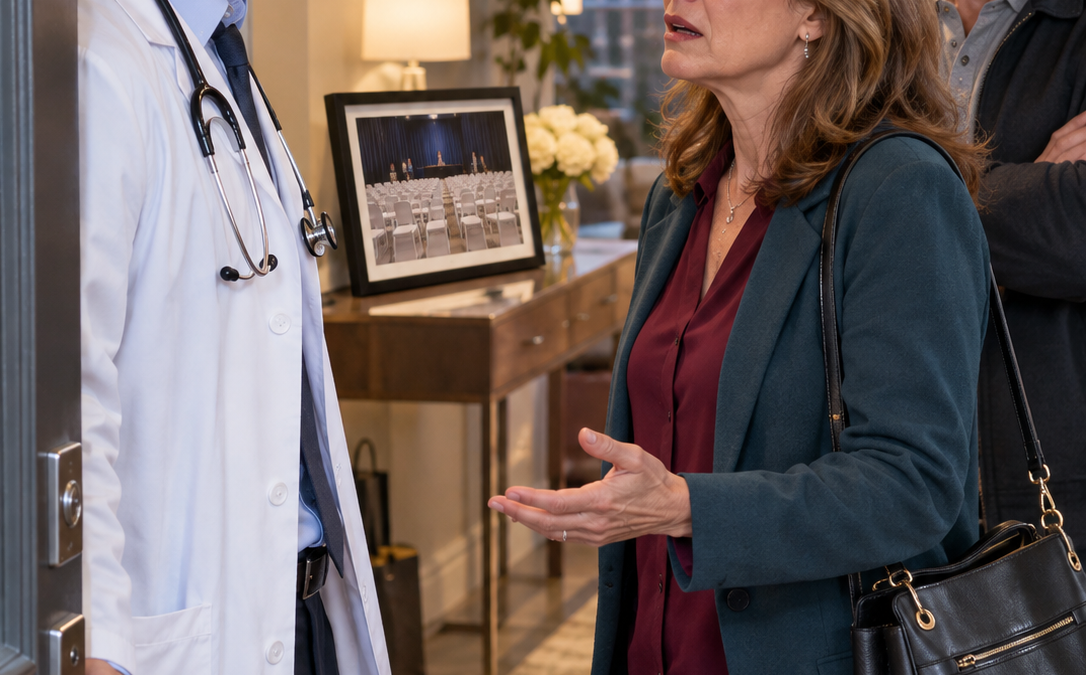
It was a Thursday evening, two weeks after graduation, when I heard the knock. I’d just gotten home from a residency orientation meeting. I was still wearing my white coat, my stethoscope dangling around my neck like a statement I didn’t have to make anymore. My apartment was quiet, warm with the smell of the takeout I’d just unpacked. And for the first time in what felt like months, I was actually looking forward to a peaceful night alone.
Then came the knock. Not loud, not desperate, just confident, like whoever was on the other side assumed they had every right to be there. I opened the door halfway, and there she was. My mother.
Her hair was windswept, her cheeks red from either the wind or the anger. Probably both. Behind her, standing awkwardly on the landing, was Gary, his arms crossed, his eyes scanning the hallway like he expected security to jump out at any moment.
My stomach dropped, but I didn’t move. I didn’t say anything. My mother blinked at me, and for a moment, it was like she didn’t recognize me. Maybe it was the coat, or the quiet, or the fact that I didn’t immediately open the door wider like I used to, back when I was still trying to earn a sliver of her approval.
She cleared her throat. “Adam, can we come in?”
I tilted my head. “Why?”
She looked startled, as though the question itself were offensive. “Because we need to talk. In private. Face-to-face.”
I stepped into the doorway, blocking it fully. “We could have done that two weeks ago. At graduation.”
Gary snorted. “Come on, man. Are you still holding on to that? It’s not like we didn’t congratulate you.”
“No,” I said calmly. “You ridiculed me, then prioritized a Caribbean buffet over showing up for your own son.”
My mother’s eyes flared. “That’s not fair. You didn’t even give us time to explain.”
I raised an eyebrow. “You sent me a text that said, ‘Watching you pretend to be a doctor sounds painful.’ What exactly was I supposed to wait for? The punchline?”
Gary stepped forward then, his voice rising. “You’re being petty. That money wasn’t yours to touch.”
“There it is,” I muttered, almost smiling. “This isn’t about showing up. It’s about the inheritance.”
My mom’s lips tightened. “We thought we could use some of it for the remodel. Your grandma would have wanted the family to enjoy it together.”
“You mean like she enjoyed being iced out by you after she got sick?” I asked, my voice sharp now. “Or how she had to move in with a friend because you didn’t want to deal with her medication schedule?”
My mom flinched. She hadn’t expected that, but I wasn’t finished.
“She changed the will because she saw what I didn’t. That you only show up when there’s something to take. Not to support, not to encourage, just to grab what’s left.”
Gary’s arms uncrossed, and he stepped forward again, his voice low and angry. “You think you’re so righteous, don’t you? Just because you got some fancy degree, you think you’re above us.”
I stared him down. “No. I think I finally see you clearly, and I’m done pretending you’re anything more than what you’ve shown yourselves to be.”
My mom’s voice cracked. “Adam, please. You’re still our son.”
“That’s funny,” I said, crossing my arms. “Because two weeks ago, you were telling me I was pretending to be a doctor. But now that there’s no check coming, I’m suddenly worth a visit.”
She opened her mouth, but no words came. Just guilt, maybe shame. It flickered in her eyes for a second, but not long enough to matter. I stepped back and closed the door halfway.
“You flew across the country for this,” I said softly, “but couldn’t make it across a stage for me. That tells me everything I need to know.”
She stepped forward, almost like she might push against the door, but stopped herself. Her voice came out small. “Can’t we just start over?”
I paused, then said, “We already did. I just started without you.”
And I closed the door.
I didn’t cry. I didn’t smile either. I just stood there, listening to the silence on the other side until their footsteps finally faded down the hall.
The fallout didn’t end there, of course. Word got around the family fast. My aunt told her sisters, who told their husbands, who told my cousins. Some called me a genius. Others called me cruel. My cousin Drew texted me, “You did what we all wish we had the guts to do.”
But not everyone was on my side. There were group chats. I got removed from Facebook posts. I wasn’t tagged anymore. My mom’s side of the family, those who had never liked Grandma anyway, started acting like I’d robbed some sacred family vault. I even got a message from an uncle I hadn’t spoken to in five years. It simply said, “You’ll regret this. Blood is blood.”
But I didn’t regret it. I went to work. I wore my white coat with pride. I hung my diploma on the wall, not the one I’d mailed my mom, but a new one, framed with a photo of Marcus and me beneath it. We were both grinning like fools in front of the university banner. And I kept building.
Three years passed. In that time, I completed the hardest years of my life as a medical resident. Long shifts that stretched into 48 hours. Missed birthdays, missed holidays, missed sleep. But I grew. I healed patients. I held hands with the dying and the scared. I cried in elevators. I laughed in break rooms at three in the morning. I saw things I can’t unsee.
And I became a doctor, not just in title, but in spirit. The kind of doctor who doesn’t flinch, who stands his ground, who listens before speaking, and who speaks with intention when he does.
While my professional life was growing, so was something else. That tiny idea I’d planted after graduation, the clinic, was no longer just an idea.
With Marcus’s help and some generous donors I’d met through residency, I opened a small community clinic on the edge of a neglected neighborhood in the city. It wasn’t flashy. One floor, five rooms, two doctors, a nurse, and a volunteer desk. But it was ours.
A place where no one asked if you had insurance first. A place where we kept the lights on late because people didn’t stop getting sick after five in the afternoon.
I named it after my grandmother: the Evelyn R. Wellness Center. Her photo hung in the lobby, and every day I walked in, I felt grounded.
I rarely thought of my family anymore. It wasn’t even avoidance. It was just peace. The kind that comes when you stop chasing something that was never running toward you in the first place.
But peace has a way of being interrupted.
It was late October when the email came. The subject line read, “Family Reunion: 75th Birthday for Uncle Rich.” The message had been sent to a long CC list, but it still began with a cheerful greeting.
“Hey everyone, hope you’re all doing great! We’re putting together something special for Uncle Rich’s 75th. Potluck-style backyard bash. You know how it goes.”
I almost deleted it on sight, but then I noticed something at the bottom, tacked on almost as an afterthought.
“P.S. Adam, we all really hope you come. It’s been too long. Your mom said she misses you.”
It wasn’t signed by my mom. It was signed by my cousin Olivia, the family diplomat. I didn’t reply.
Two days later, a handwritten letter showed up at the clinic. No return address. Just neat cursive handwriting I hadn’t seen in years.
“Adam, I know I’m the last person you want to hear from. And maybe I don’t deserve to ask for anything. But if you can find it in your heart to come, I’d be grateful. Not to talk about the past, not to argue. Just to see you. Just to see my son again.
“I’ve changed. I swear I have. I know it’s late, but I’m still your mother.
“Love, Mom.”
She had underlined the word “Love” twice. I stared at that word for a long time. Then I folded the letter, slipped it back into the envelope, and tucked it into a drawer I hadn’t opened in over a year. The same drawer where I kept the photo of the empty chairs from graduation. I didn’t look at the photo. I just closed the drawer again.
And I went.
I don’t fully know why. Curiosity, maybe, or a desire to finally close a door properly. Not slam it, not bolt it shut, just close it.
The reunion was at a rented hall. Balloons, cheap catering, plastic tablecloths. Exactly the kind of thing my family loved. The parking lot was already full by the time I arrived. I stepped out of my car wearing a crisp button-up shirt and slacks and felt the fall wind bite through the air.
Inside, it was noisy. Kids were running around, people were laughing, and the DJ was playing an overly loud oldies playlist. Someone had already spilled punch on the gift table.
The moment I stepped inside, heads turned. There was a beat of silence, a collective intake of breath, as if seeing me had triggered some ancient family muscle memory. Someone whispered, “Is that Adam?”
I just nodded politely and moved toward the back wall. I hadn’t come for small talk. I’d come to see if there was anything worth salvaging.
Then I saw her. My mother.
She looked older, softer around the edges, less put together than I remembered. Her hair was streaked with silver, and she wore a pale blue cardigan over a dress that didn’t quite fit right. Her eyes locked on mine like she was afraid I might vanish.
“Adam,” she breathed.
“Hi,” I said.
She took a step forward. “You came?”
“I did.”
Tears sprang into her eyes instantly, like she’d been holding them back for three years. “I… I didn’t know if you’d even open the letter.”
I waited for an apology, for ownership, for something more than guilt. Instead, she reached for my hand. “I’ve missed you so much.”
I gently stepped back. “You missed the chance to show up when it mattered.”
She flinched. I watched her expression change before I continued.
“I’m not here to fight,” I added. “I just wanted you to see me. Not out of spite. Just so you know that I’m doing fine without your support. Without the money you expected, without any of the things you thought I needed you for.”
There was a pause. She lowered her eyes. “I deserve that.”
“Yes,” I said simply. “You did.”
Then I handed her a small envelope. Inside was a folded pamphlet for the Evelyn R. Wellness Center, along with a handwritten note that said, “In case you ever want to understand what I’ve been building and why I stopped waiting for you to be proud of me.”
She took it with shaking hands. I didn’t linger.
I stayed long enough to greet Uncle Rich. Long enough to prove that I wasn’t hiding, that I’d grown roots without them, that I’d built something out of the very silence they had left me in.
As I walked back toward my car, someone called out behind me. It was Marcus.
I hadn’t invited him. He had just shown up. He said he figured I shouldn’t have to face them alone. He held up a coffee from our favorite place and gave me a familiar look.
“I figured you’d want an exit drink.”
I laughed for the first time that day. “Let’s go,” I said. “I’ve got clinic work in the morning.”
As we drove away, I looked in the rearview mirror one last time. My mother stood in the doorway of the hall, the pamphlet pressed to her chest, her eyes locked on the car as it disappeared down the road.
She didn’t wave. Neither did I.
Because some endings don’t need closure. They just need peace.
And I finally had mine.








