Reddit drama tales, full story: by 21, i had paid off my student loans, bought a house, and built a six-figure business – all without a dime from my parents. but when my golden child brother went bankrupt, they sued me for ‘stealing the future he was supposed to have.’ i didn’t settle. i made an example out of them.
When I was sixteen, I made a silent promise to myself: I would never rely on anyone to save me. Not my parents, not my teachers, not some magical opportunity that might fall into my lap. Just me.
That promise shaped every decision I made afterward, even if no one around me noticed or cared at the time. Especially not my parents. If you’d asked them back then, they would have described me as the quiet one. The kid who always had his head buried in a laptop. The one who didn’t understand how the world worked. Meanwhile, my older brother Aaron walked around like he’d been born wearing a crown. Every birthday felt like his coronation. Every family dinner became a performance celebrating his supposed brilliance. And my parents always clapped the loudest.
My name is Carl. I’m twenty-four now, but this story really begins a few years ago, when I was turning twenty-one. By then, I had already paid off my student loans. All of them. I’d bought my first home with cash, nothing flashy, just a small place in the suburbs. And I’d grown my e-commerce business into something I could genuinely be proud of. Six figures in revenue, a handful of freelancers working with me, and the kind of freedom most people my age could only dream about. I wasn’t flashy about any of it. I didn’t post pictures or brag about my success. I kept my head down and worked, because somewhere deep inside, I believed that if I ever stopped long enough to celebrate, someone would find a way to take it all from me.
Turns out, I was right.
Growing up in a small town, everybody knew everybody else’s business, especially when you had a last name like ours. My dad, Martin, was a regional manager for a construction supply company, and he wore that title like a badge of honor. My mom, Cheryl, floated between part-time jobs and what might as well have been a full-time position supporting Aaron’s ambitions. Aaron was two years older than me, and he’d always been the golden child. My parents used to joke that he’d come out of the womb with a winning smile and a scholarship offer. It didn’t matter that he’d failed classes, wrecked two cars, or once maxed out my dad’s credit card on a spring break trip he wasn’t even supposed to take. Every single time, my parents found a way to brush it off.
“He’s just finding himself,” they’d say. “He’s meant for great things.”
And me? I was the backup plan. The invisible sibling.
I still remember one Thanksgiving dinner, not long before everything fell apart. We were sitting around the table at my parents’ house, the turkey half carved and my mom already a glass and a half into her boxed wine. Aaron had recently returned from Los Angeles, where he’d tried to launch a startup that ended exactly the way most of his ventures did: with him sleeping on somebody’s couch and begging to come home. My parents welcomed him back like a war hero returning from battle. That evening, my dad raised his glass and looked directly at Aaron.
“To new beginnings,” he said. “We know your next chapter is going to be a big one.”
Aaron smirked and clinked his glass against Dad’s. I said nothing.
Nobody had toasted me when I bought my house. Nobody had even mentioned it. They all knew about it, of course. I’d told them months earlier, sent photographs, and offered to have them over. I never received a response. But Aaron moved back into their house carrying two duffel bags, with debt collectors practically on his heels, and suddenly he was the phoenix rising from the ashes.
I tried not to let it bother me. I really did. I’d spent years building my business, learning everything I could about SEO, product sourcing, and customer service. Every late night, every missed party, every small victory I’d quietly celebrated alone in my apartment had been part of building something that belonged to me. I’d thought that maybe, just maybe, accomplishing something real would finally earn me a little respect. But I should have known better. In our house, effort didn’t matter. Results didn’t matter. What mattered was image, charm, and drama, and Aaron had all three in spades.
A week after Thanksgiving, my mom called. There was something strange about her voice, something tight and rehearsed. She asked whether I could come over because the family needed to talk. Naturally, I assumed it had something to do with Aaron. Maybe they wanted me to help him find a job or pretend to be a reference. I was used to being the quiet fixer, the ghost behind the curtain who made problems disappear without ever receiving credit. But the moment I arrived, I knew something was wrong.
My dad was sitting in his recliner with his arms crossed and the television muted. Aaron lounged on the couch in sweatpants, looking smug, as though he was in on some private joke. My mom wore that nervous smile she always put on when she was about to say something she knew would upset me. She gestured toward the kitchen table.
“Why don’t we sit down?”
I remember how slowly I moved, how heavy the air seemed as I pulled out a chair. It felt as though something was about to shift, although I couldn’t have explained exactly what. My mom took a breath, folded her hands on the table, and finally said what they’d apparently been rehearsing.
“We were hoping you could help Aaron with a little investment.”
The word hung between us like a bad smell. Investment. As though I were some angel investor they could charm into saving their sinking ship. I blinked, trying to make sense of what I was hearing.
“What kind of investment?”
Aaron immediately leaned forward. “I’ve got this idea. It’s like a subscription box service, but for tech gadgets. You know, like those mystery boxes? We could market it to college kids. Low overhead, high margins.”
I looked from him to my parents. “And you want me to fund it?”
My dad cleared his throat. “Not fund it exactly. Just help him get started. You’ve had a good run, Carl. You’ve done well for yourself. It’s time to pay it forward.”
Pay it forward. As though someone had handed me my success for free. As though the customer emails I’d answered at three in the morning, the fourteen-hour workdays, and the ramen-fueled grind through college meant absolutely nothing because I hadn’t achieved success the way they thought I should.
“I’m sorry,” I said slowly, struggling to keep my voice steady, “but I’m not in a position to just throw money at a vague idea with no business plan.”
Aaron rolled his eyes. “It’s not vague. I’ve got contacts. I know people.”
“You’ve been back here for two weeks,” I reminded him. “Living in the guest room.”
That was a mistake. I saw my mother’s expression harden and my father lean forward in his chair. Mom placed one hand flat on the table, as if she were preparing to deliver a lesson to an unruly child.
“Carl, we’re just asking you to help your brother. Family supports each other.”
“I’ve supported myself since I was eighteen,” I said, pushing back my chair and standing. “That’s how I was taught, right?”
Nobody answered. I looked at each of them, waiting for someone to say something that might change the meaning of what had just happened. Nothing came. So I left.
I honestly thought that would be the end of it. I figured they’d try to guilt-trip me, maybe send a few passive-aggressive text messages, and eventually move on. That was how these things had always gone in my family. Aaron wanted something, my parents tried to make it my problem, and if I refused, everybody acted offended until the next crisis came along.
What I didn’t understand was how desperate things were about to become. I had no idea how far my parents were willing to go to protect their golden boy. Because the next time I saw them after what happened next, we would be in court.
But I’m getting ahead of myself. There was much more to it than that. What started as a request for a favor became a silent war, then a full-blown legal ambush. There were betrayals, accusations, and lies I never imagined my own family capable of telling. Eventually, I would have to face the realization that my parents were willing to destroy everything I’d worked for just to prop up the son who had never lifted a finger to save himself. And for the first time in my life, I would decide to stop turning the other cheek.
It began on a Wednesday night.
I remember the day clearly because Wednesday was inventory night, the least glamorous but most essential part of running my business. Every week, I’d haul boxes out of the storage room, scan and repackage products, and prepare orders for my fulfillment partners. That evening, I was ankle-deep in shipping labels when I heard my front door open.
At first, I thought I must have imagined it. I lived alone, and as far as I was concerned, nobody had a spare key. Then came the unmistakable click of the deadbolt sliding shut again, followed by the low murmur of several voices. Three, maybe four. And one of those voices belonged to Aaron.
I came around the corner quickly, my heart pounding. “What the—”
My parents were standing in my entryway. Aaron was behind them, wearing that familiar smirk, as though he owned the place. My dad had a manila folder tucked under his arm and the same self-righteous expression he used to wear whenever he lectured me about my attitude as a kid. My mom gave me a tight-lipped smile, pretending this was an ordinary family visit rather than three people walking into my home without permission.
“How did you get in?” I asked, genuinely stunned.
“We used the key,” Mom said, as though that explained everything.
She was talking about the emergency spare I’d given them years earlier, back when I still believed we had something resembling a healthy relationship. Apparently, she’d decided that having a key meant she could simply waltz into my house whenever she pleased.
I held out my hand. “Give it back. Now.”
She hesitated before reaching into her purse and dropping the key into my palm like a child caught stealing. What bothered me most wasn’t even the fact that she’d used it. It was the expression in her eyes. She wasn’t embarrassed or apologetic. She looked disappointed in me.
“What are you doing here?” I asked, feeling more exhausted than angry.
Aaron shrugged and strolled into the living room as if he had every right to be there. “We tried being polite. You slammed the door in our faces. So now we’re handling things the proper way.”
“The proper way?” I repeated, narrowing my eyes.
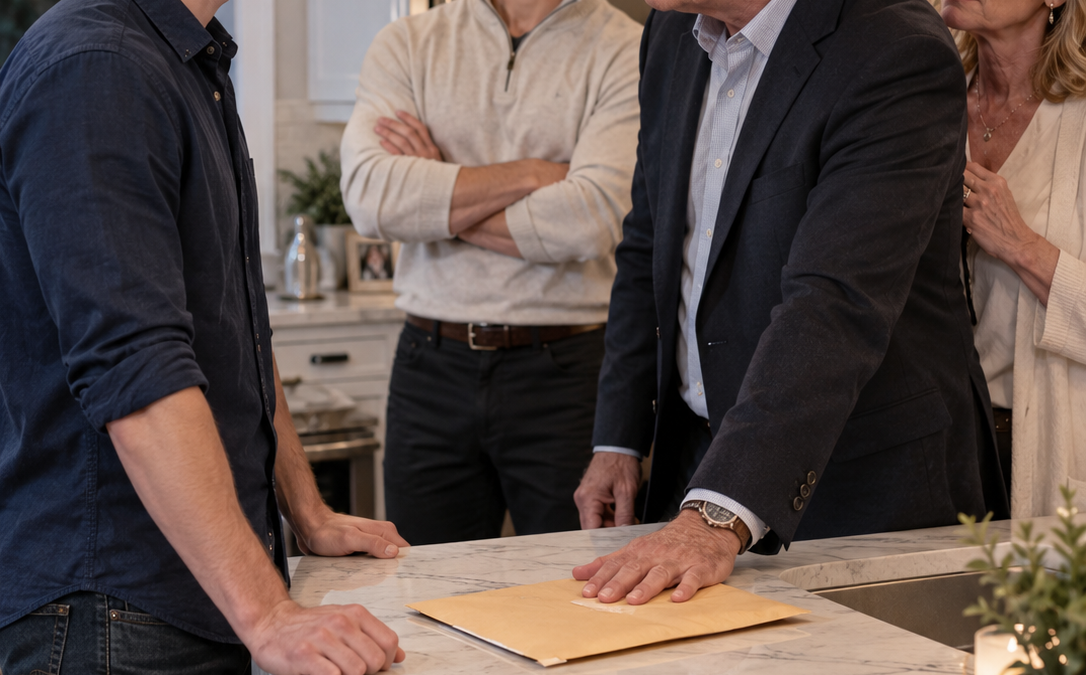
My dad walked to the kitchen island, set down the manila folder, and slid it toward me. “It’s time we had a serious talk, Carl, about what you owe this family.”
I didn’t open it immediately. I was too busy trying to figure out whether I was dreaming. Three people had entered my home uninvited, and somehow they were behaving as though I was the one who’d done something wrong.
“You’re in my house without permission,” I said. “You have five seconds to explain why I shouldn’t call the cops.”
“Oh, please,” Mom scoffed. “You’re acting like a stranger.”
“I wonder why.”
“Just read the paperwork,” Dad said, nodding toward the folder.
I flipped it open. At first, the words didn’t register. There were names, numbers, and pages of legal language that seemed completely disconnected from reality. Then I saw the claim filed in my parents’ names against me, and certain phrases seemed to leap off the page.
Fraudulent withholding of assets. Misappropriation of family investment. Unjust enrichment at the expense of a sibling.
I stared at the documents. “What the hell is this?”
My voice sounded sharp and unfamiliar in the stillness of my own kitchen. Aaron stepped closer, folded his arms, and looked at me with open satisfaction.
“It’s what you get when you lie about where the money came from.”
“I didn’t lie about anything.”
“Oh, come on.” He rolled his eyes. “We all know you didn’t build this business from scratch. You used the money Grandpa left, didn’t you?”
My jaw dropped. “Are you serious right now?”
He grinned like a cat that had cornered a mouse. “You think I didn’t notice how you suddenly got real cozy with e-commerce the year Grandpa died? That’s when your little side hustle blew up. Admit it.”
“I didn’t get a cent from Grandpa’s estate,” I said, barely believing I had to explain this. “He left everything to Grandma. She made that clear.”
“Yeah, and she always had a soft spot for you,” my mother said quietly. “Even when Aaron was the one who needed help.”
I looked at her, then at Dad, and finally back at Aaron. The pieces were starting to come together, and what they formed was uglier than anything I’d expected.
“So let me get this straight,” I said slowly. “You break into my house, throw false accusations at me, and what? You want me to admit to stealing money I never touched?”
“We want what’s fair,” Dad replied firmly. “Aaron has been struggling. You’ve clearly been profiting. It’s time to rebalance the scales.”
There it was. The mask was finally off.
I’d expected manipulation. Maybe a guilt trip, another lecture about family loyalty, or some ridiculous argument about how brothers were supposed to share. But this was a lawsuit against their own son, brought into my home like a threat. Something inside me cracked. Years of being overlooked, talked down to, and treated like a background character in Aaron’s story suddenly came boiling to the surface.
“You want to rebalance the scales?” I asked, my voice shaking. “Fine. Let’s talk about scales. Let’s talk about the two cars you bought him before he was even twenty. The loans you co-signed. The credit cards you paid off. The way you let him move back home every time something went wrong. Every time he failed, you gave him everything. And me? I’ve never asked you for a single cent.”
“Because you were always too proud,” Mom snapped.
“Because I had to be!” I shouted. “You never offered. You never believed in me. You never even asked what I was building. And now that it worked, you think I owe you?”
For a moment, the room fell completely silent. My parents stared at me, and even Aaron seemed caught off guard by the force of my anger. Then he muttered, almost under his breath, “You wouldn’t even have a future if it weren’t for this family.”
My fists clenched at my sides. “You mean the family that’s suing me?”
Dad took a step forward, trying to regain control of the conversation. “You can avoid all of this. If you just help your brother get on his feet, we can drop the claim. Clean slate.”
I stared at him. There was no mistaking what he meant now. “You mean hand over my money so you don’t drag my name through the mud?”
He didn’t answer.
I picked up the folder and tossed it back across the island. “Get out. Now.”
Mom looked as though she wanted to argue. Dad’s face tightened, and for a second I thought he might put his fist through the wall. Aaron didn’t say another word. He simply turned and walked out with that smug swagger of his, as though he believed the whole thing had gone exactly according to plan.
But they hadn’t won anything.
They’d lit the fuse.
Over the next few days, the fallout began to arrive in pieces. First came a letter from their lawyer, confirming that my parents intended to move forward with the claim. Then came the phone calls from extended family. Uncles, cousins, even old neighbors I hadn’t spoken to in years suddenly wanted to “check in” after hearing certain things about me. The small-town rumor mill was spinning faster than I could keep up with, and every version of the story painted me as the villain.
I tried to stay focused. My business was still running, orders were still coming in, and customers were still expecting their shipments. But everything felt poisoned. Every email notification made me wonder whether another legal document had arrived. Every family text felt like a trap waiting for me to step into it. I stopped sleeping properly and began checking my front door three times every night. Then, three weeks after my family walked into my house, I received an email that made the entire nightmare suddenly, terrifyingly real.
It was from my bank. One of my business accounts had been frozen pending an investigation connected to the legal dispute.
For a moment, I couldn’t breathe. I clicked through the notification with trembling fingers, reading the same words over and over. I’d done nothing wrong. I’d paid my taxes, kept clean records, and built my business without stealing a single dollar from anybody. Yet somehow, because of my family’s baseless accusations, I was being treated like a criminal.
I called the bank immediately. The representative was polite but firm. The account would remain frozen until the claim was resolved in court. No matter how carefully I explained the situation, nothing changed. Aaron had said he wanted to make things fair. Instead, he was dragging me into the mud, and my parents were standing beside him, handing him the rope.
I thought that would be the worst of it. Then I discovered something that made my blood run cold.
Aaron hadn’t stopped at the lawsuit. He’d also filed for a restraining order against me, claiming that I’d threatened him. According to his paperwork, I was erratic, hostile, and a danger to his safety. I stared at the copy in disbelief. The timing was no coincidence. He was trying to paint me as unstable so that when the court examined the financial accusations, the judge would be more inclined to believe him instead of me.
It was character assassination, plain and simple. A smear campaign built on lies and supported by the same people who had tucked me into bed when I was little.
That was my breaking point. It wasn’t just about the money anymore, and it wasn’t even about the lawsuit. It was about principle. About finally standing up to people who had used love as a leash and expected me to roll over and thank them for it. I wasn’t going to settle. I wasn’t going to apologize for something I hadn’t done. And I certainly wasn’t going to let them rewrite the story of my life.
They wanted a war. Fine. I’d give them one.
And the first shot would be aimed at the one secret they thought I didn’t know existed: the financial skeleton hidden in their own closet.
The restraining order hearing was scheduled for a Monday morning in early spring. The sun was shining when I left the house, but I barely noticed. I hadn’t slept the night before. My thoughts had been running in circles, playing through every possible worst-case scenario until I could hardly distinguish one fear from another.
My lawyer, a guy named Miles whom I’d found through a friend of a friend, had assured me that Aaron’s case was weak. “This isn’t going anywhere,” he’d said. “Judges can smell fabricated drama a mile away.”
But I was still shaking when I walked into the courthouse. What frightened me wasn’t really the possibility of losing the restraining order hearing. It was the knowledge that Aaron was willing to go this far, and that my own parents were apparently prepared to swear under oath that I was violent, unstable, and dangerous to my brother. I was convinced they’d been coaching him on what to say. Their names weren’t on the restraining order paperwork, but I could see their fingerprints all over it.
They all showed up that morning. Aaron arrived wearing a blazer that didn’t fit properly, acting as though he were the victim of some elaborate mafia vendetta. My parents sat directly behind him, looking like his personal support team. Mom dabbed at what I was certain were fake tears, while Dad glared at me as if I’d personally disgraced the family name.
Twenty minutes into the hearing, the judge threw out Aaron’s case, citing insufficient evidence and a clear motive of financial retaliation. My family reacted with open disbelief. Aaron even tried speaking again after the gavel came down, apparently convinced that one more argument might persuade the judge to reconsider. But that part of the battle was over.
I should have felt relieved. Instead, I felt empty.
I’d technically won, but I knew the real fight hadn’t even begun. The restraining order wasn’t the main attack. It had been a distraction, a calculated attempt to damage my character before the lawsuit moved forward. And in one important respect, it had worked. Not in court, but inside my head.
I went home that afternoon, sat on my living room floor, and stared at the unopened boxes of unshipped inventory stacked against the wall. For the first time in years, I didn’t want to work. I didn’t want to answer emails, check orders, or fix another problem. I didn’t even want to fight. I just sat there in silence, feeling as though something important had been taken from me, something I couldn’t quite put into words.
Over the next month, everything stalled. My business accounts remained partially frozen, and although I managed to move some operations to a backup account, the damage had already been done. Cash flow suffered. My advertising budget dried up, and fulfillment times grew longer. Customers noticed the delays, and some canceled their orders. One of my best-selling suppliers dropped me altogether, citing “reputational risk.”
I tried to explain what was happening. I kept pushing, looking for ways around each new obstacle, but the harder I struggled, the more it felt as though I were drowning in mud someone else had poured over me. I was losing my footing, not only financially but mentally. My business had once been the one place in my life where effort produced results I could trust. Now even that felt uncertain.
Then came the worst blow of all.
It was a Thursday afternoon when my phone rang. The caller was the landlord who owned the small warehouse space I rented. The place was barely eight hundred square feet, but it had become the beating heart of my operation. It was where inventory arrived, where orders were packed, and where the business I’d built from almost nothing finally felt real. He told me he wouldn’t be renewing my lease.
“Too much legal noise,” he explained. “I’ve got other tenants. I can’t afford drama.”
I begged him to reconsider. I even offered to pay three months’ rent in advance, hoping that would reassure him. But he wouldn’t budge. When the call ended, I sat there staring at the wall.
That was rock bottom.
It wasn’t dramatic or cinematic. There was no shouting, no spectacular collapse, no single moment when everything visibly fell apart. It was quiet and cold, like something inside me had finally broken loose and drifted away. I’d spent three years building something that worked, something honest, something that belonged entirely to me. And in less than two months, the people who had raised me had come frighteningly close to destroying it.
I could have folded. I thought about it seriously. I even started drafting a letter to the court agreeing to some kind of small settlement, just enough to make the whole thing go away. I hated the idea of giving them anything, but I was exhausted, and the possibility of finally being left alone was beginning to sound almost worth the price.
I never sent that letter.
Because that night, I received a message from someone I hadn’t heard from in more than a decade.
Her name was Elise. She’d been my neighbor when we were children. We’d played tag in our backyards, ridden bicycles through the cul-de-sac, and spent countless afternoons doing the ordinary things kids do when they assume the people around them will always be there. Then she’d moved away in middle school, and we’d lost touch. I hadn’t thought about her in years.
Yet there she was, sending me a message through LinkedIn, of all places.
“Hey, Carl,” she wrote. “I saw your name in a mutual post and did a double take. I remembered you from back home. I was sorry to hear about the lawsuit. Just wanted to say, don’t let them take what you’ve built. You were always the smart one, the quiet one. But we all knew.”
I read that message again and again. Not because it solved any of my problems. My accounts were still frozen, my warehouse lease was still ending, and my parents were still trying to take me to court. But something about those words reminded me of a version of myself I’d almost forgotten.
I remembered the kid who stayed up late watching YouTube videos about coding. The kid who once sold homemade candles door-to-door just because he enjoyed making something and seeing whether people would buy it. The kid who kept building things even when nobody paid attention.
And suddenly, I understood something.
They could freeze my accounts. They could spread rumors, file lawsuits, and convince half the town that I was dishonest. They could take away the business I’d built, or at least make it almost impossible to run. But they couldn’t touch the part of me that knew how to create something out of nothing. That ability had existed long before the money, the house, or the company. It was still there, buried beneath the exhaustion and anger, waiting for me to remember it.
So that night, I got up from the floor. I went into the storage room, cleared off my whiteboard, and started again from scratch.
Rebuild. Rebrand. Restart.
I started small because I didn’t have much choice. I had only a few hundred dollars in liquid cash, barely enough to fund a single Facebook advertising run. So I abandoned the idea of paid advertising and went organic instead. Reddit, Instagram Reels, TikTok snippets. Whatever could put my products in front of people without requiring money I couldn’t afford to spend.
I took my best-selling product, gave it a different name, and rebuilt the branding around a cleaner aesthetic and a more personal voice. I launched a new Shopify store using a VPN and a fresh business LLC registered in another state. Every night, I stayed awake until three in the morning. I made calls, wrote marketing copy, worked on the website, and learned more about web optimization in three weeks than I had in the previous year.
Slowly, quietly, it began to work.
My direct messages started filling with customers asking what had happened to the old brand. When I responded personally, some thanked me and placed new orders. One customer turned out to be a YouTuber who eventually featured the product in a review. That review took off, and within a week, my orders had tripled.
Meanwhile, the lawsuit was moving at a crawl. Miles filed a motion to dismiss, and my parents’ legal team responded by trying to amend their claims. The judge pushed the hearings back another month, then another. Under ordinary circumstances, I might have found the delays infuriating. This time, they gave me something valuable.
Time.
Time to recover, time to rebuild, and time to prepare.
Because while my family was busy telling fairy tales about how I’d supposedly stolen the future Aaron deserved, I was busy collecting receipts. Not just business receipts, either. Family receipts. Financial records. Documents that could expose the truth about money my parents had never expected me to investigate.
The tax records I would eventually uncover weren’t easy to obtain, but they were real. And the first important clue had been sitting much closer to me than anyone realized.
Before my grandmother passed away, she’d mailed me a manila envelope containing some of her personal papers. She’d still been living alone when she sent it. At the time, I’d put it away without understanding how important it would become. Inside were copies of the trust she’d established after Grandpa died.
And those documents contained a detail that changed everything.
Aaron had received a payout. A large one. Enough money to pay off his college loans, start a business, or even buy a house. It could have given him the kind of financial head start most young people would never experience.
But he hadn’t used it for any of those things.
He’d blown it on gambling, bars, trips, and crypto scams. Within a year, the money was gone. Aaron knew exactly what he’d done with it. My parents knew, too. What they apparently never expected was that I might find out.
I also discovered an old voicemail from Grandma. She’d left it a few weeks before she passed away, and although her voice sounded frail, every word was clear.
“I hope you’re doing well, Carl. I just wanted to say I’m proud of you. I wish the others saw what I see. Keep going. And remember, don’t let them guilt you into saving people who never tried to save themselves.”
I listened to that recording over and over the night I had it transcribed for evidence. Hearing her voice again hurt in ways I hadn’t anticipated, but her words also gave me something solid to hold on to. I finally understood the possible motive behind my family’s accusations. And now I had proof that the story they were telling wasn’t the whole truth.
The tide was beginning to turn.
I didn’t tell anyone. I stayed quiet and kept building. I moved my entire operation into a friend’s garage temporarily. He ran a coffee-roasting business and generously let me use his back room for shipping. It wasn’t the warehouse I’d lost, but it was enough to keep orders moving while I figured out the rest.
For a while, I made myself practically invisible. No posts, no personal updates, not even conversations with extended family members. I let them believe I was losing. Let them keep telling one another that the truth was finally catching up with me. I knew what was happening behind the scenes, and for once, I didn’t feel the need to explain myself.
I watched. I waited. I prepared for the next phase.
Sooner or later, the court date would arrive. And when it did, I wasn’t planning merely to defend myself. I intended to dismantle the story my parents and Aaron had built around me, piece by piece. Not out of revenge, at least not entirely, but because some people only learn when you stop allowing them to write your story and finally hand them a copy of the real one.
And believe me, I was keeping track of every word.
They didn’t know I had the file. That was what made the whole situation almost satisfying.
The documents from Grandma’s estate, the ones she’d tucked into that envelope before she passed away, weren’t merely sentimental relics. They were a blueprint, a timeline, and a financial record that could unravel the accusations against me. They were exactly the kind of thing my parents had assumed would never see daylight. After all, Aaron had burned through his inheritance so quickly that the ink on the check had barely had time to dry. Who would still remember what happened to that money? Who would care enough to dig through the paperwork?
I would.
I scanned every page and highlighted the important figures. The trust documents laid out the distribution details, including the fact that Aaron had received a $75,000 payout at the age of twenty-two, under the condition that the money be used for long-term growth and development. It wasn’t a small amount. It was the kind of money that could have completely changed the direction of his life if he’d handled it responsibly.
My name appeared nowhere in those distribution records. I hadn’t received a penny.
But the part that stayed with me most wasn’t the dollar amount. On the back of the final page, Grandma had written a note in her familiar cursive handwriting. Six simple words.
“Carl doesn’t need it. He builds.”
I stared at that sentence for a long time. Those six words destroyed the entire narrative my parents had constructed. They turned Aaron’s sob story into what it had always been: a squandered inheritance, not a stolen one. A future he’d been given every opportunity to build, then set on fire with his own hands.
Still, I didn’t make any of it public. Not yet.
The lawsuit was continuing to crawl through the legal system, and my parents’ lawyer kept attempting to push the hearings back. That suited me perfectly. Every additional week gave me time to strengthen my business, organize my defense, and uncover more of the truth. It also gave my family more opportunities to contradict themselves.
While they stalled, I started digging deeper. Not only through legal records and bank statements, but through people.
There’s something about growing up in a small town that can work either for you or against you. People remember things, and people talk, especially when you’re polite enough to listen and quiet enough to let them finish. I reached out to an old neighbor named Mrs. Delaney, who had lived across the street from us when Aaron and I were growing up.
She remembered far more than I’d expected.
She recalled the day Aaron received his check and the brand-new car that appeared in our driveway barely a week later. She remembered the parties, the constant spending, and the screaming matches between Aaron and my father when the money finally ran out. What my parents had treated like ancient family history was still remarkably fresh in her mind.
“She always said he’d waste it,” Mrs. Delaney told me over tea, referring to my grandmother. “Your grandma. She wasn’t blind, you know. She just didn’t want to hurt your mom.”
I hadn’t even asked her to give a formal statement before she offered one.
Word gradually spread that I was trying to establish what had really happened, and more information began coming my way. Before long, I had a small collection of messages, text conversations, and photographs. There was Aaron in Las Vegas with champagne in his hand. Another picture showed him on a boat, tagged in an old college friend’s Instagram post, holding a bottle of Grey Goose and giving the camera the middle finger. Every photograph had a timestamp, and those dates fell within the twelve months following his trust payout.
Together, they painted a loud, obnoxious, undeniable picture of where the money had gone.
But that wasn’t the only angle I was pursuing. There was one more person I needed to contact, someone whose involvement required a little more finesse.
His name was Mr. Jenkins. He’d been our family accountant years earlier, back when my parents still filed their taxes properly. I hadn’t seen him in ages, and I wasn’t entirely sure he’d remember me. But when I called, recognition came almost immediately.
“Carl? You were the quiet one, right? The polite one?”
“I need a favor,” I told him.
I wasn’t sure whether he’d be willing to help, especially given his long history with my family. So I explained everything: the lawsuit, the restraining order, the accusations about my business, and the claim that I’d secretly taken money from Grandpa’s estate. As I spoke, Mr. Jenkins grew quiet. Very quiet.
“They told me you stole from them,” he finally said. “Said you were hiding something big. But I didn’t buy it.”
“Why not?”
“Because I did their taxes the year they got that trust distribution. Cheryl told me it was going toward Aaron’s future. Seed money for a tech company, she said. I filed it under a gift transfer, just like she asked.”
I sat up straighter, trying not to let the excitement in my voice get ahead of me. “Would you be willing to put that in writing?”
There was a pause on the other end of the line.
“I’ll do better,” he said. “I’ve still got the files.”
He sent them the next morning.
Suddenly, I had proof coming from three separate directions: Grandma’s trust documents, eyewitness testimony about how Aaron had spent the money, and tax records confirming that he had received funds my parents had never disclosed during discovery. None of it depended on whether somebody liked me or believed my version of the story. These were records, dates, signatures, and transactions.
Miles nearly fell out of his chair when I handed him the file.
“They’re cooked,” he said, flipping through the pages. “This isn’t just a defense anymore. This is counterclaim material.”
I nodded. “That’s the plan.”
But I didn’t want simply to win in court. I wanted to change the narrative that my family had spent months constructing around me. I wanted people to understand who I was without having to listen to Aaron’s version first. So while Miles prepared our legal strategy, I began building something else, something much more public.
I’d already restarted my company, but now I pushed the rebrand further. A new name, a different domain, new visuals, and a completely different presentation. This time, instead of hiding behind the products, I leaned into the story of how the business had come to exist. Not the lawsuit itself, but the broader truth of what it had taken to build something without help.
“Built from scratch,” I wrote on the About page. “Bootstrapped. No handouts. Every dollar earned the hard way.”
I never mentioned my parents or Aaron by name. I didn’t have to.
People knew enough to recognize what I was saying. Old customers began returning, and new ones followed. Word spread through online communities, and eventually somebody started a Reddit thread about the rebrand. It caught fire.
“This is how you bounce back,” one comment read.
“This guy’s work ethic is unreal,” another person wrote.
My email list tripled. Revenue rebounded. Orders were coming in consistently again, and the brand I’d been forced to rebuild was beginning to find its footing. I could finally see a future beyond the endless legal paperwork and the constant fear of another account being frozen.
Still, I kept quiet about the evidence. I was waiting for one more thing to fall into place.
Aaron’s next move.
It came sooner than I expected.
One morning, while I was packing orders, Miles called. His voice had the controlled urgency I was beginning to recognize.
“They filed an emergency motion,” he said.
I stopped packing. “For what?”
“To freeze your personal assets. They’re claiming you’re hiding money.”
I should have been furious. I should have felt that familiar surge of panic, the one that had nearly swallowed me when the bank first froze my business account. Instead, I found myself smiling.
“Let them try.”
Because while my family had been playing checkers, drunk on rage and entitlement, I’d been quietly setting up the chessboard.
By then, everything I owned had been placed under a new financial and legal structure. My assets were now protected under a new LLC. I’d transferred my house into a trust, arranged for my car to be leased under the business, and divided my savings between two accounts held under separate holding companies. It had taken time, organization, and a great deal of paperwork, but I’d made those arrangements while my parents were still convinced I was too frightened to defend myself.
When Miles reviewed the documents, he laughed.
“You’ve been busy.”
“They taught me well,” I said. “Never trust anyone. Not even family.”
We answered the emergency motion with everything we had. The tax records. Grandma’s trust documents. The timeline of Aaron’s spending. Mrs. Delaney’s letter. Mr. Jenkins’s statement. And a complete audit trail documenting the growth of my business, starting with the day I sold phone accessories out of my college dorm room and continuing all the way to the day I purchased my house.
There was nothing vague about our response. Every important detail had supporting evidence. Every transaction was accounted for. The accusations my parents had been making suddenly looked very different when placed beside years of financial records.
It was surgical, and it was devastating.
But I still wasn’t finished.
Because here’s the thing about people like Aaron and my parents: money was never the only thing they wanted. They wanted control. They wanted the power to decide what everyone believed, to shape the story until their version became the only version that mattered. They wanted to be able to look me in the eye and say, “You owe us,” knowing the people around us would automatically take their side.
For years, I’d allowed them to do exactly that. I stayed quiet, worked hard, and convinced myself that my achievements would eventually speak for themselves. But the lawsuit had taught me something. Silence doesn’t always protect you from people who are determined to lie.
So I planned one final move. Something public. Something that would remain visible long after the legal proceedings ended.
I scheduled an interview on a small podcast run by a fellow entrepreneur I’d met years earlier. It wasn’t a famous show, and I had no expectation that the episode would go viral. That wasn’t why I agreed to appear. I wanted the opportunity to tell my story honestly, in my own words, without my family interrupting or correcting me.
For an hour, I talked about my life.
I didn’t focus on the lawsuit or revenge. I talked about growing up in the shadow of a brother who could do no wrong. About working on my business late at night while the rest of my family laughed off my ambitions. About paying off my student loans with money earned from side hustles. About what it meant to spend years being underestimated by the very people who were supposed to encourage you.
“Sometimes,” I said during the interview, “the hardest part isn’t starting from nothing. It’s starting from behind, when the people who should have supported you were the ones holding you back.”
The episode aired a week later.
The response overwhelmed me. My inbox filled with direct messages, emails, and comments from strangers who recognized pieces of their own lives in what I’d said. Some had been belittled by their families. Others had spent years fighting to build something while the people closest to them insisted they would fail. They weren’t all entrepreneurs, but they understood what it felt like to have to fight for every inch of progress.
More importantly, people started asking questions.
Questions about the lawsuit. Questions about the accusations against me. Questions about the financial history my parents had spent months trying to keep out of public view.
And those were questions my parents weren’t prepared to answer.
Not long afterward, their lawyer called Miles, sounding considerably less confident than he had in previous conversations.
“We’d like to revisit settlement discussions,” he said.
“We’re not interested,” Miles replied.
Because by then, it was too late for the kind of settlement they’d been hoping to force on me. I wasn’t simply trying to survive their accusations anymore. I was beginning to set the terms of what happened next.
The next hearing was approaching quickly, and I was ready. Not just with evidence or people willing to testify, but with the unshakable knowledge that no matter how many times my family tried to rewrite my story, I still held the pen.
And soon, I intended to use it to bring their version to an end.
The courtroom was colder than I remembered. Not physically, exactly. It was that sterile, rigid kind of cold that seemed to settle somewhere along your spine when you knew something irreversible was about to happen. The walls were beige, the lighting harsh and fluorescent. There was nothing dramatic about the room itself, no pounding music or grand spectacle, just the low hum of tension as people shuffled papers, adjusted their chairs, and waited for the proceedings to begin.
It had been nine months since my parents first filed their lawsuit. Nine months since they and my golden-child brother decided that I somehow owed Aaron the life he’d squandered. Nine months of venomous text messages, weaponized family gossip, and increasingly desperate attempts to destroy everything I’d built on my own since I was eighteen.
And now, finally, it was time.
Their side looked rattled before the hearing even began. Aaron sat beside their attorney in a wrinkled suit that looked as though he’d never learned how to wear it properly. He kept chewing the inside of his cheek, occasionally shifting in his chair as if he wanted to disappear into it. My parents sat behind him, dressed as though they were attending a church fundraiser rather than a courtroom hearing. Mom wore pearls and pastel colors. Dad sat stiffly in a blazer that no longer fit comfortably around his stomach.
Neither of them would look at me.
I was calm. Not because I wasn’t nervous. I was. My stomach felt tight, and I was painfully aware of every movement in the room. But underneath the nerves was a strange, quiet certainty. It was the kind of calm that comes from spending months preparing for a moment with such precision that, when it finally arrives, there’s nothing left to panic about. Every document had been examined. Every financial record had been organized. Every decision that mattered had already been made.
Miles sat beside me, shuffling through the papers in front of him. At one point, he leaned toward me and whispered, “This is going to be fun.”
I glanced at him, then back toward the judge’s bench.
The judge was a stern-looking woman in her early sixties. When she called the courtroom to order, the remaining conversations stopped almost immediately. The hearing began with my parents’ attorney laying out the same tired argument we’d been hearing for months. According to him, I’d unfairly benefited from family resources, deliberately misled my parents into believing I was self-made, and hoarded financial assets that should rightfully have been shared with Aaron.
He made it sound as though my brother’s entire life had somehow been derailed by my refusal to hand over money that belonged to me.
Listening to him, I was struck by how hollow the accusations sounded. They’d repeated the same claims so many times that there was almost nothing left beneath the words. But their lawyer continued, carefully presenting Aaron as the disadvantaged son and me as the selfish brother who had supposedly stolen opportunities that were never mine to take.
Then it was our turn.
Miles stood without any dramatic gestures. He didn’t raise his voice or try to intimidate anyone. He simply straightened the papers in front of him, looked toward the judge, and began.
“Your Honor, we’ll be demonstrating three things. First, that my client, Carl, received no financial support or inheritance from his family. Second, that the plaintiffs’ son, Aaron, received a $75,000 distribution from a family trust, which he irresponsibly spent. And third, that this lawsuit is a malicious attempt to extract funds from my client under false pretenses after the plaintiffs failed to control their own finances or their son.”
He placed the first folder on the table with a firm thud.
“Exhibit A.”
Inside were the trust documents from Grandma’s estate, clearly establishing that the money had been designated for Aaron and Aaron alone. My name did not appear among the recipients. There was no hidden payment, no mysterious inheritance, and no evidence that I’d ever taken a dollar from the trust.
Miles moved to the next set of papers.
“Exhibit B.”
This was the notarized letter from Mr. Jenkins, our family’s former accountant. It confirmed that he’d recorded the financial gift as a trust distribution under explicit instructions from my mother. It also supported the fact that my parents had known about the money Aaron received long before they began accusing me of taking family assets.
Then came Exhibit C: the timeline of Aaron’s social media posts, travel records, and online purchases. The photographs from Las Vegas. The expensive trips. The designer sneakers and bottle service in Miami. Every date lined up with the twelve months following his trust payout. Together, they documented a pattern of spending that had nothing to do with responsible investment or the long-term development the trust was supposed to support.
I watched Aaron as the information was presented. He’d stopped shifting around in his chair. His face had gone rigid, and his eyes stayed fixed on the documents in front of Miles.
But there was still more.
“Exhibit D,” Miles announced.
This time, he introduced Grandma’s recorded voicemail, which had been authenticated and transcribed. Her words were presented as part of the evidence, including the message that had become so important to me.
“Carl doesn’t need it. He builds.”
The courtroom went still.
For a moment, I could hear the faint hum of the fluorescent lights overhead. My parents’ attorney tried to object, but the judge overruled him. The documents and testimony remained before the court, and the facts they established were becoming increasingly difficult for my family to escape.
Then Miles delivered the final blow.
He pulled out a spreadsheet.
“Your Honor, we’ve also prepared a breakdown of my client’s business growth over the past four years. All of it is verifiable. From his dorm-room operation to the first product launch to the Shopify sales records. Every dollar, every invoice, every tax return. There’s no missing money, no hidden assets. Just a young man who worked hard and succeeded without help.”
He paused, allowing the weight of the records to settle over the room.
“Meanwhile, we have evidence that the plaintiffs and their son have consistently misrepresented their financial situation to multiple parties, including their mortgage lender and this court.”
The judge raised an eyebrow.
Miles gave a small smile before continuing. “Which is why we’re also filing a counterclaim for defamation, malicious prosecution, and emotional distress.”
I’ll never forget what happened next.
The judge leaned back in her chair and removed her glasses. She looked directly at my parents, studying them for a moment before speaking. Her voice was calm, but there was an unmistakable coldness beneath it.
“I’ve presided over a lot of family cases,” she said. “But this is one of the more cynical attempts I’ve seen to weaponize the legal system against a relative for personal gain.”
My mother sat motionless. My father stared straight ahead. Aaron looked as though he was having trouble understanding what was happening.
“Based on the evidence presented,” the judge continued, “I’m dismissing all claims against Mr. Davis with prejudice.”
That was it.
After nine months of accusations, sleepless nights, damaged business relationships, frozen accounts, legal bills, and the constant fear that everything I’d built could disappear, the claims against me were dismissed.
But the judge wasn’t finished.
“As for the counterclaim,” she continued, “Mr. Davis is within his rights to pursue damages. And frankly, I believe he has a case.”
Their attorney’s face went pale.
Aaron sat frozen, like a deer caught in headlights. My mother began blinking rapidly, her fingers twisting and turning her wedding ring as though she couldn’t keep her hands still. My father’s face flushed a deep red, somewhere between anger and humiliation.
None of them said a word. Not one.
We walked out of the courtroom in silence. The hallway outside was brighter and noisier, filled with footsteps and the distant murmur of conversations, but for a moment, everything around me seemed strangely far away. I’d spent so long fighting that I almost didn’t know what to do with the fact that the main battle was finally over.
Miles turned toward me once we were clear of the courtroom.
“They’ll settle,” he said. “Trust me. They can’t afford not to.”
And he was right.
Two weeks later, their attorney contacted Miles with an offer. My parents were willing to cover all my legal fees, issue a written apology drafted by us, and relinquish any right to pursue future legal action against me. In exchange, they wanted me to drop the counterclaim.
On paper, it was almost everything I’d been fighting for.
But I didn’t agree immediately.
There was one more thing I needed.
Truth.
I wasn’t willing to accept an apology that disappeared into a private letter or was buried beneath pages of legal language. My parents had spent months spreading accusations about me. They’d allowed family members, neighbors, and people I’d known since childhood to believe I was a thief. Their lies had damaged my reputation, my business, and my peace of mind. A private acknowledgment wouldn’t undo what had been done publicly.
If they wanted me to agree to a settlement, the apology had to be visible.
So I made sure their formal statement was published on my business website. I shared it as an open letter on LinkedIn, where people who had followed the story could read it for themselves. I also arranged for it to be featured on the same small podcast that had helped bring attention to my experience in the first place.
The truth needed to be part of the public record.
It wasn’t about humiliating them for revenge. It was about making sure the false story they’d told about me could no longer stand unchallenged. I didn’t want their money. I wanted accountability. I wanted the people who had heard the accusations to have the opportunity to see what the evidence had actually established.
The day the statement went live, more than two hundred emails arrived in my inbox.
Some were from strangers who had followed the podcast. Others came from friends, former classmates, and even a few teachers I hadn’t spoken to in years. People who’d heard rumors about me months earlier now understood how much of the story had been distorted. Many of the messages were deeply personal. Some people wrote about their own experiences with family members who had tried to take advantage of them.
But despite the different stories and backgrounds, the messages all seemed to express the same simple sentiment.
“Thank you for telling the truth.”
I read those words more than once. For so long, I’d believed that nobody was listening, that the only voices anyone cared about belonged to Aaron and my parents. Now people were finally hearing mine.
As for Aaron, he disappeared from social media.
His accounts went quiet, and before long, rumors began circulating that he’d left town. Some people said he’d moved in with a cousin a couple of states away. Nobody seemed to know for certain, and I didn’t make any effort to find out. Whatever he was doing, he was no longer walking around our hometown acting as though the world owed him a future.
His name still came up in conversations, but not in the way it once had. The admiration and indulgent laughter that used to follow every mention of Aaron had been replaced by embarrassment. People who once talked about his enormous potential now remembered the money he’d wasted and the accusations he’d made against his own brother.
My parents faced a different kind of reckoning.
They lost most of their inner circle. People they’d spent years gossiping with began avoiding them. Some of the same neighbors who had once welcomed them into their homes started crossing the street rather than risk an uncomfortable conversation. The social standing my father had always valued so much seemed to evaporate almost overnight.
Mrs. Delaney told me they’d stopped attending church altogether. They no longer showed up at the neighborhood barbecues where they’d once been regular fixtures. The familiar performances of the happy, successful family had come to an end.
No more neighborhood gatherings. No more smiling for appearances. No more pretending everything was fine.
They hadn’t simply lost the lawsuit. They’d lost control of the story.
Because I’d finally reclaimed it.
In the months that followed, my business doubled in size. I expanded into two new product lines, hired a small team, and began thinking about the future in ways that would have seemed impossible during those months when I was sitting on my living room floor, staring at boxes I couldn’t afford to ship.
The company was no longer just something I’d built to survive on my own. It had become proof that I could lose almost everything and still find a way to begin again.
Eventually, I launched a mentorship program for underprivileged students who wanted to start businesses of their own. I called it the Builder’s Fund. The goal was to help young people who had ideas and determination but lacked the support or opportunities that could make those ideas possible.
I wanted them to have someone who believed in what they were capable of building, even if the people around them couldn’t see it yet. I knew what it felt like to work through the night while everyone else dismissed your ambitions. I knew what it meant to build something without encouragement, to celebrate small victories alone, and to wonder whether anybody would ever recognize the work you’d put in.
If I could make that road a little easier for someone else, I wanted to do it.
I knew Grandma would have liked that.
Sometimes I still think about the message she left me before she died. I think about the way she understood something my parents never seemed willing to acknowledge. She hadn’t measured my future by how much money she could leave me or how many times someone else might come to my rescue. She’d seen what I was capable of creating with my own hands, my own determination, and my willingness to keep going when nobody was watching.
For years, I believed being independent meant never needing anyone’s approval. But somewhere along the way, I’d still been waiting for my parents to recognize what I’d accomplished. I’d kept hoping that one day they’d look at me the way they looked at Aaron, with admiration instead of indifference.
That hope had cost me more than I realized.
Maybe one day I’ll forgive them. I can’t say for certain. But not yet. Forgiveness is earned, and they haven’t even tried.
They thought they could take what I’d built.
What they never understood was that I am what I built.








