On my birthday, my parents gave my brother a watch and me a lecture. the cake had his name on it. i laughed along so i wouldn’t cry. that night, i packed a hoodie, $60, and vanished. two weeks later, my dad called me sobbing: “your room’s still here… please pick up.”
Still, I tried. I got good grades. I stayed out of trouble. I worked part-time stocking shelves at the grocery store so I could save money for college, because I already knew they weren’t going to help. Every time the conversation veered toward my future, my dad would just grunt and say, “You’re smart. You’ll figure it out.”
Mason, on the other hand, got a brand-new laptop for his sixteenth birthday because he supposedly needed it for school, even though he mostly used it to play games and scroll through TikTok. I remember asking my mom once if I could borrow it to fill out college applications. She told me to ask my brother. So I did, and he said no.
When my eighteenth birthday finally came around, I wasn’t expecting much. Maybe a card, a family dinner. I didn’t even expect a gift. I just wanted a moment, some kind of acknowledgment that I’d made it through eighteen years in a house that barely tolerated me. That maybe, just maybe, they saw me.
My birthday landed on a Saturday that year. I didn’t have to work, so I slept a little later than usual and came downstairs expecting at least a “Happy birthday” from someone.
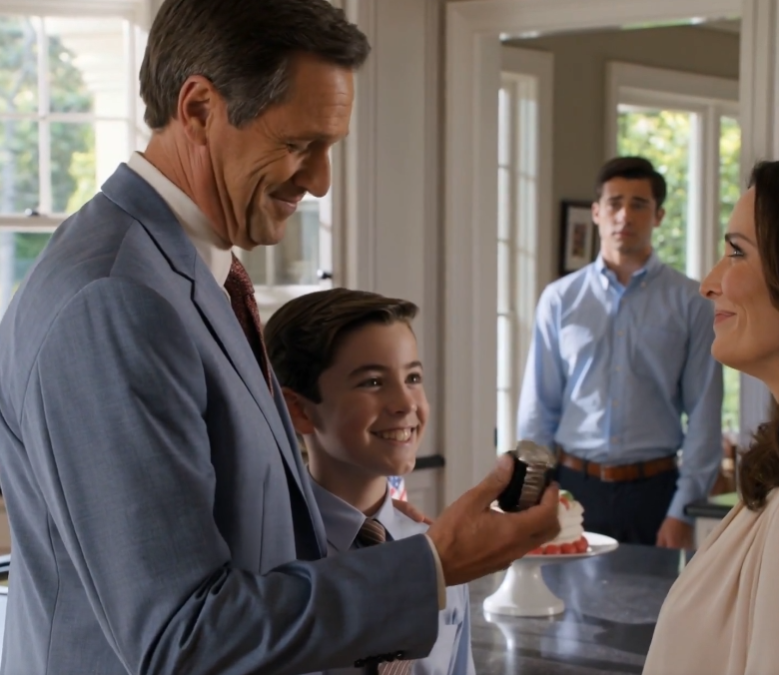
Instead, I found my dad in the kitchen, tying a bow onto a sleek black box, while Mason bounced on his heels like a little kid on Christmas morning. I stood in the doorway, still half asleep, watching this private little moment between them as though I were intruding on something.
My mom turned around with a big smile and said, “Perfect timing. Come on, Mason. Open it.”
No one looked at me. No one even seemed to notice that I hadn’t spoken yet.
Mason ripped into the box and let out this exaggerated gasp, like he’d just won the lottery. Inside was a silver watch, expensive-looking, with a leather band and Roman numerals on the face.
“Oh my God, Dad. This is so sick,” Mason said, grinning as he slipped it onto his wrist. “Now I don’t have to borrow your old one anymore.”
My dad laughed and ruffled his hair. “Well, you’ve earned it, kid. You’ve been working so hard lately.”
Hard.
The kid’s biggest accomplishment that week had been making it to second base with some girl in his chemistry class.
I stood there, frozen, waiting for someone to remember the actual reason the day mattered. My mom finally glanced over at me.
“Don’t look so sour, Ryan. It’s not always about gifts. When you’re older, you’ll understand that what matters is who you become, not what you get.”
It hit me like a slap.
She said it in that calm, condescending voice she always used when she wanted to sound wise, as though I were some selfish kid who just didn’t understand how the world worked. I tried to nod and play along, but my throat tightened.
“I thought we were having cake,” I mumbled.
“Oh, we did that earlier,” Mason said casually. “While you were sleeping.”
I blinked. “You had cake without me?”
“It was just a small thing,” my mom said quickly. “Nothing big.”
“Whose name was on it?”
There was a silence, just a beat too long.
Then Mason smirked. “Mine?”
I stared at him.
“I mean, it was a joint thing, but—”
“It’s not your birthday,” I said.
“Don’t be dramatic,” my dad snapped. “It’s just a cake.”
I wanted to scream. I wanted to throw something. But instead, I laughed.
It was a sharp, short sound, and it didn’t even sound like me. I laughed because if I didn’t, I was going to cry right there in front of them, and I wasn’t about to give them the satisfaction.
Mason raised an eyebrow like I was the crazy one. My mom gave me that familiar look, all pity and disappointment, as though I were ruining a perfectly good day.
That night, I didn’t even bother turning on the light when I went upstairs to my room. I sat on the edge of my bed for a long time, staring at the floor and trying to swallow the lump in my throat.
I kept thinking the same thing over and over. They’re never going to love you the way you want them to. It doesn’t matter what you do. It doesn’t matter how hard you try. You’re never going to be Mason.
So I made a decision.
I grabbed my backpack and stuffed it with a hoodie, a water bottle, a few granola bars, and the sixty dollars I’d stashed in an envelope at the back of my sock drawer. I didn’t have a plan. Not really. But I had my ID, a phone charger, and a bus schedule I’d secretly printed at the library weeks earlier.
At midnight, while the house was quiet and everyone was asleep, I slipped out the back door and didn’t look back.
I figured I’d stay gone for a day or two. Maybe crash at the shelter near the downtown church. Maybe try to find another part-time job or couch-surf if I could find someone kind enough to take me in. I didn’t know exactly what I was going to do.
I just knew I couldn’t stay.
What I didn’t expect was that two weeks later, my phone would buzz with a number I hadn’t seen in days.
My dad.
I let it ring the first time, and the second. But on the third try, I answered. Before I could say anything, his voice came through, choked with emotion and barely above a whisper.
“Your room’s still here,” he said. “Please, just tell me where you are. Please.”
That was when I realized something had shifted. I just didn’t know what had changed or why. And the part that scared me most was that I wasn’t sure I wanted to go back.
So I didn’t.
Not that week. Not the next. And not after the voicemail my dad left two days later. This time, his voice was quieter, but there was anger underneath it.
“I don’t know what you think you’re proving, Ryan, but this isn’t how family works. You don’t just vanish.”
That part made me laugh a little. It was ironic, considering I’d spent my entire life feeling like a ghost in that house.
I stayed gone.
I bounced around for a while. First at the church shelter, then at a small room-for-rent setup run by a retired mechanic named Len, who had a soft spot for strays, both dogs and people. I paid him what I could, about $130 a week, for a mattress in the corner of his garage that he’d sectioned off with plywood and a curtain.
The place smelled like oil and rust, but it was warm. And for the first time in my life, I didn’t have to tiptoe around someone else’s rules just to exist.
I found part-time work unloading trucks at a shipping warehouse and spent the rest of my hours filling out college applications at the public library, using computers that timed out every thirty minutes.
I didn’t tell anyone where I was. I didn’t want my family to find me until I had something to show for myself.
But eventually, they did.
It was Mason who showed up first.
I was walking out of the library one afternoon when I saw him leaning against a car that was definitely too nice for him. New model, shiny black paint, leather seats. He hadn’t noticed me yet. He was staring at his phone, looking bored.
I froze.
My first instinct was to turn around and bolt in the other direction, but curiosity pinned me in place. He spotted me a second later and smirked, like I was late to something I hadn’t known I’d been invited to.
“There you are,” he said, slipping his phone into his jacket. “You look like crap, bro.”
“Thanks,” I said flatly.
“Seriously, though, Mom’s freaking out. Dad’s being weird. You made your point, okay? Come home.”
“I’m not coming home.”
He rolled his eyes. “Come on, man. You had your little tantrum. Now everyone’s waiting for you to crawl back so things can go back to normal.”
That word, normal, hit me like a brick.
“You mean where my birthday cake had your name on it?” I asked. “That kind of normal?”
He shrugged as though I’d just brought up the weather.
“It was just a mix-up. You always take things so seriously. They didn’t mean anything by it.”
“You’re right,” I said. “They never mean anything by it. That’s the problem.”
His smile dropped.
“Look, I don’t know what kind of sob story you’re telling yourself, but you’re not the only one with problems, okay? You don’t see me running away.”
“No,” I said. “You just see the world bending to make sure you don’t have to.”
That got to him. His jaw tightened.
“Whatever. Just know that when you finally come back, don’t expect a parade. They’ve been bending over backward trying to reach you.”
I nodded slowly.
“Yeah. Did they tell you what they said the night I left?”
He didn’t answer. I hadn’t expected him to.
“Tell them I’m doing fine,” I said, turning away. “And if they’re really so worried, they can stop calling my number and start thinking about why I stopped picking up.”
A week passed, then two. I started hearing less from them. No more voicemails, no more texts. I figured they’d given up and moved on. They’d probably already reallocated my bedroom to a storage space or a little home gym, or whatever project they could come up with to fill the silence I’d left behind.
I thought that was the end of it.
Until I got an email.
Not from my parents, but from my high school counselor, Mrs. Devo.
It was short and awkward, written in that careful tone people use when they don’t know whether to sound concerned or polite. She said she hoped I was safe and doing okay, but she wanted to let me know that my transcripts had been requested and withdrawn.
According to the school’s system, my parents had contacted them and said I would not be attending college. They had instructed the school to cancel any further application correspondence.
I sat there in the library, staring at the screen, barely breathing.
I read the email again, then a third time.
They had tried to erase me.
I called the school immediately, my heart pounding, and thankfully, Mrs. Devo picked up. I explained everything. She confirmed what had happened, her voice full of apology, but it was clear she hadn’t known the full story.
I spent the next two days untangling the mess and making sure my applications hadn’t been affected. A few deadlines had already passed. I’d missed a scholarship opportunity that I’d had a real shot at getting.
That night, I couldn’t sleep. I kept turning the email over in my head, wondering what kind of people would go out of their way to block their own child’s future.
It wasn’t even about control anymore.
It was sabotage.
I didn’t want revenge. Not yet. What I wanted was to disappear so completely from their narrative that one day, they’d have to explain to someone why their firstborn son had never come home.
But fate had other ideas.
A month later, I received a letter in the mail. A real letter, paper and envelope, with no return address. Just my name, written in my dad’s familiar handwriting.
Inside, there was no apology.
There was a list. A literal, bullet-pointed list of things I needed to do before we could talk about me coming home.
It included gems like, “Stop blaming others for your unhappiness.” “Apologize for walking out and ghosting your family.” “Recognize the sacrifices we made for you.” And, of course, “Understand that we do what we do out of love.”
I read it in silence.
Then I laughed, because what else could I do?
It wasn’t a letter. It was a contract. A way to make me the problem again. A way to pull me back into that endless loop of guilt, obligation, and performance.
I crumpled it, tossed it into the trash, and told myself for what felt like the hundredth time that I was done.
But then came the moment that changed everything.
It happened in early spring. I’d started working more hours at the warehouse, trying to save enough money for community college. One evening, Len came into the garage holding a thick envelope. He said someone had stopped by earlier, asked if Ryan lived there, and handed it over without saying another word.
I opened it slowly.
Inside was a formal letter from a lawyer’s office. The kind printed on heavy paper, full of legal language that made my stomach tighten before I even understood what it meant.
It stated that I was being removed as a dependent from my parents’ tax records retroactively. That I was no longer considered part of their household. That I had until the end of the month to collect any remaining personal belongings from their property before those belongings would be disposed of at the homeowners’ discretion.
There was a sticky note attached to the letter.
All it said was, “This is what consequences look like.”
Signed, Mom.
That was the moment something inside me shifted.
I felt a switch flip, something hardening and settling into place. It wasn’t anger. It wasn’t even sadness.
It was clarity.
They weren’t just trying to hurt me. They were trying to erase me.
And if they wanted to play that game, they had no idea who I was about to become.
For two days after I got the letter, I barely spoke. Len noticed, but he didn’t press me. He just slid an extra sandwich across the workbench during lunch and said, “Whatever it is, kid, it won’t last forever. Not if you don’t let it.”
I nodded, but I didn’t believe him.
Rock bottom doesn’t always look like some dramatic fall. Sometimes it’s quiet, a dull ache that settles in your chest and refuses to leave. It’s walking home after a double shift, your fingers sore and your boots soaked, and realizing you don’t actually have a home. Just a garage with no insulation and a curtain for privacy.
It’s sitting in that cold room at three in the morning, your hoodie pulled over your face, knowing your family has written you off like a bad investment.
They weren’t just done with me.
They were punishing me for leaving.
I didn’t even have much to go back for. A few clothes, a shelf of books I’d collected over the years, and my guitar, assuming it hadn’t already been sold or thrown away.
But even so, I felt hollow knowing that my name, my space, my entire existence in that house was being scrubbed clean, as though I were a stain on their perfect family portrait.
And the worst part was that I almost let it break me.
That week, I skipped two shifts. I didn’t answer when Len knocked. I stopped checking my email. I barely ate and hardly slept. I just lay there listening to the wind pushing against the garage door, wondering what I was even doing anymore.
But then something stupid saved me.
A book.
Well, not just any book. My book. One I’d thought I’d lost during the move.
It was buried at the bottom of my backpack, a worn-out, dog-eared copy of Into the Wild by Jon Krakauer. I’d already read it three times, but that night, I flipped it open and landed on a sentence I’d underlined years earlier in red ink.
“Happiness is only real when shared.”
It should have made me feel worse.
Instead, it made me sit up.
I realized I’d spent my entire life trying to share it with people who never wanted it. I kept handing over pieces of myself, hoping that eventually someone would look at me and say, “We see you. You matter.”
But they never would.
That wasn’t the family I was born into, and I couldn’t change them. I could only change myself.
The next morning, I went back to work. I apologized to my supervisor for missing my shifts and offered to take the graveyard slot for the next two weeks to make up for it. He didn’t ask questions. He just grunted and handed me a badge for the overnight crew.
The work was harder. Heavier boxes, colder nights, longer hours. But I didn’t care.
I needed it.
That was the beginning of my rebuild. Quiet, simple, and entirely mine.
Over the next few months, I fell into a rhythm. Wake up, work, read, sleep, repeat. I started putting aside every extra dollar I could. I downloaded budgeting apps, cut out anything unnecessary, and even stopped using mobile data on my phone to save money on the bill.
Len noticed and started finding extra chores for me to do in exchange for credit toward the rent. Sometimes he’d toss me a twenty and say it was for groceries, pretending like I hadn’t just spent hours scrubbing his entire truck engine clean.
I applied to community college again, this time completely on my own, and paid the application fee myself.
I wrote an essay that was so brutally honest I cried after hitting Submit. I didn’t sugarcoat anything. I talked about growing up invisible, about the way silence can scream louder than words, about rebuilding yourself from scratch when nobody hands you the tools.
And then, slowly, things started shifting.
One night, while mopping the warehouse floor, I overheard two of the logistics guys complaining about a glitch in the shipping software. I’d picked up a little coding knowledge from an online course I’d been dabbling in. Nothing serious, just a free Python class, but I offered a possible solution anyway.
They shrugged it off at first.
Two days later, one of them pulled me aside.
“Hey, that thing you mentioned? It worked.”
Next thing I knew, I was unofficially the guy everyone came to whenever the systems froze or the printers went haywire.
I didn’t get a raise or a title, but people started learning my name. They started thanking me. They started seeing me.
It was a strange feeling, the kind that makes you sit with it for a while and quietly whisper to yourself, Maybe I’m not just background noise.
My first big win came in early summer.
I got an email from the community college.
Accepted.
With a scholarship, too.
It wasn’t a full ride, but it was enough to cover tuition as long as I kept working part-time. I remember sitting there staring at the screen, rereading the word “Congratulations” over and over, like it might vanish if I blinked too hard.
Len let me use his kitchen that night to bake a boxed cake.
It came out lopsided and slightly burned, but I didn’t care. I wrote my own name on it in blue frosting.
Ryan.
Just Ryan.
No shared celebration. No forgotten candle. No lecture about gratitude or what really mattered in life.
Just me, a beat-up garage, and the first piece of joy I’d built with my own two hands.
I didn’t call my parents. I didn’t tell them anything. But I knew they’d find out eventually, because people talk, especially in a town like ours.
Sure enough, one day at the grocery store, I ran into an old neighbor, Mrs. Kavanaugh. She was a kind woman who used to sneak me cookies when my mom wasn’t looking.
She smiled widely when she saw me.
“I heard you’re going to college! Your mom must be so proud.”
I just nodded and said, “Yeah. Must be.”
But I knew better.
They weren’t proud. They were probably furious that I’d done it without them.
And I was okay with that, because their approval wasn’t the currency I needed anymore.
Later that week, I got a call from an unknown number. I let it go to voicemail.
It was my mom.
She didn’t cry. She didn’t yell. She just said, “We heard about school. Glad you’re doing well. I hope you’ll remember where you came from.”
I replayed that line five times.
Where I came from.
Like I was some wandering stray who needed to remember where his kennel was.
But I didn’t feel angry.
I felt free.
By the end of that summer, I’d moved out of Len’s garage. I found a shared apartment near campus with two roommates who kept to themselves and didn’t ask questions. I started classes and landed a part-time IT gig at the school’s help desk.
It wasn’t glamorous, but it paid the bills. Little by little, I began building something that looked suspiciously like a life.
I still had scars. Emotional ones.
I still flinched when people raised their voices. I still second-guessed compliments. I still caught myself apologizing for taking up space.
But I was learning.
Healing isn’t loud. It’s not always dramatic. Sometimes it’s just drinking coffee in a quiet room and realizing you’re no longer afraid to be seen.
One night, I opened a new notebook and wrote down a list. Not a list of goals, but of truths. Things I’d learned. Things no one could take from me.
At the top, I wrote, “You don’t need permission to become someone they never imagined.”
And underneath it, “Your worth isn’t measured by someone else’s disappointment. You can start over, even when they say you can’t. Family isn’t who you’re born to. It’s who roots for you in the quiet.”
I closed the notebook, turned out the light, and slept better than I had in years.
But I should have known it wasn’t over.
Because just when I thought I was finally free, something happened that pulled me right back in. Something that changed everything.
It started with a message request.
Late one night, I was reviewing notes for an upcoming midterm, sitting on the floor of my apartment with a half-eaten burrito beside me and three different tabs open about laptop troubleshooting, when I noticed a new message on Facebook.
I hadn’t used Facebook in months, maybe longer. I’d only kept the account active in case of emergencies or for identity verification.
The sender’s name stopped me cold.
Mrs. Langford.
She was my parents’ old neighbor, the one whose garden used to spill into our backyard. She’d always been kind but distant, friendly in that particular way suburban neighbors are. Cordial waves, polite holiday cards, whispered gossip across fences.
I hadn’t spoken to her in years.
The message was simple.
“Hey Ryan, I wasn’t sure if I should say anything, but I thought you had the right to know. Your parents listed your childhood home for sale. The sign just went up this week. Hope you’re doing well.”
I stared at the message, then read it again.
The house was up for sale.
Our house.
For a second, I didn’t feel anything. Just blankness. Then something flickered inside me. Not quite sadness. Not anger, either.
Something else. Something sharper and colder.
I’d always assumed they’d sell eventually. Once Mason graduated or moved out, they’d probably downsize or relocate to some gated community where the HOA newsletter came with a warning label.
But the fact that it was happening now, after everything, after cutting me off and pretending I had never existed, didn’t sit right with me.
So I did what any reasonably curious person would do.
I opened Zillow.
It didn’t take long to find the listing.
There it was. A bright, overexposed photograph of our front porch. The white shutters had been cleaned up, and the old oak tree still cast its crooked shadow across the lawn.
The description was flowery and fake.
“Charming family home with rich character, lovingly maintained for over two decades. Four bedrooms, custom finishes, quiet neighborhood.”
I scrolled through the photographs.
Living room. Kitchen. Master bedroom.
Then bedroom one.
I clicked on it.
My breath caught.
They’d turned my room into a guest suite.
Neutral walls, beige bedding, generic art prints hanging where my posters used to be. Every trace of me was gone. No desk, no shelves, no books, nothing to suggest that someone had spent eighteen years growing up inside those four walls.
It was as though I’d never been there.
They hadn’t just pushed me out.
They’d erased me.
That was the moment an idea began to take shape.
Not revenge. Not yet.
At first, it was just curiosity. I wanted to see the house one last time before it belonged to someone else.
So that weekend, I borrowed a collared shirt from my roommate, printed a fake preapproval letter using a free online template, and booked a tour through the real estate website using a separate Gmail account.
Buyer name: Ryan L.
Email: lamepurchases\@gmail.com.
I didn’t know what I was expecting when I pulled up to the curb in a borrowed car. Maybe some overwhelming rush of emotion. Nostalgia, bitterness, something that would make sense of everything I’d been carrying around.
But mostly, I just felt numb.
The porch still creaked the same way it always had. The front door still had that scratch near the bottom from the time I’d tried to sneak a stray cat inside.
And the real estate agent, a perky woman named Sasha with a wide, toothy smile, had no idea she was walking me through a minefield of memories.
“So, the sellers are really motivated,” she chirped. “They’re looking for a quick close. They’ve already moved most of their personal stuff out. Looking to downsize now that their youngest is off to college.”
I nodded politely and let her guide me from room to room.
I barely listened.
My attention was on the walls, the spaces, the familiar corners, and the gaping absence of me.
When we reached the backyard, I stopped.
The fence was newer. Mason must have helped build it, or at least posed for a picture while someone else did the actual work.
The treehouse I’d built with my uncle when I was twelve, back when I still had hope, was gone.
Torn down.
Nothing remained except a patch of disturbed dirt and a few rusty nails sticking out of an old log.
“I’ll give you a minute,” Sasha said, apparently sensing something in my silence.
I nodded and walked toward the back fence, keeping my hands buried in my pockets so she wouldn’t see them shaking.
That night, I sat in the borrowed car long after the engine had cooled, and I knew it wasn’t just curiosity anymore.
It was war.
They wanted to pretend I’d never existed?
Fine.
Then I’d make sure the world knew exactly who I was, and that they were the ones who had lost me.
I didn’t want to burn the house down. That would have been too easy, too fast. I wanted something slower, smarter, and permanent.
So I started planning.
The first step was research.
I spent the next week digging through property records, trying to find out who actually owned the house and what my parents’ financial situation looked like.
Thanks to a few publicly available databases, I discovered something interesting.
The mortgage wasn’t paid off.
And they were behind on their payments.
Not by much, just a few months, but enough to raise questions about why they were really selling.
I filed that information away.
Next, I needed help.
I called someone I hadn’t spoken to in a while. Milo, an old classmate from high school who used to run a tech club and now worked freelance in cybersecurity.
We weren’t particularly close, but I knew two things about him. He hated bullies, and he owed me a favor from years earlier, when I’d covered for him during a plagiarism accusation.
We met for coffee.
I laid out a version of the story. Not everything, just the core of what had happened.
He listened without interrupting, then leaned back in his chair.
“What do you need?” he asked.
“I need access to the real estate documents. Maybe the seller disclosures, any correspondence I can find. I want to know what they’re hiding.”
Milo cracked his knuckles.
“Give me forty-eight hours.”
He came through in thirty-six.
It turned out my parents had listed the house without disclosing a major plumbing issue that had developed in the basement, something that could cost thousands of dollars to repair.
And the documents weren’t merely misleading.
They were forged.
Not just dishonest.
Illegal.
I saved every file, printed copies, and uploaded backups to encrypted cloud storage.
The evidence was there, but I didn’t want to reveal everything at once.
I wanted to time it.
Precision mattered.
Meanwhile, I reached out to the college administration office and confirmed something I’d been quietly working toward for months.
Thanks to my GPA and work-study contributions, I was eligible to transfer into a full-scholarship program.
They also wanted me to speak at the fall orientation as a first-generation student.
That was when the idea hit me.
What if I invited my parents?
Not directly, of course. But what if they saw me standing on a stage, holding a scholarship certificate, being introduced to an entire audience as someone they’d given up on?
And what if, right around that same time, the buyers for their house backed out and someone reported their fraudulent documents?
What if everything they’d built their image around started to crack?
Not because I screamed.
But because I succeeded.
Because I smiled.
Because I made it without them, and then made it clear they had never been part of the journey.
That was the setup.
And I wasn’t finished.
I had one more card to play.
Mason.
He was still their golden boy. Still their pride and joy.
But I knew things about him that even our parents didn’t know.
Old screenshots. Messages he’d sent from his school-issued iPad when he was seventeen, joking about borrowing money from our dad’s wallet and blaming the maid.
Comments about skipping community service hours and having his friend sign attendance forms for him.
Minor stuff, maybe, until you packaged it together and handed it to a college admissions committee.
I hadn’t used any of it.
Not yet.
But I would if they pushed me far enough, because I didn’t need to destroy their lives.
I just needed them to watch me build mine.
Brick by brick.
Speech by speech.
Without them.
And then, when the moment was perfect, I would drop the match.
Quietly. Carefully. In a way they couldn’t deny.
Then I’d walk away.
Not bitter. Not broken.
Just free.
I didn’t want the ending to be loud. I didn’t want a scene or another tantrum they could point to as proof that I was the problem.
I wanted it to feel quiet and measured, like placing the final stone on a grave.
And that’s exactly how it played out.
The house sale was the first domino to fall.
I timed everything carefully, waiting until the buyers had gone through the inspection, financing, and all the other drawn-out steps involved in purchasing a house.
I waited until they were emotionally and financially invested.
Then I sent them a small anonymous package through a third-party forwarding service that guaranteed there would be no return address.
Inside was a flash drive.
On it were photographs of the basement flooding from the old sump pump issue, screenshots of the forged disclosure document, and a typed letter.
“This house has a secret. The sellers didn’t fix it. They covered it up. If you sign that contract, the problem becomes yours. Think twice. Ask the agent about the sump pump and see what happens.”
The fallout was immediate.
Three days later, the house disappeared from Zillow.
The buyers backed out.
The listing went dark.
And my parents, who were already behind on their mortgage, were suddenly staring down the possibility of foreclosure if they couldn’t find another buyer in time.
Except this time, they couldn’t fudge the paperwork.
The plumbing issue had been legally flagged and was now part of the public record. Any new buyer would demand repair credits they couldn’t afford to give.
I didn’t even have to lift a finger after that.
I just watched.
Meanwhile, I said yes to the orientation speech.
The school had arranged for a local news crew to film parts of the event for a segment about community success stories.
I didn’t expect it to be a big deal. I figured I’d get a five-minute slot on some sleepy Sunday news hour, and that would be the end of it.
But what I hadn’t expected was the article.
A few days after orientation, someone from the city college board reached out and asked if they could feature my story on their website.
I said sure, figuring it would be a short blurb.
Instead, they ran a full profile.
Headshot, interview, the whole nine yards.
The headline read, “From Down to Dean’s List: Ryan Lane’s Journey from Abandonment to Academic Triumph.”
It was dramatic. A little too dramatic, honestly.
But it was real.
And it spread.
People shared it. Old classmates saw it. Teachers, neighbors, people who hadn’t thought about me in years.
Eventually, so did my parents.
I found out through a secondhand Facebook comment that someone had screenshotted and texted to me.
“This article is full of exaggerations. Some kids just don’t appreciate how much their family sacrifices for them.”
It was my mother’s comment.
Passive-aggressive and anonymous enough to seem subtle, but clearly hers.
She was spiraling.
And I wasn’t done yet.
Because Mason, the golden boy, had just started applying to transfer universities.
And I still had those screenshots.
I didn’t want to destroy his future, but I wanted to fire a warning shot.
So I sent a short anonymous email to the admissions office of the university he was trying to get into.
Just a few carefully selected lines about falsified community service records, a suspicious paper trail of attendance forms, and a history of academic oversights.
I attached three old screenshots of him joking about it.
I signed the message, “For the integrity of your academic program.”
Whether they acted on it or not didn’t matter.
What mattered was that Mason would know someone knew, and that he would never feel completely untouchable again.
Now, here’s the part I didn’t expect.
They came to me.
Not together.
Separately.
First, it was my dad.
He showed up at the campus help desk one Tuesday morning, looking like a man who hadn’t slept properly in weeks.
His eyes were bloodshot. His tie was loose, and his face looked haggard.
“Ryan,” he said. “We need to talk.”
I stared at him, calm and steady.
“You mean now that the house is unsellable and Mason’s applications are falling apart?”
I kept my voice quiet.
He blinked, like he hadn’t expected me to admit any of it.
“We didn’t know it had gotten this bad,” he said. “You’ve made your point, okay? We get it.”
“No,” I said. “You don’t. And that’s why it got this far.”
He tried again.
“We can fix it. Maybe… maybe come home. Let’s talk this through.”
I gave him a small, cold smile.
“There is no home,” I said. “You burned that bridge and sold the ashes.”
Then I turned around and walked away.
He didn’t follow me.
Two weeks later, I got a letter from my mom.
No envelope this time, just a folded piece of paper slipped underneath my apartment door in the middle of the night.
“Ryan, we made mistakes. I see that now. But you’re being cruel. Punishing us like this doesn’t make you better than us. Please, this is your family. Mom.”
I read it once.
Then I read it again.
For eighteen years, I’d wanted those words. I’d wanted her to admit that she’d made mistakes, that she’d hurt me, that maybe she’d finally understood.
But even now, with everything falling apart around them, she still couldn’t offer an apology without turning it into an accusation.
She was still trying to make me responsible for the pain she’d caused.
I didn’t respond to the letter.
Instead, I did something else.
I sent her a photograph.
A simple one.
It showed me standing in front of the college banner, holding my scholarship award.
Smiling.
On the back, I wrote, “This is what consequences look like.”
And that was the last message I ever sent them.
Since then, the house has been foreclosed on.
Mason transferred universities, but not to the school he wanted.
And my parents moved into a rental house two counties over. Smaller, older, with a lawn they don’t post pictures of.
As for me, I’m thriving.
I graduated with honors.
I started working with a nonprofit organization that helps first-generation students navigate college without family support.
Now I mentor kids who feel invisible, just like I did.
Kids who grew up believing they were the problem because the people who were supposed to love them never made them feel like enough.
I know what that kind of silence can do to a person. I know how it feels to sit in a crowded family room and somehow still be completely alone.
And when those kids talk to me, I listen.
I make sure they know someone sees them.
I have a new apartment now. A dog. A full fridge. Friends who choose me, not because they have to, but because they want to.
And not once, not once, have I needed to look back.
My revenge wasn’t loud.
It didn’t come with slamming doors or screaming matches.
It came with quiet wins, with unstoppable progress, with the kind of success you build brick by brick while everyone else is busy watching for your collapse.
For years, my parents treated me like a disappointment. Like I was the mistake in their perfect family picture, the child who somehow never measured up to the one they really wanted.
They thought that if they ignored me long enough, I’d eventually learn to accept whatever scraps of affection they were willing to give.
And when I finally left, they thought I’d come crawling back.
They were wrong.
The best part is that they’ll spend the rest of their lives pretending they didn’t lose a son, while I’ll spend the rest of mine never needing them again.
I wasn’t the disappointment in that house.
I was the escape artist they never saw coming.








