My son’s wife was telling her boss how i was “just an enlisted man” i just stood there quietly. then her boss, the admiral, turned to me and said… “commander, it’s an honor”
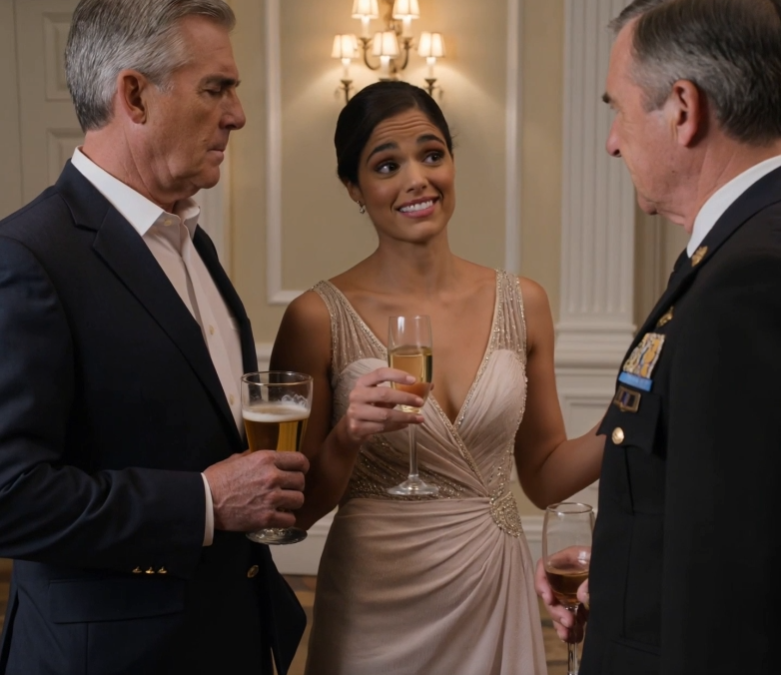
My daughter-in-law called me dead weight in front of her biggest client. My name is William Anderson, and apparently, I’m the family embarrassment.
For two years, my son’s wife treated me like damaged goods, a broken veteran cluttering up her perfect life. She had plans to ship me off to assisted living. She called me dead weight in front of her Harvard Law colleagues. She even suggested I needed professional help for my issues.
But what Brittany didn’t know was that her biggest career opportunity, a $12 million Navy contract she’d been chasing for months, required one signature.
Mine.
I stayed calm. I’d learned patience in places she couldn’t pronounce. If you’re watching this, please subscribe and let me know where you’re watching from. This is how a law firm holiday party became the most expensive mistake of her life.
It started small. The eye rolls when I joined family dinners. The way she’d change the subject whenever I mentioned military service. Brittany Davis, Harvard Law senior associate, drove an Audi Q7 worth more than most people’s houses. She married my son Tommy two years ago.
Good kid, Tommy, but he’d always been easily influenced. He worked in IT, made decent money, but nothing close to Brittany’s league. She reminded him of that regularly.
The first red flag was Thanksgiving 2022. I brought up a Navy buddy who’d just passed away. Twenty-five years of service, Purple Heart recipient. Brittany actually yawned.
“Can we talk about something current?” she said. “Like Tommy’s promotion opportunities?”
I drove a 2014 Ford F-150 with 119,000 miles on it and a dented tailgate from hauling lumber. She called it “that truck” and suggested I take an Uber instead of driving to family events.
“It reflects poorly,” she’d say.
My phone was an iPhone 7 with a cracked screen. Worked fine for calls and texts. Brittany bought Tommy the latest model and made a point of showing me all its features.
“Technology moves fast these days, Bill. Might be hard for your generation to keep up.”
I shopped at Walmart. Twelve-dollar flannel shirts, generic jeans. She shopped at Nordstrom and talked about investment pieces that cost more than my monthly disability check. When she saw my clothes, she actually winced.
The drinking became her favorite ammunition. I had a beer or two in the evenings, sometimes whiskey when the memories got loud. She told Tommy I was developing a problem and needed an intervention.
“Alcoholism runs in military families,” she said, like she’d read it in some textbook.
She started leaving assisted living brochures around the house.
“Sunrise Senior Living has excellent facilities for veterans with PTSD,” she’d say casually. “Tommy shouldn’t have to worry about his father’s mental health affecting our future.”
Our future. Like I wasn’t part of the family anymore.
The house became another point of contention. A four-bedroom colonial in Virginia Beach, fifteen minutes from the ocean. I inherited it when my wife Elizabeth passed away in 2019. Brittany called it outdated and inefficient. She’d been pushing Tommy to convince me to sell, to move somewhere more appropriate for my needs.
“The property taxes alone could fund a nice assisted living situation,” she told him.
I heard them through the kitchen wall.
“Plus, we could use the equity for our down payment.”
Their down payment. On my house.
She started bringing work colleagues around, introducing me as “Tommy’s father, who lives with us,” not “whose house we live in.” Just “lives with us,” like I was some charity case they’d taken in.
The worst part was watching Tommy change. He started apologizing for me.
“Sorry, Dad’s having one of his rough days,” he’d say whenever I mentioned anything military-related. “The VA says it’s normal for veterans his age.”
I never told him about my nightmares. Never mentioned the phone calls that came at odd hours, voices with urgent questions about situations most people would never know existed. Never explained why certain dates on the calendar hit differently or why I sometimes stared at the ocean for hours.
Some things can’t be explained to people who’ve never carried that weight.
But Brittany made one crucial mistake. She assumed my silence meant weakness. She confused quiet dignity with defeat. She saw an old man in Walmart clothes driving a beat-up truck and decided she knew my story.
She was about to learn how wrong she was.
By spring 2023, Brittany’s campaign to remove me intensified. She started documenting everything: my drinking, my antisocial behavior, my failure to contribute meaningfully to household discussions.
“Tommy’s career is taking off,” she told me one morning. “He deserves a home environment that supports his success, not drags him down.”
She’d found a veterans facility in Norfolk.
“Sunrise Manor specializes in combat trauma,” she said, sliding the brochure across the kitchen table. “They have group therapy, structured activities, medical support. Everything you need.”
Everything I needed. Like she had any idea what I needed.
The brochure showed smiling elderly men playing checkers and participating in arts-and-crafts therapy. Monthly cost: $3,200.
“We’ve already spoken to the financial adviser,” Brittany said. “Your disability payments and pension would cover most of it.”
My disability payments were $1,550 monthly for shrapnel in my left leg and hearing damage from IED explosions. My pension was $3,200 from twenty-two years of service.
She’d calculated it down to the penny.
“The house sale would provide a substantial nest egg,” she continued. “Current market value is approximately $2.1 million. After paying off the remainder of Tommy’s student loans and covering my bar exam costs, there’d still be plenty for your care.”
My house. Elizabeth’s house. The place where we’d planned to grow old together, where she’d tended her garden until cancer took the steadiness from her hands, where I still kept her coffee mug in the cabinet because some mornings I’d reach for it out of habit.
“I’m not going anywhere,” I said.
“Bill, be practical. You’re fifty-nine. You’re drinking more, sleeping less, clearly struggling with unresolved trauma. This isn’t about what you want. It’s about what’s best for everyone.”
Everyone. Not including me, apparently.
She’d been building her case for months, collecting screenshots of my “concerning behavior.” Like the time I’d gotten up at 0300 hours to answer a phone call on the back porch.
“Middle-of-the-night disturbances,” she called it.
Never mind that Admiral Brooks was calling from Pearl Harbor, three time zones away, about a consultation that couldn’t wait.
She documented my “isolation patterns,” how I’d spend evenings on the deck looking out at the water.
“Antisocial withdrawal,” according to her notes.
She never asked why I sat there. Never noticed I was actually listening to frequencies most people couldn’t hear, to patterns in radio chatter that sometimes carried echoes of operations still classified.
The drinking documentation was particularly thorough. Photos of empty beer bottles in the recycling. A picture of the whiskey bottle in my bedroom, the one I’d bought to mark the anniversary of the Cobble evacuation, when sixteen Marines died and I couldn’t stop thinking about the Marines I’d trained who weren’t coming home.
“Alcohol dependency with potential for escalation,” her notes read.
She’d even researched veteran suicide statistics.
“High-risk demographic,” she’d written. “Intervention necessary.”
Intervention. Like I was some kind of bomb that might go off.
Tommy started avoiding me. Conversations became brief, stilted.
“How was your day, Dad?”
But his eyes would dart to Brittany, checking her reaction to my answers.
She convinced him to join her for family therapy sessions without me.
“We need strategies for managing this situation,” she told him. “Professional guidance for handling elderly relatives with combat trauma.”
Elderly relatives. I was fifty-nine years old.
The final straw came in November. Brittany had gotten promoted to senior associate at Morrison and Associates, one of D.C.’s most prestigious firms. She was working on landing their biggest client, a Navy contract worth $12.3 million annually over five years.
“This contract will make partner for me,” she told Tommy. “But I can’t have instability at home affecting my performance. Partners notice everything.”
Partners notice everything. Including that their potential star associate was living with a mentally unstable veteran who might become a liability.
“I found a place,” she announced one evening. “Sunrise Manor has an opening in January. I’ve already put down a deposit.”
A deposit on my future. With my money.
“We’ll need to list the house after Christmas,” she continued. “Get ahead of the spring market. I’ve already spoken to a realtor friend. She thinks we can get $2.2 million, maybe $2.3 million, if we stage it properly.”
We. She kept saying “we” like it was a shared decision.
“The moving company can handle your belongings,” she said. “Just essentials, of course. Sunrise provides most furnishings.”
Just essentials.
Twenty-two years of service, thirty-seven years of marriage, a lifetime of memories reduced to essentials that would fit in a shared room with a stranger.
That night, I sat on the deck until sunrise, watching the horizon where aircraft carriers used to bring me home. The water was calm, but something was building.
A storm Brittany couldn’t see coming.
Some battles you choose. Others choose you.
The breaking point came December 10, 2023. Tommy’s birthday dinner. Brittany had invited her parents and her sister Clare, all successful professionals who spoke in acronyms and dropped names like breadcrumbs.
I bought Tommy a watch. Nothing fancy. A Timex Expedition, forty-three dollars at the PX. Water-resistant, reliable, the kind that worked when everything else failed. Military practical.
Brittany’s gift was Apple’s latest smartwatch.
“$399,” she announced. “GPS, heart-rate monitoring, cellular connectivity. Perfect for Tommy’s active lifestyle.”
Active lifestyle. Tommy worked at a desk and played video games.
“Thanks, Dad,” Tommy said, holding my watch. “It’s classic.”
“Classic,” Brittany repeated, like the word tasted sour. “How thoughtful.”
Her father, Richard, examined my gift.
“Timex, huh? Don’t see many of these anymore. Very retro.”
“Bill shops at the base exchange,” Brittany explained. “Everything’s discounted there. Military benefits.”
The way she said “military benefits” made it sound like food stamps.
Dinner conversations centered on Brittany’s work, the Navy contract, her promotion timeline, the partnership track.
“We’re representing three major defense contractors,” she said. “The legal fees alone will exceed two million annually.”
Two million. More than my house was worth.
“The Navy’s being very selective,” her mother added. “Only the most prestigious firms even get considered.”
“It helps that I understand military culture,” Brittany said, glancing at me. “Living with a veteran gives you insights into how they think.”
How they think. Like we were some exotic species she’d studied.
“What was your role in the Navy, Bill?” Richard asked.
“Commander,” I said. “Twenty-two years.”
“And what do you do now?” Clare wanted to know.
“I’m retired.”
“Fully retired?” Brittany clarified. “Disability pension.”
The word “disability” hung in the air like smoke. Clare looked uncomfortable. Richard nodded with the patronizing sympathy people reserve for wounded animals.
“Military service is challenging,” Brittany’s mother said carefully. “So many veterans struggle with adjustment.”
Struggle with adjustment. Like I was some kind of malfunctioning equipment.
“Bill has PTSD,” Brittany announced. “We’re working on getting him proper care.”
The table went quiet. Tommy’s face flushed red.
“Brittany—”
“It’s nothing to be ashamed of,” she continued. “Mental health awareness is important. Bill’s generation doesn’t always understand the resources available.”
My generation. Like I was some relic from a different era.
“What kind of care?” Richard asked, leaning forward with professional curiosity.
“Assisted living with specialized veteran services,” Brittany said. “Structured environment, group therapy, medication monitoring. Much better than him trying to manage independently.”
Manage independently. Like I was incapable of basic human function.
“That sounds expensive,” Clare said.
“The house sale will cover most costs,” Brittany replied. “And his benefits help.”
His benefits. His house. Like I wasn’t sitting right there.
I set down my fork. Twenty-two years of patience training kicked in.
“I’m not going anywhere.”
“Bill, we’ve discussed this.”
“You’ve discussed this. I haven’t agreed to anything.”
“Be reasonable,” Richard said. “At your age, with your condition—”
“What condition is that?”
Awkward silence followed. They exchanged glances the way people do when dealing with someone they consider mentally impaired.
“Your PTSD,” Brittany said slowly, like I might not understand. “Your drinking. Your antisocial behavior.”
“I have two beers in the evening and prefer quiet. That’s not antisocial. That’s being an adult.”
“Bill,” her mother said gently, “sometimes we can’t see our own problems clearly.”
Our own problems. This woman had met me exactly three times.
“What problems?” I asked.
“The middle-of-the-night phone calls,” Brittany said. “The drinking. The way you stare at nothing for hours. The nightmares.”
“You hear my nightmares?”
“Tommy told me he’s worried about you.”
I looked at my son. Twenty-eight years old, avoiding eye contact, letting his wife discuss my private struggles with strangers.
“Tommy,” I said, “you worried about me?”
“Dad, I…” He glanced at Brittany. “Maybe we should talk about this later.”
“Now’s fine,” I said. “Tell me what worries you.”
“The drinking,” he said quietly. “And you seem angry all the time.”
Angry. I wasn’t angry. I was disappointed. Disappointed that my son believed his wife’s version of me over his own experiences. Disappointed that two years of her campaign had convinced him I was broken.
“What else?” I asked.
“The calls at weird hours,” Tommy said. “People coming by the house. It’s strange.”
Strange. Admiral Brooks stopping by was strange. Judge Miller calling to check on me was strange. The FBI agent who’d served with me bringing Christmas cookies was strange.
“Who are these people?” Richard asked. “Are you involved in something?”
Involved in something. Like I was running drugs or smuggling weapons.
“They’re friends,” I said.
“Friends don’t call at three a.m.,” Brittany said. “Unless there’s a problem.”
“What kind of problem?” her father pressed.
I looked around the table. Six people who’d decided I was mentally unstable, financially irresponsible, and potentially dangerous. Six people planning my future without my consent.
Then the phone rang.
My phone. The ringtone I’d assigned to one specific contact.
“Excuse me,” I said, standing.
“Bill,” Brittany said sharply. “We’re having dinner.”
“This won’t take long.”
I answered on the fourth ring.
“Admiral.”
“Commander Anderson,” came the familiar voice. “Sorry to interrupt your evening. We’ve got a situation that requires your input.”
“I’m listening.”
“The Morrison contract. There’s been a development. Can you talk?”
I looked back at the dining room. Six people watching me, convinced I was taking a call from someone at the VFW or my therapist.
“Give me five minutes,” I said.
“Roger that.”
I hung up and walked back to the table. Six pairs of eyes full of concern and judgment.
“Everything all right?” Richard asked.
“Fine,” I said. “Just Navy business.”
Brittany laughed. Actually laughed.
“Navy business? Bill? You’re retired.”
“Some things don’t retire,” I said.
“Like what?” she challenged.
I looked at her. Harvard Law senior associate, working for months to land the biggest Navy contract in her firm’s history. Smart woman. Educated woman. A woman who thought she understood everything.
“You’ll find out,” I said.
After that dinner, things escalated quickly. Brittany convinced Tommy to start looking at assisted living facilities, “just to explore options.” She scheduled tours without telling me, then came back with brochures and pricing sheets.
“Sunset Gardens has a beautiful therapy wing,” she’d say, spreading glossy photos across the kitchen table. “Art therapy, music therapy, group discussions about military experiences.”
Group discussions. Like war stories shared with strangers over juice boxes and cookie time.
But she started noticing things that didn’t fit her narrative, little things that made her pause.
The first was the mail. Official-looking envelopes with Pentagon return addresses. Department of Defense seals. FBI letterhead. She’d see them piled on the kitchen counter and ask casual questions.
“More veteran paperwork?” she’d say, picking up an envelope marked confidential.
“Something like that,” I’d tell her.
She tried steaming one open once. I caught her in the kitchen with a tea kettle, holding an envelope over the steam.
“Just checking if it’s important,” she said, “in case it affects the house sale timeline.”
The envelope was from Admiral Brooks’s office. Classification: Top Secret. Subject: Maritime Security Consultation Request.
“I’ll handle my own mail,” I said, taking it from her.
“Bill, if it’s medical information or benefits paperwork, I might be able to help. I deal with complex legal documents every day.”
“I’m sure you do.”
But her expression had changed. Something about the envelope’s weight, the seal, the way EYES ONLY was stamped across the front.
This wasn’t veteran disability paperwork.
The second thing was the visitors. They started coming more frequently after Thanksgiving. Always well-dressed, always polite, always asking for me specifically.
Judge Miller stopped by on a Tuesday morning. Federal judge. Black sedan with government plates. Driver in a dark suit. He stayed for an hour, and when he left, he shook my hand with both of his.
“Thank you for your counsel, Commander,” he said, loud enough for Brittany to hear. “The Secretary will be pleased with your assessment.”
The Secretary.
Brittany was in the kitchen, supposedly making coffee, actually straining to hear every word.
“Who was that?” she asked after he left.
“Old friend.”
“He called you Commander.”
“Old habit.”
“He mentioned a Secretary. Secretary of what?”
“Defense,” I said casually, like it was no big deal.
Her face went pale.
“Defense? As in the Pentagon?”
“David and I go way back,” I said. “We served together in Afghanistan.”
“That man is a federal judge,” she said. “I’ve seen him in the news.”
“Good for him.”
But she was thinking now. Federal judges didn’t make house calls to disabled veterans living on government benefits. Federal judges didn’t call retired enlisted men “Commander” unless there was more to the story.
The third thing was the phone calls. She started paying attention to them. Late-night calls that sent me to the back porch for privacy. Calls that started with “Sir” and ended with “Roger that.”
“Admiral Brooks again?” she asked one morning after a 0600 call.
“Navy personnel matter,” I said.
“What kind of personnel matter requires consultation from a retired… what rank were you again? Commander, right?”
“Retired Commander.”
She was fishing now, starting to research.
I’d find browser history on Tommy’s laptop: Navy commander ranks, Pentagon consultants, military retirement benefits for officers.
She was learning that commanders didn’t retire to drink beer and live on disability checks. Commanders retired with full pensions, investment portfolios, and ongoing security clearances for high-level consulting work.
She was learning that the government didn’t assign admiral-level contacts to broken-down veterans with PTSD.
The fourth thing was my behavior around other military personnel. She saw it at the base commissary when we ran into Master Chief Rodriguez. The way he straightened up, called me “Sir,” asked permission before speaking freely.
“How do you know him?” she asked afterward.
“We worked together.”
“He acted like you were his boss.”
“I was.”
“But you said you were just a sailor.”
“I never said that.”
She was starting to piece things together, but she couldn’t see the whole picture. Couldn’t imagine that the man she’d been trying to warehouse in assisted living had spent twenty-two years in special operations.
Couldn’t fathom that my “antisocial behavior” was actually maintaining security protocols for information she didn’t have clearance to know.
Couldn’t understand that those late-night calls were briefings on situations that would be declassified twenty-five years from now, if ever.
The morning of December 15, I got a call from Morrison and Associates. The lead attorney handling the Navy contract wanted to schedule a meeting.
“We understand you have expertise in maritime security operations,” he said. “Admiral Brooks recommended you as a consultant for our Defense Department proposal.”
I looked across the kitchen at Brittany, who was pretending to read emails while listening to every word.
“I’ll consider it,” I said.
“Excellent. The Admiral speaks very highly of your work. She mentioned you two have a long professional relationship.”
A professional relationship with Admiral Brooks. The same Admiral Brooks who happened to be the final approval authority for the contract Brittany had been chasing for eight months.
The storm was building, and Brittany still couldn’t see it coming.
December 15, 2023. Morrison and Associates’ annual holiday party at the Ritz-Carlton Pentagon City. Fifteen-thousand-dollar venue rental. Two hundred guests. Black tie optional.
Brittany had been preparing for weeks.
“This is my moment,” she told Tommy. “Half the Pentagon brass will be there. If I can network effectively tonight, the Navy contract is practically guaranteed.”
She’d bought a new dress. Eight hundred dollars, according to the credit card statement I accidentally saw.
“Investment piece,” she called it. “You have to dress for the position you want.”
Tommy wore his only good suit. I wore what I always wore: navy blue blazer, gray slacks, white shirt, black shoes. Clean, pressed, appropriate.
“Bill,” Brittany said as we were leaving, “maybe you should consider staying home tonight. Law firm parties can be intense.”
“I’ll manage.”
“I just don’t want you to feel out of place. These people speak a different language.”
A different language. Like legal jargon was harder to understand than tactical radio communications under fire.
The party was everything she’d promised. Marble floors, crystal chandeliers, waiters carrying champagne that cost more per bottle than my monthly grocery budget.
Partners in thousand-dollar suits, associates networking like their careers depended on it, which they did.
Brittany was in her element, working the room, introducing herself to senior partners, dropping hints about the Navy contract she was practically guaranteed to land.
“This is my husband, Tommy,” she’d say, “and his father, Bill. Bill’s a veteran. Disabled, you know. We’re helping him through some challenges.”
Helping me through challenges. Like I was a charity project.
I stayed quiet. Nursed a beer. Watched the room. Recognized several faces, people who’d worked Pentagon contracts for years, military liaisons who’d briefed me on operations Brittany would never hear about.
Around 9:00 p.m., Brittany, having gathered confidence from champagne, decided to make a statement.
She spotted the firm’s managing partner, Harrison Stone, talking to a group of senior associates near the bar.
“Excuse me,” she said, approaching the group. “Mr. Stone, I wanted to update you on the Navy contract status.”
“Of course, Brittany. How are things progressing?”
“Excellent. I’ve been building relationships within the military community for months. I understand their culture now, their priorities, their decision-making processes.”
She gestured toward me.
“My father-in-law is Navy retired. Living with him has given me invaluable insights into military thinking.”
Military thinking. Like twenty-two years of service could be reduced to insights gained from observing someone you considered mentally unstable.
“That’s wonderful,” Stone said. “Personal connections are invaluable in government contracting.”
“Absolutely,” Brittany continued, warming up. “Bill here is typical of his generation. Traditional military mindset, very structured thinking. It’s helped me understand how Navy procurement officials approach vendor relationships.”
Typical of his generation. Traditional military mindset.
She was describing me like a museum exhibit.
“What was your father-in-law’s role in the Navy?” one of the associates asked.
“Oh, he was just enlisted,” Brittany said dismissively. “Career sailor, you know. Twenty-some years of taking orders, following procedures. Not much independent thinking required, but it gives you insight into institutional culture.”
Just enlisted. Twenty-some years taking orders.
The group nodded politely. Military service was something they respected in theory but didn’t really understand. Brittany’s explanation fit their assumptions. Long-serving enlisted man, probably a good soldier, but not decision-maker material.
“The beautiful thing,” Brittany continued, “is that he’s so grateful for everything we do for him. Veterans of his generation, especially ones dealing with PTSD and adjustment issues, they just want stability. We’re providing him housing, helping with his medical needs, handling his finances. It’s the least we can do for someone who served.”
Someone who served. Past tense. Like my service was ancient history with no current relevance.
“That’s very generous,” Stone said.
“Well, we all have family obligations,” Brittany replied. “Bill’s been through a lot. Combat trauma, adjustment difficulties, some drinking issues. The VA says it’s common for veterans his age. They get confused, paranoid sometimes. Think people are watching them or that they’re still involved in important operations.”
Still involved in important operations.
She actually laughed when she said it.
“We’re looking into assisted living facilities,” she continued. “Specialized care for veterans with his challenges. It’ll be better for everyone, especially once I make partner and we need to entertain more frequently.”
The group listened with the polite attention people give to personal oversharing at professional events. But I noticed something else.
Several people in the background had stopped their conversations to listen.
“The Navy contract will change everything for us,” Brittany said. “Twelve million annually, five-year term. Harrison, once that’s locked in, I think partnership discussions become very interesting.”
“Let’s see how the proposal process goes,” Stone said diplomatically.
“Oh, it’s essentially decided,” Brittany said. “I’ve done my homework. The approval authority is some Admiral Brooks. I think my research shows she values legal expertise combined with military cultural understanding. Having Bill around has been like having a cultural interpreter.”
Cultural interpreter. Twenty-two years of service reduced to cultural interpretation services.
“Admiral Katherine Brooks?” asked a voice from behind her.
Brittany turned.
A woman in a Navy dress-blue uniform had approached the group. Commander stripes, chest full of ribbons, bearing that unmistakably said officer.
“Yes,” Brittany said, suddenly uncertain. “Do you know her?”
“I work for her,” the woman said. “Lieutenant Commander Sarah Johnson, Admiral Brooks’s legal aide. I’m here representing the Admiral’s office for contract discussions.”
The group went quiet. Navy representatives didn’t usually attend law firm holiday parties unless there was serious business to discuss.
“Oh,” Brittany said, recovering quickly. “How wonderful. I’m Brittany Davis, senior associate, lead attorney on the Morrison Navy proposal.”
“Miss Davis,” Lieutenant Commander Johnson said formally, “I’d like to introduce you to someone.”
She gestured toward the entrance, where two more people had just arrived.
One was a woman in civilian clothes, an expensive suit, military bearing, confidence that filled the room. The other was a Navy captain in dress uniform.
“Admiral Katherine Brooks,” Johnson announced, “and Captain Michael Torres, Pentagon liaison for defense contracting.”
Brittany’s face went pale.
The Admiral was here. The person whose signature meant sixty million dollars over five years had just walked into the party.
“Admiral,” Brittany said, approaching quickly. “What an honor. I’m Brittany Davis. I’ve been handling your contract proposal.”
Admiral Brooks looked at her with the expression senior officers reserved for junior personnel who’d made assumptions above their pay grade.
“Miss Davis,” she said coolly. “I believe you’ve met my consultant.”
“Your consultant?”
The Admiral looked past Brittany, scanning the room until her eyes found mine.
“Commander Anderson,” she said, her voice carrying across the suddenly quiet ballroom. “Thank you for agreeing to attend tonight.”
Every conversation in the room stopped. Two hundred people turned to look at the broken-down veteran in the Walmart blazer.
“Admiral,” I said, standing up straight for the first time all evening.
And everything changed.
The ballroom went dead silent. Two hundred lawyers, Pentagon officials, and defense contractors watched Admiral Brooks walk directly to me, past the managing partner, past the senior associates, past Brittany, who stood frozen with her champagne glass halfway to her lips.
“Commander Anderson,” Admiral Brooks said, extending her hand. “Thank you for your consultation on the Morrison proposal. Your assessment was exactly what we needed.”
My assessment on the Morrison proposal. The same proposal Brittany had been working on for eight months.
“My pleasure, Admiral,” I said, shaking her hand. “How did the security review turn out?”
“Clean bill of health, thanks to your recommendations. The Secretary was particularly impressed with your infrastructure analysis.”
The Secretary. As in Secretary of Defense.
Brittany’s face had gone completely white.
“Commander?” Captain Torres stepped forward. “Good to see you again. Pearl Harbor sends their regards. Admiral Chen was asking about your availability for the Pacific Fleet consultation.”
“Tell her I’ll review the materials next week,” I said.
Captain Torres nodded and handed me a manila envelope.
“Classified brief for your review. Standard protocols apply.”
I took the envelope. TOP SECRET stamped across the front. EYES ONLY. Commander W. Anderson.
The same kind of envelope Brittany had tried to steam open the week before.
Lieutenant Commander Johnson approached with a tablet.
“Sir, if you could verify the final security clearance recommendations for the Morrison contract.”
I reviewed the screen quickly. Names, positions, security levels required for personnel assigned to the Navy project. Standard vetting process for defense contractors.
“Delete Brittany Davis,” I said quietly.
“Security risk, sir?”
“Personal reliability issues. Remove her from all classified access lists.”
“Yes, sir.”
Behind me, I could hear Brittany breathing rapidly. Fast, shallow breaths like someone having a panic attack.
Harrison Stone, the managing partner, approached carefully.
“Admiral Brooks, I don’t believe we’ve been properly introduced. I’m Harrison Stone, Morrison and Associates.”
“Mr. Stone,” Admiral Brooks said formally. “We need to discuss your personnel assignments for this contract.”
“Of course. Brittany Davis is our lead attorney.”
“Miss Davis has been removed from the project,” Admiral Brooks said. “Security concerns.”
Security concerns.
Stone looked confused.
“I don’t understand.”
“Commander Anderson identified several red flags in Miss Davis’s background check. Personal judgment issues that make her unsuitable for classified defense work.”
Personal judgment issues. Like trying to warehouse a consultant the Admiral had worked with for fifteen years.
Judge Miller appeared at my elbow.
“Bill, good to see you.” He turned to Admiral Brooks. “Admiral, has the Commander briefed you on the maritime security recommendations?”
“Thoroughly,” she said. “The Joint Chiefs were very impressed with his analysis.”
The Joint Chiefs.
Brittany made a small choking sound.
“Excuse me,” she said weakly. “I think there’s been some confusion.”
Admiral Brooks turned to look at her.
“Miss Davis?”
“Bill… Commander Anderson. He’s my father-in-law. He’s retired, disabled. He has PTSD and drinking problems.”
“And, Miss Davis?” Admiral Brooks cut her off. “Commander Anderson holds the highest security clearance available to military consultants. He’s briefed the Pentagon monthly for the past four years. His psychological evaluations are classified, but I can assure you he’s been deemed fit for duty at the highest levels.”
Fit for duty at the highest levels.
“But he lives in our house,” Brittany said desperately. “He’s on disability. He shops at Walmart and drives an old truck.”
“And, Miss Davis,” Captain Torres interrupted, “are you questioning the judgment of the United States Navy?”
Questioning the judgment of the United States Navy in front of two hundred witnesses, including her boss, her colleagues, and half the Pentagon’s contracting officials.
“No, sir,” she whispered.
FBI agent Michael Wilson walked over from the bar.
“Commander,” he said. “D.C. field office got your recommendations on the port security assessment. Bureau’s implementing your suggestions starting next month.”
“Good,” I said. “The vulnerabilities were significant.”
“Vulnerabilities you identified during your last classified briefing,” Wilson said, loud enough for the crowd to hear. “Homeland Security wants to discuss expanding your consulting role.”
Homeland Security. Expanding consulting role.
Brittany was staring at me like I’d grown a second head.
“Who are you?” she whispered.
“Commander William Anderson,” Admiral Brooks said. “Twenty-two years active duty, specialized in maritime security and counterterrorism operations. Purple Heart recipient. Currently holds Top Secret clearance with special compartmented access. Naval intelligence consultant to the Joint Chiefs, Pentagon security adviser, and one of three civilian experts authorized to brief the Secretary of Defense on maritime threats.”
One of three civilian experts authorized to brief the Secretary of Defense.
“The Commander’s expertise in maritime security is unparalleled,” Admiral Brooks continued. “His operational experience in classified theaters makes him invaluable for defense contractors seeking Navy partnerships.”
Classified theaters. Places Brittany would never hear about, operations that wouldn’t be declassified until 2048, if ever.
“In fact,” Admiral Brooks said, turning to Harrison Stone, “the Morrison contract requires the Commander’s ongoing consultation. Any firm wanting Navy business needs his security approval.”
His security approval.
The same man Brittany had been trying to commit to assisted living.
“Admiral,” Stone said carefully, “I need to clarify something. Miss Davis has been representing to us that she has special insight into military culture through her family relationship with the Commander.”
“What kind of insight?” Admiral Brooks asked, her voice sharp.
Stone looked uncomfortable.
“She indicated that living with a veteran gave her unique understanding of military thinking. She suggested the Commander was typical of his generation. Traditional mindset, structured thinking, not much independent analysis required.”
Not much independent analysis required.
Admiral Brooks’s expression could have frozen seawater.
“Miss Davis,” she said, “are you suggesting that Commander Anderson lacks analytical capability?”
“I… no, ma’am. I just meant—”
“Because the Commander’s threat assessments have shaped Navy policy for the past decade. His strategic recommendations are classified at levels above your clearance. His analysis has prevented terrorist attacks you’ll never hear about.”
Prevented terrorist attacks you’ll never hear about.
“The Commander’s operational record includes classified missions in hostile theaters,” Admiral Brooks continued. “His decorations are classified. His current consulting work involves national security matters at the highest levels.”
His decorations were classified. Even his awards were too sensitive for public knowledge.
“And you thought he was just a typical veteran with PTSD?” Admiral Brooks asked.
The ballroom was completely silent now. Two hundred people watching a Harvard lawyer get dismantled by the United States Navy.
“Admiral,” Brittany said desperately, “there’s been a misunderstanding.”
“No misunderstanding,” Admiral Brooks said. “Lieutenant Commander Johnson, please note that Miss Davis has demonstrated poor judgment regarding military personnel assessment. Flag her file accordingly.”
“Yes, ma’am.”
“Mr. Stone,” Admiral Brooks continued, “Morrison and Associates will assign a different lead attorney to this contract. Someone who understands the value of military expertise rather than dismissing it.”
“Of course, Admiral. Immediately.”
Harrison Stone was looking at Brittany like she’d just cost him sixty million dollars, which she had.
“Commander Anderson,” Admiral Brooks said, turning back to me. “Will you be available for the security briefings next week?”
“Yes, ma’am.”
“Excellent. The Pentagon appreciates your continued service.”
She turned and walked toward the exit, followed by Captain Torres and Lieutenant Commander Johnson.
Conversation gradually resumed throughout the ballroom, but in hushed tones. People kept glancing at me, then at Brittany, trying to process what they’d witnessed.
Harrison Stone approached me directly.
“Commander Anderson, I owe you an apology. We had no idea about your current role with the Navy.”
“No apology necessary,” I said.
“If you’re open to it, we’d like to discuss expanding your consulting relationship with our firm.”
“I’ll consider it.”
He nodded and walked away, pointedly avoiding eye contact with Brittany.
Tommy appeared at my side, looking dazed.
“Dad, what just happened?”
“Your wife learned something about assumptions,” I said.
Brittany was standing alone near the bar, holding her champagne glass with shaking hands.
Eight months of work gone. Partnership track destroyed. Career momentum reversed.
All because she’d confused quiet dignity with weakness. All because she’d never bothered to ask the right questions. All because she’d assumed my silence meant I had nothing important to say.
Some battles you win by letting the enemy destroy themselves.
Tonight, I’d just given Admiral Brooks the information she needed to make an informed decision about Morrison and Associates’ personnel.
The Navy got reliable contractors. I got my family back. My family.
Brittany got a lesson in the cost of arrogance.
Fair trade.
The ride home was silent. Tommy drove, hands gripping the steering wheel. Brittany stared out the passenger window. I sat in the back seat, watching Virginia Beach pass by like I had for fifty-nine years.
“Dad,” Tommy finally said as we pulled into the driveway, “can we talk?”
“Inside,” I said.
We gathered in the kitchen. The same kitchen where Brittany had spread assisted living brochures, where she’d calculated my disability payments, where she’d planned my removal like I was unwanted furniture.
“I don’t understand,” Tommy said. “Why didn’t you tell us?”
“Tell you what?”
“That you’re still working. That you’re important. That the Navy still needs you.”
Important. Like importance was measured by other people’s recognition rather than the work itself.
“I never stopped working,” I said. “I just stopped talking about it.”
“But the drinking, the nightmares, the weird phone calls—”
“The drinking is two beers and occasional whiskey. The nightmares are normal for anyone who’s seen combat. The phone calls are briefings on situations you don’t have clearance to know about.”
“Clearance?” Brittany spoke for the first time since leaving the party.
“Top Secret with compartmented access,” I said. “Renewed annually. Background investigation every five years. Polygraph every two years.”
“You have a security clearance?”
“Several.”
She looked around the kitchen like she was seeing it for the first time.
“That’s why those people come here. That’s why you get official mail.”
“Yes.”
“And the money? The disability payments, the pension?”
“The disability is $1,550 monthly for combat injuries. The pension is $3,200 for twenty-two years of service. The consulting fees are classified, but they’re substantially higher than my government benefits.”
Substantially higher. Enough to own a $2.1 million house without a mortgage. Enough to pay cash for trucks and avoid credit card debt. Enough to live simply because I wanted to, not because I had to.
“Jesus Christ,” Tommy said. “Brittany was trying to put you in assisted living, and you’re consulting for the Pentagon.”
“I’m not trying to put him anywhere,” Brittany said quickly. “I was concerned about his welfare.”
“You were concerned about your image,” I corrected. “You thought having a disabled veteran in the house made you look bad to your law firm colleagues.”
“That’s not true, Bill.”
“Brittany,” I said quietly, “I heard you on the phone with your mother. ‘Poor old Bill is dragging us down. Tommy deserves better. We need to think about our future.'”
Our future without me in it.
“I was worried.”
“You were embarrassed. You wanted me gone so you could use my house for entertaining your law firm friends without explaining why you were living with your deadbeat father-in-law.”
The kitchen went quiet except for the refrigerator humming and the distant sound of waves on the shore.
“The assisted living facility,” I continued, “$3,200 monthly. Exactly what my pension pays. You’d calculated it perfectly. Warehouse me in Norfolk. Sell my house for $2.1 million. Use the proceeds for Tommy’s student loans and your partnership wardrobe.”
“We weren’t going to sell your house,” Tommy said.
I pulled out my phone, scrolled to a saved email, and read aloud.
“Sunrise Manor deposit confirmed. January 2024 move-in. Property listing scheduled for December 28. Estimated market value, $2.2 million. Commission, seven percent.”
Property listing already scheduled.
“You went behind my back,” I said to Tommy. “Your wife planned my future, and you went along with it.”
“Dad, I thought—”
“You thought I was broken. You thought I needed help. You thought your Harvard-educated wife knew better than I did what was best for my life.”
“We were trying to help,” Brittany said.
“Help?”
I set my phone on the counter.
“Let me make three phone calls. Show you what help looks like.”
I dialed the first number.
“Admiral Brooks, Bill Anderson. The Morrison situation tonight went exactly as expected. Yes, ma’am. They’ve been flagged accordingly. No, ma’am. I won’t be needing assisted living services. Thank you, Admiral.”
I hung up and dialed the second number.
“Judge Miller, Bill Anderson. I need a legal favor. Property ownership clarification. Yes, the house is solely in my name. No, no one else has legal claim to force a sale. Thank you, David.”
The third call.
“Agent Wilson, Bill Anderson. I need a background check run. Brittany Davis, Morrison and Associates. Yes, the usual flags. Security clearance suitability. Thank you, Michael.”
I set the phone down.
“Help,” I said. “Admiral Brooks will ensure Morrison and Associates understands my consulting role with the Navy. Judge Miller confirms that no one can force me to sell my property or move to assisted living. Agent Wilson is running a federal background check on someone who demonstrated poor judgment regarding military personnel.”
Poor judgment regarding military personnel. Career-ending words in the defense contracting world.
“Your contract is gone,” I told Brittany. “Your partnership track is finished. Your reputation in the defense legal community is destroyed.”
“You can’t do this,” she said.
“I didn’t do anything. You destroyed your own career by publicly dismissing a Pentagon consultant as a disabled burden.”
“Fix this,” she demanded. “Call them back. Tell them it was a misunderstanding.”
I looked at her for a long moment. Two years of dismissal, humiliation, and planning my removal. Two years of treating me like a problem to be solved rather than a person to be respected.
“No,” I said.
Some battles you win by not fighting. Others require decisive action.
Tonight was decisive action.
By Monday morning, the defense contracting community in D.C. knew exactly what had happened at Morrison and Associates’ holiday party. Word travels fast when someone publicly humiliates a Pentagon consultant.
Brittany’s phone started ringing at seven a.m.
Not good calls.
“Morrison and Associates has decided to restructure the Navy contract team,” Harrison Stone told her in his office. “Your role will be transitioning to other attorneys.”
“Sir, I can explain.”
“There’s nothing to explain. Admiral Brooks requested your removal. When the Navy requests personnel changes, we comply.”
“But I’ve worked on this for eight months.”
“And now someone else will finish it. Clean out your office. Human Resources will contact you about transition arrangements.”
Clean out your office. Partnership track over. Career momentum gone.
The legal community was small, especially defense contracting. By Tuesday, three other firms had called to discuss her availability, then mysteriously found reasons not to schedule interviews.
“We decided to go with someone who has more experience with military clients,” they’d say.
Or, “We found a candidate who better fits our Pentagon relationships.”
Pentagon relationships. Code for someone who doesn’t insult Navy consultants at professional events.
Wednesday brought the real consequences. FBI agent Wilson’s background check had flagged her security clearance application as denied pending further review.
Without clearance, she couldn’t work defense contracts anywhere in D.C.
“What does this mean?” she asked the security officer who delivered the news.
“It means federal agencies consider you a security risk. Could be temporary, could be permanent. Depends on the review outcome.”
Security risk. The kiss of death for defense lawyers.
By Friday, her Audi lease company had called about payment issues. Her credit cards were approaching their limits. Tommy’s salary couldn’t cover their lifestyle without her income.
“We need to talk,” she told me Friday evening.
I was on the deck watching the sunset over the water.
“Talking won’t change anything,” I said.
“Please. I made mistakes. I understand that now.”
“You made assumptions. You treated me like a burden instead of family. You planned my removal without my consent.”
“I was wrong about your situation.”
“My situation?”
“Your work. Your importance. Your connections.”
My importance. Like importance was the issue rather than basic human respect.
“Brittany,” I said, turning to face her. “You spent two years trying to convince my son I was mentally unstable. You documented my drinking, photographed my mail, scheduled assisted living tours behind my back. You told your law firm colleagues I was a typical broken veteran who gave you cultural insights into military thinking.”
“I was trying to help.”
“You were trying to remove an obstacle to your perfect life. You wanted my house without me in it. You wanted Tommy’s loyalty without family complications. You wanted to play house with my property while warehousing me in Norfolk.”
“That’s not true.”
I pulled out my phone, scrolled to a voice memo, and hit play.
Her voice filled the evening air.
“Tommy, your father is becoming a liability. My career is taking off, and I can’t have a mentally unstable veteran affecting my professional image. The assisted living place has an opening, and we should take it.”
Her own words, recorded during one of her phone conversations when she thought I was napping.
“That’s… you recorded me?”
“I documented everything the way you documented my drinking. Fair’s fair.”
“You can’t use that against me in court.”
“You’re right. It might not be admissible, but it’s excellent context for Admiral Brooks’s evaluation of your judgment regarding military personnel.”
Her face went white.
“You sent that to Admiral Brooks?”
“Along with photos of the assisted living brochures you left around the house, screenshots of your text messages about selling my property, and copies of the deposit receipt for Sunrise Manor.”
“Oh my God.”
“Professional reference material helps the Admiral understand your decision-making process when dealing with military consultants.”
“This will destroy my career.”
“Your career destroyed itself. I just provided documentation.”
She sat down heavily in the deck chair beside me. For the first time in two years, she looked small, vulnerable, defeated.
“What do you want?” she asked quietly.
“I want my son back. I want respect in my own home. I want you to understand that quiet doesn’t mean weak, and simple doesn’t mean stupid.”
“And if I… if we…”
“If you what?”
“If we apologize. If we change. If we treat you better.”
I watched a Navy destroyer moving south along the horizon, probably heading for Norfolk, full of sailors who’d trained under officers I’d helped develop, carrying equipment I’d helped design security protocols for.
“Respect isn’t something you negotiate after getting caught,” I said. “It’s something you offer because it’s right.”
“So what happens now?”
“Now you live with the consequences of your choices. Now you explain to future employers why Admiral Brooks flagged your file. Now you figure out how to rebuild a career after publicly dismissing Pentagon consultants as disabled burdens.”
“And us? This family?”
“That depends on Tommy and you. And whether you’ve learned anything from this.”
The destroyer disappeared into the evening haze. Another ship coming home, carrying people who understood that service didn’t end with retirement.
Some lessons are expensive. Some consequences are permanent.
Tonight, Brittany was learning the difference.
Christmas morning, three weeks later. The house was quiet except for coffee brewing and waves outside the kitchen window.
Tommy came downstairs first.
“Morning, Dad.”
“Morning, son.”
Brittany appeared a few minutes later. She’d been staying in the guest room since the party. Neither of them had mentioned divorce, but the separate bedroom spoke volumes.
“Coffee?” I offered.
“Thank you,” she said quietly.
We sat around the kitchen table. The same table where she’d spread assisted living brochures, where she’d calculated my disability payments, where she’d planned my future without asking my opinion.
“I’ve been thinking,” Tommy said, “about everything that happened. And I owe you an apology. I should have listened to you instead of assuming things.”
“You trusted your wife. That’s not wrong.”
“But I stopped trusting my father. That was wrong.”
Brittany stared into her coffee cup.
“I owe you more than an apology,” she said finally. “I owe you an explanation.”
“I don’t need explanations.”
“I need to give one to myself. Maybe…” She looked up. “I was scared.”
“Of what?”
“Of not being good enough. Of not measuring up. Tommy married beneath his potential. That’s what my parents always said. He could have done better than a girl from Midwest public schools who fought her way through law school on loans and scholarships.”
“So you decided I was the problem.”
“I decided you represented everything I was trying to leave behind. Blue-collar background, simple lifestyle, people who didn’t understand ambition.”
She paused.
“I was ashamed of my own father, who worked factory jobs his whole life. When I saw you in Walmart clothes driving an old truck, it reminded me of where I came from.”
Where she came from. Like it was something to escape rather than honor.
“Your father sounds like a good man,” I said.
“He was… is. But I spent so many years trying to become someone else. I forgot that good people come in all packages.”
“Yes, they do.”
“I know this doesn’t fix anything,” she said. “I know I destroyed my career, damaged our family, hurt people I should have respected. But I want you to know I understand now.”
“Understand what?”
“That quiet power is still power. That simple living doesn’t mean simple thinking. That the most dangerous people are often the ones who don’t need to prove anything. And… and that I confused your kindness for weakness, your patience for confusion, your humility for insignificance.”
I finished my coffee, stood up, and walked to the window overlooking the water. A Coast Guard cutter was passing by, probably running morning patrol from Little Creek.
“Here’s what happens now,” I said without turning around. “You rebuild your career somewhere else, with someone else’s clients, using whatever you learned from this experience. Tommy decides whether your marriage survives your choices. And this family figures out whether respect can be rebuilt after trust is broken.”
“What about you?” Tommy asked.
“I keep doing what I’ve always done. Serve when called, protect what matters, live quietly, and let my actions speak for themselves. And the house stays mine, as it always was.”
I turned back to face them.
Some boundaries had gotten reset these past few weeks. Some lessons had been learned the hard way. Some people had discovered that assumptions could be expensive.
“What’s the lesson?” Brittany asked.
“Don’t judge people by what they wear or where they shop or how quietly they live their lives. Some of the most powerful people in this world prefer to stay invisible. Some of the most important work gets done by people you’d never notice.”
“Like you?”
“Like a lot of people. Veterans, teachers, first responders, parents who sacrifice everything for their families’ futures. People who serve others instead of serving themselves.”
I walked toward the kitchen door, paused, and looked back.
“Oh, and Brittany, next time you meet someone in simple clothes doing humble work, consider the possibility that they chose that life rather than having it chosen for them. Humility is often a sign of strength, not weakness.”
I stepped onto the deck, breathed the salt air, and listened to waves that had been keeping me company for thirty-seven years.
Behind me, Tommy and Brittany were talking quietly, maybe working things out, maybe saying goodbye.
Either way, they’d learned something about the cost of disrespecting people who’d earned better treatment.
The lesson was expensive, but some lessons need to be.
If you’re watching this story and you’ve got family members who served, or anyone in your life who lives quietly but loves deeply, maybe take a moment to really see them. You might be surprised what you discover.
And remember, still waters run deep, and the quietest people often have the most interesting stories.
They just don’t feel the need to tell them unless you’re willing to listen.








