My son came to visit me and found me lying in the garage, hungry and bruised, “dad, what happened to you? why are you living in the garage? you have a pension of $7,000 a month!” then my son-in-law came out and proudly said, “that pension belongs to me, i’m taking it all!” my son took off his watch… and did something that made him shut up!
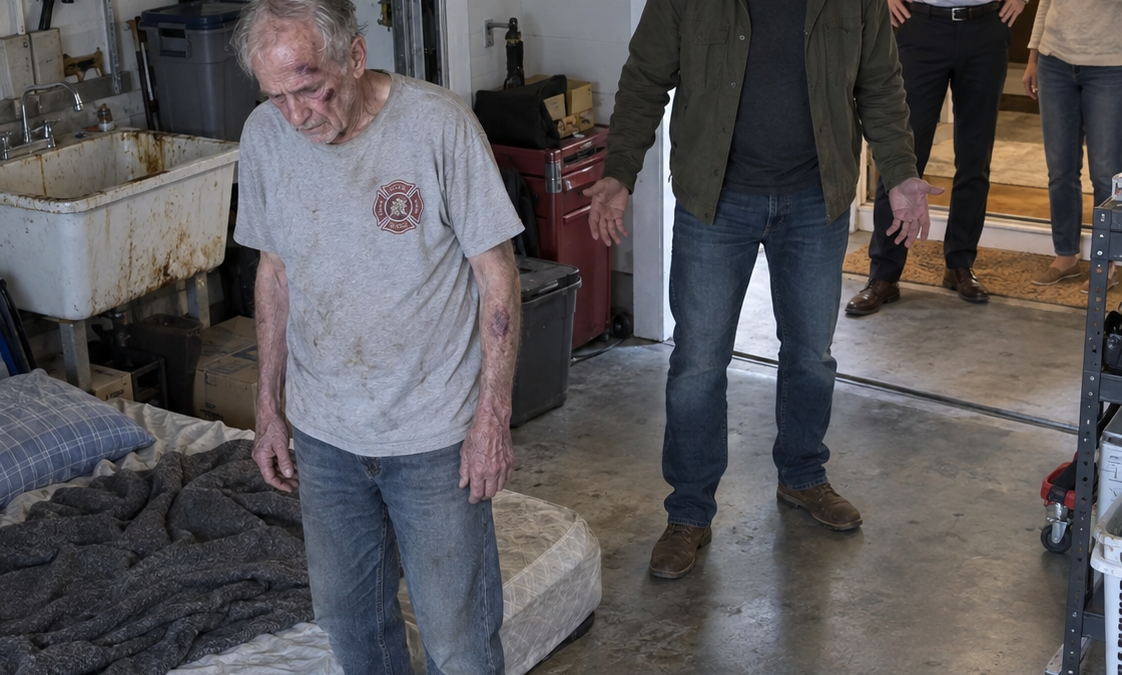
I pushed myself upright, my joints cracking in protest, and wrapped the scratchy blanket around my shoulders. Through the small window facing the kitchen, I could see them sitting at my dining table. Wesley, broad-shouldered and perfectly comfortable, was eating scrambled eggs from my plates as though he owned the place. Beside him sat Gertrude, her blond hair pulled back, her eyes fixed on her coffee mug as though it contained answers she was afraid to search for anywhere else.
My daughter. My little girl. The same child who used to climb into my lap after nightmares, who begged me to read just one more story before turning out the light. Now she wouldn’t even look toward the garage. She hadn’t met my eyes directly in days.
My stomach growled. I’d eaten three crackers the day before, and nothing since. The water from the utility sink tasted of rust, but it filled the emptiness a little. I stood slowly, testing my balance, and shuffled toward the kitchen door. Before my hand could reach the handle, the door swung open.
Wesley filled the doorway. At six feet two, he towered over my five-foot-nine frame. His eyes were flat and uninterested.
“I just need some coffee,” I said, my voice coming out hoarse. “Just coffee, Wesley.”
“Garage residents don’t get kitchen privileges.” He crossed his arms. “That’s the rule. You know the rule.”
I looked past him toward Gertrude. She was staring down at her plate, pushing a small piece of egg around in circles with her fork.
“Gertrude, sweetheart.”
She didn’t lift her head. “Wesley’s right. You should go back, Dad.”
Not Daddy. Not Papa. Just Dad, delivered in that flat, distant voice she’d been using for the past two weeks, ever since they’d moved me into the garage. That formality cut deeper than Wesley’s shove ever could.
Wesley’s mouth curved into something that wasn’t quite a smile. “Oh, and your pension came through yesterday. Don’t worry. I’m handling everything just fine.”
He closed the door, and the lock clicked into place.
For a moment, I stood there with my hand still raised. Then I turned slowly and walked back toward the mattress. My fingers curled into fists, relaxed, and curled again. The anger was still there, small but bright, like an ember buried beneath a thick layer of ash.
My old flip phone lay on the concrete beside my pillow. I’d kept it for emergencies after my smartphone disappeared ten days earlier. Wesley claimed he’d taken it to pay the phone bill. I picked up the little phone with trembling hands and checked the latest text notification from the bank, an automated alert system I’d arranged months earlier, back when I still had control of my own accounts.
Withdrawal: $7,000. New balance: $14,723.
Seven thousand dollars. My entire monthly pension payment, gone.
I sat down on the mattress and stared at the screen until the numbers blurred. On the wall across from me, my old firefighter’s uniform hung from a nail. The dark blue fabric, the badge catching the weak sunlight, the patches from Station 19, where I’d spent the last fifteen years of my career. That uniform had been through smoke and flame. It had been soaked by water from broken hydrants and carried the smell of ash, sweat, and courage. Now it hung silently over a garage floor where I slept like someone who had nowhere else to go.
I’d trusted Wesley. That was my first mistake.
Three months earlier, when he offered to help with my finances, I’d thought he was being kind and responsible, a good son-in-law helping his retired father-in-law manage the bills. I’d signed the papers without reading every word. Gertrude had smiled and called me a good dad. Wesley had shaken my hand.
The trap had already closed. I just hadn’t felt it yet.
Through the window, I watched Wesley laugh at something on the television. My television, in my living room. The previous week, he’d rearranged the furniture, pushing my favorite recliner into a corner and replacing it with a leather sofa I’d never seen before. He’d probably charged it to my credit card. Everything seemed to be charged to my accounts these days.
I looked down at the flip phone again. Daniel’s number was the only one programmed into it. My son lived two hours away in Harrisburg with his wife and children, and I hadn’t spoken to him in three months. Wesley had taken my smartphone before I could call him, and the old flip phone had no calling credit left. The automated voice had made that painfully clear when I tried the day before.
“Insufficient credit. Please add funds to make this call.”
But I had no funds. Wesley controlled everything.
I set the phone down and returned to the window. My reflection stared back at me from the glass. I was thinner than I used to be, with gray stubble on my jaw and bruises beginning to yellow across my shoulder. An old man. A defeated man.
Except something inside my chest had started to shift. The ember was spreading.
I’d spent forty years walking into burning buildings while everyone else was running out. I’d carried unconscious victims down smoke-filled stairwells and stood on rooftops with flames licking at my boots, figuring out how to get my crew home alive. The Philadelphia Fire Department had awarded me seventeen commendations. The mayor himself had shaken my hand at my retirement ceremony.
And now I was sleeping in a garage, begging for coffee, watching another man steal my life piece by piece.
Wesley thought I was broken. He thought he’d won.
I walked to the wall and touched the badge on my uniform, feeling the cool metal beneath my fingertips. In a fire, sometimes you have to retreat, regroup, and find another way inside. Sometimes it looks as though you’re trapped, but you’re really waiting for the right moment, positioning yourself for the next move.
I turned from the window and sat down on the mattress again. The flip phone lay beside me, useless. My pension was gone. My home was occupied. My own daughter wouldn’t meet my eyes.
But I wasn’t finished.
I needed to understand exactly how I’d ended up here. When had the trap closed? Where had I missed the warning signs? I shut my eyes and forced myself to remember, step by careful step, how a respected firefighter had become a prisoner in his own garage.
The memories came slowly and painfully, but they came. I sat on that mattress for a long time, tracing my way backward through the months, gripping the edge of the thin fabric until my knuckles turned white. The truth was there, waiting for me. I just had to stop being afraid of it.
Six months earlier, everything had been normal. I’d been living alone since my wife, Martha, died four years before, and I was managing just fine. My pension covered everything. The mortgage had been paid off, the bills were manageable, and there was always a little money left over for birthday presents for the grandchildren.
Then Gertrude called.
She and Wesley had lost their apartment. There had been some trouble over unpaid rent, something about a dispute with the landlord. Could they stay with me for a while? Just temporarily, until they got back on their feet.
I’d said yes without a second thought. She was my daughter. What else was I supposed to do?
They arrived with two suitcases and a mountain of promises. Wesley would find work soon. Gertrude was applying for office jobs. They would be gone in two months, three at the most. I gave them the guest room and the spare bedroom, told them to make themselves comfortable, and meant every word.
Within a week, Wesley started talking about finances.
The memory came back into focus now, sharp as broken glass. It was June, three months earlier. We’d been sitting at the kitchen table after dinner. Gertrude was washing dishes, humming something to herself, and Wesley had a folder of papers he’d printed from the computer I’d let him use.
“Ambrose,” he began in that friendly, helpful voice of his, “I’ve been thinking. You’re managing an awful lot here. Bills, insurance, pension payments. What if I helped out? Took some of that burden off your shoulders?”
I’d been tired that evening. I’d spent the afternoon pulling weeds in the heat.
“I appreciate it, Wesley, but I’ve got everything under control.”
“I know you do.” He opened the folder. “But what happens if you get sick or forget a payment? With power of attorney, I could handle everything. You could just relax and enjoy retirement.”
I frowned at the pages in front of me. Dense paragraphs filled with legal language.
“Power of attorney? That sounds pretty serious.”
“It’s standard. Limited power of attorney, just for banking convenience.” He clicked a pen and positioned it beside the first signature line. “You keep control of everything important.”
Gertrude came over then, set a fresh cup of coffee beside me, and kissed my cheek.
“Dad, Wesley’s really good with finances. It’ll make things easier for everyone.”
I looked from her to him. “You’re sure this is standard? Family helping family?”
“Absolutely,” Wesley said with an easy smile. “My uncle did the same thing with my grandfather. Made everything run smoother.”
So I signed. Three pages, six signature lines, and initials in four different places. Wesley pointed to each spot, and I put my name wherever he told me, without taking the time to read the fine print.
Why would I have needed to? He was family.
The trap was set.
For a while, nothing seemed to change. The bills got paid. My pension arrived as usual. Wesley told me he’d moved everything into a joint account for easier management, but assured me I still had access. If I needed cash, all I had to do was ask. No problem.
Six weeks passed before I noticed anything wrong.
It was late July. I was sitting at the kitchen table opening the mail, mostly junk and a few catalogs, when I came across a bank statement. I opened it out of habit and stared at the balance.
Three hundred forty-seven dollars.
That couldn’t possibly be right. My pension was seven thousand dollars a month. Even after paying the bills, there should have been thousands left.
I called the bank. The woman who answered was polite and patient, explaining everything in the careful voice of someone reading information from a computer screen.
“Yes, Mr. Russell, your pension is being deposited directly. No, not into this account anymore. It’s being automatically transferred into a different account, the joint account ending in 4792. That arrangement was set up two months ago.”
I found Wesley in the living room, watching television.
“Wesley, I need to talk to you about the bank accounts.”
He barely looked away from the screen. “What about them?”
“My pension. It’s going into another account. The woman at the bank said something about a joint account.”
“Oh, that.” He reached for the remote and changed the channel. “That’s the one I set up. It’s more efficient. Don’t worry about it.”
“But I need access to my money.”
“You have access. I’ll give you cash whenever you need it.”
He finally glanced at me, and something in his eyes had changed. There was a hardness there I hadn’t noticed before.
“It’s better this way, Ambrose. Trust me.”
That was when the first alarm bells started ringing. Quietly at first, but they were there.
After that, I began watching more carefully. I noticed the new laptop that appeared in the spare bedroom, the expensive dinners Wesley brought home, steaks and wine and restaurant food I never would have bought for myself. Gertrude started wearing a new leather jacket, the price tag still hanging from its sleeve. Three hundred dollars.
When the credit card statement arrived, forwarded from the joint account, the truth began to take shape. Electronics, restaurants, clothing, furniture. Thousands of dollars in charges.
My thousands.
A month ago, I finally confronted him. Even now, sitting on the garage mattress, the memory burned so fiercely that my hands began to tremble.
I’d waited until Gertrude went to the grocery store. Wesley was sitting in my recliner with his feet up, drinking my beer.
“Wesley, where’s my pension?” I demanded, holding six bank statements in my hand, each one marked with yellow highlighter. “The account is empty. Where’s my money?”
He lowered the beer bottle slowly. “Our money? You signed it over. I’m managing it properly.”
“Managing it? You’re stealing it!” My voice rose despite my efforts to stay calm. “I never agreed to this. I signed those papers for convenience, not so you could—”
He stood so abruptly that I instinctively stepped backward. In an instant, he was close enough to make me feel his size and height.
“You signed the papers,” he said coldly. “It’s legal. Power of attorney means I control the accounts. And if you make trouble, Ambrose, I’ll have you declared incompetent. You’re old. You’re forgetful. You’re clearly not capable of managing your own affairs.”
He leaned closer, lowering his voice.
“Nursing home. Think about it.”
Then came the shove. Not a punch. A punch would leave the kind of marks people might ask questions about. Just a hard palm against my chest, powerful enough to send me stumbling backward into the wall.
My shoulder struck first. The same shoulder that still throbbed as I sat remembering it.
Gertrude returned ten minutes later. She saw me holding my shoulder, saw Wesley sitting calmly with his beer, and looked between us. Then she said nothing.
That was when I realized she was complicit. Not forced. Not deceived. Complicit.
Two weeks earlier, they’d stopped pretending altogether. Wesley summoned me into the dining room as though I were an employee he intended to discipline. Gertrude was already there, sitting silently with her hands folded in her lap.
“New arrangement,” Wesley announced. “You’re taking up too much space in the house. The garage has everything you need. Mattress, sink, toilet. You’ll stay out there unless you have permission to come inside.”
I started to protest, but he cut me off before I could finish.
“Your choice, Ambrose. The garage, or I call social services and have you evaluated for senile dementia. Your call.”
That night, I carried my mattress through the kitchen and into the garage while Wesley and Gertrude watched television.
Now, sitting in the August heat with the dead flip phone in my hand, I could finally see the entire picture. Every step. Every careful piece of the trap Wesley had built around me.
For weeks, I’d been thinking like a victim. Trapped, helpless, afraid. But victims don’t survive burning buildings. Firefighters do. And firefighters don’t panic. They plan. They find the exits. They learn the weaknesses in a structure and wait for the right moment to move.
I got up and walked over to my uniform. My fingers brushed the badge again, and I remembered something forty years of firefighting had taught me. Sometimes you have to retreat before you can advance. Sometimes looking beaten is exactly what allows you to position yourself for the next move.
Wesley thought he’d won. He thought I was broken.
He was wrong.
I looked at my reflection in the garage window. I was older, thinner, and bruised, but my eyes were different now. Harder. Clearer.
I couldn’t call Daniel yet. Not without a working phone. But Wesley had unknowingly given me something valuable.
Time.
Two weeks in that garage, watching the household through the little window, had taught me their patterns. I knew when Wesley left for his afternoon walks, when Gertrude took her long baths, where they kept the spare keys, and how the house sounded when everyone was asleep.
I’d learned something else, too. I wasn’t finished fighting. Not even close.
The next day, something changed. Something Wesley hadn’t expected.
Friday evening brought a peculiar stillness to the garage. It wasn’t peaceful, just empty. I sat on an old wooden chair I’d dragged out of the corner and watched the shadows stretch across the concrete floor as the sun went down. My posture was different now, straighter than before. The bruise beneath my left eye had turned a yellowish purple, two days old from what Wesley had called an accidental elbow.
But something inside me had shifted since I’d forced myself to face those memories. I wasn’t simply surviving anymore.
I was waiting.
Then I heard it. The familiar rumble of Daniel’s Honda Accord, with that slightly loose exhaust he’d been meaning to fix for months.
My heart seized. Hope and dread collided inside me so suddenly that I could hardly breathe. Not now. Not like this. I couldn’t let him see me this way.
But the engine stopped. A car door slammed, and footsteps moved up the driveway.
Through the little window, I watched the house. I couldn’t see the front entrance from where I stood, but I heard the door open, followed by Daniel’s warm, unsuspecting voice.
“Hey, anybody home? Where’s Dad?”
There was a pause. Then Gertrude answered too quickly, her voice pitched unnaturally high.
“Daniel! We didn’t know you were coming. Dad’s… he’s in the garage, working on something.”
Wesley’s voice followed, casual but territorial. “Daniel. Long time no see.”
I rose slowly, my hands trembling. Part of me wanted to call out and warn my son. Another part wanted to disappear, to preserve the illusion that everything was fine and protect him from the truth. But my legs refused to move in either direction.
“Where’s the garage?” Daniel asked.
He knew perfectly well where it was. He’d grown up in this house. The question wasn’t really a question. It was a challenge.
Footsteps approached, and the garage door swung open. Light from the house spilled into the dim space, outlining Daniel’s silhouette in the doorway. He looked taller than I remembered, broader through the shoulders. As his face emerged from the backlight, I watched the emotions move across it.
Confusion. Horror. Shock.
His eyes found mine, then traveled to the bruise beneath my eye, the mattress on the concrete floor, and the single thin blanket.
“Dad?” His voice cracked slightly. “Dad, what… what happened to your face?”
I couldn’t speak. I couldn’t even make my mouth form a word. I stood there like a specimen being examined, unable to hide what had happened to me.
Daniel crossed the garage in three strides and gripped my shoulder.
“You’re living in the garage?” His eyes widened. “Why are you living in the garage? You have a pension. Seven thousand dollars every month!”
“Daniel.” My throat felt dry. “You shouldn’t have come.”
“Seven thousand dollars, Dad. Where is it?”
“It’s complicated, son.”
Wesley appeared in the doorway before I could say more, his chest puffed out, his bulky frame filling the opening. He wore the same smug expression I’d come to know so well.
“Not complicated at all,” he said. “That pension belongs to me now. I control everything. Your father signed the papers.”
Daniel turned slowly toward him and straightened to his full height.
“Excuse me?”
“Power of attorney. All legal.” Wesley stepped farther into the garage as though he owned every inch of it. “He signed it over. The money’s mine. The house is mine. Well, it will be.”
He gestured dismissively toward the mattress and then toward me.
“And this? This is where he lives now. House rules.”
From behind him, Gertrude’s voice came weakly. “Wesley, maybe we should—”
“Shut up, Gertrude.” He didn’t even turn around. “Your brother needs to understand how things work here.”
Daniel’s jaw tightened. His hand moved toward his wrist, where a stainless steel Omega watch caught the light. I’d seen that watch before. He’d received it as a company gift two Christmases earlier, after hitting his performance targets three years in a row. He’d been so proud of it.
Now he unclasped it. The tiny click sounded strangely loud in the silence. He held the watch in his palm for a moment, then placed it on the dusty workbench with deliberate precision.
“This watch is an Omega,” Daniel said, his voice measured and cold. “My company gave it to me for hitting targets three years running. It’s worth about eight thousand dollars.”
He looked directly at Wesley.
“Take it.”
Wesley blinked. “What?”
“Take the watch. Take it and walk out of this house right now, before I make a phone call you won’t like.”
The watch lay between them on the workbench, eight thousand dollars’ worth of stainless steel and craftsmanship resting among sawdust and old oil stains.
Wesley stared at it, then at Daniel, then back at the watch. I could almost see the calculations moving behind his eyes. Greed. Suspicion. Anger.
Behind him, Gertrude had gone pale. She pressed one hand against the doorframe to steady herself.
“Take it,” Daniel repeated. “Last chance.”
Wesley’s mouth curved into that familiar smile, the one that always appeared when he thought he’d won. He reached down, picked up the watch, and turned it over in his thick fingers.
“Nice watch,” he admitted, setting it down again. “But why would I take eight thousand dollars when I’ve already got seven thousand coming in every month for free?”
Daniel’s voice stayed perfectly level. “That pension isn’t yours.”
“It is now. Power of attorney, kid. All legal.”
Wesley crossed his arms with renewed confidence.
“You want to call the cops? Go ahead. They’ll tell you the same thing. Your old man signed it over. His choice.”
Daniel slipped a hand into his pocket and pulled out his smartphone.
Wesley’s smile widened. “Be my guest. They won’t do anything. I’ve got the paperwork. The pension gets deposited into my account.”
He gestured toward the house.
“And this place? Once I get him declared incompetent, it’ll be mine, too. He lives in the garage because those are the rules now. My rules.”
I watched Daniel’s face as something shifted behind his eyes. He held the phone casually, angled away from Wesley. His thumb moved across the screen, but he didn’t lift the device to his ear.
“So you’re forcing him to live out here,” Daniel said quietly.
It wasn’t a question. It was a prompt.
“Forcing?” Wesley laughed. “He’s free to leave whenever he wants. He can find himself a nice nursing home. Some state-run facility for incompetent seniors. That’s his other option.”
“And you’re spending his pension?”
“My pension now. Legally transferred. Like I said, the paperwork’s all in order.”
Gertrude made a small sound from the doorway, almost a whimper.
“Wesley, maybe we should just—”
Daniel didn’t even look at her when he spoke.
“Don’t. Not one word, Gertrude.”
“Danny, you don’t understand. We needed—”
“I’ll talk to you later.”
His eyes never left Wesley.
“Right now, I’m getting Dad out of here.”
Wesley stepped forward. “He’s not going anywhere. This is his home.”
Daniel moved to my side and placed a gentle hand on my shoulder.
“Dad, get up. We’re leaving.”
I straightened, my legs weak beneath me, but Daniel’s grip steadied me. Wesley planted himself in front of the doorway.
“You can’t just move him.”
When Daniel answered, there was something in his voice I’d never heard before. It wasn’t anger. It was something colder than anger.
Authority.
Wesley hesitated. For the first time since the nightmare began, I saw uncertainty flicker across his face. Then, slowly, he stepped aside.
Daniel guided me past him, past Gertrude, who pressed herself against the wall, and through the house that used to be mine. I didn’t look at the furniture or the rearranged rooms or the life they’d built using my money. I simply kept walking, feeling Daniel’s steady hand against my shoulder until we reached his car.
He opened the passenger door and helped me inside as though I were fragile.
Maybe I was.
We pulled out of the driveway, and I watched the house grow smaller in the side mirror. Wesley stood in the doorway with his arms crossed, still wearing that confident smile.
He had no idea what Daniel had just done.
The car felt like another world. Clean, warm, safe. I sat in the passenger seat with my hands folded in my lap, watching the Philadelphia suburbs slide past the windows. Evening lights were coming on in the houses along the streets. People were sitting down to dinner, watching television, going about the ordinary business of their lives, unaware that a few blocks away, an old man had been sleeping on a concrete floor.
“You shouldn’t have seen that,” I said finally.
Daniel’s hands tightened around the steering wheel. His jaw was set.
“How long, Dad? How long has this been happening?”
“Three months since the papers. Two weeks in the garage.”
“And the bruise?”
I touched the area beneath my eye without thinking.
“Two days ago. He gets angry when I ask questions about the money.”
The muscles along Daniel’s jaw worked, but he said nothing else. He drove until we reached the parking lot of a Holiday Inn Express, then climbed out, came around to my side, and opened the passenger door as though I might break if he handled me too roughly.
We walked into the lobby together. Daniel paid for a room with his corporate credit card, told the desk clerk we were visiting family, and collected two key cards. Neither of us spoke during the elevator ride or the walk down the hallway.
He unlocked Room 214 and held the door open.
Inside were two beds with clean white linens, a television, and a bathroom with actual hot water. I stood in the middle of the room and felt something give way inside my chest. These were ordinary things, things I’d once taken for granted, and now they looked almost impossibly luxurious.
“Sit down, Dad.” Daniel pulled the desk chair away from the table. “I’m ordering dinner.”
He called room service and ordered more food than two people could reasonably eat. Steak, baked potatoes, green beans, salad, bread, soup. When I started to protest the cost, he simply shook his head.
The food arrived twenty minutes later. Daniel arranged the plates on the desk and handed me a knife and fork. I looked at the steak, thick and properly cooked, with steam rising from its surface, and my hands began to tremble.
“When did you last eat?” Daniel asked quietly.
“Yesterday. Three crackers.”
He watched as I cut the first piece of steak and brought it to my mouth. I chewed slowly, carefully, like someone who had forgotten what it felt like to be full. Daniel didn’t say anything. He just watched me with an expression that made my chest hurt more than hunger ever had.
I managed half the steak before I had to stop. My stomach seemed to have forgotten how to accommodate a real meal. Daniel wrapped the leftovers and placed them in the mini-fridge for later. Then he reached into his laptop bag, took out a legal pad, clicked a pen, and sat across from me with the methodical air of a man preparing for a project debrief.
“Tell me everything,” he said. “Start at the beginning. When did Wesley first suggest the power of attorney?”
So I told him. Early May, as I remembered it. Wesley’s friendly offer, the papers spread across the kitchen table, Gertrude’s encouraging smile, and my signature on documents I had barely bothered to read.
Daniel took notes, asking precise questions about dates, amounts, and the exact words used in conversations. He approached the situation the way he would approach a complicated logistics problem: gather the information, identify patterns, and locate vulnerabilities.
“The exact wording matters,” he said. “Did Wesley actually say limited power of attorney?”
“Yes.”
“Limited to banking?”
“He told me I’d keep control of everything else.”
“But he redirected the pension?”
“All of it. Seven thousand five hundred dollars a month for three months.”
Daniel paused, calculated, and wrote down the figure.
“Twenty-two thousand five hundred dollars.”
He circled the amount.
“Has he threatened you? Besides the physical intimidation?”
“Nursing home. Says he’ll have me declared senile, incompetent. Says I’ll die in some state facility.”
Daniel’s pen stopped moving. He looked up, and for a moment, something dangerous flickered behind his eyes before disappearing beneath his professional calm.
“This is elder financial abuse,” he said. “Pennsylvania has specific laws about it. And there’s the illegal eviction. You own that house, right?”
“Paid it off fifteen years ago. Deed’s in my name.”
“Then he’s committed a crime. Multiple crimes.”
I shook my head. “He has the legal papers, Daniel.”
“Papers obtained under duress can be challenged. Financial exploitation of an elderly person can also be prosecuted as a felony in Pennsylvania.”
Daniel turned to a clean page on the legal pad.
“We need a lawyer who specializes in elder law.”
“I can’t afford—”
“I can.”
He met my eyes before continuing.
“Dad, this is what I do. I solve complicated logistics problems. This is another system we need to analyze. And Wesley made a mistake tonight.”
“What mistake?”
Daniel’s mouth curved slightly, though it wasn’t quite a smile.
“He confessed to everything on a recording.”
I stared at him. “You recorded him?”
He took out his phone, tapped the screen, and pressed play.
Wesley’s voice filled the quiet hotel room.
“That pension belongs to me now. I control everything. Your father signed the papers. The pension gets deposited into my account. This house? Once I get him declared incompetent, it’ll be mine, too. And he lives in the garage because those are the rules now. My rules.”
Daniel stopped the recording.
“Pennsylvania is a one-party consent state,” he explained. “You can legally record a conversation you’re participating in. Wesley admitted to controlling your finances, forcing you into the garage, and intimidating you. That recording is evidence.”
For the first time in months, I felt something like hope.
We talked until midnight. Daniel filled page after page with notes, building timelines and outlining what needed to happen next. Legal consultation. Documentation. Medical records showing the bruises. Financial records showing the missing money. Revocation of the power of attorney. Criminal complaints. Protective orders.
He organized everything like a project plan, breaking the nightmare down into objectives, resources, timelines, and obstacles. Watching him work, I saw the man my son had become. Successful, systematic, thorough, and remarkably difficult to shake.
Finally, we were both too exhausted to continue. We lay down in our separate beds, and Daniel switched off the light. I could hear him breathing in the darkness, awake just as I was.
“Thank you,” I whispered.
“We’re going to fix this, Dad. All of it.”
And I believed him.
Morning came much too soon. Daniel’s alarm sounded at six. He showered, packed his things, and had us checked out by seven. We stood beside his car in the parking lot, neither of us quite ready to say goodbye.
“I have to get back to Boston,” he said. “Work. But I’ll be back Friday. One week.”
I nodded. “And I’ll go back to the garage.”
His face tightened.
“Dad, you can stay here. I’ll pay for the room all week. You don’t have to go back.”
“No.” I rested a hand on his arm. “I have to. If I disappear, Wesley might do something unpredictable. Destroy evidence. Run. But if I’m back in the garage, he’ll think he’s won. He’ll think you gave up.”
Daniel studied me. “Are you sure?”
“Forty years fighting fires taught me something. Sometimes you have to go back into the smoke to get what you need.”
I managed a small smile.
“I’ll be okay for one more week. Besides, I’ll be watching him. Learning his patterns.”
Daniel reached into his pocket and brought out a small, basic phone.
“Burner phone. My numbers are already programmed in. If anything happens, anything at all, you call me.”
I took it and turned it over in my palm.
“Where am I supposed to hide it?”
“Somewhere he won’t think to look.”
I immediately thought of my firefighter’s jacket. There was a small tear in the inside lining that nobody would notice unless they knew it was there.
“Perfect.”
Daniel hugged me, holding on longer than he ordinarily would.
“One week, Dad. I promise.”
“I know.”
I watched him drive away and stayed in that parking lot until his car disappeared around the corner. Then I started walking back toward the house, toward the garage. My steps were steady now.
Wesley and Gertrude were watching from the living room window when I arrived. I saw the curtain move and caught a glimpse of Wesley’s face, that satisfied smirk back in place.
He thought I’d tried to escape and failed. He thought Daniel had abandoned me.
He was wrong about both.
I walked into the garage, lay down on the mattress, and stared at the ceiling. My hand slipped into my pocket, where I could feel the small phone Daniel had given me. Solid. Real. A connection to someone who believed me.
One week. I could survive one week. I’d survived worse than this.
And for the first time, I wasn’t surviving alone.
Daniel texted when he reached Boston.
Made it. Starting lawyer research tomorrow. Hang tight.
On Sunday, another message arrived.
Found three elder law specialists. Calling Monday.
After that came daily check-ins. The messages were short, sometimes only a sentence, but each one felt like a lifeline.
Wesley noticed I was calmer, and it bothered him.
On Monday, he searched the garage while I was using the bathroom inside the house, a privilege I was allowed for ten minutes each day. When I returned, I watched through the window as he pawed through my few belongings, hunting for money, a phone, or anything else Daniel might have left behind.
He found nothing. The burner phone was hidden inside the lining of my firefighter’s jacket.
Forty years of emergency preparedness had taught me to think about the unexpected. You learn where to keep what matters, even when other people don’t understand why.
By Wednesday, Wesley was openly suspicious. He kept watching me through the kitchen window, trying to understand why I’d stopped begging, why I no longer pleaded for every small mercy. By Thursday, his suspicion had turned into something close to paranoia.
Friday, the day Daniel was supposed to return, couldn’t come soon enough.
Monday morning, I woke before dawn. It was an old firefighter’s habit. After four decades of emergency calls and early shifts, the internal alarm clock never quite shut off. The garage was dark and cold as I reached into the lining of my jacket and touched the hidden phone.
My hands no longer shook.
I had work to do.
Daniel had called from Boston on Sunday night, keeping the conversation brief and careful.
“Dad, document everything. Photographs, dates, amounts. The lawyer needs evidence.”
So that was exactly what I did.
I photographed the mattress first, then the bare concrete floor, the lack of insulation, and the single thin blanket that did almost nothing against the chill. I photographed the rust-stained utility sink and the view through my window toward the house, where Wesley and Gertrude continued living comfortably on my money.
In a dusty corner of the garage, I found an old contractor’s notebook, spiral-bound, with half the pages still blank. I brushed the dirt from its cover, opened it, and began writing.
May 8: Wesley suggested power of attorney. Said it was just for convenience.
May 10: Signed papers at kitchen table. Gertrude present, reassuring.
June 15: Discovered pension redirected to joint account. $7,500 missing.
The dates came back more easily than I’d expected. It was the firefighter training again. We logged everything back at the station: every call, every incident, every decision that could matter later.
It turned out that financial abuse could be documented like any other emergency. You needed a timeline, evidence, and witnesses.
Through the garage window, I watched Tuesday unfold. Around noon, a delivery truck pulled into the driveway. Two men climbed out and wrestled an enormous cardboard box toward the front door. A seventy-inch television, its logo visible even from where I stood.
Wesley directed the deliverymen with the confident gestures of a homeowner, wearing a satisfied smile as they carried the box inside.
I photographed the whole thing through the window. The picture wasn’t perfect, but it was clear enough to show what was happening, and the phone recorded the time.
Later that afternoon, a new SUV appeared in the driveway. A black Ford Explorer, gleaming beneath the sunlight, with temporary dealer tags still attached.
Wesley and Gertrude walked around it admiringly. He hadn’t sold the old sedan. He’d simply added a second vehicle to the household fleet.
My fleet. My pension money.
Twenty-eight thousand dollars of my retirement, and the total was still climbing.
I took more photographs, capturing the SUV from several angles. Then I photographed Wesley unloading grocery bags from the trunk, expensive whiskey bottles visible among the purchases. I recognized the premium labels from the days when I could occasionally afford something nice for myself.
Daniel called Tuesday night.
“The lawyer’s name is Sandra Mitchell,” he said. “She specializes in elder law. We’re meeting Wednesday at three. Coffee shop on Broad Street, that little independent place near the library. Can you get there?”
“I’ll tell Wesley I’m taking a walk.”
“Be careful, Dad.”
On Wednesday morning, Wesley watched me even more closely than usual. I could feel his eyes through the kitchen window while I sat in the old garage chair pretending to read a magazine I’d found among my things.
Around two o’clock, I stood, stretched my back, and made a show of needing some fresh air.
“Going for a walk,” I called toward the house. “Need to stretch my legs.”
No one answered, but I could feel him watching.
I walked six blocks to the coffee shop. The world outside my garage seemed strangely unfamiliar. Ordinary people were doing ordinary things, buying coffee, laughing at something on their phones, and living lives that didn’t involve sleeping on concrete floors or begging relatives for food.
Daniel was already there, sitting in a corner booth. Beside him was a woman in her mid-fifties, wearing a professional gray suit, with a leather briefcase resting on the table.
She stood as I approached and extended her hand.
“Mr. Russell, I’m Sandra Mitchell. Daniel’s told me about your situation. Before we begin, I need to hear everything directly from you. Everything that’s happened.”
I sat down and took a breath.
“Where do I start?”
“Start with the power of attorney. When did Wesley first mention it?”
So I told her the entire timeline. The friendly offer that turned into a trap, the documents I’d signed without reading carefully enough, and the gradual theft of my pension, my autonomy, and my home. I told her about the threats, the physical intimidation, and the garage.
Sandra took notes in quick shorthand, occasionally interrupting to clarify an amount or pin down a date. She had the focused intensity of someone who had handled cases like mine before and knew exactly which details mattered.
When I finished, she took out a tablet, connected a pair of headphones, and pressed play.
Wesley’s voice filled the small space between us.
“That pension belongs to me now. I control everything. Your father signed the papers. The pension gets deposited into my account. This house? Once I get him declared incompetent, it’ll be mine, too.”
Sandra stopped the recording, removed the headphones, and looked directly at me.
“Mr. Russell, Pennsylvania law is very clear about financial exploitation of older adults. If we can prove that the power of attorney was obtained through coercion, and this recording certainly supports that argument, the document can be challenged and voided.”
“But Wesley says it’s legal. He says the police won’t help.”
“He’s wrong.”
She pulled several papers from her briefcase.
“What he’s done constitutes elder financial abuse. Pennsylvania takes that seriously. And forcing you out of your own home raises additional legal issues involving your right to occupy your property.”
She paused long enough to let me understand what she was saying.
“We can stop him. More importantly, we can pursue criminal charges.”
That last word seemed to hang in the air between us.
Criminal.
Daniel leaned forward. “Tell Sandra about your documentation, Dad.”
I took out the notebook and showed her the timeline I’d written, the amounts, the specific dates, and descriptions of what had happened.
Sandra studied every page, nodding as she read.
“This is excellent. Detailed, specific. Exactly the kind of documentation that can become powerful evidence in court.”
She looked up.
“You were a firefighter?”
“Forty years. Philadelphia Fire Department.”
“That training is helping you now.”
She scrolled through the photographs on the burner phone Daniel had given me. The mattress, the concrete floor, the garage window, and the evidence of the conditions I’d been forced to endure.
“These images are important. Your living conditions, combined with the recording, give us a strong foundation.”
She set the phone on the table.
“Mr. Russell, we have a strong case, but we need one more thing.”
“What?”
“Medical documentation. The bruises, the weight loss. We need a doctor to examine you and officially record those findings. Can you do that?”
“When?”
“Tomorrow, if possible. The sooner we document everything, the better.”
We talked for another hour. Sandra outlined the legal process, step by step. Revoke the power of attorney, seek protective orders, pursue criminal charges, and recover the stolen pension funds.
Every step was precise, methodical, and achievable. I’d spent three months feeling helpless, but after forty minutes of speaking with Sandra Mitchell, I finally had a plan.
When we left the coffee shop, Daniel walked part of the way back with me. He stopped at the corner, two blocks from the house.
“You okay, Dad?”
“I’m okay.”
He pulled me into a hug.
“One more week. Maybe less.”
I walked the last two blocks alone.
Something felt wrong before I even turned onto my street.
Wesley’s SUV was parked crookedly in the driveway, as though he’d pulled in too fast. The garage door was slightly open. I always made sure it was completely closed.
My hand went instinctively toward my jacket pocket, searching for the outline of the phone, but there was something different about the way the fabric felt.
I pushed the garage door open.
Wesley was sitting on my workbench with his legs dangling over the edge. He was holding something in one hand. At first, the garage was too dim for me to make out what it was. Then my eyes adjusted.
Pieces of a phone. A phone that looked exactly like the one Daniel had given me.
My hand flew to my jacket. The pocket was empty, and the lining had been ripped open.
He’d found it.
The mattress had been overturned. My firefighter’s jacket lay crumpled on the concrete, its interior lining torn apart. My few belongings were scattered across the floor.
He’d searched everything.
Wesley lifted the shattered phone, its broken screen hanging loose.
“What’s this, Ambrose? Where’d you get a phone?”
His smile was triumphant.
I made my voice small and submissive.
“I… Daniel gave it to me. Just so I could call him sometimes.”
“Daniel gave it to you.” Wesley repeated the words slowly, as though tasting them. “Daniel, who took you away last week. Daniel, who thinks he can interfere.”
He slid off the workbench and stood over me, using every inch of his height to make himself seem more intimidating.
“Who have you been talking to?”
“Just Daniel, I swear. Just my son.”
“Liar.”
He stepped closer.
“You’ve been leaving the garage every day. Where do you go?”
“Walks. Just walks, to get some air.”
He threw the broken phone pieces at my feet. Plastic and glass scattered across the concrete.
“You think I’m stupid? You think I don’t notice things?”
My heart was hammering, but my mind remained clear.
The phone was a decoy now. The real evidence was already safe with Sandra. I’d sent the photographs on Tuesday, and Daniel had received the timeline in his email Monday night.
Wesley thought he’d destroyed the threat. I needed him to keep believing that.
“You want to know something funny, old man?” he asked.
His voice dropped lower, taking on a dangerous edge.
“That power of attorney you signed? It’s not just financial. It’s medical, too. I can make healthcare decisions for you.”
Cold fear spread through my chest.
“Medical?”
“That’s right. So if I decide you’re not competent, if I decide you need to be in a nursing home, a locked ward for dementia patients, I can arrange it. One phone call.”
From the doorway came Gertrude’s quiet voice.
“Wesley…”
“Shut up, Gertrude.” He didn’t turn around. “Your father needs to understand his position.”
I looked toward my daughter and met her eyes. Everything I wanted to say was in that look.
Stop him. Help me. You’re my daughter.
She looked away.
That was when I understood completely. She’d chosen Wesley over me, not merely by remaining passive, but by actively allowing him to continue.
“Please,” I whispered, letting my voice shake.
It wasn’t entirely an act. The medical threat had frightened me in a way the financial threats hadn’t.
“I’m sorry. I won’t cause any trouble.”
“You’re right. You won’t.”
Wesley picked up my firefighter’s jacket and examined the torn lining.
“No more phones. No more walks without permission. And no dinner tonight. You need to learn.”
Then he walked out. Gertrude followed without looking back.
I stood alone in the wreckage of the garage, surrounded by scattered belongings and broken pieces of the phone. Slowly, I righted the mattress and picked up my jacket. The lining was destroyed, but the jacket itself remained intact.
Evening settled over the house. My stomach cramped with hunger, and Wesley made good on his threat. No dinner. But I’d eaten at the coffee shop with Daniel and Sandra, and I knew I could manage one more night.
Around seven, I walked over to the neighbors’ house. The Johnsons lived about fifty feet away. I’d known Martha and Frank Johnson for fifteen years, ever since I’d moved into the neighborhood, and they’d always been good neighbors.
They were a nice couple who mostly kept to themselves, but I knew they’d noticed things. I’d seen Martha watching from her window more than once when Wesley was treating me badly.
I knocked quietly.
Martha Johnson opened the door, and her expression immediately shifted from surprise to concern.
“Ambrose! Are you all right?”
“Martha, I’m sorry to bother you. I need to ask a favor.”
“Come in. Please, come in.” She turned toward the living room. “Frank! Frank, Ambrose is here.”
Frank appeared a moment later. One look at me, and his face hardened.
“My word, Ambrose. What’s happened to you?”
They brought me into their warm kitchen, and Martha insisted on making coffee. Sitting there between them, I explained enough of the situation for them to understand. I didn’t tell them everything. I didn’t mention the lawyer or the case we were building. I simply explained that Wesley had taken my phone and that I needed a way to communicate with my son while some family matters were being handled.
Martha and Frank exchanged a long look. They’d been married long enough to read each other’s thoughts without speaking.
“Ambrose,” Martha said carefully, “we’ve been worried. We’ve seen things. The way you’re living in that garage…”
“It’s being handled,” I assured her. “I have help. I just need a way to communicate.”
Frank stood, decisive as ever.
“Use our phone. Anytime, day or night. We mean it.”
Martha reached across the table.
“How long has this been going on?”
“Months. But it’s going to end soon.”
She covered my hand with hers.
“We should have said something sooner. We should have done something.”
I looked at her and shook my head.
“You’re doing something now. That’s what matters.”
Frank wrote their phone number on a piece of paper and handed it to me. He told me the back door was always unlocked whenever they were home and that I could come over whenever I needed help. If they were out, they kept a spare key beneath the mat, and he made sure I knew exactly where to find it.
I walked back to my garage feeling less alone than I had in months.
Later that night, I returned to the Johnsons’ house and used their phone to call Daniel. I told him about Wesley finding the burner.
To my surprise, Daniel laughed. Actually laughed.
“Dad, that phone was backup. Everything important is already with Sandra. He didn’t find anything that can hurt us.”
“He has medical power of attorney,” I told him. “He threatened to put me in a nursing home.”
Daniel’s voice immediately turned cold.
“I’ll forward that information to Sandra. She needs to know. But listen, Dad, it doesn’t change the plan. We’re moving Friday. Medical examination Thursday, then the paperwork Friday. Just hold on until then.”
Thursday morning, Wesley cut my food again. Breakfast consisted of two crackers. Dinner would be the same, assuming he decided to give me anything at all.
He also changed the shower schedule. I was now permitted one shower a week, on Sundays only.
He was tightening the cage, trying to crush whatever spirit he sensed was still alive inside me.
But I had an appointment that day.
Sandra had arranged a medical examination at a clinic downtown. The purpose was to document my bruises, the weight I’d lost, and the physical effects of Wesley’s abuse. Not merely for the civil case, but for the criminal charges she believed were coming.
I told Wesley I was going for a walk. He watched me leave with narrowed, suspicious eyes, but he said nothing.
At the clinic, Dr. Sarah Chen examined me thoroughly. She asked questions, and I answered them honestly. She photographed the yellowing bruise beneath my eye, weighed me, and documented the loss of muscle, the signs of malnutrition, and the physical indicators of prolonged stress.
I’d lost twenty-three pounds in three months.
“Mr. Russell,” she said quietly while completing her forms, “I’m required to report this. What’s being done to you is abuse.”
“It’s being reported,” I told her. “A lawyer is handling it. Criminal charges are coming.”
She handed me copies of the documentation.
“Good. You deserve better than this.”
On the way back, I stopped at the Johnsons’ house. Martha made me lunch, a proper meal with a sandwich, soup, and fruit. Frank sat with me while I ate, talking about nothing particularly important.
That ordinary conversation was a gift. For a little while, I was just a neighbor having lunch with friends, not a frightened old man whose son-in-law controlled when he could eat.
That night, lying on my thin mattress while my stomach cramped despite the lunch I’d eaten, I thought about time. How differently it moves when you’re waiting for rescue. Days feel like weeks, and every hour stretches longer than the last.
But I’d survived worse.
Burning buildings. Smoke-filled rooms. Collapsed structures.
I could survive my own son-in-law a little longer.
Friday morning, I walked to the corner grocery store. I didn’t actually need groceries. The quart of milk I intended to buy was only an excuse. What mattered was being there at exactly 9:15, when Daniel would happen to drive by.
Wesley watched me leave. I could feel his eyes following me from the kitchen window, but I’d been taking walks all week. Since the incident with the phone, he’d become suspicious of my new habit, though he still allowed it.
He probably figured I had nowhere to go and no way to cause trouble.
He was wrong.
Daniel’s Honda pulled into the grocery store parking lot at 9:17. He climbed out, looked around, and arranged his expression into one of mild surprise.
“Dad? What are you doing here?”
I held up the quart of milk I’d purchased with a handful of quarters.
“Daniel! I didn’t know you were coming to town.”
“Last-minute decision. Wanted to check on you.”
His eyes met mine, then dropped to the milk. He understood immediately.
“Let me buy you breakfast,” he said. “A real breakfast. We need to talk.”
Twenty minutes later, we were at the medical clinic. Dr. Sarah Chen was expecting us. Sandra had briefed her beforehand, a professional courtesy between people who regularly worked with victims of abuse.
This examination was even more thorough. Dr. Chen photographed every bruise from multiple angles, using a medical-grade camera capable of capturing details a phone camera might miss. She weighed me again and recorded the number: 152 pounds, down from my usual 175.
She tested my reflexes, assessed my cognitive function, and checked for signs of malnutrition. She took her time with every part of the examination, recording clinical findings while asking careful questions about how long each symptom had been present.
“Mr. Russell,” she said, typing notes into her computer, “these bruises are in different stages of healing. This one appears to be about four days old. This one is closer to two weeks. Can you tell me how you got them?”
I told her about Wesley shoving me on Wednesday and described the other incidents as best I could. There had been so many smaller moments of physical intimidation that I’d stopped keeping track. Eventually, they’d all begun to blur together.
“And the weight loss?”
“Limited food. Wesley controls when I eat and how much.”
Dr. Chen stopped typing. She turned toward me, and for a moment, her professional mask slipped.
“Mr. Russell, I’m required by law to report suspected elder abuse. But I want you to understand something. I’m not reporting this simply because I have to. I’m reporting it because what I’m seeing is clear evidence of systematic abuse. No one should have to live like this.”
Her written report ran fifteen pages. It contained detailed measurements, clinical observations, and photographs. She used phrases such as deliberate deprivation and pattern consistent with long-term physical abuse, medical language that would carry weight in court.
The weekend crawled past.
Sandra was finalizing documents, checking and rechecking the evidence, and preparing the necessary filings. Daniel stayed at a hotel, but he visited on both Saturday and Sunday, bringing food and making certain I ate properly for the first time in months.
Monday morning, Sandra called me through the Johnsons’ phone.
“Mr. Russell, the documents have been filed.”
“All of them?”
“All three actions. Wesley will be served on Wednesday.”
“What happens after that?”
“He’ll have to respond. But more importantly, I’ve requested emergency temporary orders. We should hear something within forty-eight hours.”
“Temporary orders?”
“Orders freezing his access to your accounts and allowing you to return to your home. We can’t wait for a full trial, Mr. Russell. You need protection now.”
On Wednesday afternoon, I was sitting in the garage when I heard shouting from inside the house. Wesley’s voice rose first, loud and furious. Then came Gertrude’s, high-pitched with panic.
The process server had arrived.
Through the little window, I watched the scene unfold. Wesley tore open an envelope and began reading. His face changed from confusion to comprehension, then to outright rage.
“Gertrude!” he bellowed.
She came running from the kitchen. He waved the papers in front of her face.
“Your father’s suing me! He got himself a lawyer! He’s trying to take everything back!”
Her voice carried clearly through the window.
“Adult Protective Services. Financial exploitation.” She sounded increasingly frightened as she read. “Wesley, this says criminal investigation.”
I sat on my mattress and allowed myself a small smile.
The counterattack had begun.
That evening, using the Johnsons’ phone, I listened as Daniel described Wesley’s frantic attempts to find an attorney. One lawyer after another had apparently declined the case after reviewing the available evidence.
The recording was the decisive problem. Wesley had openly boasted about controlling my pension and forcing me to live in the garage. What he’d considered a demonstration of power had become evidence of his own wrongdoing.
Eventually, he found someone willing to represent him. Attorney James Kovatch, a recent graduate and solo practitioner who was still trying to build a client base.
“Can we win?” Wesley had apparently asked him.
Daniel played a recording of the exchange for me. There was a long pause before Kovatch answered.
“We can try.”
Even his own lawyer seemed to understand how difficult the case would be.
Thursday morning, I woke to the ringing of the Johnsons’ landline phone. With their permission, I’d been keeping it in the garage overnight so I could receive calls. Sandra’s voice came through the receiver, crisp, professional, and unusually excited.
“Emergency orders granted. Effective immediately, Wesley’s financial access is frozen. And, Mr. Russell, you have the right to move back into your house today.”
I sat on the thin mattress one last time and looked around the garage that had been my prison for three weeks. The bare concrete floor, the single hanging lightbulb, and the little window through which I’d watched my own life being stolen.
Then I stood, gathered my few possessions into a plastic bag, and walked toward the front door.
Wesley was in the living room when I entered.
“I’m moving back inside,” I said. “I’ll take the guest bedroom.”
He rose from his chair. “You can’t just—”
I held up the printed court order Daniel had emailed to the Johnsons.
“Court order says I can. Section two, paragraph three. Read it if you want.”
His voice turned dangerous.
“You’re making a mistake, old man.”
I met his eyes. There was no fear left in me now, only cold certainty.
“The only mistake I made was trusting you. That won’t happen again.”
I walked past him into the guest bedroom, closed the door, and turned the lock.
The click was the sweetest sound I’d heard in months.
Thursday morning, at 10:15, Teresa Williams pulled into the driveway in a county vehicle marked Adult Protective Services. I watched from my new window, the guest bedroom window rather than the garage, as Wesley straightened his shirt and carefully arranged his face into a welcoming expression.
He opened the front door before she could knock.
“Good morning! You must be Ms. Williams. Welcome, welcome. We’re so glad you’re here to help clear up this misunderstanding.”
I’d seen plenty of performances during my forty years in the fire department. People lied to investigators after setting their businesses on fire for insurance money, claiming faulty wiring or accidents with practiced sincerity.
Wesley sounded exactly like them. Too smooth. Too eager. Too helpful.
Teresa Williams stood on the doorstep carrying a tablet and a professional camera. She didn’t return his smile.
“I’m Teresa Williams from Adult Protective Services. We’ve received a complaint concerning the living situation at this address. I need to interview everyone in the household and inspect the premises.”
Gertrude appeared behind Wesley, radiating nervous energy.
“Can I get you some coffee? Water? We want to help however we can.”
Teresa ignored the offer.
“Let’s begin with the garage. I understand Mr. Russell has been staying there.”
For the first time, Wesley’s performance faltered.
“He… he wanted privacy. Independence. We offered him a bedroom, but he preferred—”
“Show me.”
They walked toward the garage while I remained in my room, listening through the wall. I heard the camera clicking and Teresa’s voice, cool and controlled.
“There’s no heat source, no proper bathroom, and one mattress lying directly on concrete. You expect me to believe a sixty-eight-year-old man voluntarily chose this over a bedroom in the house?”
“He’s stubborn,” Wesley answered. “You know how elderly people can be.”
“I know how elder abuse presents itself, Mr. Matthews. And this looks exactly like it.”
Next came the interviews.
Teresa arranged to speak with each of us separately. Wesley and Gertrude were sent to the living room while she knocked on my bedroom door.
“Mr. Russell, I’d like to speak with you privately.”
We sat across from each other at the kitchen table. She placed her tablet between us and started recording.
“Mr. Russell, I need you to be completely honest with me. Are you afraid of Wesley?”
“Yes.”
“Has he physically harmed you?”
“Yes. Multiple times. The most recent incident was last week.”
I touched the fading bruise beneath my eye.
“There have been others.”
“Did you choose to live in the garage?”
“No. He forced me out there three weeks ago. Said it was the new rule. I own this house. Paid it off fifteen years ago. But he has power of attorney. He controls my pension. He controls everything.”
I paused, then corrected myself.
“Controlled. Past tense now.”
Teresa wrote quickly.
“The power of attorney. Did you sign it willingly?”
“He pressured me. And after I started questioning him, he threatened to put me in a nursing home if I didn’t cooperate. I was afraid.”
She spent twenty minutes asking questions. I answered every one with facts, dates, and descriptions of specific incidents. I didn’t need to embellish anything. The truth was damaging enough on its own.
After my interview, Teresa questioned Wesley and Gertrude separately. From what I could hear through the walls, their stories were too carefully coordinated, too rehearsed. They repeated phrases that sounded scripted and offered explanations that contradicted my timeline.
Then Teresa left the house and walked next door to the Johnsons’.
She stayed for forty-five minutes.
When she returned, her professional composure remained intact, but I could see the controlled anger beneath it. She took additional photographs of the garage, made measurements, and filled several more pages with notes.
Then she left without saying goodbye to Wesley.
Friday morning, the temporary orders arrived.
Daniel called me while I was at the Johnsons’ house.
“Dad, check your email. Sandra sent you the court order.”
I sat at the Johnsons’ computer and read the document slowly.
Wesley Matthews is hereby enjoined from accessing any financial accounts belonging to Ambrose Russell.
“Does that mean…?”
“It means he can’t touch your money,” Daniel said. “Not a dollar. Now look at section two.”
I read the next provision aloud.
Ambrose Russell is granted immediate right to reside in his primary residence.
I was already back inside, but now the order made it official. Legal. Uncontestable.
“What about Wesley?”
“He can’t stop you. If he tries, he’ll be in contempt of court.”
That evening, Gertrude knocked on my bedroom door. When I opened it, I saw that her face was blotchy from crying.
“Dad, can we talk?”
“What do you want, Gertrude?”
“How could you do this? We’re your family. We took you in when—”
I opened the door wider and looked at my daughter. This woman had watched her husband abuse me for months and had done nothing to stop him.
“You took me in?”
My voice sounded calmer than I felt.
“This is my house, Gertrude. I own it. You didn’t take me in. You stole from me, starved me, and forced me to sleep in a garage.”
“It wasn’t like that. Wesley was just trying to help manage things.”
“Family doesn’t do what you did. Family doesn’t stand by while their father is abused.”
Her face crumpled, but I continued.
“You made your choice, Gertrude. You chose him over me. Now you have to live with that choice.”
“I’m still your daughter.”
I began closing the door.
“Then you should have acted like it.”
The weekend passed in cold silence. Wesley barely emerged from his room. I could hear Gertrude crying through the walls. I remained in the guest bedroom with the door locked, eating the food Daniel brought and gradually regaining some of my strength.
Sandra called Sunday afternoon.
“The final hearing is Friday, one week from now. Judge Morrison will hear both sides and issue permanent rulings concerning the power of attorney, financial restitution, and housing. The Adult Protective Services report will be part of the record.”
“What about criminal charges?”
“Teresa is recommending prosecution. The district attorney will make that decision after the civil hearing.”
Monday, Tuesday, Wednesday. Each day seemed to creep toward Friday.
Daniel arrived Thursday night and stayed at a hotel, then came to the house early Friday morning. I walked outside toward his car. Wesley was watching from the living room window. I saw the curtain move, but I didn’t look back.
“Ready, Dad?” Daniel asked as I climbed in.
I fastened my seat belt. The courthouse was twenty minutes away. Twenty minutes until the next stage of everything we’d been working toward.
“I’ve been ready for months,” I told him. “Let’s finish this.”
Tuesday morning, Daniel parked in the courthouse visitor lot. Through the windshield, I could see the Philadelphia Court of Common Pleas building, all granite and glass, imposing in the way government buildings seemed designed to be.
“You ready, Dad?” he asked again.
Was I ready? Ready to face Wesley before a judge? Ready to have strangers examine my humiliation, my bruises, and the photographs of the mattress where I’d slept on a garage floor?
“Let’s go,” I said.
Because ready or not, this was happening. And I’d rather face it standing than hide from it defeated.
Sandra was waiting outside Courtroom Five, dressed in a navy suit, her leather briefcase beside her. She looked like the very picture of professional confidence.
She shook my hand.
“Good morning, Mr. Russell. How are you feeling?”
“Nervous.”
“Good. Nerves keep you sharp.”
She glanced at her watch.
“The judge has allocated two hours for this hearing. I’ll present our evidence first: medical, photographic, financial, and audio. Kovatch will attempt to rebut it. Then the judge will rule. It could happen today or next week, but given the temporary orders, I expect a decision today.”
Inside, the courtroom looked exactly as I’d imagined it would. High ceilings, polished wood paneling, and a raised judge’s bench that resembled an altar dedicated to justice.
Wesley sat at the defense table beside Attorney Kovatch. He was wearing an ill-fitting suit, and Gertrude sat next to him, pale and visibly anxious. Wesley’s eyes met mine for a moment before he looked away.
Judge Patricia Hendricks entered at precisely ten o’clock. She appeared to be in her late sixties, with steel-gray hair and the kind of face that suggested she’d seen everything twice and hadn’t been particularly impressed either time.
“Be seated. Ms. Mitchell, you may proceed with your opening statement.”
Sandra stood.
“Thank you, Your Honor. This case is straightforward. The defendant, Wesley Matthews, systematically exploited his father-in-law through financial manipulation, physical abuse, and unlawful deprivation of housing.”
Her voice remained steady as she continued.
“We have medical evidence, photographic evidence, financial records, witness testimony, and, most damningly, an audio recording of Mr. Matthews admitting to these actions.”
She clicked her remote, and the courtroom screen lit up with Dr. Chen’s medical report.
Photographs of my bruises appeared, purple, yellow, and green, each in a different stage of healing. The judge leaned forward to examine the accompanying information.
Then came the photographs of the garage. The thin mattress, the bare concrete floor, the single lightbulb, and the utility sink. Each picture seemed more damning than the last.
Judge Hendricks’s expression hardened.
Next, Sandra presented the financial records. Bank statements marked in yellow showed $7,500 being redirected every month. There were expenditure records, including forty-two thousand dollars for the SUV, three thousand dollars for the television, and hundreds more spent on premium alcohol.
Then she played the recording.
Wesley’s voice filled the courtroom, arrogant and unmistakable.
“That pension belongs to me now. I control everything. Your father signed the papers. The money’s mine. The house is mine. Well, it will be. And this? This is where he lives now. House rules.”
When the recording ended, silence settled over the courtroom. Heavy, damning silence.
“Please note that recording as Exhibit D,” Judge Hendricks said. “Ms. Mitchell, is that the defendant’s voice?”
“Yes, Your Honor. Recorded by Daniel Russell during a confrontation at the property. Pennsylvania is a one-party consent state. The recording was legally obtained.”
The judge turned toward Wesley.
“Mr. Matthews, is that your voice?”
“Yes.”
“And did you make those statements?”
“I… it was taken out of context.”
The judge regarded him evenly.
“What context would make the statement ‘That pension belongs to me now’ acceptable when discussing someone else’s retirement income?”
Wesley said nothing.
Attorney Kovatch attempted to present the defense. He argued that the power of attorney had been signed voluntarily, that this was a family dispute rather than abuse, and that I had always been free to leave.
The judge’s questions stripped away each argument.
“Mr. Matthews, you are under oath. Did you or did you not use Mr. Russell’s pension funds to purchase a vehicle for your personal use?”
“I… we needed transportation.”
“A forty-thousand-dollar SUV. Mr. Russell already owned a functional vehicle, correct?”
“Yes, but—”
“Did you ask his permission before spending his money?”
There was a pause.
“No,” Wesley admitted quietly.
“And did Mr. Russell live in the garage by his own choice?”
“He… it was complicated. We had space issues.”
“Space issues in a three-bedroom house occupied by three people? Try again.”
Silence.
The judge leaned forward.
“Let me be more direct. Did you tell Mr. Russell that he had to live in the garage?”
Wesley’s answer was barely audible.
“Yes.”
Judge Hendricks sat back and studied him for a long moment.
“I have heard sufficient evidence to make my ruling. Mr. Matthews, Ms. Matthews, please stand.”
They rose. Gertrude was trembling.
“I find that the power of attorney was obtained through coercion and threats. Even if it had been signed voluntarily, its subsequent use constituted financial exploitation under Pennsylvania law. The power of attorney is hereby voided in its entirety, effective immediately.”
She paused, allowing her words to settle.
“Furthermore, I find that Mr. Matthews misappropriated approximately twenty-eight thousand dollars of Mr. Russell’s pension funds. Restitution in that amount is ordered, payable within ninety days.”
Gertrude whispered something I couldn’t hear.
“Third, regarding the housing situation, Mr. Russell is the lawful owner of the property. Mr. and Ms. Matthews are hereby ordered to vacate the premises within forty-eight hours. Failure to comply will result in law enforcement assistance.”
Wesley’s face turned pale.
Forty-eight hours. Thursday at noon.
“Finally, I am issuing a protection-from-abuse order. Mr. and Ms. Matthews are prohibited from contacting Mr. Russell or coming within five hundred feet of his person or property.”
The judge paused once more.
“One additional matter. The evidence presented here suggests criminal conduct, specifically financial exploitation of an older adult. I am referring this matter to the Philadelphia District Attorney’s Office for review and potential prosecution.”
The gavel struck.
“Court is adjourned.”
In the hallway, Gertrude approached me with tears streaming down her face.
“Dad, please. We didn’t mean—”
I stepped back.
“Don’t. Just don’t.”
“We’ll pay you back. We’ll make this right.”
“You had months to make it right, Gertrude. You chose not to.”
Daniel moved between us.
“The judge issued a no-contact order. You need to leave.”
Wesley grabbed Gertrude’s arm and pulled her away.
“This isn’t over,” he spat.
Sandra stepped forward.
“Actually, Mr. Matthews, it is. And if you violate that protection order, you can be arrested. I suggest you spend the next forty-eight hours packing rather than making threats.”
We walked out into the afternoon sunlight.
The contrast was almost overwhelming. One moment, I’d been inside a dim courtroom reliving everything I’d endured. The next, I was standing outside in the bright August sunshine, knowing the judge had listened to the truth and ruled in my favor.
Sandra shook my hand on the courthouse steps.
“You’ll receive the written order within twenty-four hours. Enforcement begins immediately. If they’re not out by Thursday noon, call the police.”
Daniel hugged me.
“It’s over, Dad. You won.”
Not quite over. Wesley and Gertrude still had forty-eight hours to pack and leave. Thursday at noon, I’d be able to walk back into my house knowing it belonged to me again in every sense.
But standing on those courthouse steps, breathing freely, knowing that someone in authority had finally seen what was happening and believed me, felt an awful lot like winning.
Tuesday evening, Daniel and I sat in his hotel room. Sandra had gone home, but she’d left us copies of the court order, with the important sections highlighted.
“You should stay here until they’re gone,” Daniel said. “I’ve already paid for the room through Friday.”
I nodded. I wasn’t afraid of Wesley anymore. The court had taken away the power he’d held over me. But I didn’t want to watch him pack, and I didn’t want to share a house with him for even one more night.
“Thursday noon,” I said, reading the order again. “They have to be out by Thursday noon. Two more days. I can wait two more days.”
Wednesday afternoon, I drove past the house. Through the windows, I could see cardboard boxes stacked everywhere, evidence of frantic packing. Gertrude spotted my car from the living room and hurried outside, her face streaked with tears.
“Dad, please. Can we talk?”
I kept the engine running but lowered the window.
“What is there to say, Gertrude?”
“I’m sorry. I know I should have stopped him. I should have protected you.”
I looked at her for a long moment.
“You’re right. You should have. You made your choice when you let him put me in that garage. When you stood by and watched him starve me.”
“I was scared,” she whispered. “Wesley controlled everything. I didn’t know how to—”
“I was scared, too.”
My voice remained steady, though the memory still hurt.
“I was sixty-eight years old, being beaten and starved, and you’re my daughter. You should have helped me.”
“I know. I’m so sorry.”
I could see the regret in her eyes. Maybe it was genuine. Maybe losing the house and facing legal consequences had finally forced her to recognize what she’d allowed to happen. But recognizing it now didn’t erase the months she’d spent looking away.
“I love you, Gertrude,” I said. “You’re still my daughter. But the trust is broken. Maybe someday we can repair it. Right now, I need you to leave my house and let me heal.”
She began sobbing.
“I understand.”
“Goodbye, Gertrude.”
I raised the window and drove away without looking back.
Thursday morning, at 11:45, Daniel and I stood together in the driveway. The house was quiet, but I knew Wesley and Gertrude were still inside, finishing whatever remained of their packing.
At 11:52, a U-Haul truck pulled out of the driveway. Wesley was behind the wheel, with Gertrude in the passenger seat. Neither of them looked toward us. They stared straight ahead as the truck rolled down the street and disappeared around the corner.
Then there was silence.
For a moment, I simply stood there, letting it settle over me. No shouting. No threats. No footsteps coming to order me back into the garage.
Just silence.
I walked toward the front door.
My door.
I slipped my key into the lock, turned it, and stepped inside.
The house was empty of their presence. The rooms had been cleared, and their keys lay on the kitchen counter. Everything looked strangely bare, but the emptiness didn’t trouble me.
The silence was different now. It wasn’t oppressive or frightening.
It was peaceful.
“Welcome home, Dad,” Daniel said behind me.
Friday became restoration day.
The locksmith arrived at nine in the morning and changed every lock in the house. The front door, back door, garage, and basement. I stood beside him as he finished the last one, then slipped the new keys into my pocket.
“The old keys are useless now,” he confirmed.
“Good,” I said. “I want him to have nothing that works here anymore.”
After that, Daniel took me to the bank. The manager helped close my old accounts and open new ones protected by two-factor authentication. She explained that the bank had updated its records to reflect the court’s ruling.
“Even if Mr. Matthews attempts to present the old power of attorney, our system will flag it immediately,” she assured me.
I looked at her across the desk.
“So it’s really over?”
“From a banking perspective, yes, sir. Your money is yours again.”
The next step was security. We had cameras installed at the front and back doors, along with motion sensors. The technician showed me how to use the monitoring app on my phone.
“You can see who’s at your door before you answer,” he explained, demonstrating the camera feed.
Layer by layer, I reclaimed control of my life. Physical security. Financial security. And, slowly, the peace of mind that had been taken from me.
Saturday morning, the Johnsons arrived carrying a freshly baked apple pie, still warm from the oven.
“Welcome home, Ambrose,” Frank said as I opened the door. “Properly home this time.”
I smiled and stepped aside to let them in.
“Thank you for the pie. And for everything else. For testifying, for letting me use your phone, for caring when I needed someone.”
Martha shook her head.
“We should have done more sooner.”
“You did enough,” I told her. “You did what mattered.”
We sat together in my living room. My living room again. We drank coffee, ate apple pie, and talked about ordinary things. The weather, neighborhood gossip, and the block party someone was organizing for the following month.
Normal conversation. Something I’d never thought of as a gift until I’d lost it.
After they left, Daniel and I sat together in comfortable silence.
I held a cup of coffee in my favorite mug, the old ceramic one I’d retrieved from the back of the kitchen cabinet where Gertrude had hidden it. I hadn’t seen it in months.
On the mantel stood an old family photograph. My late wife, young Gertrude, and Daniel as a teenager, all smiling together. We looked so happy in that picture, so certain that the family we’d built would always remain the same.
That family no longer existed in quite that form. But the love that had shaped it, especially the love Martha and I had shared while raising our children, was still part of who I was.
Daniel followed my gaze toward the photograph.
“How are you feeling, Dad? Really?”
I thought about it before answering.
“Tired. Relieved. Strange.”
“Strange how?”
I looked around the room.
“I’m sitting in my own house, drinking coffee from my own cup, in my own chair. Things that were completely normal six months ago feel like luxuries now.”
“They should never have been taken from you.”
“No,” I said quietly. “They shouldn’t have.”
I paused, turning the mug slowly between my hands.
“You know what I keep thinking about? Forty years I spent running into burning buildings, saving people. Forty years risking my life for strangers. And I never once thought that someday I’d have to save myself from my own family.”
Daniel leaned forward.
“But you did save yourself. You fought back, Dad. And you won.”
“I did. With your help.”
I looked at him.
“What you did, coming when you did, believing me, finding Sandra… I couldn’t have done it alone.”
“You shouldn’t have had to do it at all.”
He was quiet for a moment before continuing.
“But I’m proud of you, Dad. Standing up to Wesley, gathering all that evidence, going through the hearing. That took courage.”
I smiled slightly.
“Even at sixty-eight, you can still be strong. You can still fight. You can still win.”
Daniel smiled back.
“So what’s next for you?”
I looked around the living room again. The furniture wasn’t arranged quite the way I wanted it yet, and there were still things to repair. The house carried traces of the past few months, and I knew my life wouldn’t return to normal overnight.
But it was mine.
“Living,” I answered. “Just living. In my house, with my pension, on my terms.”
I took another sip of coffee.
“That’s enough.”
One month later, the mail brought news.
The first envelope contained a formal notification concerning Wesley Matthews. He had been charged with felony financial exploitation and was facing a possible prison sentence of two to four years.
The second envelope contained a handwritten letter.
I recognized Gertrude’s careful script immediately.
I carried it into the living room, sat down in my chair, and unfolded the paper.
Dear Dad,
I know this letter can’t fix what I did. I know saying I’m sorry isn’t enough, but I need you to know something.
I cooperated with the prosecutors. I told them everything.
They offered me probation if I testified against Wesley, and I accepted. Wesley is facing prison now.
I’m ashamed that it took losing everything for me to see what he was and what I allowed him to do to you.
I don’t expect forgiveness. I don’t deserve it. But I hope that someday, maybe years from now, we might be able to talk again.
I love you, Dad. I always did.
Gertrude.
I read the letter twice.
Then I folded it carefully and placed it in my desk drawer.
I didn’t throw it away. But I didn’t answer it, either.
I simply put it somewhere safe, for later. For someday. For whenever I might be ready.
Maybe Gertrude and I would talk again. Maybe we wouldn’t. The choice would be mine, and I would make it on my own timeline, without anyone pressuring me or telling me what I was supposed to feel.
That evening, I sat in my living room as the sun went down.
My house. My chair. My life.
Outside, the Johnsons were working in their garden. Martha was tending the flowers while Frank moved something near the fence. A couple walked their dog past my driveway. Somewhere farther down the street, a car door closed, and the faint sound of laughter drifted through the warm evening air.
Just another ordinary suburban evening.
I’d spent three months living in fear, hungry and humiliated, sleeping on a garage floor while someone I had trusted took control of everything I’d worked forty years to earn.
But I’d survived.
More than survived.
I’d found the courage to fight back, to gather evidence, to ask for help, and to stand in a courtroom while the truth was finally heard.
And I’d won.
The pension was mine.
The house was mine.
My dignity was mine.
I leaned back in my chair, holding my coffee as the last light of the day faded through the windows. There were no footsteps coming to drag me out of my home. No one was waiting to tell me when I could eat, when I could shower, or whether I was allowed to enter my own kitchen.
I could sit there as long as I wanted.
I could get up whenever I pleased.
I could close my eyes without worrying about what would happen when I opened them again.
For forty years, I’d risked my life pulling people out of burning buildings. In the end, the hardest rescue I’d ever been part of had been my own.
And sitting there in the peaceful silence of the life I’d reclaimed, I understood just how much that meant.
It was everything.
If you enjoyed this story, please like the video, subscribe to the channel, and share your thoughts about the story in the comments. To listen to the next story, click the box on the left. Thank you for watching.








