My son and his wife handed me a document to sign away my $1.8m villa, laughing behind my back about how clueless i was. i said nothing and signed. one hour later, my lawyer called… they begged for mercy.
My son handed my villa to his wife’s family like it was a wedding favor. I’m Robert Miller, and I built that house with money they’ll never understand.
See, Bradley always thought his old man got lucky in business. Just a blue-collar guy who stumbled into success. His wife, Victoria, made it clear I was an embarrassment to their refined social circle. What they didn’t know was that their simple father had just been humiliated for the last time.
Three months ago, I watched my own son sign over the deed to my $1.8 million Greenwich villa. He actually smiled when he handed me those assisted living brochures. Said it was for the best.
If you’re watching this, please subscribe and let me know where you’re watching from, because tonight’s story is about the moment when quiet power finally speaks up.
It started with the biggest mistake a parent can make. I trusted my son to understand respect.
The first sign came at Bradley’s law firm Christmas party last December. I pulled up in my 2018 Toyota Camry. Nothing fancy, but reliable. Victoria’s parents, the Hartfords, were standing by the valet station with their Bentley. When they saw me get out of my car, Mrs. Hartford whispered something to her husband, loud enough for me to hear.
“Is that really Bradley’s father in that vehicle?”
Victoria rushed over, her face flushed. “Dad Bob, maybe you could park down the street. The partners are here tonight.”
I’d been called Dad Bob since their wedding. Never just Dad. Always Dad Bob, like I was some distant relative they tolerated.
Inside, Bradley introduced me to his colleagues. “This is my father, Bob Miller. He’s retired.”
The way he said retired, like it was code for something shameful. One partner asked what I used to do.
“Construction,” Bradley answered before I could speak. “Manual labor, you know.”
That wasn’t exactly true, but I let it slide. I always let it slide.
The second incident happened at their country club in February. Victoria’s charity committee was planning its spring fundraiser, and I’d driven there to drop off Sarah’s old jewelry. Victoria had said they needed donations for the silent auction.
I walked into the main dining room wearing my usual khakis and polo shirt. Walmart brand. Comfortable and clean. Mrs. Hartford looked me up and down like I was tracking mud onto her carpet.
“Robert, this is the Greenwich Country Club,” she said. “There are standards.”
Victoria appeared at my elbow. “Dad Bob, maybe next time you could dress up a little. We have a reputation here.”
I handed over Sarah’s diamond earrings, the ones I’d bought her for our twentieth anniversary, worth about $15,000. Victoria barely glanced at them.
“Thank you, Dad Bob. The valet will validate your parking for one hour.”
One hour. Like I was the help.
But the worst part came after I left. I’d forgotten my reading glasses on their table, so I went back. That’s when I heard Victoria talking to her mother and two other women.
“I just don’t understand how Bradley turned out so well with that background,” Victoria was saying. “His father’s nice enough, but so ordinary. All those years working with his hands. Barely finished high school. Bradley’s embarrassed, though he’d never say it.”
“Well, dear,” Mrs. Hartford replied, “at least Bradley has your family’s breeding now. The children will never know that side of their heritage.”
They laughed. Actually laughed.
I stood there for thirty seconds, holding those reading glasses. Part of me wanted to walk in there and set the record straight, to tell them exactly who their ordinary Dad Bob really was. Instead, I left my glasses behind and drove home.
That night, I called my attorney, Margaret Davis. We’d worked together for twenty-three years. She knew everything about my businesses, my investments, my real worth.
“Margaret,” I said, “I think it’s time my family learned who they’re dealing with.”
“What do you want me to do, Bob?”
“Nothing yet. But when the time comes, I want to be ready.”
I hung up and looked at Sarah’s photograph on my kitchen table. She’d always said our son needed to learn humility. Said we’d raised him too soft, given him too much without teaching him gratitude.
“You were right, honey,” I told her picture. “I should have listened.”
Three weeks later, Bradley called with his big announcement. He and Victoria had decided to help me transition to a more appropriate living situation. The villa was too big for one person, too much responsibility. They’d found a lovely assisted living community. Very reasonable, only $4,000 a month.
Oh, and they’d already signed the villa over to Victoria’s parents. Temporary, of course, just until they figured out the best way to sell it. For my own good.
That night, I sat in my kitchen staring at the assisted living brochures Bradley had left behind.
Sunset Manor: Where Independence Meets Community Support.
The photographs showed elderly people playing checkers, attending watercolor classes, celebrating birthdays with cake from a box. Smiling faces in a place designed for people who’d given up.
Four thousand dollars a month for a studio apartment. Meal plan included. Activities coordinator. Twenty-four-hour nursing support when needed.
I was sixty-two years old. I could still split firewood, change my own oil, and balance my own checkbook. The idea of some twenty-five-year-old aide checking on me twice a day made my skin crawl.
But that wasn’t the worst part. The worst part was what I’d lose if I simply accepted this.
First, I’d lose my dignity. Every family gathering would remind me that I was the old man who couldn’t take care of himself, the one who needed help making decisions. Bradley would introduce me to people as his father, who lived in assisted care now. Victoria would pat my hand and speak louder, assuming I couldn’t hear properly.
Second, I’d lose my independence. No more working in my garden at five in the morning. No more driving wherever I wanted, whenever I wanted. No more privacy. Someone else’s schedule, someone else’s rules, someone else’s idea of what was appropriate for a man my age.
Third, I’d lose my connection to Sarah.
She died in our bedroom upstairs, holding my hand, looking out at the garden we’d planted together. Every room in that house held thirty years of our marriage. Her coffee mug still sat in the cabinet. Her reading chair still faced the window where she’d watch the birds every morning.
The assisted living facility had a policy about personal belongings: Limited space encourages residents to keep only essential items.
Essential items. As though Sarah’s memory could be reduced to one small box.
But the biggest loss would be my legacy. Not the money. That was never what mattered. The legacy of showing Bradley that a man stands up for himself. That respect isn’t something you give away just to keep peace in the family.
I’d built something from nothing. Started with a high school diploma and dirty fingernails. Ended up creating jobs for eight hundred people. Along the way, I’d learned that the most dangerous thing a man can do is let people define him by their expectations.
If I moved to Sunset Manor without a fight, I’d be teaching my son that it was okay to discard people when they became inconvenient. That family loyalty only flowed in one direction. That power belonged to whoever took it, not whoever earned it.
Sarah used to say that our biggest job as parents wasn’t to make Bradley happy. It was to make him a good man.
I’d failed at that job. But maybe it wasn’t too late for one final lesson.
I picked up my phone and dialed Margaret Davis again.
“Margaret, it’s Bob. I’ve made my decision.”
“What do you need?”
“I need you to pull together my complete financial portfolio. Everything. The manufacturing company sale, the real estate holdings, the charitable foundation records. All of it.”
“Bob, are you sure about this?”
“Thirty years I’ve been quiet about money. Thirty years I’ve let people make assumptions. It’s time for my son to learn who his father really is.”
The confrontation came the next morning.
Bradley knocked on my door at eight-thirty, dressed in his lawyer uniform: navy suit, red tie, briefcase that cost more than most people’s rent.
“Dad, we need to talk about the timeline.”
I poured myself coffee. Didn’t offer him any.
“Timeline for what?”
“The move. Sunset Manor has an opening next month. We should start packing your things.”
“I’m not moving.”
Bradley set his briefcase on my kitchen table like he was preparing for a deposition.
“Dad, we’ve been through this. The house is too much for you.”
“Says who?”
“Says common sense. You’re sixty-two, living alone in a 4,800-square-foot house. The property taxes alone are crushing you.”
“How do you know what’s crushing me?”
Bradley opened his briefcase and pulled out a folder.
“I’ve done the math. Your Social Security and pension barely cover the utilities. You’re house-poor, Dad. It’s irresponsible.”
I sat down across from him. “You’ve done the math on my finances?”
“Someone has to be realistic here.”
“Realistic?” I repeated the word slowly. “Tell me something, son. When you were growing up, did we ever miss a meal?”
“What does that have to do with anything?”
“Did we ever lose power because I couldn’t pay the electric bill? Did your mother ever go without medication? Did you ever need something for school that we couldn’t afford?”
Bradley shifted in his chair. “No, but—”
“Did I ever ask you for money? Ever ask you to cosign a loan? Ever ask you to help with bills?”
“No.”
“Then what makes you think I can’t handle my own expenses now?”
Bradley pulled out another document.
“Because I’ve seen the deed transfer, Dad. You gifted this house to me and Victoria. Legally, it’s ours now.”
I felt something cold settle in my chest.
“Show me.”
He slid the papers across the table. There it was in black and white. My signature on a quitclaim deed, transferring full ownership of 47 Maple Ridge Road to Bradley Miller and Victoria Hartford Miller.
I remembered signing it three months ago, right after Sarah’s birthday. Bradley had said it was estate planning, making sure the house wouldn’t go through probate if something happened to me. He’d said I’d still live there as long as I wanted.
“You told me this was to protect the family.”
“It is protecting the family. From you making poor decisions.”
“Poor decisions?” I kept my voice level. “Like what?”
“Like living in a house you can’t afford. Like refusing to accept help when you need it.”
I stood up and walked to my coffee pot, taking my time pouring a second cup.
“Bradley, do you know what I did before I retired?”
“Construction work? Some kind of contracting?”
“What kind of contracting?”
He waved his hand dismissively. “Dad, this isn’t about your work history.”
“Answer the question. What kind of contracting?”
“I don’t know. Building houses, I guess. Blue-collar stuff.”
I turned to face him. “For thirty years—”
“Dad, can we focus on—”
“For thirty years, I built nothing but houses?”
Bradley’s phone buzzed. He glanced at it, then back at me.
“Look, I don’t have time for this nostalgia trip. Victoria’s waiting at the real estate office. We’re meeting with an agent at ten.”
“You’re selling my house?”
“We’re selling our house. The deed’s already transferred, remember?”
“Without asking me?”
“You gave it to us freely.”
I set my coffee cup down carefully.
“Gifts have conditions, son.”
“What’s that supposed to mean?”
“It means I gave you this house trusting you’d respect my wishes, trusting you’d honor your mother’s memory, trusting you’d understand what family means.”
Bradley stood up and closed his briefcase.
“Dad, you’re being emotional. This is a business decision.”
“Everything’s business with you.”
“Because that’s how the real world works. You can’t make decisions based on sentiment.”
I walked him to the front door.
“Tell me something, Bradley. When you walk through this house, what do you see?”
“I see inefficient use of space, high maintenance costs, property that should be liquidated.”
“You don’t see the kitchen where your mother taught you to make pancakes? You don’t see the living room where you opened Christmas presents for eighteen years?”
“Dad, that’s exactly what I’m talking about. Emotional thinking.”
I opened the front door.
“And when you look at me, what do you see?”
Bradley hesitated. “I see a man who needs help accepting reality.”
“Reality?” I nodded slowly. “Okay, son. Let’s talk about reality.”
“What do you mean?”
“I mean maybe it’s time you learned who you’re really dealing with.”
Bradley stepped onto the porch.
“Dad, don’t make this harder than it has to be.”
“Oh, I’m not making this hard, Bradley. You are.”
“What’s that supposed to mean?”
I smiled for the first time in weeks.
“You’ll find out.”
After he left, I called Margaret Davis for the third time.
“Margaret, it’s time. Tonight, I want you to prepare a complete dossier. Everything.”
“Bob, are you absolutely certain about this?”
“My son just told me he sees me as a man who can’t accept reality. I think it’s time to show him what reality looks like.”
The signs started the next morning, but Bradley and Victoria were too busy planning my life to notice.
The first sign was Margaret Davis arriving at nine in the morning with a leather portfolio. She drove her Mercedes into my driveway and stayed for exactly forty-seven minutes. I made sure to meet her on the front porch where the neighbors could see.
Bradley called at lunch.
“Dad, Mrs. Peterson saw a lawyer at your house this morning. Are you okay?”
“Just updating some paperwork.”
“What kind of paperwork?”
“Estate planning. You said I needed to be more responsible.”
“Oh.” Relief filled his voice. “Good. That’s good thinking.”
He had no idea Margaret had brought documents worth more than his annual salary.
The second sign was the Wall Street Journal delivery. I’d been getting it for twenty-three years, but lately I’d been reading it on my front porch every morning, making sure the neighbors noticed.
Victoria saw it when she came by Tuesday afternoon. She was carrying fabric samples, planning to redecorate our house before putting it on the market.
“Dad Bob, why do you read that financial paper? Isn’t it kind of over your head?”
I folded the paper carefully. “Old habits.”
“From what?”
“From when I needed to stay informed.”
She laughed. “About construction work? Something like that?”
She spread fabric samples across my coffee table, the one Sarah had refinished by hand.
“We’re thinking sage green for the main rooms. Very sellable. Neutral enough for any buyer.”
I picked up one sample.
“This is nice. Expensive, about forty dollars a yard, but it’s an investment.”
“Forty dollars a yard,” I repeated, doing the math out loud. “For the living room alone, you’re looking at twelve hundred dollars.”
Victoria paused.
“How did you calculate that so quickly?”
“Practice.”
“From construction?”
“From budgeting.”
She went back to her samples, but I caught her glancing at the Wall Street Journal.
The third sign was the phone calls. They started Wednesday morning and came every few hours, always when Bradley or Victoria happened to be visiting.
The first call came from someone who identified himself as being from Governor Anderson’s office. Bradley was in my kitchen reviewing real estate listings on his laptop. When my phone rang, I answered it in front of him.
“Bob Miller.”
“Mr. Miller, this is Governor Anderson’s chief of staff. The governor wanted to personally thank you for your support of the Children’s Hospital initiative. Your contribution made all the difference.”
“I’m glad to help.”
“The governor would like you to join him at Thursday night’s charity gala. As his guest, of course.”
I looked at Bradley, who was staring at me.
“I’ll be there.”
After I hung up, Bradley closed his laptop.
“Dad, who was that? The governor’s office?”
“Yes.”
“Why would the governor’s office call you?”
“Community volunteer work.”
“What kind of community work?”
“The kind that helps people.”
Bradley didn’t press it, but he looked confused.
The second call came Thursday afternoon. Victoria was measuring windows for new curtains when my phone rang.
“Bob Miller.”
“Mr. Miller, this is Judge Patricia Wilson’s clerk. The judge wanted to confirm your attendance at tonight’s Children’s Hospital gala. She’ll be introducing you during the recognition ceremony.”
“I’ll be there.”
“Wonderful. The judge said to remind you that the press will be present for the donor recognition segment.”
Victoria had stopped measuring. She was listening to every word.
After I hung up, she said, “Dad Bob, was that about the hospital charity?”
“Yes.”
“They’re recognizing you for something?”
“Community service.”
“What kind of community service?”
I smiled. “The helpful kind.”
The third call came an hour before the gala. Margaret Davis, right on schedule.
“Bob, everything’s ready. Judge Wilson has your introduction prepared. The press has been briefed. Are you sure you want to do this?”
“I’ve never been more sure of anything.”
“Your son’s going to be shocked.”
“My son needs to be shocked.”
After I hung up, I went upstairs to get dressed. For the first time in months, I put on my good suit, the one I’d worn to board meetings for fifteen years. When I came downstairs, I looked like a different man.
Tonight, Greenwich was going to meet the real Bob Miller.
The Children’s Hospital Charity Gala was held at the Greenwich Country Club, the same place where Victoria’s mother had criticized my Walmart clothes three months earlier.
I arrived at seven-thirty, driving my Toyota Camry right up to the valet station. The same valet who’d given me one-hour parking validation was there. This time, he looked confused when I handed him my keys.
“Sir, are you sure you’re at the right event? This is a private gala.”
“I’m sure.”
Inside, the ballroom was decorated with white roses and gold ribbons. Two hundred guests in evening wear, cocktails in crystal glasses, silent auction tables displaying vacation packages worth more than most people’s cars.
I wore my navy suit with Sarah’s favorite tie, the blue one with tiny silver dots. Nothing flashy. Nothing that screamed money. Just a well-dressed older man who looked like he belonged.
But apparently, I didn’t belong.
Victoria spotted me first. She was standing near the auction tables with her mother and father, all three of them laughing at something. When she saw me, her face went white. She rushed over in her $800 black dress.
“Dad Bob, what are you doing here?”
“I was invited.”
“Invited by whom?”
“Does it matter?”
Bradley appeared at her shoulder, looking around nervously.
“Dad, this is a five-thousand-dollar-a-plate event.”
“I know.”
“How did you afford a ticket?”
“I managed.”
Mrs. Hartford joined us, looking me up and down with that same expression from the Christmas party.
“Robert, I’m surprised to see you here.”
“Are you?”
“Well, yes. This crowd is rather sophisticated.”
Mr. Hartford stepped forward.
“No offense, Bob, but these are serious donors. People who contribute significant money to worthy causes.”
“Define significant.”
Bradley laughed nervously.
“Dad, these people write checks with lots of zeros.”
“How many zeros?”
“Five figures minimum. Some six figures.”
I nodded thoughtfully.
“That is significant.”
Victoria grabbed my arm.
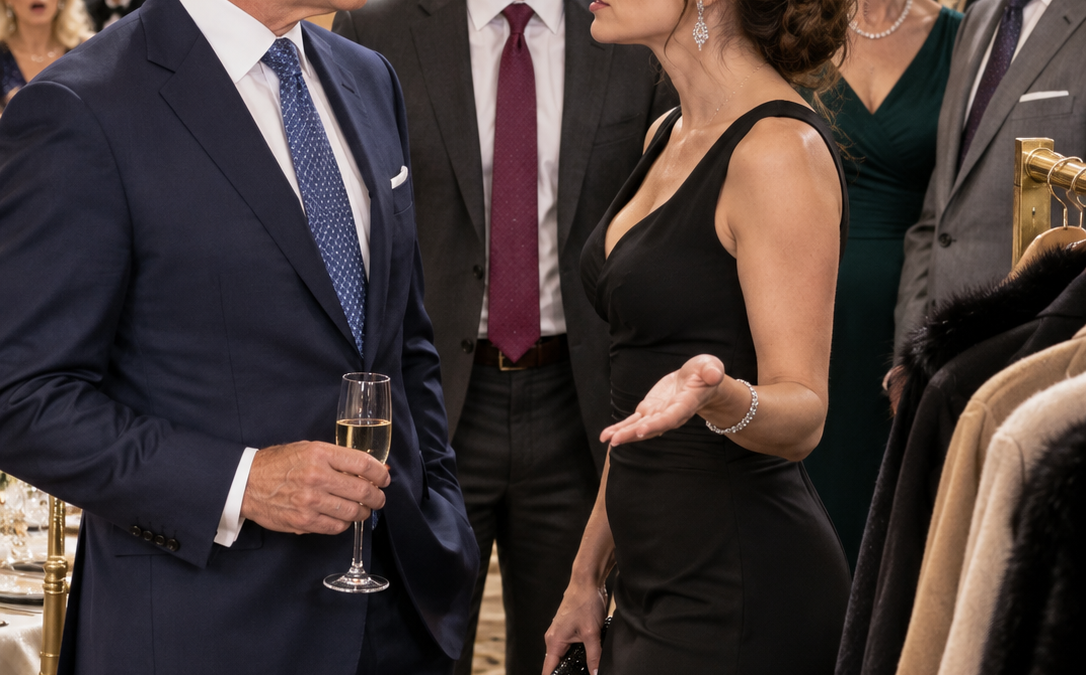
“Dad Bob, maybe you’d be more comfortable helping with the coat check. They could use volunteers.”
The coat check.
“It’s important work,” she continued. “Someone needs to handle the guests’ wraps.”
I looked at the group surrounding me. Victoria’s parents, my son and daughter-in-law, two other couples I didn’t recognize. All of them waiting for me to accept my proper place.
“So, let me understand this,” I said quietly. “You want me to take coats while you enjoy dinner.”
“It’s volunteer work,” Bradley said. “Community service. You said you liked helping people.”
“I do like helping people.”
Mrs. Hartford smiled condescendingly.
“Wonderful. The coat check is right by the entrance. Very visible position.”
“Very visible,” I repeated.
“And afterward,” Victoria added, “we could drive you home. Save you the trouble of staying for the whole event.”
I looked around the ballroom. Doctors, lawyers, business owners, politicians. People who’d worked hard, built successful careers, earned their places at tables like these.
People like me.
“Tell me something,” I said to Bradley. “What exactly do you think I contributed to get invited tonight?”
“I don’t know. Maybe fifty dollars? A hundred?”
The group chuckled. Actual chuckles.
Mr. Hartford put his hand on my shoulder.
“Bob, every donation matters. No one’s judging you.”
“No one’s judging me?”
“Of course not. We all give what we can afford.”
I removed his hand from my shoulder.
“And what can I afford?”
“Well,” Mrs. Hartford said delicately, “Victoria mentioned you’re transitioning to assisted living. So, probably not very much.”
“Probably not very much,” I repeated.
Bradley stepped closer.
“Dad, let’s not make this awkward. Just help with the coats, okay? It’s a good way to contribute.”
“A good way to contribute.”
“Yes. Everyone finds their own level.”
Victoria nodded enthusiastically.
“Exactly. You help with coats. We handle the financial donations. Teamwork.”
I stood there for ten seconds, looking at each face. My son, who thought his father was worth fifty dollars. My daughter-in-law, who wanted me taking coats like hired help. Her parents, who’d decided my level for me.
“You know what?” I said finally. “You’re absolutely right.”
Relief flooded their faces.
“I should find my appropriate level.”
“Exactly,” Bradley said.
“I should contribute what I can afford.”
“That’s the spirit,” Mrs. Hartford said.
“I should remember my place.”
Victoria beamed.
“Dad Bob, you’re being so reasonable.”
I smiled back at her.
“I try to be reasonable.”
A waiter passed with champagne. I took a glass and raised it toward my family.
“Here’s to finding your level,” I said.
They all raised their glasses, thinking they’d won.
“And here’s to contributing what you can afford.”
They clinked glasses with me, smiling.
“And here’s to remembering your place.”
They drank to that, too.
I took one sip of champagne and set my glass down on the nearest table.
“Excuse me,” I said. “I need to find the restroom before the program starts.”
I walked away, leaving them congratulating themselves on handling the Dad Bob situation so smoothly.
What they didn’t know was that in fifteen minutes, Judge Patricia Wilson would step up to the podium to begin the evening’s program.
What they didn’t know was that the first item on the agenda was recognizing major donors.
What they didn’t know was that the biggest donor in the room had just walked away from their little circle.
The man they’d assigned to coat check duty. The man whose level they’d determined for him. The man who was about to show them what contributing what you could afford really meant.
I found a quiet corner near the stage and checked my phone. One text message from Margaret Davis.
Everything ready. Judge Wilson has your intro. Press section briefed. It’s showtime.
I typed back, Let’s do this.
At eight-fifteen, Judge Patricia Wilson stepped up to the podium. She was an elegant woman in her sixties, silver hair perfectly styled, wearing a midnight-blue gown that probably cost more than most people’s monthly salary.
I stood in the back of the ballroom near the bar, watching my family at table twelve. Bradley was cutting his filet mignon. Victoria was taking photos of her plate for Instagram. Her parents were talking to the couple next to them, probably explaining how they’d handled the Bob situation so diplomatically.
“Ladies and gentlemen,” Judge Wilson began, “welcome to the fifteenth annual Children’s Hospital Charity Gala.”
Polite applause. Two hundred people who’d paid $5,000 each to be there, ready to feel good about their generosity.
“Before we begin tonight’s program,” the judge continued, “I want to recognize some very special people. The donors whose extraordinary generosity makes our work possible.”
I moved closer to the front, weaving between tables. Bradley still hadn’t noticed me. He was showing Victoria something on his phone, both of them laughing quietly.
“Our first recognition goes to donors who’ve contributed between fifty thousand and one hundred thousand dollars this year.”
A dozen people stood for applause. Doctors, lawyers, business owners. Respectable contributions from respectable people.
“Our second recognition goes to donors who’ve contributed between one hundred thousand and five hundred thousand dollars.”
Eight more people stood. Bigger applause. These were serious philanthropists, people who’d written checks that made a real difference.
I was now three tables away from Bradley, close enough to see his face clearly.
“Our third recognition,” Judge Wilson said, “goes to donors who’ve contributed between five hundred thousand and one million dollars.”
Four people stood. The applause was louder now. These were major players, people whose names would go on hospital wings.
Bradley looked up from his phone. He was scanning the room, probably wondering where I’d gone. His eyes passed right over me.
“And now,” Judge Wilson said, “I want to recognize someone very special. A man whose generosity has quite literally saved lives. A man whose contribution this year totaled two million dollars.”
The room went silent.
Two million dollars was serious money, even for this crowd.
I started walking toward the stage.
“This gentleman represents everything we hope to achieve through philanthropy,” Judge Wilson continued. “He built his success through hard work and determination, starting with nothing and creating something extraordinary.”
I was now walking between tables six and seven. People were looking around, trying to figure out who the mystery donor was.
“He sold his manufacturing company in 2019 for three hundred and forty million dollars. But you’d never know it from meeting him. He drives a modest car, lives simply, and gives generously without seeking recognition.”
Bradley’s head snapped up. He’d heard those numbers.
Three hundred and forty million.
His eyes were searching the room frantically now.
“The Wall Street Journal called him one of America’s most successful under-the-radar entrepreneurs. Forbes estimated his net worth at over four hundred million dollars.”
I was passing table nine now. Mrs. Hartford was staring at Judge Wilson with her mouth slightly open. Mr. Hartford had stopped eating entirely.
“But most importantly,” Judge Wilson said, “he’s a devoted father and a loving husband to his late wife, Sarah, whose memory he honors through his charitable work.”
Victoria had gone completely pale. She was looking around the room as though trying to solve a puzzle.
“Ladies and gentlemen, please join me in recognizing our evening’s guest of honor and largest donor, philanthropist Robert Miller.”
I stepped into the spotlight at the front of the room.
Two hundred people rose to their feet in thunderous applause.
I turned to look at table twelve.
Bradley was standing with everyone else, but his face had gone gray. His mouth hung open, and he looked like he was having trouble breathing. Victoria was gripping the table with both hands, staring at me like I was a ghost.
Mrs. Hartford had dropped her napkin. Mr. Hartford was looking back and forth between me and the judge, as though trying to understand how this had happened.
Judge Wilson gestured for quiet.
“Bob, would you like to say a few words?”
I walked to the podium and adjusted the microphone, then looked out at the crowd. Doctors who’d saved lives. Lawyers who’d fought for justice. Business leaders who’d created jobs. Politicians who’d served their communities.
People like me.
“Thank you, Judge Wilson,” I said, my voice carrying clearly through the sound system. “And thank you all for being here tonight.”
I paused, letting my eyes sweep across the room.
“Thirty years ago, I started Miller Manufacturing in a rented garage in Stamford. I had twelve hundred dollars, a high school diploma, and dirty fingernails.”
Scattered chuckles came from the audience. They thought I was being humble.
“I spent the first five years sleeping on a cot in my office, working eighteen-hour days, learning that success isn’t about what people think of you. It’s about what you build when no one’s watching.”
I found table twelve again. Bradley was staring at me with an expression I’d never seen before. Complete shock mixed with something that might have been recognition.
“By year ten, we employed two hundred people. By year twenty, we were the largest specialty manufacturer in New England. When I sold the company three years ago, we employed eight hundred and thirty-seven people across four states.”
The applause started again, but I raised my hand to stop it.
“The Wall Street Journal article Judge Wilson mentioned ran on March fifteenth, 2019. The headline was Connecticut Entrepreneur Sells Manufacturing Empire, Plans Anonymous Philanthropy.”
I pulled a folded newspaper clipping from my jacket pocket.
“I’ve kept this article in my wallet for three years. Not because I’m proud of the money. Money is just a tool. I kept it because of what it says about the responsibility that comes with success.”
I opened the clipping and read directly from it.
“Miller, fifty-nine, plans to focus on charitable giving in his retirement, particularly organizations serving children and families. When asked about his philanthropic philosophy, Miller said, ‘True wealth is measured by what you give away, not what you keep.'”
I folded the paper and put it back in my pocket.
“Tonight, I’m honored to present the Children’s Hospital with a check for two million dollars.”
I reached into my other jacket pocket and pulled out a folded check, holding it up so the room could see it.
“This donation is made in memory of my late wife, Sarah Miller, who always believed that our greatest obligation is to help those who can’t help themselves.”
The applause was deafening now. People were actually cheering.
But I wasn’t looking at them.
I was looking at my son, who was still standing at table twelve with tears in his eyes. I was looking at my daughter-in-law, who had both hands over her mouth. I was looking at her parents, who were staring at me like they were seeing me for the first time.
Judge Wilson took the microphone back.
“Ladies and gentlemen, Robert Miller, Greenwich’s most generous and most humble philanthropist.”
As I walked back toward table twelve, every person I passed wanted to shake my hand, introduce themselves, and thank me for my generosity.
But all I wanted was to have a conversation with my family.
A conversation about respect.
I didn’t go back to table twelve right away. Instead, I spent twenty minutes moving through the ballroom, shaking hands with people who suddenly knew exactly who I was.
Dr. Sarah Johnson, chief of pediatric surgery, approached me.
“Mr. Miller, your donation will fund our new cardiac unit. You’re literally saving children’s lives.”
Then Congressman David Williams came over.
“Bob, I had no idea you were the Miller behind Miller Manufacturing. Your company employed half of Stamford at one point.”
Margaret Chen, the hospital board chair, also introduced herself.
“Mr. Miller, we’ve been hoping to meet you for years. Your anonymous donations have kept us running.”
Through it all, I could feel eyes on me from table twelve.
My family was watching their simple Dad Bob work the room like he belonged there.
Because I did belong there.
Finally, I walked over to their table. The other two couples had moved away, probably sensing this was about to become a private family moment.
Bradley stood up as I approached.
“Dad, I… we had no idea.”
I pulled out the empty chair next to Victoria.
“May I sit?”
“Of course,” Mrs. Hartford said quickly. “Please.”
I sat down and folded my hands on the table. I couldn’t help remembering Victoria spreading her fabric samples across my coffee table, planning to redecorate my house.
“So,” I said quietly, “I believe we were discussing my appropriate level.”
No one spoke.
“And my ability to contribute what I can afford.”
Victoria stared at her plate.
“And the importance of remembering my place.”
Bradley cleared his throat.
“Dad, we owe you an enormous apology.”
“Do you?”
“Yes. We had everything wrong.”
I nodded slowly.
“What did you have wrong?”
“We thought… we assumed…” He struggled with the words. “We didn’t understand your situation.”
“My situation?”
“Your financial situation.”
“Uh-huh.”
I picked up the water glass in front of me.
“What exactly did you think my financial situation was?”
Bradley glanced at Victoria, then back at me.
“We thought you were struggling. Living paycheck to paycheck, unable to afford the house.”
“Based on what?”
“Based on the way you live. The car you drive. The clothes you wear.”
“The way I live?”
“Yes.”
I took a sip of water.
“Tell me, son, what’s wrong with the way I live?”
“Nothing’s wrong with it. It’s just…”
“Just what?”
“Just not what we expected from someone with your resources.”
I set the water glass down carefully.
“Someone with my resources should live differently?”
“Well, yes. I mean, you could afford so much more.”
“I could afford more.” I looked around the table. “More what?”
Mrs. Hartford spoke up hesitantly.
“More appropriate things. A better car, better clothes, a lifestyle that reflects your success.”
“A lifestyle that reflects my success,” I repeated slowly.
I turned toward her.
“Mrs. Hartford, what exactly does success look like to you?”
“Well, it looks like quality, sophistication, the finer things.”
I nodded.
“The finer things.”
I reached into my jacket pocket and pulled out my car keys, setting them on the table.
“These are the keys to my 2018 Toyota Camry. It has seventy-three thousand miles on it. I bought it used for eighteen thousand dollars.”
They all stared at the keys.
“This car has never failed to start, never left me stranded, never required major repairs. It gets thirty-two miles per gallon and will probably run for another hundred thousand miles.”
I picked up the keys and put them back in my pocket.
“Now, Mr. Hartford, you drive a Bentley. What did that cost you?”
He shifted uncomfortably.
“That’s… that’s not really relevant.”
“Humor me.”
“About two hundred thousand dollars.”
“Two hundred thousand dollars.”
I did the math out loud.
“That’s eleven times what I paid for my car. Does your Bentley get you to your destination eleven times faster than my Toyota?”
“Well, no.”
“But does it provide eleven times more transportation value?”
“It’s not about transportation value. It’s about image.”
“Image.”
I turned to Victoria.
“Tell me about image.”
She looked like she wanted to disappear.
“Dad Bob, I’m sorry about what I said about your clothes and everything.”
“What you said was that I didn’t understand standards. That you had a reputation to maintain.”
I pulled out my wallet and set it on the table.
“This wallet cost twelve dollars at Walmart. I’ve had it for six years.”
I opened it and pulled out a plastic card.
“This is my American Express Centurion card. Do you know what that is?”
Bradley nodded slowly.
“It’s a black card. Invitation only.”
“Invitation only. They don’t give these to people who can’t afford them.”
I put the card back in my twelve-dollar wallet.
“But apparently, it doesn’t help my image.”
The silence at the table was deafening.
I reached into my jacket and pulled out another folded paper.
“This is the deed to 47 Maple Ridge Road. My house. The house you signed over to yourselves three months ago.”
Bradley’s face went white.
“Dad, we can fix this. We can transfer it back.”
“Can you?”
I unfolded the paper.
“Because according to this document, I gifted the property to you and Victoria with no conditions attached.”
“We didn’t mean to—”
“Didn’t mean to what? Take my house?”
Victoria finally spoke.
“We thought we were helping you.”
“Helping me?”
“Yes. We thought you couldn’t afford it anymore.”
I folded the deed and put it back in my pocket.
“Victoria, do you know what my monthly expenses are?”
“No.”
“Take a guess.”
“I… I don’t know. Maybe four thousand dollars?”
“Four thousand dollars a month.”
I smiled.
“That’s what you wanted me to pay for assisted living.”
“We thought that was reasonable for your budget.”
“My budget?”
I pulled out my phone and opened my banking app, turning the screen toward them.
“This is my checking account balance. Just my checking account.”
Mrs. Hartford gasped. Mr. Hartford leaned forward to get a better look.
The number on the screen was $847,392.
“That’s just my spending money,” I said. “Money I keep available for daily expenses.”
I swiped to another account.
“This is my money market account for short-term investments. Two point three million dollars.”
Another swipe.
“This is my primary investment account. Eight point seven million dollars.”
One more swipe.
“And this is my charitable foundation account. Twelve point four million dollars.”
I put the phone back in my pocket.
“So, when you say I can’t afford my house, what exactly are you basing that on?”
No one answered.
“When you say I need help with expenses, what expenses are those?”
Still silence.
“When you say I should live in assisted living because it’s more appropriate for my situation, what situation is that?”
Bradley finally found his voice.
“Dad, we made a terrible mistake.”
“Yes, you did.”
“We’ll fix it. We’ll transfer the house back immediately.”
I shook my head.
“No, you won’t.”
“What?”
“You’re not transferring anything back, Bradley.”
“I don’t understand.”
I stood up from the table.
“Tomorrow morning, my attorney will serve you with a formal notice. You have thirty days to vacate the premises.”
Victoria’s eyes went wide.
“You’re evicting us?”
“I’m reclaiming my property. There’s a legal principle called rescission of gift due to changed circumstances. When someone accepts a gift under false pretenses, the gift can be legally revoked.”
Bradley stood up, too.
“Dad, please. We can work this out.”
“We are working it out. Legally. Properly. The way you wanted to handle everything.”
I pulled one more document from my jacket.
“This is the termination notice for your trust fund, Bradley.”
“What trust fund?”
“The one that’s been paying your law firm’s rent for the past three years. The one that’s been covering your BMW lease. The one that’s been supplementing your salary so you could afford your lifestyle.”
His face went gray.
“Dad, I didn’t know that money came from you.”
“You didn’t ask where it came from. You just spent it.”
I handed him the termination notice.
“Effective immediately, all financial support ends. Your rent, your car lease, your credit card payments. All of it.”
Mrs. Hartford looked panicked.
“Robert, surely we can discuss this reasonably.”
I turned to her.
“Mrs. Hartford, three hours ago, you wanted me to work coat check because it was my appropriate level. Now you want to discuss things reasonably?”
“We made a mistake.”
“You made a choice. You chose to judge me based on appearances. You chose to decide my worth without knowing anything about me. You chose to treat me like hired help.”
I picked up my water glass and finished it.
“Now you get to live with those choices.”
The news traveled fast in Greenwich.
By Saturday morning, three days after the gala, everyone in town knew the story. The simple retiree from Maple Ridge Road was actually Robert Miller, the manufacturing mogul who’d sold his company for $340 million.
The Greenwich Time ran a front-page story: Local Philanthropist Revealed as Major Donor.
They used the photo from the gala where I was handing the two-million-dollar check to Judge Wilson.
But the real story was spreading through social media and coffee shop conversations. The story of a son who tried to put his millionaire father in assisted living. A daughter-in-law who assigned him to coat check duty at a charity gala. A family who learned the hard way not to judge a book by its cover.
I spent Saturday morning in my garden the same way I’d spent every Saturday for thirty years.
But this time, I had visitors.
The first was Margaret Davis, carrying a thick folder of legal documents.
“Bob, the eviction notice has been served. Bradley and Victoria have thirty days to remove their belongings from the house.”
“Any response from them?”
“Bradley called my office six times yesterday. He wants to negotiate.”
I kept weeding around Sarah’s rose bushes.
“What’s to negotiate?”
“He’s offering to pay rent. Market rate. Fifteen thousand a month.”
“Fifteen thousand.”
I pulled up a particularly stubborn dandelion.
“Three months ago, he thought I couldn’t afford four thousand for assisted living. Now he wants to pay fifteen thousand to live in my house.”
“He also offered to sign a formal apology. Something about acknowledging his lack of judgment and respect.”
I stood up and brushed dirt off my knees.
“Margaret, what would you do?”
“Honestly? I’d let them sweat for a while. They need to understand consequences.”
The second visitor was Dr. Patricia Chen from the hospital foundation. She drove up in a Tesla and knocked on my front door at eleven in the morning.
“Mr. Miller, I hope you don’t mind me stopping by. I wanted to thank you personally for your donation.”
I invited her in for coffee.
We sat in my kitchen, the same kitchen where Bradley had spread out real estate listings, planning to sell my house.
“Your gift will fund our new pediatric cardiac unit,” Dr. Chen said. “We’ll save at least fifty children’s lives in the first year alone.”
“That’s what matters.”
“May I ask you something personal?”
“Sure.”
“How long have you been giving anonymously?”
I poured her a second cup of coffee.
“Since I sold the company. Three years.”
“And your family never knew?”
I shook my head.
“My wife knew. She helped me plan the charitable foundation before she died. But after that, I kept it quiet.”
“Why?”
I looked out the window at Sarah’s garden.
“Because the moment people know you have money, they treat you differently. They stop seeing you as a person and start seeing you as a bank account. Even family. Especially family.”
Dr. Chen set down her coffee cup.
“Mr. Miller, the hospital board would like to name the new cardiac unit after you and your wife. The Miller Sarah Pediatric Cardiac Center.”
“I appreciate that, but I’d prefer to stay anonymous.”
“Are you sure? After what happened at the gala, your anonymity is already gone.”
She had a point.
By Monday morning, everyone in Greenwich would know exactly who I was.
The third visitor surprised me.
Victoria’s father, Charles Hartford, arrived at two in the afternoon, driving his Bentley. He looked smaller than I remembered, older somehow.
I met him on the front porch.
“Bob, I came to apologize.”
“Apologize for what?”
“For everything. For the way we treated you. For the assumptions we made.”
I gestured toward the porch chairs.
“Sit down, Charles.”
We sat in the same chairs where Margaret had briefed me on the legal documents three days earlier.
“Bob, I need you to know something. Victoria and Bradley are devastated.”
“Are they?”
“They’ve been crying for two days straight. They know they messed up.”
I looked across my front yard. Mrs. Peterson was walking her dog, but she kept glancing toward my house. Everyone was curious about the mysterious millionaire next door.
“Charles, let me ask you something. When you met me at that Christmas party, what did you think?”
He was quiet for a long moment.
“Honestly?”
“Honestly.”
“I thought Bradley had married beneath his station. I thought Victoria had settled.”
“Settled?”
“I thought she’d married into a working-class family. I was worried about our grandchildren, whether they’d learn proper values.”
“Proper values.”
“Bob, I know how that sounds now.”
I turned to look at him.
“It sounds like exactly what you believed then.”
“You’re right. And I was wrong.”
“What were you wrong about?”
“I was wrong about everything. About you, about what success looks like, about what really matters.”
A car pulled into my driveway.
Bradley’s BMW.
He got out slowly, like he was approaching a crime scene.
“Dad,” he called from the driveway. “Can we talk?”
I looked at Charles Hartford.
“Did you plan this?”
“He followed me here. He’s been driving around town for hours, trying to work up the courage to face you.”
Bradley walked up to the porch. He looked terrible. Unshaven, wrinkled clothes, dark circles under his eyes.
“Dad, I came to beg.”
“Beg for what?”
“For forgiveness. For a chance to make this right.”
I stood up.
“Bradley, sit down.”
He sat in the third porch chair, the one where Sarah used to read her morning paper.
“Tell me something,” I said. “What exactly do you want to make right?”
“Everything. The house, the trust fund, the way we treated you.”
“The way you treated me?”
“Yes.”
“How did you treat me?”
Bradley’s voice cracked.
“Like… I was ashamed of you.”
“Were you ashamed of me?”
“Yes.”
The word came out like a confession.
“I was ashamed that my father drove an old car and wore Walmart clothes and worked with his hands. And now… now I’m ashamed of myself.”
Charles Hartford stood up.
“Bob, I should go. This is between you and your family.”
After he left, Bradley and I sat in silence for several minutes.
“Dad, can I ask you something?”
“Sure.”
“Why didn’t you ever tell me about the company? The money? Any of it?”
I looked at my son. Really looked at him.
Thirty-four years old. Successful lawyer. Beautiful wife. Everything handed to him on a silver platter.
“Because I wanted you to respect me for who I was, not what I had.”
“But if I’d known—”
“If you’d known, you would have treated me differently. You would have been proud to introduce me at parties. You would have bragged about your successful father. But it wouldn’t have been real respect.”
Bradley started crying.
“Dad, I’m so sorry.”
“I know you are.”
“Can you ever forgive me?”
I stood up and walked to the porch railing, looking out at the neighborhood where I’d lived for twenty-five years. The neighborhood where, until three days ago, I was just Bob Miller, the quiet retiree who kept to himself.
“Bradley, forgiveness isn’t the issue.”
“What is?”
“The issue is trust. For thirty-four years, I’ve been the same man. I’ve never lied to you. Never pretended to be something I wasn’t. But you decided I wasn’t good enough.”
“I was wrong.”
“You were wrong about me. But you were right about yourself.”
He looked up sharply.
“What do you mean?”
“You are exactly who I raised you to be. Someone who judges people by their possessions. Someone who cares more about appearances than character. Someone who discards family when they become inconvenient.”
The words hit him like physical blows.
“Dad, please. I can change.”
“Can you?”
“Yes. I swear to you, I can change.”
I turned back to face him.
“Bradley, I love you. You’re my son, and that will never change. But love and trust are different things.”
“What do I have to do to earn your trust back?”
“I don’t know if you can.”
We sat there until sunset, not saying much. Just a father and son trying to figure out if thirty-four years of damage could ever be repaired.
Two weeks later, Bradley and Victoria moved out of my house.
They didn’t go far, just to a rental apartment in downtown Greenwich. Eight hundred dollars a month, more than they could afford without the trust fund, but they were managing somehow.
I watched from my kitchen window as the moving truck pulled away. Victoria carried a single suitcase to her car. Bradley took one last look at the house before driving off.
That evening, I had dinner alone for the first time in two weeks. No phone calls from lawyers. No visits from apologetic family members. No reporters asking for interviews about my philanthropic philosophy.
Just me, a grilled cheese sandwich, and Sarah’s photo on the kitchen table.
“Well, honey,” I said to her picture, “I think you would have approved.”
After dinner, I walked through every room in the house.
The living room where Bradley had opened Christmas presents for eighteen years. The dining room where we’d hosted Thanksgiving dinners. The bedroom where Sarah and I had shared thirty years of marriage.
It felt different now. Quieter, but also more peaceful.
My phone rang at eight that evening.
Bradley’s number.
“Dad?”
“Yes?”
“I wanted to call and… and thank you.”
“Thank me for what?”
“For evicting us.”
I sat down in Sarah’s reading chair.
“That’s not what I expected you to say.”
“These two weeks have been the hardest of my life, but also the most honest.”
“How so?”
“Victoria and I had to look at our bank statements for the first time ever. Had to figure out what we actually earn versus what we actually spend. Had to face reality.”
“And?”
“And we were living completely beyond our means. Everything we had, the lifestyle, the appearances, the status, it was all borrowed money. Your money.”
I looked out the window at the garden Sarah and I had planted together.
“What are you going to do about it?”
“We’re selling the BMW. Victoria’s getting a job, her first real job ever. We’re learning to live on what I actually make.”
“That’s good.”
“Dad, I have one more thing to ask you.”
“What’s that?”
“Will you have dinner with us? Not at some fancy restaurant. At our apartment. I want to cook for you.”
“You want to cook for me?”
“Yes. A meal I can afford. Food I bought with money I earned.”
I smiled for the first time in two weeks.
“What are you planning to make?”
“Spaghetti and meatballs with sauce from a jar. Nothing fancy.”
“I’d like that.”
“Really?”
“Really. But I have one condition.”
“Anything.”
“I drive myself in my Toyota Camry.”
Bradley laughed. The first genuine laugh I’d heard from him in months.
“Dad, I wouldn’t have it any other way.”
After I hung up, I walked out to my front porch and sat in Sarah’s chair. The neighborhood was quiet, streetlights just coming on. A few neighbors were walking their dogs.
Mrs. Peterson stopped in front of my house with her golden retriever.
“Good evening, Bob.”
“Evening, Mary.”
“How are you doing after everything that’s been in the papers?”
“I’m doing fine.”
She hesitated, then said, “Bob, I hope you don’t mind me saying this, but I’m… I’m proud of you.”
“Proud of me?”
“For standing up for yourself. For showing your family that respect goes both ways.”
I nodded.
“Thank you.”
“And Bob? For what it’s worth, I always knew you were special. Maybe not the details, but I knew you were more than you appeared to be.”
After she walked away, I sat there thinking about the past month. About assumptions and appearances. About family and respect. About the difference between being loved and being valued.
My phone buzzed with a text message from Victoria.
Dad Bob, thank you for teaching us what we should have learned long ago. We love you. We respect you, and we promise to earn back your trust, even if it takes the rest of our lives.
I typed back:
Love isn’t something you earn, but respect is. See you Sunday for dinner.
Then I put my phone away and looked up at the stars.
“Sarah,” I said quietly, “I think our boy is finally growing up.”
The truth is, I could have handled this whole situation differently. I could have pulled Bradley aside privately, shown him my bank statements, explained who his father really was. I could have avoided the public confrontation, the family drama, the painful lessons.
But sometimes the kindest thing you can do for someone is let them face the consequences of their choices. Sometimes love means setting boundaries, even when it hurts. Especially when it hurts.
My son learned that respect isn’t about what car you drive or what clothes you wear. He learned that true wealth isn’t about what you have; it’s about what you give. He learned that family loyalty works both ways.
Most importantly, he learned that his father, the man he’d been ashamed of for years, was worth respecting all along.
If you’re watching this, I hope you learned something, too. About the danger of judging people by appearances. About the importance of treating family with dignity. About the difference between being quiet and being weak.
And if you’ve got a family member you’ve been taking for granted, maybe it’s time to think about what respect really means.
Thanks for listening, and remember: sometimes the most powerful person in the room is the one who doesn’t need to prove it.
Tighten the repetitive middle sectionsClarify the deed transfer timeline








