My sister’s new boyfriend mocked me at dinner—everyone laughed, mom told me to “stop making the family look bad,” so i let them talk… until he mentioned his job, then i pulled out my phone—and watched their smiles fade.
My name is Tyler. I’m 26 years old, and if I had to summarize my family in one sentence, it would be this: Image matters more than integrity.
That probably sounds dramatic, but if you’ve ever had a mother who cared more about what the neighbors thought than about your mental health, or a sibling who could do no wrong even while doing everything wrong, you’d understand. My family wasn’t exactly abusive. They were performative. Everything was polished smiles, carefully chosen words, and holiday cards that looked like Hallmark had thrown up all over them. Scratch just a little beneath the surface, though, and all you’d find was ego, judgment, and an exhausting obsession with appearances.
I’d always been the odd one out. I was the quiet kid with a head full of ideas, the one who felt more comfortable building websites or tinkering with Python scripts than making small talk at church brunches. I earned a full scholarship in computer science and spent four years quietly developing a side project I never bothered telling my family about. Long story short, that project took off after graduation. There were software licensing deals, a modest early exit from part of the business, and some smart investments. Nothing outrageous. No yachts, no Teslas, no private jets. But it was enough that I could freelance when I wanted, travel occasionally, and live comfortably without attracting attention.
And that was exactly how I liked it.
My family, however, had somehow convinced themselves that I was still wandering aimlessly through adulthood, trying to figure out what to do with my life. My mother would casually drop comments like, “You’ll find your calling soon, sweetheart,” even after I’d bought my house outright.
Then there was my sister, Belle.
Belle was 28, a former beauty pageant contestant who’d studied communications and married her college sweetheart at 23. When that marriage crashed and burned the previous year because of what she called “irreconcilable ambition differences,” she moved back into our parents’ house for a while.
That was when things started getting strange.
Almost overnight, Belle became a whirlwind of self-reinvention. New hairstyle, new wardrobe, carefully curated Instagram aesthetic, and eventually a new boyfriend.
His name was Brad. Because, of course, it was.
He looked exactly like someone named Brad. Tall, tanned, perfectly trimmed beard, and the sort of expression that suggested he probably used the phrase “alpha energy” without a trace of irony. But the real surprise wasn’t Brad himself.
It was how much my family adored him.
My mother practically gushed every time his name came up, like she’d appointed herself his personal publicist.
“He’s very successful in finance,” she announced one evening, sipping her wine with the confidence of someone who understood absolutely nothing about the industry.
My father, who usually stayed out of conversations like that, simply nodded.
“He carries himself well.”
I’d met Brad briefly once at my parents’ house. It had been nothing more than a handshake and a casual, “Yo, man, what’s up?” But even during that short interaction, something about him hadn’t sat right with me. He was too slick, too rehearsed, too comfortable performing for an audience.
And the way Belle looked at him wasn’t quite love. It was performance, as though she wanted everyone watching to recognize that she’d finally leveled up.
I kept my opinions to myself, smiled politely, and went home. I figured Brad would eventually disappear, just like most of Belle’s other passion projects.
I was wrong.
About a week before everything happened, I got a text from my mother.
“Family dinner Sunday at 6:00. Be there. Belle’s bringing Brad.”
No emoji. No please. Just a commandment.
Typical.
I considered skipping it. It wasn’t as though anyone would genuinely miss me. But something about the wording got under my skin. It wasn’t an invitation. It was an obligation. My role was to show up, smile at the appropriate moments, and help maintain the illusion that we were one big, happy family.
Against my better judgment, I went.
I arrived ten minutes late that Sunday, partly because I wasn’t in a hurry and partly because I knew it would irritate my mother. She opened the door wearing perfectly applied lipstick and gave me the kind of disapproving look you’d expect if I’d arrived covered in mud.
“Tyler,” she sighed. “We were about to start.”
No hug. No hello.
I nodded and walked inside.
The dining room looked like something out of a lifestyle magazine. Crystal glasses, neatly folded cloth napkins, expensive dishes, and my mother’s signature overcooked roast. Everyone was already seated. Dad occupied the head of the table, slowly sipping his scotch. Belle was dressed like she was attending a charity gala, and Brad sat leaning back in his chair as though he owned the place.
“Yo, what’s up, bro?” he called, flashing that irritating grin. “Nice of you to finally show up.”
I gave him a thin smile.
“Traffic.”
He snorted.
“Right. In this town?”
My mother cleared her throat and motioned for me to sit, looking like a stage director trying to get her last actor into position before the curtain rose.
For the first few minutes, things were relatively harmless. We talked about work, the weather, and some news involving a cousin I barely remembered. I even began to think the evening might not be so terrible.
Then Brad started making jokes.
He launched into a story about a coworker who had tried to start a side business.
“Dude seriously thought he was gonna be the next Zuckerberg,” Brad said, laughing at his own story. “Made, like, five bucks and started calling himself an entrepreneur.”
Everyone chuckled.
My mother laughed the loudest. Belle even pretended to wipe a tear from the corner of her eye.
I didn’t say anything, but Brad turned toward me with an expression that made his intentions painfully obvious.
“You ever try anything like that, Tyler? I heard you’re into that tech stuff.”
I shrugged.
“A little.”
He smirked.
“You should talk to this guy I know. He teaches coding to high schoolers. Pretty solid gig for people who can’t break into real development jobs.”
Belle laughed.
“Ouch, Brad.”
But she didn’t defend me. She just took another sip of wine.
I glanced at my mother. Nothing. Not even the smallest flicker of disapproval.
So I smiled.
“Sounds like a great fallback for someone like you.”
Brad’s smirk faltered for a fraction of a second before he recovered.
“Nah, man. I’m good. I’m in finance. You know, real-world stuff.”
My father chuckled.
“We could use a little more of that around here.”
That one stung.
It shouldn’t have, but it did.
I’d helped my father set up a budgeting application the previous year. I’d literally automated half his financial management. But apparently Brad, the mysterious finance guy with the perfect beard, was the real success story.
I stayed quiet for the rest of the meal, letting them enjoy their smug little echo chamber.
But inside, my mind was working.
Because there was something I knew that they didn’t. Something Brad definitely wouldn’t have wanted me bringing up at the dinner table.
Earlier that week, acting on a strange hunch, I’d searched his name online. It hadn’t been some elaborate investigation, just one of those instincts I couldn’t ignore. And what I’d found suggested that Brad’s definition of working in finance was considerably more flexible than most people’s.
I didn’t mention it.
Not yet.
I just sat there and waited while they continued talking. And then, shortly after dessert, Brad opened his mouth again.
That was when everything began to change.
There’s a particular kind of loneliness that comes from sitting at a dinner table while everyone laughs at a joke that isn’t funny to you. Not because you don’t understand it, but because you understand it perfectly.
You’re the joke.
And everyone knows it.
Worse, everyone seems perfectly comfortable with it.
That was exactly how I felt sitting there, picking at a piece of dry roast beef while Brad held court like a motivational speaker delivering a private TED Talk.
Belle hung on his every word as though he were handing out investment advice straight from heaven. My father leaned forward whenever Brad spoke, nodding like a bobblehead. My mother wore that glassy-eyed expression she usually reserved for country club women whose husbands were doctors.
And there I was, watching my own humiliation unfold like a spectator.
“So anyway,” Brad continued, patting his stomach and pushing his empty plate away, “our firm’s launching a new algorithmic fund next quarter. Real cutting-edge stuff. You wouldn’t believe how much backend work I’ve had to oversee.”
“Backend work?” I asked mildly, turning my fork between my fingers.
He glanced at me.
“Yeah. Quantitative models, predictive analytics. Finance nerd stuff, you know.”
He chuckled, apparently amused by his own expertise.
“Oh, sure,” I said. “Sounds complex.”
“It is.” He leaned back. “You ever think about getting into real business, Tyler? Or is the dream still coding in your pajamas and drinking Red Bull at two in the morning?”
Belle burst out laughing.
“Brad, stop,” she said, though her expression made it clear she didn’t actually want him to stop. “Tyler’s always been more of a passion-project kind of guy.”
My mother didn’t laugh this time.
Instead, she gave me that familiar tight-lipped look, the passive-aggressive expression she’d perfected over decades of making everyone around her feel smaller.
“Tyler,” she said, “we’ve talked about this. You have to let people tease you sometimes. It’s how we connect.”
I stared at her.
“Tease or belittle?”
Her expression hardened.
“Don’t make a scene.”
There it was.
The sentence I’d heard a thousand times growing up.
Don’t make a scene.
Translation: Don’t make us look bad. Don’t make us uncomfortable. Don’t disturb the illusion.
I leaned back in my chair.
“Didn’t realize being mocked at dinner counted as bonding.”
Brad raised an eyebrow.
“It’s all in good fun, man. No need to get defensive.”
I didn’t answer. I just looked at him long enough that his confident smile briefly slipped.
My father finally interrupted.
“All right, all right. Let’s move on.” He turned toward me. “Tyler, you doing anything interesting these days?”
I knew he wasn’t genuinely interested. It was a lifeline disguised as small talk, a convenient way to smooth over the tension without addressing what had caused it.
“Working on a few projects,” I replied. “Keeping busy.”
Brad snorted again, which seemed to be his default response to anything I said.
“What kind of projects? Or is that top secret?”
I looked at him.
He didn’t blink.
He was trying to humiliate me again, and he knew it.
Before I could respond, my mother released a long, exaggerated sigh.
“Tyler, please. Can we not do this tonight? You’re making things awkward.”
I froze.
Every pair of eyes at the table turned toward me.
Apparently, I was the problem.
Not Brad, who had been taking shots at me all evening. Not Belle, who giggled through every insult like she was enjoying an open-mic comedy show.
Me.
Something twisted in my chest, something heavy and familiar.
It was the same feeling I’d had in high school whenever Belle threw a tantrum over something she’d done wrong and I ended up grounded because I was supposed to be the bigger person.
The same feeling I’d experienced when I earned a full scholarship to a university three states away, and my mother responded by saying, “You’ll change your mind, sweetheart. You don’t really want to leave your family, do you?”
As if pursuing my own future made me selfish.
I clenched my jaw.
“Sure,” I said tightly. “Let’s not make things awkward.”
The conversation moved on.
They talked about mutual friends, vacation plans, and somebody’s neighbor’s dog. I barely listened. I nodded when appropriate, occasionally sipped my water, and kept my face carefully neutral.
But something inside me was building.
It wasn’t just one comment or two. It was years of quiet contempt wrapped in polite smiles and forced laughter, suddenly bubbling to the surface. Every dismissal. Every time I’d been overlooked or told to be quieter, smaller, more agreeable.
And now there was a shiny new golden boy sitting across from me, a man who apparently had permission to say whatever he wanted as long as he looked impressive while doing it.
Eventually, dessert was cleared away.
It had been a store-bought cheesecake, although my mother had enthusiastically allowed everyone to believe she’d made it herself. The wine had done its work, and the table had settled into that comfortable, slightly careless atmosphere that comes after a long meal.
My father leaned back with a satisfied grunt. Belle was scrolling through Instagram, showing Brad something on her phone.
Then Brad looked up.
“So anyway, I actually gave a talk last week on fintech disruption,” he announced. “My team’s been working with this new predictive analytics firm. Startup Stream, or something like that. Tiny little development company. Barely anyone’s heard of them.”
My hand stopped moving.
Brad continued.
“They’ve got good tech, though. We’re probably gonna buy their platform outright in a few months.”
I slowly set down my glass.
“Startup Stream?” I asked.
My voice was calm. Almost conversational.
“Yeah,” Brad said. “You’ve heard of them?”
“A bit.”
He smiled.
I leaned forward slightly.
“What’s your involvement, exactly?”
He grinned, pleased to have another opportunity to impress the room.
“I’m kind of the guy who does the talking, you know? Front-facing. I smooth the deals, make sure the numbers align. Some of the executives don’t like working directly with the code people. Gets too technical.”
“The code people,” I repeated flatly.
“Yeah.” He didn’t seem to notice my tone. “No offense, but those guys aren’t exactly business-minded. Brilliant in their own way, sure, but not really cut out for the big table.”
“The big table,” I echoed.
By then, everyone was watching us.
Belle wore a nervous little smile. My father looked puzzled. My mother had begun frowning.
Brad, oblivious to the change in atmosphere, kept talking.
“Anyway, we’ll probably fold their tools into our infrastructure and maybe hire a few of their developers if they can keep up. It’s a win-win.”
I let the silence stretch for a moment.
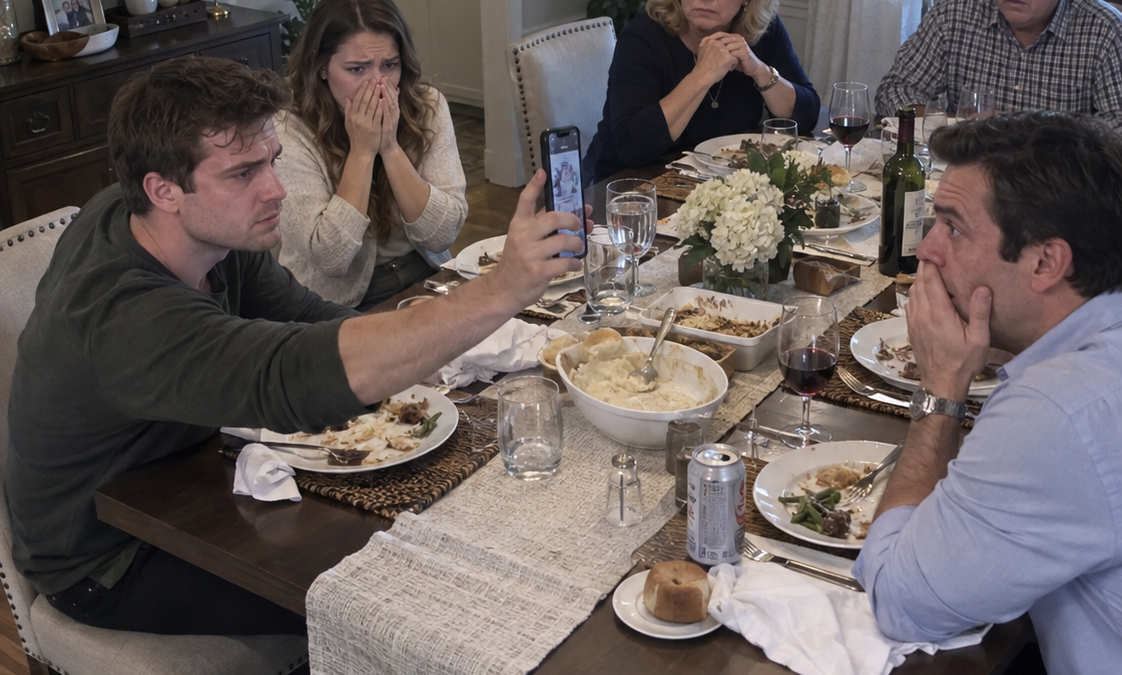
Then I reached into my pocket and took out my phone.
“What are you doing?” my mother asked sharply.
I ignored her.
I opened my email, scrolled through several messages, and found the one I wanted.
“Startup Stream,” I said, looking at Brad. “That predictive analytics firm. The one your company is supposedly about to buy.”
Brad raised his eyebrows.
“Yeah?”
“Cool.”
I turned the phone toward him.
“Because I own it.”
Silence.
Not the awkward kind of silence where someone coughs or nervously changes the subject.
Complete, heavy, absolute silence.
It was as though someone had pointed a remote control at the entire dining room and pressed pause.
Brad’s smirk melted into confusion, then into something that looked remarkably like panic.
My mother blinked.
“What are you talking about?”
I stood slowly, keeping my voice steady.
“Startup Stream is my company. I built it. Last year, I licensed our core product to three separate hedge funds, and one of them happens to be the firm you work for, Brad.”
I looked directly at him.
“I’ve had three meetings with your department heads. I didn’t recognize your name because you weren’t in any of them.”
Brad had gone pale.
His mouth opened, closed, and opened again, but nothing came out.
Belle looked like she’d just watched a car crash happen in slow motion.
My father straightened in his chair.
“Wait. What?”
I looked around the table.
“I never mentioned it because I knew exactly how this would go. Nobody would’ve believed me. Every time I’ve tried to share something real with this family, you’ve treated it like a phase, a joke, or something to roll your eyes at.”
My mother finally found her voice.
“You mean to tell me you own a tech company? Since when?”
“Since three years ago.”
“You never said anything!”
“Would it have mattered if I did?” I asked. “You all made up your minds about me a long time ago.”
Brad stood, too. His confident posture had disappeared, replaced by nervous, restless movements.
“Look, man, I didn’t know, okay?”
I cut him off.
“Exactly. Because if you had known, you wouldn’t have said half the things you said tonight. You probably wouldn’t have said anything at all.”
He glanced toward Belle, apparently hoping she would step in and rescue him.
She stared at the table.
I took one last look around the room, at the people who were supposed to be my family.
There’s a special kind of silence that happens when people suddenly realize the version of you they’ve constructed in their minds has nothing to do with reality.
It isn’t the peaceful quiet of reflection or remorse. It’s the stunned, hollow stillness of wounded egos trying desperately to rearrange themselves.
That’s what I saw that evening.
Brad’s jaw tightened. My mother blinked repeatedly, as though someone had unplugged her and she was struggling to reboot. Belle looked at me with a strange combination of confusion, embarrassment, and something dangerously close to shame.
My father sat back like a man watching the foundation of his own house begin to shift.
And I stood there with my phone in my hand, my pulse pounding.
Not because I was proud.
Not even because I wanted revenge.
I was exhausted.
Exhausted from years of swallowing words, from making myself smaller for people who’d never once thought to ask what I was building during all those hours I spent alone in my room.
They’d only ever seen a boy with a laptop.
Never a man with a plan.
I could have unloaded everything right then. I could have explained exactly how little Brad actually knew about his own firm’s negotiations, how they’d been lowballing us for weeks, and how he hadn’t even been included in the meetings.
I could have humiliated him beyond anything he’d tried to do to me.
But I didn’t.
Something inside me, perhaps the last remaining piece of the boy who’d spent his childhood trying to please everyone, told me it simply wasn’t worth it.
Not anymore.
So instead, I said the one sentence that made the entire room implode.
“I’m selling Startup Stream. The deal closes Friday.”
My mother gasped.
“You’re what?”
“It’s been in the works for months. I signed the papers last week.”
Belle stared at me.
“Wait, like selling selling? For how much?”
I held her gaze for a moment.
“Enough.”
Brad made a strangled noise.
“To who?”
I turned toward him.
“That’s not your concern.”
Then I walked out.
I didn’t wait around for another conversation. I didn’t apologize, and I didn’t say goodbye.
I simply left them sitting in that dining room like mannequins frozen in the middle of a performance.
That night, I barely slept.
You’d think walking out like that would have been satisfying. And part of it was. But underneath the relief was something heavier, something I hadn’t expected.
I kept replaying their expressions, the stunned silence, and all those years I’d spent hiding my success because I didn’t want to become the kind of person who used money to make everyone else feel inferior.
I’d never wanted to be that arrogant tech guy who announced he’d made it and was therefore better than everyone else. I didn’t want to rub my achievements in anybody’s face.
But apparently, they’d never had a problem rubbing mine in the dirt.
Now, for the first time in my life, I had nothing left to prove to them.
Still, here’s the thing about walking away: Just because you leave doesn’t mean the bruises disappear.
The days following that dinner were strangely quiet.
No texts. No phone calls. Not even one of my mother’s passive-aggressive messages suggesting that we needed to talk.
I’d half expected an elaborate guilt trip or a sudden flood of messages pretending nothing had happened.
Instead, there was silence.
At first, I welcomed it. But loneliness has a strange way of becoming louder when it follows disappointment, and I wasn’t immune to that feeling.
I didn’t fall apart. I wasn’t sitting around in some pit of despair. But I felt hollow, disconnected, as though I’d finally released a rubber band that had been stretched too tightly for years and no longer knew what to do with the slack.
So I buried myself in the sale.
The paperwork was brutal. Even with lawyers and consultants handling most of the technical details, selling a company you’ve built from the ground up feels like dismantling your own house. You pull up floorboards, inspect every corner, and make sure there isn’t a rotting beam hidden somewhere beneath the structure.
Still, the process gave me something to focus on.
There were documents to review, signatures to collect, and decisions to finalize.
And then Friday arrived.
I signed the final document at 10:07 that morning.
A minute later, a confirmation appeared on my screen.
Just like that, it was done.
I stared at my laptop for a long time.
My bank account now reflected a number that didn’t seem real. There were enough zeros to make my old high school economics teacher proud, enough money to change my life ten times over, and enough that I could disappear from everyone’s radar permanently if I wanted to.
But instead of celebrating, I closed my laptop and went for a walk.
I ended up at a small downtown coffee shop where I’d worked during college. They still served the same slightly burnt espresso, and the little table by the front window still wobbled whenever someone leaned on it.
I sat there for nearly an hour, watching pedestrians drift past the glass and wondering what came next.
For years, I’d worked toward building something meaningful. Now that I’d accomplished it, I was surprised by how uncertain the future suddenly felt.
That was when my phone buzzed.
A text from Belle.
“Hey, you around?”
I stared at the message.
For a moment, I considered deleting it and pretending I’d never seen it. But curiosity, or maybe plain stupidity, eventually got the better of me.
“Yeah,” I typed back.
She sent me an address.
It wasn’t our parents’ house. It was her apartment, the small place she’d been staying in since her divorce.
I thought about it for a while, finished my coffee, and decided to go.
When Belle opened the door, I almost didn’t recognize her.
She was wearing sweatpants and an oversized hoodie. Her hair was pulled back, and there wasn’t a trace of makeup on her face.
No perfect outfit. No carefully arranged expression. No performance.
Just Belle.
The sister I remembered from childhood, back when we’d sit at the kitchen table eating cereal before school, before everything became a competition over appearances.
She stood there silently for a moment.
Then she asked softly, “You wanna come in?”
I nodded.
Her apartment was small and cluttered. Half-unpacked boxes sat in one corner, and a forgotten wineglass rested on the kitchen counter. She motioned toward the couch, and we sat down.
“Look,” she began, twisting her hands together. “I didn’t know about the company. About any of it.”
I didn’t answer.
She started playing with the drawstring of her hoodie.
“Brad’s… well, you saw what he’s like. I thought he was this stable, confident guy after the divorce. I wanted someone who understood me, you know?”
I raised an eyebrow.
“So you brought him to dinner to parade him around?”
Her cheeks reddened.
“I didn’t expect him to be that bad. And I definitely didn’t expect you to drop a bomb like that.”
“I didn’t plan to,” I said. “But he kept pushing, and nobody stopped him.”
Belle let out a long sigh.
“That’s kind of how we are, isn’t it? We perform. We keep up appearances. We don’t rock the boat.”
I nodded slowly.
“Yeah. And the boat’s been sinking for years.”
She didn’t respond immediately.
Then she looked at me.
“Mom’s freaking out.”
I gave her a skeptical look.
“About what? The company?”
“Not just that. About what she missed. She called me yesterday crying. Said she thinks she failed you somehow.”
I almost laughed.
“Now she notices.”
“She’s not good at saying she’s sorry,” Belle admitted. “She thinks if she ignores something long enough, everything eventually resets.”
“Yeah,” I said. “That sounds familiar.”
Belle looked down at her hands.
“I’m not asking you to forgive her. But maybe you could talk to her? She’s not sleeping.”
I remained silent.
“Dad’s pretending everything’s fine,” she continued. “But I heard him talking to Uncle Ray.”
“What did he say?”
Belle hesitated.
“He said you embarrassed the family.”
I stared at her.
“I embarrassed the family?”
She nodded, wincing.
“That’s the story they’re telling themselves.”
I leaned back against the couch.
“Yeah. Figures.”
We talked for a while longer.
Belle apologized again, and this time there was nothing rehearsed about it. She wasn’t trying to make herself look good or win an argument. She was awkward, vulnerable, and plainly uncomfortable with the things she was admitting.
For once, she felt like a real person instead of the carefully polished version of herself she’d spent years presenting to the world.
And despite everything, I found myself softening a little.
She was still my sister.
Maybe, just maybe, she was beginning to understand that I was more than the family’s convenient punching bag.
But understanding wasn’t the same thing as repairing years of damage.
I left her apartment without making any promises.
I didn’t text my mother. I didn’t call my father.
Instead, I booked a trip.
Two weeks away. No laptop, no work, no family obligations.
Just me, a cabin near the coast, and enough empty hours to think about what I actually wanted from my life.
It turned out to be one of the best decisions I’d ever made.
I went hiking. I read books I’d been meaning to finish for years. I cooked my own meals and sat on the porch after dark, listening to the wind moving through the trees.
There were no judgments, no expectations, and nobody telling me who I was supposed to be.
Only stillness.
Slowly, something inside me began to rebuild.
There were no dramatic declarations or inspirational Instagram posts. I didn’t announce that I was starting a new chapter.
I simply began thinking about the future.
Not about making more money. Not about earning prestige. Not about proving that I was better than Brad or more successful than Belle.
About myself.
I’d already won the game my family didn’t even realize I was playing.
Now it was time to stop playing for them altogether.
By the time I returned home, I had a plan.
It wasn’t about revenge, and it wasn’t about proving anybody wrong.
It was about freedom.
But, of course, nothing in my family ever stayed quiet for long.
When I got home, there was a letter waiting for me.
No return address.
I opened the envelope and found a wedding invitation.
Belle and Brad.
There was also a small handwritten note from my mother.
“We hope you’ll come. Family is everything. Let’s not let one dinner ruin that.”
I must have read those words five times.
Let’s not let one dinner ruin that.
As though the dinner had been some tiny misunderstanding. As though all those years of dismissive comments, humiliation, and quiet resentment could be brushed beneath the rug with everything else my family had conveniently forgotten.
I stood in my hallway holding the invitation in one hand and my mother’s note in the other.
The house was completely silent.
Not the peaceful silence I’d grown to appreciate during my trip. This was the kind of silence that seemed to scream.
I wasn’t angry.
Not immediately.
What I felt was colder and clearer than anger.
It was the sharp realization that the people who were supposed to know me better than anyone still didn’t know me at all.
Family is everything.
That was rich.
Because if family really was everything, maybe they should have started treating me like something.
I sat down at my kitchen counter and opened the invitation again.
The wedding was scheduled for two months later. A garden ceremony, formal attire, dinner and dancing at a boutique hotel about an hour outside the city. The RSVP deadline was at the end of the month.
My name had been handwritten across the envelope in my mother’s familiar looping cursive, as though that little personal touch somehow made everything more sincere.
She hadn’t contacted me for weeks after the dinner.
Now, suddenly, there was a wedding to organize, flowers to arrange, and a guest list to finalize.
Apparently, that was enough to bring me back into consideration.
I put the invitation on the counter and stared at the ceiling.
Then I smiled.
Not a big, smug grin.
Just a small, quiet smile.
Because for the first time in a long time, I felt something I hadn’t experienced before.
Leverage.
They wanted me at that wedding. Badly.
Not because they’d suddenly realized how badly they’d treated me. Not because they missed me or wanted to rebuild our relationship.
They wanted the picture.
The illusion.
They wanted to tell their church friends that the entire family had been there, including Tyler.
They wanted me to wear a suit, shake hands, smile for photographs, and pretend everything was wonderful so nobody would notice the cracks in their perfect little world.
And I had no intention of giving them that for free.
Over the next few days, I became more productive than I’d been since the early days of Startup Stream.
I couldn’t decide whether it was spite or clarity driving me, but every morning I woke up with a renewed sense of purpose.
For once, I wasn’t simply reacting to what my family did.
I was moving forward, making plans, and figuring out my options.
The first step was information.
I didn’t trust Brad. That much was obvious.
But there was something about the way he’d stumbled through his explanation of Startup Stream during dinner that continued to bother me.
He’d exaggerated his involvement in negotiations he wasn’t even part of. He’d talked about technology he didn’t understand and deals he had no authority to make.
I wanted to know why.
So I started digging.
At first, it was basic research. LinkedIn profiles, old company websites, public social media accounts, professional histories.
The usual.
But Brad was more careful than I’d originally assumed.
His online presence was polished and deliberately curated. Every professional description sounded impressive. Every photograph seemed calculated to project wealth and confidence.
On paper, he looked like a dream candidate.
But I’d spent enough years in tech to know how easy it was to fake expertise when you understood the right buzzwords.
So I made a phone call.
His name was Ethan.
We’d worked together on a project about two years earlier. He specialized in cybersecurity and had helped me out of a difficult situation back then. Technically, he wasn’t exactly a close friend, but he was someone I trusted, and he owed me a favor.
“You want me to run a background check on a finance bro?” he asked, sounding amused.
“I want to know who I’m dealing with,” I replied. “And I’d rather keep it discreet.”
Two days later, Ethan sent me a file.
There wasn’t anything immediately damning in it, at least not criminally. But what it revealed was interesting.
Brad had bounced between jobs far more frequently than anyone in my family realized.
Startups, advisory positions, vaguely defined consulting roles. Most lasted fewer than six months.
He’d managed to move from one opportunity to the next largely through charm, impressive-sounding language, and the right connections.
And his current position?
He wasn’t an executive.
He wasn’t part of upper management.
He wasn’t working in strategy or predictive analytics.
He worked in sales.
There was nothing wrong with that, of course. Plenty of successful people made their careers in sales. But it made his grandiose dinner-table speeches about overseeing quantitative financial models sound considerably less impressive.
More importantly, Ethan’s findings suggested Brad had a history of poor investments.
Real estate deals, cryptocurrency ventures, and several e-commerce projects that had never progressed beyond their initial launches.
Brad wasn’t broke.
But he also wasn’t the powerful financial executive he’d persuaded everyone to believe he was.
That explained quite a bit.
I saved the information for later.
My second step was finding someone I could trust.
I wasn’t planning to blow up the wedding. At least, not yet.
But I wanted options.
So I called Ava.
Ava was my ex. Well, sort of.
We’d dated casually during the early years of Startup Stream, and although our relationship hadn’t turned into anything permanent, we’d remained friends.
She’d always been exceptionally good at reading people.
More importantly, she’d attended a family dinner with me a year earlier, when Belle brought a previous boyfriend home to introduce him to everyone.
Ava had noticed the same patterns I had: the performative charm, the fragile egos, and the constant need to project an image of success.
She’d even predicted that Belle’s relationship wouldn’t last.
She’d been right.
When I explained what had happened with Brad, Ava didn’t hesitate.
“I’m in,” she said. “Whatever you need.”
“You might regret that.”
“I won’t. Besides, I still owe your sister for that passive-aggressive meltdown she pulled on me at brunch.”
I laughed.
“Fair enough.”
We met at a coffee shop later that week to talk everything through.
“So what’s the plan?” Ava asked, sipping her iced latte. “Expose him at the altar? Dramatic speech? Hidden camera?”
I laughed.
“Nothing that flashy. Not yet. I want to see how deep this goes.”
She studied me.
“You think he’s hiding something?”
“I think he’s using my sister. Maybe for money, maybe for status. I don’t know. But something’s off.”
Ava nodded thoughtfully.
“You think Belle knows?”
“She’s too caught up in the idea of winning to notice.”
“And your mom?”
I gave a small, humorless smile.
“She’ll ignore anything that threatens the aesthetic.”
Ava leaned forward.
“Then let’s give them exactly what they want.”
I raised an eyebrow.
“A perfect, peaceful wedding,” she continued. “With you front and center.”
I hesitated.
“You think I should go?”
“I think you should RSVP yes. Show up, smile for the cameras, and let everyone believe things are fine. Meanwhile, we do our homework quietly. Carefully. If Brad’s hiding something, we’ll find it. And if he’s not, then we’ll be polite.”
She paused.
“But if he is…”
She didn’t need to finish.
I nodded.
“Okay. Let’s play.”
That evening, I sent in my RSVP.
Attending.
Plus one.
Nobody from my family contacted me to acknowledge it, but I knew they’d received it.
The following weeks were all about preparation.
I reconnected with people I hadn’t spoken to in years, reached out to mutual acquaintances, and quietly observed Brad’s online activity.
Ava helped me go through his social media accounts, comparing old posts and looking for patterns.
We began finding inconsistencies.
Dates that didn’t line up. Trips that didn’t match the timelines he’d publicly described. Comments from old friends mentioning side ventures that never appeared on his professional profiles.
Nothing conclusive.
But enough to keep us looking.
Then, one evening, Ava sent me a message.
“Found something.”
I opened the link.
It led to a discussion thread on an obscure financial forum, buried beneath layers of search-engine clutter.
And there was Brad.
He’d been posting under a pseudonym, though not cleverly enough to hide his identity from someone paying attention.
He was promoting some kind of cryptocurrency-based investment platform.
The whole thing looked half-finished and overloaded with fashionable financial terminology.
Worse, the claims were troubling.
Guaranteed returns. Aggressive marketing tactics. Promises that sounded too good to be true.
Several users had replied, claiming they’d invested money and never received it back.
It wasn’t exactly a smoking gun.
But there was definitely smoke.
And where there was smoke, there was a reason to start worrying about fire.
I forwarded the thread to Ethan.
Two days later, he confirmed another piece of the puzzle.
Brad had quietly registered a shell company about six months earlier. Ethan’s research suggested he’d been directing money into it from personal accounts and possibly collecting funds from friends and relatives, promising substantial returns on a product that might not even exist.
That was when I realized this wasn’t simply about getting even with an arrogant man who’d insulted me at dinner.
It was about protecting someone.
My sister was preparing to marry a man who might have been scamming people out of their savings.
And she had no idea.
My parents were planning an extravagant wedding that could eventually be overshadowed by lawsuits, debt collectors, or something even worse.
Yet everyone was so focused on Brad’s appearance of success that nobody seemed willing to question what he was actually doing.
Nobody except me.
I made a decision.
I wasn’t going to stop the wedding.
Not yet.
But I would be prepared.
Because when the day came for me to smile in the family photographs, I intended to have everything in place.
The wedding day arrived like the final act of a play that everyone had rehearsed for but nobody fully understood.
The venue was exactly what I’d expected.
Tastefully extravagant.
White orchids wound around elegant archways. Gold-trimmed invitations were handed to arriving guests by teenage cousins wearing stiff, uncomfortable suits. A jazz trio played softly near the garden entrance while people wandered around holding champagne flutes, exchanging conversations about vacations, careers, and people who weren’t there.
The conversations seemed about as deep as the decorative koi pond beside the buffet.
I pulled into the parking area in a matte charcoal rental car. Sleek, understated, professional. Nothing flashy.
Ava stepped out beside me, wearing a deep green dress that immediately caught the attention of at least three of my mother’s friends.
She slipped her arm through mine and leaned closer.
“You ready?”
I didn’t answer immediately.
Instead, I looked across the garden.
Brad was moving between groups of guests, shaking hands and flashing that familiar, carefully practiced smile.
My mother was giving last-minute instructions to the wedding planner with the intensity of a general coordinating a military operation.
And there was Belle.
She looked stunning in an ivory lace gown, her makeup flawless and her familiar pageant smile firmly in place. She stood in the middle of everything like a porcelain doll that nobody dared touch.
I watched her for another moment.
Then I nodded.
“Yeah. Let’s finish this.”
The ceremony was scheduled for four in the afternoon, when the sun would be low enough to cast everything in the warm golden light photographers love.
Everyone had dressed to impress, and for the most part, they’d succeeded.
I recognized old neighbors, family friends, and extended relatives who seemed to appear only when free food and good gossip were involved.
I kept my distance during the pre-ceremony mingling, holding a glass of water and quietly watching Brad.
He was in full politician mode.
Charming, laughing, making carefully measured boasts designed to impress people without revealing anything substantial.
If you didn’t know better, you might have thought he was the groom of the century.
But I knew better.
And so did Ava.
Around 3:30, she nudged my arm.
“He’s still working the room. You sure we wait until after?”
“Yes,” I said.
I watched Brad greet another guest.
“Let the illusion complete itself.”
When it was time, Ava and I took our seats near the front, in the second row behind the immediate family.
My mother spotted me and offered a brittle smile.
My father gave a stiff nod.
Neither approached us.
Belle didn’t look at me once as she walked down the aisle, her fingers tightly wrapped around her bouquet and her eyes fixed on the altar.
I noticed the tension in her jaw.
It didn’t look like ordinary wedding nerves.
It looked like restraint.
Brad, to his credit, played his part perfectly. He stood waiting in a clean-cut tuxedo with understated cuff links, wearing the same effortless confidence he’d displayed at every other family gathering.
The ceremony itself was short.
There were a few sentimental readings, some tears from my aunt, and an overly long exchange of personal vows that sounded suspiciously like they’d been generated by artificial intelligence.
Then came the reception.
That was where the real performance began.
Every table had custom place cards. The newlyweds performed a carefully choreographed first dance. The menu was the kind that made a point of telling guests exactly which farm had raised the chickens.
My mother delivered a speech about love, perseverance, and building a future together.
My father followed with a slightly awkward but genuinely heartfelt toast about welcoming Brad into the family.
I sat quietly.
I watched.
And I waited.
Eventually, dessert was served.
By then, the wine had loosened everyone up. Guests were laughing freely, the atmosphere had relaxed, and my mother seemed almost triumphant.
Everything had gone according to plan.
At least, everything she knew about.
I stood.
“May I say a few words?” I asked, gently tapping a spoon against my glass.
Nearby conversations faded.
Heads turned.
The master of ceremonies hesitated and glanced toward my mother, who looked suddenly frozen in her seat.
Brad gave me a tight smile.
“Of course, man. Go ahead.”
I walked toward the microphone.
“Thanks,” I began. “I’ll keep this short. I just wanted to say how happy I am for my sister.”
I turned toward Belle.
“Belle, you look beautiful today. I may not say it enough, but you’ve always been one of the strongest people I know.”
She blinked, clearly caught off guard.
After a moment, she gave a small, uncertain nod.
Then I turned toward Brad.
“And Brad, I have to admit, I wasn’t sure about you at first.”
His smile widened slightly.
“But over the past few weeks, I’ve done some homework. Looked into your background, your investments, and some of your side projects.”
I paused.
“It’s been enlightening.”
Something shifted in the room.
The scattered laughter disappeared.
Guests leaned forward. A few exchanged confused looks.
Brad’s shoulders stiffened.
“What are you—”
I raised one hand.
“It’s okay. I’m not here to ruin anything. I’m just here to tell the truth.”
Then I took out my phone.
The venue had a projector set up for a wedding-photo slideshow. I connected my device to it, and a moment later, the large screen behind me flickered to life.
A web browser appeared.
I opened the first document.
A PDF titled Investor Communication Records: Credencecoin, 2021–2023.
The room was quiet enough that I could hear someone setting down a glass.
I opened another file.
Screenshots of Brad’s posts on the financial forum, the ones he’d written under a pseudonym while promoting his questionable cryptocurrency investment scheme.
Then I opened a short video.
A recorded Zoom presentation.
Brad’s face appeared on the screen.
His voice filled the reception hall as he enthusiastically described guaranteed investment returns to a group of prospective investors.
There was no mistaking him.
The same face.
The same voice.
The same practiced confidence.
But this time, his audience wasn’t my family gathered around a dinner table.
It was a room full of people he’d apparently been persuading to trust him with their money.
Gasps rippled through the crowd.
I let the recording play for about twenty seconds before pausing it.
Then I turned back toward the guests.
“Brad has been running a small-scale Ponzi scheme for the past two years,” I said calmly. “It isn’t large enough to make national headlines. But it’s big enough to ruin people. Friends, relatives, anyone who trusted him enough to invest in the fantasy he was selling.”
For a moment, nobody moved.
Then the room erupted into murmurs.
People turned toward one another, their expressions shifting from confusion to disbelief.
My uncle leaned toward my father and whispered something.
Dad went so pale that I thought he might actually fall out of his chair.
Belle rose slowly to her feet.
She was still clutching her bouquet, gripping it so tightly that it looked almost like a weapon.
“Tyler,” she said, her voice trembling. “What is this?”
I turned toward her.
My voice softened.
“It’s what I tried to tell you, Belle. He’s not who he says he is.”
She stared at me.
“I wanted to warn you sooner,” I continued. “But I needed proof.”
Brad suddenly stepped toward me.
“You little—”
“Uh-uh.”
I held up another document before he could finish.
“I’ve already submitted this information to the SEC. What you’re seeing here is just a courtesy.”
The color drained from his face.
For the first time since I’d met him, Brad looked completely helpless.
There was no smug expression, no clever insult, no rehearsed comeback.
Just panic.
I turned toward the crowd again.
“But you know what’s really sad?”
Nobody answered.
“It’s not just the fraud.”
I looked around the room, taking in the faces of people who had spent years treating me like the family disappointment.
“It’s that nobody in this family wanted to believe I could be right about anything. That I could have value beyond being the quiet one everyone felt comfortable mocking.”
My mother’s hands began trembling around her champagne glass.
“I was told not to make the family look bad,” I continued. “I was told to be polite, to let things go, to stop making everyone uncomfortable.”
I looked directly at her.
“But today, I decided not to stay quiet.”
The room was utterly still.
“Today, I chose truth over comfort. And I think every person in this room needed to see it.”
I stepped away from the microphone.
Brad remained frozen.
Belle looked as though someone had pulled the ground out from beneath her.
Near the edge of the room, the wedding planner hovered helplessly, pale and visibly shaken, as if she were desperately searching for some way to salvage the reception.
Then came the fallout.
My mother stood.
“Tyler, we need to talk.”
I looked at her.
“I’m done talking. You only listen when it’s convenient.”
“Tyler, wait.”
That voice belonged to Belle.
I turned.
Her eyes were wet, and her voice cracked when she spoke.
“Why now?”
I looked at my sister for a long moment.
Despite everything she’d done, despite every laugh at my expense and every year she’d participated in making me feel invisible, she was still my sister.
And whatever she thought of me, she didn’t deserve to have her future destroyed by a man who’d built his entire identity around deception.
“Because you deserve better,” I told her quietly. “Even if you couldn’t see it yourself.”
Then I walked away.
I didn’t stay to argue.
I didn’t wait for Brad to invent an excuse.
I didn’t stand around while my parents tried to turn another disaster into a conversation about protecting the family image.
I simply left.
Ava followed, the soft clicking of her heels echoing beside me as we made our way out of the reception hall.
Neither of us spoke until we reached the car.
The evening air felt cooler outside, and the noise from the reception faded behind us.
Ava looked at me.
“Do you feel better?”
I took a long breath.
For a moment, I thought about the question.
I’d imagined how this confrontation might feel dozens of times. I’d wondered whether exposing Brad would bring relief or whether I’d walk away carrying another kind of guilt.
But standing there beside the car, I realized something.
I wasn’t thinking about how my mother would explain this to her friends.
I wasn’t wondering whether my father would finally be proud of me.
I wasn’t worrying about what Belle might say about me later.
For once, I wasn’t waiting for anybody’s approval.
I looked at Ava.
“I feel free.”
We got into the car and drove away.
Later, I heard that Brad had been detained for questioning that same week.
Apparently, the SEC had already been looking into his activities for months. The documentation I’d provided had given investigators another critical piece of the puzzle.
Belle had the marriage annulled in less than a month.
My parents went completely silent for a while.
No calls. No messages. No attempts to explain what had happened.
Eventually, a card arrived in the mail.
I recognized the handwriting on the envelope immediately.
Inside, there was nothing.
No apology.
No explanation.
Not even a single handwritten sentence.
Just a blank card.
I stood there looking at it for a moment before tossing it away.
Maybe, a few years earlier, I would have called my mother and asked what it meant. Maybe I would have tried to turn that empty piece of paper into some sign that she wanted to make things right.
But I didn’t feel the need to do that anymore.
I’d spent enough of my life trying to interpret their silence, excuse their behavior, and turn the smallest gestures into evidence that they cared.
This time, I simply let it go.
Some endings don’t need closure.
Some endings are clean and quiet, like the click of a door finally locking behind you.
And sometimes, silence is the loudest victory of all.








