My sister and i were both accepted into college at the same time, but my dad only paid for her tuition. “she has potential. supporting her education is a smart investment,” my dad said. 5 years later, he came to our graduation. what he saw made my mother grab my father’s arm, shaking… “what have we done?”
Five years later, the answer was waiting inside that folder.
Before I tell you what happened when my name was called, tell me where you’re watching from and what time it is there. I want to know how far this story travels and whether you’ve ever been punished for being the person everyone assumed would manage.
The graduation program listed my degree, my honors, and the title my parents hadn’t noticed. It didn’t list the year I spent wearing a grocery store name tag while my sister moved into a dorm. That missing year was the first thing I remembered when the stage manager told me I had ten minutes.
At eighteen, Harper and I had both been accepted to Hawthorne University, forty minutes from our suburban Ohio home. She chose marketing through a cooperative education track, four academic years spread across five calendar years, with extended work placements between classes. I planned to study supply chain analytics in the ordinary four-year program. We weren’t supposed to finish together. My father’s decision changed that.
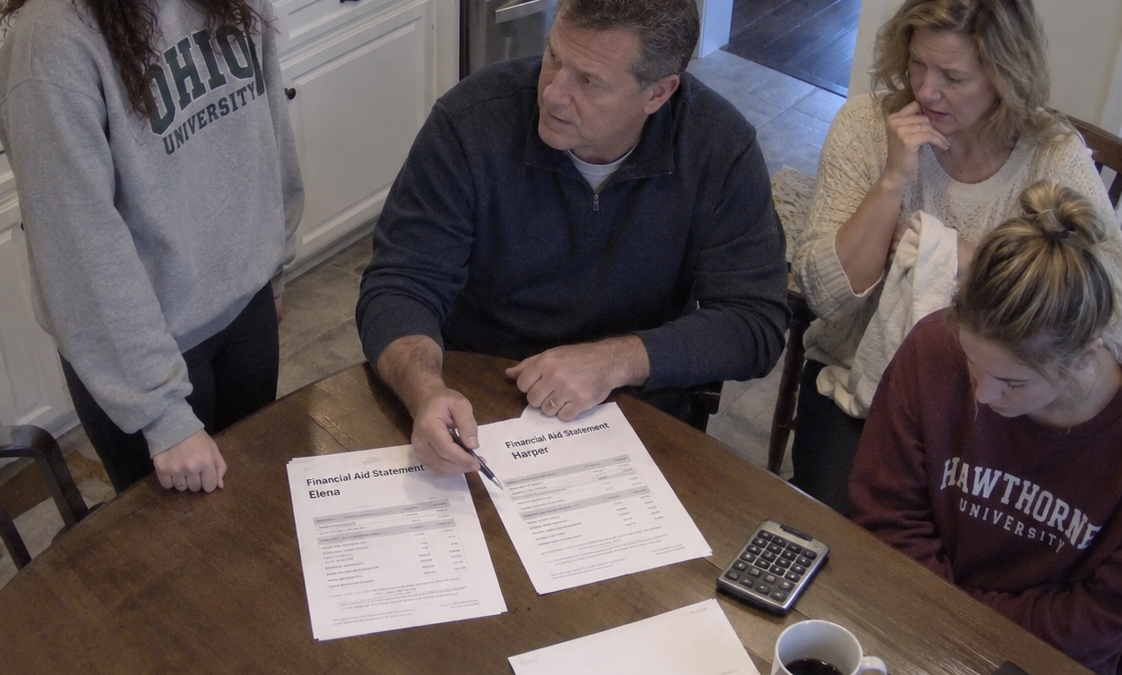
Hawthorne’s tuition was about $46,000 a year. Harper received an $8,000 annual award. I received $30,000. Our parents had saved roughly $152,000, enough to cover Harper’s remaining tuition for four academic years, assuming costs stayed close to their projections. Not enough to cover everything for both of us.
I understood the arithmetic. What I couldn’t understand was why dividing the money never became a serious option.
Dad explained it as if I had misunderstood a household repair. Harper would benefit from the network. Harper could turn introductions into opportunities. My scholarship meant I already had an advantage. When I pointed out that $16,000 in annual tuition was still $16,000, he moved my statement underneath hers.
“You’re better at finding solutions.”
I looked at the papers disappearing beneath his hand. An achievement I had worked years for had just become permission to leave me out.
Afterward, Mom followed me upstairs. She stood in my doorway holding a basket of folded towels, something to do with her hands.
“Your father isn’t saying you don’t matter.”
I waited for her to tell me what he was saying. Instead, she added, “Please don’t make your sister feel guilty.”
I hadn’t spoken to Harper yet. Somehow, managing everybody else’s discomfort had already become my responsibility.
The next morning, I called financial aid myself. The counselor explained my options without pretending any of them were painless. I requested a one-year deferral, then waited until Hawthorne confirmed in writing that my merit scholarship would remain available under its renewal conditions. I kept that letter in a plastic folder beside my bed. I wasn’t trusting another important decision to someone else’s interpretation.
I worked mornings at a grocery store and picked up weekend shifts at a café. Living at home let me save most of what I earned. There was nothing shameful about the work. The humiliation came from the explanations Dad offered on my behalf.
At Thanksgiving, he told our relatives I had decided to take some time to find myself. Harper sat beside him wearing a Hawthorne sweatshirt. He described her orientation weekend, her classmates, and the executives who attended university events. Then he lifted his glass toward me.
“Elena’s always preferred doing things her own way.”
I was carrying a serving dish when he said it. I set it down carefully.
“I deferred because I couldn’t cover the remaining tuition.”
Dad gave me a quick smile, the kind meant to close a subject.
“And you’re building character along the way.”
Nobody knew where to look. Harper kept turning the stem of her glass. I went back to the kitchen, angry at myself for leaving before the silence had to belong to him.
In January, Mom asked me to find an insurance document in Dad’s filing cabinet. Inside a folder marked School, I found an unopened envelope addressed to the parents of Elena Brooks. My high school had mailed it the previous spring. It announced a county academic distinction and invited them to a recognition evening.
The event had passed months earlier.
Beneath it lay a printed itinerary from Harper’s university welcome reception, covered in Dad’s handwritten notes.
I took the envelope downstairs. He recognized it before I finished explaining.
“That came during all the college paperwork.”
I asked why he hadn’t given it to me.
“You already knew you were doing well. We had a lot going on.”
I kept waiting for the apology. He reached past me for the television remote.
That evening, I photographed the letter and put the original in my folder. Not because I imagined using it against him, but because I needed something solid when he made me feel unreasonable for remembering.
By the time I enrolled, I had saved $18,000. I combined part of it with my scholarship, a federal loan, and a campus purchasing office job. I commuted that first year, packing lunch before the early bus.
Dad watched me zip my bag one morning and said, “See? You found a way.”
I almost told him the difference between a solution and a cost. Instead, I checked the time. Missing that bus would mean missing class, and he wasn’t the one who would have to catch up.
Eight minutes before my graduation speech, I noticed a correction in the margin of my notes. Professor Elaine Hart had written it during rehearsal.
Make the consequence visible.
She had been teaching me that lesson since the first presentation I nearly ruined.
During my first semester, I treated every assignment as evidence. I saved excellent grades in a folder on my laptop. I imagined opening it at our kitchen table, showing Dad enough numbers to force a different conclusion. The habit embarrassed me, but I couldn’t stop.
I wanted independence and his approval at the same time. One paid the bills. The other still had its hands around my throat.
My first major analytics presentation should have been easy. Our team had to recommend a delivery schedule for a fictional medical supplier. I built a model that reduced transportation costs and gave us beautiful charts.
When I finished presenting, Professor Hart pointed to a small clinic on the map. My proposal had cut its deliveries from three a week to one. I explained that it ordered less stock than the larger facilities.
“It also has almost no storage,” she said. “Your savings depend on a room that doesn’t exist.”
I stared at the screen. Someone behind me stopped typing.
I had spent so much time making the answer look convincing that I hadn’t checked whether people could live with it.
Our team received a disappointing grade. One teammate told me afterward that she had tried to raise the storage issue and I had talked over her. I wanted to defend myself. Instead, I went back through our messages and found the warning I had brushed aside.
That night, I apologized without explaining how tired I had been. Then I asked Professor Hart for another meeting. She didn’t offer comforting speeches about my potential. She made me identify every assumption I had entered into the model.
The work took three afternoons. By the end, the proposed savings were smaller, but the deliveries actually worked.
“Now,” she said, turning the revised pages toward me, “I can trust the recommendation.”
It was the first compliment in months that didn’t make me think of Dad. I wanted to earn it again.
By the following fall, I had become a resident assistant. The position covered campus housing and a standard meal plan, though it came with training, overnight duty, and the responsibility of being available when I desperately wanted to sleep.
I moved into a narrow room with a desk beneath the window. For the first time, nobody could comment on what I was eating while deciding whether my education was worthwhile.
There were difficult nights. Once, after handling a roommate dispute that stretched past midnight, I opened my laptop and discovered I had uploaded the wrong assignment file. My professor accepted the correct version with a late penalty.
I sat on the floor beside my bed, furious over the lost points. Then I started laughing quietly, and without much joy. I had been behaving as if a single imperfect grade could send me back to that kitchen table.
Professor Hart offered me paid research hours the next semester, mostly data cleaning, inventory records, and checking entries that other people assumed were accurate. I reduced my purchasing office shifts instead of stacking another job onto the same schedule.
That decision felt strangely reckless. I had become so used to proving I could endure something that choosing a manageable workload felt like cheating.
My first internship application was rejected. So was my second. At the third interview, I explained the clinic presentation and what I had changed afterward. The hiring manager asked more about that failure than about my grades.
A week later, a regional distributor offered me a paid summer placement.
I spent the summer studying delayed shipments and learning how often a neat report concealed a problem someone on the warehouse floor already understood. When the company invited me back, I called home.
Dad answered on speaker while he and Mom were driving to meet Harper. I told him about the offer.
“Good,” he said.
Then he began explaining that Harper’s placement supervisor might introduce her to a national agency.
I waited for him to return to what I had said. The conversation ended when they reached the restaurant.
I remained on the bench outside my office building with the disconnected phone against my ear. Then I called the teammate whose concern I had once ignored. We were friends by then. She congratulated me, asked what I would be working on, and remembered the name of my supervisor.
That evening, I deleted the folder of grades I had been saving for Dad. I kept my academic records where they belonged, with school documents. I stopped arranging them like an argument.
Later, Professor Hart selected me for a student project with a regional food bank network. This time, I visited the storage sites before building the model. I listened when volunteers explained why a delivery that looked efficient arrived at the worst possible hour.
Our pilot reduced unnecessary trips and improved availability at several locations. The results were modest, measurable, and useful.
When our report was approved, I felt proud before I thought about telling anyone. I didn’t recognize that as freedom immediately. I only knew I wanted more days like it.
Harper learned about the food bank project because she found me asleep over its inventory sheets in the student center. She nudged my shoe and set a coffee beside my laptop.
For a moment, we looked like ordinary sisters.
Then she said, “Dad’s been talking about your little campus job,” and the distance between us returned.
“It’s a research partnership,” I said.
She looked down at the papers.
“I know that now.”
I closed my laptop harder than I intended.
Harper wasn’t responsible for every careless thing he said, but she was often the person standing nearest when the consequences arrived.
We had spent our first years at Hawthorne moving through separate circles. Her extended placements meant we weren’t always on campus together. When we were, we could manage lunch, a shared ride, a birthday text. What we couldn’t manage was the money sitting between every ordinary sentence.
She would mention a weekend trip, then stop. I would mention an extra shift, then hate the expression on her face.
Once, she offered me $200 after I complained about a textbook bill. I refused too sharply. She put her phone away and said, “You don’t have to make everything impossible.”
I told her she didn’t get to decide which parts were easy.
Neither of us called the other for almost a month.
The conversation that changed things began badly, too.
Harper found me after Dad posted a photo from her placement office. His caption described investing in the next generation. Several relatives had congratulated him on raising such a promising young woman.
Harper sat across from me and said, “I didn’t write it.”
I hadn’t accused her of writing it. That made both of us angrier.
“You let him keep telling people I chose a different path,” I said. “You were there at Thanksgiving.”
She pulled at the paper sleeve around her coffee.
“I thought correcting him would make it worse.”
I asked her to sit with what that meant. Worse for whom?
I didn’t need to say it aloud.
For a while, she said nothing. Then the words came out in fragments. She had disliked her first placement. She had stayed because Dad kept telling people about it. When she considered changing tracks, he reminded her what tuition cost. She had once received a poor performance review and spent an entire weekend inventing a version she could tell him.
“I know I got the money,” she said quickly. “I’m not saying it’s the same.”
She swallowed.
“I just keep thinking that if I mess up, he’ll talk about me the way he talks about you.”
The sentence landed hard. She heard it, too. Her hand went over her mouth.
“That came out wrong.”
I looked at her until she lowered it.
“It came out honestly.”
I didn’t comfort her immediately. Part of me wanted to. Another part resented how familiar that impulse felt. I had spent years being asked to protect her from the discomfort of my own exclusion.
“I never wanted you to fail,” I said. “But I can’t keep helping you feel innocent about something you benefited from.”
She nodded, crying now, and let the silence stand. That mattered more than another apology would have.
We didn’t leave that conversation repaired. We started doing smaller things. She asked before forwarding family messages. I stopped assuming every invitation from her contained pity. When she talked about her work, I listened without measuring it against the hours I had worked. She learned to hear about a difficult week without immediately offering money or explaining.
At a family lunch that spring, Dad told an uncle I had never wanted much involvement from them.
Harper put down her fork.
“She asked you to split the college savings.”
Dad looked at her.
“That was more complicated.”
Her voice shook, but she continued.
“Then tell the complicated version. Don’t say she didn’t ask.”
I watched him wait for her to soften it.
She didn’t.
Mom changed the subject, and the meal continued, but something had shifted. For once, I hadn’t been left alone with the facts.
Five weeks before commencement, Professor Hart told me I had been nominated for valedictorian.
Hawthorne selected its speaker from an academic shortlist, considering faculty recommendations, campus service, and a proposed address. My final record placed me among the strongest candidates. It wasn’t automatic, and I spent the interview fighting the urge to sound like somebody else.
When the selection arrived, Harper was the first family member I told. She read the email twice, then laughed and hugged me so suddenly that I almost dropped my phone.
A moment later, she stepped back.
“I nearly said Dad would finally be proud.”
I waited.
“I’m glad I didn’t.”
I gave our parents the ceremony details and their tickets. The university published its honors announcement online. I didn’t conceal it, and I didn’t call home to stage a revelation. I had spent years trying to get them to look. This time, I let the information sit where anyone interested could find it.
Harper asked what I wanted her to do.
“Come to graduation,” I said. “Enjoy yours, too.”
She nodded. For the first time, neither of us had been assigned the job of explaining the other.
On graduation morning, Mom brought two bouquets. She held mine out with a careful smile, and I took it because the flowers hadn’t done anything wrong.
Dad was checking the battery in his camera. He told Harper he wanted a photograph of her with the business school banner, then asked whether I could take it before we went inside.
“I have to report backstage,” I said.
He glanced up.
“Already?”
I nodded.
There was a pause in which he could have asked why. Instead, he handed the camera to Mom.
Our families were seated near the front because each graduating student could request a limited number of reserved accessibility or guest seats through the ceremony office, and the speaker’s guest allocation was in the same section.
My parents had received the tickets I sent them without reading the accompanying details closely. Harper later told me Dad called it a lucky arrangement. Even then, the explanation that required the least curiosity satisfied him.
Backstage, I checked my notes and tried to slow my breathing. The speech had already been reviewed. Nobody was about to discover an unscripted accusation in front of a captive audience. I had worked too hard to turn everyone else’s graduation into a family argument.
But I had also refused to write the usual sentence thanking my parents for making everything possible.
Professor Hart found me beside the curtain. She straightened the edge of my hood where it had folded under itself.
“You know what you’re here to say.”
I nodded.
She didn’t tell me to imagine the audience in some ridiculous way. She stepped aside and let me prepare.
Through the gap, I could see Dad scanning the business graduates with his camera. Mom had the program open across her knees. She turned a page, stopped, and leaned closer.
Before I could see which page she was reading, the stage manager touched my elbow.
The university president approached the microphone. He spoke about academic distinction and service, then began reading the introduction I had approved.
Supply chain analytics. A cumulative GPA of 3.98. Senior resident assistant. Research distinction. Student lead on the food bank distribution project.
Dad’s camera remained pointed toward the graduates for the first few lines. Then he lowered it slightly.
Mom turned toward him. I saw her mouth move.
The president lifted his eyes from the folder.
“Please welcome this year’s valedictorian, Elena Brooks.”
I walked out before I could think about the kitchen table.
Harper was on her feet. I found her immediately, clapping above her head with the completely unguarded expression I remembered from when we were younger. Around her, graduates and guests joined the applause.
Dad stayed seated for a moment too long. His camera slid against his jacket and landed in his lap.
Mom caught his arm. From the stage, I saw her fingers tighten and her face turn toward him.
Later, Harper told me the words.
“What have we done?”
At the microphone, all I knew was that my mother looked frightened by something everyone else was celebrating.
I placed my notes on the lectern. My hands were steady.
“During my first analytics presentation at Hawthorne, I proposed a solution that looked excellent on a screen and failed the people who would have depended on it.”
A few faculty members smiled.
I explained the clinic with no storage and the teammate I should have listened to. I had mistaken a clean calculation for a complete understanding.
“Learning the difference has shaped everything I’ve done since.”
I spoke about the workers whose knowledge never appeared in the first spreadsheet. About students who arrived after a delayed start, changed direction, or carried responsibilities the person beside them couldn’t see. I thanked the faculty, staff, friends, and families who had offered practical help.
Then I turned a page.
“Potential is easy to celebrate after someone succeeds. The harder task is making room for it before there is proof.”
I let the sentence settle.
“And when someone finds a way through an obstacle we could have helped remove, their success does not make that obstacle a gift.”
I didn’t look at Dad when I said it. I looked at the graduates.
Several people nodded. One student in the front row pressed her lips together and reached for her friend’s hand.
“Our achievements today belong to us. So do the mistakes we corrected, the help we accepted, and the work nobody applauded because nobody saw it. As we move into positions where our decisions affect other people, I hope we remember how much can be missed when we decide too early who deserves a chance.”
The rest of the speech belonged to the class. I spoke about useful work and the courage to revise an answer.
When I finished, the applause rose around me, and I finally let myself smile.
Dad was standing now. He clapped with the camera hanging from its strap. Mom wiped her face.
I didn’t search either expression for a verdict.
After I returned to my seat, my phone vibrated with a message from an aunt.
Your mother sent us the honors page. We had no idea.
Beneath it came another.
Your dad always said you didn’t want their help.
I turned the phone face down.
I still had a degree to receive. For the next hour, whatever my father needed to explain would have to wait.
Dad reached me outside before I had finished hugging Professor Hart. He held the camera in one hand and the folded program in the other.
“Why didn’t you tell us about all this?”
His voice was low, almost controlled. I recognized the tone. It meant something had embarrassed him, and he was still deciding how much of it could become my fault.
I thanked my professor and stepped away from the main doors. Harper joined us, carrying her cap. Mom followed with both bouquets pressed against her chest.
Beyond us, families were taking pictures against the university sign. We stood near a stone bench where the noise softened enough that none of us had to raise our voices.
“I sent you the graduation information,” I said.
Dad shook the program.
“You know what I mean.”
I looked at the honors page sticking out between his fingers.
“You knew where I was studying. You knew my major. You had five years to ask about the work.”
“We asked how school was going.”
That was Mom. She sounded desperate to find a version in which they had only missed an announcement.
“And when I answered, the conversation moved on.”
I named the internship call. I named the research position Dad still referred to as a campus job.
I didn’t list everything. Two examples were enough.
Dad looked toward the nearby families, then back at me.
“This is supposed to be a happy day.”
“It is,” I said. “I’m happy.”
That stopped him more effectively than anger would have.
He had approached me as if I were withholding something he needed. For the first time, he had to consider that I already had what I had come for.
He unfolded the program.
“Look, we had limited resources. We made the decision we thought would produce the best outcome.”
There it was, dressed more carefully than it had been in our kitchen.
“Harper needed the support. You had that scholarship. I was trying to invest efficiently.”
Harper took a slow breath beside me.
I spoke first.
“You could have divided the savings. You could have helped with part of my remaining tuition. You could have said you couldn’t afford everything and worked through the options with both of us.”
“Then neither of you would have been fully covered.”
“Instead, one of us postponed college.”
He opened his mouth, but I continued.
“And afterward, you told people I wanted a year to find myself. That wasn’t a budget decision. That was you making the decision sound kinder.”
Mom looked at him.
“You did say that.”
He turned toward her, offended by the change in her tone.
“We agreed on this.”
She tightened her grip on the flowers.
“I went along with it. I’m not pretending otherwise.”
For a moment, nobody spoke. I could hear a nearby family counting down for a picture.
Dad looked back at me.
“I knew you were capable. Clearly, I was right about that.”
A familiar escape route. He had found it so many times before that I could almost see the relief arriving.
“My ability isn’t evidence that you treated me fairly.”
“I’m saying the experience may have helped you.”
“The professor who corrected my work helped me. The job that paid me helped me. The people who listened helped me. You don’t get to put your name on their part.”
His face changed. Not dramatically. His mouth tightened, and he looked down at the program as if a different argument might be printed somewhere beneath my name.
Harper stepped forward.
“And paying my tuition didn’t make everything you did to me helpful, either.”
Dad stared at her.
“You graduated with a job waiting for you.”
She nodded.
“I worked for it. But I spent years afraid to tell you anything that might make me sound like a bad purchase.”
“Harper, that’s ridiculous.”
“No,” she said, and her voice shook. “It’s embarrassing. That isn’t the same thing.”
I watched her grip the edge of her cap.
She told him about the poor placement review she had hidden, about wanting to change tracks and hearing the tuition total repeated until she stopped bringing it up.
Dad tried to interrupt, but she finished.
“You made Elena prove she didn’t need help. You made me prove I was worth what you spent. And I let you talk about her like she had chosen all of it because I was scared of being next.”
Dad glanced at me.
“Is this something you two rehearsed?”
“No,” I said. “We finally started talking without asking what would make you comfortable.”
Mom sat down on the bench. She set the bouquets beside her, then covered her face for a moment.
I felt the old reflex immediately. Soften my voice. Give her something hopeful. Make the conversation easier to survive.
I stayed where I was.
When she looked up, I took the photograph of the academic letter out of the document folder on my phone.
I hadn’t planned to show it that day, but Dad had just said they had always encouraged both of us.
I held the screen toward him.
“I found this during my gap year.”
He recognized it.
“That was an oversight.”
“You told me I already knew I was doing well.”
Mom leaned closer.
“I never saw that letter.”
Dad said there had been so much paperwork.
I lowered the phone.
“I’m not asking you to remember every envelope. I’m asking you to stop turning every choice into something that simply happened.”
He rubbed his forehead.
For the first time, he had no quick response.
Then my aunt approached from the walkway. She had come to watch our cousin graduate and had seen Mom’s message. She congratulated us both, hugged me, and said quietly, “I’m sorry. I believed you wanted to handle college without them.”
Dad shifted beside me.
“I asked for help,” I said. “I didn’t receive it.”
I didn’t add anything. I didn’t need to.
My aunt looked at Dad for a long moment, then told us she would let us have our conversation.
He watched her leave.
The story he had repeated for five years had stopped protecting him.
When he turned back, his voice was different.
“Let us pay your loans.”
I had just under $27,000 outstanding.
Hearing the offer hurt in a way I hadn’t expected. At eighteen, a fraction of that support would have changed my first year. Now he could offer the whole balance because the university had made my value impossible to dismiss.
“Not today,” I said.
“Elena, I’m trying to make this right.”
“You’re trying to find something you can finish.”
He flinched.
I gave him a moment before continuing.
“Paying a balance won’t correct what you told people. It won’t give me that year back. It won’t make Harper comfortable admitting she’s struggling. If you want to repair this, you have to stay for the parts that don’t come with a receipt.”
He looked at Mom.
She didn’t rescue him.
“She’s right,” she said.
Dad folded the program along its existing crease.
“Then I’m sorry.”
The words came quickly, and he watched me as if waiting for a door to open.
“I heard you,” I said. “I’m not ready to accept that as the end.”
He glanced at his watch.
“We have the restaurant booked. We can talk over dinner. Both of you. Whatever you want.”
I had already arranged to meet friends and several people from the project team. Before I could answer, Harper said she was coming with me.
Dad looked wounded.
“We planned a celebration.”
“You planned dinner,” she said softly. “I’d like to celebrate with my sister.”
I told them we could arrange another time to talk.
Mom nodded through tears. Dad stayed beside the bench, holding the camera he had barely used.
Harper and I walked toward the parking area together. After a few steps, she touched my sleeve. We paused long enough for her to straighten my twisted graduation cord.
Then we kept going.
Behind us, for once, nobody called my name to ask me to make things easier.
Three weeks passed before I agreed to meet my parents.
During that time, Dad sent four messages. The first explained his intentions. The second mentioned the loans again. The third said Mom was having a difficult time.
I answered only the fourth.
I’ve been defending what I did instead of listening to what it cost you. I would like to try again.
We met at a café. I brought my loan statement but left it inside my bag while we talked.
Dad admitted something he hadn’t said outside the graduation hall.
Harper’s confidence looked familiar to him. He understood her ambition because it resembled his own. My quieter interests had seemed less promising, even when the evidence said otherwise.
“I called it a financial judgment,” he said. “It was a preference.”
Mom didn’t let that become his confession alone.
She admitted that my scholarship had made it easier for her to stay silent. Every problem I solved removed another reason for her to challenge him. She had mistaken the absence of a crisis for the absence of harm.
I told them what would have to change.
No more telling relatives I had declined their help. No using a payment as proof that everything was repaired. No asking Harper to explain my boundaries. And no treating ordinary contact as a reward they could earn through one dramatic gesture.
Dad later corrected the story in our family group chat, where he had shared so many updates about his educational investment.
He wrote that I had asked for support that he had refused and that my delayed start had been financial.
He didn’t blame my scholarship or say I had misunderstood.
Several relatives replied privately to me. Others said nothing. Dad told me afterward that one of his brothers had called him directly.
I didn’t ask for the details.
Having to explain himself without controlling my answer was part of what he owed.
I eventually accepted payment of my remaining student loans. Refusing useful restitution wouldn’t return the years I had lost, but I made the terms clear before providing the information.
This settled a debt, not our relationship.
He paid without attaching a request for a holiday visit or a public thank-you.
Six months after graduation, Harper was working in marketing, and I had started as an operations analyst for a regional healthcare company.
We met for dinner without checking whether our parents were available. Sometimes we talked about work. Sometimes we ordered too much food and argued about television.
Our relationship finally contained things that had nothing to do with being compared.
With our parents, life became polite and less frequent. Sunday dinners stopped being automatic. Dad had to ask whether I was free, and sometimes I wasn’t.
When he offered career advice, Harper began saying she would think about it instead of treating it as a decision. Mom started calling me herself rather than passing along his messages.
None of those changes looked dramatic from outside. Inside our family, they rearranged everything.
Dad missed the ease he used to mistake for closeness. I could hear it when a conversation ended before he wanted it to. I didn’t stretch those calls to spare him.
Some evenings, I still felt guilty. Then I remembered how much of our old peace had depended on my silence.
One night, he asked about a scheduling project I had mentioned weeks earlier. He remembered which department was involved.
I answered honestly.
It was a small beginning, and I allowed it to remain small.
My diploma hangs above my desk now.
The photograph beside it shows Harper and me outside the restaurant after graduation. Our caps are crooked, and both of us are laughing.
Dad didn’t take it.
For once, the most important picture of our family was one he hadn’t arranged.
If your parents supported only one of you because they believed that person had more potential, could you fully forgive them? And do you think money can ever buy back the respect they lost?
Tell me where you stand.
We appreciate every viewer who stayed until the final sentence. This fictional video was made only for storytelling and educational entertainment.
We hope it reminds you that some people will call you cold when they lose access to the world they took for granted.
But protecting your peace is how you make sure it survives for the people who truly deserve it.








