My parents chose my brother’s birthday over the funeral of my husband and four children. when i called from the hospital, my father calmly replied, “handle the arrangements yourself. we cannot leave.” one year later, one headline about me sent my entire family into absolute panic when they learned i had…
The evidence bag is clear plastic, the kind they use for groceries at a discount store, except this one is sealed with a tamper-proof strip and stamped with a case number in black ink.
I am standing in the hallway of Toronto General Hospital at two in the morning, and I cannot stop staring at what is inside it. My husband Donovan’s wedding band. The gold has warped in a way I did not know gold could warp, twisted into an unrecognizable oval by the heat of the fire on the Gardiner Expressway. Beside it sits a small rubber dinosaur, the kind Eli carried everywhere in his jacket pocket. It is melted on one side, its tiny green legs fused together. Beneath that are two identical stuffed rabbits, scorched down to the wire frames inside, belonging to my three-year-old twins, Kieran and Reed. And at the very top of the bag is a single pink hair elastic with a broken clasp, the one Maya had insisted on wearing that morning even though it was already fraying at the ends. Maya was eight. She would have turned nine in February.
A paramedic had pressed the bag into my hands forty minutes ago with a look on his face that I will carry for the rest of my life. The hospital staff will not let me go in. A grief counselor named Sandra has been hovering at a respectful distance, speaking in a low voice about trauma protocols and identification procedures. I have not heard a single word she has said since the word instantaneous.
The Gardiner Expressway. A pickup truck driver with a blood alcohol level more than three times the legal limit. Saturday morning traffic. Donovan had taken all four children to the Ontario Science Center so I could have four quiet hours to finish a forensic audit for a client whose books were a disaster. He had kissed me at the front door. He had told me he loved me. He had told Eli to stop fighting with his sister and told Maya she was in charge of her brothers. She had rolled her eyes the way only eight-year-olds can, completely unbothered by the responsibility. They were gone before I had even opened my laptop.
I have been a chartered professional accountant for eleven years. I have spent my career picking through the ruins of failed companies, forged ledgers, and deliberate deceptions, making logical sense of disorder. There is no order here. There is no ledger that balances this. There is only this hallway, these fluorescent lights, this plastic bag, and the particular silence of a hospital at two in the morning, which is the loudest silence I have ever heard in my life.
My father’s phone rings four times before he picks up. The background noise tells me everything before he says a word. Bass music, laughter, the clink of glasses, and the kind of crowd energy that only exists inside a private event space with an open bar. I can hear my brother Xavier’s voice somewhere behind all of it, raised and cheerful the way he gets when people are paying attention to him.
“Celia.” My father, Reginald, speaks with the mild irritation of a man whose evening has been interrupted. “Make it quick. We’re in the middle of something.”
I open my mouth. I have to try three times before anything comes out. “Dad, there was an accident on the Gardiner. Donovan took the kids. A drunk driver hit them.” I press my palm flat against the cold painted concrete of the hospital wall because my knees have gone entirely unreliable. “Dad, they’re gone. All of them. Donovan and the kids. They’re all gone.”
The silence lasts approximately four seconds. In those four seconds, I am certain the music will cut off. I am certain I will hear my father shout for my mother, Sylvia. I am certain of the sounds a parent makes when their child delivers the most terrible news a child can deliver.
Instead, my father says, in a voice so flat and unchanged that I wonder for a moment if the call has dropped, “Celia, tonight is Xavier’s thirty-fifth birthday. We’ve booked the private room at the National Club. We cannot leave right now. Handle the hospital arrangements and call us during the week.”
The line disconnects.
I look at my phone. The call was thirty-eight seconds long.
I slide down the wall until I am sitting on the linoleum floor, my knees pulled to my chest, the plastic bag pressed against my heart. Sandra, the grief counselor, crouches beside me. She is saying something about shock, about support resources, about a family liaison officer. I cannot answer her. I am too busy understanding, with a clarity that feels almost scientific, that my father weighed the deaths of his son-in-law and four grandchildren against bottle service at a private club and made his choice without a moment of hesitation.
I have been making excuses for this family my entire life. I was the quiet one, the responsible one, the daughter who built a stable career without asking for anything, which meant I was the daughter who required no maintenance and therefore the daughter who received none. Xavier was the golden child. He had always been the golden child. He launched businesses that failed, and our parents funded the next one. He made decisions that embarrassed the family, and our parents smoothed them over. When I graduated at the top of my cohort from the Rotman School of Management, my parents did not attend because Xavier needed help moving into the Yorkville condo they were paying for.
When Donovan and I got married, my mother arrived forty minutes late because Xavier could not find his jacket, and she refused to leave without him. Donovan had held my hands in the bridal prep room and told me that from that day on, we were our own family. He had meant it. For ten years, he had meant every single word of it. He had been my home, and now my home was a plastic evidence bag in a hospital hallway.
I buried Donovan and Maya, Eli, Kieran, and Reed on a Thursday. Five caskets in a row at Mount Pleasant Cemetery, one large dark wood casket and four small white ones. The four small ones looked so impossibly small that I had to look away, then look back, then look away again for the entire service. The usher had approached me before the service began, quiet and apologetic, gesturing to the two rows of reserved family pews directly behind mine. He asked in a whisper if we should wait. I looked at the empty pews and told him my parents were not coming. He removed the velvet ropes without another word.
Donovan’s colleagues from the biotech firm filled those pews. The parents from Maya’s hockey team. The neighbors who had watched my children grow up. Total strangers who had read the obituary in The Globe and Mail and came anyway because the story was too terrible to ignore. They wept for my husband and my four babies while my parents sat in a private room somewhere in the city, deciding what to order from the dessert menu.
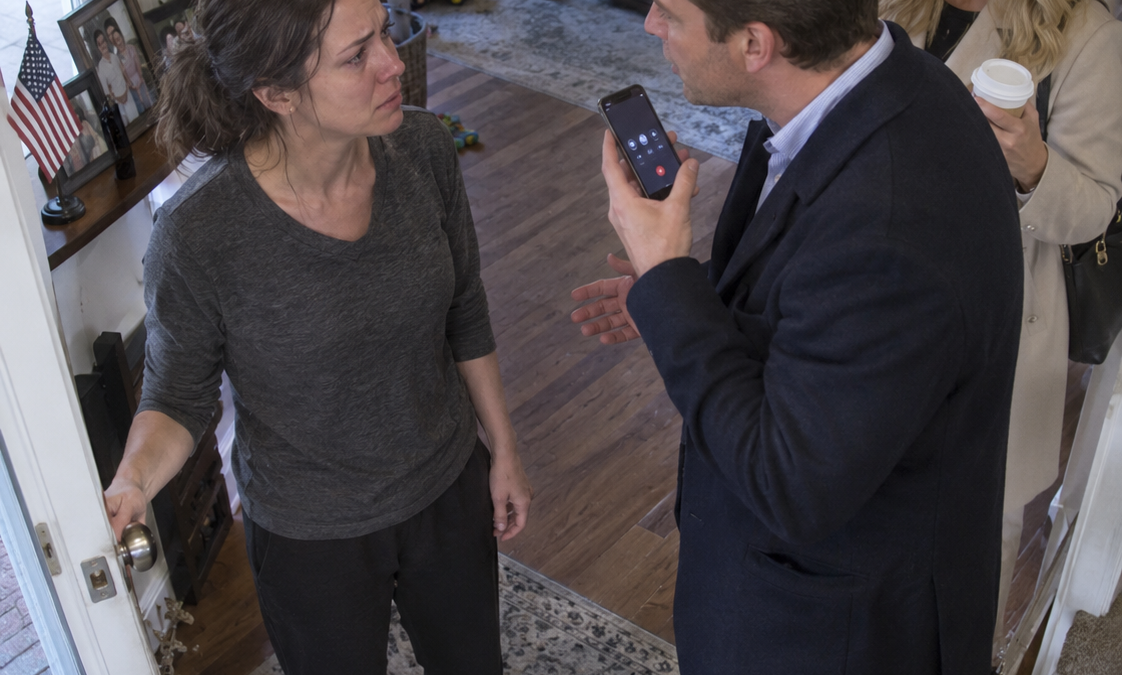
Three days after the funeral, the doorbell rang at seven-thirty in the evening. Xavier stood on my porch with his partner, Bethany. She was wearing an expensive coat and holding a coffee cup, and neither of them had brought flowers or food or anything at all that a person brings to a grieving household. Xavier pushed past me into the foyer the moment I opened the door, the way he has always moved through spaces as though he owns every room he enters by birthright.
Bethany looked around my living room, where the children’s things were still exactly where they had left them on Saturday morning, and wrinkled her nose. “You really need to open the blinds, Celia,” she said. “This is not good for you, sitting in the dark like this.”
I looked at her. I looked at a pair of Eli’s sneakers by the bottom of the stairs. Then I said, “Why are you here, Xavier?”
Xavier put his hands in his coat pockets and did not make eye contact with me. He has never been able to look me in the eye when he wants something, which is the only tell he has ever had.
“My import business is going through a rough patch,” he said. “Temporary cash flow issue. I know Donovan had a significant group life insurance policy through his company, plus the policies on the children. You’re about to receive a substantial payout, Celia, and you’re alone now. You don’t need all of it. I need a bridge loan. One hundred and fifty thousand, just until the end of Q2.”
The room tilted.
“You didn’t come to the funeral,” I said. My voice was very quiet. “You didn’t come to say goodbye to your nephews and your niece. You didn’t come to see Donovan buried. But you came to my house to ask me for money from the policies on my children.”
He opened his mouth to answer. His phone rang before he could speak. He looked at the screen and put it on speakerphone without hesitation, the way he always does when he wants witnesses.
My mother’s voice filled the room.
“Xavier, have you spoken to your sister yet?”
“He’s working on it,” he said, looking at me.
“Celia.” My mother’s tone sharpened immediately, with the particular sharpness she reserves exclusively for when I am failing to cooperate. “Stop making this about yourself. Your brother needs help. You have the money now, and you’re on your own. There is no reason to be selfish about this. Xavier’s business is this family’s legacy. You need to think about that instead of sitting in the dark feeling sorry for yourself.”
I walked to the front door and opened it.
“Get out of my house,” I said. “Both of you. Right now.”
Xavier scoffed. He grabbed Bethany by the arm and pulled her toward the door. “You’re going to regret this,” he said on his way out. “When you realize there’s nobody left, don’t come looking for us.”
I locked the deadbolt and stood in my entryway for a long time without moving. The house was completely quiet. Outside, Xavier’s car reversed out of the driveway and sped away. I stood there listening to the silence settle back in, and something cold and hard and very deliberate began to form inside my chest. Not grief. Not anger. Something with sharper edges than either of those things.
I walked into Donovan’s home office. He was meticulous about his workspace, everything labeled, everything in its place. I had gone in there once since the accident and had not been able to stay longer than two minutes. Tonight, I forced myself to stay.
I pulled the bottom desk drawer all the way out, intending to begin sorting through his files. The drawer caught halfway, and I yanked it free from the runners and set it on the floor. When I reached into the cavity to check for anything that had slipped to the back, my fingers found something attached to the underside of the desk frame. A piece of masking tape, thick and deliberate, pressed firmly against the wood.
I peeled it back carefully.
A small yellow envelope dropped into my palm.
Inside the envelope was a brass safety deposit box key and a single sheet of paper in Donovan’s handwriting. He had a particular way of writing the letter D with a long, curved tail. I knew his handwriting the way I knew the sound of his voice.
The note was two sentences.
For Celia, in case they ever try to take what belongs to us. The box is at TD Bank, King Street West branch. Authentication code: our anniversary date backwards.
I did not sleep that night. I sat in his office chair in the dark until six in the morning, waiting for the bank to open.
The safety deposit box held two leather portfolios.
The first portfolio contained an acquisition agreement. Donovan had spent seven years developing a proprietary drug delivery mechanism, a molecular platform that could dramatically improve the absorption rates of cancer treatments. I knew he was working on something significant. I did not know he had finalized the sale to one of the largest pharmaceutical companies in the country exactly six weeks before the accident.
The acquisition price printed at the bottom of the signature page was $280 million.
I had to read it four times before the number stopped looking like a typographical error.
Donovan had structured the entire transaction through a series of holding companies registered in Ontario and British Columbia. The post-tax proceeds had been funneled into a domestic blind trust, legal, airtight, and completely private. There was no public record of it. The sole named beneficiary was me.
I sat in the bank’s private viewing room, surrounded by the proof that my husband had quietly become one of the wealthiest self-made entrepreneurs in the country, and that he had spent the last months of his life making absolutely certain I would never be vulnerable.
Then I opened the second portfolio.
Donovan had labeled it in his careful handwriting: Xavier and Reginald.
It was a financial dossier. I recognized the format immediately. Bank statements, commercial property assessments, internal ledgers from Xavier’s luxury import business, the one he ran out of an office on King Street West that had been bleeding money for four years. I spread the documents across the viewing table and read them with the cold, precise attention I bring to any forensic audit.
Xavier was not struggling with a temporary cash flow issue. He was drowning in catastrophic commercial debt. He had defaulted on multiple high-interest bridge loans. His creditors were preparing to move against his assets. What he needed was not $150,000.
What he needed was a miracle.
Then I found the loan guarantee document, dated eight months before the accident.
Xavier had secured a substantial credit line, $9 million, through a private commercial lender based in Vancouver. The collateral listed was Donovan’s patent portfolio. Intellectual property belonging to my husband had been pledged without his knowledge to save my brother’s failing business.
I looked at the signature line at the bottom of the guarantee. I had signed documents next to Donovan for ten years. His signature had a very specific quality, a controlled upstroke on the D and a loop at the end of the N that he never varied. The signature on this document was close.
It was not close enough.
The pressure was wrong. The spacing between letters was wrong. It was a forgery.
The email chain in the following pages connected Reginald directly to the Vancouver lender. My father had facilitated the transaction. He had used his reputation as a retired Bay Street lawyer to vouch for the deal. He had helped his son pledge my husband’s life work as collateral for a debt Donovan knew nothing about. He had committed fraud across provincial lines, which in Canada is a federal matter under the Criminal Code.
Donovan had discovered it during the due diligence phase of his pharmaceutical sale. He had quietly compiled everything. He had taped the key under his desk so that if anything ever happened to him, I would find the truth.
I understood, sitting in that viewing room, exactly why Xavier had appeared at my door three days after the funeral, demanding $150,000. His creditors were closing in. He needed cash immediately to keep the Vancouver lender from auditing the collateral agreement and discovering the forgery.
He did not know the patent had already been sold. He did not know the money was sitting in a blind trust I now controlled entirely. He thought he was shaking down a grieving widow for insurance money.
He had no idea what he had actually done.
I gathered the documents carefully, placed them back in the portfolios, and put both portfolios in my bag. I walked out of the bank into the cold Toronto morning. The wind off Lake Ontario was sharp and carried the smell of rain. I stood on King Street West with $280 million at my disposal and irrefutable proof of federal fraud. And I made a decision about how I was going to use both.
Donovan had reached from beyond the grave to put the tools of my survival into my hands. I was not going to waste them.
Six months is how long it takes to build a perfect performance.
I sold the house on a quiet street in East York and moved into a rental apartment in a high-rise in Scarborough, the kind of building with a parking lot full of older cars and a buzzer system that never quite works. I traded my reliable SUV for a twelve-year-old Civic with a cracked dashboard and a driver’s-side window that would not roll down all the way. I stopped buying new clothes. I stopped going to the salon. I let the shadows under my eyes deepen and stay.
I ran into Xavier’s wife, Bethany, at a Shoppers Drug Mart in November, and I gave her exactly what she needed to see: a hollow version of myself in worn-out clothes, buying store-brand ibuprofen because it was two dollars cheaper than the name brand. The story filtered back to my parents within the week. Celia had completely fallen apart. Celia could barely function. Celia was, as they had always quietly suspected, unable to manage without someone holding her up.
Behind the door of my rental apartment, I was running an empire.
I had contacted Donovan’s wealth manager, Jonathan Ash, a senior partner at a private firm in the financial district, within forty-eight hours of finding the safety deposit box. Jonathan had been waiting for me to call. He had known about the trust for months. The terms of the agreement required him to wait until I initiated contact.
When I called from a parking lot in a shopping mall because I did not trust my own apartment walls, Jonathan answered on the second ring and told me, in a voice stripped of all professional distance, that Donovan had been one of the most careful and brilliant men he had ever worked with, and that he was sorry. Then he told me the full balance of the trust, and I had to sit down in my car with the engine off and breathe through my mouth for a full minute.
I gave Jonathan his first instructions before I hung up. I needed him to locate the Vancouver commercial lender holding Xavier’s $9 million debt and acquire that lending portfolio quietly, immediately, and under enough layers of holding companies that no one would ever connect the purchase to my name.
I needed to become Xavier’s creditor. I needed to hold the leash before anyone realized there was a leash.
Jonathan called me back four days later. The acquisition was complete. I owned the debt. I instructed him to grant Xavier a temporary extension on his defaulted payments. I needed my brother comfortable. I needed his arrogance inflated to maximum capacity before I removed the floor beneath him.
The invitation to the family Christmas dinner arrived by text message. My mother did not ask how I was doing. The message informed me that my father’s former colleagues from Bay Street would be attending, along with members of their social circle, and that it would reflect badly on the family if I sat alone in my apartment on Christmas Day. She told me to dress appropriately and arrive by four.
They wanted a prop. They wanted to display their charity.
I arrived at the house in North York in my old Civic, wearing a plain gray dress that I had bought from Value Village. The neighbors’ cars in the driveway were a row of German sedans. My father met me at the door, looking past my shoulder at my car with an expression he did not bother to hide.
The dinner was precisely the performance I had expected. My father presided at the head of a table set with the good china, holding court with his Bay Street colleagues about the decline of the current government and the promising outlook for commercial real estate. My mother managed the catering staff with brisk authority. Xavier was flushed with the particular warmth of a man who was confident in his position in the room.
Bethany waited until dessert had been served and the table had softened into comfortable conversation before tapping her glass for attention. She rose slightly from her chair.
“Everyone,” she began, projecting clearly, “Xavier and I have been doing so much reflecting this year about what it means to give back.”
She turned and looked directly at me at the far end of the table.
“Celia, we’ve been thinking about you constantly. We know things have been so hard, and we know you haven’t been able to find steady work since everything happened. So Xavier spoke to his business partner, and we would love to offer you a position at the firm. It wouldn’t be complicated work, mostly reception, organizing the filing system, managing the mail. It pays minimum wage, but it would get you out of the apartment and give you some structure.”
The table went quiet in the particular way a room goes quiet when everyone is watching to see what the target does. I kept my hands folded in my lap. I kept my expression small and fragile and grateful, and I said nothing.
My mother sighed loudly and placed her hand over her heart. “It’s an incredibly generous offer, Celia. Bethany is right. You’ve been wallowing for six months. The rest of the world doesn’t stop. You need to start functioning again instead of sitting in the dark being a burden to yourself.”
My father nodded. “Take the job. Learn how a business operates from the inside.”
I looked at the table. I looked at my brother, who had forged my dead husband’s signature on a federal financial document, now generously offering me minimum wage to file his mail. I looked at my father, who had helped him do it, now nodding in solemn approval. I looked at my mother, who had not called once in six months to ask if I was eating.
Then I quietly excused myself to find my father.
I found him in the hallway near his office. I let my voice tremble. I told him a debt collection firm had called me. I told him they claimed Donovan had signed a commercial loan guarantee. I told him I was terrified. I said I thought someone might have forged his signature.
My father’s face changed in a way I will never forget.
The polished, warm patriarch vanished. What replaced him was something cold and calculating and completely unguarded, because he assumed he was looking at a frightened, helpless woman with no resources and no options.
He stepped very close to me. He told me to forget the phone call ever happened. He told me Donovan was dead and his estate was a modest life insurance payout and a rented apartment in Scarborough, and no lawyer on earth was going to take my case. He told me that if I breathed a word of it to anyone, he would tie me up in litigation until I could not afford my own rent.
He told me I had nothing.
He told me to know my place.
Then he straightened his jacket, walked back into the dining room, and resumed his conversation about golf handicaps.
I stood in the hallway for a long moment. Then I walked back into the dining room, thanked Bethany for her thoughtful offer, and drove home in my old Civic through the winter dark.
Parked on my street in Scarborough, the engine ticking as it cooled, I opened the encrypted messaging application connected to Jonathan Ash’s private server. I typed four words and hit send.
Execute the acquisition. Call in the loans immediately.
I had been waiting six months to type those words. The relief was extraordinary.
Xavier’s firm received the formal legal notice from the Vancouver lender on the first business day of the new year. The notice informed him that the lending portfolio had been acquired by a holding company in a standard corporate restructuring and that, due to discovered irregularities in the collateral documentation, the full $9 million was being called in immediately. There would be no further grace periods. Any assets pledged as collateral were now subject to immediate seizure.
My brother’s CFO called him at six-thirty in the morning. Xavier called my mother. My mother called me.
I let it go to voicemail.
Three weeks later, Xavier hosted what he described as a milestone business anniversary event at a venue in the Distillery District. It was a desperate performance, one last attempt to project stability to his investors before the walls came down entirely.
He sent me an invitation, which I understood was not an invitation but a provocation, an opportunity to display his apparent success in front of the woman he believed he had reduced to minimum-wage data entry.
I arrived wearing a custom-tailored black dress, the kind that does not announce itself but cannot be ignored. I had my hair done for the first time in six months. I wore the pearl earrings Donovan had given me for our tenth anniversary. I walked through the venue’s entrance without hesitation.
Bethany intercepted me within ninety seconds. Her face was livid beneath a carefully maintained social expression. She informed me through nearly closed teeth that I was making everyone uncomfortable with my presence and that, if I insisted on staying, I was to take a seat at the table near the service corridor at the back, far enough from the main floor that I would not disturb the investors.
“Of course,” I said pleasantly. “I don’t want to draw attention.”
I found the table near the service corridor. I sat down. I ordered a glass of sparkling water from a passing server.
I waited.
At 11:58 in the evening, my father took the microphone on the small stage at the front of the room. He was wearing a beautifully cut suit and radiating the satisfied authority of a man who believes himself beyond consequence.
He gave a toast about resilience and family legacy and Xavier’s extraordinary vision. He described the past year as a difficult storm that the family had weathered with unity and strength.
He did not say Donovan’s name. He did not say Maya or Eli or Kieran or Reed. He reduced the deaths of my husband and four children to a vague, unnamed adversity that had only made the family stronger.
He raised his glass to Xavier’s future, and the room raised its glasses with him.
I watched the clock on my phone.
At midnight, the vibration started near the front of the room. One phone, then three, then ten, then a sound like rain against a window, the synchronized humming of every device in the room receiving the same high-priority news alert at the same moment.
Jonathan’s team had coordinated the release with the Financial Post and The Globe and Mail. The digital editions of both papers had published simultaneously, with breaking news notifications set to override standard settings for any registered reader.
The headline read:
Anonymous Trust Behind Landmark Pharma Acquisition Revealed as Sole Creditor in Vancouver Lending Collapse. Sole Beneficiary Named as Toronto Widow Celia Marquetti-Oce.
I watched the wave move through the room.
I watched a commercial developer near the center tables look at his phone and then look at Xavier. I watched two Bay Street investors step quietly away from my father’s immediate vicinity. I watched my father reach into his jacket pocket and read the notification.
And I watched the color drain entirely from his face.
Xavier’s phone rang. He answered it at the table, his voice still cheerful and authoritative. Then I watched the cheerfulness dissolve in real time as his CFO told him who owned his debt.
He looked across the room.
He found me sitting in the shadows near the service corridor, exactly where Bethany had put me, and the expression on his face was the most complete thing I had ever seen in my life.
He pushed toward me through the crowd. My father followed. Bethany followed, her silver heels clicking against the floor.
They reached my table.
My father tried to laugh. He called it a creative misunderstanding. He tried to grab my arm to steer me somewhere private, away from the investors who were now watching with open, undisguised attention.
I did not move.
“There is no misunderstanding, Reginald,” I said. My voice was clear and steady and carried beautifully in the sudden quiet. “I purchased the Vancouver lending portfolio seven months ago. I currently hold the entire $9 million debt against Xavier’s business. I am calling it in full. I expect payment by Friday, or I will begin liquidation of every pledged asset.”
Xavier’s knees buckled. He grabbed the edge of the table.
Bethany took one precise step backward, increasing the physical distance between herself and her husband in the way that people do when they are calculating how quickly they can get to the door.
My father’s mask came down completely. He leaned in close and threatened litigation. He threatened my mental fitness. He used the same words he had used in the hallway at Christmas, the same words about having nothing, about knowing my place.
I reached into my evening bag and placed the documents on the table. The forensic copies. The forged signature. The email chain connecting my father to the Vancouver lender. Donovan’s handwritten note from the yellow envelope.
I said, “You told me I had nothing. You were wrong.”
The RCMP financial crimes unit officers came through the front door at 12:17 in the morning. Four of them in tactical jackets, moving with the particular unhurried precision of people who know they are expected.
The room parted for them without being asked.
My father was arrested at the table.
The handcuffs made a sound that I felt in my back teeth.
Xavier began to cry before they had finished reading the charges.
Bethany walked to the exit with her coat clutched to her chest and did not look back at her husband once.
Reginald was convicted eight months later in Ontario Superior Court on four counts involving fraud, criminal breach of trust, and forgery under the Criminal Code. Xavier was convicted on three counts. Their sentences were twelve and eight years, respectively.
The sentencing judge called the offense a calculated betrayal of a grieving widow by the very people who were obligated to protect her.
My mother, Sylvia, was not charged. She had known. But knowing is not always enough for a conviction.
Her punishment came from a different direction entirely.
With the Buckhead estate seized, the bank accounts frozen, and my father in federal custody, she was entirely without the infrastructure that had held her life together. The social circle she had cultivated for decades closed itself around her the way water closes over a stone.
The country club membership was quietly revoked. The women who had admired her Christmas table settings stopped returning her calls.
She called me from an unfamiliar number on a cold Tuesday evening in March.
“I’m struggling,” she said.
She was crying.
She told me the heating bill was overdue and the refrigerator was nearly empty, and she was frightened. She told me I had enough money now to take care of everything. She told me family was all that remained between us. She told me she was still my mother, regardless of everything that had happened.
I listened to all of it. I let her finish.
Then I said, “I cannot help you right now. Handle things yourself and call me next week.”
I pressed End on the call and sat with the silence for a moment.
It was not a cruel silence.
It was a clear one.
The ledger had finally balanced.
I had not spent the previous year purely on destruction. While my family’s financial empire was being dismantled, I had been building something else entirely.
Jonathan Ash and his team helped me establish a charitable foundation structured as a registered Canadian charity, fully transparent and independently audited, because I had lived long enough inside a family of frauds to understand exactly what financial opacity costs.
I named it the Donovan Marquetti-Oce Memorial Foundation.
The first initiative was a scholarship program for young Canadians pursuing degrees in biotechnology, pharmaceutical research, and the life sciences, fields that Donovan had believed would define the next generation of Canadian innovation.
We funded tuition, housing, and living costs at universities across the country. We prioritized first-generation university students and young people from communities that had historically lacked access to the kind of educational funding my brother had received from our parents as a birthright.
The second initiative was a children’s science and arts center built on donated land in Scarborough, the same neighborhood where I had lived in my rented apartment through the hardest year of my life. The neighborhood my parents would never have visited. The neighborhood that deserved exactly the kind of facility their tax dollars had funded in North York and never quite reached.
I named the wings after my children.
The Maya Marquetti-Oce Library. The Eli Marquetti-Oce Discovery Lab. The Kieran and Reed Marquetti-Oce Early Learning Studio.
I had the names engraved in bronze and mounted in the main rotunda, where the light comes through a skylight and falls directly on the wall each morning.
On the day we opened the center to the public, I wore a green dress and walked through the rooms without stopping.
I watched a girl about Maya’s age standing in the library, stacking picture books into a tower with absolute concentration and then scattering them with a laugh that echoed off the high ceiling. I watched a small boy in the discovery lab pressing buttons on an electronic circuit board, his face lit with the specific astonishment of a child who has just made something work for the first time.
I heard toddlers laughing somewhere down the corridor, a bright, cascading sound that went straight through me like light through glass.
I stopped in the rotunda.
I pressed my fingertips to the bronze.
Donovan had built his life’s work around the belief that what we leave behind matters more than what we accumulate. He had spent his final months making certain that what he left behind could not be stolen, could not be diluted, could not be reduced to a transaction at a dinner table.
He had trusted me to know what to do with it.
I had tried to be worthy of that trust.
The scars on my heart are permanent. They are not something I expect to recover from. And I have stopped treating them as a wound to be healed and started treating them as a fact about the landscape of who I am now.
Grief does not resolve. It integrates. You carry it with you, and over time, you build around it, not past it.
My parents taught me that love was conditional, that worth was assigned according to usefulness, that the quiet daughter who asked for nothing would receive nothing. They taught me this so thoroughly and for so long that I had half believed it.
They were catastrophically wrong about what I had.
I walk out of the rotunda and back into the sunlight coming through the main doors of the center. The courtyard is full of families. Children running on the grass. A father chasing a toddler who has escaped in the direction of the fountain. A mother spreading a blanket on the ground with the slow, competent movements of someone who does this every weekend.
The ordinary, irreplaceable, completely extraordinary texture of family life carrying on in every direction.
I stand in the middle of it and breathe.
I am thirty-seven years old. I am a forensic auditor and a CPA and a philanthropist and a widow and a mother and a survivor of the worst thing that has ever happened to me.
I am the sole protector of my husband’s legacy.
I am the woman who went into the dark for a year and came back with a level of clarity that my family’s entire fraudulent empire could not withstand.
They put me by the kitchen doors because they thought shadows were where I belonged.
They had no idea I could see everything from…








