My parents always joked i wasn’t really their daughter, i returned the favor at their anniversary party, growing up, they had this hilarious running joke where they’d tell everyone… i couldn’t possibly be their daughter… i make they surprised.
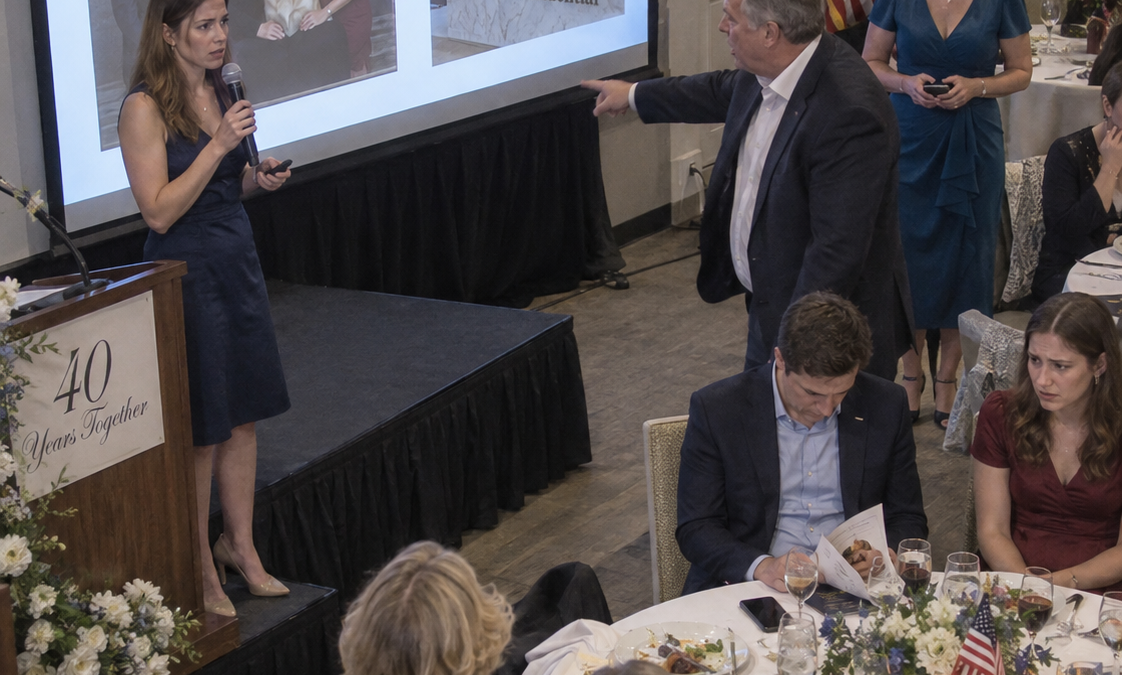
My name is Claire Bennett. I’m thirty-two years old, and my parents had been telling some version of the same joke for twenty-five years. At their fortieth anniversary party in Austin, Texas, they expected me to do what I had always done: smile, lower my eyes, and help everyone pretend it was harmless.
My mother leaned toward the microphone. “We kept her because returning her sounded expensive.” More laughter followed. Beside the stage, I pressed my thumb against the presentation remote until its edge began to hurt. Three weeks earlier, I had asked them to stop. Not during an argument, and not through somebody else. I had looked them both in the face and explained exactly what that joke had cost me. My father had promised nothing. My mother had asked whether I intended to ruin their celebration.
Now she was waving me forward to present the anniversary gift they had requested. For one second, I considered giving them the version they expected. I could create another beautiful memory for them and carry the ugly part home myself. My father reached for my shoulder. “Come on, show everyone what our resident stranger made.”
I stepped beyond his hand. “Actually,” I said, taking the microphone, “I finally worked out who doesn’t belong.”
His smile stayed in place. My mother’s didn’t.
Before I tell you what appeared on that screen and what happened after I left, share your local time and where you’re watching from in the comments. I’d like to know how far this family tradition travels.
The remote had a raised button beneath my thumb. I kept touching it while my brother finished his speech, counting the seconds between each compliment he gave our parents. Reliable. Generous. Always there. Those words might have meant more if he had ever needed something they didn’t already understand.
My brother Tyler worked beside our father at Bennett Residential, the interior renovation company our parents had built. My sister Sophie handled its marketing. I lived in Denver, where I designed murals and commissioned artwork for hotels, restaurants, and public spaces. On paper, we were three successful adults. At that table, I was still the one expected to explain herself.
Sophie had placed a folded card beside my plate. It listed the evening’s speaking order, and beneath my name was a handwritten instruction: “Keep it warm. No business talk.” I turned the card over. She had written nothing on the back. Twenty minutes earlier, Tyler had spoken about our father’s vision, our mother’s standards, and the company’s exciting expansion. Business apparently became inappropriate only when I had something to say about it.
A server passed behind me carrying grilled vegetables, and the smell brought back one particular summer afternoon. I was seven, sitting beneath the edge of a patio table with a sketchbook balanced on my knees. My father, Richard, had discovered that announcing I couldn’t possibly belong to him made adults laugh. My mother, Diane, supplied the finishing line. I didn’t understand the premise, but I understood that everyone was looking at me.
I remember asking her later, while she rinsed dishes, whether she knew for certain. She didn’t turn off the water. “Oh, Claire, don’t be ridiculous.” Then she handed me a towel. What stayed with me wasn’t uncertainty about where I came from. It was the shame of needing an answer. I had asked something sincere and somehow made myself embarrassing.
After that, I watched faces before I spoke. I learned to recognize the exact moment when an expression became inconvenient. When somebody teased me, I joined in early. At school, I made jokes about my clothes before anyone else could. On dates, I dismissed my ambitions before the other person had a chance. People called me easygoing. They never saw the preparation.
Back at the anniversary table, my father laughed at something Tyler said. I felt my own mouth move automatically, and that was the part I hated most: my body was still trying to earn safety from people I no longer trusted with my feelings. I stopped smiling and took a drink of water.
Across the room, a woman from one of my parents’ client accounts lifted her hand in greeting. She knew my work. My mother noticed the exchange and immediately crossed over to speak to her. Even from a distance, I recognized the movement. She was intercepting a conversation before it could develop beyond her control.
Years earlier, when I first started receiving commissions, my mother had begun introducing me differently. With relatives, I was the impractical one. With prospective clients, I became “our creative talent.” The first time she said it, I felt so grateful that I missed the possessive word. Our. I thought she had finally found a way to be proud of me. It took years to notice that her pride appeared most reliably when somebody was considering writing a check.
I wasn’t incapable of recognizing kindness. That made everything harder. My father once drove through a storm to bring me a replacement tire. My mother remembered that I hated cinnamon and coffee. They could be attentive in small, manageable ways. For a long time, I used those moments to argue against everything else. Every time I felt hurt, I assembled their defense before I could finish describing my own experience.
They were busy. They meant well. Other people had worse parents.
At twenty-six, I started keeping a private note on my phone titled “Things I Don’t Need to Explain Away.” It wasn’t a list of insults. It was a record of what happened after I asked for something different. That distinction mattered. A careless joke could happen once. Twenty-five years required cooperation.
At the anniversary, Sophie bent beside my chair and straightened my place card, although it was already straight. “Dad’s in a great mood,” she whispered. “Let’s keep it that way.” I looked at the instruction beneath my name, then at her hand resting over it. For years, I had mistaken that kind of warning for concern. That night, I finally understood what it was actually protecting.
Six months before the party, my parents attended the opening of my first large commercial installation in Denver. That was the version my mother posted online: “Proud to support our talented girl.” Three photographs, a heart, and a caption about family showing up.
They arrived at 6:12 and left at 6:32.
I knew because the event photographer sent me the image timestamps afterward, and because I spent the remaining two hours pretending I wasn’t watching the door.
The installation filled the entrance of a restored hotel. It was composed of layered panels of painted aluminum, designed to change as guests moved through the lobby. I had spent eleven months on it. During the final week, I slept so badly that I once put my keys in the refrigerator. My parents knew the dedication began at seven. I had sent the schedule twice.
My father still checked his watch while I explained how the panels were suspended. My mother asked me to stand beneath the hotel’s name for a photograph. Then they said they had dinner with an important contact. They hadn’t flown to Denver for me. Their meeting was the next morning. My opening had fit between their arrival and a reservation.
I knew that before they came, but I had spent seventy dollars on flowers for their hotel room anyway. I had written, “Thank you for being here,” on the card. The memory of that sentence hurt more than their early departure.
At 6:31, my father stopped near the exit. “Send Sophie the professional pictures,” he said. “This kind of thing makes us all look good.” He didn’t ask what the installation was called. When I told him, he nodded while reading a message. Then my mother kissed my cheek, leaving a small mark I wiped away before the dedication.
Onstage, the hotel director thanked my studio by name. I looked toward the entrance one last time, still imagining my parents might have changed their minds.
A week later, those photographs appeared in a Bennett Residential presentation. Sophie emailed me a copy and asked whether I could send a higher-resolution version of the widest shot. One slide described the installation as an example of the Bennett family’s expanding creative capabilities.
I called her immediately. She said the wording was aspirational. I said the hotel had hired my independent studio. She changed the slide after I insisted, but her annoyance was unmistakable. “You know, we’re trying to grow,” she said, as if accuracy were something I could contribute instead of money.
Our professional arrangement had begun two years earlier with a reasonable offer. Bennett Residential needed artwork for three renovated properties. I quoted a reduced rate because they were family, then insisted on a written agreement because the projects involved other people’s buildings and budgets. My father joked about how formal I had become. I let him joke.
The agreement gave them specific uses of the commissioned work and a limited period to display additional images from my portfolio in their marketing. It didn’t make me an employee, a partner, or their exclusive artist. For a while, the arrangement worked. The bills were paid. The clients liked the work. I believed I had found a language my parents respected.
Then the favors started accumulating around the contract. A concept sketch for a possible client. A rush revision on a Sunday. A meeting they described as casual until I joined and found six people waiting for a presentation. Individually, each request sounded small. Together, they consumed weeks.
I began sending change orders. My father began calling me difficult. My mother called afterward to translate difficult into disappointed, which somehow felt worse. I still completed the agreed work. I also stopped volunteering anything extra.
By the spring of the anniversary, the limited marketing permission was approaching its scheduled expiration, and I had decided not to renew it. That decision existed before the party, before the portrait, before I knew how far they had stretched the meaning of family.
The anniversary invitation arrived while I was reviewing a production schedule. My mother wanted me to design a presentation celebrating forty years of marriage. She said nobody else could make something so personal. I sat with that message longer than I should have.
I knew how often being needed had disguised itself as being wanted. Yet I still imagined finding photographs they had saved, discovering some private evidence that I had misunderstood them.
I agreed to make the presentation, not to renew the business arrangement. I put both points in the same email. My mother replied with three hearts and a request for a cream background. Looking back, the omission was obvious. At the time, I let her silence mean acceptance because I was tired of anticipating the worst.
How many times can you call yourself too sensitive before you stop trusting the part of you that knows you’re being hurt? I didn’t have an answer then. I only knew that I had become very good at asking for less and calling it maturity.
The portrait was mounted behind the reception desk at Bennett Residential. I saw it while picking up the old photographs my mother wanted included in the anniversary presentation.
My parents stood in the center. Tyler and Sophie stood beside them. Even our parents’ elderly dog occupied a neat patch of carpet at their feet. The photograph had been taken the previous November, on a weekend when I had been in Austin. Nobody had mentioned it. Beneath the frame, raised metal letters read, “The Bennett Family.”
A receptionist I hadn’t met asked whether I had an appointment. I said I was there to collect a box from Diane. She picked up the phone and announced, “The artwork vendor has arrived.”
There was no reason for her to know me. That wasn’t what made my stomach tighten.
On the opposite wall, a monitor was showing a slideshow of my installations. My family had removed me from the picture and kept the part they could sell.
I photographed the display, collected the box, and waited until I reached my rental car before opening it. Inside were anniversary photographs, vacation photographs, and pictures from old company events. Near the bottom lay a printed brochure for a proposed expansion into boutique hospitality interiors.
My name appeared beside the title Creative Director. Under it was a sentence stating that I would personally oversee the visual identity of every project in the new division.
I had never seen the brochure. I had never accepted that position.
I called Sophie from the parking lot. She told me it was an internal draft. I read her the print quantity on the packing slip tucked inside the box: two hundred. She went quiet, then said Dad had been talking about bringing me closer to the business.
Apparently, talking about it required neither my knowledge nor my agreement.
I asked her to email every document using my name. She said she would need to check with Tyler. I told her that wasn’t an answer. For once, I stayed on the line through the silence.
By the next morning, I had three proposals, a brochure, and a draft website page. Two proposals accurately described past collaborations. The third did not. It named me as the designated creative lead for a hotel group’s planned renovation program and described my involvement as confirmed.
I wrote to my parents and copied my siblings. I explained what was inaccurate, stated that I would not accept the proposed position, and repeated the expiration date for their limited portfolio permission. I asked them to correct the proposal and send me confirmation.
I kept the message plain. There were no accusations about childhood, no references to the portrait. I wanted the business issue resolved without giving them an excuse to call it emotional.
My father called within nine minutes. He said they had been trying to create an opportunity for me. When I pointed out that they had promised my time without asking, he said the details could be worked out later. Then he offered me a title with no defined pay, no authority over budgets, and an expectation that I relocate.
I declined.
His voice changed. “Don’t embarrass us with this, Claire.”
That was the first time I understood he already knew there was something to be embarrassed about.
Three weeks before the party, I visited their house and tried one final conversation. I asked them to stop using my name professionally without permission. I also asked them to stop making the daughter joke.
My mother folded a napkin while I spoke. My father stared at the television, which was muted but still on. When I finished, he said, “You certainly enjoy putting conditions on everything.”
I told him I was giving them information about what I would accept. My mother placed the napkin beside her plate. “If we have to watch every word around you, perhaps you shouldn’t come.”
I almost agreed. Leaving would have been easier than standing there while they treated a modest request as a threat. Then she added that my presentation would disappoint the guests after all the work Sophie had done. Somehow, I had been invited to disappear and warned against leaving in the same breath.
I stayed another ten minutes. That matters to me now. I didn’t storm out at the first uncomfortable answer. I gave them room to reconsider. My father finally said he would handle the business materials. As for the joke, he said, “People know it’s affectionate.” My mother asked me to stop confusing a celebration with a grievance meeting.
Two days later, I sent formal written notice through my studio’s business attorney, confirming the scheduled end of the marketing permission and requiring correction of the false role. It did not revoke completed client work or cancel existing commitments. I wanted every boundary to be precise.
My father acknowledged receipt with one sentence: “We’ll discuss this after the anniversary.”
I replied that the dates would remain as stated.
That evening, I opened the sentimental presentation I had nearly finished. There were forty years of birthdays, renovations, vacations, and carefully arranged smiles. I watched it once without music. Then I saved a second file.
I hadn’t decided to use it. I needed to see what the story looked like when I stopped editing out the cost.
Four days before the anniversary, a project director from the hotel group contacted my studio. Her name was Marissa Cole. We had met briefly at my Denver installation, but we had never discussed the Bennett proposal. She wanted to confirm my availability for a design meeting the following month. Attached to her email was a schedule with my name beside six deliverables.
My parents’ company had not corrected the proposal.
I answered in writing. I explained that I was an independent artist, that I had not accepted the listed role, and that I could not confirm those commitments. I included the dates on which I had already informed Bennett Residential. Marissa thanked me and said her team would contact them directly.
I didn’t ask her to withdraw their business. I didn’t need to. Accurate information could do whatever it was going to do without my assistance.
An hour later, my father called eleven times. I answered the twelfth because I wanted a record of exactly what he was asking. He said the hotel group had paused its review. I reminded him that he had been given time to correct the information himself.
He told me I should have called him before replying. “You could have given us a little cover.”
There it was, spoken so plainly that I wrote it down afterward. He wasn’t asking for my work anymore. He was asking me to help conceal the absence of an agreement.
I told him I would complete the anniversary presentation but would make no statement suggesting I belonged to the company. He said we would settle everything face-to-face. I sent a follow-up email summarizing the call, then returned to the second presentation. This time, I finished it.
At the venue, I gave the event technician both files and explained that I would choose which one to run. Both were my own presentations. The alternate contained no private client prices, confidential plans, or messages from people who hadn’t agreed to be involved. It showed public advertising, my own written notices, and a timeline of work credited inaccurately.
I was not going to make my point by becoming careless with somebody else’s trust.
Still, I nearly chose the sentimental version.
When I arrived, my mother touched my sleeve and said I looked lovely. For a moment, I could imagine the evening passing without injury. My father shook my hand, which was strange, but he didn’t mention Marissa. I let myself hope he had understood.
Then I saw the printed programs on the tables. Beneath the anniversary tribute, Sophie had added a special announcement about the next generation of Bennett Residential.
Nobody had asked me about an announcement.
I found Tyler beside the bar. He said Dad wanted to introduce the new division and present me as the family’s creative lead. I told him I had refused that role in writing.
Tyler glanced toward the guests. “Just don’t contradict him onstage. We can sort out the terms afterward.”
I looked at my brother until he stopped adjusting his cuff. He knew. He had read the notices. His plan was to let an audience make my refusal more difficult.
I told the technician to load the second file.
For the next hour, I remained seated while my family celebrated its own closeness. I listened to Tyler describe the security of working with people who had your best interests at heart. I watched Sophie thank our mother for making sure nobody ever felt overlooked.
I didn’t interrupt. I wanted to know whether either of them would glance toward me while saying it. Neither did.
Then my father took the microphone, told the joke, and called me forward. My mother added her line about returning me. The moment I had dreaded arrived almost exactly as I had imagined it, which somehow made it hurt more.
Even after everything, they hadn’t found a reason to be careful.
“Actually,” I said, “I finally worked out who doesn’t belong.”
My first slide appeared.
Happy 40th Anniversary.
Below it were their names in the elegant lettering my mother had approved. People relaxed. My father leaned back with his glass.
“For twenty-five years, my parents have said I couldn’t possibly be their daughter,” I continued. “I thought it was time to respect their judgment.”
A few guests laughed. I let the sound finish.
“So, tonight I’d like to introduce Richard and Diane. Lovely people. No relation to my studio.”
The next slide showed the company’s public advertisement, including the phrase “Our Family’s Artistic Vision.” Beside it appeared the original commission credit naming my independent business.
The laughter faltered.
My father straightened in his chair.
“They aren’t my creative directors,” I said. “They didn’t establish my studio, fund these projects, or supervise the work. Apparently, the hospital sent home the wrong daughter, but exactly the right portfolio.”
Somebody near the back laughed once, sharply, then stopped. My mother set down her phone. I saw her understanding arrive before my father’s did.
This wasn’t going to be a gentle joke that ended by praising them.
I changed the slide.
Three dates appeared: my first written request for correction, the formal notice, and the email I had received from Marissa. I had removed the hotel group’s name and all project details.
Beneath the dates was a single sentence: No position accepted. No future services authorized.
My father stood. “That’s enough business.”
“I agree,” I said. “There shouldn’t have been a business announcement about me tonight.”
His eyes moved toward Tyler. Several guests turned, too. Tyler looked down at his program.
I kept my voice steady. “I was told that refusing privately wasn’t enough. I was expected to stand here, smile, and let an announcement make the decision for me. So I’m making my own announcement.”
I glanced at the screen before continuing. “Existing client work remains covered by its agreements. New commitments require my approval. My name isn’t theirs to promise.”
My mother came toward the stage. “Sweetheart, people understand that we’re proud of you.”
I looked at her. “Then you can say what I actually do without claiming you own it.”
She stopped beside the first table.
There was no shouting now. Nobody was providing the helpful laughter that usually carried my parents across an uncomfortable moment. The next slide was the lobby portrait. No arrows, no dramatic music, just the photograph under the words The Bennett Family.
Beside it was a photograph of the monitor across the reception area displaying my work.
“This is how I’m represented at the company,” I said. “Absent from the family, present in the sales materials.”
My throat tightened, and for one frightening second, I thought I would lose the next sentence. I paused instead. The silence belonged to me for once.
“I asked you to stop the joke. I asked you to correct the advertising. You treated both requests as things I would eventually be persuaded to forget.”
My father pointed at the screen. “You’re taking everything out of context.”
“The full emails are available to the people reviewing the proposal,” I replied. “I haven’t shown them here because this room doesn’t need anyone’s private business.”
That was when he sat down.
I moved to the final slide. It contained my studio’s name, its logo, and the line I had spent an hour deciding whether to include: An Independent Business.
Beneath it was another line: At Last, a Family Tradition We Can Agree On.
“You’ve spent twenty-five years introducing me as someone who doesn’t belong to you,” I said. “Consider this my anniversary gift. I’m no longer asking you to change the introduction. I’m asking you to live with it.”
My mother whispered my name. I could hear it without the microphone.
“I came prepared to celebrate your marriage,” I told her. “I didn’t come prepared to surrender my work.”
I put down the remote.
There was no triumphant applause, no room full of people suddenly declaring me right. There were lowered glasses, unfinished smiles, and several guests studying their programs. It felt more serious than applause.
Nobody could pretend they had missed what happened.
As I stepped down, my father caught the edge of my sleeve. “You made us look like strangers.”
I gently pulled the fabric free. “I thought you liked that joke.”
I reached my rental car before my hands started shaking. For several minutes, I couldn’t fit the key into the compartment where I usually kept it. I had imagined leaving with perfect composure. Instead, I sat with the door open and breathed until I could trust myself to drive.
Speaking clearly in that room had taken everything I had.
I didn’t feel healed. I felt exposed, exhausted, and fiercely unwilling to take any of it back.
Tyler called before I reached my hotel. I let it go to voicemail. His first message accused me of destroying the evening. His second said Marissa had left without speaking to Dad. His third asked me to call her and explain that we had suffered a family misunderstanding.
I listened to all three the next morning. Then I answered in writing: “My employment status was not a misunderstanding. Do not make further commitments in my name.”
The hotel group did not immediately announce a cancellation. It requested clarification, supporting documents, and a revised staffing plan. I know because its legal department contacted my attorney about the proposed creative role. I supplied only what concerned me.
Their review took nearly three weeks.
When it ended, Bennett Residential was removed from consideration for the renovation program.
Marissa emailed to explain that the proposal had depended on resources the company had not secured and that confidence in its representations had broken down.
That distinction mattered.
A cruel joke hadn’t cost my parents the contract. Their decision to promise work they didn’t control had. The anniversary had simply made it harder to keep blaming the problem on my tone.
The video spread more quickly.
One guest posted a short clip of my opening line. Sophie demanded that I have it removed, as if I could control the account of somebody I barely knew. I asked the person to take down the cropped version because it lacked the business explanation. She did.
By then, copies had circulated through local professional groups. When people contacted my studio, I sent the same short statement: “I operate independently. I was not engaged for the proposed role, and existing agreements remain intact.”
I declined interviews. I wanted my name corrected, not a career built on discussing my parents.
The most damaging audience was small. It consisted of clients, collaborators, and referral partners who had trusted my father’s descriptions of what his company could deliver.
Two prospective customers requested written confirmation from every outside specialist named in their proposals. One chose another firm. A local developer suspended new referrals while reviewing earlier representations. Long-standing clients with completed projects largely stayed.
Nobody needed to invent a total collapse for the consequences to be severe.
My parents had already taken a larger showroom, hired staff, and ordered presentation materials for the expansion. Those expenses didn’t vanish when the hotel opportunity did.
I learned the details gradually through documents Tyler sent while trying to persuade me to return. The projections he attached assumed revenue from work they had not won. My participation had been treated as a certainty because Dad believed I would eventually give in.
Tyler proposed a six-month consulting agreement at nearly twice my usual rate.
The number made me stare.
They had always found my fees extravagant when I set them. Now the same work became valuable when it might preserve their expansion.
I declined because I didn’t trust the arrangement, not because I enjoyed watching them struggle. I had other contracts, a functioning studio, and employees whose schedules depended on my decisions.
Their emergency did not erase those obligations.
My mother called from a number I didn’t recognize. I answered, thinking it was a supplier. She cried and said my father hadn’t been sleeping. I listened.
Then she asked me to release a statement saying the anniversary speech had been exaggerated.
That was the moment I stopped wondering whether her distress automatically meant she understood mine. She wanted relief. She still wanted me to supply it by making myself less believable.
“I can say something accurate,” I told her. “You can draft it, and I’ll read it.”
The draft arrived that evening. It described a loving family, unfortunate humor, and confusion about an informal collaboration. It never mentioned that I had refused the position.
I returned one correction: “Claire had not accepted the role, and we continued to represent her participation after receiving her written objection.”
My mother said Dad would never sign that.
I said there was nothing further to discuss.
The company eventually published a correction without my endorsement. It acknowledged the inaccurate title and removed my work from new marketing when the existing permission expired. Archived client records retained their proper credits.
I checked once through my attorney, then stopped monitoring their website. I didn’t want maintaining my boundary to become another unpaid job.
Four months after the anniversary, Tyler sent me the agreement that changed the company’s ownership. He had arranged financing to buy a controlling interest at a valuation considerably below what my father had once expected. In exchange, Dad stepped down from daily management.
The expanded showroom was surrendered through a negotiated exit, and the business returned to its smaller office. My parents sold their lake property to cover obligations they had personally backed.
Their fortieth anniversary had been planned as the beginning of a grander chapter. By winter, they were explaining why that chapter had closed.
Sophie lost the launch she had spent a year promoting. She blamed me for weeks. Her first apology came with the phrase, “You have to understand,” so I ended the call. Her second admitted the brochure was wrong but said she couldn’t have opposed Dad.
I told her that being afraid of an argument didn’t give her permission to volunteer my life.
The third apology arrived in a letter. It named what she had done, including the warning on my place card. She asked for nothing. That was the one I answered.
Tyler took longer. He eventually acknowledged that he had hoped an audience would pressure me into agreeing. I didn’t congratulate him for admitting it. I told him that any future professional contact would go through my studio manager, at standard rates, with a signed scope.
He accepted. We have not worked together since.
My parents reached out five times before I agreed to meet them. The early requests concerned appearances: a holiday dinner, a photograph, an event where my absence might be noticed.
The sixth message was different.
My father wrote that he had told people I was difficult because it had been easier than admitting he had ignored my answer. He listed three people he had already corrected.
For the first time, the work of repairing his story was happening without an audience watching me forgive him.
I met my parents in a quiet café eight months after the anniversary. I chose the place, set a forty-minute limit, and drove myself. My father looked older, but I refused to let that become the entire conversation.
My mother reached for my hand, then stopped and asked permission. I said she could. It was a small thing. It mattered because she waited for the answer.
Dad told me he had enjoyed being the funniest person in the room. When the joke worked, he repeated it.
“When you learned to laugh,” he said, “I treated that as proof you weren’t hurt.”
He looked directly at me.
“Then you told me, and I decided my explanation mattered more.”
I had prepared myself for excuses about his own upbringing. He offered none.
That didn’t repair twenty-five years. It gave us one honest place to begin.
I explained what contact could look like. No public claims about our closeness. No requests for work disguised as affection. No discussing my boundaries with relatives in hopes somebody else could negotiate them down.
If the jokes returned, I would leave. I wouldn’t stay for an argument about intent.
My mother nodded. My father said he understood that agreeing once would not earn back everything.
I didn’t invite them to my next opening. They learned about it from my website and sent a card addressed to my studio, congratulating the entire team.
There was no request for photographs, no suggestion that they had helped.
I kept it on my desk for a week. Then I put it in a drawer.
I was allowed to appreciate it without turning it into a promise.
Almost a year after the anniversary, a magazine photographed me beside a completed installation. The photographer asked whether I wanted anyone else in the frame. I called over the fabricator who had solved the mounting problem and the assistant who had kept production on schedule.
We stood together beneath work we had actually made together.
I sent a copy to my parents later. Their reply was simple.
“You look proud.”
They were right.
I still grieve the family I kept trying to earn. I also love the life that became possible when I stopped offering discounts on my own dignity.
My parents lost money, authority, and the comfort of having their version accepted without question. I lost the habit of protecting that version.
I consider the exchange fair.
If a family can make rejection a public joke for twenty-five years, why should the person it hurts owe them a private response? Tell me where you draw that line, and subscribe for more stories about finding the courage to hold it.
I didn’t need to prove I was their daughter. I needed to stop letting them decide what that entitled them to.
Thank you for being here until the end of this fictional story. Everything in this video was created solely for entertainment, dramatic reflection, and education. We hope it reminds you that when someone repeatedly refuses to value you, the answer is not to become smaller, louder, or more convincing.
The answer may be to live with the dignity they never knew how to honor.








