My older brother kept lecturing me about how to raise my daughter, even though his own teenagers ignored him, insulted relatives, and did whatever they wanted; i stayed quiet for months until he criticized me in front of everyone at dinner
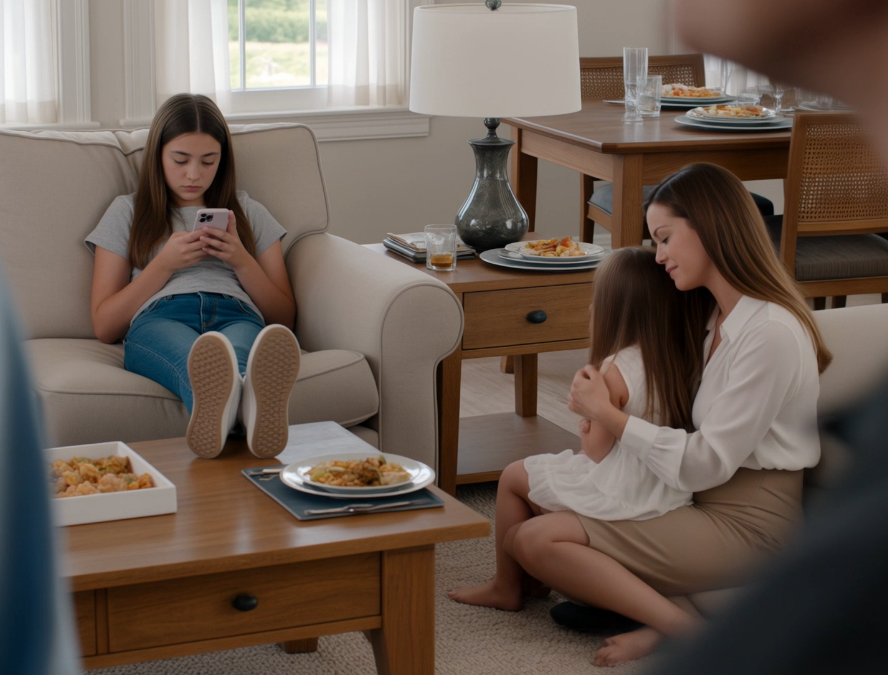
My older brother kept lecturing me about how to raise my daughter, even though his own teenagers ignored him, insulted relatives, and did whatever they wanted. I stayed quiet for months until he criticized me in front of everyone at dinner.
I met my older brother, Darren, when I was 26. He was 38. That sentence alone probably explains why our relationship has always been strange. We share a father, but we grew up completely separate. I knew there was another son somewhere out there, but I didn’t know his name, where he lived, what he looked like, or whether he even knew I existed. Then, a couple of years ago, after some family stuff I don’t really want to get into, we ended up being introduced. There wasn’t some big emotional reunion. Nobody hugged and cried. We basically shook hands like two guys meeting at a barbecue. Darren looked at me and said, “So, you’re the younger one?” I remember laughing because I had no idea what else to say. “Apparently,” I replied.
That was pretty much the beginning of our relationship. We’ve been around each other plenty since then because we now share a lot of the same extended family events, but I wouldn’t describe us as close. He’s technically my brother. Emotionally, he feels more like a cousin I met as an adult. We can have a normal conversation. We can watch a game together. We can sit at the same table for three hours without fighting. But there’s no deep brotherly bond there, and honestly, part of the reason for that is Darren’s personality.
He’s the kind of guy who always sounds like he’s explaining something to you, even when nobody asked. If somebody buys a car, he has an opinion about why they bought the wrong one. If somebody changes jobs, he knows why they should have stayed. If somebody cooks dinner differently than he would, he’ll stand there talking about how he learned the proper way from some guy twenty years ago. He rarely says, “I think.” Instead, he says things like, “What you need to understand is…” or “The problem with people these days is…” or, my personal favorite, “You’ll realize I’m right eventually.”
He’s not unbearable all the time. Sometimes he’s actually funny. But he definitely has this thing where he sees himself as the experienced adult in every room, which is especially funny considering how things work inside his own house.
Darren has three kids. His oldest son, Caleb, is seventeen. His daughter, Madison, is fifteen, and his youngest son, Tyler, is fourteen. I want to make something clear before I get into this: I don’t hate his kids. They’re teenagers. Teenagers can be moody, sarcastic, lazy, loud, and difficult. I know that. My kids are still little, so I’m not pretending I know exactly what raising teenagers is like. My oldest daughter, Sophie, is three. My younger daughter, Lily, is only a month old. I’m very aware that I’m still at the beginning, and that’s actually why I’ve always tried not to judge Darren.
But there are certain things you don’t need to raise teenagers yourself to notice, like the fact that his kids barely listen to him. The first time I really noticed it was at a family cookout. Darren told Caleb to help his mother carry a few things outside. Caleb was sitting on a patio chair, scrolling through his phone. Darren said, “Caleb, give your mom a hand.” Caleb didn’t even look up. He just said, “In a minute.” His mom ended up carrying everything herself. Maybe ten minutes later, Darren told him again, and Caleb responded, “Why are you obsessed with making me do stuff?” Darren laughed awkwardly and said, “Watch your mouth.” Caleb shrugged it off with an “Okay, whatever,” and that was the end of it. No consequence, no follow-up, nothing.
Another time, Madison asked her mom for money while we were all sitting in my aunt’s living room. Her mom said she didn’t have cash, and Madison immediately snapped, “You’re so annoying.” Her mom told her not to speak like that. Madison rolled her eyes and said, “Then stop being annoying.” I remember looking at Darren because I assumed he was going to say something. He was sitting right there, close enough to hear every word. But he just stared at the television and said nothing.
Tyler isn’t much different. He’s probably the quietest of the three, but he’ll make these little disrespectful comments that would make me lose my mind if Sophie ever said them to an adult. At Christmas, my sister Nina made a dessert everyone was eating. Tyler tried it, made a face, and said, “This tastes terrible.” Nina laughed because she’s pretty easygoing. She said, “You could have just said you didn’t like it.” Tyler shrugged and replied, “Same thing.” Darren actually laughed.
That’s the kind of thing I’m talking about. It’s not one huge incident. It’s constant little stuff. They interrupt adults. They demand things. They complain whenever they’re asked to help. They make sarcastic comments to relatives. They barely acknowledge people when they walk into someone’s house. If Darren tries to correct them, they usually argue until he gives up. I’ve even watched him change his mind after one of them got annoyed, as though their frustration alone was enough to make whatever rule he’d just established disappear.
One afternoon, Caleb wanted money to go out with friends. Darren said no because Caleb had apparently spent a bunch of money earlier that week. Caleb immediately started complaining. “Are you serious? Everyone else is going.” Darren reminded him, “You already had money.” Caleb shot back, “That was different.” They went back and forth for maybe two minutes before Caleb finally said, “Whatever. Don’t ask me for anything again.” Then he walked upstairs and slammed his bedroom door.
Darren sat there for about thirty seconds. Then he pulled out his wallet, handed some money to his wife, and said, “Just give him this before he leaves.” I remember thinking, There it is. That’s the whole problem. But I didn’t say anything because they’re not my kids. That’s always been my attitude. I can notice something without making it my business, and I’ve never felt that being related to someone gives me the right to interfere with how they run their household.
Darren and his wife also have a very different family setup from what my wife, Erin, and I want for our home. They barely eat together. Usually, Darren eats in front of the television. His wife eats whenever she gets the chance. The kids take food to their bedrooms. Sometimes one of them orders something separate because they don’t want whatever was made. Again, that’s their decision. I’m not standing outside their house with a clipboard, rating them on how they do things. But while I’ve made a point of keeping my opinions to myself, Darren has always made comments about how Erin and I parent our daughters.
When Sophie was around two, she went through a phase where she’d throw food off her high chair. We’d calmly take her plate away for a minute and explain that food stays on the table. Darren saw this once and said, “You’re wasting your time. She doesn’t understand all that talking.” I told him, “She understands more than you think.” He laughed and said, “Trust me. Just wait.” It was the kind of response he always gave, as though the fact that his children were older automatically settled every disagreement.
Another time, Sophie refused to put her shoes on before we left my sister’s house. I gave her a choice. She could put them on herself, or I would help her put them on. Darren overheard me and asked, “Why are you negotiating with a toddler?” I told him I wasn’t negotiating. I was giving her two options that both ended with the shoes going on. He shook his head like I was some clueless idiot and said, “That’s modern parenting for you.” I ignored it. In fact, that became my strategy whenever we were together: ignore Darren.
My wife noticed it, too. After one family dinner, we were driving home when she asked, “Does your brother always have something to say about how we parent?” I said, “Pretty much.” She asked why I never said anything, and I told her there was no point. “If I argue with him, he’s going to make it into a whole thing,” I explained. Erin looked out the window for a second and said, “I just think it’s funny coming from him.” I knew exactly what she meant. “Yeah,” I told her. “That’s why I’m trying not to say anything.”
Erin has met his kids enough times to know what they’re like. She never insults them, and neither do I. But after you’ve watched a fifteen-year-old tell her father, “Shut up. Nobody asked you,” and then watched him quietly keep eating dinner, it’s hard not to notice the irony when that same father tells you that you’re too soft. Still, I stayed out of it. Every time Darren said something, I reminded myself that my oldest was only three. Maybe he really did know things I didn’t. Maybe when Sophie was fifteen, I’d look back and realize some of his advice had a point. I didn’t believe that, but I left the possibility open.
The situation that finally blew everything up happened at my sister Rachel’s house. Rachel had invited the family over for dinner. Nothing formal, just pasta, garlic bread, salad, and people sitting wherever they could find a place. Erin came with me, along with Sophie and Lily. Lily spent most of the evening asleep in a carrier beside Erin, and Sophie was actually doing great for most of the night. She colored with my niece, ate some dinner, and even helped Rachel put napkins on the table. Everything was going smoothly until Sophie got tired.
Anyone who’s had a three-year-old knows exactly what happens when they’re tired but don’t want to admit they’re tired. Everything becomes a crisis. Sophie wanted juice, so I gave her juice. Then she decided she wanted a different cup. I told her she could use the cup she already had, and she started whining. I tried redirecting her attention. Then she wanted a cookie. I told her she could have one after she finished the strawberries on her plate. That was apparently the final betrayal. She pushed her plate away, and I said, “Sophie, we don’t push plates.”
“No!” she shouted.
“Okay, you don’t have to eat them,” I told her, “but the cookie is staying here.” She started crying. Not sad crying, but angry crying, the kind that comes from being exhausted and frustrated and not having the words to explain any of it. Then she reached up and hit me on the arm. It wasn’t hard. She’s three. That’s not the point. I gently caught her hand and said, “No, you do not hit me.” She tried to hit me again, so I moved her hand away and told her, “If you hit again, you’re going to sit in timeout because hitting isn’t kind.”
“No timeout!” she yelled.
“Then keep your hands to yourself,” I said. She slapped my forearm again, so I picked her up and moved her to a chair in Rachel’s hallway. I told her, “You’re sitting here for three minutes. When you’re calm, we’ll talk.”
She screamed for maybe the first thirty seconds. Then she started crying normally, and eventually, she stopped. I stayed nearby the entire time. I wasn’t yelling at her. I wasn’t ignoring her for half an hour. I wasn’t trying to humiliate her. After the three minutes were up, I crouched down in front of her and asked, “Do you know why you had to sit here?” She sniffled and said, “I hit Daddy.” I nodded. “Right. Are we allowed to hit people because we’re angry?” She shook her head. I asked, “What can you do when you’re angry?” She thought about it for a moment and said, “Say I’m angry.”
“Exactly,” I told her. Then she apologized. I hugged her, she hugged me back, and we went back into the living room. That should have been the end of it. The entire thing had taken maybe five minutes. Sophie had experienced a consequence, understood why it happened, apologized, and moved on. As far as I was concerned, the situation was handled.
But Darren had been watching.
As soon as Sophie went over to Erin, Darren walked up beside me with this little smirk on his face. “You’re way too soft with her,” he said. I already knew where this was going. I picked up my drink and said, “She’s three.” He immediately replied, “Exactly. This is when you teach them.” I looked at him and said, “I did teach her.” Darren laughed. “No, you had a conversation with her.”
“Yeah,” I said.
“That’s the problem.”
I looked at him. “What problem?”
“Kids need to know when Dad is serious,” he explained.
“She knows I’m serious.”
Darren shook his head. “No, she knows you’re going to explain everything nicely for ten minutes.”
I remember looking across the room at Erin. She wasn’t part of the conversation, but she could definitely hear us. Rachel could, too. I still tried to let it go. “It’s handled,” I said, and I walked toward the kitchen, hoping that would finally end the discussion.
But Darren followed me, and that annoyed me more than anything else. If he’d just made the one comment, I probably would have forgotten about it. Instead, he kept going. “I’m telling you now because you’re going to regret this when she’s older.” I opened the refrigerator and put my drink inside. “Okay,” I replied. He said, “You can’t be afraid to raise your voice.” I told him, “I’m not afraid.”
“Then why don’t you?”
I turned around to face him. “Because I didn’t need to.”
He laughed again, and that little laugh was really starting to get under my skin. “She hit you twice in front of the whole family,” he said. I reminded him, “Yeah, and she got a consequence.” Darren repeated, “Three minutes in a chair,” as though the idea was completely ridiculous. “She’s three years old,” I said. He shook his head and replied, “That’s exactly why you need to get control now.”
That word bothered me. Control? Like my daughter was some employee I needed to dominate instead of a little girl I was responsible for raising. I wasn’t trying to win a power struggle with a three-year-old. I was trying to teach her what was and wasn’t acceptable, and I thought I’d done exactly that.
“I’m not trying to control her,” I said. “I’m trying to teach her.”
“Same thing,” Darren replied.
“Not really.”
Then he started telling me how kids need to respect their parents, how parents today were too scared of upsetting their children, and how that was the reason so many teenagers didn’t listen anymore. “Kids need discipline,” he insisted. “Children who aren’t afraid of consequences become disrespectful teenagers.”
I stood there listening to him say all of this while his fifteen-year-old daughter was sitting about fifteen feet away with her shoes on Rachel’s coffee table, after Rachel had already asked her twice to take them down. I wish I was making that part up. Rachel had literally said, “Madison, please don’t put your shoes on the table.” Madison had moved them, and five minutes later, they were right back where they’d been. Darren either hadn’t noticed or didn’t care. Meanwhile, he was standing in front of me, lecturing me about respect.
I finally said, “Darren, I think we’re fine.”
He looked at me and replied, “You think you’re fine because your kids are still little.”
“Maybe,” I said, trying one last time not to turn it into an argument.
But he continued. “Wait until they’re fourteen. Wait until she looks you in the face and tells you no. Then you’re going to remember this conversation.”
I stared at him for a second. I’d spent two years listening to comments like this, swallowing whatever I thought about his own family, and reminding myself that keeping the peace was more important than proving a point. But standing there in Rachel’s kitchen, with Darren still lecturing me after I’d repeatedly tried to end the conversation, I finally reached my limit. I looked him straight in the eye and said, “You know what? You’re probably the last person I’d take parenting advice from.”
He stopped smiling. The entire mood changed immediately. “What does that mean?” he asked. I told him, “It means exactly what I said.” Darren crossed his arms. “No, explain it.” I probably could have walked away. Maybe I should have. But I’d spent two years listening to this guy make comments, and now he’d followed me into another room to keep criticizing me after I’d clearly tried to end the conversation. So I explained it.
“You keep warning me that my kids are going to become disrespectful teenagers,” I said, “but your teenagers are disrespectful constantly.”
His expression changed. “Excuse me?”
“Caleb ignores you when you ask him to do things. Madison talks back to both you and her mom. Tyler is rude to relatives for no reason. They argue until you give in.”
Darren just stared at me, but I wasn’t finished. “I’ve watched them demand money from you. I’ve watched them insult people. I’ve watched you tell them no and then change your mind because they got mad. So, yeah, I don’t really understand why you think you’re in a position to lecture me.”
He looked at me in disbelief. “You have no idea what it’s like raising teenagers.”
“You’re right,” I said. “I don’t.”
“Exactly,” he replied immediately, as though he’d just won the argument.
“But I know what I see.”
Darren took a step closer. Not aggressively, exactly, but more like he couldn’t believe I was actually saying any of this to his face. “So you’ve been sitting around judging my family this whole time?” he demanded. I shook my head. “No, that’s the difference.” He looked confused, so I explained. “I’ve noticed things. I kept my mouth shut because they’re your kids.”
That seemed to hit harder than anything else I’d said. For a moment, he just looked at me. Then he asked, “So you think my parenting is awful?”
I looked right back at him. “Yes.”
There was no point pretending anymore. He’d asked me a direct question, and I’d given him a direct answer. Darren stood there for a second before saying, “Wow.” I shrugged. “You wanted honesty.” He shook his head. “No, I wanted to know what you meant.” I replied, “Now you know.” Then I walked away.
I didn’t yell. I didn’t call him names. I didn’t insult his kids or say they were bad people. I said his parenting wasn’t something I wanted advice from. That was it. Apparently, though, the conversation spread immediately, because it wasn’t long before other members of the family started approaching me about what had happened.
Rachel came over about ten minutes later and asked, “What happened with you and Darren?” I told her, “He gave me parenting advice. I gave him feedback.” She closed her eyes for a second and sighed. “Oh, God.” I looked at her. “What?” She asked, “You actually told him?” I said, “He asked.” Rachel gave me a look and said, “You know how he is.”
“Exactly,” I replied. “I know how he is. That’s why I ignored him for two years.”
She told me Darren was furious, and I said that was fine. I wasn’t happy that he was upset, but I also wasn’t going to pretend the entire situation had come out of nowhere. He’d been making unsolicited comments for years, and for once, somebody had answered him.
Then my other sister, Nina, got involved. She came into the kitchen and said, “Can you two please not do this tonight?” I told her I wasn’t doing anything. Darren was on the opposite side of the house, refusing to look at me. Nina sighed and said, “You know, he’s sensitive about the kids.”
“Then maybe he shouldn’t criticize other people’s kids,” I replied.
“He wasn’t criticizing Sophie.”
“He was criticizing me as her parent.”
Nina lowered her voice. “You didn’t have to say his parenting was awful.”
I asked her, “What was I supposed to say?” She suggested that I could have just told him to mind his own business. I looked at her and said, “I tried.” When she asked what I meant, I explained that I’d tried ending the conversation multiple times and Darren had kept following me around, insisting on telling me everything I was doing wrong.
Nina sighed again. “He’s just like that.”
That sentence annoyed me, too. He’s just like that. I’ve heard that about difficult family members my entire life. Somebody can be rude, arrogant, intrusive, judgmental, or obnoxious, and eventually, everyone around them stops expecting better because they’re just like that. Their behavior becomes something the rest of the family is supposed to accommodate. Then, when someone finally pushes back, suddenly that person is the one causing drama.
I looked at Nina and said, “If he’s just like that, then I’m just like this.” She gave me a look, but I continued. “I’m not apologizing for answering a question he asked.”
The rest of dinner was awkward. Darren barely spoke. His wife looked uncomfortable, and I actually felt bad for her because she hadn’t done anything. His kids didn’t seem to care. Caleb spent most of the time on his phone. Madison whispered something to him at one point, and they both laughed. Tyler asked when they were leaving about six times. Whatever tension existed between the adults didn’t seem to bother the three of them in the slightest.
When Erin and I finally got into the car, she waited until we were a few streets away before saying anything. Then she looked over at me and said, “Well.”
I laughed. “Yeah.”
She asked, “Do you regret it?” I thought about that for a moment before answering. “The way I said it, maybe a little.” Erin nodded and asked, “The actual point?” I shook my head. “No.” She nodded again. “Same.”
I asked if she thought I’d gone too far. She was quiet for a few seconds, considering the question. Then she said, “I think if you had randomly walked up to him and said, ‘Your parenting sucks,’ you’d be completely wrong.”
“Obviously,” I replied.
“But he followed you around criticizing you after you tried to shut it down.”
“Exactly.”
“Then he asked if you thought his parenting was awful.”
“Exactly,” I said again.
Erin laughed and shook her head. “He really shouldn’t ask questions he doesn’t want answers to.”
The next morning, I had a message from Rachel. She said Darren was still angry and asked if I’d consider calling him. I told her I didn’t have anything to say. She replied, “Just clear the air.” I asked her how she expected me to do that. Her suggestion was that I should tell Darren I’d been frustrated and apologize for criticizing his parenting.
I told her I wasn’t going to do that. She wrote back, “You’re both adults.” I replied, “Yes, which is why he can also call me.” She didn’t respond after that.
Later that afternoon, Nina called. She made basically the same argument Rachel had. She said family relationships were already complicated enough, especially because Darren and I had only met recently. She didn’t think we should let something stupid destroy whatever relationship we’d managed to build.
I told her I didn’t want that either, but I also wasn’t going to apologize just because Darren was offended. Nina said, “Sometimes you apologize to keep the peace.” I asked her, “Does Darren do that?” She paused before answering, “That’s not the point.”
“It kind of is,” I said.
Because that was what bothered me most about the entire situation. Nobody was asking Darren to apologize for following me around and insulting my parenting. Nobody was asking him to admit that repeatedly telling another parent they’re doing everything wrong isn’t helpful. Nobody seemed particularly concerned that he’d ignored every attempt I’d made to end the discussion.
Instead, everyone was asking me to apologize because I was the person most likely to actually do it. I was the easier person to approach, the one who might listen, reconsider, and make things comfortable again. And I don’t want that role. I don’t want to become the family member who always has to smooth everything over because another person is too stubborn to acknowledge their part in an argument.
Two days passed, and Darren still didn’t speak to me. Honestly, it was peaceful. I wasn’t getting any lectures, there were no arguments, and I wasn’t spending time wondering what he was going to criticize next. Then my dad called. He didn’t tell me I needed to apologize. He mostly wanted to know what had happened, so I gave him the full story, including what Darren had said, how many times I’d tried to end the conversation, and exactly what I’d told him in response.
When I finished, my dad said, “You probably hit a nerve.”
“I’m aware,” I replied.
He asked, “Was it necessary?”
I thought about that before answering. “Probably not at first.”
“What do you mean?”
“If Darren had made one comment, no. But he wouldn’t stop.”
My dad said, “Darren likes to be right.” I laughed. “I’ve noticed.” Then my dad said something that actually made me think. He said, “Sometimes when people constantly give advice about one subject, they’re trying to convince themselves.”
I asked what he meant, and he replied, “Maybe he knows things aren’t great with his kids.”
That was the first time I felt a little sympathy for Darren, because maybe that’s true. Maybe he does know. Maybe every time Caleb ignores him, or Madison snaps at her mother, or Tyler refuses to do something, Darren knows he has less control over the situation than he wants people to think. Maybe he sees the way his teenagers behave and realizes that things haven’t turned out quite the way he imagined when they were little.
Maybe that’s why he talks so much about discipline. Maybe that’s why he keeps telling me what my kids will be like when they’re older. Maybe seeing me calmly deal with a three-year-old’s tantrum made him feel judged, even though I wasn’t judging him at all. At least not out loud. I could understand the possibility that some of his behavior came from insecurity rather than confidence, and that made the whole thing feel a little different.
But understanding why somebody acts a certain way doesn’t mean they get to treat you however they want. I can recognize that Darren might be struggling with his own family without agreeing that he has the right to criticize mine. And I can feel some sympathy for him without pretending that everything he said to me was acceptable.
A few days later, Darren finally texted me. His message said, “I don’t appreciate you talking about my kids like they’re terrible people.”
That annoyed me because I had specifically not done that. I hadn’t called his children terrible people. I hadn’t said I hated them or that they were beyond help. I’d pointed out behaviors I’d personally witnessed, and I’d done it only after he’d repeatedly criticized me and then demanded to know what I thought of his parenting.
I replied, “I never said your kids are terrible people.”
He responded, “You said they’re disrespectful.”
I wrote back, “They are sometimes. That’s not the same thing.”
Then he said, “You don’t know what happens in my house.”
“You’re right,” I replied. “I only commented on things I’ve personally seen.”
His next message read, “You have a three-year-old. Come talk to me when you’ve raised teenagers.”
I stared at that message for a while. There it was again. The same argument he’d been making from the beginning, as though having older children meant his opinions were automatically correct and mine didn’t deserve consideration. It didn’t matter what examples I gave or how many times I’d explained my position. He kept coming back to the idea that I couldn’t possibly understand anything about parenting because my kids were younger than his.
Finally, I wrote back, “Then maybe don’t give me parenting advice until I’ve asked for it.”
He didn’t reply.
That was almost a week ago, and we still haven’t spoken. My sisters think I’m being stubborn. Maybe I am. But the more I think about it, the more I realize I don’t actually need Darren to agree with how I parent. He can think I’m too soft. That’s fine. If he wants to yell more in his house, that’s his choice. If he thinks three minutes of timeout is ridiculous, fine. I’m not trying to copy his family. I’m trying to build mine.
I want my daughters to respect me without being afraid of me. I want them to know that being angry is okay, but hurting someone because you’re angry isn’t. I want consequences to make sense. I want to be able to correct my kids without turning every mistake into a battle. I want them to understand why certain things are wrong instead of simply being afraid of what will happen if they get caught. That’s the kind of relationship Erin and I want to build with them, and I know it’s something we’ll have to keep working on as they grow.
Will I get everything right? Absolutely not. I’m already sure I’ve made mistakes, and I’ll make thousands more. Maybe Sophie will become a difficult teenager. Maybe Lily will be even worse. Maybe someday Darren will get to laugh and tell me he warned me. But if that day comes, I’ll deal with it then. I’m not going to start parenting my three-year-old like she’s a seventeen-year-old because my brother says that’s the only way to earn respect. And I’m definitely not going to accept endless criticism from someone just because he’s older than me.
The funniest part is that before this happened, I’d never once told Darren how to raise his kids. Not once. There were dozens of moments where I could have said something. When Caleb ignored him, when Madison insulted someone, when Tyler refused to help, when Darren gave them money after saying no, or when one of them talked back and he pretended not to hear it. Every single time, I reminded myself that it wasn’t my business.
Apparently, that courtesy only went one direction.
So, no, I’m not planning to call him and apologize for the actual point I made. If we talk again, I’ll probably tell him I could have phrased it better. I’ll own that. Saying someone’s parenting is awful is harsh, and I understand why those words would hurt. I could have said I don’t agree with his parenting style. I could have said I don’t want parenting advice from him. Either of those responses would have made the same point without making things quite as personal.
But I’m not going to pretend I respect his parenting just to make him feel better. And I’m not apologizing for defending myself after he spent several minutes lecturing me in front of our family. If Darren decides this is enough reason to stop speaking to me, that’s his decision. I’m not going to chase him around trying to convince him that I still want a relationship while he refuses to consider why I finally said what I said.
We only became brothers two years ago. I’m not going to spend the next twenty pretending he’s always right because everyone else learned years ago that disagreeing with him is exhausting. Maybe we’ll eventually have another conversation. Maybe he’ll decide he doesn’t want one. Either way, I know where I stand.
Because advice means very little when it isn’t backed up by example. And being family doesn’t automatically give someone the right to criticize choices that aren’t theirs to make.








