My husband went to miami beach with his mistress, leaving me to take care of my paralyzed mother-in-law, at midnight, she stood up, handed me 20 gold bars, and revealed a shocking secret that left me speechless!
More than a year earlier, something about him had changed. He began coming home later and later, dressing in expensive-looking clothes, and keeping his phone facedown whenever he placed it on the table. Every innocent question I asked seemed to irritate him. He answered me as though I were a stranger intruding on a life that no longer included me.
Then, two months ago, Rose suffered what appeared to be a terrible accident.
She had gone into the backyard to gather kale for soup when she suddenly fell. At first, I thought she had simply slipped on the wet ground. But our family doctor, Dr. Miller, came to examine her and told us she had suffered a nerve injury that had temporarily paralyzed her legs. She would need absolute rest and someone to care for her around the clock.
From that day forward, nearly every responsibility in the house fell on my shoulders. I bathed Rose, changed her clothes, cleaned her, fed her soup, massaged her legs, washed the sheets, and emptied her bedpan. Even in the middle of the night, the slightest cough from her bedroom would send me rushing out of bed to make sure she was all right.
I never complained. I genuinely loved Rose.
She could be demanding, and she had never been particularly affectionate with words, but I knew what kind of woman she was. On the day I first moved into the house as her daughter-in-law, she had handed me an old wooden recipe box and said, “You can consider this your home. If there’s something you don’t like, tell me to my face. I don’t like hypocrisy.”
Those words had stayed with me throughout our marriage. A mother-in-law who treated me with that kind of honesty deserved my respect, even if she wasn’t the sort of woman who expressed affection through hugs and compliments.
John, however, seemed determined to become the exact opposite of the son he had once been.
From the moment his mother became bedridden, he practically disappeared from the house. He left early, returned late, and behaved as though caring for Rose had nothing to do with him. One afternoon, when I asked him to help lift his mother so I could change the sheets, he stood in the doorway, pinched his nose, and grimaced.
“Can you hurry it up? The smell of medicine is unbearable.”
I felt something tighten painfully in my throat. The woman lying helplessly in that bed was his mother, the person who had raised him and sacrificed so much for him. Yet he spoke as though she were an unpleasant burden someone had forced upon him.
That very night, while I was preparing warm water to wash Rose, I heard the rattling wheels of a rolling suitcase crossing the living room floor.
I stepped out of the bedroom and found John standing near the front door. He was wearing a crisp white shirt and new, sharply creased trousers. His hair was slicked back with gel, and the cologne surrounding him was so strong that it made my head ache. A black suitcase stood beside his polished shoes.
“Where are you going at this hour?” I asked.
He barely glanced at me. Instead, he checked his identification and slipped it into his pocket.
“I’m going to Miami Beach for a week. I have business with some partners.”
I stared at him, unable to believe what I was hearing. “What kind of business trip is this? You didn’t even tell me about it. Your mother is lying helpless in that bed, and you’re leaving for an entire week?”
He finally raised his eyes. The coldness in them frightened me more than his answer.
“Mom has you to take care of her. Since you’re staying home anyway, make sure you look after her properly. And don’t call me over every little thing.”
Before I could respond, the zipper on the outer compartment of his suitcase came loose. A tight red women’s dress, still bearing its store tag, slipped out and fell onto the floor.
It was clearly not something a man needed for a business meeting.
I bent down and picked it up, my fingers trembling. “Whose dress is this?”
John snatched it from my hands and shoved it back into the suitcase.
“Don’t touch my things,” he growled.
At that exact moment, his phone lit up with a message from a woman named Sylvia.
“Are you downstairs yet? I’m waiting for you at the curb. If we miss the flight, I’ll be mad at you.”
It felt as though something inside my chest had been crushed. I looked directly at my husband and struggled to keep my voice steady.
“You’re going with her?”
John stared at me for several seconds before letting out a contemptuous laugh.
“Since you already know, why bother asking? At least with her, I can breathe. Unlike you, always smelling like pain-relief cream and fussing over a paralyzed old woman.”
His words struck harder than any slap.
Inside the bedroom, Rose lay silently beneath her thin blanket. But I noticed her hand trembling, just slightly, against the sheet. She had heard everything. I could only imagine what it felt like for a mother to listen to her own son speak of her with such disgust.
“Do you still consider this your home?” I asked, my voice breaking. “Do you even consider your mother your mother anymore?”
John grabbed the handle of his suitcase and dragged it toward the door.
“Don’t lecture me. And if anything happens to my mother while I’m gone, don’t even think you’ll still have a place in this house.”
With that, he opened the door and walked out.
From beyond the iron gate came the sharp, delighted laughter of a young woman. I stood alone in the middle of the living room, my hands still carrying the faint smell of Rose’s ointment, watching my husband’s figure disappear into the darkness.
That night, only my supposedly paralyzed mother-in-law and I remained in the house.
I thought I had just endured the most humiliating night of my life. I couldn’t have imagined that before the night was over, the woman who had spent two months lying motionless in bed would stand before me and reveal a secret powerful enough to destroy everything I thought I knew about my marriage.
But to understand how John, once such a gentle and thoughtful man, had become capable of such cruelty, I have to go back to the years when we first met, when our home still echoed with laughter.
I was born into a family of tailors. My parents were never wealthy. They spent their days hunched over old sewing machines, altering clothes and making uniforms and formal dresses for people in our neighborhood. We had very little savings, but my parents taught me something more valuable than money.
“We can be poor in money,” they would say, “but we must never be poor in character.”
I grew up learning to be independent, to appreciate what I had, and never to measure happiness by expensive possessions.
When I met John, I was working as an administrative assistant at a construction supply company. He was a technician, the kind of man who rode an old motorcycle and wore shirts faded by sunlight and construction dust. He didn’t have money for elaborate gifts or grand romantic gestures, but there was something about him that touched me deeply.
He adored his mother.
I still remember one evening when rain was pouring down so heavily that the street outside our company had nearly disappeared behind a curtain of water. John was waiting near the entrance with a pharmacy bag in one hand, using his other hand to shield his jacket from the rain.
“Why didn’t you go straight home?” I asked him.
He smiled, almost sheepishly.
“My mom’s joints have been bothering her again. I stopped to pick up some medicine. Figured I’d come get you, too.”
It was such a simple thing to say, but I remember thinking that a man who remembered his mother’s medicine even in the middle of a downpour couldn’t possibly be a bad person.
After a few months of dating, John took me home to meet Rose.
Back then, she was still full of energy. She was short and quick on her feet, with hair already turning gray and eyes that were bright, alert, and remarkably sharp. She ran a small deli at the front of the house, opening it herself every morning and spending her afternoons recording what regular customers owed on their accounts.
She didn’t greet me with exaggerated affection or pretend we were already family. Instead, she studied me from head to toe and asked a very practical question.
“Do you know how to cook?”
A little embarrassed, I admitted that I knew how to prepare a few simple dishes.
Rose nodded. “Whatever you don’t know, you can learn. I don’t need a daughter-in-law who knows how to show off. I just need someone genuine.”
Her words made an impression on me. She hadn’t promised to love me like her own daughter, and she hadn’t offered empty compliments simply to make me comfortable. Yet there was something reassuring about her honesty.
Later, after John and I married and I moved into the house, Rose handed me that old recipe box.
“From today on, you live here. Consider this your home. If something doesn’t please you, say it to my face. I don’t like hypocrisy.”
For a young woman from a humble family, those words meant more than she probably realized.
The first years of our marriage were peaceful, even though we had few luxuries. John would hand me his paycheck because, he said, I was better at managing household expenses. On weekends, he helped his mother restock the deli shelves, replace light bulbs, and clean the awning.
Rose complained about almost everything, but whenever I became ill, she was the first person to bring a hot bowl of chicken soup to my bedside.
“Eat this and get your strength back,” she would say gruffly. “If you just lie there, who’s going to get your work done?”
I understood that it was her peculiar way of showing affection, and I loved her for it.
Sometimes I thought I was an incredibly fortunate woman. My husband’s family wasn’t wealthy, but they had principles. My mother-in-law wasn’t gentle with her words, but she was fair. My husband wasn’t ambitious about appearances, but he was sensible and hardworking.
If our lives had continued that way, I would never have found myself standing alone in the living room, watching my husband leave for a vacation with another woman.
The change began about a year earlier, when a middle-aged couple started visiting our home regularly.
The man’s name was Anthony, and the woman’s name was Fatima. They introduced themselves as distant relatives who had finally managed to reconnect with the family after many years.
From the beginning, Rose seemed uneasy around them. She received them politely, offered them water, and invited them to sit, but I could tell she didn’t welcome their visits.
John’s reaction was completely different.
I never knew exactly what Anthony and Fatima said to him behind closed doors, but after only a few meetings, he became strangely attached to them.
Mr. Anthony frequently took him out for beer. Mrs. Fatima bought him new clothes and watches, calling him in a sugary voice, “My son, you’ve suffered so much in your life.”
Every time I heard her say my son, an inexplicable chill ran down my spine.
Soon afterward, John’s behavior began changing in ways I could no longer ignore.
He started giving me less money for household expenses, claiming that a man needed his own account for socializing and maintaining business relationships. He began criticizing the house his mother had worked so hard to build, calling it outdated and complaining that the deli at the front was an embarrassment.
One evening, after returning from coffee with Mr. Anthony, John said something that left me speechless.
“A person has to know where he comes from. You can’t spend your whole life bowing your head to people who don’t even share your blood.”
I looked at him in confusion. “What are you talking about?”
He immediately became irritated.
“If you don’t understand my family’s business, stay out of it.”
That night, I found Rose sitting alone on the porch. She held a cup of tea that had long since gone cold and stared silently into the dark backyard. I wanted to sit beside her and ask what was wrong, but when she noticed me approaching, she raised one hand.
“It’s nothing, dear. Go to bed.”
Another time, I accidentally overheard her speaking to Dr. Miller on the phone. Her voice was unusually quiet and exhausted.
“I’m afraid they’re manipulating him. But if I tell him the truth too soon, he’ll only hate me more.”
I stood frozen behind the kitchen door, a cold sensation creeping through my body.
At the time, I had no idea what truth she was hiding, much less that it involved John’s real identity.
Around that same period, Sylvia appeared in our lives.
At first, it was only late-night phone calls and messages John hurried to delete. Then he began returning home later, his clothes carrying the scent of unfamiliar perfume. Money disappeared from our joint account faster than before, and the way he looked at me grew increasingly contemptuous.
Eventually, I asked Rose whether we should confront him about what was happening.
She studied my face for a long moment before replying.
“It’s not the right time yet, dear. Some truths have to come to light on their own. If we speak too soon, we only give people with bad intentions a chance to invent excuses.”
I thought she was simply trying to endure the pain of watching her son change, hoping that patience might somehow bring him back.
What I didn’t understand was that Rose already saw far beyond anything I could imagine. And it was during those painful months that she began planning the extraordinary deception that would finally be revealed on the night John left me behind to go to Miami Beach with his mistress.
Rose’s accident happened on a gray, drizzly morning.
I had been suffering from a stomachache since the previous night and was standing in the kitchen, preparing to make myself some tea and toast. When Rose saw how pale I looked, she immediately motioned for me to stop.
“Go lie down and rest. I’ll get some kale from the backyard and make you a nice hot soup. It’ll be good for your stomach.”
Before I could object, she had already put on her raincoat, picked up a basket, and walked out through the back door.
About ten minutes later, I heard a muffled thud from the yard.
My heart lurched. I ran outside and found Rose lying on her side beside the vegetable garden. The basket had overturned, scattering kale leaves across the wet ground. Her face was pale, one hand gripping the edge of a planter, while her legs remained unnaturally stiff.
For a moment, I was so frightened that I could barely speak.
“Mom! Can you hear me? Where does it hurt?”
John was still home, standing in front of the bedroom mirror and adjusting his collar before leaving for work. When I called for him, he came outside, but his reaction was strangely unsettling.
Instead of rushing to help his mother, he stood motionless for several seconds, staring at her with an expression that seemed to combine fear and confusion.
Only after I shouted again did he pull out his phone and call Dr. Miller.
The doctor arrived quickly. He had treated Rose’s joint problems for years, and seeing his familiar face helped calm me a little. After examining her, he frowned, pressed gently against her knees and feet, and instructed us to carry her inside and put her to bed.
“What’s wrong with my mom?” John asked impatiently. “Is it serious, Doctor?”
Dr. Miller looked at him for a moment before answering.
“There are signs of a neurological injury in the lumbar region. For now, she can’t move her legs. She’ll need complete bed rest and close observation.”
I felt my own knees growing weak.
“Shouldn’t we take her to the hospital for more tests?” I asked.
Dr. Miller hesitated briefly.
“There’s no need to rush into moving her right now. Rose has a history of spinal problems, and improper movement could make things worse. We’ll manage her treatment here at home, and I’ll come by regularly to check on her.”
At the time, I was too frightened for Rose to question his decision. But looking back, I remember something peculiar about the way he watched me.
Before leaving, he asked me to step onto the porch with him.
“Amelia,” he said quietly, “from now on, take very good care of Rose, especially at night. And don’t let anyone enter her room unless you’re present.”
I stared at him. “Why would you say that?”
He placed a reassuring hand on my shoulder.
“A bedridden patient is vulnerable to many things. A little caution and some chicken soup never hurt anyone.”
I had no idea why his words left me feeling so uneasy.
When John learned that his mother would remain at home instead of being admitted to a hospital, he didn’t appear devastated or even particularly concerned. Instead, he let out a long sigh, almost as though a burden had been lifted from his shoulders.
“Staying home isn’t so bad,” he said. “We’ll save money on hospital bills. Besides, Amelia is here to take care of her.”
I looked at him and felt a coldness spread through my chest.
His mother was lying helpless in bed, unable to move her legs, and the first thing he seemed relieved about was saving money.
From that day forward, my entire routine revolved around Rose.
I rearranged her bedroom so that a chair, washbasin, clean towels, medication, and pain-relief creams were always within reach. During the day, I prepared soft meals and soups, feeding her patiently by the spoonful. At night, I woke every few hours to help her change position, massage her legs, replace her adult diapers, and make sure she was comfortable.
Eventually, I became so accustomed to listening for her that even a quiet cough would startle me awake.
But as the weeks passed, certain things began troubling me.
Rose didn’t always behave like someone who had completely lost sensation in her lower body.
One night, while I was carefully massaging her foot, I noticed her big toe move.
It was barely noticeable, just a tiny movement that might have been an involuntary reflex. I immediately looked at her face, but her eyes were closed and her breathing remained calm.
I wondered whether I had imagined it because I was so exhausted.
Then, on another occasion, while helping her change her blouse, I discovered an old flip phone hidden beneath her pillow. It had been wrapped carefully in a handkerchief.
Curiosity overcame me. I opened the contact list and found only two saved numbers.
Dr. Miller.
Attorney Nolan.
I stared at the screen, completely bewildered.
Just then, Rose opened her eyes and placed her hand over my wrist.
She didn’t say a word. She simply looked at me intensely and gave the smallest shake of her head.
The message was unmistakable: Don’t ask questions. Don’t tell anyone.
My anxiety deepened after that.
Why would a helpless woman need to hide a telephone? Why had Dr. Miller warned me against allowing people into her room? And why did Rose become unnaturally still every time John came near her bed, almost as though she were suppressing every instinct to react?
Meanwhile, my husband was finding new ways to make life more difficult.
He began pressuring me to quit my job entirely. He claimed that with his mother bedridden, he didn’t trust strangers to take care of her and that, as her daughter-in-law, the responsibility belonged to me.
I tried to explain that although my salary wasn’t large, it was steady income. If I resigned, finding another job later might be difficult.
John frowned impatiently.
“How much do you even make? Do you honestly think my mother worked her whole life without saving enough money for us to look after her?”
He was quick to remind me that Rose had savings, yet every week he became more reluctant to give me money for her care.
Whenever I bought adult diapers, he rolled his eyes. If I purchased vitamins, he accused me of wasting money.
Once, when I asked for additional funds to buy a pressure-relief mattress to prevent Rose from developing sores, he threw several bills onto the table.
“Watch how you spend that money,” he snapped. “She’s just lying in bed. What does she need all this fancy stuff for?”
I swallowed the anger rising in my throat.
Rose lay with her eyes closed, but I could see tears collecting at their corners. She had heard every word.
This was the woman who had sold her jewelry and even a piece of land, who had worked from sunrise until long after sunset to give John a future. And now her own son considered a simple medical mattress an unnecessary luxury.
One afternoon, when Rose developed a high fever and her body felt dangerously hot, I called John and begged him to come home so we could take her to a doctor.
He answered with obvious irritation.
“What are you even doing at home that you have to call me about every little thing? I’m not a nurse!”
Then he hung up.
I stood in the middle of the bedroom with the phone still pressed against my ear. The air smelled of ointment, and tears ran down my cheeks.
It was during those miserable weeks that I began to understand something frightening.
John’s change wasn’t merely the result of growing tired of our marriage or falling in love with another woman. Something deeper seemed to be eating away at his character.
Either his ingratitude had reached the point where he could no longer feel pity for the woman who had raised him, or someone was deliberately pulling him away from his home, his wife, and whatever conscience he still possessed.
As Rose remained bedridden, Mr. Anthony and Mrs. Fatima started coming to the house even more frequently.
At first, they pretended their visits were simply expressions of concern. They arrived carrying fruit, asked superficially about Rose’s condition, and offered a few sympathetic words.
But something about their behavior was deeply peculiar.
They never actually went into her bedroom to spend time with her. They would stand near the doorway, offer a hurried “Get well soon,” and then make their way straight into the living room, where John was usually waiting.
I noticed how completely my husband’s personality changed whenever they were around.
With me and his mother, he was harsh, dismissive, and impatient. But in front of Anthony and Fatima, he behaved almost like a little boy desperate for approval.
Mr. Anthony would pat him on the shoulder and casually call him “my son.” Mrs. Fatima brought expensive shirts, watches, and perfume, smiling in a way that always struck me as painfully insincere.
“A man who goes out into the world needs to dress well,” she would tell him. “Otherwise, people won’t respect him.”
Her words were like sweet poison to John.
He spent more time admiring himself in the mirror, complained that his old car was embarrassing, criticized his mother’s house for being outdated, and repeatedly called the deli an eyesore.
Even the food I cooked became another reason for him to humiliate me.
“Always this poor people’s food,” he muttered one evening, staring at an ordinary home-cooked meal. “No wonder our lives never move forward.”
I remained silent, but from Rose’s bedroom, I noticed her fingers gripping the edge of the sheet until her knuckles turned white.
Mrs. Fatima seemed to take particular pleasure in making cruel remarks within my hearing.
One afternoon, while I was gently wiping Rose’s forehead with a damp cloth, Fatima appeared at the bedroom doorway. She glanced around with an expression of thinly disguised contempt.
“It’s very strange,” she remarked, “to let someone who isn’t even related by blood take care of everything in a house like this. Blood is blood, after all. No matter how much you raise an outsider, it’s never anything more than a favor.”
I froze.
There was no mistaking the malice behind her words.
I looked toward John, waiting for him to defend me, but he merely continued staring at his phone as if he hadn’t heard a thing.
Rose squeezed her eyes shut, and her breathing became noticeably heavier.
I didn’t understand it then, but Fatima’s words had reopened the deepest wound in my mother-in-law’s heart.
One quiet afternoon, while a gentle breeze moved through the backyard, I was hanging blankets on the clothesline when I heard voices drifting through the open living room window.
I recognized Mrs. Fatima’s voice immediately.
“Your mother is old and paralyzed,” she told John. “Sooner or later, this house will belong to you. Don’t let your wife or anyone else interfere. Once women get their hands on money, they never want to let go of it.”
I stopped moving and remained hidden beside the wall.
John said nothing for several seconds. Then I heard him answer softly.
“But she raised me since I was a baby.”
Mrs. Fatima interrupted him before he could continue.
“She raised you because she couldn’t have children of her own. You don’t owe her your entire life out of pity. People don’t always adopt children because of love. Sometimes they just want someone to take care of them when they’re old.”
Every word felt like a knife being driven into something sacred.
I didn’t yet understand the family history they were discussing, but their intentions were becoming painfully clear. They were feeding John resentment toward the woman who had raised him and loved him as her own flesh and blood.
After that conversation, his behavior deteriorated even more rapidly.
He rarely entered Rose’s bedroom anymore, and when he did, his visits usually involved questions about money and documents.
“Where did you put the key to that wooden lockbox?” he demanded one day. “And what about your bank passbooks? Do you still have them?”
On another occasion, he pulled a chair up beside her bed and tried to speak in an unusually gentle voice.
“Mom, now that you’re sick, you should transfer the deeds and important papers into my name. It’s more practical that way. If anything gets lost, it’ll be a huge headache.”
Rose stared at the ceiling without answering.
Her silence made John furious.
“Don’t think I’m a fool! I’m your son. Or are you saying you trust outsiders more than me?”
As he said the word outsiders, he glanced pointedly in my direction.
I felt an ache spread through my chest.
Rose slowly closed her eyes, and a single tear slipped down the side of her face.
Around the same time, Sylvia’s involvement in John’s life became impossible to deny.
She was no longer merely an unfamiliar name appearing on his phone late at night.
One afternoon, John went to shower and left his phone on the living room table. The screen lit up with a new message.
“When you sell that house, we’re going to open our own med spa. I don’t want to work for other people my whole life.”
My fingers went cold as I read it.
Before I could see anything else, John came out of the bathroom and lunged for his phone.
“Who gave you permission to touch my things?” he shouted.
“I wasn’t trying to,” I said. “But what house are you planning to sell? Your mother’s house?”
He didn’t answer.
Instead, he struck me across the face so hard that my skin burned and my ears rang.
“Don’t think that just because you’ve been taking care of my mother for a few days, you have the right to run this house,” he snarled.
I stood there in stunned silence, unable even to cry.
When I looked toward the bedroom, I saw that Rose had opened her eyes. Tears streamed down her temples, but she made no sound.
Her silence frightened me almost as much as John’s violence. It seemed as though she were holding something enormous inside her, something so powerful that once it came out, nothing in our household would ever be the same.
That evening, Dr. Miller came to check on Rose.
He noticed the red mark on my cheek immediately, and his expression darkened.
When John stepped outside to answer a phone call, the doctor moved closer and spoke quietly.
“Amelia, from now on, if John gives Rose any food, water, or medicine, save the packaging and whatever is left over. Anything that seems unusual, keep it.”
I stared at him in alarm.
“What do you mean, Doctor?”
He glanced toward the bedroom and then toward the doorway, as though he were afraid someone might overhear us.
“There are people who are in more of a hurry than we think.”
His answer sent a chill through me.
I began thinking about everything that had happened: Rose’s fall, her supposed paralysis, the hidden phone, Dr. Miller’s warnings, and the strange way she remained silent whenever John or his new companions entered the room.
None of it felt ordinary anymore.
I was increasingly certain that Rose and Dr. Miller knew far more than they were willing to tell me. Perhaps they were waiting for the right moment to expose whatever was happening.
From then on, living in that house felt like walking across a sheet of thin ice.
On one side was my husband, growing more hostile every day. On the other were Anthony and Fatima, two people who spoke constantly about blood ties while looking at everything around them as though calculating its monetary value.
And in the middle of it all lay Rose, apparently helpless, yet somehow watching and listening to everything.
As for me, I had believed my only responsibility was to care for a sick elderly woman. I never imagined I was being drawn into a situation that would teach me just how much more destructive human greed could be than any illness.
A week before John left for Miami Beach, he came home drunk.
I was sitting beside Rose’s bed, replacing the cool cloth on her forehead, when I heard the front gate slam shut. A moment later came the uneven sound of footsteps crossing the living room.
The smell of alcohol, cigarette smoke, and women’s perfume drifted down the hallway before John even reached the sofa.
He stumbled into the room, tossed his keys onto the table, and collapsed onto the cushions. His shirt was partly unbuttoned, and a smear of red lipstick marked his collar.
I stood in the bedroom doorway, looking at him.
Strangely, I no longer felt the sharp jealousy that had tormented me when I first suspected his affair. When a woman is hurt repeatedly, even her tears eventually begin to dry up.
“Do you still consider me your wife?” I asked quietly.
John lifted his head. His bloodshot, alcohol-clouded eyes settled on me with open disgust, and he gave a mocking laugh.
“A woman needs to know her place. What do you have besides the title of my mother’s caregiver? Don’t think that because you spend all day locked inside that sickroom, it gives you some special status.”
I clenched the hem of my shirt to stop my hands from shaking.
“I don’t need you to praise me,” I answered. “But your mother is sick, and our home is falling apart. You can have whatever life you’re living out there, but couldn’t you at least stop long enough to take care of her?”
Without warning, John grabbed a drinking glass from the table and hurled it onto the floor.
The crash made me jump.
From the bedroom, I caught a glimpse of Rose’s eyelids fluttering, but she remained motionless.
John pointed a trembling finger at me.
“If she’s sick, then you take care of her! I’m not going to bury my life beside a paralyzed old woman and a wife who’s always moping around like you!”
His voice was slurred, but the venom in his words was unmistakable.
I didn’t know how deeply Rose suffered as she listened to her own son say those things. All I could see was her hand tightening beneath the bedsheet, the veins rising sharply against her pale skin.
Still, she said nothing.
By then, her silence no longer seemed like helplessness. It felt more like the silence of someone enduring terrible pain while waiting to discover just how deeply the final betrayal would cut.
The following morning, Mr. Anthony and Mrs. Fatima visited again.
They carried an expensive bag of fruit, which they placed on the living room table without bothering to enter Rose’s bedroom.
Mrs. Fatima made a point of speaking loudly enough for me to hear.
“A long illness is difficult for everyone. The person lying in bed suffers, of course, but so does the person looking after them. A man can’t be expected to let his whole life come to a stop because of something like this.”
I paused while pouring their water.
Mr. Anthony sat with his legs crossed, wearing the smug expression of someone who believed his opinions were unquestionably wise.
“You have to think about your future, son,” he told John. “You’re at the age when you should be earning money, enjoying life, and building something for yourself. Don’t let old-fashioned ideas about duty and morality hold you back.”
John listened without objecting, occasionally nodding.
Watching the three of them, I had the uncomfortable feeling that I was witnessing a performance they had rehearsed together.
Then Mrs. Fatima turned toward me, her voice falsely innocent.
“Some marriages are nothing more than a burden. When a man has a house and money, he can always start his life over.”
I set the glass down on the table with a sharp bang.
“What exactly are you to my husband that you feel entitled to interfere in our marriage?”
The living room fell silent.
Mrs. Fatima recoiled slightly, while Mr. Anthony fixed me with an icy stare.
John sprang to his feet.
“Watch your mouth! Your elders are speaking. Who gave you permission to interrupt?”
I looked straight at him.
“Am I wrong? Ever since these two started coming here, you’ve changed. You despise your mother, you despise your wife, and all you ever talk about is money and property. Who are they, anyway?”
Mr. Anthony gave a contemptuous smile.
“You’re just his wife, young lady, and there’s no guarantee you’ll remain his wife forever. Some matters concern blood relations, and you have no right to interfere.”
The words blood relations landed heavily between us.
I stood frozen.
Mrs. Fatima quickly grabbed Anthony’s arm, trying to silence him, but the damage had already been done.
I looked at John, hoping he would deny what the man had implied.
Instead, my husband turned his face away.
His silence told me more than any explanation could have.
That night, John began preparing for his trip without bothering to hide his plans any longer.
I watched him lay out swim trunks, sunglasses, cologne, identification, and cash, arranging everything with the excitement of someone preparing for a long-awaited vacation.
I leaned against the bedroom doorframe, my throat painfully tight.
“Mom has a high fever today. Can’t you postpone the trip for a few days?”
He continued packing without looking up.
“The flights are already booked. I don’t have time to change them.”
“You’re going with Sylvia, aren’t you?”
His hands stopped moving. He turned toward me with a look so indifferent that it was almost cruel.
“And if I am? If you already know, why bother asking?”
I felt the last fragments of our marriage slipping through my fingers.
“What about your mother? What about me? What about this house?”
John gave a dry laugh, pulled several bills from his wallet, and tossed them onto the table.
“If you run out of money, figure something out. Aren’t you the perfect daughter-in-law? Take good care of my mother, and don’t keep calling me to solve problems while I’m trying to enjoy myself.”
I looked down at the money scattered across the table.
Six years of marriage, and my own husband was treating me like an unpaid domestic servant.
I said nothing more.
There are moments when silence isn’t surrender. Sometimes it’s simply the realization that the person standing in front of you no longer deserves the effort of an argument.
As John prepared to leave with his suitcase, his phone rang.
Sylvia’s shrill voice carried clearly through the speaker.
“Hurry up! I want to take pictures at the airport. And if you spend this vacation looking miserable, I’m going to be mad at you.”
John’s voice softened immediately.
“I’m coming down. Give me two minutes.”
Then the front door slammed, and moments later, the sound of a car engine faded beyond the gate.
I stood in the living room for a long time.
Finally, I knelt to gather the broken glass John had scattered across the floor the previous evening. I was so distracted that one of the sharp fragments sliced into my hand. Blood began running across my fingers.
I hadn’t even found anything to wrap around the cut when a voice called softly from the bedroom.
“Amelia.”
I went still.
It was Rose’s voice, clear and steady, without the weak, exhausted tone she had used throughout her illness.
I hurried into her room.
She was lying with her eyes wide open, watching me with a brightness I hadn’t seen in weeks. Her expression was grave.
“Lock the door, dear.”
I stood beside her bed, bewildered.
“Mom? You can speak clearly?”
She didn’t answer.
Instead, she placed both hands against the mattress, slowly pushed herself into a sitting position, and lowered her feet to the floor.
Then, right before my eyes, she stood up.
Straight and steady.
I took an involuntary step backward, my heart pounding so violently that I thought it might burst through my chest.
For two months, I had bathed those legs, massaged them, lifted them, and treated them as though they had no strength or feeling. Yet Rose was now standing in front of me as naturally as she had before the accident.
Before I could form a question, she walked to the nightstand and opened a hidden compartment beneath the drawer.
From inside, she removed an old metal box.
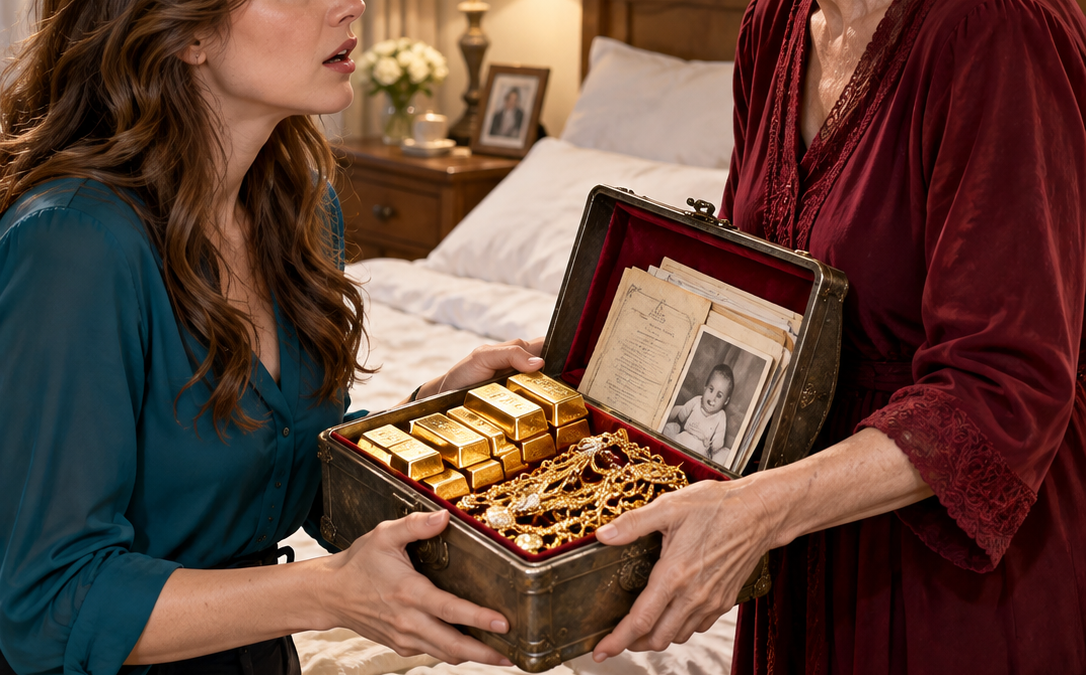
When she lifted the lid, I saw dozens of old gold coins and several thick gold chains wrapped carefully in red velvet. Beside them were the deed to the house, bank passbooks, and a yellowed folder filled with documents.
She gathered everything and placed it into my trembling hands.
Her voice was calm, but beneath that calmness lay an unbearable sadness.
“I’m entrusting you with these Gold Eagle coins and the family jewelry. And here are the deed to the house and John’s adoption papers.”
For a moment, I couldn’t understand what she had said.
“Adoption papers?”
Rose looked into my eyes. Tears were sliding down her cheeks, but she spoke slowly and clearly.
“John isn’t my biological son. His real parents are Anthony and Fatima. They abandoned him when he was a baby, and now they’ve come back to teach him to sell this house, abandon his wife, and forget the woman who raised him for more than thirty years.”
I held the heavy metal box against my body, feeling an icy sensation travel from my fingertips to the back of my neck.
Somewhere beyond our home, John was happily beginning a vacation with his mistress.
And inside the bedroom, the mother-in-law I had believed was paralyzed stood before me, revealing a family secret that threatened to bring our entire world crashing down.
I remained motionless for a long time, clutching the box and struggling to make sense of everything.
Twenty gold coins, the deed, and the adoption papers were right there in my hands. The evidence was too real to dismiss.
Yet the gold and documents weren’t what frightened me most.
It was Rose herself, standing on legs I had spent two months caring for as though they would never move again.
She motioned for me to close the curtains.
Then she walked out of the bedroom, checked that the front door was locked, switched off the porch lights, and returned to sit in the chair beside her bed.
For a moment, she simply breathed.
“I was never really paralyzed, dear,” she finally said, her voice hoarse but unmistakably clear. “When I fell in the yard, I only suffered a sprain. But Dr. Miller told me that if we allowed everyone to believe the situation was more serious, we might finally learn whether John still had a conscience.”
I stared at her, my throat tightening.
“So you and Dr. Miller have been pretending for two months?”
She nodded.
Her face was thin, and there were deep shadows beneath her eyes, but her gaze remained astonishingly alert.
“I didn’t want to do it, Amelia. No mother wants to lie helplessly in bed and listen to her own son speak cruelly about her. But I caught him searching through my drawers for the deed and asking about my bank passbooks. Then I saw the messages he exchanged with Sylvia about selling the house and opening a spa.”
She paused, her hands tightening in her lap.
“That’s when I realized that if I continued walking around as though nothing was wrong, he would never reveal what he was really planning.”
A shiver traveled down my spine.
For months, I had believed Rose was the most helpless person in our household and that I was the only one strong enough to protect her.
Now I understood that she had been the most clearheaded person in the entire house.
Lying silently in bed, she had listened to every cruel remark from John, every poisonous suggestion from Anthony and Fatima, and every provocation connected to Sylvia.
Her suffering had never truly been in her legs.
It was in her heart.
Rose opened the yellowed folder and began showing me its contents.
There was an adoption certificate, an old birth certificate, several faded photographs, and a picture of John as a newborn wrapped in a blue blanket. He was being held by a man I recognized as Rose’s late husband, the only father John had ever known.
Rose gently brushed her fingertips across the photograph.
“His father and I couldn’t have children,” she began. “One rainy night, a baby was found abandoned outside the community health clinic. He was burning with fever and crying until his voice was hoarse. There was a little note pinned to his clothes. It said, ‘No means to raise him.'”
Her voice grew softer.
“We adopted him when he was only a few months old. At first, we planned to tell him the truth when he was older. But we were afraid it would hurt him, and we kept putting it off.”
After John’s adoptive father died, Rose had been left to raise him alone.
She ran the deli, worked tirelessly, and used nearly everything she earned to pay for his upbringing and education.
There had been a year when John failed a grade at school, and Rose sold her wedding earrings so she could afford the expenses of having him repeat it.
Later, when he wanted to take a vocational course, she sold the piece of land behind the house to pay for his training.
“You know, dear,” she said, her voice breaking, “I never regretted any of it. To me, he was my son. I may not have given birth to him, but I raised him. That was what being his mother meant to me.”
I couldn’t find the words to answer.
My eyes burned as I looked at this woman who had devoted her life to loving a child someone else had abandoned, only to discover that the same child now considered her an obstacle to his happiness.
Rose went on to explain that Anthony and Fatima had first approached her almost two years earlier, before their visits to the house became frequent.
They had cried and begged for understanding, claiming that desperate poverty had forced them to abandon their baby. Now that they were growing older, they said, they wanted to reconnect with their own flesh and blood.
Rose had been moved by their story.
She allowed them to meet John, asking only that they reveal the truth gradually so he wouldn’t be overwhelmed.
But her compassion had opened the door to disaster.
“They didn’t come back because they loved him, dear,” she said bitterly. “They came because they discovered I owned this house and had some gold and savings. They told John I was nothing more than his nanny. They convinced him I had hidden his identity to keep him tied to me so he’d take care of me in my old age.”
She lowered her gaze.
“They poisoned him little by little until he stopped looking at me as his mother.”
I remembered Fatima’s cruel remarks, Anthony’s calculating glances around the house, and Sylvia’s messages about selling the property.
Suddenly, everything fitted together in a horrifying way.
John wasn’t merely being unfaithful to his wife. He had allowed the greed of his biological parents to pull him away from the woman who had given him everything.
Rose pushed the metal box toward me.
“I saved these twenty gold coins over the course of my life. Some I bought while I was running the deli. Some came from money John’s father left behind. Others I kept in case of medical emergencies.”
She covered my hand with hers.
“I want you to keep them safe. Not because I want to burden you with my problems, but because you’re the only person in this house I still trust.”
I shook my head and tried to push the box back.
“I can’t, Mom. If John finds out I have all this gold, he’ll think even worse of me.”
Rose caught my hand with surprising firmness.
“Then perhaps it’s better if he does find out. I want to see whether he comes home because he’s worried about me, or whether he’ll show his true colors the moment he thinks the gold is slipping out of his reach.”
I didn’t know what to say.
There was a depth of grief in her eyes that seemed to have gone beyond tears.
I didn’t believe she wanted revenge on her son. More than anything, she wanted to know whether the boy she had raised for over thirty years still possessed even the smallest trace of gratitude.
She instructed me to preserve every message John sent, keep records of his phone calls, avoid opening the door to anyone when I was alone, and never reveal that she could walk.
“This isn’t over yet,” she told me. “He’s gone now, but the moment he thinks something is happening to the house or the money, he’ll come running back.”
Just then, my phone began ringing.
John was calling me on video.
His face appeared on the screen from the airport. Behind him, Sylvia had wrapped her arms around his shoulders and was smiling with the unmistakable satisfaction of a woman who believed she had won.
Rose reacted instantly.
She lay back on the bed, pulled the covers over her legs, and closed her eyes. Within seconds, she looked exactly like the helpless patient I had been caring for all those weeks.
I wiped away my tears, took a slow breath, and answered the call.
For the first time since discovering my husband’s betrayal, I understood that I was no longer simply an abandoned wife.
I was the only person standing beside Rose, and together we were protecting a truth that could change everything.
The airport behind John was brightly lit, and he looked almost absurdly pleased with himself. His hair was carefully styled, and he had changed into a new polo shirt. Nothing about his appearance suggested a man troubled by the fact that he had abandoned his sick mother.
Sylvia kept tugging at his arm, trying to squeeze herself into the camera frame.
“How are things at home?” John asked casually. “Has Mom gotten any worse?”
I glanced toward the bed. Rose was perfectly still, breathing evenly beneath the covers.
“She’s about the same,” I answered. “Just a little more tired. I finished bathing her a while ago.”
“Uh-huh,” John muttered.
He didn’t ask whether she had a fever, whether she had eaten, or whether I had enough medicine to care for her.
His eyes kept wandering toward Sylvia.
Finally, she leaned into the camera and waved.
“Hi, Amelia! I’m Sylvia, John’s partner. You’re doing such a good job holding down the fort over there.”
She stretched the word partner with deliberate emphasis.
She wore a sleeveless top that exposed her shoulders and a shiny necklace I recognized immediately. John had once told me the necklace was a promotional gift intended for a client.
Now the supposed client was smiling directly into my face.
“What kind of business partners travel together dressed for the beach and cling to each other like a couple?” I asked.
John’s expression darkened.
He pulled the phone away from Sylvia.
“Stop imagining things. I’m here for work. Don’t embarrass me in front of other people.”
I gave a bitter laugh.
“Other people? Who are the other people, John? Her or me?”
He hesitated for a moment before replying coldly.
“Don’t start with your drama. My mother is sick, and you need to look after her. What I do with my life is none of your business.”
In the bedroom, Rose tightened her grip on the sheet.
I knew she was hearing every word.
Then John’s tone changed so abruptly that it made me suspicious.
“Oh, by the way,” he said, almost pleasantly, “where did you put the key to that wooden lockbox in Mom’s room? I remember she kept some insurance papers in there. If her condition gets worse, at least we’ll have the documents ready in case she needs to be admitted somewhere.”
I immediately understood what he was really asking.
From the bed, Rose tapped the mattress twice with her finger, the signal we had agreed would mean I should pretend not to know anything.
“I’m not sure,” I answered. “Mom always kept those things locked away. I can look for the key later.”
John’s voice became noticeably sweeter.
“Yes, look carefully. If you find any deeds, bank passbooks, or transfer documents, take pictures and send them to me. You know how she is right now. We have to think about the future.”
His words made my stomach turn.
He was speaking about his mother as though she were already a collection of documents to be sorted and assets to be distributed.
“The future for your mother?” I asked. “Or the future for you and Sylvia?”
John immediately lost his temper.
“Amelia, don’t push me when I’m trying to be civil. I’m warning you. The only reason you’re living in that house is because of me. Don’t make me repeat myself.”
Then he ended the call.
The screen went dark, but the coldness of his words seemed to linger in the room.
I put the phone down and turned toward Rose.
She opened her eyes and sat up, her expression calm in a way that frightened me more than tears would have.
“Did you notice, dear?” she asked quietly. “He didn’t ask whether I was suffering. He asked about the papers.”
Then she rose from the bed and walked toward the old clock hanging on the wall.
She turned a small knob behind it, and a concealed panel opened to reveal a tiny camera.
I stared at it in disbelief.
“Attorney Nolan had this installed,” Rose explained. “Everything that needs to be seen will be seen.”
She went to the closet and removed a thin brown envelope.
“This is our bait.”
Inside were photocopies of documents prepared to make John believe she was arranging a transfer of her assets.
Rose pointed to one of the pages, and I took a photograph that showed the words heir and transfer of rights without revealing the entire document.
Then I sent the picture to John.
Less than five minutes later, my phone began vibrating repeatedly.
“Is that what I think it is?” John demanded when I answered. “Is my name on it?”
I pretended to be nervous.
“I’m afraid Mom might find out.”
“What’s she going to find out in her condition?” he snapped.
There was a pause, as though he had realized how cruel his words sounded.
“I mean, she’s sick. You need to help her manage things properly. Don’t be an idiot.”
I looked at Rose.
Her face had grown pale, but her eyes remained hard and determined.
“I’ll look into it later,” I said. “Mom’s having trouble breathing. I need to check on her.”
John responded with little concern.
“Fine. Just let me know what you find. And save that envelope. Don’t tell anyone else about it.”
After I ended the call, Rose and I exchanged a long look.
Neither of us needed to say what we were thinking.
That evening, following our plan, I sent John another message.
I told him Rose had developed a high fever, was delirious, and had become difficult to wake. I added that I didn’t know what to do with the documents from the lockbox if something terrible happened to her.
His reply came almost immediately.
He didn’t ask whether I had called Dr. Miller.
He didn’t ask whether his mother needed an ambulance.
Instead, he focused on the documents.
“While she’s asleep, find the papers. We can’t miss this opportunity.”
I showed Rose the message.
Her hands trembled slightly, but her voice remained firm.
“Take a screenshot, dear. This is the first piece of proof he’s handed us on a silver platter.”
Outside, the wind howled around the house, rattling the windows and bending the trees in the yard.
Inside, it was only the two of us.
We understood that we weren’t simply waiting for John to return. We were giving him an opportunity to reveal, through his own words and choices, exactly how little his mother and wife had come to mean to him.
The next morning, just as I placed a bowl of chicken soup on Rose’s nightstand, my phone buzzed with a message from an unknown number.
“If you can’t hold on to your husband, holding on to the house won’t do you any good. Be smart and sign the divorce papers early.”
I stood motionless in the kitchen, the soup spoon still in my hand.
Rose noticed my expression and asked what had happened.
When I showed her the message, she gave a sad, knowing smile.
“That’s Sylvia. No one else would have that kind of nerve.”
I typed a short reply.
“What do you want?”
A few seconds later, my phone rang.
Before answering, I activated the call recorder.
Sylvia’s voice came through the speaker, sugary sweet but edged with contempt.
“Oh, Amelia, let’s be clear about something. Why are you still clinging to John when the love is gone? You need to move on with some dignity.”
“Did you call me to lecture me about divorce?”
She laughed.
“No. I called because I want you to put John where he belongs.”
“And where exactly is that?”
“In a hotel room with me,” she replied proudly. “And in charge of that house the old woman has been holding onto all these years. John has suffered enough. He has a right to live for himself instead of being dragged down by his adoptive mother and a nagging wife.”
My heartbeat quickened when she said adoptive mother.
She knew the family’s secret.
And from the way she spoke, she knew about the property and the money as well.
I glanced toward Rose. She was gripping the arms of her chair, her face almost colorless.
“Who told you that secret?” I demanded.
Sylvia laughed again.
“Do you think John wouldn’t tell me? He told me that woman didn’t even give birth to him, and now she wants to trap him inside that rundown house for the rest of his life. You’re no different. You just want to get whatever money you can out of him.”
“And what do you want from John?” I asked.
“I want him to sell that house and invest the money so I can open a med spa. He’ll be the boss, and his real parents can come live with us. He’ll finally have the family he should have had all along.”
Her voice hardened.
“As for you, sign the papers, take a few dollars, and disappear before you end up with nothing.”
It was all becoming unmistakably clear.
Sylvia wanted the house, the gold, and the satisfaction of building her future with money someone else had spent a lifetime earning.
“Don’t you feel any pity at all?” I asked. “Rose raised him. She gave him everything.”
Sylvia’s answer was chilling.
“So she raised him. So what? She’s sick in bed now, isn’t she? Then she should know her place and stop being a burden. Tell me something, Amelia. Would you want to spend the rest of your life cleaning up after an invalid?”
I turned toward Rose.
She had lowered her face, and tears were running silently down her cheeks.
John had given a woman outside the family its most intimate secrets, allowing her to use those secrets as weapons against the mother who had raised him.
Before hanging up, Sylvia warned me that I had no chance of standing against her because John was firmly on her side.
When the call ended, I sat in silence for a moment.
Rose wiped her eyes.
“Save that recording,” she said. “It tells us everything we need to know about what they’re after.”
Less than an hour later, Mr. Anthony and Mrs. Fatima arrived at the house.
This time, they didn’t bring fruit or bother pretending their visit was particularly friendly.
Mr. Anthony went straight to the point.
“John called us. How is Rose?”
I stood in front of the bedroom doorway.
“Mom’s the same. What are you two doing here?”
Mrs. Fatima arranged a false smile on her face.
“We came to visit, of course. And we wanted to suggest something practical. Perhaps it’s time to put Rose in a nursing home. Keeping a bedridden person at home makes life difficult for both the patient and the caregiver.”
I folded my arms.
“Mom is in her own home. Why should she have to leave it?”
Fatima’s smile disappeared.
“This house is going to belong to John. Don’t talk as though you’re the owner.”
Mr. Anthony stepped closer and drew me aside, lowering his voice into something that sounded unmistakably threatening.
“You’re still young. Don’t waste your time clinging to this house. Sign the divorce papers, and we’ll give you a little money so you can go away. If you insist on being stubborn and end up with nothing, don’t say we didn’t warn you.”
I looked directly at him.
“Who told you I’m clinging to this house? Or do you know there’s something more valuable here than the house itself?”
Anthony immediately fell silent.
That reaction told me he knew about the gold.
At that moment, my phone vibrated in my pocket. Rose had sent me a message from the bedroom, instructing me to ask them about abandoning their son.
I didn’t hesitate.
“All those years ago, you abandoned John. Did you come back because you wanted your son, or because you wanted his inheritance?”
Mrs. Fatima’s expression changed instantly.
Her face twisted with anger, and she lunged toward me.
“What do you know, you stupid girl? Don’t think you can boss us around just because you’ve spent a few days taking care of that old woman!”
I stepped toward the front door and opened it.
“Both of you need to leave. Right now. Mom needs to rest.”
They stormed out, muttering threats as they went.
I locked the door behind them and returned to Rose’s bedroom.
She instructed me to review the footage from the hidden security camera.
What I saw made my blood run cold.
While my back had been turned as I filled a glass of water, Mrs. Fatima had quietly slipped into the bedroom and poured a white powder into Rose’s medication cup.
I watched the recording twice, hardly able to believe my eyes.
If Rose had genuinely been paralyzed, and if I had given her that medicine without noticing the powder, I couldn’t imagine what might have happened.
Rose sat beside me, watching the screen.
Her expression became so cold that I barely recognized her.
“We’re not just testing them anymore,” she whispered. “They want to get rid of me for good.”
I immediately called Dr. Miller.
He arrived about half an hour later, looking more serious than I had ever seen him. He closed the curtains, watched the footage, and asked me to bring him the medication cup.
Then he removed a rapid-testing kit from his medical bag and began examining the contents.
Within minutes, his expression hardened.
“Sedatives,” he said. “A very high dose. If a weakened person took all of this at once, it could cause severe respiratory failure and even a coma.”
He looked at Rose.
“This is a police matter.”
My entire body was shaking.
“Mom, we need to go to the police. This is too dangerous.”
Rose turned toward the small shelf in the living room, where a photograph of her late husband stood beside a candle.
For a long moment, she didn’t speak.
“Not yet,” she finally said. “I need John to come back. He has to see everything and make his choice in front of everyone.”
I stared at her, frightened by how determined she sounded.
“If we go to the police now,” she continued, “they’ll deny everything, and John will keep telling himself he’s the victim of some terrible deception. I need him to see the truth with his own eyes.”
But even Rose understood that the situation had become far more dangerous than she had anticipated.
That evening, she called Attorney Nolan.
He arrived quietly, examined the camera footage and the recordings, and carefully secured the contaminated medication cup as evidence.
At Rose’s request, he began preparing a criminal complaint concerning the attempt on her life. He also started the legal preparations necessary to challenge John’s inheritance rights based on his conduct toward her.
For the first time, I understood that Rose was no longer simply trying to discover whether her son was capable of gratitude.
She was protecting her life.
When she spoke about placing her savings and valuables under my care, I immediately objected.
“Mom, I don’t want your money or your property. I’m taking care of you because I love you and because it’s the right thing to do. I never wanted anything in return.”
Rose took both my hands.
“That’s exactly why I trust you,” she said. “I’m not doing this simply because you’re my daughter-in-law. I’m doing it because when I was lying helpless in that bed, you were the only person who continued treating me like a human being.”
Her words brought tears to my eyes.
For the first time in six years of marriage, I felt that someone in the family truly saw what I had given and understood what it had cost me.
Attorney Nolan documented everything and instructed us to make three backup copies of all the camera footage and audio recordings.
Then we prepared the final trap.
I sent John another message, telling him that Rose had become delirious with a high fever and might need to go to the emergency room.
I added one detail I knew would capture his attention.
“If something happens to her and I can’t find the house papers, this is going to be a mess.”
A short while later, he called.
His voice was filled with alarm, but not the kind I would have expected from a son worried about losing his mother.
“Are you alone with her?” he demanded. “Don’t let any neighbors or lawyers see anything. Where are the papers? If you find the gold or the passbooks, hide them. We’ll figure out what to do with Mom later.”
I felt physically sick listening to him.
The woman who had raised him might have been dying, and all he could think about was securing her possessions before anyone else discovered them.
Then Sylvia sent me another message.
“The old hag is dying. Hand over the papers and the gold before John gets there, and we’ll give you a few bucks.”
I decided to draw her out.
“How much will you give me?” I replied.
She took the bait immediately.
“Whatever you want. Just hand over the deed and the gold.”
I stared at those words.
It was the first time Sylvia had explicitly mentioned the gold in writing.
Another piece of evidence had fallen into our hands.
Near midnight, John sent his final message.
“Changed my flight. Arriving tomorrow morning. Keep everything exactly as it is. Don’t touch the lockbox.”
None of us slept much that night.
Dr. Miller and Attorney Nolan remained at the house with Rose and me.
Outside, the wind continued to rise as a storm moved closer.
Inside, we waited for John to come home.
At five o’clock the following morning, the sound of a car braking sharply outside the gate shattered the silence.
John unlocked the front door and burst into the house, pulling his suitcase behind him. He smelled of airport air and the same overpowering cologne he had worn when he left.
He barely looked at me.
“Where are my mother’s papers?” he demanded.
I pointed toward the bedroom.
Rose was lying in bed with the blanket pulled up to her neck, looking weak and exhausted.
John hurried toward her and leaned over the mattress.
“Mom? Mom, can you hear me?”
His voice sounded concerned, but his eyes quickly moved toward the wooden lockbox sitting in the corner.
I leaned against the bedroom doorframe.
“Did you come home for your mother, John, or for that lockbox?”
He spun toward me, his face darkening.
“What are you trying to say? I changed my flight to come back here, and you’re still trying to cause trouble?”
“Did you come back because you were worried about her? Or because you wanted the deeds and the gold?”
He stepped closer, lowering his voice to an angry growl.
“Don’t talk to me like that.”
Before I could move, he slapped me across the face.
The force knocked me off balance, and I grabbed the doorframe to keep myself from falling.
Behind him, Rose’s hand clenched tightly beneath the blanket.
John sneered.
“Don’t think you’re getting your hands on any of it.”
I looked at him, my cheek burning.
“What do you think I want? You’re the one looking for the gold and the deeds. You’re the one who told me to find everything while your mother was delirious!”
John ignored me.
He seized the keys and went straight to the wooden lockbox. When he found the brown envelope, he tore it open impatiently.
His eyes widened as he saw the words Transfer of Rights printed across one of the pages.
For a moment, his face brightened with naked excitement.
Then he turned toward me.
“Sign the divorce papers. I’ll give you ten thousand dollars, and you can walk out of here empty-handed.”
I laughed, but there was no humor in it.
“Six years of my life are worth ten thousand dollars to you?”
He said nothing.
“And what about your mother? Where is she supposed to go if you sell this house?”
“I’ll put her in a nursing home. They have people more qualified than you to take care of her. My life can’t rot away beside a paralyzed old woman.”
I looked past him toward Rose.
She remained motionless, but I could see how tightly she was holding her hands beneath the covers.
Before I could answer, another car pulled up outside.
A moment later, Sylvia entered the house with Mr. Anthony and Mrs. Fatima.
Sylvia was wearing the same tight red dress I had seen fall from John’s suitcase before his trip. When she spotted me, she laughed triumphantly.
“You understand now, don’t you, Amelia? You lost. Taking the money is the smartest thing you can do.”
Mrs. Fatima walked into the living room and sat down as though she owned the place.
“John, hurry up and get those papers sorted out,” she ordered. “There’s no reason to drag this out.”
Mr. Anthony nodded.
“Exactly. The old woman won’t even know what’s happening. After all, John is our son.”
John stood in the middle of the room, breathing heavily.
Then, in a sudden burst of anger, he shouted, “Yes! I’m their flesh and blood! She hid everything from me. She owes me a decent life!”
I stared at him.
“A decent life?” I repeated.
After everything Rose had given him, those were the words he chose.
Sylvia seemed impatient with the argument.
“Hurry up, John,” she said. “Where’s the gold? We can’t open the spa without it.”
A sudden silence fell over the room.
John turned toward her, bewildered.
“You knew about the gold?”
Sylvia hesitated.
I immediately took out my phone and started recording.
“You just said your spa needs the gold,” I told her. “So you’re admitting you knew about it all along, aren’t you?”
Sylvia began stammering, suddenly unable to find the confident words she had used against me only moments earlier.
Mrs. Fatima sprang from her chair.
John looked from Sylvia to his biological parents, as though he were finally beginning to suspect that the woman he had chosen over his wife was also interested in the family fortune.
He reached toward my phone, trying to snatch it away.
And at that exact moment, the bedroom door opened.
Dr. Miller stepped into the living room, followed by Attorney Nolan.
Then, before the astonished eyes of everyone present, Rose walked out of the bedroom on her own two feet.
Sylvia jerked in surprise, and the sunglasses perched on top of her head slipped off and fell onto the floor.
John stumbled backward as though he had seen a ghost.
Mrs. Fatima’s mouth fell open. She stared at Rose’s legs, unable to speak.
My mother-in-law wore a simple dark dress, her gray hair neatly tied back. She stood straight, looking at her son with an expression so calm and severe that no one dared interrupt her.
“You said I owe you a decent life,” she began.
John opened his mouth but couldn’t produce a word.
“Well, today I’m going to pay that debt. I’m going to pay it with the truth, with the law, and by taking away everything that was never yours to begin with.”
John stared at her, opening and closing his mouth several times.
Finally, he managed to whisper, “Mom? You can walk?”
Rose studied him from head to toe.
“Yes, son. I can walk. And I can hear and see everything, too.”
She took a step toward him.
“I saw you leave for a vacation with your mistress. I heard you ask about the deeds instead of my health. I heard you say you were going to put me in a nursing home.”
Her voice trembled slightly, but she didn’t stop.
“Perhaps if I were already dead, your life would be even easier.”
“No,” John whispered, lowering his head.
But Mrs. Fatima immediately hurried forward, trying to turn the moment to her advantage.
“Oh, Rose! Thank God you can walk!” she exclaimed in a trembling voice. “We were all so worried. And you have to understand John. It’s natural for him to be upset after discovering you hid his real family from him.”
She reached toward Rose as though to embrace her.
Rose stepped aside.
“Don’t touch me.”
Fatima froze.
“Were you worried about my son?” Rose asked. “Or were you worried about the deed to this house?”
Mr. Anthony straightened indignantly.
“We are his biological parents!”
“Biological parents?” Rose repeated calmly.
She turned to face him.
“The same biological parents who left him at a health clinic on a stormy night? The same people who returned more than thirty years later to convince him to turn his back on the woman who raised and supported him?”
Mrs. Fatima tried to respond, but Attorney Nolan stepped forward and placed a tablet on the table.
“I suggest everyone listen carefully,” he said.
He played the recordings one after another.
First came John’s voice asking about the gold and the bank documents while supposedly worrying about his mother’s condition.
Then came Sylvia’s cruel remarks, including the things she had said about Rose being a burden and the money she hoped to obtain from selling the house.
Finally, Attorney Nolan played the security footage.
On the screen, Mrs. Fatima could clearly be seen slipping into Rose’s bedroom and pouring white powder into her medication cup.
Fatima began shouting before the video had even finished.
“It was only a sedative! I just wanted to help her sleep!”
Dr. Miller spoke in a firm, controlled voice.
“The substance was tested. The dosage was high enough to cause potentially fatal complications. What you did is a serious crime, Mrs. Fatima.”
Her face drained of color.
Sylvia grabbed John’s arm and tried to pull him toward the door.
“I didn’t do anything!” she cried. “John was the one who promised me money! I was just going along with it!”
Attorney Nolan raised a hand.
“Ladies and gentlemen, every recording and piece of evidence has been preserved and duplicated. Anyone who wants to cause further trouble can answer for it through the appropriate legal channels.”
Sylvia began crying.
Rose looked at her without pity.
“You’re still young,” she said. “But don’t try to build your future on the suffering and tears of older people. Sooner or later, the bill always comes due.”
No one answered.
The house fell into a heavy silence.
Then Rose called John over to the small shelf where a candle burned beside the photograph of his late adoptive father.
She took out an old, worn notebook and placed it in his hands.
“Read this,” she said.
John looked down.
The notebook contained records Rose had kept since the day he came into their family.
There were expenses for milk and medicine, school supplies and tuition, and notes about the money she had received from selling her earrings to pay for his education.
Every page told the story of what it had cost to raise him, not simply in money, but in years of labor and sacrifice.
As John turned the pages, his hands began to tremble.
Then Rose placed the report from the community health clinic in front of him.
It documented how he had been found abandoned as an infant.
His biological parents hadn’t been separated from him by circumstances beyond their control, as they had led him to believe.
They had left him behind.
John stared at the report for a long time.
Finally, he turned toward Mrs. Fatima.
“Why did you lie to me?”
She averted her eyes.
Mr. Anthony turned away and faced the wall.
For the first time, John seemed to understand what had happened to him.
The people he had welcomed into his life as his long-lost biological family had used his longing for belonging to manipulate him. They had encouraged him to reject the woman who raised him, abandon his wife, and pursue wealth that did not belong to him.
He stood in stunned silence.
But even then, the lesson had not fully reached him.
After a moment, he turned toward me and then back to Rose.
“What about my ten thousand dollars?” he asked. “Are you really going to give the whole house to her, Mom?”
I felt a wave of revulsion.
After all the evidence, after learning the truth about his childhood, after seeing what his biological parents had done, he was still thinking about money.
Rose sighed deeply.
“I never took this house away from you, John. You lost it the day you decided I was an obstacle to your happiness.”
Mr. Anthony and Mrs. Fatima immediately began accusing me of manipulating Rose to gain control of her gold.
I didn’t bother arguing.
Instead, I handed the keys to Attorney Nolan and asked him to open the safe.
Inside were the twenty small gold bars, intact, sealed, and properly documented.
There was no sign that I had spent or taken anything for myself.
When Sylvia realized the accusations were getting nowhere, she made one last desperate attempt to change the situation.
She suddenly clutched her stomach.
“I’m pregnant!” she announced. “John’s child deserves a share of the inheritance!”
Everyone turned toward her.
She hurriedly pulled out her phone and displayed what she claimed was an ultrasound image.
Dr. Miller asked to examine it and requested her medical records.
As he studied the image, the deception quickly became apparent.
The dates and patient identification information had been smudged and altered.
Then another message appeared on Sylvia’s phone.
It was from a friend, referring to the fake ultrasound she had been advised to use to frighten the older man into giving her money.
The room fell silent again.
Sylvia’s face crumpled.
John staggered toward a chair and collapsed into it, burying his face in his hands.
He began crying, not with the quiet grief Rose had endured for months, but with a mixture of panic, humiliation, and the realization that his greed had destroyed nearly everything he once had.
It was then that Attorney Nolan opened his folder and began reading Rose’s new will.
The house would remain entirely in Rose’s name for the rest of her life.
After her death, it would pass to a charitable institution, such as the Salvation Army or a local organization providing shelter for homeless elderly women, with Attorney Nolan overseeing the arrangements.
The gold and savings would be placed under my care for the sole purpose of meeting Rose’s needs. I would have no authority to sell or liquidate those assets except as legally authorized for her medical expenses.
I listened in astonishment.
Rose had spent her life building security for her son, but now she had decided that what remained of her life’s work should help people who genuinely needed it.
Attorney Nolan then explained the third provision.
If John agreed to leave the house immediately, signed the divorce papers without contesting them, and stayed out of our lives, Rose would not proceed with the court action to disinherit him.
The family would also refrain from handing over the evidence of Mrs. Fatima’s attempted murder to the police under the proposed arrangement.
John reacted with outrage.
He shouted that it wasn’t enough, that he deserved more, that he had spent his entire life in that house and couldn’t be expected to walk away with nothing.
I looked at Rose.
Despite everything John had done, I couldn’t forget that she had once held him as a feverish, abandoned infant and promised to be his mother.
I spoke quietly to her.
“Mom, let’s leave him that small way out. Not because he deserves it, but because someone who believes he has absolutely nothing left can become dangerous. I don’t want this to turn into a blood feud. I just want us to have peace.”
Rose listened without interrupting.
Eventually, John signed the divorce papers and the other documents placed before him.
His expression was defeated, and there was none of the arrogance he had displayed when he returned from Miami demanding his mother’s property.
Mr. Anthony and Mrs. Fatima also signed agreements requiring them to stay away from the family, knowing that the recordings and evidence could still be used against them if they caused further trouble.
Sylvia, seeing that there was no money left for her to gain, abandoned the house without another word.
A week later, John packed the remainder of his belongings and prepared to leave for good.
Before walking out, he stopped in front of his adoptive father’s photograph.
For a long time, he stood there without speaking.
Then he began to cry.
I didn’t try to comfort him or make him feel better. Too much had happened, and there were wounds no apology could immediately heal.
Rose had asked me to give him the old photo album from his childhood.
I carried it to him and placed it in his hands.
Inside were pictures of the little boy he had once been, surrounded by the family that had loved him when he had nothing.
John held the album against his chest.
Then he walked out of the house.
This time, I didn’t follow him to the gate.
I simply watched him leave and closed the door behind him.
Our lives gradually became peaceful again.
I returned to my job and hired a part-time caregiver to help me look after Rose, although she no longer needed the constant care we had once believed was necessary.
Rose began using part of her savings to assist struggling neighbors and elderly people in our community. She had always been hardworking and practical, but after everything she had endured, she seemed even more determined to make sure her money was used for something meaningful.
The house that had once been filled with suspicion, bitter arguments, and the constant fear of betrayal became quiet again.
There were no more late-night confrontations, no cruel comments about the smell of medicine, and no strangers sitting in our living room calculating the value of things they had never worked to earn.
One afternoon, Rose called me over while I was finishing some household chores.
She was sitting near the window, where sunlight fell softly across her face.
In her hands were the deed to the house and a set of keys.
She held them out toward me.
I looked at her in confusion.
“Mom, what’s this?”
She smiled gently.
“I don’t want you to accept these yet, dear. I just want you to remember something.”
I sat beside her.
She placed the keys in my palm and closed my fingers around them.
“What keeps people together in a home isn’t blood,” she said. “It’s love.”
I looked down at the keys, struggling to hold back my tears.
For years, I had believed that being a good wife meant enduring hardship, working quietly, and doing everything possible to preserve a marriage.
I had believed that loyalty would eventually be rewarded with loyalty and that love, if given patiently enough, would somehow be returned.
But I had learned that not everyone understood love in the same way.
John had shared Rose’s home, accepted her sacrifices, and called her his mother for more than thirty years. Yet when greed and temptation entered his life, he had forgotten nearly everything she had done for him.
I was not related to Rose by blood. I had entered her family through marriage, and when that marriage ended, there was no legal or biological bond requiring us to remain in each other’s lives.
Yet she had trusted me when she could trust no one else.
And I had stayed because I loved her, not because I expected an inheritance or a reward.
In the end, I left a marriage without making much noise.
But I gained something I had never expected.
I gained a mother who trusted me during the darkest days of her life.
And although life leaves wounds that are difficult to heal, I know that within the walls of this house, something remains intact.








