My husband slapped our 5 yo son: ‘that’s for looking like you,’ his mother spat in the boy’s eyes and said, ‘you deserve it!’; my restraint lasted one second, and what I did next left them both shaking and speechless to this day.
There are moments in life when the ground beneath you simply vanishes, and you realize you have been standing on borrowed time all along.
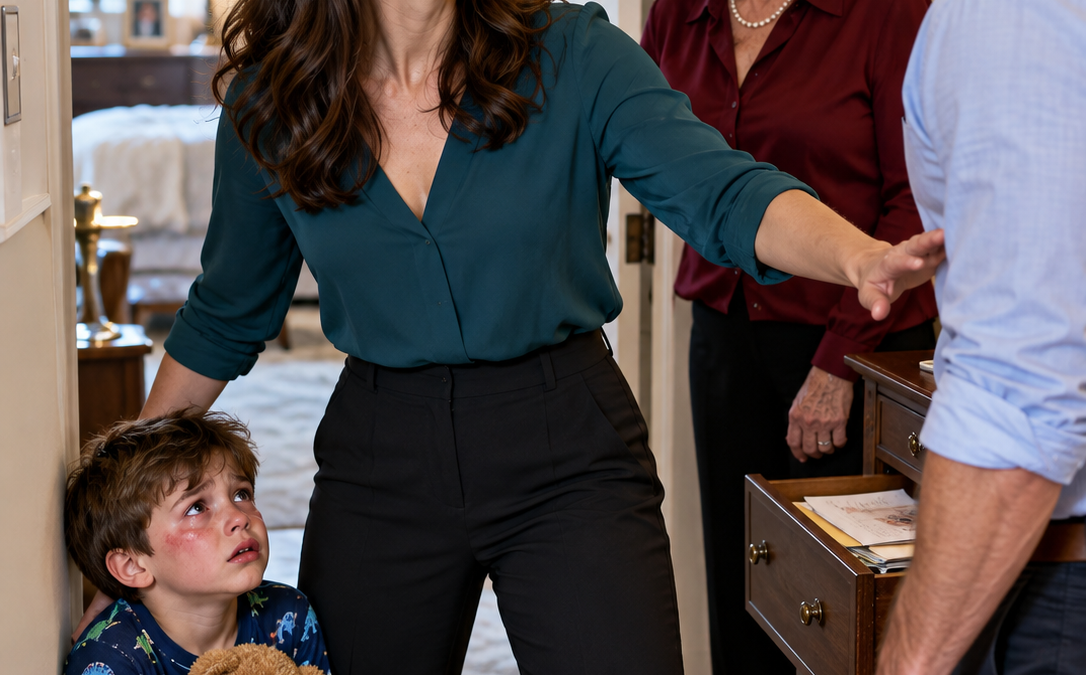
That moment came for me on a Tuesday evening in our Seattle townhouse, when my husband, Scott, stood over our five-year-old son, raised his hand, and brought it down across the little boy’s cheek with a crack I will hear in my nightmares until the day I die.
Then his mother, Dorothy, stepped forward, leaned over my sobbing child, and spat directly into his eyes.
“That’s what you get,” she hissed, “for being her boy.”
My restraint lasted exactly one second.
What I did next left both of them unable to speak above a whisper for weeks.
But let me start where all the worst stories begin. At the very beginning, when everything still looked beautiful.
I met my husband, Scott Harding, at a mutual friend’s rooftop party in Capitol Hill when I was twenty-seven. He was charming in the way that men who have been loved too fiercely by their mothers often are. Attentive, a little theatrical about it. The kind of man who remembers how you take your coffee and texts you at midnight just to say he was thinking about you.
I was a graphic designer building my own small studio, renting a one-bedroom apartment in Fremont, and paying off my student loans with disciplined precision. I was not looking for someone to rescue me. I was looking for a partner, and I thought Scott was that.
We dated for two years. We moved in together in a rented place in Ballard. We got engaged on the ferry to Bainbridge Island, with fog rolling in off the water and Scott down on one knee, holding a ring his grandmother had left him. It was a good story. We believed it.
What I did not fully understand until after the wedding was that Scott had never actually left home. Not in any way that mattered.
His mother, Dorothy Harding, had raised him alone after his father died from a sudden cardiac event when Scott was eleven years old. She had poured every ounce of herself into him. His lunches, his laundry, his homework, his feelings about every minor social slight he had ever experienced. And when he grew up and married me, she simply extended the perimeter of her control to include our household.
She lived in Bellevue, twenty-two minutes across the lake by bridge. It might as well have been twenty-two feet.
In the first year, her involvement felt like generosity. She sent us a Le Creuset Dutch oven as a housewarming gift. She offered to hemstitch our new curtains. When I came down with the flu in January, she appeared at our door with homemade chicken soup and a stern instruction that Scott sleep in the guest room so he would not be infected.
I thanked her. I meant it.
Then we had Owen.
Our son arrived on a rainy March morning at Swedish Medical Center on First Hill. He weighed seven pounds, four ounces. He had my dark eyes, my rounded nose, my narrow chin. The labor and delivery nurse placed him on my chest, and I felt the world rearrange itself around the weight of him, around the fierce, animal certainty that I would burn down everything that ever tried to harm him.
Dorothy arrived at the maternity ward before I had finished my first post-delivery meal. She stood at the foot of my hospital bed and stared at her grandson with an expression I could not quite decode. Not warmth, exactly. Assessment.
“He looks like Audrey,” she said to Scott, using my name the way people use citations as evidence of a problem.
Scott laughed softly and took the baby from my arms to show his mother.
“He’s got the Harding ears, though, Mom,” he said.
Dorothy did not respond. She simply held Owen at a slight distance, the way you hold a coffee cup that might be too hot, and said nothing more.
That was the first signal I did not take seriously enough.
The second year of Owen’s life was the year Dorothy’s management of our household became systematic. She began calling Scott every morning on his way to his marketing director position at a tech firm in South Lake Union. These were not casual check-ins. They were briefings.
She told him what grocery list to send me. She weighed in on Owen’s pediatric appointments and questioned our choice of physician after Owen’s eighteen-month checkup revealed a minor ear infection. Our family pediatrician was Dr. Angela Quan at NeighborCare Health on Capitol Hill, a warm, excellent clinician with an outstanding reputation.
Dorothy had never met her. That was irrelevant.
“That ear infection is from the daycare,” Dorothy informed Scott, who relayed it to me that evening. “Owen should not be in daycare. Audrey should be home with him. That’s what mothers do.”
I was, at that time, running my graphic design firm from a converted studio space I rented near Pike Place Market. I had four steady corporate accounts and two small nonprofits. I was earning slightly more than Scott and had been doing so quietly for the previous eighteen months.
I did not broadcast this. I simply continued working, continued paying our portion of the joint household fund, and continued building our family savings.
I said nothing to Scott about Dorothy’s daycare commentary. I had already learned that repeating her statements back to him produced only defensiveness. He would soften them, reframe them, explain what she really meant.
She meant well, he would say. She was old-fashioned. She had sacrificed so much to raise him. I should try harder to appreciate the love behind her intentions.
By the time Owen was two, I had stopped explaining Dorothy’s intentions to myself. I simply observed her.
She arrived every Sunday under the pretense of family dinners. Within twenty minutes, she had navigated to our kitchen, surveyed the refrigerator contents, and offered a running editorial on what she found there.
The organic whole milk irritated her. The fat content was excessive, apparently. The sourdough bread from the Columbia City Bakery was, in her estimation, too dense for Scott’s digestion. She had opinions about our dish soap, our throw pillows, and the angle at which I had placed Owen’s car seat.
Scott watched all of this from the couch with the contented expression of a man who felt profoundly taken care of. I watched it from the kitchen doorway with the steadily calcifying conviction that I was not the woman of this house. I was a placeholder, an inconvenience between Scott and the life Dorothy had designed for him.
Still, I held the line. I kept our home clean and running. I kept Owen healthy and happy. I kept my business growing. I kept my marriage limping forward out of sheer determination and the deep, quiet belief that Scott was salvageable.
That somewhere beneath Dorothy’s lifelong project of total possession, there was still the man who had proposed to me on a ferry in the fog.
The Sunday that broke my belief in that theory came in February, when Owen was four and a half.
Dorothy had arrived early, as she sometimes did when she suspected I had not prepared sufficiently. Owen was on the living room rug arranging his wooden train set, deeply absorbed in the way small children become when they are doing exactly what their whole being wants to do.
Dorothy swept past him without a word of greeting, went directly to the kitchen, opened the oven, and frowned at the pot roast I had put in at noon.
“You’ve overseasoned it,” she announced. “Too much garlic. Scott’s stomach is sensitive to allium.”
“Scott has never once mentioned being sensitive to garlic,” I said, keeping my voice even.
“He doesn’t like to complain,” she replied, already pulling open my spice drawer and rearranging it.
From the living room, Owen called, “Grandma, look at my train.”
Dorothy glanced toward him briefly.
“Not now, Owen,” she said, in the same tone she might use for a dog tracking mud across a clean floor.
Something cold moved through me.
I set down my spatula and went to my son. I sat on the rug with him and admired his train track, which was ambitious and complicated and genuinely impressive for a four-year-old. We played there together for the next twenty minutes while Dorothy retooled my kitchen.
At dinner, Dorothy seated herself across from Scott and began. She talked about a neighbor’s home renovation, a charity luncheon, a medical appointment for her knee. Then she pivoted, as she always did, to Scott’s career.
Was he being recognized appropriately? Was his department underfunding his team’s resources? Had he spoken to the vice president about the promotion discussion he had mentioned three months ago?
Scott answered all of it with the attentiveness of a student reporting to a professor.
Owen, seated beside me, knocked over his juice.
“Owen!” Dorothy’s voice sharpened immediately. “You must pay attention.”
Owen looked up at her, startled, his lower lip beginning to tremble. He was four years old. He had knocked over a cup of apple juice.
“He’s fine,” I said, already blotting the spill with a napkin. “It’s just juice.”
“Children who are not corrected grow into adults who are not careful,” Dorothy said, looking directly at me. “That is parenting, Audrey.”
The silence at the table stretched for a long moment.
I watched Scott. I waited.
I had been waiting for years for him to hear his mother clearly, to recognize her contempt for what it was, to place himself between her and his family.
He reached for the bread basket.
“Mom’s right that we should probably work on table manners more consistently,” he said.
I looked at my son.
Owen’s dark eyes were wet. He looked exactly like me. The same shape of face, the same curve of the jaw, the same dark lashes. He looked like mine, entirely mine.
And I understood then, with sudden crystalline clarity, why Dorothy had never warmed to him.
He was the living evidence that Scott had chosen someone else.
I excused myself after dinner under the pretense of getting Owen ready for his bath. I stood in the upstairs hallway for a moment with my back against the wall and breathed.
I could hear Dorothy below, giving Scott an itemized list of things she felt needed improvement in our household. I heard my name twice. I heard Owen’s name once.
I texted my closest friend, Grace, who was a senior associate at a family law firm downtown.
Grace called me back in under three minutes.
“You sound like someone standing at the edge of something,” she said.
“I think I’ve been standing here for years,” I told her.
“Then it might be time to step back from it,” she said. “Not over it. Back from it. Come see me this week.”
I went to see Grace that Wednesday at her office in the Columbia Center building. She was not my attorney. She referred me to a colleague, a family law specialist named Helen Voss.
But over coffee, Grace listened to the full accounting of my marriage and said something I wrote in my journal that evening and have not stopped thinking about since.
“The problem isn’t Dorothy,” she said. “Dorothy is exactly who she has always been. The problem is that Scott chose her over you every single time and convinced himself it wasn’t a choice.”
Helen Voss met with me the following Monday.
She was a direct woman with close-cropped silver hair and the quiet intensity of someone who had spent twenty years watching families fracture and had decided long ago that clarity was kinder than softness.
“Washington is a community property state,” she told me. “Any income and assets accumulated during the marriage belong equally to both spouses. Before we discuss anything else, I need you to understand your own financial position precisely. Do you have personal savings separate from your joint accounts?”
I did.
I had maintained a private high-yield savings account since before the marriage, a habit born of my independent financial life, and I had continued depositing a portion of my design income into it quietly over the years.
I had never hidden this from Scott. It was in my individual name. I had simply never foregrounded it, either.
“Good,” Helen said. “Keep funding it, and I want you to pull every joint account statement you can access going back three years.”
I pulled them that evening while Scott was at the gym.
What I found did not shock me the way it might have, because by then I had already grown accustomed to Dorothy’s fingerprints on everything. But the scale of it was larger than I had imagined.
Over the previous nineteen months, Scott had initiated sixteen wire transfers from our joint investment account into an account in Dorothy’s name.
The total transferred was $240,000.
Two hundred and forty thousand dollars.
I knew Dorothy was not struggling financially. She owned her Bellevue home outright. She received a substantial pension from her late husband’s corporate life insurance policy. She had no mortgage, no dependents, no medical catastrophe that any of us knew about.
I sat at the kitchen island for a long time looking at the numbers.
Then I opened a new note on my phone and began to write down everything I could remember about the past nineteen months.
The mink-toned cashmere coat Dorothy had described as a gift from a cousin. The two-week resort stay in Scottsdale she had called a medical rest for her knee. The complete renovation of her home office, which she had mentioned casually as just refreshing things a bit. The new Lexus she had driven to our house in June, which she said she had gotten a remarkable deal on.
It had all been funded through my marriage, through my family’s savings, through the account I had contributed to with equal or greater input than Scott.
I did not confront him that night.
I made dinner. I put Owen to bed. I read him three chapters of his book because he had asked for three, and he had asked so sweetly.
I lay in bed in the dark until Scott’s breathing slowed beside me.
Then I started making plans.
The weeks that followed were a masterwork of restraint.
I met twice more with Helen Voss, building a file. I accessed what records I could. I said nothing to Scott about what I had found, and I watched how he behaved without the pressure of discovery.
He was more comfortable than ever. Dorothy was calling daily. He was meeting her for lunch twice a week, and he had recently mentioned, with studied casualness, that Dorothy was thinking of spending a few months in our guest room to rest her knee, just until the fall.
I told him no.
He blinked. He was accustomed to my strategic patience, my careful management of conflict, my long-view tolerance. He had never seen me look at him the way I was looking at him then.
“She’s your mother, Audrey, not a stranger.”
“She is not staying in this house,” I said. “Not one night. Not one hour. If she walks in with luggage, Owen and I will not be here when she arrives.”
He called it an ultimatum. He looked genuinely wounded.
I explained that it was a statement of fact.
He told his mother.
Dorothy erupted.
The texts began arriving in waves. First wounded, then accusatory, then finally threatening. She was going to speak to Scott’s company contacts about my little design business. She was going to make sure people understood what kind of wife and mother I really was.
I screenshotted every message and forwarded them to Helen Voss.
Scott and I moved through the subsequent two weeks like two planets whose orbits had drifted into cold parallel. He was sullen and unreachable. Dorothy’s campaign to isolate me accelerated.
She contacted two mothers from Owen’s preschool class, whom she had met at a birthday party, and implied in her gracious, soft-spoken way that Owen’s behavioral difficulties, which did not exist, were the result of an unstable home environment.
I found out from another preschool parent who liked me enough to relay the conversation verbatim.
I added that to my file.
Then Dorothy called Scott one Thursday evening and told him she had been taken to Overlake Medical Center in Bellevue after experiencing chest pain and dizziness. She was being evaluated by cardiology. She might need a procedure.
Scott went to her immediately and stayed until midnight.
He came home gray-faced and frightened. He sat at the kitchen island and told me the cardiologist believed Dorothy might need a cardiac catheterization. The procedure would require a specialist. Insurance had coverage disputes. A preliminary deposit was required by the surgical facility.
He looked at me across the island.
“She said you have savings from the design business,” he said carefully. “She’s asking if we can help bridge the gap.”
The number he named was $350,000.
I was quiet for a moment.
“What’s the name of her attending physician?” I asked.
He hesitated.
“Doctor… I don’t know his full name. She mentioned a Dr. Reynolds. Department of Cardiology.”
“I’d like to speak with him directly tomorrow morning,” I said. “If your mother is facing a serious cardiac procedure, I want to understand the medical situation clearly.”
Scott’s jaw tightened.
“She doesn’t want strangers involved.”
“I’m her daughter-in-law, not a stranger,” I said. “And I’m not transferring $350,000 without speaking to her doctor.”
He left the room without another word.
The following morning, I drove to Overlake Medical Center in Bellevue and spoke to the cardiology department administrator.
There was no Dr. Reynolds currently consulting on any inpatient case matching Dorothy Harding’s name.
After a brief search, the administrator confirmed that Dorothy had been admitted the previous day for observation following a reported episode of palpitations and anxiety. She had been monitored overnight. Her cardiac enzyme levels were entirely normal, and she was being discharged that morning with a prescription for a mild anti-anxiety medication and a recommendation to reduce caffeine.
There was no procedure scheduled.
There was no insurance dispute.
There was no deposit of any kind required.
I took the elevator to Dorothy’s room on the second floor.
I heard her before I saw her.
Her door was open two inches. Inside, Dorothy was seated in the bedside chair in her robe, her reading glasses on, speaking on her phone with the brisk, animated energy of someone planning a garden party.
“The villa rental in Positano is confirmed through September, Diane,” she was saying. “Three weeks. I told you Scott would come through. All I had to do was play the health card again. The girl has her own savings, apparently quite a lot of it. Scott was ready to wire it this morning before she started asking questions. I’m going to have to work around her somehow.”
I pushed the door open.
Dorothy looked up.
The color left her face instantly. Then it flooded back in a deep, mottled red.
“What are you doing here?” she demanded, her voice dropping to a compressed hiss.
“Checking on your cardiac procedure,” I said.
I held up my phone. The screen showed an active voice memo timer.
“Dr. Reynolds’s department had no record of you, Dorothy. But I’ve been standing here for ninety seconds, and I have a very clear record of you.”
She lunged.
She came out of the chair faster than I would have believed possible and grabbed for my phone with both hands.
I stepped back.
She stumbled forward, caught herself on the doorframe, and straightened up, breathing hard.
“Delete that,” she said.
“It’s already backed up to cloud storage,” I told her.
She stared at me with an expression I had never seen on her face before. Not rage exactly, but the panicked calculation of someone watching a carefully constructed structure collapse from the bottom.
“You have no idea what you’re doing,” she said.
“I know exactly what I’m doing,” I answered.
I turned and walked back down the corridor.
I drove home, and for the first time in years, I felt something close to stillness.
I began packing Owen’s things that afternoon. His clothes, his books, his stuffed bear, the small blue blanket he still slept with. I arranged for him to spend the night with my parents at their home in Issaquah.
Then I went back to the townhouse bedroom to retrieve several documents I needed: Owen’s birth certificate, my passport, the deed copies, and the insurance policy folder I kept in the bottom drawer of my nightstand.
I had just pulled the drawer open and found what I needed when I heard the front door.
Scott came in first, then Dorothy behind him, still in the blouse she had been wearing at the hospital, having apparently come directly from Overlake in a rideshare car.
Her face was white and set with fury.
Scott’s face was something worse. The blind, cornered look of a man who had chosen a side and knew it.
“Leaving?” Scott said from the bedroom doorway.
“I’m getting our documents,” I said, keeping my voice level. “Please move.”
“You’re not taking Owen anywhere,” he said, stepping into the room.
From the hallway came a small sound.
I felt it before I processed it. That specific quality of small-child silence that is not peace but held breath.
Owen was standing in the hallway.
He had been asleep in the guest room, where I had settled him before my parents arrived to collect him. I had not realized he had woken.
He stood there in his dinosaur pajamas, clutching his bear, his dark eyes wide and uncomprehending, taking in his father’s expression, his grandmother’s rigid posture, and the charged, crackling air.
“Daddy,” he said very quietly. “Are you angry?”
Scott’s face did something I had never seen it do.
Something gave way in it, collapsed inward, and what replaced it was unrecognizable.
He took two strides into the hallway.
I was moving already, already stepping toward Owen, but not fast enough.
“That’s enough out of you!” Scott said.
His palm struck our five-year-old across the face with a force that sent Owen sideways into the wall.
“You look just like her! You’ve always looked just like her!”
Owen slid down the wall and hit the floor, wailing, his hand pressed to his cheek.
Dorothy did not stop him.
She did not help.
She walked directly to my son, where he lay crumpled against the baseboard, bent over him, and spat into his eyes.
“Serves him right,” she said.
One second.
I gave myself one second.
Then I moved.
I crossed the hallway in three steps and shoved Scott Harding backward through the open bedroom doorway with every pound of force I had in me.
He hit the dresser hard, stumbled, and went down, taking the lamp with him. The ceramic base shattered across the hardwood floor.
He lay there dazed, staring at the ceiling.
Dorothy turned from Owen toward me, and something in my face stopped her entirely. She pressed herself back against the wall.
I dropped to my knees beside my son.
“I’ve got you,” I said, my voice somehow steady. “Oh, Mama’s right here.”
He turned his face into my shoulder and sobbed with his whole body, the deep, shaking sobs of a small child who had been truly frightened.
I held him with both arms. Then I stood up carrying him and walked to the guest bathroom, locked the door, and ran a warm washcloth under the faucet.
I cleaned his face with the gentleness that was the only counter I had to what had just happened. I applied a cold pack from the medicine cabinet to his swollen cheek. I wrapped him in a bath towel and held him against my chest.
“You’re safe,” I told him again and again until his breathing quieted. “Nobody is going to touch you again. Mama has you.”
With my free hand, I called my brother Declan, who lived twelve minutes away in the Beacon Hill neighborhood and had spent four years as a firefighter before transitioning to emergency management.
Declan answered on the second ring.
“Come to the house right now,” I said. “Scott hit Owen. I put Scott on the ground. Bring police and an ambulance.”
Declan did not ask any questions.
“On my way,” he said.
Within twelve minutes, the street outside our townhouse held two patrol cars, a fire engine, and Declan’s truck.
The paramedics found Scott sitting on the bedroom floor, with a cut on his forearm from the lamp base, largely uninjured.
Dorothy was in the living room, insisting at increasing volume that she was the victim of an unprovoked assault by a dangerous and unstable woman.
The officer who spoke to me was Sergeant Lorraine Webb, a calm, experienced woman with a methodical way of listening that made you feel heard without being rushed.
I handed her my phone with the hospital recording still accessible. I showed her the bruising already blooming across Owen’s cheek. I told her about the $240,000 in wire transfers.
Sergeant Webb listened to approximately ninety seconds of the Overlake recording.
Then she looked at Dorothy.
“Ma’am,” she said, “I’m going to need you to come with us.”
Dorothy was taken for questioning.
Scott was transported to the emergency room for evaluation of the cut on his arm and a possible mild concussion from hitting the dresser.
Declan drove Owen and me to my parents’ house in Issaquah, where my mother met us at the door and took my son from my arms with the practiced calm of a grandmother who had been waiting for exactly this call.
Three days later, I sat in Helen Voss’s office for the last time as someone still unsure of her path.
“You have everything,” Helen told me, spreading the documents across her desk.
“The recording is admissible under Washington’s one-party consent law. The wire transfer records constitute financial waste of community property. The pediatric injury documentation is thorough. The preschool parent testimony about Dorothy’s defamatory statements is usable. The hospital administration records directly contradict the family’s narrative.”
She looked up at me.
“This is going to be comprehensive,” she said. “Are you ready?”
“I’ve been ready for years,” I told her. “I just needed the facts to be visible.”
The legal process moved with a swiftness that surprised me, though Helen had warned me that cases with documented child abuse and recorded financial fraud tended not to invite extended litigation.
A domestic violence protection order was granted within forty-eight hours, giving Owen and me exclusive occupancy of the townhouse and prohibiting Scott and Dorothy from coming within five hundred feet of either of us.
Scott was arraigned on one count of felony assault in the fourth degree for striking a minor.
Dorothy was charged with assault in the fourth degree for the act against Owen and investigated separately for financial fraud, based on the wire transfer records and the recorded phone call at Overlake.
The divorce filing followed.
Helen presented our audit to the court: $240,000 of community property dissipated by Scott to his mother.
Washington community property law entitled me to an offset from his share of the marital estate. Combined with my equal claim to our home equity and our joint investment accounts, the financial outcome was decisive.
Scott’s attorney, a careful man named George Abrams, attempted the expected defenses.
The wire transfers were gifts within a family’s discretion. My use of physical force against Scott was disproportionate and potentially criminal. The incident with Owen was an isolated moment of overwhelmed parenting.
Helen placed the pediatric emergency department photographs on the table.
“Grade one contusion to the left cheek,” she said, “in a five-year-old child, documented by the attending physician at Seattle Children’s Urgent Care on Roosevelt Way. The child’s own statement, taken by the forensic interviewer at the Child Advocacy Center, describes his father’s words verbatim.”
She paused.
“We also have sixty-three seconds of recorded audio from Overlake Medical Center in which the defendant’s mother describes, in her own voice, her plan to use a fabricated medical emergency to extract funds from the marital estate.”
The room was very quiet.
The court’s orders were issued six weeks later.
Scott was granted supervised visitation only, contingent on completion of a batterer’s intervention program and an independent parenting evaluation.
Sole physical and legal custody of Owen was awarded to me.
Scott was ordered to pay maximum child support under Washington State guidelines, plus spousal maintenance for a defined term.
Dorothy’s charge was resolved with a deferred prosecution agreement that included mandatory counseling and a no-contact order with Owen until his eighteenth birthday.
The civil suit against Dorothy for financial fraud was settled out of court. The number her attorney agreed to was enough to fully fund Owen’s college education, with a margin remaining.
Scott called me on the evening the final divorce decree was signed.
He sounded like someone who had woken from a long sleep in a room he did not recognize.
“I don’t know who I was,” he said. “I don’t know how I let this happen.”
I listened.
I thought about the man on the ferry in the fog.
I thought about Owen’s face against the hallway wall.
“You let it happen because choosing her was easier than growing up,” I said. “I’m sorry for both of us, but I’m not going to keep paying the price for it.”
I ended the call.
That was fourteen months ago.
I live now in a corner unit in a building in the Phinney Ridge neighborhood, with high windows that face the Cascades on clear days.
Owen is in first grade at a school three blocks away. His teacher sends me notes about how thoughtful he is, how carefully he listens during circle time, how he always waits his turn.
His cheek healed without a scar.
His laugh is enormous and completely his own.
My design firm has grown. I hired a part-time project coordinator in the spring. I have turned down more work than I have accepted, which is the luxury of having built something real.
On Sunday mornings, Owen and I walk to the farmers market on Phinney Avenue. He carries the tote bag and negotiates seriously over which apples we buy.
He has opinions. He states them without apology.
He looks just like me, and I look at him and feel nothing but fierce, uncomplicated gratitude.
Last Sunday, he looked up at me over his apple and said, “Mama, are you happy?”
I considered the question the way he deserved it to be considered, which was seriously.
“Yes,” I told him. “I am.”
He nodded, satisfied, and moved on to evaluating the peaches.
That is the whole of it, I think.
You endure what you can endure. You document what needs to be documented. You protect what cannot be left unprotected.
And when the moment comes that you have been circling for years, when the ground finally shows itself for what it is, you step back from the edge, and you take your child with you, and you walk toward the light.








