My daughter left her adopted 9-year-old home alone for five days to take her biological twins on a cruise. A stranger called me at midnight: “he’s been sitting on this bench since six.” Then i opened my phone and saw her post — a photo of the whole family on the ship’s rail, captioned “party of four. Best week of our lives.” So i called a lawyer.
The phone rang at 11:52 on a Friday night. On the other end was a woman I had never met. She told me there was a little boy sitting alone on a bench outside the community center over in Orchard Mesa. The center had closed at six, which meant he’d been out there for almost six hours. Nine years old. A blue backpack sitting by his feet and a silver metal whistle hanging around his neck.
That was all I needed to hear. I knew exactly who that child was, because four years earlier, on the day the court finalized his adoption, I was the one who put that whistle around his neck. I still remember kneeling down, looking him straight in the eyes, and saying, “If you’re ever in trouble, you blow this whistle. No matter where you are, somebody will come find you.”
But that night, he sat alone on that cold bench for five hours and fifty minutes, and he never blew it. Not once. Because in the mind of a nine-year-old boy, he would rather suffer by himself than cause a grown-up any trouble.
But that’s not the part that haunts me most. The thing that stayed with me for months afterward was a much crueler truth. I was the one who taught that boy the whistle was for calling out for help. But when he’d been sending out a different kind of distress signal, over and over for months, I was the one who never noticed.
My name is Lauren Beckwith. I’m sixty-nine years old, and I’ve lived in Grand Junction, Colorado, since 1979. I spent twenty-nine years as the search-and-rescue coordinator for this county. People hear that and picture helicopters. There’s some of that, sure. Mostly, though, it’s a man in a folding chair at a trailhead at four in the morning, with a laminated map, a marker, and a radio, running a search grid.
And here’s the thing about that work that I want you to hold on to, because it’s the whole spine of this story. It took me until I was sixty-eight years old to apply it where it counted.
The terrain almost never kills anybody. The delay does.
That’s not a saying. That’s twenty-nine years of after-action reports. A person goes off a trail in the Book Cliffs. The temperature is the temperature. The distance is the distance. Those numbers don’t move. What moves is the number of hours between the moment that person gets into trouble and the moment somebody picks up a phone and says they’re overdue. That’s the only variable in the entire equation.
And I’ll tell you what causes that delay, nearly every single time. It isn’t a lack of caring. It’s a person standing in a kitchen saying, “Let’s give it another hour. I don’t want to make a big thing of it. They’ll probably walk out on their own, and I’ll feel like an idiot.”
Nobody wants to be the one who overreacted. I’ve run searches where the delay was ninety minutes and searches where it was two days, and I can tell you about the difference in outcomes. It will keep you awake at night.
Now hold on to all of that, because in September, in my own family, the delay was six days. There were four adults who could have made a call, and none of us did. I was one of the four.
My wife was Karine. She died four years ago, an aneurysm at the kitchen sink. There was nothing anybody could have done, and I’ve made my peace with about a third of that. My daughter is Sloan. She’s thirty-eight. She married a man named Chase Renick eleven years ago. He does something in commercial development, and he’s good at it. In eleven years, he has never once mailed me anything with his own handwriting on it.
They’ve got twins, Brin and Tate. They were six that fall. And they’ve got Micah.
Micah is nine. He came to them when he was five, and the adoption became final about eight months later. By the time he walked into that courtroom, he had already lived in four houses that weren’t his.
I was there that day. I sat in the second row wearing a jacket I hadn’t put on since Karine’s funeral. Afterward, out in the parking lot, I gave Micah a whistle. A real one, on an orange lanyard, the kind we hand out at trailheads. I got down to his level, looked him in the eyes, and said, “Micah, anybody who’s got one of these can be found. You blow this, and somebody comes. That’s the whole deal.”
He was five. He wore it in the bathtub for a week.
He was still wearing it four years later, on a bench outside a locked building at midnight. And he never used it.
That Friday, September 12, I was asleep in a chair with a ball game going on the television and a plate of cold beans on the side table, which is what a Friday night looks like for a sixty-nine-year-old widower who’s quit pretending otherwise.
The phone lit up on the arm of the chair. Local number. Unknown caller. And I almost let it go.
I want you to understand how close I came. I actually looked at the screen and thought, No. I moved my hand toward it on the second ring, then stopped. It was on the fourth ring, right at the edge of going to voicemail, that I finally picked it up.
There’s a version of that night where I don’t answer. I think about that more than I want to.
“Is this Lauren Beckwith?”
“It is.”
“Sir, my name is Geneva Royal. I close up the rec center on Orchard Mesa. I’m sorry to be calling this late. Your name’s on an emergency card in the office. It’s third down.”
Then she stopped, and I could hear her swallow.
“There’s a boy out here on the bench. He’s been sitting here since we locked the doors at six.”
I came forward so fast the plate went off the table, and I didn’t hear it hit the floor.
“Nine years old? Sandy hair? Blue backpack? Whistle on an orange lanyard?”
“That’s him,” she said. “That’s exactly him.”
Six o’clock to 11:52. Five hours and fifty-two minutes on a metal bench on the mesa in September, when the sun goes down and the cold comes up out of the ground like it’s got an appointment.
“Ma’am, put him on the phone and don’t hang up. I’m six minutes out.”
There was a scrape, a shuffle, and then the smallest voice I have ever heard come through a telephone.
“Grandpa?”
“Hey, bud. I’m already driving. Are you cold?”
“A little bit.”
A pause.
“I’m okay, though. I’ve got my jacket.”
He did not have a jacket. I had bought that boy one the previous November, and three weeks after that night I learned it had gone into a donation bag back in June because it was taking up room in the mudroom. What he actually had on was a T-shirt and a hoodie with a broken zipper.
“Micah, stay right where you are with Miss Royal. Don’t get up for anybody else. My headlights are going to come around that corner before you can count to two hundred.”
There was quiet on the line. Then he said, “Grandpa, is Mom mad at me?”
I was standing in my own kitchen in the dark, with my keys already in my hand, and I had to put my other hand flat on the counter.
“Why would you ask me that, son?”
He answered fast, the way a kid says something he’s been practicing.
“Because they left on Sunday, and I think I did something Sunday.”
It was Friday night.
I don’t remember putting on my boots. I remember 29 Road, and I remember the light at B 1/2 Road, and I remember coming around into that parking lot and seeing him stand up from the bench beneath a security light, his backpack already on both shoulders.
And I remember Geneva Royal. Sixty-eight years old, four feet eleven, wearing a rec center polo with her own jacket wrapped around a child who wasn’t hers. She had an expression on her face that told me she’d already decided she wasn’t going anywhere until somebody worth trusting pulled into that lot.
Micah didn’t say anything when he saw me. He just walked straight into me, put his arms around my middle, and held on. I picked him up, all sixty pounds of a kid who should have been closer to seventy, and stood there in a parking lot at midnight holding my grandson while a stranger turned toward the road to give us some privacy.
Geneva told me the rest quietly. She’d called both numbers on the emergency card. His mother’s phone went straight to a recording. His father’s did, too. Camp season had ended that afternoon. Nobody came at pickup. Nobody came at six. She’d stayed four hours past her shift.
Then she said, “Mr. Beckwith, I want to be straight with you. That child told me he’s been sleeping at his house by himself. He gave me the code to his own front door in case I needed to check something.”
I looked at her over the top of his head.
“Would you be willing to put that in writing? Everything you saw and everything he said, with times on it?”
She didn’t hesitate for one second.
“I’ll have it to you before breakfast.”
Then she looked at Micah and said, “And sir, I hope somebody answers for this.”
They did. I just didn’t tell her that yet.
Micah was asleep before I got out of the lot. At the light at 12th Street, I did the thing I’d been telling myself not to do ever since Geneva said the word Sunday.
I opened Sloan’s social media page.
She’d posted that afternoon at 4:31 p.m. Fort Lauderdale, Florida. My daughter in sunglasses, leaning against a ship’s rail. Chase with his arm around her. Brin and Tate in matching shirts, holding those enormous frozen drinks with the flexible straws.
And the caption read, “Party of four. Best week of our lives.”
Four.
I sat at a green light on 12th Street with nobody behind me and my grandson asleep in the back seat, and I read that word. I’m not exaggerating. I read it eleven or twelve times.
She had counted her family out loud, in public, in front of every person she’d ever known.
And she came up four.
I’ve stood on scene at things I’m not going to describe on the internet. I’ve made notifications. I’ve carried people. I’ve never in my life been as cold as I was at that intersection.
If you’ve ever seen in writing that somebody left you out of a number, a card, an invitation, a photograph, or a list, you know that the arithmetic is the part that gets you. Cruelty you can argue with. A number is just a number. It doesn’t have a tone you can dispute.
I took Micah back to my place on North 7th and put him in the spare room, which had been his mother’s room back when she was somebody I recognized. He was out before his head touched the pillow. I sat on the edge of the bed until his breathing evened out, watching his hand resting around that whistle. He wasn’t holding it up. His hand was just lying against it the way you rest your hand on something familiar.
Then I went into the kitchen, made coffee I had no business drinking at one in the morning, got out a legal pad, and started a log.
Sunday, September 7: Departure.
Friday, September 12, 11:52 p.m.: Call received.
Every date. Every hour. The name of the camp, the name of the custodian, the emergency card in the office, the social media caption, and its timestamp. Then, while it was still exact in my head, I wrote down every single thing Micah had said to me, in his words, not mine.
And I want to explain why I did that instead of what I wanted to do, which was drive to a house on a cul-de-sac and put my fist through a door.
Because anger is a flare. It’s very bright, and it lasts about eleven seconds. Then you’re standing in the dark holding a hot tube.
Twenty-nine years of running searches taught me one thing above everything else: the people who get outcomes are the people with the paperwork, not the loudest person on the scene. The one with the log at 2:40 in the morning.
I typed three words into my phone: family attorney Grand Junction.
The fourth name down was a woman named Ren Casperjack. Forty-seven years old. Twelve years running her own practice on Main Street. Under her photograph was one line that made me sit up straight in my kitchen chair.
Prior to private practice, Ms. Casperjack had spent nine years as an attorney with the Colorado Department of Human Services.
Nine years being the person who filed the report.
I sent her an email at 2:58 in the morning. I’ll give you the substance of it.
“My name is Lauren Beckwith. I’m sixty-nine, retired county search-and-rescue coordinator. My nine-year-old grandson was left with no adult in the house for six days while both parents took his siblings out of state. He was found tonight alone outside a closed facility at 11:52 p.m. I have a signed eyewitness statement coming and a timeline already built. I want to know every single thing the law permits me to do.”
Then I wrote one more line, and I meant it.
“I’m not looking for an apology.”
After I sent the email, I opened another window on my computer and bought two plane tickets to Seattle.
Now, before I tell you about that trip, do me one favor. If this story is landing on you at all, hit subscribe. Most people listen the whole way through and never do. It costs you nothing, and it’s the entire reason I’m able to keep doing this.
Here’s why Seattle.
That boy had a map. Not a poster, but an actual folded National Park Service map, the big kind they hand you at a visitor center, with all the national parks printed on it and a little box beside each one.
He’d found it in my garage, in a box of Karine’s things, about three years earlier. He asked if he could have it, and I said, “Take it, buddy.”
He checked a box whenever he’d been somewhere. In four years, he’d checked exactly one.
Colorado National Monument, which was eleven minutes from his house, and which was a monument, not a national park. It wasn’t even on that list. He’d written it himself at the bottom, in the margin, in pencil, and made his own little box beside it. Then he’d checked it.
He knew it didn’t count. He was seven years old, and he knew it didn’t count, but he checked it anyway because otherwise there was nothing on that map at all.
He used to lie on his stomach on my living room rug for an hour at a stretch, with that map spread open in front of him and a pencil in his hand. He wouldn’t write anything. He’d just look.
And there was a strip of blue running all down the left side of it.
That kid had never seen an ocean. Not once. Nine years old, growing up in the high desert, and he’d never laid eyes on one.
At three in the morning, I called my daughter.
I knew she wouldn’t answer. They were at sea, and her phone had been going straight to a recording for six days. I didn’t want her to answer. What I wanted was for her to roll over in a stateroom on a Saturday morning, reach for her phone the way everybody does, and find her father’s voice sitting there waiting for her.
I’ve made about ten thousand radio transmissions with something coming down around me. You learn to keep your voice level. That’s a skill, and it doesn’t leave you.
So I kept it warm. I kept it easy.
“Hey, sweetheart. It’s Dad. Wanted to let you know I’ve got Micah with me. Picked him up tonight. He’s fine. He’s asleep. Sounds like he’s been on his own a while over there. Don’t cut anything short on my account. He and I are going to take a little trip of our own. We’ll talk when you’re back.”
Then I hung up.
I sat back down, opened a map of the Olympic Peninsula on my laptop, and thought about what I actually had. A signed statement coming at breakfast. An attorney who used to write the state’s side of cases like this. Two plane tickets. A log.
And a daughter with absolutely no idea.
Saturday morning, Micah came into my kitchen wearing socks, his hair sticking up on one side. He stopped in the doorway and looked at me.
“Grandpa, why are you dressed like that?”
“Because a man wears a real shirt when he’s flying.”
He stopped moving altogether.
“Flying where?”
“Washington.”
“The ocean?”
I watched him look at me the way a kid looks at you when he’s been let down enough times that he checks the exits first. He didn’t jump. He didn’t yell. He just stood there in his socks and asked very carefully, “For real ocean or pretend ocean?”
That right there. That’s the sentence. That’s the one I’ll still be hearing when they put me in the ground.
“For real ocean,” I told him. “You and me. Wheels up at noon.”
And he ran.
He went down that hallway so hard he took the runner with him. About forty seconds later, he came back holding that map in both hands, breathing like he’d sprinted a mile.
“Can I bring this so I can check it right when we get there?”
“Son, you can check it on the airplane.”
Rialto Beach, Washington. Monday morning, about ten o’clock.
I’ve never been a man with money. I drive a twenty-year-old truck on purpose. I think a nice restaurant is one where somebody brings the ketchup to the table.
But we came out of the trees at the end of that trail, and the Pacific was just there. Gray and enormous, with the sea stacks standing out in the water and fog sitting halfway down them. And that noise it makes, a sound that isn’t quite like anything else in the world.
Micah stopped walking.
He was about eight feet out onto the sand when he stopped, and he didn’t move or say one word for what I would put at forty seconds.
Then he said, “Grandpa.”
“Yeah?”
“It doesn’t stop.”
That’s what he said about the ocean.
It doesn’t stop.
He sat down right there in the sand, laid the map across his knees, and checked the box. He pressed so hard with the pencil that he put a dimple through the paper. Then he looked at the box he’d drawn himself down in the margin. He looked at the real one he’d just checked. He looked at all the other boxes still waiting.
And he said, mostly to himself, “Two.”
We had six days together.
On day two, an old woman named Opal Ferris led a tide-pool walk at low tide out on the rocks. She was a retired schoolteacher who’d spent sixty years in Clallam County, with knees that looked like they were held together by tape.
Micah asked her nine questions in half an hour. I counted, because I count things. It’s a job you don’t get to quit. Then Opal put her hand on his shoulder and pointed into about eight inches of water.
There was a small octopus down there.
Micah got down on his stomach on the wet rock, wearing a borrowed rain shell, and watched that creature for eleven minutes. He wouldn’t be moved. On the way back up, he said, “Miss Opal said it can taste with its arms.”
Then he looked at me.
“Grandpa, is that true, or is that a thing grown-ups say?”
“That one’s true, bud.”
On day three, we drove up to the Hoh Rain Forest. That rainforest is a green I do not have a word for. Micah walked the entire spur trail with his head tipped back and his mouth open. He didn’t say a single thing for the first fifteen minutes, which, for that child, was a record.
Day four, a man named Dwayne Cruz, who ran the motel in Forks, taught him how to build a driftwood fire on the beach. Dwayne’s own grandkids were over in Yakima, and I think he was lonesome.
But here’s the part nobody on that peninsula saw.
Every night, once Micah was down, I took my phone outside onto the walkway beyond our motel room. I slid the door shut behind me, sat on a plastic chair in the wet cold, and called Ren Casperjack. Nine o’clock sharp, ten her time.
She picked up on the first ring every single night.
That woman does not do pleasantries. I asked her once how her day had gone, and she said, “Long. Tell me about the school file.”
On the first night, she told me something I wrote down on a motel notepad. I’m going to give you the substance of it, because I remember that conversation almost word for word.
“Mr. Beckwith, I’m going to be direct, because I think you’d rather have that.”
I told her I would.
“What you’ve described is not a parenting disagreement, and it’s not a gray area. Leaving a child of that age without adequate supervision for that period has a definition in this state, and the definition is neglect. That’s not my opinion. That’s a statute.”
I heard papers moving on her end of the line.
“And what you have is unusually clean. You have an independent third-party witness with a signed, timed statement. That is the piece I almost never get. You have a public post placing both parents out of state inside the exact window. You have the child’s own account, which I want recorded properly by somebody trained, not by you.”
“Why not me?”
“Because I will not hand anybody the sentence, ‘His grandfather coached him.’ Not one inch of it.”
“What do we do?”
“Three things simultaneously. One, I file the report. Not hold it. File it. Two, I petition the court for emergency temporary guardianship, ex parte, which means we can be in front of a judge before her plane is on the ground. Three, I subpoena the school. If there’s a counselor’s note in that boy’s file, I want it.”
I put my hand on the wet railing.
“There is one.”
Silence on the line.
“Last March, his teacher called me. Not them. Me. She said he’d stopped eating lunch. I called Sloan about it, and she told me to stay in my lane.”
“Mr. Beckwith, before you go to bed tonight, write down the date of that call and everything you can remember about it. Do it tonight while you’re annoyed, not tomorrow when you’re sad.”
I did.
I still have the sheet.
Night two was about the money.
Ren said, “You’re going to want to change your will. Everybody in your position does. I’m going to tell you how to do it so nobody can undo it, and then I’m going to tell you how to do it so it doesn’t wreck him. Those are two different conversations.”
She walked me through an irrevocable trust. Once it was executed, the assets would sit outside my estate and beyond everybody else’s reach. Not my daughter’s. Not her husband’s. Not any attorney they could ever afford. Not a probate fight. Not a claim that somebody had talked me into it.
Finished.
Then she said, “But you are not handing a lump sum to an eighteen-year-old. I’ve watched that go badly more times than I can count. Education and housing at twenty-one through an independent trustee. The balance at twenty-seven. And you name a successor trustee and a successor guardian right now, in writing. Both younger than you.”
“Why both?”
“Because the first move opposing counsel makes against a sixty-nine-year-old petitioner is your age. I intend to have that answered before they finish saying it.”
I thought about it for about four seconds.
My niece, Talia. Forty-three years old, a physician assistant down in Durango. Married, with two kids of her own. She’d loved Micah since the week he showed up.
“Get me her number tonight,” Ren said.
On night three, the motel door slid open behind me, and there was Micah standing in his pajamas, squinting into the light.
“Grandpa, who do you talk to at nighttime?”
I put my hand over the phone.
“Just grown-up business, bud. Go on back.”
He weighed that with the enormous dignity of a nine-year-old who suspects he’s being handled. Then he said, “Can I get hot chocolate from the machine by the ice?”
“It’s nine o’clock at night.”
“We’re at the ocean, though.”
I want the record to show that I was standing on a motel walkway in Forks, Washington, with a former state child-welfare attorney on the telephone building a case against my own daughter, and I was being negotiated with over cocoa.
“One cup, then bed.”
He was gone.
I got back on the phone and started to apologize, but Ren cut me off.
“Don’t.”
Then something almost human came through that voice for about half a second.
“How’s he doing?”
“He laughed at breakfast until he got the hiccups.”
“Good. Write that down, too. I want the contrast between eighteen months of documented decline and how that child is right now in your care. That contrast will carry more weight with a judge than anything I say out loud.”
I wrote it on the back of a receipt.
Night four was the one I wasn’t ready for.
We were at a place in Port Angeles with paper on the tables and a window full of boats. Micah was working his way through a plate of fish and chips, giving me an individual scouting report on every French fry.
Then he put his fork down and looked at the table.
“Grandpa, can I ask something, and you won’t get mad?”
“You can always ask me anything.”
He kept looking at the table.
“Is it because I’m not really theirs?”
I want to slow all the way down here, because this is the actual center of the whole thing. Everything else in this story is scaffolding around it.
The restaurant kept going. Somebody laughed at the bar. A server called out a number. And at our table, everything stopped.
I put down my fork. I reached across the table and took both of his hands in mine.
Those hands were so small. I don’t know how to make you feel that. Nine years old, and both of his hands fit inside one of mine.
And I told him the truth. All of it, at the size a nine-year-old could carry. I didn’t soften a single part that mattered.
I told him what an adoption actually is. That it is not a backup plan, and it is not a consolation. That a family isn’t something you get issued at a hospital. It’s something people say out loud in a room in front of a judge, with their whole legal names signed at the bottom of a page.
I told him that somebody choosing you is not the runner-up prize.
It’s the entire event.
I told him that whatever was wrong in that house was wrong before he ever walked through the door, and that a nine-year-old boy is not capable of being the reason grown adults behave badly.
Not capable. It’s not on the menu.
And I told him I’d spent twenty-nine years going out at night and finding people who’d been left behind, and there wasn’t one thing on this earth, or anywhere in the state of Colorado, that was going to stop me from finding him.
His eyes filled.
He nodded slowly, working every piece of it through the way he does.
Then he sniffed and said, “Can I have your coleslaw?”
“You can have anything on this table.”
“And can we get pie?”
“Two pieces.”
He smiled a little at first. Then bigger. Then the real smile came, the one that gets all the way up into his eyes and stays there.
I excused myself, walked back to the restroom, and ran cold water over my wrists. I looked at a sixty-nine-year-old man in the mirror for a long minute.
Because I’d been steady at that table. He needed steady, and steady was what he got. But I’m a man, not a statue.
And fifteen hundred miles east of me, my only child, the girl I’d taught to drive a stick shift on Glade Park Road, the girl I’d walked down an aisle eleven years earlier while crying the entire way, was asleep on a boat.
That was the thought that made me dry my hands.
I went back out, sat down across from Micah, and stopped weighing it.
No more telling myself, She’s my kid, too.
No more wondering, Let’s see how she responds.
We were going home.
And Ren Casperjack had work to do.
Wednesday, September 24. Eight fifty-nine in the morning. My house.
Sloan and Chase had landed on the twenty-second. My daughter had sent me exactly one message, nine words, no punctuation.
“Got your voicemail we should talk in person”
I forwarded it to Ren with one line.
“Wednesday, 9:00 a.m. My house.”
She wrote back four minutes later.
“I’ll be there at 8:59 with all of it.”
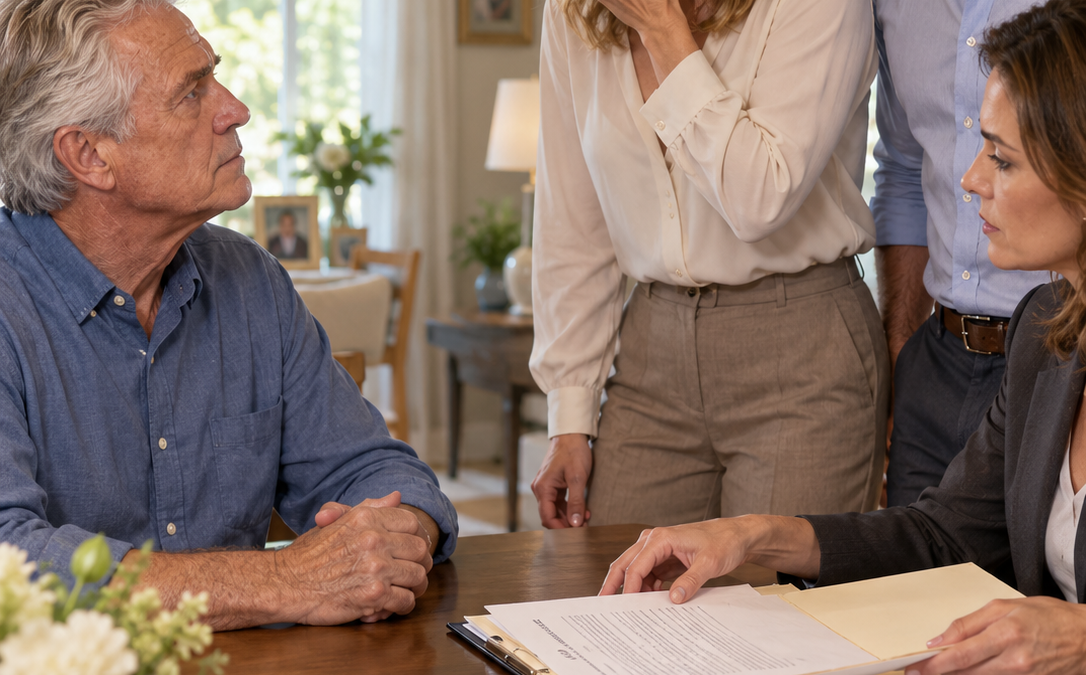
Now, I want to slow this down, too, because what happened that morning took forty minutes. It was the longest single conversation in this whole story, and I’ve gone over it more times than I’ve gone over just about anything in my life.
Ren arrived wearing a charcoal suit and flat shoes, carrying a briefcase with the corners worn off. She set two folders on my dining table, took coffee without any ceremony about it, and sat down like she’d been sitting at that table her entire career.
“They don’t know I’m here,” she said without looking up.
“No. They think this is family talk.”
The corner of her mouth moved about a sixteenth of an inch.
“It is family talk. It’s just going to be a well-documented one.”
Micah was at school. I’d made very sure of that.
At 9:04, I heard the car.
Chase came in first. Forty-two years old, tan from the boat, wearing a collared shirt. A man who’d dressed for a meeting. Sloan came in behind him with her chin up and her arms already crossed.
She’d spent that entire drive building her argument. You could see it sitting on her like a coat.
Then Chase saw the woman sitting at my dining table and stopped walking, as if somebody had pulled his cord.
Sloan’s voice came out thin.
“Dad, who is this?”
“Sloan. Chase. This is Ren Casperjack. Family law. Twelve years in private practice. Before that, nine years working for the state on cases exactly like this one. Sit down. There’s coffee.”
Sloan didn’t sit.
“You brought a lawyer into your house to talk about your grandson?”
Ren looked at her.
“Mrs. Renick, please sit down.”
She wasn’t loud. Not one decibel above conversational.
Sloan sat.
Ren opened the first folder and slid a single sheet across the table as casually as if she were passing the cream.
No speech. No buildup.
That’s the part I’d never seen done before, and I’ve been in a lot of rooms.
The sheet was a timeline.
Sunday, September 7, 6:22 a.m.: Vehicle departs residence. Four occupants. Neighbor’s doorbell camera across the cul-de-sac.
September 7 through September 12: Minor child, age nine, present at residence with no supervising adult.
Child self-transported to and from day camp on foot.
Child reports eating cereal, crackers, and half of each camp-provided lunch, which he saved for the evening.
Friday, September 12, 6:00 p.m.: Camp season concludes. No authorized adult present at pickup or at closing.
Friday, September 12, 11:52 p.m.: Child found outdoors, unsupervised, by facility custodian G. Royal. Signed statement attached as Exhibit A.
Friday, September 12, 11:58 p.m.: Child retrieved by maternal grandfather.
Exhibit C: Public social media post, timestamp September 12, 4:31 p.m., placing both parents in Broward County, Florida.
Chase read the page, and his face didn’t move a single muscle.
Sloan read it, and her face did nothing but move.
“This is—Dad, this is twisted around. We had it arranged. Chase’s cousin Denise was supposed to be checking.”
Ren slid a second sheet across the table.
“I spoke with Denise Renick on Monday. Ms. Renick states that she was asked in a group text on August thirtieth. She never confirmed. She was in Moab the entire week. She provided the message thread voluntarily.”
Sloan’s mouth closed.
And Ren said, in a pleasant voice, doing more damage than I’ve ever heard anybody do without raising it, “I’m going to save everybody some time. We are not here to establish whether it happened. It happened. We’re here so that you understand what has already been done.”
Already.
I watched that word land on my daughter.
“On Tuesday, the sixteenth, I filed a report with the Department of Human Services. It is not sealed, and it is not sitting at Mr. Beckwith’s discretion. It is filed, and as of Monday, it carries a substantiated finding.”
Chase finally spoke.
“You can’t just—”
Ren kept going as though he hadn’t made a sound.
“On Wednesday, the seventeenth, I appeared before Judge Renata Bo on an emergency ex parte petition. Mr. Beckwith was granted temporary guardianship of Micah that afternoon. That order has been in effect for eight days.”
She turned a page.
“The full hearing is October ninth. You’ll both be served this afternoon. I’d rather you heard it in a kitchen than from a process server in a parking lot.”
The room went quiet in a way that had actual weight to it.
Then my daughter said, “He’s sixty-nine.”
Her voice broke on the number.
Ren laid one more page on the table.
“Sixty-nine, with a full physical dated September twenty-second. Twenty-nine years of public service. No criminal record. Homeowner. No debt. And a named successor guardian, Talia Beckwith, forty-three, physician assistant in Durango, who has already consented in writing and already cleared a background check.”
Then Ren said the sentence I’d asked her to say.
“That boy will not be placed again. Ever. I built the file specifically so that nobody can ask that question a second time.”
And that was when my daughter looked up at me for the first time since she’d come through the door.
Her eyes were red.
“Dad.”
Just that one word, carrying six days and eighteen months and eleven years.
And I gave her nothing.
I want to be honest about that. I didn’t help her. I let her carry the whole thing the rest of the way herself.
Then she said, “I knew.”
Her voice came apart in the middle of it.
“I knew the whole time.”
She looked down at the table.
“Chase said it was one trip. He said Micah doesn’t like crowds anyway. He said we’d do something with just him.”
She stopped. Her jaw was working.
Then she said, “The part I haven’t been able to put down since…”
She took a breath.
“I packed my bag, and I walked past his door with it in my hand. He was sitting on his bed with that map open. And he looked up and asked me what state we were going to.”
She paused again.
“And I told him. I stood in the doorway, and I told him Florida. And I said, ‘See you soon, bud.’ Then I picked up my suitcase, walked out, and shut the front door.”
Chase turned and looked at her hard.
She didn’t look back at him.
She kept her eyes on me, completely out of armor.
And here’s what I felt. I’m not going to dress it up.
I was furious. I want that on the record. I was as angry as I’ve ever been in my life. But underneath that anger, older than it, was something else.
Grief.
Plain grief for a girl I’d raised and a woman I no longer recognized.
I let myself hold that for about three seconds.
Then I opened my own folder and slid it across the table.
“I know you knew, Sloan. That’s the part I can’t get past. Not the six days. The doorway.”
She flinched like I’d touched her.
Chase got to the folder first.
He read it. Then he set it down slowly.
The house on North 7th. My accounts. The sixty acres up on Glade Park that my father left me, and his father left him.
All of it, as of Friday the nineteenth, sitting in an irrevocable trust for Micah.
Education and housing released at twenty-one through an independent trustee out of Denver. The balance at twenty-seven.
Not revocable. Not contestable. Not reachable by any attorney either of them could ever afford.
And on the second page was one line I’d insisted on, a line Ren and I had argued about for twenty-five minutes.
Two separate, modest college accounts in the names of Brin and Tate Renick.
Sloan found that line and looked up, confused.
“They’re six years old,” I said. “None of this is theirs to carry. I’m not going to do to those two what was done to him.”
Then I looked at both of them.
“But their grandfather is going to be extremely clear for the rest of his life about who got left on a bench.”
Chase finally found his voice.
“This is punitive.”
“No, son. Punitive is what I wanted to do at midnight on the twelfth. This is just accurate.”
Ren closed her briefcase with a small click and laid out the position we would be taking into the October hearing.
Micah would stay with me.
He would attend weekly sessions with a licensed child therapist, paid for by the trust. Sloan would have supervised visitation at a facility, one hour a week, contingent on documented completion of parenting and family counseling.
For Chase, no contact pending evaluation.
And I’ll tell you the reason plainly, because Ren said it out loud in that room, and I’ve never been so glad to hear a sentence.
In eleven years, that man had never once signed a card. Not one birthday card, not one Christmas card in eleven years for a child in his own house.
And the school file contained a counselor’s note from March, flagging withdrawal and weight loss, acknowledged in writing by both parents and never acted upon.
“These aren’t offers,” Ren said pleasantly. “This is the position we’re taking into court, and the court has already read the file.”
They signed the acknowledgment at 10:38.
Chase walked out first without another word.
Sloan stopped at my front door, her back to me, one hand resting against the frame.
“Is he?”
Her voice caught.
“Dad, is he okay?”
I let that question sit in the air long enough for her to feel every second of it.
Then I said, “He will be. No thanks to you, but he will be.”
She nodded at the doorframe and went out.
Seven months on now.
Permanent guardianship came through in the second week of January. Judge Bo said from the bench that, in her time, she’d rarely seen a petition assembled that thoroughly. She looked over her glasses at me when she said it.
Ren didn’t smile. She wrote something down.
I’ve decided that’s her version of smiling.
Micah has put on nine pounds. He eats like a hired man. He sees a therapist named Miss Abernathy on Thursdays. He reports that her office has a lamp shaped like the moon and that she lets you not talk if you don’t feel like talking, which he says is the best part. I suspect that’s precisely the point.
The map is on his wall now. Two boxes checked, plus the one he drew himself, which he’s decided to leave right where it is. We did Arches in November because it’s four hours away and I felt like driving. We’re doing Mesa Verde over spring break.
Sloan comes to every single visit. One hour every week. Never once late. She brings a book and reads to him, and she doesn’t perform it. She doesn’t cry where he can see, which I’ve come to understand costs that woman something.
Her counselor told her something that she passed along to me during one of the careful telephone conversations we’ve started having.
Chase had never wanted the adoption finalized.
He’d treated it as a temporary arrangement he was waiting out. And Sloan had spent eleven years making herself smaller to fit inside a house he designed.
She filed for divorce in February.
And I want to say something about her, because I know some of you are already typing.
I don’t think she’s redeemed. I don’t use that word.
I think she made a calculation she has never said out loud, which is that if she fought for the one, she would lose the two. She chose three over one and then went and bought sunscreen.
But I know the difference between a person performing change and a person attempting it. Twenty-nine years of watching people at the worst moments of their lives will give you that.
My daughter is attempting it.
Slowly. Badly, some weeks.
But she’s at least on the road.
Brin and Tate come once a month now. The first time, Brin came across that visitation room at a dead run, hit her brother around the waist, and said, “Where did you go?”
Micah looked at me over the top of her head with an expression I’m not going to try to put into words for you.
So here’s what all of this taught me, and it isn’t the lesson people expect.
Everybody wants the lesson to be, “Family is who shows up.”
Fine. True. It’s on a thousand mugs.
But the real lesson is the one I built an entire career on and failed to apply where it counted.
In every search I ever ran, the terrain didn’t kill anybody.
The delay did.
The hours between the trouble starting and somebody picking up a phone. That’s the only number that ever moves, and it’s the only number that ever mattered.
And I can tell you exactly what causes that delay.
Every time, whether it’s in the backcountry or inside a house on a cul-de-sac, it’s a decent person deciding they don’t want to overreact.
They don’t want to be dramatic. They don’t want to be the one who made it a thing.
That boy sat on a bench for five hours and fifty-two minutes with a whistle around his neck and didn’t blow it because he didn’t want to get anybody in trouble.
His mother stood in a doorway with a suitcase and didn’t say the true thing out loud because she didn’t want to blow up her marriage.
Denise Renick received a group text and never confirmed it because she didn’t want to be rude about it.
And his grandfather got a phone call from a teacher in March, got told to stay in his lane, and stayed in his lane for six months because he didn’t want to be the interfering old man.
Every one of us had a whistle.
Not one of us blew it.
So here’s the one thing I’d ask you to actually do.
It takes about four minutes to set up, and then it takes ninety seconds a week for the rest of your life.
Every trip plan I ever filed had one thing at the bottom of it. Not the route. Not the gear.
Who’s expecting you back, and what time do they call it in?
That’s the entire system.
That is the only reason anybody ever gets found. Somebody, somewhere, is expecting you at a specific hour, and when you don’t turn up, they call.
Most kids in bad houses don’t have one.
There is no adult outside that household who is expecting them on a schedule.
So be one.
Pick a child in your extended life. A grandkid, a niece, a nephew, the kid across the street. Set up something ordinary and repeating. A Sunday afternoon phone call. A Wednesday text about nothing. A standing arrangement.
Not so you can investigate anybody.
So that it becomes normal.
And so that the day it stops, somebody notices.
And the noticing isn’t a confrontation. It’s just a missed check-in.
Micah and I had one on Sunday nights. We’d been doing it for two years, and it had stopped in July.
I let it go because I told myself he was busy, and they were busy, and I didn’t want to be a pest.
The check-in stopped in July.
I didn’t call it in until September.
And the question I sit with most nights is this: If something went wrong tomorrow for the child I love most in this world, who would be the one to notice?
And how many hours would it take them?
Last Sunday, I found Micah on the living room rug, lying on his stomach with that map spread open in front of him and a pencil in his hand.
Out on the left side, in the blue west of the Washington coast, he’d drawn a small dot in pen and put a ring around it.
“What’s that, bud?”
He didn’t look up.
“That’s where the octopus was, so I don’t forget the spot.”
They spent twenty-one thousand dollars to tell the internet their family was a party of four.
I’m going to spend every dollar I’ve got left and every day I’ve got coming making sure one boy never has to wonder about the number again.
Now, I want to hear from you on this, and I’m asking honestly because I’m not certain I got all of it right.
Comment one if you think I did the right thing by building the file quietly, taking Micah on that trip, and letting Sloan and Chase find out in a kitchen with a lawyer sitting at the table.
Comment two if you think I should have called the state from that parking lot at midnight on September twelfth and let the system handle every bit of it from the first hour, instead of running my own operation for eleven days.
And comment three if you think I was too soft on my daughter. That a woman who stood in a doorway with a suitcase and said, “See you soon, bud,” should never have gotten one supervised hour, let alone fifty-two of them.
Number three is the one two of my sisters have already told me I got wrong.
And it’s the one I sit with at three in the morning.
If you’ve got something for me there, I’ll read it.
And tell me where you’re listening from and what time it is where you are right now.
It’s a little after nine here, and the monument has gone that dark orange it does in the evening. It still gets me that somebody might be hearing an old search-and-rescue coordinator talk while they’re eating breakfast on the other side of the world.
But here’s the one I really want to hear about.
If you’ve ever had a bad feeling about a kid and waited for it to get clearer, waited for somebody else to say something first, waited for it to stop being your business, tell me how long you waited.
You don’t have to say who.
Because I waited six months after a teacher called me.
And there’s a bench on Orchard Mesa that I have to drive past to get to the hardware store.
I’ve never once managed to look at it.
If this story reached you, stay with me and subscribe. It’s an old man on North 7th with a microphone and a boy who’s asking about Mesa Verde every eleven minutes.
There’s another one coming.
Go be somebody’s overdue contact.
This is a fictional story inspired by real emotional experiences, fully rewritten and reimagined in Grand Junction to create original content. Any resemblance to real people or events is coincidental.








