My daughter ignored me for 5 years, but when she saw my new $150,000 mercedes on facebook, she called me: “i’ll be waiting for you tomorrow for dinner, bring $200,000 with you!” i came with a surprise, she screamed
My daughter ignored me for five years as if I didn’t exist, but I still sent her greetings. Then she saw my new $150,000 Mercedes on Facebook, and suddenly my phone rang.
“I’ll be waiting for you tomorrow for dinner. Bring $200,000 with you.”
She was waiting for money, but I came with a surprise that would change our lives forever.
Before we continue, please subscribe to the channel and write in the comments what time it is where you are now.
The morning had settled into its usual rhythm. I sat in my home office, my laptop screen glowing with investment portfolios showing modest gains and steady returns. Nothing particularly exciting. Outside my Philadelphia rowhouse, the August heat was already building. I’d finished my coffee, answered a few emails, and was considering whether to water the small garden out back when my phone rang.
An unknown number appeared on the screen. I stared at it for three rings, my thumb hovering over the decline button. Spam calls came daily now, but something made me answer.
“Hello?”
“This is Kora.”
Her voice arrived like a winter draft, formal and flat, carrying no warmth whatsoever.
“I’m having dinner tomorrow evening at six. You should come.”
My chest tightened. Five years. Five years of silence, of birthday cards returned to sender, of text messages that never earned even a single-word reply. And now this. My daughter’s voice was in my ear again, as if no time had passed, as if she hadn’t cut me out of her life completely.
“Kora.” I managed to keep my voice steady, though my hand gripped the phone harder. “It’s good to hear from you. I didn’t expect—”
“Tomorrow at six,” she interrupted, cutting through my words like scissors through paper. “My address hasn’t changed. Bring $200,000 with you.”
The number hit me like a physical blow. I sat up straighter, the portfolio spreadsheet completely forgotten.
“Two hundred thousand? What? Kora, I don’t understand. Why now? Why?”
“It’s not complicated.” Her tone suggested I was being deliberately obtuse. “Tomorrow. Six o’clock. Don’t be late.”
The line went dead.
I sat there with the phone still pressed against my ear, listening to silence. Slowly, I lowered it to the desk. My hand was trembling, not because of my sixty-seven years, but because of the sheer audacity of what had just occurred.
Two hundred thousand dollars, demanded as casually as someone might ask me to bring a bottle of wine.
I stood, my legs unsteady, and walked to the kitchen. My coffee sat where I’d left it, now cold. I poured it anyway, held the mug with both hands, and moved to the window overlooking my backyard. The small patch of grass needed mowing. The tomato plants I’d started in spring were heavy with fruit. Normal things. Mundane things. Things that made sense.
Nothing about that phone call made sense.
Five years earlier, everything had fractured. I’d sold my construction company after spending forty-three years building it from nothing into something solid and respectable. The sale price was substantial, and I’d been generous, or so I’d thought. I’d given Kora and her husband, Stuart, $300,000 outright, with no strings attached, to help them buy their house and start their life together.
It hadn’t been enough.
The memory surfaced unbidden. Stuart stood in my living room, arms crossed over his chest, a smug expression twisting his features.
“You sold the company for over two million and gave us scraps,” he’d said, his voice dripping with contempt. “We deserved half of that, at least.”
And Kora, my daughter, stood beside him. She didn’t defend me. She didn’t acknowledge the gift, the generosity, or the decades I’d spent building something I hoped to pass on. Instead, she looked at me with cold calculation.
“Maybe if you’d been fair to your family, we wouldn’t have to do this.”
Do this? As if I were the one who had done something wrong. As if expecting gratitude for a $300,000 gift made me some kind of villain.
I’d tried to explain. The company sale included debts, obligations, and retirement funds for employees who’d worked for me for decades. The two million dollars wasn’t two million dollars sitting in my pocket. But Stuart had talked over me, his voice rising as he accused me of hiding money, cheating them, and loving my employees more than my own blood.
Kora had said nothing more. She’d simply watched me with those expressionless eyes while her husband dismantled our relationship sentence by sentence.
Eventually, I’d asked them to leave, and they’d left.
That was five years ago.
Since then, nothing but silence. I’d sent birthday cards, holiday messages, and texts asking whether we could talk, whether we could find some middle ground. Nothing ever came back. Each message was a small humiliation, another reminder that my daughter had chosen money over me.
And now this.
I set down my coffee mug and moved to the living room bookshelf. The photo album was where it had always been, its spine worn from years of handling. I opened it carefully.
There was Kora at five, gap-toothed and laughing as she rode on my shoulders at the park. Kora at eighteen, wearing her cap and gown, holding her diploma high, her smile so wide and genuine. Kora at twenty-nine, on her wedding day, her white dress flowing around her as she looked at Stuart with such hope.
When had that hope curdled into this cold transaction?
I pulled out my phone again and opened the message thread bearing her name. Five years of one-sided conversation stared back at me.
Happy birthday, sweetheart. Hope you’re doing well.
Merry Christmas. Would love to hear from you.
Thinking of you today. Miss you.
Each message was a monument to rejection, a testament to silence. I placed the phone face down on the coffee table. My hands wanted to shake, but I wouldn’t allow it. Instead, I picked up the cold coffee and drank it anyway, using the bitter taste to center myself and push through the storm of emotions threatening to overwhelm my composure.
I needed to think. I needed to understand what had changed. What had triggered this sudden contact after five years of nothing? Why exactly $200,000? Why tomorrow?
The morning sun climbed higher outside my window. I sat in my chair, the photo album still open on my lap, and forced myself to breathe slowly. I had to think clearly, not react, but analyze.
Finally, I reached for my laptop and opened Facebook, something I rarely bothered with anymore. I logged in to check something that had been nagging at the back of my mind.
My profile loaded, and there, at the top of my feed, was the post from yesterday. It was a photograph I’d taken in a moment of simple pride, showing my new Mercedes S-Class, silver and gleaming in the driveway.
The caption read, “Treating myself after some successful investments. Life is good.”
I stared at the screen, at the view count, at the list of people who had seen it. And there, among the names, was Kora Fields.
My breath stopped.
According to the viewing history displayed on the screen, she’d looked at it multiple times. Yesterday evening at six, again at 7:15, and then at 9:43.
Three separate visits to look at my car, my caption, my small moment of satisfaction. And this morning, she’d called.
I took a screenshot, my fingers moving automatically while my mind processed what this meant. The timing wasn’t a coincidence. It couldn’t be.
Five years of absolute silence, and less than twenty-four hours after I posted a photograph of an expensive car, my phone rang with demands for money.
“Twenty-four hours,” I said aloud to my empty house. “That’s all it took. One picture of a car, and suddenly I’m worth calling after five years.”
The Mercedes had cost me $150,000. A splurge, yes, but I’d earned it. Decades of careful investing, of living modestly while building wealth slowly and deliberately. The car was beautiful and comfortable, a small reward for patience and discipline.
Kora had seen it and calculated.
Calculated that if I could afford that car, I must have liquid assets. Calculated that I was weak enough, lonely enough, desperate enough for her contact that I’d comply with any demand. Calculated that she could snap her fingers and I’d come running with my checkbook open.
The realization cut deeper than the original phone call.
This wasn’t a change of heart. This wasn’t regret, reconciliation, or even basic human decency. This was predatory. She’d seen an opportunity and moved on it with the precision of someone circling wounded prey.
I closed Facebook and opened a new browser tab. I typed Pennsylvania estate law inheritance rights, then irrevocable trust structures, then disinheritance legal requirements Pennsylvania.
My construction business had taught me many things. One of them was to do thorough groundwork before beginning any major project. Another was that professionals existed for a reason. You didn’t wire your own electrical systems or plumb your own buildings. You hired experts who knew the codes, the regulations, and the pitfalls.
I needed an expert now.
My desk drawer held business cards accumulated over years of contracts and collaborations. I flipped through them until I found what I wanted.
Margaret Chen, Attorney at Law. Chen Law Associates.
I’d used her for business contracts, the company sale paperwork, and a few property disputes over the years. She was sharp, discreet, and didn’t waste time on pleasantries when work needed doing.
I studied the card, rehearsing what I’d say. The estrangement. The sudden contact after five years. The demand for money. My suspicion about Kora’s motives and my desire—no, my need—to protect what I’d built.
I wanted to send a message about respect, about family, about consequences.
“If she thinks I’ll just hand over money because she snapped her fingers,” I muttered, pulling my phone closer, “she learned nothing. Nothing from what happened five years ago.”
I dialed the office number. Two rings later, a receptionist answered.
“Chen Law Associates. How may I help you?”
Her voice was pleasant and professional.
“This is Harley Fields.” I kept my tone level and businesslike. “I need to speak with Margaret Chen today, if possible. It’s urgent, regarding estate planning and family matters.”
There was a pause and the faint sound of keyboard clicks.
“Ms. Chen has a full schedule today, Mr. Fields. Could we arrange something for next week?”
“Please tell her it concerns restructuring my will and potentially establishing a trust.” I made my voice firm but polite. “I can work around her schedule today.”
“One moment, please.”
Hold music played. I stared at Kora’s photograph on my phone screen, the wedding photo from years earlier, her smile wide and genuine. When had I stopped seeing my daughter in that smile? When had it become just a stranger’s face?
“Mr. Fields?” The receptionist returned. “Ms. Chen can see you at four this afternoon. Will that work?”
“I’ll be there. Thank you.”
I set the phone down carefully.
Four o’clock. That gave me several hours to prepare, to organize my thoughts, and to gather whatever documentation Margaret might need.
I looked at the computer screen, still showing search results about estate law. Then I looked at my phone, at the Facebook screenshot, and finally at my hands.
They were steady now. No tremor.
“You want to play this game?” I said quietly to Kora’s photograph. “Fine. But this time, we play by my rules.”
The hurt was still there, that deep, old wound of parental rejection, of being valued only for what I could provide financially. But something else was growing alongside it now, something cold, calculated, and precise.
I wasn’t going to be a victim this time. I wasn’t going to let her use my love for her as a weapon against me.
I’d spent five years hoping for reconciliation, sending messages into the void, keeping the door open for her return. She’d kicked that door shut, locked it, and now she wanted to pick the lock only when she saw something inside worth stealing.
Not anymore.
I glanced at the clock. It was nearly noon. The appointment was at four, and I had time to think this through properly, to approach it the way I’d approached every major decision in my business career: with preparation, professional advice, and a clear understanding of goals and consequences.
I closed the laptop with a sense of purpose, stood, and moved toward the bedroom. There were documents I needed to locate: the original will, financial statements, and records of the gift I’d given Kora and Stuart five years earlier. Margaret would want to see everything and understand the full picture before advising me.
But more than that, I needed to prepare myself mentally.
This wasn’t about revenge in the petty sense. This was about teaching a lesson that should have been learned long ago, about demonstrating that respect couldn’t be demanded with threats, that family was more than a resource to be exploited, and that actions had consequences.
I had several hours before the appointment, several hours to gather what I needed, to think through what I wanted to achieve, and to transform myself from the shocked father who’d answered the phone that morning into someone who could make difficult decisions with clarity and conviction.
The man who’d built a construction company from nothing understood foundations. He understood that you didn’t build something lasting on soft ground. He understood that sometimes you had to tear down a crumbling structure before you could rebuild correctly.
Today, I would start laying a new foundation.
The drive through Philadelphia traffic gave me time to think. I’d spent the intervening hours gathering documents: financial statements, property deeds, investment portfolios, everything Margaret would need to understand the full scope of what I was protecting and what I intended to take away.
Her office building was modern glass and steel, professional without being pretentious. I’d been there before, years ago, when Margaret handled contracts for the construction company. The parking garage smelled of concrete and exhaust. I took the elevator to the fourth floor, carrying a leather folder thick with documentation.
The reception area hadn’t changed. Muted gray carpet, framed diplomas on cream-colored walls, the quiet hum of filtered air, and the distant tapping of keyboards. The receptionist looked up and smiled with recognition.
“Mr. Fields, Ms. Chen is expecting you.”
Margaret emerged from her office before I could sit down. She was in her mid-fifties, sharp-eyed, with a firm, brief handshake. She noticed something different in me immediately. I could see it in the way her gaze lingered a moment longer than necessary.
“Harley, come in.”
Her conference room overlooked the city, afternoon light slanting through vertical blinds. I sat across from her at the polished table and opened my folder, laying out the evidence methodically.
The Facebook post. Screenshots with timestamps. Kora’s viewing history, showing three separate visits to stare at my car. A timeline I’d written documenting five years of ignored birthday cards, unanswered messages, and complete silence.
“She hasn’t spoken to me in five years,” I said, my voice level. “Not a word. Yesterday, I posted a photo of my new car, and this morning she called demanding $200,000. That tells me everything I need to know about why she reached out.”
Margaret took notes on a legal pad, her pen moving steadily.
“Tell me about the estrangement.”
I explained the company sale, the $300,000 I’d given them, Stuart’s accusations, his contempt, and his insistence that I’d cheated them. I described Kora standing beside him, saying nothing in my defense, choosing his version of events over our relationship.
“Since then, nothing,” I continued. “I tried. I sent cards and messages. I kept the door open.”
I tapped the timeline.
“Every attempt is documented here. Every rejection.”
Margaret studied the papers without speaking for a long moment. When she finally looked up, her expression remained professionally neutral, but something in her eyes suggested recognition. She’d seen this pattern before in her estate planning practice.
“What do you want to do, Mr. Fields?”
“I want to create a new will.”
The words came more easily than I’d expected.
“I want to disinherit Kora completely. Everything I have, approximately $1.8 million in assets, goes to the Construction Industry Veterans Support Fund instead.”
Margaret set down her pen.
“Mr. Fields, I need to ask this clearly. Are you certain about this decision? Disinheriting your only child is legally valid, but it’s permanent. Once you present this to her, there’s no walking it back.”
“I’ve had five years to think about what family means,” I said. “She made her choice. I’m making mine now.”
Margaret nodded slowly and pulled her legal pad closer.
“If she contests this, she’ll likely claim undue influence or diminished capacity. We need to document that you’re acting voluntarily, that you understand the implications, and that your reasoning is sound.”
“Then document it. I want this ironclad.”
I leaned forward slightly.
“I’m not punishing her. I’m protecting what I built from someone who only sees it as money she’s owed.”
Margaret stood and walked to her bookshelf, returning with a thick Pennsylvania state law reference. She opened it to a marked section and turned it toward me.
“Pennsylvania law gives you testamentary freedom,” she explained. “You can disinherit adult children, but challenges are possible, so we make it bulletproof.”
Her finger traced down the page.
“We’ll include a detailed recital of your reasons. The more specific we are about your relationship history and her conduct, the stronger the will becomes. And you’re certain about the charitable beneficiary?”
“The Construction Industry Veterans Support Fund,” I replied without hesitation. “Those people built their lives with their hands, just like I did. They deserve support more than someone who can’t see past a dollar sign.”
She made more notes.
“We’ll also include a no-contest clause. Anyone who challenges the will forfeits any potential inheritance. Not that there would be any for her, but it adds another layer of protection.”
For the next hour, we worked through the details: specific language, asset inventories, witness requirements, and notarization procedures. Margaret asked probing questions about my mental state, my understanding of the consequences, and whether I was making the decision voluntarily.
It was standard procedure, she explained, to demonstrate competency if the will was ever challenged.
I answered everything clearly, providing the financial documents she needed and explaining my reasoning without emotion or anger. This was business. Strategic. The same way I’d approached every major decision in my construction career.
Finally, Margaret closed her legal pad.
“I’ll draft this tonight and have it ready by nine tomorrow morning. Given the urgency and complexity, I’ll need a substantial retainer.”
I wrote the check without blinking.
This wasn’t impulsive. It was calculated.
“One more thing,” I said. “I want five notarized copies prepared.”
Her pen paused in the middle of a note.
“You want five notarized copies for tomorrow? That’s unconventional. Most people keep wills private until after death.”
I allowed myself a slight, cold smile.
“I’m not most people, and I want her to understand exactly what her phone call cost her.”
Margaret studied me for a moment, then nodded.
“I’ll arrange it.”
She stood and extended her hand. I shook it, feeling the firmness of her grip, the professional confidence that told me she’d create exactly what I needed.
As I reached the door, she spoke again.
“Harley, this path you’re choosing is legal. It’s your right. But it’s also final. Make sure you can live with it.”
I turned back.
“I’ve already lived with her choice for five years. Now she can live with mine.”
I walked down the hallway, took the elevator to the parking garage, and sat in my car for a moment before starting the engine.
The weight of what I’d set in motion felt substantial, real in a way that the morning’s anger hadn’t been. But my resolve didn’t waver.
Tomorrow morning, Margaret would have the documents. Tomorrow evening, Kora would discover what her calculated phone call had actually accomplished.
I drove home through lengthening shadows, the city lights beginning to glow against the darkening sky.
I woke before dawn, my sleep fractured by anticipation rather than doubt. The bedroom was gray with the first hint of morning light. I lay still for a moment, feeling the weight of what the day would bring, then rose and moved through my morning routine with deliberate normalcy.
Coffee. Shower. Shave.
I dressed carefully in dark jeans and a pressed button-down shirt. Nothing flashy. I wasn’t trying to impress anyone, just maintaining my dignity.
My phone showed an email from Margaret, sent at 7:30.
Documents ready for pickup. Office opens at 8:30. MC.
I drove through light morning traffic, retracing yesterday’s route. The city was quieter at that hour, the streets not yet choked with commuters.
Margaret’s receptionist buzzed me in immediately. Margaret met me in the lobby, holding a large manila envelope sealed with her firm’s label. Her expression was serious.
“Everything’s here,” she said. “The original and five copies. I’ve included the affidavit of mental competency, as we discussed.”
She paused.
“Robert Kowalski, the notary I mentioned, has an office on Walnut Street, about fifteen minutes from here. I called ahead. He’s expecting you.”
I took the envelope and felt its weight.
“Thank you, Margaret.”
“Good luck, Harley.”
She didn’t specify with what.
Robert Kowalski’s office occupied the ground floor of an older building, the kind with high ceilings and crown molding that spoke to an earlier era. The sign beside the door read Kowalski Notary Services, Since 1995.
Inside, the space was small but impeccably organized. File cabinets lined one wall. A simple desk held a computer, a heavy embosser, and neat stacks of forms.
Robert himself was perhaps sixty-two, gray-haired, wearing reading glasses on a chain around his neck.
“Mr. Fields.” He extended his hand. “Margaret Chen speaks highly of you. Please sit.”
His assistant, a middle-aged woman with kind eyes, nodded at me from a second desk near the window.
I sat across from Robert, opened the envelope, and withdrew the documents. He examined each page methodically, checking signature lines, witness blocks, and completeness. It was the careful bureaucracy that transformed ordinary paper into legal armor.
“Mr. Fields, I’m required to ask. Are you signing this document of your own free will, without any pressure or coercion from any person?”
“Yes,” I replied steadily. “Completely voluntary. I’ve thought about this carefully.”
“And you understand this is your last will and testament, that it supersedes any previous wills, and that it directs the disposition of your estate upon your death?”
“I understand completely. That’s exactly what I want.”
Robert studied me over his glasses for a moment.
“I’ve been doing this thirty years, Mr. Fields. Usually, people signing wills look uncomfortable, like they’re planning their funeral. You look decided.”
I allowed myself a slight, humorless smile.
“That’s because I’m not planning my death. I’m planning something else entirely.”
He nodded slowly, then turned to his assistant.
“Linda, we’ll need you as a witness.”
The process was formal and precise. Robert positioned the first document, the original, in front of me and indicated where to sign. I wrote my name clearly and dated it. Linda stepped forward, added her signature, and printed her name as a witness. Robert did the same.
Then came his notary seal, a heavy embosser that created a raised impression in the paper, the distinctive mark of authentication. He applied it carefully, added his signature, and completed the official certificate.
“Five copies as well?” Linda asked, glancing at the stack.
“Yes,” I confirmed.
We repeated the process five more times. Six signatures from me in total, each one deliberate and clear. Six notarizations, each seal pressed firmly into paper, transforming the drafts into official legal instruments.
As Linda signed the fourth copy, she glanced at me.
“You requested five additional notarized copies. That’s unusual for a will. Most people just need the original.”
“I have unusual circumstances,” I said. “I need to make sure certain people understand exactly where things stand.”
When we finished, Robert stacked the documents neatly and slid them back into the envelope. I paid his fee in cash. I’d come prepared, and he gave me a receipt.
“These are now official legal instruments, Mr. Fields,” Robert said. “Keep them secure.”
“I will.”
I left his office carrying the envelope, drove three blocks, then pulled into an empty parking space. I sat for a moment with the engine running, opened the envelope, and withdrew the top document.
My signature. The notary seal, raised and official. Today’s date.
And the words:
I hereby disinherit my daughter, Kora Elizabeth Fields, for reasons fully detailed herein.
“Five years,” I said aloud to my empty car. “It took her five years to call and twenty-four hours to lose everything she thought she’d inherit.”
I closed the envelope and secured it inside the leather portfolio I’d brought specifically for this purpose. Then I drove home through midmorning traffic.
The afternoon stretched ahead, hours to wait before evening, before the dinner invitation she’d issued so casually, so confident I’d arrive with money in submission.
I showered again, taking my time. I chose my clothes carefully: the same dark jeans, a different shirt, this one blue. Casual, but not dismissive. I wasn’t dressing for her approval, only for my own sense of appropriateness.
At four, I made coffee but didn’t drink it. I paced my living room and checked the portfolio again, confirming that all six copies were present and properly organized.
At five, I decided to leave. Better to arrive early than sit at home counting minutes.
I placed the portfolio carefully on the passenger seat of the Mercedes, the car that had started all of this. Gleaming silver evidence of resources she’d decided to claim.
I walked to my front door and paused with my hand on the knob.
My home was modest, comfortable, and paid for. It had been my sanctuary for five years while she maintained her silence. I looked back at the living room, the bookshelf with its photo albums, and the quiet order I’d built around myself.
Then I walked out, locked the door behind me, and got into my car.
The drive to the suburbs took forty minutes. Traffic was lighter heading out of the city, and I navigated familiar roads, though I hadn’t driven them in years.
Her address hadn’t changed, she’d said. I’d never actually been to this house, purchased after our estrangement, but I’d looked it up online. I knew what to expect.
The sun was lowering, painting everything in amber light. I drove with the portfolio beside me, carrying six copies of her inheritance, all of them zeros.
The neighborhood announced itself through manicured lawns and fresh paint, a kind of upper-middle-class suburban confidence. These were houses that whispered success without shouting it.
Kora and Stuart’s home was a two-story Colonial with professional landscaping, the kind of presentation that mattered to people who cared about appearances.
I sat in my car for a long moment, hands resting on the steering wheel, the portfolio beside me on the passenger seat. Through the front window, I could see movement.
They were watching for me.
I picked up the portfolio and walked to their door with measured steps. No hesitation.
The door opened before I could knock.
“Dad!”
Kora’s voice was too bright, her smile stretched too wide.
“I’m so glad you came.”
She hugged me briefly, a performance of warmth where no warmth existed. Stuart appeared behind her, extending his hand with practiced congeniality.
“Harley, good to see you. Come in, come in.”
The contrast was staggering. Five years of silence, and now they greeted me as though we’d had lunch together the previous week.
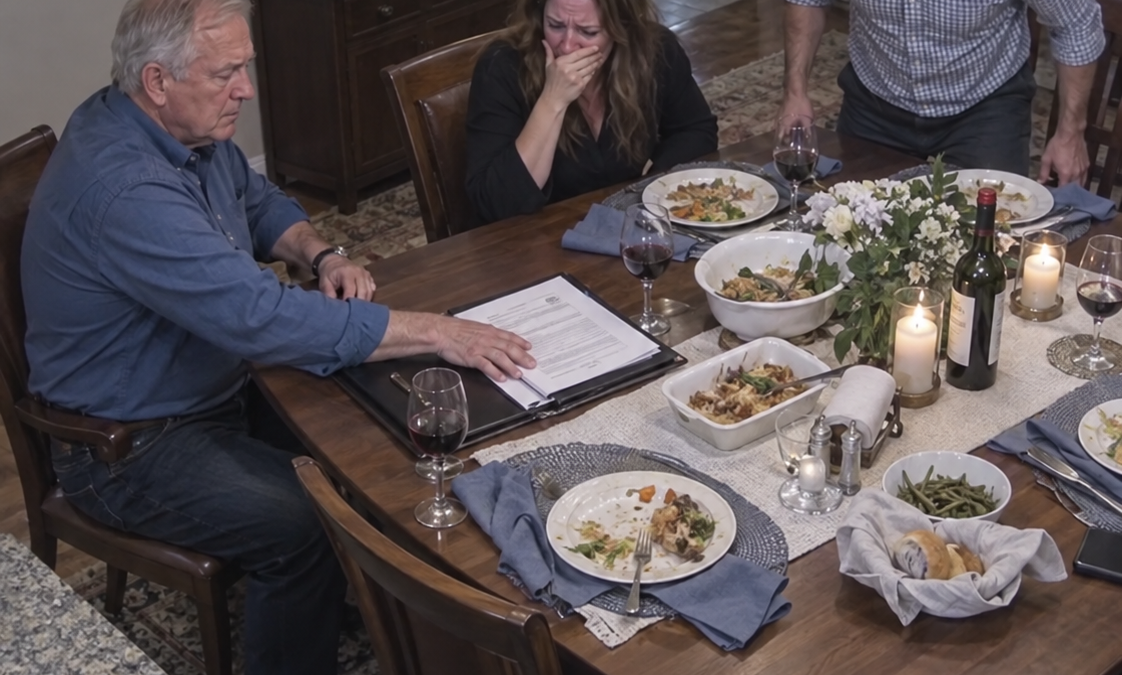
Their dining room was elaborately staged. Candles flickered on a table set with wine glasses and cloth napkins. The food, clearly purchased from an expensive restaurant, was still being transferred from takeout containers to serving dishes. It smelled rich and carefully chosen.
“We thought we’d make this special,” Kora said, gesturing toward a chair. “Family should celebrate being together again.”
I sat, placing the portfolio beside my chair. Stuart’s eyes flicked toward it, then away.
Kora poured wine with trembling hands. Nerves, not emotion.
The meal proceeded with stilted conversation. Kora asked about my health, my house, and my investments, questions designed to inventory my resources without appearing mercenary. Stuart discussed market trends and business opportunities, establishing his expertise.
I ate little and watched everything.
They exchanged glances when they thought I wasn’t looking. Silent communication. Rehearsed coordination.
After the main course, Stuart leaned back with calculated casualness.
“Harley, I wanted to run something by you. There’s an incredible investment opportunity that’s come across my desk.”
His voice shifted into salesman mode, smooth and confident.
“Residential development in a growing market. The returns are projected at eighteen to twenty-two percent annually. Really solid fundamentals.”
He continued before I could respond.
“We need to move fast, though. The window closes this week. Early investors get the premium positions.”
Kora added her part right on cue.
“Dad, Stuart’s been working so hard on this. We finally have a chance to really build something.”
Her voice carried practiced emotion.
“I know you understand what it means to build a future. You did it with your company.”
I leaned back in my chair, arms crossed, and let them finish.
Stuart laid out more details, deliberately vague specifics wrapped in financial jargon meant to sound legitimate while saying nothing concrete. Kora nodded along, playing the supportive wife, the loving daughter who just wanted her father’s help.
When they finally paused, waiting for my response, I spoke quietly.
“I do understand building a future. I spent forty-three years building mine.”
I met Stuart’s eyes, then Kora’s.
“I also understand what happens when people only see you as a means to an end.”
I reached down to the portfolio, opened it with deliberate slowness, and withdrew two copies of the will.
Then I slid them across the table like a dealer distributing cards.
One to Kora. One to Stuart.
The documents landed between the candles and wine glasses with devastating finality.
Stuart picked his up first. I watched his expression change from confusion to comprehension, then fury. He stood abruptly, his chair scraping loudly against the floor.
“What is this?” His voice rose. “A will? You brought your will to dinner?”
Kora read more slowly, her performance crumbling as understanding set in. Tears started before she finished the first page, but I’d seen enough angry tears in my life to recognize them.
She wasn’t heartbroken. She was furious at being denied.
“You asked for $200,000 after five years of not speaking to me,” I said, my voice calm and factual. “I thought you should know where you stand. You’re not in this document. Neither of you. Everything goes to the Construction Industry Veterans Support Fund.”
“How can you do this?” Kora’s voice shook with rage disguised as grief. “I’m your daughter! Your only child!”
“You were my daughter,” I replied, keeping my tone steady and controlled. “Then you chose to become a stranger who only calls when she wants money. This is what that choice costs.”
Stuart slammed the document onto the table.
“You can’t do this! We’ll fight this! You’re not in your right mind. We’ll prove it!”
I stood, preparing to leave.
“I’m perfectly sound. Ask the notary, the attorney, the witnesses. This document is legal, filed, and final.”
I looked at both of them, seeing their calculation exposed, their masks discarded.
“You wanted to know my value in dollars. Now you know. To you, I was worth a phone call. To me, my legacy is worth more than that.”
I walked toward the door. Behind me, Kora’s voice turned desperate.
“You’ll regret this! Don’t walk out that door!”
I paused at the threshold but didn’t turn back.
“I’ve spent five years with regrets. Tonight, I finally have clarity instead.”
I stepped into the cool evening air.
Behind me, the shouting began. But now they were arguing with each other, not with me. Accusations flew about whose idea this had been and whose plan had failed.
I got into my Mercedes and started the engine. As I pulled away from the curb, I glanced into the rearview mirror.
The front door stood open. Stuart was silhouetted in the light, his phone already pressed to his ear.
I drove into the darkening evening, knowing this wasn’t ending.
This was just beginning.
My phone woke me before dawn, buzzing insistently against the nightstand in the gray light before sunrise. I lay still for a moment, awareness settling in slowly.
The phone kept buzzing.
I picked it up. The lock screen was filled with notifications. Six missed calls from Kora. Three from Stuart. Several from numbers I didn’t recognize. Text message previews scrolled down the screen, too many to count.
The war had begun while I slept.
I set the phone down and went to make coffee. I showered, dressed, and established some sense of normalcy before engaging with the attack.
I’d expected this. They were panicking, and panicked people made mistakes.
At my kitchen table, with my laptop open, I began documenting everything. I took screenshots before opening a single message, created a folder labeled Evidence, and then methodically started reading.
Kora’s early texts alternated between tearful apologies and furious accusations.
Dad, please call me. I’m sorry we argued. Can we talk about this calmly? You’re my only family.
Six hours later, the tone had changed completely.
You’re being incredibly selfish. After everything I’ve been through, you do this to me? Call me back immediately.
Stuart’s messages were purely strategic.
An email with the subject line Legal Action appeared in the middle of the morning.
Mr. Fields, your actions yesterday demonstrate either malicious intent or diminished mental capacity. We will be consulting with an attorney about challenging your recent will on grounds of undue influence and incompetence. This can be resolved, or it can become very expensive for your estate. Your choice.
I copied each message into a document, noting the date, time, and sender. I categorized them: threats, manipulation, guilt trips, legal intimidation.
The construction business had taught me that documentation protected you when people turned hostile.
The voicemails were worse. Kora sobbing about family. Stuart’s cold recitation of legal options. Then Kora again, her voice shifting between pleading and anger.
“How can you do this to your own daughter? I made mistakes, but five years? You’re going to punish me forever? That money is my inheritance from my family!”
I saved every recording to my computer and created a spreadsheet tracking every contact attempt: date, time, method, sender, message type, and content summary.
The second day brought more of the same.
The third morning brought Kora herself.
I was standing at my kitchen window with a cup of coffee when her car pulled aggressively into my driveway. She got out, slammed the door, and stood on my front lawn.
“Harley!” she shouted. “I know you’re in there! You can’t hide from this!”
I moved to the front window, where I could observe her while staying uninvolved. I pulled out my phone and started recording video. I believed Pennsylvania law allowed recording on my own property for security purposes, and I was building a case if I needed one.
Kora alternated between crying and yelling.
“You’re being cruel! Vindictive! Everyone needs to know what kind of father does this!”
The neighbors were noticing. Curtains moved in nearby windows.
Then Danny Morrison emerged from his house two doors down. Danny was in his early seventies, a retired police officer, steady as bedrock. He walked toward Kora with the measured confidence of someone who’d spent decades handling public disturbances.
“Miss, I’m going to ask you to leave,” he said.
His voice was calm but carried authority.
“This is disturbing the peace, and Mr. Fields is within his rights not to engage with you. If you don’t leave voluntarily, I’ll need to make a phone call.”
He tapped his phone meaningfully.
Kora turned on him.
“You don’t understand what he’s doing! He’s—”
“I understand you’re on someone else’s property, shouting.” Danny’s tone didn’t change. “That’s enough. Time to go.”
She got back into her car, but not before one final shout toward my window.
“This isn’t over! He’ll regret this! We’ll see what a judge thinks!”
She drove away, her tires squealing slightly.
Danny waited until she was gone, then walked to my door. I opened it before he knocked.
“You all right, Harley?” His weathered face showed concern. “That was quite a show. Want me to file a report?”
“I’m fine, Danny. I’ve documented everything.”
I gestured toward my phone.
“If they escalate further, I might need you as a witness, if you’re willing.”
“Thirty years on the force. I know how family disputes get ugly.”
He nodded slowly.
“You’ve got my number. That video you took? Keep it safe. You might need it.”
After he left, I saved the video to my evidence folder and made a note about Danny’s availability as a witness. I sent him a brief thank-you text, establishing a written record of the incident.
That evening, I composed an email to Margaret Chen with the subject line Anticipated Legal Challenge.
I attached everything: message screenshots, voicemail transcripts, the video of Kora’s outburst, and my timeline spreadsheet.
I intended to stay one step ahead.
I closed my laptop as evening settled in. For the first time in three days, my phone was quiet. No calls, no texts.
The silence felt ominous rather than peaceful.
Then a notification appeared. One new email from an unknown sender.
The subject line read Re: Fields Estate Matter — Legal Representation.
I stared at it, my thumb hovering over the screen.
This was their formal response. The harassment phase was over.
The legal war was beginning.
Two days of quiet passed. I sat in my home office reviewing investment statements, trying to maintain some semblance of routine, when my phone rang and Margaret’s name appeared on the screen.
I knew immediately.
“Harley, I received formal notice this morning.”
Her voice was serious but measured.
“Stuart retained Nathan Burkowitz. He’s aggressive but predictable. They’re filing to contest the will on grounds of diminished capacity and emotional duress. We need to move fast.”
I felt relief more than anxiety. The ambiguity was over. The fight was now formal, with rules and procedures.
“I expected this,” I said. “What do we need to do?”
“Medical evaluation, psychological assessment, anything that proves you were and are of sound mind. The stronger the documentation, the faster we can shut this down. Can you see your doctor today?”
“I’ll make it happen. What else?”
“I’ll prepare our defensive package. But Harley, they’ll argue the timing proves this was rash and emotionally driven. We need to show deliberation, careful thought, and professional consultation.”
I called Dr. Stevens’s office the moment we hung up and explained the situation briefly. His nurse found an opening that afternoon.
The examination was comprehensive. Cognitive function tests, memory, reasoning, processing speed, and blood work to rule out medical issues affecting judgment.
Dr. Stevens was thorough and methodical, checking everything.
“Harley, your cognitive function is excellent,” he said, reviewing the results. “Memory, reasoning, judgment, all within the normal range for your age. Actually, better than average. Blood pressure is good. No signs of neurological issues. You’re healthier than most sixty-seven-year-olds I see.”
“I need that in writing, Doc. Detailed.”
He looked up.
“Someone’s trying to claim I’m not competent to make my own decisions.”
Understanding crossed his face immediately.
“Family dispute over money?”
“Something like that.”
“I’ll have a comprehensive report ready by tomorrow. Fifteen years I’ve treated you, Harley. You’re one of the most clear-headed patients I have.”
The following day brought the psychological evaluation.
Dr. Patricia Hang’s office was quiet and professional. She specialized in elder competency assessments, Margaret had explained.
The appointment involved two hours of testing: mental status examinations, decision-making scenarios, and an evaluation of my emotional state.
“Walk me through how you made the decision to change your will,” she said, her pen poised over her notepad. “What was your thought process?”
I laid it out clearly and in order.
“My daughter didn’t contact me for five years. Then she called demanding $200,000 the day after seeing a photo of my car online. That showed me she only valued me as a source of money. I consulted my attorney, considered my options for twenty-four hours, and decided my assets would do more good supporting veterans than enabling someone who sees relationships as transactions.”
“That’s a very coherent, logical progression.”
She made more notes.
“Do you feel you were pressured into this decision by anyone?”
“The opposite. I was pressured to give money. I chose not to.”
She asked further questions, probing for signs of coercion, depression, or impaired judgment. She found none.
By the end of the session, she seemed satisfied.
“Mr. Fields, you demonstrate full mental capacity and sound decision-making. I’ll provide a detailed report confirming that.”
Margaret reviewed both reports in her office, satisfaction visible on her face.
“This is solid. Two independent medical professionals, both stating you’re fully competent, combined with the timeline showing deliberation, the consultation with me, and the notary process. Their case is weak, but expect them to fight dirty.”
“They already are,” I said. “The gossip campaign started two days ago.”
Her eyes sharpened.
“What gossip?”
I explained that Tom Chen, a former business associate, had called the previous day. He’d run into Stuart at a restaurant.
“Stuart seemed genuinely worried,” Tom had told me. “Mentioned you were having difficulties. Memory problems. Emotional issues.”
“Document everything,” Margaret said firmly. “If it crosses into defamation, that’s another tool we can use.”
I spent that evening making calls, not defending myself emotionally, but sharing facts.
When Tom expressed concern, I was direct.
“Tom, I appreciate it. I’ve just completed full medical and psychological evaluations. I’m happy to send you copies if you want to see for yourself. Stuart is trying to contest my will because he doesn’t like what’s in it. The doctor visits are part of protecting my right to make my own choices.”
There was silence on the other end.
Then Tom spoke.
“I appreciate your honesty, Harley. Stuart made it sound different.”
“I imagine he did.”
By evening, I’d reached four people who’d heard versions of Stuart’s story. Each conversation followed a similar pattern: calm facts countering emotional manipulation.
I documented every call and saved every voicemail Stuart and Kora had left. My evidence file continued to grow.
Margaret and I sat in her office with documents spread across the conference table. Medical reports, legal briefs, and the evidence folder from the harassment days covered the polished surface.
She leaned back, studying the array of documentation.
“We’re well defended now,” she said, “but they’ll keep pushing. What’s your next move?”
I was quiet for a moment, thinking.
Then I said something that made her look up sharply.
“What if I remove what they’re fighting over? Not from the will. Make it disappear before I’m even gone.”
Margaret leaned forward, interested.
“Explain.”
“If they’re contesting my will, they’re fighting over my estate after I die. But what if significant portions of my estate aren’t there anymore? What if I transfer assets now, during my lifetime, to the charity?”
Her expression shifted to calculation.
“An irrevocable trust.”
“Exactly.”
“That’s…” She paused, considering. “That’s aggressive. Once you do that, those assets are gone. You can’t change your mind.”
“I won’t change my mind.”
She pulled her laptop closer.
“Let me draft something. Come back in two days. We’ll make this happen.”
I spent those two days reviewing my finances: account statements, investment portfolios, and property valuations. I calculated what I could afford to transfer while maintaining a comfortable retirement.
The number settled at $500,000.
Significant enough to matter, but not so much that I’d compromise my security.
When I arrived at Margaret’s office, coffee was already waiting. She’d prepared, too.
“An irrevocable charitable trust removes assets from your estate immediately,” she explained, pulling up documents on her laptop. “They’re gone. Not in your will. Not contestable. Kora and Stuart can fight over the will all they want, but they can’t touch what’s already transferred.”
“What about my living expenses?” I asked. “I don’t want to put myself in a position where I need their help.”
“You’ll retain approximately $1.3 million in assets. Your house, your car, your remaining investments. More than enough for a comfortable retirement. The $500,000 represents about twenty-seven percent of your total estate. Significant enough to matter, not so much that you’re compromising your security.”
I studied the trust documents she’d prepared. Pages of legal language, but the core was clear.
An irrevocable transfer to the Construction Industry Veterans Support Fund.
Once signed, permanent.
“And once I sign this, it’s permanent?” I needed to hear it clearly. “No one can challenge it, claim I was incompetent, or force it back into the estate?”
Margaret’s response was firm and confident.
“Irrevocable means irrevocable. We have your medical evaluations, witness testimony, and documentation of your deliberative process. This trust is as bulletproof as we can make any legal document.”
I looked at the papers, thinking about what this meant.
Five hundred thousand dollars gone from any future fight, transformed from a contested inheritance into an immediate charitable benefit.
“Then let’s do it,” I said. “They want to fight over my money? Let’s give them less to fight over.”
The signing process was meticulous. The same witnesses as the will, the same careful notarization. Margaret walked me through each section: grantor provisions, beneficiary designations, and irrevocability clauses.
I paused before every signature, rereading the critical passages, making it clear and documented that I understood exactly what I was doing.
When the signatures were complete, I pulled out my phone.
Mark, my investment broker, answered on the second ring.
“I need to execute a transfer of $500,000 in securities from my primary investment account to a new trust account. Margaret Chen will provide the account details.”
“That’s a significant transfer, Mr. Fields.” His voice carried surprise. “This is for a charitable trust?”
“That’s right. The Construction Industry Veterans Support Fund. People who built things deserve support.”
“I’ll process it today. You’ll have confirmation by close of business.”
Margaret watched me put my phone away.
“You mentioned wanting to make a public statement,” she said. “I’d advise caution. Anything you say can be used in litigation.”
“I understand. But right now, Stuart and Kora are controlling the narrative. People are hearing that I’m incompetent or cruel. I want my version out there. Not emotional, not attacking, just clear about my right to make my own choices.”
“Keep it brief and factual. Don’t name them. Don’t defend specific decisions. Just assert your autonomy and competence, and run it by me before you post.”
That evening, I sat at my computer composing carefully. I wrote several drafts, removed anything that sounded bitter or vindictive, and kept only the dignified core.
Finally, I sent it to Margaret.
How’s this?
Families are built on respect and love, not financial obligation. After much thought and consultation with legal and medical professionals, I’ve made decisions about my legacy that reflect my values. I hope everyone can respect that we all have the right to choose how our life’s work benefits the world.
Her response came quickly.
That’s good. Dignified. Doesn’t give them ammunition. The reference to legal and medical professionals subtly establishes your competence without being defensive. Post it.
I clicked Publish and watched.
Within minutes, comments began appearing.
Danny Morrison wrote, Well said, Harley. A man’s entitled to his decisions. Respect.
A former construction colleague added, Harley, you built one of the most solid companies in Philadelphia with integrity. Whatever you decide about your legacy will have that same integrity. Don’t let anyone tell you different.
More comments accumulated. Support came from people I’d worked with, done business with, and lived near for years.
The narrative was shifting.
I wasn’t the confused old man Stuart described. I was someone making clear, autonomous choices.
I read through the responses, feeling a sense of validation I hadn’t experienced in years. My community saw me clearly.
Then a new notification appeared.
A private message request from an unknown name.
I clicked it open. The message was brief and urgent.
You should know what they’re planning. Can we talk? This has gone too far.
The profile showed a woman’s name I didn’t recognize. No mutual friends, no profile picture beyond a generic avatar.
I stared at the message, my finger hovering over the reply button.
Was this genuine concern, or another manipulation tactic? Were Stuart and Kora trying a different angle?
The cursor blinked in the reply field, waiting for my decision.
Three days passed.
I’d ignored the mysterious Facebook message, deciding it was likely another manipulation attempt.
Then my phone rang.
Kora’s name appeared on the screen.
“Dad?”
Her voice was subdued, nothing like the angry demands of her previous calls.
“I know you probably don’t want to hear from me, but Stuart and I have been doing a lot of thinking. We handled everything wrong. Could we meet just to talk? Not about money. About us.”
I felt immediate skepticism. After everything that had happened, this sudden shift felt calculated.
“Where?” I asked.
“Anywhere you want. Your choice.”
“There’s a coffee shop on Market Street. Thursday afternoon, two o’clock.”
“We’ll be there. Thank you, Dad. Really.”
I spent the next two days preparing. I checked that my phone’s voice recorder worked properly. I believed Pennsylvania was a one-party consent state and that I could legally record any conversation I participated in.
I rehearsed questions mentally, considering ways to guide the dialogue and encourage honesty without revealing what I suspected.
Thursday arrived.
I drove downtown and entered the busy coffee shop early, choosing a corner table with my back to the wall. I activated the recording app and placed my phone face down on the table before they arrived.
Stuart and Kora entered together.
No expensive clothes today. They were dressed casually, their manner subdued. Kora’s eyes looked red, as if she’d been crying.
They sat across from me, both wearing expressions of remorse.
“Dad, I know we handled everything wrong.”
Kora’s voice trembled slightly.
“The things I said, the way I…” She hesitated. “I’ve been talking to a counselor, and I realized I let Stuart’s stress about money affect how I treated you. That was wrong.”
Stuart leaned forward, seemingly earnest.
“Mr. Fields, Harley, I owe you an apology, too. I pushed Kora to ask for money when we should have just asked to reconnect. Financial pressure made me lose perspective on what’s actually important.”
I nodded slowly, maintaining calm body language.
“I appreciate you saying that. These past weeks have been difficult. I’ve had time to think, too.”
“So have we.”
Kora reached across the table, not quite touching my hand.
“We don’t care about the will or the money. We just want you back in our lives. That’s what matters.”
I let the silence hang for a moment before speaking carefully.
“I’ve been reconsidering some of my decisions, wondering if I acted too hastily, too emotionally. There might be room for adjustments.”
Stuart’s eyes sharpened.
“Adjustments? Like to the will or the trust?”
So they knew about the trust.
They’d been investigating.
“I’m just thinking out loud,” I said. “Nothing set in stone.”
Kora leaned forward, eagerness breaking through her subdued demeanor.
“Dad, if you did reconsider, we wouldn’t need much. Maybe just enough to cover our mortgage, get us stable.”
“Two hundred thousand would change everything for us,” Stuart added quickly. “We have some debts that are causing stress. If you could help with those, maybe set up something regular, even just $5,000 monthly, we could focus on rebuilding our relationship without financial pressure hanging over us.”
I pulled out a notepad, wrote down the figure, and tapped my pen thoughtfully.
“You’re saying money stress is preventing you from being fully present in a relationship?”
“Exactly.”
Stuart didn’t hear the trap in my question.
“Once we know we’re financially secure, we can really invest in family time. Maybe Sunday dinners, holidays together. We’d make it work.”
Kora laughed, nervous and revealing.
“I’d even tolerate Stuart’s parents at Thanksgiving if it meant having you there, too.”
Then, more seriously, she added, “I mean, we’d make whatever effort was needed. That’s what family does, right?”
I regarded them for a moment.
“So, if the financial piece was resolved, you’d be able to prioritize family?”
“Absolutely,” Kora said, nodding emphatically. “That’s really what this has all been about. Security. Once we have that, everything else falls into place.”
Stuart pressed forward.
“Could we maybe talk timelines? If you were willing to reconsider, how soon could changes be made? We have some payments due next month that are causing anxiety.”
I’d heard enough.
Twenty minutes of them discussing dollar amounts, payment schedules, and what they’d be willing to tolerate in exchange for money.
All of it recorded.
Clear. Damning.
I stood and gathered my notepad.
“I’ll think about everything you’ve said. This conversation has been clarifying.”
Kora stood, too, a desperate edge creeping into her voice.
“Dad, wait. When will we hear from you? Should we call tomorrow?”
“I’ll be in touch.”
I walked toward the door.
“Take care.”
I sat in my car for several minutes, immediately backing up the audio file to cloud storage and emailing a copy to myself. Then I drove home, listening to portions of the recording to verify the quality.
Every word was clear.
That evening, I sat at my computer with headphones on, listening again.
Stuart’s voice filled my ears.
“Once we know we’re financially secure, we can really invest in family time.”
Then Kora’s nervous laugh about tolerating family obligations.
I stopped the playback, picked up my phone, and sent Margaret a text.
Meeting tomorrow? I have something you need to hear. It’s time to end this.
The message showed as delivered.
I set the phone down with quiet finality.
The conference room felt formal and tense.
Stuart, Kora, and their attorney, Nathan Burkowitz, sat on one side of Margaret’s large table. I took my seat across from them, carrying only a slim folder.
The audio recording was ready, already connected to Margaret’s speaker system.
Nathan opened professionally.
“Thank you all for coming. My clients believe Mr. Fields’s recent testamentary decisions were made under significant emotional duress following a family conflict. However, in the interest of avoiding prolonged litigation, they’re prepared to settle if Mr. Fields will restore Ms. Fields as primary beneficiary, with a minimum inheritance of $1.2 million.”
Margaret responded with practiced calm.
“Let me address the diminished capacity claim first.”
She slid documents across the table: medical reports, psychological evaluations, and notarized statements.
“Dr. Stevens, Mr. Fields’s physician of fifteen years, conducted a comprehensive cognitive evaluation. Excellent results across the board. Dr. Hang, a licensed clinical psychologist specializing in competency assessments, found him fully capable of reasoned decision-making, with no signs of coercion, depression, or impaired judgment.”
Nathan attempted a counterargument.
“The emotional context remains relevant. Making such a drastic decision immediately following a contentious phone call suggests—”
“The timeline shows twenty-four hours of deliberation,” Margaret interrupted smoothly. “Consultation with legal counsel and methodical execution. Hardly impulsive.”
She paused for effect.
“Furthermore, three days ago, Mr. Fields established an irrevocable charitable trust, transferring $500,000 in liquid assets. Those funds are no longer part of his estate. They cannot be contested, challenged, or recovered through this will contest.”
Stuart’s face went white.
“You did what? When?”
I spoke for the first time.
“After your attorney filed his challenge, I decided that if you were going to fight over my estate, I’d make the estate smaller.”
Kora turned desperately toward Nathan.
“Can he do that? Isn’t that… can’t we stop it?”
Nathan’s professional mask showed cracks.
“An irrevocable trust, properly executed, is beyond challenge in this proceeding. The assets are gone.”
Margaret delivered the final blow.
“There’s one more thing.”
She connected the audio device to her speaker system.
“Mr. Fields met with your clients two days ago. The recording was made with his understanding of Pennsylvania’s consent requirements. I think you should hear this conversation.”
She pressed Play.
Stuart’s recorded voice filled the room.
“Once we know we’re financially secure, we can really invest in family time. Maybe Sunday dinners, holidays together.”
Then came Kora’s laugh.
“I’d even tolerate Stuart’s parents at Thanksgiving. We’d make whatever effort was needed.”
Stuart’s voice followed.
“Could we talk timelines? If you were willing to reconsider, how soon could changes be made?”
I watched Nathan’s face as the recording continued. I saw recognition, understanding, and the professional calculation that this case was lost.
The recording ended.
Nathan conferred quietly with Stuart and Kora. Their whispered argument was sharp and bitter.
Finally, Nathan spoke formally.
“After reviewing the comprehensive evidence, my clients have decided to withdraw their challenge. We acknowledge that Mr. Fields acted within his legal rights and with full mental capacity.”
Stuart hissed at Kora, loudly enough for me to hear.
“You and your tolerating comment. You couldn’t just stick to the script.”
Kora’s face crumpled.
She looked at me, tears streaming down her cheeks.
“Daddy, please. This isn’t how it should end.”
I stood slowly and looked at her for a long moment.
“Five years ago, you chose money over me. You stopped calling, stopped visiting, cut me completely out of your life until you saw a photo of an expensive car. Then suddenly, I was worth contacting, but only with a demand for $200,000.”
I paused, making sure she heard every word.
“That showed me exactly what I meant to you. Now you know what that choice costs.”
I turned toward the door.
“You’ll both be fine. You have each other, jobs, health. You just don’t have my money. Live with the choices you made.”
I walked out.
I didn’t slam the door. I just walked away.
Behind me, Margaret’s voice remained calm and professional.
“Nathan, I’ll send over formal withdrawal documents for your signatures. This matter is concluded.”
I drove home through afternoon traffic.
The city looked different somehow, sharper, clearer.
I’d spent five years hoping for reconciliation, keeping doors open, waiting for my daughter to remember that I was more than a bank account.
That wait was over.
At home, I made coffee and sat in my living room. The photo album was still on the bookshelf, exactly where I’d left it.
I didn’t open it.
Those memories belonged to a different relationship, a different daughter. The woman in that conference room wasn’t someone I recognized anymore.
My phone buzzed.
Danny Morrison.
Heard through the grapevine. Things got resolved. Hope you’re doing okay.
I texted back.
I’m fine. Thanks for everything.
Another message arrived, this time from Margaret.
Well done. You protected what matters. Call if you need anything.
I set the phone down and looked around my house.
Modest. Comfortable. Mine.
The Mercedes was in the driveway. My investments were secure. Five hundred thousand dollars was already supporting veterans who’d built things with their hands, just as I had.
Kora and Stuart would tell their version of the story. I knew they would paint me as cruel and vindictive, a father who chose money over family.
But I had the recordings, the documentation, and the evidence showing who had chosen what.
I’d spent forty-three years building a construction company. Building required solid foundations. It required knowing when structures were compromised beyond repair. It required the wisdom to walk away from projects that would only collapse and take you down with them.
This was simply another kind of construction.
Building boundaries. Protecting what I’d created. Ensuring my legacy went to people who valued effort and integrity.
The sun was setting, painting my living room in amber light. I sat in my chair, my coffee growing cold, and felt something I hadn’t experienced in five years.
Peace.
Not happiness. There was sadness in this ending, genuine grief for the relationship that could have been.
But there was peace, too.
The clarity of knowing I’d done what needed doing. I’d protected my autonomy and established consequences for behavior that demanded them.
Tomorrow, I’d call the Veterans Fund and see how they planned to use the trust. Maybe I’d visit some of the programs they ran, connect with people who understood that building something meaningful required more than entitlement and calculation.
But tonight, I just sat in the quiet of my home, free from manipulation, free from false hope, and free from waiting for someone who only saw me as a resource to exploit.
The legal war was over.
I’d won.
But more importantly, I’d protected what I’d spent a lifetime building. Not just money, but dignity, autonomy, and the right to choose who benefited from my life’s work.
That was victory enough.
If you liked this story, please like this video, subscribe to the channel, and share your impressions in the comments. To listen to the next story, click on the box on the left.
Thank you for watching.








