My daughter demanded my $2.6m house, telling me, “you owe me this, dad!”; this was just days after i wasn’t invited to her wedding, i didn’t argue… i called the orphanage instead
But here’s what really matters. I never forgot where I came from. Every month, I write a check to St. Mary’s for $5,000. No publicity, no tax write-offs, just giving back. My daughter, Madison, never knew about any of this. You see, I made a mistake. I gave her everything I never had: private schools, designer clothes, summer camps in Switzerland, and a trust fund that kicked in when she turned twenty-five, with $400,000 waiting for her. I thought I was being a good father.
Turns out I was creating a monster.
Madison grew up thinking money just appeared, that success was normal, and that struggle was something that happened to other people. Then she met Preston Blackwood III at Harvard Business School. Old money. Trust-fund baby. His family had been rich since the 1800s. His great-grandfather owned textile mills. His grandfather owned steel plants. His father owned half of Boston’s real estate.
Preston took one look at my daughter and saw exactly what she was: new money trying to buy class. But Madison saw him as her ticket to the life she thought she deserved. They got engaged after six months. She called me crying with joy, saying she’d finally found her real family. She told me the Blackwoods understood her in ways I never could.
That should have been my first warning.
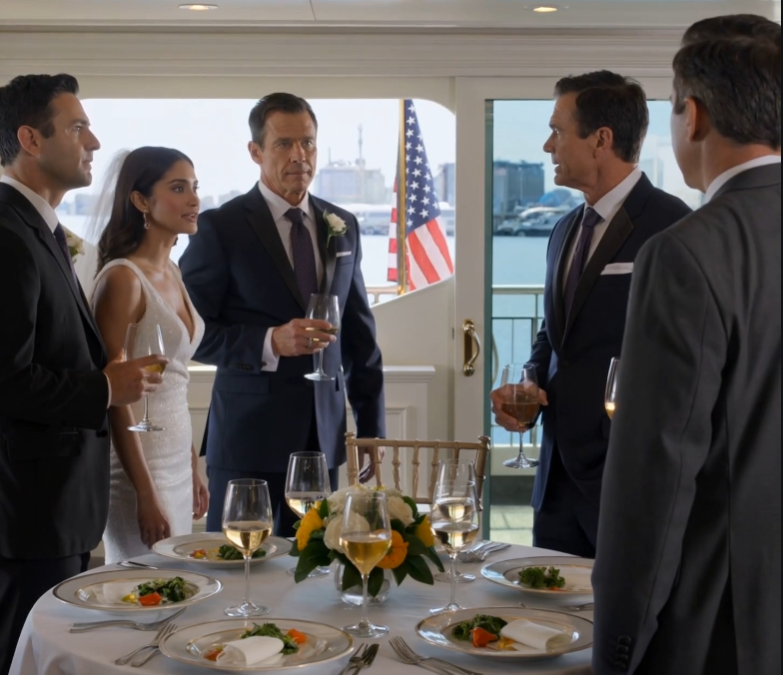
The wedding planning started immediately. The venue was the exclusive Chatham Yacht Club, $85,000 just for the location. Flowers came from some fancy place in Boston. The dress came from Paris. The menu was designed by a celebrity chef. Nothing was too extravagant, too expensive, or too elaborate for the future Mrs. Preston Blackwood III.
Two weeks before the wedding, Madison called.
“Dad, we need to talk.”
I knew that tone. It was the same tone she’d used when she wrecked her BMW at seventeen, when she maxed out her credit cards at twenty-three, and whenever she needed me to fix something she’d broken.
“What’s wrong, sweetheart?” I asked. “Did something happen with the venue? The catering? I can write another check if—”
“No, Dad. It’s about you.”
The silence stretched between us. I could hear her breathing on the other end of the line, nervous and guilty. Finally, she said, “Preston’s family has some concerns.”
“What kind of concerns?”
“About your background. Your circumstances.”
Circumstances. She said it like being an orphan was a character flaw. Like spending my childhood without parents was something shameful, something I should have worked harder to avoid.
“Madison, what are you trying to say?”
“They think it might be better if you didn’t attend the ceremony.”
The words hit me like a physical blow. My own daughter. The girl I’d raised, fed, clothed, educated, and loved. The child I’d worked eighteen-hour days to provide for, who had never gone without a single thing she needed.
“You’re uninviting me from your wedding?”
“It’s not uninviting, Dad. It’s just that the Blackwoods have a certain image to maintain. Their friends, their business associates, they’ll all be there. And with your history…”
“My history of what? Working hard? Building a business from nothing?”
“Dad, please don’t make this harder than it has to be.”
“How much harder can it get, Madison? You’re choosing them over me.”
“I’m choosing my future.”
“What about your past? What about the man who raised you?”
“You gave me money, Dad. That’s not the same as raising me.”
Another blow, this one straight to the heart. I sat there with the phone pressed against my ear, trying to recognize the voice of the little girl who used to run into my arms when I came home from work.
“I see,” I said.
“Do you? Because I need you to understand something. The Blackwoods don’t just have money. They have breeding, class, history. Things you can’t buy.”
“And I don’t have those things?”
“Dad, you’re a food cart guy who got lucky.”
Lucky. Thirty years of eighteen-hour days, and she called it luck. Building a restaurant business from a fifty-dollar cart, surviving years when I barely slept and didn’t know whether I’d make payroll, and she reduced all of it to a fortunate accident.
“I worked for everything I gave you, Madison.”
“And I’m grateful. But gratitude doesn’t change what you are.”
“What am I?”
“You’re not their kind of people.”
There it was. The truth she’d been dancing around since the conversation began. I sat quietly, letting the words settle before I asked the question I already knew the answer to.
“I see. And what kind of people are they?”
“Better people, Dad. Accomplished people. People who matter.”
I stayed quiet for a long moment, processing, planning. Then I said, “Okay.”
“Okay?”
“If that’s what you want, I won’t attend.”
“Really? You’re not going to fight me on this?”
“No, sweetheart. I want you to be happy.”
“Thank you, Dad. You don’t know how much this means to me.”
I knew exactly how much it meant to her. Everything.
So I didn’t go to my daughter’s wedding. Instead, I spent that Saturday at St. Mary’s reading stories to children who had nobody, kids just like I used to be. Children who still looked at the world with hope even when the world had given them so little reason to.
I thought maybe Madison would call after the honeymoon. Maybe she’d apologize. Maybe she’d remember that I was her father, the man who had always been there whenever she needed him.
She didn’t call.
But three days after she got back, my phone rang.
“Dad, it’s Madison. We need to talk.”
Her voice was different this time. Shaky. There was none of the confidence she’d had when she uninvited me from her wedding.
“What can I do for you, Madison?”
“Can we meet in person? It’s important.”
“I’m listening.”
“Not over the phone. This is sensitive.”
Sensitive. Another word she liked to use when she needed something.
“I’m at the restaurant,” I told her. “Southshore location. You know where it is.”
Twenty minutes later, she walked through the doors of Harris Family Kitchen, the same restaurant she’d once called embarrassingly middle class. When she’d brought Preston by for dinner, she’d looked around like she’d never seen the place before. Red vinyl booths, checkered floors, pictures of regular families on the walls. Real people. Not her people.
“Dad.”
“Madison.”
She sat across from me in booth seven, the same booth where I’d taught her to count money from the register when she was six, where we’d eaten countless dinners together before she decided I wasn’t good enough.
“You look tired,” I said.
“I haven’t been sleeping well.”
“Wedding blues?”
“Something like that.”
She twisted her wedding ring around her finger. A $20,000 Harry Winston. I knew because I’d seen the receipt. Preston had charged it to a credit card that was already maxed out.
“How’s married life?” I asked.
“Dad, I need to tell you something. About Preston. About us.”
“I’m listening.”
“We’re having some financial difficulties.”
Financial difficulties. Rich people never said they were broke. They had difficulties.
“What kind of difficulties?”
“Preston made some investments that didn’t work out.”
“What kind of investments?”
“Cryptocurrency, mostly. And some tech startups that folded.”
“How much?”
She didn’t answer right away. Instead, she started picking at her cuticles, a nervous habit she’d had since childhood. I remembered watching her do the same thing before every difficult conversation we’d ever had.
“Madison, how much did he lose?”
“Three hundred and twenty thousand dollars. In crypto.”
My restaurants made more than that in two months. But for trust-fund babies, I supposed it was devastating.
“That’s unfortunate.”
“There’s more.”
Of course there was.
“He invested in a company called Virtue Signal Technologies. It was supposed to revolutionize social media advertising.”
“Supposed to?”
“It was a Ponzi scheme. Preston lost $410,000.”
Seven hundred and thirty thousand dollars total. Still not catastrophic for an old-money family, or so I thought.
“And… there are credit cards.”
“How many?”
“Seventeen different cards. All maxed out.”
“How much?”
“Seventeen thousand dollars.”
Now we were getting somewhere. $847,000 in debt. Still manageable if you had real family money.
“Can’t Preston’s family help?”
She laughed, but there was nothing happy about it. It was a bitter, exhausted sound, the kind people make when they’ve finally run out of lies they can tell themselves.
“That’s the thing, Dad. Preston’s family doesn’t have as much money as everyone thinks.”
“What do you mean?”
“His grandfather lost most of the steel money in the dot-com crash. His father’s been mortgaging properties to maintain their lifestyle. The Blackwood fortune is mostly smoke and mirrors.”
“So Preston is broke.”
“We’re broke. Completely broke.”
I let that sink in. The daughter who had called me peasant stock had married into fake aristocracy. The family she’d worshipped for its wealth and breeding was apparently little more than a carefully maintained illusion.
“What about your trust fund?” I asked.
“Gone.”
“Gone?”
“Preston convinced me to invest it all in his ventures. He said we’d double our money in six months.”
Four hundred thousand dollars. Gone.
“I see.”
“Dad, we might lose everything. The apartment, the cars, everything. Preston’s talking about bankruptcy.”
“That’s rough.”
“The worst part is his family is furious. They’re saying it’s my fault. That I brought bad luck into their family. That I’m not really one of them.”
The irony was thick enough to cut with a knife.
“How does it feel?” I asked.
“What?”
“Being told you don’t belong.”
She stared at me. For one brief moment, I thought she might understand. I thought she might finally apologize, might remember what she’d done to me and recognize that the pain she was feeling was the same pain she’d handed her own father.
Instead, she leaned forward.
“Dad, I need your help.”
“What kind of help?”
“I need to borrow something.”
“Money?”
“Not exactly.”
“Then what?”
“Your beach house.”
I blinked. “My beach house?”
“In Cape Cod. The one you bought last year.”
My $2.6 million beach house. Oceanfront. Four thousand square feet. My retirement dream, the place I’d planned to spend my later years after decades of working until my bones ached.
“What do you need my house for?”
“We need to sell it.”
“Sell my house?”
“Just temporarily, to cover our debts. We’ll buy it back when things turn around.”
“You want me to give you my house so you can sell it?”
“It’s not giving, Dad. It’s lending. Family helping family.”
Family. Now we were family again.
“Madison, that house is worth $2.6 million.”
“I know, and we’ll pay you back every penny.”
“With what money? You just told me you’re broke.”
“Preston has some deals in the works. Big deals. We just need time.”
“What kind of deals?”
“Import, export, international consulting. High-level stuff you wouldn’t understand.”
Wouldn’t understand. More insults wrapped in desperation. She was sitting in a restaurant I owned, asking me to risk millions of dollars, and she still couldn’t bring herself to speak to me with respect.
“How long would you need the house?”
“Six months? Maybe eight? A year at most.”
“A year. And if these deals don’t work out?”
“They will.”
“But if they don’t?”
“Dad, you have to trust me.”
Trust. From the daughter who’d uninvited me from her wedding because I wasn’t good enough for her new family.
“Let me understand this correctly,” I said. “You need me to hand over my most valuable asset to cover debts from investments I had no part in making.”
“When you put it like that, it sounds…”
“It sounds like what, Madison?”
“Look, I know I hurt you with the wedding thing, but family is family. Blood is blood.”
“Where was that blood when you called me peasant stock?”
“Dad, please. We’re desperate.”
“How desperate?”
“Preston’s family will disown him if he files for bankruptcy. His business connections will dry up. We’ll have nothing.”
“You’ll have what I had at your age. Nothing.”
“That’s different.”
“How is it different?”
“You didn’t have anything to lose.”
“I had my dignity.”
“Dad, please. You owe me this.”
There it was. The entitlement that had been building for years. The belief that everything I owned was hers to claim, that my sacrifices meant nothing unless they continued to benefit her.
“I owe you? After everything?”
“After all the sacrifices I made growing up with a working-class father.”
Sacrifices. She actually called being my daughter a sacrifice.
“What sacrifices, Madison?”
“Having to explain why my father owned restaurants instead of companies. Why we lived in a normal house instead of an estate. Why I couldn’t bring friends over because you might embarrass me.”
Every word was a knife. I looked across the table at the woman sitting in front of me, trying to see the child who used to hold my hand when we walked through the park.
“I see.”
“So, will you help us?”
I looked at my daughter. Really looked at her. The girl I’d raised was gone. In her place sat a stranger who saw me as an ATM with legs.
“I’ll think about it.”
“How long?”
“I’ll call you.”
“Dad, we don’t have long. The creditors are already calling.”
“I said I’ll call you.”
She left without saying goodbye, just as she’d left my life when she found what she considered better people. But she’d made one mistake. She’d shown me exactly who she really was.
Now it was time to show her who I really was.
That night, I couldn’t sleep, so I did what I always do when I need to think clearly. I went to work. My office sits above the original Harris Family Kitchen location, in the same building where I started with that $50 food cart. I keep it simple. A metal desk, two chairs, a file cabinet. No fancy art or leather furniture. Just a place to get things done.
I pulled Madison’s financial records. As her father, I still had access to her accounts until she turned thirty. She’d forgotten about that detail. What I found made my stomach turn. While Preston was losing their money on cryptocurrency and Ponzi schemes, they were spending like royalty. Fifteen-thousand-dollar handbags. Eight-thousand-dollar dinners. Thirty-thousand-dollar weekend trips to Paris. In the six months before their wedding, they’d blown through $212,000 on luxury items while crying poverty.
But that wasn’t the worst part. I found the credit card statements from their honeymoon. Twelve days in Italy, including a presidential suite at the Hotel Delli in Venice for $3,000 per night. Private yacht tours. Michelin-starred restaurants for every meal. The total cost was $67,000. The same daughter who had uninvited me from her wedding had spent more on her honeymoon than most people make in a year.
I printed everything. Bank statements, credit card bills, investment records, shopping receipts. By the time I finished, I’d built a file as thick as a phone book. I sat there for a while, staring at the evidence of everything my daughter had become. Then I made a decision.
I picked up my phone and dialed a number I hadn’t called in fifteen years.
St. Mary’s Children’s Home.
“This is Sister Catherine.”
Her voice was exactly the same. Warm, patient, kind. The voice that had comforted me through nightmares when I was eight years old.
“Sister Catherine, this is Martin Harris.”
“Martin! My goodness, how are you, child?”
Child. I was fifty-five years old. But to Sister Catherine, I’d always be that scared eight-year-old boy who arrived with nothing but the clothes on his back.
“I’m well, Sister. And you?”
“Oh, you know, same as always. Trying to keep forty-seven children fed and happy with not enough money and too many needs.”
Forty-seven children. Just like when I was there.
“How’s the funding situation?” I asked.
“Tight. Always tight. The state gives us just enough to keep the lights on. Everything else comes from donations, and those have been scarce lately.”
“What would make the biggest difference right now?”
“Well, if I’m being honest, we desperately need a new building. This old place is falling apart. The roof leaks when it rains. The heating system is from the 1960s. The children deserve better.”
“How much would a new building cost?”
“Oh, Martin, we could never afford something like that. We’d need at least $2 million, maybe more. It’s just a dream.”
Two million dollars. Less than my beach house was worth.
“Sister Catherine, what if someone wanted to make a substantial donation? What would be the process?”
“Well, we’re a registered 501(c)(3) charity. All donations are tax-deductible. But Martin, we’re not talking about your usual monthly check, are we?”
“No, Sister. We’re not.”
“How substantial are we talking?”
“Substantial enough to buy land and build that new facility. With a playground, a library, and individual bedrooms for every child.”
The line went quiet for a long moment. I could practically picture her sitting behind the old wooden desk in her office, holding the telephone with both hands, trying to decide whether she’d heard me correctly.
“Martin, are you serious?”
“Dead serious.”
“That would be… that would change everything. These children could have real homes. Real futures.”
Real futures. Just like Sister Catherine had given me.
“Sister, I want to make this donation publicly, with the media present. I want the world to see how important this work is.”
“Of course. We’d be honored to have the recognition.”
“Can you be available tomorrow afternoon?”
“Tomorrow? My goodness, Martin, what’s the rush?”
“Let’s just say I need to make a point.”
“What kind of point?”
“About what really matters in life.”
I spent the rest of the night making arrangements. I called my lawyer and had him draft the donation papers, making sure everything would be legal and binding. Then I called Channel 7 News and told them I had a major philanthropic announcement that would interest their viewers. They agreed to send a crew.
After that, I called Madison.
“Dad, it’s late,” she answered.
“I’ve made my decision about the house.”
“Yes?”
“And I want to discuss it in person.”
“Your office? Dad, can’t we just handle this over the phone?”
“This is a $2.6 million decision, Madison. I think it deserves an in-person conversation. Can you and Preston come to my office tomorrow at two-thirty?”
“Okay. We’ll be there.”
“Good. And Madison?”
“Yes?”
“Bring your checkbook.”
“My checkbook? Why?”
“You’ll see.”
I hung up before she could ask any more questions. Then I sat back in my chair and looked out the window at the street where I’d sold hot dogs thirty-three years ago, where I’d learned that hard work could overcome almost anything. Tomorrow, I was going to teach my daughter that same lesson, whether she wanted to learn it or not.
But first, I had one more call to make, to someone who would appreciate what I was about to do more than anyone else in the world.
“Sister Catherine, it’s Martin again. I have one more question.”
“Of course, child.”
“When we do this tomorrow, when we make this donation official, I want you to tell the cameras about the children. About what this will mean for them.”
“I’d be happy to.”
“And Sister?”
“Yes?”
“I want you to tell them about a little boy who lived there once. A boy who had nothing and no one, but who learned that giving back is the only thing that really matters. Will you do that for me?”
“Martin, of course. It would be my honor.”
Tomorrow was going to be interesting.
The next morning, I met with my attorney, David Chen, at his office in downtown Boston. David had been handling my legal affairs for twelve years. Corporate contracts, real estate deals, business acquisitions. He’d seen me make plenty of big decisions, but nothing like this.
“Martin, let me make sure I understand what you’re asking me to do.”
David sat behind his mahogany desk, reading the documents I’d requested. Three different contracts were spread across his leather desk blotter.
“You want to donate your Cape Cod property to St. Mary’s Children’s Home?”
“That’s correct.”
“The property valued at $2.6 million?”
“Yes.”
“And you want this donation to be irrevocable? Meaning once you sign these papers, you can never change your mind?”
“Exactly.”
“Martin, this is your retirement home. Your biggest single asset outside the restaurants.”
“I’m aware.”
David leaned back in his chair and studied me over his reading glasses.
“Can I ask why?”
“Personal reasons.”
“This wouldn’t have anything to do with your daughter, would it?”
David knew about the wedding situation. He’d been invited himself, before Madison decided I wasn’t welcome.
“It has everything to do with my daughter.”
“Martin, if this is about revenge—”
“This isn’t revenge, David. This is about values.”
“What kind of values are worth $2.6 million?”
“The kind you can’t put a price on.”
He sighed and picked up his pen. He’d known me long enough to recognize when I wasn’t going to change my mind.
“Okay. Let’s go through this step by step. The donation papers will transfer full ownership of the property to St. Mary’s Children’s Home, effective immediately upon signing.”
“Good.”
“The tax implications are actually favorable. As a charitable donation, you’ll receive a full deduction against your income.”
“I don’t care about the tax benefits.”
“You should. This will save you roughly $800,000 in federal and state taxes over the next three years.”
Eight hundred thousand dollars. Almost exactly what Madison and Preston owed in debts. The coincidence wasn’t lost on me.
“What about the media component?” I asked.
“I’ve contacted Channel 7. They’ll have a crew at your office at two o’clock. That gives us thirty minutes to handle the legal formalities before your guests arrive.”
“And everything will be recorded?”
“Every signature, every word. The donation will be legally binding the moment you sign, regardless of who’s watching.”
“Perfect.”
David pulled out another document and slid it across the desk.
“This is the press release we’ll distribute after the signing. It announces the donation and explains the impact on the children’s home.”
I read through it quickly. Standard language about charitable giving and community support. Nothing wrong with it, but it was missing something important.
“Add something.”
“What?”
“Add that this donation was inspired by my own experience as a child at St. Mary’s, from 1977 to 1985.”
David made a note. “Anything else?”
“Yes. Include a quote from Sister Catherine about how many children this will help.”
“Already done. She mentioned forty-seven current residents, plus room for expansion.”
“Good.”
David stacked the papers neatly, aligning their edges before looking up at me again.
“Martin, I have to ask one more time. Are you absolutely certain about this? Once these papers are signed, there’s no going back.”
“David, let me tell you something. I’ve made a lot of decisions in my life. Some good, some bad. But this… this is the rightest thing I’ve ever done.”
“Even knowing your daughter will be devastated?”
“Especially knowing that.”
“Why?”
“Because maybe losing something she never earned will teach her the value of what she threw away.”
David nodded slowly, as though he was beginning to understand something that had been troubling him since I’d walked through his door.
“In that case, I’ll see you at one-thirty. We’ll have everything ready to go.”
I stood to leave, then turned back.
“David?”
“Yes?”
“When this hits the news tonight, my phone’s going to ring off the hook. Family members, friends, reporters. Everyone’s going to want to know why I did this.”
“What should I tell them?”
“Tell them sometimes the best way to help someone is to stop helping them.”
“And if they ask about Madison specifically?”
“Tell them I’m teaching my daughter that there are two kinds of people in this world. Those who lift others up and those who tear others down. Today, she’s going to learn which kind her father is.”
I left David’s office and drove straight to St. Mary’s. I wanted to see Sister Catherine before everything went public. I wanted to see the children who would benefit from this decision, to remember why I was doing this in the first place.
The old brick building looked exactly the same as it had forty years ago. The same cracked sidewalk, the same rusty fence, the same feeling of hope mixed with desperation. I could remember walking through those doors as a frightened little boy, wondering whether I would ever belong anywhere. Standing there again, I realized how much of my life had begun behind those walls.
But tomorrow, everything would change. For forty-seven children who deserved better, and for one daughter who needed to learn what better actually meant.
By noon, my phone started ringing. The first call came from Madison’s cousin Jennifer, my brother’s daughter. Jennifer had always thought she was smarter than everyone else, and she never missed an opportunity to share her opinions.
“Uncle Martin, Madison called me crying. She says you’re being unreasonable about the house.”
“Is that what she said?”
“She told me about Preston’s financial troubles. How they need family support right now.”
“Did she tell you why they need support?”
“Something about bad investments. Uncle Martin, these things happen. Families should stick together.”
“Did she tell you she uninvited me from her wedding?”
Silence.
“What?”
“Madison banned me from her own wedding because I wasn’t good enough for Preston’s family.”
“That… that can’t be true.”
“Ask her.”
“But Uncle Martin, even if that happened, family is family. You can’t hold grudges forever.”
“This isn’t a grudge, Jennifer. This is about consequences.”
“You’re going to let your pride destroy your relationship with your daughter.”
“My pride isn’t the problem here.”
She hung up.
Twenty minutes later, my ex-wife called. Linda and I had divorced when Madison was sixteen, but we’d managed to stay civil for our daughter’s sake. At least, we’d managed it until now.
“Martin, what the hell are you doing?”
“Hello, Linda.”
“Madison is hysterical. She says you’re refusing to help her when she needs you most.”
“Did she explain why she needs help?”
“Her husband made some bad investments. So what? That’s what family does. We help each other.”
“Like she helped me when I wanted to attend her wedding?”
“Oh, for God’s sake. Martin, you’re still upset about that?”
“Upset? No, Linda. I’m educated.”
“What’s that supposed to mean?”
“It means I learned something about my daughter that day. Something important.”
“What could be more important than helping your child?”
“Teaching your child.”
“Teaching her what?”
“That actions have consequences.”
“You’re being ridiculous.”
“Am I? Tell me, Linda, what did Madison say when she asked for the house?”
“She said it was temporary. That they’d pay you back.”
“With what money? They’re broke.”
“They’ll figure something out.”
“Like they figured out those investments?”
Linda’s voice grew sharper. “Martin, if you don’t help her, she could lose everything.”
“Good.”
“Good? How can you say that about your own daughter?”
“Because maybe losing everything is exactly what she needs.”
“You’re heartless.”
“No, Linda. I’m finally learning to say no.”
She hung up, too.
The third call came from Preston himself. His voice was different from the way it had sounded around the wedding. No more condescending tone. No more barely hidden contempt. Now he sounded desperate.
“Martin, we need to talk.”
“I thought I wasn’t sophisticated enough to understand your business dealings.”
“Look, I know I may have come across as dismissive at the wedding.”
“Dismissive?”
“Okay. I was rude. I was nervous about the marriage, and I took it out on you. I’m sorry.”
Too little, too late.
“What do you want, Preston?”
“I want to make this right between us. Between our families.”
“How?”
“By being honest about everything.”
“I’m listening.”
“The truth is, my family isn’t as wealthy as people think. My grandfather made some bad investments in the nineties. My father’s been borrowing against properties for years.”
“So you’re all broke.”
“Not broke. Just not liquid.”
Liquid. Even broke, he couldn’t bring himself to say the word poor.
“And now you need my house.”
“We need a bridge loan. Something to cover our debts until my consulting business takes off.”
“What consulting business?”
“I’m starting an international trade consulting firm. High-end clients, multinational corporations.”
“With what credentials?”
“I have my MBA from Harvard.”
“So do fifty thousand other people.”
“Martin, please. I’m trying to be reasonable here.”
“Are you?”
“Yes. And I’m prepared to offer you something in return.”
“What?”
“A partnership in my new business. Twenty percent equity.”
“Twenty percent of nothing is still nothing.”
“That’s generous. I thought you’d appreciate it.”
I stared through the windshield of my parked car and tried to imagine the expression on his face. Even now, with his financial life collapsing around him, Preston seemed to believe that offering me a piece of an imaginary business was some grand favor.
“Preston, let me ask you something.”
“Okay.”
“When you decided I wasn’t good enough for your wedding, did you think about what that would do to me?”
“I… look, that wasn’t personal.”
“What was it, then?”
“It was about optics. Image. My family has certain expectations.”
“And I didn’t meet those expectations.”
“You have to understand, my family moves in very specific circles. There are protocols, social dynamics you might not understand.”
There it was again. The condescension. Even desperate, he couldn’t help himself. He was asking for millions from a man he still considered beneath him.
“I see.”
“So you’ll consider the partnership?”
“Preston, I want you to listen very carefully to what I’m about to tell you.”
“Okay.”
“Tomorrow at two-thirty, come to my office. Bring Madison. We’ll settle this once and for all.”
“Really? You’ll transfer the house?”
“We’ll settle it.”
“Thank you, Martin. You won’t regret this.”
“You’re right about that.”
“What?”
“I won’t regret it at all.”
After I hung up, I sat in my car outside St. Mary’s and watched the children playing in the courtyard. Forty-seven kids who had nothing but hope. Tomorrow, they’d have more than hope. They’d have a future.
And Madison would finally understand the difference between family and blood.
One call left to make. The most important one.
“Sister Catherine, it’s Martin. Everything’s set for tomorrow. Are you ready?”
“Ready as I’ll ever be, child.”
“Good. Because tomorrow we’re going to change some lives.”
“Including yours.”
“Especially mine.”
The next day, everything fell into place like clockwork. At one-thirty sharp, David arrived at my office with the donation papers. Three copies, each one notarized and ready for signatures. The Channel 7 news crew pulled up five minutes later.
“Mr. Harris, I’m Janet Morrison from Channel 7. We spoke yesterday about your philanthropic announcement.”
Janet was a veteran reporter, somewhere in her forties, wearing a sharp suit and carrying herself with the no-nonsense attitude of someone who could spot a story from a mile away. She shook my hand firmly while her cameraman started unloading equipment.
“Thank you for coming, Janet.”
“Can you give us a preview of what we’re announcing today?”
“It’s better if you experience it in real time. Trust me, you’ll want to be rolling when it happens.”
Her eyes lit up. Nothing gets a reporter more excited than a story with a genuine surprise.
“How substantial are we talking about?”
“Life-changing.”
“For whom?”
“Forty-seven children who deserve better than they’re getting.”
At two o’clock, Sister Catherine arrived. She looked nervous but excited, wearing her best habit and carrying a folder full of photographs from St. Mary’s. She held it close to her chest as she stepped into my office, looking around at the cameras and unfamiliar faces.
“Martin, I still can’t believe this is really happening.”
“It’s happening, Sister. Are you ready to tell the world about those children?”
“More ready than I’ve ever been.”
At two-fifteen, my phone buzzed. A text from Madison.
Running a few minutes late. Preston had to stop at the bank.
Perfect. Let them think this was about money changing hands.
At two-twenty-five, Madison and Preston walked through my office door. Madison looked hopeful but anxious. Preston looked like he’d rather be anywhere else. Both of them were dressed as though they were attending some important business meeting, trying to maintain an appearance of confidence that no longer matched their circumstances.
Then they noticed the camera crew.
“Dad, what’s going on? Why are there cameras here?”
“Sit down, Madison. Both of you.”
They took the chairs across from my desk. Those were the same chairs where I’d fired employees for stealing, where I’d negotiated million-dollar deals, and where I’d made some of the hardest decisions of my business life. I’d learned that important conversations didn’t require fancy surroundings. They only required people willing to face the truth.
“Preston, Madison, I want you to meet some people.”
I gestured toward Sister Catherine.
“This is Sister Catherine. She runs St. Mary’s Children’s Home in Dorchester.”
Madison looked confused. Preston looked annoyed.
“And this is Janet Morrison from Channel 7 News.”
Now Preston looked alarmed.
“Martin, what exactly is going on here?”
“We’re here to make an announcement, Preston. About my Cape Cod property.”
Madison perked up immediately.
“You’re transferring it to us?”
“In a manner of speaking.”
Janet positioned herself beside the camera and gave her cameraman a small nod.
“Mr. Harris, whenever you’re ready.”
I stood behind my desk, the same desk where I’d built my business from nothing, where I’d planned every expansion, every success, and every dream. I looked at my daughter and her husband, sitting there with their expectations written plainly across their faces.
“Madison, Preston, three days ago, you asked me for help. You asked me to give you my beach house to cover debts from investments I had nothing to do with.”
“Dad, we discussed this,” Madison interrupted. “It’s temporary.”
“You also told me I owed you this help after everything.”
“Well, yes.”
“You were right about one thing. I do owe someone something after everything.”
Preston shifted in his chair. “What do you mean?”
“I owe it to the children who are growing up the way I did. With nothing, with no one, with no hope except what kind strangers are willing to give them.”
Sister Catherine smiled. She was beginning to understand. Madison wasn’t.
“Dad, what are you talking about?”
“I’m talking about real family, Madison. Not the kind of family that uninvites you from weddings because you’re embarrassing, but the kind of family that lifts each other up.”
“I don’t understand.”
“You will.”
I picked up the donation papers David had prepared. Three copies, each one identical, each one binding. I laid them carefully across my desk, taking my time to make sure everyone in the room could see what I was doing.
“Janet, are you recording?”
“Rolling now, Mr. Harris.”
“Perfect.”
I looked directly into the camera.
“My name is Martin Harris. Thirty-seven years ago, I was a homeless eight-year-old living at St. Mary’s Children’s Home. Today, I’m the owner of eight successful restaurants and a $2.6 million beach house in Cape Cod.”
Madison’s face went white.
“Today, I’m donating that house to Sister Catherine and the children of St. Mary’s so they can build a new facility. So forty-seven children can have real bedrooms instead of dormitories. So they can have hope instead of just survival.”
Preston shot to his feet.
“What the hell are you doing?”
Madison stared at me in shock.
“Dad, you can’t be serious.”
I picked up my pen.
“I’ve never been more serious about anything in my life.”
And I signed the first paper, the one that would change everything for everyone.
“Stop!”
Madison lunged forward, reaching for the papers. But it was too late. My signature was already dry on the first copy. She stared down at it as though she’d just watched her future disappear.
“Dad, what have you done?”
“I’ve done what I should have done years ago.”
Preston grabbed Madison’s arm, pulling her back. His face was red with rage, his carefully maintained composure finally gone.
“You senile old bastard! Do you have any idea what you just did?”
“I donated my house to charity on live television, in front of witnesses.”
“That was our house!”
“Your house?”
I looked directly into the camera.
“Janet, did you catch that? Preston just called my house their house.”
Janet nodded, still recording. This was better than she’d hoped for. She had arrived expecting a charitable announcement and found herself in the middle of a family confrontation that no producer could have scripted.
“Preston, when exactly did my house become your house?”
“We had an understanding.”
“We had a conversation. There’s a difference.”
Madison was hyperventilating now, struggling to catch her breath as she looked from Preston to the papers and back to me.
“Dad, please. You can undo this. Call your lawyer. Stop the transfer.”
“David?”
I looked at my attorney, who was standing quietly in the corner.
“Can this be undone?”
“Not a chance. The moment you signed that document, ownership transferred to St. Mary’s Children’s Home. It’s irrevocable.”
“Irrevocable?” I repeated, turning to my daughter. “Do you know what that means, Madison?”
“It means you’ve lost your mind!”
“It means I can’t change my mind. Even if I wanted to. Which I don’t.”
Sister Catherine stepped forward. Her expression was gentle, but her voice carried the quiet firmness I’d known since childhood.
“Perhaps I should explain what this donation means for the children.”
“Nobody cares about your damn children!” Preston shouted.
The room went dead quiet. Janet’s camera was still rolling. Sister Catherine looked shocked, and even Madison turned to stare at her husband in horror.
“What did you just say?” I asked quietly.
Preston realized his mistake immediately, but it was too late. The words were already out there, spoken in front of a nun, a lawyer, a reporter, and a camera that had captured every second.
“I… I didn’t mean—”
“You said nobody cares about orphaned children. On camera. In front of a nun.”
“I was upset. I misspoke.”
“No, Preston. You spoke honestly for the first time since I’ve known you.”
I signed the second copy of the donation papers.
“Dad, stop!”
Madison was crying now. Tears streamed down her face as she watched the future she’d imagined for herself slipping further out of reach.
“You’re destroying our lives!”
“Am I? Or am I finally teaching you what lives are actually worth?”
“What’s that supposed to mean?”
I turned toward Sister Catherine.
“Sister Catherine, would you please tell the camera about the children who will benefit from this donation?”
She composed herself, straightened her shoulders, and looked directly into the lens.
“St. Mary’s currently houses forty-seven children, ages six to seventeen. Most have been abandoned by their families. All of them have experienced trauma, neglect, or abuse.”
“And what will this donation allow you to do?” I asked.
“We’ll be able to build a new facility. Individual bedrooms for each child, a proper library, a playground, a computer lab. Most importantly, we’ll be able to expand our capacity to help even more children.”
“How many more?”
“With a new building, we could help up to seventy-five children at any given time.”
I turned back to Madison and Preston.
“Seventy-five children who will have hope because of this decision.”
“We don’t care about other people’s children!” Madison screamed. “We care about us!”
Another honest moment. Another moment caught on camera. I looked at my daughter, and for an instant I couldn’t speak. I remembered the little girl who used to ask me questions about the world, who once believed that everyone deserved kindness. Somewhere along the way, she’d forgotten the answers I’d tried to give her.
“Madison, do you remember when you were six years old and you asked me why some kids didn’t have daddies?”
“What does that have to do with anything?”
“I told you that sometimes daddies get lost. But I promised you that your daddy would never get lost. That I would always be there for you.”
“You were there until you decided to throw your money away!”
“I was there when you graduated high school. I was there when you graduated college. I was there when you needed money for your apartment, your car, your credit cards.”
“So?”
“But you weren’t there when I needed you.”
“When did you ever need me?”
“At your wedding, Madison. I needed my daughter to want me there.”
She went quiet. For the first time since she’d entered my office, she didn’t seem to have an answer waiting. I could see the question working its way through her mind, but I wasn’t finished.
“Instead, you told me I was embarrassing peasant stock. You told me I wasn’t good enough for your new family.”
“That was different.”
“How was it different?”
“Preston’s family has standards.”
“What kind of standards?”
Preston tried to interrupt.
“Madison, don’t.”
But she continued.
“Standards about breeding, about class, about the kind of people who matter.”
I signed the third and final copy.
“There it is,” I said quietly. “The truth.”
“What truth?”
“You’re ashamed of me. You’re ashamed of where you came from. You’re ashamed of the man who raised you.”
“I never said that.”
“You didn’t have to. Your actions said it for you.”
Janet stepped forward with her microphone. Her eyes moved between Madison and me before she asked the question that had been hanging over the room from the beginning.
“Mr. Harris, why was it important to you to make this donation publicly?”
“Because I wanted my daughter to see what real values look like.”
“And what are those values?”
“That you lift people up. You don’t tear them down. That you help those who can’t help themselves. That blood doesn’t make you family. Character does.”
I looked directly at Madison.
“You called me peasant stock, sweetheart. And you know what? You were right.”
Her face crumpled. She looked at me as though she couldn’t understand how I could possibly agree with the insult that had hurt me so deeply.
“Peasants work the land. They feed people. They build things from nothing. They give more than they take.”
I stood up and walked around my desk.
“I’m proud to be peasant stock because peasants like me understand something that people like you never will.”
“What’s that?” Madison whispered.
“That the only wealth that matters is what you give away.”
Preston was shaking with rage. All the polish and arrogance of the Blackwood family had disappeared. What remained was a frightened man who had built his entire identity around money he didn’t actually possess.
“You’ve destroyed us,” he said. “We’ll lose everything.”
“Good. Maybe losing everything will teach you what everything actually means.”
Sister Catherine approached Madison gently. She didn’t look angry or triumphant. She looked sad, the way she used to look at children who’d been hurt so badly they no longer knew how to trust kindness.
“My dear, your father has just given forty-seven children a chance at life. That’s not destruction. That’s creation.”
Madison looked at the nun as though she were speaking a foreign language.
“Those children don’t matter to me.”
“Then you’ve learned nothing from the man who raised you.”
I picked up all three signed copies of the donation papers and handed them to Sister Catherine.
“It’s done.”
She looked down at the documents in her hands. Her eyes filled with tears, and for a moment she seemed unable to find the words.
“Martin, how can I ever thank you?”
“Take care of those kids. The way you took care of me.”
Janet lowered her camera and turned toward me.
“Mr. Harris, do you have any final words for your daughter?”
I looked at Madison one last time. She was standing beside Preston, her eyes red, her face streaked with tears. For a moment, I could see the little girl she’d once been, buried somewhere beneath all the anger and disappointment.
“I love you,” I said. “I always will. But I won’t enable you anymore.”
“Dad, please.”
“Madison, you have two choices. You can learn from this, or you can keep blaming everyone else for your problems.”
“What am I supposed to do now?”
“What I did when I had nothing. Figure it out.”
Preston grabbed Madison’s arm.
“Come on. We’re leaving.”
As they reached the door, Madison turned back. Her face was twisted with hurt and fury, and for a moment I wondered whether the last words she spoke to me would be the ones I remembered for the rest of my life.
“I’ll never forgive you for this.”
“I know. But maybe someday you’ll thank me.”
The door slammed behind them.
Sister Catherine came over and squeezed my hand.
“You did the right thing, Martin.”
“I hope so.”
Janet began packing up her camera equipment. She moved with the efficiency of someone who knew she had an extraordinary story and needed to get it on the air.
“Mr. Harris, this story is going to be everywhere by tonight.”
“Good. Maybe it’ll inspire other people to help children who need it.”
As everyone left, I sat alone in my office. For the first time in years, I felt truly at peace. Outside my window, the sun was setting over the city where I’d built my life from nothing. Tomorrow, forty-seven children would wake up knowing their lives were about to change, and my daughter would wake up knowing hers already had.
The story broke on Channel 7’s six o’clock news that same evening. I was having dinner at my Southshore restaurant when every television in the place switched to Janet Morrison’s report.
“A local businessman made headlines today when he donated his $2.6 million Cape Cod beach house to charity, live on camera, in front of his own daughter, who had asked to borrow the property to cover massive debts.”
The footage rolled. Preston screaming about “our house.” Madison crying that I was destroying their lives. Preston’s comment about not caring about those damn children. The camera had caught every word, every expression, every ugly truth they’d tried so hard to keep hidden.
The restaurant went completely silent. Every customer, every employee, everyone in the room was watching the screens.
Then something unexpected happened.
Applause.
It started with one customer, an elderly woman sitting alone at table twelve. She started clapping. Then the couple next to her joined in. A moment later, the entire restaurant erupted.
“That’s our boss!” shouted Maria, my head waitress. “That’s Mr. Harris!”
I sat there watching people applaud, not quite knowing what to do with the attention. I’d spent most of my life working quietly, building something from nothing, never expecting anyone to notice. Now strangers were standing up and cheering because I’d given something away.
My phone started buzzing immediately. Text after text after text.
Saw you on the news. You’re a hero.
That one was from Don, my business partner.
Made me cry. Those lucky kids.
Susan, my accountant.
About time someone stood up to entitled brats.
An unknown number.
But not all the messages were supportive.
How could you do that to your own daughter?
Linda, my ex-wife.
Family first, Martin. Always.
Jennifer, my niece.
You’ll regret this.
Preston.
I deleted that one without reading it twice.
By seven o’clock, the story had gone viral on social media. Janet forwarded me screenshots from Twitter and Facebook. Thousands of strangers were sharing the video, adding their own opinions, arguing about family obligations, money, gratitude, and what parents owed their children.
Father donates $2.6 million house to orphans instead of entitled daughter. This is what accountability looks like.
Did you see the daughter’s reaction? “Those children don’t matter to me.” Disgusting.
The son-in-law saying nobody cares about your damn children. To a nun. On camera. Career suicide.
That last comment made me smile. Preston’s consulting business would be dead before it started. He’d spent years cultivating an image of wealth, sophistication, and social importance, only to destroy it with a few words spoken in anger.
At eight-thirty, Sister Catherine called.
“Martin, you need to see this.”
“What’s happening?”
“The phones at St. Mary’s haven’t stopped ringing. We’ve received over $40,000 in donations just since the story aired.”
“Forty thousand dollars in two hours? That’s wonderful, Sister.”
“There’s more. A construction company in Quincy called. They want to donate labor for the new building. A furniture store in Newton wants to donate beds and desks for every room. The story is having an impact.”
I leaned back in my chair, feeling something loosen inside my chest. The donation had been enough to change the children’s lives, but now other people were stepping forward to help, too.
“Martin, this isn’t just about the house anymore,” Sister Catherine continued. “This is about inspiration. People are seeing what’s possible when someone chooses principle over profit.”
At nine o’clock, my phone rang again. This time, the number was unfamiliar, with a California area code.
“Mr. Harris, this is Rebecca Chen from Good Morning America. We’d like to have you on the show tomorrow to discuss your donation.”
Good Morning America. National television.
“I appreciate the interest, but this isn’t about publicity.”
“Mr. Harris, your story is resonating with people across the country. Parents who feel taken advantage of by entitled children. People who want to make a difference but don’t know how.”
“What would you want me to discuss?”
“The decision-making process. How you found the courage to choose charity over family pressure.”
“I’ll think about it.”
“We can have a car pick you up at five in the morning.”
“I said I’ll think about it.”
At nine-forty-five, Madison called.
Her voice was different this time. Smaller. Defeated. Gone was the young woman who’d sat across from me at the restaurant demanding that I hand over my retirement home. Gone was the certainty that the world existed to give her whatever she wanted.
“Dad?”
“Madison.”
“I saw the news coverage. And people are saying terrible things about me online.”
“What kind of things?”
“That I’m spoiled. Entitled. That I don’t deserve to be your daughter.”
“Do you disagree with them?”
There was a long pause. I could hear her breathing, and for once, she didn’t seem to be searching for the answer that would get her what she wanted.
“I… I don’t know anymore.”
“Madison, for the first time in this conversation, you’re being honest.”
“Dad, I’m scared.”
“Of what?”
“Of losing everything. My friends, my social circle, my reputation. Preston’s family is already talking about annulment.”
“Because of the bankruptcy?”
“Because of the video. Preston’s comment about the children. My reaction. They’re saying we embarrassed the family name.”
The irony was perfect. The same family that had rejected me for being embarrassing was now rejecting Madison for exactly the same reason. The people she’d sacrificed her relationship with her father to impress had turned on her the moment she became inconvenient.
“What are you going to do?” I asked.
“I don’t know. Preston’s talking about moving to his uncle’s place in Florida. Starting over.”
“And you?”
“I don’t want to run away, Dad. But I don’t know how to face this.”
“Madison, do you remember what I taught you about falling off your bike when you were seven?”
“You said the only way to stop being afraid was to get back on.”
“That’s right.”
“But this is different. This isn’t just falling. This is crashing.”
“Sometimes crashing is the only way to learn how to ride properly.”
She was quiet for a moment. I could almost hear her trying to make sense of everything that had happened, trying to understand how her life had gone so wrong so quickly.
“Dad, can I ask you something?”
“Of course.”
“Do you really think I’m a terrible person?”
I thought about my answer carefully. There had been a time when I would have told her exactly what she wanted to hear, when I would have rushed to reassure her and make the discomfort go away. But I had learned that protecting someone from the truth wasn’t always the same as loving them.
“I think you’re a person who lost her way. There’s a difference.”
“Can I find my way back?”
“That depends.”
“On what?”
“On whether you want to be the kind of person who lifts others up or the kind who tears them down.”
“I want to be better, Dad. I just don’t know how.”
“Start with one small thing. Help one person who can’t help themselves.”
“Like what?”
“Figure it out, Madison. That’s how you learn.”
After I hung up, I sat in my office until midnight, reading messages from strangers who’d seen the story. Parents who were setting boundaries with entitled children. People who were inspired to volunteer at local charities. Families who were having conversations about values and sacrifice that they’d been avoiding for years.
One message stood out from the rest.
Mr. Harris, I’m eight years old, and I live at a children’s home in Texas. Sister Mary showed us your story on the news. Thank you for helping kids like me. Maybe someday I can help kids, too.
Your friend, Timothy.
I printed that message and put it in my wallet.
Tomorrow, the world would keep talking about what I’d done. People would argue about whether I’d been right or wrong, whether I was a good father or a cruel one, whether Madison deserved what had happened to her.
But tonight, I knew I’d done the right thing. For Timothy, for the forty-seven children at St. Mary’s, and maybe, just maybe, for Madison, too.
Six months later, I stood in the courtyard of the new St. Mary’s Children’s Home.
The building was beautiful. Three stories of red brick and hope. Seventy-five individual bedrooms. A library with ten thousand books. A computer lab with thirty stations. A playground that looked like something from a dream.
I stood there looking up at the building, remembering the old brick walls I’d grown up behind. The leaking roof, the unreliable heating, the cramped rooms where children had slept without any space to call their own. Now there was something entirely different in its place, something built not just to shelter children but to give them room to grow.
Sister Catherine walked up beside me, beaming.
“The children moved in yesterday. Would you like to see their rooms?”
“I’d love to.”
We walked through hallways filled with laughter. Real bedrooms with real doors and real privacy. Children who’d never owned anything now had spaces to call their own. Some had pictures taped to their walls. Others had books neatly arranged on shelves. There were small desks beside the windows, places where they could study, draw, or simply sit and imagine what their futures might hold.
“Room fourteen,” Sister Catherine said, stopping at an open door. “This is Timothy’s room.”
I looked inside.
The eight-year-old from Texas, the boy who’d written me that letter six months earlier. St. Mary’s had agreed to transfer him when his local facility closed.
Timothy was sitting at a small desk, writing in a notebook. He looked completely absorbed in his work, his head bent over the page, his pencil moving carefully across the paper.
“What are you working on?” I asked.
He looked up and recognized me immediately.
“Mr. Harris! I’m writing thank-you letters to people who donated money for our new home.”
“How many have you written?”
“Forty-seven so far. One for each kid who was here when you gave us the house.”
Forty-seven letters.
This kid understood gratitude better than my own daughter had.
“Timothy, what do you want to be when you grow up?”
“I want to help kids like me. Maybe run a place like this.”
“I think you’d be good at that.”
He smiled and went back to his writing. I stood there for another moment, watching him carefully form the words of his next thank-you letter. He was only eight years old, but he already understood something that had taken my daughter nearly thirty years to learn.
As we walked back toward the lobby, Sister Catherine handed me an envelope.
“This came for you yesterday.”
I recognized the handwriting immediately.
Madison.
Inside was a check for $5,000 made out to St. Mary’s Children’s Home. And a note.
Dad,
I’ve been volunteering at a food kitchen in Boston for the past four months. Preston and I divorced three months ago. I’m living in a studio apartment and working as a server at a restaurant downtown.
It’s hard, but I’m learning what real work feels like. This donation is from my own savings. Not much, but it’s mine.
I hope someday you’ll be proud of me again.
Love, Madison.
I folded the letter carefully and put it in my wallet next to Timothy’s message.
Sister Catherine watched me for a moment before asking, “Will you see her?”
“When she’s ready.”
“Really ready? How will you know?”
“When she stops asking for things and starts giving them.”
That evening, I appeared on a PBS documentary about charitable giving. The producer asked me the same question everyone seemed to ask whenever they heard my story.
“Mr. Harris, do you ever regret giving away $2.6 million?”
I thought about Timothy writing thank-you letters. About seventy-five children sleeping in real beds. About Madison learning to work for what she wanted, discovering the difference between having money and earning it.
“I didn’t give away $2.6 million.”
“What did you give away?”
“A house. Just a house.”
“And what did you get in return?”
I smiled.
“Everything that matters.”
Six months after that, Madison called.
“Dad, I know you’re probably busy, but I wanted to tell you something.”
“I’m listening.”
“I got promoted to assistant manager at the restaurant. And I’ve been accepted to a program that trains people to run nonprofit organizations.”
“That’s wonderful, sweetheart.”
“Dad?”
“Yes?”
“I understand now what you were trying to teach me.”
“What’s that?”
“That the only wealth that matters is what you give away.”
“I’m proud of you, Madison.”
She was quiet for a moment. When she spoke again, her voice sounded different from the way I’d heard it in years. There was no demand in it, no expectation that I would immediately give her whatever she wanted. Just a daughter reaching out to her father.
“Does this mean you’ll have dinner with me sometime?”
“I’d like that very much.”
“There’s a little place near my apartment. Nothing fancy, just good food and honest prices.”
“Sounds perfect.”
“Dad?”
“Yes?”
“Thank you for not giving up on me.”
“I never gave up on you, Madison. I just stopped enabling you.”
“I love you.”
“I love you, too.”
After I hung up, I walked outside and looked up at the stars.
Somewhere in the city, seventy-five children were sleeping safely in beds they’d never dreamed they could have. Somewhere else, my daughter was learning that the best way to find yourself is to lose everything you thought you needed.
And somewhere in between, a father had finally figured out the difference between helping and healing.
It had cost me a house, but it had given me back my daughter.
And that was worth more than all the money in the world.








