I wasn’t even out of my jacket when my dad said, “didn’t know they let dropouts in here.” a few relatives laughed. i just nodded and took a seat at the back. later, my sister’s husband asked where i worked. i told him the company name. he paused, looked me over again, then said, “wait… you’re my ceo?” the room went dead silent.
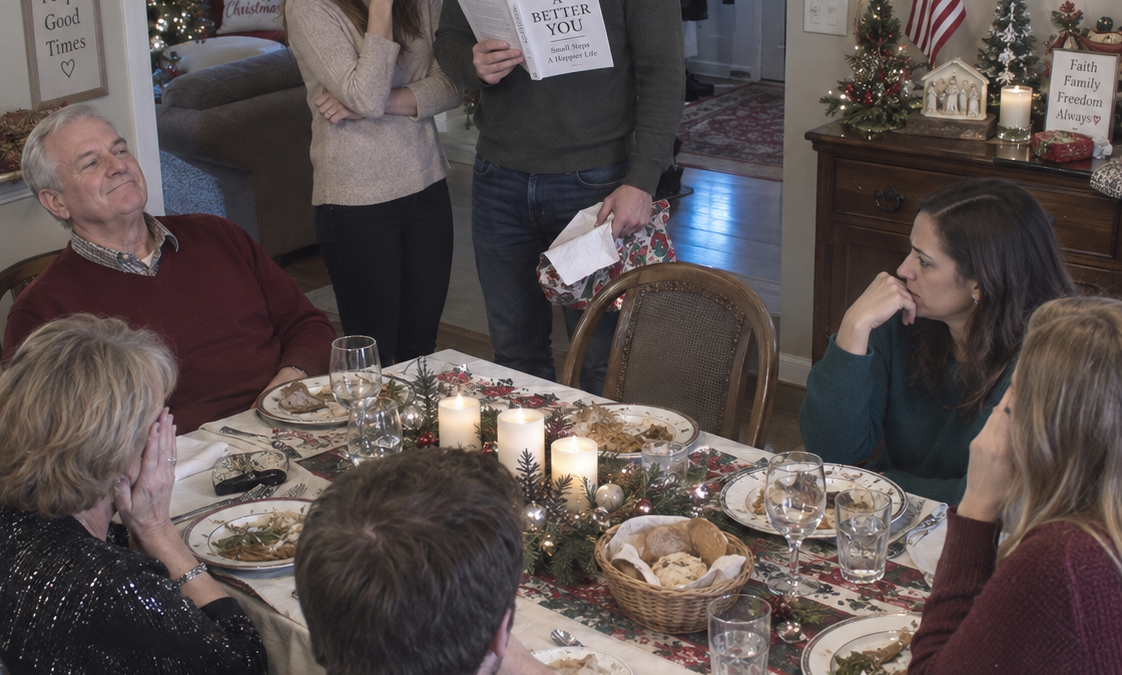
I was still shaking snow off my coat when my dad looked up from his drink and muttered, “Didn’t know they let dropouts in here.”
The words hit harder than the winter air I’d just escaped. A few relatives chuckled, like it was some inside joke they’d all agreed on years ago. I didn’t say anything. I just nodded as though I agreed with him, hung my jacket up slowly, and took the seat farthest from the table, the one near the drafty window. I told myself I was only there to make an appearance. Maybe stay an hour, tops, then disappear again, the way I always did.
My name’s Elliot. I’m 32 now, but this happened last winter, right before Christmas, when my sister decided to host the annual family dinner at her house. Technically, it was her and her husband’s house, but we all knew who paid for what.
My family’s not the warm, hugging type. Growing up in that house meant learning how to dodge sarcasm better than dodgeballs and figuring out how to downplay your accomplishments so nobody thought you were bragging. My parents weren’t cruel in the obvious ways. There were no broken bones or empty pantries, but they knew how to chip away at you, piece by piece, quietly and consistently. Sometimes I wonder if it would have been easier if they’d just screamed in my face like normal dysfunctional parents.
I dropped out of college when I was 20. That’s the headline they’ve clung to ever since.
It doesn’t matter that I left because the business I’d started in my dorm room suddenly exploded and I couldn’t manage it between midterms. It doesn’t matter that I sold that company five years later for an amount I still haven’t fully processed. To them, I quit. I couldn’t hack it. I was the family’s cautionary tale.
Every time my name came up, it was followed by that long sigh, the one that said, Imagine if he’d just stayed in school.
I rarely went to family gatherings anymore. The last time I’d shown up for a holiday dinner, my mom asked if I was still figuring things out. I’d just landed a major government contract. I remember staring at her across the table, holding my fork in midair, wondering if she genuinely didn’t know or simply didn’t care. Either way, I stayed silent. I’d learned it was easier that way. Less friction, less temptation to remind them who I really was.
But this time felt different.
My sister Cara had personally called to invite me. She’d always been the peacemaker growing up, trying to maintain some kind of balance between my brooding silence and our parents’ performative judgment. She said she missed me, that it wasn’t the same without me, and that I should at least come for dessert if I couldn’t make it for dinner.
Then she said something that made me hesitate. Dad had softened up, she told me. He was trying.
Against my better judgment, I said I’d think about it. As the week went on, I figured there was no harm in showing my face, eating some pie, and leaving before anyone got too nosy.
I pulled into their driveway ten minutes late. Not late enough to make a scene, but late enough to avoid the opening speeches. The lights inside glowed warm and golden, and for one brief second, I almost believed this time would be different.
Then the door creaked open, and Dad saw me before anyone else.
“Didn’t know they let dropouts in here.”
No hello. No smile. Just that.
I could have left right then, gotten back into my car, and driven away. But something inside me, some mixture of curiosity and quiet defiance, made me stay. Maybe I wanted to see how far they’d go this time. Maybe I was just tired of running from people who never bothered to catch up.
The dining room was packed, with long tables stretching almost wall to wall, covered in beige and gold decorations of the sort that practically screamed, We only use these for company. Every seat was taken except the one in the corner.
I passed cousins I hadn’t seen in years, their kids glued to tablets, while the smell of cinnamon and turkey hung thick in the air. My mom barely glanced at me.
“Oh, you came,” she said, then turned back to her conversation about someone else’s wedding.
I sat quietly, observing. I’d gotten good at that over the years.
My cousin Ben was talking loudly about his promotion at some insurance firm. His wife chimed in, practically reciting his résumé. Everyone nodded, congratulated him, and raised their glasses in a toast. I picked at the bread rolls. Nobody asked me anything, which, honestly, was a relief.
Then, during the second round of wine, someone clinked a glass and announced, “Time for the family career check-in.”
It was supposed to be a joke. Kind of.
Uncle Ron had started the tradition years ago, and somehow it had stuck. Everyone would take a turn giving a quick update on what they were doing. Promotions, new jobs, even firings—it was all part of the ritual. The adults pretended it was lighthearted, but you could feel the tension building as it moved around the table.
My turn came last.
Cara tried to skip over me, but Uncle Ron laughed and said, “What about Elliot? Still chasing the dream?”
I looked up from my drink.
“Yeah,” I said. “Still chasing.”
A few people chuckled. My dad smirked.
That’s when Cara’s husband, Matt, leaned toward me. He was relatively new to the family, having married my sister a few years earlier. Nice guy. Corporate type. We’d never really talked much.
“Where do you work, anyway?” he asked casually, like he wasn’t expecting much.
I paused. I thought about lying, about saying I worked in consulting or giving him something equally vague. But I was tired. Tired of minimizing, tired of pretending.
So I told him the company name.
He blinked, then looked me over as though I’d just started speaking fluent Mandarin.
“Wait,” he said slowly, his eyes narrowing. “You’re my CEO?”
The room went silent.
I mean, dead silent.
Forks stopped moving. Even the kids looked up, and that was the first time I realized nobody there knew. Not even Cara.
I looked at him, deadpan.
“Yeah. Small world.”
He let out a short, sharp laugh.
“You’re kidding.”
I wasn’t.
The silence stretched again. My dad’s expression shifted from confusion to denial, then to something harder to read. My mom blinked as though she’d misheard. Uncle Ron cleared his throat, but nobody said a word.
I reached for my glass, took a sip, and let the tension hang.
But that was only the beginning. Because the second Matt pulled out his phone, fact-checked me beneath the table, and confirmed it, the entire dynamic of the room began to unravel.
And trust me, I hadn’t even gotten to dessert yet.
Matt stared at me as though he were trying to rewrite everything he’d ever thought he knew. The screen of his phone glowed beneath the table as he scrolled, no doubt checking the company website, maybe even our LinkedIn page.
I didn’t need to look. I knew exactly what he’d find.
My name was right there on the executive roster. CEO. Co-founder. The title they’d all scoffed at, if they even knew it existed.
Matt looked up again, his face flushed, his eyebrows raised as though he were still trying to process what he was seeing.
“You’re Elliot Hawthorne,” he muttered, just loud enough for my sister to hear. “As in that Elliot Hawthorne?”
Cara turned toward him, confused.
“Wait, what are you talking about?”
I could feel every set of eyes on me now. All the cousins, the in-laws, even the second cousins’ kids. Some were pretending to keep eating, but most weren’t even blinking.
Matt gave a half laugh, as though he were still hoping I’d admit it was a joke.
“He owns the company I work for. Like, the whole company. I’ve seen him in all-hands meetings, but I thought he…”
He trailed off, clearly struggling to reconcile the man sitting at the end of the table in a thrifted coat and scuffed boots with the polished executive voice he’d heard on conference calls.
Cara blinked.
“Wait, you run that company? You never told me that.”
I shrugged.
“You never asked.”
She sat back slowly, absorbing it. Matt shook his head, and I could tell it was dawning on him that the awkward black sheep of his wife’s family, the one everyone barely acknowledged, was the man signing his paychecks.
Dad laughed, but it wasn’t a laugh of joy or surprise. It was that dry, wheezy scoff he used whenever someone else’s success made him uncomfortable.
“So what? You own some tech company. Doesn’t mean you actually do anything. These days, everyone with a laptop thinks they’re a CEO.”
There it was. The deflection. The dismissal.
I’d seen it coming.
“I started it in my dorm,” I said calmly. “We went public last year.”
Mom finally joined in.
“Well, you certainly never brought it up before. You could have said something instead of letting everyone assume.”
“Assume what?” I asked, not bothering to hide the edge in my voice. “That I was a burnout? That I failed?”
Silence.
“I didn’t correct anyone because none of you ever asked. You decided who I was years ago, and anything that didn’t fit that version just didn’t exist.”
I hadn’t planned to say any of that, but once the words started coming, I couldn’t stop.
Dad set down his fork, his tone sharpening.
“Don’t get dramatic. If we treated you differently, it’s because you were different. You quit school. You stopped calling. You didn’t want to be part of the family.”
“No,” I said, keeping my voice steady. “I just got tired of being treated like a joke. Like my path didn’t count because it wasn’t the one you chose.”
The energy in the room shifted. Cara looked down at her lap, visibly uncomfortable. A few aunts exchanged glances. Matt was still staring at me like he’d just discovered some rare animal.
But the moment didn’t last.
Uncle Ron jumped in, trying to smooth things over with a fake laugh.
“Well, hey, look at that. Maybe now you can buy us all a vacation, huh? Since you’re such a big shot.”
A few people chuckled, relieved to break the tension, but something tightened in my chest.
Because that was always how it went.
The second things got real, they turned everything into a joke. Redirect, deflect, move on.
Except this time, I didn’t want to move on.
“I could,” I said. “But I won’t.”
That got their attention.
“I’m not here to impress anyone. I came because Cara asked me to. But if all you’re going to do is pretend this isn’t a pattern, I’ll save you the trouble next year.”
Dad scoffed again.
“There he goes. Always so sensitive.”
And that’s when it happened. The breaking point.
Matt, still holding his phone, cleared his throat.
“Actually, I’ve got something to say.”
Everyone turned toward him.
“I’ve been working at Elliot’s company for three years. He built it from the ground up. We had layoffs during the pandemic, and he personally made sure no one on my team lost their job. I didn’t even know who he was at the time, but now that I do, I think this is the first time I’ve ever seen someone hide their success because of how their family would react.”
He turned toward Cara.
“Babe, how did you not know?”
Cara looked like she was about to cry.
“He never talks about work. I thought he just did freelance stuff.”
That stung more than I expected.
“I didn’t talk about it,” I said quietly, “because I didn’t want to be accused of bragging again.”
Dad snorted.
“You think we’re the problem? You’ve always thought you were better than us.”
“No,” I said. “I hoped you’d be proud of me. But eventually, I realized that wasn’t going to happen.”
I stood up. Not dramatically, just enough to signal that I was done being cornered at the kids’ table while the adults played pretend.
“I’ve worked hard,” I said. “Really hard. But it’s never been enough for this family. I could cure cancer, and you’d still say I should have gone back to college.”
Mom opened her mouth to respond, but I held up a hand.
“I’m not doing this anymore. I’m not shrinking myself so you can feel comfortable.”
Then I turned toward Cara.
“Thanks for inviting me, but I think I’ve stayed long enough.”
I grabbed my coat and headed toward the door.
And that’s when the betrayal came.
“Wait,” Cara said, her voice cracking.
I turned around.
She was holding something behind her back. A small wrapped box.
“I was going to give this to you later. It’s from everyone.”
She handed it to me.
I opened it.
It was a book. A self-help book.
Finding Success After Failure: How to Rebuild When You’ve Hit Rock Bottom.
I stared at it, then looked up at her.
“You all picked this out together?”
She hesitated.
“It was Dad’s idea,” she said. “He said maybe it would help you get back on track.”
The room was silent again. Even Matt looked horrified.
I didn’t say anything. I didn’t throw the book. I didn’t shout.
I just set it on the table, turned around, and walked out.
As the door closed behind me, I heard Dad say, “See? Can’t even take a joke.”
That was the last time I spoke to any of them, at least for a while.
But what they didn’t know, what none of them realized, was that their words that night, the way they laughed, and that gift were the things that finally made something inside me snap.
Because I wasn’t the dropout anymore.
I was their boss, their future landlord, their unacknowledged success story.
And for once, I wasn’t going to let that power go to waste.
When I stepped out into the cold, I didn’t feel powerful. I didn’t feel smug or victorious or any of the things you’d imagine after dropping a truth bomb like that. I just felt hollow.
The night air wrapped around me like a wet blanket, and I could still hear echoes of laughter and silverware clinking through the windows behind me.
You’d think walking out like that, on your own terms, with your dignity intact, would feel like freedom.
But it didn’t. Not yet.
It felt like walking out of a burning house, only to realize you’d left pieces of yourself inside.
I sat in my car for a long time, the engine running, my fingers gripping the steering wheel. I thought about driving straight to the office. Thought about texting an old friend. Thought about Cara’s face when she handed me that book, like she genuinely believed it would help me.
The thing is, when someone hands you a book titled Finding Success After Failure, it’s not just a gag gift. It’s a message, one wrapped in holiday paper and forced smiles. One that says, We don’t see you. We don’t hear you. We still think you failed.
And I guess part of me believed them.
Somewhere deep down, even after all the contracts, headlines, and IPO celebrations, there was still that insecure kid sitting in the back row, desperate for a nod of approval that never came.
That night, I didn’t sleep. I paced my apartment, restless, replaying the entire dinner like a courtroom drama. The faces, the silence, the way Dad said, “Can’t even take a joke,” as though I were the one making things awkward.
I thought about calling Cara, but what was there to say? Thanks for the book, by the way?
I thought about Matt, too. How quickly he’d gone from disbelief to silence. It was as though, once the novelty wore off, he remembered who I was supposed to be in the family hierarchy and adjusted accordingly.
By morning, something in me had shifted.
I didn’t spiral exactly, but I withdrew. I stopped responding to emails that didn’t need urgent answers. Stopped showing up for optional calls. I still ran the company, sure, but I started letting other people take the spotlight. I delegated more. I began showing up in jeans and hoodies instead of the tailored blazers I’d once worn like armor.
People noticed, but nobody said anything. I guess when you’re the CEO, people assume you’re always in control, even when you’re unraveling.
But I wasn’t spiraling out of recklessness. I was shedding something, peeling back layers I hadn’t even realized I’d been wearing.
I stopped going to the gym and started eating more takeout. Nights blurred into mornings, and I found myself rereading old journals, old pitch decks, even some of my college essays, looking for the moment I became that guy, the one my parents could only describe with disappointment.
And somewhere in that mess, I found something I’d forgotten.
A letter.
It was from my freshman-year professor, printed out and folded into quarters. It was his response to an email I’d sent him right after I dropped out.
Back then, I’d written to apologize for wasting his time, for not seeing things through, for not becoming what he thought I could be.
His reply had been short.
“Elliot, you’re not a failure. You just outgrew the room. It’s scary, but that’s not the same thing as quitting. Keep building. The rest will catch up eventually.”
I must have read that letter five times in a row. And on the sixth reading, something inside me clicked.
I hadn’t failed.
I’d evolved.
My parents didn’t want evolution. They wanted obedience, predictability, a version of success that looked like a framed degree, a cubicle, and a mortgage by 30.
They didn’t know how to process someone who’d skipped all that and still come out ahead.
I spent the next few weeks doing something I hadn’t done in a long time. I unplugged. Not from the company—I still took key meetings and checked in with the executives—but from the noise, the expectations, and the constant pressure to prove something to someone.
I walked more. I explored bookstores I’d always passed but never entered. I started journaling again, not in some performative self-care way, but honestly and messily. I even bought an old typewriter from a thrift store and banged out pages just for the sound of it.
Slowly, the fog began to lift.
I started mentoring a few young entrepreneurs in my spare time. Kids who reminded me of myself, smart, scrappy, and completely unsupported by the people closest to them.
I didn’t do it for clout or ego. I did it because I wanted someone else to hear the words I’d needed when I was younger.
You’re not broken. You just don’t fit the mold, and that’s okay.
One of them, a 19-year-old named Jordan, had built a mobile app that was clunky and barely functional, but it had heart. Real vision.
I helped him polish his pitch and connected him with a few angel investors. Before I knew it, he’d raised his first round of funding.
Watching him succeed felt better than anything I’d done in months.
That’s when I realized something else.
I wasn’t just rebuilding my self-worth. I was redefining what success meant to me.
It wasn’t just headlines and revenue. It was legacy. It was being the person I’d needed when I was younger. It was building something that would outlast me, not just a company, but a belief system, a model that didn’t demand people conform to be worthy.
Meanwhile, my family stayed silent.
No calls. No texts. Cara sent one message in mid-January saying she hoped I was well, but I didn’t respond. Not because I was angry, but because I was tired. Tired of being the only one doing the emotional labor.
Then, one day in February, something unexpected happened.
I got a message from HR. Apparently, Matt had requested a transfer. Something about a conflict of interest and uncomfortable family dynamics.
I didn’t stop it. I didn’t even respond. I let it pass through me like wind through a cracked window.
But the timing was interesting, because just two days later, a certified letter arrived in the mail.
It was from my parents.
More accurately, it was from their lawyer.
They were selling their house, and they were offering me the first opportunity to buy it at a generous family rate before they listed it on the market.
I laughed out loud. Not because it was funny, but because it was so completely them.
After all these years, after writing me off, belittling my every achievement, and handing me a self-help book over holiday dinner, their first real contact was a real estate offer.
I didn’t respond right away.
I wanted to think, not just about the house, but about what I wanted now. What had felt like revenge six weeks earlier didn’t feel quite the same anymore. I wasn’t interested in proving a point merely for the sake of pride, but I was interested in taking control of the narrative.
I stared at that letter for a long time. Then I set it down, opened my laptop, and began drafting a different kind of response.
Because the thing about rock bottom is that it’s not always a place of despair. Sometimes it’s the foundation you rebuild on, stronger, sharper, and more unshakably yourself than ever before.
And that letter was the blueprint for what came next.
But they had no idea what was coming.
I didn’t reply to the letter. Not at first.
I folded it and slipped it into a drawer beside rejection letters from colleges I never attended, an old bank statement from the month I first hit seven figures, and a faded photograph of me at 16, standing stiffly in a wrinkled button-down shirt at my sister’s high school graduation.
In the picture, my dad was beaming behind her as though she’d just solved world hunger.
I stared at that drawer for a while.
I wasn’t angry anymore. Anger had burned away weeks earlier. What remained was something cooler, more focused, more precise.
I’d learned a long time ago that revenge wasn’t about shouting the loudest or slamming the most doors. It was about control. About showing people, quietly and methodically, that the world didn’t revolve around their approval.
That offer to buy the house wasn’t a peace offering.
It was bait.
My parents weren’t sentimental. If they had been, they would have called. They would have asked how I’d been since the dinner. Maybe apologized, or at least pretended to.
But this wasn’t about reconnecting.
It was about convenience and desperation.
I did some digging. One of the perks of owning a company that specializes in financial software integration is access. Not illegal access, mind you, but connections, data, public records, real estate filings, and market trends.
A few calls later, I had the full picture.
It turned out my parents were broke.
Not completely bankrupt, but close.
Their retirement fund had taken a hit during the last market dip, and Dad, Mr. I Worked Hard for Everything I Have, had apparently refinanced the house two years earlier to fund some investment opportunity.
Some nonsense crypto startup run by a guy named Lance, who had frosted tips and wore a Shopify hoodie.
It tanked.
Now my parents were trying to sell the house before the bank started knocking. Their pitch to me as the first family buyer was more about avoiding realtor fees than mending fences.
It all clicked into place.
The self-help book. The silence. The sudden need to reconnect through certified mail.
They didn’t want a relationship.
They wanted a bailout.
And that’s when I knew I wasn’t just going to reject their offer.
I was going to turn the entire dynamic on its head.
I sat down that night and made a list. Not a petty list. Not some burn-it-all-down revenge fantasy. This wasn’t about rubbing anything in.
It was about resetting the table.
For once in my life, I was going to be the one pulling the strings.
Step one was to buy the house, but not from them.
I contacted the bank directly. Not through a third party, but through someone I’d met years earlier at a fintech conference in Austin, a midlevel account manager who’d since been promoted to vice president of lending.
After a quick conversation, I learned that foreclosure was much closer than my parents had let on. They were hoping to sell before the official notice arrived, probably to avoid the embarrassment.
But I had a better idea.
I made an offer to the bank. Quietly. All cash, through a shell company I’d already established years earlier for property investments.
Technically, it was an anonymous entity, with no ties to the Hawthorne name.
The bank was thrilled.
I got the property for 20 percent below market value. No drama, no back-and-forth, just business.
Step two was setting the stage.
I didn’t evict them. Not yet. That would have been too obvious, too fast.
I needed them to feel safe, settled, believing they’d dodged a bullet and perhaps even come out ahead.
So I waited. Watched. Paid the utilities quietly. Made sure the mail kept coming.
From the outside, nothing changed.
But behind the scenes, I was preparing.
I hired a property manager, a woman who was new to my circle and had no connection to the company. She could serve as the representative of the new landlord without raising any immediate suspicions.
I gave her clear instructions. There was no rush. Let the tenants enjoy the remainder of their lease. Just make sure they knew the house had been sold and would eventually be repurposed.
When the letter from the property manager arrived a month later, Mom called Cara in a panic.
Cara texted me.
“Did you buy the house?”
I ignored it.
She sent another message the next day.
“They think you did. You didn’t, right?”
I still didn’t reply.
Not because I was trying to be cruel, but because I wanted them to sit with the uncertainty. To feel what I’d felt for years.
Ignored. Dismissed. Left out of the loop.
It wasn’t about cruelty.
It was about balance.
Step three was gathering my allies.
Matt quit his job. He didn’t say why, and he didn’t have to. HR flagged it for me, and I let it happen.
But I did keep an eye on his next steps.
It turned out he’d landed a position with one of our competitors. A small firm, underfunded and barely profitable. A few of their clients overlapped with ours.
I made some calls. Not to sabotage him. I’m not that petty. I simply wanted to understand the playing field.
What I learned was interesting.
Matt had pitched himself as an executive strategist at his new company, claiming years of experience managing high-level contracts. That wasn’t technically a lie, but it wasn’t entirely true, either.
He’d used my company’s name on his résumé as though it were a stepping stone he’d outgrown. There was no mention of the fact that he’d worked two rungs below the department head and had never once been in a room with me.
That gave me leverage.
I didn’t use it. Not right away.
I filed the information away because Matt was just another symptom. The real target was the culture that had created him. The family machine that churned out expectations and double standards like clockwork.
Step four was building a new image.
I started showing up at conferences again, attending investor events and speaking on panels. But this time, I didn’t lead with technology.
I led with values.
I told stories about growing up in a family that measured success by degrees and job titles. About feeling like a failure even as my company grew. About what it meant to reclaim your own narrative.
The stories resonated. People leaned in.
One panel at South by Southwest led to a podcast interview, which led to a magazine feature.
Suddenly, I wasn’t just a tech guy.
I was a story. A voice for the unconventional path.
The dropout who didn’t just win, but redefined winning.
I knew my family had seen it. I could follow the breadcrumb trail.
Cara’s old college friend started following me on Instagram. A cousin liked a photograph from a keynote I’d given. Even Dad’s LinkedIn account appeared in the list of people who’d viewed my profile.
He never sent a connection request.
Of course he didn’t. That would have meant admitting he was interested.
But the message was clear.
They were watching.
Good.
Let them.
Step five was the invitation.
By late March, I got another text from Cara.
“Dad’s turning 65 in April. He wants a small dinner, just family, no drama. He asked me to invite you.”
I stared at the message for a while.
This was it. The next move. The moment when the balance could tilt either way.
I waited a few hours, then replied.
“Me? Sure, I’ll come. Let me know when and where.”
Simple. No sarcasm, no conditions.
Let them think I’d moved on. Let them believe the awkwardness was behind us.
But behind the curtain, I was orchestrating the final act. Because if they thought this family dinner would be just another awkward gathering where I sat quietly in the corner while they danced around the truth, they had no idea what was coming.
The table was set. The house was mine. The power had shifted, and I was done playing small.
I arrived five minutes early. Not on purpose, really. I’d debated whether to show up fashionably late or not at all, but something told me being early was the better move.
There’s a certain power in being the first person at the table, especially when that table used to be one you weren’t even invited to sit at properly.
The birthday dinner was at a quiet little steakhouse downtown, the kind of place with white tablecloths, candlelight, and menus that didn’t list prices.
Cara had reserved a private room near the back. Twelve seats, one long table. The same number of people who’d sat around that dining table at Christmas when they handed me a self-help book wrapped in red foil.
It felt poetic.
I wore a dark navy blazer, no tie, just polished enough to draw a line between who I used to be and who I’d become. I’d gotten a haircut that week, sharper than usual, and given myself a clean shave. I wore a new watch, a gift to myself, not for status, but for symbolism.
The inscription on the back read, You built this.
I didn’t expect anyone at the table to notice. That wasn’t the point.
Cara arrived next. She gave me a tight-lipped smile and an awkward hug, the kind where you can feel all the words someone wants to say but doesn’t.
I nodded, thanked her for the invitation, and took my seat.
Then the others started trickling in. Mom, with that ever-practiced smile. Uncle Ron, already chuckling about some traffic joke. A couple of cousins I hadn’t seen in months.
And finally, Dad, walking in like he owned the place.
He ignored me at first, until our eyes met.
“Glad you could make it,” he said.
His tone was neutral, measured, almost careful.
“Wouldn’t miss it,” I replied.
Dinner started civilly enough. Small talk about the weather, Cara’s kids, and a new Netflix show someone had been watching.
I let the conversation wash over me.
I wasn’t there to engage in the usual banter.
I was waiting.
Timing mattered.
Matt arrived late, looking sheepish. He gave me a quick nod and sat down beside Cara, fidgeting with his napkin. He hadn’t made eye contact with me once since the day he quit.
The waiter came to take our orders. Wine was poured, bread was passed, and the evening moved along until the main courses arrived.
That’s when I saw my window.
Dad had just cut into his steak when Cara stood and cleared her throat.
“Okay,” she said, raising her glass. “Before we dig in too much, I just wanted to make a quick toast. Dad, happy 65th. We all love you, and we hope this next chapter brings you peace, rest, and a whole lot of fishing.”
There was light laughter, the clinking of glasses, and a few voices offering agreement.
Then it was Dad’s turn.
He wiped his mouth and stood, holding his wineglass.
“Thanks, everyone,” he began. “Really, I wasn’t sure if we’d all be able to get together like this again, but I’m glad we did. Means a lot to see all of you here, especially you, Elliot.”
He looked at me as though he were trying to read a line off an invisible teleprompter.
“I know things haven’t always been perfect between us, but I’ve always wanted the best for you, even if I didn’t always say it the right way.”
That caught a few people’s attention.
My mom even reached out and squeezed his wrist, like she’d been waiting years for him to say something like that.
I gave him a small nod.
“Appreciate that.”
He sat back down. A few people clapped, and Cara looked visibly relieved.
The wine was flowing freely by then, and people began relaxing into the evening.
But I wasn’t relaxed.
Because now it was my turn.
I waited until dessert.
The plates were cleared, and the waiter brought out a modest chocolate cake with 65 candles burning brightly. There were pictures, singing, and some awkward applause.
Then, as everyone began digging their forks into slices of cake, I stood.
“Before we all head out,” I said, raising my glass, “I’d like to share something, too. Just a quick announcement.”
Every head turned toward me.
I took my time.
No rush. No nerves.
“Most of you know I’ve spent the last decade or so building my company. It’s been a journey. Lots of ups and downs, late nights, and learning things the hard way. But I’m proud of what it’s become. And recently, I started exploring something new. Real estate.”
A few polite nods followed.
“I’m not talking about flipping houses or anything like that. I’m building something more meaningful. A series of community projects, mixed-use developments, even a few legacy properties.”
I looked around the table, pausing just long enough to catch everyone’s gaze.
“One of those properties came up for sale recently. It meant something to me. Carried a lot of history. So I bought it.”
The room tensed.
I could feel the shift.
I turned toward Dad.
“It was yours.”
He froze.
I kept going.
“I didn’t buy it from you. I bought it from the bank. You were in pre-foreclosure. You probably thought you had more time, but your crypto guy, Lance, was it? His business tanked faster than expected.”
The color drained from Dad’s face.
Mom’s fork dropped onto her plate.
I wasn’t smiling. I wasn’t gloating. I was simply speaking, steady and measured, like I was reading a press release.
“I’ve let you stay there these past few months. Covered the utilities. Didn’t raise the rent. Didn’t kick you out. I wanted to make sure you were comfortable. But now that your lease is ending, things are going to change.”
“What?” Dad asked, his voice low, sharp, and defensive. “What are you saying?”
“I’m saying you’ll be getting a formal letter in the mail this week. You’ll have 60 days to vacate. After that, the property will be converted into a startup incubator for underserved founders. It’s part of the foundation I’m launching.”
Mom gasped.
“You’re evicting us?”
I looked at her, not with cruelty, but with clarity.
“I’m reclaiming something that was never yours to weaponize.”
Silence.
Dead, thick silence.
“You could have called,” she whispered.
“You could have believed in me,” I replied. “At any point in the last twelve years. But instead, you mocked me. Dismissed me. And when I finally showed up as more than what you expected, you handed me a book about failing better.”
I paused, looking from one parent to the other.
“So yeah, I bought the house. And I’m using it for something good.”
Dad stood, his face turning red.
“You think this makes you better than us?”
“No,” I said. “It makes me free.”
Matt was staring at his plate.
Cara looked like she wanted to sink into the floor.
I took out a small envelope and slid it across the table toward her.
“What’s this?” she asked.
“Something for your kids. A scholarship fund. Fully paid tuition wherever they go. No strings attached. Just because I still love you, and I know you tried.”
Her eyes welled with tears.
She didn’t open the envelope.
Dad’s chair scraped loudly against the floor as he pushed it back.
“You’ve always been ungrateful.”
“No,” I said quietly. “I’ve just stopped apologizing for existing on my own terms.”
He stormed out.
Mom followed, muttering something about unbelievable arrogance.
A few of the others stayed behind, stunned.
Uncle Ron looked like he’d just watched a Shakespearean tragedy unfold in real time.
I sat back down and picked up my wineglass.
Cara looked at me for a long moment.
“I didn’t know it was that bad,” she whispered.
I nodded.
“That’s because I stopped telling you when it started hurting.”
She didn’t say anything for a long time. She just stared at the envelope in front of her.
Then, finally, she leaned closer.
“Thank you,” she whispered.
I nodded again.
By the time the check arrived, half the table had already cleared out. Only Cara and Matt remained.
Matt still hadn’t spoken.
Not once.
As I stood to leave, I placed a second envelope in front of him.
He looked up.
“What’s this?”
“A choice,” I said. “Your new employer is about to be audited. They’re not ready. You can stay, or you can jump ship and join a competitor I’m quietly funding. Higher salary. Better fit. No family drama. It’s your call.”
He opened his mouth, then closed it.
Finally, he nodded.
I didn’t wait for a thank-you.
I didn’t need one.
I walked out into the night. The air was crisp and clean, and the sky stretched wide above me.
There was no fanfare. No applause.
Just peace.
And for the first time in years, I wasn’t chasing anything.
I was walking toward something entirely my own.
I wasn’t the dropout anymore.
I was the legacy.








