Early that morning, a deputy sheriff knocked on my door with a court order. My sister stood by her SUV, smiling and saying, “Pack your things… This house is mine now.” I read the papers… Then I asked the deputy one question. He stopped everything.
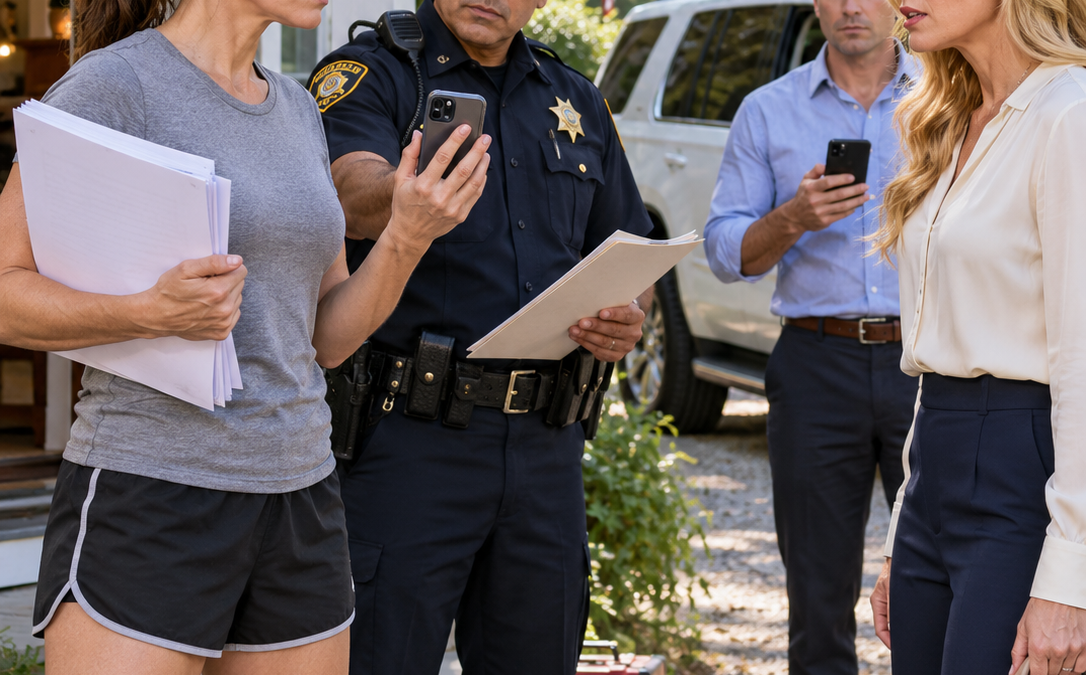
At 7:08 on Tuesday morning, three days after I returned home from Poland, someone knocked on my front door.
Three hard knocks, evenly spaced. Not a neighbor. Not a delivery driver. Whoever stood outside expected me to answer.
I had just finished a short run around the property. I was still wearing a gray Army training shirt, black shorts, and running shoes covered in damp dirt. My hair was wet from the morning air, and the coffee maker had started making the kind of noise that usually meant I was about thirty seconds away from becoming pleasant.
Then came the knock.
I opened the door and found a deputy sheriff standing on my porch, holding a thick packet of papers. He looked to be in his late forties, with a calm face, a clean uniform, and the composed manner of someone who had no interest in creating unnecessary drama. Behind him stood a locksmith carrying a red toolbox.
That got my attention.
“Lieutenant Colonel Natalie Brooks?” the deputy asked.
“Yes.”
He checked the page in front of him. “Ma’am, I’m Deputy Daniel Ruiz. I’m here to execute a writ of possession.”
For one second, I honestly thought he had the wrong address.
I looked past him toward the mailbox. Same house number. Same driveway. Same old oak tree leaning slightly toward the fence because my father had refused to cut it down for thirty years.
I looked back at Ruiz. “Possession for whom?”
He glanced at the paperwork. “Brooks Heritage Development LLC.”
The name meant nothing to me. I had never heard it in my life.
“That company does not own this property.”
Ruiz didn’t argue. He had probably heard that sentence on a hundred different front porches.
“I understand what you’re saying, ma’am. I have a court-issued writ based on a judgment entered in Cumberland County. My job is to carry out that order.”
He handed me the packet.
Before I could read the first page, I heard a car door close near the end of the driveway.
My younger sister, Mallerie, stood beside a white SUV. She wore dark pants, a cream blouse, and heels that had no business being on a gravel driveway before breakfast. Her hair was done. Her makeup was done. She looked prepared for photographs.
Gavin Pierce stood several feet behind her, holding his phone sideways.
He was recording.
“We need a full condition video before possession transfers,” he announced, loud enough for everyone to hear.
He used the tone contractors adopt when they want to sound official in front of people who don’t know enough to challenge them. Unfortunately for Gavin, I had spent almost twenty years around men who became louder whenever their facts grew weaker.
Mallerie walked closer.
At first, she kept her expression flat, professional, concerned, almost respectful. Then she saw the confusion on my face, and she smiled.
It wasn’t a nervous smile. It wasn’t an embarrassed one. It was the smile of someone watching a plan arrive exactly on schedule.
“For once,” she said, looking at my Army shirt, “your uniform can’t fix everything.”
Ruiz turned toward her. “Ma’am, please stay back until I finish speaking with the occupant.”
“The former occupant,” Gavin corrected.
Ruiz gave him a look.
Gavin stopped talking.
I didn’t.
“Mallerie, what is this?”
She crossed her arms. “You had months to deal with it.”
“I got home three days ago.”
“That is not my problem.”
It was an interesting answer because it told me two things. First, she knew exactly what those papers were. Second, she had expected me not to know.
I stepped inside and placed the packet on the entry table. Ruiz remained at the open door. The locksmith waited behind him, looking like a man who had learned not to form opinions until someone paid the invoice.
I started reading.
I didn’t yell. I didn’t throw the papers. I didn’t march down the driveway and introduce Gavin’s phone to the gravel.
I read.
That was what I had been trained to do when something made no sense. Find the first fact, then the second, and then locate the lie somewhere between them.
The first page named Brooks Heritage Development LLC as the plaintiff. The registered agent was Gavin Pierce. The company manager was Mallerie Brooks.
The next pages referred to a lawsuit filed months earlier.
A lawsuit against me.
According to the complaint, I had entered into an agreement to contribute my home and nearly six acres of land to a development company. It claimed that I had later refused to complete the transfer and that my refusal had caused financial damage.
I had never received a complaint. I had never received a summons. I had never appeared in court.
That explained the next page.
A default judgment had been entered six weeks earlier.
Six weeks earlier, I had been in Poland, working eighteen-hour days during a multinational logistics exercise. I had been tracking vehicles, equipment, fuel, and personnel across several locations.
Apparently, I had also found time to lose my house in North Carolina.
Efficient of me.
I kept reading.
The plaintiff claimed it had made reasonable efforts to locate me. That sentence nearly made me laugh.
Mallerie had my email address. She had my personal phone number. She had my military mailing address. She had even mailed me a birthday card in Poland with a handwritten note complaining that international postage was basically robbery.
Then I found the affidavit.
It stated that the plaintiff had been unable to determine whether I was in military service.
I read that sentence twice.
Then I looked at Deputy Ruiz.
“Deputy, does the file include a military status affidavit?”
He stopped writing. “Yes, ma’am.”
“May I see the version attached to your copy?”
He pulled several pages from his folder and handed them to me.
The language matched.
Mallerie had signed the filing as company manager.
Ruiz studied my face. “Are you currently on active duty?”
“Yes.”
Mallerie stepped closer. “She came home. She’s standing right there.”
Ruiz held up one hand. “I’m asking her.”
I looked at him. “I returned Saturday night after an eight-month rotation in Poland. I was there under official orders.”
“Do you have those orders?”
“On my phone. I have the full PDF and my travel records.”
I opened my military document folder. The orders showed my assignment dates, location, unit, and authorized travel. Then I pulled up my flight itinerary and return documentation.
Ruiz read carefully.
Mallerie shook her head. “I didn’t know if that was an actual deployment or some kind of training trip. Natalie goes everywhere. She doesn’t exactly send the family a daily briefing.”
That almost impressed me.
She had gone from certainty to confusion in less than ten seconds.
I opened my text messages.
“On February fourth, you asked me to send you my orders because the insurance company wanted proof I would be overseas.”
Mallerie said nothing.
I turned the screen toward Ruiz.
The thread showed her message: Send me the official orders, not just your flight schedule.
My reply contained the PDF attachment.
Below it was another message from Mallerie: So you are in Poland through May 17th. What day do you actually get back to North Carolina?
I had answered with the exact date.
Ruiz looked from the phone to Mallerie.
Her smile disappeared.
Gavin lowered his phone slightly. Mallerie noticed.
“Keep recording,” she told him.
Ruiz turned toward Gavin. “No. Stop recording and step back from the porch.”
“This is our property,” Gavin protested.
“Not while I’m speaking.”
Gavin lowered the phone.
Ruiz walked several feet away and called his supervisor. He spoke quietly, but I heard the important words.
Active duty.
Possible false affidavit.
Orders provided.
Execution paused.
When he returned, his tone was firm.
“I’m not canceling the writ. I don’t have the authority to do that. I’m pausing execution while our office contacts the court and confirms how to proceed.”
Mallerie’s face tightened. “You cannot just ignore a court order.”
“I’m not ignoring it.”
“She is delaying this on purpose.”
Ruiz looked directly at her. “She asked a relevant legal question and provided documentation. You and Mr. Pierce need to return to your vehicle.”
Mallerie didn’t move.
Ruiz repeated himself.
This time, she moved.
The locksmith closed his toolbox with visible relief.
I called Rebecca Sloan, a civilian attorney I knew through a military family legal seminar. She answered on the fourth ring.
I gave her the facts, not the emotions.
The facts were bad enough.
She asked me to photograph every page and send the images immediately.
“Did the deputy stop the eviction?” she asked.
“He paused it.”
“Good. Listen carefully, Natalie. You haven’t won anything. The judgment still exists. The writ still exists. If the court doesn’t intervene, they can come back and finish this.”
“How fast can we move?”
“Now.”
Ruiz gave me his business card before leaving. He told me not to remove, destroy, or transfer any property covered by the order. He also told Mallerie not to enter the house while execution was paused.
She stood beside the white SUV, staring at me.
There was no smile now.
Only anger.
I returned to the entry table and photographed each page.
In the final set of documents, I found a contract.
My full name appeared at the top. The agreement said I had voluntarily contributed the house and land to Brooks Heritage Development LLC.
At the bottom was a signature.
Natalie Brooks.
It looked close enough to fool someone who had never watched me sign my name.
But it wasn’t mine.
That was the moment I understood my sister hadn’t just tried to take my house.
She had built an entire legal story in my name.
I held the contract in both hands for another minute before finally setting it down on the kitchen table.
The signature bothered me, not because it looked convincing, but because someone had spent time learning how to fake it.
People don’t wake up one morning and forge their own sister’s name by accident.
Something had been growing for a long time, long before a deputy sheriff ever knocked on my door.
It had started almost two years earlier.
My father, Robert Brooks, died after fighting heart disease for nearly five years. He was seventy-four.
Before becoming a truck mechanic, he had served in the Army during the late seventies. He never talked much about that part of his life. Whenever someone thanked him for his service, he usually changed the subject and asked about their family instead.
He liked engines better than conversations.
He could rebuild a diesel transmission faster than most people could explain what was wrong with it.
He never became rich.
He never wanted to.
He owned a weathered wooden house on almost six acres outside Fayetteville, about forty minutes from Fort Bragg. There was a small guest cottage near the tree line, an old workshop behind the barn, and enough open land that you could stand outside at night and hear almost nothing except insects and wind.
To most people, it looked ordinary.
To me, it looked like home.
After I joined the Army, I was stationed all over the country. Every promotion seemed to move me somewhere else.
Dad never asked for money.
That was exactly why I sent it.
Over the years, I paid to replace the roof after a bad storm. I paid to reinforce the foundation when one corner started sinking. I covered part of his medical bills after insurance stopped being generous. I hired electricians to replace wiring that probably belonged in a museum.
Whenever I had leave, I spent it fixing fences instead of taking vacations.
Not because anyone expected me to.
Because I wanted my father to stay in the only place he had ever loved.
Mallerie loved him, too. I never questioned that.
She visited often, especially when her life was falling apart. Sometimes she needed money. Sometimes she needed somewhere to stay. Sometimes she needed Dad to tell her that everything would somehow work out.
He always did.
That was who he was.
When Dad passed away, we buried him on a cool fall afternoon. Half the people at the funeral wore work boots. The other half wore uniforms.
That would have made him smile.
A week later, we met with his attorney.
The office smelled like old books and coffee that had been sitting too long. The attorney opened a folder and began explaining Dad’s wishes.
They were straightforward.
The main house and most of the surrounding land would go to me. The guest cottage would belong to Mallerie. She would also receive his savings account.
There were no surprises for me.
Dad and I had talked about it years earlier, not because he was planning to die, but because military families learn to have uncomfortable conversations before they become emergencies.
Mallerie stayed quiet while the attorney finished reading.
Then she looked at him.
“So Natalie gets everything.”
The attorney calmly shook his head. “No. Your father divided the estate based on several factors.”
“It doesn’t look very divided.”
“He considered financial contributions toward maintaining the property.”
Mallerie glanced at me.
The attorney continued. “Lieutenant Colonel Brooks invested substantial personal funds into preserving the property over many years. Your father wanted the main residence to remain intact.”
I spoke before things became worse.
“Mallerie, I’m not asking you to leave.”
She frowned. “You’re not?”
“No.”
I explained exactly what I planned.
The guest cottage was hers. She could continue using the shared driveway. If I ever considered selling any land around her cottage, we would discuss it first.
I wanted us both to keep living there.
I thought that sounded fair.
Mallerie didn’t.
She looked directly at me.
“You always knew how to make him proud.”
The room became quiet.
Most people would have heard that sentence as a compliment.
I didn’t.
There was too much history behind it.
Growing up, teachers compared us. Neighbors compared us. Even strangers compared us.
Natalie is responsible. Mallerie is creative.
Natalie always has a plan. Mallerie will figure it out eventually.
None of those comments came from Dad.
But hearing them for twenty years leaves marks.
At the time, I believed we would move past it.
I was wrong.
About six months later, a commercial development company contacted me. One of its representatives drove out to the property, walked the land, measured distances, and asked questions about utilities.
Then he made an offer.
Just under two million dollars.
He said they wanted to build a mixed retail development. Restaurants, parking lots, office space.
He called it progress.
I called it pavement.
I thanked him for his time and declined before he finished the presentation.
He seemed surprised.
“Colonel Brooks, this changes your life.”
“It already has.”
“You could buy any house you want.”
“I already have the one I want.”
That conversation lasted less than fifteen minutes.
I never thought about it again.
Mallerie did.
She called that evening.
“You turned down two million dollars?”
“I did.”
“Without even asking me?”
“I don’t need permission to keep my own home.”
“You own the valuable part.”
“We both inherited what Dad wanted us to have.”
She sighed. “You know the cottage isn’t worth much by itself.”
“I know.”
“If you sold everything together, we’d both benefit.”
“I didn’t spend twenty years protecting this place so someone could put a coffee shop where Dad planted apple trees.”
She hung up first.
Not long afterward, Gavin Pierce started appearing more often.
Officially, he worked in commercial contracting. Unofficially, he always seemed to know exactly how much other people’s property was worth.
The first time he mentioned the land, he laughed.
“You know what your sister’s doing?”
“What?”
“Holding everybody else’s money hostage.”
“Our father’s house isn’t everybody else’s money.”
He shrugged. “Depends who you ask.”
At first, I ignored comments like that.
Looking back, I should have paid closer attention, because Gavin wasn’t creating resentment.
He was feeding something that already existed.
The truth was, I had spent most of my adult life rescuing Mallerie.
When she buried herself in credit card debt during her twenties, I quietly paid enough to stop the collection calls. Dad never found out.
When an ex-boyfriend became controlling, I drove five hours overnight to bring her home.
When she borrowed money from Dad without asking, I replaced it before he noticed.
When she wanted a career in real estate, I introduced her to the wife of an old Army friend who owned a brokerage.
Every single time, I believed I was helping.
I was the older sister.
That was my job.
At least, that was what I told myself.
Years later, I learned that Mallerie remembered those moments very differently.
To her, every rescue carried an invisible reminder.
Natalie fixes problems. Mallerie creates them.
Natalie pays. Mallerie owes.
Natalie succeeds. Mallerie disappoints.
I never intended to send those messages.
But intent doesn’t erase impact.
Several months later, I received orders for an eight-month assignment in Poland.
Before leaving, I met with an attorney. I wanted someone local to handle emergencies while I was overseas.
The document was intentionally limited.
I sat across the kitchen table from Mallerie while we reviewed every page together. I pointed to each paragraph.
“You can pay taxes.”
She nodded.
“You can authorize emergency repairs.”
Another nod.
“You can deal with utility companies if something breaks.”
“Okay.”
Then I tapped the final restriction.
“You cannot sell, transfer, borrow against, or change ownership of the property.”
She read the sentence herself.
Then she signed.
“I understand.”
I signed, too. The attorney notarized everything.
Simple. Clear. Exactly how legal documents should be.
The morning I left for the airport, Mallerie hugged me in the driveway.
It wasn’t awkward. It wasn’t forced.
She actually held on for a few seconds.
“You can trust me,” she said.
“I know.”
Those were the last words we spoke before I boarded my flight.
Less than two hours later, after my plane was already somewhere over the Atlantic, Mallerie drove back to the house.
She unlocked Dad’s old desk in the study, opened the bottom drawer, and removed a professional appraisal of the property.
She carried it outside to Gavin.
He studied the number at the bottom of the page.
Just under two million dollars.
He smiled without looking up.
“Your sister doesn’t have to agree,” he said quietly, “if the court believes she already did.”
Mallerie folded the appraisal, slipped it back into the envelope, and locked Dad’s desk as if nothing had happened.
If anyone had walked into the house that afternoon, they would have seen two people talking quietly over coffee.
Not plotting. Not arguing.
Just talking.
That was how it started.
Not with forged signatures. Not with fake lawsuits.
With small decisions that looked harmless by themselves.
A week after I arrived in Poland, Mallerie called me.
“Since you’re gone for a while,” she said, “it might be easier if some of the property mail comes to the cottage instead of sitting in your mailbox.”
I was halfway through unloading equipment from a delayed cargo shipment.
“What kind of mail?”
“Tax notices, utility bills, insurance stuff. Things like that. Just property-related things.”
“Exactly?”
“Exactly. It’ll save me from walking over every few days.”
It sounded reasonable.
She already had the limited power of attorney. She already lived on the property. I didn’t see a problem.
“That’s fine,” I said. “Just let me know if anything important comes in.”
“I will.”
She kept her promise.
At first.
She forwarded the utility bills. She asked about one insurance renewal. She sent me photos when the water heater leaked in the guest cottage.
Everything looked normal.
That was the point.
The easiest lie to believe is the one that begins with the truth.
A few weeks later, Gavin registered a new company.
Brooks Heritage Development LLC.
The name sounded respectable. Family-owned. Local. The kind of business people assume has existed for years.
It hadn’t.
The paperwork was brand new.
Gavin handled every filing himself.
He explained the plan to Mallerie one evening while they were sitting at the kitchen table in the guest cottage.
“We’re not stealing anything.”
Mallerie looked uncertain. “It feels like stealing.”
“No. We’re creating leverage.”
“I just want Natalie to listen.”
“And she won’t unless she thinks she has something to lose.”
Mallerie stared at the appraisal again.
“I don’t want to end up in court.”
“You won’t.”
Gavin leaned back.
“We’re just giving her a reason to negotiate.”
He spoke with the confidence of someone who had rehearsed the speech before.
“We draft an agreement saying she intended to contribute the property to the company.”
“But she never agreed to that.”
“That part becomes a disagreement.”
Mallerie frowned. “I don’t understand.”
“You don’t need to.”
He smiled.
“If Natalie responds, we settle. If she doesn’t, then the court assumes our version is true.”
Mallerie was quiet for a long time.
“I don’t want fake deeds.”
“We’re not filing fake deeds. We’re filing a contract dispute.”
He tapped the table.
“Big difference.”
Legally, there was one.
Morally, there wasn’t much.
Meanwhile, my life looked completely different.
Most mornings started before sunrise. The logistics coordination center never stayed quiet for long.
One convoy arrived late because of weather. Another shipment contained equipment with serial numbers that didn’t match the inventory report. A multinational exercise involving American personnel and British units nearly lost an entire day’s schedule because transportation requests had crossed in the wrong order.
Young officers came into my office carrying problems that felt impossible.
I listened. Asked questions. Checked facts.
Then I solved one issue at a time.
Panic spreads quickly.
Calm spreads faster.
That had become my job.
Ironically, I applied that discipline everywhere except my own family.
Back home, Gavin and Mallerie kept building their story.
The fake agreement became more detailed. It described future commercial development, profit sharing, management responsibilities, and construction phases.
The document looked impressive, mostly because Gavin copied language from legitimate business contracts.
He knew appearance mattered.
People trust paperwork that looks expensive.
Still, there was one obstacle.
My military status.
Mallerie had everything she needed to prove exactly where I was. She had my deployment orders, my military mailing address, and our text messages.
She knew the day I had left.
She knew the day I planned to return.
One evening, she finally asked Gavin the question that mattered.
“What if the court asks whether she’s serving?”
“They probably will.”
“So what do we say?”
Gavin shrugged.
“We say we couldn’t determine it.”
Mallerie looked uncomfortable. “But we can.”
“You can,” he corrected. “But the paperwork doesn’t have to.”
She looked down at the unsigned affidavit.
“If this comes back on me—”
“It won’t.”
“You keep saying that.”
“Because it’s true.”
“What if Natalie finds out?”
“Then we settle.”
“And if she doesn’t?”
He smiled again.
“We win by default.”
There was still time for Mallerie to walk away.
She could have refused. She could have called me. She could have sent one email with one attachment.
Instead, she signed.
Not because Gavin forced her hand.
Because she decided the risk was worth taking.
That signature changed everything.
Thousands of miles away, I never knew it had happened.
Instead, I spent my evenings answering emails from junior officers worried about things far more ordinary.
Someone couldn’t find replacement vehicle parts. Someone had forgotten customs paperwork. Someone needed another fuel request approved before sunrise.
Those were problems that made sense.
Problems with answers.
Family didn’t work that way.
About three months into my assignment, my neighbor Eleanor sent me an email.
It contained two photographs showing orange ribbons tied around several trees near the back of my property.
The subject line read: Do you know who’s marking your land?
I called Mallerie that evening.
“Hey, Eleanor says somebody’s been surveying.”
“Oh, that.”
“What was it?”
“The county.”
“For what?”
“Possible road expansion.”
“They never contacted me.”
“They talked to me because you’re overseas.”
“Anything I need to sign?”
“Oh, no.”
She answered so naturally that I never questioned it.
A week later, I received an automated notice saying my mailing address for certain county records had changed.
I texted Mallerie.
Did something get updated?
She replied almost immediately.
Probably just the county system catching up with the power of attorney. Makes everything easier.
Again, it sounded reasonable.
Again, I believed her.
The lawsuit arrived several weeks later.
The summons was delivered to my North Carolina address, exactly where Mallerie knew I wasn’t.
She accepted the paperwork.
She never scanned it. Never emailed it. Never mentioned it.
From the court’s perspective, I had simply failed to appear.
From my perspective, I never even knew there was a hearing.
When the response deadline passed, Gavin filed for a default judgment.
The judge reviewed the documents that had been submitted. No one argued the other side. No one challenged the affidavit. No one questioned the story.
The judgment was granted.
Soon afterward, Gavin met with a private bridge lender.
He walked in carrying three things: the company documents, the court judgment, and confidence.
He explained that the ownership issues had been resolved. Development could now move forward.
The lender approved an initial loan of approximately $375,000.
Some of that money paid legal expenses. Some paid surveyors. Some covered consulting fees.
And some quietly disappeared into Gavin’s personal financial problems.
Debt has a way of finding fresh money before honest work does.
None of this reached me.
Instead, one Saturday evening in Poland, I called home.
Mallerie answered from the front porch. Behind her, the sunset looked almost identical to the one outside my childhood bedroom.
For a moment, I forgot how far away I was.
“Everything okay?” I asked.
“Everything’s fine.”
“How’s the house?”
“Same as always.”
“The roof still holding?”
“No leaks.”
“The old oak?”
“Still refusing to die.”
That made me laugh.
Dad used to say that tree was too stubborn for nature.
We talked for another few minutes. Nothing unusual. Nothing dramatic.
Before hanging up, I smiled.
“I’m glad I have someone I can trust back home.”
Mallerie looked away from the camera for just a second, toward someone standing outside the frame.
Toward Gavin.
Then she looked back at me.
“Everything here is under control.”
We ended the call.
The screen went dark.
Gavin stepped onto the porch carrying another folder.
Inside was the approved schedule for executing the writ of possession.
He handed it to Mallerie.
She read the date slowly.
My return flight would land on Saturday evening.
The sheriff’s office planned to execute the writ on Tuesday morning.
She looked up.
“So she’ll only be home a few days.”
Gavin nodded, then slipped the papers back into the folder.
“Let her sleep in her house three more nights,” he said. “It’ll make Tuesday easier to remember.”
I kept replaying that last video call in my head while I unpacked my duffel bag.
Not because Mallerie had said anything unusual.
Because she hadn’t.
When someone hides something that big, normal becomes suspicious.
I landed on Saturday evening, just before sunset. The drive from the airport felt familiar enough that I barely needed directions. Every curve in the road reminded me that I was finally home.
The front porch light was on.
The house looked exactly the way I had left it, at least from the driveway.
Mallerie had texted me that morning.
Sorry, I think I’m coming down with something. Don’t want to get you sick after eight months overseas. I’ll stop by in a few days.
It sounded thoughtful.
I believed her again.
I unlocked the front door.
The house smelled like old wood and furniture polish.
Home.
Real home.
Not a hotel. Not temporary housing. Not another duty station.
I walked from room to room without turning on every light, just checking, making sure everything still felt right.
Then I noticed the first thing that didn’t.
The back door had a different deadbolt.
Same brand. Different finish.
I stood there for a second.
Maybe the old lock had broken. Mallerie had authority to approve emergency repairs. That alone wasn’t strange.
I made a mental note to ask her later.
The second thing was harder to explain.
Dad’s desk drawer in the study wasn’t fully closed.
Only about an inch.
Dad never left drawers open.
Neither did I.
Inside, the folders looked different. Not messy, just rearranged.
I couldn’t immediately explain why that bothered me. The tax records usually sat on the left. Now they weren’t there.
Maybe Mallerie had needed them.
Maybe she’d returned them somewhere else.
I kept looking.
The mailbox outside held almost nothing. One grocery flyer, one hardware store advertisement, and one church bulletin.
That was it.
Eight months away should have created a mountain of mail.
Instead, it looked as though someone had been cleaning it out regularly.
Reasonable.
Still, another mental note.
On Sunday morning, I started putting groceries away. While reaching under the kitchen sink for trash bags, I found a business card stuck behind a bottle of cleaner.
Sandhill Survey and Land Services.
A local surveying company.
Someone had written an appointment date on the back.
No explanation. No paperwork.
Just a card.
I stared at it for a few seconds.
Maybe it belonged to Mallerie. Maybe someone had inspected something near the cottage.
Again, reasonable.
But now I had four reasonable explanations sitting next to each other.
That usually meant one unreasonable truth.
Monday morning, I called the number on the card.
A receptionist answered.
“Sandhill Survey.”
“My name is Natalie Brooks. I found one of your business cards in my house.”
“Yes, ma’am?”
“I’m trying to figure out why your company surveyed my property.”
She typed for several seconds.
“I see the project.”
“Who requested it?”
“I’m sorry. I can’t discuss client information.”
“I own the property.”
Another pause.
“I can tell you the project is associated with Brooks Heritage Development LLC.”
The name would soon become painfully familiar.
“Who hired your office?”
“I’m not authorized to release that information.”
“I own the land.”
“I understand, ma’am.”
“So who do I speak with?”
“If you have questions, you’ll need to contact Gavin Pierce.”
I thanked her and hung up.
I didn’t like hearing Gavin’s name connected to my property. Not because I had proof of anything, but because he always seemed to appear wherever money appeared.
Instead of calling him, I drove downtown.
Public records have one advantage over rumors.
They don’t care how anyone feels.
The clerk pointed me toward the land records terminal.
I searched my property address.
Then Brooks Heritage Development LLC.
The company existed.
Recently formed.
Manager: Mallerie Brooks.
Registered agent: Gavin Pierce.
I kept reading.
A contract appeared in the filing history.
My name. My property. My supposed agreement to contribute the land to the company.
I opened the scanned document.
There it was.
My signature.
Or someone’s version of it.
I knew within half a second that it wasn’t mine.
Whoever had copied it understood the shape, not the rhythm.
People don’t realize signatures have timing. Mine always slowed on the final letters.
This one never did.
I opened the next document.
A civil lawsuit.
Plaintiff: Brooks Heritage Development LLC.
Defendant: Natalie Brooks.
Then another document.
A default judgment.
Then another.
An application for a writ of possession.
I sat there without moving.
I had deployed into places where incoming rockets sounded closer than anyone wanted.
None of those moments felt like this.
Because strangers attacking you makes sense.
Your own family rewriting reality does not.
I left the courthouse and made exactly the wrong decision.
I called Mallerie.
She answered on the third ring.
“Hey, sis.”
Her voice sounded completely normal.
“Why was my mail forwarded?”
Silence.
Only for a second.
“I don’t know what you mean.”
“I found almost nothing in the mailbox.”
“Maybe the post office messed something up.”
“What about county records?”
“I honestly have no idea.”
“What about legal documents?”
Another pause.
“I haven’t seen any.”
She sounded calm.
Too calm.
I ended the call after less than two minutes.
By the time I reached my truck, I already regretted making it.
In the Army, we call it showing your hand too early.
I had just told Mallerie exactly what I was investigating.
If she had missed anything, she wouldn’t miss it now.
Later, I learned that within an hour of our conversation, she had logged into a shared family email account.
Messages disappeared.
Attachments disappeared.
Notifications disappeared.
I had given her time.
Exactly what I should not have done.
That afternoon, I met Rebecca Sloan in her office.
She read every document without interrupting. When she finished, she folded her hands.
“I believe your signature was forged.”
“So we fix it.”
She shook her head. “It doesn’t work like that.”
“They know I didn’t sign.”
“We still have to prove it.”
“I was deployed.”
“We have to prove that mattered legally.”
“They lied.”
“We have to prove they lied.”
I leaned back in the chair.
“So what happens?”
Rebecca opened a legal pad.
“The default judgment is valid until a judge says it isn’t.”
I didn’t like hearing that.
“You’re telling me the court currently believes my sister owns my house?”
“I’m telling you the court currently believes a judgment exists.”
“Same difference.”
“No.”
She looked directly at me.
“Details matter.”
She started making a list.
“We need to challenge service.”
She wrote another line.
“We need to establish your military status.”
Another line.
“We need to attack the contract supporting the lawsuit.”
Then another.
“We need evidence before accusations.”
“I already know who did this.”
“I know.”
“So why aren’t we going after them?”
“Because every time you confront them, they learn what we know.”
I folded my arms.
“I’m not good at sitting still.”
Rebecca smiled slightly.
“I figured.”
“I solve problems.”
“This isn’t a convoy problem.”
She slid the legal pad toward me.
“Every move you make gives them a chance to move, too.”
That sentence stayed with me, mostly because I knew she was right.
I just didn’t like it.
Even so, I couldn’t completely resist.
Monday evening, I invited Mallerie and Gavin over for dinner.
Barbecue. Potato salad. Sweet tea.
As normal as possible.
Neither of them hesitated.
That interested me.
People with guilty consciences usually overthink invitations.
Gavin complimented the brisket. Mallerie asked about Poland. We talked about weather, neighbors, and football.
Nothing important.
Halfway through dinner, I casually said, “The Army’s been talking about moving me to Virginia.”
Mallerie looked up immediately.
“Really?”
“Maybe.”
“So what would happen to the house?”
“I’ve thought about selling.”
Neither of them spoke for almost two seconds.
Then Mallerie leaned forward.
“Have you picked a realtor?”
Not Why are you selling?
Not Are you sure?
A realtor.
Gavin followed with his own question.
“When do you think you’d be ready to sign paperwork?”
Too fast.
Both of them.
I shrugged.
“Hard to say.”
I took another bite before adding, “I’ve been trying to figure out why so much of my mail disappeared.”
Mallerie answered without thinking.
“Maybe the post office lost the court papers.”
Silence.
Nobody moved.
I slowly looked at her.
“I didn’t say anything about court papers.”
Her eyes widened just enough.
Only a fraction.
Then she laughed.
“I just meant if there were any.”
I smiled.
“So did I.”
The conversation drifted somewhere else.
Neither of us mentioned it again.
Just before midnight, my phone rang.
Rebecca.
“I found something,” she said.
“What?”
“The writ of possession has already been forwarded to the sheriff’s office.”
“How long do we have?”
“I don’t know.”
I looked at the clock on the microwave.
11:57 p.m.
The house was completely quiet.
Outside, the old oak tree barely moved in the wind.
By sunrise, my sister would be standing outside my house, waiting to watch the court finish what she had started.
And when Deputy Ruiz arrived that Tuesday morning, everything unfolded with a speed I could barely control.
After the confrontation on the porch, he remained there until everyone stopped talking over one another.
Then he looked directly at me.
“Ma’am, I need you to understand something.”
I nodded.
“This is not canceled. It’s paused until the court tells us what to do.”
“So they can still come back?”
“Yes.”
“When?”
“I don’t know.”
That was the hardest part.
An enemy with no schedule is difficult enough.
A legal deadline with no schedule is worse.
Ruiz handed me his business card.
“If the court contacts you, respond immediately.”
“I will.”
He looked toward Mallerie.
“And nobody enters this house without legal authority while this is under review.”
Mallerie folded her arms.
“We already have legal authority.”
Ruiz didn’t argue.
“You have a judgment.”
She smiled again.
“Exactly.”
“I said what I said.”
There was a difference.
She knew it.
He knew it.
I knew it.
Gavin tried to keep things moving. He walked toward the locksmith.
“Just wait in the truck.”
The locksmith looked relieved. He picked up his toolbox and headed back to his van without saying a word.
I couldn’t blame him.
He had shown up expecting to change locks.
Instead, he had walked into a family disaster.
Within twenty minutes, Rebecca Sloan called back.
“I filed an emergency motion already,” she said. “I didn’t waste time.”
“What happens now?”
“We’re asking the court to stay enforcement and reopen the case.”
“And if the judge says no?”
“I’ll worry about that.”
She paused.
“The good news is we’ve been granted a temporary hold while the hearing is scheduled.”
“How long?”
“About ten days.”
“Ten days?”
It wasn’t much.
But it was more than I had an hour earlier.
“You don’t have time to prove everything,” Rebecca continued. “You only need enough evidence to convince the court this deserves another look.”
“So we build the foundation.”
“Exactly.”
By noon, I was sitting across from Rebecca with every document spread across her conference table.
Legal filings. Company records. Property records. Court documents.
We stopped looking at them as one story.
Instead, we treated them like separate witness statements.
That was when the cracks began to appear.
Rebecca pointed to the original complaint.
“Look at this.”
The lawsuit claimed I had verbally agreed to contribute my property to Brooks Heritage Development LLC.
“No written agreement?” I asked.
“Not here.”
She picked up another filing.
“This one says something different.”
Now the story claimed I had signed a written contract.
She slid another document beside it.
“And here’s a third version.”
This filing suggested that Mallerie had authority under my power of attorney to act for me regarding the property.
I stared at all three pages.
“They can’t all be true.”
“They aren’t.”
Rebecca leaned back.
“That’s actually helpful.”
“How?”
“Because honest stories usually stay the same.”
She tapped the papers.
“These changed.”
I started reading them again.
Every time Gavin and Mallerie had encountered a problem, they had added another explanation.
No written agreement? Now there was one.
Questions about authority? Mention the power of attorney.
Questions about intent? Claim verbal approval.
Instead of fixing weaknesses, they had buried them beneath more paperwork.
That was a mistake.
Military investigations often work the same way.
One lie creates another, then another.
Eventually, the lies begin contradicting each other.
The challenge is surviving long enough to notice.
Rebecca spent the afternoon searching financial filings connected to the LLC.
About three hours later, she stopped typing.
“Well.”
I looked up.
“What?”
“I think I know why they’re moving so fast.”
She turned the monitor toward me.
A private bridge lender had issued Brooks Heritage Development LLC an initial loan.
$375,000.
I read the number twice.
“They borrowed against my property.”
“Indirectly,” Rebecca said.
“They don’t own it.”
“They convinced someone they soon would.”
I kept reading.
The agreement included future funding if certain development milestones were completed.
The lender could release more than one million additional dollars.
I felt my stomach tighten.
“This isn’t about selling the land anymore.”
“No.”
Rebecca looked at the screen.
“They’ve already used the property to build a financial structure. If they get possession, they’ll unlock the next phase.”
I understood immediately.
In logistics, once supplies begin moving through a system, stopping them becomes much harder.
Money worked the same way.
Banks. Contracts. Investors. Permits.
Every new layer created another complication.
“If this drags out—” I began.
“The lender will have interests to protect,” Rebecca finished. “They’ll argue they acted in good faith.”
“Exactly.”
I rubbed my forehead.
“My sister turned Dad’s house into collateral.”
Rebecca didn’t answer.
She didn’t need to.
The documents answered for her.
We kept digging.
Late that afternoon, another set of filings appeared.
Utility coordination requests.
Environmental review paperwork.
Preliminary demolition preparation.
I frowned.
“They’re tearing it down?”
“Not immediately.”
Rebecca read more carefully.
“This isn’t a demolition permit.”
“So what is it?”
“Preparation.”
She highlighted several sections.
“They’ve started requesting utility surveys.”
Another page.
“They’ve begun preliminary demolition planning.”
Another.
“They’re preparing the paperwork they’ll need.”
I leaned forward.
“How long would they have if they gain possession?”
She calculated for a moment.
“They could empty the house, change the locks, complete the utility disconnects, and potentially begin demolition preparation within two weeks.”
Two weeks.
Dad had lived in that house for almost forty years.
Forty years could disappear in fourteen days.
That realization stayed with me all evening.
Not because of the building itself.
Wood can be replaced. Windows can be replaced. Even land heals.
But memories don’t.
You don’t rebuild the kitchen where your mother taught you to make biscuits.
You don’t reconstruct the marks Dad carved into the laundry room doorframe to measure our height every birthday.
You don’t replace the sound old floors make when you’ve walked across them your entire life.
Those things disappear once.
Forever.
The next morning, Rebecca met me at the property.
I wanted to inventory everything important.
We started in the workshop.
Old tools. Boxes of manuals. Military photographs. Tax records. Family albums.
Everything went onto a checklist.
Then we walked into Dad’s storage room.
Against the back wall had always stood a gray fireproof safe.
It wasn’t huge, maybe three feet tall, but it was heavy enough that two people could barely move it.
I stopped walking.
Rebecca looked at me.
“What?”
“The safe.”
“What about it?”
“It’s gone.”
She looked around the room.
“You sure?”
“I bought this safe with Dad twelve years ago.”
Nothing remained except faint marks on the concrete floor where the wheels had rested.
Dust outlined the exact shape.
Someone had rolled it away.
I walked closer.
The impressions were still visible.
Inside that safe, Dad kept things he couldn’t replace.
Letters. Insurance papers. Old photographs. Military records. Copies of estate documents. Personal notes.
Nothing worth much to a thief.
Everything worth everything to a family.
Mallerie knew exactly what was inside.
She had seen Dad open it dozens of times.
I reached for my phone.
“I’m calling the sheriff.”
Rebecca gently lowered my hand.
“Wait.”
“They stole it.”
“We don’t know who did.”
“It disappeared.”
“I know.”
“Isn’t that enough?”
“No.”
I stared at her.
“If we accuse the wrong person now, they’ll use it against us later.”
I hated the answer, mostly because it was right.
For the first time since returning home, I felt something stronger than anger.
Loss.
Not legal loss.
Personal loss.
It felt as though someone had reached backward through time and started stealing my father one piece at a time.
His house.
His papers.
His handwriting.
His memories.
My phone rang.
Rebecca answered because the call had come directly to her office.
She listened without speaking for nearly a minute.
Finally, she said, “Thank you. Please email every document you have.”
She ended the call slowly.
I knew that look.
“What happened?”
“That was counsel for the bridge lender.”
“Why are they calling you?”
“They’ve learned ownership is being challenged.”
“Good.”
“They’re cooperating.”
“That’s better.”
Rebecca didn’t smile.
“They also told me something else.”
She turned the phone toward me after the email arrived.
Attached was another document.
Another signature.
My name.
My address.
My supposed certification.
The form stated there were no ownership disputes involving the property.
Rebecca looked at me across the table.
“They didn’t just forge your agreement with the company.”
She paused.
“They used your name to guarantee the loan.”
I looked at the forged loan guarantee one more time before sliding it back across Rebecca’s desk.
Then something hit me.
Not a fact.
A memory.
“Dad had another place.”
Rebecca looked up.
“What do you mean?”
“He stopped keeping everything in the house after the workshop fire.”
“When was that?”
“About fifteen years ago.”
The fire had started from an old battery charger. It damaged part of the workshop before the volunteer fire department arrived.
Nobody was hurt.
But afterward, Dad became almost obsessive about protecting important documents.
“He rented a safe deposit box.”
Rebecca closed her notebook.
“Let’s go.”
The bank manager confirmed my identity before disappearing into the vault.
A few minutes later, he returned carrying a long gray box.
I hadn’t seen it in years.
Dad never talked about it unless something absolutely required it. He used to joke that if anyone wanted family secrets badly enough to rent a vault, they probably deserved to find them.
I unlocked the box.
The smell of old paper escaped before I touched anything.
Everything inside had been carefully organized.
Dad never believed in messy endings.
The first envelope contained a certified copy of his will.
The second held a codicil signed several months later.
Rebecca read every page carefully.
“This doesn’t change ownership,” she said.
“I know. But it helps explain intent.”
That mattered because the fake contract depended on convincing people Dad had wanted the property developed.
These papers showed exactly the opposite.
Another folder contained years of letters between Dad and his estate attorney.
Most discussed ordinary things.
Taxes. Medical updates. Property maintenance.
Then we found a letter discussing the inheritance.
Dad had written in his own handwriting that he wanted the main house preserved because Natalie had invested years of labor and personal savings into protecting it.
He specifically wrote that selling should remain my decision.
Rebecca quietly photocopied every page.
Next came the appraisal.
The same appraisal Mallerie had taken from Dad’s desk.
Only this copy had never left the bank.
The numbers matched perfectly.
Almost two million dollars.
Dad had known exactly what the property was worth.
He simply hadn’t cared enough to sell it.
Near the bottom of the box was something wrapped in soft cloth.
Dad’s old wristwatch.
The crystal was scratched. The leather band had been replaced twice. It had stopped working years before he died, but he refused to throw it away.
“It’s still right twice a day,” he always joked.
I held it in my hand longer than I expected.
Some objects stop measuring time.
They start measuring people.
Under the watch rested one final envelope.
My name appeared across the front.
Natalie.
No rank.
No title.
Just Natalie.
I unfolded the paper carefully.
Rebecca stayed silent while I read.
Dad’s handwriting wasn’t perfect anymore. His heart medication had made his hand shake during his final years.
Still, every word sounded exactly like him.
He wrote that he loved both his daughters. He wrote that he hoped we would always find our way back to each other.
Then the letter changed.
He admitted something I had never heard him say out loud.
He knew Mallerie had spent her entire life comparing herself to me.
He knew she carried resentment she rarely admitted.
Then I reached the sentence that stayed with me longer than any legal document ever could.
You’ve spent too much of your life fixing what your sister refuses to face.
I stopped reading.
Rebecca didn’t interrupt.
Dad continued.
Helping someone wasn’t wrong.
Protecting family wasn’t wrong.
But rescuing the same person over and over eventually teaches them they never have to rescue themselves.
He worried that I confused responsibility with guilt.
He hoped someday I would understand the difference.
By the time I reached the last page, I wasn’t thinking about lawsuits anymore.
I was thinking about every time I had cleaned up another crisis because it seemed easier than letting Mallerie face the consequences.
Dad had seen the pattern years before I did.
He hadn’t blamed either of us.
He had simply recognized it.
For the first time since Deputy Ruiz knocked on my door, I cried.
Not loudly.
Not dramatically.
Just enough to admit that I had lost more than a house.
I had lost a chance to tell Dad he had been right.
Rebecca quietly handed me a tissue.
“We’ll use the documents,” she said.
I nodded.
“But keep the letter for yourself.”
That wasn’t evidence.
That was family.
The next breakthrough came from my neighbor, Eleanor.
She was almost eighty, sharp as ever, and occasionally a little too confident in her memory.
“I knew something looked funny,” she told us while standing on her porch.
“What did you see?” Rebecca asked.
“Your sister and that Gavin fellow went by Friday afternoon.”
“You’re sure?”
“Oh, absolutely.”
Rebecca asked if Eleanor still had her Ring camera.
She did.
We downloaded the footage.
The timestamp said Thursday, not Friday.
Eleanor laughed at herself.
“Well, I got the day wrong.”
“You got the people right,” I said.
The video wasn’t dramatic.
No faces pointed toward the camera.
No conversations.
No confessions.
Just Mallerie and Gavin rolling Dad’s gray fireproof safe across the driveway on a furniture dolly before loading it into a trailer.
That mattered because, during our earlier conversations, Mallerie had insisted she hadn’t entered the workshop storage room after I left for Poland.
Now we knew she had.
She hadn’t just been mistaken.
She had lied.
Rebecca smiled for the first time all week.
“I like witnesses who admit when they remember something wrong.”
“Why?”
“Because juries trust people who correct themselves.”
The investigation kept growing.
Rebecca hired a digital forensic specialist to examine the electronic files connected to the supposed agreement.
A few days later, we met in his office.
He projected several screens onto a monitor.
“This contract wasn’t typed by Natalie Brooks,” he said.
“I know.”
“I can tell you more.”
He pointed at the metadata.
Creation date.
Edit history.
Software version.
User profile.
The original document had been created while I was physically in Poland.
The computer profile connected to the edits matched devices regularly associated with Gavin’s office.
“It doesn’t prove he forged the signature,” the specialist explained.
“No,” Rebecca said, “but it proves where the document began.”
Every answer created another question.
Rebecca also tracked down the notary listed on the agreement.
The woman looked exhausted before the interview even started.
She admitted she hadn’t actually watched me sign anything.
“I thought everything had already been executed.”
“Who brought you the papers?” Rebecca asked.
“Gavin.”
“Did you verify Natalie Brooks was present?”
“No.”
“Did you compare identification?”
“No.”
The notary rubbed her forehead.
“I handled it carelessly.”
She wasn’t part of some criminal conspiracy.
She had simply failed to do her job.
Sometimes negligence causes almost as much damage as dishonesty.
By then, Rebecca believed we had enough information to change strategies.
“We stop reacting,” she said.
“What do you suggest?”
“We make them feel safe.”
“I don’t follow.”
She explained her idea.
We would send a confidential settlement proposal. The letter would imply that I wanted to avoid public litigation because of my military career.
It would suggest I preferred a quiet resolution.
“They’ll think you’re afraid,” I said.
“I know.”
“I hate that.”
“I know.”
“What do we ask for?”
Rebecca slid another draft across the table.
The proposal requested copies of the original agreement, any power of attorney they intended to rely on, loan documents, related emails, and accounting records showing how the loan money had been spent.
I looked at her.
“You think they’ll hand all that over?”
“I think they’ll hand over enough.”
She was right.
Within days, Mallerie and Gavin responded.
Confident people often talk too much.
Confident people who believe they’re winning usually write even more.
Mallerie signed a new declaration.
She now claimed I had verbally approved the agreement during one of our video calls from Poland.
Gavin signed his own statement.
His version said Mallerie had already provided him with a contract I had personally signed before leaving the country.
Then Rebecca opened the bridge loan file.
There, the explanation changed again.
According to those documents, Mallerie had authority to sign for me under the limited power of attorney.
Rebecca quietly laid all three statements side by side across her conference table.
No one spoke for several seconds.
Finally, she looked at me.
“They just gave us three different stories under three different signatures.”
I looked down at the papers one last time.
“Then let’s make them repeat every one of them under oath.”
I studied the three statements again before sliding them into my binder.
For months, Mallerie and Gavin had controlled the story.
Now they would have to answer questions instead of writing them.
That changed everything.
Mallerie’s deposition took place first.
She arrived wearing a navy business suit and carrying herself like a realtor meeting an important client. Confident, calm, prepared. Her attorney sat beside her, while Rebecca took the seat across the table. I remained at the far end of the room, saying nothing.
Rebecca had warned me before we started.
“Don’t react.”
“I won’t.”
“Not even if she lies.”
“I understand.”
She gave me one last look. “I mean it.”
The court reporter finished explaining the oath. Mallerie raised her right hand and promised to tell the truth.
Then Rebecca began.
“Ms. Brooks, did your sister ever express interest in commercially developing the property?”
“Yes. We talked about it several times.”
“Did she agree?”
“Yes.”
“How?”
“She said it made financial sense.”
Rebecca made a note.
“Did you believe the paperwork filed with the court was legitimate?”
“I did.”
“Who handled preparing those documents?”
“Gavin handled the technical side.”
“What do you mean by technical?”
“The contracts, filing things, business paperwork.”
“So you weren’t involved?”
“I trusted him.”
It was a careful answer. Not innocent, not guilty. Just careful.
Rebecca changed directions.
“Ms. Brooks, when the lawsuit was filed, where was Natalie Brooks living?”
“I wasn’t exactly sure.”
“You had no idea?”
“I knew she traveled.”
“Where?”
“I don’t remember.”
Rebecca reached into her folder.
“I’d like to mark Exhibit Twelve.”
She placed a printed text message on the table.
Mallerie looked down.
It was the conversation where she had asked for my deployment orders.
Rebecca spoke quietly.
“Is this your phone number?”
“Yes.”
“And did you ask Natalie Brooks to send her military orders?”
“Yes.”
“Why?”
“For insurance.”
Rebecca nodded and introduced another exhibit.
My deployment orders.
Then another.
An email in which Mallerie asked for my exact return date.
Then another.
A shipping receipt showing that she had mailed a care package to my Army mailing address in Poland.
Rebecca folded her hands.
“So,” she began, pausing long enough for the silence to become uncomfortable, “you knew where Natalie Brooks was.”
Mallerie shifted in her chair.
“I knew she was in Europe.”
“You knew she was in Poland.”
“Yes.”
“You knew she was serving under military orders.”
“I wasn’t sure it was an official deployment.”
Rebecca didn’t raise her voice.
“You personally requested a copy of those official orders.”
Mallerie looked toward her attorney.
For the first time that morning, her confidence disappeared.
Rebecca moved to another subject.
“Did you ever enter the workshop storage room while Natalie Brooks was overseas?”
“No.”
“Not once?”
“No.”
“Not for any reason?”
“No.”
Rebecca looked down at her notes. She wanted to make sure the record was clear, so she repeated the question several different ways.
Each time, Mallerie denied entering the building.
Finally, Rebecca nodded.
“Thank you.”
She connected a laptop to the conference room monitor.
The Ring camera footage appeared on the screen.
The timestamp showed Thursday afternoon.
Mallerie.
Gavin.
A furniture dolly.
Dad’s gray fireproof safe.
There was no sound, no dramatic music, and no need for either. The video showed two people rolling the safe across the driveway before loading it into a trailer.
Nobody spoke.
Mallerie stared at the screen.
Rebecca let the video finish.
Then she asked one question.
“Were you inside the workshop that day?”
A long pause followed.
“Yes.”
“So your earlier testimony wasn’t accurate.”
“I… Gavin told me the documents belonged to the company.”
Rebecca didn’t argue. She simply wrote another note.
The damage had already been done.
Two days later, Gavin appeared for his own deposition. He had hired a different attorney.
Unlike Mallerie, he tried to sound confident from the beginning.
“The entire project depended on representations made by Mallerie Brooks,” he explained.
“You relied on her?” Rebecca asked.
“Yes.”
“You believed Natalie Brooks approved everything?”
“Correct.”
He produced several emails. One showed Mallerie sending him the land appraisal. Another encouraged him to keep moving while Natalie was overseas.
He looked satisfied, as though those messages shifted responsibility away from him.
Rebecca thanked him, then opened another folder.
“Mr. Pierce, I’d like to discuss these documents.”
First came the LLC formation papers.
His name appeared throughout.
“You formed Brooks Heritage Development LLC.”
“Yes.”
Then came the draft contract.
The metadata linked back to his office.
“You prepared this document.”
“I assembled it.”
Next came emails with the notary.
“You contacted the notary.”
“Yes.”
Another set of documents followed, this time correspondence with the bridge lender.
“You initiated financing.”
“Yes.”
Then came instructions explaining how court filings should be submitted.
“You wrote these.”
“Yes.”
Rebecca closed the folder.
“So despite your testimony, you were not simply following instructions.”
“I was handling paperwork.”
“You built the company.”
“I managed the paperwork.”
“You drafted agreements.”
“I coordinated them.”
“You found the lender.”
“I contacted them.”
“You directed filing procedures.”
“I helped.”
Every answer made his role larger instead of smaller. By lunchtime, it was obvious that neither Gavin nor Mallerie could honestly describe themselves as passive participants.
Then something unexpected happened.
Mallerie asked to clarify part of her testimony.
Rebecca agreed.
Mallerie looked toward me for the first time all morning.
“There are things the court should know.”
Rebecca nodded.
“Go ahead.”
Mallerie took a deep breath.
“Natalie always fixed everything.”
I stayed quiet.
“When I got into credit card debt…” She looked down. “She paid it.”
Rebecca said nothing.
“When I dated someone who became abusive, she came for me.”
Another pause.
“When I took money from Dad without asking, she secretly replaced it.”
The room remained silent.
Mallerie laughed once, a short laugh without any humor.
“Everybody says she helped me.”
She looked directly at me.
“But nobody asks what it feels like to be the person who always needs help.”
I finally understood something I had missed for years.
Every time I believed I was protecting my sister, she believed I was reminding her that she couldn’t stand on her own.
I never wanted her to feel that way.
But intent didn’t change reality.
“Dad looked at Natalie with pride,” Mallerie continued, swallowing hard. “People looked at me with concern.”
No one interrupted. Not Rebecca, not the attorneys, not even the court reporter.
Because none of that excused fraud.
But it explained something far more dangerous.
The resentment had been building long before Gavin ever arrived.
Rebecca let the silence settle before opening one final binder.
“Ms. Brooks.”
She slid several bank statements across the table.
“I’d like to discuss the bridge loan.”
The atmosphere in the room changed immediately.
Rebecca pointed to the first transfer.
“A portion of the loan proceeds went directly into Mr. Gavin Pierce’s personal account.”
Gavin leaned forward. His attorney whispered something to him.
Rebecca continued.
“Another transfer entered your personal checking account.”
Mallerie frowned.
“I thought that was reimbursement.”
Rebecca placed another document beside it.
Vehicle purchase records.
A recently purchased white SUV.
The same SUV parked in my driveway the morning Deputy Ruiz arrived.
Mallerie slowly turned toward Gavin.
“You told me those were development expenses.”
Gavin didn’t answer.
Rebecca spoke again.
“The remaining balance doesn’t match the accounting submitted to the lender.”
Mallerie kept staring at him.
“How much did you take?”
Gavin finally looked back.
“You wanted the house.”
She blinked.
“Answer me.”
“You wanted the house.”
“I asked how much you took.”
His voice hardened.
“Don’t act like this was my idea.”
Mallerie’s face went pale.
“You said no one would ever find out.”
Nobody said another word.
There wasn’t much left to say.
By the end of the day, Rebecca had enough testimony to request additional financial discovery. Gavin left the building without speaking to anyone.
Mallerie remained in the conference room for several extra minutes before quietly walking out through another door.
That evening, investigators learned that the remaining money had been withdrawn from the LLC’s operating account.
Gavin had emptied what was left and disappeared from his listed address.
Just after sunset, my phone buzzed while I was reviewing deposition transcripts at my kitchen table.
Mallerie.
For the first time in nearly two years, she wasn’t calling to argue. She wasn’t calling to explain. She wasn’t calling to celebrate.
She was calling because she needed help.
I looked at her name on the screen until the ringing stopped. Then I set the phone face down on the table and went back to reading the deposition transcripts.
About twenty minutes later, Rebecca called.
“They found Gavin.”
“Already?” I asked.
“No. They found where he isn’t.”
I leaned back in my chair.
“He emptied the remaining LLC account before anyone could freeze it,” she explained.
“How much?”
“Enough.”
“Where did he go?”
“The trail leads into South Carolina.”
“Did he leave anything behind?”
“Only bills.”
That didn’t surprise me.
People like Gavin rarely disappear empty-handed.
They disappear after someone else pays.
Within days, the bridge lender formally demanded repayment. The loan agreement had already fallen apart, and the ownership challenge stopped the next round of funding.
The development project froze almost overnight.
Then the pressure shifted.
Not onto Gavin.
Onto Mallerie.
Her attorney contacted Rebecca. Off the record, no negotiations, just information.
Mallerie had been warned that she could lose her real estate license.
Civil liability was only part of the problem. Criminal investigators had begun reviewing the fraud allegations, the forged documents, the military affidavit, the loan paperwork, the missing safe.
Everything.
For the first time since this nightmare began, Mallerie realized something Gavin had known all along.
He had planned an exit.
She hadn’t.
Late one evening, rain started falling just after dark.
Not a storm, just steady rain, the kind that makes everything outside disappear behind gray sheets.
Around 9:30, someone knocked on my front door.
Softly this time.
Nothing like Deputy Ruiz’s knock.
I looked through the window.
Mallerie stood on the porch without an umbrella. Her hair hung flat against her face, and her clothes were soaked.
She looked smaller somehow.
Older.
I opened the door.
She didn’t try to come inside.
“Can we talk?”
I stepped aside.
She entered quietly.
Neither of us spoke until I handed her a towel. She wrapped it around her shoulders without looking at me.
Finally, she whispered, “Gavin’s gone.”
“I know.”
“He stopped answering my calls.”
“I know.”
“He left me with everything.”
I didn’t answer.
She looked around the kitchen.
Nothing had changed.
Dad’s old coffee mug still sat on the shelf. The same curtains Mom had sewn years ago still hung over the sink.
The house felt exactly like home.
Maybe that made the silence worse.
Mallerie finally reached into her purse.
“I’ll sign everything.”
She placed several folders on the table.
“The LLC.”
Another folder.
“My interest in anything connected to the property.”
Another.
“Whatever documents I still have.”
She slid them toward me.
“I’ll cooperate.”
I stayed where I was.
“I’ll help recover the money from Gavin.” Her voice cracked. “I’ll tell investigators everything.”
I still didn’t touch the folders.
She took a slow breath.
“I only need one thing.”
“What?”
“When this is over…”
She struggled to finish the sentence.
“Tell them it was a family misunderstanding.”
I looked at her.
“I can’t.”
“Nat.”
I hadn’t heard that nickname in years. Only my parents had used it regularly. Mallerie almost never did.
She tried again.
“Please.”
Rain tapped against the windows.
She kept talking.
“Do you remember second grade?”
I said nothing.
“You picked me up after school because Mom got stuck at work.”
She smiled weakly.
“You carried my backpack because I said it was too heavy.”
Another pause.
“When Dad got mad because I scratched his truck, you told him it was your fault.”
I remembered.
It hadn’t been my fault.
She did it.
“When Eric got violent…” Her eyes filled with tears. “You drove five hours to get me.”
She laughed quietly.
“You didn’t even pack clothes.”
I remembered that, too.
“When I couldn’t pay my credit cards, you paid them. You didn’t tell Dad.”
“No.”
She looked down at her hands.
“You never let me drown.”
The room became quiet again.
Then she whispered something I had never heard before.
“I hated being introduced as Lieutenant Colonel Brooks’s little sister.”
I blinked.
“What?”
“You had everything.”
“No.”
“You had a career.”
“I worked for it.”
“You had respect.”
“I earned it.”
“You had Dad’s pride.”
I shook my head.
“You had that, too.”
“No. You did.”
She looked around the kitchen.
“You had this house.”
“You have a future.”
She wiped her face.
“I had nothing.”
I walked over to the window. For a while, neither of us spoke.
Finally, I turned around.
“My success never took anything away from you.”
She laughed.
“See?”
“What?”
“You still don’t understand.”
I waited.
“You’ve never lived inside someone else’s shadow.”
I thought about that.
Maybe she was right.
Maybe I hadn’t.
But shadows don’t forge signatures. They don’t lie to courts. They don’t steal family homes.
People do.
I stepped closer.
“I need to ask you something.”
She nodded.
“If the sheriff had removed me,” I said slowly, “and the house had been demolished…”
She looked down.
“Would you be standing here apologizing tonight?”
She didn’t answer.
I gave her time.
Nothing.
I asked another question.
“Did you ever plan to tell me before everything inside this house was gone?”
Still nothing.
Finally, she looked up.
“It’s only a house.”
I felt something inside me settle.
Not anger.
Clarity.
She kept talking.
“It’s wood.”
She pointed toward the walls.
“It’s concrete.”
Then toward the yard.
“It’s dirt. We could have taken the money.”
She stepped closer.
“We both could have started over.”
There it was.
The answer.
She still believed the problem was the building, not what it represented. Not our father. Not trust. Not family.
Just property.
In that moment, I understood something painful.
Mallerie wasn’t standing in my kitchen because she finally understood what she had done.
She was standing there because the consequences had finally reached her.
Then she did something I never expected.
She dropped to her knees.
Not dramatically.
Not for show.
Just slowly and quietly.
She looked exactly like the little girl I used to help after she scraped her knees riding bicycles.
“Please.”
One word.
Then another.
“Help me.”
I closed my eyes for a second.
My entire life had led to moments exactly like this.
Mallerie made a mess. I cleaned it up. She apologized. I rescued her.
The pattern repeated again and again.
Dad had seen it years before I had.
You’ve spent too much of your life fixing what your sister refuses to face.
His words came back as clearly as if he were standing beside me.
If I lied now, nothing would change.
Not really.
She would survive this one, too.
And someday there would be another disaster because I had taught her there would always be another rescue.
I opened my eyes.
“I love the sister you used to be.”
She looked up hopefully.
“But I will not lie for the woman standing in front of me.”
Her shoulders fell.
“I can’t save you from this.”
She started crying.
Real crying this time.
Not careful.
Not controlled.
“I don’t know what to do.”
“Call your attorney.”
“I already did.”
“Then listen to your attorney.”
I picked up the folders she had brought.
“I want every document.”
“You’ll have them.”
“Every email.”
“Yes.”
“Everything Gavin ever sent you.”
She nodded.
I walked to the front door and opened it.
The rain had almost stopped.
She stood slowly.
For a second, I thought she might hug me.
Instead, she simply walked outside.
She never looked back.
The next morning, acting on her attorney’s advice, Mallerie voluntarily met with investigators.
Before speaking with them, she handed over a small USB drive she had hidden from Gavin.
It contained years of emails, business plans, draft contracts, and internal notes.
Most concerned my family’s property.
One email thread didn’t.
In that exchange, Gavin discussed using the same strategy on another piece of real estate owned by someone completely unrelated to us.
By then, the questions investigators were asking had grown well beyond the Brooks family.
The USB drive changed the pace of the case almost immediately.
Not because it contained one perfect confession.
It didn’t.
What it contained was worse for Mallerie and Gavin.
A pattern.
Emails matched court filings. Draft contracts matched metadata. Loan records matched bank transfers. Private messages matched the lies both of them had told under oath.
No single document won the case.
Together, they made the story impossible to defend.
Within a few months, the civil court vacated the default judgment. The writ of possession was declared invalid. The contract carrying my forged signature was rejected.
The title records were corrected.
My ownership was restored.
Brooks Heritage Development LLC was blocked from selling, borrowing against, or transferring anything connected to the property.
When Rebecca called with the ruling, I was sitting in my truck outside work.
For several seconds, I said nothing.
“We got the house back,” she said.
“I heard you.”
“You don’t sound happy.”
“I think I’m waiting for someone to tell me there’s another form.”
Rebecca laughed.
It was the first legal conversation we’d had in months that ended with either of us laughing.
The judge’s decision didn’t rest on one dramatic piece of evidence.
It rested on everything.
The summons had not been properly handled. The military status affidavit was false. The contract metadata pointed to Gavin’s office. The notarization process was unreliable.
Mallerie and Gavin had given conflicting explanations.
Their emails showed planning.
Their bank records showed motive.
The court didn’t have to guess what had happened.
It only had to compare their story with the records.
Records don’t get nervous. They don’t forget dates. They don’t suddenly remember a fourth explanation.
People do.
The civil ruling gave me back the property, but it did not end the investigation. That part lasted almost two years.
Gavin managed to remain in South Carolina for a while by moving between short-term rentals and using different mailing addresses. He stopped using his normal phone and avoided old business contacts. He apparently believed that crossing one state line had transformed him into an international fugitive.
It hadn’t.
Financial transactions eventually revealed where he was staying. He was ordered to appear, and this time, he did.
By then, the evidence had grown far beyond our property dispute. Investigators had reviewed the other real estate plan found on Mallerie’s USB drive. They had also traced lender communications, false certifications, and diverted funds.
Gavin eventually accepted a plea agreement involving financial fraud and false documents.
Mallerie also accepted responsibility for the acts she had directly committed.
Her case was not identical to his. She had cooperated, turned over evidence, and voluntarily appeared with her attorney. Those decisions mattered, but they did not erase what she had done.
She lost her real estate license. She served a period of custody followed by strict supervision and was placed on probation. She also became responsible for restitution.
The cottage Dad had left her was sold to address part of those financial obligations.
Even then, not all the money came back. Some of it had been spent. Some had vanished into Gavin’s debts. Some became legal fees, interest, and recovery costs.
Justice has an invoice.
It doesn’t always collect the full amount.
People assumed I felt satisfied when the sentences were entered.
I didn’t.
I felt relieved, angry, tired, and sometimes guilty, all in the same hour.
I had spent nearly two years proving I was the victim of a crime committed in my own name. During that time, I paid more in legal fees than I ever expected to spend defending something I already owned.
I sold investments. I used savings. I delayed repairs on the house because every extra dollar went to attorneys, document specialists, and court costs.
The Army did not punish me for what happened, but life doesn’t pause because someone forged your signature.
I missed a professional development program I had planned to attend because too many hearing dates overlapped with the schedule. A promotion opportunity was delayed.
Not destroyed.
Delayed.
That distinction mattered on paper.
It felt different in real life.
At night, I checked the locks, then checked them again. Sometimes I woke up convinced I had heard someone on the porch.
I kept copies of property documents in three locations. I photographed important mail before opening it. I became suspicious of small mistakes.
An envelope delivered late. A number that didn’t match. A door left slightly open.
Every ordinary thing started looking like the beginning of another attack.
The hardest part was admitting I wasn’t handling it well.
I was a lieutenant colonel. People came to me when systems failed. I was supposed to remain calm, make decisions, and know what to do.
For months, I treated sleep problems and anxiety like scheduling issues.
More exercise.
Less coffee.
An earlier bedtime.
None of it worked.
Eventually, I spoke with a counselor through the Army.
The first session was uncomfortable. I spent twenty minutes explaining the legal timeline. She let me finish without interrupting, asking for clarification, or steering the conversation in another direction.
Then she asked, “How did it make you feel when your sister stood outside your home?”
I answered with facts.
She asked again.
I answered with more facts.
She waited.
That was when I understood that I had been using facts to avoid the one thing I couldn’t organize.
Grief.
Not only for Dad.
For Mallerie.
For the sister I thought I had.
For the version of our family that no longer existed.
Asking for help didn’t make me less capable.
It made me more honest.
That lesson took longer than any court ruling.
Several months into Mallerie’s sentence, a letter arrived.
Her handwriting covered the envelope.
I left it unopened on the kitchen counter for three days.
When I finally read it, parts of the apology felt real.
She wrote that she had blamed me for choices she had made herself. She admitted she had wanted to see me lose control. She admitted the sheriff’s visit had been planned to humiliate me.
Then came the excuses.
Gavin had manipulated her.
Dad had favored me.
The property had created pressure.
She had felt trapped.
Maybe all of those things were partly true.
They were still excuses.
I read the letter once, then placed it in a folder.
I didn’t write back.
Forgiveness is not a court deadline.
Neither is reconciliation.
I wasn’t ready for either.
Keeping the house required another difficult decision.
I sold a small strip of land along the far edge of the property.
Not the main acreage. Not the workshop. Not the trees Dad cared about.
Just enough to cover a large portion of the legal costs and stabilize everything.
Again, the sale hurt.
But it was my choice.
That made all the difference.
I kept the main house.
I also kept the cottage after it was sold through the restitution process, purchasing it back at fair value.
Not for Mallerie.
For something better.
I converted it into temporary housing for military families arriving near Fort Bragg.
Families between assignments. Families waiting for housing. Families with children sleeping on air mattresses because government paperwork hadn’t caught up with their move.
The first family stayed there for six weeks. They left the cottage cleaner than they found it.
The second family planted flowers near the steps.
The third family had a little boy who asked whether the workshop was haunted.
I told him no.
He looked disappointed.
I also created a small scholarship in Dad’s name.
Nothing enormous.
One student each year.
It was meant for children from military families studying mechanics, engineering, technology, or logistics.
Fields Dad would have understood.
Fields that solve real problems.
Almost two years after Deputy Ruiz knocked on my door, I stood on the porch shortly after sunrise.
A young Army family was moving into the cottage.
The father carried boxes while the mother tried to unlock the door with a diaper bag hanging from her shoulder.
Their daughter ran across the yard, right through the place where Mallerie had stood beside the white SUV and laughed.
The little girl stopped near the oak tree and looked up at it.
“That tree is huge.”
“It is,” I said.
“Is it yours?”
I looked at the house, the cottage, and the yard. Then I looked at the family carrying their life through a temporary front door.
“It’s here for all of us.”
I checked Dad’s old watch on my wrist.
It still didn’t work.
I wore it anyway.
For a long time, I thought winning meant getting the house back.
It took me two years to understand that the house was never the most important thing I had lost.
My true victory wasn’t simply recovering the property.
It was finally losing the belief that love required me to keep cleaning up someone else’s damage.
Mallerie was responsible for what she did, from the forgery to the fraudulent loan. Nothing in our past, and no influence from Gavin, could excuse that.
But I also had to be honest with myself.
For years, I had enabled her behavior by paying her debts and shielding her from consequences. I mistook enabling for loyalty.
I thought I was protecting my sister.
In reality, I was stealing her opportunity to grow from her mistakes.
The lessons I learned were harsh, but necessary.
Compassion is not permission.
You can love your family and still demand honesty. Being related to someone is not a free pass to escape accountability.
A boundary is not cruelty. It is a clear statement of what you will and will not accept.
Those who benefited from your lack of boundaries may call you selfish when you finally establish them.
That is how you know the boundary is working.
I also learned the importance of legal vigilance.
Never sign a power of attorney without reading every single line. If you are going to be away for an extended period, maintain strict control over your records and mail.
Never let one person hold all the keys to your life.
And when betrayal happens, facts matter more than accusations.
Don’t threaten. Don’t argue.
Stay calm and gather evidence.
Your feelings matter, but only evidence changes court orders.
People call what happened to Mallerie and Gavin revenge.
To me, real revenge wasn’t seeing them in custody.
It was refusing to lie for my sister again.
It was taking the cottage, the site of her betrayal, and turning it into a home for other military families.
I took my life back without allowing bitterness to consume me.
Forgiveness and reconciliation are not the same thing.
Forgiveness is a private act of finding peace. Reconciliation requires responsibility, real change, and trust rebuilt over time.
I may forgive Mallerie someday.
But that doesn’t mean I am required to hand her the key to my life ever again.
Dad’s old watch still hangs by the door.
It doesn’t run, but it reminds me that while we cannot undo the past, we can decide what happens next.
Sometimes loving someone means finally stepping out of the way and allowing them to face the life they created.
If this story helped you find the strength to set necessary boundaries, share your thoughts in the comments. Don’t forget to subscribe for more journeys of reclaiming justice and rediscovering yourself after family betrayal.








