During easter dinner, my daughter-in-law threw a wine glass at me when i refused to let her parents move into my house. “you’re being selfish!” my son said, and she added, “you have empty bedrooms!” so i smiled, got up, and drove to the er. while bleeding, i texted my lawyer, “phase one is complete.” the police came!
My name is Gabriel Foster. I am seventy years old, and if there is one thing life has taught me, it is that family is not about blood. It is about loyalty.
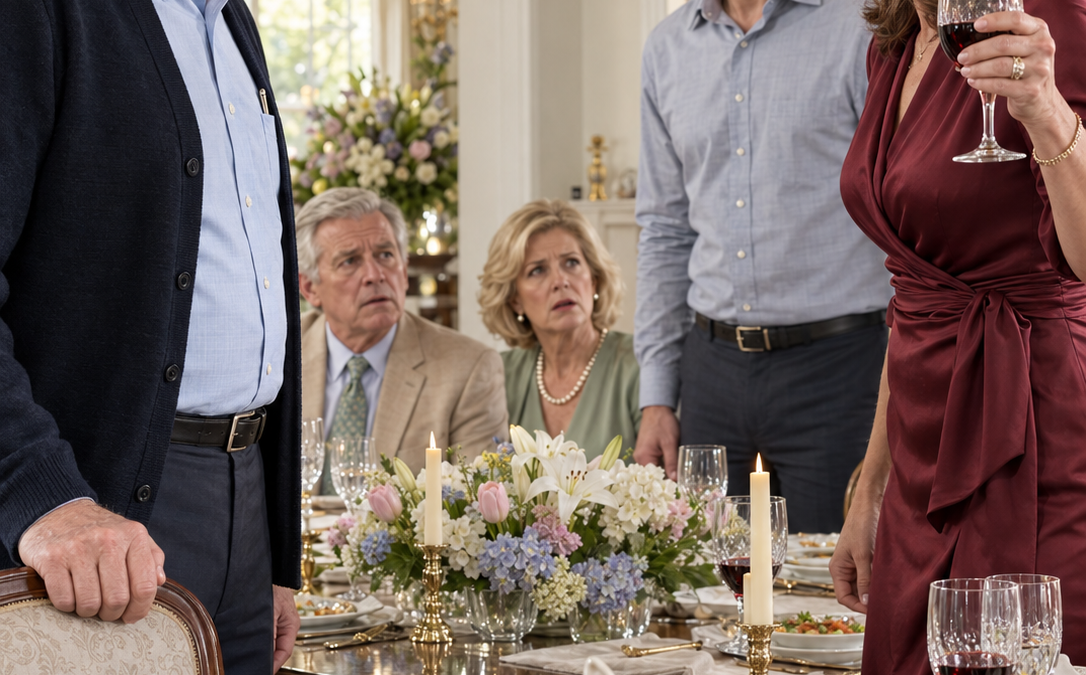
Last Sunday, during Easter dinner, my son and his wife demanded that I sign over my house to them. When I refused, my daughter-in-law hurled her wineglass straight at my face, leaving me with a serious injury to my cheek. My son, Jason, stood there and screamed, “You’re being selfish!” I simply smiled, drove myself to the emergency room, and sent a text message to my lawyer.
Phase one is complete.
What they did not know was that the entire attack had been captured on camera. They also had no idea that I had been waiting six months for them to make precisely this kind of mistake. Before I tell you how I set the trap, let me know in the comments where you are watching from. And please like and subscribe if you believe that respect is earned, not given.
The trap had truly been set the previous Wednesday. I was sitting in my home office, not tending to my roses as my neighbors probably imagined, but reviewing quarterly reports from an offshore trust. My phone rang, and my son Jason’s name appeared on the screen. I switched the call to speakerphone and continued working.
“Dad? Hey, Dad.”
His voice sounded thin, strained by a familiar anxiety. It was the kind of anxiety a man developed when desperation had become a permanent companion.
“Jason, what a surprise. How are you?”
“I’m good, Dad. Great, actually. Look, I know this is last-minute, but Easter is this Sunday. We were thinking maybe we could have dinner at your house.”
I stopped typing, leaned back in my leather chair, and stared at the phone.
My house? Of all places, he wanted to come to my house.
My daughter-in-law, Alysia, hated the place. She called it a relic, a depressing old mausoleum. She had visited only twice during the past year, and on both occasions, she behaved as though the antique furniture might give her some contagious disease. This was not an invitation. It was a move.
“That sounds fine, son. But why the sudden interest in my old mausoleum?”
He gave a nervous little laugh, high-pitched and uncomfortable.
“Oh, come on, Dad. It’s Easter. We just want to spend it with you. And, well, Alysia’s parents are in town. Mike and Diana. They’d love to see you, too.”
There it was. The other half of the equation. The sharks were circling.
Mike and Diana Russo were two people who had perfected the art of living comfortably on other people’s money. I knew for a fact that they had recently filed a fraudulent bankruptcy petition in Florida. My son Jason was a good man at his core, or at least he had been once. But he was weak, easily manipulated, and in deep, deep trouble.
I knew these things because I was not simply some harmless retired old man. For forty years, I had worked as a senior financial crimes investigator for one of the largest corporate security firms in the world. I did not merely look at people. I studied patterns, and Jason’s pattern over the previous six months had been one long, desperate spiral.
I knew he was drowning in more than $250,000 of gambling debt. I knew Alysia was spending money she did not have, money that had likely been embezzled from her employer. And I knew they had decided that I was their solution, their personal get-out-of-jail-free card.
“Dad? You still there?”
I smiled.
“Of course, son. That sounds wonderful. I’d love to host everyone. My home is your home. You know that.”
“Great, Dad. Thanks. We’ll see you Sunday around six.”
He hung up, leaving a heavy silence in my office. I turned toward the photograph on my desk. It showed my late wife, Emily, smiling at me with the same gentle expression I had loved for half a century.
“They’re coming for the house, Emily,” I whispered. “And I’m going to be ready for them.”
The trap was officially baited.
I immediately picked up my secure phone and dialed my lawyer. Ben Carter answered on the first ring.
“Ben, it’s Gabe.”
“I was wondering when you’d call,” he said, his voice crackling faintly over the connection. “The Easter invitation?”
“You’re getting good, Ben. Sunday at six, my house. They’re bringing the in-laws.”
Ben sighed. “Gabe, are you absolutely sure you want to go through with this? We can shut them down right now. We have proof of Alysia’s embezzlement. We have the records of Jason’s debts.”
“No,” I said firmly. “It’s not enough. If I simply cut them off, they’ll play the victims. They’ll tell the world I’m a coldhearted old man abandoning his family. I need them to show me who they really are, Ben. I need them to make the first move, something so blatant and undeniable that nobody can possibly defend them.”
Forty years of investigations had taught me one undeniable lesson: criminals, especially desperate criminals, almost always overplayed their hands.
“The Emily Foster Trust is locked down, right?” I asked.
“Tighter than Fort Knox,” Ben assured me. “They can’t touch a dime of your real money. As far as they know, all you have is this house and your pension.”
“Good. And the surveillance?”
“The pinhole cameras in the living room, dining room, and your office are active. The microphones are live. Everything is being recorded to a secure cloud server, exactly as you requested.”
I leaned back in my chair.
“What they don’t know, Ben, is that I already fixed Jason’s biggest problem. I already paid off his $250,000 marker with that loan shark in Miami.”
There was a sharp intake of breath at the other end of the line.
“Gabe, you did what?”
“I went to Franco a month ago. Anonymously. I gave Jason a clean slate. I wanted to see what he would do with it. Would he come to me, confess everything, and ask for help rebuilding his life? Or would he see it as a lucky break and double down on his greed?”
“And now he’s coming for your house,” Ben said grimly.
“Now he’s coming for the house,” I confirmed. “He didn’t just fail the test, Ben. He’s trying to burn the whole school down.”
For the next three days, I played the part of the happy, slightly senile grandfather. I went to the grocery store and bought a large turkey, potatoes, and everything I needed to make Emily’s famous apple pie. I even called Alysia to ask what kind of wine her parents preferred, knowing perfectly well that they were connoisseurs of anything expensive and free.
“Oh, Gabe, that’s so sweet,” she cooed over the phone. “Don’t worry about it. We’ll bring the wine. We want this to be a perfect evening.”
I could hear the meaning beneath her words.
Our perfect evening. Our new beginning.
In my house.
Sunday arrived quietly. I spent the morning in Emily’s garden, surrounded by the roses she had planted and tended for so many years. At five o’clock that afternoon, I checked the security systems one final time. Every camera showed green. Every microphone was active. I slipped a silver pen into my shirt pocket. It was not an ordinary pen but a high-fidelity audio recorder.
At precisely six, a car pulled into my driveway. It was a brand-new BMW, one I knew they could not afford. I shuffled toward the front door, arranging my face into the most convincing expression of mild confusion I could manage. Then I opened it with a broad, welcoming smile.
“Jason! Alysia! You’re here!”
And there they were, accompanied by Mike and Diana Russo. Alysia wore a silk dress that probably cost $2,000. Mike had on a suit that practically smelled of new money. They walked past me without so much as a greeting, their eyes already moving over the entryway as though they were inspecting a property they intended to purchase.
“This foyer is darker than I remember,” Diana remarked, wrinkling her nose. “We’ll need to paint this whole area, Mike. Something lighter. Maybe a pale cream.”
Mike nodded and tapped the wall with his knuckle.
“It’s solid, though. Good bones. We can work with this.”
They were already redecorating. They had not even said hello.
Jason looked pale and refused to meet my eyes.
“Hey, Dad. Thanks for having us.”
“Nonsense, son. Come in, come in,” I said, shuffling along behind them.
Alysia went directly to the bookshelf in the hallway, the one that held Emily’s collection of classic novels. She leaned toward Jason and whispered something, apparently unaware that the microphone in my pen could capture every word.
“Are you sure this is where he keeps the safe? It just looks like a bunch of dusty old books.”
“That’s what he told me,” Jason whispered back.
I smiled, although something inside me turned cold. Ten years earlier, I had deliberately lied to Jason about the location of my safe, partly to see whether he would ever attempt to find it. Until now, he never had.
As they moved into the dining room, Diana paused beside the large floral arrangement in the center of the table. She leaned toward the lilies, pretending to admire their fragrance, and whispered to her husband.
“Alysia says if he refuses to let us move in, Jason is supposed to get aggressive. Make it look like the old man is a danger to himself. Stick to the plan.”
I stood in the dining room doorway holding the roast turkey.
“Dinner is served,” I announced cheerfully. “Let’s begin.”
We gathered around the dining table Emily and I had bought at a flea market forty years earlier. We had refinished it ourselves in our garage, spending an entire summer working on the wood until it shone. Now it was covered with her finest china, the dishes I brought out only for special occasions.
Alysia picked up her heavy silver fork and regarded the turkey with a carefully arranged smile.
“Gabe, this turkey is lovely. So traditional.”
I knew exactly what she meant. Simple. Uninspired. Peasant food. I had spent the entire morning preparing it, carefully tending the roast and making certain everything was perfect.
Beside her, Mike Russo swirled the wine in his glass. It was an expensive Cabernet that Alysia had insisted on bringing.
“A good aroma,” Mike announced, as though he were a judge at some international wine competition. “A bit heavy on the tannins for my taste, but acceptable. Very acceptable.”
I merely smiled and continued playing my role.
“Oh, I don’t know much about those things, Mike. I just know what tastes good.”
They exchanged a look, one I had come to recognize all too well. It said that I was a simpleton, a harmless old fool who would never understand what was happening around him.
Good. That was exactly what I wanted them to believe.
The pinhole camera in the corner of the dining room was recording everything. The high-fidelity microphone in my shirt pocket captured every word as Diana, Alysia’s mother, put down her fork after a single delicate bite and slowly surveyed the room.
“Gabe,” she began, her voice dripping with artificial sympathy, “this house is truly lovely.”
“Thank you, Diana. Emily and I put a lot of work into it over the years.”
“But it’s just so much house for one person,” she continued, gesturing vaguely toward the ceiling. “All these empty rooms, the upkeep. It must be a terrible burden for you, living here all alone.”
This was their first probe. Not a direct attack, merely a test. Was I overwhelmed? Was I weak? Was I searching for an escape?
I gave a small, tired sigh.
“Oh, I manage. A little dusting here and there. You know, it keeps me active.”
I did not mention the professional cleaning service that came every Tuesday, paid for by the private trust my family knew nothing about.
Alysia saw the opening immediately. She placed her hand over her mother’s, presenting a perfect picture of filial devotion.
“Mom is just worried about you, Gabe. We all are, especially after what she and Dad just went through.”
I turned toward her, feigning ignorance.
“Oh? Is everything all right?”
Alysia’s face twisted into an expression of carefully rehearsed sadness.
“It’s just that they had some terrible luck in Florida. Their business, well, they lost everything.”
Bad luck. That was what she called it.
I had read my private investigator’s report three days earlier. Fraudulent bankruptcy was the proper term. Mike and Diana had not lost everything. They had hidden their assets, though not nearly as well as they imagined. Now they were running from creditors.
Mike Russo, determined to maintain his image as the proud family patriarch, cleared his throat.
“We just need a place to restart, Gabe. Somewhere we can get our feet back on the ground and rebuild.”
A restart in my house, using my money. I could see the entire chessboard spread out before me. They believed they were making the moves, but I had already positioned every piece.
I turned toward Jason. He had remained silent throughout the meal, pushing mashed potatoes around his plate. His complexion was pale, and his hands trembled slightly. He knew what was coming. He was the one they intended to use as their battering ram.
Alysia turned sharply toward him.
“Jason, honey, aren’t you going to ask your father?”
Jason swallowed visibly and put down his fork. He would not look at me. Instead, he stared at the gravy boat as though the answers to every question in the universe might be floating inside it.
“Dad,” he began, barely above a whisper. “Dad, about what we were talking about. Well, Mike and Diana, they need a place to stay for just a little while. And since you have all this space…”
I waited. I offered him no assistance. I let him struggle, allowing his discomfort to fill the room.
“We were hoping,” he finally managed, “that they could move in here. Just temporarily, Dad. Just until they get back on their feet.”
Temporarily. The word of a coward. The comforting lie a man tells himself so he can sleep at night. Even then, Jason could not meet my eyes.
I allowed the silence to stretch while pretending to be a confused old man struggling to understand this unexpected proposal.
“Move in?” I asked, making my voice tremble. “Here? Mike and Diana?”
Alysia could stand it no longer. She slammed her hand onto the table, making the silverware jump.
“No, Jason. Stop sugarcoating it. We discussed this.”
Then she turned to face me. The softness and false sympathy had disappeared from her expression, replaced by a hard mask of impatience and cold efficiency.
“Gabe, they’re moving in permanently.”
The room went silent. From the hallway came the steady ticking of the grandfather clock Emily had inherited from her mother.
Permanently.
Jason flinched as though Alysia had slapped him. Diana and Mike watched me with hard, expectant faces. There was no longer any reason for them to pretend.
This was the demand.
“I… I don’t understand,” I stammered, playing my part to perfection. “Permanently?”
“Yes,” Alysia snapped. “It makes perfect sense. They’re family. And frankly, you shouldn’t be alone in this big house anyway. It isn’t safe. You’re seventy years old, Gabe. You forget things. You could fall. What if something happened and nobody found you for days?”
There it was. The groundwork for declaring me incompetent. Exactly what Ben Carter and I had predicted. She was already constructing the narrative.
“So,” she continued, taking a breath, “Jason and I have decided that we’re all going to move in. Mike and Diana will take the two upstairs guest rooms, and Jason and I will move into the master suite with you.”
A cold sensation passed through me.
The master suite. Emily’s room.
It was the room I had not allowed anyone else to sleep in since her passing, the room where I could still detect the faintest trace of her lavender perfume.
“It’s for the best,” Alysia said, softening her voice into a grotesque imitation of kindness. “That way, we can manage things for you.”
I looked directly at her.
“Manage things?”
“Yes, you know.” She waved one hand dismissively. “The bills, the investments, the house maintenance. You’re getting to that age, Gabe. You shouldn’t have to worry about your finances anymore.”
And there it was. The final piece of their pathetic, transparent plan.
Manage your finances.
They were not simply coming for my house. They were coming for my name, my signature, my accounts, my entire life.
I looked at Jason, my son. The boy I had taught to ride a bicycle. The boy I had held when his first girlfriend broke his heart. He was still staring at the gravy boat, his face pale and his jaw clenched.
He had sat there in silence while his wife and her bankrupt parents staged a hostile takeover of his father’s life.
The microphone in my pen captured every syllable. The camera in the corner recorded every greedy expression, every arrogant smile, and every ounce of my son’s pathetic cowardice.
This was even more revealing than I had imagined.
The words manage your finances seemed to linger in the room, their arrogance hanging in the air, heavy and suffocating, more powerful than the aroma of the roast turkey. She had finally said the quiet part aloud, revealing the real purpose of this entire charade.
Manage.
I had heard that word countless times in corporate boardrooms, usually when a larger company was preparing a hostile takeover of a smaller one. We’re just going to help them manage their assets. That was always the explanation.
It was always a lie. It was always about theft.
And now I was hearing it at my own dining room table, from people who claimed to be my family.
I looked at Jason again. He was still staring at his plate. He had allowed a woman he had known for five years to declare war on the man who had raised him for forty-five. He said nothing, offered no defense, and would not even look in my direction.
He had become an accomplice to the destruction of his own family.
I thought of Emily. I thought of the fifty years we had spent building our life together. I remembered her kneeling in the garden with soil on her hands, tending the roses with extraordinary care. I remembered her sitting in the very chair Alysia now occupied, laughing because I had managed to overcook another perfectly good steak.
This house was not merely wood and plaster. It was a testament to the life we had shared. It was the one place where her presence still surrounded me.
And these people intended to take it away. They wanted to sleep in her room and spend my money while doing it.
A cold, clear anger settled over me. It was not the heated rage of an ordinary argument but the precise, controlled fury of an investigator who had just uncovered the final piece of evidence.
The camera was recording. The microphone was live. They had given me everything I needed.
Slowly and deliberately, I placed my knife and fork on the china plate. The small metallic clink seemed astonishingly loud in the silence.
Diana and Mike watched me expectantly. Alysia wore a tight, triumphant smile. She believed she had won. She believed the senile old man would simply surrender.
I raised my eyes to meet hers and allowed the mask I had been wearing to fall away. For the first time that evening, I let her see the man I really was: the man who had negotiated million-dollar deals and dismantled entire financial fraud operations.
“No,” I said.
The word was quiet. It was not a shout or an emotional outburst. It was a statement of fact, as solid and immovable as a granite wall.
Alysia’s smile froze.
“What? What did you just say?”
Mike and Diana exchanged bewildered glances. Jason finally raised his eyes from his plate, panic spreading across his face.
“I said no,” I repeated, my voice as calm and cold as a winter morning. “This is my house. This is Emily’s house. Your parents, Alysia, are not moving in here. You are not moving in here. And you are certainly not managing my finances.”
For a moment, nobody spoke.
I could almost see Alysia recalculating. This was not part of their plan. The old man was supposed to be weak. He was supposed to cry, bargain, and ultimately express gratitude for their generous offer to help him.
Jason broke the silence first.
He sprang up so abruptly that his chair nearly tipped backward. His pale face turned blotchy red with shame and anger.
“You’re being selfish!” he screamed.
Those words struck something deep inside me.
Selfish? Me?
I was the man who had quietly paid off his $250,000 gambling debt only the previous month. I was the man who had funded his failed startup five years earlier with a $100,000 loan I had never intended to collect. I had raised him, clothed him, and given him every opportunity to build a good life.
And now he was standing in my dining room, accusing me of selfishness while trying to take away everything I had built.
Before I could respond, Alysia was on her feet as well. Her carefully constructed image as the loving daughter-in-law had vanished. Beneath it stood a woman consumed by greed and rage.
“Selfish!” she shrieked, her voice echoing through the dining room. “You’re sitting here alone in this museum. You have three empty bedrooms upstairs. Three! And you only use one!”
“Those rooms are not empty,” I said, allowing my voice to rise. “One of them belonged to my son, the son I used to know. The other two belonged to my wife.”
I pointed toward the staircase.
“Her sewing room. Her library. Those rooms are full of her, and you will never set foot in them.”
“We are his family now,” Diana interrupted from her chair. “You owe him this. We need a place to live.”
“Then you should have thought about that before you committed fraud in Florida,” I replied evenly.
The color vanished from her face. She had clearly never imagined I might know the truth.
“How dare you?” Mike sputtered, rising from his chair.
“Sit down, Mike,” I ordered.
To my surprise, he obeyed. He was a bully, and like most bullies I had encountered during my career, he was a coward when confronted by someone who refused to be intimidated.
I rose slowly and placed my napkin on the table. I had seen enough. The experiment was finished, and the trap had been sprung.
“This dinner is over,” I said, leaving no room for negotiation. “I want all of you out of my house. Now.”
Jason looked at me, his eyes suddenly pleading.
“Dad, wait. Please. You don’t understand. We… I need this. You have to help us.”
“Help you?” I asked. “Help you steal my home? Help you have me put in a nursing home, which was your next step? Help you forge documents declaring me incompetent?”
I looked directly into his face.
“I know the plan, Jason. I’ve known about it for six months.”
His expression collapsed. For an instant, he appeared unable to breathe. He knew then that I knew everything.
Alysia, however, was not finished. She had been cornered, and desperation had stripped away what little restraint she possessed.
“You can’t prove any of that, you old fool!” she screamed. “It’s our word against yours. Who are they going to believe? A loving family or a confused, selfish, senile old man who’s a danger to himself?”
“We’ll see,” I replied.
I turned away from them.
“This discussion is over.”
I took a step toward the kitchen, intending to call the police and have them removed from the property. I never reached the phone.
Behind me came the scrape of a chair, Jason’s frightened gasp, and Alysia’s furious scream.
“You can’t turn your back on me!”
I turned just as she hurled her crystal wineglass across the dining room.
The entire incident seemed to unfold in slow motion. I had taken one step toward the kitchen, intending to pick up the telephone, dial 911, and have the four of them removed for trespassing. It was supposed to be the clean, legal way to end the evening. But before I could take another step, I heard Alysia’s voice rise into a furious scream.
“You can’t turn your back on me!”
Her chair scraped sharply against the hardwood floor. Jason gave a small, frightened gasp.
“Alysia, no!”
I turned toward the sound. The crystal wineglass was already flying across the space between us, its dark red Cabernet catching the chandelier’s light. I caught a glimpse of Alysia’s expression, twisted by anger. The polished, calculating woman who had arrived at my house an hour earlier had disappeared completely.
“You old fool!” she screamed.
The next instant, the glass struck the right side of my face and shattered. My glasses were knocked away, clattering somewhere across the floor. Wine splashed over my face and down the front of my white shirt, and a sudden, sharp pain told me that the injury was serious.
For a moment, I could scarcely believe what had happened. Alysia had actually thrown a heavy crystal glass at me in my own dining room. My family had come to Easter dinner demanding my house, and now my daughter-in-law had physically attacked me because I refused to surrender it.
The room fell into absolute silence.
I stood there, one hand raised instinctively toward my injured cheek, looking at the four people gathered around Emily’s dining table. Alysia remained frozen beside her chair, her arm still partially raised, her mouth open in shock.
Perhaps she had not expected the glass to strike me. Perhaps she had not expected the consequences of her own temper. Whatever the reason, her expression was not one of concern for me. It was the expression of someone who had suddenly realized that she had made a terrible mistake.
Her parents stood motionless. Neither Mike nor Diana hurried to help. They did not ask whether I was all right or offer to call an ambulance. They simply watched, their pale faces betraying the calculations racing through their minds.
They were trying to determine how this unexpected turn of events might affect their plan. They had been preparing for a dispute over money, property, and my supposed incompetence. An unmistakable act of violence had never been part of their strategy.
And then there was Jason.
My son was standing near the far wall, his hands pressed over his mouth. He looked from my injured face to his wife and back again. His entire body trembled, but he said nothing. He did nothing.
He simply stood there while his father needed help.
In that moment, something inside me changed permanently. I had spent six months gathering evidence against them, and somewhere beneath all my anger and disappointment, I had continued to hope that Jason might finally do the right thing. I had hoped that when the situation became serious enough, he would remember the man I had raised him to be.
That hope disappeared.
He was not behaving like my son. He was behaving like a frightened man who happened to share my name.
My cheek throbbed painfully, and I could feel the wine irritating the injury. I reached into my pocket, retrieved the white linen napkin I had placed there earlier, and pressed it gently against my face. The fabric quickly became stained, confirming that I needed medical attention.
I looked directly at Alysia.
Then I smiled.
It was not a broad or theatrical smile. It was nothing more than a slight movement at the corners of my mouth. But I watched her expression change as she struggled to understand it.
She had expected anger, fear, or perhaps a desperate plea for help. Instead, I was looking at her with the calm recognition of an investigator who had just witnessed the decisive mistake in a case.
The entire confrontation had been recorded. Every threat, every demand, every word about taking control of my finances, and now this attack. They could still tell whatever story they wanted, but the cameras would tell a different one.
Alysia’s expression crumpled. She did not yet understand how completely she had lost control of the situation, but she seemed to recognize that something irreversible had happened.
I allowed the silence to remain for another moment. Then I spoke, my voice steady and clear.
“Thank you, Alysia. You just completed this for me.”
She grabbed the back of a chair.
“What? What does that mean?”
I offered no explanation. Instead, I turned toward my son, who was still standing against the wall.
“Jason.”
He flinched at the sound of his name.
“I hope this was all worth it.”
I walked past the broken glass and the spilled wine, crossed the hallway, and stopped at the small table beside the front door. I picked up my car keys.
Jason finally found his voice.
“Dad, wait! Where are you going? We can clean this up. We can talk.”
I opened the door. The cool evening air felt welcome against my face.
“I’m going to the emergency room, son. I’ll need a medical report for the police. You understand?”
I stepped onto the porch.
“But you can’t!” Alysia screamed from the dining room. “You can’t do that! We’ll say you fell. We’ll say you’re crazy!”
I paused at the top of the steps and looked back through the open doorway. The four of them had gathered together, a miserable collection of people who had spent the evening trying to intimidate me and now found themselves confronting the consequences.
“You can say whatever you want,” I called back. “But the cameras in that dining room don’t lie. And they’ve been recording this entire lovely Easter dinner.”
I did not remain to watch their reactions.
I walked down the porch steps, climbed into my ten-year-old sedan, started the engine, and drove away. Behind me stood the house that would never, ever belong to them.
I drove carefully through the quiet streets. I did not speed, run yellow lights, or make sudden turns. I kept to the speed limit and used my turn signals exactly as I always had. My injured cheek required attention, and I concentrated on reaching the hospital safely.
At a stop sign, I switched on the interior light and adjusted the rearview mirror. The injury was worse than I had initially realized. My cheek had been cut badly, and I knew I would need stitches. I pressed the napkin in place again, then turned the light off and continued toward St. Jude’s emergency room.
A panicked man might have driven recklessly, overwhelmed by fear and anger. I was certainly in pain, but my thoughts remained focused. I had spent forty years learning to distinguish emotion from evidence, and I was not about to forget those lessons now.
I was a patient who needed treatment, but I was also an investigator who had just obtained the most important evidence of his final case.
I pulled into the emergency entrance at St. Jude’s, parked my car, and walked through the automatic doors. A young triage nurse with tired eyes looked up from her computer and immediately hurried toward me.
“Oh my God, sir! What happened? Did you fall? Please, sit down.”
She reached for a wheelchair, but I raised my free hand.
“I didn’t fall, and I’m fine to walk.”
I stood beside her desk beneath the bright fluorescent lights. My shirt was stained with wine, and the napkin remained pressed against my cheek. I knew that my first statement would become part of the official medical record, and I intended to make it precise.
“My name is Gabriel Foster,” I began, speaking clearly. “My date of birth is October nineteenth, nineteen fifty-five. At approximately six forty-five this evening, at my primary residence, my daughter-in-law, Alysia Foster, assaulted me. She threw a crystal wineglass at my face. I am here for medical treatment, and I need you to notify hospital security and the police. I wish to file a report.”
The nurse’s expression changed immediately. Her initial assumption that I had suffered an accident disappeared, replaced by professional concern.
“Of course, Mr. Foster. Immediately.”
She contacted security and the on-call physician, then escorted me through the doors into a private treatment room. I watched the medical team begin its work, understanding that the hospital’s records would be important later.
A young resident hurried into the room.
“Mr. Foster, I’m Dr. Chen. Let’s get that cleaned up and see what we’re dealing with. That looks nasty.”
He approached with a sterile wipe, but I asked him to stop for a moment.
“Before you begin, Doctor, I need the injury documented.”
He looked surprised.
“Sir, you’re bleeding.”
“I understand that. But I need clear photographs taken before treatment, along with documentation of my shirt and the condition I was in when I arrived. The police are already on their way.”
Dr. Chen glanced at the nurse, who nodded.
“Of course,” he said. “This is an assault. We’ll follow the proper documentation procedures.”
He asked the nurse to bring the necessary equipment and record the visible injury, including its location, condition, and any possible evidence relevant to the object involved. They also documented the stains on my clothing.
For the next several minutes, I sat beneath the examination light while the nurse took photographs. Each flash reminded me that what had happened at my house was no longer merely an accusation I would have to defend. It was becoming part of an independent record.
A lawyer could argue about motives. A family member could dispute a conversation. A convincing liar could change the way people interpreted an incident. But medical photographs, contemporaneous records, and video footage would make their task considerably more difficult.
They had believed I was senile. They had believed I was weak. They had believed I was finished.
They had forgotten what I had spent forty years doing for a living.
I had not merely balanced books or reviewed financial statements. I had investigated people who built fortunes by destroying the lives of others. Men who wore expensive suits, bankrupted entire companies, and smiled pleasantly while committing crimes.
And sometimes, it turned out, those people could even share your last name.
Once the documentation was complete, Dr. Chen began treating my cheek.
“This is a serious cut,” he told me. “You’re fortunate your eye wasn’t injured. You’re going to need stitches. At least four.”
“Four is fine,” I replied. “I don’t need it to be pretty.”
As he worked, my thoughts returned to Jason. My son had stood against the wall while his wife assaulted his father, unable or unwilling to intervene. I had known for six months that something terrible was approaching, but seeing his cowardice firsthand had affected me more deeply than I expected.
This had never been only about a house.
I had been tracking their finances for half a year. I had seen Alysia’s $20,000 credit card charges. I had studied the transfers from Jason’s accounts to an offshore gambling website. I knew he owed a quarter of a million dollars, and I knew his Miami loan shark was growing impatient.
I also knew that the previous month, Alysia had met with an attorney who specialized in elder law, specifically proceedings involving the mental competency of elderly people. That meeting had been one of the clearest signs of their intentions.
They were not preparing to ask me for money. They were preparing to take control of it.
The plan was to have me declared mentally incompetent, gain access to my assets, and arrange for me to be placed in a care facility where I could no longer interfere with their decisions.
The assault at dinner had not been part of that plan. It had been an impulsive mistake born of anger and desperation. But it had given me something their careful preparations could not erase.
Evidence that their concern for my well-being was a performance.
“All right,” Dr. Chen said, finishing the treatment. “That should do it. Four stitches.”
“Thank you, Doctor. Now I need two things from you.”
He began applying a dressing.
“What’s that?”
“First, I need a complete copy of my medical report. I want it to include the time I arrived, the statement I made about my daughter-in-law, and your professional findings about the nature of the injury.”
The doctor nodded.
“That’s all in the chart. We can provide the appropriate records.”
“Good. And second, I need a fully itemized bill for this visit.”
The nurse looked up from her computer.
“Sir, your Medicare and supplemental insurance should cover this.”
“I understand,” I replied. “But I’m paying for the visit myself. I want the payment documented.”
I wanted a receipt showing that Gabriel Foster had personally paid the medical expenses resulting from Alysia Foster’s actions. It was another piece of the paper trail, another detail that could be independently verified.
The paperwork took another thirty minutes. I waited patiently without calling Ben or checking my phone. I simply sat there, an elderly man with a freshly treated injury, feeling more composed than I had in many months.
Eventually, the nurse returned with a large manila envelope. Inside were my medical report, copies of the photographs, and an itemized bill stamped PAID IN FULL in red ink.
I slipped the envelope into the inside pocket of my blazer.
As I left the treatment area, I saw two police officers who had taken my initial statement. They were speaking to Ben Carter, who had just arrived at the hospital.
Ben looked at me, his eyes moving over my face and the bandage covering my cheek. He gave a single, slow nod. He understood the significance of what had happened.
“Gabe,” he said, stepping toward me. “Are you all right?”
“I’m perfect, Ben.”
I patted the envelope inside my blazer.
“Phase one is truly complete. Now it’s time for phase two. Let’s go and let them panic.”
The nurse had handed me the envelope only minutes earlier, but I could still feel its weight against my chest: the official photographs, the detailed eight-page medical report, and the bill bearing that red PAID IN FULL stamp.
Exhibit A.
My hand remained steady as I touched it. The adrenaline from the confrontation had gradually faded, replaced by a familiar sensation of cold, methodical focus. I remembered that feeling from my working years, the stillness that came just before a major raid or the final move against a financial conspiracy that had taken years to unravel.
The hunt was on.
I took out my phone. The screen was stained from the evening’s events, and the sight of it almost made me laugh. They imagined that I would be helpless and frightened. They believed that a man my age, especially one they had spent months trying to undermine, would respond to their aggression by surrendering.
But I was not surrendering.
I opened the secure messaging application Ben Carter had installed on my phone six months earlier and typed a message.
“Ben, phase one is complete. I am at St. Jude ER, room three. Four stitches. Wound documented by staff. Photos taken. Medical report secured. Bill paid in full.”
I pressed Send.
My thoughts turned to the four people I had left inside my house.
Were they celebrating? Were they panicking? Were they trying to clean up the broken glass and the evidence of what had happened?
I imagined Alysia furiously scrubbing the hardwood floor, humiliated that she had lost control. I imagined Jason pacing in circles, wringing his hands, unable to decide whether to apologize or defend his wife. I imagined Mike and Diana Russo whispering together, attempting to calculate their next move.
“He said there were cameras!”
I could almost hear Alysia shouting.
“Did he mean it? Did he really have cameras?”
Whether they believed me was irrelevant. The recordings existed. Their uncertainty was simply another advantage.
My phone buzzed with a message from Ben.
“The ER is required to report suspected serious assault. Officers should be there any minute. I’m five minutes out. Remember the plan, Gabe. Do not press charges. Not yet.”
I typed back a single letter.
“Y.”
It was my shorthand confirmation. I understood exactly what Ben intended.
I would not ask the officers to pursue charges that evening. Not yet.
Immediate confrontation would reveal too much of our strategy. I needed Alysia to think I had been frightened into silence. I needed Jason to believe I had retreated. Most of all, I wanted them to become comfortable enough to continue making mistakes.
There was a rattling sound as the curtain to my treatment room slid open.
Two uniformed police officers stepped inside.
The older man was Officer Riley, a broad-shouldered veteran with a gray mustache and the tired, skeptical eyes of someone who had seen far too much of human nature. The younger officer, Chen, was alert and observant, already holding a small notepad.
“Mr. Gabriel Foster?” Officer Riley asked in a low voice.
I lowered my shoulders, folded my hands in my lap, and stared at the floor. When I answered, I allowed a slight tremor into my voice.
“Yes. Yes, that’s me.”
“We received a call from the triage nurse,” Officer Chen explained. His eyes moved toward the bandage on my cheek. “She stated that you reported an assault, that you were struck in the face by a glass object.”
I nodded without meeting his eyes.
“Yes, but it was a misunderstanding. A family argument. It got… it got out of hand.”
Officer Riley sighed. He had clearly heard this explanation many times before.
“Sir, this,” he said, indicating my injury, “is not a misunderstanding. The doctor’s report describes a serious laceration consistent with being struck by a glass object. We need you to tell us exactly what happened. Who did this to you?”
I drew a shaky breath.
“It was… it was my daughter-in-law. Alysia Foster.”
“Your daughter-in-law?” Riley repeated, writing the name down. “And what was the argument about?”
“Just family things,” I whispered. “She’s been under a lot of stress. Her parents are visiting. I don’t think she meant to do it. She just snapped.”
Even as I spoke, my mind supplied an entirely different response.
She had not meant to call me a selfish old fool? She had not meant to demand control of my house? She had not meant to throw a heavy object across the dining room?
Of course she had meant those things.
She had simply failed to anticipate the consequences.
“Mr. Foster,” Riley said, his tone softening with frustration, “in our experience, when someone behaves this way, it’s rarely an isolated incident. This is a serious assault. We can go to the house and investigate immediately.”
He leaned slightly closer.
“Sir, do you wish to press charges?”
This was the pivotal moment of phase two.
I looked up at him, widening my eyes as though the question itself terrified me. I allowed my voice to tremble again.
“Press charges?” I whispered. “Against… against Alysia? My son’s wife?”
“Yes, sir. You have the right to report this. We can also discuss an emergency protective order to help keep you safe.”
I began shaking my head.
“No. No, I can’t do that. Please.”
Officer Chen spoke gently.
“Sir, you could have been seriously hurt. If this behavior isn’t addressed, it may happen again.”
“You don’t understand,” I pleaded. “She’s my family. Jason is my son. It would destroy him. And where would I go? I live in that house. If I do this, they’ll kick me out.”
I looked from one officer to the other, letting my voice become thin and uncertain.
“I’m seventy years old. I’m an old man. I have nowhere else to go. Please, just let it go.”
I buried my face in my hands.
It was an elaborate performance, perhaps even more convincing than I had intended. I was presenting exactly the image Alysia and Jason had tried to impose upon me for six months: a frightened, dependent old man who believed his family held all the power.
Now I was using that image for my own purposes.
Riley and Chen exchanged a troubled glance. I could tell they interpreted my reaction as the familiar behavior of someone trapped in an abusive family situation, too afraid of losing his home and relationships to accept help.
“Sir,” Riley said firmly, “we can’t force you to make that decision tonight. But I strongly recommend that you do not return to that house. It is not a safe environment.”
He paused.
“Do you have a friend or relative who could take you in?”
Before I could answer, another voice came from the doorway.
“He does.”
Ben Carter stepped into the room.
He was not dressed like the flashy attorneys people saw on television. He wore an old-fashioned three-piece wool suit, an understated tie, and carried a briefcase that probably cost more than my car. He had the quiet authority of a man who had spent decades entering rooms where important decisions were being made.
“Officers, thank you for your time. I’m Ben Carter, Mr. Foster’s attorney.”
Riley and Chen acknowledged him, their posture becoming slightly more formal.
Ben walked over and placed a reassuring hand on my shoulder. I kept my head lowered.
“Gabe, are you all right? I came as soon as I heard.”
“Ben,” I whispered, allowing my voice to thicken with apparent emotion. “They want me to arrest Alysia. I can’t, Ben. I can’t. It’s family. She’s Jason’s wife.”
Ben patted my shoulder.
“It’s all right, Gabe. You’re in shock. You don’t have to make every decision right now.”
Then he turned toward the officers, his manner becoming crisp and professional.
“Officers, my client has plainly experienced a traumatic event, and he is not prepared to make decisions about prosecution at this moment. As you’ve correctly noted, returning home tonight would not be advisable. He will be staying with me at a private location until we can resolve the immediate situation. I’ll be handling his communications from this point forward.”
Officer Riley nodded, visibly relieved that someone responsible would be looking after me.
“Very well, Counselor. That sounds like a good plan.”
He handed me a small pamphlet.
“Mr. Foster, here are some resources for victims of domestic violence and elder abuse. Please read them, and please reconsider your options. People who behave this way often escalate.”
“Thank you, Officer,” I murmured, accepting the pamphlet with a trembling hand. “Thank you for your kindness.”
The officers left.
The moment the curtain closed behind them, I straightened my back. I stopped trembling, wiped the moisture from my eyes, and looked at Ben.
The defeated old man had vanished.
Gabriel Foster, the investigator, was back.
“Did they buy it?” I asked.
Ben permitted himself a thin smile.
“Hook, line, and sinker. They think you’re a terrified old man who’s too frightened to act.”
“Perfect.”
I stood, buttoned my blazer, and picked up the manila envelope.
“By now,” I said, glancing at my watch, “Officer Riley has probably decided to check on the situation at the house. He’ll tell them I’m not asking for charges tonight. He’ll tell them I’m shaken and staying with a friend.”
Ben nodded as he retrieved my overnight bag.
“Alysia will think she’s won. She’ll think you’re weak. She’ll believe she’s gotten away with it.”
“She’ll think the senile old man is running scared,” I corrected. “And when people like her think they’ve won, they get sloppy. They become arrogant.”
I walked toward the exit, feeling the dressing on my cheek pull slightly as I moved.
“Let’s go to the penthouse, Ben. It’s time to listen to their panic. It’s time for phase two.”
The automatic doors of St. Jude’s emergency room slid shut behind us. Cool night air brushed against my face, and I could feel the tightness of the fresh stitches beneath the dressing. Across the parking lot, Officer Riley and Officer Chen were climbing into their patrol car, most likely preparing to visit my house exactly as I had anticipated.
They would arrive and find evidence of the confrontation. They would encounter a hysterical Alysia and a confused Jason, both insisting that I had become senile and was a danger to myself. They would listen to the story my family had carefully prepared.
What the officers ultimately believed was less important than what Alysia and Jason believed they had accomplished. The visit would give them an opportunity to repeat their lies to the authorities, and they would probably mistake my reluctance to pursue charges for proof that their intimidation had worked.
Ben held open the passenger door of his black Mercedes. It was not an ostentatious car, but it was an expensive, solidly built machine that suggested old money rather than a desperate desire to impress strangers.
I settled into the passenger seat, and the door closed with a heavy, satisfying thud. The interior smelled faintly of leather, sealing me inside a quiet refuge from the events of the evening.
“They bought the whole act, Gabe,” Ben said as he climbed behind the wheel and eased away from the curb.
His voice was no longer that of a worried friend. He had become my lawyer again, precise and analytical.
“Of course they did,” I replied. I unbuttoned my blazer and carefully placed the manila envelope on my lap. “It’s the story they’re accustomed to hearing. A weak, frightened old man who depends on his abusive family too much to fight back. They encounter situations like that all the time. I gave them a perfect example.”
“Your performance was convincing,” Ben observed. “The trembling hands, the tear. I almost believed it myself.”
“It wasn’t all an act,” I admitted, touching the bandage on my cheek. The anesthetic was beginning to wear off, and a dull ache had settled into my face. “But it was necessary. You and I both know how these things unfold, Ben. If I had demanded immediate prosecution tonight, they would have tried to turn the whole thing into a domestic dispute. A minor assault arising from a family argument. They would have portrayed Alysia as a woman who simply lost her temper.”
“She might have received a fine,” Ben said, keeping his eyes on the road. “Possibly an order to attend anger management classes.”
“And in court, they would have tried to use the confrontation against me. They would have claimed I provoked her, that I was unstable and aggressive, perhaps even dangerous. My own statements to the police could have become material for their incompetency hearing.”
“Exactly.”
The word came out low and deliberate.
“They were already building that case. This was never about a few empty bedrooms, Ben. It was never about Easter dinner. This was about money. It’s always about money.”
Outside the windows, the dark streets slipped past in long bands of shadow and light. I turned toward Ben, thinking about everything I had uncovered during the previous six months.
“They had a three-step plan,” I said. “I’ve been watching them put it together.”
Ben remained silent. He already knew most of the details, but he wanted to hear my final assessment.
“Step one was to isolate me. They’ve been doing it for a year, suggesting that certain friends were a bad influence, forgetting to pass along messages, finding reasons I shouldn’t see people. Tonight they intended to install Alysia’s parents in my house as permanent, twenty-four-hour guards.”
I paused to look out the window.
“Step two was to have me declared incompetent. Alysia had already consulted someone named Dr. Miles, a bottom-feeder who specializes in geriatric evaluations. Their plan was to begin creating a medical and legal paper trail. A sudden fall at home. Stories about confusion and forgetfulness. Reports that I was becoming erratic. Tonight’s police visit would have given them another opportunity to claim I was unstable.”
“And step three,” Ben said, finishing the thought, “was to seize the assets. Once they obtained the necessary legal authority, they would attempt to control your finances, sell the house, and empty every account they could reach.”
“Every account they know about,” I corrected. “Which is just the house and my local pension account. They’re amateurs, Ben. Greedy, stupid, desperate amateurs.”
The Mercedes merged onto the freeway, its engine producing a low, powerful hum.
“How desperate are they, Gabe?”
“You’ve seen the reports. You know the numbers.”
“I know. But tell me again.”
I closed my eyes and recited the facts as easily as I once recited the findings of an investigation.
“My son owes $250,000 to a loan shark in Miami, a man who doesn’t accept late payments. Jason has spent the past year gambling away his future, and as far as he knows, he has until next Friday to settle the debt.”
“And Alysia?” Ben prompted.
“Alysia is worse. Jason is weak. She’s malignant. She’s been embezzling from her employer, $50,000 during the last quarter alone. The company is conducting an audit next week. She knows she’ll be caught, and she’ll do almost anything to avoid the consequences.”
Ben gave a soft whistle.
“So this isn’t simply about getting rich. It’s about survival. They’re trying to avoid prison, financial ruin, and whatever Jason believes his creditors might do to him.”
“Which is why I couldn’t just cut them off,” I explained. “Desperate people don’t necessarily go away when you refuse them. Sometimes they become more dangerous. If I had simply rejected their demands tonight, what would they have attempted next week? Another confrontation? A mysterious accident at the house? Some new story designed to convince the authorities I couldn’t look after myself?”
I tapped the envelope resting on my lap.
“I couldn’t let them control the narrative or the timeline. Tonight, Alysia lost control. She escalated in the most foolish and provable way imaginable. She handed me the evidence I needed to put an end to this on my terms.”
I sat quietly for a moment, then continued.
“She thinks I’m a frightened old man who ran to a friend’s house. She imagines me sitting in your guest room right now, crying into a cup of tea. She thinks she has time. Tomorrow morning, she’ll probably call Dr. Miles and accelerate the plan to have me declared incompetent, using my departure from the house as proof that I’m unstable.”
Ben smiled.
“When in reality, you’re heading to the Four Seasons penthouse suite, where you can watch the live feeds from every camera in your house.”
“Exactly.”
The illuminated tower of the hotel appeared ahead of us.
“She thinks I’m a danger to myself. The truth is, I’m a danger to her plans. The police report is filed. The medical evidence is secure. My legal team is on alert, and the targets have no idea how closely they’re being watched.”
Ben guided the Mercedes into the hotel’s private underground garage. A security guard recognized him and nodded as we passed.
As he brought the car to a stop, I thought again about the money I had secretly paid to Jason’s creditor.
“Ben,” I said, my voice suddenly heavy, “you know I paid off Jason’s gambling debt. You know I gave him a clean slate a month ago. He didn’t have to do any of this. He had a way out.”
Ben looked at me without speaking.
“He was free,” I continued. “The $250,000 was gone. He could have confessed everything. He could have started over.”
I opened the passenger door and stepped into the cool, sterile air of the garage.
“But he didn’t. He didn’t want a clean slate. He wanted more. He wanted the house, Alysia, and the easy life he believed I owed him. He saw my generosity not as a gift, but as a weakness he could exploit.”
For a moment, I stood beside the car, looking at my old friend.
“Tonight wasn’t simply about stopping a crime, Ben. It was about confirming a tragedy. My son is gone. And that’s a wound no doctor can repair.”
I adjusted my blazer, covering my stained shirt.
“Let’s go upstairs. I want to be watching when they get home from the police station. The panic should be setting in by now.”
The drive through the city had been quiet. Ben understood that I needed those moments to move beyond the helpless figure I had portrayed at the hospital and recover the discipline that had defined my working life.
I had not returned home, at least not in the way my family expected. Going back openly would have been the obvious choice, and I had no intention of behaving predictably.
Twenty minutes after leaving the hospital, we were not in a guest room at Ben’s house. We were standing inside the private elevator of the Four Seasons, rising toward the penthouse suite his firm maintained for high-profile clients who required absolute discretion.
The elevator doors opened onto a sprawling interior of glass, dark wood, and polished stone. Beyond the floor-to-ceiling windows, the city glittered beneath the night sky.
It was precisely the kind of place Alysia and Jason dreamed of owning, the kind of luxury they were willing to betray their family to possess. And for the previous six months, it had served as my secret office.
Ben went to the wet bar and poured two glasses of Scotch. He handed one to me.
“Phase two,” he said, raising his glass.
“To phase two,” I replied.
The expensive liquor barely registered as I took a sip. I was thinking about the work ahead.
I walked toward the desk and took out my personal cellphone, the one Jason and Alysia knew about. Fourteen missed calls glowed on the screen, all from Jason.
I studied the number for a moment and switched the phone off.
Click.
As far as they knew, the senile old man was now missing. The line had gone dead. They were alone with what they had done.
I picked up a different device, a secure satellite phone, and dialed a number.
“Activate the house feeds.”
Across the room, a large television screen flickered to life and divided into six high-definition images. I could see my dining room, my living room, the front porch, the upstairs hallway, and my office. Every camera offered a different view of the home I had shared with Emily.
And there they were.
The dining room looked chaotic. Broken crystal still littered the hardwood floor, and the abandoned dishes remained on the table. Alysia paced back and forth with her hands in her hair. Her expensive silk dress was stained from the confrontation.
“He said cameras!” she was shouting.
Her voice came through the speakers with remarkable clarity.
“Where are the cameras, Jason? Did you see any cameras?”
Jason sat slumped in one of the dining chairs, his face buried in his hands.
“I don’t know. I don’t know. Maybe he was bluffing. Old people bluff.”
“He went to the emergency room, you idiot!” Mike Russo shouted, his face turning purple. “He’s probably talking to the police right now. You attacked him, you stupid, impulsive girl!”
“Me?” Alysia spun toward her father. “You were the one pushing this! Get the house, Alysia. Get the money, Alysia. That’s all you’ve been saying!”
“Shut up, all of you!” Diana suddenly screamed. “Someone’s coming!”
On the monitor, headlights swept across the living room windows. A patrol car was pulling into the driveway.
Right on cue.
I settled back into my chair and lifted the glass of Scotch.
“Showtime,” I murmured.
We watched as Jason and Alysia scrambled to compose themselves. Alysia wiped her face and forced herself into the expression of a worried, tearful daughter-in-law. Jason hurried toward the front door.
The porch camera showed Officer Riley and Officer Chen approaching. They were the same two men I had spoken to at the hospital.
“Mr. Foster?” Riley asked.
“Yes, Officer. Thank God you’re here,” Jason replied, his voice strained and pleading. “It’s my father. We’re so worried.”
“We’ve already spoken with your father, sir,” Riley said. “He’s been treated at the hospital for a serious facial injury.”
Alysia appeared behind Jason, her eyes red and her hands clasped tightly together.
“Oh, thank heavens he’s safe,” she said. “Did he tell you what happened? He fell. He tripped on the rug. He was holding his wineglass, and he just… he fell right onto it.”
The lie was delivered so smoothly that I almost admired her technique. She had given herself barely an hour to invent an explanation, and she recited it with the conviction of someone who had been rehearsing for days.
“Ma’am,” Officer Riley replied flatly, “that’s not what your father-in-law told us. He said you threw the glass at him.”
Alysia burst into tears.
“He… he what? How could he say something like that?”
She covered her mouth, apparently overwhelmed.
“Officer, you have to understand. He’s sick. He’s been so confused lately. He’s seventy years old. He forgets things, gets angry, and says things that don’t make sense. We’ve been trying to get him help.”
Jason stepped forward, nodding vigorously.
“It’s true, Officer. He’s been paranoid. He’s a danger to himself. We’re his only family, and we’re just trying to take care of him. We would never, ever hurt him.”
I turned toward Ben.
He was smiling.
“And there it is, Gabe,” he said quietly. “They’ve just repeated their entire story to two police officers. They’ve placed it on official body-camera footage, and we have evidence contradicting it.”
On the screen, Riley looked skeptical. He seemed unwilling to accept their explanation entirely, but he also appeared determined to communicate the immediate situation without escalating it unnecessarily.
“Your father has declined to pursue charges at this time,” he told them. “He was shaken and said he would be staying with a friend.”
I watched Alysia’s face.
For a fraction of a second, pure triumph flickered in her eyes.
Scared. He was scared of her.
That was what she believed.
“Oh, the poor man,” she sobbed. “He’s just so confused. Thank you for telling us, Officer. We’ll try to find him. We only want him to be safe.”
The officers departed a few minutes later. Jason closed the front door, and Alysia’s tears stopped instantly.
She turned on her husband.
“He’s running. The old fool is running scared. Find out which friend he’s staying with. And call Dr. Miles. Now. We’re accelerating the timeline.”
I sat in the deep leather armchair, a glass of twelve-year-old Scotch cool against my fingers. Across the room, the sixty-inch television screen glowed with six different views of the house I had just left.
The audio from the dining room microphone was so clear that I could hear the faint sounds of dishes and glasses being moved across the table.
Ben Carter eventually departed, satisfied that the first stage of our strategy had succeeded. Phase one was complete. Now all I had to do was watch.
On the monitor, the red and blue lights of the patrol car flashed across my living room windows, then disappeared into the darkness as Riley and Chen drove away.
The moment the front door clicked shut, the silence inside the house shattered.
Alysia, who had presented herself to the officers as a distressed and loving family member, transformed before my eyes. She spun around and shoved Jason hard against the wall.
“He called the cops!” she hissed. “He called the cops on me!”
Jason rubbed his shoulder, his eyes wide with terror. But it was not me he feared. He was afraid of his wife.
“He’s not scared,” Alysia continued. “He’s not confused. He’s fighting back!”
“Alysia, what do we do?” Jason asked. “What do we do now? He’s gone. He’s with that lawyer. They believed us, right? They believed the senile story?”
“It doesn’t matter what they believed,” she snapped, pacing across the floor. “He has that injury on his face. He has a medical report. He’s building a case, you idiot. We’re done.”
“No,” Jason replied, his voice shaking. “No, we’re not done. We just have to move faster. That’s all.”
Alysia stopped pacing.
“Faster? How?”
“We accelerate,” Jason said, his voice gaining a thin, desperate strength. “We were going to do this slowly. We were going to build the incompetency case over weeks. But we don’t have weeks anymore. We have hours. By tomorrow morning, we have to make sure he’s the crazy one, not us.”
He pointed toward the phone.
“Call Dr. Miles. Now.”
Alysia stared at him, and a slow, predatory smile spread across her face.
“Dr. Miles? But we weren’t supposed to use him unless it was a real emergency.”
“This is a real emergency!” Jason shouted. “The old man is out there with a lawyer. We have to establish the story first. We have to make sure that when he starts talking, everyone already thinks he’s insane. Call him.”
I leaned forward, the glass of Scotch still in my hand.
Dr. Miles.
The disreputable physician from Palm Beach whose medical license was under review because of concerns about his prescribing practices. My private investigator had flagged him three months earlier.
Of course that was the man they would choose.
On the screen, I watched Alysia take a slow, unsteady breath. She pinched her cheeks to make them appear flushed and rubbed her eyes until they reddened. Then she dialed the number.
When she spoke, her voice was a masterpiece of manufactured hysteria.
“Dr. Miles? Oh, thank God. Thank God you answered!”
She was already sobbing. The performance was nearly flawless.
“It’s Alysia Foster. We spoke last week about my father-in-law, Gabriel.”
She paused to listen.
“It’s so much worse than we thought. He’s had a complete psychotic break. He got violent. He threw his wineglass against the wall and then… then he fell on it.”
I nearly choked on my drink.
He fell on it.
Brilliant. An entirely new variation on the lie she had just told the police.
“Yes, Doctor,” she continued. “He injured his face. We tried to help him. We tried to calm him down, but he hit me. He actually hit me, Doctor. And then he ran away.”
She was attempting to construct a counteraccusation of assault. Clever in its own twisted way, but nowhere near clever enough.
“He’s missing,” she cried into the phone. “He’s seventy years old. He’s injured and confused, and he’s out there alone. We’re terrified something terrible will happen to him or to someone else.”
She listened to the response, nodding vigorously.
“Yes. Yes, we need you to file the paperwork. The emergency competency hearing. Whatever psychiatric evaluation or emergency hold is necessary. Immediately. We’ll pay, of course. We’ll pay your full fee. Double, if we have to. Just please find him and get him into a secure facility where he can’t hurt himself.”
She ended the call.
Her tears stopped at once. Her expression became cold and composed.
“Done,” she told Jason. “The petition will be filed in the morning. Now, when the police find him, he won’t be treated as a victim. He’ll be a missing, at-risk senior who needs psychiatric care.”
She looked around the room.
“Now the money.”
Mike and Diana Russo, who had remained near the corner like two vultures waiting for an opportunity, finally spoke.
“That’s smart, honey,” Diana said. “But what about the money? We’re still broke, and the hotel bills are piling up.”
“Jason,” Alysia ordered, “call the bank. Now. Tell them your father is missing and mentally incompetent. Tell them he may be getting taken advantage of by that friend the police mentioned. Get them to freeze his accounts.”
She folded her arms.
“We can’t let him spend our money while he’s having an episode.”
Our money.
The breathtaking arrogance of those two words almost made me laugh.
I watched Jason take out his phone. His hands shook, but he dialed obediently. He was a puppet, and his wife was pulling every string.
“Yes, hello. My name is Jason Foster. I’m calling about my father’s account. Gabriel Foster.”
He recited the account number I had given him when he was twenty-one. It was the account I had originally established to cover his college expenses, later converted into a modest allowance account.
The decoy.
“I need to report an emergency,” he stammered. “My father is mentally unwell. He’s had a breakdown, and now he’s missing. You need to freeze his accounts immediately. He’s not in his right mind.”
He paused to listen.
I watched the confusion develop across his face.
“What? What do you mean you can’t discuss the account with me?”
He listened again. His complexion turned an unhealthy shade of gray.
“No, that’s not possible. What do you mean he was just there? He’s missing. I just told you.”
Another long pause followed.
“A… a trust?”
Jason stared at the phone as though it had begun speaking a foreign language.
“What trust? What are you talking about? What do you mean the account is empty? Where did the money go?”
His voice rose.
“You have to tell me! I’m his son!”
He listened again, looking increasingly desperate.
“What do you mean I’m not an authorized party? I’m his son. I’m his only…”
He stopped speaking.
For one final, terrible moment, he listened to the person on the other end of the line. Then he slowly lowered the phone from his ear.
He did not even hang up. He merely let his arm fall to his side.
“Jason?” Alysia asked sharply. “Jason, what is it?”
He turned toward her. His eyes looked empty.
“He knew,” he whispered.
Alysia frowned.
“What?”
“He knew we were coming. The bank manager, David, said my father was there this morning. He said he moved all his assets into a private trust. He said the account is empty.”
Jason looked around the room, barely able to understand the words coming from his own mouth.
“There’s nothing left. It’s all gone.”
I watched the four of them through the security feeds, their faces registering the destruction of a fantasy they had spent months nurturing.
Jason looked as though he might collapse. Alysia seemed almost to vibrate with anger. Mike and Diana Russo stood nearby, stunned into silence. For an instant, they resembled a pack of stray dogs caught in a storm, exhausted, desperate, and uncertain where to run.
Their dream of taking over my life was falling apart in front of them.
Then Jason’s phone rang again.
I could tell from the way he answered that he recognized the caller. His shoulders hunched, and his face became even paler.
The loan sharks.
He must have received the call he had been dreading, the one in which the men from Miami stopped asking politely.
“They’re coming, Alysia,” he stammered.
His voice was captured perfectly by the microphone I had installed in the porch light fixture six months earlier.
“They’re not going to wait. They said tonight.”
Alysia turned sharply toward him.
“Then we’re not waiting either. He’s not here. He’s hiding at his lawyer’s house like a coward. He abandoned the house. We have to get inside now.”
“Get inside?” Mike Russo repeated, his voice suddenly small. “The police were just here. The old man has lawyers.”
“He’s an old man!” Alysia shrieked. “He’s senile. He’s not thinking straight. He has cash in there. I know it. Or jewelry. Or the real bank documents. The trust has to be in the house somewhere. He wouldn’t just leave it!”
She was right about one thing.
I would not.
Alysia grabbed Jason by the front of his shirt.
“Your key. The one to the front door. You still have it.”
Jason stared at her in horror.
“Alysia, no. That’s breaking and entering. That’s a felony.”
“It’s not a felony if it’s your house!” she screamed. “And it will be your house. He’s your father. He’s just confused. We’re going inside to wait for him and make sure he’s safe.”
She tightened her grip.
“Now open the damn door, Jason, or I swear I’ll break a window!”
I leaned back in the leather chair, swirling the Scotch in my glass, and watched my forty-five-year-old son face one final choice.
This was the man I had taught to fish. The boy I had encouraged to tell the truth, even when telling it was difficult. The child I had once believed would grow into someone his mother and I could be proud of.
He trembled, glancing at his wife, at his desperate in-laws, and finally at the front door of the house where he had grown up. It was the house where his mother had spent her final days, the house where our family had celebrated birthdays, anniversaries, Christmas mornings, and countless ordinary afternoons.
He reached into his pocket and pulled out the key.
“He didn’t even change the locks,” Alysia muttered contemptuously. “He really is stupid. He really is senile. He just ran away.”
Oh, Alysia.
My dear, foolish Alysia.
I had not changed the locks because I had anticipated that they might return. I wanted to see whether they would respect my clear refusal or continue trying to seize what was not theirs.
An assault charge could be contested. Their attorney would attempt to present it as a family dispute, an impulsive act arising from an argument.
But entering my home after being ordered to leave, then searching it for valuables and confidential financial documents, would provide evidence of an entirely different kind.
In my old profession, we called that a clean bust.
I watched on the foyer camera as Jason struggled with the lock. His hands shook so badly that it took three attempts to turn the key.
Finally, the deadbolt moved.
Click.
The door swung open.
They did not hesitate. All four hurried into the foyer, moving like seawater through a breach in the side of a sinking ship.
For a moment, they stood in the darkness, breathing heavily and looking around the silent house. Then Alysia took charge.
“Okay,” she said in a low, urgent voice. “Here’s the plan. Jason, you search the living room. Look for a floor safe, anything behind the paintings or under the rugs.”
She pointed toward the stairs.
“Dad, Mom, you go upstairs. Search everything. The attic, the closets, under the mattresses. Especially the master bedroom. That’s where he slept with Emily. That’s where he’ll keep the most valuable things.”
I felt my anger return.
The master bedroom.
Emily’s room.
I switched the monitor to camera four, the one positioned in the upstairs hallway.
Mike and Diana Russo climbed the stairs almost at a run. They did not hesitate outside Emily’s bedroom or show the slightest respect for her memory. They pushed the door open and switched on the lights.
I adjusted the camera view.
Diana walked straight toward Emily’s antique wardrobe. She opened the doors and began pulling out the neatly folded sweaters that Emily’s sister had packed away after the funeral.
Those sweaters had been untouched for years. I could still remember Emily wearing some of them during cold winter mornings, sitting beside the window with a cup of coffee while she read the newspaper.
Diana lifted one sweater, regarded it with disgust, and tossed it onto the floor.
“Nothing,” she muttered. “Just worthless, moth-eaten old-lady clothes.”
Mike was more methodical.
He went directly to Emily’s nightstand, where she had kept her reading glasses and a small book of poetry. He pulled the drawer open and emptied its contents onto the carpet.
There was loose change, a dried rose, and an old prescription bottle dating back a decade.
“Just junk,” he growled. “Pills and junk.”
“Check under the mattress!” Alysia shouted from downstairs, her voice echoing through the stairwell.
I remained fixed on the screen.
I felt that I owed it to Emily to witness what these people were doing. They were not merely searching for money. They were desecrating a place that had held decades of love, grief, and memories.
Mike and Diana lifted the heavy king-sized mattress and tilted it sideways. Finding nothing but the box spring beneath, they dropped it back into place.
“Where does he keep it?” Mike demanded.
They moved through the upstairs rooms like scavengers, pulling open drawers, disturbing furniture, and searching every place that might conceal valuables.
They entered the room that had once belonged to Jason and overturned its mattress. Then they went into Emily’s sewing room.
I watched Diana empty containers of fabric and thread, scattering the supplies Emily had once organized so carefully. She searched among the shelves and storage boxes for a hidden safe that did not exist.
This was the part that hurt.
The financial crimes, the lies, the fraudulent documents, those were things I understood. I had spent my professional life dealing with them. But watching strangers tear through the private belongings of my wife was something else entirely.
This was personal.
And I would remember every second of it.
Every camera continued recording, with the footage transmitted to the secure system Ben Carter was monitoring.
Before the final confrontation, I had taken my position in the reinforced reading room hidden within the house, the room Emily had always jokingly called the bunker. Behind its concealed entrance, the wall of monitors showed the invasion unfolding throughout our home.
Camera four showed Diana opening Emily’s jewelry box. She tipped its contents onto the bed and began examining the pieces. Then, with a quick movement, she slipped a pair of pearl earrings into her pocket.
They had belonged to my grandmother.
Camera three showed Alysia in my office, kneeling in front of the wall safe and pounding her fists against its steel door.
“Think, Jason! Think!” she screamed. “What’s the code?”
Jason stood behind her, wringing his hands.
“His anniversary. June twenty-first.”
She entered the numbers.
Beep. Beep. Beep.
A small red light flashed on the keypad.
ACCESS DENIED.
“I don’t know, Alysia,” Jason said miserably. “I don’t know.”
“Try his birthday!” she snapped. “October nineteenth!”
Another sequence of electronic tones sounded.
ACCESS DENIED.
“You useless idiot!” she screamed.
She was crying now, but not from remorse or sadness. These were tears of frustration from a woman who believed that everything she wanted was only inches away, locked behind a steel door she could not open.
“It’s all in there,” she sobbed. “And we can’t get it. He’s won. The old fool has won.”
I glanced toward Ben Carter, standing beside me in the darkness.
Two other men were with him, both wearing suits. Detective Miller and Detective Sanchez had been watching the invasion unfold for the previous twenty minutes, observing the recordings and the behavior of everyone inside the house.
“I think,” I whispered to Miller, “we have established intent.”
The detective gave a grim nod.
I leaned toward the broadcast-quality microphone mounted on the security console. Its speakers were connected to the house’s internal system.
It was time.
I pressed the button.
“It’s Emily’s birthday, Alysia.”
My voice filled the office.
On the monitor, Alysia froze. Her head snapped upward, and Jason went completely still.
“The code is zero-eight-one-four. August fourteenth. The day you never bothered to remember.”
Alysia scrambled backward, stumbling over a pile of first-edition books she had thrown onto the floor.
“Who’s there? Who said that?”
Jason turned pale.
“Dad? Is that… is that the intercom?”
“He’s watching us!” Mike shouted from the upstairs hallway.
Camera four showed him standing beside Emily’s antique armoire, one hand still resting against the furniture.
“He’s in the walls! It’s a trap!”
“It was always a trap, Mike,” I answered.
My voice echoed through the house from speakers in every room.
“From the moment you accepted the invitation. What did you think this was? An inheritance?”
I watched the four of them panic.
Mike and Diana rushed down the staircase, nearly colliding as they hurried toward the foyer. Jason and Alysia scrambled out of my office. All four converged near the front door, desperate to escape.
Jason seized the deadbolt and twisted it.
Nothing happened.
He tried again.
Click. Click.
“It’s stuck!” he shouted, rattling the handle. “It won’t turn!”
“It’s not stuck, Jason,” I said, my voice coming from the speakers around him. “It’s a heavy steel bolt connected to the security system. The magnetic lock is active. You’re not going anywhere until this is resolved.”
They were sealed inside the foyer, finally confronting the consequences of the choices they had made.
My mice in my maze.
I looked at Ben and then at the detectives.
“Gentlemen,” I said, “shall we?”
I pressed another button on the security panel.
The wall section disguised as a mahogany bookcase slid aside with a deep mechanical hiss.
The four intruders stood huddled beside the front door, staring as part of the wall opened before them.
I stepped into the hallway first.
Ben Carter followed, his briefcase in hand. Detective Miller and Detective Sanchez came out behind us, their badges plainly visible.
“Hello, family,” I said.
Jason made a strangled sound.
“Dad? You… you were here the whole time? But the hotel. The hotel!”
I let out a quiet laugh.
“The Four Seasons? That was just a reservation, son. A digital breadcrumb for you to follow, something to make you believe I was running scared.”
I took a step toward them.
They flinched.
“You thought I’d run. You thought I’d hide. But I wasn’t hiding, Jason. I was waiting. Right here, in your mother’s reading room. The room all of you thought was nothing more than a closet.”
I looked from one face to another.
“I needed you to come back. I needed you to cross this threshold by your own choice. I needed to see what you would do when you thought I wasn’t here to stop you.”
My voice became colder.
“And you showed me. Every one of you.”
Mike Russo, who had spent the evening alternating between arrogance and cowardice, straightened his back and attempted to recover a little authority.
“Now hold on,” he said. “We’re family. We were worried. We came to check on you. We thought you were missing. Jason has a key. This is all a misunderstanding.”
“A misunderstanding?” Detective Miller repeated.
His voice was low and rough.
He stepped forward and held up a small evidence bag.
“Is that what you call this? My colleague found these in your pocket, Mrs. Russo.”
Diana gave a frightened squeak and looked toward the pocket where she had hidden Emily’s pearl earrings.
“You were worried,” Miller continued, “so you decided to help yourself to the family heirlooms?”
He turned to Mike.
“And you, sir. Were you worried about Mr. Foster when you were trying to pry the backs off paintings in the master bedroom?”
Mike had no answer.
Ben Carter stepped forward, holding a thick legal document.
“Jason Foster. Alysia Foster. Mike Russo. Diana Russo.”
His voice was the one he used during depositions, a quiet and measured delivery that left little room for misunderstanding.
“You are facing arrest and serious charges arising from unlawful entry, attempted grand larceny, and conspiracy to commit fraud.”
“Fraud?” Alysia shrieked. “You can’t prove that! We were just… we were just…”
“Alysia,” I interrupted.
My voice was quiet, but it cut through her panic.
“We have recordings documenting your plans over the past six months. We have conversations in which you discussed having me declared incompetent. We have recordings involving your arrangement with Dr. Miles to obtain a fraudulent medical certification.”
I paused.
“We have records of your $50,000 embezzlement. We have records of Jason’s $250,000 gambling debt.”
I allowed the words to settle before turning my full attention toward my daughter-in-law.
Ben cleared his throat.
“And Alysia Foster, there is an additional, very serious matter. The assault with a deadly weapon.”
I raised my hand and indicated the fresh stitches on my cheek.
“The district attorney is particularly interested in that incident,” Ben continued. “Especially because you gave a contradictory account to two uniformed police officers and claimed Mr. Foster was the violent party.”
He closed the folder.
“That false report will only add to your problems.”
Alysia stared at the bandage on my face. Then she looked at the detectives, at Ben, and finally back at me.
For the first time, she seemed to understand what had happened.
She had never been in control of this situation. She had walked into a trap prepared by someone with decades of experience recognizing fraud, deception, and manipulation.
Her world, built on lies and arrogance, was collapsing.
Detective Miller remained professional. He did not raise his voice or indulge in theatrics. He simply took out a pair of handcuffs.
“Jason Foster, you are under arrest. Please turn around and place your hands behind your back.”
The sound of the handcuffs opening finally broke my son’s composure.
His knees buckled, and he sank to the floor beside the front door, overwhelmed by panic.
“No, no, no. Please!”
His voice rose into a desperate plea.
“Please, you don’t understand!”
Detective Sanchez, who was taking Alysia into custody, remained composed.
“You can explain your situation downtown, sir.”
“You don’t understand!” Jason shouted.
He was no longer speaking to me or to his wife. He was pleading with the detectives as though they represented his last possible hope.
“She made me do it! I didn’t have a choice!”
“Everyone has a choice,” Detective Miller replied.
“No, I didn’t!”
Jason’s words poured out in a frantic rush.
“I owe money, okay? A lot of money. Two hundred and fifty thousand dollars. And they’re not bankers. They’re from Miami. They’re dangerous men, and they told me I had until Friday.”
He looked desperately toward Miller.
“They’re going to kill me. I have to get the money. You don’t understand. I have to!”
Alysia stopped struggling and turned toward him.
“You what?”
Mike and Diana Russo, already restrained and standing near the wall, watched the exchange with sudden alarm. They had little interest in the emotional collapse of our family, but they understood the kind of creditors Jason was describing.
Jason remained on his knees.
“Please,” he begged the detectives. “You have to protect me. You can’t send me to jail. They’ll find me. They’ll kill me.”
I had remained silent throughout his confession, watching the final unraveling of the man I had raised.
I had given him so many opportunities to tell the truth. So many chances to take responsibility and rebuild his life.
And this was what he had chosen.
I sighed.
The sound was quiet, but Jason heard it. He stopped speaking and looked up at me.
“No, Jason,” I said calmly. “They won’t kill you.”
He stared at me, confused.
“What? What did you say?”
“I said they are not going to kill you. Those men from Miami. Your loan sharks. Your $250,000 problem.”
I looked into his eyes.
“It’s gone.”
Jason’s mouth fell open.
“What? What do you mean, it’s gone?”
I looked at my son, this forty-five-year-old stranger kneeling in my foyer in handcuffs, and prepared to tell him the truth.
“I mean I paid it,” I said, my voice flat. “All of it. The full quarter of a million dollars. I wired the money anonymously from an offshore account. Your debt was cleared a week ago.”
Jason stopped moving.
For a long moment, he simply stared at me, unable to absorb the information. His breathing slowed, and all the frantic movement seemed to leave his body.
Even the detectives paused, sensing that the conversation had become something more than an ordinary arrest.
Alysia stared at me.
“You… you paid it? A week ago?”
“Yes,” I replied, never taking my eyes off Jason. “I did. I’ve known about his debts for six months, Alysia. I’ve known about your embezzlement. I’ve known about your parents’ fraudulent bankruptcy. I’ve known everything.”
Jason searched my face, desperately trying to understand.
“But… but if you paid it, why? Why all this?”
I knelt carefully so that I could look him in the eye. For the last time, I wanted to speak to him not as an investigator but as a father.
“Because I was testing you, son.”
My voice thickened with a sadness I had been carrying for months.
“I cleared your debt. I gave you a clean slate. I took away your biggest and most frightening problem. I gave you your life back, free and clear.”
I watched understanding begin to dawn in his eyes.
“I wanted to see what you would do with that second chance. I wanted to see what kind of man you really were. Would you come to me, humbled by what happened, and confess? Would you apologize? Would you try to rebuild your life and become a better husband, a better son?”
I rose slowly, my old knees protesting the movement.
“I gave you a miracle, Jason. I gave you a way out. And what did you do with it?”
I indicated my bandaged cheek.
“You had a clean slate, and you chose this. You chose to follow Alysia. You chose to break into my home, destroy the peace your mother left behind, and try to take my property for money you didn’t even need anymore.”
I watched the last trace of hope fade from my son’s eyes.
He finally understood.
It had not merely been a trap.
It had been a test.
And he had failed it in the most complete and devastating way imaginable.
“Get him out of my house,” I said to the detective.
Then I turned my back on Jason for the last time.
Detective Miller helped him to his feet. My son no longer resisted. He moved as though all his strength had left him, repeating the same words under his breath.
“He paid it. He paid it. A week ago.”
He was broken.
But Alysia was not.
She was made of something different, something hard, calculating, and relentlessly venomous.
As Detective Sanchez secured her hands behind her back, she did not cry. Her eyes moved rapidly around the foyer, searching for one final opportunity, one remaining piece on the board that she might still use.
Then she appeared to find it.
She stopped struggling and looked directly at me. A slow, ugly smile formed across her face.
“You think you’re so smart, don’t you, old man?” she hissed.
I did not answer. I simply held her gaze.
“So you paid his debt. So what?” she continued. “You can’t kick us out. You can’t take this away from us.”
She nodded toward the house.
“This house. This property. Jason is your son. He is your only blood. He has rights.”
Hearing his name, Jason looked up from his stupor. A faint, desperate flicker of hope appeared in his expression.
“Dad,” he whispered. “The house. She’s right. I’m your son.”
Alysia recognized the opening immediately.
“We’ll see you in court, Gabe!” she shouted, pulling against Detective Sanchez’s grip. “We’ll sue for it. We’ll tie you up in litigation until you’re dead. A son has a right to his father’s property. You can’t just disinherit him!”
Her voice echoed through the high-ceilinged foyer.
“We’ll take this house, and we’ll sell it, and you’ll have nothing!”
It was her final desperate gamble.
She truly believed that the law would ultimately reward Jason simply because he was my son, regardless of what he had done.
That was when Ben Carter stepped forward.
He had observed the entire exchange with clinical detachment, showing neither anger nor satisfaction. He did not raise his voice. He merely adjusted one cufflink and regarded Alysia with the calm expression of a man correcting a simple factual error.
“Actually, Mrs. Foster,” he said, “he does not.”
Alysia froze.
“What?”
“Legally speaking,” Ben continued, opening his briefcase, “Jason Foster has about as much claim to this property as I do. Which is to say, none at all.”
“What are you talking about?” Alysia demanded, looking from Ben to Jason and back again. “He’s his son!”
“He was my son,” I said quietly. “But he made a choice five years ago.”
I walked past the detectives and entered my office. There, mounted behind a framed panel, stood the wall safe Alysia had been desperately trying to open only minutes earlier.
My hands were steady as I approached the keypad.
Zero-eight-one-four.
Emily’s birthday.
The date my daughter-in-law, in all her greed, had never bothered to learn.
The safe acknowledged the code with a soft electronic tone, and its heavy steel door swung open.
Alysia and Mike Russo stared at it, their eyes widening. I knew what they expected to see: stacks of currency, gold, negotiable securities, or something else that might restore their crumbling dreams of wealth.
Instead, I reached inside and withdrew a single leather-bound document.
“This house,” I announced, holding it up for everyone to see, “has not legally belonged to me for five years. It, and every asset I placed with it, belongs to the Emily Foster Irrevocable Trust.”
“A… a trust?” Jason stammered.
The word seemed unfamiliar to him.
“Yes, son. A trust. The one I established after your mother’s funeral. The one I created to protect her memory and this house from people exactly like you and your wife.”
I walked toward Jason, still standing beside Detective Miller, and opened the folder to its final page.
“Do you remember this, Jason? Five years ago, you came to me because you needed money for that can’t-miss technology startup of yours. The one you managed to run into the ground in less than six months.”
I looked at him.
“You needed $100,000.”
“I… I remember,” he whispered.
“I gave it to you. But it wasn’t a gift, son. It was a transaction.”
I tapped the signature line.
“This is your signature. In exchange for that $100,000 payment, you signed away your future claims and inheritance rights concerning this property and the assets held within the Emily Foster Trust.”
I closed the folder with a quiet thud.
“You burned through your inheritance, Jason. You sold your birthright for a hundred thousand dollars, and you were so eager to get your hands on the cash that you didn’t even read what you were signing.”
Jason stared at the document, his mind seemingly unable to process another revelation.
But Alysia was still fighting.
“The trust,” she hissed at Ben. “Fine. So it’s in a trust. Who’s the beneficiary? Him?”
She jerked her head toward me.
“We’ll fight it. We’ll contest it. We’ll say he was incompetent when he created it.”
Ben Carter actually smiled.
It was a thin-lipped smile, utterly devoid of warmth.
“That will be difficult, Mrs. Foster. As the trust’s executor, I can assure you that Mr. Foster is not the primary beneficiary.”
“Then who is?” Mike Russo shouted from near the wall. “Who gets it all? Who gets the money?”
I allowed the silence to stretch for a moment.
Then I looked around my beautiful home.
I looked toward the staircase Emily had descended every morning. I looked at the doorway where we had measured Jason’s height as he grew, marking each passing year with a pencil.
Those faded marks were still there. I had never been able to bring myself to paint over them.
And standing there, surrounded by the remains of a family that had once meant everything to me, I finally revealed the truth.
“When I pass,” I said, my voice clear and strong, “this house and every asset in the Emily Foster Trust, every stock, every bond, every last penny, will be liquidated.”
I paused.
“And the entire proceeds will be donated to St. Jude Children’s Research Hospital in Emily’s name.”
Alysia did not scream.
She did not cry.
She simply seemed to deflate, as though the force that had been holding her upright had suddenly disappeared.
A low, miserable sound escaped her. It was the sound of someone realizing that a final, desperate gamble had been lost before it was ever placed.
She had not merely lost the house. She had lost the money. Worse, she now understood that she had committed assault, participated in a conspiracy, and exposed herself to prison for a prize she had never stood any chance of winning.
“You get nothing,” I said quietly as the detectives began leading them toward the door.
I looked at her one last time.
“You never did.”
The trial, when it finally came, scarcely felt like a trial at all. It was more like a foreclosure, a cold and methodical accounting of debts owed and payments due.
Ben Carter was not merely a lawyer in that courtroom. He was an executioner of lies. He did not rely on emotional speeches or elaborate arguments. Instead, he presented the evidence piece by piece, allowing the jury to see precisely what had happened.
There was the high-definition video from the dining room camera, showing the agonizing minutes during which Jason sat staring at his plate while his wife and her parents attempted to take control of my life. There was the crystal-clear audio from the microphone in my pen, capturing Alysia’s contemptuous remarks about a senile old man who needed to be managed.
And then there was Exhibit A.
Ben displayed the eight-by-ten photographs taken at St. Jude’s emergency room. They documented my injury and the stitches required to treat it. He placed those images beside footage from the police body cameras, recorded shortly afterward.
On that footage, Alysia stood in my doorway with an expression of tearful concern, telling Officer Riley that I had become confused and had fallen onto a wineglass.
The contradiction was unmistakable.
The jury deliberated for only forty-five minutes. It was barely enough time for them to have a cup of coffee before reaching a decision that would alter four lives forever.
Jason was sentenced first.
He stood before the judge looking like a hollowed-out version of the man I had once known. He had lost fifty pounds during pretrial detention. His clothes hung loosely on his frame, and he did not look at me even once. He merely stared at his restrained hands resting on the table.
The judge described his actions as a profound and baffling betrayal of the most fundamental standards of human decency.
Five years in state prison for conspiracy to commit fraud, felony breaking and entering, and perjury relating to his false statements to the police.
Jason barely reacted. He gave a small, mechanical nod, as though he had known this was the only possible ending since the moment I revealed that I had already paid his debts.
Then came Alysia.
She had one final performance left in her.
She cried, pleaded, and begged for leniency. She tried to blame Jason and his gambling debts. She blamed her parents for pressuring her. She even blamed me, accusing me of deliberately trapping her instead of simply giving them the money when they asked for it.
The judge was an older woman, approximately my age, with eyes that suggested she had heard every excuse a person could possibly invent.
She listened patiently.
When Alysia finally finished her long, tearful explanation, the judge leaned toward her microphone.
“Mrs. Foster,” she said, her voice quiet but carrying through the courtroom, “you did not simply assault an elderly man. You attacked the father of your husband. You did not merely plan financial fraud. You helped construct a scheme intended to strip a man of his independence, his dignity, and the home he built over a lifetime.”
The courtroom remained silent.
“You attempted to exploit the very person who had spent his life providing for your husband. Your conduct was predatory.”
The judge paused before announcing the sentence.
Eight years.
Eight years for assault with a deadly weapon, conspiracy to commit fraud, and attempted grand larceny.
Alysia erupted. She screamed that the sentence was unfair, that I had tricked her, that she was the real victim. She continued protesting as the bailiff escorted her from the courtroom.
Even then, she could not accept responsibility for what she had done.
As for Mike and Diana Russo, they became little more than a footnote in the proceedings. They were no longer my priority. Federal authorities took custody of them because the state of Florida had been pursuing their fraudulent financial activities.
Six months later, I read about their convictions. Both were found guilty on multiple federal counts of bankruptcy fraud, and each received a three-year prison sentence.
They had gambled on taking my house to save their assets. Instead, they lost the one thing they still possessed.
Their freedom.
And then it was over.
The house was quiet. The accounts were secure. The people who had spent so long circling my life like vultures could no longer reach me.
A year has passed since that Easter dinner, and the house is quiet again.
Quieter than before.
I am sitting in Emily’s garden as I tell this story. Her roses are in full bloom, and the spring air carries their familiar sweetness. I find that I spend most of my days out here now, surrounded by the flowers she loved.
The silence no longer feels heavy with suspicion or conspiracy.
It is simply peace.
Sometimes I lift a hand to the thin white scar on my right cheek. It has faded considerably, but it is still there. The doctors did good work, though some experiences leave marks that never completely disappear.
It does not hurt anymore.
It is merely a reminder of what happens when someone mistakes kindness for weakness. A reminder of how close I came to losing everything.
I lost my son.
I want to be absolutely clear about that. There was no victory in watching Jason receive his prison sentence. No amount of evidence, no successful investigation, and no judgment from a court could make that loss disappear.
Sometimes I watch the footage from the trial. Sometimes I look back at the recordings from the cameras inside my home.
I watch Jason’s face when I tell him that I paid his debts.
It is not the face of a monster.
It is the face of a weak, broken child trapped inside the life of a forty-five-year-old man, someone who never learned how to confront the consequences of his own choices.
I lost him to greed, to his wife’s ambition, and to his desperate desire for a life he had done nothing to earn.
That is a tragedy.
But I did not lose my wife.
I did not lose Emily.
I protected her memory. I protected the house we built together, the garden she loved, and the sanctuary she left behind.
They did not get to sell it. They did not get to claim her bedroom as their own or erase her presence from the home. They were not allowed to turn fifty years of love and sacrifice into money for their selfish ambitions.
Her memory remains intact.
Her legacy is safe.
And now, because of what happened, other people are safer, too.
The Emily Foster Irrevocable Trust accomplished precisely what it had been created to do. With the house and its assets protected, I turned my attention toward a different purpose.
I used my own personal wealth, the money Jason and Alysia never knew existed, to establish something new.
I now sit on the board of a charitable organization called the Foster Foundation for Elder Protection.
Ben Carter runs it, of course.
We combine my forty years of experience as a financial crimes investigator with Ben’s fifty years of legal practice to provide free assistance to elderly people experiencing financial exploitation or legal abuse, particularly when the people responsible are members of their own families.
Last week, we helped an eighty-year-old woman in Ohio prevent her grandchildren from having her declared mentally incompetent so they could sell her farm.
Her story was agonizingly familiar.
The manipulation, the expressions of false concern, the attempts to convince an elderly person that she could no longer make decisions for herself. I recognized every part of it.
But this time, when she called for help, someone answered.
My son is in prison.
My daughter-in-law is in another prison.
They have become ghosts in the life I once imagined we would share.
But I am still here, sitting in Emily’s garden.
The work is done.
Justice, in its own cold and imperfect way, has been served.
My plan, my final investigation, is complete.
Phase two, the last phase of my old life, is over.
The house is quiet, and at long last, I am at peace.
What this entire ordeal taught me was painful but necessary. Kindness without boundaries can become an open invitation for exploitation.
I spent years believing that love would be enough, that if I remained patient and generous, my son would eventually find his way back to the man I had raised him to be.
But love cannot cure greed when someone refuses to recognize it. And weakness becomes a choice when a person repeatedly abandons what he knows is right.
True strength is not measured by how loudly you can shout or how much fear you can inspire in others.
Sometimes strength means remaining silent long enough to understand what is happening around you. Sometimes it means thinking carefully, refusing to be manipulated, and having the courage to defend the life you have built.
And sometimes it means accepting that the people you love are not the people you believed them to be.
Protecting your peace may require letting go of someone who once occupied a permanent place in your heart.
I wish that lesson had not cost me my son.
But I have learned to live with the truth of it.
Never allow anyone, especially someone who calls themselves family, to mistake your quiet dignity for weakness.
What would you have done in my position? Would you have given Jason another chance, or would you have made the same decision I did? Let me know your thoughts in the comments below, and please like and subscribe for more stories just like this.








