During dinner, my sister said she was pregnant with my husband’s baby… but then I revealed… a secret.
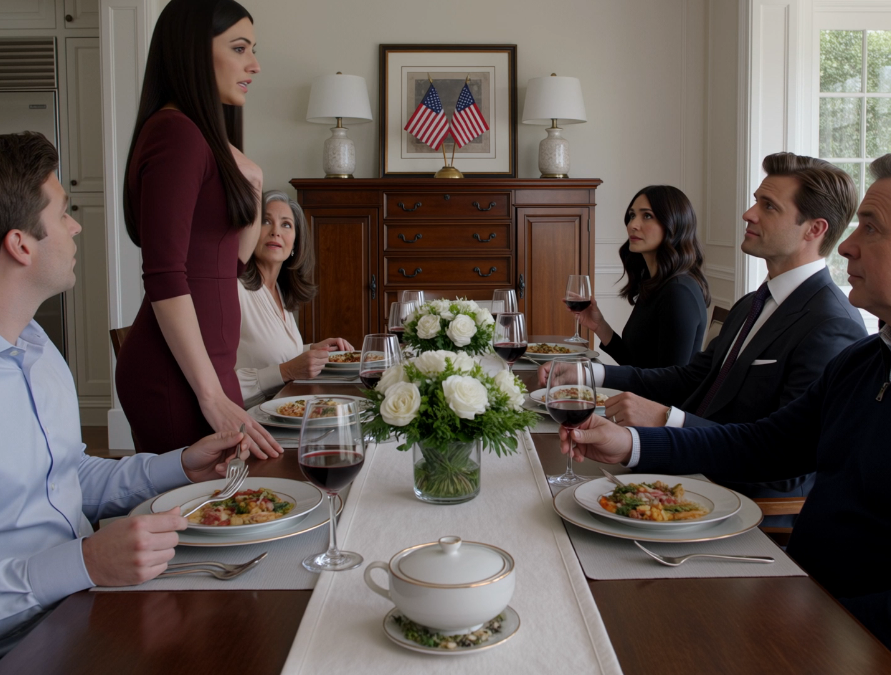
My sister pushed back from my dining table in the middle of the lamb course, pressed one hand to her collarbone as though she were about to deliver a confession in church, and announced to my entire family that she was carrying my husband’s child.
I kept my wineglass perfectly level. I did not set it down. I did not spill a single drop.
They were all watching me. My mother, Lorraine, frozen in the middle of reaching for the bread basket. My father, Howard, suddenly very interested in the grain of the walnut tabletop. My husband, Gavin, leaning back in his chair with a performance of reluctant honesty so rehearsed it might have worked on someone who hadn’t spent the past six months quietly building a case against him.
They had no idea that the case was already closed.
I am thirty-eight years old. I founded my brand strategy and crisis communications firm at twenty-six, working from a sublet desk in Kensington Market with $3,200 in my checking account and a single client who paid me in two installments. My firm now occupies two floors of a glass tower on Bay Street. I manage the reputations of provincial cabinet ministers, national athletic brands, and three of the largest publicly traded companies in the country. When a corporate scandal breaks at midnight, my phone rings first.
I am the woman you call when everything is on fire and you need someone who does not panic. So when my own house began to burn, I did what I always do.
I let it burn exactly where I needed it to.
Sunday dinners at my home in Forest Hill had been an institution for years. My institution. I had bought the lot, hired the architects, and overseen every structural decision while managing a full client roster. The result was a home that felt warm and effortlessly refined, with wide-plank oak floors, cathedral ceilings, and a kitchen that opened into a dining space where the light fell beautifully in every season.
That October evening, the table was set for six. The private caterers I had hired moved quietly through the background. The lamb was slow-roasted with rosemary and garlic. The wine was a Niagara Pinot Noir I had been saving for exactly the right moment.
This was the right moment.
Gavin, my husband of six years, sat at the opposite end of the table. He worked in private equity on Bay Street and was handsome in the way men are handsome when they know it. He had spent our entire marriage playing the role of the charming, cultured partner who gave my ambition a softer face at industry dinners. He was very good at the role.
He’d had a lot of practice.
My sister Claudine sat to my left. She was thirty-one, luminously beautiful, and had built a moderately successful lifestyle brand on Instagram by photographing herself in places I paid for and wearing clothes financed by her husband, Brett.
Brett was a quiet, methodical software architect who had been devoted to Claudine since the day they met at a mutual friend’s cottage in Muskoka three years earlier. He sat beside her, eating steadily, unsuspecting in every visible way.
My parents occupied the two remaining seats. Howard and Lorraine had been members of the Granite Club for twenty years. They golfed. They brunched. They cared deeply about what the right people thought of them.
They had spent my entire childhood making it quietly clear that Claudine’s softness and beauty were assets worth protecting, while my drive and self-sufficiency were simply convenient tools to be deployed whenever Claudine created a disaster too large for them to absorb on their own.
When Claudine stood up, it was Gavin who had been building toward something all evening. A theatrical clearing of the throat. A weighted glance across the table at my sister. I had watched the choreography of their plan playing out in real time and said nothing because I needed them to reach the moment they had been rehearsing.
Claudine beat him to it.
She pressed her hand to her chest, let her lips tremble at exactly the right frequency, and said she couldn’t carry the guilt any longer.
The room went still.
Brett looked up from his plate. Claudine did not look at her husband. She fixed her eyes on me, and they were already bright with tears.
She said she was sorry. She said it had happened gradually, that neither of them had planned it, that some connections were simply too powerful to fight. She said she was pregnant, that Gavin was the father, and that they were in love.
The silence that followed was the heaviest kind, the kind that presses into your chest and rings in your ears.
Brett’s fork struck the rim of his plate with a small, hard sound and slid onto the tablecloth.
My mother did not ask my sister how she could do this. Instead, she pushed back her chair, walked around the table, and gathered Claudine into her arms, smoothing her hair and murmuring that everything was going to be all right, that they would figure it out together as a family.
My father stared at his lamb with the focused intensity of a man pretending he had not already known this moment was coming.
They had known.
I understood it the way you understand something you have suspected for a long time. Not as a shock, but as confirmation of the worst thing you had hoped wasn’t true about the people you were supposed to trust most.
Lorraine looked at me over Claudine’s shoulder. What I saw in her face was not sympathy. It was the calculation of a woman who had already decided which daughter she was choosing and was now simply waiting for the other one to concede.
“Muriel,” she said carefully, “you have to understand the position we’re in. You have always been the capable one. You built your firm. You built this house. You manage everything with such precision. But Gavin has felt invisible inside this marriage for a very long time. Claudine is different. She sees people. She has always been emotionally present in a way that your career has simply not allowed you to be. You cannot be surprised that this happened.”
I set my wineglass down then, slowly and without a sound.
“What you’re telling me,” I said, “is that my husband getting my sister pregnant is a consequence of my professional ambition.”
Howard finally looked up. He had the expression of a man hoping to contain a fire with a damp cloth.
“Let’s not make this crueler than it needs to be. We’re a family. We handle this quietly among ourselves, with dignity. No lawyers, no press, no airing of private matters. You’re a communications professional, Muriel. You understand better than anyone how damaging public exposure can be. The right thing to do here is to absorb this gracefully and move forward.”
Absorb it gracefully.
I had been absorbing things gracefully my entire adult life.
I had absorbed Claudine’s failed vintage jewelry business when she was twenty-four, which my parents quietly asked me to cover with $12,000 from my early savings because Claudine was too fragile to face her own bookkeeping. I had absorbed the cell phone plan, the car insurance, and the Muskoka cottage weekend I had organized and paid for, where Claudine met Brett.
I had been the load-bearing wall of this family for fifteen years, and every time I bent under the weight, they called it strength and handed me something heavier.
Gavin had been listening to my parents with an expression of quiet satisfaction. He stood and buttoned his jacket.
“Your parents are being very reasonable, Mire.”
He said it the way he said everything: smoothly, with the confidence of a man who believed he had already won the room.
“I’ve had a document prepared.”
He reached for his leather folio and produced a stack of papers, which he placed on my side of the table with a gentleness that was somehow more offensive than if he had thrown them.
“I want this to be clean and private. I know how much your reputation matters to you, and I have no interest in a public spectacle. But my terms are non-negotiable.”
He looked down at me with the settled calm of a man who had rehearsed this moment many times.
“Fifty percent of the firm. The house. The joint investment accounts. Everything resolved within sixty days. If you contest any of it, I’ll go to every journalist in this city. I know your clients. I know their vulnerabilities. I know exactly how to frame a narrative about a woman whose personal life is a catastrophe, and I’ll make sure every boardroom in the country hears it before you can manage a single word of your own response.”
I looked at the papers on my table.
Brett had gone the color of old plaster. He was looking at his wife the way a person looks at something they have loved for a long time and suddenly cannot recognize.
He had come to this dinner with a bottle of Ontario Riesling because Claudine had told him it was a simple family meal. He had worn his good sweater. He had carried the wine with both hands.
He had given Claudine everything he had without ever questioning whether she was telling him the truth.
He had paid off $40,000 of what she called a bad influencer sponsorship deal the previous year, drawing down his own RRSP to cover it because she had wept and told him she was embarrassed, and he could not stand to watch her suffer.
He had renewed the lease on her Range Rover two months earlier. He had booked a trip to Portugal for the following spring because she said she needed something to look forward to.
Gavin was still outlining his terms. He was listing the investment accounts by name. He was describing with tremendous casualness which room in my home would make the best nursery.
Brett’s hand was on his wineglass. His knuckles had gone white.
Gavin turned to Claudine and told her not to worry, that he had thought through every detail, that some things were simply larger than intention.
Brett stood up.
He did not shout.
He lifted the wineglass and brought it straight down onto the table. The stem shattered, and the Riesling spread across the white linen in a cold, pale wash.
Brett’s palm was bleeding, and he did not even look at it.
He looked at his wife.
“How long?”
His voice was barely above a whisper and somehow carried every syllable.
Claudine tried the tears again. She said it had been complicated, that she had been confused, that she never meant to hurt him.
“I paid off your debt last year,” Brett said. “I did it because I believed you. I moved money out of my retirement savings to cover a loss you told me was an accident. Was any of it real, Claudine?”
What happened to Claudine’s face in the next three seconds was something I had been watching my entire life.
The trembling chin disappeared. The soft, wounded expression dissolved. What replaced it was colder and more calculating. The real face underneath the performance, the one she only let through when she had decided the performance was no longer worth maintaining.
She told Brett that he was a good man, but not the right man. She said he was reliable the way furniture was reliable. She said Gavin operated in the world with an authority Brett had never been able to match, that she had spent three years shrinking herself inside their life, and that she was done.
Brett took one unsteady step backward.
My mother screamed at him to get out of my house.
My father positioned himself between the two men, hands raised, lecturing Brett about restraint and dignity while his other son-in-law stood there, having just announced that he had impregnated one of Howard’s daughters while married to the other.
They were protecting Gavin.
They had come to this dinner having already decided whose side they were on, and they executed that decision with an efficiency that confirmed what I had suspected about the conversation they had almost certainly held before arriving.
Brett left.
The front door closed behind him with a controlled, deliberate sound that was somehow more dignified than anything else that had happened in my dining room all evening.
Gavin smoothed the front of his jacket. He picked up the gold pen he had laid beside the settlement papers and placed it next to my right hand.
“Sign it tonight, Muriel. You keep your dignity, and we keep this out of the papers.”
I looked at the pen.
I looked at the man who had stood beside me in a Niagara vineyard six years earlier and made me a promise while our families took photographs behind us in the golden September light.
I reached forward, picked up the settlement documents with both hands, and tore them in half. Then I tore them in half again and set the pieces on Gavin’s dinner plate.
The room erupted.
Gavin’s voice went tight and hard. My mother gripped my arm. My father spoke about legacy and optics and the sanctity of keeping family matters private.
Gavin reminded me that he had connections at every major media outlet in the country, that he knew which of my clients had vulnerabilities they paid me to protect, and that he was fully prepared to weaponize every piece of private information he had accumulated in six years of sitting beside me at industry events.
I let them finish.
Then I reached into my bag and placed a blue medical folder on the table.
“Open it,” I said to Gavin.
He stared at it.
Something shifted in his face, a small, involuntary tightening around the eyes that I had learned to read over years of watching him perform confidence he did not entirely feel.
He opened it.
I watched him read the letterhead of the private men’s health clinic in Yorkville. I watched him find his own name and date of birth, and the procedure code for the vasectomy he had undergone four years earlier without telling me.
While we were actively discussing having children, while I was scheduling consultations at a fertility clinic on St. Clair, while he was telling me patiently that these things took time and we simply needed to keep trying, he had decided unilaterally that he did not want children.
He had made that decision permanent without a single conversation and then spent four years watching me grieve a possibility he had quietly eliminated.
I had found the record six months earlier, buried in an insurance explanation of benefits he had asked me to organize when we switched providers.
He had forgotten it was in there.
I had filed it away and said nothing.
I had waited.
“Gavin,” I said, “tell the room what it says on page two.”
He could not speak, so I spoke for him.
“Four years ago, Gavin had a voluntary surgical procedure at a private clinic in Yorkville. The documentation is complete, and the outcome is permanent. Gavin cannot father a child. He has known this for four years and has not mentioned it to me or, evidently, to my sister.”
Claudine had gone absolutely still against the wall behind her chair.
Gavin turned to her. The performance of polished authority fell away entirely.
He asked the question in a voice that had nothing left in it.
“Claudine, whose baby is this?”
Claudine pressed herself harder against the wall. The tears were gone. What replaced them was the expression of someone calculating how much longer she could hold a position that had already collapsed.
“Answer him,” I said.
She shook her head.
“You can’t give him an answer,” I said. “Because there is no baby. There is no pregnancy. There is no other man.”
My mother sat down. My father removed his glasses and pressed his fingers to his eyes.
Gavin stared at me.
“What do you mean, there’s no pregnancy?”
“I mean the ultrasound photograph she showed you was purchased from a novelty site online for less than thirty dollars. I mean the positive test came from a private seller. I mean my sister has been mimicking morning sickness by drinking salt water before you met. And she’s genuinely good at it because she spent two years in community theater in her early twenties and never entirely left the stage.”
I held his gaze.
“There is no pregnancy, Gavin. There never was.”
Gavin said Claudine’s name.
He said it the way a man says something when he is trying to locate a solid surface to stand on and finding only air.
Claudine slid down the wall until she was sitting on my oak floor with both hands pressed over her face.
I continued.
“When I found Gavin’s clinic records six months ago, I knew immediately that Claudine was lying. What I didn’t know was why the plan was this elaborate. Why would she fake a pregnancy, convince my husband to detonate his own marriage, and engineer this entire dinner just to claim she was in love? It seemed disproportionate, even by Claudine’s standards.”
I looked at my sister, still sitting on the floor.
“So I had a professional look into her finances. Not the joint account she holds with Brett. The private accounts. The ones she opened under her business number three years ago.”
The room was absolutely silent.
“Claudine, you’re carrying $150,000 in personal debt that Brett doesn’t know exists. You borrowed it from a private lending operation that doesn’t operate through any institution the Financial Consumer Agency of Canada has ever heard of. You borrowed it to maintain a lifestyle that your influencer income stopped supporting two years ago.”
Claudine did not move.
“Those lenders have been calling for months. You’ve been out of options because Brett placed limits on your joint spending, and Mom and Dad can’t cover $150,000 without selling their home.”
I looked at Gavin.
“But I can. My firm can. My investment accounts can.”
He stared at me, and for the first time that evening, there was nothing calculated about his expression.
“Claudine knew she couldn’t come to me directly because I stopped giving her money after the jewelry business. She needed someone with access to my finances who was also angry enough at me to use it.”
I let the silence hold for a moment.
“She chose you, Gavin, because she knows precisely what you are. She told you that you were underappreciated inside this marriage. She told you that you were the real stability behind my firm’s success. She made leaving me feel like an upgrade.”
His gaze shifted toward Claudine.
“What you were was the tool. She needed you to demand my assets and believe you were entitled to them. The moment the settlement money cleared into a joint account, she would have been gone with it.”
Gavin stared at my sister on the floor.
She said nothing.
“You were not the plan,” I said. “You were the instrument. She chose you because you were greedy and available and close enough to my finances to be useful.”
He looked as though he wanted to speak, but no words came.
“And while we’re discussing what Gavin has had access to…”
I reached into my bag again and set a small flash drive on the table.
“My forensic accountant has completed her review of the past eight months of my firm’s secondary operating account. Eighty-seven thousand dollars transferred out in increments, booked as vendor payments to accounts that don’t exist, routed through a structure my accountant recognized within four hours of looking at it.”
Gavin’s face had gone pale.
“I have documented every transfer and every destination account, and I have retained outside counsel to determine the appropriate next steps. What I can tell you is that federal wire fraud is what that counsel is going to call it.”
Gavin made a sound that was not a word.
I did not look at him.
I looked at my mother.
Lorraine walked past Claudine on the floor and came directly to me. And I felt a small, terrible hope rise in my chest.
The same hope I had felt my entire life. The one that never fully died, no matter how many times it should have.
For one suspended second, I thought she was finally going to see me.
She pointed at the drive on the table.
“You need to destroy that tonight,” Lorraine said. “You transfer whatever is needed to cover Claudine’s debt, and you give Gavin enough to make this quiet. You handle this inside this family, where it belongs.”
Her voice was firm now, stripped of the soothing gentleness she had used with Claudine.
“You’re in communications, Muriel. You know how to restructure a narrative. Write the transfers off as a bad investment. Categorize it as a business loss. Whatever you need to do, do not bring investigators into our lives over money you can afford to absorb. Do not embarrass this family to prove a point.”
I looked at the woman who had held me in a hospital room thirty-eight years earlier and had been making decisions about my value ever since.
“You’re asking me to commit fraud to conceal a fraud,” I said.
Howard stepped forward. His voice was measured and paternal.
“We’re asking you to protect your family,” he said. “You have the capacity. Claudine does not. That is not a moral judgment. It’s simply the situation as it exists.”
He had the tone exactly right.
He always had the tone exactly right.
It was the same tone he had used every single time in my life that I was asked to absorb something I had not chosen. The tone that made sacrifice sound like privilege and boundaries sound like selfishness.
“I’ve spent my entire life being the load-bearing wall for the mistakes of the people in this room,” I said. “I’m not doing it anymore. Not because I want to punish anyone, but because what you’re describing would cost me my firm, my professional license, and potentially my freedom.”
I looked from my father to my mother, then to the man I had once believed I would spend the rest of my life with.
“And because I’ve finally decided that my peace is worth more than your comfort.”
I raised my hand and snapped my fingers once toward the hallway.
Both of the caterers set down what they were carrying.
They untied their aprons.
Underneath, they were wearing the dark uniforms of a private security firm, one of the most well-regarded in the Greater Toronto Area, known for discretion and effectiveness.
I had retained them three weeks earlier, when the outline of Claudine’s scheme had become clear enough that I knew how the dinner would need to end.
They had spent the evening pouring water and circulating quietly, completely invisible, the way people in service are always invisible to guests who are not paying attention.
Gavin stepped back against the wall.
My father’s false authority evaporated in an instant.
“I have four envelopes,” I said. “Three are formal notices that permission to be on this property is revoked, effective tonight.”
I turned toward Gavin.
“The fourth is from my solicitor. I’m not suggesting that a security contractor can eliminate your residential claim. That proceeds through the courts, and my counsel files first thing tomorrow morning. But you threatened me with fraud and extortion in my own home, and I’ve called the police to document the situation. You can leave voluntarily now, or you can explain the evening to the officers when they arrive. Either way, you’re not spending the night here.”
Claudine looked up from the floor.
Her mascara had tracked down her face in long, dark lines. The curated beauty was entirely gone. What was underneath was a thirty-one-year-old woman who had run out of performances.
She asked where she was supposed to go.
I looked at my mother.
“With you,” I said. “You’ve always told me that the capable one carries the vulnerable one. That the strong daughter has a responsibility to protect the fragile one. Now you can find out what that actually costs when the capable one is no longer available to do it for you.”
Howard tried once more.
He used the word family. He used the word legacy. He used the word disappointed, which had worked on me for thirty-eight years without interruption.
It did not work that night.
The security team walked them out with professional courtesy and no warmth.
And the front door closed with a sound I will remember for the rest of my life.
Clean and final and entirely mine.
I stood in the front hall in the silence of my own house and breathed.
That was eleven months ago.
The divorce was handled through the courts with the efficiency that comes from having a signed marriage contract, protected business assets, and a forensic accountant who could document every unauthorized transfer going back three years.
Gavin retained a lawyer who cost him money he did not have. The marriage contract held.
The criminal referral was made through outside counsel and moved at the pace these matters move, but it moved.
The last I heard through professional channels was that Gavin had been quietly terminated following an internal review at his firm. His Bay Street network had cooled with remarkable speed, and he was managing legal exposure that no amount of charm could redirect.
Claudine’s situation resolved without my involvement.
Brett’s counsel worked efficiently with what Brett had lawful access to: his own accounts, his own records, the purchase history, and the gaps in the timelines that didn’t add up when examined carefully.
The divorce was finalized in four months. The court did not look sympathetically on the documented financial deception. She received considerably less than she had planned for.
The private lenders did not care what the court awarded.
They cared about $150,000.
My parents began selling assets to cover it.
The cottage on Georgian Bay went first. Sixteen years in the family, gone in a private sale in under a month.
Then came the house in Leaside and a move into a two-bedroom rental in a neighborhood my mother had referred to for as long as I could remember as “not really us.”
I drove past the Leaside house on a Saturday morning in early spring, the week before the sale closed.
The realtor’s sign was on the lawn.
I slowed down and looked at the place where I had grown up, where I had been told at twenty-three that my savings were needed to cover Claudine’s first failure, where I had been measured against my sister for as long as I was old enough to understand measurement.
I looked at it for a long moment.
Then I drove to the office.
My firm now occupies two full floors on Bay Street. I tripled revenue in the eleven months following that dinner.
When I stopped spending my energy managing the manufactured crises of people who should have been managing themselves, I found that I had an extraordinary amount of capacity left.
I expanded into national accounts. I hired six people in the spring.
My vice president, Yolanda, who had been with me for four years and had helped me quietly vet the security team for that October evening, is one of the sharpest strategic minds I have worked with in my career.
And I told her so when I gave her the promotion last week.
Canadian Business Magazine included me in its annual feature on women reshaping Bay Street.
The photograph was taken in my office, at the window, with the lake visible behind me in the late September light.
I have the copy on my desk.
Gavin once told me in my own dining room that my ambition was the problem, that my drive had made me an insufficient wife, that my refusal to be invisible was the reason he had looked elsewhere.
I think about that sometimes.
I think about the years I believed, on some deep cellular level, that my capability was something I owed to people who claimed to need it. That being the strong one meant being the endless one. That I could not set down the weight without proving them right about the kind of woman I was.
The most important boundary I ever drew was the one I drew around my own life.
Not in anger, and not in grief, but with the steady hands of a woman who had finally decided that her peace was not a luxury she would keep deferring until everyone around her was comfortable.
I built this firm from a sublet desk and $3,200.
I built this life from nothing anyone gave me, and I will protect it with every tool at my disposal for exactly as long as I choose to.
The storm broke over my dining table eleven months ago, and when it passed, every false thing it had been holding up came down along with it.
What remained was entirely real.
And it was entirely mine.
Have you ever had to draw a hard line with the people who were supposed to protect you? Leave a comment and tell me where you finally found the courage to do it.








