At the gala, my husband told me to sit and watch and even said I couldn’t dance; I simply smiled: ‘not tonight,’ and minutes later, a world-class tango maestro walked past everyone and bowed only to me…
“Just stay at the table tonight, Iris. You’ve never really been comfortable at these things, and I need this to go smoothly.”
Maxwell Holt said those words with the practiced warmth of a man accustomed to managing rooms. He leaned toward me with a careful smile, one arranged for the benefit of the investors watching from three tables away. He smelled of cedar and single-malt Scotch, and his eyes were already moving past me toward the dance floor before he had finished speaking. What he didn’t know—what he had never thought to ask—was that I had once performed at La Scala. Not as a guest. Not from a seat in the audience. I had stood on that stage beneath the lights, performing in a program headlined by the Buenos Aires Tango Festival’s elite touring company. My name had appeared in bold letters on the program: Solé. It was a stage name I had buried so deliberately for five years that even hearing it silently in my own mind felt like pressing against a bruise. And in approximately forty minutes, Raphael Reyes, the man The New York Times had once called the architect of contemporary Argentine tango, would walk through the double doors of the Four Seasons Chicago and bow before me while three hundred of my husband’s colleagues watched. But Maxwell knew none of that yet.
The gala was Meridian Development Group’s annual showcase dinner, held in the Grand Ballroom on the second floor of the Four Seasons on East Delaware Place. Maxwell had spent months coordinating this particular evening. Meridian had just completed its most ambitious project, a mixed-use arts and hospitality complex on the North Shore that included three dedicated performance venues, and tonight marked the formal unveiling of that vision to institutional investors and civic partners. The ballroom smelled of white roses and catered wealth. Crystal chandeliers scattered prismatic light over a sea of dark tuxedos and designer gowns. At the far end of the room, a broad expanse of polished hardwood had been deliberately cleared for dancing. I had avoided looking at that floor since we arrived, not because I was afraid of dancing, but because I was afraid of the particular way my body might remember it. There was a muscle memory that lived beneath conscious thought, an instinctive adjustment of my left hip toward the music the moment a live ensemble began to play. I knew how quickly it could awaken.
I had spent five years learning to suppress that reflex. During the first year after the accident, suppressing it had felt like survival. By the third year, the habit had hardened into something I called preference. By the time Maxwell and I married, I had perfected the art of appearing mildly disinterested whenever a dance floor came into view. Maxwell, brilliant and ambitious but fundamentally incurious about the life I had lived before meeting him, accepted that explanation without a single follow-up question. He knew I had suffered an ankle injury. That was the entirety of his knowledge, and he had never wanted to learn more. Perhaps there had been a time when I wanted him to ask. Eventually, I had become so accustomed to his silence that I stopped expecting anything different.
Cassandra Voss appeared at his elbow before the first course had been cleared. She was Maxwell’s vice president of brand partnerships, the sort of woman who moved through corporate events as though she were directing them from within. Her dress was a deep sapphire blue that brought out the copper tones in her hair. She rested one hand on Maxwell’s arm with the easy familiarity of someone who had occupied this metaphorical table long before I arrived. “The orchestra coordinator confirmed the cue,” she told him, offering a private smile before turning toward me with carefully measured warmth. “Iris, are you feeling all right? You look a little pale.” I told her I was fine, but she made a small, sympathetic sound. “The ballroom does get warm. And I imagine these evenings can be a lot, especially if dancing really isn’t your thing.”
She said it gently, in the way people deliver conclusions they have already decided are true without bothering to ask. “Maxwell mentioned you’re not really a dancer,” she added. I looked at her. “Maxwell mentioned that?” Cassandra smiled and turned back toward him. “We should go over the entrance sequence one more time before—” I interrupted before she could finish. “You rehearsed a sequence?” Maxwell straightened his cuffs, wearing the expression he always adopted when redirecting a conversation he considered inconvenient. “It’s the flagship unveiling of the North Shore project. The performance venues are our centerpiece. It made sense to open the floor with something that demonstrated our commitment to the arts.” He pronounced the word arts the same way he pronounced synergy, with complete confidence and no particular understanding. “Cassandra has a background in stage production. She helped design the routine.”
Cassandra extended her hand as the orchestra began to tune. “Ready?” Maxwell took her fingers without hesitation, with the unconscious ease of someone repeating a gesture that had become habitual. As he turned to follow her toward the dance floor, he glanced back at me one final time. “Just relax. You’ll enjoy watching.” I watched them walk away. Several investors seated at the neighboring table watched me watching them. I picked up my champagne glass and held it without taking a drink. The ballroom lights softened as the musicians settled into position, and conversations gradually faded beneath the opening notes.
When the music began, Cassandra moved through the first measures with the disciplined ease of someone who had spent genuine hours in a studio. Maxwell was considerably less polished. He possessed all the confidence of a corporate executive and none of the genuine surrender the dance required, but he was presentable enough, and the assembled guests seemed charmed. Applause rose in waves as they circled the hardwood. I barely noticed their footwork. I was listening instead to the musical structure beneath their movements, hearing the phrases in the particular way you do when the music has once belonged to you. Every accent carried a familiar weight. Every pause seemed to leave room for a memory I had spent years trying not to recover.
Then Cassandra executed a transition in the second phrase. It involved a specific release of the left axis, followed by a delayed step into the open lane, resolving in a controlled rotation of the torso. The audience applauded the flourish, but I went completely still. I had written that transition. Not a variation of it. Not something vaguely similar in interpretation. I had created that exact movement on a Thursday afternoon in a studio on the outskirts of Buenos Aires, sitting on the floor with a cheap notebook and a pencil stub while I worked through a problem in the second act of a piece I had titled Still Water. I had spent three days developing that single phrase. Even now, I could remember the humid air in the studio and the precise way the old fan in the corner rattled every few seconds.
Cassandra did not merely know the step. She performed it with the confidence of someone who had learned from an authoritative source, not someone guessing at an interpretation but someone following a template. There was the slight hesitation before the weight transfer, the angle of her chin during the pivot, the relaxed position of her free foot before the final beat. Those details had belonged to my choreography. I set my champagne glass down. The master of ceremonies was speaking into the microphone again, thanking Maxwell and Cassandra as the applause continued, but my thoughts had returned to that studio in Buenos Aires five years earlier, where I had worked through the same phrase again and again until it finally opened into something true. For a moment, the crowded ballroom seemed very far away.
“We do have one more surprise for our guests this evening,” the master of ceremonies announced, his voice rising with the particular excitement of someone preparing to reveal something genuinely impressive. “He is currently in Chicago as an adjudicator for the Great Lakes International Dance Symposium. Please welcome to the Four Seasons one of the most celebrated figures in contemporary tango, Maestro Raphael Reyes.”
The response told me immediately how much the arts and entertainment guests understood the significance of that name. Several people rose halfway from their chairs, and a woman seated at the investment table to my left covered her mouth with one hand. Maxwell, returning to our table and still flushed with the satisfaction of his performance, frowned toward the stage. “That’s not in the program. How did he get on the schedule?” Across the ballroom, Raphael appeared. He was older than I remembered. Silver had completely overtaken his hair, and the lines around his eyes had deepened. Yet he walked exactly as he always had, as though the floor were calibrated to his particular frequency. His movements were unhurried, precisely weighted, carrying the strange impression of a man who existed slightly outside ordinary time.
Raphael accepted the microphone and offered a few gracious words about Chicago’s arts community. When the master of ceremonies laughingly suggested that perhaps the maestro might select a partner for a brief demonstration, Raphael returned the microphone with a quiet nod. “I’ve already selected her,” he said. He did not turn toward the front tables, where two professional company dancers had been strategically positioned. Instead, he looked across the ballroom, past the investors and civic officials, past Cassandra, who remained standing at the edge of the cleared dance floor, until his gaze found me. There was no uncertainty in his expression. He had known exactly where I was sitting.
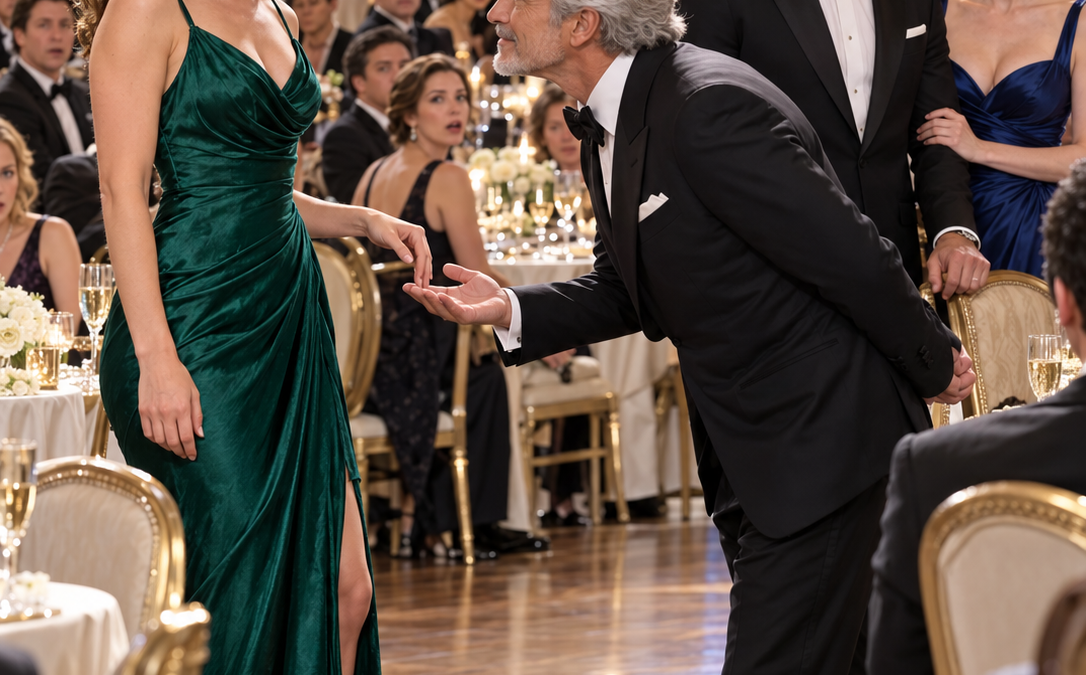
As Raphael began walking toward me, I felt the old tightness return to my left ankle. It was not exactly pain, but the phantom architecture of a memory: the hollow corridor of a hospital in Buenos Aires, the orthopedic surgeon’s carefully compassionate voice explaining what the damage meant for the kind of dancing I had been doing. Maxwell turned and stared at me. “Iris, do you know that man?” Raphael reached our table and bowed with a grace that probably had not been witnessed in a Chicago ballroom in a generation. He extended one hand, palm upward, and looked at me with the particular patience of someone who had been waiting a very long time. “It’s been five years,” he said, softly enough that the words almost belonged to us alone. “I’ve been hoping to see you dance again.”
I heard Maxwell say something sharp and territorial behind me. Cassandra made a sound I could not quite identify. I kept my attention on Raphael. “I’m not what I was,” I told him. He did not withdraw his hand. “That was never my concern.” Maxwell spoke again, his voice tight beneath its attempt at composure. “Iris. How do you know this man?” I did not answer. I was studying Raphael’s open palm and the extraordinary patience in that simple gesture. I was remembering the evening I signed my discharge papers at the clinic in Buenos Aires and told myself that dancing was finished for me, finally and forever. At the time, the declaration had felt less like a decision I had made than something that had been decided on my behalf.
Raphael’s assistant appeared beside my left shoulder carrying a small black zippered bag. Raphael nodded, and the assistant opened it. Inside was a pair of low-heeled, matte-black tango shoes, exactly my size. I closed my eyes briefly at the sight of them. “Iris,” Maxwell said again, sharper this time. “You don’t have to do this. You’ll hurt yourself, and frankly, this is not the moment for—” I interrupted him. “I know.” He seemed to take that as agreement. “Then sit down.” I turned to look directly at him, without the careful management of my expression that I had practiced throughout our three years of marriage. “Maxwell, I’ve been sitting down for five years.”
I unclasped my heels and placed them beneath the table. The hardwood felt cool against my bare feet during the three seconds it took to slip into the tango shoes and fasten their ribbons. As I stood, Cassandra moved toward me. The warmth had vanished entirely from her voice. “Iris, your ankle is badly damaged. You told me yourself you shouldn’t push it. At a corporate event, the liability alone—” I looked at her. “When did I tell you that?” Cassandra blinked. “Maxwell mentioned—” I held her gaze. “Maxwell mentioned,” I repeated. Something in my tone stopped her from continuing. I turned back to Raphael, took his offered hand, and walked with him toward the center of the dance floor.
Three hundred people fell completely silent. The orchestra director looked toward Raphael, who raised two fingers. The tempo that followed was deliberate and restrained. The opening phrase asked nothing athletic of me, nothing that required the old recklessness. It asked only for presence and attention, for the willingness to listen. I did not move during the first measure or the second. On the third, I allowed my left foot to trace a slow diagonal arc across the floor, and I felt Raphael’s entire body recalibrate to meet me. Not to lead me. To meet me. Whatever Maxwell saw from the table, whatever the investors or civic partners believed they were witnessing, I cannot say precisely. I only know that I was not performing. I was resuming a conversation that had been interrupted five years earlier and never properly finished.
Raphael offered a direction. I held my position for one breath longer than he expected, then stepped into it differently from what he had anticipated. I watched his eyes change with something between recognition and delight. He adjusted, and together we renegotiated the next phrase in real time. Somewhere in the third section, my left ankle registered its old complaint. I acknowledged the sensation without ignoring it or surrendering to it, modifying the geometry of my movement without breaking the line. Raphael understood the adjustment with the sensitivity of a musician hearing a change of key. He reshaped his lead around the reality of my body as it existed now, rather than the body he remembered from five years earlier.
In the final phrase, he gave the floor to me. Eight bars. One extended line of movement that I built from the ground up, through the ankle, through the hip, through a rotation I had not performed in five years and was only now discovering I still possessed. The last note landed precisely on the downbeat. I cannot remember the exact instant the silence broke. I remember it building instead: someone beginning to clap somewhere behind me, another person joining, then a wave of applause spreading through the ballroom until the sound seemed to rattle the crystal on the tables.
Maxwell was not applauding. He stood at the edge of the floor with his hands hanging at his sides, staring at me the way a person might stare at a wall that had unexpectedly revealed itself to be a door. Near the front of the stage, a prominent arts philanthropist rose to her feet and spoke, not into a microphone but simply aloud. The room was quiet enough for nearly half the guests to hear her. “My God. Is that Solé?” I heard the name land in the ballroom. I watched it register on Maxwell’s face, and then I watched it reach Cassandra’s face, where it produced an entirely different reaction.
Maxwell crossed toward me while the applause was still continuing. He kept his voice under careful control. “Who is Solé?” I looked at him. “Someone you don’t know.” His jaw tightened. “Iris.” I remained steady. “You never asked, Maxwell. In three years, you never asked what the injury was from, or what I was doing in Buenos Aires, or what I had spent the previous decade of my life building. You knew I had a bad ankle. That was enough for you.” He seemed to struggle against the accusation before answering. “You didn’t offer.” I nodded. “No. I didn’t. That’s also true.”
Raphael appeared at my shoulder, and what he said next quietly turned everything I believed I understood about the previous five years inside out.
“The workshop footage has been recovered,” he told me.
I went still. “What workshop footage?”
“The Buenos Aires intensive. The full session where you developed the Still Water sequence.” He paused, studying my expression before continuing. “And there is something else. The facilities archive team found internal correspondence from that period. Iris, the transfer of your unfiled choreographic frameworks to a third-party management company was initiated before you were discharged from the hospital.”
Around us, the ballroom continued to celebrate. Somewhere nearby, Maxwell was asking Cassandra a question I could not make out. Cassandra’s face had gone the color of old paper. I looked at Raphael. “Before I was discharged?” He nodded. “Three days before you were released. Before you’d signed anything. The paperwork was generated while you were still in recovery.”
The sequence assembled itself in my mind with terrible, methodical clarity. My ankle had given way on a newly installed portable floor. It had happened near the stage-right wing, on a particular section of flooring the stage manager had flagged for inspection but that had somehow never been formally checked. The workshop schedule had been altered at the last moment to move the installation date forward, ensuring that the floor would be in place for my dress rehearsal. And the framework documents for Still Water, which I had uploaded to the shared company server the morning before rehearsal, had been accessible to everyone with a production role. For five years, I had believed what happened to me was an accident.
I sat with Raphael in a quiet room off the hotel corridor for forty minutes. When Maxwell knocked and Raphael’s assistant told him to wait, he actually waited. That alone was something of a revelation, because in all the years I had known Maxwell Holt, I had never seen him willingly wait for anything. Raphael spread a collection of documents across the table and began walking me through the chain of title. My unfiled choreographic frameworks—the foundational structural documents for Still Water and two other pieces I had been developing that year—had been bundled into a creative-assets package by a Buenos Aires production firm after the company collapsed under debt following my injury. That package had subsequently been sold to a U.S.-based arts management nonprofit, which had spent the intervening years licensing portions of the material to various commercial entities.
One of those licenses had been executed eighteen months earlier for a significant sum. The buyer was Meridian Development Group, and the material had been acquired specifically for performance programming at the new North Shore Arts Complex. The transaction had been brokered by a consultant with extensive knowledge of the Buenos Aires arts community and direct ties to the original production firm. I stared at the documents while Raphael explained the connections. Cassandra Voss had lived in Buenos Aires for two years as a young production assistant. She had worked for the company during the period when I was developing Still Water. The implications were beginning to take shape before I was ready to acknowledge them.
When Maxwell finally entered the room, he examined the documents Raphael had arranged across the table and remained silent for a long time. He was a man who processed information architecturally, searching for load-bearing elements and structural weaknesses, identifying which parts of a system could withstand pressure and which might collapse. I watched him read. I watched the exact moment the signature on the consulting agreement registered. He looked up from the page. “She brokered this purchase?” I nodded. “Yes.” His gaze moved between the documents and my face. “Did she know the material was yours?” I considered the question for a moment. “The movement vocabulary of Still Water is about as generic as a fingerprint.”
Maxwell looked down again, this time at the acquisition date. Something complicated passed across his face. “This was signed four months before our wedding.” The significance of that timeline did not escape me either. For several moments, neither of us spoke. The papers lay between us, carrying the kind of information that could rearrange an entire history without altering a single event that had already happened. What followed was not one dramatic confrontation, but a succession of smaller ones, each more uncomfortable than the last.
Maxwell summoned Cassandra to a formal meeting the following morning. He arranged the documents in front of her methodically, the way I imagined he presented architectural plans to contractors, establishing the relevant facts before making his demands. She lasted approximately twenty minutes before her account began to unravel. She had known who I was from the moment Maxwell introduced us. She had recognized my first name, connected it with my history in Buenos Aires and the ankle injury, and understood within minutes of our first dinner together that I had once been Solé. She had also understood exactly what she stood to lose if I ever began to reclaim that part of my life.
Cassandra had not caused the original ankle injury, but she had known what caused it. The stage manager who moved the floor-installation date had been responding to pressure from the production company’s business director. That director had been quietly negotiating the sale of the company’s creative library while the performance season was still underway. He needed to ensure that the company’s star choreographer did not sign an international intellectual-property protection agreement before the transfer could be completed. The premature installation of the portable floor, the neglected inspection, and the timing of the accident now occupied a different place in the sequence of events. A serious ankle injury, one capable of ending a career, had provided the time necessary for the transaction to proceed.
Cassandra had known enough to understand what was happening. She had been a junior production assistant, close enough to overhear the conversations that mattered but without any formal authority over the decisions being made. She chose to remain silent. Over the years, that silence had been rewarded with introductions, professional references, and eventually her position at Meridian. The same business director who had overseen the original negotiations had helped guide her career. He now operated a private arts management firm in New York. Cassandra had not tampered with the floor or personally engineered my injury. She had simply watched, understood, and kept quiet. Then she had allowed that silence to continue paying her long after the damage was done.
I did not attend the board meeting where Maxwell disclosed the scope of the acquisition irregularities to Meridian’s institutional investors, but I read the summary afterward. He presented the matter in language I recognized as his own: not sentimental, not personal, but structurally sound. If intellectual property could not be verified as having been legitimately transferred, it could not be legitimately commercialized. The threat to the firm’s long-term credibility exceeded any short-term revenue consideration. Three of the five board members initially resisted that position. Maxwell overrode their objections. Whatever else I believed about him, I understood that he was taking a position that did not serve the immediate financial interests of the project he had spent so much time building.
He called me that evening, and I answered. I think that surprised us both slightly. “The North Shore performance venues open in the spring,” he told me. “The programming director position is vacant. The board approved an outside search.” I listened without interrupting. “Is that an offer?” I asked. “It’s a fact I wanted you to have.” I sat with that answer for a moment before asking the question that had been waiting beneath everything else. “Maxwell, did you know? When you acquired that creative library, did you know any of it?”
He was silent for long enough that I found myself trusting whatever answer came next. “No,” he said finally. “I didn’t have the fluency to recognize it. I saw commercial performance assets with strong metrics and a clean purchase agreement.” He exhaled, and when he continued, his voice sounded unusually stripped of its professional certainty. “I saw exactly what I was shown and nothing else. Which is a failure of a different kind.” I looked at the phone in my hand. “Yes,” I said. “It is.” Another silence settled between us. This one felt less like avoidance than the uncomfortable space left when neither person could find anything untrue to say.
“Iris,” he began again, “at the gala, when I told you to sit down and watch—” I closed my eyes briefly. “I know.” He continued anyway. “I didn’t know what I was asking you to do.” I opened my eyes. “No,” I said. “You didn’t.” The distinction between deliberate cruelty and spectacular structural ignorance was something I was still learning how to hold. Maxwell had not consciously intended to diminish me. He had simply never been curious enough to discover who he might be diminishing. Understanding that distinction did not immediately make it easier to live with, but it mattered.
Two days later, I met Raphael for coffee at Intelligentsia on Randolph Street. Chicago was doing its familiar November thing, gray and bluntly honest, offering no flattering light to soften the edges of anything. Raphael had the spring roster for the Great Lakes Symposium spread across the small table between us. He tapped a line on the page. “Guest choreographer residency,” he said. “Six weeks. The symposium underwrites it entirely. You develop new work on your own terms, using your name.” I studied the printed page, trying to absorb the simplicity of what he was offering. “My name?” I asked. Raphael looked at me with an expression that made the answer seem obvious. “You were always just Iris,” he said. “You can have that back for free.”
I laughed. It was a small sound, but a real one. “The ankle will limit what I can develop.” Raphael did not seem troubled. “Then develop within those limits. The most interesting choreography usually comes from constraint, not freedom. You know that.” And I did know it. I had known it before the injury, before the hospital, before the years of trying to convince myself that the life I once lived had become permanently inaccessible. I had simply spent five years pretending that constraint represented the end of the story rather than the beginning of a different one. Sitting across from Raphael, with the residency agreement between us and the gray November light filling the café windows, I began to understand how thoroughly I had mistaken those two things.
I signed the residency agreement on a Monday. On Wednesday, I filed a formal intellectual-property claim concerning the Still Water frameworks, supported by the documentation Raphael’s archive team had assembled and a legal brief prepared by the firm my attorney had retained. The process would take months. It might not be fully resolved for a year or longer. The man who had orchestrated the original transfer had already retained his own legal team and issued a series of carefully worded denials. I understood that recovering legal ownership of the work would be more complicated than identifying where it had gone. There were years of transactions to examine, documents to authenticate, and claims to establish. But now a formal record would exist. My name would be attached to it. No one would be able to erase that name again without leaving evidence of the erasure.
Maxwell and I had dinner in late November at a restaurant on Armitage Avenue. It was his choice, which meant he had actually asked someone for a recommendation instead of automatically selecting the firm’s preferred expense-account restaurant. The place was a small neighborhood Italian spot with handwritten menus and no valet service. We sat across from each other in a booth beside the window and had, for the first time in three years of marriage, an almost entirely honest conversation. He asked what Buenos Aires had been like. He asked what Still Water was about. He listened while I answered, without redirecting the conversation toward something he understood better. Eventually, he asked the question that seemed to cost him the most. I could see the effort it required. “Why did you never tell me?”
“Because you never asked,” I said. “And because I decided the version of me you knew was safer.” Maxwell studied me for a moment. “Safer for whom?” I looked toward the window and considered the answer before giving it to him. “For both of us. I didn’t want to be someone with that kind of loss. And you didn’t want to be married to someone complicated.” He did not deny it. There was a time when his silence would have made me angry, when I would have interpreted it as another refusal to acknowledge something uncomfortable. That evening, I simply allowed the silence to remain. “I’m trying to want different things,” he said eventually. “I don’t know how good I’ll be at it.” I looked back at him. “I believe that,” I said, and I meant both parts of his admission.
We did not reconcile that night. Nothing was resolved with a neat conclusion, and neither of us pretended otherwise. We paid the check separately, stepped out into the November cold, and stood on the sidewalk for a moment with the uncertainty of two people who could not decide whether they should share a cab. Maxwell kept his hands in his coat pockets. “The spring programming roster,” he said after a while. “If the board approves the symposium partnership, your residency work might be eligible for the North Shore premiere season.” I nodded. “I know. I read the proposal. And if the work is good enough, it should stand on its own in front of a neutral selection committee, not because you owe me a stage.”
He considered that for a moment before nodding slowly. “That’s fair.” I shook my head. “It’s not about fair, Maxwell. It’s about what the work actually is.” A cab turned the corner, and I raised my hand. Maxwell remained where he was, watching as the driver pulled toward the curb. Before I opened the door, I turned back once. “The dinner was good,” I told him. “The restaurant, I mean. Good choice.” He almost smiled. “I asked my assistant. She’s been going there eleven years, and apparently it’s her favorite.” I looked at him for a moment, then opened the cab door. “See?” I said. “Asking people things. You’re getting better at it.”
The cab pulled out onto Armitage, and I watched Chicago through the rain-blurred window. The storefronts along Lincoln glowed against the wet pavement. Oz Park formed a dark wedge at the intersection, its trees barely distinguishable beneath the overcast night sky. The city looked the way Chicago often looked after dark, as though it were perpetually in the middle of deciding something. I sat with my hands in my lap, watching the lights slide past the glass. My left ankle rested against the floor of the cab, steady and present and mildly unreliable. That was simply what it had become. I no longer needed to pretend otherwise.
For five years, I had stood before a door I had decided I was not permitted to open. What I understood now, sitting in that cab and moving through a city that neither knew nor cared what I had once been on a stage in Buenos Aires, was that no one had locked that door. I had done that myself, out of grief, out of pride, out of the particular exhaustion of being someone who loses one enormous thing and cannot bear to confront all the smaller losses that follow. I had mistaken my decision to remain outside for proof that there was no way back in. The truth was more complicated than that, but it was also much simpler.
The symposium residency began in February. I named the new piece Groundwork. It was nothing like Still Water. The movement was quieter, more interior, built around the physical limitations of an ankle that would never entirely trust itself again. I did not try to recreate the choreography I had made before the accident, and I did not ask my body to pretend the intervening years had never happened. The work emerged from the reality of what remained possible. The dancers in the company approached it with a seriousness that moved me in ways I had not expected. They listened to the music, studied the spaces between movements, and treated every limitation as part of the composition rather than an imperfection to conceal.
On opening night, I stood in the wings and listened as the first note of the cello dissolved into the darkness of the auditorium. Beyond the curtain, the audience waited for the movement to begin. I did not watch from a table at the edge of the room. I did not sit quietly with a champagne glass I had no intention of drinking. I stood exactly where I had always belonged, in that space between the music and the movement, with my name printed on the program and my eyes wide open.








