At my sister’s wedding, i found my seat – a folding chair near the restrooms. her maid of honor whispered, ‘she said you’d be fine back here.’ i looked around—even distant cousins had front-row seats. i left my gift on the cake table and walked out. ten minutes later, she was crying in her dress outside the venue…
My name is Daniel. I’m 27, and this is the story of the last time I ever let myself feel like a background character in my own family.
My sister Amanda is two years older than me. Growing up, we were never especially close. She was always the golden child, the one who got straight A’s, had the perfect boyfriend—now husband—and never forgot to remind everyone how helpful she’d been in organizing Mom’s birthday or Dad’s retirement party.
Me? I was the quiet one. I kept to myself and did my own thing. I got into art school instead of studying business like our parents wanted, and somehow, that became my permanent identity in the family: the sensitive, struggling artist. It didn’t seem to matter that I’d eventually landed a stable job and moved into my own place. To them, I was still the same kid who’d chosen the wrong path.
But I didn’t mind it much. At least, not until Amanda’s wedding.
Amanda got engaged last year, and from the moment she announced it at our parents’ Christmas dinner—complete with a slideshow, I kid you not—the entire family seemed to lose their minds. Suddenly, everything was Amanda this and Amanda that. My mom started calling me just to talk about Amanda’s wedding plans. Every family group text turned into a stream of bridal shower updates, venue photos, and countdowns to the big day.
At first, I thought, Okay, she’s the bride. Let her have her moment. I even congratulated her genuinely and told her I was happy for her. And I meant it. Whatever our relationship had been growing up, I wasn’t interested in competing with my sister over her own wedding.
But slowly, I started noticing things.
For example, Amanda never asked me to be in the wedding party. That didn’t really surprise me, but it still stung a little. I saw photos later of her fiancé’s younger brother holding her veil and my cousin Tyler, whom she only sees once a year, standing beside her in a tuxedo. I figured maybe she was keeping the wedding party small, but nope. There were ten people on each side. Ten.
I was invited, of course, but only as a guest. No speech, no reading, no special mention. Nothing that suggested I was her brother rather than some distant acquaintance who happened to share her last name.
Still, I tried not to take it personally. Maybe she assumed I was busy with work. Maybe she just didn’t think I’d be into that kind of thing. That’s what I told myself repeatedly, because finding excuses for Amanda had become something of a family tradition, and apparently, I was still participating.
Then came the rehearsal dinner.
I showed up on time, gift in hand, dressed respectfully. Amanda barely acknowledged me. She was laughing with her bridesmaids at the other end of the table, and when I went over to say hello, she gave me one of those fake smiles people give waiters when they’re annoyed.
The whole night, no one really talked to me. Not Mom, not Dad, not even my aunt, who usually corners me to ask if I’m dating anyone. I sat there surrounded by people I’d known my entire life, somehow feeling like the only stranger in the room.
When I left, I had this weird feeling in my chest, like I’d just watched a movie where everyone knew their lines except me. I didn’t say anything. I just nodded goodbye, walked out, and drove home in silence.
Still, I showed up the next day.
The ceremony was at this beautiful lakeside venue, all white roses and twinkling lights. I wore my best suit, brought the gift Amanda had listed on her registry—an absurdly expensive Vitamix—and walked into the reception hall looking for the seating chart.
That’s when I felt it. That moment, you know, when your stomach kind of drops and your mind struggles to catch up with what your eyes are seeing.
My name was scribbled in the bottom corner of the chart. It wasn’t even typed like the rest. It was handwritten. Amanda had arranged perfect calligraphy place cards for everyone else, but mine looked like a last-minute addition. I actually had to double-check that it said Daniel because the handwriting was barely legible.
Table 19.
I looked around for the table, couldn’t find it, and eventually asked one of the ushers where it was. She glanced at the chart, then at me, before leading me through the main hall, out a side door, and into a strange little alcove near the restrooms.
And there it was.
A folding chair. One.
No table, no other guests, no decorations. Just a single white plastic chair with my name card taped to the back. It was directly across from the kitchen entrance, where servers bustled in and out carrying trays of food. The sound of dishes and swinging doors filled the narrow space.
I stared at it, genuinely thinking there had to be some mistake. Maybe they’d moved the table. Maybe someone had mixed up the numbers. Maybe this was some kind of temporary holding area and I was supposed to be seated somewhere else.
Then Amanda’s maid of honor walked by. She did a double take when she saw me standing there.
“Oh, yeah,” she said. “You’ll be fine back here.”
She gave a weak shrug, almost like she was embarrassed for me, then walked off before I could even respond.
I stood there stunned. I looked around again, trying to make sense of what had just happened. Every table in the main hall was packed. Even our third cousins from Ohio had prime seating. Through the doorway, I could see Amanda laughing at the head table, clinking glasses with her new in-laws.
She didn’t even glance in my direction.
For a moment, I felt like I was ten years old again, being told to sit this one out while Amanda showed off for guests in the living room. It was that same familiar feeling, that quiet certainty that everyone else belonged somewhere and I was supposed to be grateful for whatever space remained.
I clenched my jaw, turned back toward the hallway, and quietly made my way to the cake table. It was near the front of the room, right beside the dance floor.
I placed the Vitamix gift bag deliberately in the center of the table.
Then I walked out without saying a word.
No drama. No announcement. No confrontation. Just silence.
The cool evening air hit me as I stepped outside, and for a moment, I felt tears prick at the corners of my eyes. Not because I was sad, but because I was furious. Furious that I had let this happen again. Furious that I’d spent years telling myself to be understanding, to give people grace, to avoid making things awkward.
I was halfway across the parking lot when I heard someone yell my name.
I turned, and there she was.
Amanda, in her wedding dress, running across the gravel parking lot in heels. Her hair was slightly frizzy, her bouquet half-forgotten in one hand.
“Daniel!” she called again, louder, her voice shaky.
I didn’t move. I just watched her coming toward me, and the whole thing looked like some twisted scene out of a romantic comedy. Except the groom wasn’t the one running after the bride. It was her brother, standing in the parking lot because he’d apparently been too inconvenient to seat with the rest of the family.
She stopped a few feet away, breathless.
“Where are you going?” she asked, as if it wasn’t obvious.
“I think you made that pretty clear,” I said.
Her face fell. “Wait, can we talk?”
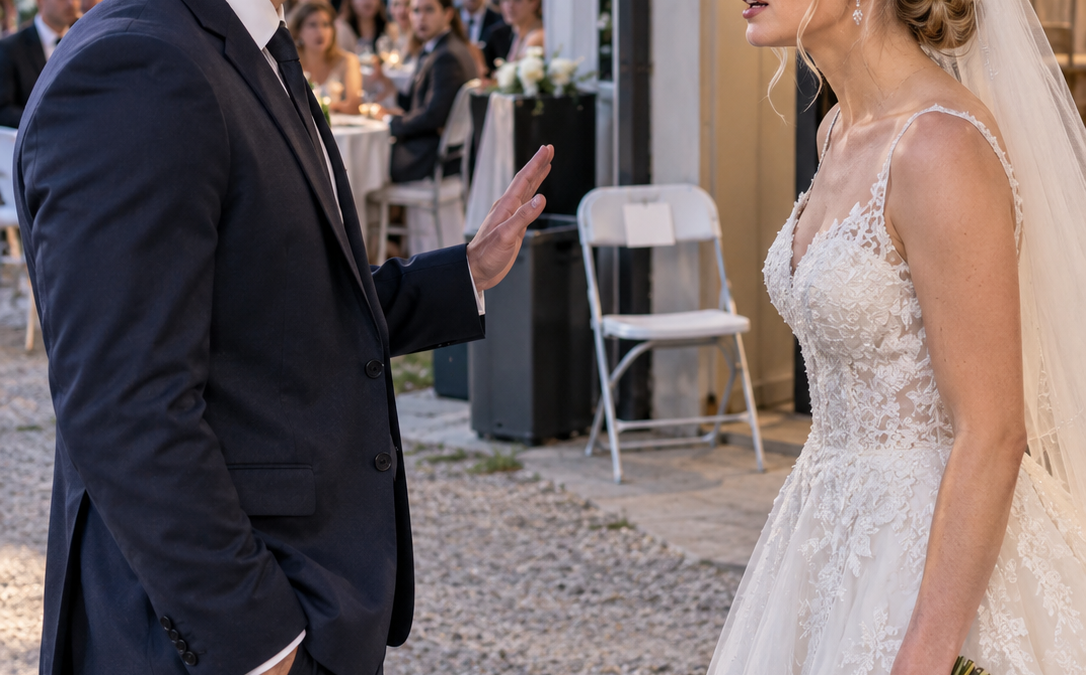
I didn’t respond. I just stared at her, waiting to see whether she’d actually say something meaningful. Something real. And just as she opened her mouth to speak again, I raised my hand. Not angrily, just enough to stop her.
“No,” I said. “Not here. Not like this.”
Amanda blinked, confused. “Daniel, it’s my wedding day.”
I let out a short breath, the kind that’s part laugh and part disbelief.
“Exactly. And somehow that meant I didn’t even deserve a seat at a table.”
She looked around, as if realizing for the first time that we were standing in the middle of the gravel parking lot in front of the venue. Cars were parked in neat rows. Music drifted through the open reception hall doors, and a few guests were staring at us through the windows.
“It wasn’t meant to be like that,” she said quietly. “We just… we ran out of space.”
I shook my head.
“Amanda, there were twenty tables in there. Ten people at each. I counted. And yet you somehow found space for everyone else, including people you haven’t seen in five years, but your own brother got a folding chair by the restrooms.”
She fumbled with her bouquet, refusing to look directly at me.
“It’s not what you think.”
I raised an eyebrow. “Okay, then tell me. What is it?”
There was a long pause.
She didn’t answer.
That silence told me everything I needed to know. She didn’t have a reason. Or maybe she did, but she didn’t think I deserved to hear it. Either way, she stood there in her wedding dress, staring at the gravel, while I waited for an explanation that wasn’t coming.
And that’s when something in me snapped.
Not in a loud, explosive way. In a quiet, irreversible one, like a door clicking shut behind you.
“You know,” I said, my voice calm but sharp, “I’ve been second to you my whole life. Second to your grades, your boyfriends, your big announcements. Every Christmas, every birthday, every family dinner. It’s always been Amanda’s story, and Daniel’s just here.”
I paused, watching her expression change.
“And I never complained. Not once. I showed up. I gave support. I laughed at your jokes. I let you shine because I thought that’s just what family did.”
Amanda finally met my eyes. Hers were glassy.
“Daniel, I didn’t mean—”
“But this,” I cut her off, “this was deliberate. You didn’t forget me. You minimized me. You put me in the one place where no one would see me. No one would talk to me. You made me invisible.”
I could hear my own voice tightening, but I kept it steady.
“And the worst part is, I actually dressed up and brought you a gift, thinking maybe, just maybe, this time would be different.”
Her lips quivered.
“I was just stressed. The planner said we had too many guests, and I thought you’d understand. You always understand.”
You always understand.
That line. Those three words.
I almost laughed again, but there was no humor left in me.
“Yeah,” I said. “That’s what you’ve always counted on, isn’t it?”
She stepped closer, lowering her voice.
“Please don’t do this right now. Everyone’s inside.”
I gestured back toward the venue.
“Then go back inside. Get back to your perfect wedding. Cut the cake. Toss the bouquet. Pretend everything is picture-perfect.”
“I didn’t mean to hurt you.”
“I know,” I said. “And that’s what made it worse.”
Her shoulders sank. For a moment, she looked less like the flawless bride everyone had been celebrating and more like someone who genuinely didn’t know what to do when she couldn’t talk her way out of something.
“What do you want me to do, Daniel?” she asked. “You want me to apologize in front of everyone? You want me to move someone and give you a better seat? Fine, I’ll do it.”
“No,” I interrupted.
I looked directly at her, making sure she heard every word.
“What I want is for you to actually value me when there’s nothing in it for you. Not out of guilt. Not because someone’s watching. Just because I’m your brother.”
I paused.
“And clearly, that’s asking too much.”
She opened her mouth again, but I didn’t wait to hear what came next.
I turned and walked away.
I didn’t look back. Not even when I heard her start to cry. Not even when she called my name again.
I got in my car, closed the door, and just sat there with my hands gripping the steering wheel, my heart pounding. I didn’t start the engine. I stared out at the venue through the windshield, thinking about everything that had brought me to that moment.
The years of small slights. The quiet dismissals. The jokes at my expense. The way our parents had always brushed it off with the same tired excuse: That’s just how Amanda is.
And the way I had always told myself to suck it up, to let it go, to be the reasonable one.
But that night, I didn’t let it go.
I let it sink in.
As I sat there in the driver’s seat, watching the reception hall lights flicker behind the trees, I realized something that hit me harder than anything Amanda had said.
If I hadn’t walked out, she would have let me sit in that corner all night. Alone, unseen, disposable. She would have celebrated, danced, cut her cake, and gone home without giving that folding chair another thought.
That realization didn’t make me angry.
It made me cold. Numb.
A knock on my window jolted me out of my thoughts. I turned, expecting Amanda, but it was my mom.
I rolled the window down halfway.
“Daniel,” she said softly, like she was talking to a stray dog that had wandered too close. “What are you doing out here?”
“What does it look like?” I replied, not unkindly, but not warmly either.
She sighed, clearly annoyed that I was making a scene.
“Your sister’s crying inside. You can’t just walk out like that.”
“I didn’t make her cry,” I said. “She did that all on her own.”
“You’re overreacting.”
That word. Overreacting.
I’d heard it a hundred times growing up. Whenever Amanda took something from me, whenever I got upset, whenever I dared to point out the double standards, that was always the word my parents reached for.
I stared at her.
“Did you know where she put me?”
My mom blinked.
“Well, the seating was a little tight. We told Amanda not to invite so many people.”
“You let your only son sit on a folding chair by the bathroom.”
“Daniel, it’s not a big deal.”
There it was again.
I took a deep breath.
“You all think I’m fine with scraps. You think I’ll smile through anything. That I’ll always be there, clapping quietly from the sidelines while Amanda gets the spotlight.”
She crossed her arms.
“You’re ruining her day.”
“No,” I said. “She did that the moment she decided I didn’t matter enough to sit with the rest of the family.”
Mom opened her mouth, probably to tell me I was being dramatic, that I needed to think about Amanda’s feelings, or that this wasn’t the time to make everything about myself.
But I rolled up the window before she could speak.
Then, and only then, I started the engine.
As my car pulled away from the venue, I saw Amanda in the rearview mirror, still in her wedding dress, standing just past the entrance. She was still crying.
But for the first time in years, I didn’t feel guilty.
I felt free.
I didn’t go home right away. I drove for hours that night, with no destination in mind. Just me, the hum of the engine, and this strange mix of emotions swirling inside me. Relief, anger, grief, and something else I hadn’t felt in a long time.
Clarity.
I’d spent so many years telling myself to keep the peace, to be the understanding one, the reasonable one, the person who didn’t stir up conflict. I’d convinced myself that staying quiet was the same as keeping the family together.
But that night, sitting in my car miles away from the venue, I realized that peace isn’t real if it only exists at your expense.
When I finally got home around two in the morning, my phone had twenty-seven missed calls.
Twelve from Amanda, seven from Mom, and three from Dad, which was surprising. He usually let Mom handle the emotional stuff. The rest were a couple from my cousin Riley, and even one from Aunt Linda.
I didn’t check the voicemails. I didn’t reply to the texts. I turned my phone off and tossed it onto the counter like a piece of trash.
I didn’t owe anyone an explanation that night.
And I slept like a rock.
The next morning, my phone was still off, and my apartment was quiet. No wedding photos, no speeches, no awkward small talk. Just silence, and I loved it.
I made myself a proper breakfast, took a long shower, and finally powered my phone back on.
The notifications hit like a tsunami.
The family group chat had exploded, with messages flying in from every direction.
Amanda had written, “Daniel, where did you go? Everyone’s asking what happened. I can’t believe you just left. You made me cry on my wedding day.”
Mom’s messages were even worse. “You owe your sister an apology. People noticed. You embarrassed the family. You better fix this before the brunch today.”
Dad’s lone message was exactly what I’d expected from him.
“Call your mother.”
But Riley’s message was different, and it made me pause.
“I saw what happened. That was messed up. You didn’t deserve that.”
It was the first time anyone in my family had ever said something like that to me. No excuses for Amanda. No lecture about keeping the peace. No suggestion that I needed to be the bigger person.
Just a simple acknowledgment that what happened had been wrong.
It hit harder than I expected.
Still, I didn’t respond. I didn’t go to the post-wedding brunch either.
That morning, I got a follow-up email from the wedding website, one of those automatic thank-you-for-attending messages. Amanda had clearly written it in advance. There was a smiling picture of her and her husband posing beneath fairy lights, accompanied by the kind of cheerful, impersonal message you send to everyone on a guest list.
I hovered over the reply button for a moment, then went into my email settings and marked it as spam.
I spent the rest of the day doing things I loved. Painting, walking around the city, grabbing coffee. It was peaceful. For once, I didn’t have to brace myself for a snide remark or a guilt trip.
But I knew it wouldn’t last.
Not with my family.
That evening, the real fallout began.
Amanda called.
This time, I picked up.
Her voice was soft, almost rehearsed.
“Daniel, I think we need to talk.”
“Now you want to talk?”
“I didn’t mean for it to go the way it did. I was overwhelmed. Things got out of control.”
“You had a year to plan this, Amanda. Don’t insult me with ‘overwhelmed.'”
There was silence on her end. Then she brought up what Mom had been saying.
“Mom says you’re still upset.”
“I’m not upset,” I said. “I’m done.”
She went quiet again.
“You don’t mean that.”
“Oh, I do. Because here’s the thing, Amanda. I didn’t leave just because of the chair. I left because the chair was the final straw.”
I could hear her breathing on the other end of the line, but she didn’t interrupt.
“Every family event, every celebration, every chance I had to feel like a part of this family, you’ve taken it and made me feel like an extra in your movie. And last night, you made it very clear that I’m not even an extra. I’m not in the credits at all.”
She tried the classic manipulation tactic.
“So what? You’re just going to cut off your family over a chair?”
“No,” I said calmly. “Over years of disrespect. Over being treated like I’m disposable. Over the fact that no one—not you, not Mom, not even Dad—stopped to say, ‘Hey, maybe Daniel shouldn’t be sitting by the bathrooms.’ That’s what this is about.”
“I cried,” she said, a little more forcefully now. “You walked out of my wedding. Everyone saw.”
“You made your choices,” I said. “And so did I.”
She started to say something else, but I hung up.
That week, I didn’t respond to the family group chat. I ignored every attempt at a family intervention, no matter who it came from or how many times they tried to reach me.
Mom texted again, this time sending a long paragraph about how I was tearing the family apart, how Amanda felt awful, and how I needed to be the bigger person.
I read the entire message. Then I replied with exactly one sentence.
“Tell Amanda to return the Vitamix.”
Two days later, I got a call from Dad.
Now, my dad is the kind of man who only speaks when something’s broken or someone’s passed away. So when his name appeared on my screen, I knew it wasn’t going to be a friendly check-in.
“I don’t know what’s going on between you and your sister,” he said bluntly, “but this needs to end.”
“No, it doesn’t,” I replied. “It needs to finally be seen for what it is.”
“What’s that?”
“Favoritism. Gaslighting. Years of pretending I’m fine with being ignored.”
He huffed.
“You’ve always been sensitive.”
I laughed, although there was nothing particularly funny about it.
“No, I’ve always been silent. Not the same thing.”
He didn’t get it. I didn’t expect him to. For as long as I could remember, Dad had preferred the version of our family where nobody challenged anything, where uncomfortable conversations could be dismissed with a sigh and everyone went back to pretending things were fine.
And then the real kicker came.
Three days later, my mom posted wedding photos on Facebook.
The whole family was tagged. Everyone was smiling, raising glasses, dancing, posing for pictures, and celebrating Amanda’s perfect day.
But I wasn’t in a single photo.
Not even in the background.
I scrolled through them slowly, carefully. There were more than 120 pictures, and not one included me. Not a blurry shot of me walking past a table. Not a family photograph where I happened to be standing off to the side. Nothing.
It was like I had never been there.
Like I’d been edited out.
I stared at the screen for a long time, remembering that handwritten name at the bottom of the seating chart and the single white chair outside the reception hall. Somehow, the photographs felt like a continuation of the same message.
That’s when I knew this wasn’t just a mistake. This was who they were, who they had always been. The wedding hadn’t created the problem. It had simply made it impossible for me to keep pretending the problem didn’t exist.
So I did the one thing they never saw coming.
I posted my own photo.
It was from the morning after the wedding. I was standing in front of a mural I’d painted years ago, sunlight falling across my face, holding a coffee.
The caption was simple.
“Sometimes walking away isn’t dramatic. Sometimes it’s necessary.”
That was it. No names, no accusations, no long explanation about the wedding or what had happened in the parking lot. Just a photograph and two sentences.
It got more likes than Amanda’s entire wedding album.
Friends from college, coworkers, and even Riley commented with hearts and clapping emojis. A few people messaged me privately, saying things like, “I always wondered why you were never at family stuff,” or, “Proud of you, man.”
Those messages surprised me. I’d spent so much time convincing myself that my place in the family was normal that I’d never really considered how strange it might look to people outside it.
Amanda didn’t comment.
But Mom did.
“You’re being cruel.”
I looked at the words for a moment, then deleted her comment.
And blocked her.
That was the day I started cutting ties, not just emotionally, but digitally too. I changed the locks to my apartment. I stopped attending family gatherings. I stopped making myself available whenever someone wanted something from me.
The next family holiday came and went without me. They called. They texted. I didn’t respond.
Because I wasn’t their background character anymore.
I was gone.
Two months passed.
Two full months of complete silence from me and escalating chaos from them.
At first, Amanda kept texting. Nothing openly angry, just those insincere, placating messages that sounded like they were designed to make everything seem normal again.
“Hope you’re doing okay. Can we talk soon?”
And occasionally, “I miss you.”
I didn’t respond.
Then came the guilt-bomb text from Mom.
“I don’t know what happened to you. Your sister is hurting.”
And my personal favorite: “Your absence is ruining our family.”
I read those messages, and something about them struck me. They were so focused on what my absence was doing to everyone else that there was still no acknowledgment of what had caused it.
None of them, not a single one, had apologized.
Not once.
They were more upset that I had walked away than they were about the reason I’d walked away. They wanted the old arrangement back, the one where Amanda did whatever she wanted and I quietly absorbed the consequences.
That told me everything I needed to know.
I spent those two months focusing on my art.
Without the constant emotional weight of trying to belong in a family that treated me like an afterthought, I actually began to feel free. I could wake up in the morning without wondering whether someone was angry at me for something I hadn’t done. I could spend an entire day working without feeling obligated to answer another family message.
I applied for a gallery showcase.
I got accepted.
I started selling pieces again.
I started living again.
And for the first time in a long time, the things happening in my life felt like they belonged to me.
Then came Amanda’s big mistake.
It happened in early spring, around what would have been our family’s annual Spring Fling weekend. That was the cheesy name Mom had come up with years ago for a tradition where we’d rent a cabin, eat too many marshmallows, and pretend we were a happy family for three days straight.
This year, I obviously didn’t go.
But Amanda did something else instead.
She posted an open letter on Facebook.
She titled it, “To My Brother, Wherever You Are.”
It was long, rambling, and self-pitying, full of half-truths and emotional manipulation. She wrote about how life was short, how she had never meant to hurt me, and how she wished I could find it in my heart to forgive her.
That part almost sounded sweet.
Until she added the line that made my jaw drop.
“I wish Daniel could understand that weddings are chaotic and people get overlooked. I thought he would be stronger than that. I never expected him to abandon me on the most important day of my life.”
And there it was.
The narcissism. The blame-shifting. The entire reason I’d walked away in the first place, now plastered online for hundreds of people to see, all under the disguise of healing.
She had taken what happened at her wedding, stripped away the details that made her look bad, and turned herself into the wounded sister whose unreasonable brother had abandoned her.
And of course, the post went semi-viral among our extended family and friends.
Dozens of comments rolled in.
People offered sympathy, telling her things like, “Family is everything,” and, “You tried your best.”
Others wrote, “Brothers can be so dramatic sometimes.”
I watched it happen from a distance. The same people who hadn’t asked me a single question about what happened were now confidently explaining my behavior to each other.
Then someone tagged me.
Just one person, a friend from college who had met Amanda once and clearly saw through her nonsense.
He wrote, “Didn’t you stick Daniel in a folding chair by the bathroom? LOL. This feels like leaving out a few key details.”
It was the crack in the dam.
Suddenly, more people began asking questions. A few distant relatives messaged me privately to ask whether what Amanda had said was true.
One even wrote, “She made it sound like you just stormed off for no reason. But then someone told me you weren’t even seated with the family.”
I didn’t respond directly.
But I saw an opportunity.
A week later, I posted my own open letter.
Not on Facebook, though.
I created a blog post, complete with photos.
The first photo was my seat: the folding chair next to the bathrooms, with a plate of half-eaten cake sitting on a trash can beside it. I had snapped the picture with my phone right before I walked out that night.
Looking at the photograph again, I was struck by how ridiculous the whole arrangement was. There was the white plastic chair, isolated from every other guest, exactly where I’d found it. No explanation was necessary to understand what it showed.
Then I wrote the story.
The full story.
I explained how I’d been treated like an afterthought at every major family event. How Amanda had handwritten my name on a place card and literally placed me outside the reception hall. How her maid of honor had looked me in the face and told me I’d be fine back there.
I described the wedding, the seating chart, the single chair, and the conversation in the parking lot. I explained why that moment had been different from all the smaller incidents I’d endured over the years.
I didn’t go on a rant.
I didn’t attack Amanda’s character.
I just stated the facts, calmly and clearly, with timestamps.
I even included a screenshot of the wedding registry confirmation showing that I’d gifted Amanda a $600 Vitamix, the same one she had never returned or acknowledged.
Then I ended with this:
“Walking away from your family is never easy, but staying where you’re constantly made to feel invisible is harder. I didn’t ruin Amanda’s wedding. She did that when she decided I wasn’t worth a seat at the table. Literally.
“I walked away quietly. She went public. So now, here’s the truth. Do with it what you will.”
That post got shared a lot.
Not viral, but enough that word spread through our social circles. My old art professor shared it. So did Riley.
Even a few of Amanda’s own friends commented supportive things.
“Wow, I never knew. That’s awful.”
And, “This actually explains a lot.”
I read those comments carefully. These weren’t strangers who had no connection to Amanda. Some of them were people who had known her for years, people who had celebrated with her and stood beside her at important moments.
And now they were seeing a different side of the story.
Amanda didn’t comment.
But two days later, Mom called me in a fury.
“You had no right to post that online!”
“Neither did Amanda,” I replied.
“She was trying to reach out to you!”
“No,” I snapped. “She was trying to control the narrative. And I’m done letting her.”
Then I heard it.
The first real silence from my mom in years.
Not the passive-aggressive kind. The stunned kind. The kind where she realized, maybe for the first time, that I wasn’t going to roll over anymore.
I didn’t hang up.
I waited.
For once, I wanted to give her the opportunity to say something different. Something that acknowledged what had happened instead of immediately turning the blame back on me.
Finally, she spoke.
“You embarrassed the family.”
I laughed.
“No, Mom. I told the truth. That’s not the same thing.”
And I hung up.
That was the last time I spoke to her for a long while.
Three weeks later, I got a package in the mail.
No note. No return address.
Inside was the Vitamix, still sealed.
I stood there looking at it, remembering how carefully I’d chosen it from Amanda’s registry and carried it into the reception hall on her wedding day. I remembered placing it on the cake table before walking out, still hoping, in some small way, that the gesture would mean something.
Now it had come back to me without a single word.
That would have been satisfying enough.
But karma wasn’t done yet.
It turned out Amanda’s little stunt had consequences that went well beyond our family.
One of her bridesmaids, Tessa, was the maid of honor who had made the comment about my seat. She was a graphic designer who also did freelance work for a wedding-planning blog.
Apparently, she’d been quietly appalled by the whole wedding drama and ended up using Amanda’s wedding as a cautionary tale in an article titled How Not to Treat Guests at Your Wedding.
She changed the names, but the details were identical.
The folding chair. The bathroom placement. The “You’ll be fine back here” line.
Anyone who knew about Amanda’s wedding could recognize the situation almost immediately.
The article blew up.
It got reposted on Reddit, on wedding forums, and even appeared in a BuzzFeed listicle called Top 10 Worst Wedding Seating Disasters.
Amanda didn’t just look bad.
She became a meme.
One photograph from her wedding, cropped to show Amanda laughing at the head table while a guest in the background was blurred carrying a folding chair, became a symbol of bad wedding etiquette.
The image spread alongside the story, turning what Amanda had presented as a minor seating mishap into a public example of how not to treat someone at a celebration.
She eventually deleted her Facebook account.
Not long after, Riley texted me.
“Did you see the article? Amanda’s fuming. Mom says she won’t come out of her house.”
I didn’t respond.
Because finally, finally, the world saw what I’d always known.
Amanda wasn’t the golden child.
She was just someone who had never expected the spotlight to turn the other way.
And me?
I kept painting.
I hosted my first solo exhibit.
The piece that got the most attention was a minimalist portrait called Empty Chair.
Just a stark white folding chair set against a dark, echoing background.
There were no people in it. No wedding decorations, no angry faces, no elaborate scene explaining what had happened. Only that solitary chair, surrounded by darkness.
I never explained it to anyone.
I didn’t have to.
Because people saw it, and they understood.
The final text I got from Amanda came months later.
It said, “I didn’t know you felt that way. I’m sorry. I wish you told me sooner.”
I read it.
I didn’t reply.
Some apologies only come when the damage is irreversible.
And some stories are better left as finished paintings.
Quiet, still, and complete.








