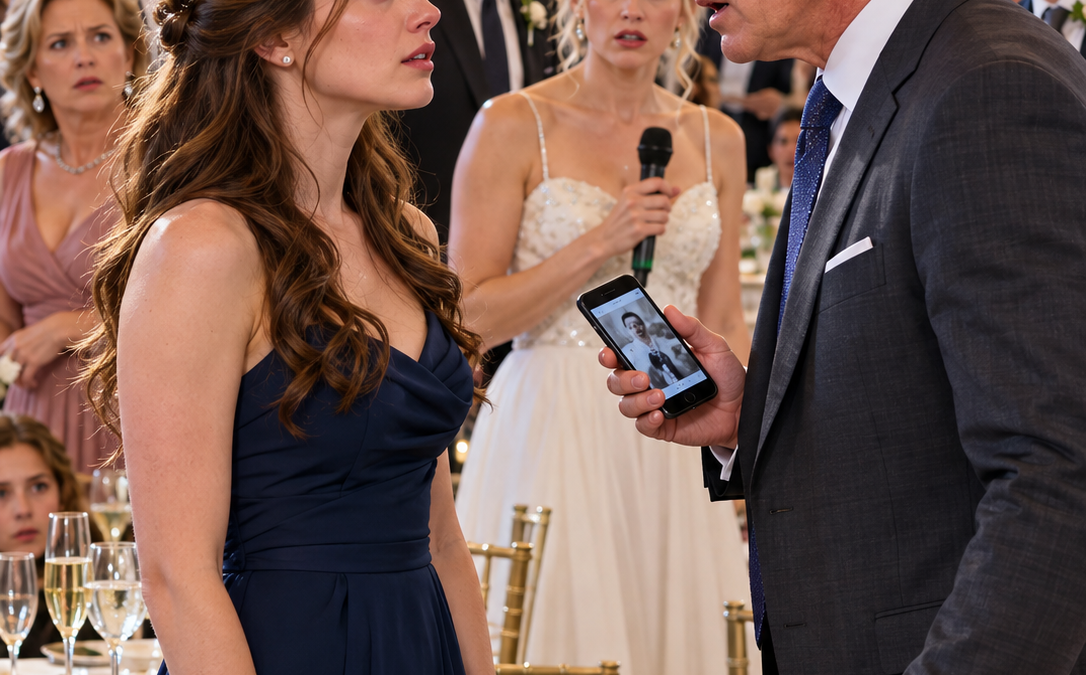
At my sister’s wedding dinner, she thought it’d be funny to introduce me like: “this is my stepsister – just a nurse.” and laughed. dad burst out laughing. mom smirked. until groom’s father stared at me: “wait, you’re the girl who…” his next words… froze the entire room.
Shelly.
No one in my family had ever bothered to learn the difference.
There was no plus-one, either. I set the invitation on my kitchen counter beside a stack of trauma nursing journals and stared at it the way a person might stare at a summons. Because that was exactly what it was. Not an invitation. A summons. Britney didn’t want me at her wedding. She wanted me accounted for.
Growing up in my father’s house had been an exercise in learning how to become furniture. Michael married Susan when I was nine years old. Britney was twelve. From that first week, the entire architecture of our family shifted around me. Britney’s bedroom had a canopy bed and a framed portrait Susan had commissioned from a local artist. Mine was an old study repurposed with a cot and a lamp that flickered whenever the heater kicked on. Britney’s school photographs climbed the staircase wall in matching frames, marking every year of her childhood. Mine sat in a drawer.
Susan introduced Britney to guests as “our daughter.” I was always “Michael’s kid from before.” And my father let it happen. Every single time.
For years, I called him every Sunday like clockwork. He would answer with a distracted, “Hey, Shell,” talk for ninety seconds, and then promise, “I’ll call you back.”
He never did.
Three months could pass without my hearing his voice. When I finally worked up the courage to dial again, he would answer as if no time had passed at all, as if I weren’t someone whose absence was worth noticing. There was never an apology, never an explanation, never even a question about what had been happening in my life. I learned to fill the silence myself until eventually I stopped expecting anything on the other end of the line.
So when Britney’s invitation arrived with my name misspelled and no guest included, I almost threw it away.
Almost.
Then my phone rang. It was my father.
“Britney wants you there,” he said.
His voice carried that rehearsed warmth he only used when someone else was listening. “It would mean a lot.”
I should have known better. When my father called, it was never really for me. It was always about whatever Britney needed.
That night, I looked up the family Britney was marrying into. I sat cross-legged on my apartment floor with my laptop balanced on a stack of pathophysiology textbooks and began reading everything I could find about the Sterlings.
Charles Sterling was sixty-three. He had started as a construction laborer in his early twenties and built a real estate development company from a single renovated duplex into a business that had reshaped half the commercial corridor in Fairfield County. He was self-made, the kind of man magazine profiles described as possessing unpretentious wealth. His son, Chad, was a corporate attorney, a Georgetown Law graduate and junior partner at a midsize downtown firm. In photographs, he was handsome in a clean, careful way, with the composed expression of a man who had learned early how to look comfortable in expensive rooms.
Britney had been dating Chad for two years. During that time, she had constructed an entire mythology around our family. I pieced it together from her Instagram account—the one she had never allowed me to follow but had never bothered to make private.
There were carefully curated photographs of Sunday family brunches at restaurants where I had never been invited. Michael wore a blazer Britney had picked out for him. Susan appeared with freshly highlighted hair, smiling beside elaborate floral arrangements and candles arranged across pristine tablecloths. The captions read like advertising copy.
Nothing matters more than family.
The comments were a chorus of admiration.
Your family is goals.
So blessed.
One photograph had forty-seven likes. I wasn’t in a single frame.
Michael managed an Ace Hardware store in Milford. Britney told the Sterlings he worked “in the hardware industry,” a phrase vague enough to suggest an executive position without technically requiring a direct lie. Susan had once catered small neighborhood events, providing sheet cakes and chafing dishes for birthday parties and community gatherings. Britney had repackaged that experience into a story about her mother running her own catering company.
Everything about our family had been renovated for presentation. New paint over rotten studs.
I later learned from Chad himself that Britney had given the Sterlings specific instructions about how to regard me. But even before that conversation, I caught part of a phone call between Britney and Susan the week before the pre-wedding brunch.
“We need her there for the family photo,” Britney said. “After that, keep her invisible.”
The word landed like a closed fist.
Invisible.
That had always been my assignment.
Here’s the thing about being invisible at home: eventually, you learn how to become essential somewhere else.
My shifts at St. Luke’s Regional started at seven at night and didn’t end until the board was clear, which sometimes meant nineteen hours later. During the week before Britney’s pre-wedding brunch, I worked four back-to-back twelve-hour shifts. We handled three codes and one pediatric trauma that I still think about whenever the emergency department goes quiet.
There was also a sixty-year-old man whose heart stopped in the waiting room. I had my hands on his chest before the crash cart even arrived. Five days later, he walked out of the hospital carrying flowers for his wife.
Nobody at St. Luke’s cared who my stepsister was marrying. They cared whether my IV lines were clean, whether my assessments were accurate, and whether I could recognize the earliest signs of a patient deteriorating before a monitor started screaming.
Dr. Sarah Jones, the attending physician who ran our emergency department like a submarine captain, had nominated me for the Nursing Excellence Award the previous year.
I won.
The plaque sat in my locker at work. I never brought it home. I never posted about it on social media. I never told my family.
There had been one occasion when I tried to share something about my professional life. I mentioned to Britney that I had been nominated for an award. She tilted her head and gave me a small, indulgent smile.
“That’s cute. Do they give real awards to nurses?”
Susan laughed from the kitchen.
Michael said nothing.
So I stopped sharing. I let my work exist in the places where it mattered: in patient charts, discharge summaries, and the quiet nod of acknowledgment from a surgeon who knew I had caught something he had missed. I had learned that recognition didn’t have to be loud to be real.
The biggest case of my career had happened three years earlier.
An eighteen-wheeler had jackknifed on Interstate 95 during a rainstorm, causing a massive collision involving multiple vehicles. I was driving home from a double shift when I came upon the wreckage. What happened during the forty-seven minutes that followed would change my life in ways I couldn’t possibly have imagined.
But I’ll get to that.
In the emergency department, nobody asks what your family thinks of you. They only need your hands to be steady.
The pre-wedding brunch was held at the Sterling estate, a sprawling stone Colonial house set on four acres, with a circular driveway and hedges trimmed so precisely that they looked like architectural features. I parked my Honda Civic between a Porsche Cayenne and a Mercedes-Benz S-Class, turned off the engine, and sat there for two full minutes with my hands resting on the steering wheel.
Just one afternoon, I told myself. I only had to survive one afternoon.
Inside, everything smelled of freshly cut peonies and old money. Caterers moved through the rooms carrying silver trays, navigating clusters of guests with the practiced ease of people trained to be present without being noticed. Britney had positioned herself at the center of the living room, laughing brightly at something Eleanor Sterling had said. Her hand rested on Chad’s arm, and she looked as though she had been born into that house.
I needed to find the restroom. A caterer directed me down a hallway that took me past Charles Sterling’s study. The door stood open, and although I had no intention of stopping, something about the room drew my attention.
Floor-to-ceiling bookshelves lined the walls. A cherrywood desk stood near the windows, with a decanter of amber-colored Macallan eighteen-year-old whisky resting on a polished tray. Framed business awards and photographs filled the shelves. Yet in the center, given more prominence than any industry plaque or commemorative deal tombstone, was a photograph that seemed strangely out of place.
It showed a man lying in a hospital bed, oxygen tubing beneath his nose and dark bruises covering his jaw. Beside the frame sat a small handwritten card bearing the words, To the angel on I-95.
Next to it was a clipped newspaper article from the Fairfield County Register.
Local Businessman Survives Horrific Highway Crash Thanks to Off-Duty Nurse.
I looked at the photograph. The man’s face was badly swollen, half concealed beneath gauze. I didn’t recognize him. I treated hundreds of patients every year, and three years was a long time. Faces blurred. Details dissolved. I glanced at the article but didn’t read past the headline.
Then Charles Sterling walked into the room behind me.
“That’s my second birthday,” he said, nodding toward the photograph. “The day someone gave me my life back.”
I smiled politely. “That’s incredible.”
He looked at me for a moment, holding my gaze a beat longer than was comfortable. Something moved across his expression, but before he could say anything else, Eleanor called to him from down the hallway.
The moment broke.
Britney appeared at my elbow almost immediately.
“Stop bothering Mr. Sterling,” she hissed. “Come on.”
She caught my arm and pulled me away before I could say another word.
The formal brunch introductions took place in the garden beneath a pergola heavy with wisteria. Britney moved through them like a press secretary—poised, efficient, every sentence polished to a shine. She guided the guests from one conversation to another, making sure every connection was properly displayed.
“My mother, Susan,” she announced with a brilliant smile. “She ran her own catering business before she retired.”
Susan beamed. Charles nodded appreciatively.
“And my stepfather, Michael. He’s been in the hardware industry for over twenty years.”
Michael straightened his borrowed blazer and shook Charles’s hand a little too firmly.
Then Britney moved to the next cluster of guests without pausing. She skipped me entirely. I stood three feet away holding a glass of sparkling water, and she turned her body as though I were a pillar someone had placed in an inconvenient spot.
Eleanor Sterling noticed.
She extended her hand toward me. “And who’s this?”
Britney’s smile tightened almost imperceptibly, the way a stitch pulls just before it tears.
“Oh, that’s Ashley. She’s around.”
Eleanor looked at me with genuine curiosity. “What do you do, Ashley?”
Before I could answer, Britney leaned forward.
“She works at a hospital in some capacity.”
I met Eleanor’s eyes.
“I’m a registered nurse in the emergency department at St. Luke’s Regional.”
Eleanor’s eyebrows lifted. “That must be incredibly demanding.”
Britney’s hand landed on Eleanor’s arm, redirecting her like a rudder.
“It is. Anyway, Eleanor, I wanted to show you the floral mock-ups for the centerpieces. The florist did something absolutely gorgeous with the John Smith roses.”
And just like that, I was behind them again, watching their backs as they disappeared into another conversation.
Later, while I was walking through the house, Britney fell into step beside Susan. They were speaking softly, and I caught only fragments of their conversation. But one sentence reached me clearly.
“She’s already talking too much. Handle it.”
Susan glanced over her shoulder at me and smiled.
It was the kind of smile that wasn’t really a smile at all.
Susan found me near the rose garden a few minutes later. I was standing alone with my water glass, watching the caterers clear away the brunch trays. She approached the way she always did—softly, carefully, like a door closing so gently you didn’t realize you had been locked out.
“Honey,” she said, touching my arm. “Can we talk for a second?”
She guided me toward a stone bench at the far edge of the garden, well away from the other guests. The string lights overhead hadn’t been turned on yet. It was the kind of secluded corner where people put things they wanted out of sight.
“Britney is under so much pressure,” Susan began, her voice dripping with manufactured sympathy. “This wedding is everything to her. You understand that, right?”
I looked at her. “What are you asking me to do, Susan?”
She blinked, momentarily thrown by the directness of the question. Then she recalibrated.
“Just be supportive. Be quiet. Don’t make it about you.”
I had heard that script before. At Thanksgiving, when Britney announced her engagement and I was told not to overshadow the moment by mentioning my Nursing Excellence Award nomination. At Michael’s sixtieth birthday, when Susan suggested I should pop in and then pop out so the photographer could get a picture of “just the immediate family.” And at my own college graduation, where Michael arrived late, checked his phone throughout the ceremony, and left before I crossed the stage because Susan had a migraine.
I was always the thing to be managed, the variable to be controlled, the person whose presence had to be carefully measured against everyone else’s comfort.
“I hear you, Susan,” I said.
And I did. Every single word.
I walked back through the house and eventually found myself outside by my Civic. Sitting on the hood, I called my friend May from the hospital. I needed to hear the voice of someone who actually knew me.
“I don’t know why I came,” I told her.
Then I heard Britney speaking through an open window. She was on the phone with someone, and her voice carried clearly into the afternoon air.
“No, I told the Sterlings she has issues. Emotional stuff. They won’t ask questions.”
I stopped breathing for a moment. May was still talking on the other end of the call, but her words seemed to disappear beneath the sudden pounding of my heartbeat. I sat completely still, listening to Britney move away from the window.
Issues. Emotional stuff.
I had spent most of my life being ignored, but this was something different. Britney hadn’t merely decided I was beneath her. She had invented a reason for other people to keep their distance from me. She had taken the years of exclusion I had endured and disguised them as evidence that something was wrong with me.
I felt something rearrange inside my chest. It didn’t break. It shifted.
Those words replayed in my head for the rest of the day. I drove home with the windows down, letting the air push against my face as if it might strip the conversation from my skin.
It didn’t.
Two days later, the confirmation came by accident. I had attended a rehearsal walkthrough at the Oakmont Country Club, a short session to time the processional and work out the wedding arrangements. I stepped outside for some air and heard voices coming from the patio.
Chad was talking with one of his college friends, a groomsman named Brad. Neither man could see me around the corner.
“Yeah,” Chad said casually, almost offhandedly. “Britney’s stepsister has some personal issues. Britney doesn’t like to talk about it. It’s sad.”
Brad murmured something sympathetic.
Chad continued, “The family tries to keep it low-key, you know? Supportive from a distance.”
Supportive from a distance.
That was the phrase Britney had packaged for public consumption. She hadn’t simply excluded me. She had rewritten me.
In the Sterling family’s minds, I wasn’t a woman being pushed aside by her own relatives. I was someone they were gently quarantining. The unfortunate stepsister with mysterious problems nobody wanted to discuss over dinner. The family wasn’t cruel for keeping me away. According to Britney’s version of events, they were compassionate.
That night, I called my father.
There was no preamble.
“Did you know Britney told the Sterlings I have mental health issues?”
Silence.
Then came a sigh. I knew that sigh intimately. It was the particular sound Michael made when he had been caught doing something wrong and wanted to appear exhausted rather than guilty.
“She’s just protecting the family image, Ashley. Don’t make a scene.”
“Protecting the family image from what? From me?”
“You’re twisting this.”
“Did you go along with it?”
He didn’t answer.
Which was an answer.
I pictured him in the Allen Edmonds shoes Britney had bought him, wearing the suit Susan had chosen and repeating the talking points his stepdaughter had scripted. For twenty years, I had told myself that my father was passive, that he was weak, that he simply didn’t know how to stand up to Susan and Britney.
But I finally understood something I had spent two decades avoiding.
He hadn’t just allowed her to erase me.
He had helped.
The rehearsal dinner was the following Friday. It was held at the Oakmont Country Club, with 120 guests gathered beneath crystal chandeliers that scattered tiny rainbows across the ceiling. A live string quartet played Debussy. Hand-calligraphed place cards in Hermès orange sat at each setting. It was the kind of event where even the folds of the dinner napkins probably had names.
I arrived twenty minutes early because I didn’t know what else to do with my anxiety.
I wore a navy dress I had found at Target for thirty-nine dollars. It was simple, with clean lines and no embellishments. The only jewelry I wore was a pair of small pearl earrings that had belonged to my mother. Two luminous studs she had worn every day until cancer took her when I was seven years old.
They were the only things of hers I had left.
The seating chart stood on a gold-framed easel near the entrance. I found my name misspelled again, this time beside Table 14. It was the last table in the room, positioned closest to the kitchen doors. My assigned companions were a babysitter, a distant colleague of Diane’s, and an empty chair.
Britney had been thorough.
I walked into the ballroom alone. Women wearing Valentino and Cartier moved around me like water around a stone. Susan spotted me from across the room and performed a quick inspection, head to toe, three seconds flat. Then she leaned toward Britney and murmured something.
Britney glanced over her shoulder, looked at me, and turned away.
I read her lips.
“She’s fine.”
Meaning I looked plain enough not to cause trouble.
I made my way to Table 14, unfolded my napkin, and studied the menu. Chilean sea bass, roasted endive, crème brûlée. Each entrée probably cost more than I made in three shifts. I sat with my hands in my lap while the rest of the room hummed with conversation, watching waiters navigate between tables as guests greeted one another with air kisses and effortless familiarity.
Twenty minutes later, Britney took the stage. She held a crystal-encrusted microphone rented for the occasion, and the room gradually fell silent as she began introducing the people closest to her.
I knew something was coming.
What I didn’t know was who would be watching.
Britney started with Susan.
“My mother,” she said warmly, “the woman who taught me everything about grace and resilience.”
The room applauded. Susan pressed a hand to her chest as though she had just been crowned.
“Then my stepfather, Michael. The man who gave me a real family.”
Michael’s eyes turned glassy. He raised his champagne glass, and the room followed.
Britney went on to introduce her bridesmaids, her college roommate, and her boss at the wedding-planning firm. Each introduction was a small coronation, polished and affectionate, designed to impress the Sterlings sitting at the head table. She knew exactly how to give each person their moment without surrendering control of the room.
And then she turned toward Table 14.
“And this…”
She paused.
It was a practiced pause. I knew because I knew Britney, and Britney never left silence unscripted.
“This is my stepsister, Ashley. She’s…”
Another pause. A tilt of the head. A small, performative smile.
“Just a nurse.”
She said just the way someone might say only, as though apologizing for something unfortunate that couldn’t be helped.
Then she added brightly, “Anyway…”
My father laughed.
A real, full laugh. The kind you give when a joke lands exactly as intended. Susan smirked, one corner of her mouth lifting with satisfaction, as though a box had been checked. A few guests laughed along—not necessarily out of cruelty, but out of reflex. When the bride laughs, the room follows.
For three seconds, 120 people looked at me.
Then the conversation resumed, and I dissolved back into the wallpaper.
I sat with my hands folded beneath the table, pressing my fingers so hard into my palms that I would find little half-moon marks there later. I didn’t cry. I didn’t stand. I didn’t leave.
But I noticed something at the head table.
One person wasn’t laughing.
Charles Sterling was staring directly at me. His champagne glass stood untouched in front of him. He leaned toward Eleanor and said something I couldn’t hear. Then he turned to Chad, and I saw his lips form five words.
“That girl. I’ve seen her before.”
Britney gave another toast thirty minutes later.
She stood beneath the chandeliers holding the crystal microphone like a scepter, her silhouette outlined against an extravagant wall of white roses.
“I want to tell a story about family,” she began, smiling at the room. “Growing up, my little stepsister always wanted to help people. She’d bandage the dog. She’d make ice packs for scraped knees.”
Polite laughter rippled through the guests.
“I guess she eventually found her level.”
The room chuckled again.
Michael raised his glass. Susan touched her collarbone and smiled with her eyes closed, as though she were savoring a beautiful piece of music.
I remained seated at Table 14, my hands wrapped around a glass of water. The babysitter beside me, a college sophomore named Emily, glanced sideways with the uncomfortable expression people wear when they know they’re witnessing something ugly but don’t want to get involved.
After the toast, a woman from Britney’s side of the family approached my table. She was blonde, somewhere in her mid-forties, with cocktail rings sparkling on three fingers.
“So, you’re the stepsister,” she said. “What do you do? Like, empty bedpans?”
She laughed at her own joke before I could answer.
I looked at her.
“Among other things, last Tuesday I assisted in an emergency thoracotomy. We opened a man’s chest in the trauma bay and repaired a lacerated ventricle. He lived.”
Her smile collapsed.
She opened her mouth, found nothing to say, and excused herself.
Britney materialized beside me within seconds.
“Ashley, don’t bore people with work stories.”
I said nothing.
I didn’t need to. The silence after the words he lived had already done the work for me.
Across the room, I noticed another subtle change. Chad stood near the bar, watching his fiancée with an expression I had never seen on his face before. There was a faint crease between his eyebrows, the beginning of a question he didn’t yet know how to ask.
An hour later, Britney cornered me in the powder room.
The space was all white marble countertops, Aesop soap dispensers, and monogrammed linen towels folded into elaborate fans. She closed the door behind her, and the sound was strangely final.
“Listen to me.”
Her voice was flat and clean, stripped of the cheerful performance she wore in public.
“Tomorrow is my wedding. My wedding. You will sit. You will smile. You will say nothing. Don’t talk to the Sterlings. Don’t talk about your job. Don’t talk. Period.”
I met her eyes in the gold-framed mirror.
“Why did you tell them I have mental health issues, Britney?”
She didn’t flinch. She didn’t even bother denying it.
“I told them what they needed to hear.”
“You lied about me.”
“I managed the narrative.”
She said it without hesitation, as though we were discussing a public relations strategy rather than my life.
“You think the Sterlings would accept this family as it is? A hardware store manager and a nurse?” She pronounced the word nurse the way someone might say rash. “I’m building something here. This wedding is the most important day of my life. Don’t destroy it.”
“You’re asking me to pretend I don’t exist.”
“I’m asking you to know your place.”
Know your place.
Three words. The same message my family had delivered in a hundred different ways over the previous twenty years, through empty chairs, misspelled names, borrowed suits, and photographs from which I had been cropped.
Britney was simply the first person to say it out loud.
The door opened. Susan appeared, her face smooth and alert.
“Everything okay in here?”
“Just sister stuff,” Britney replied lightly.
She smoothed the front of her dress and adjusted the borrowed bracelet on her wrist, a piece of designer jewelry I happened to know had come from one of her clients.
Susan smiled and closed the door, sealing the conversation like a letter she had co-signed.
I stood there for another minute, surrounded by marble and monograms in a room whose fixtures probably cost more than my monthly rent.
And I made a decision.
I didn’t know exactly what shape it would take. I didn’t have a speech prepared or a strategy worked out. I only knew that tomorrow, for the first time in my life, I wasn’t going to be silent.
I left the rehearsal dinner early.
No one noticed.
In the Oakmont Country Club parking lot, my Civic sat wedged between a Porsche Macan and a black Range Rover. I climbed inside but didn’t start the engine. My hands rested on the steering wheel while the little keychain charm hanging from the ignition caught the streetlight and threw a reflection onto the dashboard.
It said RN.
My emergency department team had given it to me after my first year.
I could drive home. I could skip the wedding. I could let Britney have her perfect day and return to the emergency department, where people actually needed me and where my name was spelled correctly on every chart I signed.
Nobody inside that ballroom would miss me.
That was the entire point of Table 14.
I called Dr. Sarah Jones.
She answered on the second ring, as she almost always did, even when she was off duty. That was the kind of person Sarah was.
When I told her what had happened, she listened without interrupting. Then she repeated the words slowly.
“They called you just a nurse.”
Her voice was steady, the way a scalpel is steady.
“Ashley, you’ve saved more lives in one year than most people do in a lifetime. Don’t let anyone shrink you.”
I looked through the ballroom’s floor-to-ceiling windows. The party was continuing without the slightest indication that anyone had noticed my absence.
Then I saw Charles Sterling.
He was standing alone near the bar, holding a glass and staring through the same window I was looking into. For a brief moment, our eyes met across the glass, with the parking lot and the strange distance between what I was and what those people thought I was stretching between us.
My phone buzzed.
A text message from a number I didn’t recognize appeared on the screen.
This is Eleanor Sterling. I got your number from the guest list. I just wanted to say I’m glad you’re here tomorrow. Charles was asking about you.
I read it three times.
I didn’t understand why she had sent it. I wouldn’t understand until the following day. But there was something about those final words—Charles was asking about you—that made me hesitate.
I started the engine and drove home.
Not away from tomorrow. Toward it.
Sitting in that parking lot, I had come very close to driving away from everything. I had almost let Britney win again. And I think many of you know that feeling, that moment when your hand is on the steering wheel and you’re asking yourself whether staying is worth the pain.
If you’ve ever stayed when everything inside you wanted to leave, tell me in the comments what made you stay. And if this story is pulling you in, subscribe, because the part that changed everything was still ahead.
The wedding was held the following day on the Sterling estate.
There were 200 guests, flower arrangements flown in from the Netherlands, peonies, garden roses, and trailing jasmine woven through the ceremony space. Britney wore a Reem Acra bridal gown that caught the September sunlight and turned it into something almost holy. A string orchestra played during the ceremony, while a jazz band warmed up behind the reception tent. Every detail looked as though it had been art-directed, from the white chairs arranged in perfect rows to the delicate greenery suspended above the tables.
I arrived early because I didn’t entirely trust myself to arrive at all.
Britney intercepted me in the driveway.
“Why are you early?” she demanded. “Stay out of the photos until I call you.”
She called me exactly once, for the full family photograph. The photographer positioned me at the far edge of the group, behind Diane’s shoulder. I would see the picture later. My face had been cropped out of every version Britney posted.
At the reception, I found my assigned seat at Table 18, near the service entrance. Two of the chairs were empty, belonging to guests who hadn’t shown up. The tablecloth was slightly wrinkled, and the centerpiece had noticeably fewer flowers than those at the other tables.
I had been positioned as close to invisible as geometry would allow.
Then Charles Sterling appeared.
He was moving through the reception table by table, shaking hands and thanking guests for coming. When he reached Table 18, he didn’t shake my hand and move on as I expected. Instead, he pulled out an empty chair and sat down beside me.
“You know,” he began, slowly turning his glass between his fingers, “three years ago, I almost died on I-95.”
I looked at him.
“A truck hit my car head-on. I was pinned. And for forty-seven minutes before any ambulance arrived, one person kept me alive.”
He told me about the rain, the broken glass, and the woman who had crawled through the wreckage to reach him. He remembered how she held his head still and kept talking so he wouldn’t lose consciousness.
“The paramedic told me that if she hadn’t been there, I’d be in a box,” he said. “Not at this wedding.”
My heart was hammering, but I still didn’t make the connection. Three years had passed. I had treated hundreds of patients, and the faces of people I helped during emergencies often blurred together in my memory. In those moments, I remembered injuries, vital signs, the things I had done with my hands. The faces came later, if they came at all.
Charles studied me.
“I’m sorry,” he said. “You remind me of someone.”
Before I could ask him anything, someone called his name from across the tent. He stood, gently squeezed my shoulder, and returned to the celebration.
I watched him walk away with a strange uneasiness settling over me.
Britney’s reception speech was her masterpiece.
She stood in the center of the dance floor holding a wireless microphone, her free hand pressed dramatically against her heart. She thanked every person who had ever made her feel as though she mattered.
“Susan, my rock, my compass, my first best friend.”
Susan’s face glowed.
“Michael, my hero. The man who showed me what a real father looks like.”
Michael smiled and lifted his glass.
She thanked her bridesmaids, her college roommate, her boss, Chad’s groomsmen, and the Sterlings.
“My new family,” she called them. “The people I’ve been waiting my whole life to find.”
She thanked the florist, the caterers, and the string quartet. She even thanked the venue coordinator by first and last name.
She did not say my name.
Not once.
Not even in passing.
Two hundred people applauded. Susan nodded with the satisfaction of someone watching a carefully designed plan unfold flawlessly. Michael raised his glass again. Nobody seemed to notice the omission, because you can only notice someone missing if you know they were supposed to be there.
I sat at Table 18 between two empty chairs and a centerpiece that was already beginning to wilt. I listened to my sister thank every person in her orbit except me.
Afterward, Chad leaned toward her.
“You didn’t mention Ashley.”
Britney touched his cheek with an affectionate smile.
“She prefers it that way. Trust me.”
I got up and went to the restroom.
After locking myself inside a stall for a moment, I stepped toward the mirror and looked at my reflection beneath the soft vanity lights. My mother’s pearl earrings caught the glow. My eyes were dry. My face was completely still.
I touched one of the earrings.
Mom would have called my name.
Mom would have called it first.
The door opened behind me, and Eleanor Sterling entered.
She saw me standing there. She didn’t pretend otherwise or offer the kind of artificial smile people use when they are hoping to avoid an uncomfortable conversation.
“I noticed you weren’t mentioned,” she said quietly. “Are you okay?”
I looked at her reflection.
“I’m used to it.”
Eleanor held my gaze.
“No one should be used to that.”
Something in the certainty of her voice nearly undid me. There was no pity in it, only a simple recognition that what had happened was wrong.
I thanked her and stepped outside, needing air more than I needed another conversation.
I found my father on the patio, leaning against a stone railing with a glass of Macallan twenty-five-year-old Scotch in his hand. The whisky had come from the Sterlings’ private bar, paid for with Sterling money and poured into Sterling crystal.
“Dad.”
He turned.
Something flickered across his face. Recognition, perhaps, or the faint discomfort of a man who knows he is about to be asked a question he cannot easily deflect.
“She didn’t say my name in front of two hundred people.”
Michael exhaled through his nose.
“Ashley, don’t do this tonight. It’s Britney’s day.”
“When is it my day, Dad? When has it ever been my day?”
“You’re being dramatic. This is exactly what Britney says about—”
He stopped.
I stared at him.
“About what? That I’m unstable? That I have issues? You told them that, too, didn’t you?”
He looked away, down toward the garden where fairy lights had been wrapped around the boxwood hedges. His eyes traveled anywhere they could go without meeting mine.
That was his answer.
It had always been his answer. The look away. The silence. The retreat into a private distance where he didn’t have to account for the daughter he had stopped parenting two decades earlier.
“I’m done,” I said.
He flinched.
“Not done with this wedding. Done waiting for you to see me.”
I turned and walked back toward the ballroom.
He didn’t call after me. He didn’t follow. He remained on the patio in his borrowed suit, drinking borrowed Scotch, and let me walk away the same way he had been letting me go every day since he married Susan.
The worst pain wasn’t being erased by my sister.
It was watching my father choose to help her do it.
I pushed through the ballroom doors and stopped.
Charles Sterling was standing alone at the bar, staring intently at his phone. From where I stood, I could see an old newspaper article displayed on the screen. The photograph was yellowed, and he was studying it with the kind of concentration that comes just before recognition.
He lifted his head, saw me, and set down his glass.
Then he started walking toward me.
He stopped about two feet away. His phone was still in his hand, the screen glowing between us. At an angle, I could read part of the headline.
Local Businessman Survives Horrific Highway Crash.
It was the same article I had seen framed in his study.
“Excuse me,” he said.
His voice was careful and controlled, the way someone speaks when they are holding something fragile.
“Can I ask you something?”
“Of course.”
“Where did you work three years ago?”
“St. Luke’s Regional,” I answered. “I still do.”
“The ER?”
“Yes.”
He stared at me.
“Were you on I-95 that night? November fourteenth?”
And there it was.
The date. The highway. The night that had lived inside my body for three years.
In my hands, in my shoulders, in the way I still flinched whenever I heard tires lock on wet pavement.
“Yes,” I whispered.
My voice cracked for the first time all evening.
Charles stood perfectly still. His eyes began filling with tears, slowly, the way water rises in a basin. There was nothing sudden or theatrical about it. Just a steady, unmistakable realization.
“It’s you,” he said.
“Mr. Sterling, I—”
“You held my head for forty-seven minutes in the rain. You talked to me so I wouldn’t lose consciousness. You told me about your mother’s pearl earrings. You told me she wore them every day so I’d have something to focus on while I couldn’t feel my legs.”
My hand went instinctively to my ear.
The pearl stud.
My mother’s pearl stud.
The same one I had been wearing that night on the highway. The one I had described to a bleeding, trapped stranger so he could hold on to something gentle while the sirens were still miles away.
Charles looked down at the earring. His jaw tightened, and when he spoke again, his voice broke.
“It is you.”
Before either of us could say another word, Britney’s voice crackled through the speakers.
“Attention, everyone! It’s time for the father-daughter dance!”
Charles glanced toward the dance floor. He had to go, but before he left, he took both of my hands between his.
“Don’t leave,” he said urgently. “Please. I have something to say tonight.”
For three years, he had been looking for me.
And I had been sitting at Table 18 in his son’s family.
The father-daughter dance began beneath a canopy of fairy lights. Britney and Michael moved slowly across the floor to “What a Wonderful World,” and the room sighed on cue. Britney rested her head against Michael’s shoulder and smiled for the photographer.
It was a beautiful image.
With Britney, it was always a beautiful image.
I stood near the edge of the tent and watched Charles disappear through a side door.
He was gone for twelve minutes.
I counted.
I learned afterward what happened during those twelve minutes. Charles told me himself.
He walked to the far end of the garden, took out his phone, and called St. Luke’s Regional Medical Center. The night operator connected him to the emergency department, where Dr. Sarah Jones was on call.
“I’m looking for information about a trauma nurse named Ashley Davis,” he told her. “She was involved in a multi-vehicle accident on I-95 on November fourteenth, three years ago. The patient was Charles Sterling. That’s me.”
There was a pause.
Then Sarah answered in the same steady voice I knew from countless difficult nights in the emergency department.
“Ashley was the lead nurse on scene that night. She stabilized you for forty-seven minutes before EMS arrived. She received a formal commendation from the hospital. Mr. Sterling, she saved your life.”
Charles was silent for a moment.
“Can you email me the commendation letter?”
“I can send it right now.”
Three minutes later, his phone buzzed.
An email arrived from St. Luke’s Office of the Chief Nursing Officer. Attached was a formal commendation letter signed by the chief of surgery and the hospital director. It described the incident in precise clinical language.
Ashley Davis, RN, BSN, demonstrated extraordinary poise under extreme conditions, stabilizing a critically injured patient with suspected cervical spine trauma using manual in-line stabilization for forty-seven minutes in adverse weather.
Charles read it twice.
Then he closed the email and called Eleanor.
“I need the microphone after the toasts,” he said. “I have an announcement.”
Eleanor paused.
“What kind of announcement?”
“The kind this family needs to hear.”
While all of this was happening, I returned to Table 18.
The dance floor was full. Britney was glowing, spinning beneath the lights with Chad, then Michael, then one of the groomsmen. The room revolved around her. Susan moved from one group to another taking photographs, curating the evening in real time.
I sat alone between the empty chairs and the thinning centerpiece. For a while, I stared at my reflection in the blade of a dinner knife. My pearl earrings looked back at me, two small points of light amid everything dark.
Then Eleanor Sterling sat down beside me.
She didn’t announce herself or make a scene. She simply pulled out the chair next to mine, set her clutch on the tablecloth, and settled in as though she had chosen that particular seat on purpose.
Her Loro Piana shawl was draped over the back of the chair, understated and expensive, quiet in the way true wealth often is.
We sat together in silence for a little while.
Then she spoke.
“Charles told me about the highway.”
I turned toward her.
“He remembers more than I expected.”
“He remembers everything,” she said. “He talks about that nurse every Thanksgiving. Every single one.”
She folded her hands on the table.
“You saved the most important person in my life, and you never once came forward.”
“I didn’t do it for recognition, Mrs. Sterling. I did it because I was there and I knew what to do.”
“I know,” she replied. “That’s exactly why you deserve it.”
A pause settled between us as the jazz band shifted into a slower arrangement.
“What’s he going to do?” I asked.
Eleanor looked at me with an expression I hadn’t seen directed toward me in a very long time.
Something close to maternal protection.
“What he should have done if he’d found you sooner.”
She reached across the table and covered my hand with hers.
And I let her.
Because for the first time that night, someone was sitting beside me who genuinely wanted to be there.
Eleanor Sterling, a woman who owned more than most people would ever see in a lifetime, had chosen to sit at the worst table in the room.
In that moment, I understood something.
Respect has nothing to do with where people seat you.
It has everything to do with who chooses to sit beside you.
Even now, I get chills remembering what happened next. If you want to know what Charles said to that room full of people, make sure you’re subscribed and keep following, because the night was about to change in a way none of us could have predicted.
The toasts ended.
The jazz band lowered their instruments. The master of ceremonies stepped forward, adjusted his lapel microphone, and smiled.
“Ladies and gentlemen, the father of the groom would like to say a few words.”
Applause filled the tent.
Two hundred chairs shifted as the guests turned toward the stage.
Charles Sterling stepped into the spotlight looking like a man who had been waiting three years for this exact moment.
Britney stood near the cake table, beaming. She adjusted a loose strand of hair and leaned affectionately into Chad. This was the part of the evening she had choreographed so carefully—the Sterling patriarch praising his new daughter-in-law, welcoming her into the family, and sealing the polished image she had spent two years constructing.
Charles gripped the microphone.
He didn’t smile.
“Most of you know,” he began, his voice carrying through the tent with the quiet authority of a man accustomed to having rooms listen when he spoke, “that three years ago, I was involved in a serious accident.”
Conversations stopped. Even the waitstaff slowed their movements.
“An eighteen-wheeler jackknifed on I-95 during a rainstorm. It struck my car head-on. My door was crushed inward. My legs were pinned. The steering column was pressed against my chest.”
The tent grew still.
“For forty-seven minutes, before any ambulance arrived, before any paramedic reached me, before anyone had the tools to free me from the wreckage, one person kept me alive.”
He paused, looking across the gathering.
“A woman. She crawled through broken glass in the rain. She held my head and neck still because she knew a wrong movement could sever my spinal cord. And she talked to me through the worst forty-seven minutes of my life.”
Britney was still smiling, but her smile had stiffened. She wasn’t sure where the story was going, and for the first time all evening, she was hearing words she hadn’t approved in advance.
“I never found her,” Charles continued. “The hospital wouldn’t release her name. Privacy regulations. I searched. I hired people to search. I even established a foundation in her honor. For three years, I called her the angel on I-95.”
He took a breath.
“Tonight, I found her.”
Nobody moved.
Charles turned slowly and looked directly toward Table 18.
“The woman who saved my life,” he said, “is sitting right here at Table 18.”
Two hundred heads turned.
Two hundred pairs of eyes landed on me.
The woman in the navy dress at the worst table in the room. The one beside the service entrance, with the thinning centerpiece and two empty chairs.
“Her name is Ashley Davis.”
Silence.
Absolute, physical silence. The kind in which you can hear ice shifting inside a glass.
I stared at Charles, unable to move. My hands were resting on the tablecloth. Eleanor sat beside me, her posture straight, her expression calm.
Charles’s voice didn’t waver.
“At the rehearsal dinner, Ashley was introduced to this family as ‘just a nurse.’”
He turned his head toward Britney.
Her smile disappeared. The color drained from her face until it was nearly the same shade as the white tablecloths.
“Let me tell you what ‘just a nurse’ means,” Charles said.
His voice dropped into something low and unbreakable.
“It means kneeling in broken glass in the rain at eleven o’clock at night. It means holding a stranger’s head still for forty-seven minutes so his cervical spine doesn’t suffer a catastrophic injury. It means talking about your mother’s pearl earrings—the ones you’re wearing right now—to keep a dying man conscious when there’s nothing else left for him to hold on to.”
My hand rose involuntarily to my ear.
Charles held up his phone, turning the screen toward the guests.
“This is an email from St. Luke’s Regional Medical Center. It’s a formal commendation letter signed by the chief of surgery and the hospital director.”
He glanced down at the screen.
“It says that Ashley Davis demonstrated extraordinary poise under extreme conditions and was responsible for stabilizing me until the paramedics arrived.”
Someone at a middle table began clapping.
Then another person joined.
Then another.
The applause rose from the back of the tent and swept forward, gathering force until nearly every guest was on their feet. Two hundred people were standing, applauding a woman they had barely noticed an hour earlier.
I remained seated for a moment, overwhelmed by the sound.
Britney stood frozen near the stage. Michael had set down his glass and was staring at me with an expression I had never seen on his face before. Something between shame and awe, as though he were looking at a stranger he should have known all along.
Then Chad turned toward Britney.
His voice was quiet, but somehow it carried through the room.
“You told me she had mental health issues.”
Britney looked at him.
“You lied to me.”
The standing ovation gradually faltered, collapsing into a collective, uncomfortable silence.
Every eye turned toward the bride.
Chad stood three feet from her, his arms at his sides.
“Did you tell my family Ashley was mentally unstable?”
Britney’s hands fluttered toward her necklace.
I recognized the gesture instantly. It was something she had done since childhood, the nervous movement she made whenever a lie was about to be exposed.
“Chad, this isn’t the time.”
“Answer me.”
The tent had become a courtroom. Two hundred witnesses. No objections. No place to hide.
Britney tried to smile. It came out wrong, too wide and too bright, the reflex of a woman who had spent her entire life performing for an audience.
“I was just trying to keep things simple.”
Eleanor rose from the chair beside me.
Her voice was calm, cultured, and utterly devastating.
“Simple? You lied to our family about the woman who saved my husband’s life. You fabricated a mental health condition so you could hide her at the back of the room.”
Michael took half a step forward.
“Let’s not blow this out of proportion.”
Charles turned toward him.
“Michael, with respect, your daughter fabricated a story about your other daughter’s mental health to manipulate my family.”
He didn’t raise his voice.
“That’s not a proportion issue. That’s a character issue.”
Britney’s eyes filled with tears. They came quickly, almost on command, the kind of tears I had watched her summon whenever she needed to turn a confrontation into a performance of her own suffering.
Susan moved toward her daughter, reaching out, but Britney pushed her mother’s hand away.
Then her voice broke into something sharp and raw.
“This is her fault!”
She pointed directly at me.
“She should have stayed invisible!”
A gasp moved through the tent like wind passing through curtains.
Two hundred people heard it.
Emily, the babysitter from my rehearsal dinner table. The caterers standing near the kitchen. Chad. Charles. Eleanor. My father.
Everyone.
She should have stayed invisible.
Nobody had coached her to say those words. Nobody had scripted them or rehearsed them in advance. And that made them the most honest thing Britney had said all night.
I didn’t respond.
There was nothing left for me to explain.
Charles reclaimed the microphone. The room was still ringing with Britney’s outburst, but he stood at the center of it with the composure of a man who had survived things far worse than a wedding going sideways.
“I didn’t plan to do this tonight,” he said.
His voice was rougher now, the edges worn down by emotion he had been holding back.
“But I think the timing couldn’t be more right.”
He straightened and looked across the room.
“Three years ago, after the accident, I established the Sterling Foundation First Responder Scholarship. Two hundred thousand dollars annually, dedicated to nurses and emergency medical technicians who demonstrate exceptional dedication in the field.”
Murmurs rippled through the tent.
“I’ve spent three years looking for the right person to receive the inaugural award. I looked across the state, across the country. I reviewed dozens of nominations.”
He shook his head slowly.
“And she was here. Sitting at Table 18 in a thirty-nine-dollar dress.”
Charles stepped down from the stage.
The spotlight followed him.
The same light that had been illuminating Britney’s twelve-thousand-dollar Reem Acra gown was now tracking a sixty-three-year-old man as he walked toward the back of the room.
He stopped at my table and extended his hand.
“Ashley Davis, on behalf of the Sterling Foundation, I’d like to officially invite you to become the first recipient of this scholarship. It will fund advanced trauma nursing certification, continuing education, and anything you need to keep doing the work you do.”
I stood.
My legs felt unsteady, but my eyes remained dry.
I took his hand.
The room rose with me.
Two hundred people.
A standing ovation loud enough to shake the poles of the reception tent.
Charles leaned close enough that only I could hear him.
“Just for me,” he whispered. “Thank you for my life.”
Behind us, Britney remained near the stage, alone beneath a spotlight that no longer belonged to her.
Her wedding. Her guests. Her carefully arranged evening.
And the only story anyone would remember from that night was the one she had tried so desperately to erase.
I hadn’t saved Charles Sterling because I wanted recognition. I had saved him because I was a nurse and there was a human being in front of me who needed help.
That was what nurses did.
But I won’t pretend it didn’t matter that someone had finally seen it.
Chad took Britney gently but firmly by the arm and led her through the glass doors to the terrace. He didn’t pull her. He didn’t raise his voice. But there was something unmistakable in the way he guided her away from the guests.
Britney followed because, for the first time in their relationship, she didn’t have a script for what was happening.
Through the glass, I could see their silhouettes. Britney stood with her arms crossed defensively over her chest. Chad kept his hands in his pockets, then pulled them out, then ran one through his hair. It was the body language of a man recalibrating everything he thought he knew about the woman he had married.
Fragments of their conversation drifted through the partially open door.
“You told my parents she was unstable,” Chad said. “You had me believing my own wife’s stepsister was someone to pity. What else have you lied about?”
“Everything I did was for us, Chad. For our image.”
“Our image?”
His voice rose just enough for the words to reach the nearby tables.
“I married you because I thought you were kind. My father almost died, and the person who saved him was sitting at the back of our wedding because you put her there.”
“She’s nobody.”
“She’s the reason my father was able to be here today. She’s the reason he could walk into this wedding. She is somebody.”
Silence followed.
Then Chad spoke again, more quietly, but with a firmness that carried through the glass.
“Here’s what’s going to happen. You’re going to apologize to Ashley. Not later. Tonight. In front of the people who watched you humiliate her.”
“Chad—”
“And Monday morning, we’re calling a marriage counselor. We start next week.”
“You can’t be serious.”
“If I find out you’ve lied about anything else—anything at all—we’re done.”
Through the glass, I watched Britney’s posture change.
The confident architecture of her spine seemed to soften into something I had never seen from her before.
Uncertainty.
She stood on the other side of the glass wearing her twelve-thousand-dollar wedding gown, the same dress she had chosen so carefully to announce her arrival into the Sterling family.
And for the first time, the armor wasn’t holding.
I didn’t seek my father out after that.
He found me.
I was standing on a balcony at the far side of the estate, away from the noise of the reception, looking down at the garden where the fairy lights made everything appear gentle and full of possibility. The September night had cooled, and I could feel the air against my bare arms.
I didn’t mind.
At least the cold was honest.
“Ashley.”
I turned.
Michael stood in the doorway, his borrowed suit wrinkled and his face devastated. He looked like a man who had just watched a building collapse and realized too late that he had been standing on the foundation.
“I didn’t know,” he said.
“About the highway? About Charles?”
He nodded.
“No,” I said. “You didn’t. Because you never asked.”
He opened his mouth, but I wasn’t finished.
“You never asked what happened at work. You never asked if I was okay. You never asked anything.”
He looked down.
“I thought I was keeping the peace.”
“You were keeping Britney happy. That’s not the same thing.”
He tried to speak again, but the words dissolved before they reached his mouth.
Then he cried.
My father, standing on a billionaire’s balcony in a suit his stepdaughter had bought him, began to cry like a man who had just discovered that the house had been on fire for years while he deliberately ignored the smoke detectors.
I didn’t hug him.
I stayed exactly where I was.
“I don’t hate you, Dad,” I told him. “I just stopped expecting you to be my father a long time ago.”
He wiped at his face.
“Can I fix this?”
“I don’t know. But you can’t fix it by crying at Britney’s wedding and going back to normal on Monday.”
He rubbed his eyes with the back of his hand.
“Britney told me you’d be happier if we kept our distance. And I believed her because it was easier.”
There it was.
Twenty years of abdication summarized in one sentence.
He hadn’t simply been deceived.
He had volunteered.
“I don’t need your tears, Dad. I need you to remember this feeling on a regular Tuesday, when Britney asks you to pretend I don’t exist again.”
He nodded, unable to meet my eyes.
I walked back inside.
For once, I didn’t feel the need to look over my shoulder to see whether he was following.
Britney returned to the ballroom fifteen minutes later.
Someone had touched up her makeup, but her eyes were still red beneath the concealer. Her posture had the rigid, unnatural quality of a woman who had just received an ultimatum from the man she had married three hours earlier.
Chad walked beside her without touching her.
Present, but separate.
She took the microphone for the third time that evening.
The first time, she had introduced her family. The second time, she had delivered her carefully rehearsed toast. This time, the room knew what was coming, and the silence had become a different species of quiet.
Expectant.
Judicial.
“I owe someone an apology tonight,” Britney began.
Her voice was thin. She scanned the room as if searching for an exit strategy, but there was nowhere to go.
“Ashley, I shouldn’t have introduced you the way I did. I’m sorry.”
She stopped.
The room waited.
Somewhere nearby, ice shifted inside a glass.
Then Eleanor spoke from her chair.
Her voice was polite, precise, and relentless.
“And the lies about her mental health?”
Britney’s composure cracked. The change was visible, like a hairline fracture spreading through porcelain.
“I… I told the Sterlings things about Ashley that weren’t true. I’m sorry for that, too.”
The apology landed in the tent like a coin dropped into a cathedral.
Small. Hard. Echoing.
It wasn’t enough, and everyone knew it. But it was what one night could extract from someone who had spent a lifetime avoiding accountability.
I didn’t walk to the stage. I didn’t hug her. I didn’t tell her I forgave her.
Because forgiveness isn’t a reflex.
It’s a decision that deserves time.
I met her eyes from across the room and nodded once.
That was all.
Chad leaned toward the microphone.
“Ashley, my family owes you more than an apology. And we intend to show it.”
Britney stood beside her new husband, listening as the story of her wedding was rewritten in real time.
For the first time in her life, she had no control over the narrative.
She had apologized using the same microphone she had used to humiliate me. I didn’t need to hear her say she was sorry. I needed her to hear herself say it.
The reception continued because weddings have momentum, even when the ground shifts beneath them. The jazz band played. Guests returned to the dance floor. The cake was cut, and servers circulated with champagne.
But the atmosphere had changed.
It wasn’t exactly sour.
It was honest.
People spoke more quietly. Laughter came in smaller doses. The effortless performance of perfection had given way to something more complicated, and nobody seemed entirely sure how to resume pretending.
Later that evening, Charles found me in the garden.
I was sitting on a stone bench near the magnolia tree where the ceremony had taken place hours earlier. The chairs had already been cleared away, and the aisle runner was gone. Only the grass and lanterns remained, with the faint sound of music drifting across the lawn.
Charles sat beside me and reached into his jacket.
“I want to show you something.”
He took out a weathered brown leather wallet, cracked along the folds, and removed a small, creased piece of paper.
He unfolded it carefully, the way someone handles an object they have carried too long to treat roughly.
It was a printout from a medical record. At the top, in plain clinical type, was my name.
Lead Nurse: Ashley Davis.
“I’ve carried your name in my wallet every day for three years,” he said. “I didn’t know your face. I didn’t know your voice. But I knew your name, and I knew I was alive because of it.”
I looked at the paper.
The creases had worn soft. The ink was beginning to fade. It had been folded and unfolded so many times that I could almost imagine the movement of his hands over the years.
He hadn’t simply saved it.
He had lived with it.
“When that woman said ‘just a nurse’ at the rehearsal dinner,” he continued, “I wanted to stand up right there. I wanted to turn the whole room upside down. But I needed to be sure first.”
I looked at him.
“Why does it matter to you so much? After three years?”
Charles met my eyes with the absolute clarity of a man who had been given a second life and had spent every day of it trying to earn that gift.
“Because no one,” he said slowly, “no one gets to reduce the person who saved my life to a punchline.”
For a while, neither of us spoke.
Then he handed me a business card.
Sterling Foundation.
A phone number. A name.
“This is real,” he assured me. “The scholarship is real. Call this number Monday. And Ashley, if you ever need anything—anything at all…”
He let the rest of the sentence remain unfinished.
I took the card and held the worn piece of paper with my name on it.
For the first time, I allowed those three years of silence to mean something.
A week later, the dust had settled into something measurable.
The Sterling Foundation called on Monday morning at nine o’clock sharp. A woman named Megan from the grants office walked me through the details of the award.
Two hundred thousand dollars had been designated for advanced trauma nursing certification through Johns Hopkins, continuing education credits, and a stipend for conference travel. The paperwork would take approximately two weeks to complete. An official announcement would appear on the foundation’s website.
My name, spelled correctly, would be listed as the inaugural recipient.
I signed the forms at my kitchen table while wearing scrubs, just before leaving for a twelve-hour shift.
There was no audience. No photographer. No chandelier reflecting in my coffee cup. Just a stack of documents, a pen, and the morning light coming through my apartment window.
It felt more real than anything that had happened on that stage.
Britney and Chad began marriage counseling that same week.
I heard through Michael, who had suddenly developed the ability to make regular phone calls, that the Sterlings had placed conditions on the house they had planned to help the newlyweds purchase. There would be no financial support until Britney and Chad had completed six months of counseling.
Britney’s social circle contracted like a fist.
Friends of the Sterlings—the people who actually mattered in the world Britney had been so desperate to enter—stopped returning her calls. Her carefully curated wedding photographs on Instagram went from receiving eight hundred likes to barely a hundred. The comment sections, once filled with heart emojis and breathless admiration, went quiet.
She had spent two years constructing an image of herself as someone who belonged among those people. One evening had revealed what stood beneath the polished surface.
Michael sent me a letter.
Not a text message. Not an email.
An actual handwritten letter on lined paper torn from a yellow legal pad.
I barely recognized his handwriting because I had seen so little of it over the years.
He wrote about regret.
He wrote about the things he should have said at my graduation, at my nursing school pinning ceremony, and at every dinner table where he had allowed someone else to narrate my life.
He wrote that he was sorry.
I read the letter.
Then I folded it and placed it in the drawer of my nightstand.
I didn’t write back.
Not because I wanted to punish him. Not because I had decided he could never change.
But because some apologies need to sit for a while before you can tell whether they’re seeds or merely words.
Susan didn’t call.
She didn’t text.
That was Susan.
When there was nothing left to gain, she disappeared.
Consistent to the end.
Britney’s apology had cost her nothing in the moment she made it. The real cost came afterward, when the people she had spent so much time performing for stopped watching.
I returned to work the Monday after the wedding.
The emergency department didn’t care about anything that had happened in a tent full of champagne and fairy lights.
A construction worker came in with a piece of rebar through his forearm. A teenager arrived after overdosing in the ambulance bay. A grandmother went into cardiac arrest in Room Four, and we brought her back.
The monitors kept beeping. The trauma pagers kept sounding. The automatic doors opened and closed, carrying in people whose worst days had nothing to do with mine.
At St. Luke’s, the world hadn’t changed.
And I was grateful for that.
Dr. Sarah Jones caught me in the hallway between traumas. She leaned against the wall with her arms crossed and her reading glasses pushed up into her hair.
“Charles Sterling called the hospital again this morning,” she said. “Wanted to thank the nursing staff personally. He specifically mentioned you.”
I looked at her.
She paused.
“He said you’re a hero.”
I shook my head.
“I’m a nurse.”
Sarah smiled.
It was the rare, unguarded kind of smile she saved for moments when she truly meant what she was saying.
“Yeah,” she replied. “You are. And that’s more than enough.”
I didn’t tell my colleagues the full story.
I didn’t post about it, just as I had never posted about the Nursing Excellence Award, the thoracotomy save, or any of the hundreds of other moments that had shaped the nurse I had become.
My work lived where it mattered.
In the charts.
In the outcomes.
In the patients who walked back through the hospital doors on their own feet after being carried through them.
But something had shifted.
Not in the world.
In me.
Before my shift, I stood in front of the locker room mirror and touched my mother’s pearl earrings.
For years, they had been a reminder of everything I had lost.
Now they meant something different.
They were a thread connecting every version of myself.
The seven-year-old girl who lost her mother and couldn’t understand why the world kept moving.
The nine-year-old who watched her father remarry and felt her place in the family begin to disappear.
The teenager who learned to make herself small in her father’s new household, who discovered that silence was sometimes easier than asking to be included.
The twenty-six-year-old nurse who knelt on broken glass in the rain and held a stranger’s life in her hands.
The twenty-nine-year-old woman who sat at Table 18 and refused to leave.
All of them were me.
And for the first time, I didn’t look at those younger versions of myself with embarrassment or regret. I didn’t wish they had been louder, tougher, or better at demanding love from people who had made it clear they didn’t want to give it.
I understood what they had been doing.
They had been surviving.
I hadn’t planned any of this. I hadn’t schemed or strategized. I hadn’t gone to the wedding hoping to expose Britney, embarrass my father, or gain the attention of a wealthy family.
I had simply lived my life.
I had done my job.
And eventually, the truth had caught up.
The revenge wasn’t what Charles Sterling said on that stage.
The revenge was spending twenty years becoming someone Britney could never diminish, no matter how hard she tried.
Real strength isn’t always loud.
Sometimes it’s forty-seven minutes in the rain when nobody is watching.
If you’re sitting at Table 18 in your own family, if someone has told you that your work, your life, or your contribution is “just” something, I want you to hear this.
You are not your family’s opinion of you.
You are not the worst table at the party.
You are what you do when nobody is clapping.
Last week, I received a card in the mail.
It came in an envelope made from thick, cream-colored stationery, the kind of paper that feels substantial between your fingers. The handwriting was unmistakably personal.
It was from Charles Sterling.
A Thanksgiving invitation.
Our table seats twelve, he had written. There’s a chair with your name on it. Spelled correctly.
I read the words several times.
It was the first time in years that someone had invited me to a family table where I wasn’t an afterthought.
Where I wasn’t included for a photograph and then expected to disappear.
Where nobody needed me to shrink myself to make the occasion more comfortable for someone else.
I pinned the invitation to my refrigerator with a magnet shaped like a stethoscope.
It sits beside my work schedule and a photograph of my mother, the one where she’s laughing with her head thrown back, her pearl earrings catching the light.
Sometimes, when I’m making coffee before a shift, I look at those two pieces of paper together.
My mother’s photograph.
Charles’s invitation.
One reminds me of where I came from.
The other reminds me that there are still places in the world where I can belong without having to beg for a seat.
I don’t know what happens next with my father. I don’t know whether the letter he sent will become the beginning of an actual relationship or remain another promise that eventually fades into silence.
I don’t know whether Britney will change or simply learn to hide the parts of herself that were exposed that night.
I don’t know whether Susan will ever pick up the phone.
But I know this.
I’m not waiting for any of them anymore.
This morning, I clipped my badge to my scrubs.
Ashley Davis, RN, BSN.
I put in my mother’s pearl earrings, picked up my keys, and drove my Civic to the hospital.
The parking lot was already crowded when I arrived. The fluorescent lights in the emergency department were as bright and unforgiving as ever, and the charge nurse handed me three charts before I had even poured my coffee.
There was no applause.
No orchestra.
No one asking me to stand beneath a spotlight.
Just another day of work waiting to be done.
My mother used to say, “Help people, and the right people will find you.”
It took twenty-nine years, but she was right.
My name is Ashley Davis.
I’m just a nurse.
And that’s the most powerful thing I’ve ever been.
That’s my story. I know it’s a long one, but if you’ve made it this far, perhaps something in it spoke to you. Perhaps you recognized a part of your own life in that table at the back of the room, or in the silence of someone who should have defended you.
So here’s what I want to ask.
Do you think Britney will really change? Or do people like her simply learn to hide their behavior better once they’ve been exposed?
Tell me what you think in the comments. Change or hide? I read every single response.
If this story made you feel something, give it a like. It helps more people hear it. And if you’d like more stories like this one, check the description for a playlist that will keep you going.
Thank you for listening.
Take care of yourselves.
And remember: you are more than what they call you.








