At my sister’s ski-lodge rehearsal dinner, she smirked and asked me to reveal my old mountain-rescue call sign. she expected the groom’s family to laugh at me. i calmly said: “northstar.” the groom’s 74-year-old uncle froze. he slowly put down his glass, then ordered my sister to apologize immediately. the entire table looked confused. my sister’s smile vanished.
Before I tell you why that name stopped him cold and what I chose to do when my sister tried to blame me, tell me what time it is where you are and where you’re watching from. I’d like to know how far this story reaches.
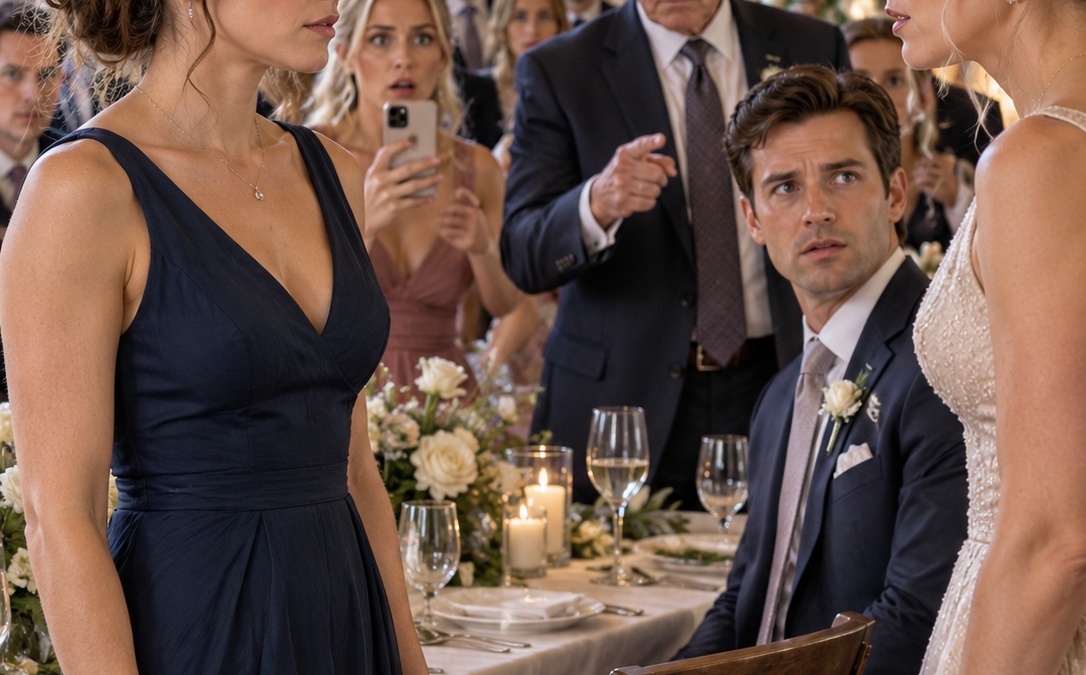
The phone stayed raised for another second. That was what pulled me backward. Not the laughter, but the little red recording symbol reflected in the maid of honor’s glasses.
At sixteen, I had watched another camera point at me while my sister read a private journal entry aloud at a family cookout. I could still remember our mother pressing a napkin into my hand and whispering, “Smile, Monica. People will think you’re upset.”
I had smiled with my mouth full of salt from a bitten lip. Later, the photograph went on our refrigerator. Everyone looked happy. My sister called that proof.
Now Vanessa stood at the head of the rehearsal table, with eight months of wedding planning arranged around her. Lauren, her maid of honor, lowered the phone. Our mother, Diane, reached toward my wrist, but I moved my hand before she could touch it.
That small movement startled me more than the uncle’s command. Usually, I accepted the warning touch. Usually, I knew my assignment before anyone said it. Keep the evening pleasant. Absorb the joke. Let Vanessa be generous afterward, when nobody was looking.
“Uncle Walter,” Vanessa said, trying a softer smile. “You’ve misunderstood our sense of humor.”
Her fiancé, Ethan, turned toward me instead of answering for her. I had known him for eighteen months. He had always been kind, but much of what he knew about me came through Vanessa. The remote sister. The serious sister. The woman who preferred mountains because people were complicated.
I used to believe correcting those descriptions would sound petty. Sitting there, I understood how convenient that silence had been for her.
Walter’s gaze moved to me.
“Which team?” he asked.
“Brier County Volunteer Mountain Rescue,” I said. “Until last spring.”
His fingers settled against the stem of his glass.
“The North Range?”
I nodded. He looked down for a moment, and I saw him swallow. I didn’t know his connection yet. I only knew that he had asked about the work before asking me to perform it. Nobody in my family had done that in years.
Vanessa shifted her weight.
“She mostly handled radios toward the end,” she said. “We’re making this sound a little grand.”
For half a breath, the pressure of the chair against my legs seemed to disappear. I was back in a communications shelter, listening to sleet rattle against the roof. Three volunteers were bringing two stranded hikers down a ridge, and their transmission had broken into fragments.
I repeated the last confirmed position, checked it against the map, and told them to hold while our field leader verified the descent. For eleven minutes, I gave the same clear instructions without once letting the people listening hear how badly I wanted an answer.
Then I was at the table again, with my dinner untouched.
“I worked in the field for six years,” I said. “After an ankle reconstruction, I coordinated communications for two more. Both jobs mattered.”
I had left the operational roster when my engineering job began requiring travel. There was no mysterious dismissal, no failure I was hiding. My ankle still stiffened on cold mornings, but I could hike. What I missed was the team and the certainty that useful work did not require anyone to find me entertaining.
Northstar wasn’t our official radio identifier. Dispatch used unit numbers. It was a team nickname used off duty, one Vanessa had flattened into something theatrical because call sign gave her better material. I had explained that once. She preferred her version.
During that winter operation, the field leader had come back exhausted, put a gloved hand on my shoulder, and said, “Couldn’t see a thing, but we always knew where your voice was.”
A week later, someone had taped a paper star above my workstation. The nickname followed. I hadn’t chosen it, and I had never mistaken it for a medal.
Vanessa had heard it at a holiday dinner two years earlier. She asked if I had assigned everyone else constellation names, then laughed before I could explain. Eventually, I stopped explaining.
Six days before the rehearsal dinner, she texted to ask whether she could use the Northstar thing during her welcome remarks.
I wrote back, “Please don’t make my rescue work or the nickname part of a joke. I’m happy to toast you and Ethan. Leave that out.”
Her answer was still on my phone.
“Fine. No mountain material. Happy now?”
I had brought a toast about our shared apartment, about Ethan fixing her crooked bookshelves, and about the ordinary tenderness I hoped would outlast the flowers. I had arrived ready to celebrate her.
That mattered to me now because I could already feel the old accusation gathering. I had come looking for trouble.
I looked at the phone beside my plate and let myself remember that I had come with something kind.
Have you ever laughed at your own humiliation just to keep someone else’s evening pleasant? I had. This time, my mouth stayed closed.
No one laughed again. Walter pushed his chair back and stood. There was nothing quick about it. He steadied himself on the table, straightened, and waited until Vanessa stopped trying to fill the silence.
“I heard her answer,” he said. “I also heard the way you asked.”
Vanessa set down her champagne.
“We tease each other. She knows that.”
“Then let her tell us.”
His eyes met mine. He wasn’t asking me to describe a rescue. He was leaving room for a sentence my family usually supplied on my behalf.
“No,” I said. “I don’t enjoy this. I asked her not to do it.”
My voice came out softer than I intended. I almost repeated myself more loudly, as if a boundary needed volume to count.
Ethan had heard me. He moved his chair back several inches, leaving a visible space between his shoulder and Vanessa’s hand. She reached for him and touched the chair instead.
“You never said I couldn’t mention it,” she told me. “You said not to make it a big thing.”
I took my phone out of my bag. I could have argued from memory. That was what we always did. She softened the wording. I tried to remember exactly. Our mother declared the truth somewhere in the middle.
This time, I opened the exchange and read only my own message, including the offer to give a toast. Then I read Vanessa’s reply.
“I can show you the dates,” I said to Ethan, “but I’m not handing my private conversations around the table.”
I put the screen in front of him. He looked, scrolled just enough to see the preceding question, and gave it back.
For the first time that evening, Vanessa didn’t look at me as though I were a prop that had failed. She looked at the phone.
“You kept that?”
“It was six days ago.”
A cousin at the far end of the table put down his fork. Somebody who had laughed earlier shifted in his seat. I noticed those movements because I needed somewhere to put my eyes.
Being believed did not feel triumphant yet. It felt like standing up too quickly after sitting in an uncomfortable position for years. Everything hurt as the feeling came back.
Mom leaned forward.
“We can discuss the wording privately.”
“The wording was private,” I said. “Vanessa brought the subject here.”
My mother’s hand stopped beside the bread basket. I could see the effort it took her not to tell me I was making things worse. I knew that expression intimately. For years, I had treated it as an emergency I was responsible for resolving.
Now, I let her sit with it.
That was harder than reading the message. Evidence was simple. Watching my mother be disappointed in me still reached somewhere the mountains never had.
Walter remained standing.
“You owe her an apology,” he said to Vanessa. “Her work doesn’t have to impress you for her refusal to matter.”
Something in my chest loosened at that. I hadn’t realized I was bracing for another test. Tell the impressive story. Earn the right to be treated decently.
I could have been terrible on a mountain. I could have left after a month. I still would have been entitled to say no to this. Walter’s words gave me a place to stand that didn’t depend on anybody admiring me.
Vanessa folded her arms, then unfolded them when she noticed Ethan watching.
“I’m sorry the joke landed badly.”
I looked at the empty space between their chairs. A few minutes earlier, I might have accepted that sentence just to end the attention. Now I heard the escape built into it.
The joke had landed badly. No one had aimed it. No one had ignored a request.
“You don’t have to apologize because he told you to,” I said. “But I won’t agree that this was an accident.”
Ethan turned toward Lauren. Her phone was face down beside her water glass.
“Were you recording before Monica answered?”
“Yes,” she said.
Vanessa cut in. “We’ve been filming everything all weekend.”
I looked at Lauren.
“Please delete the recording of me, including any copy in your recently deleted folder. I didn’t agree to be filmed for this.”
Lauren picked up her phone immediately. I watched her remove the short clip and clear it from the recovery folder. I could not know whether another copy existed, so I asked her directly. She said she hadn’t sent or uploaded it. I held her gaze until she stopped looking toward Vanessa for permission to answer.
“I thought it would be funny,” Lauren said. “That was wrong.”
“Thank you for deleting it,” I answered.
I did not tell her it was fine.
Across the table, Ethan rubbed his thumb along the edge of his place card.
“You told me Monica wanted to tell a rescue story tonight,” he said to Vanessa.
I hadn’t heard that version before. My sister opened her mouth, and I watched the pleasant explanation she had been preparing fail before she could say it.
“I said she might,” Vanessa replied.
Ethan shook his head.
“You said she asked for a few minutes. That’s why I told everyone to let you introduce her.”
I remembered the way he had smiled when Vanessa raised her glass. He had expected to welcome me. She had arranged for him to help corner me without telling him what he was doing.
The humiliation had not been an impulsive remark made after too much champagne. It had a place in the evening. Other people had been given roles.
I opened my bag and took out the folded toast I had written. The paper had a coffee mark in one corner.
“This is what I offered,” I said.
I handed it to Ethan. He read the first few lines, then stopped at the mention of the bookshelves. His mouth tightened.
“You told me she refused to say anything nice about us.”
The table had become so still that I could hear a server collecting glasses in the adjoining room. Vanessa’s eyes flashed toward our mother, but Mom was looking at the paper in Ethan’s hand.
“Give that back,” Vanessa said.
It took me a second to understand that she meant my toast.
“It’s mine,” I said.
Ethan returned it to me carefully.
There was no third person stepping forward with a secret that rescued me. There was my own message, my own handwriting, and my decision to stop allowing Vanessa to explain what I meant.
I put the paper back in my bag. I no longer wanted to read it aloud. The kindness in it had been real, but I didn’t owe the room a demonstration.
Vanessa lowered her voice.
“I was nervous. Your family barely knows me, and I wanted everybody relaxed.”
“At her expense,” Ethan said.
She looked at him with open frustration now.
“You know I didn’t mean anything serious.”
“I know what you told me.”
He stood. She caught his sleeve.
“Don’t walk out on our rehearsal dinner.”
He gently removed her hand.
“I’m taking ten minutes. Don’t ask anyone to explain you to me.”
Then he looked at me.
“I’m sorry I helped set that up.”
I nodded because I could see the difference between his apology and hers. He had named what he did.
After he left, Vanessa turned back toward Walter.
“I still don’t understand why one nickname matters this much.”
I expected him to refuse the distraction. Instead, he rested one hand on his chair and looked at me.
“May I explain why I recognized it?”
I nodded.
“In 1986, a woman on that county’s rescue team helped bring me off the North Ridge when a winter hike went wrong,” he said. “Her teammates called her Northstar. Years later, I asked why, and they told me it was because people found their bearings around her.”
He stopped there. No long account of the mountain, no demand that I become the woman he remembered.
“I haven’t heard it used for someone else on that team until tonight,” he added.
That surprised me. I told him I had seen the old name in a framed team photograph, but nobody had described mine as an official inheritance. Our field leader had used it independently decades later.
Walter nodded.
“I didn’t assume you were related. I wondered whether the habit had survived.”
He sat down. His connection made sense now. The county, the nickname, the sudden stillness. He had recognized an echo, not magically recognized me.
Vanessa stared at the table.
“I didn’t know any of that.”
“Neither did I,” I said. “You still had my message.”
That was the part I refused to let disappear beneath a moving story. She didn’t need a respected older man’s memories to understand a sentence I had written plainly. She didn’t need a dramatic explanation for why my team mattered to me.
I had been her sister before I had been useful to anyone on a mountain. That should have been enough.
Mom finally spoke.
“Vanessa, she did ask you.”
Four words from my mother, said without a correction attached.
I looked at her, and a childish part of me wanted to rush toward that tiny offering. Another part wanted to ask where it had been when I was sixteen, or twenty-three, or last Christmas.
I did neither.
“Yes,” I said.
I let agreement be agreement instead of pretending it repaired everything.
I stood, picked up my bag, and told the table I was going upstairs. Vanessa stepped around her chair.
“So now everyone watches you leave.”
There it was. Even my exit belonged to her if she could describe it first.
My knees felt unsteady. I wanted, with embarrassing force, for her to say something that would let me stay. Instead, I said, “I’m leaving because I’m finished being discussed.”
I walked out without looking for applause. Nobody gave me any.
Behind me, I heard Walter ask the server to keep my meal warm. That practical kindness nearly undid me. I reached the elevator, pressed the button, and only then let my hands shake.
At eleven that night, Vanessa sent me a draft for the wedding group chat.
“Family banter got a little emotional tonight, but we’ve hugged it out and can’t wait to celebrate tomorrow.”
Under it, she wrote, “Just say yes. We need to stop people speculating.”
I stared at the words.
Hugged it out.
She hadn’t come to my room. She hadn’t called. She was asking me to approve a reconciliation that had not happened so everyone else could stop wondering what they had witnessed.
I replied, “Do not say I agreed to that. We haven’t resolved this. I’ll discuss my participation tomorrow morning.”
Then I turned off notifications.
I ate the dinner the hotel had sent upstairs and realized halfway through that I was hungry. That felt strangely important. My body had needs beyond holding itself together in front of people.
I took off my earrings, washed my face, and slept badly, but without composing a message to make Vanessa feel better.
She knocked shortly after seven. I opened the door with the security latch still fastened. She wore the ivory robe she had ordered for photographs.
“Ethan wants to meet before we get ready,” she said. “He wants you there.”
I asked her to have him contact me directly.
She stared at the narrow opening as though I had installed a checkpoint in a hallway that had always belonged to her.
“We’re sisters.”
“Then you can tell him I’ll answer my phone.”
I closed the door gently.
Five minutes later, Ethan called and asked whether I would join them in a small breakfast room. I agreed to twenty minutes.
When I arrived, there were three places set. No Walter, no mother, no gathering of relatives to vote on whether I had been heard enough.
Ethan had asked for the conversation. I had chosen to attend it.
Vanessa began before I sat down.
“I’m sorry I embarrassed you. I should have found another way to get everyone laughing.”
I set my phone beside my cup and left it untouched.
“You also told Ethan I wanted to speak and that I refused to toast you. Those were different stories. Neither was true.”
She looked toward the door.
“Can we please deal with one thing at a time?”
“They were all part of the same thing,” I said.
My voice trembled on the last word. I let it. I didn’t want to spend the rest of my life making pain sound elegant enough to be admitted into evidence.
Ethan folded his hands.
“I need to know if this is who I’m marrying,” he said. “Because you’ve asked me twice since dinner to help describe something I saw as something else.”
Vanessa looked down. For a while, I thought she would reach for the same explanation again.
Then she said, “I wanted them to think you took yourself too seriously.”
It was so direct that I stopped moving.
“They kept asking about your rescue work when they saw the mountain photographs in the lobby,” she continued. “I wanted them to see what you’re like at home.”
“You mean the version you tell them about?” I said.
She gave a small, angry nod, then looked ashamed of the nod.
“Yes.”
There was nothing grand beneath it. No hidden debt, no larger conspiracy. She had seen interest moving toward me and decided to make that interest embarrassing.
I felt grief before satisfaction.
Somewhere inside me, I had continued saving room for a better explanation. It hurt to close that room. It also made the next sentence easier.
“I won’t be a bridesmaid today,” I said. “I won’t give the toast, and I won’t pose for photographs meant to show that we’ve settled this. If you correct the story with the people who heard it, I’m willing to attend as a guest.”
Vanessa’s eyes filled.
“You’ll leave a gap.”
“The coordinator can adjust the procession.”
She shook her head.
“I meant beside me.”
I heard the hurt. I believed it was real. I also knew she was asking me to treat that hurt as more urgent than what she had chosen to do.
“I know,” I said.
I didn’t offer to fill it.
That was the moment I stopped negotiating against myself.
Ethan said he had not yet decided whether he was ready for the ceremony.
“I’m not asking Monica to make that decision,” he added. “And you don’t get to tell me she approves if she stays.”
I thanked him for saying it. His marriage could not become another responsibility handed to me because I had finally objected.
Before my twenty minutes were up, I gave Vanessa the language I could truthfully acknowledge. She had ignored my refusal, misrepresented me to Ethan, and planned the joke. The correction had to reach the rehearsal guests, not the whole internet.
Then I left them to speak without me.
For once, leaving a room did not feel like losing it.
In the corridor, I found myself waiting for someone to call me back. My feet had stopped, although I had somewhere to go.
I recognized the habit. Leave slowly enough to be forgiven. Stay close enough to be useful.
I made myself walk to the elevator.
Inside, I took the folded toast from my bag and read the last line. I had wished them a home where neither person had to become smaller to be loved.
I had written it for them without noticing that I wanted it for myself.
I folded the paper carefully and put it away again.
The first thing I saw when I returned that afternoon was my bridesmaid bouquet sitting alone on a side table. Nobody had thrown it away. Nobody had replaced me. The coordinator had simply reduced the procession by one person and moved the remaining attendants closer together.
Vanessa had been right about the gap. It existed. It just wasn’t the catastrophe she had trained me to prevent.
I stood beside it in the charcoal dress I had packed for traveling home and felt my shoulders drop.
Two hours earlier, she had sent a message to the rehearsal dinner group. I read it in my room, with the latch open this time.
“I planned a joke about Monica’s rescue nickname after she specifically asked me not to. I told Ethan she wanted to speak when she hadn’t asked to, and I misrepresented her offer to give a toast. She did not cause what happened last night. I did. Please don’t contact her asking her to smooth this over.”
There was no request for everyone to keep it positive. No mention of wedding stress.
I answered only, “That is an accurate account.”
I didn’t add a heart.
Several people wrote privately to apologize for laughing. One said he had assumed I was in on it because Vanessa introduced the exchange as something I enjoyed.
I thanked him for telling me. I did not send his message to my sister or collect the apologies into a scorecard.
The correction had done what I asked. People who had been given a false account now had a true one. My reputation was no longer collateral Vanessa could spend and privately promise to replace later.
Ethan had called after their conversation. He said the ceremony would go ahead.
I sat on the edge of the bed and listened without offering congratulations I wasn’t ready to give.
“I love her,” he said. “I also told her love doesn’t make last night acceptable.”
He explained that they had postponed their honeymoon by mutual agreement. They would lose the nonrefundable portion of their booking. They had also withdrawn, before signing, from the larger joint apartment they planned to take the following week.
For now, they would stay in his existing place and begin counseling before making further commitments.
I asked whether Vanessa had agreed without being told I expected those changes.
“I told her they were mine,” he said. “You didn’t ask for any of them.”
I was glad he understood why that mattered.
A wedding could continue without every plan continuing untouched. But I didn’t mistake postponed travel for proof that he had chosen wisely. That was his risk to assess and his life to live.
“Please don’t make me the person who checks whether she’s improving,” I said.
He agreed. It was the last conversation we had about his decision that day.
At the lodge, Mom found me near the abandoned bouquet. She looked at my dress, then at my empty hands.
“I told the photographer you’d decide which pictures you wanted,” she said.
“Thank you.”
She rubbed one thumb over the clasp of her purse.
“I used to think getting you to let things go was helping.”
I waited.
“It was easier than getting her to stop.”
I felt the old, sharp impulse to reassure her that she had done her best. Instead, I said, “It was easier for you.”
She nodded.
We stood together without trying to turn that admission into forgiveness.
I took a seat in the fourth row. Walter sat across the aisle and greeted me with a small nod. He did not introduce me to everyone around him as the rescuer from dinner.
I appreciated that more than another defense.
For the first time all weekend, I was allowed to be a guest with a coat folded over her knees.
When the music began, I watched Vanessa enter.
She looked beautiful. I could acknowledge it without wanting her life.
Ethan took her hand, and I saw him breathe out before they turned toward the officiant.
They exchanged vows. I heard them promise honesty, and the word landed differently than it would have the day before.
I did not know whether they would keep that promise. I knew only that Ethan had heard a reason to question it and had chosen to remain.
I stayed through the ceremony because that was what I had agreed to do, not because the vows erased anything.
When everyone stood at the end, I stood too.
There were moments of real happiness in that room. They existed alongside the harm, which made the day more difficult to simplify and more honest to remember.
The harder moment came after the family photographs.
I had agreed to one group picture, standing beside Mom at the edge. Then the photographer glanced at his list.
“Sisters together next.”
Vanessa turned toward me automatically, her hand already reaching.
I stepped back.
“We’re skipping that one.”
The photographer lowered his camera.
Vanessa looked toward the cousins waiting nearby. I could see the calculation pass across her face. Make a little joke. Call me stubborn. Let the room nudge me into place.
My stomach tightened before she said anything.
“Monica, it’s one photo,” she murmured.
There was the old door opening.
“I told you this morning.”
She glanced at Ethan, who stood a few feet away.
“She did,” he said.
He didn’t pull me into position. He didn’t ask for a compromise.
Vanessa’s hand dropped.
After a moment, she turned to the photographer.
“Take it off the list.”
The words were clipped. She wasn’t suddenly graceful. She was angry, embarrassed, and choosing under visible pressure to stop.
I could work with that more honestly than another perfect apology.
Lauren approached before dinner and asked whether I wanted company at my table.
I said I preferred a few minutes alone. She accepted that without making me reassure her.
From my seat, I watched Vanessa speak to two guests who had been beside me the night before. I could not hear the conversation. I saw her listen without interrupting, then nod and step away.
There was no dramatic rejection, no collective punishment. There were simply people she now had to face without my smile beside hers, and explanations she would have to give without borrowing my voice to finish them.
At the reception, the coordinator removed the planned sister toast from the schedule.
I watched Vanessa look at the microphone when the final speaker sat down.
There was no speech from me assuring Ethan’s family that she was the best person I knew. No story smoothing the edges of what they had seen.
The meal continued. People were courteous. Some laughed with her. Others kept their conversations brief.
I couldn’t know what each guest thought, but I could see that she no longer assumed their attention belonged to her. She waited to be included in conversations she once would have taken over.
Later, she found me beside the coatroom.
“I keep thinking about the photo,” she said.
“I know.”
“There won’t be another wedding day.”
“There won’t be another first meeting with his family for me either.”
She looked at me then, really looked, and I watched her stop preparing her next sentence.
I wasn’t pleased by every part of her pain. Some of it hurt me, too. But for the first time, I wasn’t paying to spare her from all of it.
I took my coat from the attendant.
Vanessa moved aside without asking me to stay longer, and I left the reception at the time I had chosen.
Three months later, Vanessa asked if I would send her the toast.
She wanted to put it in the wedding album beside the page where the sisters’ portrait should have been.
I was standing in my kitchen when I read the message, holding a mug that had already gone cold.
For a moment, I pictured the coffee-stained paper filling that blank space, turning an absence into something tender. Anyone opening the album would see my words and assume the day had ended with everything between us repaired.
I set the mug down before answering.
“No. Those words were offered for a moment you chose to treat differently. I’m keeping them.”
She called that evening.
I watched her name appear and let the phone ring twice before picking up.
“I’m not asking you to pretend dinner didn’t happen,” she said. “I just want something from you in there.”
I understood the distinction she was trying to make.
I also remembered standing beside the photographer while she asked me to disregard the boundary I had stated that morning.
“You have the family photograph,” I said. “I’m in it.”
She was quiet.
“You know what I mean.”
“I do.”
For once, understanding her wish did not make me responsible for granting it.
The next morning, she sent a shorter message.
“I shouldn’t have pushed after you answered.”
I read it twice.
There was no complaint about how difficult I had become. No reminder that she only had one wedding album.
I appreciated that.
I still didn’t send the toast.
Learning to recognize a better response without rewarding it with immediate access to everything I had withheld was new for me. I had spent so many years waiting for an apology that I used to imagine one would settle the entire account.
They were still married.
Vanessa told me they were still living in Ethan’s old apartment. The larger place had gone to another couple, and the honeymoon credit had expired before they agreed on new dates.
She mentioned the lost money in a flat voice, then admitted that what bothered her more was having to discuss plans she once would have announced as decisions.
Ethan wanted them to finish several months of counseling before making another major commitment together.
I heard this from her. I wasn’t checking with him, and I wasn’t asking relatives for updates.
Once, she said, “He used to believe me without needing every detail.”
I was sitting at my kitchen table, sorting mail. My hands stopped over an unopened envelope.
“You gave him a reason to ask,” I said.
She let out a tired breath.
“I know. I just hate that it follows us.”
I looked at the envelope until the printed address stopped blurring.
For years, the consequences of her behavior had followed me home while she moved on to the next pleasant evening.
“You can talk about that with him,” I said. “But I’m not the person who can make it easier for you.”
Our calls became shorter after that.
Some were ordinary. We talked about work, a broken dishwasher, and the price of replacing her winter tires. Others ended awkwardly because she reached for an old habit and found I wouldn’t follow it anymore.
One afternoon, she began a joke about how seriously I took everything, then stopped halfway through.
I waited.
“That wasn’t fair,” she said finally.
“No,” I answered.
She asked about my week instead.
After we hung up, I realized I wasn’t composing an apology for sounding cold. I put my phone down and finished making dinner.
Mom changed more slowly.
When she called about the holidays, she began by telling me everyone would come to my place because I had the largest dining table.
I said I hadn’t agreed to host.
Her first response was a disappointed silence, and my stomach tightened with the old urge to solve it.
Then she said, “You’re right. I should have asked.”
I told her I already had plans with friends.
She started to ask whether those plans could be moved, caught herself, and stopped.
We ended the call without an argument.
I stood in the quiet afterward, surprised by how much energy I still had.
I missed my sister sometimes.
I missed the afternoons when we could laugh without anyone becoming the joke. I missed calling her with a small piece of good news before remembering how carefully I used to edit it.
Those memories made me sad, and occasionally they made me doubt myself.
Then I would remember her message asking me to approve the claim that we had hugged things out when she hadn’t even come to my room.
I could miss the closeness I wanted without pretending it was the closeness we had.
In December, Vanessa asked if I would meet her for coffee.
She suggested a quiet place halfway between us and gave me two dates instead of announcing when she needed me.
I chose one.
We stayed for forty minutes. She asked about my work and listened to the answer.
When the conversation drifted toward the wedding, she said, “I wish I’d stopped when you first told me no.”
I believed her.
I also knew she was speaking with the knowledge of what ignoring me had cost. I wasn’t ready to call that lasting change.
I was willing to have another coffee sometime.
Walter’s card arrived that same week.
Inside, he had written, “You deserved respect before anyone knew what the name meant.”
I put it on my refrigerator beneath a plain black magnet. I didn’t photograph it or mention it to Vanessa.
Some mornings, I read it while the coffee brewed.
I thought about how easily the dinner could have gone differently if he hadn’t been there, and how important it was that my next boundary wouldn’t depend on someone like him being in the room.
Beside his card, I pinned the dates for a volunteer equipment-check weekend.
My travel schedule finally allowed me to help, and the team needed someone to test batteries and inventory radios.
On Saturday, I spent three hours checking chargers, labeling cables, and catching up with people who remembered me in a fleece jacket with a pen behind my ear.
Nobody asked me to explain the nickname. Nobody needed a remarkable story.
I drove home tired and content, with dust on my sleeves and plans to return the following month.
The wedding album stayed unfinished a little longer.
Eventually, Vanessa told me she had removed the empty page.
I said I hoped she liked the photographs she kept.
I never gave the toast, and I never supplied the missing portrait.
My sister could work toward a different relationship with me, one conversation and one respected refusal at a time.
She could not demand the old one back.
Would you have stayed for the wedding?
I did.
But when I left, I took something home that I had spent years leaving behind at family gatherings.
The right to decide what happened next.
We truly appreciate every viewer who stayed with this story. This video is completely fictional and made only for storytelling and educational purposes.
We hope it reminds you that when someone keeps testing how much you can tolerate, they may eventually meet the version of you that no longer wants to prove anything.
That version may be quieter, but it is also free.








