At my daughter’s wedding, they sat me next to the restroom. “we can’t sit you next to all the guests, you’re too poor,” whispered her groom. then a man in a black suit sat down next to me and said, “let’s pretend we’re old friends.” when my son saw us together, his face turned pale!
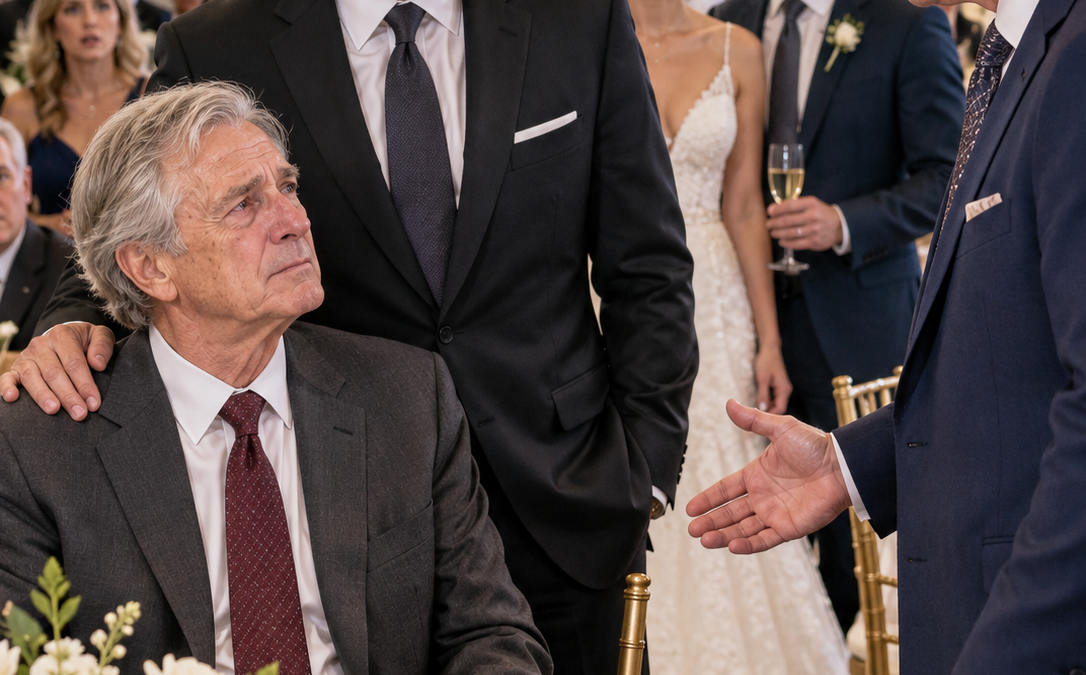
At my daughter’s wedding, they seated me next to the restroom.
“You’re too poor to sit with everyone else,” the groom whispered.
I sat there alone, humiliated, until a man in a black suit suddenly pulled out the chair beside me.
“Let’s pretend we’re old friends,” he said quietly.
At that moment, my son spotted us together. His face turned pale, as though he’d seen a ghost. Because the man sitting beside me had the power to destroy everything they had tried to protect by hiding me near the restroom—with a single word.
Before we continue, please subscribe to the channel and write in the comments what time it is where you are right now.
“Dad, I need to talk to you about the wedding.”
Jennifer’s voice had that familiar edge I’d learned to recognize over the years, the particular tone she used whenever she wanted something. She stood beside my kitchen counter, her engagement ring catching the February afternoon sunlight filtering through my worn curtains. Michael leaned against the doorframe behind her, his arms crossed, already looking bored.
I sat at my small dining table with both hands wrapped around a coffee mug that had long since gone cold.
“Of course, sweetheart. Whatever you need.”
She exchanged a glance with Michael. Something passed between them, some silent agreement that I wasn’t part of.
“Christopher’s family is… well, they’re used to a certain lifestyle.”
She touched the edge of my counter, trailing her fingers across the laminate as though checking for dust.
“The wedding is going to be high-profile. There’ll be business associates, important people.”
“That’s wonderful.”
I smiled, remembering her as a little girl twirling around my classroom after school, proudly telling anyone who would listen that her father was the smartest person alive.
“I’m so happy for you, Jennifer.”
“Right. Happy. That’s good.”
She walked toward the window, her expensive coat—probably four hundred dollars, maybe more—shifting around her with every step.
“But here’s the thing. I need your help.”
“Anything.”
“I need you to adjust how you present yourself.”
The words landed strangely, as though they’d been arranged in the wrong order.
“Adjust?”
Michael stirred from his position beside the door.
“Come on, Jen. Just say it straight.”
She turned toward me, her expression taking on the same stubborn determination I remembered from when she was sixteen and arguing for a later curfew.
“I need you to pretend you’re more successful than you are. Just for the wedding. Just for one day.”
My hands began to tremble. I carefully lowered my coffee mug onto the table.
“What exactly are you asking me to do?”
“Dad, don’t make this harder than it needs to be.”
She came back to the table and sat across from me.
“Christopher’s father owns three car dealerships. His mother sits on charity boards. They’re going to ask about you, about what you do—or did, whatever.”
“I was a teacher,” I said quietly. “I taught history for thirty-seven years.”
“See? That’s exactly what I mean.”
Michael pushed away from the doorframe. His new watch, worth at least three hundred dollars, flashed as he gestured.
“You say ‘teacher,’ and people think… you know. Maybe say you worked in education management instead. That’s technically true. You managed classrooms, students, curricula.”
I looked at my son and wondered when he had learned to twist words so easily.
“It’s my wedding day, Dad.”
Jennifer reached across the table, stopping her hands just short of mine.
“My special day. Can’t you just do this one thing for me?”
One thing.
The phrase echoed inside my head.
I thought about five years earlier, when I’d worked double shifts and tutored children after school four nights a week. I’d canceled my long-awaited trip to the Grand Canyon and put thirty-five thousand dollars toward Jennifer’s graduate tuition at Portland State.
When she received her acceptance letter, she’d hugged me so tightly I could hardly breathe. She’d told me I was the best father in the world.
“I don’t understand why you need me to lie.”
“It’s not exactly lying,” Michael said.
He pulled out the third chair and made himself comfortable, as though we were conducting a business negotiation.
“It’s just framing things better. You were in education management. You live in Southeast Portland. That’s true. No need to mention it’s a studio apartment. You’re retired now. That’s completely accurate.”
“After everything I’ve done for you both…”
“After everything?”
Jennifer’s voice sharpened.
“Dad, that’s not fair. We’re grateful for everything. That’s why I’m asking you to do this. If you really love me, you’ll help me fit in with Christopher’s family. You’ll make this easier, not harder.”
I stared at her.
Sunlight illuminated one side of her face, leaving the other in shadow. I searched for the little girl who used to wait outside my classroom, grab my hand, and tell me everything that had happened during her day.
I couldn’t find her.
“You want me to pretend I’m someone I’m not.”
“I want you to be there for me.”
Her voice cracked, and I hated how skillfully she used it. She knew exactly which emotion would reach me.
“Is that so much to ask? One day. A few hours. You don’t even have to say much. Just let me introduce you the right way.”
Michael leaned back in his chair.
“Dad, you know how these things work. Appearances matter. Jen’s not asking you to change who you are. Just present yourself better.”
Present myself better.
As though I were a project that needed polishing.
I remembered another conversation at this very table three years earlier, when Michael had asked me for eight thousand dollars to start a business.
“Six months tops, and I’ll pay you back with interest.”
He had never mentioned that money again. Never repaid it. Never even acknowledged that the loan had happened.
“There’s a Men’s Wearhouse on Eighty-Second Avenue,” Jennifer continued, sensing my hesitation. “Get something in charcoal or navy. Nothing cheap-looking. I’ll give you eight hundred for it.”
She glanced around my apartment.
“And before the wedding, I want to bring Christopher by to meet you. We’ll need to clean up the apartment a little. Maybe put away some of these…”
She gestured vaguely toward my walls.
The framed photographs of Jennifer and Michael growing up. The bookshelves filled with history texts I’d collected over decades. The ordinary possessions that told the story of my life.
“You’re ashamed of me.”
“Dad, don’t be dramatic.”
Michael again, always backing his sister whenever it served him.
“We’re trying to help you. This is a good thing. You’ll meet Christopher’s family. They’re great people. You’ll probably like them.”
“As long as I pretend to be somebody else.”
Jennifer stood and smoothed her skirt.
“Fine. You know what? Forget it. Don’t come to the wedding. Stay here in your little apartment with your little life, and I’ll tell Christopher my father couldn’t make it. Would that be better?”
Her words struck like a physical blow.
I looked up at the stranger wearing my daughter’s face.
“That’s not what I want.”
“Then what do you want?”
She was crying now—or pretending to. I honestly couldn’t tell anymore.
“I’m trying to start a new life. Christopher is good to me. His family has connections that could help Michael and me both. This is important, Dad. Why can’t you see that?”
I thought about my wife, gone seven years now.
What would she have said if she could see us sitting there? Would she have told me to stand my ground? Or would she have encouraged me to give in, keep the peace, sacrifice one more time for our children?
My shoulders slumped.
“Fine.”
Jennifer blinked.
“What?”
“I’ll do it.”
The words tasted like ash.
“I’ll be whoever you need me to be.”
Her face brightened instantly. The tears disappeared as though they had never existed.
“Thank you, Dad. You won’t regret this. It’s going to be beautiful. You’ll see.”
She hugged me quickly, like someone completing a transaction.
Michael was already checking his phone.
“I’ll text you the details about meeting Christopher’s parents,” Jennifer said as she headed toward the door. “Probably next week. And remember—education management, comfortable retirement, Southeast Portland. Keep it vague. Keep it positive.”
They left together.
I heard Michael’s car start in the parking lot below. I walked to the window and watched them drive away in his new sedan, something German that probably cost more than I had earned in a year of teaching.
My apartment felt emptier than it had before they arrived.
I returned to the dining table.
Three coffee mugs sat there. Mine was barely touched. Theirs were empty.
I stared at them for a long time, trying to understand how I had raised two people who looked at me and saw something that needed to be hidden.
The afternoon light was fading by the time I could bring myself to do anything.
Not physically, of course. I’d gotten up twice, once to the window and once to the bathroom. But mentally, I remained trapped in that conversation. My thoughts kept circling back to Jennifer’s face when she asked me to pretend, and to Michael’s casual cruelty disguised as reasonable advice.
The three coffee mugs were still on the table.
I should have washed them. I should have made dinner. I should have done any of the ordinary things people do on a Tuesday evening in February.
Instead, I walked toward my bookshelf and picked up a framed photograph from Jennifer’s college graduation.
She wore her cap and gown, one arm around my shoulders, both of us grinning at the camera.
I remembered that day. She had introduced me to her professors and told them I was the reason she had made it through college.
“My dad always believed in me,” she’d said.
I put the photograph down and picked up another.
Michael’s wedding, four years earlier.
I had taken out a twelve-thousand-dollar personal loan at eight percent interest because he said his future in-laws expected a certain standard.
I believed him then. I believed it was an investment in his happiness.
It took me two years to pay off that loan.
I moved to my desk, opened my laptop, and logged into my bank account.
The numbers stared back at me in cold blue text.
My checking account balance was modest. My savings account held fifteen thousand dollars.
That money represented everything—my entire financial safety net, accumulated over seven years of careful retirement living.
My pension provided twenty-eight hundred dollars a month. Rent took fourteen hundred. Utilities, groceries, and basic necessities consumed most of what remained.
I wasn’t poor, not exactly.
But I certainly wasn’t comfortable.
Eight hundred dollars for a suit amounted to more than a quarter of my monthly income.
I clicked through to the Men’s Wearhouse website and examined the rental options.
Charcoal or navy, Jennifer had said. Nothing cheap-looking.
The irony was impossible to miss.
I was spending money I didn’t have so I could look like a man who had money I didn’t have.
My phone rested beside the laptop.
I picked it up, opened my messages, and began typing to Jennifer.
I’ve been thinking about what you asked.
I deleted it.
I started again.
Can we talk about this more? I’m not sure…
I deleted that, too.
What could I possibly say?
That her request hurt me? She knew it hurt me.
That it was wrong? She didn’t care.
That I had spent my entire adult life teaching my children to be honest, to value character over appearances, and now they were asking me to perform the exact opposite?
I placed the phone back on the desk.
Seven years earlier, when my wife died, I had held Jennifer while she cried. She was twenty-five then, still finding her way in the world.
“I don’t know how to do this without Mom,” she’d whispered.
I told her we would figure it out together. That I would always be there for her.
I meant every word.
Another memory surfaced.
Jennifer at fourteen, coming home from school and hugging me in the kitchen of our old house.
“Dad, can you come to my concert tomorrow? I want all my friends to meet you. I told them my dad is the best teacher in the whole city.”
Of course I went.
I sat in the auditorium with the other parents, watched her sing in the choir, and beamed with pride when she waved at me from the stage.
When had that changed?
When had I become someone she needed to hide?
I opened a notepad on my computer and began typing Jennifer’s instructions, as though I were writing a grocery list.
Suit: Men’s Wearhouse. Eight hundred dollars.
Story: Education management professional.
Clean apartment before Christopher visits.
Keep details vague.
Southeast Portland. No specifics.
Writing it all down made the arrangement real.
I was committing myself to the deception, to pretending my life was something other than what it was.
My hands hovered over the keyboard.
I considered calling Jennifer and telling her I’d changed my mind. That I couldn’t go through with it.
But then what?
She had meant every word she’d said. If I refused, I wouldn’t be allowed at the wedding.
I might lose her completely.
Was that worse than losing myself?
I closed the laptop and returned to the living room.
My apartment wasn’t large, just seven hundred square feet of modest living space.
The couch was old but clean. The curtains were faded but functional. The books on my shelves represented a lifetime of learning, teaching, and trying to expand the minds of the students who had passed through my classroom.
I had always been proud of this space.
It was mine, paid for with my pension and filled with my memories.
Now I saw it through Jennifer’s eyes.
Shabby. Insufficient. Embarrassing.
I sat on the couch and let my head fall back against the cushions.
Somewhere in my mind, Michael’s voice echoed.
“Six months tops, and I’ll pay you back with interest. I promise.”
Three years earlier.
Eight thousand dollars I’d transferred without hesitation because my son needed help.
He hadn’t repaid a single cent or even acknowledged the debt.
And here I was, preparing to put on a costume and play pretend for their benefit.
“It’s one day,” I said aloud to the empty apartment. “Just one day of pretending. I’ve done harder things.”
Even as I spoke, I knew something had broken.
Not suddenly. Nothing quite that dramatic.
But there was a crack now, a small fissure in the foundation of everything I believed about my relationship with my children.
They saw me as a problem to be managed.
I picked up my phone again, opened the Men’s Wearhouse website, and found the location on Eighty-Second Avenue.
The store was open until seven on weekdays.
I could go the following afternoon, get fitted, and choose something appropriate.
Charcoal or navy.
Nothing cheap-looking.
I opened my calendar and added the appointment.
Wednesday, 2:00 p.m. — Suit rental.
My jaw tightened as I typed.
It wasn’t anger. Not yet.
It was something else—a small, hard seed of recognition that this wouldn’t be the last thing my children asked me to compromise.
Jennifer’s wedding was only the beginning.
Soon there would be gatherings with Christopher’s family. Holidays when I’d have to maintain the illusion. Perhaps grandchildren who would be taught to see their grandfather through a carefully manufactured image of respectability.
Unless I said no.
But I wasn’t going to say no.
That wasn’t the kind of father I knew how to be.
I was the father who gave, who sacrificed, who showed up even when showing up cost him everything.
I placed the phone on the coffee table and stared at the blank television screen.
My reflection looked back at me, distorted and gray.
“You’re doing the right thing,” I whispered. “It’s her wedding. You’re doing this because you love her.”
My reflection offered no answer.
It didn’t agree or disagree. It simply stared back with tired eyes that had seen too much, given too much, and somehow still had more to give.
Outside, the February evening had turned completely dark.
Somewhere across Portland, Jennifer was probably telling Christopher how well our conversation had gone, how her father had agreed to everything.
Michael was probably sitting in some bar, having already forgotten the afternoon.
And I sat alone in my small apartment, committed to telling a lie I didn’t want to tell for children who had learned to take everything and offer nothing in return.
Tomorrow, I would rent the suit.
Tomorrow, I would begin becoming someone else.
Two weeks passed after I made that appointment.
I rented the suit. Eight hundred dollars that made me wince when I looked at my checking account.
I practiced my lines in the bathroom mirror like an actor preparing for opening night.
“Education management. Curriculum oversight. Program development.”
The words felt like marbles in my mouth.
Jennifer communicated only through brief, clinical text messages.
Dinner. March 8. 7:00 p.m. Le Pjon downtown. Wear the suit. Be there at 6:55 sharp.
And so, at 6:50 on a cold March evening, I found myself standing outside a restaurant I would never have considered entering on my own.
Through the windows, I could see exposed brick walls, candlelit tables, and couples leaning toward one another over glasses of wine that probably cost more than my monthly utility bill.
The warm glow spilling onto the sidewalk seemed intended for people who belonged to a different world.
I checked my reflection in the glass.
The charcoal suit fit well enough, but it didn’t feel like mine.
I adjusted my tie for the third time, drew a breath that did nothing to steady my hands, and pushed through the door.
Jennifer waved from a table in the center of the restaurant.
She was already seated with Christopher and two people who could only be his parents. They looked polished and confident, occupying their surroundings with the effortless assurance of people accustomed to being important.
I approached, my shoes sounding unnaturally loud against the hardwood floor.
“Dad.”
Jennifer stood and quickly kissed my cheek.
Her smile was tight, more of a warning than a welcome.
“This is Christopher and his parents, Richard and Patricia Benjamin.”
Richard extended his hand. His grip was firm and assessing, the handshake of a man who had learned to judge people in seconds.
“Barney, pleasure to finally meet you. Jennifer speaks so highly of her father.”
“The feeling’s mutual.”
I shook Patricia’s outstretched hand. She leaned forward and air-kissed near both my cheeks, leaving behind a cloud of expensive, overwhelming perfume.
Christopher half rose from his chair and nodded.
“Good to meet you, sir.”
His eyes slipped away from mine almost immediately, already evaluating, already forming conclusions.
We sat down.
A server appeared with menus almost as thick as the textbooks I’d used in my classroom.
I scanned the prices.
Forty-five to eighty-five dollars for an entrée.
My weekly grocery budget on a single plate.
“Order whatever you like,” Richard said, waving one hand with expensive carelessness. “We’re celebrating.”
The conversation began safely enough.
The weather. Portland’s recent rain. Traffic downtown.
Then Richard leaned back in his chair, his wineglass balanced perfectly in one hand, and the interrogation began.
“So, Barney, Jennifer mentioned you had quite the career in education. Tell us about that.”
I had rehearsed this moment.
I knew my lines.
“I spent my career in education management, curriculum development, and program oversight, working with teachers to improve student outcomes.”
Technically true.
Deliberately vague.
“Fascinating,” Patricia said, although her tone suggested she found it anything but fascinating. “And where are you living these days? Jennifer mentioned Southeast Portland. That area’s seen quite the boom. Property values must be impressive.”
“I have a place there. Yes. Modest, but comfortable.”
“Have you considered selling?”
Richard leaned forward.
“Market’s hot. Good time to capitalize on equity.”
“I rent, actually.”
There was a pause.
Just a beat, but I felt it.
Patricia’s smile remained unchanged, yet something behind her eyes shifted.
“Smart man,” Richard recovered smoothly. “Liquidity is important. Speaking of which, what’s your investment strategy these days? Stocks? Bonds? Real estate holdings elsewhere?”
Jennifer’s foot pressed firmly against mine beneath the table.
A warning.
Stay on script.
But something inside me cracked.
Not anger.
Disgust.
An overwhelming, stomach-turning disgust at the performance, the carefully constructed half-truths, and the expectation that I should pretend my life had been something other than what it was.
I put down my fork.
“I need to be honest.”
My voice came out calm, the same steady teacher’s voice I’d used for thirty-seven years whenever a student needed to hear an uncomfortable truth.
“There’s been a misunderstanding.”
Everyone looked at me.
“I wasn’t in education management. I was a high school history teacher. I don’t have investment portfolios or property holdings. What I earned, I spent on my children, making sure they had opportunities I never had.”
Silence dropped over the table like a stage curtain.
Richard’s expression became carefully neutral.
Patricia pressed her lips into a thin line.
Christopher’s jaw visibly tightened.
And Jennifer’s face drained of color. Her knuckles turned white around the napkin in her hands.
“Well,” Patricia said in a voice cold enough to frost glass. “That’s certainly admirable.”
“Very noble,” Richard added.
But he made the word sound like an insult.
The conversation eventually lurched forward, yet everything had changed.
They spoke around me now.
Questions went to Jennifer. The topics shifted toward things I couldn’t contribute to.
Patricia asked about honeymoon destinations. Christopher displayed photographs of houses on his phone, calling one of them their future home. I would later learn it was rented for thirty-five hundred dollars a month.
Richard mentioned his three thriving car wash locations and his plans for expansion.
The message beneath their conversation was unmistakable.
We have wealth. We are successful. You are not.
I sat through four courses I could barely taste.
Seared duck. Roasted vegetables arranged like artwork. A chocolate dessert that must have taken hours to prepare.
Every bite tasted like ash.
When Richard paid the bill without offering to split it or even asking whether I’d like to contribute, I felt the full weight of my irrelevance.
Outside, in the parking lot behind the restaurant, the cold air cut through my suit jacket.
Jennifer walked ahead of me, her heels clicking sharply against the pavement.
Christopher and his parents had already driven away.
Then she spun around.
Her face held an expression I’d never seen before.
Rage.
Pure, undiluted rage.
“You ruined everything!”
Her voice trembled.
“Why? Why couldn’t you just keep quiet? Just sit there and nod and let them think—”
“Think what? That I’m someone I’m not?”
“Yes!”
She was crying now, but not from sadness. From frustration. From shame.
“Is that so impossible? One dinner, Dad. A few hours of pretending. But no, you had to be honest. You had to embarrass me in front of Christopher’s family.”
“I’m not ashamed of what I am, Jennifer.”
“Well, maybe you should be.”
The words struck like a slap.
“Maybe if you’d cared more about success and less about being noble, we wouldn’t be in this situation. Maybe if you’d saved money instead of throwing it away on us, you’d have something to show for your life.”
I stood there with my hands in the pockets of the rented suit and let her words hit me.
What could I say?
That I’d worked two jobs to pay her tuition?
That I’d canceled vacations, eaten cheap food, and worn old clothes so she could have new ones?
She knew all of that.
She simply didn’t care.
“I’m sorry,” I said quietly. “I tried.”
“Not hard enough.”
She wiped her eyes, smearing her mascara.
“Just forget it. I need to go.”
She climbed into her car, another new German model I didn’t recognize, and drove away without looking back.
I remained alone in the parking lot for a long time.
Other diners came and went around me. Couples laughed. Groups of friends chatted as they walked toward their cars.
No one noticed the old man in the rented suit, standing perfectly still while his world collapsed.
When I got home, I carefully hung up the suit.
Eight hundred dollars.
I’d need that deposit back.
I sat in the darkness, still wearing my white dress shirt, and waited.
My phone rang at 10:30.
Michael.
“Jen called me.”
His voice was cold and distant.
“I can’t believe you did that.”
“Michael—”
“This was her chance at a good life, Dad. Christopher’s family has money, connections. She could’ve had everything. And you sabotaged it because of your pride.”
“It wasn’t pride. It was—”
“Save it.”
A pause followed.
“Just try not to ruin the actual wedding, too.”
The line went dead.
I sat there holding the phone, staring at the blank screen.
Outside, Portland continued its evening as though nothing had happened.
Cars passed. Sirens sounded somewhere in the distance. Life went on for people whose children didn’t despise them.
The suit hung on my bedroom door, a costume for a performance that had failed.
Tomorrow, I would return it, get my deposit back, and resume my small life in my small apartment.
But something had changed.
Not in my children.
In me.
A question had begun forming in my mind, quiet but insistent.
Why was I still trying to please people who saw me as a burden?
I didn’t have an answer yet.
The silence that followed the dinner was deafening.
I called Jennifer the next morning.
She answered on the fifth ring.
“I can’t talk right now.”
Click.
I sent an apology by text, although I wasn’t entirely sure what I was apologizing for.
Being honest?
Existing?
No response.
Three days later, I tried again.
Honey, I’m sorry about the dinner. Can we talk?
Hours passed before she finally replied.
Too busy with wedding prep.
I stopped trying.
March became a study in absence.
My phone sat on the kitchen counter like an artifact from a dead civilization. I picked it up compulsively, checked for messages that never arrived, and put it down again.
When Jennifer did text, her messages were purely logistical.
Wedding April 18. The Nines Hotel downtown. 200 guests. Ceremony 4:00 p.m. Reception 6:00 p.m.
No I love you.
No I hope you can make it.
Just coordinates for an event I was obligated to attend.
I asked about the dress code.
Formal.
I offered to contribute money. Anything I could manage, even a thousand dollars from my savings.
Everything is paid for by the Benjamin family. Just show up.
Just show up.
As though that was all I was good for.
Michael’s silence ran parallel to Jennifer’s.
I called him twice.
Both calls went to voicemail.
“Just checking in, son. Love you.”
A week passed without a reply.
Then a text arrived.
Busy with work. See you at wedding.
They had coordinated.
My children, who used to argue about everything, had finally found common ground in freezing me out.
My apartment became both a prison and a sanctuary.
I walked in circles through rooms that suddenly felt too small and too empty at the same time.
Past the refrigerator, where Jennifer’s childhood artwork still clung to the door. Finger paintings from twenty-eight years earlier, faded and curling at the edges.
Past the shelf holding Michael’s Little League trophy. I had coached his team for three years, giving up my Saturday mornings so he could play.
I pulled out photo albums I hadn’t opened in months.
Jennifer’s high school graduation.
She had been valedictorian, with full scholarship offers from three universities.
I sat in the front row that afternoon, tears running down my face, thinking, We did it. She made it.
That same day had also been my twenty-fifth work anniversary.
The school had organized a ceremony, complete with a plaque presentation and cake in the teachers’ lounge.
I missed it.
Jennifer’s graduation was scheduled for the same afternoon, and there had never been any question about where I would be.
I turned another page.
Michael at twenty-two, standing proudly beside a used Honda Civic.
I remembered that day, too.
Two weeks earlier, he had called me crying. He’d totaled his car, had no insurance money coming, and his unemployment benefits were nearly exhausted.
“I can’t get to job interviews without a car, Dad. I’m so sorry.”
I took out a six-thousand-dollar personal loan at nine percent interest.
For months afterward, I ate ramen noodles and peanut butter sandwiches so I could make the payments.
Michael hugged me when I handed him the keys and promised to pay me back as soon as he was on his feet.
That was thirteen years earlier.
The loan had long since been paid off.
Michael hadn’t contributed a cent.
I flipped to a photograph from my sixtieth birthday, three years before.
I’d mentioned several times in the weeks leading up to it that I hoped we could have a small dinner together.
When the day arrived, both children texted around noon.
Swamped with work, Dad. Rain check.
I heated a frozen dinner, ate alone, and went to bed at eight.
One week before Jennifer’s wedding, a heavy cream-colored envelope appeared in my mailbox.
The invitation was beautiful.
Gold embossing. Elegant calligraphy. Cardstock so thick it seemed sturdy enough to build houses with.
Mr. and Mrs. Richard Benjamin request the honor of your presence at the marriage of their son, Christopher Michael Benjamin, to Miss Jennifer Marie Butler.
I read it three times.
I was the bride’s father.
Yet I was being formally invited like some distant cousin.
My name appeared nowhere. Not as a host. Not even as an acknowledgment.
This was a Benjamin wedding.
Jennifer was simply the bride being acquired.
I propped the invitation on my kitchen counter, where I saw it every morning while making coffee.
A beautiful reminder of my irrelevance.
Despite everything—the coldness, the rejection, the formal invitation that treated me like a stranger—I still wanted to give Jennifer something meaningful.
Something that said, I’m still your father. I still love you.
Maybe material things spoke louder than words in her new world.
One Thursday afternoon, I drove to Hawthorne Boulevard.
The district was lined with boutiques and cafés I’d never entered, shops selling artisanal goods to people with artisanal incomes.
An antique store stood between a pottery studio and a wine bar.
Inside, surrounded by objects from other people’s pasts, I began searching.
Vintage jewelry felt too impersonal.
Furniture seemed too presumptuous.
Then I saw the clock.
It was made of brass and mahogany, crafted in the 1940s, with Roman numerals and a face that had aged into character.
I picked it up and turned the key.
The mechanism caught, then began to tick.
Steady.
Reliable.
Built to last.
“That’s a quality piece,” the shop owner said.
He was perhaps fifty, with a gray beard and kind eyes.
“Built to last generations.”
“It’s for my daughter’s wedding.”
His smile was genuine.
“She’ll treasure it. These pieces hold their value, both monetary and sentimental.”
“I hope so,” I said quietly.
Five hundred dollars.
Nearly twenty percent of my monthly pension.
I paid in cash, using bills I’d withdrawn from the ATM specifically for the purchase.
The owner carefully wrapped the clock in brown paper and bubble wrap.
At home, I wrapped it again in expensive paper I’d bought from a craft store.
Twelve dollars for wrapping paper, more than I would normally have spent.
I tied it with silk ribbon and attached a card in my careful handwriting.
To Jennifer and Christopher,
May your life together be as timeless as this clock.
Love always, Dad.
I practiced what I would say when I handed it to her.
Would she even open it at the wedding?
Would she thank me in front of Christopher’s family?
Or would my gift be quietly pushed aside, another embarrassment she’d deal with later?
The night before the wedding, my phone buzzed.
Jennifer.
Please just come tomorrow and don’t draw attention. Thanks.
I read it three times, searching for warmth that wasn’t there.
Not I love you, Dad.
Not I’m glad you’ll be there.
Just another set of instructions for managing a problem.
A problem named Barney Butler.
I placed the phone beside the wrapped clock on my dining table.
In my bedroom, I had laid out the next day’s clothes.
The same suit from the dinner. I’d rented it again.
Another eight hundred dollars I couldn’t afford.
Polished shoes. A conservative tie.
Everything was ready.
I was ready.
But ready for what?
To be tolerated?
To be managed?
To sit quietly in whatever corner they’d assign me and watch my daughter marry into a family that measured human worth in bank statements?
I turned off the lights and climbed into bed, but sleep wouldn’t come.
The clock in the living room—my old wall clock, not the gift—ticked steadily through the darkness.
Every second brought me closer to tomorrow, to an event that filled me with dread instead of joy.
Moonlight through my bedroom window touched the wrapped gift on the table.
Five hundred dollars of hope that, somewhere beneath her shame, my daughter still loved me.
I closed my eyes and waited for morning.
The wedding day arrived beneath gray Portland skies that perfectly matched my mood.
I woke at six, although I’d barely slept.
My older charcoal suit hung on the closet door, freshly pressed and presentable despite its age. It wasn’t a rented suit this time, just something I had taken care to make look respectable.
I spent an hour getting ready.
I polished my shoes until they gleamed, at least from a distance. I tied my necktie three times before I was satisfied. I examined my reflection with the critical eye of a man who knew judgment was coming.
The wrapped clock waited in its gift bag beside the door.
Five hundred dollars of hope.
I drove downtown and parked in the garage beneath the Nines Hotel.
Twenty-five dollars for the day.
I made a mental note of the expense, another amount I couldn’t comfortably afford but would pay anyway.
The elevator carried me to the event floor.
When the doors opened, I stepped into a world of luxury I’d previously seen only in magazines.
White orchids filled crystal vases. Chandeliers caught the light like frozen waterfalls. Champagne flowed on silver trays carried by servers in crisp uniforms.
Two hundred guests in designer clothing moved through the space with the casual confidence of people who knew they belonged.
I tightened my grip on the gift bag and stepped into the reception area.
Near the ballroom entrance stood an ornate seating chart in a gilded frame, its elegant calligraphy listing the guests and their assigned tables.
I approached and ran my finger down the alphabetical list.
Butler, Barney — Table 18.
My stomach dropped.
Through the open ballroom doors, I could see table eighteen in the far back corner, barely ten feet from the restroom doors.
It was poorly lit compared with the front tables, which glowed beneath the chandeliers.
Tables one through six, closest to the head table, were clearly reserved for family members and important guests.
I could read some of their place cards from where I stood.
Table five listed Michael and Amanda Butler.
My own son had been seated fifteen tables closer to his sister than I had.
I walked into the ballroom, weaving between tables already set with crystal glasses and gold-rimmed china.
Nobody acknowledged me.
Guests clustered in groups, laughing and raising champagne flutes.
I was invisible, a background figure in somebody else’s celebration.
At table eighteen, I found my place card.
Mr. Barney Butler.
The elegant script made my name look more important than the seating arrangement suggested.
The other names meant nothing to me.
Strangers. Distant acquaintances of the Benjamin family, judging by their surnames.
No family.
No friends.
I sat down and carefully placed the gift bag beneath my chair, out of sight.
What was the point of displaying a gesture no one would notice?
From my isolated corner, I watched the social machinery of the room begin turning.
The head table glittered with attention.
Richard and Patricia Benjamin held court near the bar, surrounded by admirers.
Christopher moved through the crowd in a designer tuxedo, shaking hands and accepting congratulations.
Michael stood nearby with a champagne flute, laughing at something Richard had said. They clinked glasses like old friends.
Then Jennifer appeared in her white pre-reception dress.
Her hair had been styled into elaborate waves, and her makeup was flawless.
She moved from group to group, accepting hugs and congratulations, glowing with joy.
For one brief moment, our eyes met across the forty feet separating us.
She looked away almost immediately.
Neither of my children approached to greet me.
Servers passed my table periodically on their way to and from the restrooms.
A few glanced at me with mild curiosity.
I could almost hear their thoughts.
Who is that older man sitting alone in the corner?
I lowered my eyes and tried to occupy as little space as possible.
During the cocktail hour, Christopher approached with a glass of champagne in his hand.
His smile was calculated and cold.
“Barney.”
He gestured toward my table.
“Hope the location works for you.”
I looked up at him.
“Table eighteen. Quite far from the family tables.”
“Well, we had to arrange seating by…”
He paused, selecting his words carefully.
“By status. I mean, by how well guests know each other.”
“You mean because of my financial situation.”
I met his eyes directly.
“Because I’m poor.”
His laugh was nervous and sharp.
“Let’s say our guests are accustomed to certain conversational levels. Investments, business ventures, that sort of thing.”
He leaned a little closer.
“You said it yourself at dinner. You’re a simple teacher.”
“I’m Jennifer’s father.”
“Right.”
He was already stepping back, already dismissing me.
“Just enjoy the celebration. Try not to upset Jennifer, okay?”
He walked away before I could respond, greeting other guests with more warmth than he’d shown me.
I sat alone with a glass of water in my hand.
I hadn’t touched the champagne. I couldn’t risk appearing drunk or unprofessional, even now, when professionalism clearly wasn’t going to earn me anything.
Across the room, Michael glanced in my direction.
Our eyes met.
He looked away, took another drink, and continued his conversation with Richard Benjamin.
Amanda, his wife, chatted animatedly with Patricia near the head table.
Even she had been absorbed into the Benjamin family circle.
Only I remained in exile.
A server approached and refilled my water glass.
“Can I get you anything else, sir?”
“No, thank you. This is fine.”
She smiled kindly.
“Let me know if you need anything. It’s a beautiful wedding.”
“Yes,” I said. “Beautiful.”
She moved on.
And I realized that her simple kindness had been my warmest interaction of the entire evening.
Two guests passed my table on their way to the restrooms.
Their conversation drifted back to me.
“Who’s that man sitting alone back there?”
“Not sure. Maybe a distant relative. Poor soul looks lonely.”
They didn’t know I could hear them.
Or perhaps they didn’t care.
I looked down at my hands resting on the table.
Weathered. Veined.
The hands of a sixty-three-year-old man who had spent his life giving everything to children who had grown into strangers.
Five hundred dollars for a clock they would probably never wind.
Thirty-five thousand dollars for Jennifer’s graduate education, which she never mentioned anymore.
Eight hundred dollars for a rented suit so I could pretend to be somebody else at a dinner that had ended in humiliation.
How much did it cost to be worth a decent seat at your own daughter’s wedding?
Apparently more than I would ever have.
The ballroom gradually filled as the ceremony approached.
Guests moved toward their assigned tables, adjusting chairs and settling into their places.
The head table remained empty. The wedding party would enter after the ceremony.
But the tables closest to it filled with laughter and conversation.
Table eighteen remained mostly empty.
Except for me.
I held my water glass and watched my children at the front of the room.
They belonged to a different world now.
A world where I was an embarrassment to be hidden, a problem to be managed, an obstacle between guests and their destination.
Then I heard a chair scrape against the floor beside me.
Someone was sitting down.
I looked up, expecting another stranger assigned to my little corner of exile, another person who would spend the evening wishing they’d been seated anywhere else.
Instead, I saw a man approximately my own age settling into the adjacent chair.
He wore an expensive black suit.
His eyes were kind, and his warm smile seemed genuine in a room crowded with carefully calculated expressions.
“This seat taken?” he asked.
Then he smiled a little wider.
“Mind if I pretend we’re old friends? This corner looks too lonely for a celebration.”
I stared at him, startled.
Throughout the entire evening, nobody had voluntarily approached me.
“Sure.”
I gestured toward the empty chair.
“Though I should warn you, this isn’t exactly the prestigious section.”
He settled into the seat and placed his glass on the table.
Expensive whiskey, I noticed.
Not champagne.
His suit whispered wealth rather than shouting it.
Something about his face seemed familiar.
“Have we met?” I asked.
He studied me more closely.
“You look familiar.”
I examined him again.
The shape of his face. The way his eyes crinkled when he smiled. The cadence of his voice.
Recognition struck like electricity.
“Robert? Robert Thomas, from Portland State?”
His entire face lit up.
“Barney Butler! I can’t believe it! How long has it been?”
“Twenty years, at least. Since you moved to Seattle.”
“Closer to twenty-two.”
He stood, and I rose to meet him.
We embraced in a genuine hug between old friends, nothing like the air-kissed politeness I’d watched all evening.
Several nearby guests glanced toward us, curious about the unexpected display of emotion at table eighteen.
We sat down again.
For the first time since I’d arrived, I felt genuine warmth.
“You look good, my friend,” Robert said. “Still have that teacher energy about you.”
“Still a teacher?”
“Well, retired now.”
I managed a smile.
“You clearly did better than I did.”
Robert waved away the compliment, but his suit and watch told a story his modesty wouldn’t.
This was a man who had succeeded in ways I’d never imagined.
Then his expression changed.
He looked around the ballroom, studying the elaborate tables near the front and the arrangement of the head table.
“Wait. Why are you back here?”
He gestured toward the front of the room.
“Barney, you’re the bride’s father. Where’s the family table?”
“This is my assignment. Table eighteen.”
“That’s insane. There must be some mistake.”
“No mistake,” I interrupted.
I couldn’t keep the bitterness entirely out of my voice.
“Just priorities. Different priorities than mine.”
Robert’s jaw tightened.
He was a businessman now, someone trained to read situations quickly.
He didn’t press me for details, but I saw understanding—and anger—flash across his face.
“I need to tell you something,” he said quietly. “I’m here because Richard Benjamin invited me.”
I turned toward him.
“Richard?”
“He’s been hounding me for months about investing in his businesses. His car washes. Three locations, all struggling.”
Robert leaned closer and lowered his voice.
“He’s leveraged beyond reason, Barney. Bank debt over three hundred forty thousand dollars. He needs at least two hundred thousand in fresh capital just to survive the next year.”
I absorbed the information slowly.
The same Richard Benjamin who had lectured me about investment strategies over dinner?
The man who had spoken so confidently about his thriving businesses?
“Does he know you’re undecided?”
“He knows I’m evaluating.”
Robert’s eyes traveled across the ballroom.
The opulent decorations. The expensive champagne. The lavish display of wealth.
“Tonight was supposed to impress me. Show me stable family values, business acumen.”
He paused, turning his gaze back toward our isolated corner.
“Seating the bride’s father by the restroom doesn’t exactly convey family values.”
Across the ballroom, I noticed Michael moving.
He’d been standing near the bar, but now he was slowly edging closer to our table.
His face looked pale.
The drink in his hand hung forgotten at his side.
His entire attention was fixed on us.
“Your son?”
Robert followed my gaze.
“Yes. Michael.”
“He looks concerned about something.”
I watched Michael shift position again, trying to get closer without appearing obvious.
Amanda touched his arm and said something, but he brushed her off without looking at her.
“Robert,” I said carefully, “tell me more about Richard’s situation. What exactly would your investment involve?”
He studied me, curious about my sudden interest.
“Full partnership. Restructuring operations. Family involvement in the turnaround.”
He paused.
“Why?”
“Just curious about my daughter’s new family.”
I kept my tone casual.
“I’d like to know where she’ll be living her life.”
Robert didn’t seem entirely convinced that was my only reason, but he continued.
“Richard approached me six months ago. The car washes have potential, but they’re poorly managed. He’s made expensive expansion decisions without proper capital backing. Now he’s months behind on loan payments. Vendors are threatening to pull service contracts. The whole operation is on the verge of collapse.”
“And he needs your money to save it.”
“He needs my money, my business connections, and my reputation.”
Robert tapped his fingers once against the table.
“That last part matters most. If Robert Thomas invests, other investors follow. Banks extend more credit. Vendors offer better terms.”
I considered his words.
Slowly, the pieces began falling into place.
Richard’s desperate pursuit of Robert’s approval.
Christopher’s marriage to Jennifer as part of the image of a respectable, successful family.
The seating arrangement that had hidden a poor schoolteacher from the wealthy investor whose money they needed.
“How much have you committed?”
“Nothing yet.”
Robert’s expression hardened.
“I’ve been avoiding it because something felt off. The numbers work on paper, but family businesses live or die on family dynamics.”
He glanced toward Michael, who had moved even closer and now stood about twenty feet away.
“And after seeing how they treat you tonight, I’m inclined to walk away entirely.”
Michael must have heard those last words.
His face went from pale to ashen.
“Don’t make that decision based on me,” I said quietly.
“Why not?”
Robert leaned back.
“You think I invest in people who disrespect loyalty? People who hide their own family members? That tells me everything about their character, Barney.”
To our right, Michael had moved close enough that I could clearly see the panic in his eyes.
He recognized Robert Thomas.
He must have seen his photograph in Forbes, the Portland Business Journal, or some financial news article.
Robert Thomas.
Venture capital investor.
Estimated net worth between forty and fifty million dollars.
One of the Pacific Northwest’s most influential business figures.
And here he was, sitting at table eighteen, deep in conversation with the father everyone had dismissed.
“Your son definitely recognizes me,” Robert observed with some amusement.
“He manages a car dealership. He’d know who you are.”
“Does he know we’re friends?”
“He does now.”
Robert turned his attention back to me.
“So tell me, old friend. How did you end up with a daughter marrying into this particular family?”
I gave him the abbreviated version.
Jennifer’s engagement.
The pressure to pretend I was wealthier and more successful than I was.
The disastrous dinner.
The weeks of silence.
And finally, the wedding where I’d been assigned to a corner like a piece of damaged furniture.
Robert listened without interrupting.
With every detail, his expression grew darker.
“And you came anyway.”
“She’s my daughter.”
“Even after they put you here.”
It wasn’t a question.
Just a statement of fact.
“Even after.”
Robert remained silent for a moment, his eyes distant.
Then he focused on me again.
“Barney, let me explain exactly what Richard proposed.”
He leaned forward.
“A full partnership would mean restructuring the entire business. I’d have decision-making authority over operations, hiring, and family roles in the company.”
He paused meaningfully.
“Including whether certain family members remain involved at all.”
I understood what he wasn’t saying.
“You’d have leverage.”
“Considerable leverage. If I choose to use it.”
Soft string music began playing through speakers hidden around the ballroom.
Guests moved toward their seats.
The ceremony was about to begin.
Michael stood frozen about thirty feet away, watching us, apparently calculating whether he should intervene or report what he’d discovered to Christopher and the Benjamins.
Robert raised his whiskey glass slightly.
“To old friends who show up even when they’re not wanted.”
I lifted my water glass.
“To old friends who sit in the corner when they could sit anywhere.”
Our glasses touched.
Across the ballroom, I saw Michael finally move.
Not toward us.
Toward Christopher, who stood near the ceremony entrance.
They began speaking urgently.
Christopher’s eyes snapped toward table eighteen.
“I think we’ve been noticed,” Robert said mildly.
“I think you’re right.”
The music swelled.
The ceremony was beginning.
But for me, something else was beginning, too.
I was finally recognizing that I wasn’t as powerless as my family had assumed.
I had Robert’s ear.
Robert had leverage.
And the Benjamin family desperately needed Robert’s approval.
The father they’d hidden beside the restrooms had suddenly become the most important person in the room.
Michael didn’t walk across the ballroom.
He ran.
His sudden movement caught the attention of nearby guests.
A groomsman abandoning his post and weaving urgently between tables was bound to attract attention.
I watched from table eighteen as Michael reached Christopher near the ceremony entrance, grabbed his arm, and pulled him aside.
Even from forty feet away, I could see Michael’s lips moving rapidly. He gestured back toward our table.
Christopher’s face drained of color.
“Your son seems distressed,” Robert observed mildly.
“He just figured out who you are.”
“Ah.”
Robert took a sip of whiskey.
“And realized his family seated you here as a deliberate insult.”
“Something like that.”
Jennifer joined them a moment later, her white dress rustling as Michael pulled her into their urgent conversation.
Christopher spoke rapidly, gesturing toward us.
Jennifer’s expression shifted from confusion to horror as the meaning of their conversation became clear.
All three stared toward table eighteen.
“Here comes the cavalry,” Robert said.
But it wasn’t either of my children who approached first.
Richard Benjamin came toward us wearing his polished business smile, his confident stride carrying him across the ballroom.
He already had one hand extended toward Robert when he finally noticed who Robert was sitting beside.
His steps faltered.
The smile remained, but his eyes widened slightly.
“Robert! So glad you could make it.”
He recovered quickly and continued forward.
“But why are you sitting back here instead of at…”
His voice trailed off.
He looked at me with barely concealed dismay.
“You two know each other?”
Robert stood and shook Richard’s hand with considerably less warmth than politeness required.
“Know each other? Richard, Barney and I are best friends. Have been for nearly forty years. College roommates, actually.”
His words carried clearly.
Several nearby guests turned to look.
Richard gave a nervous laugh.
“How wonderful. I had no idea you and Barney were… that you…”
He couldn’t finish.
“That we were close?”
Robert’s voice developed a sharp edge.
“Very close. He’s one of the most honest, principled people I’ve ever met.”
Christopher and Jennifer arrived at that moment.
Their expressions combined forced happiness with barely concealed panic.
“Dad!”
Jennifer’s voice was too bright, too high.
“Mr. Thomas, I had no idea you two knew each other.”
I looked at my daughter.
“You never asked about my life, Jennifer. You assumed poor teachers don’t have successful friends.”
“That’s not fair.”
“Fair?”
I kept my voice calm and conversational.
“Would you like to discuss fairness, starting with where you seated me?”
Christopher stepped forward.
“Sir, this is all a misunderstanding. The seating wasn’t meant to—”
“Wasn’t meant to what?”
I looked directly into his eyes.
“Humiliate me? Exclude me? You said it yourself earlier. I’m too poor for proper conversation with your guests.”
“I never said exactly—”
“You said exactly that.”
Robert had heard the entire story.
He shifted his chair slightly closer to mine.
It was a small movement, but the physical declaration of solidarity didn’t go unnoticed.
His expression had hardened.
“Barney explained the situation,” he said. “The table by the restroom, your comments about his poverty making him unsuitable for proper guest interaction, the systematic exclusion from his own daughter’s wedding.”
Richard’s panic was becoming visible.
“Robert, please. I’m sure there’s been a misunderstanding.”
Robert stood.
When he spoke, his voice carried across several nearby tables.
“Richard, I’m afraid I need to reconsider our upcoming business meetings. A man who doesn’t respect his future daughter-in-law’s father is unlikely to be a reliable business partner. Family values matter significantly in my investment decisions.”
The atmosphere changed instantly.
Conversations at surrounding tables stopped in midsentence.
Heads turned.
Richard’s face went from pale to gray.
“Robert, no. Please. This was a mistake. A seating error. Nothing more.”
“Mistakes reveal character.”
Robert’s voice was ice.
“I’ll be in touch about my decision.”
Christopher quickly stepped in.
“Mr. Thomas, my father has been working toward this partnership for months. You can’t make a decision based on a wedding seating chart.”
“I can make decisions based on whatever criteria I choose.”
Robert looked at Christopher with the same cold assessment he might give a failing business proposal.
“And I choose to invest in families that value loyalty, respect, and integrity.”
Jennifer touched my arm.
I looked down at her hand, then slowly raised my eyes to her face.
She pulled away as if she’d been burned.
“Dad, please,” she whispered. “Can we talk about this privately?”
“We’ll talk later, Jennifer. Maybe.”
More guests had noticed the confrontation.
Whispers began spreading outward like ripples across water.
“That’s Robert Thomas.”
“Who’s the older man?”
“I think he’s the bride’s father.”
“Why would they seat the bride’s father there if he knows Robert Thomas?”
Patricia Benjamin appeared beside her husband, visibly confused.
“Richard, what’s happening?”
“Robert is reconsidering the investment,” Richard said through clenched teeth.
“Because of seating arrangements?”
Her voice rose slightly.
“That’s absurd.”
“That’s business.”
Robert sat down beside me again, effectively dismissing all of them.
“Now, if you’ll excuse us, Barney and I have forty years to catch up on.”
The ceremony began shortly afterward.
Jennifer and Christopher exchanged their vows, but much of the earlier joy seemed to have evaporated.
Richard kept glancing toward table eighteen, where Robert and I sat talking animatedly, laughing over shared memories and displaying the comfortable familiarity of a friendship that had lasted decades.
During dinner, I noticed other guests asking questions.
They leaned toward their companions, gestured subtly in our direction, and received whispered explanations.
The social currency of the room had shifted.
Suddenly, the old man seated beside the restroom was the most interesting person in attendance.
The Benjamins attempted to approach us several times throughout the evening.
Each time, Robert and I were deep in conversation, reminiscing about our college days, discussing his business ventures, and comparing notes on the decades that had passed since we’d last spent time together.
We weren’t deliberately shutting them out.
We simply had more interesting things to discuss than their crisis.
My children mostly stayed away.
Michael stood near the bar, watching us with visible anxiety.
Jennifer sat beside Christopher at the head table, her smile brittle, her eyes repeatedly darting toward table eighteen.
Amanda kept trying to talk to Michael, but he barely acknowledged her.
Near the end of the evening, as guests began departing, Robert and I stood to leave together.
We had talked for hours.
And in those few hours, I had felt more respected and valued than I had in years with my own family.
Jennifer approached one final time.
“Dad, please. We need to talk.”
“We’ll talk later, Jennifer. Maybe.”
“When?”
“When you understand what you did.”
I looked past her toward Christopher and Michael, who were standing nearby.
“All of you.”
Robert placed a hand briefly on my shoulder.
It was a simple gesture of solidarity, but several departing guests noticed it.
“Ready, Barney?”
We walked toward the ballroom exit together.
At the doorway, Robert took a business card from his wallet, wrote something on the back, and handed it to me.
“My personal cell. Call me tomorrow. We should talk more.”
Michael stood near the exit.
He watched the exchange closely, his eyes following the card from Robert’s hand into my pocket.
Robert and I walked out side by side.
Behind us, my children watched from the ballroom.
Christopher stood with one arm around Jennifer. Both looked shell-shocked.
Richard Benjamin watched us leave, his face a mask of barely controlled desperation.
His business hopes were walking out the door.
And he knew it.
Sleep didn’t come that night.
I lay in my apartment, still wearing my dress shirt, watching shadows move slowly across the ceiling.
My phone buzzed constantly on the nightstand.
Jennifer’s messages progressed from apologetic to desperate.
Dad, please answer.
We need to talk.
I’m so sorry.
Christopher’s family is really stressed.
I didn’t respond to any of them.
Michael called twice.
Both calls went to voicemail.
Around nine the next morning, my phone buzzed with a different name.
Robert Thomas.
Coffee today. We should talk. Elite Coffee in the Pearl District. 11:00 a.m.
I texted back.
I’ll be there.
I showered and dressed in clean jeans, a button-down shirt, and my blazer.
I wasn’t trying to impress anybody.
I was simply presenting myself with quiet dignity.
The man in the mirror looked different from the one I’d seen the previous morning.
More solid somehow.
More present.
Elite Coffee occupied a converted warehouse in the Pearl District.
Exposed brick lined the walls. Local artwork hung above the tables. Customers in expensive athleisure clothing sipped single-origin pour-overs.
I spotted Robert at a corner table.
Two cups of coffee were already waiting.
He stood when I approached and embraced me warmly.
“How did you sleep?”
“I didn’t.”
“Really?”
“Too much to process.”
We sat down, and he slid one of the cups toward me.
“I’ve been thinking all night, too, Barney. I’m furious on your behalf. How can I help? What do you need?”
I wrapped both hands around the cup, feeling its warmth against my palms.
“I don’t want revenge. That’s not who I am.”
I paused, searching for the right words.
“But I want them to understand. I want them to learn what respect actually means.”
Robert leaned back and studied me thoughtfully.
“Richard Benjamin is desperate. He’ll agree to almost anything to secure my investment. We can use that.”
“Use it how?”
“Conditions. Requirements that make them experience consequences.”
He opened a leather portfolio and clicked his pen.
“Not arbitrary punishment. Logical business terms that happen to teach lessons.”
We talked for nearly two hours.
Robert sketched out possible investment structures, timelines, and contingency plans.
He explained Richard’s financial situation in detail.
Three car wash locations, all hemorrhaging money.
Bank debt exceeding three hundred forty thousand dollars.
A default timeline of approximately sixty days without fresh capital.
“Christopher works as a financial analyst,” Robert said. “Makes about a hundred twenty thousand a year. Lives comfortably while his father’s business collapses.”
“And Jennifer benefits from that comfort.”
“Exactly.”
Robert tapped his pen against the portfolio.
“What if the investment terms require Christopher’s direct involvement? Family businesses need family commitment. He’d have to quit his current job and work in the car washes.”
“What would that pay?”
“Manager salary? Sixty-five thousand, maybe seventy. Nearly half his current income.”
“Nearly half,” I repeated.
“Plus, I’d require operational cost optimization. That means the family downsizes from their expensive West Hills home and moves somewhere more modest.”
I considered what he was proposing.
“They’d hate that.”
“They’d experience what you’ve experienced. Financial pressure. Diminishment. Loss of status.”
Robert looked directly at me.
“Is that revenge or consequences?”
“Consequences,” I said slowly. “Natural results of poor business decisions.”
“Exactly. And one more condition.”
His expression hardened.
“A formal public apology to you at a family meeting. For the record.”
“You think Richard will agree?”
“He has no choice. Without my two hundred thousand, he’s bankrupt in two months.”
Then Robert mentioned something else.
He was considering supporting a charitable foundation focused on retired educators who had sacrificed financially during their careers.
“You’d be perfect as a consultant,” he said. “Five thousand a month for legitimate work. You have thirty-seven years of experience in education. That expertise has value.”
“Robert, I can’t accept charity.”
“It’s not charity. It’s employment.”
He leaned forward.
“Forty years ago, you lent me fifty dollars when I couldn’t make rent. You never asked for it back. Never mentioned it again. That’s who you are, Barney. Let me return the favor.”
I thought about his offer.
Five thousand dollars a month would nearly double my pension income.
More importantly, it would demonstrate to my children that their father possessed knowledge and value they had never bothered to acknowledge.
“All right,” I said. “But I work for it. Real consulting. Real contribution.”
Robert smiled.
“Wouldn’t have it any other way.”
Three days later, I sat in Steven Parker’s law office in Southeast Portland.
The attorney listened carefully while I explained what I wanted.
A trust directing my savings to charitable purposes after my death.
My children would be explicitly excluded as beneficiaries.
“They can contest this,” Parker warned. “Claim undue influence or diminished capacity.”
“I’m sixty-three, healthy, and clearheaded. Document my reasoning thoroughly. They’ve treated me like an ATM for decades. No more.”
Parker made notes.
“This will hurt them when they eventually learn about it.”
“That’s the point.”
I wrote a check for three thousand dollars.
Nearly twenty percent of my remaining savings.
My hand was steady.
Over the following weeks, a new pattern emerged.
My phone rang constantly.
Jennifer. Michael. Sometimes Christopher.
I developed a simple system.
Glance at the screen.
Decline the call.
Return to whatever I had been doing.
Occasionally, I responded to their text messages with brief, cold replies.
Busy with work. Can’t talk now.
Jennifer’s messages grew increasingly desperate.
Dad, please call me. We need to talk. I’m so sorry about everything.
Hours later, I replied.
Busy with work commitments. Maybe later.
What work? Dad, please. Christopher’s family is really stressed about Mr. Thomas’s decision.
Not my concern. You made your priorities clear.
That’s not fair. I love you.
I stared at those words for a long moment before answering.
Then you should have seated me like you loved me.
By late May, Robert had arranged a formal meeting at his downtown office.
The space was sleek and modern, with panoramic views of Portland and a conference table that probably cost more than my car.
Richard and Patricia Benjamin were present, along with Christopher and Jennifer.
I attended as Robert’s adviser.
He presented his investment terms through a series of PowerPoint slides.
Professional.
Impersonal.
The numbers were stark.
Two hundred thousand dollars in exchange for forty percent equity and operational control.
Then he advanced to the slide outlining his conditions.
“Family involvement is non-negotiable,” Robert said. “Christopher will work directly in operations at market rate for car wash managers.”
Christopher turned pale.
“Wait. I have to quit my job?”
“Yes.”
“That’s a significant pay cut.”
“It’s a significant investment.”
Robert continued.
“Additionally, cost optimization requires residential downsizing from your current West Hills property to something more financially sustainable.”
Patricia’s voice sharpened.
“You’re dictating where we live?”
“I’m requiring financial responsibility. These are standard terms for distressed business investments.”
He advanced to the next slide.
“Finally, family accountability requires a formal apology to Mr. Butler for his treatment during the wedding planning and ceremony. Public record. Witnessed. Documented.”
Jennifer gasped audibly.
Richard stared at the projection screen, his jaw working.
“These terms are non-negotiable,” Robert continued. “Accept them or I walk away. You have until the end of the week to decide.”
The silence stretched.
I could hear Patricia’s breathing, rapid and shallow.
Christopher gripped the armrests of his chair.
Jennifer stared at me with something resembling betrayal in her eyes.
Finally, Richard spoke.
His voice was tight.
“We accept.”
“Excellent,” Robert replied. “My attorneys will prepare the formal documents.”
As everyone stood to leave, Jennifer approached me.
“Dad, please.”
“We’ll see how you handle these changes, Jennifer. Actions matter more than apologies.”
I left with Robert, allowing my family to process what accepting those conditions would actually mean for their lives.
In the parking garage, Robert spoke quietly.
“This is just the beginning. The real test comes when they have to follow through. People can agree to anything when they’re desperate. Living up to agreements reveals character.”
I nodded.
He was right.
Knowing what would happen was one thing.
Watching my children actually experience the consequences was another.
That difficult part was still ahead.
Jennifer’s next message arrived on a Monday morning in early June.
Christopher started at the car washes today. This is harder than we expected.
I read it over coffee at my dining table, the same table where I’d sat months earlier trying to process my children’s request that I pretend to be someone else.
I didn’t respond.
The consequences I’d helped set in motion were beginning to unfold, and I decided to let them happen without offering either intervention or comfort.
Over the following weeks, updates reached me through several channels. Jennifer’s increasingly infrequent text messages, occasional conversations with Robert, who was tracking the Benjamin business situation as part of his due diligence, and even social media.
Jennifer’s Instagram account, once filled with carefully curated photographs of luxurious experiences, now showed long gaps between posts.
From everything I gathered, Christopher’s transition was brutal.
He had gone from being a financial analyst in a climate-controlled office to managing daily operations at a car wash. Instead of working in business-casual clothes, he dealt with pressure washers, drainage problems, and soaked clothing.
He managed minimum-wage teenagers who sometimes failed to show up for their shifts. His salary had dropped from a hundred twenty thousand dollars to sixty-five thousand, nearly half his previous income.
Jennifer texted me once.
Christopher comes home exhausted every night. He’s so angry all the time.
I imagined him discovering what it meant to work hard for modest pay.
The same Christopher who had dismissed me so easily as just a teacher.
They had moved out of their Pearl District apartment, which had cost thirty-five hundred dollars a month and came with floor-to-ceiling windows and expensive building amenities.
Their new apartment cost eighteen hundred dollars a month in a less fashionable neighborhood.
No doorman. No gym. Just basic shelter.
Jennifer’s lifestyle visibly collapsed.
Her coworkers noticed that she wore the same outfits repeatedly and brought lunch from home instead of joining them at restaurants.
When they asked whether everything was all right, she made vague excuses about saving for a house.
I knew the truth.
She had eliminated her manicure budget, saving two hundred forty dollars a month. Boutique shopping was gone, as were the casual hundred-and-fifty-dollar dinners.
Every discretionary expense had been examined, scrutinized, and cut.
Meanwhile, my consulting work with Robert’s foundation began in earnest.
I met with retired teachers, reviewed grant applications, and shared my experience in curriculum development.
The work was meaningful, and it paid five thousand dollars a month.
For the first time in years, I felt valued for my knowledge rather than my willingness to open my wallet.
I carried the leather portfolio Robert had given me and introduced myself as an educational consultant with quiet pride.
People listened when I spoke about pedagogy and the importance of supporting teachers who had devoted their careers to public education.
My thirty-seven years in the classroom weren’t something to disguise anymore. They were the very reason people wanted my opinion.
Jennifer tried visiting once in July.
She arrived unannounced.
I met her at the door but didn’t invite her inside.
She had lost weight, and not in a healthy way. Dark roots were visible beneath the salon highlights that had begun growing out. She wore jeans and a simple top instead of the designer casual clothing I’d grown accustomed to seeing her in.
She looked older than her thirty-two years, exhausted in a way makeup could no longer conceal.
“Dad, can we talk, please?”
“I’m busy, Jennifer. Preparing for a foundation meeting.”
“Foundation?”
Confusion crossed her face.
“My consulting work. I told you I was busy with work. I wasn’t lying.”
“I thought… I didn’t know you actually had a job.”
“You never asked. You assumed I was avoiding you out of spite.”
I kept my tone even.
“I’m avoiding you because I have responsibilities now. People who value my expertise.”
She left shortly afterward.
I watched from my window as she climbed into her car.
It wasn’t the new model she’d driven at the wedding.
This one was older and more practical.
Robert continued updating me periodically on the Benjamin family’s situation.
Patricia was quietly selling jewelry through consignment shops, desperately trying to maintain appearances while her family’s money disappeared.
Richard worked twelve-hour days and looked a decade older, struggling to stabilize operations while Christopher’s inexperienced management created one crisis after another.
The family that had performed wealth so convincingly at the wedding was unraveling, thread by thread.
But the greatest damage was taking place inside Jennifer’s marriage.
She began texting me fragments of their arguments.
Christopher blames you for everything.
Then another message.
He says if you hadn’t been so sensitive about a seating chart, none of this would have happened.
And finally:
We can barely speak to each other anymore.
I could read between the lines.
Christopher was revealing his true character under pressure. Selfish, mercenary, and incapable of accepting responsibility.
Jennifer was finally beginning to see what I had seen at that first dinner.
A man who valued money over people.
Transactions over relationships.
Michael called me in the middle of July.
“You cut me out of your will. I’m your son.”
I put the phone on speaker and pulled out the notes I’d prepared for this conversation.
“Yes. And for thirty-five years, I’ve been your personal bank. Let me remind you of the math.”
“I don’t need a lecture.”
“Eight thousand dollars three years ago for a business that never materialized. Six thousand dollars thirteen years ago for a car you wrecked through negligence. Twelve thousand dollars for your wedding, borrowed at eight percent interest, which I paid off alone. Thirty-five thousand dollars for Jennifer’s education.”
I let the numbers settle.
“Never one thank-you. Never one cent repaid.”
“Family helps family.”
“Family also respects family.”
My voice remained level, almost educational.
“You taught me that actions have consequences. I’m teaching you the same lesson.”
He threatened legal action.
I gave him Steven Parker’s telephone number and ended the call.
Robert’s final decision came later that month.
I was present when he delivered it, sitting beside him in his downtown office as his adviser.
The Benjamin family assembled around the conference table.
Richard and Patricia. Christopher and Jennifer.
All of them tense, hopeful, and desperate.
Robert opened the meeting with his usual professional composure.
“After comprehensive evaluation, I’ve decided not to proceed with investment in Benjamin Automotive Services.”
Richard’s face crumbled.
“Robert, please. We’ve implemented every change you required.”
“The changes weren’t sufficient. I’ve observed continued family dysfunction, blame-shifting, and an absence of genuine accountability. These are red flags for business partnerships.”
Christopher struggled to control his voice.
“This is personal, not professional.”
“Personal character is professional.”
Robert’s eyes were cold.
“How you treat family reveals how you’ll treat business partners. I invest in integrity. I don’t see it here.”
I watched the family absorb the death of their hopes.
Without Robert’s two hundred thousand dollars, Richard would have to sell at least one car wash at a distressed price just to partially satisfy his bank creditors.
The business empire he’d spent decades building was finished.
Later, Jennifer told me what Christopher had said when they returned home.
“This is because of your father. If you hadn’t been so attached to him, Robert would have invested.”
Even in failure, he couldn’t accept responsibility.
He blamed Jennifer, blamed me, and blamed everyone except himself.
That was when Jennifer finally understood what kind of man she’d married.
Someone who saw her as an investment that hadn’t paid off.
Someone who had wanted her to uninvite her own father from her wedding for practical reasons.
Someone who had never truly loved her at all.
Late August arrived with warm afternoons and the first hints of autumn.
Jennifer stood in my hallway wearing jeans and a plain T-shirt.
She wore no makeup, and her hair was tied back in a simple ponytail.
In her hands, she carried the antique clock I’d given her at the wedding.
It was no longer wrapped.
“Hi, Dad. Thank you for seeing me.”
We sat at my dining table.
She placed the clock between us, its mechanism ticking softly in the quiet apartment.
For a long moment, she looked down at it.
Then she began to cry.
“I was ashamed of you,” she admitted. “I wanted to belong in Christopher’s world so badly that I treated you like an embarrassment.”
I said nothing.
She wiped her eyes.
“The wedding seating? I approved that. I was a coward.”
I studied my daughter, trying to reconcile the exhausted woman sitting before me with the confident bride who had barely acknowledged my existence four months earlier.
“Where’s Christopher now?” I asked.
“I filed for divorce three days ago.”
Her voice trembled.
“He never loved me. He thought I came from wealth. When that illusion crumbled, so did his interest.”
I looked at the clock between us.
The brass and mahogany had aged beautifully. Its steady ticking filled the silence.
I remembered standing in that antique store, hoping my daughter would treasure a gift that represented something more meaningful than money.
Now she’d brought it back, not to return it, but to place it between us while she told me the truth.
Michael arrived shortly afterward.
He looked equally humbled.
“I treated you like a bank,” he admitted. “Never paid you back. Never thanked you. I’m ashamed it took losing my inheritance to understand.”
I listened to both of them.
For decades, I had been the father who solved every problem, paid every bill, and sacrificed without asking for anything in return.
I had believed that was what loving your children meant.
But now I understood that love without boundaries had taught them to expect sacrifice instead of appreciating it.
“This wasn’t revenge,” I told them both. “This was education. If we rebuild our relationship, it has to be on different terms. Honest ones. Respectful ones.”
Jennifer nodded through her tears.
“Whatever it takes. I’ll prove it through actions, not words.”
And this time, I wanted to believe her.
By September, our new reality had begun to settle into place.
Jennifer started a new job that Robert helped arrange.
Michael began visiting me weekly.
We rebuilt our relationships slowly, on a foundation of honesty rather than obligation.
The Benjamin family sold their car washes to pay their debts.
Christopher fled to Arizona.
I moved into a better apartment, somewhere comfortable and safe, a place where I could finally enjoy the retirement I’d worked so hard to earn.
One evening, Robert and I sat on my balcony watching the sunset.
The sky above Portland glowed with the fading light of another day.
“How are things with Jennifer and Michael?” he asked.
“Slowly improving,” I said. “Different than before, but better. More honest.”
My phone buzzed.
A message from Jennifer.
First day. Thank you for everything, Dad.
A moment later, another message arrived.
Michael.
Need anything for Sunday dinner?
I smiled and typed my answer.
Just bring yourself.
For the first time in years, I felt complete peace.
Not because everything was perfect.
Not because all the damage had disappeared.
But because my relationships were finally real.
My children had learned that dignity couldn’t be purchased and that respect had to be earned.
They had learned those lessons the hard way, but they had learned them.
And I had learned something, too.
Standing up for yourself is never the wrong choice.
For years, I’d confused being needed with being loved. I’d measured my worth by how much I could give, how much I could sacrifice, and how much disappointment I could endure without complaint.
But my value had never depended on the size of my bank account, the kind of suit I wore, or where somebody chose to seat me at a wedding.
I had spent thirty-seven years teaching history, helping young people understand the world and believe in their futures.
I had raised two children, buried the woman I loved, survived years of loneliness, and somehow never stopped believing that kindness mattered.
None of that made me insignificant.
And no seating chart could change it.
What began as humiliation at table eighteen had ended with something far more meaningful than revenge.
It was justice.
The quiet satisfaction of finally being valued for who I was.
If you liked this story, please like this video, subscribe to the channel, and share your impressions in the comments. To listen to the next story, click the box on the left.
Thank you for watching.








