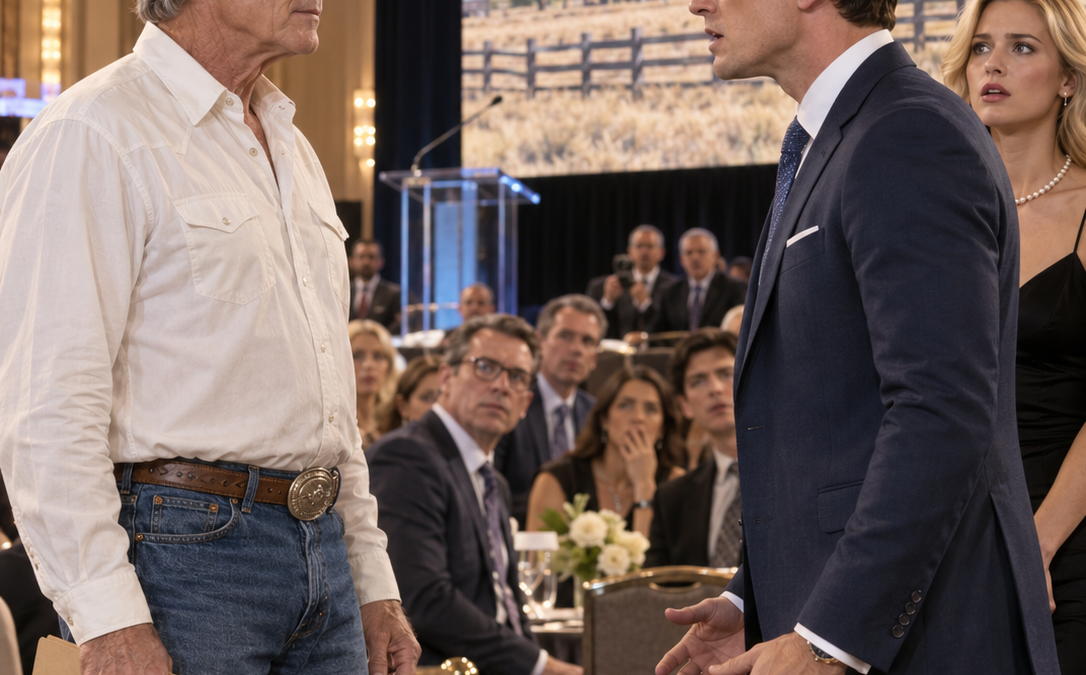
At his launch party, my son called me a “failure” in front of his investors. everyone laughed. i said nothing, just walked on stage with one piece of paper… the room fell silent.
My son sold my life’s work for pocket change while I was dying. $3.2 million.
That’s what Jake got for my 2,000-acre ranch while I was lying in a hospital bed, hooked up to machines and fighting cancer. He walked into my room afterward, looking proud of himself, telling me he’d finally solved my financial problems. He called me a poor old farmer right to my face.
I just smiled.
You see, Jake thought he was so smart with his Stanford MBA and his fancy tech startup. He thought his old man was just some backward rancher who didn’t understand the digital economy. He had no idea what he’d just done.
While he was celebrating his big sale, bragging to his girlfriend about liquidating my “hobby farm,” I was lying there thinking about a phone call I’d received three months earlier. A call that would change everything.
But Jake didn’t know about that call yet.
Let me back up and tell you how we got here.
My name is William Anderson, but folks call me Bill. I’ve been ranching this land in West Texas for 45 years. Bought it back in 1978 with money I’d saved from my first career, but we’ll get to that later.
Eighteen months ago, the doctors gave me the news. Stage three pancreatic cancer. The kind of diagnosis that makes a man start thinking about what he’s leaving behind.
My son Jake was 31 then, running an artificial intelligence startup in Austin called TechVision Solutions. He’d always been the ambitious type, that boy. Got his MBA from Stanford, wore expensive suits, and drove a white Tesla Cybertruck that cost more than most people’s houses.
When I told him about my diagnosis, do you know what his first question was?
Not “How are you feeling, Dad?” Not “What can I do to help?”
It was “Have you thought about your estate planning?”
Jake started visiting more often after that, but not for the reasons you’d think. Every time he came out to the ranch, he’d walk around shaking his head, looking at my cattle like they were some kind of museum exhibit. He’d make comments about inefficient land use and obsolete business models, as though everything I’d spent my life building was an embarrassment he couldn’t wait to put behind him.
One Saturday in February, he brought his girlfriend, Emma, out to meet me. Pretty girl. Worked in marketing for some tech company.
They were sitting at my kitchen table while I made coffee, and I heard Emma whisper to Jake, “This place is so rustic.”
Jake laughed. “That’s one word for it. Dad’s been stuck in 1975 his whole life. Cattle ranching in 2024. Really?”
I kept pouring that coffee like I hadn’t heard a thing.
But the worst conversation happened in March, right after I’d gotten home from another round of chemotherapy.
I was weak, sitting in my old recliner, when Jake started in on me again.
“Dad, we need to talk about reality here. This ranch isn’t making money. You’re spending more on feed and maintenance than you’re bringing in, and with your medical bills piling up…”
He pulled out his phone and started showing me spreadsheets.
“I ran the numbers. Two thousand acres, decent grazing land, close enough to the highway for development potential. We could probably get three, maybe three and a half million.”
“This is my home, Jake.”
“It’s a business, Dad. A failing business. Look, I know this is emotional, but sometimes you have to make hard decisions.”
He glanced down at his phone again, then continued.
“My startup needs capital for our Series A funding round. I need four million to really make this thing take off.”
That’s when it clicked.
This wasn’t about helping his sick father. This was about Jake needing money for his big technology dreams. He’d been talking about my ranch like a financial burden, but what he really saw was a way to solve his own problems.
“What if I said no?” I asked him.
Jake got that look on his face, the same one he used to get as a kid when he didn’t get his way.
“Dad, with all due respect, you’re not exactly in a position to manage a ranch anymore. The medical expenses alone are going to eat up whatever savings you have. At least this way, you’ll have something left for whatever time you have remaining.”
Whatever time I had remaining.
My own son, talking to me like I was already dead.
But here’s what Jake didn’t know.
While he was looking at my ranch and seeing a failing business, I was looking at reports that told a very different story. Reports I’d commissioned from Patterson and Associates, a geological surveying firm out of Houston.
You see, six months earlier, my neighbor Tom Wilson had struck oil on his property. Nothing huge, but enough to get the drilling companies interested in our area. And when you’ve been around as long as I have, you start asking questions.
Questions like, if Tom found oil on his land, what might be under mine?
So I hired Patterson and Associates to conduct a private survey. It cost me $30,000 I couldn’t really afford, but sometimes you have to spend money to make money.
The results came back in January.
Eighty-five million barrels of recoverable oil reserves, sitting right beneath my grazing land.
I kept that report in my desk drawer and didn’t tell a soul.
While Jake was pressuring me to sell my supposedly worthless hobby farm, I was having very different conversations with very different people. People from Houston, people from Dallas, people who understood what 85 million barrels of oil really meant.
But I let Jake keep talking. Let him keep pushing. Let him believe his old man was too stubborn and too sick to see reason.
Because sometimes the best lessons are the ones that cost the most.
Jake finally wore me down in late March.
Or at least he thought he did.
I signed the papers and transferred the surface rights to the property for $3.2 million. What Jake didn’t notice, because he was too busy celebrating his big victory, was a little clause in that deed.
A clause stating that all mineral rights were specifically retained by the seller.
But hey, what would an old farmer know about legal technicalities, right?
The worst part came three days after the sale closed. I was back in the hospital for another round of treatment, and Jake came to visit.
He brought Emma with him this time, and they were both in such good moods. Jake had that glow people get when they think they’ve just made the smartest decision of their lives.
“Dad, I’ve got some great news,” Jake said, pulling up a chair beside my bed. “The ranch sale went through perfectly. After paying off your medical debts and the mortgage, you’re walking away with $2.8 million. That should be more than enough for, well, whatever you need.”
Whatever I needed.
There was that phrase again.
“I’m proud of you for making the tough choice,” Emma added, squeezing my hand like she was comforting a child. “It takes real strength to let go of the past.”
Let go of the past.
These kids had no idea what they were talking about.
Then Jake’s phone rang.
He looked at the caller ID, and his face lit up.
“Oh, this is perfect timing. Dad, this is my lead investor. Do you mind if I take this? I want to tell him the good news.”
Before I could answer, Jake had already swiped to accept the call and put it on speakerphone, right there in my hospital room.
“David, great to hear from you, man.”
“Jake, please tell me you’ve got some positive updates on your funding situation.”
“Actually, I do. Remember how I mentioned my family situation was complicating our timeline? Well, that’s all resolved now.”
Emma was grinning, giving Jake a thumbs-up.
“My old man finally agreed to liquidate his little hobby farm,” Jake continued, satisfaction practically dripping from his voice. “$3.2 million for 2,000 acres of Texas grazing land. Not bad for property that barely breaks even, right?”
The investor laughed.
“Smart move. Agricultural real estate is such a sunset industry anyway. Better to convert those assets into something with real growth potential.”
“Exactly what I told him. Sometimes you have to help family members see the bigger picture, even when they’re emotionally attached to outdated business models.”
I lay there listening to my son discuss my life’s work like it was some failed investment he’d finally managed to unload.
But it got worse.
Emma leaned closer to the phone. “Tell him about the best part, Jake.”
“Oh, right.” Jake laughed. “So, get this. My dad spent 45 years thinking he was building some kind of cattle empire. Two thousand acres of prime grazing land that was losing money every year. The man literally thought he was sitting on a gold mine.”
They were all laughing now.
My son, his girlfriend, and his investor were having a good chuckle about the dumb old rancher who didn’t understand modern economics.
“Well,” the investor said, “at least he’ll stop embarrassing you at those networking events.”
“God, you remember that?” Jake groaned. “When he showed up to the Austin Tech Awards in his cowboy boots and started talking to everyone about cattle futures?”
“Classic,” the investor replied. “Nothing says disruptive innovation like your dad asking the venture capitalists if they’ve ever seen a real bull.”
More laughter followed.
“But seriously,” Jake said, his voice becoming more businesslike, “this solves our immediate funding gap. I can personally invest $2.5 million into the Series A round. Shows commitment. Gives us more leverage with other investors.”
“Smart thinking. Sometimes you have to cut dead weight, even if it’s family.”
Even if it’s family.
My own son was agreeing that I was dead weight.
Emma noticed I hadn’t said anything during the entire call.
“Are you okay, Mr. Anderson? You look a little pale.”
I reached over to my bedside table and picked up the leather journal I’d been keeping since my diagnosis. I opened it and started writing something down while Jake finished his conversation.
“What are you writing, Dad?” he asked after hanging up.
“Just some thoughts,” I said, still wearing that same calm smile. “You know how us old farmers like to keep track of things.”
“Well, I hope you’re writing about how proud you are,” Emma said. “Jake really saved your financial future today.”
“Oh, I’m writing about the future, all right.”
Jake looked at Emma, then back at me. Something in my tone must have caught his attention.
“Dad, you’re not… you’re not having second thoughts about the sale, are you? Because legally, everything’s already finalized. The new owners take possession next month.”
“No second thoughts at all, son. I think everything worked out exactly the way it was supposed to.”
I closed my journal and set it back on the table.
“In fact, I think you’re going to learn something very valuable from all this.”
“Learn what?”
I looked at Jake, then at Emma, then back at my son. These two young people thought they had the whole world figured out.
“That there’s a difference between being smart and being wise. And sometimes the most expensive lessons are the ones that teach you that difference.”
Jake laughed nervously.
“Dad, you’re being weird. Are the pain meds making you say strange things?”
“I’ve never been more clearheaded in my life, Jake.”
But I didn’t say anything else.
I just lay back in that hospital bed, watching the two of them exchange confused glances, wondering what the crazy old farmer meant.
They’d find out soon enough.
Three days later, I was discharged from the hospital. The doctor said the treatment was going better than expected. Funny how getting good news about your health can sharpen your focus on everything else.
My first stop wasn’t home.
It was the law office of Dorothy Miller, who’d been handling my legal affairs for 30 years. Dorothy was one of the few people who knew all my business, going back to the early days.
“Bill,” she said, looking up from her desk when I walked in. “You look better than I expected.”
“Clean living,” I told her, settling into the leather chair across from her desk.
Dorothy had already pulled my file. All the paperwork from the ranch sale was spread out in front of her, along with some other documents Jake had never seen.
“I assume you’re here about the mineral rights situation.”
“I am.”
“And you want to know your options.”
I leaned back in that chair, thinking about Jake’s phone call, about him calling my ranch a hobby farm and agreeing that I was dead weight.
“Dorothy, let me ask you something. If someone betrays your trust, takes advantage of your illness, and publicly humiliates you, what would you do?”
“Legally speaking? Sue them for elder abuse and fraud.”
“But what would you do?”
Dorothy had known me since Jake was in diapers. She understood the question I was really asking.
“I’d make sure they learned a lesson they’d never forget.”
I nodded. “That’s what I thought you’d say.”
Dorothy pulled out a manila folder that was thicker than the ranch sale documents. Inside were geological surveys, mineral rights assessments, and correspondence with three different oil companies.
“The Patterson and Associates report confirms 85 million barrels of recoverable reserves,” she said, flipping through the papers. “Current market price for West Texas Intermediate crude is running about $82 per barrel.”
I did the math in my head.
“That’s about $7 billion in the ground, minus extraction costs, royalty payments, and taxes.”
“Yes, but Bill, there’s something else.”
She pulled out a contract bearing ExxonMobil letterhead.
“They want a 30-year drilling lease. Standard terms would give you an 18% royalty on all extracted oil. Based on their production estimates, that’s $2.8 billion over the life of the lease.”
$2.8 billion.
Jake had sold what he thought was a $3.2 million ranch. The mineral rights I’d retained were worth nearly a thousand times more than what he’d gotten for the surface land.
“When can we sign?” I asked.
“That’s up to you. ExxonMobil is ready to move forward immediately. They’ve been waiting for your decision since March.”
I thought about that hospital room, about Jake’s laughter, and about his investor calling me dead weight.
“I want to wait.”
Dorothy looked at me. “Wait for what?”
“Jake’s having a launch party for his startup in three months. Big event. Lots of investors, lots of media. He’s planning to use the ranch sale as a case study in his presentation.”
Dorothy raised an eyebrow. “How do you know that?”
“Because he told me right there in the hospital. Said it was a perfect example of helping family transition from legacy industries to modern wealth management.”
“And you want to…?”
“I want to let him give that presentation. I want him to stand up in front of all those important people and tell them how smart he was. How he saved his poor old father from financial ruin.”
“Bill, that’s…”
“That’s justice, Dorothy. Jake wants to use my ranch as proof of his business expertise. Fine, let him. But he’s going to learn that there’s more than one kind of expertise in this world.”
Dorothy was quiet for a long moment. Then she started laughing.
“You want to wait until he’s publicly committed to this narrative, then pull the rug out from under him.”
“I want to teach my son that respect isn’t something you inherit. It’s something you earn. And when you don’t show respect to the people who raised you, there are consequences.”
“What if he figures it out before then? What if he realizes what he missed?”
I reached into my jacket pocket and pulled out a copy of the deed transfer, the one Jake had signed without reading carefully.
“Dorothy, my son has an MBA from Stanford. He’s a tech entrepreneur. He’s got access to all the same public records and geological surveys that I do. If he’s too proud or too busy to do his due diligence, that’s not my problem.”
I paused, looking down at the deed.
“And if he does figure it out, then he’ll come to me, apologize for how he treated me, and we’ll work something out as a family. But if he doesn’t…”
I looked out the window of Dorothy’s office toward the direction of my ranch.
My former ranch, technically.
“Then sometimes the best lesson is the most expensive one.”
The ranch sale closed on April 15. Jake got his $2.8 million after debts, just like he’d calculated.
That same day, I sent him a gift.
It was a framed photograph of the original ranch deed from 1978, the one from when I’d first bought the property. I’d had it professionally matted and framed in antique oak, the kind of frame that costs more than most people spend on art.
The card I included was simple.
“For my son, who knows the value of everything and the price of nothing. Love, Dad.”
Jake called me that evening.
“Dad, I got your gift. It’s nice. Really thoughtful.”
“I’m glad you like it.”
“The frame must have cost a fortune. Are you sure you should be spending money on stuff like this right now?”
Even after getting nearly $3 million from my life’s work, Jake was worried about me spending money on a picture frame.
“Don’t worry about my finances, son. I’m doing just fine.”
There was a pause on the line.
“Dad, is everything okay? You’ve been acting kind of strange since the sale.”
“Strange how?”
“I don’t know. You seem different. More confident, maybe. Like you know something I don’t.”
I looked at that photograph sitting on my kitchen table. Forty-six years of my life, reduced to a piece of paper in a fancy frame.
“Jake, when you get to be my age, you learn that confidence comes from understanding what really matters.”
“What do you mean?”
“I mean there’s a difference between knowing the price of something and understanding its value.”
Another pause.
“Dad, you’re being cryptic again. Are you sure the medication isn’t affecting your thinking?”
“My thinking has never been clearer.”
And it was true.
The cancer treatments were working better than anyone expected. I was getting stronger every week, strong enough to start making some phone calls.
The first call was to Tom Wilson, my neighbor who’d found oil on his property.
“Tom, it’s Bill Anderson.”
“Bill, how you feeling, son?”
“Better every day. Listen, I wanted to ask you about something. That oil company that’s drilling on your land, are they finding what they expected?”
“More than they expected, actually. Turns out this whole area sits on a formation they call the Permian Extension. Some kind of geological gold mine.”
“Is that right?”
“Bill, I probably shouldn’t tell you this, but after they started drilling on my property, they did some additional surveys on the surrounding area. Your ranch came up in their reports.”
“Did it now?”
“Yeah. And Bill, if I were you, I’d get my own geological survey done. A professional one. Because what they found under your land makes my little oil patch look like a puddle.”
I let Tom think he was giving me new information.
“That’s interesting advice, Tom. I might just do that.”
After I hung up with Tom, I made another call. This one was to Patterson and Associates in Houston.
“Mr. Anderson,” the geology manager said when I identified myself, “we’ve been hoping to hear from you. Have you had a chance to review our survey results?”
“I have, and I’m ready to move to the next phase.”
“Excellent. We have three major companies that want to bid on drilling rights. When would you like to schedule meetings?”
“Not yet. I want to wait a few months.”
“Sir, with respect, oil prices are at historic highs right now. Market conditions may not be this favorable in a few months.”
“I understand the risk, but I have my reasons for waiting.”
What I didn’t tell them was that I’d been busy with other research. The kind that didn’t involve rock samples or drill cores.
I’d been learning about Jake’s business.
TechVision Solutions was further behind schedule than Jake had let on. They’d missed two major development milestones, and their lead investor was getting nervous. The artificial intelligence market was more competitive than Jake had anticipated, and several bigger companies had launched products similar to what TechVision was trying to build.
In other words, Jake needed that ranch money even more desperately than I’d realized.
A week after receiving my gift, Jake started getting careless about what he said around me. Maybe he thought the cancer was affecting my memory, or maybe he just stopped caring whether I heard him.
I was visiting him at his Austin apartment when his business partner called. Jake put the call on speaker without thinking.
“Jake, we need to talk about the development timeline. Our AI model is still six months behind where we promised investors.”
“I know, I know. But the good news is I’ve got the family money situation resolved. I can inject another $2.5 million into development.”
“Where did you get $2.5 million?”
“Finally convinced my dad to sell the ranch. Guy was sitting on $3 million worth of land and didn’t even realize it. Took some persuading, but he came around.”
Three million dollars’ worth of land.
Jake was already inflating the sale price in his stories.
“That’s great news. How’s your dad handling it?”
“Better than I expected. I think he’s actually relieved to be out from under all that responsibility. The ranch was becoming too much for him to handle anyway.”
Too much for me to handle.
After Jake hung up, he noticed me looking at him.
“Dad, you don’t mind me talking about the ranch sale, do you? I mean, it’s not like it’s a secret.”
“Not at all, son. You should be proud of your business acumen.”
“Thanks. I know it was hard for you to let go, but honestly, it was the right financial decision.”
“I’m sure it was.”
That evening, I called Dorothy Miller.
“Dorothy, I want you to start making some calls. ExxonMobil, Chevron, ConocoPhillips. Tell them I’m ready to hear their offers.”
“All of them?”
“All of them. And Dorothy, I want these meetings to happen in June.”
“Any particular reason for June?”
“That’s when Jake is having his big launch party. I want to have all my options on the table by then.”
“Bill, what exactly are you planning?”
I looked out my window toward where my ranch used to be, where 85 million barrels of oil were still sitting underground, waiting.
“I’m planning to teach my son the most valuable lesson he’ll ever learn.”
Two weeks later, I was having coffee at Mabel’s Diner in town when Jake showed up. He wasn’t alone. Emma was with him, along with two other people I didn’t recognize.
They were all dressed in that casually expensive way that practically screams tech startup. You know the look. Designer jeans that cost more than most people’s rent, sneakers that cost more than most people’s car payments.
They didn’t see me at first.
I was sitting in my usual booth in the back corner, the one where I could see the whole diner. Old habit from my younger days.
Jake was talking loudly enough for half the restaurant to hear.
“And that’s the beauty of the disruption model,” he was saying, gesturing with his hands like he was giving a presentation. “You identify legacy industries that are operating on outdated assumptions, and you find ways to optimize their asset allocation.”
One of his companions, a woman with short blonde hair and an expensive-looking laptop bag, was taking notes on her phone.
“Can you give us a specific example?” she asked.
Emma jumped in before Jake could answer.
“Tell them about your dad’s ranch.”
My coffee cup stopped halfway to my mouth.
“Oh, that’s a perfect case study,” Jake said, clearly enjoying having an audience. “My father spent 45 years running a cattle ranch in West Texas. Classic example of someone who confused emotional attachment with business strategy.”
The woman was still taking notes.
“What do you mean?”
“Two thousand acres of prime real estate sitting there generating maybe $50,000 a year in cattle revenue. Meanwhile, the land itself was worth over $3 million. But my dad couldn’t see past his emotional attachment to the ranching lifestyle.”
That’s when Tom Wilson looked up from his booth across the diner.
Tom had been coming to Mabel’s every morning for 20 years, just like me.
“Your daddy’s smarter than you think, boy,” Tom said, loudly enough for the whole place to hear.
Jake turned around, annoyed at being interrupted.
“Excuse me?”
“I said, your daddy’s smarter than you think.”
Tom stood up, all six feet four inches of him. He’d been a roughneck before he started ranching, and he still looked like a man who could handle himself.
“Maybe you should listen to him more instead of running your mouth about things you don’t understand.”
Jake’s face flushed red.
“Sir, I don’t think you understand the economic realities of modern agriculture.”
“Economic realities?” Tom laughed, but it wasn’t a friendly sound. “Son, I’ve been working this land since before you were born. You want to talk about economic realities? Let me tell you about economic realities.”
The whole diner had gone quiet now. Even Mabel stopped wiping down the counter to listen.
“These old-timers just can’t accept the digital economy,” Jake said to his companions, loudly enough for everyone to hear. “They’re stuck in the past, afraid of change.”
That’s when I stood up.
“Hello, Jake.”
My son spun around, his face going white when he saw me.
“Dad, I didn’t… How long have you been here?”
“Long enough.”
I walked over to their table and nodded to his companions.
“You must be the Forbes journalist Emma mentioned. Sarah Johnson, right?”
The blonde woman looked surprised.
“Yes. How did you…?”
“Word travels fast in small towns. I hear you’re doing a story about successful young entrepreneurs.”
Jake was looking back and forth between me and Tom Wilson, clearly uncomfortable with the direction the conversation was taking.
“Dad, maybe we should…”
“Should what, son? Continue discussing my economic realities? Or would you prefer to talk about the phone calls I’ve been getting from Houston?”
Jake’s face went even whiter.
“What phone calls?”
But I just smiled and pulled out my wallet to pay for my coffee.
“Tom’s right about one thing, Jake. Sometimes the smartest thing you can do is listen to people who’ve been around longer than you have.”
I left a five-dollar tip for Mabel and walked toward the door.
“Dad, wait!”
But I was already gone.
Three days after the diner incident, Jake launched his media offensive.
It started with a LinkedIn post that went viral within hours.
“Sometimes love means making the hard decisions for people who can’t make them themselves. This week, I helped my father transition from a legacy industry, cattle ranching, to a more secure financial future. It wasn’t easy. He’d spent 45 years building an emotional attachment to land that was costing him money every month. But sometimes family means having difficult conversations about reality. #FamilyFirst #BusinessStrategy #ModernWealth”
The post got 15,000 likes in two days.
But that was just the beginning.
A week later, TechCrunch published an interview with Jake titled “How I Helped My Father Transition from Legacy Industry.”
The article painted Jake as a caring son who’d saved his stubborn father from financial ruin.
“It’s heartbreaking when you watch someone you love make decisions based on emotion rather than data,” Jake was quoted as saying. “My father spent decades thinking he was building some kind of cattle empire, but the numbers don’t lie. He was losing money every year while sitting on millions of dollars in untapped real estate value.”
The article mentioned that Jake had used the family asset optimization to fund his own startup, positioning it as a win-win scenario in which traditional wealth was converted into innovation capital.
Emma shared the article on her Facebook page with the caption, “So proud of Jake for having the courage to make tough family decisions. Sometimes love means being the adult in the room.”
That post got shared 800 times.
But the piece that really got my attention was the opinion article Jake published in the Austin Business Journal, titled “Disrupting Family Tradition for Financial Reality.”
In it, Jake positioned himself as part of a new generation of entrepreneurs brave enough to challenge outdated family business models. He wrote about the emotional labor of convincing older family members to embrace evidence-based decision-making.
The money quote was in the third paragraph.
“Sometimes you have to save people from their own nostalgia. My father would have spent his final years watching his net worth evaporate, all for the sake of preserving a lifestyle that stopped making economic sense decades ago.”
My final years.
Jake was talking about me like I was already dead.
The opinion piece was picked up by three other business publications. Suddenly, my son was being positioned as some kind of thought leader on family wealth transition strategies. He started getting invited to speak at conferences, and every new appearance seemed to make him more confident in the story he’d created.
But Jake made one mistake in all his media coverage.
He kept using specific numbers.
$3.2 million for 2,000 acres. Forty-five years of negative cash flow. Converting legacy assets into growth capital.
Every interview, every article, every social media post, Jake kept coming back to those same talking points. He was building his entire public brand around the story of how he’d saved his ignorant father from financial disaster.
Which was exactly what I was waiting for.
I called Dorothy Miller.
“Dorothy, are you following Jake’s media tour?”
“Hard to miss it. The boy’s everywhere.”
“Good. I want you to set up meetings with all three oil companies for next week.”
“All of them?”
“All of them. And Dorothy, I want these meetings documented. Photos, contracts, the whole thing.”
“What are you planning, Bill?”
“Jake wants to be a thought leader on family wealth strategies. Fine. But he’s about to learn that there’s more than one way to think about wealth.”
That evening, I did something I hadn’t done since Jake was in high school. I created a LinkedIn account.
My profile was simple: William Anderson, Rancher, West Texas.
No fancy job titles, no business school credentials. Just the truth.
Then I did something that would have surprised Jake if he’d been paying attention.
I connected with Sarah Johnson, the Forbes journalist who’d been at the diner.
She accepted my connection request within an hour. The message she sent came even faster.
“Mr. Anderson, I’d love to hear your side of the story.”
I messaged her back.
“Miss Johnson, I think you’ll find my story is more interesting than you might expect, but I’d prefer to wait until next month to tell it. There are some developments coming that will provide better context.”
“What kind of developments?”
“The kind that tend to change people’s perspectives on family wealth strategies.”
Sarah responded immediately.
“I’m intrigued. Can you give me a hint?”
I thought about Jake’s opinion piece, his conference speaking engagements, and all those interviews where he’d called me financially illiterate.
“Let’s just say that sometimes the student becomes the teacher. And sometimes the most expensive lessons are the ones that teach you the difference between knowing the price of something and understanding its value.”
“When can we talk?”
“June 8. But trust me, Miss Johnson, it’ll be worth the wait.”
I logged off LinkedIn and reached for my leather journal.
“Truth has its own timeline,” I wrote.
The meetings with the oil companies took place over three days in May.
The first meeting was with ExxonMobil at their Houston headquarters. I drove down in my old pickup truck, wearing the same Carhartt jacket I’d worn for 20 years.
I’m sure I looked out of place in their glass tower lobby, but appearances can be deceiving.
Richard Davis, their vice president of land acquisition, met me personally.
“Mr. Anderson,” he said, shaking my hand in his corner office overlooking downtown Houston. “We’re very excited about the potential of your property.”
“What kind of potential are we talking about specifically?”
Davis pulled out a geological report that was thicker than my Bible.
“Based on our preliminary surveys and the data from neighboring properties, we estimate 85 million barrels of recoverable reserves.”
He showed me seismic maps, drill core samples, and production forecasts, the kind of technical data that takes years of experience to interpret properly.
“What most people don’t realize,” Davis continued, “is that this area sits on an extension of the Permian Basin Formation, the same geological structure that’s made West Texas the largest oil-producing region in North America.”
“And you want to lease my mineral rights?”
“We want to offer you a 30-year drilling lease with an 18% royalty on all extracted oil. At current market prices, that’s approximately $2.8 billion over the life of the lease.”
$2.8 billion.
I kept my expression neutral, but inside I was thinking about Jake’s LinkedIn post, about him bragging that he’d gotten $3.2 million for 2,000 acres.
“That’s a substantial offer,” I said.
“Mr. Anderson, can I ask you something?”
“Of course.”
“How long have you known about the oil reserves under your property?”
I pulled out the Patterson and Associates geological survey I’d commissioned back in January.
“Since before I sold the surface rights.”
Davis looked confused.
“You sold the surface rights but retained the mineral rights? Why?”
“Because I wanted to see what would happen.”
“I don’t understand.”
I leaned back in my chair and studied the man across from me.
“Mr. Davis, I spent the first 20 years of my career as a petroleum geologist. Worked the Gulf of Mexico back in the seventies and eighties. I know what oil looks like when it’s still in the ground.”
Davis’s whole demeanor changed.
“You’re a petroleum geologist?”
“Licensed professional engineer, actually. University of Texas, class of 1973. Magna cum laude.”
I pulled out my old diploma, the one I’d kept in my desk drawer for 40 years.
Davis stared at it.
“Mr. Anderson, why didn’t you mention this earlier?”
“Because nobody asked.”
I let those words settle before continuing.
“My son certainly didn’t ask about my background before he decided I was just a poor old farmer who didn’t understand modern economics.”
The meeting with Chevron went similarly. So did the one with ConocoPhillips.
By the time I was done with all three meetings, I had signed contracts worth a total of $2.8 billion in my briefcase.
But I also had something else.
Each company had insisted on photographs for its internal documentation. Photos of me signing contracts, photos of the geological reports, and photos of my petroleum engineering degree.
And I’d made sure Sarah Johnson from Forbes knew about every meeting.
She’d been following the story since our conversation at Mabel’s Diner. By now, she understood there was more to the poor old rancher story than Jake had let on.
“Mr. Anderson,” she said when she called after the ExxonMobil meeting, “I’ve been doing some research into your background.”
“What kind of research?”
“The kind that reveals you’ve been consulting for oil companies under the name William Patterson for the last 20 years.”
William Patterson.
My middle name was Patterson, after my mother’s family. I’d been using it as a professional name since the early eighties to keep my consulting work separate from my ranching.
“You’ve earned over $2.3 million in consulting fees since 2004,” Sarah continued. “You hold six patents related to offshore drilling technology. And according to the Texas Railroad Commission, you’ve been the technical adviser on 17 major oil discoveries in the last decade.”
She paused, allowing the weight of those numbers to settle.
“Is that right, Mr. Anderson? You’re not just some rancher who got lucky. You’re one of the most respected petroleum geologists in Texas.”
I said nothing.
“Why didn’t you tell your son about any of this?”
I thought about Jake’s TechCrunch interview, his conference presentations, and the way he’d called me financially illiterate in front of strangers.
“Because sometimes people need to learn lessons the hard way.”
“And what lesson is your son about to learn?”
“That there’s a difference between being smart and being wise. And that respect isn’t something you inherit. It’s something you earn.”
Sarah was quiet for a moment.
“When are you planning to make this public?”
“June 8.”
“That’s when Jake is having his big product launch party. Two hundred investors, tech media, the whole Silicon Valley crowd.”
“And you’re going to…?”
“I’m going to attend my son’s presentation as his guest.”
June 8 arrived with the kind of Texas heat that makes you grateful for air conditioning.
Jake’s product launch party was being held at the Austin Convention Center. TechVision Solutions had rented the main ballroom, 2,000 square feet of marble floors and crystal chandeliers, the kind of space that costs more per hour than most people make in a month.
I arrived at six o’clock, right when the cocktail reception was starting.
I’d dressed for the occasion. Clean jeans, my good boots, and a white button-down shirt. Nothing fancy, but respectable. The same outfit I’d worn to Jake’s college graduation.
The ballroom was packed with exactly the kind of people you’d expect at a technology startup launch. Venture capitalists in expensive suits, tech journalists carrying laptops and recording devices, and other entrepreneurs hoping to network their way to funding.
Jake was in his element, working the room like he was born to it.
He wore a navy blue suit that probably cost more than my truck, and he carried himself with the confidence of someone who believed he was about to change the world.
He spotted me near the registration table and came over immediately.
“Dad, you made it.”
He seemed genuinely happy to see me, which made what was about to happen even more difficult.
“I wasn’t sure you’d feel up to traveling,” he said.
“Wouldn’t miss it for the world, son.”
Emma appeared beside Jake, looking polished in a black dress and pearls.
“Mr. Anderson, it’s so good to see you looking healthy.”
“Thank you, Emma. I’m feeling better every day.”
Jake introduced me to several investors and journalists. Each time, he told the same story.
“This is my dad, the one I told you about. The rancher who finally saw the light about modern asset management.”
Everyone smiled politely and made comments about generational wisdom and difficult family decisions.
I just smiled back and shook hands.
At 7:30, Jake took the stage for his presentation.
“Ladies and gentlemen, thank you for joining us tonight for the launch of TechVision Solutions’ revolutionary artificial intelligence platform.”
The lights dimmed, and Jake’s presentation began.
There were slides full of market projections, user growth charts, and revenue forecasts. The standard startup pitch deck, polished and professional.
But 20 minutes into the presentation, Jake reached the slide I’d been waiting for.
“Now, I want to share with you a personal case study that illustrates the broader principles of our approach to wealth optimization.”
The slide showed a photograph of my ranch.
My former ranch.
“This is a story about disrupting traditional thinking and embracing data-driven decision-making, even when it challenges long-held family beliefs.”
Jake told the whole story.
The cancer diagnosis. The failing ranch finances. My emotional resistance to change. His eventual success in convincing me to modernize my asset allocation strategy.
“Forty-five years of traditional cattle ranching had generated an average annual loss of $12,000,” Jake said, clicking to a slide full of financial projections. “But the underlying real estate asset was worth $3.2 million. Wealth that was essentially trapped by outdated business practices.”
The audience nodded along.
This was exactly the kind of story they wanted to hear.
A young entrepreneur saving his old-fashioned father from financial ruin.
“The transformation took patience and careful negotiation, but ultimately we were able to convert legacy agricultural assets into growth capital for innovation. A classic win-win scenario where traditional wealth becomes the foundation for tomorrow’s breakthrough technologies.”
Jake clicked to his next slide.
The title read: “From Ranch to Riches: Lessons in Modern Family Wealth Management.”
That’s when I stood up.
I was sitting in the third row, close enough to the stage that everyone could see me clearly.
Jake noticed immediately.
“Oh, and I should mention we’re honored to have the subject of this case study with us tonight. My father, William Anderson.”
Polite applause came from the audience.
Jake gestured toward me, clearly expecting me to wave and sit back down.
Instead, I raised my hand.
“Jake, could I ask you a question?”
Jake looked slightly confused, but he nodded.
“Of course, Dad.”
“What’s the current market price for West Texas Intermediate crude oil?”
You could feel the energy in the room shift.
That wasn’t the kind of question anyone expected.
Jake laughed nervously.
“Dad, I don’t think crude oil prices are really relevant to tonight’s…”
“Humor me, son. What’s the current market price?”
“I… I’m not sure. Maybe $60 a barrel?”
“$82.15 as of market close today. But that’s okay. There’s no reason you’d know that.”
I stood up fully and walked toward the stage.
“Ladies and gentlemen, my name is William Anderson, and I have something to add to my son’s presentation.”
Jake was looking panicked now.
“Dad, maybe we should…”
“Jake told you that I spent 45 years as a cattle rancher. That’s true. What he didn’t tell you is what I did for the 20 years before that.”
I reached into my jacket and pulled out my petroleum engineering degree.
“I’m a licensed petroleum geologist, University of Texas, class of 1973. For 20 years, I worked oil platforms in the Gulf of Mexico. For the 20 years after that, I’ve been consulting for major oil companies under my middle name, William Patterson.”
The room had gone completely quiet.
I could see faces turning toward one another. A few people leaned forward in their chairs, watching me more closely now.
“Jake also told you that he helped me modernize my asset allocation strategy by selling my ranch for $3.2 million. What he didn’t know is that before I signed those papers, I commissioned a geological survey of my property.”
I pulled out the Patterson and Associates report.
“Eighty-five million barrels of recoverable oil reserves, sitting right under the grazing land he thought was worthless.”
I heard someone in the audience gasp.
“Now, Jake calculated that my ranch was losing $12,000 a year in cattle operations. But what he didn’t calculate was the value of what was underground.”
I pulled out the ExxonMobil contract.
“This is a 30-year drilling lease I signed last week. Eighteen percent royalty on all extracted oil. At current market prices, that’s $2.8 billion over the life of the lease.”
The silence in that room was deafening.
Jake’s face had gone white.
“Dad, what are you…?”
“I’m teaching you a lesson, son. The same lesson you tried to teach me about modernizing my thinking.”
I turned to face the audience.
“My son sold the surface rights to a property for $3.2 million. The mineral rights I retained are worth $2.8 billion. That’s a ratio of about one to nine hundred.”
I looked back at Jake.
“Now, Jake, who do you think needs to modernize their thinking about asset valuation?”
Jake tried to speak, but no words came out.
Richard Davis from ExxonMobil stood up in the back of the room.
I’d invited him personally.
“Ladies and gentlemen,” he said in his practiced corporate voice, “I can confirm that ExxonMobil has indeed signed a $2.8 billion lease agreement with Mr. Anderson. We consider this one of the most significant oil discoveries in Texas in the last decade.”
Emma had her phone out and was typing frantically.
Several investors were already making phone calls.
Jake finally found his voice.
“Dad, why didn’t you tell me?”
“Because you never asked.”
I looked directly at my son.
“You assumed that because I wore work boots and drove an old truck, I didn’t understand business. You called me dead weight and financially illiterate without ever bothering to learn what I actually knew.”
I walked closer to the stage.
“You want to know about disrupting traditional thinking, Jake? Here’s what I learned in 45 years. The most expensive mistakes come from assuming you’re the smartest person in the room.”
Sarah Johnson from Forbes was taking pictures from the side of the room.
I turned slightly, knowing she was capturing every word.
“The ranch you sold for $3.2 million, Jake? You just helped me demonstrate that sometimes traditional industries and modern business strategies work better together than anyone realizes.”
Then I turned back to the audience one final time.
“TechVision Solutions is probably a fine company with a bright future, but tonight’s lesson isn’t about artificial intelligence. It’s about a different kind of intelligence. The kind that comes from respecting people who’ve been around longer than you have.”
I started walking toward the exit.
“Jake, when you’re ready to have a real conversation about business strategy, you know where to find me.”
The room erupted in whispers as I left.
The aftermath was swift and brutal.
Jake’s investors started calling their lawyers before I’d even left the building.
TechVision Solutions lost its Series A funding within a week. Three major investors pulled out, citing concerns about leadership judgment and due diligence practices.
The Forbes article Sarah Johnson published was titled “The Rancher Who Fooled Silicon Valley.”
It went viral within hours, generating more than two million views and 15,000 comments.
Jake’s LinkedIn post about helping his father transition from a legacy industry was screenshotted and shared across social media as an example of entrepreneurial arrogance.
The hashtag #PoorOldFarmer started trending on Twitter.
Emma broke up with Jake via text message during the presentation.
She’d already posted on Instagram about dating a successful tech entrepreneur. After the oil discovery went public, she deleted Jake from all her social media accounts.
TechVision Solutions shut down six months later.
Jake moved back into a small apartment and took a regular programming job with a cybersecurity firm in Austin. Good work, decent pay, but nothing like the startup dreams he’d been chasing.
Meanwhile, the first ExxonMobil drilling operation on my former ranch began in September.
The local newspaper ran a front-page story about the economic impact on our county. Suddenly, everyone wanted to buy me coffee and hear my story.
Eight months after the launch party disaster, Jake showed up at my door.
He looked different.
Older. Humbler.
“Dad, can we talk?”
We sat on my porch, the same porch where he’d pressured me to sell the ranch a year earlier.
For a while, Jake seemed to struggle with what he wanted to say. Then he looked at me.
“I owe you an apology,” he said. “For everything. For not listening. For assuming I knew better. For treating you like you were just in the way.”
I studied his face.
“Apology accepted.”
Jake lowered his eyes.
“I lost everything, Dad. The startup, the investors, Emma. My reputation in the tech industry is basically ruined.”
“And what did you learn from losing everything?”
Jake was quiet for a long moment.
“That there’s more than one kind of intelligence. And that respect isn’t about age or industry. It’s about wisdom.”
“That’s exactly right.”
He sat there a little longer, as though he was trying to decide whether he had any right to ask what came next.
“Dad, I know I don’t deserve this, but is there any chance you might have a job for someone who’s finally ready to listen?”
I looked at my son.
Really looked at him for the first time in years.
The arrogance was gone. The condescension was gone. What remained was just a young man who’d learned an expensive lesson about humility.
“As a matter of fact, I could use some help managing the new oil operations.”
Jake looked up.
“Turns out there’s a lot of technology involved in modern petroleum extraction. Might need someone who understands both the digital side and the traditional side.”
Jake’s eyes lit up for the first time since the launch party.
“But Jake…”
“Yes, sir?”
“This time, we do things as partners. Equal partners. No more assumptions. No more lectures about outdated business models. We combine your tech knowledge with my industry experience, and we build something together.”
Jake looked at me, and for the first time in a long while, I could see the son I remembered beneath everything that had happened.
“I’d like that, Dad.”
That was six months ago.
Today, Jake manages the digital infrastructure for our drilling operations while I handle the geological side.
We’ve turned my former ranch into a model for sustainable oil extraction combined with continued cattle grazing.
Forbes featured us again last month, this time as an example of a successful intergenerational business partnership.
Jake learned that respect isn’t inherited. It’s earned.
And sometimes the most expensive lessons are the ones that teach you the difference between knowing the price of something and understanding its true value.








