After the divorce, my husband’s family threw me out of the house with my 8-year-old son. My father-in-law tossed me a torn cloth bag: “Take it. Don’t open it here.” In a run-down rented room, I opened it… and froze at what I saw inside…
Tyler had always been soft-spoken. He rarely drank, never seemed interested in staying out with friends until all hours, and almost always came home on time. When we were dating, my mother used to tell me that a man like him was someone a woman should hold on to for life.
“Because when you marry,” she said, “what matters most is having a man who always knows his way home.”
I believed her for years. I thought that if a man worked hard, came home every evening, and cared about his family, the rest of life could be managed with patience and understanding.
After the wedding, Tyler and I moved into his parents’ three-story house, which stood on land they owned. My father-in-law had spent most of his life working as a carpenter. Even after he grew older and stopped taking on large jobs, he never lost the habits of a working man. Every morning, he woke around five, brewed himself a strong cup of black coffee, and went outside to the small backyard patio, where he tended dozens of potted plants.
He wasn’t much of a talker. He could spend an entire meal listening while everyone else discussed the day without offering more than a few words. When it came to household finances, family decisions, or the children, he generally left those matters to his wife.
My mother-in-law was his exact opposite. She was energetic, capable, and relentlessly particular about every detail of how a household should be run. She could remember how much I had paid for a pound of ground beef the previous month, how long a bottle of dish soap had lasted, and whether the electric bill was three dollars higher than usual. If I came home fifteen minutes later than expected, she noticed.
During the first few years, I convinced myself that this was simply how older people behaved. They had lived through harder times, and saving money was second nature to them. I didn’t want to become the kind of daughter-in-law who complained about everything, so I tried to adapt.
Every month, I contributed money toward groceries, water, electricity, and other household expenses. When Luke, our son, was born, I stopped working for almost a year to care for him. Once I returned to my job and he eventually started preschool, I took on extra bookkeeping work at night for two established local businesses.
There were evenings when I sat at my computer until nearly eleven, checking invoices, balancing accounts, and entering transactions long after everyone else had gone to bed. By the time I finally went downstairs, the kitchen was usually dark and quiet.
Yet more often than not, I would find a small pot on the stove with a plate covering it. Inside was a bowl’s worth of soup, still waiting for me.
My father-in-law never announced that he had left it there. He never made a show of being considerate. One evening, I asked him whether the soup was meant for me.
“I made extra,” he replied.
I smiled because I had looked inside the pot, and there was exactly one serving left.
In that house, he was one of the few people who consistently made me feel that I wasn’t a stranger. His kindness was quiet, almost hidden, but it meant more to me than he probably realized.
In the beginning, Tyler was considerate, too. I still remember the month his company delayed payroll and he handed me every dollar he had earned from overtime work.
“Put this away for Luke’s preschool,” he told me. “We’ll figure out the rest.”
Those were the moments I held on to whenever I felt worn down by life with his parents. I told myself that the arguments with my mother-in-law were just the ordinary friction of several generations sharing one roof. We had a child, two jobs, and a future to build. Surely the small irritations would matter less once we had a home of our own.
Everything began changing three years before the divorce.
Tyler decided to leave his job and open an appliance and HVAC supply store with an acquaintance. They had a business plan, a location in mind, and enough experience in the industry to believe they could make it work. What they lacked was approximately $25,000 in startup capital.
One evening, Tyler asked how much I had managed to save.
At that point, I had $15,000. Some of it came from years of carefully setting aside money from my paychecks, and some had been given to me by my mother when I married. It wasn’t a fortune, but it represented years of effort and the small measure of security I had built for myself.
I kept $1,500 in reserve in case Luke had a medical emergency and gave Tyler the remaining $13,500.
He took both my hands and promised that once the store became stable, I would be the one managing the finances. He said we would sacrifice for a few years, work as hard as we could, and eventually buy a condo where the three of us could live comfortably.
I was so happy that night I could barely sleep.
Anyone who has spent years living with in-laws might understand why the promise of a home of my own meant so much. It was never about having a large house or expensive furniture. I wanted a door I could close behind me and know that the space on the other side belonged to my little family.
I wanted to decide what to cook for dinner without being questioned. I wanted to sleep an extra half hour on a Saturday without feeling guilty. I wanted to buy Luke a slightly more expensive gallon of milk without having to explain why the cheaper brand wasn’t good enough.
Those were small wishes, perhaps, but after years of living according to someone else’s rules, they felt enormous.
The store did well during its first year. Tyler worked long hours, but I understood. Starting a business demanded sacrifices, and I knew better than most people how much work went into keeping a small company running.
During the second year, however, his behavior began to change.
He started coming home later and later. Sometimes he said he had been visiting job sites. Other nights, he claimed he had meetings with customers or needed to pick up materials from a supplier. His cell phone, which he used to leave lying around anywhere in the house, became something he carried with him constantly.
I noticed, of course. One evening, I asked him why he had suddenly become so protective of it.
He looked irritated.
“You’re an accountant, so you look at everything like it’s an audit.”
That sentence silenced me more effectively than shouting would have.
I had never liked arguments. My mother had taught me that problems in a marriage were better discussed calmly, when both people could hear each other without anger getting in the way. I tried to follow that advice. Whenever Tyler seemed annoyed or tired, I told myself I would ask him about things the next day.
But the next morning always arrived with Luke needing breakfast, a school drop-off to manage, and a mountain of work waiting on my desk. Before long, another day would pass, and the question would remain unasked.
I learned later that a family can begin falling apart over things as thin as a strand of hair. While you’re living through them, you think you can sweep the trouble aside and keep going. Only afterward do you realize that the dirt has settled into cracks too deep to clean.
Early that year, Tyler told me the store was losing money. He said operating capital was running low and he had fallen behind on payments to suppliers.
Naturally, I offered to help. Accounting was what I did for a living, and if there was a financial problem, I wanted to understand it before it became worse. I asked him to bring home the books so I could look through them.
He refused.
“The store already has someone handling the accounting,” he told me. “Stay out of it.”
I was hurt, but I didn’t push. I told myself that perhaps he was embarrassed about the business struggling and didn’t want his wife looking over his shoulder.
Two months later, I discovered that the store wasn’t losing nearly as much money as Tyler had led me to believe.
The first person to alert me was my father-in-law.
One night, after everyone else had gone to bed, he quietly asked me to come into the kitchen. A single sheet of paper lay on the table. Several numbers had been written across it in his familiar handwriting, though his fingers had become less steady with age.
He pointed to the paper and asked, “How much money did you give Tyler when he opened the store?”
“Thirteen thousand five hundred dollars,” I answered.
He didn’t respond immediately. He studied the numbers for a while, then folded the sheet and put it away.
“Keep your documents safe,” he said.
I stared at him. “Is something going on, Dad?”
He shook his head, refusing to say more.
Three days later, Tyler asked me for a divorce.
He told me he no longer loved me. There was no long explanation, no attempt to sit down and discuss what had happened between us. He simply said it in our bedroom while I was folding Luke’s clothes for school the following morning.
I remember smoothing the collar of one of Luke’s shirts twice before I could make myself turn around.
“You have someone else, don’t you?” I asked.
Tyler stood there without answering.
The silence lasted long enough that I no longer needed him to speak.
I didn’t scream or throw anything. Perhaps I was too shocked, or perhaps some part of me had suspected the truth for so long that hearing it confirmed left me strangely calm.
I asked who the woman was, how long they had been seeing each other, and what he intended to do about our son.
He admitted that the relationship had been going on for almost a year. He wanted what he called an amicable divorce.
We discussed Luke first. Both of us agreed that he should continue living primarily with me, since I had always handled most of his daily routines. I knew his teachers, scheduled his appointments, helped him with homework, and was the person he called for when he woke up sick in the middle of the night. Keeping his primary home with me would give him the most stability.
But when the conversation turned to money and property, Tyler’s tone changed.
The house belonged to his parents, so it was not ours to divide. The store was registered in his name and his business partner’s name. The truck he drove belonged to the company. Most of the savings in our joint bank account had already been withdrawn and invested in the business.
I listened to him list everything we supposedly didn’t own, and then I asked the question that had been troubling me since the first mention of divorce.
“What about the money I gave you?”
He lowered his eyes to his phone and started moving his finger across the screen.
“That was marital money that went into the business,” he said. “There’s no way to untangle all that math now.”
I remember staring at his hands.
They were the same hands that had held our feverish son through countless nights, the same hands that had reached for mine when we crossed flooded streets after heavy rain. Once, I had thought those hands represented safety.
Now he was swiping at his phone while dismissing $13,500 of my savings as though we were discussing money belonging to a stranger.
The divorce proceedings lasted more than two months. We had to clarify financial issues, work through custody arrangements, and settle the obligations that would continue after the marriage ended. Eventually, we agreed to joint custody, with Luke maintaining his primary residence with me and Tyler paying child support.
The money I had put into the store was more complicated. There had been no formal loan agreement between us, and proving exactly how the money had been used was difficult. The arguments became exhausting, especially when they took place in front of our son.
Luke began having trouble sleeping whenever he heard adults raise their voices.
I couldn’t bear watching him become frightened every time someone spoke too loudly. In the end, I decided to finalize the divorce and address the financial rights I could prove afterward. I knew I might have to fight for that money eventually, but I wanted to give Luke some peace first.
I thought signing those final papers would be the hardest part.
I was wrong.
On the very afternoon the divorce decree became final, my mother-in-law told me to pack my belongings.
She stood in the middle of the living room, a ring of house keys jingling in her hand. Her voice was so composed that she might have been asking me to take out the garbage.
“Now that the papers are done, you should go back to your own family,” she said. “Sooner or later, Tyler needs to rebuild his life.”
I stared at her. I had lived in that house for years. I had worked, cooked, cleaned, contributed to the bills, and raised my son under that roof. Yet she spoke as if I were a visitor who had overstayed her welcome.
“Could you give me two days?” I asked. “I’m trying to find an apartment. I still have to work, and Luke has school tomorrow.”
She pulled out a chair and sat down.
“After a divorce, who expects to keep living with their in-laws forever? Two days will turn into a week. You’re a grown woman. Figure it out.”
My father-in-law had been outside watering his plants. He heard the conversation and came into the living room.
“Let her stay a few more days with the boy,” he told his wife. “The house isn’t going to collapse because of it.”
She turned on him immediately.
“If you feel so sorry for her, why don’t you pay for her rental? I’ve already made myself clear. It’s over. Those family ties have been cut.”
Tyler was sitting on the sofa across the room.
From beginning to end, he said nothing.
I looked at him once, waiting for him to say that Luke at least deserved a little time to adjust. He didn’t even raise his eyes. That silence took away whatever desire I had left to plead my case.
I went upstairs and started packing.
Luke was eight years old. He sat on the bed watching me fold our clothes and put them into a suitcase. After a while, he asked, “Mom, are we going on vacation?”
I turned toward the closet because I couldn’t bear to let him see my face.
“No, sweetheart,” I told him after a moment. “We’re moving to a new house.”
“Is Dad coming with us?”
“No. Dad is staying here.”
Luke fell quiet. Then he climbed off the bed, went to his bookshelf, and began putting some of his favorite stories into his backpack. He chose four books, but the last one wouldn’t fit. He tried pressing it down between the others, then finally took it out and returned it to the shelf.
Watching him make that choice nearly broke me.
My little boy was already learning to decide which parts of his life he could carry away and which ones he had to leave behind.
I packed our clothes, important documents, Luke’s books, and my old work laptop. I also took the pots I had bought, a fan I had paid for, and the small cabinet my mother had given me as a wedding present. Everything else stayed where it was.
By the time I carried the suitcase downstairs, the sky outside had begun to darken.
My mother-in-law looked over our belongings.
“Remember to leave the house key.”
I removed it from my keychain and placed it on the table.
My father-in-law was sitting near the front door. His eyes rested on that key for a long time. Then he slowly stood and disappeared into the little room at the back of the house.
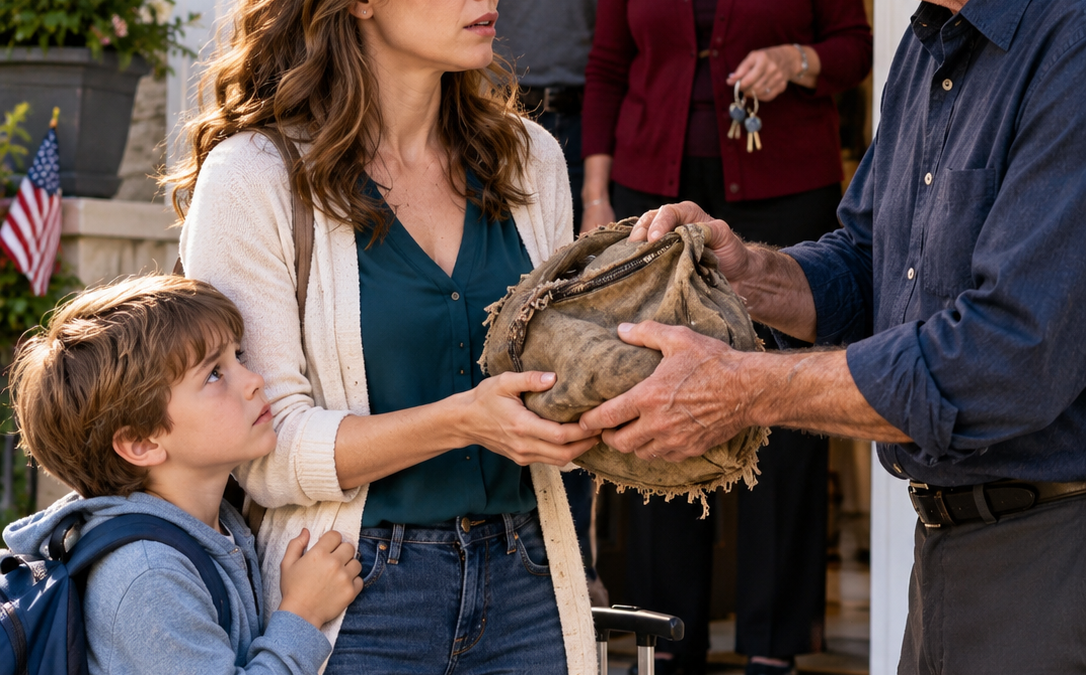
Less than a minute later, he returned carrying an old cloth bag.
It was faded and torn in places, with a rusty-looking zipper running across the top. He pressed it into my hands.
“Take it.”
My mother-in-law gave a mocking laugh.
“With all the nice bags in this house, that old rag is what you’re giving her?”
He ignored her. Instead, he moved closer to me, lowered his voice, and said, “I never forgot. Don’t open this bag here. Wait until the boy is truly hungry, and only then open it.”
I wanted to ask him what he meant. I wanted to know what he had never forgotten and why Luke being hungry mattered. But before I could say anything, he turned away.
My mother-in-law was already hurrying to close the door because it looked as though rain was coming.
I pulled our suitcase down the street, holding Luke’s hand with one hand and carrying the cloth bag with the other. At the corner, I looked back.
My father-in-law was still standing behind the gate.
Tyler never came outside.
That night, Luke and I rented a small room at the back of an old acquaintance’s house. The room contained a wooden bed, a plastic table, and an aging fan that made a high, squeaking noise whenever it turned.
It was not the apartment I had imagined for us, but it was somewhere we could sleep.
I went out and bought fast food for dinner. Luke sat at the plastic table, took two bites, and put down his fork.
“Mom,” he asked, “do you still have money?”
I forced myself to smile.
“Yes, sweetheart. We’re okay.”
The truth was that after paying the room deposit and transportation costs, I had less than $120 left in my wallet. Payday was still more than a week away. I also needed to find a real apartment, and I had no idea how I was going to afford the deposit, rent, and moving expenses.
I didn’t want Luke to know any of that.
After dinner, I put my father-in-law’s old bag under the table. I was curious about it, but his strange instructions kept coming back to me. For reasons I couldn’t explain, I decided to leave it closed.
Two days later, Luke developed a mild fever and had to stay home from school. I asked my employer for permission to work remotely so I could care for him.
On the third day, the landlord informed me that we couldn’t keep the room for long. Relatives from out of state were coming the following month, and he would need the space for them.
That evening, after giving Luke his medicine and settling him in bed, I opened my banking app and started calculating expenses.
I checked my balance, subtracted what I would need for food, transportation, and school, and estimated how much another rental deposit might cost. No matter how I rearranged the numbers, the result looked the same. I had barely enough to move into another inexpensive room and get through the rest of the month if nothing unexpected happened.
From the bed, Luke called softly, “Mom, I’m hungry.”
I closed the banking app and stood up. I was about to grab my purse and go to the corner restaurant for some chicken noodle soup when my eyes fell on the cloth bag beneath the table.
My father-in-law’s words came back to me with startling clarity.
Wait until the boy is truly hungry.
I crouched down and pulled the bag toward me.
It was lighter than I expected. The fabric felt rough and thin in places, and the zipper jammed twice before I managed to slide it open.
Inside lay a man’s old shirt, worn soft with age but folded with extraordinary care.
I lifted the shirt and found a thick manila envelope, a small notebook with a blue cover, and a wooden box about the size of my palm.
I recognized my father-in-law’s handwriting on the envelope.
My heart began beating faster. I pulled out the first sheet of paper, but before I could unfold it, my cell phone vibrated on the table.
It was my father-in-law.
I answered immediately.
He didn’t say hello.
“Did you open the bag?” he asked quietly.
I looked down at the paper in my hand.
“Yes, Dad. I just opened it.”
There was a pause.
“What’s the boy doing?”
I glanced toward the bed. Luke was wrapped in a thin blanket, watching me with tired eyes.
“He still has a little fever,” I said. “He told me he was hungry, so I was just about to go buy him some soup.”
My father-in-law let out a soft sigh.
“Then it was the right time. Read the paper first. When you’ve finished, ask me whatever you want.”
I placed the phone on the table, switched on the speaker, and carefully unfolded the sheet.
His handwriting had once been firm and steady, with the precise lines of someone accustomed to measuring things with his hands. Now some of the letters wavered, as though his fingers had trembled while he was writing.
The first line contained a date from more than three years earlier, around the time Tyler had been preparing to open the store.
Below it was a detailed list of amounts. The $13,500 I had given Tyler was there, along with $4,500 my father-in-law had contributed to his son and another $3,000 he had taken from his own savings to purchase equipment for the new business.
Beside each amount, he had written a date, a purpose, and an explanation.
I read the page twice before I could speak.
“Dad, when did you write all this down?”
“Back when he opened the store,” he replied, sounding almost casual.
“Why?”
“Because I was a carpenter for decades. Even a piece of wood in my shop had to be marked so everyone knew who it belonged to. Money is no different.”
He paused before continuing.
“I told Tyler that your contribution should be documented properly. But he kept saying there was no need for accounting between a husband and wife.”
I looked at the next page.
It was a photocopy of a capital declaration bearing Tyler’s signature. Under the section identifying the source of the funds was a line that read, “$13,500 — family contribution.”
Beside it, in my father-in-law’s handwriting, was the date he had personally seen me transfer the money.
For several moments, I could only stare at it.
“Dad,” I asked, “could this help me get my money back?”
“I don’t know for certain,” he said. “But I kept it because I thought there might come a day when you would need to prove where the money came from. Take it to someone who understands the law.”
I leaned back in the plastic chair and looked around the little room.
Over the previous few months, the money itself hadn’t been the only thing hurting me. I had worked long nights and denied myself small comforts to save it. That money represented my effort, my mother’s generosity, and the future I had believed Tyler and I were building together.
Yet he had dismissed it all with one sentence: It went into the business.
As if $13,500 were loose change forgotten in a coat pocket.
I looked again at the items on the table.
“And the wooden box, Dad? What’s in that?”
“Wait. Don’t open it yet.”
He directed me to the blue notebook instead and told me to find a page with a folded corner.
The notebook resembled an old-fashioned bank passbook. Its early pages recorded ordinary household expenses: electricity, medication from the pharmacy, repairs to the roof. Each entry had been made neatly, sometimes with a few notes in the margin.
About halfway through, I found the folded page.
Luke’s name was written at the top.
Below it was a series of monthly entries stretching back almost four years. Most amounts were between $150 and $200. I turned several pages, following the steady pattern, unable to understand what I was looking at.
“What money is this, Dad?”
He coughed lightly.
“It’s the money I’ve been saving for the boy.”
I stared at the notebook.
He explained that ever since Luke had started preschool, he had been putting aside part of what he earned from occasional carpentry jobs, along with money his children gave him. He had never spent much on himself, and whenever he had a little extra, he added it to Luke’s savings.
Originally, he had intended to give it to his grandson when Luke entered high school. But once he began to notice the problems in our marriage, he decided to keep the arrangement even more private.
“Why didn’t you ask Mom to keep it?” I asked.
He gave a dry little laugh.
“If I handed it to your mother-in-law, by tomorrow morning the entire town would know exactly how much Grandpa had saved for his grandson.”
Despite everything, I smiled.
He wasn’t wrong. My mother-in-law was remarkably skilled at turning private family information into grocery-store conversation.
Perhaps he heard the smile in my voice, because his tone grew lighter.
“Now you can open the wooden box.”
I lifted it carefully. It was sturdy, with smooth, sanded edges, exactly the sort of thing a skilled carpenter would make and keep for years.
Inside lay a small metal key, a piece of paper with a bank’s address, and a deposit slip bearing my father-in-law’s name.
Before I could ask, he explained.
“I have a safe-deposit box at the bank. That’s the key. I’ve already prepared the necessary power-of-attorney paperwork.”
My head started spinning.
“What did you put in there?”
“Go tomorrow and find out.”
“Dad, you can just tell me now. If you don’t, I won’t be able to sleep tonight.”
I looked around the small room, at Luke lying under the thin blanket and at our belongings crowded beside the bed.
“I haven’t slept properly for several nights already,” I added.
There was a long silence on the other end of the line.
Then he asked, “Are you angry with me?”
I knew exactly what he meant.
He was thinking about the afternoon his wife had thrown Luke and me out of the house. He had defended us, but in the end he had allowed us to leave.
“No, Dad,” I said. “I know you could have let us stay a few more days, but it would have started a war with Mom. Even if we had stayed, we wouldn’t have had any peace.”
He didn’t reply.
Just then, Luke pushed himself upright in bed.
“Is that Grandpa?”
I nodded and handed him the phone.
“Grandpa, when can I come get my chess set?”
My father-in-law’s laugh came through the speaker.
“Your chess set is safe with Grandpa. When you’re feeling better, I’ll bring it over.”
I couldn’t help asking, “Will Grandma let you?”
This time, he laughed so hard I could almost picture him leaning back in his chair.
“The chess set belongs to me. I’m the one bringing it. Your grandma might control what I eat, but she hasn’t started bossing my chess set around yet.”
Luke laughed, too. For the first time in days, his tired face seemed to brighten.
After we hung up, I went downstairs and bought chicken noodle soup. Luke and I ate together, and when he was finally asleep, I returned to the table and continued studying the documents.
I stayed awake until nearly midnight.
Inside the manila envelope were more records than I had expected. My father-in-law had kept copies of transfers related to the store, notes about the initial capital, and printed records of several bank transactions Tyler had made while managing the business.
Some of those transfers caught my attention immediately.
They involved large amounts being sent to an account I didn’t recognize.
I wrote down the dates and figures before putting everything away. The more I looked, the more I understood why my father-in-law had warned me to keep my documents safe.
The next morning, Luke’s fever was gone. I left him with a trusted coworker, arranged to take the morning off, and drove to the bank listed on the paper.
It was about five miles away.
I carried my driver’s license, the power-of-attorney documents, the small key, and everything my father-in-law had prepared. At the counter, an employee checked the paperwork carefully. Once the required verification was complete, he escorted me to a private room where the safe-deposit box was brought out.
I sat down, inserted the key, and turned it slowly.
For some reason, I had imagined finding cash inside.
Instead, there was a bank passbook, a thick stack of documents tied neatly with string, and an envelope with Luke’s name written across the front.
I opened the passbook first.
The balance made me blink twice.
I knew my father-in-law had always been careful with money, but I had never imagined that a retired carpenter who lived so modestly could have managed to save an amount like that.
Beneath the passbook lay the documents.
The first was a deed to a small piece of land in a rural Illinois county, roughly forty miles outside Chicago. The property was a little more than an acre, and it was located in the area where my father-in-law had grown up.
Attached to the deed was a handwritten letter signed by him.
I was reading the first few lines when my phone vibrated.
This time, it wasn’t my father-in-law.
It was Tyler.
I answered, and he immediately asked, “You still have that bag Dad gave you the other day, don’t you?”
I looked down at the papers spread across the table.
“Why do you ask?”
He hesitated.
“Mom noticed an old bag was missing from his room. She questioned him, and he admitted he gave it to you.”
I said nothing.
“What was in it?” Tyler asked.
He was trying to sound casual, but there was something strained in his voice. I knew him well enough to recognize the difference.
“Some old clothes,” I said. “Why? Were you looking for something?”
He swallowed audibly.
Then he explained that his father sometimes put family documents in strange places because of his age. He was concerned that the old man might have accidentally handed over important papers.
It might have been a convincing explanation if Tyler hadn’t called at precisely the moment I was examining the contents of his father’s safe-deposit box.
“What kind of papers?” I asked.
“I don’t know. Mom just wanted me to check.”
I closed the folder in front of me.
“Your dad gave me the bag. If he wants anything back, he can call me himself.”
Tyler started to say something else, but I told him I was busy and ended the call.
The bank employee was waiting discreetly outside. I took a breath and returned my attention to the documents.
The land deed was still in my father-in-law’s name. His accompanying letter stated that he intended to give the property and his savings to Luke, with me responsible for managing them on the boy’s behalf until he reached adulthood.
I read the letter slowly, paying particular attention to the final paragraphs.
My father-in-law had listed the origins of the money and property in painstaking detail. The savings came from his carpentry work, an inheritance from his parents, and the sale of another property he had owned years earlier.
He had explained all of it so that no one could later claim I had taken money or property that rightfully belonged to Tyler’s family.
My eyes filled with tears.
Even while dealing with his own troubled household, that old man had been thinking about how to protect his grandson and me from accusations he seemed to know might someday come.
The envelope with Luke’s name was still lying inside the box. I picked it up but didn’t open it. Whatever his grandfather had written, I wanted Luke to read it himself when he was old enough to understand.
I carefully returned everything to its place, secured the box, and called my father-in-law.
He answered almost immediately.
“Well? Did you see it?”
“Dad, you left far too much for Luke.”
“That’s between me and my grandson.”
“Twenty-five thousand dollars isn’t a small amount.”
“Of course it isn’t,” he said. “I spent five years saving it. I didn’t find it lying on the floor yesterday morning.”
I laughed through my tears.
Then I asked him about the land.
He explained that he had inherited it from his parents. People had offered to buy it from him over the years, but he had never agreed to sell.
“I kept it so my grandson would always have a safe harbor,” he said.
I looked again at the deed.
“But it’s still in your name.”
“Of course. What you have is my written intention and proof of where everything came from. We still have to handle the official transfer according to the law. As long as I’m healthy enough, I’ll make sure the paperwork gets done properly.”
His explanation relieved me. I didn’t want anything hidden or handled through questionable arrangements. I had already spent too much time dealing with a marriage in which important things were kept secret.
“Why didn’t you tell Mom?” I asked.
He laughed softly.
“If I had told your mother-in-law, you wouldn’t have enjoyed a single peaceful day today.”
I understood what he meant.
My mother-in-law had always protected Tyler with a fierceness that sometimes felt suffocating. She seemed convinced that the world was constantly trying to take something from her son. Since the divorce, she had repeatedly reminded me that everything in the house and every dollar in the family accounts had been earned through their hard work.
In her mind, anything that left the house with me represented something being taken away from Tyler.
I told my father-in-law about the phone call.
His tone changed immediately.
“What exactly did Tyler ask?”
I repeated the conversation, including his claim that the bag might contain family papers placed there by mistake.
My father-in-law was silent for a while.
Then he said, “I’ll come by your place later this afternoon. We need to talk.”
“You don’t have to come all the way over,” I said. “I’m about to move out of that room anyway.”
“All the more reason for me to come. There’s something serious I need to discuss with you.”
I asked what it was, but he only told me to wait until he arrived.
When I left the bank, I stopped at a diner for lunch. I hadn’t eaten anything since the previous evening, and I knew I should be hungry. But once the daily special was set in front of me, I could barely touch it.
All I could think about were the bank transfers in my father-in-law’s envelope.
One account had received several payments from Tyler’s store over a period of approximately ten months. The transfers added up to more than $30,000.
I still didn’t know who owned that account.
Until then, I had believed our marriage had ended because Tyler had fallen in love with another woman. That was painful enough. But the documents now suggested that something else had been happening alongside his affair, a second story involving money, secrecy, and decisions he had carefully kept beyond my reach.
I was beginning to suspect that I had understood only a fraction of what had happened to my family.
That afternoon, I picked Luke up after finishing work. He was feeling much better, and the first thing he asked when we entered our little rented room was whether Grandpa had brought his chess set.
I smiled. “Do you miss Grandpa, or do you miss the chess set?”
Luke considered the question seriously.
“Grandpa,” he said after a moment. “But only a little bit more.”
I laughed, and he grinned at me. The past few days had been so difficult that hearing him joke again felt like a gift.
Around six that evening, my father-in-law arrived on his old motorcycle. True to his word, he had brought Luke’s chess set, along with a bag of oranges and some takeout food.
He stepped into the room, looked around, and frowned.
“How are the three of you supposed to live in a place this small?”
“Just the two of us, Dad,” I corrected gently.
He scratched his head.
“Right. I’m getting old. Sometimes habit gets the better of me.”
We both understood that he had counted Tyler without thinking.
For a moment, neither of us knew what to say. Then he called Luke over and helped him set up the chess pieces on the floor, giving us something else to focus on.
Once Luke was busy arranging the board, my father-in-law pulled a chair closer to mine.
He reached into his jacket pocket and took out a small slip of paper.
“Do you remember those transfers you found?”
“Of course.”
“Do you know whose account received the money?”
I looked at him, suddenly alert.
Before I could answer, footsteps sounded outside, followed by my mother-in-law’s unmistakable voice.
“Well, aren’t you clever? Sneaking off behind my back, and here you are bringing food to them.”
She appeared in the doorway with Tyler standing just behind her.
For a few seconds, I could hardly process what I was seeing. I had been thrown out of their house only days earlier, yet now both of them were standing at the entrance to the tiny room I had managed to rent.
Tyler stepped inside. His eyes moved across the table and stopped on the safe-deposit box key lying beside some paperwork.
“We need to clear this up once and for all,” he said.
My father-in-law stood immediately and drew the slip of paper toward himself.
My mother-in-law noticed the movement. Her expression hardened, and she pointed at the paper.
“You’re still hiding those things, aren’t you?”
My father-in-law folded the slip and pushed it into his pocket.
“Why did you follow me here?”
She stepped farther into the room.
With four adults crowded around a small plastic table, the air suddenly felt heavy. Luke, who had been sitting on the floor examining his chess pieces, looked up when he saw his father and grandmother.
I moved my chair closer to him.
“Please keep your voices down,” I said. “Luke’s been sick.”
My father-in-law turned to Tyler.
“Did you bring your mother here?”
Tyler shook his head.
“Mom wanted to come. And I wanted to talk to her, too.”
My mother-in-law interrupted before anyone else could speak.
“There’s nothing to discuss. I just want to know what my husband is secretly giving to someone who isn’t part of this family anymore.”
The words isn’t part of this family anymore seemed to settle over the room.
My father-in-law stared at her.
“For years, she cooked your meals, helped take care of this house, looked after you, and gave you your grandson. You called her your daughter-in-law all that time. Now one divorce paper gets stamped, and you’ve forgotten what that word means?”
My mother-in-law lowered herself into a chair.
“Don’t change the subject. I want to know what was in that bag.”
“What belongs to me is mine to give,” he replied. “I can give it to whoever I want.”
“I know there were property documents in there.”
I looked at her with surprise.
So she already knew something about the contents.
My father-in-law’s eyes narrowed.
“Who told you?”
She glanced at Tyler. He immediately looked away.
In that moment, I understood that Tyler must have known at least part of his father’s intention to leave the rural land to Luke. When the old bag disappeared, he had become frightened that those plans might be moving forward without his knowledge.
I quietly picked up the bank key and slipped it into my purse.
“You can relax, Mom,” I said. “The land is still in Dad’s name. I haven’t received any property.”
She studied my face suspiciously.
“And what about the savings?”
Before I could respond, Tyler spoke.
“Mom, I’m not trying to hide anything.”
She turned sharply toward him.
“Your father has been putting away more than forty-five hundred dollars without anyone in this family knowing about it.”
My father-in-law sat down and placed both hands on his knees.
“Since when do I need permission to spend money I earned with my own sweat?”
“We’ve been married for forty years,” she snapped.
“Exactly. And in forty years, have I ever demanded to know whether you had your own little savings tucked away somewhere?”
That silenced her briefly.
I didn’t want the discussion turning into an argument between two elderly people about a lifetime of household finances. I asked my father-in-law to sit comfortably and poured everyone some water.
Tyler pulled the empty chair across from me.
“I didn’t come here to argue about Luke’s money,” he said.
“Then why did you come?”
“I want to know which documents from the store Dad has been keeping.”
My father-in-law gave a short, humorless laugh.
“What are you so afraid of?”
Tyler frowned.
“I’m not afraid of anything.”
“Then why are you so curious?”
My mother-in-law stepped in again.
“The store is a business. Your father is old, and he doesn’t understand how companies are managed anymore. Keeping random paperwork is only going to create trouble.”
My father-in-law slowly reached into his pocket.
“Then let someone who understands accounting look at it.”
He pulled out the folded slip of paper and placed it firmly on the table in front of me.
I unfolded it.
It contained the bank information for an account holder, including the name attached to the account that had received the transfers.
I read it once.
Then I looked up at Tyler.
The name was Diana.
I knew that name. It belonged to the woman Tyler had admitted he was having an affair with.
“Why did you transfer thirty thousand dollars from the store’s account to Diana?” I asked.
My mother-in-law turned toward her son so quickly that her chair scraped the floor.
Tyler immediately began explaining.
“Those were payments for materials. Diana helped broker some equipment purchases for the store. Every transfer was legitimate.”
“Then where are the invoices?”
“My partner keeps those records.”
“Fine. Show me the invoices, and we can settle the question right here.”
Even I was surprised by how calm my voice sounded.
Tyler rubbed his hands together and shifted in his chair.
“Business is complicated,” he said. “You wouldn’t understand everything involved.”
For a moment, I almost laughed.
I had worked as an accountant for more than ten years. I understood invoices, cash flow, supplier payments, and the difference between legitimate business expenses and unexplained withdrawals.
My father-in-law raised his glass of water to hide a smile.
Tyler noticed and flushed.
“If those transfers are legitimate, I have nothing more to say about them,” I continued. “I only want to know what happened to the capital I contributed.”
My mother-in-law glanced from the paper to her son.
“Tyler, tell us the truth. How much money did you give that woman?”
“I didn’t give her anything.”
“Then what were those transfers?”
“I already told you. They were for business.”
My father-in-law finally lost patience.
“That must be some kind of business,” he said. “Always making payments on Sunday nights, with nothing written in the description except ‘transfer.’”
Tyler shot him an angry look.
I turned toward my father-in-law, realizing that he had investigated far more thoroughly than I had imagined.
He explained that about six months earlier, Tyler had asked him to bring a binder from the store back to the house. While he was carrying it, several papers had slipped out. Among them were records showing repeated large transfers to the same person.
By then, my father-in-law had already begun to suspect that Diana was involved with Tyler. Seeing so much money moving into one account troubled him, so he photographed the documents before returning them to the binder.
“Why didn’t you tell me sooner, Dad?” I asked.
Guilt crossed his face.
“I didn’t know everything at the time,” he said. “If I accused him without proof, the fighting at home would only get worse. When you two started talking about divorce, I thought those records might be connected to the money you originally put into the store.”
Tyler stood abruptly.
“Dad, that’s basically spying on me.”
“I wanted you to have an explanation,” his father replied. “You kept saying you hadn’t taken anything from anyone.”
I stood as well.
“Then show me the accounting books, Tyler.”
He turned toward me.
“What for?”
“So I can see exactly where the money I gave you was spent. If everything is clean, I won’t bring it up again.”
To my astonishment, my mother-in-law spoke before he could respond.
“Show her.”
Tyler stared at his mother.
She lowered her voice but didn’t look away from him.
“I thought the store’s money was safe. If you’ve been taking company money and giving it to another woman, then you need to answer for it.”
For the first time since the divorce, I saw genuine doubt in her face when she looked at her son.
Tyler didn’t respond. Instead, he grabbed his phone and headed toward the door, apparently intending to call someone.
My father-in-law caught his arm.
“We’re not finished.”
From another pocket, he produced a second slip of paper.
“I nearly forgot this.”
He handed it to me.
Written on it was the address of a condo in a newly built residential development less than two miles from Tyler’s store. Beside the address was the date of a purchase contract signed eight months earlier.
I looked at the name of the buyer.
Diana.
My father-in-law explained that the earnest-money deposit for that condo had been made exactly three days after the store recorded a $10,000 withdrawal.
Tyler reached out to snatch the paper from my hand.
I stepped back before he could touch it.
My mother-in-law’s lips began trembling.
“Tyler, what is this business about an apartment?”
Before he could answer, his phone rang.
The screen lit up, clearly displaying the caller’s name.
Diana.
Everyone saw it.
Tyler hesitated for several seconds before rejecting the call.
“Why didn’t you answer?” his mother demanded.
He shoved the phone into his pocket.
“Work stuff.”
My father-in-law gave him a cold look.
“She calls just when we’re asking about an apartment, and you say it’s work? You certainly have a lot of interesting business going on.”
I bent down and began gathering the papers scattered across the plastic table.
Luke was still on the floor with his chess set, but he was no longer paying attention to the game. His eyes kept moving between the adults. I knew he had already heard more than he should have.
I asked him to go play for a while in the landlord’s living room. He hesitated, then took a few chess pieces with him and left.
Only after he was safely out of earshot did I turn back to Tyler.
“You don’t have to explain your feelings to me anymore,” I said. “We’re divorced. I don’t need to know what you feel for Diana or what kind of relationship you have. I only want to know whether the money I invested in your store has anything to do with that apartment.”
Tyler sat down again.
“The apartment isn’t mine.”
“I know. It’s in Diana’s name.”
“Then why are you bothering me about it?”
“Because three days before the down payment, ten thousand dollars disappeared from the store.”
He rubbed his forehead.
“You’re mixing apples and oranges.”
“Then show me the books. I’ll look at them and decide whether they’re apples or oranges.”
My mother-in-law, who would normally have rushed to defend him, remained silent. She sat with her hands clasped tightly together, staring at the floor.
A few minutes later, Tyler’s phone vibrated again.
Diana was calling.
This time he got up and stepped into the hallway. He left the door partly open, and I could hear his voice drop.
“I’m busy right now. Don’t call me again. I’ll come by tonight.”
My mother-in-law’s expression grew even more strained.
She looked at me.
“Did you already know about that apartment?”
“I found out at the same time you did, Mom.”
The word Mom came out before I could stop it.
I noticed, but I didn’t correct myself. She didn’t comment on it either.
When Tyler returned, I asked him directly, “Will you let me see the accounting records tomorrow?”
He stood there for several seconds before finally answering.
“Fine. Nine o’clock tomorrow morning. At the store.”
His agreement surprised me.
Either the books were clean enough that he believed I wouldn’t find anything, or he had realized that continuing to refuse would make his own parents even more suspicious.
My father-in-law immediately said he wanted to come along.
“You don’t need to,” I told him. “I can review the records myself.”
He glanced toward his son.
“I’ll sit at the coffee shop across the street. You two can discuss the numbers. I won’t interfere.”
My mother-in-law folded her arms.
“If he’s going, I’m going, too.”
My father-in-law frowned at her.
“Do you even understand a balance sheet? If you don’t, what are you going to do there besides stare at the walls?”
She glared at him.
He chuckled.
“If we all show up, the store might as well sell tickets and bring in extra chairs.”
Despite the tension, I almost smiled. Even my mother-in-law seemed momentarily distracted from her anger, though she turned away with a look that suggested she didn’t appreciate the joke.
The following morning, I arrived at the store shortly before nine.
My father-in-law was already sitting in the coffee shop across the street. When he saw me, he lifted his mug in acknowledgment, silently promising that he would keep his word and stay out of the meeting.
Inside the store, Tyler led me to the computer.
He logged into the accounting system and opened the cash-flow ledger. At first glance, the records were organized and reasonably detailed. I entered the date of my original contribution and began tracing the transactions.
The $13,500 I had given him had indeed gone into the business. The records showed payments for equipment and tools, the initial lease on the commercial space, and deposits to suppliers.
Up to that point, Tyler hadn’t lied about how the money was used.
I felt a small measure of relief, even though I knew that proving the original investment was only part of the problem.
The trouble began in the following year.
Revenue had been fairly strong, but dozens of transactions were recorded as advances to vendors. When I added them together, they represented a financial gap of nearly $45,000.
I asked Tyler for the supporting receipts.
He brought me a stack of invoices and laid them on the desk.
For the next half hour, I checked dates, amounts, supplier names, and payment records against the ledger. The longer I worked, the more inconsistencies appeared.
Three transactions stood out immediately.
One $9,000 advance had been entered on a Friday, but the invoice supporting it was dated the previous week. Another transaction, for $12,000, had no receipt attached at all. The remaining records raised questions about whether money had actually returned to the business after certain proposed purchases were canceled.
I turned the computer monitor toward Tyler.
“Where is the documentation for this?”
He glanced at the screen.
“My partner must have forgotten to enter it.”
“Your partner?”
At that moment, a man in his forties came out of the warehouse area.
I recognized him immediately. He was Tyler’s business partner, someone I had met several times over the years.
He saw me at the desk and looked surprised.
“Are you here checking the books?”
Tyler jumped to his feet.
“It’s nothing. Don’t worry about it.”
His partner looked from him to me, clearly sensing that something was wrong.
I decided to ask while I had the opportunity.
“Would you mind telling me what the nine-thousand-dollar advance from last October was for?”
He frowned.
“What nine-thousand-dollar advance?”
Tyler interrupted.
“She’s got something mixed up.”
But his partner stepped closer to the screen.
“Let me see.”
He studied the transaction, scrolled through several related entries, and turned slowly toward Tyler.
“That’s the money you withdrew for the bulk HVAC equipment order,” he said. “The deal fell through. I thought you had already deposited the money back into the company account.”
I sat a little straighter.
“Did the money come back?”
His partner pulled up the company’s banking records and checked the relevant dates.
Then he shook his head.
“No.”
The color drained from Tyler’s face.
“They must have refunded it to a different account,” he said.
His partner stared at him.
“Which account?”
Tyler didn’t answer.
I continued examining the ledger.
Two more transactions followed a similar pattern. Money had left the company for supposed purchases that were later canceled, but the corresponding refunds never appeared in the accounts.
Together, those unexplained withdrawals totaled almost $21,000.
Tyler’s partner leaned back in his chair, his expression hardening.
“Tyler, you’re going to have to explain this very carefully,” he said. “And not just to your ex-wife.”
Tyler walked over to the window and folded his arms across his chest.
For a long moment, he said nothing.
Then he finally admitted it.
“I loaned the money to Diana.”
I looked up from the screen.
At almost the same moment, my mother-in-law appeared at the store entrance. She had arrived just in time to hear his confession.
She came storming inside.
“You loaned almost twenty-one thousand dollars to that woman?”
Tyler’s face tightened.
“What are you doing here now, Mom?”
“Do I need a hall pass to go wherever I want?”
Outside, my father-in-law noticed the commotion through the coffee-shop window. He set down his mug and made his way across the street at his usual unhurried pace.
Tyler sank into a chair.
“Diana needed money for a down payment on a condo,” he said. “She promised she’d pay me back in a few months.”
I stared at him.
“So you used company funds to help her buy an apartment, and your business partner knew nothing about it?”
No one answered.
His partner closed his laptop.
“This afternoon, we’re doing a full audit of these books,” he said.
I began putting my papers together.
The situation was becoming clearer. My original $13,500 had been used for legitimate startup expenses, but Tyler had later begun taking money from the store to finance his personal relationship.
If I wanted to recover what I was legally entitled to, I needed to keep the financial questions separate from my anger over the affair. This could not simply be a fight over an unfaithful husband. It involved business records, company funds, and potentially property acquired during our marriage.
I was preparing to leave when the store door opened again.
Diana walked in.
She wore simple office clothes and carried a document folder under one arm. When she noticed Tyler, his parents, his partner, and me gathered around the accounting desk, she stopped.
Tyler hurried toward her.
“What are you doing here?”
She looked from him to me.
“You told me everything was resolved, so I came.”
She placed her folder on the desk.
“I also came to return this. I’m not going through with the apartment purchase anymore.”
Tyler stared at her.
“What are you talking about?”
Diana opened the folder and removed a stack of papers.
“The twenty-one thousand dollars Tyler transferred to me is almost all here,” she explained. “I want to return it to the store.”
She placed another sheet on top of the others.
“And I think everyone should look at these records, because the amount Tyler told me he withdrew doesn’t seem to match the figures in your company ledger.”
His partner picked up the document.
He had barely read half a page before his expression changed.
He looked directly at Tyler.
“How much did you tell her you took out?”
Tyler said nothing.
Diana sat down, appearing calmer than anyone else in the room.
“Tyler told me the money was his personal savings,” she explained. “Twenty-one thousand dollars, transferred in several installments. He said the store was doing extremely well and that he and his partner settled the profits at the end of the year.”
His partner pointed toward the computer.
“We have almost twenty-one thousand dollars missing from the business, recorded as advances to vendors. And that doesn’t even account for the other unexplained withdrawals.”
Diana turned toward Tyler.
“You told me that money belonged to you. How exactly were you planning to put it back?”
He had no answer.
My mother-in-law leaned against the nearest table. The anger that had carried her into the store seemed to drain away, leaving genuine confusion.
Until then, I think she had imagined that her son was simply a foolish man who had become infatuated with another woman. But watching his business partner question him about unexplained company withdrawals made her realize that the consequences could be far more serious than a failed romance.
“Where were you going to get the money to repay it?” she asked him.
Tyler swallowed.
“I would have figured something out.”
My father-in-law, standing near the doorway, spoke quietly.
“That’s what you said when you asked your wife for money to open the business.”
Tyler turned on him.
“Dad, can you stop taking shots at me?”
His father’s expression didn’t change.
“Fine. You talk, and I’ll listen. But you still have to explain what happened.”
I took out my phone and photographed the documents concerning my original contribution. Tyler’s partner agreed that I should preserve those records.
Diana opened her folder again and took out additional bank statements.
“These show every transfer Tyler made to my account.”
She spread the pages across the desk.
The money she had received matched almost exactly the $21,000 we had identified among the questionable vendor advances. That portion of the missing funds now had an explanation, even though the explanation exposed Tyler’s dishonesty.
But a considerable amount remained unaccounted for.
His partner turned to him.
“Sit down. We’re going through everything today.”
Tyler exhaled in frustration.
“We have customers. We can’t spend the whole day doing this.”
“I can’t sell ten air-conditioning units with these numbers hanging over my head,” his partner replied.
My father-in-law nodded.
“For once, I agree.”
My mother-in-law rounded on him.
“Would you please be quiet? Do you think anyone is enjoying this? I’ve been here since morning, and I haven’t even had lunch.”
The complaint was so unexpected that Tyler’s partner let out a short laugh.
“Sorry,” he said, standing. “I need a little air.”
Even I felt the absurdity of it. We were uncovering missing money and hidden transactions, yet my mother-in-law could still find room to complain about lunch.
Once everyone settled again, we began examining the books more carefully.
Nearly two hours passed.
We discovered that part of the financial gap came from transfers to Tyler’s personal account. He had used some of that money to pay down a personal loan taken out during the early stages of the business. Depending on the supporting records and the nature of the loan, some of those expenses might be explainable as legitimate business obligations.
But after we accounted for those payments and the money sent to Diana, another $12,000 remained unexplained.
I pointed to the figure on the monitor.
“What did you do with this money?”
Tyler stared at the screen.
Then he answered in one breath.
“I gave it to Mom.”
My mother-in-law had been drinking from a paper cup. She stopped halfway through a sip.
“You gave me what?”
“The money,” Tyler said. “When you were doing those renovations on the house downstate.”
She frowned.
“I paid for those renovations myself. You didn’t give me twelve thousand dollars.”
Tyler looked bewildered.
“I didn’t?”
“No, you didn’t.”
She put down her cup and stood.
“Tyler, you had better start making sense.”
A heavy silence settled over the store.
My mother-in-law emptied most of her purse onto the table while searching for her phone. She wasn’t comfortable using banking apps, so after fumbling with the screen for a few moments, she called an acquaintance who worked at the local bank branch and asked for help confirming the relevant transactions.
We waited while she checked.
When she finally ended the call, she looked at her son.
“You gave me forty-five hundred dollars. Not twelve thousand.”
His partner immediately asked, “Then where’s the other seventy-five hundred?”
No one spoke.
I looked down at the numbers.
At that moment, the arguments that had destroyed my marriage seemed almost small compared with the financial confusion surrounding Tyler’s business.
I no longer cared about humiliating him or proving that he was a bad husband. What mattered was securing the portion of the assets legally owed to me and protecting Luke’s future. Whatever problems Tyler had created with his partner were for them to address through the proper channels.
Then Diana spoke.
“I think I know where that seventy-five hundred dollars might have gone.”
Tyler looked at her with open hostility.
“Diana, are you seriously going to keep bringing things up?”
She met his glare.
“You still want to hide things at this point?”
My mother-in-law leaned forward.
“If you know something, say it.”
Diana took out her phone and searched through her messages.
“About six months ago, Tyler asked me to arrange a seventy-five-hundred-dollar loan for him,” she said. “He told me he needed money quickly to fill a cash-flow shortage at the store.”
She explained that she had refused. At the time, she didn’t feel comfortable lending him that amount.
His partner interrupted.
“But where did the original seventy-five hundred go?”
“Tyler told me he had managed to solve the problem afterward,” Diana replied.
I turned toward my ex-husband.
“What did you spend seventy-five hundred dollars of the store’s money on?”
He sat motionless, his hands interlocked on the table.
His mother had reached the end of her patience.
“Come on, Tyler. Speak.”
Finally, he lifted his head.
“I used it for an earnest-money deposit on another house.”
For a second, I thought I had misunderstood him.
“What house?”
He avoided my eyes.
“The one we were thinking about living in.”
The room seemed to shift around me.
I remembered the promise Tyler had made three years earlier, when I handed him my savings. Once the store became successful, we would move into a condo of our own.
We had even gone to look at a beautiful two-bedroom unit. I remembered walking through it, imagining where Luke’s furniture would go and how wonderful it would feel to have a kitchen where I could make decisions without someone watching.
I had loved that apartment.
A few months after our visit, Tyler told me the prices had become too high and we should postpone buying anything.
I had been disappointed, but I trusted his judgment. After all, he was the one running the business.
Now he was sitting in front of me, admitting that he had put money down on another property.
“When did you make that deposit?” I asked.
“About two years ago.”
“And where is this house now?”
He didn’t answer.
His partner tapped his knuckles firmly against the desk.
“Come on, man. Tell us everything.”
Tyler searched through the photographs on his phone. After several moments, he found an image of a receipt and handed me the device.
I read the address, the date, and the amount.
The earnest-money deposit was $7,500.
“So why did you back out of buying it?” I asked.
Tyler shook his head.
“I didn’t back out.”
I stared at him.
“If you bought the condo, why wasn’t it included in the list of assets during our divorce?”
My mother-in-law looked equally stunned.
“You bought an apartment without telling your parents?”
Tyler scrolled to the final page of the purchase agreement.
I leaned closer to the screen.
The buyer listed on the document wasn’t Diana.
It wasn’t Tyler, either.
It was my mother-in-law.
For several seconds, none of us seemed able to process what we were seeing.
Then my mother-in-law snatched the phone from Tyler’s hand. She read the name once, then again. She scrolled back to the previous page and returned to the signature.
“Tyler,” she said, her voice rising, “I never signed anything like this in my life.”
His partner pointed to the bottom of the document.
“Then whose signature is that?”
She examined it carefully.
Her expression changed.
“That is not my signature.”
She put the phone on the desk, picked it up again, and held it closer to her face.
“I know exactly what my own signature looks like. These scribbles aren’t mine.”
Tyler reached toward her.
“Mom, calm down. Let me explain.”
She slapped his hand away.
“Then explain, Mr. Mastermind.”
No one laughed.
Tyler’s partner had already pulled up a chair directly across from him. My father-in-law stood motionless near the doorframe, and Diana leaned against the edge of the desk, watching with growing discomfort.
I stood beside the computer, waiting.
I had come to the store believing we were going to trace a few questionable business transactions. Instead, we had uncovered a second apartment, a concealed purchase agreement, and a document bearing a signature my mother-in-law swore she had never written.
Tyler finally began talking.
He claimed that the purchase agreement with his mother’s name was only a preliminary draft prepared by the real estate agency. According to him, it had been sent for review and had never been used to transfer ownership. No official title had been issued in her name.
His mother looked furious.
“Then why is my signature on it?”
“The realtor signed it just to prepare the sample document.”
“Signed it for me? You mean someone forged my handwriting?”
Tyler fell silent again.
I asked to see the official paperwork.
“I don’t have it here,” he said.
His partner crossed his arms.
“You bought a property, and you don’t keep the documents?”
“I have the deed at home,” Tyler finally admitted.
My father-in-law raised his eyebrows.
“Which home? Ours, or the other one?”
Tyler looked trapped.
Then, with the air of a man who could no longer keep his story straight, he began explaining the purchase from the beginning.
He had signed an agreement to buy the apartment almost two years earlier. The initial $7,500 earnest-money payment had come from the store’s account. Afterward, he arranged to make installment payments directly to the developer rather than financing the purchase entirely through a traditional mortgage.
Because the store’s revenue fluctuated from month to month, he said, he had decided to keep the matter quiet until the business became more stable.
I listened, trying to separate the facts from his excuses.
“So you committed to buying this property while we were still married?”
“Yes.”
“And where did the money for the monthly installments come from?”
“My income from the store.”
I turned back to the computer and reopened the financial history.
“What income, Tyler?”
Silence settled over the room.
His partner pulled the monitor closer.
“If you’ve been paying for a condo for almost two years, that money has to come from somewhere. It should show up in your salary, profit distributions, or other recorded withdrawals.”
He scrolled through the figures.
“I don’t see enough legitimate personal income here to cover those payments.”
Before Tyler could respond, Diana spoke.
“He told me his parents bought him that condo.”
My mother-in-law looked at her in disbelief.
“You knew about this place?”
Diana shifted uncomfortably.
“I went there with him.”
She explained that Tyler had told her the apartment was an investment property his parents had purchased. He claimed that was why it was usually locked and empty. According to Diana, he had taken her there several times during their relationship.
My mother-in-law’s face flushed.
“An apartment supposedly bought in my name, one I’ve never even seen, and you’re taking your mistress there?”
My father-in-law cleared his throat.
“Woman, focus on the accounts. We can deal with the rest later.”
She turned sharply toward him.
“I’ll focus on whatever I want.”
I could understand her anger, but I was no longer interested in hearing the details of Tyler’s relationship. I wanted the documents.
“Whose name is actually on the title?” I asked.
Tyler answered so quietly I almost missed it.
“Mine.”
I looked at him for a long moment.
The purchase agreement naming his mother had served as a distraction, whether through a fabricated draft or a deliberately misleading explanation. The actual property was registered to Tyler.
I asked for the precise date of the original purchase agreement and checked it against the records on my phone.
There was no question about the timing.
When Tyler entered that transaction, we were legally married. In fact, it was before our relationship had deteriorated into constant arguments and suspicion.
I turned back to him.
“You committed to buying a property during our marriage. That property may be subject to marital property laws, and you left it completely out of the assets we discussed during the divorce. Why?”
He began offering explanations about business profits, separate funds, and the difficulty of proving which money had been used for what.
I listened until he finished.
“If this were only about showing that the money was separate property, I would have been willing to review the evidence,” I said. “But you didn’t disclose the property at all. You hid it.”
His face darkened.
“Now you want to take a house you didn’t put a dime into?”
Before I could answer, his mother spoke.
“You looked me in the face and swore that you two didn’t have any major assets to divide.”
“Mom, I didn’t want to make everything more complicated.”
“You made it complicated the day you hid something this big,” his father said.
Tyler’s partner interrupted before another family argument could begin.
“We need to separate the marital issue from the business issue,” he said. “First, we have to find out exactly how much company money went into that apartment.”
I agreed.
We spent several more hours cross-referencing cash-flow records, bank transfers, payment dates, and the amounts Tyler had withdrawn for personal use.
Gradually, a pattern emerged.
Money was transferred from the business to Tyler’s personal accounts shortly before monthly payments were due to the property developer. Some transactions had been recorded under vague descriptions that made them difficult to trace without comparing several sets of records.
By the time we finished identifying those payments, we had found almost another $15,000 connected to the apartment.
Tyler admitted that he had taken advances from the business, but insisted that he was paying the money back gradually from his share of the profits.
His partner looked directly at him.
“Did you ever discuss those advances with me?”
Tyler lowered his head.
“Just because the business is making sales doesn’t mean you can take company money whenever you want,” his partner continued. “There are proper ways to distribute profits and record advances. You can’t simply move funds around and promise to fix the accounting later.”
For the first time that day, Tyler appeared to have no defense left.
I should have felt vindicated.
Instead, I felt terribly tired.
The man standing before me had once seemed honorable, dependable, and careful. I had trusted him with my savings, my future, and the ordinary details of our family life. Now I was looking at someone who had repeatedly concealed information, shifted money between accounts, and told different stories to his wife, his parents, his business partner, and the woman he was seeing.
Every lie seemed to require another one to keep it standing.
By the time we added everything together, the store’s financial records had become a tangled web of questionable advances, hidden obligations, and transactions that might push the company toward serious trouble if they weren’t corrected.
Tyler had tried to hide losses, create the appearance of profits, and explain away payments he had made without proper authorization. He had also been using the same business to support a private life none of us fully understood.
I asked him one final question about the apartment.
“How much is still owed on it?”
He hesitated.
Then he told us.
Approximately $75,000.
I stared at him.
“Is anyone living there now?”
His eyes shifted briefly toward Diana.
She immediately straightened.
“Don’t look at me.”
Tyler looked away.
“No. No one is living there right now.”
His mother folded her arms.
“Then I want to see it this afternoon.”
Tyler began protesting. He said there was too much work to do at the store and that the property wasn’t ready for visitors.
His father stepped forward.
“Your mother should see it.”
With both parents insisting and his business partner watching, Tyler eventually ran out of excuses.
As we prepared to leave, memories came back to me of the days when Tyler and I had looked at furniture catalogs together, discussed whether round or rectangular tables would fit better in a dining area, and imagined the home where Luke would grow up.
I had believed those conversations were part of a shared future.
Now I was going to see an apartment my husband had secretly purchased while telling me we couldn’t afford a home.
Unexpectedly, my mother-in-law turned toward me.
“You’re coming, too.”
I hesitated.
“Mom, I don’t think—”
“You were his wife when that property was bought,” she said firmly. “Whatever happens now, you have a right to see what he did. I want you to know the whole truth.”
I looked at her.
The woman who had ordered me out of her house without giving me two days to find somewhere else to live was now insisting that I accompany her to see a property Tyler had concealed from us both.
I didn’t know whether her attitude toward me had truly changed. Perhaps she was simply furious with her son. But for once, she wasn’t pretending that his version of events had to be accepted without question.
I agreed to go.
That afternoon, we drove into the residential development where the condo was located.
Tyler opened the building’s electronic entrance, and we took the elevator to the twelfth floor.
When he unlocked the apartment, I stepped inside and stopped.
The place was beautifully decorated.
The furniture looked carefully chosen, the finishes were attractive, and almost everything appeared new or recently purchased. Yet the apartment didn’t have the empty feeling of an unoccupied property.
There were small signs of daily life everywhere.
A pair of slippers lay on the floor. The refrigerator was running and fully stocked. The furniture was arranged as though someone regularly sat there, ate there, and slept there.
Diana looked around with open disbelief.
“You told me this place was empty,” she said.
Tyler didn’t respond.
Before anyone could ask another question, a cell phone began ringing somewhere inside the apartment.
The sound came from the bedroom.
Tyler froze.
My father-in-law moved first. He crossed the room, reached the half-closed bedroom door, and gently pushed it open.
On the nightstand sat a bright red purse.
Beside it, a smartphone was ringing.
My mother-in-law brushed past everyone and picked up the purse.
“Tyler, who is staying here?”
He stumbled through an explanation, saying that he had allowed a friend to use the apartment temporarily. According to him, it was only a private arrangement, nothing that should concern the family.
But after everything we had discovered that morning, no one was willing to accept another vague explanation.
He tried to take the keys back and move everyone out of the bedroom, but my mother-in-law refused.
She had spent two years without knowing about the existence of this property. She wasn’t about to leave while someone else’s belongings sat inside it.
Then Diana, who had been standing near the living room, spoke unexpectedly.
“Wait. I know that purse.”
I turned toward her.
“Who does it belong to?”
She looked at Tyler, then back at me.
“His little sister.”
That answer startled everyone.
Tyler’s younger sister had married and moved to Peoria years earlier. She lived far enough away that we rarely saw her except during family occasions, although she and Tyler had continued speaking from time to time.
My mother-in-law immediately shook her head.
“Why would my daughter be staying here? If something that serious was happening to her, I would know.”
But as the questions continued, the truth finally emerged.
Tyler’s sister had been going through severe problems in her own marriage. The situation had been deteriorating for months, and she had eventually moved out. Tyler had allowed her to stay in the condo so she would have somewhere safe to go while sorting out her personal affairs.
They had kept the arrangement secret, supposedly to avoid upsetting their aging parents.
My mother-in-law stood holding the red purse, looking as though she didn’t know whether to be angry, frightened, or relieved.
The phone on the nightstand rang again.
This time, Tyler picked it up. The caller was someone familiar to the family, and he put the conversation on speaker so everyone could hear. The call confirmed that his sister had been staying at the apartment and was expected to return after taking care of something that morning.
There was no longer any doubt about who had been using the place.
My father-in-law let out a long, exhausted sigh.
He looked around the apartment, then at his son.
“You’ve somehow managed to keep one secret from your wife, another from your parents, another from your partner, and another from your own sister’s family,” he said. “All because you think staying quiet will stop people from worrying.”
Tyler lowered his eyes.
I had reached the end of my patience.
“But the money used to buy this place came from accounts connected to our marriage and your business,” I said. “Why did you lie to me? Why did you let me believe we couldn’t afford a home when you were secretly paying for one?”
I walked through the apartment, trying to understand how much of it had been arranged while I was still dreaming about a future with him.
Then I reached the south-facing balcony.
The view was familiar in a way that made my chest tighten.
Several of the finishes resembled choices I had once discussed with Tyler. The decorative doors, the details around the balcony, and even the pattern of the colored tiles reminded me of things I had pointed out during our visits to model apartments.
I remembered telling him that a particular tile design would be easier to keep clean.
Now that same kind of flooring was installed in a home I had never known existed.
I turned toward him.
“You knew how badly I wanted us to move out,” I said. “You knew how difficult it was for me to keep living with your parents. Why would you let me believe we had to keep waiting?”
Tyler looked uncomfortable.
He said he had intended to move us eventually, once the business improved. But he had become concerned about taking on more expenses and upsetting his mother, who believed renting was a waste of money when there was plenty of space in the family house.
So he kept postponing the decision.
And while I waited, he continued making payments on an apartment he had never told me he owned.
My mother-in-law had often insisted that it made no sense for us to pay rent while her house had empty rooms. Tyler had used that attitude, along with the uncertainty of his business income, as an excuse for delaying our plans.
I had believed him.
Looking around the condo now, I realized how much of our life had been built on promises that he was never willing to explain honestly.
I asked whether any part of my original investment had contributed to the purchase or its payments.
Tyler finally admitted that some of the money movements were connected. Funds had moved between business accounts and his personal expenses, and he could no longer pretend every transaction had been completely separate.
Whatever explanation he offered, I could see that his credibility had collapsed.
I told him that I wanted a formal accounting of every relevant transaction. I wanted the original capital traced, the company advances identified, and the apartment’s purchase and payment history examined by qualified people.
For years, I had been willing to overlook small amounts of money simply to avoid an argument. I had told myself that keeping peace was sometimes more important than proving who was right.
But I couldn’t afford to do that anymore.
Not with Luke depending on me.
I made it clear that I wasn’t asking to take money that belonged to anyone else. I wanted the amounts separated accurately, the lawful obligations established, and every dollar accounted for without favors or hidden adjustments.
My mother-in-law listened.
Then, to my surprise, she agreed.
She said the family had already suffered enough damage from people hiding things. If there were financial questions, they needed to be resolved openly so that no one could later accuse anyone of taking what wasn’t theirs.
I looked at her for a moment.
Her words were very different from the ones she had spoken when she ordered me out of her house. I didn’t know whether we would ever have an easy relationship, but I appreciated that she was beginning to see the importance of the truth.
We eventually agreed that the business records and the condo documents would have to be reviewed formally.
None of us yet knew how many complications that review would uncover.
Once the immediate tension eased, Diana began gathering her belongings. Before leaving, she confirmed that she would return the money she had received from Tyler to the store’s accounts that week. She wanted the repayments documented properly so that there could be no further confusion about what she had received or why.
She also made something else clear.
Her relationship with Tyler was over.
He looked at her, seemingly expecting an argument or another chance to explain himself, but she had already made her decision. She had believed his stories about his finances, his business, and the circumstances of our marriage. Now she knew that much of what he had told her was false.
As she passed me, she stopped.
“I’m sorry,” she said quietly.
I looked at her.
She explained that Tyler had led her to believe our marriage had effectively ended long before the divorce was finalized. He had presented our relationship as something already broken and settled, making it easier for her to believe that starting a future with him would not cause the harm it eventually did.
I listened without interrupting.
For months, I had thought of Diana as the woman who had taken my husband away. I had imagined her sharing the life I was losing, enjoying the attention and promises that had once belonged to me.
But now, looking at the documents and remembering everything Tyler had concealed, I realized that she had also been living inside a story he had invented.
That didn’t erase the hurt. It didn’t change the fact that our marriage had ended or that she had been involved with my husband. But I no longer felt the need to direct all my anger toward her.
“We both believed things that weren’t true,” I finally said.
She nodded.
There was no dramatic reconciliation, no embrace, and no sudden friendship. We simply acknowledged that we had both been deceived in different ways by the same man.
Diana left that day, and I never saw her again.
Over time, I stopped thinking about her as the center of my failed marriage. The affair had been devastating, but the financial deception revealed something deeper about Tyler. He had built his life around avoiding uncomfortable truths, hiding problems, and inventing explanations instead of accepting responsibility.
What I had once interpreted as a passionate betrayal now looked like part of a much larger pattern of dishonesty and incompetent management. He had lied to maintain appearances, then lied again when the first explanation no longer worked.
Even without Diana, the damage had been building for years.
My mother-in-law approached me after the others had finished discussing the immediate financial arrangements.
She asked about my temporary living situation and offered several possible ways to help. Perhaps I could stay somewhere connected to the family while the property matters were being settled. Perhaps we could find another arrangement until I had a permanent home.
I appreciated that she was finally asking, but I declined.
Moving back into a family-controlled property, even temporarily, would only complicate an already difficult situation. I didn’t want to depend on arrangements that might become another source of resentment or another argument over who owed whom.
I needed a home where Luke and I could live peacefully, with clear boundaries and no uncertainty about whether we were welcome.
I explained that I wanted the documents reviewed, the assets clarified, and the necessary legal arrangements completed properly. I had no interest in aggressive litigation simply for the sake of punishing Tyler. I wanted a fair settlement based on evidence, including any marital property that had been omitted from our divorce proceedings.
The custody arrangements also needed to remain clear. Luke’s stability mattered more to me than any argument over pride or blame.
My mother-in-law listened without interrupting.
When I finally prepared to leave the apartment, my father-in-law called me aside.
He had been unusually quiet while the family discussed the property. Now he reached into an old cardboard folder he had brought with him and removed a folded piece of brown paper.
He placed it in my hand.
Written on it was the contact information for someone he trusted who understood local real estate matters. He explained that this person had experience with property records and complicated ownership questions.
“Keep this,” he told me. “You might need someone who knows how to read more than what’s written on the first page.”
I thanked him and started to put the paper away.
But he wasn’t finished.
“There is something else you should remember,” he said.
I thought he was going to speak about the rural land he wanted to leave Luke. Instead, he referred to money that had once gone into construction and finishing work connected to Tyler’s family property.
At first, I didn’t understand.
I remembered buying small household items, helping with ordinary expenses, and contributing toward things that seemed necessary at the time. I remembered payments for improvements, minor repairs, and materials. But I didn’t recall agreeing to put a large separate amount of my own money into property I didn’t own.
My father-in-law looked at me steadily.
“Think about the money your mother gave you when you got married.”
I went still.
The wedding gift.
Seven thousand five hundred dollars.
I remembered it clearly now. That money had been part of the savings I later brought into my marriage and trusted Tyler to use responsibly.
My father-in-law explained that records connected a portion of that money to construction improvements and finishing work. The transactions had been scattered among other expenses, and I had never been given a clear explanation of how the money had moved or why those particular costs were being paid.
I had always assumed the money we contributed was being used for the purposes Tyler and I had discussed. I had never imagined I would one day have to trace it through several properties and sets of accounts.
The realization left me standing in silence.
It wasn’t merely that Tyler had hidden an apartment. Money I had brought into the marriage had become entangled in property expenses that had never been disclosed to me clearly.
I looked at my father-in-law.
“Why didn’t anyone tell me?”
He didn’t offer a convenient excuse.
He simply acknowledged that far too much had been handled without proper explanations, and that those silences had eventually created the mess we were trying to untangle.
That evening, I returned to the small rented room and spread the documents across the plastic table again.
Luke was resting on the bed while I examined bank statements, transfer receipts, and the notes my father-in-law had saved. The room was cramped, and the old fan was still making its familiar squeaking noise, but I no longer felt as helpless as I had when we first arrived.
The papers in front of me represented years of transactions. Some were ordinary and easy to understand. Others had been divided into smaller payments, moved between accounts, or recorded under descriptions that revealed almost nothing about their actual purpose.
I began arranging them by date.
I separated the original business investment from later withdrawals, then placed the documents related to the two properties in their own groups. I compared what Tyler had told me with the dates shown on the statements.
I kept coming back to the same realization: I had spent years trusting that important financial decisions were being made openly, while Tyler had been deciding what I was allowed to know.
The following morning, I went to the county clerk’s office to learn more about the property records and the proper process for resolving the ownership questions.
I also sought guidance about my financial rights under the applicable marital property rules. I needed to know which contributions could be traced, which claims required additional evidence, and what steps were available when a significant asset had been left out of a divorce settlement.
I learned that the documentation of my personal contributions could be important in seeking an appropriate financial adjustment or reimbursement, depending on the circumstances and the legal treatment of the funds.
The bank receipts and records my father-in-law had preserved gave me a much clearer foundation than I had possessed during the divorce.
For the first time in months, I felt that I could approach the situation with more than frustration and suspicion.
I didn’t need to rely on accusations.
I had dates, figures, transaction records, and supporting documents.
I continued to favor an orderly settlement over a prolonged fight. I wanted the titles corrected where necessary, the financial obligations established, and the arrangements affecting Luke protected through proper legal procedures.
Above all, I wanted the uncertainty to end.
That afternoon, I returned to my former in-laws’ house.
Standing on the porch felt strange.
For years, I had walked through that doorway carrying groceries, work bags, school supplies, and laundry. I had known which steps creaked and where to place my shoes so they wouldn’t bother my mother-in-law.
Now I stood outside like a visitor.
For the first time, I rang the doorbell.
My mother-in-law opened the door and stepped aside to let me in.
Inside, the dining table was covered with documents.
Tyler was there, along with his father, and the atmosphere was serious but calmer than it had been at the store.
My mother-in-law had helped organize the records, including the entries relating to the $7,500 and the other amounts we had identified. Dates, transfers, and supporting statements were laid out where everyone could examine them.
Tyler looked exhausted.
As we went through the papers, he admitted more about how he had handled the money. He said he had believed he could keep the business stable by temporarily moving funds between accounts and replacing them later when revenue improved.
Whenever an expense became difficult to explain, he had postponed dealing with it. When another payment came due, he covered it with money intended for something else.
Over time, those decisions had produced increasingly complicated records and losses he could no longer conceal.
He had convinced himself that if he eventually put the money back, the earlier decisions wouldn’t matter.
But the accounting told a different story.
The financial damage wasn’t erased simply because he had intended to repair it someday.
I proposed that we begin with a formal appraisal of the condo and a complete accounting of the connected assets and liabilities. We needed to establish its value, identify every outstanding obligation, and determine how any remaining proceeds should be distributed after the debts were settled.
Tyler’s business partner was already reviewing the company transactions, and Diana had agreed to return the money she had received. Those developments would help clarify the store’s financial position.
But the apartment had to be handled separately, with its own title records, payment history, and liabilities.
Everyone agreed that the figures needed to be established before any final division could be made.
As the discussion became calmer, my mother-in-law stood up and went to another room.
She returned carrying an old tin box.
I had seen it before but had never known exactly what she kept inside.
She placed it on the table and opened the lid.
Inside were records of money saved for Luke over the years.
She explained that since he was a baby, she had been setting aside money given to him during Christmas celebrations, birthdays, and other family occasions. Sometimes relatives gave him cash. Sometimes she added a little of her own.
She had kept track of those amounts and maintained the savings separately.
When we compared her records with the corresponding bank balance, the figures matched down to the penny.
The total was approximately $6,250.
I looked at the old box and then at my mother-in-law.
For years, I had known her as the woman who counted every household expense and questioned every unnecessary purchase. I had often felt suffocated by her attention to money.
Now I was seeing another side of the same habit.
She had been carefully preserving money intended for her grandson.
That didn’t excuse the way she had treated me, but it reminded me that people rarely fit neatly into the roles we assign them when we’re hurt.
My father-in-law watched her arrange the papers.
For once, he didn’t tease her about being overly particular.
Unfortunately, the financial questions weren’t finished.
As the formal review continued, a bank representative became involved because of the audit Tyler had requested. The examination of the condo’s financing uncovered additional complications connected to its valuation and the way it had been used in borrowing arrangements.
The apartment had been involved in another bank advance, and the associated records revealed substantial liabilities tied to Tyler’s efforts to cover accumulated financial shortfalls.
The outstanding exposure was around $75,000, with further complications involving charges and penalties resulting from the way some obligations had been handled.
The figure Tyler had mentioned earlier was far from a simple remaining payment on a home.
There were linked debts, financial adjustments, and questions that had to be resolved before the property could be sold and the proceeds divided.
I stood beside the table with my hands on my hips, listening as the representative explained the figures.
Every time I thought we had finally reached the bottom of Tyler’s financial decisions, another hidden arrangement appeared.
My mother-in-law sighed heavily.
My father-in-law sat with his hands folded, looking older than he had a few weeks earlier.
Tyler’s partner studied the new records with an expression that suggested he was already calculating how much work remained to untangle them.
No one had the energy for another argument.
Eventually, with the relevant financial oversight and documentation in place, we agreed that selling the condo was the most practical solution.
Keeping it would preserve the very obligations that had created so much uncertainty. Selling it would allow the debts connected to the property to be settled and any remaining value to be properly accounted for.
I made one condition absolutely clear.
Luke’s savings were not to be used to repair the adults’ mistakes.
The money my father-in-law had saved for him, along with the $6,250 my mother-in-law had preserved, belonged to his future. Those funds were to remain separate from the business debts, the condo settlement, and the arguments surrounding our divorce.
My mother-in-law agreed.
In fact, she became more insistent about it than anyone else.
“Every penny of that sixty-two hundred and fifty dollars goes into the boy’s account,” she said. “Every penny.”
She looked around the table.
“If we’d all kept better track of things from the beginning, perhaps we wouldn’t be sitting here trying to repair a mess this big.”
My father-in-law gave her a sideways glance, but this time he didn’t make a joke.
I checked the numbers one last time and closed my notebook.
We continued working through the settlement details until evening. It wasn’t pleasant, and there were still legal and financial steps to complete, but the discussion no longer felt like a battle in which everyone was trying to hide something.
For the first time, the goal seemed to be the same for all of us.
We wanted the accounts corrected and the obligations settled.
When I finally left the house, I didn’t feel the sharp bitterness that had consumed me on the day I was thrown out.
The past hadn’t been erased, but its hold on me was beginning to loosen.
As I was leaving, my phone displayed a new banking notification.
A transfer had been recorded in connection with the repayment Diana had promised.
She had followed through on returning the money to the proper account, and the accompanying statements helped document the transactions that had previously been scattered across the business records.
That repayment didn’t solve every problem, but it closed an important part of the financial gap.
Tyler’s partner began requiring much stricter oversight of the business. Transfers, withdrawals, advances, and expenses had to be recorded and supported with the appropriate documents.
My father-in-law was particularly firm about that.
“If money is lost, you have to know where it went,” he told Tyler. “If you owe someone, you have to be able to show exactly how much. Every dollar belongs on the books.”
Tyler no longer argued.
He acknowledged that he had obligations to his partner, the lenders, and the people affected by his decisions. He agreed to cooperate with the formal reviews and complete whatever records were needed.
There were no grand promises that everything would magically become normal again.
There was simply work to be done.
Over the following weeks, the financial arrangements moved forward. The property settlement and liquidation process eventually produced enough remaining funds, after the required obligations and divisions, to give Luke and me a more secure foundation.
Within a month, I was able to arrange a long-term lease on an apartment in a pleasant residential complex overlooking a sports park.
It wasn’t an extravagant place, but it was bright, comfortable, and ours to live in without anyone questioning whether we belonged there.
Luke loved the view.
He could see children playing outside, and he quickly began talking about where he wanted to put his books and how he would arrange his things.
Watching him make those plans brought back the memory of the day he had stood in his old bedroom deciding which storybooks would fit in his backpack.
This time, he didn’t have to leave the fourth book behind.
Even after we found the apartment, however, there was one final financial confession Tyler needed to make.
Before our remaining interests in the business were completely resolved, he admitted that he had kept nearly $15,000 in a separate reserve without properly disclosing it.
He said he had been holding on to the money because he wanted to repair part of the financial shortfall before the final settlement. In his mind, he had been preparing for one last attempt to put everything right.
He seemed to expect me to understand his intention.
Instead, I looked at him and felt the same weary disappointment I had experienced so many times before.
“You still don’t understand, do you?” I asked.
He lowered his eyes.
“It isn’t just about whether you eventually put the money back. It’s about making decisions without telling anyone. You kept deciding what was best, hiding the consequences, and expecting everyone else to trust you.”
For years, that had been the pattern of our marriage.
Whenever a problem appeared, Tyler handled it privately. He decided which information I needed, which obligations could wait, and which explanations would be enough to keep me from asking questions.
He hadn’t treated me as an equal partner in the decisions that shaped our family’s life.
Even when he believed he was protecting us, he had taken away my ability to make informed choices.
I no longer wanted to punish him for every mistake. I could see that many of his decisions came from fear, pride, and an inability to confront failure rather than from a carefully planned desire to harm everyone around him.
But the absence of deliberate cruelty didn’t make the damage disappear.
I insisted that the reserve be included in the formal accounting. It had to be reviewed along with the remaining business balances, the original contributions, and the unresolved $7,500 connected to the property transactions.
Everything needed to be documented, divided, and settled according to the proper process.
No secret repayments.
No hidden accounts.
No more private arrangements made in the name of protecting the family.
When Tyler finally agreed, I felt something inside me settle.
I didn’t need him to become the man I had once believed he was. I only needed him to accept responsibility for the obligations he had created.
As the final arrangements progressed, we began moving the last of my belongings and furniture.
There was a familiar kind of chaos around the loading area.
My mother-in-law had brought extra pots and kitchen supplies, insisting that I would need them in the new apartment. She complained that the place looked too small for everything and questioned whether I had enough cabinets.
My father-in-law, meanwhile, had appeared carrying a sturdy but rather roughly finished desk he had made himself.
He was determined that Luke should have somewhere proper to do his schoolwork.
My mother-in-law took one look at it.
“Where exactly is she supposed to put that enormous thing?”
“It isn’t enormous,” he replied. “It’s a desk.”
“She barely has room for the furniture she already owns.”
“The boy needs somewhere to study.”
“He already has a table.”
“That plastic table isn’t a desk.”
I stood nearby watching them argue while my father-in-law stubbornly held on to his handmade furniture.
For the first time in a long while, their familiar bickering didn’t make me anxious.
They sounded like the same elderly couple I had known for years, disagreeing over furniture, household space, and practical details that seemed far more important to them than to anyone else.
But the argument no longer determined where I could live or what I could keep.
I was free to accept their help without surrendering control of my home.
Eventually, the desk came with us.
So did the extra pots.
While unpacking, I came across the old cloth bag my father-in-law had given me on the day we left the family house.
By then, I had taken out almost everything it contained. The documents were organized, the wooden box had been put away, and the shirt had been carefully folded.
The bag itself looked even more worn than I remembered.
I decided to empty it completely before washing it and repairing the small tear along one side.
As I turned it inside out, my fingers caught on something hidden deep in an old seam near the bottom.
At first, I thought it was simply another piece of loose lining.
But when I pulled gently, a small folded piece of brown paper slipped free.
The paper was yellowed with age, and the handwriting was so faded that I had to hold it near the light to read it.
It was a letter.
The writing wasn’t my father-in-law’s.
The letters were smaller and more delicate, formed in a hand that belonged to another generation. As I examined the paper, I realized it appeared to have been written long before Luke was born.
I showed it to my father-in-law.
He took one look and went completely still.
For several seconds, he didn’t speak.
Then his hands began to tremble.
“Where did you find this?”
“Inside the lining of the bag.”
He turned the paper carefully, looking at the faded writing as though he were seeing something impossible.
It had been written by his mother.
She had died many years earlier, and he had believed the letter was lost.
The old bag, which everyone else had regarded as worthless, had once belonged to his family. Somewhere along the years, the paper had become trapped inside one of its seams and forgotten.
His mother had written the message for him when he was young, intending it to be read when he was old enough to understand the responsibilities of family and property.
Seeing the handwriting again brought tears to his eyes.
I stood beside him while he read.
The message spoke about land, money, and the disputes that could divide relatives when property became more important than affection.
It warned that even a small amount of money could cause bitterness when people stopped remembering why they had wanted to earn and save it in the first place.
And it returned, again and again, to the responsibility adults had toward children.
When disagreements arose over property, inheritance, or even the last few dollars in a household, the letter urged its reader to remember those who depended on the family for food, shelter, and love.
A child should never be made to suffer because adults were too proud to settle an argument.
The letter wasn’t long, and some parts were difficult to decipher after so many years. But its meaning was clear enough.
Money could be earned again. Property could change hands. Families could survive hardship, but only if people were willing to put aside resentment and speak honestly.
My father-in-law held the paper for a long time.
I could see that he was remembering his mother, her words, and perhaps the circumstances in which she had written them.
He had spent years keeping careful records, saving money for Luke, and quietly protecting the documents he believed we might someday need.
Now, through an old letter he thought had disappeared forever, his own mother seemed to be reminding him why those efforts mattered.
I looked down at the faded bag.
When he gave it to me at the doorway, I had thought it contained nothing of value. It was worn, patched, and almost falling apart.
Yet it had carried proof of my contribution to Tyler’s business, evidence of hidden transactions, the keys to savings for Luke, documents concerning land, and now a message from someone who had been gone for decades.
The most valuable thing inside it wasn’t the money or the property.
It was the truth those objects had helped us uncover.
Without the records, I might have continued believing that my years of work and sacrifice had simply disappeared into a business I no longer had any connection to.
Without my father-in-law’s careful notes, I might never have discovered the apartment Tyler had concealed.
Without the savings he had protected, Luke’s future would have felt far less secure during those frightening weeks after we left home.
And without the old letter, I might have forgotten that solving the financial mess was never supposed to mean destroying every remaining family bond.
There had been consequences for the people who lied. Tyler had to answer for the money he moved, the obligations he concealed, and the harm caused by his decisions.
But the purpose of uncovering the truth wasn’t endless punishment.
It was to stop the lies from shaping our lives.
I had spent more than a decade balancing other people’s accounts. I knew how to find missing figures, reconcile statements, and identify transactions that didn’t belong where someone had placed them.
Yet for years, I had failed to apply the same clarity to my own life.
I had accepted vague answers because I wanted peace. I had overlooked uncomfortable details because I didn’t want to create conflict. I had allowed other people to decide which truths I was strong enough to hear.
I would never live that way again.
From then on, I intended to be responsible for my own home, my finances, and the decisions affecting my child.
I could forgive mistakes without pretending they hadn’t happened. I could accept help without allowing someone else to control my life. And I could love people without giving them permission to hide the truth from me.
As the months passed, our relationships gradually became calmer.
My mother-in-law still had her habits. She still noticed household expenses and occasionally offered advice I hadn’t asked for. She remained particular about where things belonged and how money should be managed.
But she no longer treated me as someone who had no right to make decisions for herself.
One day, she asked whether she could spend time with Luke and occasionally care for him when the arrangements allowed.
She asked properly, without assuming she could simply decide when to take him or where he should stay.
I appreciated that.
We discussed his schedule and made arrangements that worked for everyone, keeping the custody agreement and Luke’s routines in mind.
I wanted my son to have a relationship with his grandparents. They loved him, and despite everything that had happened between the adults, he loved them.
I also wanted him to understand that love should come with respect.
Tyler gradually became more consistent about his responsibilities.
One afternoon, he came to my apartment to deliver the monthly child-support payment. Instead of making excuses or waiting for me to remind him, he handed me the full amount in cash and looked directly into my eyes.
There was an awkwardness in his expression that I recognized as shame.
He knew how much had been damaged by his silence.
He also knew that making one payment on time couldn’t erase years of dishonesty.
Still, it was a beginning.
We continued working through the necessary financial and legal arrangements, including the formal acknowledgments and corrections required to put the past transactions in order.
Tyler accepted responsibility for the half-truths he had told and agreed that the remaining obligations should be clearly recorded rather than handled through private promises.
There were documents to sign and records to correct. Nothing could be repaired simply by saying he was sorry.
Our marriage was over, and I didn’t want to return to it.
But I could recognize that Tyler was trying, however imperfectly, to become more responsible as a father.
I wanted Luke to grow up knowing that his father had made serious mistakes, but that those mistakes didn’t have to define every moment of their relationship.
The important thing was what Tyler chose to do afterward.
Responsibility had to become something visible in his actions, not merely something he promised when confronted.
I kept the old cloth bag.
I washed it carefully, stitched the small tear along the side, and folded it away with the documents that mattered most.
The financial records were now organized and properly accounted for. The papers concerning Luke’s savings and his grandfather’s intentions were kept separately, where they could be found when needed.
I also preserved the faded letter from my father-in-law’s mother.
Someday, when Luke was old enough, I would tell him the whole story.
I would explain why his grandfather had saved money quietly for years, why his grandmother had kept track of every Christmas gift, and why an old bag that looked like trash had become one of the most important objects in our lives.
I would tell him about the difficult days when we had almost nothing, when I worried about rent and food, and when his simple words, “Mom, I’m hungry,” reminded me of the instructions his grandfather had given me.
I would tell him how the savings and documents helped protect his future, and how the care of one generation could become a source of hope for the next.
I wanted him to understand that the value of what his grandfather left him wasn’t measured only in dollars or acres of land.
It was measured in the years of patient work, the meals quietly saved for someone coming home late, the careful records kept when no one else thought they mattered, and the willingness to do what was right even when it meant disagreeing with the people closest to you.
Perhaps one day, Luke would have children of his own, and the story would become something he could pass on to them.
Not as a lesson about how money had divided a family, but as a reminder of why honesty and responsibility were necessary to keep a family together.
Life eventually became peaceful again.
Not because every wound disappeared or because everyone suddenly agreed about the past. There were still memories that hurt, decisions I wished had been different, and conversations that could never be taken back.
But the financial accounts had been addressed, the hidden obligations brought into the open, and the boundaries between our households made clear.
Luke had a stable home. His grandparents remained part of his life. His father was learning to meet his obligations, and I no longer had to depend on promises that weren’t supported by actions.
For the first time in years, I could sit at my own table, look around my apartment, and feel that the life surrounding me belonged to me.
The old bag remained tucked away, carefully repaired and preserved.
Whenever I saw it, I remembered the afternoon my father-in-law stood at the doorway and told me not to open it until Luke was truly hungry.
At the time, I thought he was speaking only about food.
Now I understood that hunger could mean more than an empty stomach.
I had been hungry for security, for answers, for a place where my son would be safe, and for the truth about a marriage that had slowly fallen apart while I was trying so hard to hold it together.
The bag had given me a way to find those answers.
And in the end, I learned that a relationship cannot survive on affection alone when honesty has disappeared. Trust must be supported by the truth, just as every balance in an accounting ledger must be supported by the numbers beneath it.
Only when the hidden accounts were finally opened could the rest of our lives begin to settle.
Thank you for taking the time to listen to today’s story on the Life as Two channel. If this story reminded you of something you’ve experienced in your own family, feel free to share your thoughts or experiences in the comments so we can learn from one another and better understand the challenges that life sometimes brings.
And if you’d like to continue following Life as Two for more stories about ordinary people facing extraordinary difficulties, don’t forget to subscribe. There will be more opportunities for us to come together, reflect on everyday life, and share the lessons we discover along the way.








