After my son-in-law banned me from the wedding, i arrived at the empty venue. i just smiled and played an audio recording for everyone to hear… he begged me to stop.
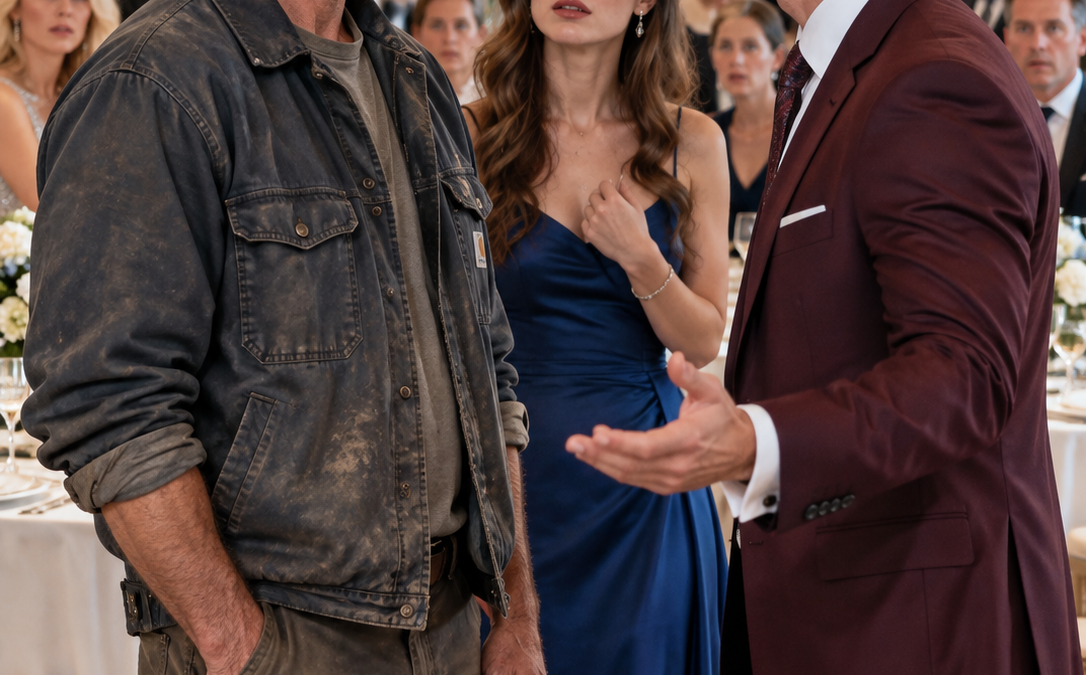
“We only want important people at our celebration.”
I was standing in the doorway of Oak Valley Country Club’s private dining room, still wearing the clothes I’d worn all day at the construction site. My hands were calloused, my boots were dusty, and the smell of honest work still clung to my faded Carhartt jacket. Inside, my daughter Emma’s rehearsal dinner was in full swing. Crystal glasses caught the light, designer dresses filled the room, and everywhere I looked, I saw the kind of people who measured another person’s worth by their ZIP code and job title.
Bradley spotted me almost immediately, and the color drained from his face. He leaned toward Emma and whispered something before making his way across the room. As he approached, he arranged his features into that particular smile wealthy people sometimes use when they’re preparing to humiliate someone politely.
“Thomas,” he said, not quite meeting my eyes. “We only want important people at our celebration. I’m sure you understand.”
I looked at him for a long moment. Twenty-five years of sacrifice. Twenty-five years of building something this young man couldn’t begin to imagine. Twenty-five years of deliberately allowing people like Bradley to believe they knew everything about me simply because they could see my work boots.
Then I smiled and said one word.
“Interesting.”
To understand why that word mattered, you have to understand how we got here.
Twenty-five years earlier, I had made a decision that would eventually change everything. I was twenty-seven, fresh out of college with a business degree, and I had just inherited $43,000 from my grandfather. It wasn’t a fortune, but it was enough to build something if I was willing to work hard and make the right choices.
I could have bought expensive suits, found a corporate job, and spent my life trying to impress people who judged success by the logo on a briefcase. Instead, I bought a pair of work boots and a pickup truck.
I had seen too many wealthy children grow up believing money appeared out of nowhere, as though someone simply had to ask for it. They inherited opportunities without understanding the sacrifices that created them. I never wanted my daughter to become that kind of person. I wanted her to understand the weight of a dollar, the dignity of honest work, and the difference between earning respect and demanding it.
So I started Wilson Construction with one truck and a dream.
What nobody knew was that I wasn’t simply swinging hammers. I was making deals, negotiating contracts, acquiring properties, and building relationships that would eventually be worth millions. And I did it all while wearing the same faded Carhartt jacket that made people assume I was just another laborer.
During my first year, I earned $62,000. I lived in a one-bedroom apartment and saved every penny I could. Emma was only two years old, and her mother had died in childbirth. From the beginning, it had been just the two of us against the world.
In my second year, I made $98,000. The third year brought in $35,000. Through every success and setback, I kept wearing my work clothes, driving my old truck, and allowing people to make whatever assumptions they wanted about a man who earned his living with his hands.
By the fifth year, I owned three construction crews and held contracts worth more than half a million dollars annually.
Emma was seven by then, old enough to notice that the houses I built for other families were far bigger and more beautiful than the one we lived in. One afternoon, she asked why we couldn’t have a house like that ourselves.
“Someday, sweetheart,” I told her. “When you understand why we don’t need to.”
She didn’t understand what I meant. I didn’t expect her to. There were lessons I wanted her to learn through living, not through speeches about money.
The business continued to grow. Wilson Construction became Wilson Development, and Wilson Development eventually led to Wilson Holdings. By Emma’s sixteenth birthday, I owned eleven companies operating across three states. My net worth had grown to a level that would have made Bradley’s wealthy family look as though they shopped at garage sales.
But Emma never knew.
As far as she was concerned, her father was an ordinary construction worker who got up early, put on his boots, and returned home each evening with sawdust in his hair. She watched me pull crumpled bills from my pocket to pay for her private school education. She saw the old truck in our driveway and the modest house we called home. She believed I was scraping by, making enormous sacrifices so she could have opportunities I couldn’t afford for myself.
In a strange way, she was right.
I was sacrificing something. It just wasn’t money.
I was sacrificing the comfort of allowing my daughter to know that her father was wealthy. I was allowing her to believe I was ordinary because I wanted her to become the kind of woman who would never look down on an ordinary man.
Then, last month, everything I had spent twenty-five years carefully building was put to the test.
Emma was twenty-four, a college graduate whose education I had quietly funded through what she believed were her construction-worker father’s savings. She brought home a young man named Bradley Morrison.
Bradley was twenty-eight, an assistant marketing director at Patterson and Associates. He drove a leased BMW, wore expensive clothes, and carried his arrogance with the same confidence other men carried a designer briefcase.
Their first dinner at my house was painful to watch.
I had lived in the same modest two-bedroom home for twenty years. It was comfortable, clean, and perfectly suited to my needs. Bradley, however, kept looking around as though he had wandered into a museum dedicated to poor financial decisions.
“So, Mr. Wilson,” he began, cutting his steak with almost surgical precision. “Emma tells me you work in construction.”
“I do.”
“That must be challenging. Physically, I mean.”
He left the rest of the sentence hanging, apparently expecting me to apologize for the nature of my work. Instead, I lifted my hands slightly, showing him the calluses and scars I had earned over decades.
“Builds character,” I said.
Bradley smiled at me the way someone might smile at an interesting animal behind glass.
“I’m sure it does.”
Over the following months, I watched him systematically attempt to separate Emma from the background he clearly considered embarrassing. He suggested that she didn’t need to mention her father’s profession when speaking with his colleagues. He offered to pay for things so she wouldn’t have to ask her supposedly struggling father for money. Every gesture was disguised as generosity, but the message was unmistakable.
The less his professional circle knew about Emma’s family, the better.
Then the wedding planning began, and things became considerably more interesting.
Bradley insisted on having the ceremony and reception at Oak Valley Country Club. The venue alone cost $45,000. I quietly transferred the money into Emma’s account, allowing her to believe I was handing over my entire life savings.
The dress cost $8,500. The flowers were another $12,000. The photographer charged $12,000 more.
Every time Emma became anxious about the expense, I told her the same thing.
“Don’t worry about money, sweetheart. Your happiness is worth everything I’ve got.”
The first time I said it, she cried. She wrapped her arms around me and apologized because she believed I was giving up everything I had to provide the wedding she deserved.
If only she had known.
The final straw came three days before the wedding, during a walkthrough at Oak Valley. Bradley was showing his parents around the venue while they discussed the guest list and seating arrangements.
“We need to be careful about optics,” his mother announced, her voice sharpened by years of practiced superiority. “This is a networking opportunity as much as a celebration.”
“Absolutely,” Bradley agreed. “We’ve got the Patterson partners coming, the Morrison family friends, some of my connections from the country club. Important people.”
Then they noticed me standing quietly in the corner, still wearing my work clothes.
Bradley’s father looked me up and down as though I were tracking mud across an expensive Persian rug.
“Who’s that?” he asked.
“That’s Emma’s father,” Bradley replied, lowering his voice to a whisper that wasn’t nearly quiet enough. “He’s… well, he works construction. With his hands.”
The disgust in his voice could have stripped paint.
I said nothing. I had spent most of my adult life listening to people reveal exactly who they were when they believed I had nothing they wanted. Bradley was simply making his character easier to understand.
That evening, Emma came to me with tears already forming in her eyes.
“Dad,” she began hesitantly. “Bradley thinks… he thinks maybe you could skip the ceremony. Just come to the reception.”
I studied her face, giving her time to continue.
“He’s worried his colleagues might think…”
She couldn’t finish the sentence.
I should have been angry. A part of me certainly had reason to be. But what I felt was something colder, something far more deliberate.
“What do you think I should do?” I asked.
“I don’t know.” Tears began running down her cheeks. “I love you, Dad, but I love him, too. And he says this wedding could really help his career.”
I pulled her into my arms and held her tightly. She was still my little girl, still the child I had raised alone, still the person for whom I had worked every long day and sleepless night.
And in that moment, I made my decision.
“Don’t worry, Emma,” I told her. “Everything’s going to work out exactly the way it should.”
She had no idea how right she was.
At 2:15 the following morning, my phone rang, jerking me awake. The caller ID displayed Bradley’s number.
For a moment, I considered declining the call. Then I remembered something my grandfather had taught me years earlier: Never miss an opportunity to let your enemies reveal themselves.
I activated the recording app on my phone and answered.
“Hello, Bradley.”
“Thomas.” His voice was thick and slurred. He had clearly been drinking, and whatever cocktails he had consumed had given him a dangerous amount of confidence. “We need to talk.”
“I’m listening.”
“Look, I like you, okay? You’re a good guy. Salt of the earth and all that. But Emma and I are building something here. Something important. And honestly, you’re going to hold her back.”
I sat upright in bed. Suddenly, I was completely awake.
“How’s that?”
“Come on, man. Be realistic. I work at Patterson and Associates. Do you know what that means? We handle clients worth hundreds of millions. The Vanderbilt account alone is worth more than you’ll make in your entire lifetime.”
He paused, and I heard the unmistakable sound of him taking another drink.
“Emma’s a smart girl. Beautiful, too. She could fit into that world if she plays her cards right. But having a father who shows up to social events in work boots? It’s not going to work.”
“I see.”
“I mean, what would I tell my colleagues? ‘Hey, meet my father-in-law. He does manual labor.’ These people drive cars that cost more than your annual salary. They summer in the Hamptons. They don’t want to make small talk with someone who… who smells like sawdust.”
I glanced at my phone. The recording app had passed the four-minute mark and was still running.
“So what are you suggesting?” I asked.
“I’m suggesting we keep things simple. You love Emma, right? Then let her have the life she deserves. Stay in the background. Let me handle the social stuff. Maybe we could even set you up with a nice little job somewhere. Something clean, supervisory. You could wear a button-down shirt, you know.”
I closed my eyes and silently counted to five.
“Tell me more about this life Emma deserves.”
“Partnership track at Patterson. Country club membership. The right neighborhood, the right friends. Emma’s got potential, Thomas. Real potential. But she needs to distance herself from… well, from where she came from.”
“Where she came from?”
“Look, I’m not trying to be cruel here. You did your best with what you had. But Emma’s moving up in the world now. She doesn’t need to be dragged down by all this blue-collar stuff.”
He was gaining momentum, becoming increasingly comfortable with every insult he delivered.
“I mean, you didn’t even go to college, right? Emma told me. High school, then straight into construction. Nothing wrong with that, but it’s not exactly the background you want when you’re trying to impress clients who went to Harvard and Yale.”
“Anything else?”
“Just… just try to understand. This isn’t personal. It’s business. Emma’s future is business. And having a father who works with his hands, who drives that beat-up truck, who lives in that tiny house… it’s not the image we need to project.”
Seven minutes of recorded gold.
“Bradley, can I ask you something?”
“Sure.”
“Do you know what I do for work? I mean, specifically.”
He laughed, an ugly, condescending sound that told me everything I needed to know about the man my daughter was planning to marry.
“Emma said you work construction. Building stuff, right? Houses and things.”
“Houses and things,” I repeated. “That’s accurate.”
“Look, Thomas, I respect the work. Really. Someone has to do the manual labor. But let’s not pretend it’s the same as what I do. I manage accounts worth more money than you’ve probably seen in your life.”
“How much money do you think I’ve seen in my life?”
“I don’t know. Fifty thousand a year, maybe sixty if you work a lot of overtime.”
I smiled in the darkness of my bedroom.
“Bradley, I want you to remember this conversation tomorrow. Every word of it.”
“What’s that supposed to mean?”
“It means your education is about to begin. Good night.”
I ended the call and lay staring at the ceiling for a long time. There was no satisfaction in knowing that my daughter had chosen a man who considered her father an embarrassment. But there was clarity, and I had learned long ago that clarity was often more useful than anger.
Eventually, I opened my laptop and began making a list.
My first call was to Sarah Thompson, my business manager. She had worked with me for eight years, handling everything from payroll to property acquisitions. Apart from my accountant, Sarah was the only person who understood the full scope of what I had built.
“Sarah, it’s Tom Wilson. I know it’s early, but I need you at the office by seven. We’re going to war.”
My second call was to Richard Hayes, my banker at First National. Richard had managed my finances since the beginning. He had watched one ordinary checking account evolve into a complicated network of corporate holdings, commercial properties, and investment portfolios.
“Richard, it’s Tom Wilson. I need you to prepare a complete financial summary. Everything. All accounts, all properties, all business holdings. I need it by noon today.”
The third person I called was Marcus Webb, my attorney.
If you intend to destroy someone’s carefully constructed world, you had better be absolutely certain that your own position is legally secure.
“Marcus, I need a complete legal review of the Patterson and Associates employee handbook, particularly their ethics clauses and conflict-of-interest policies. I also need you to research their client list and recent business dealings.”
My fourth call was to Emma’s college registrar. Persuading someone to pull academic records at three in the morning took some effort, but I had donated $200,000 to the university’s scholarship fund over the years. That kind of longstanding relationship tended to make people accommodating.
By six that morning, I had everything I needed to begin.
Bradley Morrison was about to learn the difference between having money and having power. More importantly, he was about to discover that some lessons cost exactly $100,000.
At eight o’clock sharp, Sarah walked into my office carrying three thick folders. She wore the kind of restrained smile that usually meant someone was about to have a very unpleasant day.
“The Patterson and Associates information you requested,” she said, dropping the first folder onto my desk. “Very interesting reading.”
“How interesting?”
“Interesting enough that Bradley Morrison is about to become unemployed.”
I opened the folder. Inside were financial statements, client lists, recent contracts, and detailed records of the firm’s business relationships. On page fourteen, I found exactly what Sarah had been referring to.
Patterson and Associates. Recent Construction Projects.
“Look familiar?” she asked.
I ran my finger down the list. The Morrison Plaza renovation had been completed by Wilson Development. The Patterson family estate expansion had been handled by Wilson Construction. Three downtown office buildings were listed under Wilson Holdings subsidiaries.
Bradley’s company had paid my companies more than $2.3 million over the previous eighteen months.
The young man who had spent seven minutes explaining why I was unworthy of meeting his colleagues had been handling business that ultimately helped pay his own salary.
He had effectively been working for me without even realizing it.
I closed the folder and looked up at Sarah.
“I want you to contact every wedding vendor,” I said. “Tell them there’s been a change of plans. All of them. Every single one.”
The first person on my list was Patricia Wells, owner of Enchanted Gardens. She had used Wilson Construction for her greenhouse expansions for five years, and we had developed a solid professional relationship.
“Patricia, it’s Tom Wilson. I’m calling about the Morrison wedding tomorrow.”
“Oh, Tom! I was hoping you’d call. The arrangements are absolutely stunning. Emma is going to love the orchid cascades.”
“Patricia, there’s been a complication. I need to cancel the floral contract.”
Silence settled over the line.
“Cancel? Tom, the wedding is tomorrow. The flowers are already arranged. The delivery truck is loaded.”
“I understand. Send me the full invoice for labor and materials. I’ll pay every penny.”
“But why?”
“Let’s just say the groom has some concerns about the importance of certain guests.”
Patricia was quiet for a long moment. She had met Bradley several times during the planning process and had seen how he treated her staff.
“You know what, Tom?” she finally said. “I was never comfortable with that boy anyway. Invoice sent. And Tom? Those flowers will find a good home at the children’s hospital. On the house.”
I thanked her and moved to the next name.
Masterpiece Catering belonged to James Rodriguez, whose commercial kitchen had been built by Wilson Construction.
“James, it’s Tom Wilson. We need to talk about the Morrison wedding.”
“The reception tomorrow? Tom, everything’s prepped.”
“Change of plans. Cancel the contract.”
“Cancel? Tom, we’ve got food for two hundred people. The staff is scheduled. The setup crew is ready to roll.”
“Bill me for everything. Full cost.”
“I don’t understand.”
“You will. And James, donate the food to the homeless shelter on Fifth Street. Send me that bill, too.”
The photographer was next. David Chen owned Eternal Moments Photography, and his studio occupied a property belonging to Wilson Holdings.
“David, it’s Tom Wilson. The Morrison wedding is off.”
“Off? Tom, I’ve cleared my entire weekend. My equipment is packed, and my assistant is ready.”
“You’ll receive full payment for your services, but there won’t be any pictures.”
“This is insane. What happened?”
“Bradley Morrison happened. Send your invoice.”
One by one, the remaining arrangements collapsed like dominoes.
The cake was being prepared by Victoria’s Sweet Dreams, a bakery whose financing came through First National Bank, where I served on the advisory board. Harmony Strings Quartet rehearsed in a space owned by Wilson Properties. Premier Transportation, the limousine service, financed its fleet through a bank in which I was a major investor.
Every company involved had a business connection to my network. I made certain that none of them would lose money because of my decision, and each was informed that its services were no longer required.
By ten o’clock that morning, I had made eight phone calls and spent $63,000 in cancellation fees.
The wedding was already dead.
Bradley just didn’t know it yet.
But the most important part of my plan was still ahead.
“Sarah,” I said, “get Patterson and Associates on the phone. I want to speak with senior partner William Patterson.”
A few minutes later, Bill answered personally.
“Mr. Wilson. Bill Patterson here. How can I help you today?”
“Bill, I think we need to discuss one of your employees. Bradley Morrison.”
“Morrison? He’s one of our assistant directors. Smart kid. Handles some of our construction liaison work.”
“I’m aware. In fact, he’s been handling quite a bit of business with my companies.”
“Your companies?”
“Wilson Development. Wilson Construction. Wilson Holdings. We’ve paid Patterson and Associates just over $2.3 million this year alone.”
The line went completely silent.
“Bill? You still there?”
“Mr. Wilson, I… I had no idea you were… That is, I didn’t realize…”
“That your assistant director has been insulting your biggest construction client? Calling me an embarrassing blue-collar nobody who smells like sawdust?”
“He said what?”
“It’s all recorded, Bill. Every word. I can email you the file if you’d like.”
“Mr. Wilson, I am so sorry. This is completely unacceptable. Bradley Morrison will be dealt with immediately.”
“Actually, Bill, let’s hold off on that. I have a better idea.”
“Whatever you need.”
“I need you to trust me for about six more hours. Can you do that?”
“Of course. Anything.”
“Perfect. Oh, and Bill, you might want to clear your Saturday schedule. I have a feeling you’re going to want to see how this plays out.”
When I ended the call, I knew the trap was set. Bradley had supplied every piece of evidence himself, and the people whose approval he valued most were about to discover what kind of man he really was.
All I had to do was let him walk into it.
At eleven that morning, my phone rang again.
This time, it was Emma.
She was crying so hard that I could barely understand her.
“Dad, something terrible is happening. The vendors are calling Bradley, saying they’re canceling everything. The flowers, the food, the photographer. Everything.”
“That’s strange, honey. Did they say why?”
“They keep saying there was a change in circumstances and that Mr. Wilson requested the cancellations.” Her voice trembled. “Dad, please tell me you didn’t.”
“Emma, I need you to come to my office right now.”
“Your office? Dad, you work at construction sites.”
“1247 Industrial Boulevard. The big glass building. Ask for Thomas Wilson. Top floor.”
“I don’t understand.”
“You will. Bring Bradley.”
An hour later, Emma entered the lobby of Wilson Holdings headquarters.
I had owned that building for seven years. I had designed it myself, overseeing the construction from the foundation to the top floor. Behind its glass exterior was the operational center of a business empire generating approximately $15 million a year.
The receptionist looked up as Emma approached and greeted her with a warm smile.
“Miss Wilson, your father is expecting you. Top floor. Executive elevator.”
I watched the scene through the security cameras in my office. Emma’s face turned white. Bradley stood beside her, looking confused and increasingly uncomfortable as he glanced around the marble-and-glass lobby.
When the executive elevator opened, it delivered them directly to my office.
It wasn’t a cubicle or a construction trailer. It was a spacious corner office with floor-to-ceiling windows overlooking half the city, furnished with pieces that cost more than most people’s cars.
Emma stopped in the doorway, unable to move.
“Hello, sweetheart,” I said.
“Dad… what is this place?”
“This is where I work. Every day for the last seven years.”
Bradley was staring at the walls. Framed building permits hung beside architectural awards. There was a photograph of me shaking hands with the governor at a ribbon-cutting ceremony. Business licenses for twelve different companies were displayed among the other documents.
“I… I don’t understand,” Emma whispered.
I opened my desk drawer and pulled out a folder nearly six inches thick.
“Twenty-five years ago, I started Wilson Construction with $43,000 and a dream. Today, Wilson Holdings owns eleven construction companies, forty-seven commercial properties, and generates $15.8 million in gross annual revenue.”
I slid the folder across the desk.
“Bank statements, property deeds, business licenses, tax returns. It’s all there.”
Emma approached slowly. Her hands were shaking as she opened the folder and began turning the pages. The first document was a statement from First National Bank showing a current balance of $2.4 million.
“This can’t be real,” she whispered.
“Page twelve,” I said. “Your college tuition payments. $180,000 over four years. Page eighteen, your car insurance, health insurance, and credit card bills. All paid through Wilson Holdings accounts.”
Bradley finally found his voice.
“This is impossible. You drive a beat-up truck. You live in a tiny house. You dress like… like a construction worker.”
“Because that’s what I am, Bradley. I just happen to own the construction companies.”
I rose from my chair and walked toward the windows. The city stretched out below us, its buildings and streets representing twenty-five years of work, decisions, risks, and opportunities.
“Emma, do you see that building across the street? Morrison Plaza? I built that. The Patterson family estate on the north side? I built that, too. In fact, I’ve built most of the commercial real estate in this city over the last two decades.”
Emma was crying now, but there was more she needed to know.
“The scholarship fund at your university, the one that’s received $200,000 from an anonymous donor over the last ten years? That was me. The new children’s wing at General Hospital? Wilson Holdings donated the construction materials and labor. The homeless shelter on Fifth Street receives a check from my foundation every month.”
I returned to my desk, opened another drawer, and removed a second folder.
“Bradley, this might interest you.”
He looked at the cover, and whatever color remained in his face disappeared.
It was a complete financial analysis of Patterson and Associates.
“Your company has paid my companies more than $2.3 million this year alone,” I told him. “The Morrison Plaza renovation your firm managed? My crews built it. Your family’s estate expansion? Wilson Construction handled the entire project.”
I pulled out a contract and slid it toward him.
“Page four. The signature line. See that? Thomas Wilson. Wilson Development. I’ve been signing your paychecks, and you never knew it.”
Bradley stared at the document. His mouth opened and closed, but no words came out.
“But wait,” I said. “There’s more. Sarah, could you come in here, please?”
My assistant entered carrying another folder.
“Bradley, this is Sarah Thompson, my business manager. Sarah, would you read Bradley the employment section from the Patterson and Associates handbook?”
“Of course.” She opened the folder and found the marked page. “Section twelve, subsection four. All employees are expected to maintain professional relationships with clients and vendors. Any behavior that damages the reputation of the firm or creates conflict with business partners may result in immediate termination.”
I watched Bradley absorb those words before continuing.
“Sarah also has a complete transcript of our phone conversation from 2:15 this morning. Every word. Would you like me to play it for Emma?”
“No.”
His voice was barely a whisper.
“I’m sorry, Bradley. I didn’t hear that.”
“I said no.”
“Good choice. But I think Mr. Patterson deserves to hear it. Don’t you? After all, you did call his biggest construction client an embarrassing blue-collar nobody who smells like sawdust.”
Emma turned toward Bradley. The expression on her face made it clear that she was seeing him in a way she never had before.
“You said what?”
“Emma, I can explain.”
“Oh, please do,” I said. “Explain to my daughter how I’m too embarrassing to attend her wedding. Explain how I’m holding her back. Explain why she needs to distance herself from her blue-collar background.”
Sweat had begun forming on Bradley’s forehead.
“Mr. Wilson, I was drunk. I didn’t mean—”
“You meant every word. And you know what? I’m grateful, because you’ve just taught Emma something invaluable about the difference between class and money.”
I returned to my chair and sat down behind the desk.
“So here’s what’s going to happen. The wedding is canceled. Every vendor has been paid in full and released from their contract. The venue is available for other events.”
“Dad, please,” Emma whispered.
“Emma, I’ve spent twenty-five years building something real. Something that matters. I’ve employed more than three hundred people, housed dozens of families, and given back to this community in ways that actually make a difference. I’ve done all of it while staying humble, staying grounded, and remaining true to the values I wanted to teach you.”
I turned toward Bradley.
“But I will not be disrespected by someone who measures human worth by appearance. And I will not stand by and watch my daughter marry a man who is ashamed of where she came from.”
“This is insane,” Bradley snapped, finally recovering enough confidence to speak. “You can’t just destroy a wedding because your feelings got hurt.”
“Watch me.”
Emma had barely spoken for the last ten minutes. She was sitting in one of my office chairs, staring at the bank statements spread across my desk as though she were examining evidence of life on another planet.
“Dad?”
“Yes, sweetheart?”
“Why didn’t you tell me?”
There it was. The question I had been dreading for twenty-five years.
I took a moment before answering.
“Because I wanted you to grow up normal. I wanted you to understand that people’s worth isn’t measured by their bank accounts. I wanted you to know the value of hard work and of treating people with respect, regardless of their job titles.”
“But I’ve been worried about money my entire life. I thought we were struggling. I thought you were sacrificing everything for me.”
“I was sacrificing something,” I said quietly. “Just not what you thought.”
Bradley had begun pacing near the windows. His hands were trembling, and every few seconds he straightened his jacket or adjusted his tie as though he could restore control of the situation by fixing his appearance.
“This changes nothing,” he announced. “You’re still… you’re still not the kind of person my colleagues expect to meet. You still dress like a construction worker.”
Emma turned on him with a fury I had never seen in her before.
“Shut up. Just shut up.”
“Emma, be reasonable. Your father may have money, but he doesn’t have class. He doesn’t know how to act in social situations. He’s never been to the country club, never been to a proper dinner party.”
I opened my desk drawer again and removed a leather portfolio.
“Bradley, you mentioned the country club. Which one did you mean?”
“Oak Valley, obviously. The premier club in the city.”
I slid a document across the desk.
“My membership card. I’ve been a member for twelve years.”
His face went white.
“And the Vanderbilt account you mentioned during our conversation? Eleanor Vanderbilt and I serve on the hospital board together. Her husband, James, and I play golf every Thursday.”
I removed another document.
“The Governor’s Business Council. I’ve been a member for six years.”
Then another.
“The Rotary Club Scholarship Committee. I’m the chairman.”
“This is impossible,” Bradley muttered.
“What’s impossible, Bradley, is your complete inability to see past your own prejudices. You spent months insulting me without ever asking what I actually do for work. You assumed that because I dress practically and drive a practical vehicle, I must be poor and worthless.”
Emma was crying again, but her tears had changed. The confusion was giving way to anger.
“Bradley,” she asked slowly, “did you really think my father was embarrassing?”
“I… Emma, you have to understand. Image matters in my business.”
“Your business? You mean the business that pays my father’s companies millions of dollars every year?”
“That’s different.”
“How is it different?”
Bradley straightened his tie, making one final attempt to regain his composure.
“Look, I’m willing to overlook this little deception. We can still make this work. Maybe your father could dress better for social events. Learn some etiquette.”
I laughed. I actually laughed.
“Bradley, let me explain something to you. In about four hours, you’re going to walk into Oak Valley Country Club expecting to get married. Instead, you’re going to find two hundred confused guests. No flowers, no food, no photographer, and no bride.”
He looked at Emma.
“Emma, you can’t be serious about this.”
My daughter studied him for a long moment. I watched the hesitation in her expression slowly disappear.
Then she removed her engagement ring and placed it on my desk.
“The man I fell in love with wouldn’t have been ashamed of my father,” she said. “The man I fell in love with would have seen past the work clothes to the man underneath.”
“Emma, please. Think about what you’re giving up. Our future together. The life we planned.”
“The life you planned,” she corrected him. “The life where I pretend to be ashamed of the man who built everything I am.”
She stood and walked toward the window. For a moment, she looked out over the city before turning back to me.
“Dad, can I ask you something?”
“Anything.”
“Are you proud of what you built?”
“Every day.”
“Then why hide it?”
“Because pride isn’t about showing off, Emma. It’s about knowing your worth doesn’t depend on other people’s opinions.”
She stood quietly, letting those words settle. Then she turned toward Bradley.
“Get out.”
“Emma—”
“Get out.”
There was nothing left for him to say. The man who had arrived expecting to dictate who belonged at his wedding had just been told to leave by the woman he intended to marry.
But Bradley Morrison was not the kind of man who accepted humiliation quietly.
By six that evening, he had regrouped. Social media was his preferred battleground, and he came out swinging.
His first Facebook post appeared at 6:17 p.m.
“Sometimes you discover that people aren’t who they pretend to be. Wedding canceled due to family drama. Some people can’t handle their children moving up in the world. Disappointed but not surprised. #toxicfamily #movingon”
Within an hour, the post had forty-three likes and a dozen supportive comments, several from his colleagues at Patterson and Associates.
“So sorry, Bradley. You deserve better.”
“Emma’s loss. You’ll find someone who appreciates you.”
“Family drama is the worst. Stay strong.”
At 7:23 p.m., he posted again.
“Just learned that money can’t buy class. Some people think they can manipulate situations with financial threats. Real character shows when you’re tested. #integrity #stayingtrue”
More likes followed. More sympathy. Bradley was carefully constructing a version of the events in which he was the innocent victim of a controlling father and Emma was a confused young woman being manipulated by family money.
Sarah called me at eight that evening.
“Tom, you need to see Bradley’s social media. He’s spinning this like you’re some kind of financial bully who destroyed the wedding out of spite.”
“Let him spin.”
“The posts are getting shared. His friends are buying the story.”
“Sarah, do you remember the community appreciation dinner last month? The one where I received the Citizen of the Year award?”
“Of course. You almost didn’t go because you hate being the center of attention.”
“Did anyone take photographs?”
“Everyone took photographs. It was a big deal when the mayor announced your twenty-year contribution to the homeless shelter program.”
“I need you to make some phone calls.”
At 8:45 p.m., Patricia Wells from Enchanted Gardens posted a public response beneath Bradley’s accusations.
“Actually, Bradley, I’ve known Tom Wilson for eight years. He’s one of the most generous, humble men I’ve ever met. The reason your wedding was canceled had nothing to do with money and everything to do with respect. Some people earn it. Others demand it. There’s a difference.”
At 9:02 p.m., James Rodriguez from Masterpiece Catering added his own comment.
“Bradley Morrison, I’ve catered events for Tom Wilson’s companies for years. Never once has he treated my staff with anything but kindness and respect. If he canceled your wedding, you did something to deserve it.”
Sixteen minutes later, Dr. Margaret Foster from General Hospital joined the conversation.
“Tom Wilson has been quietly supporting our children’s cancer ward for over a decade. His foundation has paid for treatment, equipment, and family support services. He’s never asked for recognition or publicity. That’s real character.”
The tide was beginning to turn, though not as quickly as Bradley’s original accusations had spread.
Then, at 9:31 p.m., Eleanor Vanderbilt posted something that effectively ended his attempt to control the story.
“Bradley Morrison, I’ve served on charity boards with Tom Wilson for years. He’s contributed over $3 million to local causes and never wanted his name on a single plaque. Meanwhile, you’ve been bragging about getting invited to events that Tom helped fund. Perhaps you should consider the possibility that some bridges shouldn’t be burned.”
Eleanor Vanderbilt.
The very same Eleanor Vanderbilt whose family account Bradley had been mentioning for months whenever he wanted to impress someone.
The comment section erupted.
“Wait, Tom Wilson? Is that Tom Wilson? The Wilson Holdings guy?”
“OMG, Bradley. You had no idea who you were dealing with, did you?”
“Dude, Wilson Construction built half the city. How did you not know?”
“This is awkward.”
“Bradley’s been talking about impressing the Vanderbilts, but they’re already friends with Emma’s dad.”
By ten that night, Bradley had gone into full damage-control mode. His next post was markedly different from the first two.
“There seems to be some confusion about today’s events. I have nothing but respect for Mr. Wilson and his accomplishments. Sometimes wedding stress brings out the worst in everyone. No hard feelings.”
Unfortunately for Bradley, the internet has a long memory, and screenshots do not disappear simply because someone changes his story.
At 10:23 p.m., someone posted the audio file.
To this day, I’m not sure who leaked the recording of Bradley’s 2:15 a.m. phone call. But the seven-minute conversation spread across social media like wildfire.
His voice was unmistakable, thick with alcohol and arrogance, explaining why I was an embarrassment. People heard him describe me as a blue-collar nobody who smelled like sawdust. They heard him discuss the wealthy clients he hoped to impress and the life he believed Emma could have if only she distanced herself from her father.
The backlash was swift and brutal.
“This is disgusting.”
“Tom Wilson has done more for this community than Bradley Morrison will do in his entire life.”
“The entitlement is unreal. Judging someone by their work clothes while taking money from their companies.”
“Emma dodged a bullet. This guy would have been controlling and abusive.”
By eleven that night, Bradley had deleted his posts and deactivated his accounts, but the damage had already been done.
Sarah called me again at midnight with an update I had been expecting.
“Tom, I just heard from Bill Patterson. Bradley Morrison is no longer employed by Patterson and Associates.”
“Effective when?”
“About an hour ago. Apparently, several clients called after hearing the audio file. The Vanderbilt account specifically requested that Bradley be removed from any future projects.”
I sat quietly for a moment before asking the question that mattered more to me.
“And Emma?”
“Still in her room at your house. She’s been there since she left your office this afternoon.”
I turned toward the window and looked out over the city I had helped build during the previous twenty-five years.
Tomorrow was supposed to be my daughter’s wedding day. Instead, it was going to become a day of education—for her, and for me.
On Saturday morning, at six o’clock, I found Emma sitting at the kitchen table. She was still wearing yesterday’s clothes and staring into a cup of coffee that had gone cold hours earlier.
“I couldn’t sleep,” she said without looking up.
“Neither could I.”
I sat across from her, placing my own coffee beside a folder I had spent much of the night preparing.
“Dad, I need to understand something.”
“What’s that?”
“Twenty-five years. You’ve been pretending to be something you’re not for twenty-five years. Why?”
I looked at my daughter, then down at the folder between us.
There was an explanation I had never been ready to give her, one that began long before Bradley Morrison entered our lives. I had spent her entire childhood trying to teach her something without telling her the truth about our circumstances.
Now, for the first time, I was going to show her exactly where that decision had come from.
I opened the folder to the first document.
“This is your birth certificate. July 15, 1999. Your mother died three hours after you were born. Complications from delivery.”
Emma’s eyes filled with tears. We had talked about her mother before, of course, but never quite like this. I had always tried to give her memories of a woman she had never known without making her feel that her life began with a tragedy.
“The next document is her life insurance policy,” I continued. “Fifty thousand dollars. Not enough to raise a child properly, but enough to help me start a business.”
I turned the page.
“This is the bank loan I took out six months later. Forty-three thousand dollars to buy equipment and a truck. The loan officer told me I was crazy to start a construction company with a newborn baby. He was probably right.”
I smiled faintly at the memory before showing her another document.
“Your first daycare receipt. September 1999. Two hundred dollars a week. That was half my income at the time.”
Emma leaned closer, following the paper trail of her childhood as I continued turning pages.
“First-grade tuition at St. Mary’s Academy. Eight thousand dollars a year. I worked sixteen-hour days to afford it.”
“Dad, you didn’t have to.”
“Yes, I did. Because I made you a promise the day you were born. I promised your mother I’d give you every opportunity she couldn’t.”
I kept turning pages, revealing receipts and records that had been carefully preserved for more than two decades. Her piano lessons. Her soccer league fees. Summer camps. Orthodontist appointments. School trips. Birthday parties. Every stage of her childhood was there, recorded in invoices, canceled checks, and bank statements.
I had saved everything.
Looking through those documents, I could see the sacrifices and dedication of those early years laid out more clearly than I had ever seen them before. It was strange how overwhelming the evidence could feel, even to the man who had lived through every moment.
Emma touched one of the receipts, then another. She seemed to be trying to connect the father she remembered with the man whose financial records she had seen for the first time the previous day.
“But here’s what you didn’t know,” I said.
I pulled out a second folder, even thicker than the first.
“While I was paying for your childhood with construction work, I was building something else. Something much bigger.”
The first document was a business license.
“Wilson Development Incorporated. 2003. The fourth year of the business. By then, I’d saved enough to purchase my first rental property, a duplex on Maple Street. I fixed it up myself, working nights and weekends.”
I turned to the next page, revealing another property deed.
“By 2005, I owned six rental properties. The income from those properties paid for your private school.”
Another page showed the incorporation records for Wilson Holdings in 2008.
“By the time you started high school, I owned eleven companies and forty-seven properties. But you still saw me leave the house every morning in work boots.”
Emma looked up from the documents.
“Because you wanted me to learn values?”
“Because I wanted you to understand that a person’s worth isn’t measured by their bank account. It’s measured by their character, their kindness, their willingness to work hard, and what they do to help others.”
I opened a third folder.
“These are the charity receipts. More than two million dollars donated to local causes over the last fifteen years. The children’s hospital, the homeless shelter, the scholarship fund at your university.”
Emma was crying openly now, but she continued reading.
“And this,” I said, removing another set of records, “is the history of every employee I’ve hired. Three hundred and twelve people over the years. Single mothers, former convicts, immigrants, college students. People who needed an opportunity or a second chance.”
“Dad, wait—”
“There’s more.”
I pulled out the final document.
“This is your college transcript. Dean’s List every semester. Graduated summa cum laude. Full tuition paid through an anonymous scholarship fund.”
For a while, neither of us spoke.
I looked at my daughter, the remarkable young woman I had spent twenty-five years raising. She was kind, strong, intelligent, and independent. Those qualities had always mattered more to me than the size of our house or the balance in any of my bank accounts.
“Emma, I could have lived in a mansion,” I said. “I could have driven expensive cars, worn designer suits, and made certain everyone in this city knew how successful I was. I could have sent you to Swiss boarding schools, given you a trust fund, and made sure you never had to worry about earning anything for yourself.”
“Why didn’t you?”
“Because I watched too many rich kids grow up believing they were better than everyone else. I watched them become entitled, cruel, and shallow. I wanted you to understand that real worth comes from what you contribute, not what you own.”
She wiped her eyes with the back of her hand.
“But I almost married someone who was ashamed of you.”
“You almost married someone who couldn’t see past the surface. That’s not your fault, sweetheart. That’s his.”
“What if I had?” she asked quietly. “What if I’d actually married him?”
I smiled gently and closed the folders.
“Then I would have loved you anyway. And I would have hoped that someday someone would teach you the same lesson Bradley just learned.”
“What lesson?”
“That respect isn’t something you can buy, inherit, or demand. It’s something you earn, one honest day at a time.”
At two that afternoon, I drove my old pickup truck into the circular driveway of Oak Valley Country Club. A long line of luxury cars stood near the entrance, surrounded by beautifully dressed guests who looked increasingly confused about why they had been invited to a wedding that showed no signs of taking place.
The valet glanced at my truck as though I had taken a wrong turn. I handed him the keys anyway.
“Mr. Wilson! Thank God you’re here.”
Patricia Wells was waiting near the entrance, wringing her hands.
“Patricia, what’s the situation?”
“Chaos. Pure chaos. The guests have been arriving since one-thirty, but there are no flowers, no food, no photographer. The venue coordinator is having a breakdown.”
Through the main doors, I could see exactly what she meant.
Two hundred wedding guests, dressed in their finest clothes, were wandering around the nearly empty ballroom like survivors of a shipwreck. There were no decorations, no music, and no bride. Tables that should have held expensive floral arrangements stood bare, and the atmosphere was growing more uncomfortable by the minute.
Bradley was standing near the altar area, still wearing his tuxedo and speaking frantically into his phone. Even from a distance, I could see the dark sweat stains beneath his arms.
“Has anyone told the guests what’s happening?” I asked.
“Bradley keeps saying there’s been a temporary delay. But people are starting to ask questions.”
I straightened my tie.
It wasn’t the clip-on tie I sometimes wore when a construction-site visit required something slightly more formal. This was an Italian silk tie that belonged to a $5,000 suit I had purchased for occasions like this.
I had never worn the suit before. Until that day, there had never been an occasion important enough to justify taking it out.
“Patricia, I need you to find the microphone system.”
She stared at me.
“What are you going to do?”
“Something I should have done twenty-five years ago.”
I walked through the doors and entered the ballroom.
Conversations gradually faded as people noticed me. Heads turned, and within moments, two hundred pairs of eyes were watching the stranger in the expensive suit who seemed to have appeared out of nowhere.
Several guests looked confused. Others studied my face, trying to place me. They had been told Emma’s father was an ordinary construction worker, a man who wore dusty boots and drove an old pickup truck. The person standing before them did not match the image Bradley had created.
The irony was that I had belonged in their world for years. I simply hadn’t felt any need to advertise it.
“Ladies and gentlemen,” I began, lifting the microphone, “may I have your attention, please?”
The ballroom fell silent.
Bradley looked up from his phone. When he recognized me, his face went white.
“My name is Thomas Wilson. I’m Emma’s father.”
A ripple of confusion moved through the crowd.
“I know you’re all wondering why there are no flowers, no food, and no photographer. I’m here to explain.”
Bradley began pushing through the crowd toward me, but I raised one hand, signaling that I intended to finish.
“Yesterday morning, every vendor for this wedding received a phone call requesting cancellation of their services. That call came from me.”
The murmuring grew louder.
“I canceled the flowers, the catering, the photography, and the music. I personally paid $63,000 in cancellation fees to make certain this wedding would not happen.”
Now the murmurs turned into expressions of genuine shock. Several guests exchanged startled looks, and a woman near the back called out.
“Why would you do that to your own daughter?”
“That’s an excellent question,” I replied. “The answer is simple. Respect.”
I looked directly at Bradley.
“Three days ago, at this very venue, the groom made it clear that only important people were wanted at this celebration. He believed that a man who works with his hands and drives an old truck wasn’t worthy of witnessing his own daughter’s wedding.”
The ballroom became completely quiet.
“Two nights ago, at 2:15 in the morning, Bradley called me after he’d been drinking. He explained in considerable detail why I was an embarrassment to my future son-in-law. He said I smelled like sawdust. He said I would hold Emma back from the important life she deserved.”
I reached into my jacket and pulled out my phone.
“I recorded that conversation. Would you like to hear it?”
“No.”
Bradley’s voice cracked as he spoke.
“Thomas, please. These people don’t need to hear—”
“Actually,” I interrupted, “I think they do.”
I connected my phone to the ballroom’s sound system and pressed play.
Bradley’s slurred voice filled the room.
“Come on, man. Be realistic. I work at Patterson and Associates. Do you know what that means? We handle clients worth hundreds of millions. The Vanderbilt account alone is worth more than you’ll make in your entire lifetime.”
Gasps spread through the crowd. Several heads turned toward Eleanor Vanderbilt, who was seated in the third row with her arms crossed.
The recording continued.
“These people drive cars that cost more than your annual salary. They summer in the Hamptons. They don’t want to make small talk with someone who… who smells like sawdust.”
The disgust in the room was almost tangible. Guests who had been whispering among themselves were now shaking their heads openly. Some looked toward Bradley, who stood frozen near the front, watching his own words dismantle the image he had spent years trying to build.
I turned off the recording.
“Now, I could have simply confronted Bradley about his behavior. I could have demanded an apology. But I decided this should be a teaching moment, not just for him, but for everyone here.”
I moved toward the center of the ballroom.
“You see, Bradley made several assumptions about me based entirely on my appearance. He assumed that because I dress practically and drive a practical vehicle, I must be poor and unimportant.”
I took a business card from my jacket and held it up.
“Thomas Wilson. Chief Executive Officer, Wilson Holdings. We own eleven construction companies across three states. Annual revenue, $15.8 million.”
The silence that followed was extraordinary.
“I handled the renovation of this country club three years ago. Wilson Construction. The Patterson family estate, where several of you have attended parties? Also Wilson Construction.”
I looked toward William Patterson, Bradley’s former boss, who was sitting in the second row looking thoroughly mortified.
“Bill, would you like to tell everyone how much money Patterson and Associates has paid my companies this year?”
Patterson rose reluctantly from his chair.
“Two point three million dollars.”
“And how long has Bradley been handling the liaison work with my companies?”
“Eighteen months.”
“So, for eighteen months, Bradley has been taking my money while insulting me behind my back. Is that accurate?”
Patterson looked as though he wished the floor would open beneath him.
“That appears to be the case.”
I turned back toward the crowd.
“I’ve been a member of this country club for twelve years. I serve on the hospital board with Eleanor Vanderbilt. I play golf with James Vanderbilt every Thursday. I’ve donated more than $3 million to local charities, and I’ve never asked for recognition or publicity.”
Eleanor Vanderbilt stood.
“Tom Wilson has been one of our most valued board members for years,” she announced. “He’s also been one of our most generous donors. The Children’s Cancer Wing exists because of his foundation.”
She turned toward Bradley, her expression filled with cold fury.
“Young man, you’ve spent months name-dropping my family to impress people, without knowing that the man you were insulting is one of our closest friends.”
Bradley’s face had turned scarlet.
Several guests reached for their phones, apparently checking social media and confirming the details they had just heard. Others glanced toward Patterson, who had already returned to his seat, looking as though he wanted no further involvement in the spectacle.
“So here’s what happened,” I continued. “Bradley Morrison insulted me, left a recording of himself doing it, and then discovered that his career depended entirely on my goodwill. As of yesterday evening, he is no longer employed by Patterson and Associates.”
Another wave of gasps swept across the ballroom.
“The wedding was canceled because no daughter of mine should marry someone who’s ashamed of where she came from. No daughter of mine should ever have to apologize for her father’s honest work.”
A woman in the front row raised her voice.
“Where is Emma?”
“Emma is at home, deciding whether she wants to marry a man who judges people by their clothes or whether she deserves better.”
I let the words settle before looking around the room one final time.
“Twenty-five years ago, I made a choice to live humbly while building something meaningful. I wanted my daughter to understand that a person’s worth isn’t measured by their bank account or ZIP code. It’s measured by their character.”
My eyes returned to Bradley.
“Today, we all learn the difference.”
Then I lowered the microphone and walked toward the exit.
Behind me, conversation erupted. Two hundred people were trying to make sense of what they had just witnessed. Some were still staring at Bradley; others were talking to their neighbors or looking at their phones. The room had been silent only moments earlier, but now the noise followed me all the way to the doors.
Patricia stopped me before I reached the entrance.
“Tom, that was… that was incredible.”
“Patricia, make sure those flowers get to the children’s hospital like you planned.”
“Already done.”
I smiled, thanked her, and walked out to my truck.
The valet handed me my keys with a level of respect he hadn’t shown when I arrived. I accepted them without comment, climbed behind the wheel, and started the engine.
As I drove away, I could see wedding guests streaming out of the country club. Most had their phones in their hands, and nearly all of them were talking animatedly.
By that evening, I knew this would be the story everyone in the city was discussing. By the following day, Bradley Morrison would have become a cautionary tale, and Emma would understand exactly who her father really was.
But the part that mattered most to me had nothing to do with Bradley’s embarrassment or the spectacle at Oak Valley.
For twenty-five years, I had built two things at the same time: a successful business and a daughter who understood the value of honest work. Only now was I beginning to discover whether I had succeeded at both.
Six months later, Emma knocked on my office door at Wilson Holdings, just as she had every Tuesday for the previous twenty weeks.
“How’s the new job?” I asked as she settled into the chair across from my desk.
“Good. Really good. The nonprofit sector is different from what I expected, but I love the work.”
After everything that had happened, Emma had decided to join the Wilson Foundation as program director. She told me she wanted to understand the other half of her father’s life—the giving half. The part that had quietly supported families, hospitals, students, and people struggling to find their footing.
She had taken the work seriously from the beginning, and I was proud of the way she was finding her own place within the organization.
“Any word from Bradley?” I asked.
She shook her head.
“He moved to Phoenix last month. His new girlfriend posted about it on social media.”
“Are you okay with that?”
“Dad, I’m relieved. Can you imagine if I’d actually married him? Spending my life apologizing for who my family is?”
I looked through the windows at one of my construction crews working on a new affordable housing project. Men in work boots were carrying materials across the site, doing the same kind of work I had started doing twenty-five years earlier.
The tools had changed. The projects had grown. My business now employed hundreds of people, and the buildings we constructed shaped entire neighborhoods.
But the satisfaction I felt watching a job take shape was exactly the same.
“Emma, I need to ask you something,” I said. “And I want an honest answer.”
“Okay.”
“Are you angry that I hid all this from you? The money, the businesses, everything?”
She was quiet for a long moment.
“I was at first,” she admitted. “But then I realized something. If you’d raised me knowing we were wealthy, would I have learned to work for what I wanted? Would I have treated people with respect regardless of their job titles? Would I have chosen social work over a trust-fund lifestyle?”
I studied her face.
“What do you think?”
“I think you gave me something more valuable than money. You gave me character.”
I felt my throat tighten.
For years, I had wondered whether keeping my wealth a secret had been the right decision. I knew how much unnecessary worry Emma had carried because she believed we were struggling. I knew she had spent much of her childhood thinking her father was sacrificing every dollar he earned to give her a better life.
I could never change those years or the choices I had made.
But looking at the woman sitting across from me, I could see what those years had taught her. She understood work. She understood gratitude. Most importantly, she had learned that kindness and character mattered more than any financial statement.
“There’s something else,” she said, interrupting my thoughts.
I looked up.
“I’ve been thinking about dating again.”
“Oh?”
“There’s this guy at the foundation. He’s a social worker. Makes about thirty thousand dollars a year. Drives a beat-up Honda.”
I said nothing, waiting for her to continue.
“I really like him. He has no idea who my father is or what our family is worth. He likes me for me.”
Then she grinned, the same warm, familiar smile I had known since she was a little girl.
“And I can’t wait for you to meet him.”
I raised an eyebrow.
“Wearing your work boots,” she added.
I smiled.
Some lessons are worth exactly $100,000.
This one was priceless.








