After i refused to pay for my sister’s $50k wedding, she invited me to a “casual dinner.” three lawyers were waiting with documents. she said “sign this or i’ll ruin you,” and i said, “meet my wife.” what she handed them shut everything down…
I was never supposed to be the rich one in the family. That title belonged to my younger sister, Morgan—the golden child, the homecoming queen, the girl with the 4.2 GPA who made it into every Ivy League school she applied to. I was just Justin, 34 years old, quiet, a little awkward around big groups, and more comfortable reading quarterly reports than chatting about fashion trends or planning extravagant weddings.
I work in private equity, but you wouldn’t know it from looking at me. I wear the same $60 watch I’ve had since college, drive a ten-year-old Honda Accord, and live in a house I paid off in cash two years ago. No debt, no drama, no desire to show off. That’s probably why no one in my family ever really understood what I do, and I never corrected them.
They thought I worked in some kind of finance thing. My mom once told her friend that I was a bank teller or something like that. I just smiled and nodded. It was easier than explaining leveraged buyouts and silent partnerships, especially since Morgan sucked up all the attention anyway.
She always had.
Even when we were kids, it was like I was the backup sibling, the spare. She got piano lessons, ballet recitals, and private tutoring. I got told to be quiet during her practice sessions. If she wanted something, the whole house revolved around getting it for her. If I needed help with school or life or anything, really, I got a pat on the back and a casual, “You’ll figure it out.”
I’m not bitter. At least, I wasn’t.
For most of my life, I kept my head down, worked hard, and made peace with the fact that my parents, especially my mom, saw Morgan as the bright, shining hope of the family. They called her “our little star,” even when we were well into our twenties. Morgan played the part flawlessly, smiling, charming, and always just helpless enough to need rescuing by someone else’s checkbook.
The thing is, behind the glitter and Instagram filters, Morgan has no idea how to manage money, relationships, or really anything, if I’m being honest. She’s burned through more jobs than I can count, bounced between luxury apartments she couldn’t afford, and dated a carousel of wealthy men who always seemed to disappear the second she brought up marriage.
That’s probably why, when she finally found a guy who proposed—and, more importantly, could tolerate her long enough to actually stay—my entire family practically lost their minds with excitement. It was like Morgan had finally secured her happily ever after, and we were all expected to be extras in the fairy tale.
For a while, I played along.
I showed up to the engagement party, brought a thoughtful and admittedly expensive gift, smiled through the champagne toasts, and listened to Morgan gush about the Paris honeymoon, the custom Vera Wang gown, and the historic vineyard estate they’d booked for the wedding venue.
She dropped numbers like confetti. A hundred and ten thousand dollars for the dress, $8,000 for the flowers, and $6,000 for the calligraphy artist who was flying in from New York just to write the invitations by hand. Every detail was ridiculous. Every dollar spent was someone else’s, mostly our parents’.
But the real shock came one week after that party, when Morgan invited me to lunch.
We met at this trendy little café downtown, the kind with $15 avocado toast and baristas who looked like they belonged on the cover of GQ. I should have known something was up when she offered to pay. Morgan never offers to pay.
She ordered a beet latte, which I didn’t even know was a thing, looked at me with that practiced smile she always used when she wanted something, and said, “So, I’ve been thinking. You’re doing really well, right?”
I blinked. “Uh, I’m doing fine. Yeah.”
“No, I mean really well. Like, you have your own house, no student debt. You travel a lot. You’re probably killing it with investments, right?”
I gave her a careful smile. “I live within my means. That’s all.”
She laughed like I’d said something adorable. “That’s such a you thing to say. So humble.”
I waited. I already knew what was coming. I just didn’t know how big the ask would be.
She leaned in, lowering her voice like we were sharing state secrets. “So, listen. I’m a little over budget on the wedding. Just by a tiny bit. Okay, more than a bit. Fifty thousand, to be exact.”
I nearly choked on my water. “You’re over budget by fifty grand?”
She waved it off like it was pocket change. “It’s not that bad. We had to upgrade the catering to a Michelin-starred chef because Bryce’s family are major foodies. And I found this designer in Milan who’s doing the bridesmaids’ dresses. Trust me, it’s a vibe. But anyway, I was hoping you could help.”
“Help how?” I asked, though I already knew.
She smiled, sweet and poisonous. “Cover the difference. Just the $50,000. I mean, it’s nothing to someone like you, right? You probably made that in dividends last quarter.”
I sat back, stunned. “You’re asking me to give you $50,000?”
“Not give,” she corrected quickly. “Just pay for the wedding. It’s a one-time thing. You’d be making sure your only sister has the day of her dreams. And honestly, it would mean so much to Mom and Dad. They’re kind of maxed out, but we all know you’re the one who’s doing the best.”
I stared at her.
This wasn’t just a bad ask. It was an entitled one. There was no gratitude in her voice, no acknowledgment of how massive that number was. She genuinely thought I’d just hand it over like I was an ATM.
I took a breath. “Morgan, I love you, but I’m not funding a $50,000 wedding. That’s not happening.”
Her smile faltered for just a second. Then the performance kicked back in.
“Wow. Okay. I guess I’ll just tell Bryce we have to cancel the signature cocktails and cut the live jazz band. Thanks for nothing.”
“I didn’t say I wouldn’t help at all,” I offered carefully. “But fifty grand? Come on, that’s not reasonable.”
She stood up just like that. Didn’t even finish her latte.
“Fine. Forget it. I’ll figure it out myself. Just remember this when the time comes.”
And with that cryptic line, she walked out.
I wish I could say I forgot about it, chalked it up to Morgan being Morgan. But something about the way she said it, that weird emphasis on the time, gnawed at me. It was a threat disguised as drama. And in my family, drama has a way of turning nuclear.
Two weeks later, I got a text from her.
“Dinner at my place. Just us. Super chill. Let’s clear the air.” She even added a smiling emoji.
I knew I shouldn’t go. I went anyway.
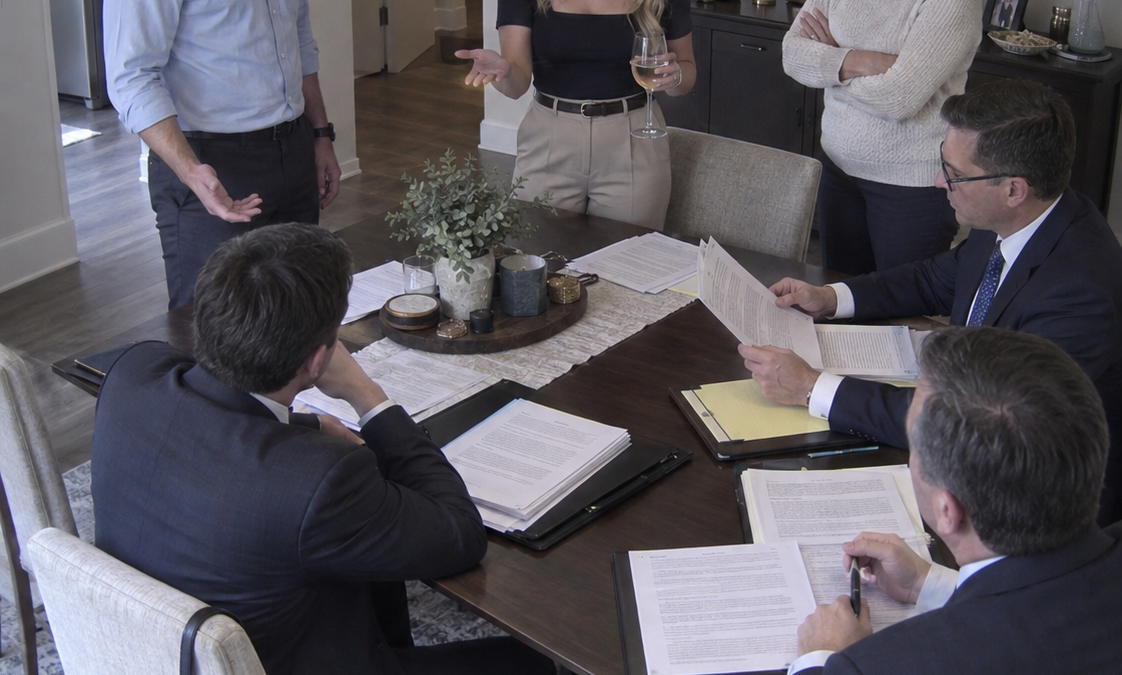
The moment I stepped into her apartment, I knew I’d made a mistake, because it wasn’t just us. Three men in suits were already seated at the table, each with a stack of paperwork.
Morgan walked out of the kitchen holding a glass of wine, wearing that same sweet smile she always used when she was about to light someone’s world on fire. She raised her glass and said, “Welcome, Justin. Let’s talk options.”
And that was the beginning of the end.
I stood there in the doorway, not moving. Something about the scene—the three men in tailored suits, the documents spread out like a contract negotiation, and Morgan smiling like she was hosting a garden party—felt off. Very off.
My gut tightened. This wasn’t a super-chill dinner. This was a setup, and I was the only one who hadn’t received the memo.
“You all right, Justin?” Morgan asked sweetly, motioning to the seat across from the lawyers. “You look like you’ve seen a ghost.”
“Didn’t realize dinner now included legal counsel,” I said, not sitting down.
She laughed. “Oh, don’t be dramatic. It’s just a little paperwork. Go on, sit. You want red or white?”
“I’ll take answers,” I said flatly, my voice low.
That made her smile freeze for half a second. Just a flicker, but I caught it.
The tallest of the three men stood and extended a hand. “Mr. Collins, my name is Frederick Kaine. I represent your sister and her fiancé in a matter of financial arbitration. Please, if you’ll join us, I can walk you through the situation.”
“No need,” I said. “My sister already walked me through it at lunch. She wants money. I said no. End of story.”
Frederick didn’t flinch. “Respectfully, I believe you’ll want to see the documents.”
“And why would that be?” I asked, folding my arms.
Morgan let out a little sigh and took a sip of her wine. “Because you made a promise, Justin.”
“What promise?”
She turned to the lawyer and gestured. “Show him the agreement.”
Frederick opened a folder and slid a few sheets toward me. I stepped forward cautiously and glanced down. The heading read, “Binding Pledge of Familial Contribution.”
It was formatted like a contract, complete with my name, address, and a digital signature I’d never seen before. I narrowed my eyes.
“What is this?”
Morgan’s voice was syrupy sweet. “It’s the email you sent Mom two months ago, saying you’d help out with my wedding however you could. I had it printed, and we added some formatting for clarity. It’s been notarized.”
My jaw clenched. “You printed my email and turned it into a fake contract?”
“Not fake,” she snapped, suddenly dropping the cutesy act. “Legally persuasive. And if you don’t agree to honor it, we can escalate.”
I shook my head in disbelief. “Are you serious right now?”
Frederick stepped in again. “Mr. Collins, we’re not here to be adversarial. Our intention is to reach an amicable solution. Your sister has already made substantial nonrefundable payments based on the expectation of your financial support. She’s asking for follow-through.”
“She’s asking for extortion,” I snapped. “You don’t get to turn a vague good-faith offer into a $50,000 invoice.”
The second lawyer, a shorter guy with glasses, spoke up then. “We’re prepared to file a claim for promissory estoppel that includes potential damages and losses if she’s forced to downsize or cancel.”
I stared at Morgan. “You’re threatening a lawsuit over a wedding?”
She gave me a pitying look. “You left me no choice, Justin. This is my one special day. I’m not asking you to buy me a house or anything crazy. I just need your help, and you’re acting like I’m a criminal.”
“No, you’re acting like one,” I said, my voice low and tight. “You forged a contract and hired a legal team to trap me.”
There was a pause. Then Morgan shrugged, turning to the lawyers with a little grin.
“He always did like playing the victim.”
That was the moment something in me shifted.
I don’t know what exactly. Maybe it was the sheer gall of being ambushed like this. Maybe it was seeing the familiar smugness on her face, the same look she wore as a kid whenever she got away with something.
Whatever it was, the anger wasn’t loud. It was quiet, controlled, cold.
I picked up the fake contract, skimmed it again, then looked directly at Frederick.
“So, let me get this straight. Your case hinges on a casual email that said I’d help out?”
“Yes.”
“With no specific amount listed, no terms, no timeline?”
“Correct.”
“And you believe that would hold up in court?”
He didn’t answer, but the smirk on Morgan’s face said everything.
“I’m not signing anything,” I said calmly, placing the papers back down. “And if you send me anything else like this, I’ll file a harassment claim.”
Morgan’s smile returned, but this time it was icy.
“I figured you’d say that, which is why I brought backup.”
She turned toward the hallway and called out, “Mom, you can come in now.”
I blinked. “Wait, what?”
Footsteps. Then our mother stepped into the room, arms crossed, expression tight. Not angry, not sad, just disappointed. The kind of look that still hits you like a punch, even when you’re a grown man.
“Justin,” she said quietly. “This isn’t how we raised you.”
My mouth opened, but nothing came out.
“You promised to support your sister,” she went on. “We all did. Your father and I have put everything we could into this wedding. Maxed out credit cards, pulled from our retirement fund. And Morgan’s done everything she can to make this day beautiful. Now you’re trying to back out over money.”
“I didn’t promise fifty grand,” I said, trying to stay calm. “That was never the deal.”
Mom shook her head slowly. “You make more than your father and I combined. This isn’t going to ruin you.”
“It’s not about that,” I snapped. “It’s the principle. You don’t ambush family with lawyers over an imaginary promise.”
Morgan sighed dramatically. “This is why I didn’t want to involve him. He always makes things so difficult.”
“I make things difficult?” I laughed bitterly. “You faked the contract, weaponized an email, and now you’re trying to shame me with Mom in the room like we’re back in high school.”
The third lawyer, who had been silent until now, finally spoke. “Mr. Collins, if I may—”
“You may not,” I said, my voice sharper than I intended. “This isn’t a legal matter. It’s a family one. Or at least it used to be.”
Mom stepped forward, placing a hand on my arm. “Please, Justin, just sign it. Let’s not turn this into a scandal.”
I stared at her hand, then met her eyes. “So that’s what this is about. Saving face.”
There was a long silence. No one moved.
Then Morgan leaned in, her voice soft and venomous, and whispered, “Sign it or I’ll ruin you.”
My eyes narrowed. “Excuse me?”
She didn’t blink. “I know things, Justin. I know about your real income, your real estate holdings, the trust, the business under your wife’s name. All of it.”
My stomach dropped.
Morgan smiled like a cat who had just caught a canary. “Did you really think I wouldn’t find out? You’ve been hiding behind that humble accountant act for years, but I talk to people. I made calls. You’ve got enough skeletons in your financial closet to bury you if I go public.”
And there it was.
Not a request, not even a demand. A full-blown threat.
I stood still for a long moment. My heart pounded, not from fear, but from fury. Controlled, cold, familiar.
I took a deep breath. “Okay.”
Morgan blinked. “Okay, what?”
I walked toward the door, my hand already reaching for my phone. “I’m calling my lawyer.”
She laughed. “What? To fight back?”
“No,” I said calmly. “To bring my wife.”
For the first time all evening, Morgan looked confused.
“Your wife?”
I opened the door. “She’ll explain everything.”
And just as I stepped into the hallway, a soft voice behind me said, “Actually, I’m already here.”
Morgan turned around, and her jaw dropped.
Because standing behind her, holding her own folder of documents and wearing a blazer that screamed federal-level authority, was the woman I’d married in secret two years ago.
She gave Morgan a nod and said, “Let’s talk options.”
And just like that, everything changed.
Have you ever watched someone’s world tilt in real time? Like a painting that slowly starts to slide off the wall, except they can’t stop it, and they realize too late that what’s crashing isn’t the painting but the wall itself?
That was Morgan.
Her smirk disappeared so fast it looked like it had been yanked off her face with a hook. She took one step back, wineglass still clutched in her hand, blinking like she wasn’t sure if she was awake.
My wife stepped into the room, calm as a surgeon before a procedure.
Her name is Vanessa, and I’ll say this: she doesn’t raise her voice. She doesn’t gloat. She doesn’t threaten. She documents, and she prepares.
We’d met six years ago when she was doing forensic accounting for a firm that audited one of the companies I’d quietly invested in. One conversation turned into two. Two turned into coffee, and coffee turned into a bond that wasn’t based on grand gestures or fireworks. It was built on mutual respect and private trust.
Vanessa is sharp, meticulous, and maybe the only person who fully understands what I do.
When we got married at a courthouse two years ago, we didn’t tell my family. It wasn’t secrecy. It was strategy. I knew how my family operated, Morgan especially. The less they knew, the less they could use.
Vanessa agreed.
Now she was standing in front of Morgan, looking perfectly composed, as if this whole ambush had been on our calendar, not theirs.
“Vanessa?” my mom whispered, eyes wide. “You’re married to Justin?”
She nodded once.
“For two years?”
Mom’s hand shot to her chest like she’d just witnessed a crime. “Two years? You never told us!”
I finally stepped back into the room, letting the door swing shut behind me. “And based on today, you think we should have?”
Morgan’s mouth opened, then closed. Then she turned sharply toward the lawyers.
“What is she doing here?”
Vanessa ignored her and addressed the three men directly. “Which one of you prepared this document?”
Frederick, the lead lawyer, cleared his throat. “That would be me.”
“Good,” Vanessa said, flipping open her folder. “Because I’d like to know which jurisdiction you think allows a contract to be formed without offer, acceptance, consideration, or clear terms, and notarized off an email, no less.”
Frederick bristled. “Ma’am, this isn’t a formal courtroom. We’re here to mediate.”
“No. You’re here under false pretenses to pressure my husband into giving up a large sum of money under the threat of reputational damage. That’s coercion. Civil court would eat this alive. But you already knew that, didn’t you?”
Morgan’s cheeks were flushed now, her eyes darting between Vanessa and me like she was trying to recalculate a math problem that suddenly had more variables than she’d expected.
“Justin,” she snapped. “Why would you bring her into this?”
Vanessa turned to her slowly, without a trace of emotion. “Because you tried to threaten my husband with lies, forged documents, and implied blackmail. That makes it our problem.”
Morgan’s voice cracked. “You think you can just barge into my private meeting?”
Vanessa held up a hand. Not aggressively, not with anger, just a simple, precise movement.
“Enough.”
The room fell silent.
Then, in a quiet voice, she asked, “You said you’d ruin him. How?”
Morgan blinked. “Excuse me?”
“You told Justin you’d ruin him. What was your plan? Leak false financials? Pretend you know something you don’t? Try to discredit a man who’s legally protected by half a dozen privacy layers and multiple holding companies? Please, enlighten me.”
Morgan swallowed. Her façade was cracking fast.
“I was bluffing. It was just a scare tactic.”
“That’s not what you said five minutes ago.”
Mom finally spoke again, still frozen near the doorway. “Morgan, what is going on?”
Morgan rounded on her. “He’s the one hiding things, Mom! He’s been playing all of us for years. He let us believe he was just some quiet finance guy while he was sitting on God knows how much money. He let us go into debt for this wedding while he sat there with a paid-off house and some secret wife, like he’s better than all of us!”
I blinked, and that was the moment I saw it for what it was.
This wasn’t about money. Not really.
This was about control, about the illusion of hierarchy.
Morgan had always been the favorite, the chosen one, the daughter my parents built their lives around. And I was supposed to orbit her, to support, to clap, to fund her dreams without question.
The fact that I’d quietly built a successful life without her, without my family knowing, was the ultimate betrayal in her eyes. Not because it hurt her, but because it threatened her place at the top.
Vanessa stepped forward and placed a printed packet in front of Frederick.
“Here’s a summary of Justin’s financials, redacted for legal safety. Note the asset-protection clauses, the irrevocable trusts, and the offshore shields that make your little lawsuit inadvisable.”
Frederick picked it up with shaking fingers.
Vanessa turned to Morgan. “This was your last shot at manipulating him. You should have spent it better.”
Morgan’s eyes welled up, and for a split second, I thought she might actually apologize. Maybe the weight of what she’d tried to pull was finally sinking in.
But instead, she turned on me.
“You lied to me,” she spat. “You let me humiliate myself. You let me think I could count on you. And now you’re parading your lawyer wife in here like some gotcha moment.”
I stared at her, feeling something unfamiliar twist in my chest.
It wasn’t just betrayal. It was grief.
Grief for the idea of family I’d been clinging to for too long. Grief for the brother I’d tried to be.
“You never tried to count on me,” I said softly. “You tried to use me. And the moment I said no, you didn’t try to talk. You brought lawyers. You forged papers. You weaponized Mom.”
“I was desperate!” she shouted. “I deserve a beautiful wedding!”
“You deserve respect,” I said. “But you lost mine a long time ago.”
Then I turned to Mom. “And you. You let this happen. You backed her. You didn’t even ask me what was true. You just assumed I owed her something. Like I’m not your son. Like I’m just a resource.”
Mom looked like she wanted to argue, but nothing came out.
Maybe she finally realized that something had shifted. That the dynamic, the unspoken rule of Morgan first, wasn’t just breaking.
It had broken.
I stepped back toward the door and took Vanessa’s hand.
“We’re leaving.”
Morgan screamed behind me. Actually screamed.
“You’re going to regret this, Justin! I swear to God, you’ll regret this!”
Vanessa paused just long enough to glance over her shoulder and say, “You should stop making threats. We record everything.”
And then we walked out.
But it wasn’t over.
Because the next day, Morgan doubled down.
That night, I didn’t sleep. Vanessa and I sat at the kitchen table going through everything. We weren’t worried legally. We were covered six ways from Sunday. But emotionally, I was wrecked. Not in the loud, sobbing way. In the silent, hollow way that sneaks up on you when you realize a part of your life has been rotten for years, and you just didn’t want to admit it.
Then, around 10:00 a.m. the next morning, my phone started buzzing.
First a call from my aunt, then a cousin, then an old friend I hadn’t heard from in months. Vanessa checked her phone and went still.
“She posted something.”
My stomach turned.
Sure enough, Morgan had taken to Facebook, then Instagram, then LinkedIn, of all places. She wrote a carefully worded post about being emotionally devastated because her own brother had withdrawn his financial support days before the wedding. She painted herself as the victim of greed, implied I’d made a cruel promise, and backed out at the last second.
She never named me, but she didn’t have to. The implication was clear. The narrative was set. And the comments? Let’s just say people love a martyr.
Within an hour, I had messages flooding in. Some accusing, some pleading, some just confused.
But the worst part was that Mom commented on the post.
A simple heart emoji and, “You don’t deserve this. We love you.”
That was it. No defense, no context, just a public stamp of approval on Morgan’s smear campaign.
And right then, something inside me snapped.
No more protecting them. No more playing nice. I was done.
Vanessa looked at me from across the table and said, “Ready?”
I nodded once. “Let’s show them who they’re dealing with.”
I didn’t speak to anyone in my family for three days. Not because I was sulking. Not because I wanted to punish them. I just didn’t know what I’d say if I did.
Every time I picked up my phone and scrolled through the dozens, then hundreds, of messages, my chest tightened like a vise. Friends, old classmates, distant cousins, a neighbor I hadn’t spoken to in two years. All of them suddenly felt the need to weigh in.
Some asked for my side of the story, though most didn’t. They just assumed the worst. Because when a woman cries on social media and says her brother betrayed her days before her wedding, nobody thinks twice. They pick up their digital pitchforks and start swinging.
I wasn’t prepared for how lonely that felt.
I thought I was. I’ve always been a little removed from my family. Not cold, just distant. I’m not the type to call every Sunday or send “thinking of you” texts, but I was there when it counted.
I helped my parents with their taxes. I co-signed Morgan’s car loan years ago. I paid off a small mortgage for my uncle anonymously. I never asked for credit. I just did it.
And none of it mattered.
Not after Morgan’s post.
That carefully worded, manipulative little essay about how she’d been emotionally blindsided and financially abandoned by her only sibling. She never once mentioned the forged contract, the lawyers, or the threat. She just played it like a Hallmark movie gone wrong. The wronged bride, the evil brother, the heartbreak of a family torn apart by greed.
And the worst part was that my parents stood by it.
Not one call from Dad. Mom posted another photo of Morgan two days later, captioned, “My beautiful girl deserves the world. We’ve got your back.”
And I just sat there in my kitchen scrolling, not feeling angry anymore. Just numb.
I didn’t eat much that week.
Vanessa tried gently to get me to talk. She didn’t push, just made tea, left notes, and sat with me in the quiet. But I could feel it, this low hum of something building inside me. Not rage. Not yet. Just this cold, heavy ache in my chest that kept whispering that I wasn’t part of this family anymore.
Not really.
And maybe I never was.
On the fourth day, I went for a drive. Not anywhere in particular. I just got in the car and went. I think I ended up somewhere near the old baseball field where Morgan and I used to ride our bikes when we were kids, the place where we built mud castles in the rain and threw crab apples at the fence when we were bored.
I sat there staring at the empty grass and wondered when she’d changed.
Or maybe the better question was whether I’d ever known her at all.
I thought about the way she used to cry when she got caught cheating at board games, how she’d always make up these elaborate excuses, claiming she didn’t mean to move two spaces instead of one, then pout until someone let her win anyway.
And Mom always did.
“It’s just a game, Justin,” she’d say. “Let your sister feel special.”
I was eight years old the first time I realized that in our house, Morgan didn’t need to follow the rules. She just needed to cry.
And I didn’t cry. I never did.
That’s when the rules changed.
When I got home that evening, Vanessa was in the office printing something. She didn’t say much, just handed me a manila folder and kissed my cheek.
“Look through it when you’re ready.”
I sat at the dining table for a long time, the folder unopened, just listening to the distant hum of the printer still working. Eventually, I flipped it open.
It wasn’t revenge. Not yet.
It was protection.
Legal documentation, asset shielding, additional privacy locks on our financials, a new will, updated beneficiary lists, and a shell-company structure that would make it almost impossible for anyone to find out what we owned or how we owned it.
Vanessa didn’t just love me. She defended me, silently and efficiently. While I was unraveling, she’d been building a wall around our life, a quiet fortress.
That night, I finally broke the silence over dinner. Some kind of pasta she’d made, which I barely tasted.
“I don’t think I ever really had a sister,” I said.
Vanessa didn’t say anything.
“She always made me feel small. Like I was useful, but not seen. You know?”
“I know,” she said gently.
I nodded. “And my parents just let it happen, over and over.”
I looked at her then. “Do you think that’s my fault for not pushing back?”
She reached across the table and took my hand. “You didn’t fail them, Justin. They failed you.”
That was the first time I’d cried in years.
Not loud, not messy. I just sat there, head bowed, tears running into my pasta while Vanessa held my hand.
The next day, I woke up with a different kind of ache. Not the empty grief of being discarded. Something else.
Resolve.
I got dressed, made coffee, and sat down at my desk. I opened my laptop and pulled up old files I hadn’t touched in a while: contact sheets, ownership breakdowns, market assets, and the spreadsheet Vanessa and I called the fire list.
It was a running document of people, businesses, and situations that had ever crossed us unfairly. Most had been harmless. A bad partner, a shady vendor, a guy who’d tried to undercut me during a deal and ended up getting fined for insider trading.
I scrolled to the bottom and added a new name.
Morgan Elaine Collins.
Reason: Personal betrayal, attempted extortion, family manipulation.
Below it, I typed a note.
Do not engage emotionally. Only strategically.
Because here’s what Morgan never understood. I never wanted power, but I’d learned how to wield it quietly, efficiently, from the shadows.
While she begged for spotlights and applause, she thought that because I didn’t flaunt it, I didn’t have it.
And now she was going to find out exactly what I’d been building while she was trying on dresses and writing sob stories for Instagram.
Two nights later, I got an invitation in the mail. An actual printed envelope with gold trim and a fake wax seal.
Morgan’s wedding invitation.
The envelope was addressed to “Mr. Justin Collins and Guest, Financial Contributor and Brother of the Bride.”
That wasn’t a joke. That was actually on the envelope.
I stared at it for a long time. Vanessa walked up behind me, read it over my shoulder, and whispered, “Wow, she’s bold.”
I laughed. Not because it was funny, but because it was so insane I couldn’t do anything else.
“She’s still pretending I’m paying for it,” I muttered.
“Yep.”
“And she’s inviting me like this is all normal.”
“Yep.”
I held the card up, stared at the words, then dropped it into the trash.
Vanessa didn’t say anything. We both knew that wasn’t an invitation. It was a declaration.
Morgan was doubling down, still trying to control the narrative, still hoping I’d cave, show up, and smile for the cameras while pretending we were one big, happy family.
And as I stood there looking at that trash can, something inside me settled.
I wasn’t going to argue anymore. I wasn’t going to plead my side to people who didn’t care to hear it. I was going to act. Not out of rage, but out of clarity.
Because I finally saw my family for what it was: a hierarchy, a show, a set of unspoken rules where love was conditional and silence was expected.
And I wasn’t playing anymore.
But first, I needed to see something. One final conversation. One final chance.
So I called my dad.
He picked up after three rings, sounding tired. “Justin. Hey.”
There was a long pause.
“This about the wedding?”
I ignored that. “You busy?”
He sighed. “Your mom’s running errands. I’ve got an hour.”
“I’ll be there in thirty.”
I hung up, and I knew this was the moment I’d find out if anyone in that house had ever truly had my back.
What I didn’t know was that I was walking into the final betrayal.
My parents’ house hadn’t changed. Same chipped paint on the porch railing. Same wind chimes clinking by the screen door. Same faded mat that said Welcome in a cheerful font that hadn’t matched the energy inside that home in a long time.
But I noticed something new as I pulled into the driveway.
The other car.
Morgan’s.
Parked perfectly in the center of the space, like she owned the whole property.
It was a white BMW. The least I knew about it was that she’d whined about the monthly payments in a group chat before she’d kicked me out of it. Shiny, loud, way too expensive.
I stared at it for a second longer than I should have, then got out of my car and headed up the steps.
The door creaked open before I could even knock.
Dad stood there, arms folded. He looked tired, not just physically, but worn. His eyes didn’t light up. His face didn’t crack into a grin like it used to when I came home for a visit.
He looked like he didn’t want me there.
“Hey, Dad.”
“Hey.”
He stepped aside without a smile. “Come in.”
I walked past him into the same living room I’d grown up in. Same recliner, same wall clock, same framed photos of Morgan everywhere. School portraits, dance recitals, a giant canvas print from her college graduation party that I’d paid for and hadn’t been invited to speak at.
No photos of me.
Not one.
“Where’s Mom?” I asked, not because I missed her, but because I wanted to know how many people I’d be up against today.
“Downstairs,” he said. “She’s making a gift basket for Morgan’s rehearsal dinner. You came at a bad time.”
I sat down anyway.
“I didn’t come for her,” I said. “I came for you.”
He lowered himself into the recliner across from me with a groan.
“You want coffee or something?”
“No,” I said, then paused. “Actually, yeah, if you’re having one.”
He disappeared into the kitchen. I heard cupboards open, the soft hum of the old drip machine heating up. I sat there and waited. Waited for him to come back. Waited for the words.
I didn’t even know how to start.
When he returned with two mugs, he passed one to me and sat back in the recliner. No small talk, just silence.
I hated how awkward it was, so I dove in.
“I need to ask you something, Dad.”
He looked at me over the rim of his mug.
“If the roles were reversed,” I said, “if Morgan was the one who got ambushed, threatened, manipulated into signing a fake contract, what would you have done?”
He didn’t answer.
So I kept going.
“Would you have told her to suck it up, to stop being difficult? Or would you have burned the whole house down for her?”
Still nothing.
“I want to know why. That’s it. Why you stood by her. Why you let Mom go along with that post. Why you haven’t called me once since it all blew up. After everything I’ve done for this family, after all the things I never asked credit for.”
He set the mug down on the side table and leaned forward.
“Because you don’t need us,” he said.
That stunned me.
“What?”
“You don’t need us,” he repeated, his eyes tired but steady. “You never have. You’ve always been fine on your own. Got yourself through college, figured out your career, built your own life. Never asked for help, never complained. You just went your own way.”
I stared at him.
He sighed.
“Morgan needs us. Always has. She’s not built like you, Justin. She’s fragile, emotional. When she falls apart, she falls apart. And your mother, she can’t stand to see that. So we pick up the pieces. That’s how it’s always been.”
I felt my chest tighten.
“So you enable her.”
He didn’t deny it.
“You let her manipulate. You let her twist everything and lie and punish people. And you excuse it because she cries when she doesn’t get what she wants.”
His voice hardened. “You think parenting is black and white. You think it’s just picking sides.”
I stood.
“No. I think parenting is doing what’s right. Even when it’s hard. Even when your favorite messes up.”
That made him wince, so I kept going.
“I didn’t come here to beg for love. I came here to say goodbye.”
His eyes snapped up. “What?”
“I’m done, Dad. With all of it. The family events, the fake holidays, the dinners where no one asks how I’m doing unless it’s about taxes or wiring money. I’m out.”
He opened his mouth, but I raised a hand.
“I’m not angry. I’m just free. I see it now. I’ve been auditioning for approval that was never mine to earn, and I don’t need it anymore.”
He looked like he wanted to argue, but he didn’t.
He just sat back and let me walk out.
That was the day I stopped bleeding.
It wasn’t dramatic. I didn’t slam any doors. Didn’t scream or cry or demand apologies. I just left, and I started to live.
Really live.
No more forced calls. No more birthday parties where Morgan made a speech and I handed her the check afterward. No more being the ghost in the background of someone else’s movie.
Vanessa and I doubled down on our plans. We bought a second property in Colorado, somewhere quiet near the mountains. She set up her own consulting firm. I invested in a startup that helps small-business owners access affordable legal protection.
Something about that just felt right.
We built quietly, peacefully. But that didn’t mean I forgot. It just meant I stopped letting them write the story.
Morgan’s wedding came and went.
We didn’t attend, but I saw the photos. The guest list was packed with the kind of people who love being seen. Fringe influencers, pyramid-scheme representatives, college sorority alumni who were probably still paying off the trip.
I recognized a few faces, and I noticed one thing right away.
No mention of me.
Not one.
Not even a lie. Just erased.
But I knew what that meant. She was covering.
Because her entire narrative, that her brother had bailed at the last second and left her heartbroken, was built on me not showing up. If I’d been there, if there had been a photo, even a whisper of our presence, her story would fall apart.
So instead, she pretended I never existed.
Which honestly felt fair, because now she didn’t exist to me either.
Three weeks after the wedding, I got a call from a blocked number. I let it go to voicemail, then listened.
It was my mom.
Her voice was tight, cold, practiced.
“Justin, I don’t know what kind of sick point you were trying to make by skipping the wedding, but your sister was humiliated. People asked questions. People whispered. She cried. She couldn’t even enjoy her honeymoon. I hope you’re happy. Don’t bother calling back.”
That was the last message I ever received from her.
And I never did call back.
But here’s the thing about walking away. You can only do it cleanly if you’ve tied up your own loose ends.
So I spent the next few months making sure there were no strings left.
I moved every last account into structures Morgan couldn’t sniff out. Liquidated the trust she’d mentioned and restructured it into an entity with a board of three, none of whom were blood relatives. I sold off the holding company attached to my old family name and started a new one.
Quiet, sleek, tightly controlled.
Vanessa’s firm flourished. She took on clients who’d been burned by family business disputes, inheritance dramas, and prenups gone wrong. Our reputation grew. Not loud, but respected.
People knew us, not because we shouted, but because we listened. And when we acted, it was final.
Then one day, about six months after the wedding, I got an email.
Subject line: Urgent Help Needed.
“It’s Morgan.”
I nearly deleted it without reading, but something made me open it.
It was from Bryce, Morgan’s husband.
I stared at the name for a long moment. We’d barely spoken before. The guy had always seemed like a placeholder with expensive shoes, but his message was short.
“Hey, Justin. I don’t know who else to ask. I know there’s a lot of bad blood, and I’m sorry for that, but Morgan’s gotten us into something financially. It’s big, and I think we’re in serious trouble. Can you please call me?”
I didn’t reply. Not right away.
But I forwarded it to Vanessa.
She read it, closed the screen, then just said, “She’s slipping.”
And I nodded. Not because I was happy, but because I knew that was the beginning of the unraveling.
And this time, I wouldn’t be the one to catch her.
I didn’t reply to Bryce’s email for three days. Not out of pettiness, not even to let him sweat. I just needed time to think. I needed to decide what kind of man I wanted to be.
Because when someone betrays you publicly, deeply, and with every intention of making it hurt, it changes you. Not instantly, but like slow poison.
You start asking yourself questions you wouldn’t have dared to ask before.
What if I didn’t forgive?
What if I didn’t walk away this time?
What if I made them feel it?
For months, I’d told myself that walking away from Morgan, my parents, and the whole rotten family ecosystem was the revenge. That living well, privately and securely, was its own kind of justice.
And maybe it was, for a while.
But now they were bleeding, and they were coming back to me.
Not with apologies. Not with humility.
But with need.
So I made a decision.
I wouldn’t ignore the email. I’d reply. Not because I wanted to help, but because I wanted to see what happened when Morgan realized the person she’d tried to destroy held the last lifeline she’d ever get.
I waited until a Thursday evening, just past 7:00 p.m., then replied to Bryce with a single sentence.
“Let’s meet tomorrow, 9:00 a.m. Your office. Just you.”
I didn’t tell Vanessa right away. She had a client call that night with someone in Australia, and I didn’t want to distract her.
But when I woke up the next morning, I found a sticky note on my monitor.
Whatever you decide, I’m with you. —V.
She always knew.
Bryce’s office was in a high-rise downtown. Nothing fancy, just a mid-tier suite in a shared workspace hub. When I arrived, the receptionist looked startled when I said his name, like she wasn’t used to people asking for him directly.
He met me at the door himself, wearing the same panicked look I remembered from the few family functions we’d both suffered through.
“Justin,” he said, his voice tight, trying too hard to sound casual. “Thanks for coming.”
I didn’t shake his hand. I just followed him in.
He’d cleared the room. No assistants, no coffee, just a whiteboard with half-scrubbed numbers and a table with two chairs.
I took the one closest to the door.
He sat across from me, wringing his hands.
“I know this is weird,” he started. “And I’m sure you have every reason to hate us. Her especially. But I really need your help, and I thought maybe you’d hear me out.”
“I’m listening,” I said, cold and controlled.
He took a breath, then started unraveling.
Apparently, shortly after the wedding, Morgan had started a side business, some kind of wedding consultancy and influencer brand.
She called it Elegance by Morgan, which honestly sounded like a candle line from a gas station, but whatever.
The plan was simple. She leveraged the success of her own wedding, the one she pretended I’d paid for, to launch a luxury planning service targeting brides with six-figure budgets.
She hired a PR firm, bought followers, rented out a fake office for Instagram content, took on three clients, and made huge promises she couldn’t keep.
And then it got worse.
Because Morgan didn’t just overpromise. She took deposits.
Large ones.
And when her vendor contacts flaked because she never paid them, when deadlines passed and refunds were demanded, she did what Morgan always did.
She blamed someone else.
This time, Bryce.
“She told them I was handling the books,” he said, his voice breaking a little. “She CC’d me on emails with fake spreadsheets I’d never seen. Used my name on invoices. I didn’t even know until two of the clients sent me legal threats.”
I didn’t say anything. I just watched him squirm.
“She forged a business account in both our names,” he continued. “She listed me as a co-founder on the website. I didn’t even know we had a website until last week.”
I leaned forward.
“And now she’s gone,” he said quietly.
I blinked. “Gone?”
He nodded. “Vanished. Her phone’s off. She drained the joint account. About $62,000. My name’s on the paperwork. I’m liable.”
He looked up at me, desperate now.
“I know you don’t owe me anything, but you know how she works. You know what she’s capable of. I need help. Please.”
I let the silence stretch.
Then I said, “You married her.”
He looked like I’d punched him.
“I know,” he whispered.
“You had every opportunity to see who she was,” I continued. “You watched her lie to her clients, threaten her own brother, forge a contract, manipulate my mother, and you stayed.”
“I thought she’d change.”
“She never even pretended,” I said.
He went quiet, and I leaned back in my chair.
“I’m not bailing you out.”
His face fell.
“But I’ll give you something better.”
He blinked.
I reached into my briefcase, pulled out a slim file, and slid it across the table.
“What’s this?”
“Her paper trail,” I said. “All of it. Every fake vendor account, every offshore account she dipped into, every identity she’s used to file contracts. She left a mess behind when she tried to disappear. You just didn’t know where to look.”
He opened it and started skimming, his eyes widening with every page.
“I have more,” I added. “Emails, IP logs, video evidence. A signed NDA she forced one of her assistants to agree to, then screenshots of the same conversation she posted to Instagram, violating the terms.”
Bryce stared at the papers like they were radioactive.
“You can take this to court,” I said. “Clear your name. Prove she committed fraud. You’ll still take a hit. Your name’s on too much, but you won’t go to prison.”
His hands were shaking.
“Why are you doing this?” he asked.
And for the first time, I let myself smile.
“Because I’m not like her.”
Then I stood.
“I don’t want her life ruined. I just want it honest.”
And with that, I walked out.
The next day, Vanessa and I got breakfast at our favorite place, this little bakery that only opens before noon and doesn’t advertise. We sat by the window watching the light spill across the cobblestone street, sipping strong coffee and eating warm almond croissants.
“I gave Bryce the file,” I told her.
She didn’t look surprised. “How did it feel?”
“Strangely good.”
“You think he’ll do the right thing?”
I shrugged. “Doesn’t matter. The right information is in the right hands now. If he buries it, that’s on him. If he fights her, well, I’m not finished helping yet.”
She smiled, brushing crumbs from my sleeve. “So it begins.”
“Not yet,” I said. “This is still the setup.”
She raised an eyebrow. “And what’s the play?”
I leaned in.
“She stole sixty grand from three clients. That’s traceable. I gave Bryce enough to cover himself, but not enough to chase her. Not yet.”
“You’re baiting her,” she said.
“She needs money,” I said. “She’s arrogant, desperate, and out of options. Eventually, she’ll come back for more.”
Vanessa tapped her mug thoughtfully. “So you’re just waiting?”
I nodded. “When she resurfaces, she’ll try to tap an old well. She always does. That’s when I’ll know where she is. And once I do…”
I didn’t finish the sentence.
I didn’t need to.
Vanessa just reached across the table and touched my hand.
And in that moment, I knew that this time, when Morgan came knocking, I wouldn’t just be ready. I’d be waiting with receipts, with leverage, and with the kind of quiet power she never saw coming.
It took four months.
Four months of silence, of waiting, of pretending to move on while I knew deep in my gut that Morgan wasn’t gone.
People like her don’t disappear. They retreat. They regroup. And when they come back, they do it with a mask and a story and just enough fake vulnerability to make people forget how dangerous they really are.
I didn’t need to chase her. I just needed to wait.
And sure enough, one evening in late April, while Vanessa and I were cooking dinner in our new place in Colorado, her phone buzzed.
She looked at the screen, arched an eyebrow, and handed it to me.
Blocked number. No caller ID.
But the voicemail was unmistakably her.
“Hey, I know I’m probably the last person you want to hear from. I just… I’m in a weird place right now, and I’m trying to fix things. I know we left things messy, but I think we should talk. You’re still my brother, and I miss you. I hope you’re okay. Call me back, please.”
Vanessa muted the speaker.
“She’s fishing.”
“She’s broke,” I said calmly, stirring the pasta. “She ran out of bridges to burn.”
We didn’t reply.
Not yet.
But that night, I sat at my desk and pulled up a file I hadn’t touched in months.
Morgan_P3.psw.
I opened it, reviewed every line, and confirmed every contact was still valid.
When I finished, I sent one email. Just one.
To a friend named Laya.
Laya works in compliance at a well-known event venue chain, the kind that caters to high-end weddings, galas, and fundraisers. We’d helped her once when she’d gotten roped into a bad deal through her ex-fiancé.
Vanessa cleared the legal side. I handled the financial cleanup.
Laya owed us, and she pays her debts.
The very next day, Morgan reappeared online.
Subtle at first.
A fresh Instagram post. Grainy sunset. Vague quote: “Life is about rebuilding, not regretting.”
Then a new Facebook page.
Morgan Collins Events.
Logo in gold script. Luxury wedding planning with heart.
No mention of Elegance by Morgan. That name was dead. This was a rebrand.
She even listed a new LLC in Wyoming. Private registry, no address.
Clever, but not clever enough.
Because within a week, her real identity started bleeding through.
Client tags, hashtags, photos with her face, her voice in stories, her testimonials. All curated. All fake.
But I didn’t stop her.
Not yet.
I let it grow. Watched as she built the illusion again.
Three new clients, two venue partnerships, a fake pop-up workshop where she charged $400 per ticket and posted the same photo from three angles to make it look full.
All fluff. All mask.
Until she made her first mistake.
She applied to host an exclusive bridal expo in a building owned by a holding company I partially controlled through three layers of legal insulation.
The name on her application was Morgan Brightite.
New last name. No mention of the LLC’s history, no mention of her scandal. Just a curated pitch deck full of Pinterest quotes and fake revenue claims.
Laya flagged it immediately.
We approved the application and scheduled the date.
Because this time, I wanted the stage set perfectly.
The expo was a sleek affair. Open bar, ambient music, fairy lights strung through a vaulted ceiling. Dozens of vendors lined the room, each with brochures, samplers, and demo reels.
And in the center stood Morgan, wearing a white power blazer, her hair in soft curls, her voice hitting every fake note of polished confidence.
Vanessa and I didn’t go.
We didn’t need to.
Instead, we had someone else attend.
Her name was Tori.
A real bride. A real planner. One of Morgan’s real victims.
She was the one who’d emailed me quietly after the wedding meltdown, saying Morgan had vanished with her deposit and blocked her after promising a full luxury package.
Vanessa had worked with her behind the scenes, helping her get a partial refund from the venue that had blacklisted Morgan.
And when we asked if she’d be willing to show up and ask some questions, Tori didn’t hesitate.
She brought a friend with a camera.
Not a big one. Nothing obvious.
Just a little clip-on microphone and a lapel camera hidden inside her handbag.
The confrontation wasn’t dramatic.
It was quiet. Professional.
Tori walked up to Morgan’s booth, smiled politely, and said, “Hi, I’m Tori. I think we worked together last year.”
Morgan blinked, hesitated, then smiled like nothing had happened.
“Oh, right, Tori. So good to see you again.”
Tori nodded. “Yeah, I was just wondering what ever happened to Elegance by Morgan. That’s what your invoice said.”
Morgan froze for just a second.
“Oh, I rebranded,” she said, waving it off. “New direction.”
“And the deposits you collected?” Tori asked. “Did those rebrand too?”
People nearby started listening.
Just one or two.
Enough.
Morgan stiffened. “I’m sorry. What is this?”
Tori smiled. “Just making conversation. Or should we continue it somewhere else?”
Morgan backed up a step, then turned and walked away.
Not fast. Not loud.
She just vanished behind a curtain.
Tori didn’t follow.
She didn’t need to.
Because by then, the microphone had done its job.
The video hit three small industry blogs within a week.
No accusations. No threats.
Just a quiet little article titled, “Why Are So Many Brides Missing Refunds From Morgan Collins?”
The post linked to receipts, contracts, dates, photos, LLC registrations, and voicemails.
No commentary.
Just facts.
And people started talking.
Vendors pulled their contracts. Clients canceled bookings. Venues flagged her name in their CRM systems.
And then came the big one.
A California bridal magazine that had featured her in a “Top 10 Planners to Watch” spread issued a quiet retraction.
No drama. Just a note in the next issue.
“Correction: We are no longer affiliated with Morgan Collins or Morgan Brite Events.”
And Morgan vanished again.
This time for good.
But that wasn’t the real revenge.
That was just cleanup.
The real revenge was quieter.
A month after the expo collapsed, I flew back to the city for a meeting with a real estate development group.
Nothing dramatic. Just business.
On the way out of the hotel, I passed a woman holding a phone up to her face, pacing in the lobby in sweatpants and a hoodie, whisper-screaming into her microphone.
It took me a second to recognize her.
Morgan.
Pale. Hair pulled back. No makeup. No audience.
I didn’t stop walking, but I slowed just enough to hear a single line.
“I don’t have the money, okay? I’m trying. I just need more time.”
I kept going.
Didn’t turn. Didn’t look back.
Because that was the moment I knew it was done.
She would never recover. Not fully. Not in the same world she’d once ruled with filters and lies and forged documents.
Her reputation wasn’t ruined by scandal.
It was erased.
There was no one left to clap. No one left to believe her.
And the silence was louder than any courtroom.
Later that week, Vanessa and I sat on the balcony of our mountain home. The air was cool. The sky was clear. Our phones were off.
I told her about the hotel.
She didn’t say anything at first. She just sipped her tea, then asked, “Do you feel better?”
I thought about it, took a breath, and said, “No. I feel clean.”
Fallout never happens in one explosion.
It happens in echoes.
Tiny, creeping aftershocks that travel through everything you thought was stable, reshaping it piece by piece until the old version of your world is gone for good.
For me, it began with a phone call.
Not from Morgan.
Not from my parents.
From a lawyer.
A young man with a calm voice who introduced himself as representing Bryce Collins in a joint civil proceeding.
“We’re filing a case against Morgan Collins under her legal name,” he said. “Your sister. You’ve been listed as a potential witness for the defense. Given your previous experience with her conduct, would you be open to speaking with us?”
I leaned back in my chair, staring out the window at the mountains. Vanessa was on the porch reading something on her tablet.
“Has she been served?” I asked.
He hesitated.
“She has. Three counts of fraud, two of breach of contract, one of misrepresentation. There’s talk of a possible criminal referral, depending on how discovery goes.”
My throat felt dry, but my voice stayed level.
“You’ll have my cooperation.”
It’s strange how justice moves.
Not with drama. Not with fireworks.
Just quiet paperwork.
By the time I gave my deposition, Morgan had already been dropped by every vendor association she’d ever joined.
The so-called luxury planning scene is small, and reputation spreads faster than truth.
Even the ones who once defended her, claiming it was all a misunderstanding or that she’d been through a lot lately, eventually went silent.
Her clients were less forgiving.
Two filed small-claims suits. One went public on social media, and that clip made its way to a consumer-rights TikTok account with two million followers.
It was brutal.
Not because it was cruel, but because it was undeniable.
Receipts. Contracts. Messages.
Vanessa and I watched from our living room one night as it played.
The creator ended the video with, “When you build your life on lies, the bill always comes due.”
The clip got three million views.
Morgan deleted her accounts two days later.
Bryce called me a week after the deposition.
“Hey,” he said quietly. “It’s done.”
“How bad?”
“She settled,” he said. “No criminal charges, but she’s broke. She had to sell her car, her jewelry, everything. She’s moving back with your parents. They co-signed a debt agreement to keep her out of jail.”
I let the silence stretch.
“And you?”
“I’m free,” he said, his voice shaking a little. “Divorce finalized last week. I can finally sleep.”
“Good,” I said. “Start over.”
He exhaled.
“You know, I used to think she was just misunderstood. That she was acting out because of her upbringing or the pressure. But she’s like a magnet for chaos. She doesn’t survive unless someone else pays the bill.”
“Yeah,” I said quietly. “I know.”
He hesitated, then asked, “Do you ever think she’ll change?”
I thought about that for a long moment.
“No,” I said. “But I think we finally did.”
The next wave came from my parents.
It started small.
An email from Mom, written in that clipped, polite tone she uses when she’s embarrassed but won’t admit it.
“Justin, I know things have been tense. Your father and I are trying to help your sister through a difficult time. She’s made mistakes, but she’s still family. We’d like to talk if you’re open to it.”
No apology.
No acknowledgment.
Just expectation.
Vanessa read it over my shoulder and said, “You don’t owe them closure.”
“I know.”
But I replied anyway.
“I hope you and Dad are well. I wish you peace, but I’m done trying to fix something that never saw me as family unless I was useful. Take care.”
That was it.
No anger. No argument.
Just the truth.
A week later, Mom sent one more message.
“We’ll respect your decision. I hope someday we can start again.”
That someday never came.
And I didn’t wait for it.
Six months later, life looked different.
Vanessa’s firm had grown into a full-fledged consultancy. She hired two assistants and started speaking at conferences. She even landed a feature in a major business magazine, a spread titled The Women Fixing What Greed Breaks.
I invested in three new ventures.
One of them was a legal-tech startup that helped automate fraud reporting for small-business owners.
I didn’t announce anything publicly. Didn’t post a single update.
Just worked quietly.
Sometimes success doesn’t roar.
It hums.
Steady, strong, certain.
The last time I saw Morgan was almost a year later.
It was at a grocery store near the city. I’d flown back for a board meeting and stopped in for something quick. Coffee, snacks, a few essentials before heading to the hotel.
I turned a corner, and there she was.
Alone.
No makeup.
Wearing an old hoodie that hung off her like a memory of a better time.
She didn’t see me at first.
She was arguing with a cashier about a declined card. Her voice was sharp, desperate, but not powerful anymore.
I stood there for a second, watching.
And in that moment, I didn’t feel joy or pity or anger.
I just felt done.
She looked up, and for a flicker, our eyes met.
Her expression shifted.
Shock, then something else.
Shame, maybe.
Or recognition.
She opened her mouth like she wanted to say something, but I just nodded once.
Not cruelly.
Not kindly.
Just a nod.
And I walked away.
That was the last time I ever saw her.
I never heard from my parents again either. No calls, no cards, no holiday messages.
And that was okay.
Because sometimes peace isn’t about fixing things.
It’s about finally being fine with the silence that comes after.
Years later, I sat on our back porch with Vanessa, watching the sun dip behind the ridge.
We’d built a life far away from noise, a quiet, steady rhythm of work, laughter, and small, meaningful moments.
She looked up from her book and said, “You never told me what you said to her that day at the grocery store.”
I smiled. “That’s because I didn’t say anything.”
She tilted her head. “Would you have?”
I thought about it.
“Maybe once,” I said. “But not anymore. Some people mistake forgiveness for weakness. It’s not. It’s freedom. You just have to stop giving them space to live inside your head.”
She smiled softly.
“So, what do you call what you did, then? What was all of that?”
I took a long sip of my coffee, let the wind move through the trees, and said, “Accountability.”
She laughed quietly.
“And do you think she ever learned?”
I stared out at the horizon, the light fading, the mountains painted gold, and shook my head.
“No. But that was never the point. The point was, I finally did.”
A few weeks later, a letter arrived at our office address, addressed to me.
No return name.
Just familiar handwriting I hadn’t seen in years.
Inside was a single page.
It said, “I’m sorry. I never realized how much you carried for all of us until it was gone. I hope you’re happy. Mom.”
No mention of Morgan.
No request to reconnect.
Just that.
And somehow, that was enough.
I folded the paper carefully, slipped it into my desk drawer, and didn’t respond.
Because sometimes closure isn’t a conversation.
It’s a decision.
That night, I sat on the porch again, the stars stretching across the sky, the air thin and quiet.
Vanessa joined me, resting her head on my shoulder.
“Do you ever miss them?” she asked.
I thought for a moment.
“Sometimes,” I said. “But then I remember I didn’t lose them. I finally saw them.”
And for the first time in my life, that truth didn’t sting.
It felt like peace.
Real, solid, unshakable peace.
I turned to Vanessa, kissed her temple, and whispered the last thing I’d ever say about any of it. A quiet truth that had been years in the making. The only ending that ever really mattered.
“They taught me everything I needed to know about loyalty by breaking it.”
And with that, I finally let the past go for good.








