6 years ago, my brother stole the love of my life — the woman i was about to propose to. now, at our father’s funeral, he walked in holding her hand and said, “some guys just finish first.” i just smirked, turned to him, and said, “you still working that office job?” then my wife stepped out of the limo… and when he saw who she was, he nearly dropped her hand…
They moved in together three months later. I cut contact. I didn’t answer Drew’s texts, and I didn’t respond when Elise emailed me twice asking if we could talk sometime. I didn’t go to their engagement party, either, although Mom tried her hardest to guilt-trip me into attending.
“Family is family, Ryan,” she told me.
But all I heard was that my feelings didn’t matter nearly as much as keeping up appearances.
So I did what I’d always done. I shut down, got quiet, and focused on work. I poured everything I had into my career. I stopped checking social media. I built walls around myself so high that eventually even I couldn’t see over them. Somewhere inside those walls, I found peace, or at least something that looked enough like peace to get me through the day.
Then, last week, Dad died.
It wasn’t sudden. He’d been sick for a while, fighting lung cancer, and we all knew what was coming. But knowing something is going to happen doesn’t prepare you for the moment it actually does. The finality of that phone call hit me like a train. I hadn’t seen him in almost a year, but I still sat alone in my apartment and cried.
Meanwhile, Drew was posting pictures of Dad in his hospital bed, accompanied by long-winded captions about cherishing every moment and how honored he was to be his son.
I wanted to scream.
Drew, who hadn’t even visited Dad last Christmas. Drew, who only started showing up again when he discovered our father had a sizable life insurance policy.
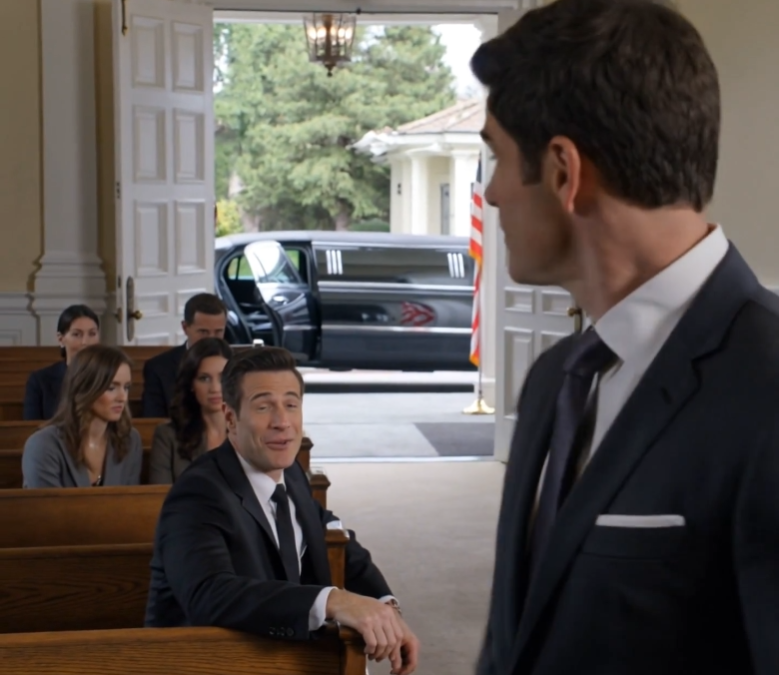
The funeral was last Saturday. Black suits, gray skies, and people I hadn’t seen in years whispering condolences into tissues. I arrived early and took a seat near the back of the church. I didn’t want attention. I didn’t want to make conversation with distant relatives or pretend everything was fine. I just wanted to say goodbye to my father.
But of course, that wasn’t part of Drew’s plan.
He walked in twenty minutes late, hand in hand with Elise. She was wearing black, but it was the kind of black that clung to her curves as though it had been stitched together with arrogance. Drew, meanwhile, looked like he was walking a red carpet instead of entering a church for his father’s funeral.
He spotted me almost immediately. I could feel his eyes scanning the room until they landed on mine, and that was when the familiar smirk spread across his face.
“Some guys just finish first,” he said as he passed me in the aisle, loud enough for everyone nearby to hear.
I didn’t flinch. I didn’t blink. I just smiled.
Then I asked, “You still working that office job?”
His smirk twitched ever so slightly. He hadn’t expected that response, and for one brief moment, I saw him struggle to come up with something clever.
But that wasn’t the real surprise.
Because just then, a sleek black limousine pulled up outside the church, and the passenger door opened.
My wife stepped out.
When Drew turned to see who had caught my attention, he saw her, and I swear he nearly dropped Elise’s hand.
The change in him was immediate. His chest, which had been puffed out like a peacock’s, seemed to deflate. His shoulders dropped slightly, and his jaw hung open just long enough for Elise to notice. She followed his gaze, confused, until her eyes landed on the woman approaching us.
Sabrina.
Elegant. Composed. The kind of woman who didn’t need to raise her voice to command a room.
She stepped away from the limousine in heels that clicked against the pavement like punctuation marks. She wore a tailored navy coat that stopped just above her knees, and a pair of sunglasses that couldn’t quite conceal the sharp focus in her eyes.
She wasn’t flashy. She was the kind of woman who made flashiness irrelevant.
Sabrina walked toward me with the same calm presence Elise once had, except now I understood the difference. Sabrina didn’t borrow grace from the people around her. She carried it within herself.
She reached for my hand and kissed my cheek. For a moment, I almost forgot where we were.
The air between us didn’t just shift. It felt as though the entire balance of power had changed.
Drew blinked like he’d just seen a ghost. Elise’s expression twisted, but it wasn’t quite jealousy. It was something worse.
Regret.
I could almost hear the gears turning in her head as Drew stared at my wife.
“Is that Sabrina Dwit?” he mouthed, barely making a sound.
Yep. The same Sabrina Dwit who had once appeared on the Forbes 30 Under 30 list. The same woman who spoke at three technology conferences a year, had built her own company from scratch, and counted nearly half the Fortune 500 among her clients.
And the same woman who, unlike Elise, had actually seen me for who I was.
Sabrina liked me when I was quiet. She didn’t need me to perform, compete, or prove myself worthy of standing beside her. With her, being myself had always been enough.
But I didn’t say any of that.
I simply turned back toward the altar with her hand in mine.
The ceremony began, and throughout the service, I could feel Drew’s eyes boring into the back of my head. I didn’t have to turn around to know he was unraveling. For the first time in our lives, I wasn’t trying to impress him, challenge him, or earn his approval. I wasn’t doing anything at all, and somehow that bothered him more than anything I could have said.
But that wasn’t the moment everything truly changed.
That came later, at the wake.
The reception was held at our parents’ old estate, a place that still smelled like burnt toast and disappointment to me. The house was crowded with mourners, and Drew was completely in his element. He shook hands, laughed too loudly, and told stories about Dad as though he’d been his devoted caretaker rather than someone who had stopped by once a month.
Elise stayed close to him, occasionally casting glances across the room at Sabrina and me.
At one point, I went into the kitchen to get a glass of water and found Mom standing at the stove, stirring something in a pot. She didn’t look up when I entered.
“I saw who you brought,” she said.
I waited.
She let out one of her deep, theatrical sighs.
“It’s just that this isn’t a competition, Ryan. It’s your father’s funeral.”
“I didn’t make it a competition,” I said calmly. “Drew did. Six years ago.”
She turned toward me, her eyes sharp, the spoon still in her hand.
“You’re still bitter about Elise? You were barely dating a year. And Drew loved her.”
I actually laughed.
“I was going to propose. You knew that.”
Mom waved the spoon dismissively, like she was batting away a fly.
“You weren’t ready. You never were. Always so cautious. So quiet. Drew goes after what he wants. Maybe you should have done the same.”
And just like that, I was twelve years old again, sitting at the dinner table while Drew got praised for making the soccer team and I got scolded for bringing home a B in math.
I was seventeen, watching Drew receive the keys to Dad’s car while I was told I wasn’t responsible enough to drive it yet.
I was twenty-five, listening to Mom tell me Elise had probably been more Drew’s type anyway when I first told her what had happened.
All those years, all those moments, all those little reminders that my brother was the standard against which I would always be measured came rushing back.
But I wasn’t twelve anymore. I wasn’t seventeen or twenty-five.
I was thirty-two, and I was done.
“Thanks for the advice,” I said.
Then I turned around and walked out of the kitchen.
Later that evening, as the sky grew darker and the crowd began to thin, Drew cornered me on the back porch. His sleeves were rolled up, and he held a glass of something dark in his hand. Scotch, probably. The same kind Dad used to drink.
He leaned against the railing beside me without speaking at first.
Then he finally asked, “You really married her?”
“Yeah,” I said, taking a sip of water.
“Crazy world.” He scoffed. “You always were lucky.”
I turned toward him.
“No. You always thought charm and shortcuts were the same thing as work. That’s not luck.”
He stared at me.
“Come on, Ryan. I mean, Sabrina Dwit? Really?”
I shrugged.
“She saw something in me, I guess.”
“Yeah,” he muttered bitterly. “Something with a lot of zeros in her bank account.”
And that was when it hit me.
Drew wasn’t shocked that Sabrina had married me because he thought I wasn’t good enough for her. He was angry because she represented something he could never reach.
Suddenly, standing there beside him, I realized that Elise no longer looked like the prize he’d spent six years showing off.
She looked like a consolation prize.
Drew opened his mouth as though he had something else to say, but before he could get the words out, Mom called from inside the house.
“Drew, the lawyer’s here.”
He straightened immediately, like a teenager being called to dinner.
Ah, yes. The will.
And that was when things really started to unravel.
Not for me. I’d already grieved my father. I’d already built a life that had nothing to do with winning my brother’s approval.
But Drew still believed he was the star of every story, and he had absolutely no idea what Dad had been planning over the past few years.
Before we reached the actual reading of the will, however, something else happened. Something small, but explosive.
Back inside the house, people were beginning to gather in the sitting room. I noticed Elise leaning close to Mom and whispering something in her ear. They both glanced in my direction before Mom turned toward me.
“Ryan, could I have a word? In private?”
I nodded and followed her into the hallway. She closed the door behind us.
“Elise is worried Sabrina might cause distractions,” she said. “She’s very high-profile, you know.”
I stared at her.
“You want her to leave?”
“Just for the reading. It’s family, Ryan.”
I almost laughed again, but this time there was nothing funny about it.
“You know,” I said slowly, “I used to think maybe you just didn’t understand how much your favoritism affected me. But now I see it clearly. You chose not to see it.”
“Ryan—”
“No,” I cut in, my voice calm and low. “You and Drew can have your little alliance. But Sabrina is my wife. She stays.”
Then I turned and walked away.
As I returned to the sitting room, I noticed the lawyer setting up at the front. He was a man in a navy blazer, carrying a worn briefcase that he placed carefully beside him. Drew was already seated in the front row with one arm around Elise, that familiar smug grin slowly creeping back across his face.
He had no idea what was coming.
The lawyer cleared his throat and opened a folder, drawing everyone’s attention. The room fell quiet, but a strange tension remained in the air, static and unspoken, almost ritualistic.
I looked around at faces I hadn’t seen in years. Most of them had aged. Some hadn’t changed at all.
Drew sat tall and confident, one leg crossed over the other, a drink in his hand. He looked like he was already calculating numbers in his head.
“I’d like to begin by thanking everyone for being here today,” the lawyer said in a dry, practiced voice. “Mr. Harold Whitmore’s final wishes were very clearly outlined in this document, which he updated one full year ago.”
At the mention of the will being updated, I noticed Drew stiffen ever so slightly. His fingers stopped moving against the rim of his glass.
“He asked that I read the following aloud.”
The lawyer removed a smaller sheet of paper from the folder and began reading a personal message Dad had left behind.
It wasn’t poetic. It wasn’t particularly warm. It was matter-of-fact, exactly the way Dad had always been.
“To my family, if you are hearing this, then I am gone. I have no illusions that I was perfect, and I know I left many things unsaid. But I want my last actions to speak clearly. I’ve spent the last year watching more carefully than most of you know. I’ve seen who showed up and who didn’t, who gave with no expectations, and who took with both hands. What I built will not go to waste. Not again.”
Several people shifted uncomfortably in their seats.
Mom blinked hard, pressing her lips together.
Drew, however, gave a tiny smirk, as though he thought Dad was talking about me.
I felt Sabrina’s hand settle gently over mine.
The lawyer placed the letter down and lifted the actual will.
“Let’s begin with the estate,” he said. “Mr. Whitmore’s residence, valued at approximately $2.1 million, will be transferred to…”
Drew leaned forward slightly.
“Ryan Whitmore.”
You could have heard a fork drop.
I didn’t move. I didn’t blink. My expression remained still, but inside, my heart skipped a beat. Not from joy, but from genuine shock.
Drew’s head jerked toward me.
“What?” he blurted.
The lawyer didn’t flinch.
“The primary residence, along with all its contents, belongs solely to Mr. Ryan Whitmore.”
“That has to be a mistake,” Mom interrupted, her voice rising. “Harold promised Drew the house years ago.”
“There was a previous version of the will,” the lawyer confirmed, “but it was legally nullified and replaced. This version is final and notarized.”
Drew shot to his feet, knocking over his glass.
“This is ridiculous! Dad said… He told me…”
“Please sit down, Mr. Whitmore,” the lawyer interrupted, still perfectly calm.
Drew didn’t sit.
Instead, he turned toward me, his face flushed with anger. Elise reached for his arm, but he shook her off.
“What did you do, Ryan? What did you say to him?”
“Nothing,” I answered evenly. “Maybe he just saw things for what they were.”
But the biggest blow was still coming.
The lawyer continued down the list. There were stocks, bank accounts, and trust funds. Some went to me, some to charitable causes Dad had quietly supported over the years, and smaller portions went to members of our extended family.
Then the lawyer paused, looked down at the next page, and continued.
“As for the remaining family business assets, including Whitmore Logistics and its fifty-one percent majority shares, these have been placed in a private family trust controlled by…”
He paused again.
“Sabrina Whitmore.”
The entire room went still.
Even I was caught off guard.
Drew’s eyes widened.
“What? Her? Are you kidding me? She’s not even… She’s not family!”
“She is,” I said quietly. “She’s my wife.”
The lawyer looked up.
“Mr. Harold Whitmore explicitly stated that he admired Mrs. Whitmore’s business acumen and her vision for long-term sustainability. The trust ensures voting control over the company remains in her hands. Mr. Drew Whitmore retains no shares.”
That was the knife.
But the next twist came from the person none of us expected.
Mom stood up so abruptly that several people turned toward her.
“Harold would never do that!” she snapped. “He would never give it to her. Not over his own son!”
The lawyer calmly unfolded another letter.
“Mrs. Whitmore, there’s a personal note addressed to you. Would you like me to read it?”
“I don’t care what it says!” she barked, her eyes burning.
The lawyer read it anyway.
“To Margaret, you’ve spent the better part of thirty years telling me which son deserved more. I let you. I thought I was avoiding conflict, but I saw how you treated Ryan after Elise left him. I saw how little you believed in him. I stayed quiet when you tried to push Drew into the company, but I’m done staying quiet. This company will go to the person who reminds me most of the man I once wanted to be. You may not like it. That’s your burden to carry now.”
Silence fell so completely that it felt as though someone had shut off all the sound in the room.
Mom opened her mouth, then closed it again.
Drew stood frozen, his hands trembling.
Beside him, Elise seemed to shrink into herself. Her eyes flicked nervously between everyone in the room, as though she wished she could disappear.
And then Drew snapped.
“You manipulated him!” he shouted, pointing at me. “This is some twisted game! You think you’ve won, huh? Because you married some rich woman and kissed up to Dad on his deathbed?”
I stood.
“I didn’t have to manipulate anyone,” I said. “I just showed up.”
Drew moved toward me, fast. Too fast.
But Sabrina stepped between us without hesitation, calm and firm.
“Don’t,” she said.
Just one word.
But the authority in her voice could have stopped traffic.
Drew glared at her, then at me. For the first time in years, I saw something in his eyes that I’d never seen before.
Fear.
Not fear of me or Sabrina, exactly, but fear of what he’d lost. Fear of realizing that something he’d spent his entire life believing belonged to him had never really been his at all.
He turned toward Elise, clearly expecting her to back him up, but she simply stared at the floor.
And that was when I knew he had nobody left to blame but himself.
Still, the real fallout hadn’t even begun.
Because as the room emptied and the lawyer began packing his briefcase, Sabrina leaned close and whispered something in my ear.
And when I heard what she said, I almost dropped her hand.
Sabrina didn’t raise her voice. She didn’t need to. Her words were like a scalpel, precise, quiet, and sharp enough to cut straight through everything I thought I’d finally put behind me.
“He tried to contact me,” she whispered.
I looked at her.
“Before the funeral. About a week ago. Through a mutual client.”
I didn’t react right away. I just kept my eyes on the half-empty room, watching Drew storm toward the garage like a man desperately searching for something to break.
My throat tightened.
“When?”
“Last Friday,” she said softly. “He asked our client to pass along his number to me. Said it was about a business proposal. I didn’t tell you because I wanted to see what kind of move he was making first.”
And now we knew.
Drew hadn’t just stolen the woman I loved six years earlier. He hadn’t just paraded her in front of me at our father’s funeral or mocked me with that smug little remark about finishing first.
He was still trying to sink his claws into everything I had.
Even after everything that had just happened, he was looking for another way in.
And the worst part was that it still hurt.
I’d thought I was past it. I’d thought marrying Sabrina, rebuilding my life, and watching Drew’s smug smile finally crumble would somehow be enough to make the old wounds disappear.
But it wasn’t.
Because somewhere deep down, a part of me still wanted a brother.
I still wanted someone I could call when life got difficult, someone who remembered the same childhood I did and understood where we came from. And I still wanted my mother to look at me just once without measuring me against the shadow she’d spent a lifetime building around Drew.
Later that night, I found myself standing in my old childhood bedroom.
It was empty now, stripped down to four beige walls and a small desk. The posters and trophies were long gone. There was still an old carving in one corner of the desk, something I’d probably scratched there when I was thirteen, back when I still believed love was permanent and families were forever.
Sabrina had stepped outside to take a phone call. I’d told her I needed a little time alone.
That was when I noticed an old photograph sitting on the shelf above the desk.
It was faded and bent around the edges. Drew and I were in high school, standing together during some summer trip to the lake. We were shirtless and grinning at the camera, our arms thrown around each other’s shoulders like we actually had each other’s backs.
He had that same cocky smile.
And I looked like a kid who hadn’t yet learned how easily everything he trusted could be ripped away.
I sank into the old, creaking desk chair, rested my elbows on my knees, and rubbed both hands over my face.
All those years of trying to earn respect. All those years of trying to be the better man, trying to keep the bitterness from taking root inside me.
And here I was, sitting in the wreckage of a family that had never truly valued me.
A father who finally came around when it was almost too late. A mother who still thought of me as the backup plan. A brother who saw me as little more than a stepping stone on his way to whatever he wanted next.
I didn’t cry.
Not this time.
But I felt hollow, and I hated that some part of me still cared.
When Sabrina came back inside, she didn’t say anything. She simply placed one hand on my shoulder and stood beside me in silence. I reached up, took her hand, and threaded my fingers through hers.
“I don’t want to fight them,” I murmured. “Not anymore.”
“You don’t have to,” she said.
“But I also can’t keep letting them rewrite the story. I can’t let Drew turn this into another version where I’m the villain who stole his life.”
“Then don’t,” Sabrina replied simply. “Tell the truth. In your way, on your terms.”
Her words stayed with me long after she left the room.
That night, I stayed awake, wandering through the halls of the estate. Every corner held a memory. Some were good, some were painful, and some were things I hadn’t thought about in years.
Around two in the morning, I found myself in Dad’s study, going through a collection of his old journals and notes. He’d never been much of a writer, but he kept records of almost everything. There were letters he’d never sent, budget notes, and printed copies of old email exchanges with our family lawyer.
In one of those emails, I found a sentence that stopped me cold.
“Ryan’s not loud, but he’s solid. I don’t say it enough, but he’s who I’d want in charge if it all came down.”
I read it again.
Then again.
I didn’t know whether to feel proud or angry.
Why had Dad never said those words to me? Why had he spent so many years allowing Mom and Drew to treat me like an afterthought, only to finally find his voice through paperwork and lawyers after he was gone?
I sat with that question for a long time.
But somewhere beneath the sadness and frustration, that sentence lit something inside me.
Not rage. Not revenge.
Resolve.
I closed the folder, pulled out my phone, and began typing.
The next morning, I asked Sabrina to help me get a few things moving. I made calls, contacted the board of Whitmore Logistics, and started reviewing the company’s bylaws. I didn’t know exactly what I was building toward yet, but I knew one thing for certain.
I wasn’t going to sit back and watch Drew throw one last tantrum and try to burn everything down.
Because he would. I knew him too well to believe otherwise.
This wasn’t over for him. Not by a long shot.
But something had changed for me.
I wasn’t going to spend the rest of my life playing defense.
And if Drew wanted to test just how solid I really was, he would get his answer soon enough.
The shift didn’t happen overnight. Things like that never do. But over the next few weeks, something began to change, not just in the world around me, but inside me as well.
Sabrina and I returned to our home in Seattle, a peaceful house with wide windows and a quiet view of the Sound. It was the kind of place that felt as though it had nothing to prove.
I remember standing on the balcony our first evening back, watching the sunset dissolve across the water and feeling something I hadn’t experienced in a very long time.
Certainty.
Not certainty about what I would do next, but certainty about why I needed to do it.
Drew remained silent for about ten days after the reading of the will. No texts. No phone calls. Not even one of his dramatic social media rants.
I knew what that silence meant.
He was scrambling behind closed doors, probably contacting every connection, every lawyer, and every family friend he could think of, hoping to find a loophole or enough sympathy to rally people behind him.
He’d always believed confidence could fill the gaps where competence failed. Charm had been his favorite shortcut, and for most of his life, it had worked.
But now there were no easy shortcuts left. No Mom whispering in Dad’s ear on his behalf. No familiar family arrangement he could rely on to get what he wanted.
Meanwhile, I began the process of stepping into the role Dad had quietly prepared for me.
At first, I wasn’t even sure I wanted to keep the company. Whitmore Logistics had always been part of Dad’s world, and I had spent so much of my adult life trying to build something separate from it.
But Sabrina, ever the strategist, said something that stayed with me.
“You don’t have to wear your father’s shoes,” she told me. “Just walk the path he paved with your own stride.”
So that’s what I did.
Two weeks after the funeral, I flew down to meet with the Whitmore Logistics board. I expected skepticism, doubt, and perhaps even outright resistance.
Instead, I walked into a conference room full of gray suits and expectant faces.
The first thing the chairman said was, “You look just like your father when he was young.”
But I didn’t feel like Dad, and I didn’t want to pretend to be him.
I told them exactly that.
“I’m not here to make promises I can’t keep,” I began. “But I won’t coast on my name either. I want to understand what this company needs to survive the next ten years, not just the next quarter.”
At first, they nodded slowly and cautiously. Then I noticed something changing in their expressions. They were listening with genuine interest.
By the end of that two-hour meeting, half the board members were shaking my hand, and the other half were pulling me aside to quietly admit how relieved they were that Drew wouldn’t be involved.
Sabrina had been right.
Dad had left the infrastructure, but now it was mine to shape.
That same week, a small business podcast interviewed Sabrina about her newest acquisition. When the host asked about her husband, she didn’t hesitate.
“He’s the most disciplined person I’ve ever met,” she said with a smile. “He doesn’t talk much, but when he moves, things shift.”
It shouldn’t have meant as much to me as it did.
But hearing those words made something tighten in my chest.
For the first time, it felt as though someone was publicly acknowledging the version of me I’d always known existed beneath the quiet, beneath the years of being treated as second best.
The next month became a blur of meetings, plans, and small but meaningful victories.
We hired a new chief financial officer for Whitmore Logistics, a sharp woman named Natalie who had absolutely no tolerance for fluff and an extraordinary ability to spot inefficiencies other people missed.
I asked Sabrina to consult on operational strategy. She never overstepped or tried to take over. She was careful and respectful, offering her expertise while allowing me to lead.
And slowly, the numbers began to speak for themselves.
Revenue stabilized. Employee morale improved. Within six weeks, we negotiated two major contracts Dad’s team had been trying to land for years.
My inbox went from being largely ignored to overflowing with invitations. Business dinners, conferences, private equity discussions, opportunities that had never included me before were suddenly appearing almost every day.
But through it all, I stayed focused.
I stayed quiet.
Drew could make all the noise he wanted. I was too busy building a foundation.
Then, on a rainy Tuesday afternoon, my phone rang.
I was in the office with Natalie, going over restructuring plans. I almost let the call go to voicemail, but something made me answer.
It was Elise.
“Hey,” she said softly.
A long silence followed, the kind that happens when two people aren’t quite sure whether they’re strangers or still connected by something neither wants to name.
“I wasn’t sure you’d pick up,” she continued. “But I, um… I wanted to say congratulations.”
I waited.
She sighed.
“You know, Drew’s been difficult. He’s taking all of this pretty hard. He keeps saying you manipulated your dad somehow, or that Sabrina made you do it.”
“Did she?” I asked, keeping my voice calm.
“No,” Elise admitted. “He just… he can’t accept that you actually came out ahead. That you built something without playing dirty. It doesn’t fit his version of the story.”
That line stayed with me.
It doesn’t fit his version of the story.
Because that was what life had always been with Drew. A story where he was the hero, no matter how much wreckage he left behind. A story where he could take what he wanted, hurt whoever stood in his way, and still expect everyone to applaud him.
Now he was faced with a reality his carefully constructed narrative couldn’t explain.
A reality in which I hadn’t merely survived what he’d done to me.
I’d thrived.
Elise hesitated again before speaking in a quieter voice.
“Can I ask you something?”
I didn’t answer, but she took my silence as permission.
“Are you happy?”
I thought about that for a long moment.
I thought about Sabrina curled up on the couch at night with her tablet, humming softly while she worked. About our quiet mornings, the smell of fresh coffee, and those little glances we exchanged across the kitchen without needing to say anything.
I thought about the respect I was slowly earning from people who had once overlooked me. Respect that hadn’t been demanded or handed to me because of my last name, but earned through my own decisions and effort.
“Yes,” I finally said. “I am.”
Elise went quiet on the other end.
Then she whispered, “I’m sorry.”
“I know,” I said gently. “But that chapter’s closed.”
She didn’t argue. A moment later, the call ended.
When I looked up, Sabrina was standing in the doorway, holding two cups of coffee. She didn’t ask who I’d been talking to. She simply raised one eyebrow and offered me the extra cup.
I took it.
Life had shifted in ways that were subtle but complete.
I wasn’t waiting for someone to apologize anymore. I wasn’t keeping score against people who had hurt me. I was finally living the life I wanted instead of fighting to be recognized by people who had never bothered to look closely enough.
Still, I knew the calm wouldn’t last.
Because I had stepped fully into the life Drew believed should have belonged to him.
And somewhere out there, I knew he was planning his next move.
The only question was how far he would go this time.
It began with a single envelope.
There was no return address, no accompanying note, just my name written across the front in the kind of hurried handwriting that suggested someone had been angry or desperate when they picked up the pen.
I opened it at my desk the following morning. A light drizzle tapped against the office windows as Seattle slowly came to life below.
Inside was a folded stack of documents: photocopied emails, legal filings, and one printed text conversation.
At first, my heartbeat seemed to slow as I flipped through the pages.
Then it began to pick up again.
Drew had been trying to sell confidential Whitmore Logistics client data to one of our competitors.
It was small-time so far. Nothing appeared to have progressed beyond preliminary conversations, but the intent was right there in black and white.
The emails showed him offering inside information about contracts, weaknesses in vendor relationships, and even private performance metrics.
The deal hadn’t gone through yet.
But he’d tried.
And the worst part was that he hadn’t even been particularly clever about it.
He’d contacted an old acquaintance, someone he’d once bragged about defeating in high school debate competitions. That same man had eventually climbed the corporate ladder at one of our rival firms.
Apparently, unlike Drew, he still had a conscience.
He’d sent everything anonymously. He didn’t want to get personally involved, but he couldn’t ignore what Drew was attempting to do.
I leaned back in my chair and stared at the ceiling.
So this was it.
Drew hadn’t accepted the loss. He hadn’t decided to move forward with his own life or build something new.
He was trying to sabotage me, to poison the ground I was finally standing on.
Not because it would help him create something worthwhile. That would have required vision, discipline, and patience.
He simply wanted to watch me fall.
For several days, I didn’t tell anyone.
Not Sabrina. Not Natalie. Not the board.
Instead, I started gathering information.
I traced Drew’s communication patterns and used the cybersecurity skills I’d spent years developing to investigate where else he might have sent confidential material and what data could have been exposed.
During that process, I discovered something that made the situation even more serious.
Drew still had access credentials that should have been revoked when Dad died. Someone in our outdated IT department had overlooked them, leaving an opening into systems he should no longer have been able to reach.
I quietly closed that security gap.
No drama. No accusations. No warnings.
Just preparation.
Because if Drew intended to play dirty, I needed to be several moves ahead of him.
The following week, I flew to New York for a conference focused on technology and logistics. It was a strange combination to outsiders, but one that mattered enormously in our industry.
Sabrina was speaking on a panel, but I had another reason for attending.
I had arranged a meeting with a startup I’d been tracking for more than a year.
For some time, I’d been quietly considering expanding Whitmore Logistics into digital inventory automation, a field Dad had never really understood or taken seriously.
But the industry was changing.
Old business models were becoming obsolete, and the companies that failed to adapt were going to be left behind.
This startup was lean, smart, and hungry. Its team had developed something valuable, but it lacked the resources and established infrastructure needed to scale.
All they needed was the right partner.
I made them an offer.
It wasn’t public or flashy, but it was substantial enough to get their board’s attention.
If the deal went through, Whitmore Logistics wouldn’t merely survive the next chapter of the industry. It would have a chance to dominate several connected areas of the market.
There was one catch.
Before signing off, the startup required a complete internal audit for legal compliance.
That was standard practice in a transaction of this size, but for me, it created an opportunity.
An audit meant examining every file, every communication, every questionable access record, and every ghost hiding inside our systems.
And Drew’s fingerprints were all over things he clearly hoped nobody would ever discover.
The next day, I called Natalie into my office.
“I want to do a top-down systems audit,” I told her.
She frowned.
“You mean for the acquisition?”
“That’s part of it,” I said. “But I also want to know who still has legacy access to our confidential systems.”
Her eyes narrowed slightly.
“You think someone’s poking around?”
“Not yet,” I answered. “But I want to be ready if they do.”
She didn’t press me for more details.
By then, we’d worked together long enough that she trusted my judgment.
And then, almost as though fate had decided to align everything at once, another surprise landed on my desk.
Sabrina walked into my office later that afternoon wearing a smile I hadn’t seen in weeks.
It was the kind of smile that meant something had finally clicked into place.
“We found the missing link,” she said, dropping a thick binder onto my desk.
Inside were scanned documents relating to a piece of property we’d inherited. It was old development land Dad had purchased years earlier but never built on.
He’d always claimed the project was too risky.
But Sabrina had arranged a quiet land survey, and what she’d discovered changed everything.
The zoning regulations had shifted.
That land was now approved for commercial construction downtown.
It was a potential gold mine.
At the bottom of the folder was another document, an old contract signed between Dad and a company Drew had once tried to start.
Dad had never moved forward with the agreement. Instead, he’d quietly buried it.
He hadn’t trusted Drew to develop the property.
And now the land was mine.
“It’s shovel-ready,” Sabrina said. “And if you back it through Whitmore, you could double your valuation inside a year.”
My head swam as I considered the implications.
Everything was beginning to align.
Power. Leverage. Visibility.
The very things Drew had always believed belonged to him by birthright were now within my reach, not because I’d demanded them, but because I’d put in the work to understand what was possible.
He’d tried to break me six years earlier.
He’d tried to humiliate me at our father’s funeral.
And even after I finally found my footing, he’d tried to tear apart the foundation I’d built.
But he had no idea what was coming.
Because now I had more than money.
I had proof.
I had influence, a company standing behind me, a wife standing beside me, and a name Drew could no longer erase with a few well-placed lies.
I didn’t want revenge.
What I was preparing to show him was something far worse than anger.
Indifference.
And when I made my next move publicly, Drew would finally understand what it meant to lose something he’d never truly owned.
But first, I had one last thing to do.
Because Drew wasn’t going to stop until I made sure he couldn’t.
It was all about timing.
That was something Drew had never understood. He rushed everything. Relationships, business deals, even the decisions that eventually led to his own downfall. He’d always believed the fastest person in the room was the one who won.
But I’d spent the last six years learning how to wait, how to prepare, and how to sharpen my blade quietly while everyone else was still swinging wildly.
And now that blade was ready.
The internal audit finished ahead of schedule.
Natalie and her team delivered their findings on a Thursday morning, and I sat at my desk reading the report three times just to make absolutely certain I understood what I was looking at.
Drew’s unauthorized access had left a trail as clear as day.
There were downloads from internal reports, suspicious logins traced to a private IP address, and, worst of all, evidence that confidential bid information had been downloaded just days before we lost one of our largest contracts to a competitor.
That single lost contract had cost Whitmore Logistics nearly $4 million.
The board didn’t know the full extent of what had happened yet.
But they were about to.
I called a special executive meeting for Monday morning. Sabrina would be there, along with our compliance officer, the company attorney, and the entire board of directors.
And because company protocol required invitations to shareholders with a history of managerial involvement and stakes exceeding five percent, Drew would be there, too.
I made certain of it.
He arrived five minutes late, of course, wearing a suit that was too tight and an overconfident smirk, as though he believed he was walking into another casual meeting where he’d get to play the misunderstood genius.
Elise wasn’t with him.
I had a feeling she was finally starting to see the cracks in the image he’d spent years constructing.
“Didn’t think you’d miss the chance to look important,” Drew said as he dropped into a leather chair near the end of the conference table.
I didn’t respond.
I simply nodded to our lead attorney, signaling that he could begin.
The attorney cleared his throat and activated the presentation screen behind him. Across it appeared a title in large, clean letters: Security Breach Findings: Summary Report.
The room grew quiet as the findings were presented.
Timestamped access logs. Flagged IP addresses. Records showing suspicious activity that correlated with contracts we’d lost.
I watched the faces around the table.
At first, there was confusion. Then disbelief. Then a slow, unmistakable shift toward anger as everyone began to understand what they were seeing.
Drew remained still.
For a while, he didn’t even blink.
But the moment the attorney displayed screenshots of the emails, Drew’s emails offering Whitmore Logistics’ internal bid figures to a rival company, I saw his jaw tighten.
“This is absurd,” he finally said. “You really think I’d risk everything over that?”
The attorney answered without raising his voice.
“You didn’t just risk it. You executed it. We have digital verification, timestamps, and traces of downloads made using your legacy credentials.”
He glanced in my direction before continuing.
“Mr. Whitmore has already filed for a retroactive internal injunction, and given the evidence, we’re preparing to notify the state authorities.”
Drew laughed.
But the sound was thin and brittle, nothing like the confident laugh I’d heard from him my entire life.
“This is a setup.”
Natalie spoke next.
“You’re the only person who still had access through a blind credential link your father left behind. We caught it. You exploited it.”
Sabrina leaned forward slightly.
“And you thought you were going to sell off his company piece by piece while smiling at his funeral. You really don’t know how to build anything, do you?”
Drew’s face turned red.
“This is insane! You’re just trying to wipe me out of the family completely!”
That was when I finally spoke.
Calmly. Steadily.
“No, Drew. You did that to yourself. I’m just making it official.”
I slid a document across the conference table.
It was a formal cease-and-desist order drafted by our legal team, barring Drew from all Whitmore-owned properties, communications, and internal systems.
He was also being referred to state business regulators over potential corporate espionage and data theft charges.
The consequences were serious. Even if the case never resulted in prison time, the damage to his reputation could destroy his chances of building another business. Any future due diligence investigation would have a trail of documented misconduct to uncover.
Drew stared at the paper for several seconds.
Then he looked up at me.
“You think you’re the better man now?” he spat.
“No,” I said simply. “I’m just not the fool anymore.”
He stood, his shoulders rising and falling as he struggled to contain his anger.
“This isn’t over! You think this is the end? You’re still the same silent little ghost living in my shadow. No matter what you do—”
“Then maybe,” I interrupted gently, “it’s time you stop walking in front of the sun.”
He blinked, completely taken aback.
That was the last thing I said to my brother.
The board voted unanimously to sever all future association with Drew. Any remaining shares he held were subject to forfeiture under a misconduct clause Dad had added during his final update to the company’s governing documents.
And given what the audit had uncovered, the misconduct was as thoroughly documented as it could be.
By noon, Drew’s access had been revoked.
By nightfall, the press had gotten wind of the internal security breach and the swift action taken by Whitmore Logistics’ new leadership.
I declined to comment.
Sabrina issued a single-line statement.
“We protect what we build.”
Later, I heard that Drew had tried to arrange a meeting with one of our former competitors, only to be politely turned away.
He’d burned too many bridges.
And some of the bridges he still believed he could buy his way across were now owned by someone else.
Me.
In the days that followed, I didn’t celebrate.
I worked.
We signed the contracts with the startup, and our market value began to rise. Sabrina negotiated an investment partnership with a European firm, giving Whitmore Logistics a presence in three new countries.
I spent my days building the company, strengthening relationships, and making decisions that would matter long after the headlines disappeared.
I wasn’t interested in gloating.
I wasn’t chasing ghosts anymore.
But there was one final moment that made everything settle into place.
A letter arrived.
It was handwritten, a short message on lined paper, without an envelope.
“You got what you wanted. I hope it was worth it. —D.”
I read it once.
Then I folded the paper and tucked it into the back of my desk drawer without saying a word.
I had no interest in responding.
Drew wanted me to come down to his level. He wanted another argument, another confrontation, another opportunity to convince himself that we were still competing for the same things.
But I was already building something he couldn’t reach anymore.
And for the first time, he knew it.
The fallout came quickly.
A week after the board meeting, Drew’s name appeared on an industry blacklist. The startup circles he’d once spent so much time trying to impress began closing their doors to him.
I didn’t have to make a single phone call.
The documents we’d uncovered spoke louder than I ever could.
His LinkedIn profile went dark.
Elise moved out quietly, without any public drama. I learned about it because Sabrina received an automated change-of-address alert connected to one of the old shared properties Drew had attempted to funnel through their joint accounts.
Elise had moved back in with her sister across town.
I wasn’t surprised.
A month later, Mom called.
I stared at her name on my phone for a long time.
The screen continued blinking until the call finally went to voicemail.
I didn’t call her back.
She tried again the following day. This time, she left a message.
“Ryan, I don’t even know what to say. He’s devastated. You didn’t have to destroy him like that. He’s your brother.”
I listened to the recording and felt the familiar weight of disappointment settling over me.
No apology.
Not even the faintest acknowledgment of what Drew had done or how much damage he’d caused.
Just more excuses.
More blame.
More of the same story I’d been hearing since childhood, the one where Drew’s mistakes were unfortunate misunderstandings and my refusal to tolerate them somehow made me the problem.
I deleted the message without replying.
Three months passed.
Whitmore Logistics was thriving.
The acquisition had been finalized, and with Sabrina’s guidance, we rolled out a new digital logistics platform that reduced processing time by thirty-seven percent.
Our valuation doubled.
Forbes published a profile about me titled The Silent Sun Who Rebuilt an Empire.
I didn’t care much for the headline.
I’d never been particularly comfortable with attention, and seeing my face and name attached to that kind of public recognition still felt strange.
But the truth underneath the article mattered.
For the first time in my life, I was being seen.
Not because I’d screamed the loudest.
Not because I’d demanded that people respect me or spent years trying to convince them that I deserved a chance.
But because I’d stood firm, done the work, and refused to let someone else’s opinion determine what I could become.
As for Drew, he tried to start over.
He moved to a smaller city two states away and launched a consulting firm under a different name.
It didn’t last.
Word spread quickly, and people were unwilling to trust a man with a documented history of corporate theft and a reputation for burning bridges.
A few months later, one of our clients sent me a photograph.
Drew was sitting in a coworking space, hunched over a laptop, wearing the same jacket he’d worn to Dad’s funeral.
The same scowl was on his face.
He wasn’t building anything.
He was just trying to stay afloat.
I looked at the picture for a moment, then set my phone aside.
There was a time when seeing him like that would have given me a sense of satisfaction. After all the years he’d spent making me feel small, I might once have imagined his downfall would somehow make everything right.
But it didn’t.
I didn’t feel victorious.
I didn’t feel sorry for him, either.
I simply felt finished.
Mom stopped calling after that.
I think she finally understood that I wasn’t coming back.
Not to Sunday dinners where every conversation became another comparison. Not to birthdays where everyone pretended our family was perfectly normal. Not to the fantasy she’d spent so many years trying to preserve.
The version of me who accepted scraps of affection and called them love was gone.
And Elise?
I saw her once, entirely by accident, at a conference.
She was standing near the coffee booth, looking quiet and distant, almost as though she were somewhere else entirely.
Our eyes met.
She didn’t speak.
Neither did I.
But the sadness in her expression said more than any apology could have.
She hadn’t simply lost me.
She’d traded me.
And now, years later, the cost of that decision had finally caught up with her.
I didn’t approach her. I didn’t ask how she was doing or whether she regretted the choices she’d made.
There was nothing left to discuss.
That part of my life was over, and I had no desire to reopen it.
Later that night, back home in Seattle, I stood on the balcony with Sabrina, watching the city lights flicker beneath us.
The air was peaceful, and for once, my mind wasn’t racing through arguments I’d never had or conversations I wished had gone differently.
Sabrina stood beside me for a while before finally speaking.
“You know,” she said, “you never once raised your voice through all of this.”
I looked at her.
“Didn’t need to.”
She smiled and leaned her head against my shoulder.
“You didn’t just win,” she whispered. “You outgrew them.”
And she was right.
For the first time in my life, I didn’t feel like I was standing in anyone else’s shadow.
I wasn’t the younger brother desperately trying to catch up. I wasn’t the disappointing son waiting for someone to recognize his worth. I wasn’t the man who’d lost the woman he thought he was going to marry and spent years wondering what he’d done wrong.
I was simply myself.
I had a wife who loved me for who I was, a business I was proud to lead, and a future that belonged to me.
I’d spent so many years believing that one day I would finally earn the respect of the people who’d made me feel invisible.
But standing there with Sabrina, watching the city stretch out beneath us, I understood something I’d never truly understood before.
I didn’t need their permission to be happy.
I didn’t need their approval to succeed.
And I certainly didn’t need Drew to lose in order for me to have a life worth living.
For the first time, I was standing on solid ground.
My own ground.
And I’d built it from the ashes they left behind.
Some men fight for power.








